Money Weekend Digest: 13 April 2013

By MoneyMorning.com.au

Technology: Why I’m Throwing Away My Keyboard and Mouse

You’ll see a theme when it comes to technology. A merging of ‘immersive technologies’ devices linked with our physical activity and digital world. Google Glass, the MYO Armband and Microsoft’s Kinect are all examples.

One of the exciting new technologies at the moment is the Leap Motion controller. It’s a piece of tech (scheduled to ship soon) which allows three dimensional control of your computer.

So instead of using a mouse and keyboard to surf, scroll and click through the net, you could just reach into your computer with your hand. Imagine being able to grab the web page you want and flick it to one side. Or push a page back and drag another one forward.

Leap Motion

Source: Leap Motion

The actual technology is quite mysterious, so I can’t really say how it works. But Leap says it’s 100 times more accurate than Kinect. There’s a host of developers working on mind-blowing programs and apps for the Leap controller. Here’s an example of the Leap developers’ work.

PC’s and laptops are the main target for Leap. And work’s underway on reverse engineering it for phones and other devices. This means you could reach into your phone and the space around your phone to work your digital environment.

Like we’ve said before, the combination of motion sensing devices with wearable tech is coming. Think Google Glass plus Leap plus MYO…

It means we might see a new ‘reality’ where your digital world and your ‘normal’ world become one.

Note: I’ve pre-ordered a Leap and hope to get it in May. When it lands on my desk hopefully I can throw away my keyboard and mouse.

Health: Tracking Yourself Has More Benefit Than You Might Think

There’s a movement underway to help us live a healthier lifestyle using tracking information. It’s possible you’re already a part of it but don’t even know. It’s called the Quantified Self (QS) movement. It’s not some fancy catch tag to sell some gadgets and apps. It’s a real effort to make new technology and programs to help us be healthier, armed with our own information.

This is a concept multi-billion dollar companies like Nike and Adidas realise is catching on. They’re investing heavily in projects like Nike+, Nike Fuel and Adidas MiCoach. These are all technologies forming the QS movement.

At the core of QS is self-tracking. Another way to look at it is self-knowledge through numbers. It’s about using the flow of info through technology and apps to make better life choices.

Digifit, RunKeeper, SleepCycle and Mood Panda are all examples of different apps that track different parts of your lifestyle.

And the technologies and apps are getting more complex and comprehensive.

Take for example the Jawbone Up. You wear it on your wrist, and it links to an app on your phone. It tracks how far you travel, time spent sitting, standing, moving and calories burned. It helps log your food intake, moods and how you’re sleeping. The linked app collates all this information to give you your own personal lifestyle analytics.

Jawbone Up

Source: T3.com

There are some people that disagree with this level of information. They argue the app companies may use the info against you, or steal it. Sure, this is possible.

But think about this example: John is suffering from early stage congestive heart failure and is unaware of his condition. He may have warning signs which indicate his illness. But in his busy day to day life, he doesn’t see the warning signs. One day John has a sudden heart attack.

With QS apps and technology, it’s possible John may have already been alerted to the warning signs. He could have put treatment measure in place and avoided a heart attack.

The QS movement isn’t about gathering data to use and abuse, it’s about giving us the ability to make better life choices. It’s means hopefully we all get to live a happier, healthier life.

Energy: If You Don’t Eat Your Greens…They Might Power the House

There are different types of innovation across the energy sector such as solar, wind, nuclear, gas and hydrogen. We think it’s not one solution, but a combination that will help solve the world’s energy issues.

One way that doesn’t get much attention is food power. An amazing amount of food is wasted and thrown out every year. In Australia we throw away approximately 20% of all food we purchase. This infograph shows the staggering statistics.

But thanks to science and technology there’s a way to convert food into renewable power.

An example of food-to-energy power is happening at Colorado State University’s (CSU) Fort Collins campus. They are trying a new food-to-energy program with the city of Fort Collins.

The university realised they produce a large amount of food waste. This used to go to landfill. Well not any more. The university is diverting 1000 pounds a day of food waste to the city’s water reclamation plant. There it’s recycled and the methane by-product heats the plant and its building.

CSU aren’t the only ones using food-to-energy power. In Avonmouth, Bristol (UK) a food waste recycling plant opened late last year. It has the potential to power about 3,000 homes. Using the same process to create methane, the plant has capacity to produce about 10GWh of energy per year.

And there are more examples of this popping up around the world. Sweden has been doing it for years and Edinburgh has recently opened a plant.

Australia has also realised this is a real source of renewable energy. Veolia, Transpacific Industries and Earthpower Technologies have opened a food-waste to energy plant in Sydney.

The Sydney plant has the capacity to power around 3,600 homes. It’s the first of its kind in Australia, and also and a positive sign private industry is heading in the right direction with renewable energy. Now if only the government had the same foresight…

Sam Volkering
Technology Analyst, Money Weekend

Ed Note: Sam Volkering is assistant editor and analyst for a new breakthrough technology investment service to be launched by Money Morning editor Kris Sayce. The breakthrough technology service will introduce cutting edge investment ideas from the technologies of the future, including medicine, science, energy, mining, and more.

Join Money Morning on Google+

From the Archives…

Only Lunatics Need Apply for This Stock Market Rally
5-04-2013 – Kris Sayce

The Run-on Effect of Aussie Housing on the Australian Stock Market
4-04-2013 – Murray Dawes

Good News in China’s Economy? Put This Date in Your Diary…
3-04-2013 – Dr Alex Cowie

‘Gold Only Rises During the Bad Times’ and other Fairy Tales
2-04-2013 – Dr Alex Cowie


On Gold — Billionaire Investor Eric Sprott Says : ‘I’m in Alex Cowie’s Camp’

1-04-2013 – Dr. Alex Cowie

The Bubble in Paper Money

By Bill Bonner

US stocks are still going up. Gold is still dillydallying.

Gold is waiting to see what happens. Japan and the US are pumping up the monetary base – fast.
But collectively, their balance sheets actually contracted by $415
billion in the first quarter – led by a $370 billion decline in the
ECB’s balance sheet.

Result: slightly less paper money in the developed economies… and a slightly lower gold price. Seems logical. Seems sensible.

You see, since the start of the secular bull market in gold, there
has been a nearly perfect correlation between the gold price and the
rate of balance sheet expansion (aka money printing) at the Fed, the ECB, the Bank of England and the Bank of Japan.

You can see clearly it in this chart courtesy of our friends at the Sprott Group.

Central Bank Assets Vs. Gold Bullion
View Larger Image

According to Sprott, for every extra $1 trillion in collective
balance sheet expansion by these central banks, gold has risen $210 per
ounce.

Gold is the world’s alternative money. It and bitcoins. New supply of paper money is expanding rapidly. New supplies of gold and bitcoins are much more stable.

But many mainstream pundits are sure the end of the secular bull market in gold is at hand.

Who knows? Maybe they’re right.

But it seems more likely that when the Japanese get their presses running hot, the price of gold will resume its upward climb.

Like the Fed in the 1970s, central banks in the high-debt, low-growth
developed economies have decided that inflation is the solution to low
growth and high unemployment.

Unless something happens to stop them, they’ll probably keep
increasing the money supply. And the price of gold will continue to
correlate to the rate of increase in the monetary base of the developed
world’s major central banks.

Doing the Damnedest Things

But we’re still laughing at the Japanese… and at Ben Bernanke… and at economists and central bankers everywhere.

And at ourselves! We all do the damnedest things.

Remember the dot-com bubble? People thought they could rich by buying
companies with no earnings… no assets… and no business plan that
had ever been tested. They invested hundreds of billions of dollars in
these companies.

And when we pointed out to them at the time in our Daily Reckoning e-letter that the whole thing was loony, they said we “didn’t get it.”

As it turned out, we were happy not to get it.

And remember the US housing bubble? People thought they could get
rich by buying houses. They thought that some magic force was making
houses more and more valuable… and that all they had to do was to buy
the biggest, most expensive house they could afford and “flip” it for a
outsized profit.

Again, we didn’t get it. How could an inanimate object that needed
constant maintenance and attention increase your wealth? Houses were
consumer items, not capital investments.

And again, it turned out that not getting it was a big advantage.

So you’re probably wondering… what is it that we don’t get now?

We’ll tell you. We don’t get how printing money can make people
wealthier. It never did in the past. Instead, it just led to higher
inflation, bankruptcies, riots, revolutions… and disappointment.

Not that we have a closed mind about it. If someone could explain how
printing up pieces of paper makes us more prosperous, we’d be all for
it.

We’d want more of it. Heck, if one or two trillion new dollars or yen
or euro makes you wealthier, why not print up 10 quazillion?

Wait a minute. Didn’t Argentina try that in the 1980s? Didn’t Brazil give it a whirl in the 1990s… and Zimbabwe in the 2000s?

We don’t remember any of them getting richer. Instead, they got poorer.

So what’s the magic that Ben Bernanke and the Japanese have discovered? What’s the secret?

There may be one. Anything’s possible. But what is it?

Until we get a good answer… we’re going to keep laughing.

Regards,

Bill Bonner

Bill

http://www.billbonnersdiary.com/articles/bonner-money-inflation.html


Update on the Best Stocks of 2013

By The Sizemore Letter

Charles Sizemore and Jeff Reeves give their latest thoughts on their picks for the 2013 Best Stocks contest: Daimler ($DDAIF) and Intel ($INTC)

SUBSCRIBE to Sizemore Insights via e-mail today.

The post Update on the Best Stocks of 2013 appeared first on Sizemore Insights.

Are We a “Criminal” Element?

By Bill Bonner

Back in the USA, stocks rose again yesterday. The Dow finished up
128 points. Gold fell $25 per ounce yesterday… and everybody seems to
think it will be going down forever. (A word of caution: probably
not.)

Last week, we went to São Paulo, Brazil. There, too, we found taxi
drivers who knew a lot more about monetary crises than the typical US
economist. Said one:

I remember. I was just a kid. But my
father would call and tell us to run to the grocery store. He had just
been paid. We’d dash for the grocery story, meet him there and buy
everything we could. We spent every cent in just a few minutes.

Our friend was recalling what it was like in the late 1980s in
Brazil. The government had caused inflation… then hyperinflation.
Prices rose so fast that as soon as people got some cash they ran to
the grocery store to spend it.

Later, there was no point. In 1990, hyperinflation in Brazil reached
30,000%. What cost 1 real (the Brazilian currency) in 1980 cost 1
trillion in 1997. The hyperinflation wiped out the middle class… and
wiped the shelves clean.

“It’s hard to run a business when you don’t know what your money is
going to be worth,” said our friend. “Businesses tended to just stop.”

From Harare to Buenos Aires…

And here in Argentina, there came an announcement this week. The
government will freeze the price of gasoline for the next six months.

Price controls didn’t work for the Romans. They didn’t work for the
Germans. They didn’t work for the Zimbabweans… or any of the other
hundreds of governments that have tried them. But who knows? Maybe
they’ll work for the Argentines…

Or gasoline will begin to disappear from the filling stations.

But inflation is just getting started here. The rate is officially
about 10%. Unofficially, it’s about 30%. Officially, you can trade a
dollar for 5.4 pesos. Unofficially, you’d be a fool to do so. The black
market rate is eight pesos to the dollar — and more.

So what do we do? We stick with the “king of cash,” the US dollar.

Which explains why the dollar is so popular. Every time we come to
Argentina, we bring the maximum — $10,000 — in $100 bills. Then, when
we need to buy things, we trade our dollars on the black market.

Isn’t that illegal? We don’t know.

Criminal Cash?

We went to a money changer in Buenos Aires. At first, we couldn’t
find it; there are no big signs to tell you where it is. So we asked a
policeman for directions. Turned out, he was standing right in front of
the money-changing shop.

It may be illegal. But it’s certainly popular… and, apparently,
tolerated. If everyone were forced to use dollars and exchange them at
the official rate, the economy would probably collapse tomorrow.

Instead, there is a whole subterranean economy that functions on
dollars. Which explains this item in the US press, from former domestic
policy advisor to President Reagan Bruce Bartlett:

A new report from the Federal
Reserve Bank of San Francisco explains cash has not only held its own
against competitors but continues to grow in popularity. Measured in
dollar terms, there is 42% more cash in circulation today than five
years ago.

Many economists believe that the
rise in cash is strongly related to growth in the so-called underground
economy — criminal activity such as drug dealing, as well as tax
evasion by people working off the books for cash. Strong evidence for
this proposition comes from examining the distribution of cash holdings
by denomination.

Criminal? What’s he talking about? People are just trying to do
business in a world where you can’t trust the local paper money or the
people who control it.

Right now, many people trust the dollar more than their home currencies. So the foreigners suck up dollars created by the Fed.

The Great Money Migration

This explains why there is so little consumer price inflation in
America — even while the Fed aggressively increases the money supply.
They ship it overseas… in $100 bills. Bartlett continues:

As one can see, 84% of the increase
in cash since 1990 has been in the form of $100 bills, which have risen
to 77% of the value of cash outstanding in 2012 from 52% in 1990.

I seldom use $100 bills for anything except Christmas gifts to
nieces and nephews, nor do I ever see people use them in stores. I
suspect that most people have the same experience. For large purchases,
most law-abiding people use checks or credit cards.

Not here they don’t. They use stacks of $100 bills! In Argentina, even if you buy a fancy house, you come with a suitcase full of $100s. More Bartlett:

One consequence of the rising share
of US currency held abroad is that it may distort analyses of the
relationship between the money supply and economic activity.

Incidentally, exports of cash appear in the Commerce Department’s
data on international transactions (Line 67). It is recorded as an
increase in foreign-owned assets in the US but is better thought of as
an almost costless way of financing a good chunk of our current account
deficit. It’s like borrowing money from foreigners that most likely
will never have to be paid back, at zero interest.

We are proud to be a part of this great money migration…

But we fear the day when it comes home!

Regards,

Bill Bonner

Bill

To learn more about Bill visit his Google+ Page or Bill Bonner’s Diary


Pakistan leaves key rate on worries over FX reserves

By www.CentralBankNews.info     Pakistan’s central bank left its benchmark discount rate steady at 9.50 percent given the risks to the balance of payments position from low financial inflows and high debt payments that will continue to put pressure on foreign exchange reserves in coming months.
    The State Bank of Pakistan (SBP), which has held rates steady this year after cutting by 250 basis points in 2012, said foreign exchange reserves had declined to $6.7 billion as of April 5 from $8.7 billion at the end of January, mainly due to debt payments.
     Net capital and financial inflow of $34 million from July-February was insufficient to finance the external current account deficit of $700 million for the same period. 
    The SBP also has to retire another $838 million of IMF loans during the remainder of the current fiscal year, which ends June 30, “thus the pressure on foreign exchange reserves is likely to remain in the coming months,” the SBP said.
    Interest rates play a key role in this context, the SBP said, aiming to “discourage speculative demand for dollars by keeping rupee denominated assets sufficiently lucrative.”
    Pakistan’s headline inflation rate dropped to 6.6 percent in March from February’s 7.4 percent, the lowest rate since April 2004, while core inflation dropped to 8.4 percent, the lowest level since October 2009.
    The decline in inflation is mainly because the government has kept check on administered prices, such as electricity, gas and some transportation while muted private sector investment expenditure is also having a dampening effect on aggregate demand and thus inflation.
    However, the SBP questioned the sustainability of these government subsidies and the fiscal position, saying any overdue fiscal consultation effort can affect the level of subsidies and thus change the current low inflationary expectations.
    “A prudent approach would be to gradually reduce the subsidy burden together with a credible and reform oriented medium term fiscal program,” the SBP said. This would include tax reforms to increase the tax base.
    The SBP targets inflation of 9.5 percent for the current fiscal year 2012/13.

    www.CentralBankNews.info

Gold Heads for Third Straight Weekly Fall in “Thin Market”, Euro Leaders “Can Do No More” for Cyprus

London Gold Market Report
from Ben Traynor
BullionVault
Friday 12 April 2013, 07:30 EST

U.S. DOLLAR gold prices fell below $1550 an ounce Friday morning, though they remained above last week’s low, as stocks and commodities also fell and the Dollar strengthened, with Eurozone finance ministers set to discuss Cyprus, Ireland and Portugal today.

“Current momentum favors a test to the downside,” say technical analysts at Scotia Mocatta, “but we would not expect significant liquidation until a break of $1500.”

Analysts at Barclays Capital meantime say gold should hit support around last week’s low of $1540 an ounce, but ad that there is tough resistance around $1590.

“It’s a thin market,” one dealer in Singapore told newswire Reuters this morning.

“Buying is not exceptionally high from India. I would say there isn’t anything unusual yet.”

Gold in Sterling meantime fell to its lowest level this year on the spot market at £1006 an ounce, only just above its December low and close to its lowest level since July last year.

Gold in Euros dropped to €1185 an ounce, a two-month low and nearly 15% off its all-time high set last September.

Heading into the weekend, the Dollar gold price looked set for its third straight weekly drop, down 2% on where it closed last Friday, the steepest drop since February.

Silver meantime fell back below $27.50 an ounce, though it remained slightly up on the week by Friday lunchtime in London.

On the currency markets, the Euro fell against the Dollar this morning, handing back all of yesterday’s gains, amid fears that Cyprus’s bailout may not be large enough.

Germany’s government said Friday that the €10 billion figure for bailing out Cyprus is “not up for negotiation” following news that the country needs to find €23 billion to meet its financing needs over the next three years.

“We cannot do any more,” agreed Luxembourg finance minister Luc Frieden, attending today’s Eurogroup meeting of single currency finance ministers.

Eurogroup president Jeroen Dijsselbloem meantime said he was “very optimistic about helping Portugal and Ireland,” adding that an agreement will “hopefully” be reached to extend loans to those countries by seven years.

Dijsselbloem denied that the subject of bad loans in Slovenia’s banking sector was due to be discussed at the meeting.

Elsewhere in Europe, British prime minister David Cameron traveled to Berlin Friday to discuss European Union reform with German chancellor Angela Merkel.

The Bank of Japan meantime has taken “all necessary steps to achieve [its] 2% inflation [target] in two years,” BoJ governor Haruhiko Kuroda said Friday.

“But it’s not appropriate to limit our policy to two years…we will not hesitate to adjust policy in the future as the economy is like a living thing.”

The BoJ’s promise last week to spend $1.4 trillion of newly-created money on various assets “does not appear to have been bullish for Japanese gold demand” says a note from Credit Suisse this morning.

“Record prices of gold in yen have seen a marked increase in sales of both bars and scrap as investors realize gains…the BoJ’s efforts to displace Yen from JGBs [Japanese Government Bonds] and into other avenues are likely to exaggerate the global hunt for yield and real returns by Japanese individuals and institutions…we think it more likely that will be reflected in rising equity prices and falling bond yields abroad than in accelerating gold demand domestically.”

The Tokyo Stock Exchange suspended JGB futures trading Fridays following a sharp drop in prices.


Ben Traynor

BullionVault

Gold value calculator   |   Buy gold online at live prices


Editor of Gold News, the analysis and investment research site from world-leading gold ownership service BullionVault, Ben Traynor was formerly editor of the Fleet Street Letter, the UK’s longest-running investment letter. A Cambridge economics graduate, he is a professional writer and editor with a specialist interest in monetary economics. Ben can be found on Google+


(c) BullionVault 2013

Please Note: This article is to inform your thinking, not lead it. Only you can decide the best place for your money, and any decision you make will put your money at risk. Information or data included here may have already been overtaken by events – and must be verified elsewhere – should you choose to act on it.


Central Bank News Link List – Apr 12, 2013: IMF says ‘So far, so good’ in easing by central banks

By www.CentralBankNews.info

Here’s today’s Central Bank News link list, click through if you missed the previous link list. The list comprises news about central banks that is not covered by Central Bank News. The list is updated during the day with the latest developments so readers don’t miss any important news.

Friday Charts: Panic in Japan and Why Businesses Hate Government, Too

By WallStreetDaily.com

When Friday rolls around, we roll out the charts in the Wall Street Daily Nation.

After all, a picture is supposed to be worth a thousand words. So we figure, why not embrace it?

This week, we’re serving up some timely Japanese economic data.

We’re scoffing at all the bears. (Then we’re making sure we have good reason to be so brazen.)

And, last but not least, we’re revealing the single most encouraging data point we’ve seen all week.

Take a look and be sure to let us know what you think!

Buy, Buy, Japan?

Forget that the Nikkei 225 Index is up 23% over the last three months. (Can you say momentum?) Or that I was bullish on Japanese stocks way before it was cool.

The only “Japan talk” going on this week involves government bond yields.

They just experienced the “sharpest three-day steepening [spike]… since April 1995,” according to Nomura.

That has some folks fretting about a (gasp) default. But everyone needs to “simma down now.”

I know the spike was sudden and all. But yields didn’t break out into uncharted territory. In fact, they were much higher, relatively speaking, only a few weeks ago.

A Correction is Coming! A Correction is Coming!

The market is so, so, so overdue for a correction, right? Well, that’s what the talking heads keep telling us.

Riddle me this, though, Batman… Why isn’t anyone betting on it?!

The latest short interest report for the S&P 1500 Index reveals that bets against stock declines remain near all-time lows. The average short interest as a percentage of float checks in at 5.6%.

Now, the “smart money” has a pretty good track record of increasing their short bets ahead of stock market declines.

As you can see, short interest spiked ahead of the mid-year swoons in 2012 and 2011. And it shot to the moon leading up to the financial crisis.

So what gives this year?

Well, considering we’re so overdue for a correction, it must be that the smart money suddenly got stupid, right?

In all seriousness, I don’t have a crystal ball. But if a correction was so clearly in the cards, we should expect to see short interest creeping higher. And it’s not.

Sell in April and Go Away?

Now that I’ve chastised all the bears, I have a confession. I wouldn’t be surprised one bit if stocks took a breather soon. I mean, that’s exactly what they did right around this time last year.

Of course, they then proceeded to rally back in a big way. So bring on the déjà vu, Mr. Market! We can handle a brief selloff – followed by a monster rally. I promise that you’ll get no complaints here.

Good News for Earnings, Bad News for the Government

I’ve featured the NFIB Small Business Optimism Index here before. The latest reading reveals that Washington is still a major problem.

The good news is, only 17% of survey respondents cited poor sales as their biggest problem. Could it be that the economy is actually recovering? Say it ain’t so!

All kidding aside, that’s encouraging news in relation to the two metrics we talked about on Wednesday. It could point to a much better quarter for sales than anyone’s expecting.

That’s it for today. Before you sign off, though, do us a favor. Let us know what you think about this weekly column – or any of our recent work at Wall Street Daily – by sending an email to [email protected] or leaving a comment on our website.

Thanks, and enjoy the weekend!

Ahead of the tape,

Louis Basenese

Article By WallStreetDaily.com

Original Article: Friday Charts: Panic in Japan and Why Businesses Hate Government, Too

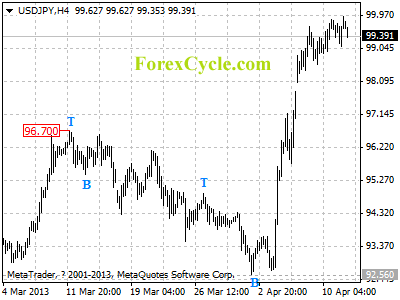
USDJPY’s upward movement extends to 99.94

USDJPY’s upward movement from 92.56 extends to as high as 99.94. Further rise is still possible, and next target would be at 101.00 area. Support is at 98.35, as long as this level holds, the uptrend will continue. However, a breakdown below 98.35 will suggest that a cycle top is being formed on 4-hour chart, then deeper decline to 97.50 to complete the consolidation could be seen.

usdjpy

Daily Forex Forecast

Singapore maintains policy band, sees higher H2 inflation

By www.CentralBankNews.info     Singapore’s central bank held its policy stance steady, saying the current “modest and gradual appreciation of the S$NEER policy band” is appropriate to contain inflationary pressures, anchor expectations and facilitate the restructuring of the economy toward sustainable growth.
    The Monetary Authority of Singapore (MAS), which targets the Singapore dollar against a basket of undisclosed foreign currencies rather than inflation, said the country’s economy should expand modestly in 2013 with a tight labor market exerting some upward pressure on core inflation in the latter half of this year as higher wage costs are passed through to consumers.
    In 2013 Singapore’s Gross Domestic Product is expected to expand by 1-3 percent, with growth gradually improving during the year on the back of a recovery in external demand.
    Consumer price inflation is forecast at 3-4 percent with average core inflation forecast at 1.5-2.5 percent, but rising moderately in the second half of the year through “persistent tightness in the labour market.”
    Singapore’s GDP shrank by 1.4 percent in the first quarter of 2013 from the fourth quarter, according estimates by the Ministry of Trade and Industry, following a quarterly rise of 3.3 percent in the fourth quarter.
    Singapore’s core inflation rate, which excludes private road transport and accommodation costs, eased to an annual rate of 1.5 percent in January-February from 2.0 percent in the fourth quarter and 2.4 percent in the third quarter of 2012, the MAS said, helped by favourable supply conditions in commodity markets and the impact of the currency’s appreciation.
    During the same period, the all-items inflation rate averaged 4.0 percent.
    For 2013, MAS is lowering its core inflation forecast to 1.5-2.5 percent from a previous forecast of 2.0-3.0 percent due to lower-than-expected price rises over the past few months, it said.
    The all-items inflation rate is forecast at 3-4 percent, down from a previous forecast of 3.5-4.5 percent.
    “The outlook for the world economy has improved since late last year, although uncertainties remain, particularly with regard to Europe,” MAS said, with economic recovery underpinned by the gradual pickup in the U.S. housing market and private demand, as well as fiscal stimulus in Japan.
    Economic activity in China should be sustained on the back of robust domestic demand and the rest of Asia will see continued moderate growth, giving a modest lift to the global IT industry following a contraction in 2012.
    Singapore’s manufacturing sector and export-oriented industries should improve gradually over the year with the economy’s level of output converging to its underlying potential and the labour market remaining a full employment, partially reflecting supply-side constraints, it said.
    MAS, which previously issued a monetary policy statement in October 2012, said the Singapore dollar’s nominal effective exchange rate (S$NEER) had fluctuated in the upper half of its policy band over the last six months with the broad-based decline in the Japanese yen leading to upward pressure.
    But this was countered by “bouts of domestic currency weakness” due to a strengthening of the U.S. dollar on speculation over an early exit from quantitative easing by the Federal Reserve and renewed uncertainty over the European debt crises, MAS said.
    Economists had expected the MAS to hold its policy stance steady.
    The MAS adjusts the rate of appreciation of the Singapore dollar against a basket of currencies by changing the slope, width and center of the trading band.

    www.CentralBankNews.info