Beware the ‘Safety Bubble’, But Don’t Sell Stocks Yet

By MoneyMorning.com.au

Safe investments are safe.

And risky investments are risky.

Sounds right…until it isn’t.

The chief investment officer of one of the world’s biggest funds management firms fears that the US stock market has built a ‘safety bubble’.

That is, the rush by investors to buy ‘safe’ assets has forced prices higher, making those assets overvalued and putting them in bubble territory.

It looks as though those Americans are at it again, creating another bubble. But they aren’t alone. The same game is playing out here. Here’s how to make sure the stock market doesn’t catch you out…

If you’re a long-time Money Morning reader you’ll know we have a simple asset allocation strategy.

We suggest you split your wealth into ‘safe money’ and ‘punting money’. The amount you allocate to each is up to you. It depends on your attitude to risk, the returns you’re after, and the risks you’re prepared to take.

If you’re a low risk investor and you’re not after big returns, you’ll have a bigger exposure to ‘safe money’ than you will to ‘punting money’.

To give you a rough idea of what we consider ‘safe money’, we put cash, term deposits, gold and silver, and dividend stocks into this category.

In the ‘punting money’ category we put growth stocks, other commodities, blue-chip growth stocks and small-cap stocks.

It’s an effective strategy. And it has worked pretty well over the past two years since we started talking about it. However, some of the biggest returns have come from the least likely source…

Safe Money Becoming Punting Money

Two years ago we rightly pointed out that it would be a tough time for growth stocks. We suggested that you only view growth stocks (blue-chip stocks and small-cap stocks) as ‘punting’ investments.

At the same time we told you to have a decent cash buffer and a good exposure to dividend paying stocks. Our belief was that if stocks didn’t go up then at least you would get better-than-the-bank cash dividends.

Owning dividend stocks was good advice. But not only for the reasons we had expected.

As it turned out you did get better-than-the-bank dividends, but you got something else you perhaps didn’t bank on — growth stock-style capital gains.

It’s these major gains that have Seth Masters, chief investment officer of Bernstein Global Wealth Management calling the rise in dividend stocks a ‘safety bubble’.

Masters told Bloomberg News:

‘Many stocks with high dividends don’t have growth potential. Their payout is their primary appeal. Utility stocks, for instance, [are perceived to] have safe dividends. So a lot of people are buying them.

Recently they were trading at a 50 percent premium to their historical average valuation. That’s their biggest premium ever.’

We know what he means. We’re looking to put some cash to work in the family retirement fund. Our initial thought was to put it in the stock market…into something safe…into a dividend stock.

But then we remembered that dividend stocks aren’t the safe stocks they used to be. Masters is right, there is something of a ‘safety bubble’ among Australian dividend stocks.

It’s not normal for a safe and boring food stock or bank stock to gain 50% in just over a year. That’s especially so when earnings have risen marginally, or in some cases fallen.

So, does that mean you should avoid dividend stocks altogether? If only investing was that easy…

Dividend Stocks are Still a Good Bet

In short, despite the threat of a ‘safety bubble’, we still believe it’s too early to sell stocks. That means you shouldn’t sell dividend stocks yet either.

We will give you one word of caution: although dividend stocks may not have shifted from ‘safe money’ to ‘punting money’, they aren’t the safe investment choice they were two years ago. So you need to be careful before you buy a dividend stock.

But we don’t want to put you off buying dividend stocks.

Last Friday we showed you a chart that compared Australian dividend yields with dividend yields on overseas stocks. Australian yields are about 70% higher than overseas stock yields.

That’s attractive to foreign investors.

The market has fallen in the past few weeks and so have the share prices of dividend stocks. That should give you the chance to buy dividend stocks at a cheaper price than three or four weeks ago.

Just be aware of the valid warning from Seth Masters. Most dividend stocks are low growth. That means you shouldn’t expect to make a killing on these stocks with capital growth.

But the combination of dividends and even modest capital growth makes income stocks a better over the next 12 months than cash, term deposits or other fixed interest investments.

If you’re happy to take on the higher risk, and you want a bit more than the returns you can get in a bank account or fixed interest investment, then dividend stocks are still a good bet.

Just remember that unlike cash, the value of shares can go down…that even goes for ‘safe’ dividend stocks.

Cheers,
Kris

Join me on Google+

PS. A new feature in Money Morning each day is Money Morning Premium. Each day we’ll take the theme from the main issue of Money Morning and turn it into an investable idea. To gain access to Money Morning Premium you just need to make a small change to your subscription. Click here to find out how…

From the Port Phillip Publishing Library

Special Report: TORRENT SIGNAL 3

Daily Reckoning: Why Europe’s Debt Crisis is Barely Getting Started

Money Morning: Rick Rule: You’re Either a Victim or a Contrarian

Pursuit of Happiness: Why the NBN is Dead Before it’s Begun

Australian Small-Cap Investigator:
How to Make Money From Small-Cap Stocks
The Euro’s Moment of Truth is Fast Approaching

By MoneyMorning.com.au

‘Nothing to see here. Move along.’

That was the message from European Central Bank (ECB) boss Mario Draghi at his press conference.

Draghi, clearly keen to draw a line under the Cyprus panic, argued that the eurozone would begin to bounce back within a few months. He gave only the vaguest hint that he might loosen monetary policy.

As a result, the euro has remained steady against other currencies. In fact, with Japan embarking on a money-printing spree, it’s even strengthened a little.

But don’t be fooled. The deal over Cyprus is already coming undone, and other countries look set to follow.

The time for Draghi to ‘put up or shut up’ on his promise to save the euro is fast approaching — and you don’t want to be holding the single currency when it does…

Cyprus Needs to Raise Another €6bn

Former German chancellor Helmut Kohl recently admitted that there is no way that Germany would have joined the single currency had there been a popular vote.

This is hardly a situation unique to Germany. The progress of the eurozone project has been one long sorry tale of voters being ignored and sidelined by ambitious political elites.

However, now that they’re in the euro, voters from Greece to Italy have backed away from the chance to exit the single currency. You can understand why. While quitting the euro might speed these countries’ recoveries in the longer run, savings and pensions would take a big hit.

But a turning point might be approaching. Cyprus is being asked for even more money to contribute to its own bailout.

Here’s a quick reminder of the story so far. Cyprus was thought to need around €17bn to bail out its banks and keep its sovereign debt at bearable levels. The troika (Europe and the International Monetary Fund (IMF)) were only willing to lend €10bn.

So Cyprus needed to raise the rest itself. And that’s why it ended up deciding to pinch a load of money from people with big deposits in its banks.

Trouble is, the Cypriot government made such a mess of organising this bank levy that lots of large depositors managed to get their money out of the country. Meanwhile, because of the damage to its banking sector, the Cypriot economy is expected to shrink severely in the next few years.

In all, this means the cost of the bailout has now risen to €23bn. And team IMF is not prepared to chip in any more money.

In other words, Cyprus has to find another €6bn. Nothing is out of bounds it seems, with the country potentially having to sell three-quarters of its gold reserves, valued at €400m, to help raise the money.

But that’s just €400m. Where’s the rest going to come from? ‘Depositors and bank bondholders’, that’s who, says Jonathan Loynes at Capital Economics. Given that Cyprus is already so tightly squeezed, it must be getting to the point where leaving the euro is no worse than staying within it.

And these aren’t problems that can be kicked down the road. Due to the revenue raised from tax being lower than previously thought, Cyprus will go bankrupt unless it gets an infusion of cash in less than a fortnight. It is by no means certain that a deal will be agreed before this happens.

The Cypriot Fear is Starting to Spread

Meanwhile savers and bondholders in other eurozone countries are starting to worry that they will suffer a similar fate to those in Cyprus. It’s a domino effect — with haircuts in one country leading to panic about another.

The fact that the troika has refused to step in automatically to protect banks is a big worry for small countries with outsized, or broken banking sectors. The latter group includes Estonia, Luxembourg and Slovakia. But the two most immediate concerns are Slovenia and Malta.

Most experts agree that Slovenia’s banks are a mess. Over one in seven loans are ‘non-performing’, (i.e., have little hope of being repaid). This means the government will either have to bail them out, or force depositors to take losses.

Combined with the deficit, a bailout could see Slovenia’s debt rise by at least 15% of GDP. Because of this, the yield on Slovenian bonds has begun to spike upwards by nearly 2% in the last fortnight alone.

Another problem case is Malta. Like Cyprus it has a huge banking sector (equivalent to seven times GDP). While some of this is due to banks using it for the purposes of moving money between their individual sub-groups, this still represents a substantial risk.

As Capital Economics points out, there are few bank bondholders to bear the brunt of any losses. This means that depositors could be hit if there is a crisis.

On top of all this, there’s the other significant problem that the eurozone economy is incredibly weak. GDP for the region is expected to shrink both this year and next. The larger countries are suffering too – France is expected to go into recession, while even Germany will stagnate.

It looks as though the ECB is going to be forced to follow Japan’s lead and boost the money supply aggressively. In other words, sooner or later, expect money-printing in the eurozone.

Matthew Partridge
Contributing Editor, Money Morning 

Publisher’s Note: This article first appeared in MoneyWeek

Join Money Morning on Google+

From the Archives…

Australia: The Home of World Beating Dividend Stocks
12-04-2013 – Kris Sayce

Investors: Ignore Japan’s Yen Devaluation Game
11-04-2013 – Murray Dawes

What Japan’s Economic Disaster Means for Australia
10-04-2013 – Dr. Alex Cowie

Gold Bulls About to Win the War
9-04-2013 – Dr. Alex Cowie

A Better Inflation Bet Than Gold…Stock Market Investing
8-04-2013 – Kris Sayce

An Odd Way to Play America’s Crumbling Roads

By MoneyMorning.com.au

I live in the Washington, DC, area, and the Capital Beltway — the vital road network of the region — is crumbling. ‘Under the surface of all but some recently restored segments,The Washington Post reports, ‘fissures are spreading, cracks are widening and the once-solid roadbed that carries about a quarter-million cars a day is turning to mush.

The 64-mile highway that rings the nation’s capital is nearing the end of its useful life. It may be too late to fix it already. Instead, it is time to rip it up and lay a brand-new roadbed from bare earth.

Besides this, road congestion is terrible and commuting times keep rising. (Fortunately, I work out of a home office. My commute is a flight of stairs.)

Crumbling America’s Roads

Of course, what’s happening here is a microcosm of what’s going on all over the US. The Beltway is, as the Post reports, ‘one roadway among the tens of thousands at the end of a long and fruitful life span.

You have undoubtedly heard by this point about the dilapidated state of American roads and bridges and the huge sums to fix them all.

And no, this isn’t a piece about investing in stocks that benefit from having to rebuild it all. Quite the opposite, actually. I don’t think the government ever makes the investments needed. For why, consider this quote from James O’Connor, author of The Fiscal Crisis of the State:

‘Transportation costs and hence the fiscal burden on the state are not only high but also continuously rising. It has become a standard complaint that the expansion of road transport facilities intensifies traffic congestion. The basic reason is that motor vehicle use is subsidized and thus the growth of the freeway and highway system leads to an increase in the demand for their use.’

This is simple economics. You subsidize something, people use more of it. In the case of the nation’s road systems, they are the progeny of tax dollars. Few who use the roads pay the full cost of their use — especially when you consider the costs of things such as pollution or even gasoline.

So the O’Connor thesis is that the more money the state dumps into roads, the more demand rises. The result is a never-ending spiral, except that demand rises faster than the ability of the state to pay for it. Hence, you reach a crisis at some point. O’Connor’s book came out in 1973, I should note — 40 years ago. This theme is one of those that took a long time to play out.

It seems we are close to that breaking point now, though. The road is so bad in parts that just laying new asphalt won’t do it. ‘The underbed is rotten,’ the Post writes, ‘so a fresh asphalt surface doesn’t last. As the surface gets rough, traffic slows and backups begin. When the surface needs more frequent repaving, traffic backs up.

In the past, I’ve pointed my readers to invest in road building. We owned, for example, Astec Industries for little more than a year in 2008–09. Astec makes equipment needed for road building.

We didn’t own it long because it didn’t take long to see that the needed investment dollars weren’t coming. Even today, you look at a five-year chart of that stock and you see it’s just been marking time and going nowhere.

So let’s forget about investing in infrastructure stocks. Doing so yields an investment thought process of an entirely different kind. It takes as its beginning that all these trends just get worse.

Americans will spend more time idling away in traffic. Congestion will continue to raise the cost of transporting goods. Costs to use this network will just go up and up. Thinking of it in this way, it signals a crisis for an old order and perhaps the birth of something new.

The New Trend to Back in the USA

The old order — namely corporate giants — benefitted tremendously from subsidized roads. What is Wal-Mart without the ability to send its cheap, China-imported crap across the country’s subsidized road networks? In fact, just about any business that depends on this infrastructure as part of a competitive cost advantage will find tougher competition than those that don’t.

The latter group would include locally sourced production that saves money on transportation costs. This is part of what’s contributing to the revival of American manufacturing and hurts China’s export model. Being near your market will be more important in the 21st century.

In the 20th century, the dominant trend of Corporate America was to get bigger. It was, as historian Robert Sobel described it, ‘the age of giant corporations.’ Scale and size were winning combinations.

In the 21st century, I think the winning formula will be a very different mix. States are broke and the infrastructure, not just the roads, disintegrates. Local businesses that serve local markets more efficiently than the big guys will be where you’ll want to put your money.

Chris Mayer
Contributing Editor, Money Morning

Join Money Morning on Google+

From the Archives…

Australia: The Home of World Beating Dividend Stocks
12-04-2013 – Kris Sayce

Investors: Ignore Japan’s Yen Devaluation Game
11-04-2013 – Murray Dawes

What Japan’s Economic Disaster Means for Australia
10-04-2013 – Dr. Alex Cowie

Gold Bulls About to Win the War
9-04-2013 – Dr. Alex Cowie

A Better Inflation Bet Than Gold…Stock Market Investing
8-04-2013 – Kris Sayce

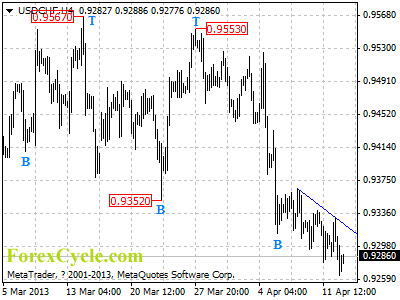
USDCHF remains in downtrend from 0.9553

USDCHF remains in downtrend from 0.9553, and the fall extends to as low as 0.9264. Resistance is located at the downward trend line on 4-hour chart, as long as the trend line resistance holds, the downtrend could be expected to continue, and next target would be at 0.9200 area. On the upside, a clear break above the trend line resistance will suggest that consolidation of the downtrend is underway, then further rally to 0.9400 area could be seen.

usdchf

Daily Forex Forecast

Time to Play Rising Natural Gas Prices

By Investment U

A recent Barron’s article was very positive about banks in 2013.

They expect healthy growth from capital markets, corporate lending and deposits. And the existing catalysts of housing and the labor market to continue to push earnings higher.

The article listed the EU and the US regulatory environment as the reasons for a recent slump in consumer confidence and the slowdown in bank stocks. But they are confident earnings growth will continue through the fourth quarter, supported by improving credit quality, loan growth, and better expense control.

The keys going forward, and where your focus should be to track this segment of the market, are the housing recovery and the improving jobs numbers. Both will run through to the banks and will drive their bottom lines.

The basket of stocks Barron’s listed are included below. The one that jumps out at me is PNC. It has shown up on at least five other recommended lists for the banking sector, and that deserves a little attention.

–      Bank of America (NYSE: BAC)

–      JP Morgan (NYSE: JPM)

–      Key Corp (NYSE: KEY)

–      Pac West Bancorp (NASDAQ: PACW)

–      PNC Financial (NYSE: PNC)

Natural Gas Prices are Surging… And Nobody Has Noticed

Next up, natural gas is quietly creeping up in price.

Gas prices are running up on much tighter than expected numbers for stored gas. The US Energy Administration reports that the stockpile was 2.1% below the five-year average.

Greg Troccoli, technician and co-founder of Chart LabPro.com stated in a recent The Wall Street Journal article that gas is up 15%  and no one is paying any attention.

The United States Natural Gas Fund (NYSE: UNG) was up 4.1% in one day of trading last week and other gas indexes are up 2% to 4%, as well.

A Goldman Sachs report stated that it sees prices going to $4.50 levels but are looking for about $4.25 this year. Gas prices broke through $4.15 early last week.

Goldman says the Street does not appreciate the significance of the fact that the gas storage surplus is gone and production is declining. Storage is actually showing a deficit through April 4 and there has been a two-month decline in production. And, Goldman expects a greater shift back to coal than previously estimated.

Natural gas is the fuel for the next 100 years. In fact, industry insiders are predicting gas will dominate transportation, electrical generation and manufacturing much sooner than anyone thinks possible.

The companies Goldman likes: Southwestern (NYSE: SWN), Cabot (NYSE: COG), Halliburton (NYSE: HAL), Basic Energy Services (NYSE: BAS), Nabors (NYSE: NBR) and NRG Energy (NYSE: NRG).

The ones I have seen on multiple gas lists are Halliburton, Nabors and Cabot.

Owning natural gas now is like buying into the oil boom of the early 20th century. It is a must for every portfolio.

[Note: Our friends at The Oxford Club have tipped us off to a natural gas stock they believe could triple by the end of the year. According to their sources, this company is about to make a major announcement that “will launch one of the most explosive stock run-ups in recent history.”

To see the full report, click here.]

Slap-In-The-Face Award: Beer Cheaper Than Water

This week the Award goes to the health minister in the Czech Republic who wants to make water cheaper than beer.

You heard me right; a glass of water in a pub in the Czech Republic is twice as expensive as beer.

The Czech Republic is the largest consumer of beer in the world and their beer-drinking heritage goes back to the 13th century.

They drink so much beer it is delivered to the pubs, not in kegs or cases, but delivered by tanker truck. The kind we use to deliver gasoline.

And they take this stuff really seriously.

There was actually a war fought over the right to brew beer and the patron saint of the country is also the patron saint of beer making, St Wenceslas.

I grew up in a coal mining town where there was a bar on every corner, and I thought we drank a lot of beer, but these folks are the real champs.

The health minister said he gives his efforts very little chance of success, but he will try again.

One pub owner was quoted as saying, “It really ticks me off. Beer is like mothers milk to us. The government should work on important things.”

Beer, half the price of water! Maybe it’s time for another trip to Prague.

Good Investing,

Steve

Article By Investment U

Original Article: Time to Play Rising Natural Gas Prices

Large FX Speculators slightly trimmed long positions in US Dollar last week

Commitment of Traders Weekly Data shows which way Large Traders and Hedge Funds were leaning last week in the Futures Market

By CountingPips.com


cot-values


The latest weekly Commitments of Traders (COT) report, released on Friday by the Commodity Futures Trading Commission (CFTC), showed that large futures traders slightly decreased their total bullish bets of the US dollar last week against the other major foreign currencies.

Non-commercial large futures traders, including hedge funds and large International Monetary Market speculators, registered an overall US dollar long position of $25 billion as of Tuesday April 9th. This was a decline from the total long position of $26.3 billion on April 2nd, according to position calculations by Reuters (US dollar positions against the total positions of eurofx, British pound, Japanese yen, Australian dollar, Canadian dollar and the Swiss franc).


Individual Currencies Large Speculators Positions in Futures:

The individual currency contracts quoted directly against the US dollar last week saw increases for the euro, Japanese yen, Swiss franc and the New Zealand dollar while the British pound sterling, Australian dollar, Mexican peso and the Canadian dollar all had a declining number of net contracts for the week.


Individual Currency Charts:

EuroFX: Weekly change of +14,843

eurofx

EuroFX: Large trader positions for the euro rose last week following three straight weeks of decline. Euro contracts improved to a total net position of -50,858 contracts in the data reported for April 9th following the previous week’s total of -65,701 net contracts on April 2nd. This is a change of +14,843 contracts from the previous week.


British Pound Sterling: Weekly change of -4,949

GBP

GBP: British pound spec positions declined last week after an increase the previous week. British pound speculative positions fell last week to a total of -69,969 net contracts on April 9th following a total of -65,020 net contracts reported for April 2nd. This was a weekly change of -4,949 in large trader contracts.

Pound speculator positions have been in a negative bearish position for nine consecutive weeks since crossing over on February 5th.


Japanese Yen: Weekly change of +474

JPY

JPY: Japanese yen net speculative contracts rose last week for a second consecutive week. Japanese yen positions increased to a total of -77,697 net contracts on April 9th following a total of -78,171 net short contracts on April 2nd. This is a weekly change of +474 positions.


Swiss Franc: Weekly change of +2,001

CHF

CHF: Swiss franc speculator positions improved last week for a second consecutive week although still remains in a bearish position. Net positions for the Swiss currency futures increased to a total of -10,014 contracts on April 9th following a total of -12,015 net contracts reported for April 2nd. This is a weekly change of +2,001  contracts.


Canadian Dollar: Weekly change of -6,589

CAD

CAD: Canadian dollar positions decreased last week for a second straight week and to a new low level in 2013. Canadian dollar positions decreased to a total of -71,133 contracts as of April 9th following a total of -64,544 net contracts that were reported for April 2nd.

This is a weekly change of -6,589 net contracts following a weekly change of -1,899 the previous week.


Australian Dollar: Weekly change of -6,092

AUD

AUD: The Australian dollar declined last week for a second consecutive week. Aussie speculative futures positions decreased to a total net amount of +77,879 contracts on April 9th after totaling +83,971 net contracts as of April 2nd. This is a weekly change of -6,092 in net positions following the previous week’s -1,544 change.


New Zealand Dollar: Weekly change of +6,763

NZD

NZD: New Zealand dollar speculator positions jump last week to rise for a third consecutive week to a new 2013 high level. NZD contracts rose to a total of +25,150 net long contracts as of April 9th following a total of +18,387 net long contracts on April 2nd. This constitutes a weekly change of +6,763 following the previous week’s change of +1,471 net contracts.


Mexican Peso: Weekly change of -213

MXN

MXN: Mexican peso speculative contracts dipped ever so slightly last week after rising for the previous two weeks. Peso positions decreased to a total of +142,542 net speculative positions as of April 9th following a total of +142,755 contracts that were reported for April 2nd. This is a weekly change in net large peso speculator positions of -213 contracts following the previous change of +14,593 contracts.


Additional Macro Financial Markets:

10 Year Treasuries: Weekly change of +10,087

10YR

10 Year Notes: 10-Year Treasury Note speculative contracts advanced higher last week to rise for a fourth consecutive week. 10-Year positions rose to a total of +120,779 net speculative positions as of April 9th following a total of +110,692 contracts that were reported for April 2nd. This is a weekly change in net large speculator positions of +10,087 contracts following the previous week’s change of +12,502 contracts.


Crude Oil Light Sweet: Weekly change of -25,452

CRUDE

Crude Oil: Crude Oil speculative contracts decreased last week after rising for the previous two weeks. Crude spec positions fell to a total of +223,398 net speculative positions as of April 9th following a total of +248,850 contracts that were reported for April 2nd. This is a weekly change in net large speculator positions of -25,452 contracts which is the largest weekly fall of 2013 so far.


Gold Futures CMX: Weekly change of -847

GOLD

Gold: Gold speculative contracts fell just slightly last week to decrease for a third straight week. Gold futures positions declined to a total of +119,359 net speculative positions as of April 9th following a total of +120,206 contracts that were reported for April 2nd. This is a weekly change in net large speculator positions of -847 contracts following the previous week’s change of -12,240 contracts.


S&P 500 Index Futures: Weekly change of +2,299

SP500

S&P 500: S&P 500 speculative contracts edged higher last week for a second straight week. S&P 500 futures positions rose to a total of +6,831 net speculative positions as of April 9th following a total of +4,532 contracts that were reported for April 2nd. This is a weekly change in net large speculator positions of +2,299 contracts.


VIX Futures: Weekly change of -1,380

VIX

VIX: VIX speculative contracts decreased last week to fall for a second week. VIX futures positions declined to a total of -69,653 net speculative positions as of April 9th following a total of -68,273 contracts that were reported for April 2nd. This is a weekly change in net large speculator positions of -1,380 contracts.


The Commitment of Traders report is published every Friday by the Commodity Futures Trading Commission (CFTC) and shows futures positions data that was reported as of the previous Tuesday (3 days behind).

Each currency contract is a quote for that currency directly against the U.S. dollar, a net short amount of contracts means that more speculators are betting that currency to fall against the dollar and a net long position expect that currency to rise versus the dollar.

(The graphs overlay the forex spot closing price of each Tuesday when COT trader positions are reported for each corresponding spot currency pair.)

See more information and explanation on the weekly COT report from the CFTC website.


Article by CountingPips.comForex News & Market Analysis


The Lucky Country…

By Bill Bonner

Nothing beats luck! Then luck beats you.

Want to know the secret of success? John D. Rockefeller explained it a century ago: “Get to work early. Work late. Strike oil.”

“It’s amazing how lucky I get when I work 14 hours per day,” said a famous workaholic.

But a lot of people who work 14 hours per day don’t get lucky. They
just get tired. They drill dry holes. They run for president… and
lose. They do careful stock market research… and the stocks go down,
anyway.

What’s the real secret? Napoleon knew it. He said he didn’t want smart generals. He wanted lucky generals.

That’s not to say that luck is everything. You have to be ready for it… and worthy of it.

How? By working hard. There are certain basic requirements for
anything. If you want to be a plumber, you’ve got to learn your pipes.
If you want to be an economist, you’ve got to know your mumbo-jumbo. And
if you want to win a Nobel Prize, you’ve got to do something that the
Nobel committee might consider worthwhile.

All of those things are more or less under your control. And if you
want to get lucky in your career or your investments, you have to lay
the groundwork. You’ve got to put in the hours.

But then… it’s a matter of luck.

The Buffett Factor

Everybody knows Warren Buffett is a genius. But there are a lot of
geniuses in the investment world. And not all of them are Warren
Buffett. What makes the difference? You got it – luck!

He was buying solid stocks in an intelligent way in the middle of the biggest financial boom in history. Here’s Bloomberg, on the case:

Bill Gross, manager of the world’s
largest mutual fund, said the most renowned investors from Warren
Buffett to George Soros may owe their reputations to a favorable era for
money management as expanding credit fueled gains in asset prices
across markets.

The real test of greatness for
investors is not how they navigated market cycles during that time, but
whether they can adapt to historical changes occurring over half a
century or longer, Gross, 68, wrote in an investment outlook published
today entitled “A Man in the Mirror,” named after a song by Michael
Jackson.

“All of us, even the old guys like
Buffett, Soros, Fuss – yeah, me too – have cut our teeth during perhaps
a most advantageous period of time, the most attractive epoch, that an
investor could experience,” Gross wrote. “Perhaps it was the epoch that
made the man, as opposed to the man that made the epoch.”

What was unique about the epoch – 1980-2007 – was that it was the final stage of a huge private-sector credit expansion.

There were many reasons for this phenomenon, in which total US debt
went from about 150% of GDP to over 350%. The main one was that the US
was lucky. It has the world’s reserve currency. People used the dollar
as they had once used gold. They thought they could trust it. So when
the US sent a dollar overseas, the foreigners were happy to take it… and keep it. They still are.

This huge credit expansion meant that consumers could buy things
without fully paying for them. The foreigners took their dollars… and
held onto them. They never asked for anything else in return.

It also meant that businesses in the US were able to earn revenue
with no offsetting labor cost. People were spending money they never
earned… that is, money that US businesses never paid out in wages.
They were living on credit – on earnings that were supposed to take
place in the future. This meant business revenues were higher than
usual… and their costs were lower.

Luck Runs Out

It was a great time to be an investor. It was a great time to be a consumer too. We were all lucky.

But luck runs out. For five years now, the US private sector has been
trying to deleverage – as the public sector insists that it borrow
more. Result: economic stagnation.

Also, US consumers have watched their wages and family incomes fall
for more than 10 years. And US investors – led by Warren Buffett – have
been unable to stay even. Adjusted for inflation (however you calculate
it), investors are still below where they were in 2000.

And now the world has changed – it is now almost the opposite of
1980, when the big boom began. Today, stocks are expensive, not cheap
like they were in 1980. Interest rates are low, not high like they were
in 1980. Total debt is now around 350% of GDP, not 150% like it was in
1980.

Hope to make a lot of money in stocks or bonds now? Good luck!

Regards,

Bill Bonner

Bill

To learn more about Bill Visit his Google+ Page or Bill Bonner’s Diary


Monetary Policy Week in Review – Apr 13, 2013: Markets digest BOJ easing as 7 central banks hold rates and 1 cuts

By www.CentralBankNews.info

    Last week eight central banks took policy decisions with only one (Mongolia) cutting its rate while the other seven banks (Poland, South Korea, Indonesia, Serbia, Chile, Peru and Pakistan) kept rates on hold as markets continued to digest the Bank of Japan’s unprecedented monetary easing.
    Singapore’s Monetary Authority, which uses the exchange rate rather than interest rates to control inflation, also left its monetary policy stance unchanged.
    Global policy makers, such as the Federal Reserve’s Ben Bernanke and Christine Lagarde of the International Monetary Fund, have generally welcomed the BOJ’s expansionary move as a welcome contribution to global economic growth.
    Stocks markets have also rejoiced while currency markets have pushed down the value of the yen further, a move that may cause friction among Japan’s competitors, especially in Asia.
    Some of the additional money being pumped into Japan’s economy will also find its way into higher-yielding currencies, presenting central banks in those countries with the challenge of managing the inflows to avoid domestic asset bubbles and currency appreciation. 
    Central banks in South America, such as Peru and Brazil, have been tackling these challenges for some time now and at meeting in Rio de Janeiro 10 of the region’s central banks said they were paying “special attention” to global liquidity.
    In its statement this week, the Central Bank of Chile again referred to an appreciation of its peso but did not sharpen its language from last month. This was viewed as a signal by the central bank that it is concerned over the currency’s level though not worried enough to start intervening, as it last did from January through December 2011.
    In addition to Chile, which merely said Japan’s quantitative easing was reflected in a depreciation of the yen, South Korea’s Monetary Policy Committee didn’t mince words, saying the weak yen would contribute to the country’s negative output gap.
    However, in its latest economic outlook, the Bank of Korea’s staff was more balanced, referring to both pluses and minuses from Japan’s move.
    Posing an upside risk from Japan’s move, the BOK outlook said economic growth could be stronger than expected while uncertainty surrounding the value of the yen – diplomatic words for depreciation – posed a downside risk to growth.
    The BOK surprised many observers by holding rates steady last week despite the confidence-sapping, sabre-rattling by its northern neighbor and a cut in its growth forecasts. But the bank argued that it was keeping a close eye on the geopolitical risks and the economy was continuing to grow, albeit at a weak level.
    Pakistan’s central bank laid out its balancing act succinctly. A decline in inflation has given it room to cut rates except for the fact that a rate cut could encourage an outflow of “speculative” capital that is dearly needed to repay foreign loans, including to the International Monetary Fund.
    Through the first 15 weeks of this year, 77 percent of the 141 policy decisions taken by the 90 central banks followed by Central Bank News have lead to unchanged rates, the same ratio as after the first 14 weeks.
    In fact, this ratio has remained largely stable this year, illustrating how many central banks – excluding those in the major advanced economies – find themselves in a bit of a sweet spot: Economic activity is slowly strengthening while weak global demand is keeping inflation under control. 
    Globally, 19 percent of policy decisions this year have lead to rate cuts – largely by central banks in emerging economies and Japan as the first central bank in developed markets – down from 20 percent last week.
    Of the 27 rate cuts worldwide so far this year, 37 percent have come from central banks in emerging markets, while banks in other unclassified markets, such as Mongolia last week and Georgia in the previous week, have accounted for 44 percent of the cuts.
LAST WEEK’S (WEEK 15) MONETARY POLICY DECISIONS:

COUNTRYMSCI    NEW RATE          OLD RATE       1 YEAR AGO
MONGOLIA11.50%12.50%13.25%
POLANDEM3.25%3.25%4.50%
SOUTH KOREAEM2.75%2.75%3.25%
INDONESIAEM5.75%5.75%5.75%
SERBIAFM11.75%11.75%9.50%
PERUEM4.25%4.25%4.25%
CHILEEM5.00%5.00%5.00%
PAKISTANFM9.50%9.50%12.00%
NEXT WEEK (week 16) features five central bank policy decisions, including Sri Lanka’s meeting that had been tentatively scheduled for last week, Turkey, Brazil, Sweden and Canada.

COUNTRYMSCI             DATE              RATE       1 YEAR AGO
SRI LANKAFM16-Apr7.50%7.75%
TURKEYEM16-Apr5.50%5.75%
BRAZILEM17-Apr7.25%9.00%
SWEDENDM17-Apr1.00%1.50%
CANADADM17-Apr1.00%1.00%

This Tsunami of Cash Will Send US Real Estate Prices Into a “Hyper-bubble”

By Justice Litle

In the movie Havana, Robert Redford tells Lena Olin, “A
butterfly can flutter its wings over a flower in China and cause a
hurricane in the Caribbean.”

The butterfly effect describes a finding of chaos theory known as
“sensitive dependence on initial conditions.” Even a minute change in
inputs (the butterfly’s wings in China) can trigger massive effects on
the other side of the globe (a hurricane in the Caribbean).

It is as true in the world of finance as it is in the world of
weather… especially when the butterfly in question is Godzilla-sized.

The new Japanese prime minister, Shinzo Abe, and Japan’s new central bank
chief, Haruhiko Kuroda, have taken “quantitative easing” (aka debt
monetization) to a level never seen before. Call it “Godzilla-sized.”

Relative to the size of its economy, the Bank of Japan‘s stimulus will be three times the size of that of the Fed.

And that is where the butterfly effect comes in…

Imagine the following scenario:

You have been saving and adding to
your nest egg for many decades. It is all you have for your retirement.
Your prime minister comes on television and basically says, “We are
going to print currency until we get a 2% inflation rate — no matter
what.”

You have no idea what the outcome of
this massive experiment will be. You understand, through some basic
research, only that it is the biggest monetary gamble in the history of
the world. It is a gamble with your retirement funds, which could potentially lose half of their value (or more) over the next two years.

You also know that, if your
government screws up this “experiment,” runaway inflation could wreak
havoc on your country. Your food and energy costs alone, for example,
could triple or quadruple (as you are essentially an island nation with
no natural resources).

This is not hypothetical. The Japanese prime minister has already
announced his crazy plan and hired a crazy central banker to carry it
out. What would you do if you were in this situation?

One thing you might do is seek out assets denominated in a stronger currency… assets that function as inflation hedges… assets such as real estate.

Property booms in Miami, New York City, Las Vegas… and even
Houston… are being driven not just by easy monetary policy and Wall
Street private equity capital, but also by foreign investors sending
their capital to the US.

When, say, a wealthy Brazilian decides to buy a block of Florida
condos as a diversification of assets, he can do it only by exchanging
the Brazilian currency for dollars. These exchanges occur on such a
massive scale they have kept the dollar more stable than many
expected…

Also, the US remains a military and agrarian superpower. This
combination of military might and food stability makes US Treasury bonds
attractive to foreign capital as a safe haven. (The political and
military positioning of the US is a valuable intangible asset, not
unlike the value of the Coca-Cola brand.)

Japanese savers are already rushing to escape a doomed currency. That
means their investment dollars will flood US markets — fueling a US
real estate hyper-bubble.

To play this setup, you could buy shares in the iShares FTSE NAREIT Resi Plus Capp (NYSE:REZ), which tracks the performance of the US residential real estate equity market.

This isn’t quite a pure play on the residential real estate sector.
(There are some health care and personal storage REITs in there too.)
But you get exposure to plenty of apartment complex REITs, such as
Equity Residential, AvalonBay, Essex Property, Camden Property Trust,
UDR and BRE Properties.

Or you simply avail of ultra-low interest rates, buy a second home and rent it out.

Both are great ways to prepare for the Godzilla-sized flood of cash out of Japan and into the US real estate market.

Carpe Divitiae,

Justice

Disclaimer

Article brought to you by Inside Investing Daily. Republish
without charge. Required: Author attribution, links back to original
content or www.insideinvestingdaily.com. Any investment contains risk. Please see our disclaimer.


Rick Rule: You’re Either a Victim or a Contrarian

By MoneyMorning.com.au

Today’s Money Weekend will begin out in the galaxy before returning down to earth to explore a rock bottom, contrarian mining play. Believe it or not, there’s a link between them.

In case you missed it, NASA confirmed this week that it’s going to try and snag an asteroid in the next decade and stick a team of astronauts on it. Hopefully they can grab some samples. Maybe they’ll just poke around.

But the larger story is that we’re on the front door step of the cosmos and are now — thanks to the commercialisation of space flight (entrepreneurship) — getting ready to take several practical steps further into the future of mankind.

Not since the moon landings have we been on the verge of really exploring our solar system like this. It will also change the world and create incredible investment opportunities.

One of them will eventually be mining in outer space. If you think working a deep sea oil rig is remote, what about an asteroid?

‘Asteroids are full of valuable minerals – as well as water and oxygen that can be used to support activity in space,’ wrote Glenn Harlan Reynolds in USA Today this week. Some of those minerals are precious metals — especially the platinum group. And one reason why entrepreneurs will probably soon lead the way into space even further than NASA. That’s what professor Michio Kaku told CBS News last month:


‘Private capitalists are saying, ‘If NASA won’t fund this thing, why not private enterprise?’ If they get a piece of the action, that’s going to be on the table as well, whether or not entrepreneurs can see a gold rush in outer space.’

You may have heard that the Google squillionaire Larry Page teamed up with some other entrepreneurs to form company Planetary Resources. But there’s also Deep Space Industries. The push into space should drive incredible advances in technology, some of which will no doubt flow through to other industries. Stay tuned for more on this.

Back Down to Earth

To be clear, asteroid mining isn’t going to happen tomorrow or anytime soon. Any space mining program will need a lot of money. Right now, that might sound pretty ambitious to people on the ground here on earth because miners, especially juniors, are struggling to attract capital.

One group is junior gold miners. A big part of that is because the gold price is not going up, lethargic even in the face of Japan’s decision to double its money supply. That’s the equivalent of a financial asteroid. It’s also highly inflationary and sets the stage for a new boom in precious metals.

But you wouldn’t know it looking at the gold price. In fact, right now it’s probably even worse for Aussie investors as the Australian dollar strengthens against the USD!

But there’s no need to worry, according to natural resource veteran Rick Rule. He calls the downward move in gold ‘a cyclical downturn in a secular bull market’. That’s a fancy way of saying the gold price will go higher in the long term, but can go down in the short term. It’s perfectly normal in any market.

We like to remember the old Wall Street saying, ‘bull markets climb a wall of worry’. The day you hear nothing else but blue sky for gold will be the day to get your money out and buy something else.

There’s different ways to play the gold bull market. One is to buy physical gold or an ETF that tracks the price. The other is to try and get leverage to the price and buy gold stocks. This is a more risky, speculative way.

Of course, there’s a handy line attributed to Mark Twain worth keeping in mind: a gold miner is a liar standing next to a hole in the ground. That is to say, it pays to be sceptical. That’s why it’s handy to have a guy like Alex over at Diggers & Drillers sniffing around.

Downturn Millionaires

If you ask natural resource veteran Rick Rule, he sees a once in a generation opportunity in gold stocks. Rick Rule spoke recently for a web event called Downturn Millionaires.

The background is that gold stocks have taken a caning lately. Rule calls it an ‘extended sale’ where the market is taking down the good companies as well as the bad. No doubt that’s true. But jeez, if you want to get on board, looks like you’ll need to be patient and have an iron gut.

Rule talked about picking up bargains in gold stocks in the 1998–2002 gold bear market. That’s four years before the payoff began. But when it did, it was a monster and that’s what he’s backing to happen a second time around.

The other hard part, he said, was accepting that right now, when people are selling, you should be buying — the classic contrarian. Does it hurt yet?

And if you think that’s hard, try this for advice: if you bought a stock at $2 and its now 20c, he says you either sell the stock and admit your thesis was wrong or you buy more. If you liked it at $2, you have to love it at 20c. If you’re not willing to buy the stock, you shouldn’t be holding the stock.

We take it as the hard voice of experience. Mining is a capital intensive business, he added. No capital, no business. That means looking for companies with lots of cash that can ride out the volatility.

Another point he made was even more interesting. He said junior mining companies, before they do into production, are not asset based companies. They’re research and development businesses. They’re exploration businesses. He meant human resources are important. Don’t get tied up in statistics. It’s the people who make these deposits work.

That means if you want to own gold miners, look for companies run by people who have been successful in the past.

Callum Newman
Editor, Money Weekend

PS. Don’t forget if you want to keep track of the latest things we’re reading and brief commentary on events that happen through the day, check out our Google+ page and Kris Sayce’s as well.

From the Port Phillip Publishing Library

Special Report: TORRENT SIGNAL 3

Daily Reckoning: The Market Is High

Money Morning: An Anarchist Squint at the US Jobs Report

Pursuit of Happiness: The Retirement Raid You Didn’t Read About…