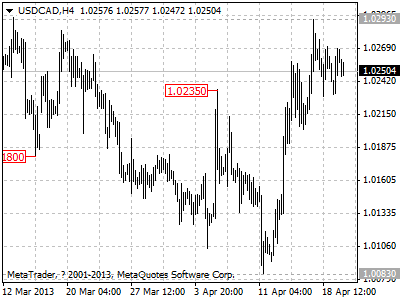
USDCAD remains in uptrend from 1.0083

USDCAD remains in uptrend from 1.0083, the fall from 1.0293 is treated as consolidation of the uptrend. Support is at 1.0200, as long as this level holds, another rise to test 1.0341 resistance is still possible, a break above this level will indicate that the longer term uptrend from 0.9632 (Sep 14, 2012 low) has resumed, then the following upward move could bring price to 1.0500 area. On the downside, a breakdown below 1.0200 level will suggest that the upward movement from 1.0083 has completed at 1.0293 already, then deeper decline towards 1.0000 could be seen to follow.

usdcad

Daily Forex Forecast

Long US Dollar Positions boosted slightly by Large Currency Futures Speculators

Weekly Commitment of Traders Data by CFTC shows which way Large Traders and Hedge Funds were leaning the previous week in the Futures Market

By CountingPips.com

cot-values


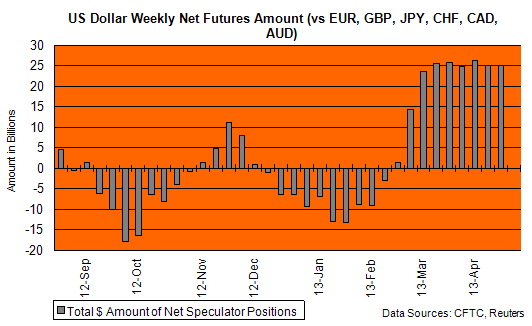
The latest weekly Commitments of Traders (COT) report, released on Friday by the Commodity Futures Trading Commission (CFTC), showed that large futures traders slightly increased their total bullish bets of the US dollar last week against the other major foreign currencies. Total speculator positions have seen little movement in the past few months, as you can see from the chart above.

Non-commercial large futures traders, including hedge funds and large International Monetary Market speculators, registered an overall US dollar long position of $25.18 billion as of Tuesday April 16th. This was a small increase from the total long position of $25 billion on April 9th, according to position calculations by Reuters (US dollar positions against the total positions of eurofx, British pound, Japanese yen, Australian dollar, Canadian dollar and the Swiss franc).


Individual Currencies Large Speculators Positions in Futures:

The individual currency contracts quoted directly against the US dollar last week saw increases for the euro, British pound sterling, Swiss franc, Mexican peso and the New Zealand dollar while the Japanese yen, Australian dollar and the Canadian dollar all had a declining number of net contracts for the week.


Individual Currency Charts: (Please Click on Chart to Enlarge)


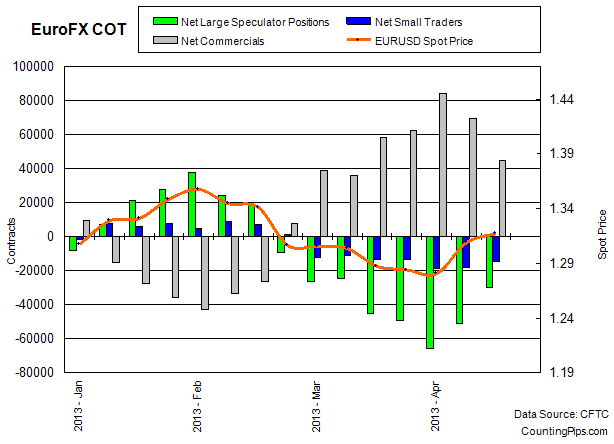
EuroFX: Weekly change of +21,094
EUR

EuroFX: Large trader positions for the euro advanced last week for second consecutive week. Euro contracts improved to a total net position of -29,764 contracts in the data reported for April 16th following the previous week’s total of -50,858 net contracts on April 9th.

This is a change of +21,094 contracts for the week compared to previous week’s change of +14,843.


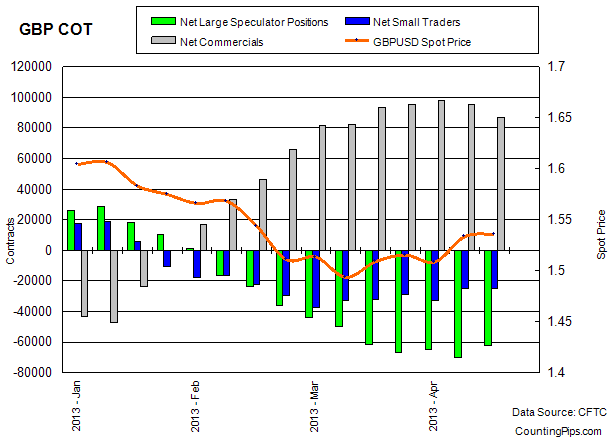
British Pound Sterling: Weekly change of +7,994
GBP

GBP: British pound spec positions improved last week to its best level in about a month after falling to the lowest level of 2013 previously. British pound speculative positions rose last week to a total of -61,975 net contracts on April 16th following a total of -69,969 net contracts reported for April 9th.

This was a weekly change of +7,994 in large trader contracts following the previous week’s change of -4,949 contracts.


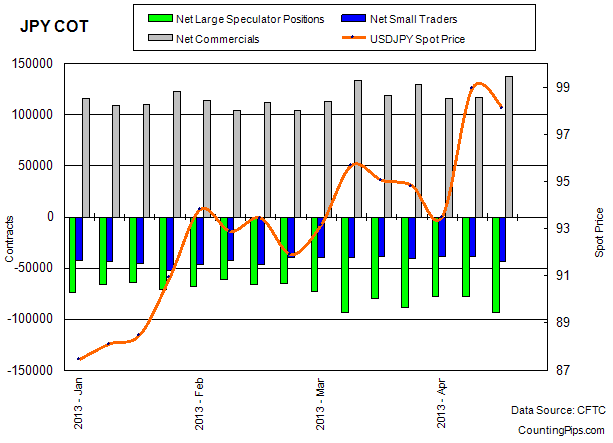
Japanese Yen: Weekly change of -15,714
JPY

JPY: Japanese yen net speculative contracts decreased last week to the lowest level since March 12th after rising for the previous two weeks. Japanese yen positions fell to a total of -93,411 net contracts on April 16th following a total of -77,697 net short contracts on April 9th.

This is a weekly change of -15,714 following the previous week’s change of +474 positions.


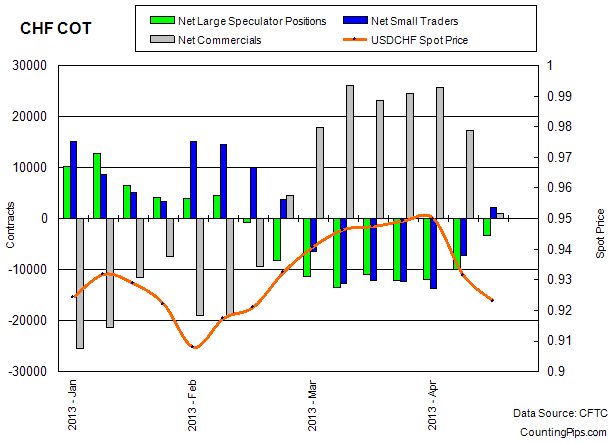
Swiss Franc: Weekly change of +6,761
CHF

CHF: Swiss franc speculator positions improved last week for a third consecutive week and to the best position since February. Net positions for the Swiss currency futures improved to a total of -3,253 contracts on April 16th following a total of -10,014  net contracts reported for April 9th.

This is a weekly change of +6,761 contracts following the previous week change of +2,001  contracts.


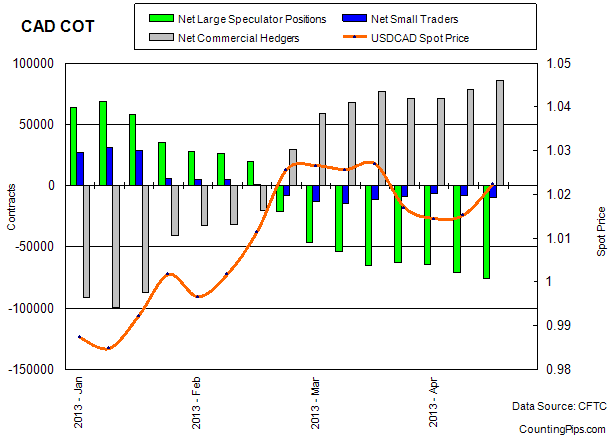
Canadian Dollar: Weekly change of -4,780
CAD

CAD: Canadian dollar positions continued to decline last week for a third straight week and to a new low level in 2013. Canadian dollar positions dropped to a total of -75,913 contracts as of April 16th following a total of -71,133 net contracts that were reported for April 9th.

This is a weekly change of -4,780 net contracts following a weekly change of -6,589 the previous week.


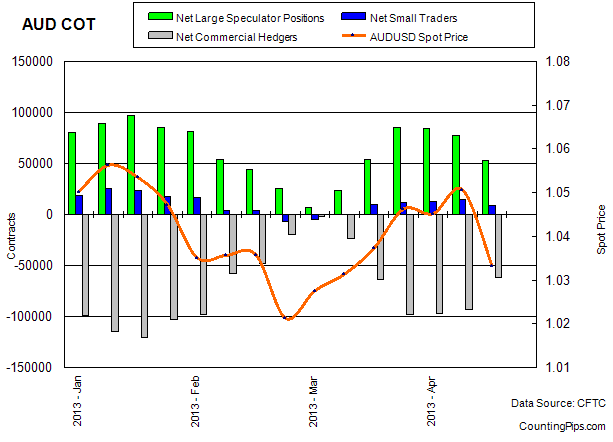
Australian Dollar: Weekly change of -24,704
AUD

AUD: The Australian dollar declined last week for a third consecutive week and to the lowest level since March 12th. Aussie speculative futures positions declined to a total net amount of +53,175 contracts on April 16th after totaling +77,879 net contracts as of April 9th.

This is a weekly change of -24,704 in net positions following the previous week’s -6,092 change.


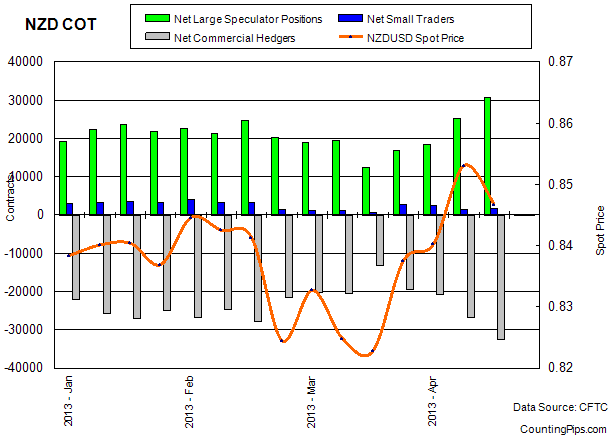
New Zealand Dollar: Weekly change of +5,658
NZD

NZD: New Zealand dollar speculator positions jump last week to rise for a fourth consecutive week and to a new 2013 high level. NZD contracts rose to a total of +30,808 net long contracts as of April 16th following a total of +25,150 net long contracts on April 9th.

This is a weekly change of +5,658 following the previous week’s change of +6,763 net contracts.


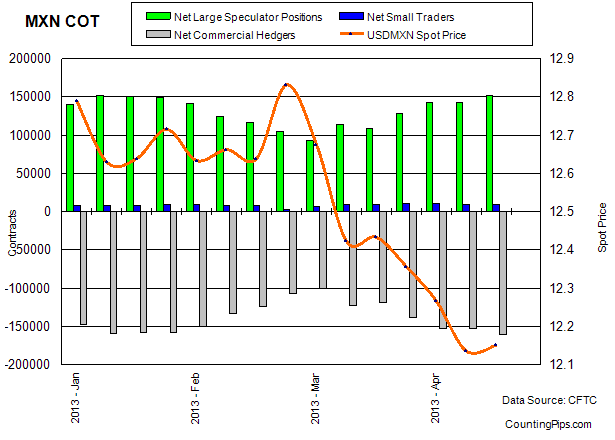
Mexican Peso: Weekly change of +8,746
MXN-1

MXN: Mexican peso speculative contracts rose last week after dipping slightly the previous week. Peso positions rose to a total of +151,288 net speculative positions as of April 16th following a total of +142,542 contracts that were reported for April 9th.

This is a weekly change in net large peso speculator positions of +8,746 contracts following the previous change of -213 contracts.


Additional Macro Financial Markets:

10 Year Treasuries: Weekly change of +14,593

10Year

10 Year Notes: 10-Year Treasury Note speculative contracts advanced higher last week to rise for a fifth consecutive week. 10-Year positions increased to a total of +135,372 net speculative positions as of April 16th following a total of +120,779 contracts that were reported for April 9th.

This is a weekly change in net large speculator positions of +14,593 contracts following the previous week’s change of +10,087 contracts.


Crude Oil Light Sweet: Weekly change of -12,695

CRude

Crude Oil: Crude Oil speculative contracts decreased last week to fall for a second straight week after rising for the previous two weeks. Crude spec positions decreased to a total of +210,703 net speculative positions as of April 16th following a total of +223,398 contracts that were reported for April 9th.

This is a weekly change in net large speculator positions of -12,695 contracts after the previous weekly change of -25,452 contracts.


Gold Futures CMX: Weekly change of +9,523

GOLD

Gold: Gold contracts rose last week to end a three week skid for speculative net positions. Gold futures positions increased to a total of +128,882 net speculative positions as of April 16th following a total of +119,359 contracts that were reported for April 9th.

This is a weekly change in net large speculator positions of +9,523 contracts following the previous week’s change of -847 contracts.


S&P 500 Index Futures: Weekly change of -5,592

SP500

S&P 500: S&P 500 speculative contracts decreased last week after advancing the previous two weeks. S&P 500 futures positions declined to a total of +1,239 net speculative positions as of April 16th following a total of +6,831 contracts that were reported for April 9th.

This is a weekly change in net large speculator positions of -5,592 contracts.


VIX Futures: Weekly change of -20,045

VIX

VIX: VIX speculative contracts declined last week to fall for a third week. VIX futures positions dropped to a total of -89,698 net speculative positions as of April 16th following a total of -69,653 contracts that were reported for April 9th.

This is a weekly change in net large speculator positions of -20,045 contracts following the previous week’s change of -1,380 contracts.


The Commitment of Traders report is published every Friday by the Commodity Futures Trading Commission (CFTC) and shows futures positions data that was reported as of the previous Tuesday (3 days behind).

Each currency contract is a quote for that currency directly against the U.S. dollar, a net short amount of contracts means that more speculators are betting that currency to fall against the dollar and a net long position expect that currency to rise versus the dollar.

(The graphs overlay the forex spot closing price of each Tuesday when COT trader positions are reported for each corresponding spot currency pair.)

See more information and explanation on the weekly COT report from the CFTC website.


Article by CountingPips.comForex News & Market Analysis


Monetary Policy Week in Review – Apr 20, 2013: One central bank raises rate, 1 cuts as inflation remains sticky

By www.CentralBankNews.info

    Last week six central banks took policy decisions with two major banks in emerging markets (Turkey and Brazil) changing their rates in opposite direction while the other four central banks (Canada, Sweden, Mozambique and Sri Lanka) kept rates steady as inflation remains sticky despite weak global growth.
    Brazil’s 25 basis point rate hike – well-flagged and overdue – was significant because it illustrates that inflationary pressures are building in some emerging markets, specifically Asian countries, and central bankers will defend their inflation-fighting credentials.
    Brazil’s move was in contrast to decisions by Canada and Sweden to further push back the time frame for rate rises, showing how the euro area’s severe crises is hampering economic recovery throughout advanced economies while growth in many emerging markets is accelerating.
    While inflation remains an issue in many emerging countries, disinflation – or deflation in the case of Japan – haunts many advanced economies as long unemployment lines holds down wage pressure along with excess industrial capacity.
    Sweden’s Riksbank specifically cited the need to keep policy rates low for longer than forecast because inflation will take longer to return to target than expected. For 2013 inflation is forecast to average a mere 0.1 percent.
    Weaker-than-expected growth is also holding back inflation in Canada, with the Bank of Canada now first expecting inflation to return to target by mid-2015, at least six months later than it expected in January.
   Turkey, which bounced back swiftly from the global financial crises but then was hit by slow growth last year, cut its rate by a larger-than-expected 50 basis points despite inflation above the central bank’s target.
    The latest central bank decisions came as policy makers gathered in Washington D.C. for the annual meeting of the International Monetary Fund.
    While the IMF trimmed its 2013 global growth forecast, it also said the global economy was taking on the characteristics of a three-speed recovery. Growth in emerging and developing markets is still strong, the U.S. is getting back on its feet, but the euro area is continuing to contract with adverse feedback loops between weak banks, weak sovereigns and low economic activity reinforcing each other.
    Through the first 16 weeks of this year, 77 percent of the 147 policy decisions taken by the 90 central banks followed by Central Bank News have lead to unchanged rates, the same ratio as after 15 weeks.
    Globally, 19 percent of policy decisions this year have lead to rate cuts – largely by central banks in emerging economies – unchanged from last week and slightly down from 20 percent the week before then.
 LAST WEEK’S (WEEK 16) MONETARY POLICY DECISIONS:

COUNTRYMSCI    NEW RATE          OLD RATE       1 YEAR AGO
MOZAMBIQUE9.50%9.50%13.50%
SRI LANKAFM7.50%7.50%7.75%
TURKEYEM5.00%5.50%5.75%
BRAZILEM7.50%7.25%9.00%
SWEDENDM1.00%1.00%1.50%
CANADADM1.00%1.00%1.00%
Next week (week 17) features eight central bank policy decisions, including Hungary, Namibia, New Zealand, Philippines, Fiji, Japan (including the economic outlook), Mexico and Trinidad and Tobago.

COUNTRYMSCI             DATE              RATE       1 YEAR AGO
HUNGARYEM23-Apr5.00%7.00%
NAMIBIA24-Apr5.50%6.00%
NEW ZEALANDDM24-Apr2.50%2.50%
PHILIPPINESEM25-Apr3.50%4.00%
FIJI25-Apr0.50%0.50%
JAPANDM26-Apr0.00%0.10%
TRINIDAD & TOBAGO26-Apr2.75%3.00%
MEXICOEM26-Apr4.00%4.50%

A Fresh (and Easy) Way to Play the Rental Market

By Investment U

When gold was at $1,900 an ounce, demand was so great they couldn’t get it out of the ground fast enough. But let it drop $500 or $600 an ounce and you can’t give it away.

John Hathaway of Tocqueville Funds called the selloff in gold a contrarian’s dream. All of the fundamentals that drove gold up in price are still in place… skepticism of fiat currencies, negative interest rates, worldwide QE, and the newest driver, governments confiscating money from bank deposits.

Our own government is printing $89 billion a month to try to devalue the dollar and they are criticizing Japan’s efforts to do the same thing to their currency.

According to Barron’s, the current sell-off is a baby and bath water scenario. There is a general liquidation of all commodities and gold is caught in the flow.

Remember, the rush to gold was in response to the abuse of paper money by governments. Nothing has changed. If anything, the abuses have gotten worse.

Gold may indeed be in a bear market, but for contrarians and gold bugs, this is like Christmas in April.

[My colleague Jeff Yastine just broke the story on what’s going on with global currencies and where gold is going from here. For his eye-opening report, click here.]

Too Good to be True?

Next up triple net leasing…

Rental real estate is very hot and has gotten pricey lately, but one of the safest and highest paying ways to play the rental market, triple net leasing, is still pretty much under everyone’s radar.

Triple net leasing sounds almost too good to be true. An investor buys or builds a property, sets up a long-term lease, 25 years is the average, leases to companies like Walgreens (NYSE: WAG) or CVS (NYSE: CVS) and builds in automatic rent increases in the deal. The investor still owns the property after the lease ends and the renters pay all the taxes, maintenance and utilities.

That’s a good deal. And these are paying returns of 6% to 9%.

Here comes the bad news. The cost of these properties runs in the millions, each. Most people don’t have the cash to get in on this kind of deal.

The one exception, though, is if you have a sale of an investment property. Triple nets qualify for 1031 Exchanges to avoid the capital gains on the proceeds of the sale of property.

But, barring winning the lottery and the occasional sale of property, the best way for the average guy to benefit from this kind of deal is with a mutual fund or REIT that focuses on them.

National Retail Properties (NNN:NYSE), formerly called Commercial Net Lease Realty, does exactly that. It has operated out of Orlando, Florida since the early 80’s and buys and build triple net lease deals.

They are a REIT that pays around 4.3% annually. They show slow, but steady growth and are expected to post gains in revenues and earnings next year.

This is not the fast track by any means, but 25- year leases and all of the expenses paid by the store is a sweet deal. And 4.3% in this market is nothing to sneeze at.

National Retail Properties… take a look at this one.

Slap in the Face Award: Wild and Crazy Predictions

Since this market has just entered the “crazy” valuation phase, the airwaves are full of people predicting higher highs in the market. I thought it would be fun to look back at other predictions from past bull markets.

Back in the hot days of the 80’s and 90’s here’s what the big money brains were thinking.

Investor ‘s Business Daily predicted the Dow would be at 49,200 by 2013. Off by just a hair!

The chief strategist at Seligman called for 100,000 on the Dow by 2020. That’s just seven years away. Where’s my checkbook? I have to get in on this one.

And Yale economist, Roger Ibbotson called for 120,400 by 2025. He is also the person who in the 80’s called for 10,000 on the Dow by 1999, so we should take him a little more seriously. 120,400?

Market Watch listed the prediction error rate by financial analysts at 48.7%.

If you were wrong almost half of the time, would you still have a job?

Good Investing,

Steve

Article By Investment U

Original Article: A Fresh (and Easy) Way to Play the Rental Market

Why Is the Media Not reporting This Positive Gold Story?

By Bill Bonner

Uh-oh… We’ve got good news and bad news. But you’ll have to figure out which is which.

We also have what is probably the most important thing you will read this year…

Yesterday, the Dow fell again – 81 points. Gold went up – by almost
$10 per ounce. Gold does not seem inclined to go down much more… at
least, not immediately. And though some big players seem to be dumping
gold – we won’t mention any names – most of the gold orders are buys,
not sells.

Here’s Paul Tustain, CEO of physical gold storage business BullionVault, on gold’s recent correction:

[H]ere are some BullionVault
statistics from the last few days, which I think offer a useful
reminder about how markets work. Remember, first of all, that for
all those people who sold in a bit of a panic, someone bought.

1. Monday and Tuesday were our strongest 48-hour period for new customers this year.

2. Since Friday, the gross value of
customer bullion sales increased markedly. About 1% of gold we look
after was sold back to the main market. That was characterized by a few
large sellers. Holders of 99% of BullionVault inventory were not
panicked.

3. Those who did sell have mostly
not withdrawn their cash from the BullionVault system. To me, that
suggests they may be intending to buy back into gold sooner rather than
later.

4. We normally have about 230
deposits a day (300 on a Monday) and about 100 withdrawals a day (120 on
a Monday). Mondays are usually higher because they include weekend
activity. On Monday, we had 723 deposits versus 284 withdrawals. On
Tuesday, we had 732 deposits versus 150 withdrawals.

5. Monday was a record day for business transacted, beating the previous peak of September 2011.

Candy for the Mind

And now… here’s why you really shouldn’t pay attention to any news.
It’s “public information” – with little integrity, little quality and
little usefulness.

Here’s our friend, the Swiss novelist Rolf Dobelli.

News is bad for you. It’s like sugar.
It gives you a rush. It’s a distraction from your own concerns. It’s
easy to digest. But this “candy for the mind” can be toxic.

In the past few decades, the fortunate
among us have recognized the hazards of living with an overabundance of
food (obesity, diabetes) and have started to change our diets. But most
of us do not yet understand that news is to the mind what sugar is to
the body.

News is easy to digest. The media feeds
us small bites of trivial matter, tidbits that don’t really concern our
lives and don’t require thinking. That’s why we experience almost no
saturation. Unlike reading books and long magazine articles (which
require thinking), we can swallow limitless quantities of news flashes,
which are bright-colored candies for the mind.

Today, we have reached the same point
in relation to information that we faced 20 years ago in regard to food.
We are beginning to recognize how toxic news can be.

News Misleads

Take the following event (borrowed from
Nassim Taleb). A car drives over a bridge, and the bridge collapses.
What does the news media focus on? The car. The person in the car. Where
he came from. Where he planned to go. How he experienced the crash (if
he survived). But that is all irrelevant. What’s relevant? The
structural stability of the bridge.

That’s the underlying risk that has
been lurking and could lurk in other bridges. But the car is flashy,
it’s dramatic, it’s a person (non-abstract), and it’s news that’s cheap
to produce. News leads us to walk around with the completely wrong risk
map in our heads. So terrorism is overrated. Chronic stress is
underrated. The collapse of Lehman Brothers is overrated. Fiscal
irresponsibility is underrated. Astronauts are overrated. Nurses are
underrated.

We are not rational enough to be
exposed to the press. Watching an airplane crash on television is going
to change your attitude toward that risk, regardless of its real
probability. If you think you can compensate with the strength of your
own inner contemplation, you are wrong. Bankers and economists – who
have powerful incentives to compensate for news-borne hazards – have
shown that they cannot. The only solution: Cut yourself off from news
consumption entirely.

News Is Irrelevant

Out of the approximately 10,000 news
stories you have read in the last 12 months, name one that – because you
consumed it – allowed you to make a better decision about a serious
matter affecting your life, your career or your business. The point is:
The consumption of news is irrelevant to you. But people find it very
difficult to recognize what’s relevant. It’s much easier to recognize
what’s new. The relevant versus the new is the fundamental battle of the
current age.

Media organizations want you to believe
that news offers you some sort of a competitive advantage. Many fall
for that. We get anxious when we’re cut off from the flow of news. In
reality, news consumption is a competitive disadvantage. The less news
you consume, the bigger the advantage you have.

News Has No Explanatory Power

News items are bubbles popping on the
surface of a deeper world. Will accumulating facts help you understand
the world? Sadly, no. The relationship is inverted. The important
stories are non-stories: slow, powerful movements that develop below
journalists’ radar but have a transforming effect. The more “news
factoids” you digest, the less of the big picture you will understand.
If more information leads to higher economic success, we’d expect
journalists to be at the top of the pyramid. That’s not the case.

News Is Toxic to the Body

It constantly triggers the limbic
system. Panicky stories spur the release of cascades of glucocorticoid
(cortisol). This deregulates your immune system and inhibits the release
of growth hormones. In other words, your body finds itself in a state
of chronic stress. High glucocorticoid levels cause impaired digestion,
lack of growth (cell, hair, bone), nervousness and susceptibility to
infections. The other potential side effects include fear, aggression,
tunnel vision and desensitization.

News Increases Cognitive Errors

News feeds the mother of all cognitive
errors: confirmation bias. In the words of Warren Buffett: “What the
human being is best at doing is interpreting all new information so that
their prior conclusions remain intact.” News exacerbates this flaw. We
become prone to overconfidence, take stupid risks and misjudge
opportunities. It also exacerbates another cognitive error: the story
bias. Our brains crave stories that “make sense” – even if they don’t
correspond to reality. Any journalist who writes, “The market moved
because of X” or “The company went bankrupt because of Y” is an idiot. I
am fed up with this cheap way of “explaining” the world.

News Inhibits Thinking

Thinking requires concentration.
Concentration requires uninterrupted time. News pieces are specifically
engineered to interrupt you. They are like viruses that steal attention
for their own purposes. News makes us shallow thinkers.

But it’s worse than that. News severely
affects memory. There are two types of memory. Long-range memory’s
capacity is nearly infinite, but working memory is limited to a certain
amount of slippery data. The path from short-term to long-term memory is
a choke point in the brain, but anything you want to understand must
pass through it. If this passageway is disrupted, nothing gets through.

Because news disrupts concentration, it
weakens comprehension. Online news has an even worse impact. In a 2001
study, two scholars in Canada showed that comprehension declines as the
number of hyperlinks in a document increases. Why? Because whenever a
link appears, your brain has to at least make the choice not to click,
which in itself is distracting. News is an intentional interruption
system.

News Works Like a Drug

As stories develop, we want to know how
they continue. With hundreds of arbitrary story lines in our heads,
this craving is increasingly compelling and hard to ignore.

Scientists used to think that the dense
connections formed among the 100 billion neurons inside our skulls were
largely fixed by the time we reached adulthood. Today we know that this
is not the case. Nerve cells routinely break old connections and form
new ones. The more news we consume, the more we exercise the neural
circuits devoted to skimming and multitasking while ignoring those used
for reading deeply and thinking with profound focus.

Most news consumers – even if they used
to be avid book readers – have lost the ability to absorb lengthy
articles or books. After four, five pages they get tired, their
concentration vanishes, they become restless. It’s not because they got
older or their schedules became more onerous. It’s because the physical
structure of their brains has changed.

News Wastes Time

If you read the newspaper for 15
minutes each morning, then check the news for 15 minutes during lunch
and 15 minutes before you go to bed, then add five minutes here and
there when you’re at work, then count distraction and refocusing time,
you will lose at least half a day every week. Information is no longer a
scarce commodity. But attention is. You are not that irresponsible with
your money, reputation or health. Why give away your mind?

News Makes Us Passive

News stories are overwhelmingly about
things you cannot influence. The daily repetition of news about things
we can’t act upon makes us passive. It grinds us down until we adopt a
worldview that is pessimistic, desensitized, sarcastic and fatalistic.
The scientific term is “learned helplessness.” It’s a bit of a stretch,
but I would not be surprised if news consumption at least partially
contributes to the widespread disease of depression.

News Kills Creativity

Finally, things we already know limit
our creativity. This is one reason that mathematicians, novelists,
composers and entrepreneurs often produce their most creative works at a
young age. Their brains enjoy a wide, uninhabited space that emboldens
them to come up with and pursue novel ideas. I don’t know a single truly
creative mind who is a news junkie – not a writer, not a composer,
mathematician, physician, scientist, musician, designer, architect or
painter.

On the other hand, I know a bunch of
viciously uncreative minds who consume news like drugs. If you want to
come up with old solutions, read news. If you are looking for new
solutions, don’t.

Society needs journalism – but in a
different way. Investigative journalism is always relevant. We need
reporting that polices our institutions and uncovers truth. But
important findings don’t have to arrive in the form of news. Long
journal articles and in-depth books are good, too.

I have now gone without news for four
years, so I can see, feel and report the effects of this freedom
firsthand: less disruption, less anxiety, deeper thinking, more time,
more insights. It’s not easy, but it’s worth it.

[This is an edited extract from an essay first published at dobelli.com.]

Regards,

Bill Bonner

Bill

To learn more about Bill visit his Google+ page or Bill Bonner’s Diary


Claim This Extra $10,400 Right Now

By Aaron Gentzler

In the most recent issue of Unconventional Wealth, I showed readers four specific ways to take advantage of the “share economy.”

How the share economy works is simple. I own things I’m not using. I
give them to you at a reasonable price for an agreed period of time.

You pay me, use the items I lend to you and then give them back. I repeat the process and lend my stuff out again for more money.

Your second home… your car… your tools… your cameras… your
kitchen appliances – you already own plenty of “stuff” the share economy
can turn into fresh capital.

In the recent Unconventional Wealth issue, I showed readers how to make $48,660 per year from the share economy. But there was one strand I didn’t cover in depth.

Let me tell you all about it right now…

Chances are you’ve at least heard of Airbnb. Put simply, Airbnb lets you rent or rent out places to stay.

Airbnb will redefine how the world thinks of booking rooms while
traveling. At the start of 2012, the company had 120,000 listings
worldwide. As I type, it has more than 300,000. The company has served
more than 4 million travelers in total and had more than 3 million
bookings in 2012 alone.

Here in the US, you can make about $100 per night renting out a private room to travelers. If you rent your entire house, apartment or condo, you can make substantially more.

But even at $100 a night per person and renting a bedroom out
just two nights a week, you have the potential to make an extra $10,400
a year.

To get started, simply visit airbnb.com.
You answer a few questions, such as what type of place you want to
rent, whether it’s a shared room or a private room, how many people the
room can accommodate and what city you’re in.

Then you can create your Airbnb profile with an email address and
upload pictures of your place. You never have to accept a booking you’re
not comfortable with. And Airbnb handles all payments from bookings.
The money appears in your account within 24 hours of your guest checking
in.

But is the money worth it? That’s a question only you can answer.

That’s why I recommend you visit the site and browse around for
listings in your area. Your first step should be to figure out if the
possible listing you have to offer matches up well with (or better than)
others near you.

Where I live, in Baltimore, Maryland, a cozy one-bedroom apartment
currently rents on Airbnb for $175 per night. Private bedrooms go for
$60-110, depending on the location. Closer proximity to cultural
attractions, nightlife or public transit all boosts the price.

If you live in the suburbs or a quiet neighborhood, you can still
benefit. Some travelers, after all, want a peaceful place to stay. You
can generate fresh income renting to these people too.

The exponential “Facebook-style” growth of Airbnb hasn’t even begun
yet. When it does, and when it begins to challenge the major hotel
chains dollar for dollar, you want your presence on the site to be well
established so you collect the biggest potential rewards.

On the other side of the equation, I recommend you use Airbnb as a
resource next time you travel. If you’re traveling on business and
visiting a city for only one night, why pay $250 to stay at a faceless
hotel when you could probably spend half as much to stay in a home or
apartment?

Visit airbnb.com today and start self-engineering wealth from the share economy.

Best regards,

Aaron.

Disclaimer

Article brought to you by Inside Investing Daily. Republish
without charge. Required: Author attribution, links back to original
content or www.insideinvestingdaily.com. Any investment contains risk. Please see our disclaimer.

New 5-Part Video Resource: 15 Commodity Opportunities You Should Be Watching Right Now

Dear Trader,

The recent downtrend has caught many traders off guard.

If you read commodity news, you’ve probably noticed a trend: Seems like no one likes commodities any more! Here are some recent headlines:

  • “Hedge Funds Cut Bets Most Since ’08 as Prices Slump: Commodities
  • “Credit Suisse Lowers Price Targets on Commodities, Prices Sink
  • “World Markets Drive Down Commodity Prices”

So, our friends at Elliott Wave International have released a free video report for commodity traders and investors: “15 Commodity Opportunities You Should Be Watching Right Now.”

This free report was designed to help you capture the next big moves in commodities.

Over the course of 5 days, EWI’s Chief Commodity Analyst Jeffrey Kennedy will walk you through the biggest trading opportunities in 15 major commodity markets for 2013 and beyond.

The action begins Monday, April 22, when the first video posts. The 5-part video series will be released each day through Friday, April 26.

Learn more about EWI’s new commodity resource and sign up to get an email alert as soon as the first video goes online >>


About the Publisher, Elliott Wave International
Founded in 1979 by Robert R. Prechter Jr., Elliott Wave International (EWI) is the world’s largest market forecasting firm. Its staff of full-time analysts provides 24-hour-a-day market analysis to institutional and private investors around the world.


Velocity: The X Factor for Hard Asset Investors

By MoneyMorning.com.au

Resource investors, gold bugs and doomers warning of an inflation crisis are all licking their wounds this week after a deflationary broadside took down commodities in an epic smack down. It’s the task of today’s Money Weekend to see if US Federal Reserve chairman Ben Bernanke might be spitting chips along with them – and why the case for hard assets stays strong.

That might sound strange. It’s tempting to think a week like this is a ‘win’ for the US Federal Reserve as gold loses lustre in the eyes of investors and the US dollar strengthens.

Remember, one of the main arguments of having a strong exposure to hard assets in your portfolio is because of the inflationary policies of the world’s major central banks, especially the US Fed. When the Fed inflates, it means the US dollar loses value. And because commodities are priced in USD, that makes them the first place to take a look.

When you see oil and gold rising, effectively that’s the US dollar going down. But as you saw this week, the US dollar went up…

Uncle Ben Bernanke Has a Problem

But Ben Bernanke doesn’t want the US dollar to go up. He wants it to go down. Many people take the line that this policy is to increase American exports. You devalue the currency and your products become more competitive in the global market. But there is another view, which your editor prefers.

Bernanke wants to import inflation. He wants the US dollar to go down so the cost of imports rises. The export benefit is a side effect. This is consistent with the fact that America imports more than it exports and with Bernanke’s working neo-classical mindset.

But why this policy? Like his counterpart Haruhiko Kuroda in Japan, Bernanke wants to generate inflation. The theory being that as inflation expectations increase, you generate spending as people move to buy before prices rise. By stimulating spending, you get the economy moving. ‘Aggregate demand’ goes up. You get nominal GDP growth. Companies will start to invest in response to economic activity.

Like we said, that’s the theory. But Ben Bernanke has a problem (or one of a few!) which doesn’t get a lot of airtime. Uncle Ben can control the supply of money. That’s a given. And gold bugs point it out often. But supply always has to meet demand. And Bernanke cannot control the demand for money.

And, by the looks of this chart, he’s losing the war in the US.

The Mystery of Velocity

This is a chart measuring velocity of the base money supply in the US. Velocity is notoriously hard to measure. But even giving this chart a wide margin for error, the trend is obvious.

Velocity is falling within the United States. In simple terms, velocity is a measure of the speed of money changing hands in an economy. Or as Wikipedia puts it, ‘Velocity has to do with the amount of economic activity associated with a given money supply.’

This relates to the ‘demand’ for money. When people aren’t spending, the demand for money is high. As in, they’re hanging on to their dollars. When they are spending, the demand for money is low (in other words, people prefer the goods they buy rather than keeping hold of money). As people spend faster this has an impact on prices. So rising velocity can have the same effect as increasing the money supply. Prices rise.

But the converse is also true. If people aren’t spending, velocity falls. This has the same effect as withdrawing the money supply. This goes some way to explaining how Uncle Ben can print so much money without generating headline inflation rates in the USA.

This also matters for Australian investors because the US dollar has a velocity outside the US and inside the US, because it is both a domestic and international currency.

Anyway, velocity is down and the US dollar is up. To generate inflation, Bernanke wants that chart to rise, not fall. Instead, Bernanke’s getting deflation. His whole career is based on the idea of preventing deflation. What a great excuse to keep printing money!

Oh! What’s this?

Bloomberg (Thursday):

‘The slump in gold may hand activist central bankers more reasons to pursue the easy monetary policy that helped drive up the metal’s price in the first place…The combination of growth jitters and reduced inflation anxiety boosts the case of Federal Reserve Chairman Ben S. Bernanke and counterparts elsewhere to keep pump-priming their economies in the hope they will finally secure traction.’

So that’s what he’ll do. But at some point, velocity will rise again. An increase in the money supply and rising velocity will take prices up with it. The question is, can Bernanke engineer it without losing control? Hard assets are your bet that he can’t.

Callum Newman
Editor, Money Weekend

PS. Don’t forget if you want to keep track of the latest things we’re reading and brief commentary on events that happen through the day, check out our Google+ page and Kris Sayce’s as well.

From the Port Phillip Publishing Library

Special Report: TORRENT SIGNAL 3

Daily Reckoning: The Brains of Barbarians

Money Morning: A Trader’s Eye View of Gold’s Frightening Collapse

Pursuit of Happiness: Reports of Gold’s Death are Greatly Exaggerated

Money Weekend Digest: 13 April 2013

By MoneyMorning.com.au

Technology: Hopefully Your Bones Aren’t Made From Glass

By now you’ll have heard us talk about Google Glass a few times (we’re just going to call it Glass).

This ‘disruptive technology’ is getting ever so close to our excited little hands. Over in the US we’re finally seeing the first ‘normal user’ images. Google also released the specifications this week. One of the coolest parts of Glass is the bone conduction audio.

When we first heard about bone conduction audio a couple years back we pictured Fred Flintstone and his mates rocking out on some instruments made from dinosaur bones. Well that’s not what it is.

Bone conduction replicates the normal audio hearing process. Of course, soundwaves enter our ear and vibrate our eardrums. But sounds vibrate through the ears’ surrounding bone too. And that’s the process this technology is artificially creating.

Source: cnet.com

There are bone conduction devices already on the market like AfterShokz range of bone conduction headphones. We’re not quite sure how well it all works though.

But there must be something in the technology. Panasonic have been dipping their toes into bone conduction audio for a few years now.

From what we understand, the number one benefit is hearing your audio without taking away ambient sound. So you still hear important sounds such as cars, sirens, or cyclists.
Google have cottoned on to the fact that if you’re wearing your Glass, you’ll need to hear your surrounding environment and also your Glass audio.

Bone conduction audio is something that is slowly finding its way into more and more audio devices, and we’re going to keep an eye on it. It’s hasn’t taken off yet, but we think it just might soon. Because it’s certainly different and a little bit crazy. And we like it when those two words go together.

Energy: How the Artificial Leaf Continues to Grow

We wrote a few weeks back about the Artificial Leaf as a new renewable energy. (If you missed it have a look here).

The aim of its inventor, Professor Daniel Nocera, is to bring cheap renewable energy to poor nations.

Unfortunately, it’s not as effective as some high-tech alternatives like solar. But the technology works. And the key point is the production process is cost-effective.

Over the space of the last few weeks, the evolution of the Artificial Leaf has accelerated.

In a report Nocera and his team completed a few months back they identified a number of problems with the artificial leaf. One problem they found was with the leaf’s real-world application.

For it to work, the leaf needs water to separate Oxygen and Hydrogen. So far tests have only been under laboratory conditions using purified water.

But water in the real world is not pure. That is, real-world-water is dirty and has muck in it that damages the leaf.

The new breakthrough is the Leaf can heal itself. Prof. Nocera has described the discovery at a meeting of the American Chemical Society,


‘Self-Healing enables the artificial leaf to run on impure, bacteria-contaminated water found in nature…we figured out a way to tweak the conditions so that part of the catalyst falls apart, denying bacteria the smooth surface needed to form a biofilm. Then the catalyst can heal and re-assemble.’

Sun Catalytix, the spin-off company from the research, has the end goal to mass-produce cost effective units. And this latest breakthrough means they’re getting closer.

They have a lofty goal of solving the world’s energy problem. But we suspect their motivation comes from the real potential to bring this to market. And make a few dollars out of it as well.

This latest breakthrough puts the artificial leaf that little bit closer to a fully functional device. And a tangible power alternative for poorer nations.

Health: The Living-Dead Organs

We’re going to keep banging on about the potential for 3D Biofabricated artificial organs. As a quick recap, the potential is in the technology of 3D printing using stem cells and other tissues to create (print) artificial organs. It could be the game-changer for modern medicine. And we believe it’s going to happen.

Here’s more evidence that lab created, artificial organs are closer to reality than you think.

At the Massachusetts General Hospital in Boston, innovative research is allowing scientists to bring dead organs back to life. Typically these dead organs would be useless for transplants.

The lead researcher, Dr. Harald Otts explains,


‘What we tried to do here is regenerate organs for transplantation. Organs for patients with end stage organ failure. What’s fascinating is that you, you’re able to, with that process, preserve the blueprint of the organ but it’s completely washed empty. It’s a mere shadow of the original tissue. The major hurdle was to get the cells, the viable building blocks back into the right spots within that viable organ.’

And that’s exactly what they figured out. Using kidney cells from newborn rats they were able to ‘suck’ cells into the washed-clean kidney structure. After a few days in an environment that simulates the body, the kidneys became functional.

Source: scientificamerican.com


What this means is with a bit of science and forward thinking, Dr. Ott has brought organs back to life. For rats at the moment. But the next step could be humans.

Let’s look at it logically. The kidney structure plus the right kind of cells to fill the structure equals a synthetic kidney.

What if we could copy that process by 3D printing the structure and filling it with stem cells? We just could have real synthetic organs, made from scratch.

Sam Volkering
Technology Analyst, Money Weekend

Join Money Morning on Google+

Ed Note: Sam Volkering is assistant editor and analyst for a new breakthrough technology investment service to be launched by Money Morning editor Kris Sayce. The breakthrough technology service will introduce cutting edge investment ideas from the technologies of the future, including medicine, science, energy, mining, and more.

From the Archives…

Australia: The Home of World Beating Dividend Stocks
12-04-2013 – Kris Sayce

Investors: Ignore Japan’s Yen Devaluation Game
11-04-2013 – Murray Dawes

What Japan’s Economic Disaster Means for Australia
10-04-2013 – Dr. Alex Cowie

Gold Bulls About to Win the War
9-04-2013 – Dr. Alex Cowie

A Better Inflation Bet Than Gold…Stock Market Investing
8-04-2013 – Kris Sayce

The End of Carnival’s Curse?

By WallStreetDaily.com

wistiaEmbed = Wistia.embed(“5o71ne3jac”, {
version: “v1”,
videoWidth: 525,
videoHeight: 295,
volumeControl: true,
controlsVisibleOnLoad: true,
endVideoBehavior: “reset”,
plugin: {
“socialbar-v1”: {
buttons: “embed-twitter-facebook”,
logo: true,
badgeUrl: ” http://www.wallstreetdaily.com/wallstreet-research/leadgen/videolg.php”,
badgeImage: “http://embed.wistia.com/deliveries/eec4bb06bdd7e8a1b9856178a39f61a1ec3620fc.jpg?image_crop_resized=100×20”
}
}
});

 
Planning a Carnival cruise any time soon?

I didn’t think so. It hasn’t had the best track record lately, after stranding 3,000 travelers without electricity and sanitation for five days in February. Or the recent engine problems that forced the Carnival Dream to cut its voyage short.

But the dark cloud surrounding the cruise line might be lifted in the near future.

Carnival Corp. (CCL) is dropping $300 million to boost emergency power and fire safety mechanisms in its fleet of 24 ships.

Will it be enough?

Article By WallStreetDaily.com

Original Article: The End of Carnival’s Curse?