Is the Rally Over?

By The Sizemore Letter

In the event you are too busy to read a full article this morning, I’ll sum it up for you in one word: no.

Yes, the S&P 500 and Dow have backed off of their recent highs, and the recent slew of earnings announcements have been a little underwhelming.  Goldmay be leading commodities into a full-blown bear market, which—given the correlation in recent years between all risky assets—is cause for concern.  And when you throw in seasonal patterns—we’ve had great first quarters for the past three years followed by awful second quarters—plenty of investors would rather sell first and ask questions later.

If you are a nimble, short-term trader, it might make sense to take a little money off the table.  And after a run like we’ve had, it’s never a bad idea to rebalance.  But I think it’s far too soon to make major portfolio moves.  Hear me out:

  • The seasonal patterns of the past several years have mostly centered around Europe.  It seems that springtime is when the Eurozone falls apart, and this year hasn’t been an exception.  The Cyprus fiasco is just getting wrapped up, and Italy is still without a government.  Yet bond yields continue to drift lower in the countries that matter most. Spanish yields are close to their lowest levels since late 2011, as are Italian yields. While I don’t consider the bond market omniscient, I do consider it more sophisticated than the stock market.  And right now, the bond market is giving us all the right signals.
  • The tight correlation between commodities and equities in recent years as part of the “risk on / risk off” trade is an anomaly.  Yes, correlations are probably permanently higher than in years past due to the financialization of gold and other commodities via ETFs and other popular trading vehicles.  But as the economy normalizes, “risk on / risk off” should give way to more normal relationships between asset classes.  I recommend investors steer clear of gold, as I expect a lot of continued selling from hedge funds and large institutional investors (see “So Paulson…About that Gold Stash…”).  But overall, I would not view gold’s breakdown of a sign of things to come for stocks.
  • The conditions are not right for a major bear market.  Stocks, though seeing inflows from retail investors, are still under-owned, and sentiment towards them has been lukewarm at best throughout this rally.  Valuations, though based on record earnings that might be temporary, are not high by any credible measure, particularly given the low inflation and low interest rate environment.  Dividend yields among many blue chips are better than what you can find in the bond market and only marginally more risky.

China is a worry, as is Japan.  But at this time, I see no compelling reason to jump ship.  For broad market exposure, I continue to like the Vanguard Dividend Appreciation ETF (NYSE:$VIG).  For shorter-term tactical plays, I continue to like Spanish and French stocks, which can be bought via the iShares MSCI Spain (NYSE:$EWP) and iShares MSCI France (NYSE:$EWQ) ETFs.

Sizemore Capital has positions in EWP, EWQ and VIG.  This article first appeared on TraderPlanet.

SUBSCRIBE to Sizemore Insights via e-mail today.

A Ph.D. in Monetary Catastrophe

By Bill Bonner

Stocks down again yesterday. The Dow slipping 139 points. Gold down slightly.

Gold has fallen so hard so fast we can’t help but feel sorry for the
losers. But who were they? Estimates of the total loss go upward from $1
trillion. Who has that kind of money to lose?

Who lost it? And whom did they owe money to?

We don’t know. It could be nothing more than a regular pullback in an
overextended, otherwise healthy bull market. We’ll just wait and see…
along with everyone else.

So let’s change the subject…

One of the things that vexes just about everyone in Argentina is money. The value of the peso changes rapidly.
There is the official rate. And there is the unofficial rate. Nobody
knows what a peso is worth. Many people – including your humble editor –
have to do some pretty serious calculating. The parts of his brain that
do math must be swelling from overexertion.

“We need gas for the truck,” said Elizabeth yesterday.

“Well, I don’t have any more peso cash. Let’s put it on a credit card.”

“They don’t take credit cards. Cash only.”

“Then let’s pay with dollars.”

“Don’t be silly. That would cost us 50% more. He won’t give us a good rate.”

“Then let’s get some pesos at the ATM.”

“That’s just as bad… we’ll get the official rate.”

Let’s see: We want to pay in pesos, but only if we get the pesos at
the unofficial rate. Otherwise, it’s better to pay in dollars, but only
if the person on the other side will take the dollars at the “blue” or
free-market rate.

Usually, you end up somewhere in between. If you try to bring money
into the country, the government insists you trade it on the official
market. But you can still work out trades at the “blue” rate – either by
bringing physical cash into the country or by working with an
unofficial money changer.

The money changers buy bonds for you in Miami. Then they sell the
bonds in Buenos Aires. The market for the bonds should be about the same
in both cities. The money changer is happy to have his dollars. You are
happy to have pesos that you can spend – or in our case, pay our
farmhands and farm expenses.

Half-Mad Money

It is always a pleasure to visit Argentina. It is a country where
economic disaster stories are daily life… where economists’ daffy
theories are government policy… and where everyday citizens have to
figure out how to deal with a monetary system that is half-mad… and
half merely incompetent.

When we are here, we need to spend pesos… especially out in the
country, where people’s math skills are not as well developed as they
are in Buenos Aires. But any serious purchase – say, if you’re buying an
apartment – requires dollars… either on top of the table or
underneath it. So you have to be prepared.

Most people want dollars. But they can’t take them. Because the
Argentine feds will ask a lot of questions. If a merchant takes dollars
at the unofficial rate, the feds will give him a hard time.

That leaves buyers and sellers of dollars getting together in dark “caves.” Dow Jones reports:

Argentina’s foreign-exchange market is
going underground. As the government restricts access to foreign
currencies, Argentines seeking hard-to-get dollars have been pushed
into cuevas, or caves – clandestine operations where customers pay
dearly to exchange pesos for greenbacks.

Buying dollars for savings is banned,
and authorities make only small amounts of foreign currency available
for travel abroad. Travelers must submit an online request to the
national tax authority just days before leaving, and they usually
receive approval for much less than they requested.

Businesses need government approval to
import equipment and materials at the cheap official exchange rate. The
national tax agency has even posted dollar-sniffing dogs at border
crossings to catch those traveling with undeclared currency.

A visit to Argentina is like taking a Ph.D. in monetary catastrophe
and economic mismanagement. It reminds us how politicians can really
make a mess of an economy when they put their minds to it.

Regards,

Bill Bonner

Bill

To learn more about Bill visit his Google+ Page or Bill Bonner’s Diary


Charles Sizemore and Jeff Reeves Talk Gold

By The Sizemore Letter

Listen to Jeff Reeves and I discuss gold’s recent meltdown and offer our ideas of what is behind it.  If you cannot view the embedded audio player, please follow this link.

From The Slant:

Gold prices have fallen some 23% from a high above $1,800 last fall to a current low of around $1,380.

And it looks like that’s only the beginning.

Charles Sizemore of Sizemore Capital Management points out that a big-time hedge fund manager unwinding his position could be partially to blame for the declines — and thinks that until some of the big gold investors unwind their positions, it’s going to be dangerous to dabble in the precious metal.

That big-time investor is John Paulson, who is out $1.5 billion (on paper, of course) thanks to an aggressive bet on gold that went south.

This is a lesson is risk management that all traders should take to heart: When you bet big, things can get painful in a hurry if the market moves the other way.

Investors “Could Sell into Strength” as Gold Climbs Back Above $1400

London Gold Market Report
from Ben Traynor
BullionVault
Friday 19 April 2013, 08:00 EST

WHOLESALE gold prices rallied above $1400 an ounce Friday morning, with analysts continuing to point to strong demand for physical bullion following gold’s sharpest weekly price fall in over four years.

“Expect the market to sell into strength,” warns bullion bank Scotia Mocatta, whose technical analysts see support for gold at $1309 an ounce, the February 2011 low.

Gold in Sterling meantime climbed to around £920 an ounce, erasing around half of its losses from Monday, as did gold in Euros which ended Friday morning in London around €1080.

Based on London Fix prices, gold in Dollars looked set for weekly drop of 8.4% by lunchtime in London, the biggest weekly drop since October 2008.

“We believe that despite the current turbulence, the long-term fundamentals of the gold market remain intact,” says Marcus Grubb, managing director, investment, at the World Gold Council.

“Physical gold demand in India, China and Dubai is incredible because of the price fall.”

In India, traditionally the world’s biggest source of gold demand, imports could rise to more than 180 tonnes over the course of the second quarter, a 20% jump on Q1, Bombay Bullion Association president Mohit Kamboj said Thursday.

“There is very good demand and the footfall [at stores selling gold] has increased multi-fold following weakness in gold price,” he said.

Earlier in the week dealers in Hong Kong and elsewhere reported premiums opening up on physical gold as a result of increased demand and supply backlogs, while demand for physical gold among investors using the internet has also surged.

Japan’s biggest online broker Dot Commodity saw trading volumes for gold jump fourfold on Tuesday compared to a day earlier, it reported in a press release, while traffic to BullionVault, the world’s biggest physical gold market online, was its highest since September 2011, when gold set its all-time record high.

Looking ahead to next week, of 34 gold analysts surveyed by Bloomberg, 15 said they expected gold to go up next week, 14 said they see it going down and five declared themselves neutral, the news agency reports today.

Silver meantime climbed as high as $23.90 an ounce this morning, before easing back, while other commodities also ticked higher after sharp falls earlier in the week that saw oil extend its losses for April.

On a weekly basis, silver recorded a weekly loss of 13.6% at Friday lunchtime’sLondon Fix.

“Commodities have been sending [a negative] signal on growth for a while,” says Mohamed El-Erian, co-chief investment officer of Pimco, which manages $2trillion of assets, “and now [it is] even louder.”

“Gold and silver, the front-runners since 2009, are likely over the next few years to be among the weakest of all the commodities,” says a note from Barclays, which has cut its average per ounce gold price forecasts to $1483 for 2013 and $1450 for 2014, down from $1647 and $1600 respectively.

“We see the outlook in the near term as fragile…gold will need to find support from the physical market in the near term, but investor interest continuing to unravel poses the largest downside risk for prices.”

Though they remained down on the week, European stock markets ticked higher this morning following gains in Asia, despite losses on US markets yesterday.

“In the short term, US stocks will unlikely see a major correction given solid economic growth and attractive valuations,” says a note from Citi.

“Challenges in the second half may include sluggish growth in Europe, bond buying slowdown by the Federal Reserve and budget negotiations in the US.”

Ben Traynor

BullionVault

Gold value calculator   |   Buy gold online at live prices


Editor of Gold News, the analysis and investment research site from world-leading gold ownership service BullionVault, Ben Traynor was formerly editor of the Fleet Street Letter, the UK’s longest-running investment letter. A Cambridge economics graduate, he is a professional writer and editor with a specialist interest in monetary economics. Ben can be found on Google+


(c) BullionVault 2013

Please Note: This article is to inform your thinking, not lead it. Only you can decide the best place for your money, and any decision you make will put your money at risk. Information or data included here may have already been overtaken by events – and must be verified elsewhere – should you choose to act on it.


Central Bank News Link List – Apr 19, 2013: ECB has ‘room to maneuver’ on rates” Lagarde

By www.CentralBankNews.info Here’s today’s Central Bank News link list, click through if you missed the previous link list. The list comprises news about central banks that is not covered by Central Bank News. The list is updated during the day with the latest developments so readers don’t miss any important news.

Friday Charts: Should We Be on High Alert for Another Banking Collapse?

By WallStreetDaily.com

You know the drill by now…

Every Friday, I put on a muzzle and do my best to let a handful of carefully selected charts do the talking for me.

Longtime readers say this is their favorite column of the week. But I think that’s because they don’t have to listen to me drone on.

Whatever the case may be, I’m happy to keep serving up the pretty pictures.

If Warner Wolf were a stock analyst, it’d be time for him to say, “Let’s go to the charts!”

Banking Collapse? Not According to This Indicator

Call it simple paranoia, or battle scars from the Great Recession…

But whenever the stock market hits the skids for a day or two, like it did in the past week, everyone starts freaking out, assuming that we’re on the cusp of another major financial collapse.

Chicken Littles!

As I’ve shared before, there’s a simple and quick way to determine if such fears are justified: Consult the latest prices for credit default swaps (CDS) for banks and brokers.

You’ll recall, CDS prices reflect the cost to insure against a default. So if there’s a genuine fear that banks are on the brink, CDS prices should be rising as stock prices are falling.

As Bespoke Investment Group reveals, though, that’s not happening at all. “Now that the financial sector stocks are experiencing a pullback, our CDS Index has actually declined a little, indicating that the credit markets are not getting more fearful at all.”

You shouldn’t be, either.

Keep This Yahoo At Arm’s Length

After running through five CEOs in five years, it appears that Yahoo! (YHOO) has finally found a good leader in Marissa Mayer. At least in terms of stock price performance.

Since she took the helm in July 2012, the stock is up over 50%. That means the former internet darling must have regained its mojo, right?

Not exactly.

In the words of Paul Simon, Yahoo!’s revenue has been “slip slidin’” lower ever since 2009.

Sorry. But lower and lower sales don’t lead to higher and higher share prices. Not over the long run. So without a revenue reversal, Yahoo!’s stock is ultimately doomed.

Broken Record Alert!

I’m getting tired of telling you this, so I know you’re tired of hearing it: The real estate market is recovering. But this week we got even more proof, so I feel obligated to share it.

Housing starts rose 7% in March to an annual rate of 1.04 million. That’s the highest rate since 2008.

What’s the significance? I’ll defer to Gennadiy Goldberg, U.S. Strategist at TD Securities. Maybe hearing it from someone besides me will finally convince you to believe it.

Goldberg says, “Underlying trends remain largely consistent with a gradual housing market recovery… The ongoing recovery in the housing market will translate into better U.S. growth – not only via a rebound in construction jobs, but also due to the wealth effect due to rising housing values.”

Maybe it’s just me. But I think I hear an echo, echo.

That’s it for today. I’m sure I’ve angered or offended someone. So let me have it by sending your comments, biting criticisms and calls for my beheading to [email protected]. You can also leave a comment on our website.

Ahead of the tape,

Louis Basenese

Article By WallStreetDaily.com

Original Article: Friday Charts: Should We Be on High Alert for Another Banking Collapse?

Why Waste Your Time on Gold When You Can Invest in Dividend Stocks?

By MoneyMorning.com.au

You may not have noticed it, given how much we’ve focused on gold this week, but there is actually more to investing than just gold.

In fact, if we’re honest, gold investing should be the least labour intensive of all investments.

You know gold is money. You know gold is a long-term protection against central bank and political meddling…so just buy it at various prices and times throughout the year. It’s a no brainer.

In our view, if you spend more than 10 minutes a week deciding whether to buy or sell physical gold, you’re wasting your time.

When it comes to investing, there are more important things to focus on. Such as, finding ways to get on what we call the ‘Secret Payroll’…

Get Your Name on the ‘Secret Payroll’

So, just what is the ‘Secret Payroll?

This is how we like to refer to dividend stocks. We call it a ‘Secret Payroll’ because in a way, as an investor in a dividend-paying company, it’s like being on the company’s payroll…only better.

Unlike regular employees, you don’t have to turn up at 9am, put in a full day of work, and only get to go home at 5pm. Instead, you get paid for doing nothing…no work…you don’t have to lift a finger and the ‘paycheques’ will still roll in.

In fact, the only thing you need to do to get on the ‘payroll’ is to do some homework (analysis) at the beginning. We guess it’s a bit like a job interview, except you’re interviewing the company.

This is where you need to take time with your analysis.

Unlike gold, where one gold bar is pretty much the same as another, when you’re dealing with stocks, well, no two stocks are the same. Even if they have the same dividend yield, it doesn’t mean they have the same growth prospects or earnings stability.

Putting in the research at the beginning is a vital part of all stock investing, especially dividend investing. When you buy a dividend stock you hope to own it for years…perhaps for life.

Ideally you don’t want to buy and sell dividend stocks. To take our ‘payroll’ analogy further, it would be like changing jobs all the time. What you’d prefer is to stay with one company, sit back and earn a completely passive and stress-free income.

If you can put in the effort at the start, it’s entirely possible to reach that goal. And if you stick with it, after a few years you should have your name on the ‘Secret Payroll’ of a handful of stocks. Each of them sending you two ‘paycheques’ each year.

A Few Hand-Picked Dividend Stocks

This is why it’s important to keep your investments in perspective. (Heck, it’s important we do that at Money Morning too.)

Gold is a great long-term investment. It’s a great way to protect your wealth from the money manipulators. But from a wealth building outlook it’s not as important as picking the right stocks.

That’s why although you should buy and own gold, you shouldn’t allow it to take up all your time, or all your money.

Instead, use your time to find the best dividend stock on the market and invest in it. Then find another, and another, until you’ve got maybe five, six or seven solid dividend payers in your portfolio.

From there the key is to add to your holdings of each stock on a regular basis. Simply put, you don’t need to own a portfolio of 50 stocks, each paying a dividend. All you need from an income perspective is to own the best stocks — that’s where doing the research comes in.

So, whether you’re starting out or rebooting your portfolio, think about how you’re spending your time. Buy the gold and be done with it. Next comes the important bit — picking stocks.

If you get that right, you’ll find that you’ve built a robust portfolio of qualify income stocks that will pay you a sustainable and comfortable income for years to come.

Cheers,
Kris

Join me on Google+

Ed Note: There’s a simple way to compound your gains without increasing your risk. How? In today’s Money Morning Premium Kris shows you how to turn a ‘safe’ income stock into a growth stock. It’s not magic, but there is a trick to it…click here to upgrade now.

From the Port Phillip Publishing Library

Special Report: TORRENT SIGNAL 3

Daily Reckoning: The Brains of Barbarians       

Money Morning: A Trader’s Eye View of Gold’s Frightening Collapse

Pursuit of Happiness: The Definition of a Stockbroker…

Australian Small-Cap Investigator:
How to Make Money From Small-Cap Stocks

The Big Crash and What Investors Can Do About It

By MoneyMorning.com.au

The news is great at telling us what’s happening. But knowing what’s happening is a lot different than understanding what happened — and that’s what makes the difference between an average investor and truly great investors.

Gold’s crash Monday is a perfect example. The media was falling all over itself as one pundit after the other came on TV to talk about how gold was falling and how far off its highs it was. Few tied the devastating slide to real economic events — let alone made the connection to actual trading.

But that’s my bread and butter. Today I’m going to tell you what really happened and why — from a market insider’s perspective. Then I’m going to tell you what to expect next and, most importantly, how you can use the situation to your advantage.

There are three fundamental things going on — all of which are at a very high level and all of which are completely transparent to most investors:

1) Japan caused the biggest single one-day gold sell off in 30 years.

No one sold their gold holdings by choice; many big players were ‘forced’ to sell gold to meet margin calls associated with Japanese bond holdings that have gone wild since ‘Abenomics’ came on to the scene.

You see, newly elected Japanese Prime Minister, Shinzo Abe, and his sidekick Haruhiko Kuroda — Bernanke’s contemporary at the Bank of Japan — have embarked on ‘Abenomics,’ or the injection of $1.4 trillion into the Japanese monetary system over the next two years as a means of stimulating the moribund Japanese economy. This will effectively double the Japanese monetary base to 270 trillion yen, or $2.9 trillion USD.

That’s hard to grasp in an era of trillion-dollar budgets, so let me put what they’re doing into perspective. In order to hit his targets, Kuroda is effectively going to have to inject, print, stimulate or quantitatively ease to the tune of approximately $150 billion a month — that’s 76% more than the $85 billion a month Uncle Ben and the Fed have been kicking in here, in an economy that’s roughly one-third the size.

As far as I’m concerned, Godzilla just walked out of Tokyo Bay. This is a regime change in the truest sense of the word. It’s also the first shot in a 1930s-style currency war.

Back to the issue at hand.

Kuroda’s actions have caused Japanese bond and currency volatility to rise markedly in recent weeks — both have had six sigma events in recent weeks — meaning they have moved several standard deviations past what institutional risk management models are built to accommodate.

The 5-Year Japanese Government Bond Volatility was bad enough.

But the jump in 10-Year Yield Range Volatility was something else entirely. It actually experienced a 13.2 sigma move — meaning it was 13.2 standard deviations from ‘normal’ behaviour.

Statisticians will tell you that’s exceedingly rare…which is why I, of course, will point out that this is the second time Japanese yields have hit these levels in 10 years. Wall Street’s wizards are clearly not as smart as they think they are.

Not surprisingly, interest rate volatility jumped off the charts as well, reaching levels consistent with 1998 and 2003 — both of which marked earlier Japanese central bank inflection points.

The computers and the risk management officers went into panic mode.

As a result, anybody with ‘too much’ exposure was effectively forced in knee-jerk reaction to liquidate anything they could to raise cash and bring their holdings back within acceptable risk limits lest they risk a Lehman-style meltdown.

Ordinarily, portfolio managers would make a beeline to Japanese bonds, which are both very liquid and highly marginable. In this case, however, knowing that Team Kuroda is going to function as a buyer of last resort, they turned to their next most marginable assets — the Japanese yen and gold — and sold enough to bring things in line for now.

When they run out of things to sell, they’ll shift to ‘other assets’ in the future, but the pool is pretty deep so I don’t expect that to happen for a while yet.

And that brings me to…

2) U.S. and European institutions are rebalancing their investment models to compensate.

Most investors don’t realize how the big boys play the game. They’re not really gunslingers. In reality, most operate on very sophisticated quantitative models that structure everything from risk management to specific stock selection.

Their models also typically include ‘tactical overlays’ that help further mitigate risk and capitalize on opportunity — I know because I’ve worked on many of them over the years.

Long story short, when holdings reach certain thresholds — either up or down — and the ‘value at risk’ exceeds specific risk management metrics, the models begin to adjust in what is essentially a monster rebalancing.

When risk is in line with expectations, this generally translates into assets being shifted around into portfolio segments that are underweighted or simply underperforming.

When risk is out of line like it was leading into Monday’s blitz, this can result in a ‘fire sale,’ wherein lots of assets are put on the block as part of a process known as ‘cross-selling’.

That’s what kicked things off in the after-hours markets as Asian exchanges came open and the ‘book’ got passed, first through European exchanges and finally into US markets when they opened.

The problem was exacerbated because when program selling kicks in, there is no buying allowed until the models come into line. This creates a situation where the ‘bids’ — meaning the buyers — walk away so prices fall even faster. In practical terms, it’s like half the markets — the buying half — simply vanish.

Compounding the problem…

3) Big traders were piling on the shorts.

This move was really not anything to do with fundamentals. It was all about big boys and their toys.

By actively shorting gold and other commodities, big traders hope to create a self-sustaining feedback loop that drives prices still lower in the immediate future. If they are successful, like they were this time, they’ll laugh all the way to the bank.

Now here’s the thing. Any speculator who sells into this because they panic actually fuels their greed, not to mention their profits, while also ensuring themselves a one-way trip to the poor house.

How Low Will it Go?

I don’t think gold hitting USD$1,200 an ounce is out of the question ultimately, but that isn’t what’s important.

The real issue (and the real unknown) is how heavily leveraged the institutions are and how far out of line the VaR (value at risk) models have become.

If there’s a fund or funds that are blowing up and they need a ton of cash, the drop could be pretty extreme even from these levels. If the institutions are simply adjusting their risk modelling, I’d expect a more moderate decline… and probably a period of ‘basing,’ too, where gold begins to establish a new, albeit lower, trading range.

Either way, though, don’t be surprised by still more volatility and another price drop in the weeks ahead.

When Will it Turn?

If CFTC (Commodity Futures Trading Commission) data is any indication, that point may be sooner than most people expect. The April 9 COT (Commitment of Traders) report shows hedge funds and money managers adding to net longs — so the buying needed to turn the tide has already begun even as the big boys hope to squeeze yet more panic into profits.

At the same time, central banks remain net buyers, having boosted their holdings by more than 15 million ounces in 2012.

I think they’ll easily double that in 2013, led by central banks from emerging markets who are only too happy to pick up the pieces the West is so cavalierly casting aside at the moment.

And, finally, interest rates will ultimately rise, creating yet another updraft. Depending on how fast that happens, the upward move could go slowly, as the markets adjust to macro-economic pressures, or it could be the reverse of Monday’s slide because risk management models begin to run the other way and the big boys find themselves needing to be net buyers.

When the big boys get rattled — why doesn’t really matter — that’s often a great buying opportunity. My favorite way to capitalize on this is to change up tactics, shifting from a ‘buy it all at once’ approach to a ‘buy it over time’ discipline.

Dollar cost averaging works really well for this because it’s simple and easy to implement. Plus it injects discipline into what is otherwise an emotionally charged situation — buying into steep declines. Over time, the advantage really adds up because dollar cost averaging helps you buy more when prices are lower and less when they are higher.

Studies suggest that this simple tactic can boost returns by several percentage points over time. I particularly like the fact that it puts you on an even playing field with the big boys…they can’t ‘game’ you if you’re not playing by their rules and aren’t putting yourself in a situation where they can take advantage of you.

The Upshot on Gold?

Many investors are fearful that the end of gold’s run is near and I don’t blame them one bit. It’s hard not to think so under the circumstances that led to Monday’s pummeling.

Every analyst from here to Saigon seems determined to revise forecasts lower. Societe Generale of France has issued a report entitled, The End of the Gold Era and none other than Goldman Sachs has issued missives advising clients that gold’s done.

Fine…just remember that Wall Street has a long, sordid history of telling the public one thing and doing another.

If you’re bothered by the thought of purchasing gold in the face of still more declines, try not to be. And, ask yourself if you’d rather buy something that’s been put on sale or something that’s too expensive?

No matter what happens with all the fancy modeling, no matter how the Fed, the ECB or the BOJ position themselves, fiat currencies are doomed to fail. History is very clear on this.

Gold, on the other hand continues to represent real wealth, and for this reason investors should continue to buy it…not all at once and not in isolation, but as part of a carefully reasoned, imminently practical and well-proven investment strategy.

Speculators…you’re on your own.

Keith Fitz-Gerald
Contributing Editor, Money Morning

Join Money Morning on Google+

From the Archives…

Australia: The Home of World Beating Dividend Stocks
12-04-2013 – Kris Sayce

Investors: Ignore Japan’s Yen Devaluation Game
11-04-2013 – Murray Dawes

What Japan’s Economic Disaster Means for Australia
10-04-2013 – Dr. Alex Cowie

Gold Bulls About to Win the War
9-04-2013 – Dr. Alex Cowie

A Better Inflation Bet Than Gold…Stock Market Investing
8-04-2013 – Kris Sayce

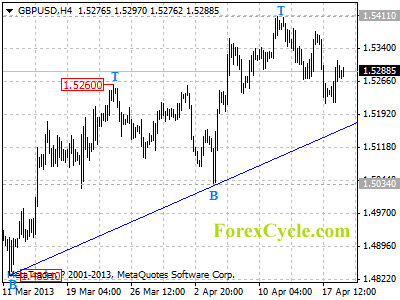
GBPUSD stays above a upward trend line

GBPUSD stays above a upward trend line on 4-hour chart, and remains in uptrend from 1.4831, the fall from 1.5411 is treated as consolidation of the uptrend. As long as the trend line support holds, the uptrend could be expected to resume, and another rise towards 1.5600 is still possible after consolidation. However, a clear break below the trend line will suggest that the uptrend from 1.4831 had completed at 1.5411 already, then the following downward movement could bring price to 1.4500 zone.

gbpusd

Forex Signals

Beware China’s Hidden Debt Crisis

By MoneyMorning.com.au

Developed governments from the UK to Japan are wrestling with massive debt burdens.

They’re all trying different ways of shedding this debt — from austerity, to money-printing, to financial repression. It’s not clear how successful they’ll be, but it is clear that these debts will weigh on growth in the developed world for some time.

That’s why so many investors have pinned their hopes on growth in emerging markets, and China in particular, to pick up the slack from the developed economies.

Trouble is, China’s problems could be even bigger than everyone else’s.

Here’s why, and what it means for your money…

China’s Financial System Creaking Under Bad Debt

Over the last decade, the Chinese state has invested huge amounts in roads, houses and other infrastructure. The trouble is, a lot of this investment was wasted. Worse, during the financial crisis, banks were forced to make even more bad loans in order to offset the slowdown in global trade.
 
The upshot is that large parts of the Chinese banking system and local government are bankrupt. Indeed, reports the FT, things are so bad, that Zhang Ke, a senior Chinese auditor, has warned that ‘local government debt is ‘out of control’ and could spark a bigger financial crisis than the US housing market.

His accounting firm has ‘all but stopped signing off on bond sales by local governments.’ And last week, credit rating agency Fitch cut China’s sovereign credit rating.
 
So what’s the problem? At first sight, China’s debts don’t look bad at all. The country’s official debt-to-GDP ratio is just 25%, well below the equivalent figure in America, Britain or Germany.

Trouble is, this doesn’t take account of all that dodgy local and regional government debt. While these are technically separate from the central government, there’s no way the cities and regions would be allowed to go bust. So their debt is effectively the government’s debt.

Conservative estimates put total debt by this measure as low as 65% of GDP. But if you include dodgy financing products — the same trick Greece used to fiddle its way into the euro — some estimates put the figure above 100%.

While an outright default is unlikely — the central government would step in to ‘bail out’ troubled banks or local governments — a loss in confidence in the banking system would cut off credit to the more productive private sector.

That’s a problem, because it hampers growth. As Jamil Anderlini points out in the FT, in the late 1990s, China’s financial system was similarly burdened with debt.

As banks kept rolling over, forgiving, or concealing bad loans, China was left with ‘a clutch of zombie banks that kept on lending but created progressively less real economic activity’.

China’s Disastrous Demographics

The bad news is that the growth outlook for China is also threatened by a much bigger, longer-term problem: demographics.

In 1978, the Chinese government established a policy limiting each family to one child. Reducing the population’s growth rate was supposed to lower the risk of famine and prevent China from becoming ‘overpopulated’.

However, if it wasn’t clear from the outset, it’s becoming very plain now that the policy was an economic disaster waiting to happen.

As the population has aged, China has managed to artificially create a situation where there will be too few young people and workers to support the old people and non-workers. The Brookings Institute notes that this will ‘test the government’s ability to meet rising demands for benefits and services’.

The problem of one couple being left to care for four sets of grandparents already has a name — ‘four-two-one’. And now, for the first time in its history, China’s working age population has started to fall. There are a third fewer primary school children than there were in 1995.

One solution is to relax the rules, and in some cases that has happened. However, it’s likely to be some time before the policy is entirely abandoned. There are also signs that the policy is so ingrained that it will be hard to raise fertility rates — many couples that are already allowed to have two children don’t do so.

The fall in the pool of available workers is also eroding China’s cost advantage. Professor Kate Phylaktis of Cass Business school notes that this will slow down China’s growth too.

In her view, the only way China can keep growing is by increasing the quality of its goods. But to do so, China will have to allocate capital more efficiently.

In other words, it can’t rely on getting state-backed banks to lend money for state-backed investments that may or may not produce a return. It needs more discriminating lending, to private sector companies that either produce results or go bust.

And of course, you can’t do that if your banking system is effectively bust and being forced to keep ‘zombie’ infrastructure projects alive, rather than lending to productive businesses.

In short, hopes that China will be the engine that drives the global economy could well fall short of the mark. Both Michael Riddell of M&G Investments and George Magnus of UBS agree that the ‘middle-income’ trap is a real threat to China.

According to the World Bank, nine out of ten countries that had middle-income status in the 1960s are still in the same place today.

So, how should investors deal with a Chinese slowdown?

A Chinese slowdown is likely to hit copper, one of the key industrial metals. Indeed, there are already concerns that Chinese stock levels (the amount of the metal kept in warehouses), is getting too high. This is one reason that we’ve been avoiding base metal miners for a long time.

Matthew Partridge
Contributing Editor, Money Morning

Join Money Morning on Google+

Publisher’s Note: This article first appeared in MoneyWeek

From the Archives…

Australia: The Home of World Beating Dividend Stocks
12-04-2013 – Kris Sayce

Investors: Ignore Japan’s Yen Devaluation Game
11-04-2013 – Murray Dawes

What Japan’s Economic Disaster Means for Australia
10-04-2013 – Dr. Alex Cowie

Gold Bulls About to Win the War
9-04-2013 – Dr. Alex Cowie

A Better Inflation Bet Than Gold…Stock Market Investing
8-04-2013 – Kris Sayce