Coming Soon: The Cottage Industry Revolution

By MoneyMorning.com.au

The 20th century was an age of big business. And investors did well backing the giant blue chips on their march to glory. But those days are over. In its simplest terms, my thesis is to bet with the small guys.

I think of them as ‘cottage’ industrials. A cottage industry brings up images of small-scale, local industry. It’s a good metaphor for what I have in mind. Today I’d like to share it with you…

Author William Thorndike sets the scene:

‘[I]n American business, there is a deeply ingrained urge to get bigger. Larger companies get more attention in the press; the executives of those companies tend to earn higher salaries and are more likely to be asked to join prestigious boards and clubs. As a result, it is very rare to see a company proactively shrink itself… [Yet] growth, it turns out, often doesn’t correlate with maximizing shareholder value.

It used to be economies of scale meant you had to get bigger. But there are also diseconomies of scale. Companies can get too big. They can get inflexible. They can saddle themselves with such enormous expenses to support that they no longer can compete effectively in smaller spaces. Yet the returns in those smaller spaces are richer than in the open plains.

Bet Against Size

Jim Gober, the CEO of Infinity Property & Casualty, told me something fascinating about his business. He said that even with all the advertising dollars spent by the big companies in recent years, consumers are no more likely to switch insurers.

As a result, the small guy could compete on price by not spending the money on national advertising. By not having to maintain a national ‘brand’, he kept his costs lower.

So Infinity has been able to compete successfully with companies 50 times as large in small markets. In fact, Infinity has outperformed them in almost every way for the whole 10 years of its existence as a public company — including the one that really counts: returns to shareholders. The big companies don’t have what it takes to compete with Gober on his own turf. They can’t.

Size, then, can actually be an impediment to good shareholder returns.

Think about what keeps the giants humming. Fat cat salaries for the brass. Lavish bonuses and stock option plans. Corporate suites with wood furniture and art on the walls. Headquarters in office towers that employ thousands of people. (Doing what? I always wonder as I walk past them in Manhattan.) Glossy annual reports that say nothing. And to top it off, they produce mostly lousy products that people hate. (Does anybody love Microsoft’s products? Try LibreOffice. It does everything Microsoft Office does — for free. It is hard not to love free.)

Where is the shareholder in all this?

Nowhere…the big blue chips are mostly faceless, bureaucratic monstrosities. Like all bureaucracies, they exist to pile food on their own plates. Shareholders are people to keep quiet and out of the way.

A better model is the cottage industrial.

But what is a cottage industrial exactly? The table below stacks up, in general terms, what I think of as ‘cottage industrial’ set against the giant offspring of state corporatism:

Giant CorporationsCottage Industrial
LargeSmall
GlobalLocal/focused
Agent managersOwner managers
Many marketsNiche markets
Large overheadLean
HierarchicalFlat
CEO in the newsNever heard of the CEO

Here is another example of a cottage industrial: Contango Oil & Gas.

Ken Peak is the founder and was the CEO and largest shareholder until recently. He was an owner, not an agent. Even at Contango’s height, it was a fraction of the size of large natural gas producers like Chesapeake. But Contango focused on creating value per share. It had eight employees and just 11 wells. Its biggest expense was taxes.

Contango was always among the lowest-cost producers of natural gas in North America. As an investment, investors are up over 2,000% since inception in 1999 — trouncing the Dow’s paltry 26% over the same period. (That’s the Dow Jones industrial average, made up of the giants of American business.) Contango’s investors have been up as much as 4,000% before natural gas prices collapsed.

Contango, as with Infinity above, is a model of the kind of business I’m talking about owning.

All is to say there is an alternative to having to shack up with the swollen GEs and AT&Ts of the world. Your returns will be greater, and instead of backing overpaid CEOs, expense accounts, overhead and bureaucracies… you’ll own shops where people are intrinsically motivated to do well because they own a piece of their work. You’ll own something you can grasp on a human scale.

Right now, the portfolio I keep is entirely made up of companies I consider cottage industrials. They are small players in their industries. They focus on local niche markets. They are lean. And they are run by owners — not hired agents.

But there is more to this story…

The Cottage Industrial Revolution

The above is a simple enough idea. In some ways, the above has always been true. What makes it timely for today?

I have to backtrack a bit and tell you about the darker side to gigantism in Corporate America. It is the history no one talks about. The history that tells you how much the state and big business are partners in crime.

For example, one of the biggest misconceptions about FDR’s New Deal is that it was somehow revolutionary and anti-business. Actually, it was the culmination of a trend that began much earlier. And business welcomed it.

The great Murray Rothbard summed up government intervention this way:

‘The intervention by the federal government was designed, not to curb big business monopoly for the sake of the public weal, but to create monopolies that big business… had not been able to establish amidst the competitive gales of the free market.’

If you apply this kind of thinking to today’s giants, it is not hard to see how government policy enabled them to achieve their great girth:

  • What is Boeing if not for the military-industrial complex and the huge sums of tax money dumped into building civil aviation?
  • What is JP Morgan without the helping hand of the Federal Reserve Bank?
  • What is Wal-Mart without the U.S. taxpayer laying out the enormous capital required to build out the nation’s interstate highways and railroads to carry its cheap junk? Without zoning laws and licensing fees that stifle competition from the small shopkeeper?
  • What is Microsoft or Pfizer without the state-granted privilege afforded by copyright and patents?

To answer my own questions: At a minimum, these firms are much smaller without the taxpayer subsidy. State privilege was a crutch that made them the giants they are today.

Today, the state weakens as its finances soften. The state can’t keep up with the roads. Intellectual property is harder to defend in an Internet age. New technologies enable all kinds of small-scale producers to compete effectively with giants.

At the very least, this thesis means lower returns for the old giants. The behemoths that prospered in the old world are ill fitted for the new world that awaits them. In impact, this new world could well be akin to another industrial revolution. Hence, the cottage industrial revolution.

Chris Mayer
Contributing Writer, Money Morning 

Join Money Morning on Google+

From the Archives…

Why Waste Your Time on Gold When You Can Invest in Dividend Stocks?
19-04-2013 – Kris Sayce

A Trader’s Eye View of Gold’s Frightening Collapse
18-04-2013 – Murray Dawes

Why You Should Buy ‘Dirty, Grimy’ Gold Stocks
17-04-2013 – Dr. Alex Cowie

Why this Historic Fall in the Gold Price Equates to a Historic Opportunity
16-04-2013 – Dr. Alex Cowie

Beware the ‘Safety Bubble’, But Don’t Sell Dividend Stocks Yet
15-04-2013 – Kris Sayce
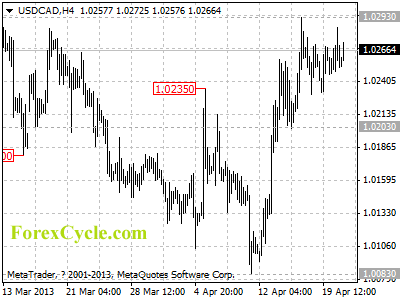
USDCAD moves sideways between 1.0203 and 1.0293

USDCAD moves sideways in a range between 1.0203 and 1.0293. Key support is at 1.0203, as long as this level holds, the price action in the trading range could be treated as consolidation of the uptrend from 1.0083, one more rise to test 1.0341 resistance is still possible. On the downside, a breakdown below 1.0203 will indicate that the upward movement from 1.0083 had completed at 1.0293 already, then the following downward movement could bring price back to 1.0000 zone.

usdcad

Forex Signals

The Wizards of Finance are Clueless: Sell Your Stocks and Hold Onto Your Gold

By Chris Hunter

The smart money is now selling stocks and holding onto gold. You should do the same.

I know. I know. Stocks have been rallying since November. I am also
aware that the media is full of wringing of hands and gnashing of teeth
over the end of the 13-year secular bull market in gold.

Bloomberg reports that in India, “There has been a rush to buy gold
because now people are getting jewelry 15% cheaper than before. It’s
value for their money.”

And from my sources in the physical gold storage business, it is
clear that the buying of bullion remained steady during the recent
panic.

Below are some statistics from physical gold storage business BullionVault (bullionvault.com).
As CEO Paul Tustain put it in a note to investors recently, “I think
they offer a useful reminder about how markets work.” (Remember also
that for all those people who sold their gold in a panic, someone took
the other side of the trade – and gladly so.)

•Monday and Tuesday were our strongest 48-hour period for new customers this year.

•Since Friday the gross value of customer bullion sales
increased markedly. About 1% of gold we look after was sold back to the
main market. That was characterized by a few large sellers. Holders of
99% of BullionVault inventory were not panicked.

•Those who did sell have mostly not withdrawn their cash from the
BullionVault system. To me that suggests they may be intending to buy
back into gold sooner rather than later.

•We normally have about 230 deposits a day (300 on a Monday) and
about 100 withdrawals a day (120 on a Monday). Mondays are usually
higher because they include weekend activity. On Monday we had 723
deposits versus 284 withdrawals. On Tuesday we had 732 deposits versus
150 withdrawals.

•Monday was a record day for business transacted, beating the previous peak of September 2011.

Meanwhile, US stocks are wobbling. As you can see from the chart
below, as of Friday, the S&P 500 had breached a not-insignificant
trading channel.

S&P 500 Large Cap Index
View Larger Image

I believe we’re witnessing the start of a correction in the rally in US stocks that began last November.
This correction is being driven by soggy earnings and an even soggier
economic backdrop that remains, from our lens, at least, in a contained
depression rather than in the “recovery” the mainstream media is so fond of talking about.

Just witness the recent downgrading by the IMF of its 2013 growth
forecast for the US from 2.1% to 1.9%. (The Fed, at one point, was
forecasting a 4% expansion. So much for the predictive abilities of the
policy wonks now in charge of resuscitating growth, balancing inflation
at precisely 2% and bringing the jobless rate down to below 6.5%!)

The problem with the bullish case for stocks… and the bearish case
for gold… is that it depends on a fallacy: Nothing can go wrong in the
world now that central banks are doing “whatever it takes” to save the financial system.

Smart investors know that gold is a form of insurance against future
financial disasters (and the blowup in paper assets that goes along with
them). But now there is a growing consensus that the wizards of modern
central banking have the situation.

So now there is a big rush to sell these gold insurance policies and
buy stocks (which can only go to the moon, so the logic goes, as long as
they have the wind of central bank monetary largesse at their backs).

But the reality is that these wizards of finance are clueless. They
are able to print money, all right. But does anyone know how they unwind
their bloated balance sheets? I certainly don’t.

This is no time to be selling your gold. Nor is it wise to buy into a mature bull run in stocks.

It may even soon be time to dip your toe back into the gold market.
The yellow metal is unloved right now. And that makes it very
interesting for independent thinkers and contrarians.

Disclaimer

Article brought to you by Inside Investing Daily. Republish
without charge. Required: Author attribution, links back to original
content or www.insideinvestingdaily.com. Any investment contains risk. Please see our disclaimer.


The Recovery That Never Happened…

By Bill Bonner

Gold seemed to be stabilizing at the end of last week. Commodities
remained weak. Steel has fallen 31% this year. Brent crude is off 17%
since early February. And copper is down 15%.

Copper is the metal you need to make almost anything – houses, cars,
electronics. When it goes down, it generally means the world economy is
getting soft.

At the start of last week, the conventional analysis of the gold
sell-off was that the central banks’ efforts to revive global growth
were working. The feds had the situation under control. So who needed
gold?

By the end of the week, it appeared that gold – and commodities – had sold off for the opposite reason: because central banks’ money printing wasn’t working and the world was slipping further into a period of slow growth and barely contained depression. From Business Insider:

Recent U.S. economic data has been
disappointing, especially in the realm of housing, which is what the US
bull case is all about.

In Germany, dubbed the strong arm of Europe, economic sentiment just fell.

Where’s the Growth?

And growth has begun to slow in China – still considered a global
growth engine – as it continues to crack down on corruption, a property
bubble and a bloated shadow banking business. China’s plan to shift its
economic model away from exports to domestic demand-led growth has also
contributed to the lower growth rate.

In the US, building permits are down… and foreclosures are up.
There is no renaissance happening in manufacturing. Only half of the new
jobs expected showed up in March. Retail sales are down, and consumer
confidence is off.

And in Britain, the unemployment rate is rising. Retail sales are
falling. And figures coming out this week will probably tell us that the
country is in a triple-dip recession.

Here’s Ambrose Evans-Pritchard in The Telegraph:

It is becoming ever clearer that the roaring boom in global equities since last summer has priced in an economic recovery that does not in fact exist.
The International Monetary Fund has had to nurse down its global growth
forecasts yet again. We are still stuck in an old-fashioned trade
depression, with pervasive overcapacity in manufacturing plant and a
record global savings rate of 25% of GDP…

As you can see from the chart below,
the divergence between stock markets and the Deutsche Bank index of raw
materials is astonishing to behold, so like the pattern in early 1929…

S7P 500 vs. Deutsche Bank commodity index

The US economy is growing below the
Fed’s own “stall speed” indicator. Half a million people fell out of the
workforce in March. Retail sales fell in March. So did manufacturing…

“There is a threat of deflation almost everywhere. A lot of central banks will have to follow the Bank of Japan, whatever they say now,” said Lars Christensen from Danske Bank.

The era of money printing is young yet. Gold will have its day again.

Regards,

Bill Bonner

Bill

To learn more about Bill visit his Google+ Page or Bill Bonner’s Diary


Gold’s Action “Dominated by Retail Buying” But Bullion “Not Trading as Safe Haven”

London Gold Market Report
from Ben Traynor
BullionVault
Monday 22 April 2013, 07:30 EST

WHOLESALE gold prices rose back above $1430 per ounce Monday morning for the first time since last Monday’s price drop, amid reports of strong buying in Asia, while stocks gained and US Treasuries fell.

Silver meantime ticked higher above $23.60 an ounce, though remained below Friday’s high, while other commodities also gained with the exception of copper.

Last week’s upturn in physical gold buying in Asia continued over the weekend according to some local press reports, with the South China Morning Post reporting “a rush of buyers” in Hong Kong.

Gold exchange traded funds by contrast continued to see outflows towards the end of last week.

“It remains to be seen which of these offsetting forces eventually wins out and exerts its influence over gold prices,” says Ed Meir, metals analyst at brokerage INTL FCStone.

“Our guess is that the sharp bounce in retail buying will likely dominate and succeed in sending prices higher over the course of the next week or two.”

“Gold is still not trading as a safe haven asset,” adds VTB Capital an analyst Andrey Kryuchenkov, “swinging back and forth in line with other metals in the precious complex, other liquid commodities and equities…volumes will remain very thin as players digest the latest pullback.”

“The aggressiveness of [last week’s] fall suggests that we are still in a consolidation rather in a reversal role,” says Tim Riddell, head of ANZ Global Markets Research, Asia.

“The $1435 level is likely to provide resistance…we really need to get back into the $1500s to say that there’s something more substantial taking place.”

On New York’s Comex exchange, “the liquidation of net speculative length [in gold contracts] appeared relatively mild [in the week ended last Tuesday],” says Standard Bank commodity strategist Marc Ground, referring to money managers’ so-called net speculative long position, calculated as the difference between the number of bullish and bearish contracts held.

“Only [the equivalent of] 20.8 tonnes (or 5.8%) were shed over the week — a long way from the worst we’ve seen this year (90.4 tonnes at the end of January). relatively strong unwinding of long positions (35.8 tonnes compared to this year’s record of 45.9 tonnes) was softened by a solid decrease in speculative shorts (15.0 tonnes).”

Ratings agency Fitch meantime has downgraded the UK’s credit rating from AAA to AA+, following a similar downgrade from Moody’s back in February. Standard & Poor’s has maintained its triple-A rating on British government debt.

“Despite the UK’s strong fiscal financing flexibility underpinned by its own currency with reserve currency status and the long average maturity of public debt, the fiscal space to absorb further adverse economic and financial shocks is no longer consistent with a ‘AAA’ rating,” said a statement from Fitch Friday.

“The UK and almost all of Europe have erred,” manager of world’s biggest bond fund Pimco Bill Gross tells the Financial Times, “in terms of believing that austerity, fiscal austerity in the short term, is the way to produce real growth. It is not. You’ve got to spend money.”

Gross adds that investors in government debt “want growth much like equity investors” and that excess austerity can lead to “recession or stagnation [causing] credit spreads [to] widen out – even if a country can print its own currency and write its own checks”.

Over in Italy, the Eurozone’s biggest issuer of public debt, Giorgio Napolitano has been elected for a second term as president by the country’s parliament after it rejected the nomination of Franco Marini. Italian politicians have failed to form a government since the general election two months ago.

Russia would like to “increase its participation” in negotiations about Cyprus, the country’s finance minister Anton Siluanov has said, but will only restructure a €2.5 billion loan in return for protection of Russian financial interests in the country, Reuters reports.

“Money of our companies has been frozen there,” Siluanov told reporters at the G20 meetings in Washington at the end of last week.

“We would like this money to reach its recipients.”

Ben Traynor

BullionVault

Gold value calculator   |   Buy gold online at live prices


Editor of Gold News, the analysis and investment research site from world-leading gold ownership service BullionVault, Ben Traynor was formerly editor of the Fleet Street Letter, the UK’s longest-running investment letter. A Cambridge economics graduate, he is a professional writer and editor with a specialist interest in monetary economics. Ben can be found on Google+


(c) BullionVault 2013

Please Note: This article is to inform your thinking, not lead it. Only you can decide the best place for your money, and any decision you make will put your money at risk. Information or data included here may have already been overtaken by events – and must be verified elsewhere – should you choose to act on it.


The Senior Strategist: This is a test week

U.S. stocks fell more last week than in any other week this year, and gold was hit hard last week dropping by 5-10 pct. The big issue is the nervousness about growth.

This week will be a test week. The markets are trying to figure out, what is going on with the growth. Senior Strategist Ib Fredslund Madsen believes that it will be a temporary soft spot in growth.

Legal information

Video courtesy of en.jyskebank.tv


Central Bank News Link List – Apr 22, 2013: Exclusive: Bernanke to skip Jackson Hole due to scheduling conflic

By www.CentralBankNews.info Here’s today’s Central Bank News link list, click through if you missed the previous link list. The list comprises news about central banks that is not covered by Central Bank News. The list is updated during the day with the latest developments so readers don’t miss any important news.

Gold, Silver and Bird Farmers

By MoneyMorning.com.au

Last was a tough week for hard assets. Prices plummeted for gold, silver, platinum, copper, oil and more. It was a broad, market-wide retreat — helped along by the ‘usual suspect’ market movers, who likely wanted to knock things down for their own nefarious reasons.

At some moments, the sell side was in a panic. People apparently bailed from large positions — although I believe that as things quickly evolved (too quickly, actually), many jumpers were forced to exit due to margin calls.

Lower prices for ‘long-term’ wealth-protection ideas like gold, silver, etc., have knocked down the share price for many a producing company.

All in all, many hard asset portfolios have taken tough hits, especially those of investors who bought in over the past year, and certainly in recent months. What happened? Where do we go? Has the hard asset train derailed? Let’s think it through.
 
I have to admit that a few weeks ago I did not foresee the sharp asset dive that we’ve just experienced. I’m more than aware that gold and silver prices go down as well as up. But I didn’t see a super-sharp selloff coming.

For example, Freeport-McMoRan Copper & Gold shares dropped from the $33 range to the vicinity of $29. Barrick shares dropped from over $25 to just under $19. These levels are five-year lows — as low as the respective companies have been since late 2008 and early 2009, during the worst days of the last crash.

At current price levels, the dividend yield for both Freeport and Barrick shares is near 4.2% for each company — not bad. If Freeport and Barrick were good ideas before, they’re ‘better’ ideas now. These entry points are attractive, although I counsel caution and suggest allowing more dust to settle. Yes, there is STILL a downside to big mining plays.

Still, at these levels, I’m inclined to suggest that long-term investors nibble away. Be sure to keep cash in reserve for other opportunities.

Markets for everything move up and down. You get bad days, right? That, and beware fighting the Federal Reserve.

But I still don’t understand why the [US] dollar is somehow so ‘strong’ in a relative sense and gold is somehow ‘weak’. The ferocity and scope of last week hard asset slide surprised me.

Why the Slide?

Let’s look at a couple of the mainstream explanations for the gold sell-off. One has to do with Japan’s intentional weakening of the yen for domestic ‘stimulation’.

In response, the dollar strengthens. Strong dollar leads to lower gold prices, right? But why would a stronger dollar trigger a major gold sell-off? On the best day, dollar-yen is an exchange-rate issue, not a fundamental restructuring of U.S. monetary issues.

How about the rumour that Cyprus will sell its national gold to pay the European Union for a bank bailout. That’s on top of Cyprus nicking all of the big bank accounts on the island for up to 60%. Still, how much gold does Cyprus have? And where would it go?

If Cyprus ‘sells’ its national gold, the transaction will likely just be a ledger move from the books of one central bank to another. That is, unless China buys the gold and demands delivery. Beware of that happening, because it’ll lead to a physical scramble to cover delivery — in which case gold prices should rise, not fall.

And why would any large gold holder — public or private — ‘sell’ it in such a way as to crash the price? That is, why dump a large gold position in a hurry? Especially if you know that it’ll spook the market downward, and at the end of the day you’ll get a lower price. That’s dumb, right?

It’s dumb unless you’ve already positioned yourself to gain from the price fall. You’ve got your short contracts in place. Basically, what if somebody is manipulating the gold market?

Who would do such a thing?

Well, gee. Isn’t it interesting that Goldman Sachs announced that it was recommending that people exit gold and await a price decline. Then, as if on cue, The New York Times published a front-page hit piece titled, ‘Gold, Long a Secure Investment, Loses Its Luster’.

When I saw the Times article, I wasn’t sure if it should be on the front page as news or the business pages, if not the obituary section. Here’s one of the key lines from the Times, ringing with empirical certitude: ‘Gold, pride of Croesus and store of wealth since time immemorial, has turned out to be a very bad investment of late.’

Got that? Gold is for losers. And then the next day, Times columnist Paul Krugman weighed in with a tirade against ‘gold bugs’, of which I’ll mention more below.

Looking for the Next Investment Fad?

First, though, looking back to 2001 or so, we’ve had a sweet, rising, bullish market for gold, silver, etc. Still, don’t confuse personal insight with a rising, bullish market.

The good news is that if you bought into the gold story back when the yellow metal was selling for $300 per ounce, you’re still up about 370% even after the pullback to the $1,400 range. If you bought silver at, say, $5 per ounce, then you’re up by a similar level.

But the last decade is history. What about the future? Is the gold pullback a harbinger of fundamental change in world monetary realities, if not market perceptions?

In other words, have central banks and their currencies — dollars, euros, yen, etc. — somehow gotten well in a hurry? Has investor sentiment changed dramatically and moved away from gold and silver?

In The New York Times, the predictably dyspeptic Paul Krugman ripped into gold and ‘gold bugs’. Krugman used his characteristic, ad hominem tone, and that nasty polemic style that he reserves to label and indict groups that lack a protected, politically-favoured status. (If Krugman were a woman, he’d be a ‘mean girl’.)

Basically, in his execrable column, Krugman gloated that after a 12-year run as a top-performing asset class, gold has hit the skids. It’s over for gold, states the economic sage of Princeton University. Of course, the former adviser to Enron has been known to be wrong in the past.

Deep down, though, let’s humour Krugman and ask the hard question. For the past decade or more, was gold just another investment fad — a transient, ‘dot-gold’ sort of thing, like buying dog food over the Internet — and now we need to find a new fad?

Looking for Clues

I’m old enough to recall the 1970s, when gold prices ran up from $32 per ounce to around $800. Then, as the 1980s unfolded, gold prices crashed back down and stayed in the dumps for two decades. I’ve seen this movie before.

What happened back then? The late 1970s and 1980s were the era of presidents Carter-Reagan in the US and prime ministers Callaghan-Thatcher in Britain.

First, under the ‘liberals’ (as the British label their politics), gold and silver prices ran up in the shadow of rampant global inflation and stagnant economies due to government mismanagement. Then, under the ‘conservatives’ (again using British terms), new leadership stopped their respective nations from turning into Cuba without the sunshine.

In the US, Federal Reserve Chairman Paul Volker raised interest rates to double-digit levels, and choked inflation out of the system. In Britain, Chancellor of the Exchequer Geoffrey Howe worked similar policy. In both nations, tough monetary policy pushed many an uneconomic enterprise into bankruptcy.

At the same time, other parts of the economy began to boom — not the least being Britain’s North Sea oil sector and American’s high-tech and defence sectors.

Returning to the present, why would the dollar get well last week while gold was forced into precipitous decline? Asked another way, is anyone serving up hard monetary or fiscal medicine to the US economy?

Do the Fed’s zero interest rate policies spread money to the job creators of the nation? Do legislative diktats like Dodd-Frank and Obamacare kick-start a profound advance in the fortunes of the US economy and its dollar.

Say again, what’s the signal for a long-term downtrend for gold? I do not see such flags waving, nor hear those drums beating and bugles blowing. It doesn’t make sense.

Just a Correction?

Try this. Perhaps the gold sell-off was more like a classic correction, where Mr. Market shakes out the weak hands. Indeed, the recent market retreat resembled a scene where valuable assets moved from weak hands to strong hands.

Consider this chart, courtesy of my friend and colleague Dan Denning:
 

The dark line represents shares in iconic Apple Computer, which are down nearly 35% in the past eight months. Compare this with gold, which dropped about 16.5%. Tell me again what’s ‘crashing’?

Investment guru Marc Faber recently made this same point during an interview with Bloomberg TV. He stated:

‘I love the markets. I love the fact that gold is finally breaking down. That will offer an excellent buying opportunity… At the same time, the S&P is at about not even up 1% from the peak in October 2007.

‘Over the same period of time, even after today’s correction, gold is up 100%. The S&P is up 2% over the March 2000 high. Gold is up 442%. So I am happy we have a sell-off that will lead to a major low. It could be at $1,400, it could be today at $1,300, but I think that the bull market in gold is not completed. Nobody knows for sure, but I think the fundamentals for gold are still intact.’

Those ‘fundamentals’ include the fact that gold is a hard asset and — if you take possession — no one else’s liability.

On this last point, consider that — as we learned from the recent Cyprus debacle — political and monetary authorities feel legally entitled and morally justified to confiscate your savings when they want the funds to cover government bills.

Meanwhile, never forget that central banks everywhere continue to print money and monetize government debt. The story of the Weimar Republic sort of speaks for itself.
 
To wrap it up, yes, the idea of a serious asset decline is always in the back of my head — certainly, since I saw gold tumble and stay down in the 1980s. But was last week the beginning of the end for gold? The resurrection of the dollar as a long-term store of wealth? I don’t believe so.

Not All Bad Luck Is Bad

One final point…

It is sad for the bird farmers, but good news for us,’ said a Chinese man, quoted in a recent issue of the UK Daily Mail. ‘Not all bad luck is bad for all,’ he added.

The Chinese man was discussing his relative good fortune. That is, he fell into a bargain buying unwanted baby ducklings from ‘bird farmers’.

The back story, here, is that the price of poultry has collapsed in China due to fears about a new strain of bird flu, called H7N9. Fearful of flu infection, Chinese diners are eating fewer duck dinners, leaving farmers who raise the birds with a large surplus.

Thus, Chinese duck farmers are selling birds on the cheap (so to speak), and others are benefitting. The ‘lucky’ farmer quoted above will feed the surplus baby ducks to his snakes.

With characteristic Chinese practicality, another farmer stated, ‘It’s not a nice end for the baby ducks but they were raised as food. They weren’t going to live on a pond for the rest of their natural lives.

Bottom line? If someone wants to sell you gold and silver at a bargain, feel free to take it off their hands.

Byron King
Contributing Editor, Money Morning

Join Money Morning on Google+

From the Archives…

Why Waste Your Time on Gold When You Can Invest in Dividend Stocks?
19-04-2013 – Kris Sayce

A Trader’s Eye View of Gold’s Frightening Collapse
18-04-2013 – Murray Dawes

Why You Should Buy ‘Dirty, Grimy’ Gold Stocks
17-04-2013 – Dr. Alex Cowie

Why this Historic Fall in the Gold Price Equates to a Historic Opportunity
16-04-2013 – Dr. Alex Cowie

Beware the ‘Safety Bubble’, But Don’t Sell Dividend Stocks Yet
15-04-2013 – Kris Sayce

A New Take on Hard Asset Investing

By MoneyMorning.com.au

Buying hard assets is all the rage.

Although in the case of gold, perhaps less than it was a few weeks ago.

Even so, with central banks printing money, investors are still worried that inflation will rear its head soon.

Hence the demand for gold, silver, property, artwork, land, and…um…cheese.

Is cheese really an investment? For some, it appears so. But it’s not the only tasty hard asset out there. There’s another that could be just as lucrative…and it won’t stink up your home…

Before we fill you in on the details, we should explain the cheese reference. This story from the UK Daily Mail reveals all:

Former milkmen will have a slice of their retirement savings rolled up in cheddar cheese as Cathedral City maker Dairy Crest attempts to solve its pensions pickle.

The dairy giant has agreed to offer £60 million worth — 20 million kilogrammes — of its maturing cheese stock as security for its pension fund as it battles to fill the holes in its final salary scheme.

At first it seems crazy — cheese in a pension fund. On reflection, it’s not so crazy. The idea isn’t that the fund pays out cheese to its members in lieu of a pension.

Instead, the idea is the pension fund holds a claim over the cheese assets and receives the proceeds when Dairy Crest sells the cheese in the future.

Cheese Beat Shares and Gold

But this isn’t the only case of pension funds using odd means to boost a pension fund gap. According to the Daily Mail, drinks firm Diageo has ‘deposited’ 2.5 million barrels of Scotch whisky into its pension fund.

And retailers Sainsbury’s and Marks & Spencer have used some of the companies’ property as security in their underfunded pension funds.

You can hardly blame the pension funds for turning to hard assets. With the recent trouble in Europe over governments defaulting or restructuring bonds, 20 million kilos of cheese seems a better bet than government debt.

And when you look at the track record of cheese over the past three years, you can see why the pension funds are happy to buy it.

According to the Chicago Mercantile Exchange, cheese block futures have risen from USD$1.42 in October 2009, to USD$1.88 today (the price peaked at $2.08 last October).

That’s a 32.4% gain. It’s not far behind the S&P 500’s 45.1% gain; slightly better than gold’s 31.7% gain; and nine-times better than the S&P/ASX 200’s 3.8% gain over the same period.

The only problem with cheese is that it’s well, a bit whiffy. The good news is there’s another tasty hard asset (actually, a liquid asset) that’s just as good as cheese. And luckily, it’s much more pleasing on the nose…

And Now for a Liquid Asset

We’re talking about wine.

According to data compiled by the world’s leading wine experts, an index of fine wine prices has gained 30.7% since October 2009.

That beats the blue-chip Australian stock index by eight times over the same period.

While past performance can’t guarantee future performance, it shows that investors are prepared to give more unconventional investments a go.

Saying that, over the past few weeks speculators have driven down the price of hard assets and commodities. You’ve seen that with the slump in gold and silver prices, and companies linked to those commodities — resources stocks.

So if you believe in the Investing 101 basic lesson of ‘buy low, sell high’, this could be the best time in five years to get your hands on hard (or liquid) assets.

Of course, like all investments, you can’t just buy anything and hope it will go up. If you buy a bottle of Jacob’s Creek chardonnay from your local bottle shop it probably won’t bag you a big return. That’s why it’s vital to find the wines that should increase in value the most.

Sound hard? Don’t worry; you don’t have to become a wine snob. Our old pal Nick Hubble has done a lot of the groundwork for you with this unusual asset class…

Raise a Glass to Fine Wine Returns

In his latest issue of the Money for Life Letter , Nick reveals the how, what, where, why and when of investing in the red and white liquid.

Like any investment, punting on wine is risky. Pick the wrong vintage or the wrong estate and it could leave you with an underperforming asset.

But then again, wine has something going for it that gold, shares and property don’t have. If it turns out to be a dud investment at least you can drown your sorrows by drinking a glass or two of the stuff.

Seriously, if you want to punt on an investment that did eight times better than the stock market over the past four-and-a-half years, then this is worth checking out. You can see Nick’s analysis, including the ins and outs of wine investing, here.

Cheers,
Kris

Join me on Google+

Ed Note: There’s more to investing than stocks and gold. In today’s Money Morning Premium Notes , Kris reveals the top 10 reasons to invest in the growing wine investment market, plus he reveals the top drop that bagged investors a 920% gain between 1999 and 2009. Could today’s market give investors similar gains? Click here to upgrade now.

From the Port Phillip Publishing Library

Special Report: TORRENT SIGNAL 3

Daily Reckoning: Ways to Invest to Improve Your Internal Well Being

Money Morning: Velocity: The X Factor for Hard Asset Investors

Pursuit of Happiness: The Definition of a Stockbroker…

Australian Small-Cap Investigator:
How to Make Money From Small-Cap Stocks

Dividend Stocks Look Expensive — What Should You Do?

By MoneyMorning.com.au

We’ve been fans of blue-chip, dividend-paying, ‘high quality’ stocks for many years now.

These companies have a lot going for them: they are tough enough to stand up to most economic conditions, and at a time when interest rates are at record lows, they represent one of the few ways to get an inflation-beating income — as long as you’re prepared to take the risk of owning stocks.

Trouble is, everyone has caught on to this idea by now. ‘Safe’ stocks have outperformed all comers during the bull run of recent years. In some cases, they now look expensive compared to other sectors.

So what should you do about it?

Investors Will Cough Up for Quality Stocks

As James Mackintosh points out in the FT, investors are increasingly willing to pay a premium for stocks that pay high dividends. ‘So much so that they are starting to look dangerously overvalued, especially in the US.

According to JP Morgan Asset Management, the highest-yielding stocks in the S&P 500 now trade on an average of 16 times forward earnings. That’s higher than at any point since 1994. The wider market is on about 14.

Reliable dividend payers — ones who keep delivering the goods, year-in, year-out — trade on even higher price/earnings ratios, notes Mackintosh.

Of course, it makes perfect sense that relatively dull, high-yielding stocks have done well compared to other stocks. If investors are gradually plucking up the courage to stick more money into equities, then where’s it going to go first? It’s going to go to the ‘safest’, most bond-like stocks.

But what do you do when the ‘safe’ stocks get expensive?

This Could Go On for a While Yet

The first thing I’d say is — don’t panic and sell.

The key with income stocks — as with any asset — is to remember why you bought them in the first place. In this case, you most likely bought these stocks because they were paying a decent dividend. Capital gains were a secondary consideration.

So it’s the dividend that matters. Unless something happens to affect that — the dividend is cut, or cancelled — then I don’t see any reason to sell urgently.

Also, while I can understand the argument that dividend-payers look expensive, I’m not sure that’s going to change in the near future.

If the economy weakens, profits might drop, and dividends might be cut. But this would also be bad for other, more vulnerable stocks. Interest rates would also stay low in such a scenario, meaning that the rationale for buying income stocks wouldn’t go away.

If the economy strengthens, interest rates might start to rise. That would make high-yielding stocks less attractive. But a stronger economy would be good for decent companies in the long run, while the threat of rising interest rates would again hit highly indebted, ‘dash-for-trash’ stocks hard.

There could be a stock market crash, no argument there. In that case, defensive income stocks would fall. But they’d probably take less damage than their less defensive peers.

The one big danger that my colleague Merryn Somerset Webb worries a lot about is a change in government tax policy. If governments decide that companies should be investing rather than paying dividends, or that dividends should be taxed more aggressively, that would be bad.

It’s not out of the question. But it’s one of those nebulous risks that you should be aware of, without necessarily adjusting your entire portfolio.

So as far as I can see, the biggest risk is that ‘quality’ stocks might underperform their more cyclical peers if money printing continues but the economy doesn’t get a lot worse. In other words, ‘quality’ will go up, but just not by as much as other stocks. That’s a risk I feel I can live with.

The Beauty of Rebalancing

That said, you know that we don’t like buying assets when they’re expensive. We’re great believers in ‘mean reversion’. Expensive stuff will eventually get cheap; cheap stuff will eventually get expensive. So if you buy when an asset is expensive, you’re more than likely to lose money in the long run.

The big threat here is that investors are currently willing to pay a premium for income stocks. That will change one day — maybe not today, maybe not tomorrow, but it will change.

So here’s what I’d suggest: take a look at your portfolio (this is all the investment assets you own).

In short, asset allocation is all about making sure you don’t have too many of your eggs in one basket when you start building your portfolio. And rebalancing is about making sure it stays that way — you check regularly to make sure that your investments haven’t become too dependent on one asset class.

Focus on the equity portion of your portfolio in particular. Split the equity portion into stocks or funds you bought for income, and ones you bought for growth.

Now I’m not going to tell you what proportion of your money should be in income stocks as compared to ‘growth’ stocks. That’s very much up to you and depends on your individual needs.

But let’s say you think the balance is starting to look rather skewed. Rather than selling some of your dividend stocks, consider putting some of the income they generate into other segments of your portfolio, rather than reinvesting it back into the same stocks.

You might want to use the money to add to the cheap markets such as Japan, or Europe. Alternatively, you might want to top up the cash section of your portfolio, and sit on the money until you see an opportunity you like.

John Stepek
Contributing Editor, Money Morning

Join Money Morning on Google+

Publisher’s Note: This article originally appeared in MoneyWeek

From the Archives…

Why Waste Your Time on Gold When You Can Invest in Dividend Stocks?
19-04-2013 – Kris Sayce

A Trader’s Eye View of Gold’s Frightening Collapse
18-04-2013 – Murray Dawes

Why You Should Buy ‘Dirty, Grimy’ Gold Stocks
17-04-2013 – Dr. Alex Cowie

Why this Historic Fall in the Gold Price Equates to a Historic Opportunity
16-04-2013 – Dr. Alex Cowie

Beware the ‘Safety Bubble’, But Don’t Sell Dividend Stocks Yet
15-04-2013 – Kris Sayce