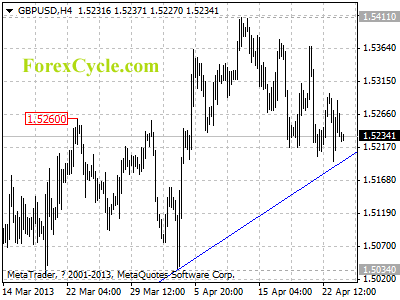
GBPUSD is facing trend line support

GBPUSD is facing the support of the upward trend line on 4-hour chart, a clear break below the trend line support will suggest that the upward movement from 1.4831 had completed at 1.5411 already, then the following downward move could bring price to 1.4500 zone. On the upside, as long as the trend line support holds, the uptrend could be expected to resume, and one more rise towards 1.5600 is still possible. Resistance is at 1.5335, a break above this level could signal resumption of the uptrend.

gbpusd

Daily Forex Analysis

How Confirmation Bias Could Ruin You

By MoneyMorning.com.au

I enjoy using Twitter.

For those who aren’t aware, Twitter is a website that lets you broadcast your thoughts to the world in 140 characters. More importantly, it lets you follow other people who might be saying interesting things, or linking to interesting articles.

It’s great for keeping abreast of breaking news, and sending messages to other users.

But can it make you a better investor?

Can Twitter Make You Money?

The FT’s Gillian Tett recently took a look at the results of a new study from Massachusetts Institute of Technology. Academics Sandy Pentland and Yaniv Altusher looked at how social media (such as Twitter) affects investment performance.

The researchers looked at the ‘eToro’ trading platform. This allows traders not only to chat about markets, but also to watch each others’ trades, and even copy them, if they wish.

The upshot of the study was that the best investors were those who ‘received information from a wide range of social groups — and copied a range of gurus — performed 10% better than ‘normal’ traders.’ They also did better than ‘traders following one or two gurus.

In short: ‘maintaining diverse social ties — and swapping information with several different crowds — tends to raise returns.

So should even the most technophobic investor be rushing out to sign up to Twitter and Facebook?

Of course not. Investors should be very picky about the information they consume. If anything, most of us should be consuming less news and information. It’s all too easy to be tempted to over-trade when you’ve got headlines screaming at you from every direction.

The Real Lesson from Social Media

However, the study does highlight a key psychological threat that every investor should be aware of: ‘confirmation bias’.

Human beings like to feel in control of their environment. It’s a survival mechanism. We form theories and look for patterns so that we can navigate an uncertain world with some sense of confidence that we’re making the right decisions. If we didn’t have this instinct, we’d spend most of the day sitting on the sofa, paralysed by indecision.

The trouble is, it’s very easy to get wedded to the illusion of certainty. It takes a lot of effort to build a world view that we feel comfortable with. So we hate it when our way of looking at things is challenged. Particularly if incorporating the new information would mean having to change our minds about a view that has proved useful in the past.

The discomfort we feel when we can’t incorporate a piece of information into our existing world view is called ‘cognitive dissonance’. It’s an unpleasant sensation — like an itch you can’t scratch. So it’s something that we all try to avoid.

We stock up on arguments to defend our views, and attack the opposing view. And sometimes, if we can’t give a well-argued answer to a point, we’ll resort to distraction tactics or personal attacks.

You only have to look at how defensive people get when discussing politics or religion to see this in action. Ever wanted to chuck a brick through the telly when you’re watching Question Time? (Who hasn’t?). That’s cognitive dissonance for you.

In short, we’d rather be proved right than proved wrong. So we seek out information and views that confirm our own take on things, and ignore information that contradicts it. This is ‘confirmation bias’ in action. And the higher the stakes, the more prone we become to it.

This is a big problem for investors. Because when we invest, we are backing our opinions with money. So the stakes are high.

Two Ways to Deal with Confirmation Bias

What can you do about this? The first solution is to seek out views that oppose your own before you invest. A key part of disciplined investing is to write down your reason for investing in a stock or any other asset before you do so. That way, you have a record of your thought process, which can help a lot when it comes to deciding whether to sell, or add more to a position.

But another good exercise is to try to make the case for doing the opposite of what you’re doing. So if you plan to buy a stock, try to make the case for shorting it. Write down all the reasons why this stock is going to tank, and why anyone who shorts it will make a fortune.

If you end up being more convinced by the ‘short’ story than the ‘long’ case — then maybe you shouldn’t be investing in that particular stock.

That might sound like a lot of work. But really, thinking about it, it’s not a lot more effort than you’d put into buying a new car or even a new TV. Given the amount of money that you’re probably putting at stake, you should be thinking these decisions through before you make them.

But there’s a second part to this, which is to build a portfolio that doesn’t depend on any given world view being ‘correct’. This is the secret behind diversification: making sure you don’t have all your eggs in one basket.

In effect, you want to ‘future proof’ your portfolio so that regardless of what happens in the future, you have a better chance of riding disasters out with minimal losses.

John Stepek
Contributing Writer, Money Morning

Join Money Morning on Google+

Publisher’s Note: This article originally appeared in MoneyWeek

From the Archives…

Why Waste Your Time on Gold When You Can Invest in Dividend Stocks?
19-04-2013 – Kris Sayce

A Trader’s Eye View of Gold’s Frightening Collapse
18-04-2013 – Murray Dawes

Why You Should Buy ‘Dirty, Grimy’ Gold Stocks
17-04-2013 – Dr. Alex Cowie

Why this Historic Fall in the Gold Price Equates to a Historic Opportunity
16-04-2013 – Dr. Alex Cowie

Beware the ‘Safety Bubble’, But Don’t Sell Dividend Stocks Yet
15-04-2013 – Kris Sayce

Netflix Crushing it After Earnings ResultsNetflix Crushing it After Earnings Results

By WallStreetDaily.com

wistiaEmbed = Wistia.embed(“lbop0yzi83”, {
version: “v1”,
videoWidth: 525,
videoHeight: 295,
volumeControl: true,
controlsVisibleOnLoad: true,
endVideoBehavior: “reset”,
plugin: {
“socialbar-v1”: {
buttons: “embed-twitter-facebook”,
logo: true,
badgeUrl: ” http://www.wallstreetdaily.com/wallstreet-research/leadgen/videolg.php”,
badgeImage: “http://embed.wistia.com/deliveries/eec4bb06bdd7e8a1b9856178a39f61a1ec3620fc.jpg?image_crop_resized=100×20”
}
}
});

 
Netflix (NFLX) is crushing it today!

The stock is up over 20% after the company reported better-than-expected results on Monday.

Earnings are up now that the company racked up two million new customers for its streaming video service in the United States. And it added another million from markets outside U.S. borders.

Shares are now trading for $218 – a far cry from its 52-week low of $52.

Article By WallStreetDaily.com

Original Article: Netflix Crushing it After Earnings ResultsNetflix Crushing it After Earnings Results

Currencies for the Stock Investor

By The Sizemore Letter

If you’ve ever wanted to lose your hair, develop a stomach ulcer and put yourself at risk of an early heart attack, I have a recommendation for you: trade currencies!

I say this (mostly) in jest, but currencies are an area that a lot of investors find baffling.  With stock market investments, you have something at least semi-tangible to analyze.  You’re looking at companies with assets and, hopefully, streams of income coming down the pipeline.  If you are a value investor, it simply becomes a game of paying a reasonable price for those assets and the income you expect them to generate.  And I could make very similar comments for bond interest, real estate rental income, and any number of other investments.

But currencies?  How do you determine what a “reasonable” price for a currency is?  You can get academic, and use some variation of a purchasing power parity model.  Or, you could a rule-of-thumb approach like the Big Mac Index, developed by The Economist, which ranks currencies based on the price of a McDonalds Big Mac translated into dollars at current exchange rates.

You could, of course.  But there is a big problem with using a model like these: they don’t work, or at least not on any reasonable timeframe.

In fact, currency moves are often completely contrary to what we learned in business school.  The principal of interest rate parity tells us that it is impossible to consistently profit from the “carry trade,” or selling low yielding currencies and using the proceeds to buy high-yielding currencies.

Whatever you gain in extra yield you lose in currency depreciation.  Or so the theory goes.  But in practice, the complete opposite is true.

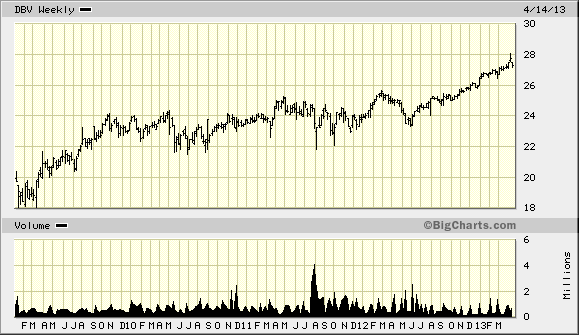
DBV

Take a look at the stock chart for the PowerShares DB G10 Currency Harvest ETF (NYSE:$DBV).  This ETF generates market-like returns by shorting the three lowest-yielding currencies of major industrialized countries and investing the proceeds in the three highest-yielding.  The strategy has delivered nearly 60% returns since 2009.

This carry-trade strategy doesn’t always work; when the market goes into panic mode and leveraged investors rush to close out their trades, years of gains can be wiped out within days.  But it shouldn’t work at all.  And yet it does…

Investors can experiment with strategies like these with whatever portion of their portfolio they dedicate to alternative investments.  The same is true of managed futures strategies, though this needs a little explanation.  There are plenty of professional and amateurs out there that generate decent and consistent returns trading currencies, and their returns are often times uncorrelated to the stock market.

But this is a particular skill that I have never seen anyone learn from a book, an article, or from a shrink-wrapped kit sold on a late-night infomercial.  From what I can see, some traders have something of an intuition here.  I don’t have it.  And chances are good that you don’t either.  There is nothing wrong with allocating a small portion of your alternatives portfolio to an active currency trading strategy.  But be honest with yourself about your trading abilities.  And if you use a manager, make sure you are comfortable with his or her track record.

What about more conservative investors?  Can currencies play a role in their portfolios as well?

Absolutely.  I only makes sense to diversify your cash savings among several world currencies if your bank or broker will allow you to.  The same is true of foreign currency bonds.  But remember, unless you have extensive business or personal commitments abroad, it makes sense to keep the bulk of your savings in the same currency as your living expenses.  Doing otherwise isn’t investing; it’s gambling.

Getting back to the stock market, currencies get very complicated very fast.  I regularly recommend and buy shares of foreign-domiciled companies.  In fact, my entry in the 2013 InvestorPlace Best Stocks contest was German automaker Daimler AG ($DDAIF), the maker of the Mercedes Benz.

A drop in the euro would be bad for American investors in Daimler because its stock price would be translated at a lower exchange rate, right?

Well…sort of.  But Daimler sells roughly two thirds of its cars outside of the Eurozone…so a falling euro means that foreign revenues translate into euros are worth more…though it also means production costs from overseas dig deeper into margins…unless the company treasury is hedging its currency exposure…

You can think yourself into a circle when you ponder currency effects too long.  Currencies do matter, particularly in the case of emerging markets, but in most cases business fundamentals matter far more.  Barring a currency collapse—which I believe may be a real possibility in Japan in the near future—you don’t need to spend an inordinate amount of time researching them.

Sizemore Capital is long DDAIF

SUBSCRIBE to Sizemore Insights via e-mail today.

Hungary cuts rate for ninth time and signals further cuts

By www.CentralBankNews.info     Hungary’s central bank cut its base rate for the ninth time in a row, as expected, to 4.75 percent and said it would consider further rate cuts if the outlook for inflation remains in line with the bank’s target and sentiment in financial markets remains positive.
    The guidance by the National Bank of Hungary signals that it will continue the easing cycle that it started in August 2012. Since then, the central bank has cut it key rate by 225 basis points and by 100 basis points this year alone.
    The central bank expects Hungary’s economy to resume growing this year, helped by better exports, but the level of output remains below its potential and unemployment above its long-term level.
    “The council expects weak demand conditions to persist, which will ensure that inflationary pressures in the economy remain muted in the period ahead,”the bank said, adding that the decline in inflation confirms that weak demand is exerting a strong downward pressure on prices.
    Hungary’s inflation rate fell to 2.2 percent in March, down from 2.8 percent in February and the seventh month in a row with declining inflation since a recent peak of 6.6 percent in September last year. It was the lowest inflation rate observed since September 1974.

    The central bank, which targets inflation of 3.0 percent, said inflation is likely to remain below its target throughout this year and settle close to the target in 2014.
    Hungary’s Gross Domestic Product contracted by 0.9 percent in the fourth quarter from the third quarter, the fourth consecutive quarterly contraction. On a year-on-year basis, the economy shrank by 2.7 percent from the fourth quarter of 2011.
    Consumer demand is expected to remain modest in the period ahead with consumers behaving cautiously and keeping the savings rate high due to increased uncertainty about the economic environment and a protracted process of reducing debt.
    Last month the central bank said it would consider further rate cuts if inflationary pressures remain moderate and largely repeated this forecast today.
    “The Council wil consider a further reduction in the policy rate if the medium-term outlook for inflation remains in line with the Bank’s 3 percent target and the improvement in financial market sentiment is sustained,” the bank said.

    www.CentralBankNews.info

Many Currency Pairs Have Range Trading Due to Low Liquidity

Many Currency Pairs Have Range Trading Due to Low Liquidity

EURUSD – The EURUSD Remains in Narrow Range

eurusd23.04.2013

The EURUSD was lowly decreasing towards the 30th figure first, then – to the level of 1.3015. Afterwards, it started increasing to the resistance at 1.3070 and dropped back to 1.3033 during the Asian session. The first day of the new trading week turned out to be like this, and there happened nothing new to the EURUSD pair. It remains in a narrow range, which will surely be broken, but hardly anyone knows the time period and the direction as well. It is indisputable that if the euro passes the support at around 1.3000, the rate will decrease towards the 29th figure. If the bulls make their way above 1.3070-1.3100, their chances to test the 1.3200 level will be dramatically increased.


GBPUSD – The GBPUSD Trading Below Figure 53

gbpusd23.04.2013

The GBPUSD managed to consolidate above 1.5200 and increase to 1.5297 due to the EURGBP decrease. As long as the pair is trading below 1.5300, its increase does not change anything — that is, the downwards risks remain. This has been evidenced by the Parabolic SAR, which is located above the price chard on the 4-hour chart and is coloured in red. However, if the pound can form the bottom above the 52nd figure, the upward correction may be continued.


USDCHF – The USDCHF Scores About 55 Points

usdchf23.04.2013

The USDCHF dynamics was no less boring — the par has passed for about 55 points in the upward direction. After it reached the level of 0.9370, it rebounded to 0.9340. The increase was due to the low activity and low volumes as well, thus you can draw a parallel with the non-alcoholic beer: the stomach is not only full of it, but there is no use of it at all. The key stage for the pair at the moment is the 93rd and the 94th figures, whose passing will set the future direction of the movement in the USDCHF.


USDJPY – The USDJPY Retreats from Figure 100 Again

usdjpy23.04.2013

Another hike to the 100.00 level for the USDJPY bulls was not successful again, and they were forced to retreat to 98.58. But is not necessary to talk about the bulls’ backdown, of course, at least as long as the pair has comfortably consolodated above 98.53-98.00. But in case of the pair’s decrease below the latter level, the bears will manage to test the support at 97.20 – it will be able to weaken the bulls’ strength and power as well. However, the 100th figure clearly attracts the dollar buyers and the Japanese yen sellers as well, thus another testing of this level looks very likely.

provided by IAFT


“Gold Rush” in China “Biggest in Half a Century” But ETFs Still Liquidating

London Gold Market Report
from Ben Traynor
BullionVault
Tuesday 23 April 2013, 07:45 EST

WHOLESALE gold bullion prices rallied back above $1420 an ounce Tuesday morning in London, having earlier dipped back towards where they started the week following yesterday’s 2% jump amid what one Hong Kong dealer suggested was the biggest rush to buy gold in half a century.


Silver meantime climbed back above $23 an ounce by lunchtime after it too fell in early trading, though unlike gold it was down slightly on the week so far.


European stock markets ticked higher in spite of earlier losses in Asia and disappointing purchasing managers’ index data, while commodities fell and US Treasuries gained.


On the currency markets the Euro fell to a two-week low against the Dollar, while Euro gold prices were trading just below €1100 an ounce by lunchtime, the level breached briefly yesterday for the first time since last week’s price drop.


The world’s largest gold exchange traded fund SPDR Gold Trust (ticker: GLD) continued to see net outflows Monday, with his holdings ending the day down more than 18 tonnes at 1104.7 tonnes.

Since the start of 2013, the volume of gold held to back GLD shares has dropped nearly 20%.


In China by contrast, “physical gold dealers and jewelry makers have had to replenish their inventory following robust sales,” according to Song Heping, assistant manager at Xiamen City Commercial Bank.


On the Shanghai Gold Exchange, the equivalent of 40.6 tonnes was traded in the benchmark ‘four nines’ spot contract (for gold of 99.99% purity) Tuesday, down a little from yesterday’s record of 43.6 tonnes. By comparison, the previous record, set on February 18 this year immediately after the week-long Lunar New Year holiday, was 22 tonnes.


“Physical markets have responded to the much cheaper gold price levels,” says UBS precious metals analyst  Joni Teves.


“Our physical flows to Asia have been particularly elevated this week.”


“In terms of volume, I haven’t seen this gold rush for over 20 years,” says Haywood Cheung, president of the Hong Kong Gold & Silver Exchange Society, quoted by the Financial Times.


“Older members who have been in the business for 50 years haven’t seen such a thing.”


Dealers in Hong Kong Tuesday reported gold bars selling at premiums over the spot price not seen for eighteen months, citing supply constraints for physical bullion.


Growth in China’s manufacturing sector meantime has slowed this month, according to the provisional HSBC purchasing managers’ index published Tuesday, which also reported falls in new export orders and employment.


Over in Europe, German manufacturing PMI has fallen further below 50, the threshold between conditions seen as improving or getting worse, provisional data published this morning show, while German services PMI fell from 50.9 to 49.2.


For the Eurozone as a whole, manufacturing PMI fell from 46.8 to 46.5, provisional figures show. Eurozone government debt-to-GDP rose to 90.6% in 2012, up from 87.3% the previous year, figures published Monday show.


The policy of cutting budget deficits being implemented by many European governments, known as austerity, “is fundamentally right [but] has reached its limits in many aspects,” Jose Manuel Barroso, president of the European Commission, said yesterday.


“A policy to be successful not only has to be properly designed. It has to have the minimum of political and social support.”


In the UK meantime, public sector net borrowing for the fiscal year ended March fell to £120.6 billion, a drop of 0.2% from the previous year. First quarter UK GDP figures are due to be published Thursday.


Ben Traynor

BullionVault


Gold value calculator   |   Buy gold online at live prices


Editor of Gold News, the analysis and investment research site from world-leading gold ownership service BullionVault, Ben Traynor was formerly editor of the Fleet Street Letter, the UK’s longest-running investment letter. A Cambridge economics graduate, he is a professional writer and editor with a specialist interest in monetary economics. Ben can be found on Google+


(c) BullionVault 2013

Please Note: This article is to inform your thinking, not lead it. Only you can decide the best place for your money, and any decision you make will put your money at risk. Information or data included here may have already been overtaken by events – and must be verified elsewhere – should you choose to act on it.


Central Bank News Link List – Apr 23, 2013: Central Bank of Russia is to further cut interest rates

By www.CentralBankNews.info

Here’s today’s Central Bank News link list, click through if you missed the previous link list. The list comprises news about central banks that is not covered by Central Bank News. The list is updated during the day with the latest developments so readers don’t miss any important news.

Stand By for the Recession Rally in Resource Stocks: Take Two

By MoneyMorning.com.au

‘KAPOW!’

‘SOCK!’

‘THWAPP!’

It’s like a Batman comic out there. Resource investors are getting belted from all sides.

I’d be dishonest if I said it was a laugh a minute.

First we had the once in 33-year fall that saw gold down by 14% in two days. Gold stocks fell off a cliff.

And then the resource sector tanked by 8%.

This all comes on the back of two long years of falls.

But there are always two sides to the same coin. So here’s the good news: The mining sector is now back to where it was in the GFC!

And last time it was down at these crisis levels…mining stocks started a 2.5-year bull market that saw the resource sector index gain 124.2%. Even better, smaller stocks gained far, far more than that.

Yet no one is thinking of the chances of that today. Fear is in control.

But like investing legend Buffett says, ‘Be greedy when others are fearful.’ And from where I’m standing, it will soon be a great time to be greedy…

Maybe it’s not your natural instinct to be bullish on mining stocks  right now.

And fair enough. After two years of falls, it’s not my natural instinct either.

But take a look at the chart…

Resource Sector — Back to Foundation Valuations


Source: bigcharts

I’ve circled where we are today.

You’ll see I’ve also circled the range it traded in during the GFC.

It’s hard to believe we’re back at GFC valuations again…but here we are…it’s incredible stuff.

Last time investors had the courage to go against the herd and buy at this level, they made life-changing amounts of money.

You have to take off your hat to those investors that stepped up the plate and went shopping for smashed up stocks in those darkest of days. The old saying goes ‘buy when there is blood on the streets’. But it’s easier said than done when it comes to it…when you’ve got real money on the line.

Back then they bought when the US economy was contracting at 4.6%, Chinese growth had collapsed from double digits to 6.2%, iron ore was at just $60/tonne, and copper was down to $3,000/tonne.

But don’t feel sorry for them. They saw the index gain 124%.

And the bravest investors who picked up the quality small-caps did FAR better than that.

In late 2008 you could have picked up copper explorer Sandfire Resources (ASX: SFR) for 6.5 cents. It had traded at $1.00 two years before that. So you would have been buying a cash starved small-cap that had already fallen 93%, and doing so during a full market capitulation.

Not the traditional investing approach, admittedly. But those that looked past the price, to the copper project the company was sitting on, went on to make 12,300% in the next two years as resource stocks recovered and Sandfire soared from 6 cents to $8.00 on its own merits.

It was the same story with Ampella (ASX: AMX), a gold explorer that was on hard times as the market crashed in late 2008. Gold had fallen 30% and gold stocks were particularly low. Cash was about to run out and the share price was down to just 6.5 cents. Bleak indeed. Yet some investors bought as they could get, and two years on, their Ampella stock had gained 5,800% to reach $3.42.

With the resource sector back at GFC valuations, it’s time to start positioning for these kinds of opportunities.

How to Pick Through the Market

If you can sort the wheat from the chaff — and pick the genuine contenders from the useless pretenders — then there is a massive opportunity brewing for you.

Possibly a better one…because the market is more on your side today than in 2008:

  • China’s growing at a chunky 7.7%, compared to 6.2%.
  • The US economy is at a modest growth rate of +1.7% but compare that to the -4.6% back in the GFC.
  • Iron ore is $140/tonne compared to $60 back then.
  • Copper is $7,000/tonnes compared to $3,000.

Cash will be essential.

By this I mean cash on the company’s balance sheet. Until they start producing, which can take years to achieve, mining juniors are money pits. With little cash on offer today, and management reluctant to raise cash at these levels, cash balances are running very low.

I ran the numbers. As of the December quarterly reports, the average small-cap was running on a song and a prayer. For the 415 resource stocks with a market cap under $20 million, the average cash balance is down to just $2.2 million, and is burning $0.9 million per quarter.

In other words, without a top up, the average sub 20 mil stock would run out of cash by September.

Bear in mind that was for the December quarter…soon we get the March quarterlies, and I’d expect the numbers to have got a lot worse.

So picking small-cap stocks to leverage a resource recovery won’t just mean picking the right projects, management and jurisdictions, but also looking very closely at the cash balance too. Ideally you want a stock that has a few years-worth of cash, though these are hard to find.

Of course, part of the reason that stocks turned up so sharply in late 2008 was monetary stimulus. In November 2008, the Fed started QE1, which would at first buy $600 billion in securities, and China unleashed a $586 billion stimulus package.

Fast-forward almost five years and not much has changed. Except in 2013, Chinese stimulus is in the form of lending — US$1 trillion worth was lent out in the first quarter of 2013 alone.

And the big growth in central bank balance sheets is from Japan’s new program to buy $75 billion of securities a month til the end of 2014…this on top of the Fed’s current $85 million a month program.

There is a great deal of capital moving into the markets, as there was in late 2008.

In so many ways the market is just the same as it was back then. Resource stocks are hugely oversold after capitulation-driven falls. The mood is intensely bearish. Cash is tight, and many stocks with the right stuff are trading at single digit prices. And to complete the recipe, we have a torrent of liquidity heading towards the market.

I won’t say that the market will turn up soon. It could fall further, and a bottom could take 3–6 months to form, but once that is done, we have all the pieces in place for these deeply unloved juniors to be many times higher  in a few years than they are today.

Dr Alex Cowie
Editor, Diggers & Drillers

Join me on Google+

Ed Note: With Aussie small-cap miners back to 2008 lows it’s easy to say the worst is over. But Doc Cowie says more falls could be on the cards. In today’s Money Morning Premium Notes, Kris focuses on a stock that could give investors a clue about the next move for the Aussie resource sector. To find out more, click here to upgrade now.

From the Port Phillip Publishing Library

Special Report: TORRENT SIGNAL 3

Daily Reckoning: The Cracks in Solidarity at the Recent G20 Gabfest

Money Morning: A New Take on Hard Asset Investing

Pursuit of Happiness: Booze, Watches and Fancy Pens — the Alternative Retirement Plan

Apple: Cash or Trash?

By MoneyMorning.com.au

With Apple Inc. off nearly 50% from its US$705.07 a share high set last September, many investors want to know if it’s a buy.

Not in my book. Here’s why:

1. The company has held on to its premium pricing strategy for too long. Going out on price as it has recently with iPhones, for example, is the death knell of competitive differentiation. Businesses that engage in price wars have a very difficult time climbing back up the proverbial ladder.

2. The present management team is having trouble fulfilling the late Steve Jobs’ vision, and execution appears to be stumbling. The Maps thing, for instance, was an unmitigated disaster and shattered Apple’s image of invincibility. The public noticed.

3. Apple has lost its ‘head start’. The company used to be one to four years ahead of everybody else with every aspect of its design, function and software, especially when it came to iPads and iPhones. Now they’re lucky to have six months…if that. Apple owned the vanguard in devices. Now it’s simply one choice among many.

4. Consumers no longer feel the need to upgrade every time something new comes out. Better, bigger, and cheaper smart phones from Samsung, HTC and other makers have displaced the ‘gotta have it’ drive for everyday people. Diehards and early adopters will never change; it’s just that their numbers have gotten smaller as the numbers of those seeking utility have gotten larger.

The Changing Landscape at Apple

Translation?

Increasing earnings pressure and diminished value in the years ahead.

Apple is doomed to go the way of Intel Corp. (Nasdaq: INTC) and Microsoft Corp. (Nasdaq: MSFT). Both are quality companies, as is Apple, yet both struggle to produce anything even remotely resembling excitement and are trapped in their own legacy. My good friend Barry Ritholtz put it succinctly on Tech Ticker: ‘Apple is transitioning from a growth stock to a value stock.’

The other thing to remember about Apple is it now oozes MBAs, whereas it used to ooze innovation. No doubt Apple’s business managers are plenty smart, but they’ve become more cautious, too.

Jobs enjoyed — even relished — a certain sense of creative recklessness, and I think that’s gone. Apple doesn’t seem to embody the same entrepreneurial energy it once had, at least to me anyway.

Anecdotally, I personally shifted from iPhones and iPads to Droid power this year. The price points were better when my team needed new equipment, and the developer market seems deeper. I miss the dependability of my iPad, but not enough to go back.  I can’t imagine I’m alone.

We still run a few Apple boxes in our office, but most of the time those are in parallel with Windows emulators because that’s where the financial software we need to do our research runs best.

Apple lovers will no doubt take issue with what I have to say and I respect that…Apple is a great company making great products. I just don’t think it’s a great investment at the moment.

The Apple TV and wristwatches everybody seems to be placing hopes on are non-starters. Consumer purchasing patterns reflect slowing big ticket item buying behaviour and tech weariness across the board as the financial crisis and ‘recovery’ wear on.

Besides, I can talk into my smart phone. Why do I need to talk into my wristwatch, too? If anything, I increasingly want to disconnect from all this technology that the twenty-somethings tell me will improve my life.

Big Problems in China

Admittedly, I once thought China would pick up the pieces if Apple dropped from the tree, but now I am not certain. A lot has changed there in Apple’s world.

It’s not that the Chinese don’t love Apple. They do. So much so, in fact, that knockoff artists even created a chain of fake Apple stores so real that employees thought they were working for Cupertino.

But the company has had its share of labour problems and those don’t seem to be going away anytime soon. If anything, they’re worsening.

That’s led to quality control issues and an unprecedented apology from CEO Tim Cook to the Chinese people covering both shoddy repairs and warranty policies.

Never mind that what prompted Cook’s apology was a ring of Chinese customers substituting fake parts, declaring they don’t work, then submitting the phones for replacement and using the repaired phones to build entirely new iPhones for the black market.

Beijing is currently cracking down on Apple’s App Store, citing objectionable content, including porn and illegal publications. It’s also targeting Apple’s operations, especially its servers, which are located outside China and therefore a censorship issue for China’s infamous ‘Great Wall’ security network. This reminds me of the Google situation a few years ago.

Reading between the lines, I think there’s a ‘full court press’ on.

China has been increasingly reliant on Droid-based technology for the past few years. Whereas Beijing once viewed that as a plus, they increasingly view that as a liability. So they’re going to undermine the top dog (i.e. Apple) in an attempt to create more competitive elbow room for home-grown companies like Lenovo and Huawei.

Apple’s penchant for secrecy isn’t helping much, and the company has been eviscerated by obviously planted stories in that nation’s national media about customer discrimination, corporate hijinks and patent challenges.

Team Cupertino is also defiant. Let’s not forget that Apple pulls down approximately $1 billion a week. It’s only natural now that Beijing’s figured out how much this has ‘cost’ their manufacturing base — and they want a bigger piece of the action.

Apple historically has not cut the pie. And, unless they learn to do so quickly, rising Chinese nationalism may undermine Apple’s leadership position on top of its profits.

Finally, what about all that cash?

Apple’s got an estimated $150 billion in the bank. Columnist Henry Blodget — yes, that Henry Blodget who famously got banned from the securities business for issuing a glowing recommendation of Apple while privately referring to it in an email as a P.O.S. — makes the case that you could effectively buy the company today for less than $390 billion, wait a few years and essentially own everything free and clear.

I don’t disagree…what I have a problem with is that I don’t think Apple’s earnings are going to support the equation needed to meet Blodget’s expectations.

Higher fixed costs + higher manufacturing costs + lower pricing = lower margins and lower earnings.

No…I would not buy Apple.

Keith Fitz-Gerald
Contributing Editor, Money Morning

Join Money Morning on Google+

Publisher’s Note: This article originally appeared in Money Morning USA

From the Archives…

Why Waste Your Time on Gold When You Can Invest in Dividend Stocks?
19-04-2013 – Kris Sayce

A Trader’s Eye View of Gold’s Frightening Collapse
18-04-2013 – Murray Dawes

Why You Should Buy ‘Dirty, Grimy’ Gold Stocks
17-04-2013 – Dr. Alex Cowie

Why this Historic Fall in the Gold Price Equates to a Historic Opportunity
16-04-2013 – Dr. Alex Cowie

Beware the ‘Safety Bubble’, But Don’t Sell Dividend Stocks Yet
15-04-2013 – Kris Sayce