By www.CentralBankNews.info
A return to normal economic conditions after years of quantitative easing is likely to be volatile for financial markets as investors adapt to rising interest rates, according to Stephen Cecchetti, senior economic adviser at the Bank of International Settlements (BIS).
After disappointing U.S. economic data between mid-March and mid-April, signs of economic growth have improved since early May and sentiment among investors has become more optimistic, Cecchetti told journalists in connection with the release of the latest BIS quarterly review.
While volatility in financial markets is normal and part of the adjustment to new information, Cecchetti warned that it also carries risks due to the large amount of bonds that are now owned by financial institutions, households and firms.
“The ride to normality will almost surely be bumpy, with yields going trough calm and volatile periods as market participants digest sometimes conflicting news about the recovery,” Cecchetti said.
Last week the yield on the benchmark U.S. 10-year Treasuries rose to over 2.2 percent from 1.6 percent in early May, a move that is hardly a surprise as interest rates rise as the economy recovers.
But financial institutions and other investors now hold large amounts of interest-sensitive assets on their balance sheets and they are facing potential losses.
“With the outstanding volume of government bonds greater than ever, interest rate risk – expressed as potential losses in relation to GDP – is at a record high in most advanced economies,” Cecchetti said.
Economists have estimated that total outstanding debt has exploded by some $34 trillion since the eruption of the global financial crises in 2007 as authorities have fought to stimulate economic growth. It is estimated that central banks have taken about $10 billion of debt onto their balance sheets, leaving some $25 trillion in newly-issued debt that is held by financial institutions, households and firms.
While sophisticated hedging strategies may shift this interest-rate risk from some banks to other institutions, it won’t completely eliminate the risk and there will be widespread losses, he warned.
The best way to guard against the possible disruptions to financial markets and economic growth is high capital buffers and robust balance sheets, Cecchetti added.
New credit gauge warns of impending crises – BIS review
By www.CentralBankNews.info A boom in credit usually foreshadows a financial crises but authorities failed to spot the build-up in total credit from the late 1990s through 2006 because they were looking the other way, according to an article in the latest quarterly review from the respected Bank of International Settlements (BIS).
While authorities were busy looking at lending by domestic banks, which only rose slowly, credit created by foreign institutions and non-banks – the so-called shadow banking sector that includes pension funds, mutual funds, hedge funds, and insurance companies – exploded.
“A new BIS database reveals, for example, that banks may provide as little as 30% of total credit to the private non-financial sector, as is currently the case in the United States,” said the article by senior BIS economist Mathias Drehmann.
The database, which captures all sources of credit regardless of source or origin, provides more information than the traditional measurements of bank credit and is therefore useful as an early warning indicator for financial crises, Drehmann finds.
That finding has very practical implications for banks as the Basel III global rules include countercyclical capital buffers that are based on a credit-to-GDP gap, but they don’t specify how national banking regulators should calculate that gap.
The article finds that the BIS database meets the Basel guidelines for measuring such a gap. Regulators can therefore use it to ask banks to set aside more funds as a buffer against possible losses when there are signs that the credit-to-GDP gap is exceeding critical thresholds.
Testing the validity of the measurements for total credit-to-GDP versus bank credit-to-GDP on the U.K., Drehmann found that the bank gap measure did not signal any large build-up in credit ahead of the global financial crises.
“In contrast, the total gap clearly captured the run-up in credit from the early 2000s onwards,” as it reflects the role played by non-bank funding, such as securitization, the main driver behind the explosion in credit.
The development of the database and the early warning indicator is part of the BIS’ focus in recent years on filling the gaps that were so glaringly exposed by the financial crises.
Not only were authorities looking in the wrong direction of credit generation, and mainly focused on keeping inflation under control, they didn’t have the right tools to spot the flashing red lights.
The latest BIS quarterly review makes further, practical progress in forging such new tools.
In addition to Drehmann’s article, which proposes how authorities can avoid being blindsided in the future, the review includes articles on how to spot systemically important institutions and how to tackle the failure of a too-big-to-fail financial institution.
The article by Chen Zhou of the Netherlands central bank and Nikola Tarashev of the BIS, looks to gauge the systemic importance of individual banks during financial crises.
Given the relative rare event of financial crises, the authors use tools from so-called extreme value theory with measurements of bank size and probability of default.
The authors find that the more systemically important banks tend to be larger, more leveraged and more active in interbank markets.
In contrast, the banks that are less systemically important tend to have a higher share of net interest income in total income, resort more to stable sources of funding and have lower operational costs.
A third article in the BIS review proposes a practical model for recapitalizing major banks that have failed or are at the brink of failure, an issue that was highlighted in Cyprus when authorities initially asked insured bank depositors to share some of the burden of rescuing the banking system.
Policy makers worldwide are currently working on how to make sure that the failure of a major bank, the so-called too-big-to-fail banks, doesn’t threaten to bring down entire economies, as occurred during the global financial crises in 2007-2009.
The article by Paul Melaschenko, and Noel Reynolds proposes a recapitalization mechanism for such too-big-to-fail banks that ensures that shareholders and uninsured private sector credits, rather than taxpayers bear the cost of resolution.
The mechanism is simple, respects the existing creditor hierarchy, can be applied to any part of a bank, and can be carried out during a weekend, the authors write.
Forex Weekend Update & Outlook: USD Specs bets up to $43.77 Billion
Forex Weekend Update & Outlook: USD Specs bets up to $43.77 Billion
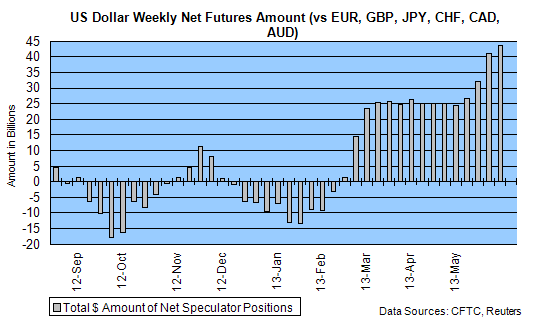
The weekly Commitments of Traders (COT) report, released on Friday by the Commodity Futures Trading Commission (CFTC), showed that large futures traders continued to add to their total bullish bets of the US dollar again last week. Total US dollar long positions have risen for four consecutive weeks and are at a new high level since 2008 when Reuters started calculating total amount of positions, according to Reuters.
Non-commercial large futures traders, including hedge funds and large International Monetary Market speculators, raised their overall US dollar long positions to a total of $43.77 billion as of Tuesday May 28th. This was an increase from the total long position of $41.0 billion registered on May 21st, according to position calculations by Reuters that derives this total by the amount of US dollar positions against the combined positions of euro, British pound, Japanese yen, Australian dollar, Canadian dollar and the Swiss franc.
See the full COT report & charts here…
US Dollar had Mixed Week vs Major Currencies

The US dollar had mixed results last week against the other major currencies in the foreign exchange trading markets. The greenback continued its ascent against the commodity currencies (Australian dollar, New Zealand dollar, Canadian dollar) while falling against the European currencies (euro, British pound sterling, Swiss franc) and also declining against the Japanese yen for a second straight week.
This week’s fundamental calendar is full of important economic events with a major focus on Friday’s US nonfarm payrolls report while there is also three interest rate decisions (Australia, euro zone, United Kingdom) for the markets to digest.
See the full Technical Currency Pairs post and charts here…
Upcoming Week’s Economic Events Highlights:
Monday, June 3
United States — ISM manufacturing
China — PMI
Australia — retail sales
Tuesday, June 4
Australia — interest rate decision
Australia — current-account
United States — US trade balance
Wednesday, June 5
Australia — GDP report
euro zone — GDP report
United States — ISM nonmanufacturing
Thursday, June 6
UK — Bank of England — interest rate decision
euro zone — European central bank — interest rate decision
Friday, June 7
United Kingdom — trade balance
Germany — trade balance
United States — nonfarm payrolls report
United States — unemployment rate
Canada — employment change and unemployment rate
See our full economic calendar for more events.
Japan Stock Bubble Built on Money Printing Bursts; And Our Turn Is…
 It’s not a surprise the Bank of Japan is failing at quantitative easing. Is America really so different that it will succeed here? My decisive answer: NO!
The central bank of Japan took to repeated rounds of quantitative easing to spur growth in the Japanese economy. Its main goal: improve exports. By selling more to the global economy, the country thought it could witness economic growth.
But the Japanese economy is experiencing the opposite. In April, the Japanese economy’s trade deficit increased to $8.6 billion. This was the widest gap in April trade since 1979. (Source: Bloomberg, May 21, 2013.) Instead of exporting more, Japan is importing at a record pace!
And retail sales in the Japanese economy declined 0.1% in April, continuing their decline from March, when they declined 0.3%. (Source: RTT News, May 28, 2013.)
Simply put, the Japanese yen has become a victim of quantitative easing—but it hasn’t helped the Japanese economy export more as was initially hoped. Since the beginning of the year, the yen is down 16% compared to other major currencies, as depicted in the chart below.

Chart courtesy of www.StockCharts.com
Just as it is here in the good old U.S., the only economic indicator that seemed to be benefiting from the Japanese money printing was the Japanese stock market. Since the beginning of 2013, the Nikkei 225 index has gone up more than 30%…but now it’s dropping like a rock, as corporate profits have failed to materialize to sustain the rally.
Returning to the U.S. economy, the quantitative easing by the Federal Reserve here could have the same effect that quantitative easing had in the Japanese economy—nothing. The demand from consumers in the U.S. economy is weak. The revised estimates of the gross domestic product (GDP) for the U.S. economy as reported by the Bureau of Economic Analysis (BEA) yesterday edged lower to 2.4% in the first quarter of 2013. (The BEA previously reported an increase of 2.5%.)
According to the BEA, inventories in the private sector U.S. businesses have been increasing, reaching $38.3 billion at the end of the first quarter of 2013, compared to $13.3 billion in the fourth quarter of 2012.
Through quantitative easing, the Federal Reserve has printed a significant amount of new money. But will we face the same music here? Instead of having a lower currency spur exports, will currency devaluation backfire for the U.S. just as it did in Japan?
As I have been writing for months, quantitative easing (money printing) is a short-term fix, which if left running for too long, will cause bigger problems than those it was first intended to resolve!
We’re following in the Japanese economy’s footsteps. Massive money printing there failed to boost the economy and only created another stock market bubble that is now bursting—the U.S. will face the same fate.
Spain, the fourth-biggest economy in the eurozone, is showing us how troubles in the common-currency eurozone region are far from over.
The gross domestic product (GDP) of Spain contracted another 0.5% in the first quarter of 2013 from the fourth quarter of 2012, when it declined 0.8%. (Source: Bloomberg, May 30, 2013.) The Organization for Economic Cooperation and Development (OECD) just slashed its forecast for the Spanish economy and expects the unemployment rate in this eurozone nation to increase to 28%.
And adding to the worries…
The European Central Bank’s (ECB) assessment of the financial system in the eurozone suggested that due to the sharp economic slowdown in the region and a hike in bad bank loans, the risk of a further banking crisis is brewing. The ECB also commented that the weakest world banks were in the eurozone nations that have high unemployment and the most stressed housing markets. (No kidding!) (Source: New York Times, May 29, 2013.)
But it’s not just the small eurozone countries that are suffering; financially larger nations are experiencing an economic slowdown as well. Germany is begging for growth, and France is in a recession!
And austerity is failing miserably throughout Europe.
Consider Portugal, for example; it is experiencing a severe economic slowdown, and it expects to see its GDP contract in 2013 for the third straight year. This eurozone country has met all the requirements asked by those who bailed the nation out with more than $100 billion in cash. But exports to the country aren’t growing as much, and local demand hasn’t recovered. (Source: Wall Street Journal, May 27, 2013.)
The president of Portugal’s Supreme Court of Justice recently warned that the gap between the poor European nations and the richer ones will continue to widen unless Portugal and the other southern eurozone countries leave the common-currency region.
Note: there are political parties in countries like Portugal and Cyprus that have changed their opinions regarding their eurozone membership. Others in Italy want a referendum, two smaller parties in debt-infested Greece want out of the eurozone, and Germany is witnessing the rise of an anti-euro political party.
I realize I’m one of the few economic commentators who keep going back to these problems in the eurozone. I focus on them often because the eurozone troubles are not only unresolved and far from over, but they are also representing a huge risk to the global economy and, of course, a large risk to the U.S. economy. Many economists and the market in general are underestimating the repercussions of the eurozone mess.
What He Said:
“When I look around today, I see falling stock prices… I see falling house prices…and prices falling for retail goods stores. The media has it all wrong blaming (worrying about) inflation. In my opinion, the single biggest threat to the U.S. economy and to the Fed in 2008 is deflation. You can bet the Fed will expand the money supply and drop interest rates aggressively as deflation starts to rear its ugly head.” Michael Lombardi in Profit Confidential, December 17, 2007. Michael was one of the first to warn of deflation. By late 2008, world economies were embedded in the worst state of deflation since the Great Depression.
Article by profitconfidential.com
As the Situation in the Eurozone Only Worsens, the Concept of Austerity Has Proven a Bad Idea
Spain, the fourth-biggest economy in the eurozone, is showing us how troubles in the common-currency eurozone region are far from over.
The gross domestic product (GDP) of Spain contracted another 0.5% in the first quarter of 2013 from the fourth quarter of 2012, when it declined 0.8%. (Source: Bloomberg, May 30, 2013.) The Organization for Economic Cooperation and Development (OECD) just slashed its forecast for the Spanish economy and expects the unemployment rate in this eurozone nation to increase to 28%.
And adding to the worries…
The European Central Bank’s (ECB) assessment of the financial system in the eurozone suggested that due to the sharp economic slowdown in the region and a hike in bad bank loans, the risk of a further banking crisis is brewing. The ECB also commented that the weakest world banks were in the eurozone nations that have high unemployment and the most stressed housing markets. (No kidding!) (Source: New York Times, May 29, 2013.)
But it’s not just the small eurozone countries that are suffering; financially larger nations are experiencing an economic slowdown as well. Germany is begging for growth, and France is in a recession!
And austerity is failing miserably throughout Europe.
Consider Portugal, for example; it is experiencing a severe economic slowdown, and it expects to see its GDP contract in 2013 for the third straight year. This eurozone country has met all the requirements asked by those who bailed the nation out with more than $100 billion in cash. But exports to the country aren’t growing as much, and local demand hasn’t recovered. (Source: Wall Street Journal, May 27, 2013.)
The president of Portugal’s Supreme Court of Justice recently warned that the gap between the poor European nations and the richer ones will continue to widen unless Portugal and the other southern eurozone countries leave the common-currency region.
Note: there are political parties in countries like Portugal and Cyprus that have changed their opinions regarding their eurozone membership. Others in Italy want a referendum, two smaller parties in debt-infested Greece want out of the eurozone, and Germany is witnessing the rise of an anti-euro political party.
I realize I’m one of the few economic commentators who keep going back to these problems in the eurozone. I focus on them often because the eurozone troubles are not only unresolved and far from over, but they are also representing a huge risk to the global economy and, of course, a large risk to the U.S. economy. Many economists and the market in general are underestimating the repercussions of the eurozone mess.
What He Said:
“When I look around today, I see falling stock prices… I see falling house prices…and prices falling for retail goods stores. The media has it all wrong blaming (worrying about) inflation. In my opinion, the single biggest threat to the U.S. economy and to the Fed in 2008 is deflation. You can bet the Fed will expand the money supply and drop interest rates aggressively as deflation starts to rear its ugly head.” Michael Lombardi in Profit Confidential, December 17, 2007. Michael was one of the first to warn of deflation. By late 2008, world economies were embedded in the worst state of deflation since the Great Depression.
Article by profitconfidential.com
Equity Flux: The Stock Market’s Latest Problem
 Blue chips need a big retrenchment.
I never root for losses, but with equities having gone up so much, a correction would be beneficial from a technical perspective.
Action in the stock market and blue chips, specifically, has been spectacular this year. But it’s time for a break.
While history proves it’s not wise to fight the Fed or the ticker tape, the stock market is most definitely a leading indicator.
As a fan of dividend-paying blue chips, utilities and consumer staples are good multiyear investment themes. But being at their cyclical highs, I would not be a buyer right now. These stocks are frothy.
I think it’s probable this year that the U.S. economy will outperform other developed economies. I also see the formation of an equity universe, in which big investors are still buying blue chips.
Corporations do have to perform. But with excellent balance sheets among most blue chips, the stock market can finish the year higher than its current level (save for a shock).
The end of quantitative easing is slowly being priced into the stock market. While more news on the subject from the Fed would result in a sell-off, this is not an unexpected reality.
The one shock that this market is not ready for is a rise in short-term interest rates. This is a possibility, perhaps even by the end of this year, depending on economic news.
Long-term cycles are in a state of fluctuation. (See “Stock Market Fake-Out: Where Is the Retrenchment?”)
I remember Black Monday on October 19, 1987. It was an accident waiting to happen. The stock market crashed, lost a ton of money, then made it back in two years.
There was another financial crisis and recession. Inflation and higher interest rates were part of that picture. Then things took off—again.
Still, it is difficult to be bullish considering where the stock market just came from.
Blue chips are fully priced and the marketplace has placed its bet. Second-quarter earnings season must deliver tangible revenue and earnings growth or investors will bail.
A diminishment or the end to quantitative easing isn’t much of a worry from my perspective. It’s always best to leave the marketplace alone. But the short-term interest rate debate is going to heat up, especially if economic data pick up in the bottom half of the year.
So far, the action in blue chips makes sense. If you were going to be a buyer with all this fragility, investors bought the safest names.
The biggest surprise was that the stock market did not sell off on first-quarter earnings. And the fact that it didn’t increases the likelihood of a major near-term retrenchment.
Article by profitconfidential.com
Why the Housing Market Is Eyeing the Fed’s Bond-Buying Strategy
 The housing market is on full alert as interest rates are edging higher after the Federal Reserve said last week that it may have to reduce its bond buying each month.
Data just came out from the Mortgage Bankers Association that showed the rise in the average contract interest rate for 30-year fixed-rate mortgages has risen 12 basis points to 3.90%, representing the highest level since May 2012. For 20-year mortgages with a balance in excess of $417,500, the rate jumped 14 basis points to 4.07%. (Source: Robinson, M., Mortgage “Applications Down 3rd Week as Rates Jump,” Mortgage Bankers Association web site, last accessed May 30, 2013.)
The impact of the higher rates on the housing market is clearly seen in the demand for mortgage applications, which declined for the third straight week. For the refinancing segment of the mortgage market, the demand plummeted 12% to the lowest point since December 2012.
Now I’m not saying the housing market is set for a collapse, but you need to be careful and take some profits off the table, which is always a prudent strategy to undertake. (Read: “Why Greed Is Not Your Friend When It Comes to Investing.”)
Based on my technical analysis, the chart of the S&P Homebuilders Index below shows the current hesitancy to move higher at the upper resistance, as indicated by the top blue line. If you look back to December 2012, there’s clearly a chance that prices can falter back to the lower support level, as indicated by the red oval in the chart below.

Chart courtesy of www.StockCharts.com
The reality is that the move away from the recession and subprime mortgage crisis has been superlative, but I feel some pausing may be due in the housing market.
Just take a look at home prices in the top-20 housing markets nationwide, which surged 10.9% in March, according to the S&P/Case-Shiller Home Price Index. March was the 14th straight up month for prices for the housing market and the highest in six years, so you understand my concern.
Of course, the Fed may be inclined to leave its aggressive stimulus in place due to the high unemployment rate, which continues to be well above the Fed’s target rate of 6.5%—it isn’t expected to fall to this level until 2015 or later.
While the jobs will come, the Fed also knows it must control any bubble-like conditions or risk the threat of another implosion, which is not what you want to see at this time.
This is why the Fed will need to inevitably take its foot off the throttle and ease off on the stimulus. This doesn’t mean the economy and housing market will crash and burn, but the easy money in the stock market will be a thing of the past until the next great bull market.
Article by profitconfidential.com
Monetary Policy Week in Review – May 27-31, 2013: 2 banks raise rates, 3 cut as focus shifts to end of U.S. QE
By www.CentralBankNews.info
This week 11 central banks took policy decisions with two banks raising rates, three banks cutting rates and the remaining six keeping rates on hold as the dominant force in global markets shifted from Japan’s massive quantitative easing to the prospect of a winding down of extraordinary monetary easing in the United States.
While the Bank of Japan’s (BOJ) new easing from April accelerated years of capital inflow to emerging markets and put upward pressure on their currencies, the eventual tapering of U.S. asset purchases is having the exact opposite effect, triggering fears that a sudden outflow of funds may lead to a fall in currencies, assets and financial instability.
One sign of the apparent shift in the direction of global capital is illustrated by the success the central banks in Thailand and Israel had in reversing last year’s appreciation of their currencies with rate cuts.
Colombia’s central bank, which continued to hold rates steady this week in after slashing them last year, also extended its intervention in foreign exchange markets for another four months to ensure the peso doesn’t appreciate.
However, the Central Bank of Colombia pointed out that its peso had been falling against the U.S. dollar, either because its exporters are getting lower prices for their goods or because investors are beginning to speculate on the U.S. Federal Reserve reducing its asset purchase program.
The trigger to this shift in global sentiment was Federal Reserve Chairman Ben Bernanke’s statement to a Congressional committee on May 22 that the Fed could “in the next few meetings take a step down in our pace of purchases.”
Bernanke’s words lead to a swift fall in U.S. Treasuries and a drop in global stock markets as major investors seem to start the long-awaited adjustment in their portfolios away from emerging markets.
Other signs of the sudden shift in sentiment and capital flows was the continued fall in Brazil’s real, despite a second consecutive rate hike this week to combat inflation, along with further falls in the currencies of Turkey and South Africa.
Jose Uribe, governor of the Central Bank of Colombia, already commented on the possible effects of changes to the U.S. policy stance, pointing to the financial crises and trauma in Latin America in the 1980s and 1990s from the reversal of capital flows following tighter policy by the Federal Reserve.
Unlike then, however, Uribe said Latin American economies are now on a much sounder footing and better able to absorb the shock, shown by their resilience to the Lehman shock, while growth in advanced economies remains sluggish and constrained by debt so the withdrawal of global liquidity is likely to be more gradual.
“In this context the adjustment of U.S. monetary policy will not lead to such a dire crash for our economies as we have experienced in the past,” Uribe said on May 15.
Along with this week’s rate cuts by Thailand and Israel, Hungary cut its rate for the 10th time in a row. It was Israel’s second rate cut this month, prompting an adviser to Bank of Israel Governor Stanley Fischer to say that the rate cuts and plans to intervene in foreign markets had been successful in reversing the shekel’s rise.
In addition to Brazil, Zambia also raised its rate this week due to inflationary pressures while central banks in Canada, Tunisia, Fiji, Moldova, Angola and Colombia maintained rates.
It was the first time this year that policy rates were raised twice in one week, raising the tantalizing prospect that a four-year trend of declining global policy rates may be coming to an end.
It is still early days, but if capital really starts flowing out of emerging markets while their economies continue to grow, it will tend to fuel inflation and lead to higher interest rates.
Through the first 22 weeks of this year, policy rates have been raised 11 times, or 5.2 percent of 211 policy decisions taken by the 90 central banks followed by Central Bank News. This is up from 4.5 percent after week 21.
Since the Bank of Japan’s launch of its new phase of monetary easing on April 4, policy rates have been cut 18 times by a total of 1,020 basis points in response to weak growth and low inflation. Seven of those rate cuts – for a total reduction of 225 basis points – were partially in response to the BOJ’s easing which has lead to a plunge in the yen and an accompanying rise in other currencies, shifting the global competitive landscape.
So far this year, rate cuts account for 24 percent of all policy decisions, unchanged from last week but down from 25 percent after week 20.
LAST WEEK’S (WEEK 22) MONETARY POLICY DECISIONS:
| COUNTRY | MSCI | NEW RATE | OLD RATE | 1 YEAR AGO |
| ISRAEL | DM | 1.25% | 1.50% | 2.50% |
| HUNGARY | EM | 4.50% | 4.75% | 7.00% |
| THAILAND | EM | 2.50% | 2.75% | 3.00% |
| TUNISIA | FM | 4.00% | 4.00% | 3.50% |
| CANADA | DM | 1.00% | 1.00% | 1.00% |
| BRAZIL | EM | 8.00% | 7.50% | 8.50% |
| FIJI | 0.50% | 0.50% | 0.50% | |
| MOLDOVA | 3.50% | 3.50% | 8.00% | |
| ANGOLA | 10.00% | 10.00% | 10.25% | |
| ZAMBIA | 9.50% | 9.25% | 9.00% | |
| COLOMBIA | EM | 3.25% | 3.25% | 5.25% |
NEXT WEEK (week 23) features seven scheduled central bank policy meetings, including Australia, Poland, Uganda, Serbia, the European Central Bank, the United Kingdom and Mexico.
| COUNTRY | MSCI | DATE | RATE | 1 YEAR AGO |
| AUSTRALIA | DM | 3-Jun | 2.75% | 3.75% |
| UGANDA | 5-Jun | 12.00% | 20.00% | |
| POLAND | EM | 5-Jun | 3.00% | 4.75% |
| UNITED KINGDOM | DM | 6-Jun | 0.50% | 0.50% |
| EURO AREA | DM | 6-Jun | 0.50% | 0.75% |
| SERBIA | FM | 6-Jun | 11.25% | 9.50% |
| MEXICO | EM | 7-Jun | 4.00% | 4.50% |
Can the Great Bull Run Charge Again?
The last thing we expected to write in these pages is that Australia might be on the verge of a historic real estate boom. But that’s the conclusion we saw this week from one controversial analyst, thanks in part to a dead Soviet researcher and twenty years of study.
It sounds a bit nuts. If you’ve caught the headlines lately, you’ll know the anxiety over the end of the mining boom in Australia is hitting fever pitch. Where will the growth come from? How could real estate soar from here?
The answer, according to Phillip J Anderson, lies in an unlikely place. And don’t bother looking up realestate.com.au. He says the best clue about where Australian housing is heading next is to check out the US stock market…
Why a Soviet Economist is Not Forgotten
Phil Anderson argues that the S&P 500 and the Dow Jones Industrials both hitting record highs is the key signal that the property market is turning in America. And if it’s turning there, Australia won’t be far behind. But there’s plenty more to it than that.
Phil is an economic historian and private investor. He’s traced two major cycles that he says have reliably repeated over the last two centuries. The first is US real estate. The second is the major global commodity cycle.
How these are interrelated and how you can identity where we stand right now are a key part of the presentation he gave to a select group of investors back in March.
These cycles give him clues to forming his investment strategy in real estate and stocks.
One of the more intriguing parts of Phil’s theory comes from the Soviet economist Nickolai Kondratiev. Back in the 1920’s, Kondratiev put out a theory that capitalism had 50–60 year supercycles. As part of this, he argued that commodities move in waves that see them rise in price for 30 years and then go down for 30 years.
Kondratiev got that mostly right. Commodities do move in big shifts. In his book Hot Commodities, notable investor Jim Rogers says the 20th century had three big commodity bull markets. They were 1906–1923, 1933–1953 and 1968–1982. That puts the average at about 17 years, which is less than a Kondratiev ‘wave’, but you can see the longest was twenty years.
But that’s history. What about the current global bull market we’re told is over? Rogers says it began in 1998. That’s when he started his commodity index. Interestingly, Phil Anderson called the commodity rally back before it began in the mid 90’s based on his own analysis. Very few other people did that to our knowledge.
We give Phil credit for that. It reminds us that all the people calling the end of the commodity boom are probably those who didn’t call the start either. Why should we listen to them?
Both Jim Rogers and Phil Anderson say the worldwide commodity bull market still has years to run (although for different reasons). That’s a contrarian position right now. If they’re right, that should mean a continuing bright future for Australia.
This is where real estate enters the picture again. Phil says the wealth brought in from selling our natural resources will show up in property prices because land always captures the gains in the end.
Before you call up your local agent, even Phil admits there’s a catch to the idea of the property boom, and it’s one he hasn’t nutted out completely. But we won’t steal any more of his thunder.
Check your email at 2pm today for more from Phil Anderson – and his prediction of a coming 18-year real estate cycle…and what it means for Australian commodity prices.
Aussie Dollar on the Nose
For now, we wonder what the Aussie dollar makes of it all. It’s looked crook since the Reserve Bank of Australia (RBA) cut the cash rate to 2.75%.
One reason for the big run it had to beyond parity with the US dollar was the strength of the commodity market in the last decade, which brought in huge foreign investment.
A second phase of the commodity bull could keep the Aussie dollar higher over a longer period of time than many expect. That would be a bummer for all the people who egg on the RBA to bring it down.
The idea here is to take pressure off the non-mining parts of the economy. Take this from The Age on Thursday.
‘The Reserve has little choice now but to follow up its May rate-cut with another one in June. As Professor Ross Garnaut has warned, it is urgent that it lower rates to help bring down the dollar rapidly, to give other industries the incentive to invest and expand in mining’s place.’
Devaluing the currency seems to be the bog standard response all over the world these days.
Yeah, it might work for a while. But does anyone seriously think this is a long term solution? Does a cheaper dollar make Australians better educated? Does it make the tax system more rational? Does it incentivise entrepreneurs and small business to add value to Australia’s abundant raw materials?
No. But it will screw over the savings class as interest rates get squeezed, and we’ll all now face higher prices thanks to imported inflation. Great! Oil, for example, is Australia’s third largest import.
Business and consumers will just love those higher fuel costs.
Granted, with Japan and the USA printing like madmen there is an undue pressure on Australia. But trying to devalue your way to prosperity is a losing game.
Germany has been an export powerhouse for 40 years with a hard currency. How? By innovating and building quality products, and investing in research and development.
This is one reason Money Morning editor Kris Sayce’s new tech newsletter will by necessity look not just in Australia but overseas too as he and his associate editor Sam Volkering hunt for the best Revolutionary stocks around the globe.
Thanks to poor policy here, a lot of the action is elsewhere. But that doesn’t mean Aussie investors are shut out of the action. In fact, it’s never been easier to get at it. Stay tuned.
Callum Newman.
Editor, Money Morning
Join me on Google+
PS. Don’t forget if you want to keep track of the latest things we’re reading and brief commentary on events that happen through the day, check out our Google+ page and Kris Sayce’s as well.
From the Archives…
The Day Japan and China Shook the Aussie Market
24-05-2013 – Kris Sayce
Why the Only Thing That Matters in the Markets is Japan
23-05-2013 – Murray Dawes
When Soros Buys Gold Stocks, You Better Take Note…
22-05-2013 – Dr Alex Cowie
Look for Small-Cap Resource Stocks with Plenty of Cash
21-05-2013 – Dr Alex Cowie
Why Bank Stocks have Outperformed Resource Stocks…
20-05-2013 – Kris Sayce
Money Weekend’s FutureWatch: 1 June 2013
TECHNOLOGY: Another Glass Hails the New Category of Devices
Google Glass is a real game changer when it comes to interaction with your devices and the digital world. When tech like this comes along it can spark the beginning of a whole new genre of communication. But some of the sceptics believe it’s not going to take off. They believe it’s a niche product that has no mass appeal.

One of the signs that new tech like this is going to have mass appeal is when similar devices are brought to market. A bit of healthy competition. That typically drives innovation and development of technology to higher levels.
And there is some healthy competition now in the wearable tech space. It’s an alternative to Google Glass. Surprisingly, it’s gone unnoticed. We think mainly because Vuzix (the manufacturer) doesn’t have the marketing budget of Google.
The Vuzix Smart Glasses M100 is the device to take on Google. It’s a new type of enhanced ‘hands-free’ smartphone device. It operates on the Android OS and you can text, video, message, email, navigate and listen to audio.
Basically everything you’d expect from your phone, wearable on your head. It looks just as ‘futurey’ as Google Glass, and hopefully it’s as easy to use as it promises. Either way with now more than one type of ‘Glass’ device available, it’s a real signal this will become a new category of devices.
HEALTH: How We Know We Don’t Have Superpowers
A few weeks ago we mentioned that a few of us were getting our DNA analysed. Hopefully this was going to prove the theory that some of us were indeed superpower mutants. In turn we could all design our own superhero outfits, and be justified in wearing them.
This week our DNA results arrived from 23andme.com. Sadly it didn’t say we had superhuman powers. But it did give us information and insight into our personal medical crystal ball. It predicted our chance of certain diseases, our reaction to certain drugs, and gave us ancestral information.

Source: 23andme.com
For an example of exactly what kind of information we got, here’s some key findings from my DNA results. I have a:
- 33.9% chance of developing Atrial Fibrillation – average risk is 27.3%
- 3.5% chance of getting Rheumatoid Arthritis – average risk is 2.4%
- 3.0% chance of Alzheimer’s disease – average risk is 7.2%
- 0.09% chance of Type 1 Diabetes – average is 1.02%
Also my BRCA genes show no mutations. The BRCA gene is the gene that’s been getting a lot of coverage over the last few weeks.
The take away from all this is getting DNA results hasn’t resulted in any great change. We’re not about to rush out and get major medical procedures based on these results.
But it has given us a greater insight into our health and genetic makeup. This is invaluable information. There are some things we might be slightly at higher risk of suffering from. But knowing this means we can put measures into place to decrease that risk over time.
As far as we’re concerned that puts the power and control of our health in our hands. It empowers us to make more informed decisions about how we live and manage our health.
ENERGY: Why July Could Be a Significant Moment in History
Elon Musk is a very smart and very rich man. He co-founded PayPal and made a fortune from it. But almost as soon as he sold PayPal and took his cut he looked for another venture.
He was of the belief that he couldn’t really add value to anything more in the ‘digital space’, so looked elsewhere to make a world changing impact.
Elon now is a pioneer of energy and transportation. What we mean by that is the companies he now runs and is involved in are doing more for efficient energy and transportation than any initiative before.

Source: allthingsd.com
Amongst the companies he now runs are Tesla, which manufactures pure electric premium vehicles; SpaceX, which make rockets and space craft for the exploration of space; and SolarCity, which is now one of the biggest solar energy companies in the US.
But speaking on Thursday at the ‘All Things Digital: D11’ conference Elon alluded to the next major energy and transportation breakthrough.
It’s called the Hyperloop. Elon is somewhat hazy as to the technical details of what this is and how it might work. But he has alluded to it a few times now, with a planned announcement sometime in July.
In short, the Hyperloop is a high speed, self-powering transportation loop that can enable travel between San Francisco and Los Angeles in less than 30 minutes. That’s a speed of more than 1,102kph. It’s a cross between a Concorde, a rail gun and an air hockey table.
This could be a revolution in domestic transportation. We’re going to keep a close watch on this one, as the announcement is coming soon and it could usher in a whole new mode of transport, never seen before.
Sam Volkering
Technology Analyst, Money Weekend
Ed Note: Sam Volkering is assistant editor and analyst for a new breakthrough technology investment service to be launched by Money Morning editor Kris Sayce. The breakthrough technology service will introduce cutting edge investment ideas from the technologies of the future, including medicine, science, energy, mining, and more.
From the Archives…
The Day Japan and China Shook the Aussie Market
24-05-2013 – Kris Sayce
Why the Only Thing That Matters in the Markets is Japan
23-05-2013 – Murray Dawes
When Soros Buys Gold Stocks, You Better Take Note…
22-05-2013 – Dr Alex Cowie
Look for Small-Cap Resource Stocks with Plenty of Cash
21-05-2013 – Dr Alex Cowie
Why Bank Stocks have Outperformed Resource Stocks…
20-05-2013 – Kris Sayce
