10 World Changing Technologies That Could Change Your Life (Part II)

By MoneyMorning.com.au

  1. In the Future Your Mind Will be the Most Powerful Computer You Own

    The future of computing doesn’t exist in your phone, as a watch, or even as a pair of glasses.

    Computing will transcend the devices we have today and are getting in the next year.

    Computing will be immersed in your everyday life. Not as something you flip out of your pocket. Your entire world will become interactive. The way you see and what you see with will merely be the conduit for what is actually going on.

    Your display might be glasses, or a contact lens. Bionic eyes might be better than having real ones. Either way everything you come in contact with will have embedded microchips and wireless communication built in.

    It will allow for a completely augmented reality (AR). The information of the world will be available to you everywhere you look and think. Computing power will be embedded in your biology to enable you to fully interact with your physical world and your digital world through your 5 senses, and a 6th, your mind.

    At first you may think that sounds a bit creepy. But think of the applications…

    You will simply need to think about a question you want an answer to, to find the information.

    People with a disability could use this technology to control bionics and robotic aides. The world of AR will slowly and comfortably enhance your world and provide you with a seamless interaction between physical and digital worlds.

  1. Safe and Waste-Free Nuclear Power?

    Nuclear Fission is the process by which the power is made in nuclear power plants today.

    But the future of power lies in Thermonuclear Fusion.

    The detailed physics of how it all works is far too complicated to explain briefly. But the key things you need to know are it’s safer than Nuclear Fission, as it doesn’t produce radioactive waste.

    This means in the event of an accident there wouldn’t be a repeat of Chernobyl or Fukushima.

    Not only that, but thermonuclear fusion can generate about four times as much energy as current fission. Advances in the science mean that it could be the best source of energy the world has within the next 10 years.

    Right now in southern France the International Thermonuclear Experimental Reactor (ITER) in being constructed. This has the potential to be the first Fusion reactor to break the plasma energy breakeven point, and produce more energy output than energy input.

  1. Liver Failure? Don’t Panic, Here’s Another Made to Order…

    Stem Cells, your own little cellular ‘Mr Fix-its’.

    The advances in medical technology are astounding. But none are as potentially revolutionary as the benefit stem cells can provide us.

    Poised to revolutionise the way the world practices medicine, Stem Cells have the ability to find their way to broken parts of the body – a bone, the liver, the heart – and to repair an otherwise unrepairable organ.

    It means living longer, staying healthier, and perhaps evading death.

    The current work on stem cells revolves around the potential for growing of fully functional human organs. It could be a future where as you age and parts of you wear away, you can simply replace them. The most important mechanic you might have will be the one that gives your body new parts…not your automated car.

  1. Safer Roads Without Passing a Driving Test

    Ever considered how misleading the word Automobile is? It obviously refers to a car, but I can tell you one thing, there’s nothing auto about it…yet.

    You may as well stop using the term car now. In fact if you have young children, put away all the story books about people driving cars. When your newborn is of ‘driving’ age, he/she will ask you this simple question. ‘Why did you ever drive cars in the olden days? That’s soooo 2013.’

    Cars themselves are the pinnacle of safety and technology, but last year in Australia 1,309 people died from road accidents. The road toll creeps down every year. But soon there could be a dramatic shift towards a zero fatality year.

    And it will be because of a fully automated car. Jump in, input destination, and let the car take you there. This technology is already available, but laws and regulations are holding it back. If we take human error out of the equation, traffic flows better, cars travel at safer speeds, and getting everyone where they want to be more efficiently.

    It’s a future world not of flying cars. But fully automated, self-driving, autopilot cars.

Sam volkering.
Editor, Money Morning

Join me on Google+

From the Archives…

Keep One Eye on Resource Stocks and the Other on the NASDAQ
31-05-2013 – Kris Sayce

Getting in on the ’99 Cent Craze’ with Crowdfunding
30-05-2013 – Sam Volkering

Buyer Beware: Japanese Government Bonds are Moving
29-05-2013 – Murray Dawes

The Best Contrarian Play on Gold I’ve Ever Seen…
28-05-2013 – Dr Alex Cowie

A Revolution in the Share Market is Coming…
27-05-2013 – Kris Sayce
Live Video Forecast & 7 Must Read Articles for ETF Traders

After a long holiday weekend, Wall Street got off to a relatively good start this week, with the Dow Jones Industrial Average finishing higher for the 20th straight Tuesday. In economic news, investors welcomed better-than-expected housing and consumer confidence data; the S&P Case-Shiller 20-City home price index rose 10.39% for March, while the Conference Board’s Consumer Confidence Index for May also topped analysts’ expectations, jumping to a five-year high of 76.2. Meanwhile, investors shifted their attention to the high-yielding corners of the market, which have recently suffered as Treasury yields skyrocket to levels not seen in over 13 months.

Below, we outline seven insightful articles circulating around the financial space this week:

  1. Stocks As Bonds And Modern Portfolio Theory at The Blog of Horan Capital Advisors
    In this article, David Templeton takes a close look at the relationship between stocks, bonds and the central bank’s stimulus measures, highlighting how modern portfolio theory has played out in the current market environment.
  2. Precious Metals & Miners Start Bottoming Process at TheGoldAndOilGuy.com
    Though precious metals have taken a beating so far this year, Chris Vermeulen thinks both precious metals and miners may be finally bottoming out. In this article, Vermeulen gives us his technical analysis of gold, silver and the Market Vectors Gold Miners ETF  (GDX, B).
  3. As US House Prices Explode Higher, We’re Still Quite A Way From Bubble Levels at Quartz
    In this short and insightful piece, Matt Phillips discusses the key housing trends seen in recent years, highlighting several charts that investors should be paying close attention to.
  4. Treasury Yield Snapshot: 10-Year Yield Highest Since Early April of 2012 at Advisor Perspectives
    On Tuesday, yields on the 10-year note rose to their highest level in more than 13 months. This article, written by Doug Short, discusses U.S. Treasuries’ recent price movements as well as a historical look at yields over the years the Fed implemented QE.
  5. Is Tesla The Next Google Or DoubleClick? at UpsideTrader
    In recent sessions, investors have witnessed Tesla’s (TSLA) meteoric rise, making many understandbly leery of the share’s recent rally. In this piece, Joe from UpsideTrader discusses his take on the stock, highlighting where he thinks Tesla may be headed next.
  6. Inflation, Deflation, and QE at Coppola Comment
    In this article, Frances Coppola highlights a key topic that has gotten significant attention since the Fed started its stimulus measures: inflation.
  7. Utilities And Staples: One Of These Defensive Sectors Is Not Like The Other at Afraid To Trade
    In this insightful piece, Corey Rosenbloom gives us his analysis of the utilities and consumer staples sectors, highlighting recent trends seen in the Utilities Select Sector SPDR ETF  (XLU, A) and the Consumer Staples Select Sector SPDR ETF (XLP, A+).

Know What the Market Will Do Next – JOIN NOW!

Chris Vermeulen


Speculators’ Bullishness on Gold Sinks, But Prices Rally as World Equities Dive

London Gold Market Report
from Adrian Ash
BullionVault
Mon 3 June, 07:50 EST

LONDON PRICES to buy gold and silver rose in volatile trade Monday morning, recovering Friday evening’s late losses as Asian and European stock markets fell hard.

Far Eastern premiums over and above international prices continued to ease back, according to wholesale dealers.

“Bids [to buy gold] seemed to vanish into thin air,” says one, “as soon as the price got close to $1420 on Friday.”

With Turkey’s stock market losing 6% after a weekend of anti-government protests were broken up by police last night, the MSCI world index of 9,000 equities in 45 countries today reversed the last of May’s rise to 5-year highs.

Last month’s drop in US Treasury debt prices pulled global bonds to their worst monthly loss in 9 years, down 1.5% overall according to the Bank of America-Merrill Lynch Global Broad Market Index.

US Treasury yields rose Monday as prices fell further, pushing 10-year yields up to a new 1-year high of 2.17%.

“Rising yields – albeit at historically low levels – is not a friendly environment for gold,” says Swiss bank and London bullion market maker UBS in a note.

With UBS’s interest-rate analysts saying that “the rise in rates is too much, too fast,” however, the predicted drop in 10-year yields to 1.7% “would be a gold-positive development,” says the precious metals team.

“It may well act as the tailwind gold needs right now to stay northbound.”

Speculative betting on rising gold prices is now “at its lowest ebb for almost a decade,” say analysts at Deutsche Bank today. So “one could argue that the pace of liquidation is likely to slow.

“The past six months,” says Deutsche, “has seen one of the most dramatic reductions in net speculative length in gold on record.”

Latest data show what Standard Bank today calls a “massive addition to short [bearish] positions” in US gold futures and options.

Analysis of the same data by BullionVault shows that less than 60% of all directional betting on gold prices by hedge funds and other speculators is for rising prices, the lowest “bull ratio” since at least 2005.

“While gold prices may temporarily move higher in the next few years,” reckons economist and Stern School of Business professor Nouriel Roubini, “they will be very volatile and will trend lower over time as the global economy mends itself.

“The gold rush is over,” he says, forecasting $1000 gold by 2015.

Roubini called gold “a bubble” in December 2009, saying almost two years and 60% before its all-time high that the bull market would burst thanks to a rising US Dollar.

Last week saw speculative betting on a rising Dollar near record levels, according to analysts at Nomura bank, while ING bank calls it “the largest ‘long’ USD position on record.”

“The bull market is over” for developing-nation currencies, reckons SocGen strategist Kit Juckes, speaking to Bloomberg, calling the South African Rand “the first of what I suspect will be a series of dominoes to fall,” after its worst 1-month drop in two years.

Data from the Bank for International Settlements meantime show international banking flows shrinking fast at the end of 2012, with cross-border loans in the 17-nation Eurozone shrinking at a 20% annual pace.

Domestic lending by UK banks also continued to shrink in the first 3 months of this year, down by £300 million despite the coalition government’s new funding-for-lending scheme.

“Gold continues to be useful as an insurance policy in people’s portfolios to guard against uncertainty and possibly some economic dislocation,” says Michael Cuggino, manager of some $14 billion in assets at the Permanent Portfolio Family of Funds in San Francisco.

“You have a lot of monetary creation going on,” he tells Bloomberg.

“While inflation is not a current threat, that doesn’t mean it’s not a threat at some point.”

Adrian Ash

BullionVault

Gold price chart, no delay | Buy gold online


Adrian Ash is head of research at BullionVault, the secure, low-cost gold and silver market for private investors online, where you can buy gold and silver in Zurich, Switzerland for just 0.5% commission.

(c) BullionVault 2013

Please Note: This article is to inform your thinking, not lead it. Only you can decide the best place for your money, and any decision you make will put your money at risk. Information or data included here may have already been overtaken by events – and must be verified elsewhere – should you choose to act on it.


Brent Crude Trades lower than $100

By HY Markets Forex Blog

For the first time in a month, Brent crude traded lower than $100, while WIT declined speculations that stockpiles will increase after OPEC reserved it production target unchanged. Brent crude priced the most among other country oil, which was changed after dropping to 0.6% to $99.75 per barrel.

The Organization of Petroleum Exporting Countries kept its yield ceiling of 30 million barrels per day, according to reports from the meeting in Vienna in May. Crude inventories in the U.S, rose to 398 million barrels in a week in the month of May, according to government reports released on May 30.

Brent oil prices in the month of July stood at $100.26 per barrel. While UK’s ICE Futures Europe exchange at 1.09pm, which later dropped to a low 64 cents to trade below $100. Last week prices dropped by 2.3 percent and 1.6 percent in the month of May.

The Organization of Petroleum Exporting Countries’ production has varied from 30.6 million to 32.4 million barrels per day since the target introduced in 2011, according to the data taken from Bloom berg.

According to data released from the Energy Information Administration, crude in the U.S. increased by 34,000 barrels to 7.29 million per day in a week ended May 24.

According to reports from the commodity futures trading commission, hedge funds reduced bullish WTI crude stakes by the most in six weeks. Money managers cut net-long wagers on higher prices by approximately 6.2 percent ended May 28.

The post Brent Crude Trades lower than $100 appeared first on | HY Markets Official blog.

Article provided by HY Markets Forex Blog

Europe Stocks show signs to open lower before PMI data

By HY Markets Forex Blog

From the data to be released from euro zone members for the final manufacturing data for the month of May, European shares are predicted to open in a negative territory.

Shares in Europe are predicted at a low and negative rate while investors look forward to the activity reports from some of the largest companies in euro zone.

Futures for the Germany’s DAX dropped from 0.76% to 8,303.00, while pan- European Euro Stoxx 50 slid 0.81% to 2,751.50, the French CAC 40 futures slid 0.55% lower at 3,919.30 and the UK FTSE 100 futures edged 0.70% to 6,527, all as of 6:06am GMT.

The PMI’s are likely to approximately settle at the same level as the preliminary reports previously recorded last week, which indicated France and Germany economies, are still stuck within contraction territory.

Germany’s final manufacturing PMI is expected to stand at 49.0 points in the month of May ,while in France , the manufacturing PMI is expected to progress to 45.5 in May , from 44.4 in the month of April .

The final manufacturing activity for the euro zone is expected to show a development of progress   from 46.7 to 47.8 in May.

Markit Economics are expected to release the final report for the manufacturing Purchasing Managers’ Indices (PMI) data for the month of May for countries in the euro zone.

According to the European Central Bank (ECB) President Mario Draghi, the monetary union was stable than before and a possibility of a breakup of euro zone coming ahead.

“The economic situation in the euro area remains challenging but there are a few signs of a possible stabilization, and our baseline scenario continues to be one of a very gradual recovery starting in the latter part of this year,” he said in a speech in Shanghai on Sunday.


The post Europe Stocks show signs to open lower before PMI data appeared first on | HY Markets Official blog.

Article provided by HY Markets Forex Blog

Central Bank News Link List – Jun 3, 2013: ECB’s Draghi says euro zone on track for “very gradual” recovery

By www.CentralBankNews.info Here’s today’s Central Bank News’ link list, click through if you missed the previous link list. The list comprises news about central banks that is not covered by Central Bank News. The list is updated during the day with the latest developments so readers don’t miss any important news.

The Single Best Way to Build Wealth: Invest in Business…

By MoneyMorning.com.au

We would be lying if we said this market is plain sailing for investors.

That’s why we don’t claim that.

If we thought this market was risk-free then we would tell you to put all your money into stocks.

But it isn’t. So we won’t.

We only suggest you have less than 50% of your investment savings in the stock market. Even though some say that’s still too much.

But whatever amount you set aside for the stock market, it should be something. Because the worst thing you can do is to avoid the market completely – especially right now. Here’s why…

We know it’s not cool to say that we like stocks. Not when the papers are full of talk about money printing, central banks and bond bubbles.

But we’re not interested in being cool. We’re just interested in making money…as much as we can. And our bet is you think pretty much the same way.

That’s why you read our email each day.

You want us to show you the best way to make money. Last Monday we claimed the best way to make money was to either start a business, or to invest in shares.

We gave you a couple of examples – Richard Branson and Kerry Packer. But perhaps that wasn’t enough to convince you. So today we’ll give you 10 more examples…

Investing in Stocks Beats Property on the Road to Riches

Below is a list of the world’s top 10 billionaires, according to Bloomberg (all amounts in US dollars):

  1. Bill Gates – $72.1 billion
  2. Carlos Slim – $67.8b
  3. Warren Buffett – $61.1b
  4. Ingvar Kamprad – $53.1b
  5. Amancio Ortega – $53b
  6. Charles Koch – $44.3b
  7. David Koch – $44.3b
  8. Larry Ellison – $40.8b
  9. Christy Walton – $36.8b
  10. Jim Walton – $35.1b

All these folks have one thing in common. They invest in businesses – a wide variety of businesses too. Bill Gates, of course, built his wealth through Microsoft [NASDAQ: MSFT]. Ingvar Kamprad built the IKEA furniture stores. And Christy and Jim Walton inherited wealth in Wal-Mart [NYSE: WMT].

And it’s not just the top 10 either. If you go down the list of the other 90 billionaires, you’ll find the same pattern – men and women who invest in business.

You can’t argue with those numbers. If you want to build wealth you need to invest in businesses. That’s true whether you want to be a billionaire or just a ‘plain old’ millionaire.

But what about property? As we said last week, property is a genuine way to build wealth…but it’s not a great way. Sure, plenty of folks have made a lot money from property – Trump, Lowy, Grollo.

But let’s look at the property billionaires in the Bloomberg top 100. How many do you think there are? 10? 20? What about 30?

Try three – Lee Shau Kee ($24.2b), Donald Bren ($14.3b), and Gerald Grosvenor (aka the Duke of Westminster – $12.7b). That’s not a great report card for property investment.

But we won’t give property investors too much stick. As we say, you can make money from property. In fact, you should check out this report  that unveils some remarkable claims about the Australian property market. It includes the extraordinary prediction that the Australian property market is on the cusp of a 14-year bull market run. Is that really possible? Check it out for yourself.

Besides, there are two investment classes that are a no-show in the top 100. Can you guess what they are?

Even After Recent Falls, Stock Investors are Still Ahead

The first one’s easy – cash. You won’t build lasting wealth for retirement by keeping all your savings in cash.

And as for the second (we’re sorry to say this to our gold investing pals), there isn’t a single person on the billionaire list who made their wealth primarily by investing in gold.

Of course, past performance isn’t always a guide to future performance, but if you believe that history is important when predicting the future, then history tells you that investing in businesses is the best way to create wealth.

That’s why we back the stock market every time over every other investment class…not for all your money, but for part of it.

It’s why we’ve never believed you should have all your money in gold and silver. And by the same token it’s why we’ve never believed you should have all your money in cash. Even when the market was as scary as heck we advised having at least 25% of your wealth in stocks.

So, are all businesses alike? Or should you pick a particular sector to invest in?

According to the Bloomberg list of top 100 billionaires, wealth accumulated and invested in diversified sectors takes the top billing with 22 billionaires.

But we prefer the second most popular category – technology. Not just because five of the top 30 billionaires are technology billionaires, but because we believe the technology sector will become the biggest path to wealth over the next 20 years. Not just for billionaires, but for everyone.

So yes, we get it. The stock market has rallied hard (1,200 points in 12 months), and now it has fallen (300 point in two weeks). But when you crunch the numbers, if you missed out on the rally because you were too scared to buy stocks, you’re much worse off than you could have been.

But don’t panic. If you missed that rally, that’s in the past. Just make sure you don’t miss out on the next one.

You’ve still got time. We still see the Aussie market tracking sideways for the rest of this year. It’s now trading at the bottom of the range, so it’s a great time to buy stocks. It’s not risk-free, but it’s a risk worth taking.

Cheers,
Kris

Join me on Google+

PS. Technology stocks will be the single best place to invest your money over the next 20 years. That’s why we’ll soon launch a new technology investing newsletter, Revolutionary Tech Investor. We’re so confident in this view that we’ve hired a technology analyst, Sam Volkering, to help out. He’ll help identify the best technology trends and which companies can offer the most profitable opportunities for investors. In today’s Money Morning, Sam introduces part one of a three part series discussing what he believes will be the 10 key technology trends of the future…

From the Port Phillip Publishing Library

Special Report: How to Buy Better Stocks

Daily Reckoning: Reckoning on the Perils and Potential of Property

Money Morning: Money Weekend’s FutureWatch: 1 June 2013

Pursuit of Happiness: How One Reader Saved $300 with a Simple Phone Call

10 World Changing Technologies That Could Change Your Life (Part I)

By MoneyMorning.com.au

It’s almost impossible to predict the future with 100% accuracy. But that won’t stop me taking a stab at it. A big part of our new technology investment service will be working out which technologies have the best chance of succeeding and which will be a flash-in-the-pan.

What follows is just a sample of some of the technologies under development right now. Let me make this clear: I haven’t just made-up a lot of random futuristic ideas. The Revolutionary technologies you’ll read about below are projects being developed in laboratories and research centres round the world…

From hypersonic jet travel to near-space exploration and vacation, to medical and scientific breakthroughs that could rewrite the laws of physics.

It’s impossible to tell how many (if any) of these developments will succeed, but you should know that technology is rapidly changing the world. Even if none of these achieve commercial success, you can be sure that something just as incomprehensible and spectacular will. Read on for our take on the future…

  1. Sydney to London and Back Again, Just for a Two Hour Meeting?

    When Concorde had its farewell flight on the 26th November 2003 it was a sad day in the progression of high speed intercontinental travel. But not all hope was lost.

    The pinnacle of terrestrial travel has been London to Sydney in less than four hours. That required speeds in excess of Mach 5, commonly referred to as the point of Hypersonic Travel.

    But the problem is at that speed, current engine technology gets too hot. Air flow reaches temperatures in excess of 1,000 degrees Celsius. That would melt most materials used in typical aircraft, so it’s not a good idea for an engine.

    Hence hypersonic travel has been out of reach. But what’s the best way to reduce the temperature of something that’s hot? Cool it. Simple. A joint program between the European Space Agency and Reaction Engines is working on a plane capable of Mach 5 flight cruising speed.

    Reaction already has the engine technology. The ESA are working on a body design.

    Put the two together and the next step is a fully functioning prototype for hypersonic travel. London to Sydney in four hours may be closer to reality than you think.

  1. After China the Next Manufacturing Revolution Could be in Your Home

    There’s been a lot of talk about 3D printing for some time.

    Some say it’s great, some say it’s a fad. Let’s get one thing straight though. This technology is a part of the revolution in manufacturing that hasn’t happened since stonemasonry was established.

    3D printing isn’t just about making Yoda Bobble Heads for your Toyota Prius, or making a plastic gun to shuffle through airport security. It’s about taking this technology and putting the capability to make things into the hands of everybody.

    Here are a few things you probably didn’t know 3D printers have done:

    • Printed a custom fitted jawbone for an elderly lady that was otherwise going to have to eat through a straw for the rest of her life.
    • Printed a trachea splint for a newborn baby who otherwise would have suffocated to death.
    • Printed a pizza made from ingredients and protein abundantly found in nature.
    • Printed a car. Lightweight, aerodynamic and with the structural rigidity of racing cars.

    What this means is it’s not just some gimmick or fad. But a whole new approach to tackling problems to find innovative, creative solutions. It’s a change of attitudes towards the traditionally accepted methods of manufacturing.

  1. The Rechargeable Battery That Rewrites the Laws of Physics

    The biggest issue with batteries is they run out and take forever to recharge.

    The same goes for electric cars.

    The bigger problem for electric cars is that if it runs out while you’re on the road, there may not be somewhere to recharge it.

    But what if there was an electric car that generated energy from the invisible radiofrequency that is all around us? A car that charged its battery while driving, and never ran out of charge?

    Some might say that’s impossible. But Nikola Tesla didn’t think so when he made his Tesla Pierce-Arrow electric car. But that vanished; along with proof his invention in 1931 was even real.

    But another man today has made his own version of the free electric car. Ismael Aviso has created an electric motor and battery that has 133% efficiency. In simple terms, it makes more energy than it uses.

    It does this by capturing energy from radiofrequency that is invisible, abundant…and free.

    Aviso has the world’s first demonstrated free energy engine. Importantly, this isn’t a trick a fake or a scam. The Philippine Department of Energy has also verified Aviso’s invention as legitimate. Aviso has put his engine in a car, and in effect now has a car with unlimited range. No fuel, no recharging…ever.

We’ll be back with part two of this series tomorrow, including why your mind could be the most powerful computer of the future…

Sam Volkering.
Editor, Money Morning

Join me on Google+

From the Archives…

Keep One Eye on Resource Stocks and the Other on the NASDAQ
31-05-2013 – Kris Sayce

Getting in on the ’99 Cent Craze’ with Crowdfunding
30-05-2013 – Sam Volkering

Buyer Beware: Japanese Government Bonds are Moving
29-05-2013 – Murray Dawes

The Best Contrarian Play on Gold I’ve Ever Seen…
28-05-2013 – Dr Alex Cowie

A Revolution in the Share Market is Coming…
27-05-2013 – Kris Sayce

USDCAD stays in a trading range

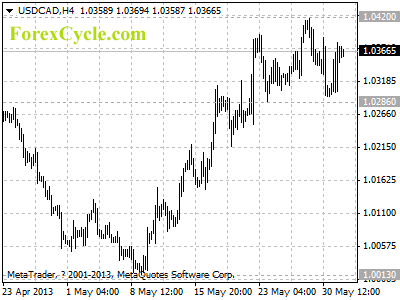
USDCAD stays in a trading range between 1.0286 and 1.0420. Key support is at 1.0286, as long as this level holds, the price action in the range is treated as consolidation of the uptrend from 1.0013, one more rise to 1.0500 area to complete the upward movement is possible after consolidation. On the downside, a breakdown below 1.0286 support will indicate that the uptrend from 1.0013 had completed at 1.0420 already, then the following downward movement could bring price back to 1.0100 zone.

usdcad

Daily Forex Analysis

Seven Keys in Timing Stock Market Tops – Part II

By Chris Vermeulen, thegoldandoilguy.com

Timing stock market tops and bottoms is risky business and we all know the more the more risk we take the more potential gain would could also make. Correctly timing a top or bottom for any investment is flat out exciting not to mention financially rewarding. But this high risk trading tactic does come with some major issues which you must FULLY understand so that you can protect your capital and self-confidence.

On May 13th I wrote a special report on how to spot market tops just before they happen and how to do it with a very high probability of success. I also explain the major pit falls to be aware of so you stay on the right side of the market.

I recommend you read this special report now: http://countingpips.com/forex-news/2013/05/how-to-spot-time-stock-market-tops/

That special report truly showed you what was going to happen a few weeks before it did. Much like how this report shows you what is likely to happen in June.

Looking at the market with my YOU ARE HERE type of using cycles, volume, price patterns and momentum to forecast what is likely to unfold in the coming weeks. Depending on the time frame used for my analysis I can figure out with a high probability where price will be in a few minutes, hours or days also.

Mall Market Directory – You Are Here

Stock market tops are tough to trade and time. That is because there are so many things happening in the media and emotions running wild that it’s tough to get a grasp on what you should really be focusing on to keep a level head trade around it.

Market tops are typically not an event but rather a progression that takes much longer than most individuals expect. I still find myself jumping the gun at times and I know this and have been through this process hundreds of times in various investments. The human brain is a powerful tool but emotions can force you to override your rules/strategy still.

U-R-Hear


Stop Fighting! – Bulls & Bears are BOTH Correct at this Stage

It does not matter where you go to get your stock market news and reports… Everyone is arguing their bullish or bearish case more than EVERY. There is a reason for this and it’s because the SP500, DJIA, RUT and NASDAQ appear to be entering a cycle top. What does this mean? It means the uptrend is almost over from a technical analyst point of view, and those who are have been bearish for a long time feel the market topping out more now than ever in their gut that this is the top.

Keeping it simple removing news, economic data, emotions and biases we are left with one thing which is technical analysis. This is based on price alone and that is important to remember because the only thing that pays you money for an investment is when price moves in your favor. Believe it or not price only has blips on the charts here and there which is based off news, economic data etc… In the big picture stock prices tend to lead economic data by several months and in some cases years.

So the big question is this… If price action is the only thing that pays you when trading why bother worrying about all the other opinions, news out there. That stuff only adds to the confusion and in most cases gets you on the wrong side of the market.

Timing the Market Top Conclusion:

In short, from a technical point of view the SP500 remains in an uptrend. But according to technical analysis the upside momentum is starting to slow. If we get a few more down days then the trend will flip and be down but it has not yet happened.

When the trend does reverse down you must remember that 80% of the time price will bounce back up to test near the recent highs before truly rolling over and collapsing. Think of it like a zombie movie. Just when you think you killed one it comes back to life for one last scare before its dead.

Just to touch on stock market bottoms so you do not get confused. Stock market bottoms are little different than tops so they are traded differently. I will cover them when the time comes.

Trading the market is not easy during this type of condition, which is why members and myself got long SSO on the 23rd and two days later sold out for a 3.5% gain. I am now looking to reload this week for another bounce/rally play but only time will tell if we get another setup.

Download my FREE eBook on Controlling Your Trades, Money & Emotions: http://www.thegoldandoilguy.com/trade-money-emotions.php

Chris Vermeulen