By www.CentralBankNews.info The central bank of Belarus cut its benchmark refinancing rate by a further 150 basis points to 23.5 percent due to a continued fall in the inflation rate and inflationary expectations.
The National Bank of the Republic of Belarus has now cut rates by 650 basis points this year after cutting rates by 1500 points in 2012 in response to lower inflation.
“The decision was taken with regard to the current tendency for further deceleration of inflation and a decline in inflation expectations,” the central bank said, adding the situation on the domestic foreign exchange market remains favorable for a stable exchange rate for the Belarusian ruble.
Real interest rates remain high, contributing to the inflow of households’ deposits to banks and any “further change in the refinancing rate will depend on the macroeconomic situation in the country, as well as the dynamics of prices and inflation expectations,” the bank said in a statement from June 7. The new rate takes effect June 10.
Belarus’ inflation rate fell to 20.7 percent in April from 22.2 percent in March as it continues to trend downward from a high of almost 110 percent in January 2012. The country, a former Soviet republic, devalued its ruble by about half during a balance of payments crises in May 2011, sparking inflation.
The central bank responded by raising interest rates from 10.5 percent in January 2011 to a high of 45 percent in December 2011. But in February last year the central bank started cutting rates.
This year the central bank expects its refinancing rate to fall to 13-15 percent by the end of the year due to falling inflation.
Ukraine cuts rate 50 bps to 7% to spur economic growth
By www.CentralBankNews.info Ukraine’s central bank cut its benchmark discount rate by 50 basis points to 7.0 percent to boost lending and spur economic activity while inflation remains close to zero.
The National Bank of Ukraine, which last cut its rate in March 2012, said the new rate would be effective from today, June 10, following a board meeting on June 6.
Ukraine has suffered from deflation in the last 12 months with the headline inflation rate at minus 0.4 percent in May compared with minus 0.8 percent in April.
In 2012 inflation averaged 0.6 percent. In 2013 and 2014 the central bank targets consumer price inflation in a range of 4.0 to 6.0 percent and between 3.-0 and 5.0 percent in 2015.
“Seeking to reinforce already prevailing positive trends in the monetary sphere, the National Bank of Ukraine has taken this step, thus providing impetus to economic growth,” the central bank said, adding the cost of funds has been on a downward trend while the banking sector has witnessed steady deposit growth with funds in national currency accounting for most of the growth.
Ukraine’s economy expanded by 0.6 percent in the first quarter from the fourth, reversing an 0.8 percent quarterly decline, for an annual contraction of 1.1 percent, less than the 2.5 percent annual fall in the fourth quarter and the 1.3 percent drop in the third quarter of 2012.
In 2012 Ukraine’s Gross Domestic Product grew by 0.2 percent and the International Monetary Fund estimates it will stagnate this year.
Turkey: A Reminder that Emerging Markets are Not Always Warm and Fuzzy
When you hear a mention of Turkey, it conjures up certain mental images. The Aya Sofya in Istanbul…ships passing through the Bosphorus…mustachioed men selling doner kebabs out of pushcarts.
And, unfortunately, military coups d’état and baton-wielding riot police.
Turkey has become a little softer around the edges over the past decade as economic growth and political reform have made the country more Western in many respects. And investors had begun to notice.
In May of this year, Turkey was upgraded to “investment grade” by Moody’s, the ratings agency, and up until recently the country was enjoying “China-like” growth rates in the high single digits. Investors had begun to lose interest in the high-profile “BRICs” countries and had started looking elsewhere for growth, and Turkey seemed a fine destination.
From January of 2012 to the recent high in May of this year, the Turkish stock market was up by more than 80%. And this is even more noteworthy when you consider that the European Union—Turkey’s most important trading partner—has been mired in recession and crisis for most of that time.
And then it all came crashing to a halt. From its May 22 high, the Turkish market is down nearly 20% and the iShares MSCI Turkey ETF ($TUR)—the primary vehicle for most American investors to get access to the Turkish market—is down further.
What happened? A series of riots broke out across the country demanding that a popular park be spared from development, and the prime minister—who, though controversial, has up until now been broadly popular—reacted the way you might have expected a Turkish general of old to react: with crushing force.
Fearing political instability and a return to Turkey’s chaotic past, investors dumped their shares and fled the Turkish markets.
So what now? After the bloodletting, are Turkish stocks attractive again?
I would like to say yes. Even after their spectacular gains of recent years, Turkish stocks are among the cheapest in the world, trading at just 10 times earnings. You would have to go to neighboring Greece or to places not known for being friendly to investors—think Argentina or Russia—to find cheaper.
Yet you don’t want to try to catch a falling knife. If the hot money has decided that the Turkish “story” is over, then it will take them time to unwind their positions and move on, which will mean more downside pressure in the near term.
I, for one, still like the Turkish growth story, and I expect that 6 months from now these riots will be a distant memory. But I sold my shares of TUR and I do not intend to buy them back until the dust settles.
Action to take: Put TUR on your watch list. This is a great long-term growth play. But wait until prices have stabilized to buy. Alternatively, you can take a play out of John Templeton’s playbook and place GTC limit orders at prices far below today’s market price. That way, if the market gets pushed temporarily lower due to panic selling, you can snag shares on the cheap.
This article first appeared on TraderPlanet.
SUBSCRIBE to Sizemore Insights via e-mail today.
Central Bank News Link List – Jun 10, 2013: Turkey’s Erdogan vows to “choke” financial speculators
By www.CentralBankNews.info Here’s today’s Central Bank News’ link list, click through if you missed the previous link list. The list comprises news about central banks that is not covered by Central Bank News. The list is updated during the day with the latest developments so readers don’t miss any important news.
- Turkey’s Erdogan vows to “choke” financial speculators (Reuters)
- German top court likely to say “yes, but’ to ECB policy (Bloomberg)
- Uruguay to change monetary policy strategy to fight inflation (Reuters)
- Exit strategies, spillovers vex G20 finance officials (Reuters)
- Poland may intervene again to curb zloty volatility-central bank governor (WSJ)
- Monsoon to matter in India’s monetary policies: Subbarao (FirstPost)
- BOK to freeze key rate in June following May’s cut: poll (Yonhap)
- Fresh SDA rate cuts expected this week (Business World)
- China tipped to cut rates to revive sagging economy (ibtimes)
- Chile annual inflation slows to 0.9 pct, rate cuts eyed (Reuters)
- China central bank ready to unveil deposit insurance (Xinhua)
- BOT unfazed by capital outflows, says official (The Nation)
- Colombia central bank may alter dollar-buying: monetary official (Reuters)
- ECB says bond-buying program is unlimited (Reuters)
- Burma to revamp central bank with new law (The Irrawaddy)
- Exit strategies, spillovers vex G20 finance officials (Reuters)
- www.CentralBankNews.info
Precious Metals Bounce, But Rally Seen “Over” as US Fed Tapering Talk Hits Emerging Markets
London Gold Market Report
from Adrian Ash
BullionVault
Mon 10 June, 08:25 EST
The GOLD PRICE rallied from a 1-week low at $1376 per ounce Monday morning in London, edging back up to $1383 as world stock markets rose.
Silver fell within 20¢ of mid-May’s 30-month low, before rallying to $21.80 per ounce.
Commodity prices fell after weaker-than-expected Chinese industrial data. US Treasury bonds also slipped in price once again, nudging interest rates on 10-year debt up to 2.17%.
The gold price “conclusively broke back down through $1400 and stayed there” following Friday’s release of US Non-Farm Payrolls data for May, says the latest daily note from brokers Marex Spectron.
But “the market is well ahead of itself in thinking the Fed will soon pare back on their stimulus,” reckons Danske Bank’s head of fixed-income trading Soeren Moerch, pointing to the slight uptick in the US jobless rate shown in Friday’s official data.
Now at 7.6%, the unemployment rate is well above the 6.5% level previously named by US Federal Reserve chairman Ben Bernanke as key to any review of target interest rates.
“The latest employment news,” says one gold price analyst, “supports our view that the [US Federal Reserve’s] asset purchase programme will not start to ‘taper’ until the latter part of this year.”
But Fed officials “are likely to signal at their June policy meeting that they’re on track to begin pulling back their $85-billion-a-month bond-buying program,” writes the Wall Street Journal’s Jon Hilsenrath – dubbed “Fed wire” for his apparent connections to the US central bank.
“The recent recovery [in the gold price] is over,” Bloomberg today quotes Richard Adcock, technical strategist at London bullion market-maker UBS.
“The next leg of the bear trend is to be seen down to the long-term 50% retracement point at $1303, which we would set as our objective.”
Other analysts point to a trading range with either $1360 or $1375 at the bottom, with a move above $1420 needed “in order to escape the downward trend” according to German refining group Heraeus in a note.
Even before Friday’s jobs data, “News out of India had already weighed on gold,” says Heraeus.
Last week’s import duty rise from 6% to 8% for gold going into India – the world’s No.1 gold-buying nation – in will cut foreign-currency outflows and so help reduce the country’s current account deficit, spokesmen for the Finance Ministry said at the weekend.
“The prospect of lower inflation and [lower] gold imports [is] good news for the Rupee,” agrees Singapore fund manager Samir Arora of Helios Capital.
The Indian Rupee today fell to new all-time lows at worse than 58 per Dollar.
“I think this is panic in the market which is unwarranted,” economic affairs secretary Arvind Mayaram told journalists Monday, pointing to concerns that tighter US policy would hurt investment flows to India.
“[The Fed] have now more than clarified that this [tapering of QE] is not imminent. Neither is it something which will happen quickly.”
“What’s happening today is not India-specific,” says J.P.Morgan’s chief India economist, Sajjid Chinoy, quoted by the Financial Times.
“Emerging markets are bleeding [money] across the board.”
Speculative traders in US futures and options meantime grew their overall bullishness on gold in the week-ending last Tuesday, latest data from regulator the CFTC show – the first such rise in two months.
The so-called “net long” of bullish minus bearish bets held by non-industry players rose by 13% to the equivalent of 204 tonnes – only the 7th week-on-week rise out of 23 weeks so far in 2013.
Compared to New Year, however, the total net long remained below one-third the size. It was less than one-fifth the record levels of summer 2011.
“Silver [positioning] followed the recovery in gold,” says the weekly analysis from Standard Bank in London.
“Unlike for gold, it was an addition to speculative longs that drove the overall improvement…avoiding a push into negative territory which had seemed imminent.”
Gold price chart, no delay | Buy gold online
Adrian Ash is head of research at BullionVault, the secure, low-cost gold and silver market for private investors online, where you can buy gold and silver in Zurich, Switzerland for just 0.5% commission.
(c) BullionVault 2013
Please Note: This article is to inform your thinking, not lead it. Only you can decide the best place for your money, and any decision you make will put your money at risk. Information or data included here may have already been overtaken by events – and must be verified elsewhere – should you choose to act on it.
Russia holds rate steady, sees risk of economic slowdown
By www.CentralBankNews.info Russia’s central bank held its policy rate steady but once again cut some of its long-term rates by 25 basis points, saying there “remain risks of further economic slowdown given the weak investment activity and the sluggish recovery in external demand.”
Although inflation is still above the Bank of Russia’s target and this may affect inflationary expectations if it remains high for “a prolonged period,” the central bank said it still forecasts that inflation will return to the target range in the second half of 2013.
At its previous meeting in May, the central bank also noted the risk of economic slowdown and its expectation that inflation would return to its target in the second half of the year.
Russia’s central bank last cut its policy rate by 25 basis points in September 2012 to 8.25 percent but has been cutting long-term rates in recent months to bring the cost of obtaining liquidity from the central bank closer to the main rates and strengthen the bank’s transmission mechanism.
On the central bank’s standing facilities, the REPO rate for up to 12 month loans was cut to 7.25 percent, on loans secured by gold the rate was cut to 7.25 percent for loans from 181-365 days, and on loans secured by non-marketable assets and guarantees, the rate on loans form 181-365 days was cut to 7.50 percent. The rate for 12 months open market operations was cut to 7.25 from 7.50 percent.
Last week Bank of Russia Governor Sergei Ignatyev, who retires later this month, said today’s policy decision was going to be very difficult given the rise in inflation while the economy remains weak.
Russia’s headline inflation rate rose to 7.4 percent in May from 7.2 percent in April, continuing its rise since hitting a recent low of 3.6 percent in May 2012, and well above the central bank’s 5-6 percent range. Core inflation in May was 5.9 percent.
The central bank said the rise was mainly due to higher prices of food and certain regulated prices and tariffs and noted that there were planned increases in the tariffs of certain natural monopolies.
Russia’s economy slowed down last year with growth slowing to an estimated 3.4 percent from 4.3 percent in 2011 and the central bank said that indicators point to continued low growth.
“The growth rates of industrial production remain subdued, investment in production capacity continues to decrease,” while consumers have been resilient, and labor and credit markets still provide support to domestic demand.
Ignatyev, who has been central bank governor since 2002, will be handing over the reins of the bank to Elvira Nabiullina, aide to President Vladimir Putin, later this month.
Last week he also noted that the continued outflow of capital from Russia has heavily impacted the depreciation of the ruble, which has complicated the central bank’s efforts to reduce inflation.
Earlier this year he said some 2.5 percent of national income, or $49 billion, illegally left Russia last year.
Since May, the ruble has lost another 3.5 percent against the U.S. dollar, just as most other emerging market currencies on fears of reduced global liquidity from the U.S. Federal Reserve’s tapering of asset purchases. This year the ruble has lost 5.6 percent and was trading around 32.3 to the U.S. dollar today.
How the Old Economy Can Pay More Than You Might Think
By Profit Confidential
 With all the financial engineering that’s been going on over the last several years, it’s great to actually find good businesses that are growing based on their own fundamentals.
There’s always a continuing flow of earnings reports, and one company I’ve followed for years just beat the Street again.
Earnings growth rates might not be as robust as they once were, but modest business growth is out there.
One growing company that continues to execute well is AAON, Inc. (NASDAQ/AAON) out of Tulsa, Oklahoma. This company manufactures and installs heating, ventilation, and air conditioning (HVAC) equipment for commercial and residential customers.
The company was founded in 1988 and now has approximately 1.5 million square feet of office and manufacturing facilities, with over 1,300 employees at two plants.
AAON’s first-quarter revenues grew three percent to $66.8 million, mostly based on higher prices. Earnings grew a substantial 56% to $7.1 million, or $0.29 per diluted share, compared to earnings of $4.6 million, or $0.18 per diluted share.
The company said that both its revenues and earnings made new records in the first quarter of 2013.
AAON’s cash balance tripled and the company’s backlog increased 22% to a record $71.7 million comparatively.
On top of this modest but successful business growth, the company boosted its semi-annual cash dividend by 25% and declared a new three-for-two stock split.
I like these kinds of small businesses.
AAON is a company making real products that the marketplace requires. The HVAC industry isn’t the fastest-growing sector, but AAON’s ability to grow its business in a diligent and consistent manner is demonstrable.
The company’s stock market performance is also noteworthy. AAON’s long-term stock chart is featured below:

Chart courtesy of www.StockCharts.com
With the stock market around its all-time high, I’m reticent about new positions. But there are plenty of companies out there that are worth keeping on your radar in anticipation of more attractive entry points. (See “Why You Should Add Two Medical Stocks to Your Watch List.”)
AAON is about to effect its fifth stock split since listing.
Small-cap stocks have performed similarly to blue chips. Their run-up has been pronounced.
Second-quarter earnings season is quickly approaching, and the marketplace will still bid those companies that beat consensus. Corporations have been deliberately subdued with their earnings outlooks. This has been going on for several years now, and it makes it easier to “outperform.”
Companies like AAON are worth adding to a watch list. Proven track records of business success, earnings growth, and stock market success are golden.
A company like AAON would make a welcome addition to a larger HVAC manufacturer if the company’s management wanted to cash out. AAON’s latest earnings report was solid.
Article by profitconfidential.com
Retail Growth Healthy, but Best Gains Have Already Been Made
By Profit Confidential
 We all know that consumer spending and the performance of the retail sector dictates the direction of economic renewal in the U.S. It’s quite simple—if consumers spend, the economy and the retail sector will grow.
Now, with home prices nationwide continuing to rise and the jobs creation picture showing signs of improvement (though it is still slogging along), the end result has been a rise in consumer spending, which has helped to drive the retail sector.
Spending on durable goods is a good indicator on how positive consumers are in the retail sector, as this spending is on nonessential goods. So when consumers spend on this group, you know there’s some confidence in the overall economy. In April, durable goods surged 3.3%, which was well above both the Briefing.com estimate calling for a 1.5% decline and the 5.9% decline in March. On an ex-transportation basis, durable goods increased 1.3%.
Retail sales edged up 0.1% in April, which was above both the Briefing.com estimate calling for a 10.7% drop and the 0.5% decline in March.
In May so far, 10 U.S. retail chains have reported, and the results have been good, with the key same-store sales surging up 3.9% versus the 3.7% estimate. (Source: Wahba, P., “Retailers’ sales rise in May, spending stays moderate,” Reuters, June 6, 2013.)
Results from the big-box stores continue to be healthy in the retail sector.
Market leader Costco Wholesale Corporation (NASDAQ/COST) reported sales growth of seven percent in May, while its key same-store sales increased by five percent.
A big surprise was delivered by American Apparel, Inc (NYSE/APP), which reported an impressive 10% surge in its same-store sales in May. (Read more on American Apparel in “A Real ‘Made in the USA’ Retail Stock That Supports Your Portfolio, Not Sweatshops.”) American Apparel remains an excellent speculative play that has moved up over 10% since my review. The best thing about this company is that its clothes are all manufactured in the U.S., which will cater to the patriotic looking for real “made in the USA” stocks.
The stock chart of the S&P Retail Index below shows the steady climb of the retail sector since the beginning of the year; the chart is also indicating that the retail sector is currently facing some stalling.

Chart courtesy of www.StockCharts.com
Much of the consumer buying has been largely due to the availability of cheap money and financing. People are saving less, given the low yields, and are spending more.
In my view, the retail sector continues to show promise, but the easy money has been made. For the aggressive trader, you need to consider contrarian retail opportunities, including bebe stores, Inc. (NASDAQ/BEBE), Chico’s FAS, Inc. (NYSE/CHS), Ascena Retail Group, Inc. (NASDAQ/ASNA), and Saks Incorporated (NYSE/SKS).
Article by profitconfidential.com
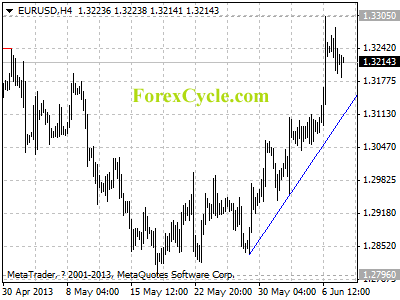
EURUSD stays above a upward trend line
EURUSD stays above a upward trend line on 4-hour chart, and remains in uptrend from 1.2796, the fall from 1.3305 is treated as consolidation of the uptrend. As long as the trend line support holds, the uptrend could be expected to resume, and one more rise towards 1.3500 is still possible after consolidation. On the downside, a clear break below the trend line support will suggest that lengthier consolidation of the uptrend is underway, then deeper decline to 1.3100 area could be seen.
Four Great Australian Technological Achievements
Australia has a reputation as ‘the lucky country’. And this is thanks to the abundance of natural resources we have. Our mining and resources boom has put Australia on the map and taken us forward economically as a nation.
But mining (and sport) isn’t the only thing Australians are good at. When it comes to having some of the best and brightest minds in the world, well, we’ve certainly got our fair share.
Some of the most world-changing technological advancement happened right here at home. Here we’ve highlighted four of Australia’s Greatest Technological Achievements.
Aussie Tech Achievement #1:
You’re Connected Thanks to This Accidental Invention
Not many people realise that a government organisation gave the world one of the most widely used technological inventions.
In 1992 and 1996 the CSIRO patented the technology that created Wi-Fi in its current form. Researcher John O’Sullivan is the man credited with this invention. He came across the mathematics of modern day Wi-Fi thanks to a failed experiment he was performing on atoms and black holes at the time.
Just about every mobile device in the world has Wi-Fi in it. Your smartphone, tablet, TV and even your fridge is likely to have Wi-Fi. (On a not-so-high-tech based point, it was an Australian invention that pioneered the mechanical refrigeration process too.)
The CSIRO’s invention has helped to define the mobile world we live in today. It’s also partially kept the CSIRO funded. A court ruling in 2009 and 2012 entitled the CSIRO to unpaid Wi-Fi royalties from giant tech companies like HP and Dell. The total awarded was over $470 million.
The CSIRO will now continue to receive royalties estimated to be worth over a billion dollars. Thanks to their invention the world is able to connect like never before. Their simple, accidental discovery has literally shaped the future of the world.
Aussie Tech Achievement #2:
The Home Grown App That Helps You Find Your Way
With the rise of applications came the rise of many application developers. The ‘App Economy’ has led to many amazing, helpful apps, and made a few millionaires along the way.
In 2003, two Danish-born brothers that had immigrated to Sydney were working on an application at their business, Where 2 Technologies. The application was a downloadable app from app stores. They were confident that it would be reasonably successful as long as they could get it to market.
In trying to launch their app, Where 2 Technologies needed some venture capital to get it off the ground and out to the public. They pitched their idea to a number of companies. One of the companies they pitched was Google.
At the Google pitch they sold the idea as a web-based application rather than a downloadable one. The product they pitched was mapping technology that allowed a user to not only see a map and get directions, but also to find things they liked or needed nearby.
Google liked it…a lot. In 2004 Google bought Where 2 Technologies for an undisclosed amount (you’d think it’d be in the hundreds of millions). Subsequently Google Maps was born and the way we navigate around the world changed forever.
Aussie Tech Achievement #3:
Pioneering Biotech from a Frustrated Plastic Surgeon
In 1992 a man arrived at Royal Perth Hospital with 90% burns to his body. He was lucky that his treating surgeon was Dr. Fiona Wood.
Dr. Wood had been working on a development in skin repair techniques for a number of years. She was frustrated that skin grafts took so long to create. Science knew that if burns victims could be treated faster they had a better chance of survival.
So she worked away at faster methods of treatment. This led to the discovery that skin cultures created in less than 10 days healed wounds better than skin cultures which typically took 21 days.
Dr. Wood and her colleague Marie Stoner invented a pioneering technique of ‘spraying’ skin cells onto skin wounds. This let the wounds heal faster and more efficiently than any other type of skin repair treatment. Spray-on-skin was born.
The man in 1992 treated by Dr. Wood and her spray on skin survived. And he wasn’t the only one.
Years of using the spray on skin technique came to public attention in October 2002 when the Bali Bombings occurred.
The Royal Perth Hospital and Dr. Wood treated 28 patients from the bombings. Most of them had over 92% burns to their bodies. Using spray-on-skin, they had saved the lives of those 28 people.
Without the use of the spray-on-skin technique, it’s likely the 28 would have died. Her invention was literally saving lives, and continues to do so today.
Aussie Tech Achievement #4:
The Research That’s Brought Sight and Sound to The World
The next Australian technology success is one of the best inventions of all time. It gives to people something priceless. Without it they would be missing something that in inherently human to have…the sense of sound and hearing.
Of course this great tech achievement is the Bionic Ear. Also known as the Cochlear Implant. It was at the University of Melbourne in the late 70′s and early 80′s where a team of researchers changed the world.
Professor Graeme Clark in 1978 gave Rod Saunders the first cochlear implant. The company Cochlear Ltd to this day holds about 70% of the market share of the world’s bionic hearing devices.
Professor Clark describes the attitude of the scientific community prior to his discovery. ‘99% of the scientific community said it was not possible. I was seen as somewhere between a dreamer and a clown.‘
But this didn’t stop him. And the belief that nothing was impossible led to this world changing invention. The lives of millions of people have changed thanks to this invention. To see for yourself just YouTube search ‘Cochlear Activation’ and see the impact it has on people that previously have never heard sound.
A Small Nation With Giant Achievements
Australia has a population of just 23 million. But Australia has some of the world’s best and brightest minds. The examples above illustrate just some of the great technological achievements from the land down under.
These four examples are all world changing advancements in technology, but as you can see they cover a whole range of industries. It’s not just computers that technology covers, but importantly medicine and manufacturing also.
There is more research happening now in Australia than ever before. A lot of this is in the field of biotech.
Aussies are starting to get a name as pioneers of great tech advancement in medicine. And as these advancements start to come to market and there will be chances to capitalise on these.
It’s an exciting time to be alive as technology advances the world. And it’s just as exciting to know that many great new technologies are more than likely to come from our own backyard.
Sam Volkering
Technology Analyst
Join me on Google+
From the Archives…
Keep One Eye on Resource Stocks and the Other on the NASDAQ
31-05-2013 – Kris Sayce
Getting in on the ’99 Cent Craze’ with Crowdfunding
30-05-2013 – Sam Volkering
Buyer Beware: Japanese Government Bonds are Moving
29-05-2013 – Murray Dawes
The Best Contrarian Play on Gold I’ve Ever Seen…
28-05-2013 – Dr Alex Cowie
A Revolution in the Share Market is Coming…
27-05-2013 – Kris Sayce
