The U.S. Dollar Under Pressure Again

The U.S. Dollar Under Pressure Again

EURUSD – The EURUSD Holds Above 1.3180

eurusd11.06.2013

Having started decreasing yesterday, the EURUSD tested the support around 1.3180, managed to stay above it and increase up to 1.3268 then. During the Asian session, the pair passed this resistance and increased to 1.3291. Thus, the pair remains positive, being in demand on wanes as well – this allows it to trade above the acsending support line and 20 day MA. The RSI on the 4 hour chart entered the overbought zone again, thus the EURUSD may return to the 32nd figure in the absence of updated drivers, whose loss would make the pair decrease to 1.3130-1.3100.


GBPUSD – The GBPUSD Consolidating After Increase

gbpusd11.06.2013

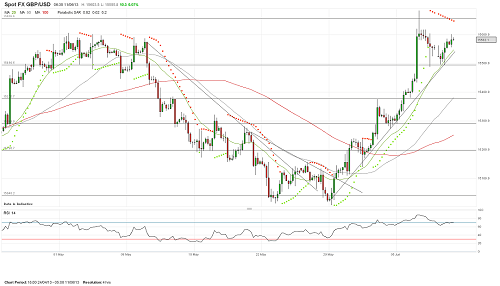
The GBPUSD was consolidating after its increase to 1.5683 and trading between 1.5494 and 1.5586. During the Asian session, the bulls tested 1.5601, after which they retreated to 1.5579. The pair’s wanes are small, but continue attracting the purchasing interest. As a result, the pair is trading above the 20 day MA, as well as ascending resistance line, maintaining its further growth potential. But the Parabolic SAR is above the price chart, and the RSI is showing signs of being overbought, thus the pair’s consolidation phase is likely to continue. The loss of the 1.5494 support would weaken the bulls and make the pair drop to 1.5430, which would not mean the end of the rising dynamics.


USDCHF – The USDCHF Tested 0.9305

usdchf11.06.2013

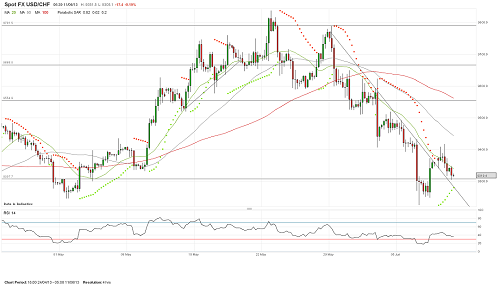
The U.S. dollar tried to win back lost positions against the Swiss franc, having increased to 0.9418, but there it faced the bears’ onslaught which made the pair return to 0.9317, but during the Asian session they had no scruple to test 0.9305. This support managed to keep the dollar from its further decrease – this makes the bulls believe the pair will return to the 94th figure. However, until the dollar is trading below 0.9500-0.9555, these levels will limit the bulls and the pair will continue being put under pressure.


USDJPY – The USDJPY Unable to Consolidate Above Figure 99

usdjpy11.06.2013

The USDJPY continued its recovery which started on Friday, but its increase was not energetic. However, having rebounded from 97.70, the dollar managed to increase to 99.28 before it came under pressure again. As a result, the rate decreased to 97.79, which was able to constrain the bears’ onslaught during the Asian session – thus, the pair pulled back to 98.47. The fact that the dollar failed to hold above the resistance near the 99th figure is the negative factor – this indicates the continuing trend towards the downward correction.

provided by IAFT


Mozambique cuts rate 50 bps, inflation overcomes floods

By www.CentralBankNews.info     Mozambique’s central bank cut its benchmark standing facility rate (FPC) by 50 basis points to 9.0 percent, saying inflation had gradually recovered from the impact of massive flooding earlier this year so the bank could now “proceed with measures to align interest rates in the context of the macroeconomic targets set for 2013.”
     The Bank of Mozambique (CPMO), which cut rates by 550 basis points in 2012 but had held them steady this year until today, also cut the rate on its standing deposit facility by 50 basis points to 1.75 percent but maintained the required reserves ratio at 8.0 percent.
    The CPMO said it would intervene in interbank markets to meet the monetary base target of 40.787 billion meticais by the end of this month, up from the target of 39.7 billion at the end of May.
    Mozambique’s inflation rate rose to 4.9 percent in May from 4.79 percent in April, continuing its steady climb since hitting a recent low of 1.41 percent in August last year. However, this is still well below of peak in inflation of 16.6 percent at the end of 2010.
    Extensive flooding in the southern and central parts of Mozambique at the start of this year lead to reduced harvests and food, contributing to a change in inflation along with a depreciation of the metical currency, higher school fees and higher prices for some commodities.
    The CPMO forecast last month that this would lead to higher inflation in the second quarter and an average inflation rate of 7.0 percent in 2013, up from 2.09 percent in 2012.
    The International Monetary Fund (IMF) forecast medium-term inflation of 5-6 percent.

     The impact of flooding also lead the central bank to reduce its economic growth forecast for 2013 to 7 percent from a previous 8 percent, down from 7.4 percent in 2012.
    Mozambique’s government has forecast growth of 8 percent this year.
    Mozambique’s economy has been expanding on the back of higher coal production, along with an expansion of financial services, transport and communications and agriculture.
   
    www.CentralBankNews.info

Central Bank News Link List – Jun 11, 2013: Draghi says he has confidence in German court OMT review

By www.CentralBankNews.info

Here’s today’s Central Bank News’ link list, click through if you missed the previous link list. The list comprises news about central banks that is not covered by Central Bank News. The list is updated during the day with the latest developments so readers don’t miss any important news.

The Senior Strategist: ECB Case at High Court

Germany’s Constitutional Court will hold a key hearing on bond buying this week.

The German central bank, the Bundesbank, will have a central role in this week’s Federal Constitutional Court hearing on complaints filed against the permanent European bailout fund known as the European Stability Mechanism (ESM) and the bond purchase program of the European Central Bank (ECB). It makes clear in its written statement that the bond purchases announced by the ECB are “to be judged critically”.

Legal information

Video by en.jyskebank.tv

Gold Falls to 3-Week Low with “Talk of Slowing QE” Weighing on Markets

London Gold Market Report
from Ben Traynor
BullionVault
Tuesday 11 June 2013, 07:00 EDT

SPOT GOLD fell to three week lows below $1370 an ounce Tuesday, as stocks and commodities also fell amid ongoing speculation over when the US Federal Reserve might begin reducing the size of its quantitative easing program.

“Gold remains bearish while trading below the $1424 current June high,” reckons Commerzbank senior technical analyst Axel Rudolph.

Gold exchange traded funds tracked by Bloomberg saw their gold bullion holdings fall by 6.1 tonnes yesterday, although the world’s largest gold E.T.F. SPDR Gold Trust (ticker GLD) added metal for only the sixth day this year, raising its holdings by 2.7 tonnes to 1009.8 tonnes.

Silver meantime dropped back below $21.60 an ounce, falling towards three-week lo0ws touched yesterday.

Major European stock markets were down nearly 1.5% by Tuesday, after losses in Asia that followed the Bank of Japan’s decision to leave its QE program unchanged.

“Upbeat sentiment over the US economic outlook continues to feed concerns of increasing US yields and an easing pace to [quantitative easing],” says VTB Capital analyst Andrey Kryuchenkov.

“Volumes in Asia will be subdued due to holidays in China,” he adds, referring to tomorrow’s Dragon Boat Festival.

Ratings agency Standard & Poor’s raised its outlook for its AA+ US credit rating from ‘negative’ to ‘stable’ Monday.

“We do not see material risks to our favorable view of the flexibility and efficacy of US monetary policy,” said a statement from S&P.

A stable outlook implies the chance of a downgrade in the rating is less than one-in-three.

“The last time the rating agency moved to downgrade US credit in August of 2011, the markets were sent into a tizzy with equities plunging and gold soaring to a record high of $1920 an ounce a month later,” says a note from Ed Meir, metals analyst at brokerage INTL FCStone.

“However, this time around, the move by S&P did not cause much of a stir, as investors seemed to be more focused on erratic growth patterns evident across most industrialized economies, coupled with growing uncertainties with respect to what the Federal Reserve is going to do with regard to its stimulus program.”

So-called ‘Fed tapering’ – the potential reduction in the size of the Fed’s asset purchase from the current $85 billion a month – “is a big issue” former World Bank president Robert Zoellick said Tuesday.

“The question,” said Zoellick, “will be, as the Fed eventually moves away from the monetary easing policies, what will be the effect of [withdrawing]the wall of money that’s moved around the world?”

“[US] Labor market conditions have improved since last summer, suggesting the [Federal Open Market] Committee could slow the pace of purchases,” James Bullard, president of Federal Reserve Bank of St Louis, which is not an FOMC member this year, said Monday.

“But surprisingly low inflation readings may mean the Committee can maintain its aggressive program over a longer time frame.”

The Bank of Japan meantime left its main policy interest rate on hold at 0.1% Tuesday, while reiterating its quantitative easing commitment to grow the monetary base by an annual up to 70 trillion Yen ($720 billion).

UK industrial production meantime fell by 0.6% in the year to April, according to official figures published this morning, while manufacturing production, a subset of industrial production, down 0.5% over the same period.

Over in Europe, Germany’s Constitutional Court today began hearing testimony on the European Central Bank’s Outright Monetary Transactions program, by which the ECB has pledged to buy the debt of distressed sovereigns on the secondary market to mitigate borrowing costs.

Bundesbank chief Jens Weidmann, who has publicly criticized OMT, is expected to testify at the hearing, which has been added to an existing case before the Court over whether the European Stability Mechanism rescue fund breaches Germany’s constitution.

Weidmann’s fellow German Joerg Asmussen, who sits on the ECB’s Executive Board, is also expected to appear, as is finance minister Wolfgang Schaeuble.

Ben Traynor

BullionVault

Gold value calculator   |   Buy gold online at live prices


Editor of Gold News, the analysis and investment research site from world-leading gold ownership service BullionVault, Ben Traynor was formerly editor of the Fleet Street Letter, the UK’s longest-running investment letter. A Cambridge economics graduate, he is a professional writer and editor with a specialist interest in monetary economics. Ben can be found on Google+


(c) BullionVault 2013

Please Note: This article is to inform your thinking, not lead it. Only you can decide the best place for your money, and any decision you make will put your money at risk. Information or data included here may have already been overtaken by events – and must be verified elsewhere – should you choose to act on it.


Japan keeps asset purchase target, economy picking up

By www.CentralBankNews.info     The Bank of Japan (BOJ) maintained its target for asset purchases and the monetary base and largely repeated its economic assessment from May, saying the “Japan’s economy has been picking up” and the economy is expected to return to a path of moderate recovery.
    The BOJ, which launched its new phase of monetary easing in April, repeated that it aims to increase the monetary base by an annual pace of about 60-70 trillion yen and it will buy Japanese government bonds so the outstanding amount rises by an annual pace of 50 trillion yen along with purchases of exchange-traded-funds, real estate investment trusts, commercial paper and corporate bonds.
    The central bank also confirmed that it would continue with its “quantitative and qualitative monetary  easing” as long as it is necessary to reach its target of 2.0 percent inflation, looking at both upside and downside risks to economic activity and prices, and make adjustments as appropriate.
    The BOJ’s new and aggressive easing is aimed at boosting years of tepid economic growth and overcoming some 15 years of deflation.
     Japan’s government on Monday revised upwards its estimate for first quarter growth, showing Gross Domestic Product rising 0.6 percent from the fourth quarter from an earlier estimate of 0.4 percent as domestic demand was revised up to a rise of 0.6 percent from 0.5 percent.
    But deflation continues to grip Japan, with consumer prices down another 0.7 percent in April, the 11th month in a row with a drop in the headline inflation rate.
    The BOJ acknowledged that consumer prices remain negative due to the reversal of the previous year’s movement in energy-related and durable consumer goods. However, it added that “some indicators suggest a rise in inflation expectations.”
    “The year-on-year rate of change in the CPI is likely to gradually turn positive,” the BOJ said, based on improving exports as overseas manufacturing is picking up and the effect of better domestic demand from the monetary easing and other economic measures.
    However, the BOJ also underlined that there is still a “high degree of uncertainty concerning Japan’s economy, including the prospects for the European debt problem and the growth momentum of the U.S. economy as well as the emerging and commodity-exporting economies.”
    In April, the BOJ forecast that inflation, excluding the effect of planned consumption tax hikes, would rise to 1.4 percent in fiscal 2014 and then 1.9 percent in fiscal 2015. In the current fiscal year, inflation is forecast at 0.7 percent.
   
    www.CentralBankNews.info

Three Technology Breakthroughs You May Have Missed…

By MoneyMorning.com.au

An old pal cornered your editor over the weekend. He asked:

Don’t you feel annoyed that all this news has come out about tech firms letting government spies in through the back door, just as you launch your new technology service?

We had a simple answer, ‘No‘. Why? Governments spy all the time.

They’ve done it for thousands of years. You could argue that one of the most famous examples of government spying and treacherous behaviour appears in the Bible. You’ve heard of Jesus Christ, Judas Iscariot and the Romans, right?

We agree that it’s annoying from a liberty perspective. But not from a technology investing perspective.

From that point of view, regardless of what immoral and maniacal governments and politicians get up to, one thing is clear – you’re living at a time that could deliver one of the biggest technological advances in history.

That’s something to embrace, not fear…

You’ve doubtless heard of codes and ciphers. These go hand in hand with spying and have existed almost since humans began to write.

So, while we may abhor governments spying on people, we have to just acknowledge it and move on.

After all, if our ancestors had given up on technology advancements due to spying by the Pharaoh’s, the French Kings, or European Emperors, we would still be rolling around in our own filth.

But fortunately, our ancestors didn’t give up. They pushed on and got on with trying to improve their lives – despite the best efforts of governments to hold them back.

And getting on with things is exactly what the world’s top scientists, researchers, innovators and inventers have done over the past week…

While You Weren’t Watching – a Cure for MS?

While everyone else seemed to focus on the US government and its corporate patsies, or the latest feuding in the Aussie federal government, you probably didn’t notice three key scientific breakthroughs:

5 June, The Independent – ‘Scientists are claiming a breakthrough in the treatment of multiple sclerosis after an experimental therapy given to a small group of patients had dramatic results.

The therapy involved extracting white blood cells from the patients which were mixed with proteins and re-infused producing a 50-75 per cent reduction in the body’s immune response.

In multiple sclerosis the immune system attacks the myelin sheath that surrounds the nerve fibres causing symptoms ranging from numbness to paralysis.

5 June, Science Daily, – ‘Researchers at the University of Copenhagen, in collaboration with Seattle Biomedical Research Institute, the University of Oxford, NIMR Tanzania and Retrogenix LTD, have identified how malaria parasites growing inside red blood cells stick to the sides of blood vessels in severe cases of malaria. The discovery may advance the development of vaccines or drugs to combat severe malaria by stopping the parasites attaching to blood vessels.

7 June, Latinos Post – ‘Humanity may not be able to beam someone to and from a planet’s surface like in Star Trek, but according to a new report in Nature Physics, we’ve just found out how to perform quantum teleportation reliably – which is something that, dramatically, the crew of the Enterprise never seems to be capable of.

Researchers working at the Niels Bohr Institute at the University of Copenhagen have successfully teleported information between two clouds of gas atoms using a laser.

We noticed them. That’s the type of thing your editor and our technology analyst (Sam Volkering) look out for every day. And just as importantly, finding ways to profit from them.

Those are just three breakthroughs. There are many tens, hundreds if not thousands of revolutionary breakthroughs happening every day.

Most of them stay within the confines of the science world because the mainstream press is too busy focusing on things that most people knew anyway – that the government is spying on you.

That’s a shame, because there is so much opportunity out there…

Twenty Thousand Years of Progress in One Century

As we say, you could just give up on the future and assume things will get worse. We’ve no intention of doing that. Or you could take a positive outlook and believe that things will get better.

That’s how our ancestors dealt with adversity. You can look at the folks who used new technology to flee persecution in Europe and build a life in the New World.

Or you can look at the Pamphleteers in the 17th, 18th and 19th centuries who used the printing presses to get their message out. Not to mention the scientists and innovators who heralded the Industrial Revolution.

And now the human race is at another inflection point. One that could result in more technological advances and more wealth than all previous advancements combined. As futurist Ray Kurzweil notes:

Because of the explosive nature of exponential growth, the 21st Century will be equivalent to twenty thousand years of progress at today’s rate of progress; about one thousand times greater than the 20th Century.

In other words, if you thought the rate of technological change over the past 40 years was impressive, it’s nothing compared to the rate of change you, your children and your grandchildren will experience over the next 87 years.

It will be truly revolutionary.

This is why we believe it’s so important for you to not stick your head in the sand and keep all your money in cash. Because if you want any chance to profit from this new revolution, you can only do so by taking part in it.

Cheers,
Kris

Join me on Google+

PS. We’ll reveal more details on our new technology investing service, Revolutionary Tech Investor throughout this week. Keep an eye open for what could be the biggest opportunity Aussie investors have ever seen…

From the Port Phillip Publishing Library

Special Report: Buy These Four Yen Dive Stocks Now

Daily Reckoning: The Debate on Gold Infiltrates the Mainstream

Money Morning: Four Great Australian Technological Achievements

Pursuit of Happiness: Improving Your Life Through New Technology

Australian Small-Cap Investigator:
How to Make Big Money from Small-Cap Stocks

There’s More to Technology Than Facebook and Spying

By MoneyMorning.com.au

Judging by the traffic I encountered along the Maroondah Hwy yesterday just before lunchtime, I’d go so far to say about half of Melbourne had been on Mount Buller all weekend.

I had been simply enjoying a relaxing long weekend away with family in the surrounding countryside. On the way home we’d managed to find ourselves in an endless procession of cars, trucks and caravans. The amount of people in a real hurry to get home was quite astounding.

Overtaking lanes became drag strips. And to be honest I’ve never seen a 4WD filled with gear and children, towing a boat, do 160kph, until yesterday.

I couldn’t figure out at 11:30am why people we’re so desperate to get home. It had crossed my mind that perhaps the next instalment of The Voice was high on the list, maybe even in a desperate attempt to see what was happening in world markets.

But it was a long weekend; the rush was probably just due to the fact people tend to drive like idiots on long weekends.

But idiocy on the roads aside, it’s fortunate that we get to celebrate the birthday of a Queen who really has nothing to do with our country. Her family did send convicts over to our shores a couple hundred years ago, and since then things have been looking up for Australia.

What that also means is a day off for the Aussie markets. No doom, no gloom, no talk of recession or bad data flowing from the institutions that create data.

And while most are away on a long weekend or simply just watching another game of footy on a Monday the rest of the world continues to go on, business as usual.

Well, I say business as usual, but in all reality it was a remarkably boring day around the world. The best thing to come out of the US was the final episode of Game of Thrones. Sadly that could have also been the reason Time Warner [NYSE:TWX] (which owns HBO, who screen Game of Thrones) was down a touch over 1.8%.

But there was some data from the major economies of the world. Albeit soft data from both the US and China. It meant a pretty lack lustre day for markets. In the US the Dow was down about 0.06% the S&P 500 down 0.03%.

You see what we mean? Pretty boring. Although, even on a boring day you can expect the Japanese market to spark some fireworks. The Nikkei225 gains almost 5%…to make back some of the 15% it had lost in recent weeks.

A Space Ripe With Opportunity

Interestingly enough though the good ol’ NASDAQ managed to post a gain of 0.13%. And that’s off the back of Apple [NASDAQ:AAPL] sliding a fraction due to a really lame attempt at a music streaming service to rival Spotify and Pandora.

Thanks to further evidence that Apple’s lost its way, Pandora [NYSE:P] happened to jump 2.45%. The basket case that Apple is quickly becoming is starting to open up opportunities in other parts of the NASDAQ arena.

What this tells us is that now is a great time to be buying technology stocks. It tells me that some of the big tech companies are starting to lose their way. That presents a great opportunity for the small tech stocks that are trying to take their place.

Every tech cloud has a silver lining.

It’s a strange world if you believe all the news reports at the moment. Ongoing issues with the global monetary system, the (what seems to be) everlasting conflict in the Middle East, the US spying on the world with their PRISM system…there’s a lot to get down about.

But chin up; as Kris mentions today, the world of technology will bring joy to the gloom. And it’s not the big players that you hear about all the time like Apple, Google and Microsoft. These tech giants won the race that’s already over.

It’s the tech stocks you haven’t heard about yet where the real opportunities lie.

And believe me, the opportunities are exciting.

You see, the opportunities are in the companies that push the boundaries of the ‘impossible’ that create unbelievable breakthroughs.

Do you think that just two years ago you’d be capable of 3D printing spare parts for home appliances? Or even just this time last year, did you think you’d be able to ask your TV what it recommends you should watch? How about the ability for paraplegics to walk using the power of their mind? It’s all due to mind blowing technology.

Those are pretty diverse technological achievements. The point is, new technology and innovation has an important impact on almost every aspect of your life. Unless you want to live like a hermit, there’s no getting away from it. And nor should you try to get away from it…embrace it.

The trick is to identify which technology trends will happen first. Even then, there are a lot of companies to choose from. So you need to really understand what their technology does, what it means, and how will it change the world.

That takes a lot of effort. But that’s what I’m here for. In short, what you need to know for now is that it’s a good time to be alive, and a great time to be an investor.

Sam Volkering
Technology Analyst

Join me on Google+

From the Archives…

Bernankenstein’s Financial Monster
7-06-2013 – Vern Gowdie

Six Revolutionary Technology Trends for the Next 20 Years
6-06-2013 – Sam Volkering

The Incredible World of Graphene
5-06-2013 – Dr Alex Cowie

After the Correction: Gold Stocks Set for the Biggest Gains
4-06-2013 – Dr Alex Cowie

The Single Best Way to Build Wealth: Invest in Business…
3-06-2013 – Kris Sayce

GBPUSD is facing trend line support

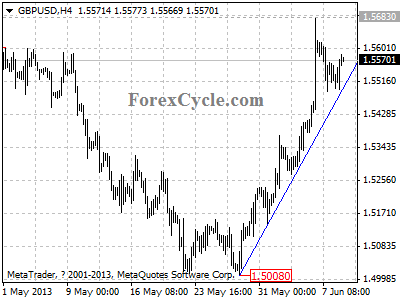
GBPUSD is facing the support of the upward trend line on 4-hour chart. As long as the trend line support holds, the fall from 1.5683 could be treated as consolidation of the uptrend from 1.5008, and one more rise to 1.5800 area is still possible after consolidation. On the downside, a clear break below the trend line support will suggest that the uptrend from 1.5008 had completed at 1.5683 already, then the following downward movement could bring price back to 1.5300 – 1.5400 area.

gbpusd

Daily Forex Analysis

Keeping Stakes Small: How Some Companies Are Navigating the Gold M&A Market: Keith Phillips

Source: Brian Sylvester of The Gold Report (6/10/13)

Bigger isn’t always better, as recent acquisitions by Agnico-Eagle Mines Ltd., Coeur d’Alene Mines Corp. and New Gold Inc. suggest. These companies are choosing to make multiple smaller deals as they keep the M&A thesis alive. In this interview with The Gold Report, Keith Phillips, head of Cowen and Company’s Metals & Mining Investment Banking Group, tells investors what they can learn from those deals, the biggest problems facing the gold equities market and how they can take advantage of what he calls the strongest debt-financing markets in history.

The Gold Report: Coeur d’Alene Mines Corp. (CDM:TSX; CDE:NYSE) recently acquired Orko SilverCorp. for cash and shares. What should investors pay attention to in that deal?

Keith Phillips: The deal involved La Preciosa, a silver asset controlled by Orko, in an attractive jurisdiction in Mexico. From an investment banking perspective, seeing two different, quality companies competing for a junior mining asset in an environment where people thought the merger and acquisition (M&A) business was dead was encouraging. First Majestic Silver Corp. (FR:TSX; AG:NYSE; FMV:FSE) made an initial bid for Orko, and Coeur d’Alene was the successful bidder.

TGR: Are high-quality silver assets more likely to be targets than similarly valued gold assets in this market?

KP: There are many targets in gold but very few buyers currently. Silver is a smaller business with fewer quality targets but a relatively large number of healthy buyers. Coeur d’Alene is obviously healthy, having gone for Orko; Hecla Mining Co. (HL:NYSE) bought Aurizon Mines Ltd. to diversify into gold but also to stay in precious metals in North America. Pan American Silver Corp. (PAA:TSX; PAAS:NASDAQ), Fresnillo Plc (FRES:LSE), Silver Standard Resources Inc. (SSO:TSX; SSRI:NASDAQ), First Majestic and many others are well positioned to be consolidators of silver assets.

TGR: What are your thoughts on the strategy of Agnico-Eagle Mines Ltd. (AEM:TSX; AEM:NYSE), which has been on a shopping spree this year? Agnico has taken significant positions in ATAC Resources Ltd. (ATC:TSX.V), Sulliden Gold Corp. (SUE:TSX; SDDDF:OTCQX; SUE:BVL), Kootenay Silver Inc. (KTN:TSX.V)and Probe Mines Limited (PRB:TSX.V) and also bought Urastar Gold Corp. and its Mexican assets for a total of CA$10 million.

KP: Many of Agnico’s friendly competitors are being cautious from an M&A perspective, and I think Agnico sees an opportunity to be more aggressive and to position itself in desirable assets. I’m impressed that it continues to be opportunistic, and I think Agnico will be rewarded for staying on track.

TGR: What are some common themes in those deals?

KP: Agnico is looking broadly. The company is focused on high-quality assets it thinks it can build in regions where it is comfortable operating. The Urastar deal was a synergistic one. Urastar’s core assets were near Agnico’s La India project in Sonora, Mexico, so it was a natural for them. ATAC is the high-grade gold play in the Yukon.

TGR: The share prices for those juniors remain stagnant, but is that the measure of success for those deals?

KP: You can measure success from the perspective of Agnico or from the perspective of the company that Agnico is investing in. We won’t know the value of these positions for Agnico for some time. For the companies that received the capital, I would differentiate them from others that had to finance in a more conventional sense, in a very difficult equity market. These companies have been able to raise capital without negatively impacting the share price.

TGR: Canada’s National Bank Financial put out a note in late May that suggested that Agnico is the trendsetter of “bite-sized deals” and that we could see more of the same from other players, includingNew Gold Inc. (NGD:TSX; NGD:NYSE.MKT), Yamana Gold Inc. (YRI:TSX; AUY:NYSE; YAU:LSE), Alamos Gold Inc. (AGI:TSX), Eldorado Gold Corp. (ELD:TSX; EGO:NYSE), Goldcorp Inc. (G:TSX; GG:NYSE) andB2Gold Corp. (BTG:NYSE; BTO:TSX; B2G:NSX). Do you think that thesis has legs?

KP: I wouldn’t rule it out. I’ve spent time with many of the companies on that list and know that some are uncomfortable having a small minority stake in the company because of the financial-statement implications. Agnico isn’t unique; Coeur d’Alene has done something similar, which is to take several small stakes. Agnico has been more aggressive this year, but I’m not sure many others will follow its strategy.

TGR: The National Bank Financial note added that it saw potential for assets in the Americas, notably Canada, the United States, Mexico, Chile, Brazil and Peru, and also in Australia. Which jurisdictions do you favor?

KP: Each jurisdiction is unique. They are all evolving, but very few are moving in a favorable direction. The mining industry is an easy revenue target, and I can’t think of many jurisdictions that are getting better for mining. We have seen permitting difficulties within Canada, in British Columbia, and there has been some pressure within Quebec on taxes and on the mining business. There’s been pressure on taxes in Nevada, considered by many to be the best jurisdiction in the United States, and pressure on taxes in strong mining regions like Australia and Chile. The pressure tends to be from governments to either raise more money through taxes or to stop development all together for community reasons.

TGR: Will analysts have to raise their discount rates in some of these once relatively stable jurisdictions?

KP: I suspect analysts will be cautious in adjusting their models until the reality has changed. I wouldn’t expect meaningful changes to discount rates in places like Nevada. Having said that, in a place like British Columbia, some projects will get built and some won’t, and it will all be based on the merit of each project and its impact on the environment. That’s the reality. Similarly, some projects in California are getting built against all odds.

TGR: Are you following any specific companies there?

KP: Golden Queen Mining Co., Ltd. (GQM:TSX) is advancing a project that is fully permitted. Pan American Silver is now drilling in California. The state is seeing modest activity; it is very much company and asset specific, but in industrialized parts of California mining is viewed as an industry to support.

TGR: What would a discount rate be on, say, Ontario; Nevada; Sonora, Mexico; Ghana; and Peru?

KP: I think everybody would use the same discount rate within Canada and Nevada and the better parts of Mexico. My guess is people would use a relatively low discount rate for Ghana, and, presumably, Peru would be higher.

TGR: National Bank Financial also shortlisted what it calls “high-quality acquisition candidates,” which included Romarco Minerals Inc. (R:TSX), Balmoral Resources Ltd. (BAR:TSX.V; BAMLF:OTCQX), Belo Sun Mining Corp. (BSX:TSX.V), Minera IRL Ltd. (IRL:TSX; MIRL:LSE; MIRL:BVL), Newstrike Capital Inc. (NES:TSX.V), Rainy River Resources Ltd. (RR:TSX.V) and Torex Gold Resources Inc. (TXG:TSX). Would you agree with those names?

KP: I don’t disagree with that list, but I could write one that is literally 10 times longer in five minutes, and it would be considered attractive by some group of potential buyers. The list of companies that have attractive projects that are available is long; the problem is very, very few buyers exist currently.

TGR: Do you see that changing in the gold space within the next 18 months to two years?

KP: Inevitably, the bigger companies currently focused on internal operating challenges, like Barrick Gold Corp. (ABX:TSX; ABX:NYSE) or Kinross Gold Corp. (KGC:NYSE), will come back. Nobody has a portfolio that can keep it going indefinitely; every gold company needs to review new opportunities.

TGR: So the M&A thesis in the gold space isn’t dead—it’s just a long thesis?

KP: That’s right. The most critical issue is this abundance of available assets and dearth of buyers. If you have a nice asset like Rainy River Resources in Ontario, the real list of buyers is somewhere between 5 and 20 names. And those names are looking at dozens and dozens on the same list of acquisition opportunities, and out of the 20, at least half are not interested in transacting right now. [Editor’s note:On 5/31/2013 New Gold Inc. announced a $310 million cash and stock deal to buy Rainy River.]

TGR: What about China? Are some of the big Chinese mining companies venturing into the small-cap space?

KP: The Chinese are always on the buy list. As a group they have not been aggressive in precious metals in North America, but we all continue to call them and try to get them interested. I know the Chinese bought Corriente Resources Inc. in Ecuador. It’s a good time to be a buyer, whether you are a North American company or an international company.

TGR: Are you noticing any other trends in this and the M&A space?

KP: The good news is the things that drive M&A activity are CEO confidence and capital markets and financing. CEO confidence on the M&A side is very low right now. But the financing market, especially debt-financing and private equity markets, is open and ready for business.

Debt-financing markets are the strongest they’ve been in the history of time—literally. If you are an acquirer, you have an opportunity to use debt to finance a company—operating companies, not project companies. Some folks are reluctant to use debt in the mining business, but I think you can use it prudently and attractively to deliver the real cost of capital.

TGR: Thanks for your insights.

Phillips was a speaker at the Society for Mining, Metallurgy and Exploration “Current Trends in Mining Finance—An Executive’s Guide” conference.

Keith Phillips is a managing director and head of Cowen and Company’s Metals & Mining Investment Banking Group. Phillips joined Cowen from Dahlman Rose, where he was head of the Metals & Mining Investment Banking and responsible for the company’s Metals & Mining investment banking effort globally. Previously, he was with J.P. Morgan, where he headed the investment bank’s Metals & Mining practice. He previously ran the Metals & Mining investment banking groups at Bear Stearns & Co. and Merrill Lynch. Phillips has worked with over 100 Metals & Mining companies during his 26-year Wall Street career, including established global leaders such as Rio Tinto, Vale, Barrick Gold and Peabody Energy, successful growth companies such as Goldcorp, Yamana Gold and PanAmerican Silver, as well as exploration and development stage companies such as Silver Standard, NOVAGOLD, Seabridge Gold, Guyana Goldfields and Gold Canyon Resources. Phillips received his Master of Business Administration from the University of Chicago and a Bachelor of Commerce from Laurentian University in Canada.

Want to read more Gold Report interviews like this? Sign up for our free e-newsletter, and you’ll learn when new articles have been published. To see a list of recent interviews with industry analysts and commentators, visit our Streetwise Interviews page.

DISCLOSURE:

1) Brian Sylvester conducted this interview for The Gold Report and provides services to The Gold Report as an independent contractor. He or his family own shares of the following companies mentioned in this interview: None.

2) The following companies mentioned in the interview are sponsors of The Gold Report: Sulliden Gold Corp., Probe Mines Ltd., Goldcorp Inc., B2Gold Corp., and Balmoral Resources Ltd. Streetwise Reports does not accept stock in exchange for its services or as sponsorship payment.

3) Keith Phillips: I or my family own shares of the following companies mentioned in this interview: None. I personally am or my family is paid by the following companies mentioned in this interview: None. My company has a financial relationship with the following companies mentioned in this interview: My company acted as a financial advisor to Urastar Gold Corp in connection with its acquisition by Agnico-Eagle Mines Limited that was announced on March 25, 2013. I was not paid by Streetwise Reports for participating in this interview. Comments and opinions expressed are my own comments and opinions. I had the opportunity to review the interview for accuracy as of the date of the interview and am responsible for the content of the interview.

4) Interviews are edited for clarity. Streetwise Reports does not make editorial comments or change experts’ statements without their consent.

5) The interview does not constitute investment advice. Each reader is encouraged to consult with his or her individual financial professional and any action a reader takes as a result of information presented here is his or her own responsibility. By opening this page, each reader accepts and agrees to Streetwise Reports’ terms of use and full legal disclaimer.

6) From time to time, Streetwise Reports LLC and its directors, officers, employees or members of their families, as well as persons interviewed for articles and interviews on the site, may have a long or short position in securities mentioned and may make purchases and/or sales of those securities in the open market or otherwise.

Streetwise – The Gold Report is Copyright © 2013 by Streetwise Reports LLC. All rights are reserved. Streetwise Reports LLC hereby grants an unrestricted license to use or disseminate this copyrighted material (i) only in whole (and always including this disclaimer), but (ii) never in part.

Streetwise Reports LLC does not guarantee the accuracy or thoroughness of the information reported.