This is a Sign a Stock Market Boom is on the Way

By MoneyMorning.com.au

Whatever your view on the global economy right now, put that to one side.

We ask you to do that because we’re pretty certain what thoughts are going through your mind: global economic depression, money printing, recession, slowing economic growth…and all the rest of it.

Now don’t get us wrong. We’re not saying you should ignore all that. We’re not telling you not to worry, or that everything is rosy.

But we are asking you to keep things in perspective. Because despite the scary stories about economic collapse and banker bailouts, private wealth has never been higher.

And you can bet your bottom dollar it’s not thanks to earning interest on cash savings…

For the past two years we’ve told you to buy stocks.

That wasn’t a popular stance. Especially among the perma-bears who felt cheated because we’d had a bearish to neutral stock market view for the previous year.

And it continues to be an unpopular view. There are those who still say we should tell people to stay away from stocks due to all the macro-economic problems facing national economies.

But as we showed you last week, the Bloomberg Billionaires Index doesn’t contain a single individual who made their fortune investing in cash.

It doesn’t contain a single individual who made their fortune investing in gold.

And it doesn’t contain a single individual who made their fortune investing in fixed interest investments.

How did they make their fortune? That’s right, by investing in businesses

Fortunes are Still Made in Recessions

Now, remember what people tell you. The world is going to pot and you’ll soon be eating canned hotdogs or two-minute noodles. But what if that isn’t true? Or what if there was a simple way to avoid it?

We’ll show you what we mean. According to the Boston Consulting Group (BCG):

Global private financial wealth grew by 7.8 percent in 2012 to reach a total of $135.5 trillion. The rise was stronger than in either 2011 or 2010, when global wealth grew by 3.6 percent and 7.3 percent, respectively.

It reminds us of the saying we came up with a few years ago to describe the phenomenon of building wealth through bad times. We coined the term, ‘Fortunes are Made in Recessions’.

It’s something we apply to small-cap investing each month in Australian Small-Cap Investigator. And right now we’re taking advantage of a recession of another sort; a Japanese yen recession.

And the wealth growth isn’t over. As the following image from BCG shows, global private financial wealth is set to expand by up to 11.4% annually in some economies:


Source: Boston Consulting Group

Not surprisingly the major wealth growth is in Asia and Latin America. More surprisingly perhaps, are the forecast growth rates for Eastern Europe and the Middle East & Africa.

Thanks to those high wealth growth markets, global wealth will grow an estimated 4.8% per year going in to 2017.

So, do you still think you can’t build wealth?

Do you still think you’ll benefit from growth in Latin America, Asia, Eastern Europe and the Middle East by sticking your cash in a 4.25% interest savings account?

Growth Stocks to Make a Comeback

Look, we don’t know how to make this any more clear.

We get it that the monetary system is in a spot of bother (we know, that’s a big understatement). But we also get it that you won’t achieve your wealth goals by sitting on the sidelines and carping about it.

Let’s put it in practical terms. If you had your wealth in gold, cash and stocks, you’ll have made the following respective gains over the past 12 months: -10.5%, +5%, +16.8%.

And that’s only capital growth for stocks. Depending on your split between growth and income stocks, you can add up to another 5-6% on top of that.

This is how you build wealth. You invest in businesses. You look for the stocks and industries you believe will benefit next. Over the past year that has been dividend stocks. Looking ahead, our bet is growth stocks will provide better returns.

That’s why we’re focusing on small-cap stocks, and high-growth technology and biotechnology stocks.

In our view, as the world economy grows, wealth grows, and health improves, tech stocks and biotech stocks in particular will benefit most from this boom.

Like any boom, it won’t happen evenly. Some firms and industries will do better than others. But as a way to boost your wealth as others build theirs around the world, you can’t go past those key wealth-building sectors.

Cheers,
Kris

Join me on Google+

From the Port Phillip Publishing Library

Special Report: Buy These Four Yen Dive Stocks Now

Daily Reckoning: Why it’s Going to Get Ugly When Interest Rates Rise Again

Money Morning: Signs of Stress in the US Bond Markets

Pursuit of Happiness: Improving Your Life Through New Technology

Australian Small-Cap Investigator:
How to Make Big Money from Small-Cap Stocks
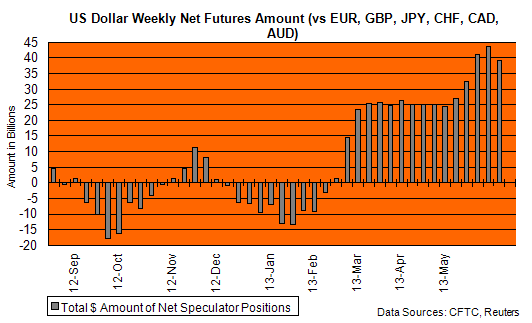
Forex Weekend Update: Currency Speculators scaled back US Dollar bets last week

Currency Speculators scaled back US Dollar bets last week. AUD bets fall for 10th week

The weekly Commitments of Traders (COT) report, released on Friday by the Commodity Futures Trading Commission (CFTC), showed that large futures traders decreased their total bullish bets of the US dollar last week for the first time since April. Prior to last week, total US dollar long positions had increased for four consecutive weeks and to a new highest level since 2008 when Reuters started calculating the total $ amount of positions, according to Reuters.

Non-commercial large futures traders, including hedge funds and large International Monetary Market speculators, trimmed their overall US dollar long positions to a total of $39.12 billion as of Tuesday June 4th. This was a decline from the total long position of $43.77 Billion registered on May 28th, according to position calculations by Reuters that derives this total by the amount of US dollar positions against the combined positions of euro, British pound, Japanese yen, Australian dollar, Canadian dollar and the Swiss franc.

See the full COT report & charts here…


US Dollar lost ground to most majors last week, gained on commodity currencies

The US dollar’s strength had been cooling off for a few weeks and then sharply crystallized last week as the American currency dropped against the euro, British pound sterling, Japanese yen, Swiss franc and the Canadian dollar. The Australian dollar and the New Zealand dollar continued to take it on the chin in the forex markets as these currencies saw more of the same last week in their steep decline.

This week’s fundamental outlook is highlighted by Japan’s monetary policy and interest rate decision on Tuesday which could provide ammunition to the already volatile Japanese yen pairs. Also on the docket for this week is the New Zealand interest rate decision on Wednesday, Australian employment report and US retail sales on Thursday, then Eurozone consumer prices as well as more data out of the United States coming on Friday. See our latest currency pair commentary & major economic highlights below.

See the full Technical Currency Pairs post and charts here…


Upcoming Week’s Economic Events Highlights:

Sunday, June 9

Japan — gross domestic product

Monday, June 10

Switzerland — unemployment rate
Switzerland — retail sales data
Canada — housing starts

Tuesday, June 11

Japan — monetary policy statement and interest rate decision
United Kingdom — NIESR GDP estimate

Wednesday, June 12

New Zealand — interest rate decision
United Kingdom — employment data

Thursday, June 13

Australia — May employment data
Switzerland — producer price data
United States — retail sales data
Japan — Bank of Japan minutes
United States — weekly jobless claims

Friday, June 14

Euro zone — consumer price index
euro zone — employment data
United States — University of Michigan confidence survey
United States — current account
United States — producer price index


See our full economic calendar for more events.


Monetary Policy Week in Review – Jun 3-7, 2013: 3 cut, 6 hold rates, markets adjust to withdrawal of global liquidity

By www.CentralBankNews.info
    This week nine central banks took policy decisions with three cutting rates (Uganda, Poland and Serbia) and the other six (Australia, BOE, ECB, Mexico, Sri Lanka and West African States) maintaining rates as global markets continue to adjust to the reality that the U.S. Federal Reserve at some point will cut back on asset purchases.
     Foreign exchange, bond and stock markets worldwide have been hyper sensitive since late May to the eventual decline in global liquidity from a U.S. tapering of bond purchases, a theme that suddenly relegated the Bank of Japan’s massive quantitative easing from early April to second place on the global agenda.
    But both forces are very powerful and will continue to dominate financial markets and influence central banks’ policy decisions in the short term.
    The latest manifestation of how most central banks, especially smaller ones, are in a constant battle to to adapt to the huge flows of capital, came from the Central Bank of Uruguay. From next month it will replace interest rate as a reference tool for monetary policy with monetary aggregates.
    Given the massive influx of foreign capital in recent years to Uruguay to take advantage of high interest rates and a relatively stable economy, the central bank said the benchmark interest rate had lost its signaling capacity and relevance for markets.
    While keeping its inflation target at 5.0 percent, the central bank widened its tolerance band to 2 percentage points, with the new range from 3.0 percent to 7.0 percent from 4-6 percent.

     This week the Bank of Mexico warned that downside risks to the country’s growth had risen after the drop in the peso and the rise in domestic interest rates, while the Reserve Bank of Australia continued its recent policy of talking down its currency.
     Although the Mexican central bank acknowledged that its economy would benefit from stronger growth in the United States, central banks in Latin America remember all too well how a tightening of U.S. monetary policy in the 1980s and 1990s triggered financial crises in the region.
     Mexico’s central bank again held its policy rate steady this week, following its 50-basis-point cut in March, but said further exchange rate volatility is likely even if global liquidity remains abundant following a gradual withdrawal of U.S. asset purchases.
    Last week the peso, along with the currencies of other emerging markets, tumbled in response to fears that the Federal Reserve would soon taper asset purchases.
    Meanwhile in the Eastern hemisphere, Australia’s central bank continued its recent policy of talking down its dollar, adding that the outlook for inflation would afford its scope for further monetary easing.
    Last month the RBA cut its rate for the first time since November 2012, taking the steam off the dollar, which has now fallen some 8 percent against the U.S. dollar since the May rate cut and some 9 percent since the beginning of the year.
    Nevertheless, the RBA last week continued its jawboning campaign, repeating that the Australian dollar was still high, despite its recent depreciation, in light of the lower export prices.

    Other decisions this week featured the Bank of England (BOE) and the European Central Bank (ECB), with both banks – as expected – keeping rates steady.
    At the BOE, it was Governor Mervyn King’s swan song as he retires at the end of the month, making room for Mark Carney who left the Bank of Canada to take the reins of the BOE on July 1.
    In addition to leaving rates on hold, the BOE also kept its asset purchase program on hold; the target of 375 billion pounds was last raised in July 2012. In the previous four meetings King, along with two other committee members, have failed in their attempts to boost the asset purchases by 25 billion.
     Whether King again failed to persuade his colleagues at his final meeting will first be known when the meeting’s minutes are released on June 19.
    In Frankfurt, ECB President Mario Draghi downgraded his economic forecast slightly. Although he still expects the suffering euro zone economy to “stabilize and recover” during the year, he admitted the recovery will “subdued.”
    The ECB’s staff trimmed their 2013 forecast for Gross Domestic Product to contract by 0.6 percent, up from the March forecast of a 0.5 percent fall, but still an improvement from 2012’s 1.5 percent shrinkage.
    As in the recent past, Draghi confirmed that the ECB would retain an accommodative policy stance “as long as necessary.”
   
    Through the first 23 weeks of this year, central bank policy rates have been cut 54 times, or 25 percent of the 219 policy decisions taken by the 90 central banks followed by Central Bank News. This is up from 24 percent after 22 weeks.
    The number of rate increases this year was stable at 11, or 5.0 percent of all policy decisions, slightly down from last week’s 5.2 percent but still higher than 4.5 percent after week 21.

    LAST WEEK’S (WEEK 23) MONETARY POLICY DECISIONS:

COUNTRYMSCI    NEW RATE          OLD RATE       1 YEAR AGO
AUSTRALIADM2.75%2.75%3.75%
UGANDA11.00%12.00%20.00%
WEST AFRICAN STATES3.75%3.75%4.00%
POLANDEM2.75%3.00%4.75%
UNITED KINGDOMDM0.50%0.50%0.50%
EURO AREADM0.50%0.50%0.75%
SERBIAFM11.00%11.25%9.50%
SRI LANKA FM7.00%7.00%7.75%
MEXICOEM4.00%4.00%4.50%

    NEXT WEEK (week 24) features nine scheduled central bank policy meetings, including Russia, Japan, Iceland, Croatia, New Zealand, South Korea, Indonesia, the Philippines and Peru.

COUNTRYMSCI             DATE              RATE       1 YEAR AGO
RUSSIAEM10-Jun8.25%8.00%
JAPANDM11-Jun0.00%0.10%
ICELAND12-Jun6.00%5.75%
CROATIAFM12-Jun6.25%6.25%
NEW ZEALAND DM13-Jun2.50%2.50%
KOREAEM13-Jun2.50%3.25%
INDONESIAEM13-Jun5.75%5.75%
PHILIPPINESEM13-Jun3.50%4.00%
PERUEM13-Jun4.25%4.25%

    www.CentralBankNews.info

Finally… A Solution to a Real Problem

By Investment U

Intel (Nasdaq: INTC) is lagging the S&P 500 for one-, three- and five-year returns. But recent moves by the chip giant have many analysts looking for a triple-digit gain in as little as the next three years.

Intel has an 80% market share of PC and laptop chips, and while sales for those types of chips have been falling since the advent of smartphones and tablets, the decline is expected to slow from a 7.8% drop this year to 1.2% next.

But the real pop from Intel will be the result of the massive spending it has done to not just catch the current big names in tablet and smartphone chips, but beat them soundly with the company’s new technology.

Last year, Intel spent seven times as much on chip research as No. 2 Qualcomm (Nasdaq: QCOM). And this year it is outspending the No. 1 chip foundry, Taiwan Semiconductor Manufacturing (NYSE: TSM).

The result is that Intel will have the fastest, lowest energy consumption and lowest-cost chips for tablets and smartphones of all its competitors.

This year, Intel launched its 28 nanometer Atom Chips, and next year the company will launch its 14 nm chip. Its competitors will be stuck at 28 nm. The smaller the nanometer, the faster the chip.

Ross Seymore of Deutsche Bank expects to see market share gains for Intel in tablet and smartphone chips as early as next year.

But, where the effect of all this research spending could be seen first is in the need for new servers to address the rising demand of data traffic. One server is needed for every 122 tablets in use and each server requires two chips. Intel’s server revenue alone is expected to grow by low double-digit percentages.

Intel has the resources to be the dominant player in the tablet and chip segment of the chip business, and retain its 80% control of the PC and laptop market. I wouldn’t bet against the company.

Why Bankers Love Steep Rate Curves

Bankers love to charge higher interest rates on loans. That, I’m sure, isn’t a surprise to anyone. And the steepening interest rate curve we have seen in the last few weeks as the 10-year Treasury popped through the 2.0% level will allow them to do just that.

The upside of the inevitable increase in the cost of borrowing is the fact that the numbers go right to the bottom line of banks… and that’s where we can make some money.

These days, banks make their money on net income margin, or the difference between what they pay to borrow money and what they charge in interest. And, there is nothing better for banks than a steepening yield curve to drive net margins higher.

Also, as Treasury yields increase, they tend to do so at a faster pace across the whole yield curve. This feeds bankers’ greatest love – borrowing short and lending long.

When you combine increasing costs to borrow and the highest consumer confidence reading in five years, it’s a screaming opportunity in banks.

Financials were up twice as much as the broad market in May and with the yield curve moving in bankers’ favor we could see more of the same for the rest of this year.

One last point – the steeper the yield curve, the more banks will lend. So we have increasing margins on what is expected to be increasing lending. That’s a one-two punch you need to be part of.

Look at financials.

The “Slap in the Face” Award: A (Comfortable) Roll in the Hay

Finally, definitive data on an issue I mentioned here last year about space- age foam versus coil-spring mattresses. I knew this would be at the top of your list of priorities.

As you might recall from last year’s piece, foam mattresses had been criticized by their owners as being lousy for sex. The experience was described as like being stuck in quicksand. Some foam users are even having sex less often since they bought their space-age bed.

But Leggett & Platt, a manufacturer of a hybrid foam mattress, now claims to have solved the problem.

A study funded by the same, titled “Sexy Sleep,” asked 255 participants to evaluate the performance of beds after sitting, laying, jumping, rolling, bouncing and even crawling on them. (That should cover about all of it.)

The hybrid won in all categories.

It seems 85% of mattress buyers never considered intimacy when making a mattress choice. Leggett & Platt are doing their best to change that.

So, if you’re in the market for a mattress you might take a look at the Leggett & Platt “Sexy Sleep” study before making a decision.

Thank God someone is on top of the really important issues we face today.

Article By Investment U

Original Article: Finally… A Solution to a Real Problem

Hourly Compensation of U.S. Employees Declines Most Since 1947

By Profit Confidential

How can consumer spending in the U.S. economy rise under these circumstances…

In the first quarter of 2013, hourly compensation of Americans employed in non-farm businesses fell 3.8%. This was the biggest drop since the Bureau of Labor Statistic started to measure this statistic in 1947. (Source: Bureau of Labor Statistics, June 5, 2013.)

Consumer spending is not rising as one would expect in a real economic recovery. In fact, real personal consumption expenditures (excluding food and energy) adjusted for price changes rose less than one percent in the first four months of 2013! (Source: Federal Reserve Bank of St. Louis web site, last accessed June 6, 2013.)

And inventories of businesses in the U.S. economy also paint a grim picture of consumer spending. In March, manufacturing and trade inventories stood at $1.64 trillion, up five percent from March 2012. (Source: Ibid.) In an improving economy, like the one that the majority of media outlets and politicians tell us we are in, business inventories are supposed to decline—not rise!

No, businesses building up inventories are not a good sign.

But in spite of the pressures on consumer spending, the stock prices of companies in the consumer “discretionary” sector—that’s businesses that sell nonessential goods—continue to rise.

Take a look at the chart below of the Consumer Discretionary Select Sector SPDR (NYSEArca/XLY) exchange-traded fund (ETF) to get an idea of what’s happened to the stock prices of companies that sell discretionary nonessential items to consumers.

XLY Consumer Discretionary Select Sector SPDR NYSE Chart

Chart courtesy of www.StockCharts.com

 Let’s call a spade a spade: the above chart is not an indication that consumer spending is rising. It’s a chart that simply shows that the stock prices of companies that sell consumers nonessential items are rising because investors are bidding up these stocks.

Don’t let the stock market falsely tell you consumer spending in the U.S. economy is improving and that businesses are doing great, because that’s simply not the case! The reality is that the opposite is happening.

Looking at the health of the U.S. economy, it is very, very weak. This is the weakest economic recovery following a recession I have ever lived through—I believe many Americans would agree with me.

Spending by U.S. consumers makes up more than two-thirds of the U.S. gross domestic product (GDP). If consumer spending isn’t increasing, we can’t have a real economic recovery; it’s that simple, regardless of what rising stock prices may allude to.

What He Said:

“For the economy the message from retail stocks is quite clear: Consumer spending, which accounts for roughly 70% of U.S. GDP, is in jeopardy. After having spent like ‘drunkards’ during the real estate boom years, consumer spending is taking the same trend as housing prices, slowing down faster than most analysts and economists had predicted. As news of the recession continues to make headlines in the popular media, the psychological spending mood of consumers will continue to deteriorate, lowering earnings at most high-end retailers and bringing their stock prices down even further.” Michael Lombardi in Profit Confidential, January 28, 2008. According to the Dow Jones Retail Index, retail stocks fell 39% from January 2008 through November 2008.

Article by profitconfidential.com

Don’t Read This if You Thought the Economy Was Improving

By Profit Confidential

A Little Problem Happened On the Way to Creating JobsThe Bureau of Labor Statistics reported this morning that the U.S. unemployment rate is now 7.6% percent, with 175,000 new jobs created in May. At the same time, the Bureau revised its April numbers down, saying 149,000 jobs were created in April, and not the initial 165,000 it reported.

 The unemployment situation in the U.S. in May was essentially the same as in April. (I wonder how the Federal Reserve looks at this. Does it say, “Wow, imagine what would have happened to the jobs market in May if you didn’t create $85.0 billion in new money during the month”?)

 My readers know I don’t care much for the “official” unemployment numbers we get from the government statistics office. I believe the official rate doesn’t show the real picture, because it does not include people who have given up looking for work in the jobs market and people who want full-time jobs but can only find part-time jobs.

 When we take into consideration these two important figures that the official numbers leave out, the underemployment rate, as it is referred to, was 13.8% in May—it’s been hovering around 14% for years now.

 A startling 7.9 million Americans are working part-time, because they can’t find full-time work in today’s jobs market.

 In total, there are still some 12 million people in the U.S. jobs market looking for work. What’s most troubling is that 37.3% of them have been unemployed for more than six months! The longer they stay out of the jobs market, the more difficulties these people will face in finding jobs as their skills become obsolete.

 Looking closer at May’s jobs market report (which I feel was an all-round terrible report), new employment in industries like mining and logging, construction, manufacturing, wholesale trade, transportation and warehousing, and financial activities witnessed next to no change in May.

 Yes, the growth in the jobs market is in low-paying retail and service positions. We have college graduates working jobs that pay minimum wage.

 Dear reader, there is something definitely wrong with this economic recovery. The government has increased its national debt by $17.0 trillion, and the Federal Reserve’s balance sheet has grown to $3.0 trillion…and we still can’t get create jobs.

 This so-called economic recovery smells funny to me. Maybe the recovery doesn’t even exist. Take out the sucker’s rally in the stock market, and there really isn’t much left to the economy.

Michael’s Personal Notes:

How can consumer spending in the U.S. economy rise under these circumstances…

In the first quarter of 2013, hourly compensation of Americans employed in non-farm businesses fell 3.8%. This was the biggest drop since the Bureau of Labor Statistic started to measure this statistic in 1947. (Source: Bureau of Labor Statistics, June 5, 2013.)

Consumer spending is not rising as one would expect in a real economic recovery. In fact, real personal consumption expenditures (excluding food and energy) adjusted for price changes rose less than one percent in the first four months of 2013! (Source: Federal Reserve Bank of St. Louis web site, last accessed June 6, 2013.)

And inventories of businesses in the U.S. economy also paint a grim picture of consumer spending. In March, manufacturing and trade inventories stood at $1.64 trillion, up five percent from March 2012. (Source: Ibid.) In an improving economy, like the one that the majority of media outlets and politicians tell us we are in, business inventories are supposed to decline—not rise!

No, businesses building up inventories are not a good sign.

But in spite of the pressures on consumer spending, the stock prices of companies in the consumer “discretionary” sector—that’s businesses that sell nonessential goods—continue to rise.

Take a look at the chart below of the Consumer Discretionary Select Sector SPDR (NYSEArca/XLY) exchange-traded fund (ETF) to get an idea of what’s happened to the stock prices of companies that sell discretionary nonessential items to consumers.

XLY Consumer Discretionary Select Sector SPDR NYSE Chart

Chart courtesy of www.StockCharts.com

 Let’s call a spade a spade: the above chart is not an indication that consumer spending is rising. It’s a chart that simply shows that the stock prices of companies that sell consumers nonessential items are rising because investors are bidding up these stocks.

Don’t let the stock market falsely tell you consumer spending in the U.S. economy is improving and that businesses are doing great, because that’s simply not the case! The reality is that the opposite is happening.

Looking at the health of the U.S. economy, it is very, very weak. This is the weakest economic recovery following a recession I have ever lived through—I believe many Americans would agree with me.

Spending by U.S. consumers makes up more than two-thirds of the U.S. gross domestic product (GDP). If consumer spending isn’t increasing, we can’t have a real economic recovery; it’s that simple, regardless of what rising stock prices may allude to.

What He Said:

“For the economy the message from retail stocks is quite clear: Consumer spending, which accounts for roughly 70% of U.S. GDP, is in jeopardy. After having spent like ‘drunkards’ during the real estate boom years, consumer spending is taking the same trend as housing prices, slowing down faster than most analysts and economists had predicted. As news of the recession continues to make headlines in the popular media, the psychological spending mood of consumers will continue to deteriorate, lowering earnings at most high-end retailers and bringing their stock prices down even further.” Michael Lombardi in Profit Confidential, January 28, 2008. According to the Dow Jones Retail Index, retail stocks fell 39% from January 2008 through November 2008.

Article by profitconfidential.com

Equity Market Super Stock Adding Up to Solid Returns

By Profit Confidential

Equity Market Super Stock Adding Up to Solid ReturnsOne company I consistently like for long-term investors looking for dividend payments is PepsiCo, Inc. (NYSE/PEP).

This is the kind of company that can be put into retirement accounts and held for long periods of time with dividend reinvestment.

The equity market has been very kind to PepsiCo since the beginning of this year. Like many blue chips, it has ridden a wave of enthusiasm by institutional investors looking to bid the equity market with the safest names.

PepsiCo offers safety as a corporation with an array of beverage products that are sold worldwide. The many brands that the company maintains are complemented by its snack business. The two businesses go hand-in-hand.

As a multinational company, currency translation plays a big role in its numbers. In the first quarter of 2013, organic revenue growth was a solid 4.4%, but after currency translation, this fell to a mere one percent.

The company’s Americas Foods division was the highlight, producing organic revenue growth of six percent (five percent after currency translation). PepsiCo experienced business growth in all its Americas Foods segments, which include Frito-Lay North America, Quaker Foods North America, and Latin America Foods.

PepsiCo’s first-quarter financial results beat consensus, and big investors celebrated the modest stability.

The equity market has generally been a consistent accumulator of shares in this company. Featured below is PepsiCo’s 25-year stock chart, adjusted for splits:

Pepsico Inc Chart

Chart courtesy of www.StockCharts.com

Consistent with its previous guidance for 2013, the company expects seven-percent growth in its core constant currency earnings per share this year. Combined with its dividend yield of nearly three percent, that’s a decent equity market prospect from such a mature and relatively safe corporation.

PepsiCo plans to spend $6.4 billion in dividends and share repurchases this year. With a forward price-to-earnings (P/E) ratio of around 17 and a trailing P/E of approximately 21, PepsiCo is fully priced.

This company is one of my long-term “super stocks”—great blue-chip companies that offer earnings growth, dividends, and capital preservation. (See “The Best Kind of Stock to Own for the Rest of This Decade.”)

I’m a big believer in dividend reinvestment for a long-term portfolio. While saving for retirement, you can increase your total returns significantly with automatic dividend reinvestment plans.

And once you’re retired, you can stay in the equity market if you choose and use those dividends for income.

If you bought PepsiCo in August of 2009, your simple return to date would be around 43%. With dividend reinvestment into new shares of the company, your return jumps to 60% (recognizing that 2009 was an exceptional base for the equity market).

There are plenty of super stocks out there to consider in a correction, and the soda, beverage, and snack market is a good one.

PepsiCo’s corporate outlooks and equity market returns are generally quite reliable.

Article by profitconfidential.com

Bull Market Not Over, but a Correction May Be on the Horizon

By Profit Confidential

Bull Market Not Over, but a Correction May Be on the HorizonI was watching CNBC Asia two nights ago and marveled at the talk of how well Japan was doing, noting the obvious enthusiasm for the record level of the stock market.

And just like it was back in late 1999, there are more bulls coming out on Wall Street and saying how high the Dow could run. I have heard talk of the Dow at 20,000 and the S&P 500 at 1,800.

Then there’s the recent cheerleading on the stock market from perennial bull Jeremy Siegel from the Wharton School of business, who thinks the Dow could trade at 17,000 this year. (Source: Navarro, B.J., “Jeremy Siegel Still Sees Dow 17,000,” CNBC, May 31, 2013.)

With all of this bullishness, I’m now thinking of an exit strategy. Everyone who thinks this stock market is going higher without some sort of correction may be surprised.

The way I see it is the stock market is vulnerable to selling, but as I said a few days ago, stocks will likely end up higher by the year’s end, as long as the Fed continues to offer easy and cheap money. (Read “How the Stock Market Staged a Rally and Not a Meltdown This May.”)

Never mind the speculation surrounding the Federal Reserve cutting its bond buying at the upcoming Federal Open Market Committee (FOMC) meeting on June 14 and 15; as long as the jobs picture remains fragile, the Fed will likely refrain from doing so until there are stronger economic signals.

The ADP Employment Change was weaker than expected at 135,000 new jobs in May (source: Automatic Data Processing web site, last accessed June 6, 2013), below the Briefing.com estimate of 140,000. If the non-farm reading today also comes in subpar, then I believe the Fed may think hard about cutting stimulus at this juncture.

Of course, you also have to worry about the bubble-like situation in the Japanese stock market. Yes, I say the Nikkei is in a bubble and may be set to burst. The reality is that the benchmark Nikkei 225 is way overvalued, and it fell another 3.8% on Wednesday. With the decline, the overhyped index is now down 15.7% from its high on May 22.

Apparently, Japan’s Prime Minister and the mastermind behind the country’s massive capital injection, Shinzo Abe, failed to discuss the Japanese economy in detail at a keynote speech. Perhaps Mr. Abe has something he wants to avoid talking about.

While the Japanese situation is 10,000 miles away, the ramifications of a major sell-off there would likely trigger a correction in other global stock markets.

The bull market is not done, but I’m seeing an upcoming opportunity to accumulate stocks.

Article by profitconfidential.com

Stock Market Rally Fizzles as 2Q13 Corporate Earnings Growth Fades

By Profit Confidential

The stock market is down 500 points in just over a week…does this mean the Dow Jones Industrial Average has finally topped out?

Corporate earnings are weak; we know that. So far for the second quarter of 2013, more than 80% of the companies in the S&P 500 that have issued their corporate earnings guidance have provided a negative outlook. (Source: FactSet, May 31, 2013.)

Yes, the key stock indices have gotten ahead of themselves. In the first two months of the second quarter, the S&P 500 increased five percent; but as that was happening, earnings estimates for the quarter dropped by 3.4%!

At the end of March, analysts expected the S&P 500 companies to register an increase of 4.4% in their corporate earnings for the second quarter; now that number has dropped to a paltry 1.3%. (Source: FactSet, May 31, 2013.)

In the first quarter of 2013, companies in the key stock indices struggled with revenue growth. Only 46% of the S&P 500 companies recorded revenues above estimates for the first quarter, while the average for the last four quarters was 52%.

But there are further threats to corporate earnings. Demand is weak in the U.S. economy, as the American consumer is still under pressure—he or she is typically working at a job that pays the minimum wage (that’s where most of our jobs growth has been since the Great Recession ended), while the costs of basic necessities continue to rise in an environment where the government says there is no inflation.

I remain skeptical of the rise in the key stock indices, as they aren’t moving in line with the current business conditions in the U.S. economy. I continue to believe the bear market rally, which began in 2009, has done a great job in luring investors back into the stock market. The key stock indices are up significantly and have given investors a false hope that they will climb further.

The S&P 500 has been making lower lows and lower highs since May 22 (as you can see in the chart below), but from what I’ve read from stock advisors, they say to buy on dips—advice I’m not following.

spx s and large cap index chart

Chart courtesy of www.StockCharts.com

What’s going on with the equity markets right now reminds me of 2007 all over again—that’s when the key stock indices were moving higher, regardless of what was happening with the economy. We are experiencing something similar to that right now, with the stock market and economy having gone in such opposite directions.

Predicting the exact point at which the top will be in for the stock market is difficult, if not impossible, but odds are we are very close.

What He Said:

“Prepare for the worst economic period ahead that we have seen in years, my dear reader, as that is what I see coming. I have written over the past three years how, in the late 1920s, real estate prices fell first before the stock market and how I felt the same would happen this time. Home prices in the U.S. peaked in 2005 and started falling in 2006. The stock market is following suit here in 2008. Is a depression coming? No. How about a severe deflationary recession? Yes!” Michael Lombardi in Profit Confidential, January 21, 2008. Michael started talking about and predicting the economic catastrophe we started experiencing in 2008 long before anyone else.

Article by profitconfidential.com

Best Explanation on the Fake Housing Market Recovery I’ve Seen

By Profit Confidential

Housing Market RecoveryThe average American Joe isn’t participating in the U.S. housing market. As a matter of fact, according to the Campbell/Inside Mortgage Finance HousingPulse Tracking Survey, investors purchased 69% of “damaged” properties in April 2013, while first-time home buyers accounted for only 16% of “damaged” purchases.

It is very well documented in these pages how home prices in the U.S. economy are being driven upward by institutional investors. Affirming my stance on the U.S. housing market, Suzanne Mistretta, an analyst at Fitch Rating Services, was quoted this week as saying, “The [housing price] growth is being propelled by institutional money… The question is how much the change in prices really reflects the market demand, rather than one-off market shifts that may not be around in a couple of years.” (Source: Popper, N., “Behind the Rise in House Prices, Wall Street Buyers,” New York Times Dealbook, June 3, 2013.)

Major financial institutions like The Blackstone Group L.P. (NYSE/BX) have become major buyers in the U.S. housing market. Blackstone has spent more than $4.0 billion for 24,000 homes in the U.S. housing market that it plans to rent out.

Rising prices on homes in various pockets of the U.S. housing market are a direct result of large institutional investors buying in.

Take Atlanta, for example. Blackstone bought 1,400 properties worth more than $100 million in Atlanta last year. (Source: Bloomberg, April 25, 2013.) And what happened to prices for homes in Atlanta? According to CoreLogic, a housing data compiler, home prices in Atlanta increased 12.4% in the 12-month period ended February 2013, compared to a 10.2% increase in the overall U.S. housing market.

Looking forward, I don’t hold a very optimistic view on the U.S. housing market for four very specific reasons: first-time home buyers (desperately needed in any housing recovery) are missing from the action; investors who are buying homes to rent them are pushing prices higher; new homebuilder stocks are down 14% in the past month, according to the Dow Jones U.S. Home Construction Index; and long-term interest rates are moving upward!

Consider Colony American Homes Inc. This company delayed its initial public offering, which would have brought in roughly $230–$260 million, due to what the company says are “market conditions.” This company was formed last year, and it purchased homes in mid- and upscale neighborhoods in the U.S. housing market. On April 30, Colony held 9,931 homes in nine states. (Source: Wall Street Journal, June 4, 2013.)

For institutional investors, at the end of the day, it’s all about the profit; they are buying homes and renting them out all in search of a higher return on their money. But institutional buying of American homes will not sustain a recovery in the U.S. housing market.

We need the average American to be involved in the U.S. housing market because he/she provides liquidity and pushes up consumer spending. Increasing home prices right now don’t mean the U.S. housing market has recovered; actually, it’s far from it when first-time home buyers are missing from the action.

As I wrote earlier this week, something is going on in the bond market. Yields on 30-year U.S. Treasuries are spiking. (See “What the Rising Yield on 30-year U.S. Treasuries Is Telling Us.”) Rising long-term interest rates could be another death-bed for the U.S. housing market. And by the way, those homebuilder stocks that went up last year on speculation, I don’t own any of them.

Michael’s Personal Notes:

The stock market is down 500 points in just over a week…does this mean the Dow Jones Industrial Average has finally topped out?

Corporate earnings are weak; we know that. So far for the second quarter of 2013, more than 80% of the companies in the S&P 500 that have issued their corporate earnings guidance have provided a negative outlook. (Source: FactSet, May 31, 2013.)

Yes, the key stock indices have gotten ahead of themselves. In the first two months of the second quarter, the S&P 500 increased five percent; but as that was happening, earnings estimates for the quarter dropped by 3.4%!

At the end of March, analysts expected the S&P 500 companies to register an increase of 4.4% in their corporate earnings for the second quarter; now that number has dropped to a paltry 1.3%. (Source: FactSet, May 31, 2013.)

In the first quarter of 2013, companies in the key stock indices struggled with revenue growth. Only 46% of the S&P 500 companies recorded revenues above estimates for the first quarter, while the average for the last four quarters was 52%.

But there are further threats to corporate earnings. Demand is weak in the U.S. economy, as the American consumer is still under pressure—he or she is typically working at a job that pays the minimum wage (that’s where most of our jobs growth has been since the Great Recession ended), while the costs of basic necessities continue to rise in an environment where the government says there is no inflation.

I remain skeptical of the rise in the key stock indices, as they aren’t moving in line with the current business conditions in the U.S. economy. I continue to believe the bear market rally, which began in 2009, has done a great job in luring investors back into the stock market. The key stock indices are up significantly and have given investors a false hope that they will climb further.

The S&P 500 has been making lower lows and lower highs since May 22 (as you can see in the chart below), but from what I’ve read from stock advisors, they say to buy on dips—advice I’m not following.

spx s and large cap index chart

Chart courtesy of www.StockCharts.com

What’s going on with the equity markets right now reminds me of 2007 all over again—that’s when the key stock indices were moving higher, regardless of what was happening with the economy. We are experiencing something similar to that right now, with the stock market and economy having gone in such opposite directions.

Predicting the exact point at which the top will be in for the stock market is difficult, if not impossible, but odds are we are very close.

What He Said:

“Prepare for the worst economic period ahead that we have seen in years, my dear reader, as that is what I see coming. I have written over the past three years how, in the late 1920s, real estate prices fell first before the stock market and how I felt the same would happen this time. Home prices in the U.S. peaked in 2005 and started falling in 2006. The stock market is following suit here in 2008. Is a depression coming? No. How about a severe deflationary recession? Yes!” Michael Lombardi in Profit Confidential, January 21, 2008. Michael started talking about and predicting the economic catastrophe we started experiencing in 2008 long before anyone else.

Article by profitconfidential.com