Central Banks Push Gold Higher, But “Investor Sentiment Negative”

London Gold Market Report
from Adrian Ash
BullionVault
Thursday, 4 July 09:15 EST

GOLD PRICES held steady in Dollars on Thursday in London, trading around $1250 per ounce as US markets were closed for Independence Day.

 European stock markets rose sharply however, and the gold price for both UK and Euro investors rose over 1.0%, as the European Central Bank and Bank of England kept their interest rates at record-low levels.

 Commodity prices rose overall, while silver prices were little changed in Dollar terms at $19.58 per ounce.

 Weaker Eurozone bonds meantime recovered from this week’s drop, easing interest rates back slightly from multi-month highs.

 “The physical market for gold remains firmly in buying mode,” says Marc Ground at bullion dealers Standard Bank in London, “providing a strong element of support in the absence of investor participation.

 “Amid the current negative investor sentiment” towards gold however, “we don’t think that that physical buying alone could push prices significantly and sustainably higher,” says Ground.

 Central-bank gold bullion buying continued in May, new data compiled by the World Gold Council show, but the pace slipped to an 8-month low beneath 30 tonnes.

 Gold coin sales by Australia’s Perth Mint meantime halved last month from May, despite the sharp drop in prices, matching only 42% of sales in April – the previous crash in world gold prices.

 US Mint gold coins sales last month fell to 27% of April’s level, Bloomberg notes.

 “With disinflation, even deflationary tendencies, we don’t need that insurance any more,” said Dominic Schnider, head of UBS bank’s commodities research in Singapore told the newswire overnight.

 “People are thinking the era of QE in the US is over, and so [they’re] going to get out.”

 Gold bullion outflows from the SPDR Gold Trust – the world’s largest exchange-traded gold fund, and the world’s biggest ETF bar none at 2011’s value peak – totaled 381 tonnes in the second quarter alone.

 That’s equal, notes CIMB Research in Kuala Lumpa, to 122% of 2012’s entire gold bar and coin demand from India, the world’s largest gold consumer market.

 “There is no demand at all and there are no supplies,” said one Mumbai wholesale gold dealer to Reuters this morning, commenting on the typically quiet summer season as well as the government’s recent curbs on new gold imports.

 The Rupee fell again to a new record-low against the US Dollar yesterday, prompting investors to send bond prices lower – and interest rates up – on fears of inflation according to newswire reports.

 Latest data on Wednesday also showed inflation in Turkey – the world’s fourth-largest gold consumer market – rising to 8.3% in June, a 9-month high.

With demonstrations continuing against what some call the “creeping Islamisation” of Turkish law under AKP prime minister Recep Tayyip Erdogan, Turkey’s government bond yields rose this week to 7.8% on two-year debt, the Wall Street Journal notes, up from 4.6% less than two months ago.

 The Turkish Lira has meantime lost 10% against the US Dollar since the start of this year, capping the drop in gold bullion prices for Turkish investors.

 Earlier this week Turkey’s central bank – now holding the official sector’s 13th largest gold reserves, up from 26th place in 2011 thanks to a policy of accepting gold bullion from commercial banks – injected funds into the domestic money market in a bid to reduce interest rates.

 “The jump in Portuguese yields is reminiscent of previous euro-zone crises,” notes HSBC precious metals analyst James Steel, “which proved to be very positive for gold.”

 Portuguese bond prices edged higher on Thursday, nudging yields lower from yesterday’s 7-month high above comparable German Bund rates.

 “With the European Central Bank refusing to ease monetary policy enough,” says Standard Bank FX strategist Steven Barrow, “and with the OMT [bond-buying program] not the bazooka that it’s made out to be, the scope for the Euro to slide and bond spreads to widen is significant.”

Following the ECB’s announcement, the Euro currency fell hard during ECB president Draghi’s monthly press conference.

The policy team “discussed extensively” the idea of cutting interest rates, he said, from their current 0.5%.

The British Pound also dropped hard, down nearly 2¢ to a 5-week low, after the first policy meeting under new Bank of England boss Mark Carney ended with a warning to investors that the recent rise in UK gilt yields “was not warranted by developments in the domestic economy.”

Adrian Ash

BullionVault

Gold price chart, no delay | Buy gold online


Adrian Ash is head of research at BullionVault, the secure, low-cost gold and silver market for private investors online, where you can buy gold and silver in Zurich, Switzerland for just 0.5% commission.


(c) BullionVault 2013

Please Note: This article is to inform your thinking, not lead it. Only you can decide the best place for your money, and any decision you make will put your money at risk. Information or data included here may have already been overtaken by events – and must be verified elsewhere – should you choose to act on it.


ECB to keep rates low for extended time and may cut

By www.CentralBankNews.info     The European Central Bank (ECB) said it will maintain an easy monetary policy stance for “as long as necessary” to boost economic growth and that it may even cut rates further.
    The ECB, which earlier today held its benchmark refinancing rate steady at 0.5 percent, said the risks surrounding its economic outlook remain on the downside and the recent rise in global bond yields “may have the potential to negatively affect economic conditions.”
    Low interest rates will help “provide support to a recovery in economic activity later in the year and in 2014,” ECB President Mario Draghi told a news conference, adding:
    “The Governing Council expects the key ECB interest rates to remain at present or lower levels for an extended period of time,” signaling that the central bank may cut rates if growth fails to improve.

.

Central Bank News Link List – Jul 4, 2013: BOJ Kuroda upbeat on Japan economy, inflation outlook

By www.CentralBankNews.info Here’s today’s Central Bank News’ link list, click through if you missed the previous link list. The list comprises news about central banks that is not covered by Central Bank News. The list is updated during the day with the latest developments so readers don’t miss any important news.

ECB holds rate steady at 0.50 percent, as expected

By www.CentralBankNews.info     The European Central Bank (ECB) held its benchmark refinancing rate steady at 0.50 percent, as expected, along with its interest rate on the marginal lending facility at 1.0 percent and its deposit rate at 0.0 percent.
    As in the past, the ECB said it would comment on the decision by its Governing Council at a press conference later today.
    At its previous meeting in June, the ECB revised downwards its 203 forecasts for growth and inflation and said that it expects the 17-nation euro area to recover during the year, though at a subdued pace.
    The euro zone’s Gross Domestic Product contracted by 0.2 percent in the first quarter from the previous quarter – the sixth quarterly contraction in a row. On an annual basis, the GDP shrank by 1.1 percent, up from a 1.0 percent drop in the fourth quarter.
    Inflation in the euro ara rose to 1.6 percent in June, the third monthly rise since falling to a low of 1.2 percent in April.
    Last week, ECB President Mario Draghi said the economic outlook for the euro zone still warranted an accommodative policy stance and an exit from that was “still distant.” In May the ECB cut its refi rate by 25 basis points.

    www.CentralBankNews.info

Chris Ecclestone: What M&A Deals Reveal About Management—and if They’re Worth Your Investment Dollars

Source: Alec Gimurtu of The Metals Report (7/2/13)

http://www.theaureport.com/pub/na/15415

“Obvious” or “huh/what?”—these are the two types of merger and acquisition deals, according to Hallgarten & Co. Principal Analyst Chris Ecclestone. In this wide-ranging interview with The Metals Report, Ecclestone discusses the anatomy of a mining deal, a few strategic metals stories flying under the radar and Soros Fund’s latest maneuver in the metals market. Along the way, he skewers management teams that cut costs everywhere except the corner office while spending billions on mega-mines with no future.

The Metals Report: In the 2013 Review of global trends in the mining industry, PwC describes the “crisis of confidence” in the mining sector. Does that analysis apply to the specialty metal miners? Are there opportunities in this small sector that might be missed?

Chris Ecclestone: Every metal and mineral has a different story. At this moment, some precious metals—like gold and silver—are in a crisis, but platinum and palladium are not. A big-brush approach to these markets can lead to errors. For example, if iron is weak, to conclude that coal is weak would be wrong. That might be true for metallurgical coal, but not for coal used for energy generation. Mid-month, the lead price got above $1 per pound ($1/lb), which was a significant recovery from its lows. The zinc price has been creeping up again. The copper price is not bad at levels about $3/lb. But the iron ore price totally plunged. So there isn’t just one thing going on here.

In the specialty metals, it’s all about the market conditions for each particular metal. You can have a situation where a primary metal is out of favor, but the alloying specialty metal is not if the specialty metal is in temporary short supply or under political export pressure. Another example of each metal having its own story is the major base metals—lead, zinc, nickel—they were already kicked in the teeth a long time ago. Zinc is nowhere near its 2008 highs, neither is lead, and nickel peaked years before that. It’s invalid to lump them all together; they need to be analyzed separately.

Reviewing the rare earth element (REE) metals situation is instructive. What looked to be a situation of mixed shortage and surplus among this large group of metals was turned into a big drama. Enormous expectations developed, as did “certainties” of shortages for some REEs, and that sent some of the prices through the roof. The trouble with REEs is you can’t divide the pack. You have to take the whole suite—the good, the bad and the ugly. That’s what sabotaged the story for the REEs. Lanthanum and cerium, which were the two biggest components of any REE mix, were in oversupply. So again—each metal has a story.

TMR: What is the most compelling specialty metals story right now?

CE: Antimony, though it’s technically a metalloid. The antimony market has seen little investment for years because of waning China dominance. Now, new applications for antimony are shaking out the old producers and changing the market dynamic. Most Western mines closed down decades ago, but recently, a few Western mines have reopened, although not enough to make up for reduced Chinese exports. As a result, I expect antimony to be strong. A similar situation exists with other metals like gallium, germanium, selenium and some REEs.

TMR: What is the new application driving demand?

CE: Antimony’s biggest rising usage is as a flame retardant in plastics used by the auto industry. After years of having the price of antimony at $2,000 ($2K), $3K and $4K per ton, now it’s at $10K/ton and itwas as high as $15K/ton. That’s a good example of a new technology but not a sexy technology, like the REEs used in cell phones. By comparison, antimony is boring but absolutely vital.

TMR: How can an investor get exposure to antimony?

CE: There are a couple of options. One is Toronto-listed Mandalay Resources Corp. (MND:TSX). It’s a gold-antimony mine in Australia. Another option is the South African company Village Main Reef Ltd. (VIL:JSE), which has the Consolidated Murchison (Cons Murch) gold-antimony mine in South Africa. Gold deposits often are associated with antimony, so it has a double-whammy positive effect because both elements have high value. Given the choice between a gold deposit and a gold-antimony deposit, I would take the latter.

TMR: Lately, you’ve written a lot about mergers and acquisitions (M&A). You categorize M&A deals as either “obvious” or “huh/what?” You dubbed the potential deal between HudBay Minerals Inc. (HBM:TSX; HBM:NYSE) and Thompson Creek Metals Co. Inc. (TCM:TSX; TC:NYSE) “obvious”. How did you come to that conclusion?

CE: That’s a good example of a deal that makes sense to everybody except current management. The companies’ managements say “no, no, no” because it theoretically means someone is going to lose their seat at the table. They don’t want to fall into the funeral procession of some of their colleagues they used to hang out with at PDAC (Prospectors and Developers Association of Canada) conference with their ancient whiskeys and big cigars. There are other deals that could make sense— Lundin Mining Corp. (LUN:TSX) and HudBay, which was a deal proposed back in 2008 and didn’t happen. Or Mercator Minerals Ltd. (ML:TSX) and First Quantum Minerals Ltd. (FM:TSX; FQM:LSE). However, First Quantum is currently digesting the acquisition of Inmet Mining Corp. (IMN:TSX).

Instead of buying a company, Capstone Mining Corp. (CS:TSX) bought a mine by purchasing Pinto Valley from BHP Billiton Ltd. (BHP:NYSE; BHPLF:OTCPK). The market thought the deal was expensive, but to Capstone (and to us), it made a lot of sense. The purchase turned Capstone in a multi-mine copper company. There are other examples of sensible and obvious M&A examples in the gold sector. More interesting to me is when mid-sized diversified miners join together and create companies that have the critical mass to become majors.

Costs are the talk of the industry right now—energy, labor, etc. Yet costs at head offices are much less discussed. If you combine two head offices, it’s like 1+1=1 because you only have one management team surviving. You don’t need to have two investor relations people. You don’t need all the flimflam. One head office gets the chop, and that saves money. In some cases, you cannot save more money at the mine, but you can save money at the head office. There are an awful lot of overpriced, overpaid midtier mining people. When you put two companies together, you can make economies of scale.

Good deals also diversify companies across metals. A company can be all zinc and if zinc goes bad, you’re really done for. Merging a copper mid-tier with a zinc or nickel producer makes sense for a lot of reasons. You get geographic and product diversification. Geographic concentration brings risks. A good example of that is Centamin Plc (CEE:TSX; CNT:ASX, CEY:LSE), which operates in Egypt and saw its market cap wilt from $3.5 billion ($3.5B) down to $600 million ($600M). It is easy to find examples of companies that are down 80%, but not many $3.5B companies are down 80%. Another example of a company that has had issues due to geographic concentration is Centerra Gold Inc. (CG:TSX; CADGF:OTCPK). Centerra has had problems with its main mine, Kumtor, which is in the Kyrgyz Republic. If you run into problems and you only have one mine, you have a big problem. There is no other story to tell investors. The pattern is a familiar one and has happened in all sorts of different places.

TMR: Of the potential mergers you mention, most have geographic diversity as well as a mix of nonferrous base metals. Is that a theme for you going forward?

CE: If there is an economic recovery, you have to bet on base metals. If risk goes down, the appetite for gold goes down. With recovery, the chance of Quantitative Easing (QE) being extended goes down. The inflation fears abate. It’s not looking good for gold, though it may have a floor.

TMR: Is the current financing climate putting the brakes on bad or high-risk mergers?

CE: It’s the bad past examples more than the financial crisis that has curbed high-risk mergers. If we hadn’t had these bad examples, companies would be out there doing the same dumb deals. Many potential acquiring companies have cash. Some of the worst companies have piles of cash. They might have had big write-offs of what they bought in the past and since then, they’ve generated a lot more new spending money. Many mining executives seem to think a $7B property is a great bargain. But why not buy three diversified, million ounce properties for $50M each, rather than buy one 3 million ounce (3 Moz) mega-mine property for $2B? Same amount of ounces, big difference in price. The trouble is many majors would rather pay $1B to buy a 3 Moz mine that’s in one location. This gigantism has now come back to haunt them. The Seabridge Gold Inc. (SEA:TSX; SA:NYSE.A) KSM project, Novagold’s Galore Creek and Barrick Gold’s (ABX:TSX; ABX:NYSE) Pascua Lama project will all be in the history books. No one is going to do a $10B, 20-year project even in the mid-term future in the gold mining sector.

TMR: Do you have any examples of recent good deals?

CE: New Gold Inc. (NGD:TSX; NGD:NYSE.MKT) recently made a really great deal, but the market slapped the stock down because the market says any deal is a bad deal. Capstone got slapped down when it did Pinto Valley. I think that after a few weeks, they recover. But a bad deal is obvious. Everyone just looks at it and says, “huh/what?” Those mining companies are the ones whose CEOs are gone a few months later if they haven’t already bit the dust. The surviving group has been getting smaller and smaller.

TMR: In your most recent monthly letter, you describe rotations. Most investors rotate from hot sectors into perceived growth opportunities looking for the next big thing. You’re proposing investors outside the mining sector are going to look at this beaten up sector as an opportunity. Are new investors rotating into the mining sector soon?

CE: I don’t think the rotation is coming; I think it is here. People look at the U.S. equity market and feel skittish. Between inflation and index changes, the market hasn’t gone anywhere since 2008. But, at the same time, people like to be moving. Brokers don’t make money by investors hanging on to stocks. They make money out of persuading clients to rotate. It becomes a bit of a self-fulfilling prophecy. There is something for each member of the financial community; the brokers, the strategists and the hedge funds guys. For example, the hedge fund guys get itchy fingers if they’re sitting at the desk and haven’t done a trade for half an hour.

But they don’t want to be buying just more of the same old Apple or index fund. They want to be buying something novel. They want to be seen to be doing something. That’s why there will be a rotation. The rotation should mean that the largest miners will see stronger share prices. They’ll benefit because they’re in indexes. Ask your average hedge fund manager who’s never done mining, “name me a mining company”, and he’ll say, “Barrick” or “BHP.” Ask your average hedge fund manager about Agnico-Eagle, and the response will be “What? Is that a brand of Swiss watch?” He won’t know what that stock is unless he’s been there, done that in the past.

It is interesting that Soros Fund’s reduced heavily their expsoure to physical gold ETFs. It’s quite clear that the physical gold exchange-traded funds (ETFs) are suffering. Soros bought options on the Gold Miners ETF (GDX). Buying options on GDX is an interesting trade because the ETF operator is not actually buying the underlying stocks. Someone else is taking the risk, whoever the option writer is. As we know, many mining stocks are now illiquid. If George Soros ever goes to exercise his options and they have to deliver him ETF shares, then they have to go to the ETF manager, which is Van Eck. Van Eck would then have to race out into the market and start buying all the stocks that make up the ETF so that it can create the units that it would then deliver. Soros could create a squeeze—and remember, George Soros’ middle name is “Squeeze”—and really blow that whole dead zone of the ETFs out of the water. Whoever wrote those options is crazy because they are on the wrong side of George Soros in a small market. There is a trade there for a smart fund manager.

TMR: Are there any other strategic minerals investors should take a look at?

CE: Fluorspar is nice. It’s not in exceptionally short supply, but there are very few companies exploring for or mining it. Canada Fluorspar Inc. (CFI:TSX.V) is still moving forward, though not as fast as many people would like. The financing is tough. The only way to do most of these projects is with an offtake agreement. Canada Fluorspar has one. An offtake agreement is not the solution to everything, but it is a big step in the right direction.

TMR: Any strategic minerals to watch?

CE: There are lots of other interesting materials like tellurium, selenium, gallium and germanium. Gallium and germanium are both high-tech elements that the Chinese have a total headlock on at the moment and have had for a long time. Very few Western companies are making any effort to get out there and find those minerals.

TMR: They’re generally byproducts of zinc refining?

CE: Some of them are, but you can find primary mines. Many gold deposits contain a little antimony, a bit of bismuth and whatever else. The minor metals weren’t really considered much. With tellurium, for example, there are no primary tellurium mines, but there are gold deposits with tellurium byproduct. I would focus not on pure gold deposits now. I would focus on gold deposits where you get something else in the mix. A polymetallic deposit is a safety net. I’d rather have a silver-zinc mine than a pure silver mine.

TMR: What is the single most important theme for metals investors at this point in the strategic metals space?

CE: The idea is to be cheap. Look for companies that buy assets cheap. It’s as simple as that. I think many of the managements of the big miners wouldn’t know cheap if they fell over it. They’ve been overpaying for deposits and overpaying themselves in the process. Avoid companies where “cheap” isn’t in their vocabulary. Avoid management with a track record of blowing away your capital while they blow away their credibility. It is an unfortunately common pattern in the mining industry.

TMR: It has been interesting and entertaining to speak with you. We look forward to talking to you again.

CE: Thanks.

Christopher Ecclestone is a principal and mining strategist at Hallgarten & Co. in New York. He is also a director of Mediterranean Resources, a gold mining company listed on the Toronto Stock Exchange, with properties in Turkey. Prior to founding Hallgarten & Co. in 2003, he was the head of research at an economic think tank in New Jersey, which he had joined in 2001. Before moving to the U.S., he was the founder and head of research at the esteemed Argentine equity research firm, Buenos Aires Trust Company, from 1991 until 2001. Prior to his arrival in Argentina, he worked in London beginning in 1985 as a corporate finance and equities analyst and as a freelance consultant on the restructuring of the securities industry. He graduated in 1981 from the Royal Melbourne Institute of Technology.

Want to read more Metals Report interviews like this? Sign up for our free e-newsletter, and you’ll learn when new articles have been published. To see a list of recent interviews with industry analysts and commentators, visit our Metals Report <href=”#interviews” target=”_blank”>homepage.

DISCLOSURE:

1) Alec Gimurtu conducted this interview for The Metals Report and provides services to The Metals Report as an independent contractor. He or his family own shares of the following companies mentioned in this interview: None.

2) The following companies mentioned in the interview are sponsors of The Metals Report: Mandalay Resources Corp. Streetwise Reports does not accept stock in exchange for its services or as sponsorship payment.

3) Chris Ecclestone: I or my family own shares of the following companies mentioned in this interview: None I personally am or my family is paid by the following companies mentioned in this interview: None. My company has a financial relationship with the following companies mentioned in this interview: None. I was not paid by Streetwise Reports for participating in this interview. Comments and opinions expressed are my own comments and opinions. I had the opportunity to review the interview for accuracy as of the date of the interview and am responsible for the content of the interview.

4) Interviews are edited for clarity. Streetwise Reports does not make editorial comments or change experts’ statements without their consent.

5) The interview does not constitute investment advice. Each reader is encouraged to consult with his or her individual financial professional and any action a reader takes as a result of information presented here is his or her own responsibility. By opening this page, each reader accepts and agrees to Streetwise Reports’ terms of use and full legal disclaimer.

6) From time to time, Streetwise Reports LLC and its directors, officers, employees or members of their families, as well as persons interviewed for articles and interviews on the site, may have a long or short position in securities mentioned and may make purchases and/or sales of those securities in the open market or otherwise.

Streetwise – The Gold Report is Copyright © 2013 by Streetwise Reports LLC. All rights are reserved. Streetwise Reports LLC hereby grants an unrestricted license to use or disseminate this copyrighted material (i) only in whole (and always including this disclaimer), but (ii) never in part.

Streetwise Reports LLC does not guarantee the accuracy or thoroughness of the information reported.

Streetwise Reports LLC receives a fee from companies that are listed on the home page in the In This Issue section. Their sponsor pages may be considered advertising for the purposes of 18 U.S.C. 1734.

Participating companies provide the logos used in The Gold Report. These logos are trademarks and are the property of the individual companies.

101 Second St., Suite 110

Petaluma, CA 94952

Tel.: (707) 981-8999

Fax: (707) 981-8998

Email: [email protected]
 

Porter Stansberry Reveals the Greatest Threat to the U.S. Economy and One Easy Way to Protect Yourself

Source: Karen Roche of The Gold Report (7/3/13)

http://www.theaureport.com/pub/na/15420

America is staring down a fiscal catastrophe, says Porter Stansberry, the outspoken investment analyst who has coined the phrase “the end of America.” Americans are living beyond their means, he says, and the global economy is tired of holding our debt. Nothing short of economic disaster will befall us. But amid such grim predictions, in this interview with The Gold Report, Stansberry takes a moment to praise the enduring value of timeless investments, such as farmland and. . .Krispy Kreme. Stansberry shares his thoughts on everything from the Federal Reserve to Hong Kong.

The Gold Report: When we spoke in December, you said that the tax base will expand and people shouldn’t fear going over the cliff—they should fear not going over the cliff. Clearly, we went over the cliff. Were you surprised at the lack of public reaction to the sequestration and the enthusiasm the market has had since then?

Porter Stansberry: No, I thought the press about the so-called fiscal cliff was nonsense and that the amount of reductions in government spending wouldn’t make any difference. I wasn’t worried the fiscal cliff would have any material impact on the financial markets. I was worried that the fiscal deficit problems would get worse if we didn’t expand the tax base. But at the end of the day, it’s a wash because spending will continue to go up and there is no way we can finance it with taxes.

TGR: You’ve written about what you call “the end of America.” This describes a shift of direct exchange treatments, caused by the debasement of the U.S. dollar through quantitative easing (QE), that will result in the dollar no longer being the world’s reserve currency. Many other countries, notably Japan, have recently been doing aggressive QE. Has that impacted the effects of QE in the U.S.?

PS: I would rather answer the question this way: Everyone else’s sovereign debt is priced off of the 10-year U.S. Treasury yield. Demand for U.S. government paper will, sooner or later, collapse when creditors around the world realize that the U.S. government is bankrupt. When that moment of realization comes, our bond market will collapse.

I wrote a piece for the S&A Digest on May 10 when the junk bond market average yield went below 5%. I said that this is as far as the Federal Reserve can press down interest rates. There is no way you can make money in junk bonds when your average yield is below 5%. I said get the heck out of bonds.

That happened to be the same moment when the market for Japanese Government Bonds (JGBs) also began to collapse. I don’t think that’s a coincidence. JGBs fell because the Japanese government said it was going to print unlimited amounts of new yen and manipulate its markets overtly.

That is the same thing that has been happening in America for the last four years.

We supposedly live in a free country—but try giving up your passport and leaving. We supposedly have free-market capitalism—but what happens to the entire world’s markets when Fed Chairman Ben Bernanke speaks? What he says drives all of the world’s stock markets, bond markets and currency markets.

I do not think we have free-market capitalism when one man’s opinion determines the outcome of every market in the world.

I believe the most important impact of quantitative easing will be the loss of prestige and power for the world’s central banks. I believe, sooner or later, the negative consequences of manipulating prices and debasing our currencies will overwhelm the near-term bubbles they have created.

In Japan, investors are abandoning the sovereign debt market in a wholesale way. I believe that is what triggered the run we have seen out of U.S. Treasuries, too. Investors suddenly realized that these markets can still crash. . .and if the currency falls far enough, the central bank cannot act. I believe both market moves were inevitable and were caused by the previous bubbles in those markets that were engineered by the central banks.

TGR: Bernanke signaled that there could be a potential scaling back on QE and that the market is going down based on that. Does that mean the Fed’s decisions have been buoying the market?

PS: The recent activity in the markets is the natural reaction to a manipulated market. All of the previous central bank buying means that market participants do not know what the actual value of the bonds really is. We do not want to find out the hard way.

Also, who is going to buy when the Fed starts selling? It has $3 trillion ($3T) worth of assets. As people around the world begin to flee from sovereign debt, there is going to be a bear market in U.S Treasury bonds. We have not seen a crisis where people flee out of Treasury bonds in a very long time, but we are at that point because the Fed’s printing of dollars to manipulate the Treasury rate destroys the credibility of the entire paper sovereign system.

TGR: Where will that money go?

PS: It can go into 30-day Treasury bills (T-bills), which is a great place to hide. It can go into real estate, timber, euros. It can go into Chinese yuan or Hong Kong dollars. The latter is an interesting trade because Hong Kong dollars are pegged to the U.S. dollar. You could have short-term Hong Kong dollars that would give you an upside as people flee into the dollar, and you have the option of turning it into Chinese yuan someday. If the dollar collapses, there is no doubt the Hong Kong monetary authority would stop following the dollar and start following the yuan.

TGR: How bad does it have to get before the Hong Kong dollar converts to the yuan?

PS: Hong Kong works on the basis of a currency board. For every Hong Kong dollar in circulation, there has to be a matching dollar in the Treasury. It’s not mismanaged. It doesn’t have to break the tie to the dollar—it can keep it as long as it wants.

In the short term, the U.S. dollar is going to be very strong because people are going to move out of bonds and into T-bills. Investors are thinking: I do not want to hold Japanese government bonds anymore, and I do not want to hold Japanese government debt. I don’t want to hold U.S. government bonds, and I don’t want to hold euro bonds. What do I hold instead? The most liquid thing in the world: a U.S. Treasury bill.

But it could be a crisis if the Treasury crash turns into a real panic and you see the 10-year yield quickly go to 4.5%, 5%, 6% or 7%. If that happens, the Fed is going to open the floodgates. Screw the long-term consequences. It’s going to manipulate the rate back down. At that point, the dollar would crater. Buying Hong Kong bills instead of Treasury bills is an interesting way to hedge against the risk of the Fed being more active rather than less active.

If the Fed sacrifices the U.S. dollar completely, we are going to have a 30% devaluation overnight, and the Hong Kong authorities will finally break the tie to the dollar. The Hong Kong dollar will have a new basket of currencies to base our currency on, or it will go to the yuan.

TGR: It has come out that Bernanke is leaving. How do you think the announcement of the new chair will affect Fed policies?

PS: It doesn’t make any difference who is in the Fed chair because Fed policy is driven by the realities of the U.S. debt crisis. With the U.S. economy $60T in debt, the Fed cannot impose a significant real rate of interest on the U.S. obligations or insist on a hard dollar. We just can’t afford it.

TGR: What advice do you have for the new Fed chair? Don’t take the job?

PS: Nobody would want to follow my advice. The Fed is emblematic of a dramatic change in American society. We are so addicted to living beyond our means that when we hear someone say we shouldn’t be borrowing so much money, it sounds like gibberish.

If you look at the promises the federal government has made with Social Security, Medicare, Medicaid—the current value of those promises is $124T. It is unreasonable to make these promises. It’s insane. If you took the collective value of every privately owned asset in the country, it comes to $99T. The government has not only promised more money than it’s ever going to have, it has promised more money than we all collectively have. Or consider this nonsense: Americans hold $1T in student loans! Are you kidding me? Does it make sense to anybody to spend $75,000 to become a dental hygienist? It has become the Fed’s job to make this huge lie—the idea that we can borrow and spend our way to prosperity—the truth.

If I were Fed chairman, I would go in my first day and say we’re going to have a real rate of interest that’s equal to at least 3%. And we’re going to do that because we want to reward people for saving. We want to have a hard currency, and everything else in the economy is going to revolve around that. That is how you reward productivity, saving and capital investment—the things that actually create wealth.

TGR: Which concerns you more—the fact that the U.S. is quickly losing its status as the world’s reserve currency or this unfunded liability?

PS: Losing our status as the world’s reserve currency is the greatest threat to our economy. It is one thing to decide for ourselves that we are not going to live a lie anymore and we are not going to live beyond our means. We could curtail our spending slowly and make sensible changes to the tax system, broadening the base, flattening the rates and getting rid of complexity. Most importantly, we could reform our entitlement programs and, in 20 or 30 years, we could end up with a healthy currency and a solvent government again.

On the other hand, if we continue down the path we are on now, the sheriff is going to show up at our house. He will say, sorry, but your creditors do not trust you anymore and they are foreclosing. At that point, they will just start taking collateral back—exchanging the trillions of dollars outstanding into hard assets in a rush. Just look at what is happening in Japan and then realize that almost 95% of their government obligations are held domestically. If creditors lose faith in the U.S. in the same way, the result will be much worse because foreign investors hold so much of our debt.

TGR: What does that mean for the average citizen?

PS: If the dollar loses its standing as the world’s reserve currency, the value of the average citizen’s savings and wages will disappear. Power bills and gas bills will go up. Doctor bills will go up, as will airline tickets, college, education, private school for kids. Yes, that has already happened quite a bit since the early 1970s, and it is going to get a lot worse. When you look around and wonder why things are not working the way they should, it is because the price system is so heavily manipulated.

TGR: Last November you were buying a lot of real estate. Are you still buying?

PS: I still am buying real estate. I’m closing on another big farm in about 10 days. I don’t want to buy stocks. They’re too expensive. I definitely don’t want to buy bonds. They’re an absolute wealth trap. I don’t want to invest any more in my own business because I’m worried about the effects of this economic uncertainty. So what do I do? I hide the money in real estate. I buy an agricultural property. If agricultural prices go up, and I believe they must, eventually, as the dollar falls, the farm becomes more profitable. Wealthy people have sheltered their assets against inflation in farmland and timberland for all of recorded history.

TGR: But don’t the underlying assets lose value if the dollars back out of the Treasury?

PS: No, they don’t. I’ve been recommending that people buy farmland for four or five years. As the 10-year yield has gone down, the yield on farm properties has also gone down. The price of farm properties has skyrocketed. In many places, you will see these prices correct—a lot—because there will be yield contraction on farmland. But, on the other hand, where you have bought property at a good price, you will not get hurt because eventually inflation will generate additional revenue for you from the farm.

What you do not want in this environment is a fixed coupon. You don’t want to buy something like a Treasury bond, which is denominated in dollars, and the coupon is paid in dollars. You are going to lose to inflation and you are going to lose as yields go higher and the value of your bond goes down. Income from a farm, on the other hand, is tied to the price of a commodity, so at least you are protected from inflation. For me it is still the least bad option.

TGR: And all the commodity prices will go up in this situation?

PS: If I am right about a run on the dollar, absolutely. The timing of the next commodity rally is, of course, uncertain. But it is also inevitable. In any case, I would much rather have a farm than a Treasury bond. I know a farm can feed me and my family.

TGR: Last December you were excited about the idea of exporting natural gas. Ernest Moniz, the new federal energy secretary, recently promised that liquefied natural gas (LNG) court decisions will be made this year. Do you think that he will come through, and if so, what will be the impact of those decisions?

PS: I don’t know the guy, so I can’t speculate on whether or not he will live up to his promise. But they have granted one more license—to a privately held company that is exporting LNG out of the Sabine Pass, near where Cheniere Energy Inc. (LNG:NYSE) is doing the same.

I’m certain that LNG exports from America are going to soar. We are the Saudi Arabia of natural gas. We have more natural gas production, more natural gas storage, more natural gas pipelines than anybody else in the world. We are going to turn that into a dynamic and fantastic competitive advantage for our country. All we have to do is get the scumbag politicians out of the way. And, fortunately, they can be bought.

TGR: Until that happens, is LNG a viable investment strategy?

PS: I am more bullish on natural gas today than I have ever been in my life. I think you’re going to see a huge bull move in these stocks as their earnings ratchet higher and the market suddenly realizes that natural gas is at $3.50 per thousand cubic feet ($3.50/Mcf) rather than $2/Mcf. I am talking about producers in the natural gas space—Devon Energy Corp. (DVN:NYSE), Chesapeake Energy Corp. (CHK:NYSE) and others like them.

TGR: I’m going to read the first sentence from an article you published in the S&A Digest: “What if there was a secret way of looking at the stock market and individual companies that allowed you to see the real value of everything regardless of the price?” What you go on to describe sounds like value investing. Is it?

PS: The question of whether you call yourself a value investor or a growth investor is less important than whether or not you look at a business’ likely earnings capacity and buy it based on a conservative estimation of that number. My experience with individual investors is that they know absolutely nothing about accounting or finance. They have no capacity to be buying individual stocks, and yet they still do. I’m challenging my readers to learn these simple tools so they can better understand our newsletters and be better investors.

On our radio site, Stansberry Radio, we have a videoup in which I just go through the numbers. I don’t tell you what the companies are, but looking at the numbers I can tell you what kind of businesses they are in terms of quality, growth and valuation. It really becomes clear when I tell you what the companies are: the Hershey Company (HSY:NYSE), a super high-quality business, and U.S. Steel (X:NYSE), a super low-quality business.

TGR: Does it make a difference what state the market is in when you are looking at a business’ core values? If you find a company that has real underlying value, do you buy it and hold it?

PS: Here’s an example. I really want to buy Krispy Kreme Doughnuts (KKD:NYSE) for my own account. It’s a legendary brand that has all the attributes of a capital-efficient business. People love their doughnuts.

They’re a fantastic little treat. If anyone is ever feeling down or sick, bring them a box of Krispy Kreme doughnuts; it’s way better than giving flowers. I can understand this business, and I know it will always be profitable. Last year, it had gross profits of $78 million ($78M). It distributed $20M of that to its shareholders. That’s a pretty good rate of capital efficiency. It bought back $20 billion in stock on $78M and net sales. It is expanding all over the world, and I have no doubt it is going to continue to grow.

About a decade ago, Krispy Kreme almost went bankrupt because of accounting fraud—the management stuffed the sales channel and badly botched a massive expansion. But it is a great brand, so it survived. In the last year the stock has gone from $7 or $8/share to $16 or $17/share, and quite frankly, I missed the turnaround. I wanted to buy the stock, but I didn’t want to get involved until the management was replaced. But I lost track of the story. I’m hoping that the turmoil in the bond markets will drive securities prices down and that this stock, which is now trading at 50 times earnings, will come down to a level where I’m comfortable buying it.

Turmoil and fear always provide opportunities to buy great assets. Will my grandkids eat Krispy Kreme doughnuts? I think so. Will a 100-acre farm be here in 100 years? I’m pretty sure it will be. So, you have got to remember to use this crisis to pick up great assets on the cheap.

TGR: It sounds as if you should do your homework now and buy selectively on dips and pullbacks. You don’t want to be caught flat-footed.

PS: I try to, but it is hard to get organized enough to really take advantage. I have been waiting for five or six years to buy Krispy Kreme and I botched it, just because I was not watching the turnaround closely enough. Warren Buffett has this idea to have a 20-hole dance card for investing. In your lifetime, you would only be allowed to buy 20 stocks. Pick 20 great companies and follow those 20 stocks your whole life. Buy them when they are really cheap. I bet if you actually did that, you would be very successful. Look at Buffett and Geico, for example. He had been buying that single stock for decades before he finally took it private.

TGR: You’ve encouraged people to hold a large allocation of gold, some of it as a hedge against the dollar collapsing. Have people missed that window of hedging?

PS: No. We have consistently recommended that people buy physical gold. Gold is the only universally accepted financial asset that is no one else’s corresponding liability. That is gold’s only purpose. It doesn’t have value as an industrial metal. You don’t buy gold because of supply and demand. You buy it as a hedge against the failure of financial institutions, whether it’s the dollar failing or JPMorgan or your credit union down the street failing.

TGR: What should be the allocation of gold in a good-sized portfolio?

PS: Assuming that price is irrelevant, I would like to see a cash and gold component of around 30%. I would have 30-day Treasury bills and gold bullion.

TGR: Where does real estate fit into that?

PS: In a balanced portfolio, something like 10%. I don’t normally associate real estate with my investment portfolio. When I think of an investment portfolio, I think of things that are liquid that you trade, and I don’t usually put real estate in that category.

TGR: What else are you looking forward to in investment ideas?

PS: Let me just say that today it seems as if everything is going great, the economy is getting better and everything is wonderful. But I think we’re at the most dangerous point in the last 50 or 100 years in our country. We have tons of unsustainable policies, and we are racing toward a cliff. Not a stupid, phony, press-driven fiscal cliff but a real cliff. This cliff involves people around the world no longer being interested in holding our debt. People don’t realize that there is no material difference between what has gone on in Greece and Spain and what’s happening now in Japan and what is happening with us. We’re just the largest kid on the block, but we’re not in any better shape.

TGR: In fact, we have more to lose in one sense because we are the reserve currency. If that goes away, we miss a leveraged advantage.

PS: China is angling to become our competitor as the world’s reserve currency. It is buying up as much gold as it possibly can to have a firm foundation for its currency. Over the next several years that will come to fruition. In fact, here’s a stunner for you: Within the next 12 to 24 months, I think the yuan will open on the capital account, which means free trading around the world. I don’t think anybody expects that.

TGR: Will that be the first domino in the U.S. dollar’s retreat from reserve currency? Does this need to happen for the U.S. dollar to be removed as the reserve currency?

PS: Before the euro, the U.S. dollar made up about 80% of all bank reserves around the world. That fell to 62% with the advent of the euro. I think the yuan will take us to below 50%. In that case, we will no longer have claim to the world reserve currency. This is happening in lots of ways already: China has set up bilateral trade agreements with a dozen of the largest Organisation for Economic Co-operation and Development (OECD) countries. It has the banks in those countries set up to do capital account yuan trading, and the banks have bought lots of yuan so they can hold the inventory and make the trades. That’s gone on with Australia, France, Britain, Russia, Japan and all the Latin American countries. They are positioned to go ahead and push the button and make that policy change at any time.

That would be an enormous change and would allow banks from all over the world to sell their dollars and buy yuan. That would be very bad for our country because it would push up interest rates on all of our bonds and weaken the value of our currency tremendously.

TGR: I assume that means the price of goods goes up for the average consumer.

PS: Yes, especially imported goods. But one positive would be that our current account and trade deficits would regain some balance because we wouldn’t be able to afford to buy so much from overseas.

It would make a dramatic difference in our standard of living. In the most important way, it would greatly increase the cost to borrow. That’s a big problem for our economy because as you know, just about everything in our life is based on debt.

TGR: Your insights, once again, are always intriguing and insightful. I really appreciate it.

Porter Stansberry founded Stansberry & Associates Investment Research, a private publishing company based in Baltimore, Maryland, in 1999. His monthly newsletter, Stansberry’s Investment Advisory, deals with safe-value investments poised to give subscribers years of exceptional returns. Stansberry oversees a staff of investment analysts whose expertise ranges from value investing to insider trading to short selling. Together, Stansberry and his research team do exhaustive amounts of real-world independent research. They’ve visited more than 200 companies in order to find the best low-risk investments. Prior to launching Stansberry & Associates Research, Stansberry was the first American editor of the Fleet Street Letter, the oldest English-language financial newsletter.

Want to read more Gold Report interviews like this? Sign up for our free e-newsletter, and you’ll learn when new articles have been published. To see a list of recent interviews with industry analysts and commentators, visit our Streetwise Interviews page.

DISCLOSURE:

1) Karen Roche conducted this interview for The Gold Report and provides services to The Gold Reportas an employee. She or her family own shares of the following companies mentioned in this interview: None.

2) The following companies mentioned in the interview are sponsors of The Gold Report: None. Chesapeake Energy Corp. is a sponsor of The Energy Report. Streetwise Reports does not accept stock in exchange for its services or as sponsorship payment.

3) Porter Stansberry: I or my family own shares of the following companies mentioned in this interview: None. I personally or my family am paid by the following companies mentioned in this interview: None. My company has a financial relationship with the following companies mentioned in this interview: None. I was not paid by Streetwise Reports for participating in this interview. Comments and opinions expressed are my own comments and opinions. I had the opportunity to review the interview for accuracy as of the date of the interview and am responsible for the content of the interview.

4) Interviews are edited for clarity. Streetwise Reports does not make editorial comments or change experts’ statements without their consent.

5) The interview does not constitute investment advice. Each reader is encouraged to consult with his or her individual financial professional and any action a reader takes as a result of information presented here is his or her own responsibility. By opening this page, each reader accepts and agrees to Streetwise Reports’ terms of use and full legal disclaimer.

6) From time to time, Streetwise Reports LLC and its directors, officers, employees or members of their families, as well as persons interviewed for articles and interviews on the site, may have a long or short position in securities mentioned and may make purchases and/or sales of those securities in the open market or otherwise.

Streetwise – The Gold Report is Copyright © 2013 by Streetwise Reports LLC. All rights are reserved. Streetwise Reports LLC hereby grants an unrestricted license to use or disseminate this copyrighted material (i) only in whole (and always including this disclaimer), but (ii) never in part.

Streetwise Reports LLC does not guarantee the accuracy or thoroughness of the information reported.

Streetwise Reports LLC receives a fee from companies that are listed on the home page in the In This Issue section. Their sponsor pages may be considered advertising for the purposes of 18 U.S.C. 1734.

Participating companies provide the logos used in The Gold Report. These logos are trademarks and are the property of the individual companies.

101 Second St., Suite 110

Petaluma, CA 94952

Tel.: (707) 981-8999

Fax: (707) 981-8998

Email: [email protected]


BOE holds rate, QE, rise in bond yields weighs on outlook

By www.CentralBankNews.info     The Bank of England (BOE) maintained its Bank Rate at 0.5 percent and its target for asset purchases at 375 billion pounds, as expected, but added the recent rise in market interest rates would have a negative impact on its outlook for economic growth and inflation, and it did not consider the implied rise in its policy rate to be warranted by economic developments.

New Free Resource: The Ultimate Wave Trading Crash Course (from a bestselling author on trading)

Greetings,

Are you looking for a new way to dramatically improve your trading?

Like anything worth mastering, learning new trading techniques takes time and patience. As Robert Prechter, founder of Elliott Wave International, often says, there is only one way to cut your learning curve short: “Find a mentor.”

We are glad to offer you an exclusive one-week Elliott wave trading primer from best-selling author and technical trading instructor Jeffrey Kennedy — a senior analyst at Prechter’s firm — absolutely FREE.

Learn what the Elliott Wave Principle can do for you with a full week’s worth of trading lessons, including two insightful excerpts from Jeffrey’s new Amazon Finance No. 1 Bestseller, Visual Guide to Elliott Wave Trading. Each easy-to-understand lesson will highlight important wave-trading tips and techniques — including two video lessons.

Put yourself on the fast track to applying the method successfully in your own trading.

Sign up now for The Ultimate Wave Trading Crash Course from Jeffrey Kennedy — it’s FREE!


About the Publisher, Elliott Wave International
Founded in 1979 by Robert R. Prechter Jr., Elliott Wave International (EWI) is the world’s largest market forecasting firm. Its staff of full-time analysts provides 24-hour-a-day market analysis to institutional and private investors around the world.

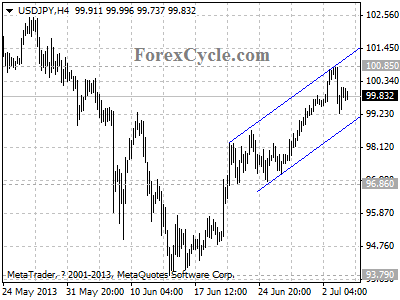
USDJPY remains in uptrend from 93.79

USDJPY remains in uptrend from 93.79, the fall from 100.85 could be treated as consolidation of the uptrend. Support is now located at the lower line of the price channel on 4-hour chart, as long as the channel support holds, the uptrend could be expected to resume, and one more rise to 102.00 area is still possible after consolidation. On the downside, a clear break below the channel support will suggest that the upward movement from 93,79 had completed at 100.85 already, then the following downward movement could bring price back to 95.00 – 96.00 area.

usdjpy

Daily Forex Analysis

S+P 500 Downtrend Looms? Counting Down The Days…

By MoneyMorning.com.au

Down 100, up 100, down 100. I’m starting to get a bit of whiplash watching the ASX 200 move around these days.

Last week I said that the current rally was nothing more than a short squeeze which will end up stalling and eventually turning back to the downside.

I said that the S+P 500 would probably top out between 1,620-1,640 with an outside chance of hitting 1,660 before rolling over again. This week the high in the S+P 500 has been 1,626 and we have seen a couple of rejections from that level over the last couple of nights.

Whether or not that level proves to be the top in this move remains to be seen of course, but it does feel like we are getting close to seeing a resumption of the downtrend…

The chart below is a 60 minute intra-day chart of the emini S+P 500 futures contract.

S+P 500 Futures Intraday Chart


Source: CQG Trader

You can see that prices have struggled to get above the point of control of the current distribution at 1,617. We’ve already seen prices move to the level 0.618 below the current range down at 1,559 so we know the market is weak.

You will often see a retest of the point of control before prices turn back down again and fail completely outside of the distribution. So the intraday charts are stacking up nicely, which suggests we may be getting close to a top in this short squeeze.

Another thing I like to look at is whether or not past short squeezes can give us any hints.

I went back over the past four years of data and looked at how long the short squeezes usually last during an intermediate downtrend. My definition of an intermediate downtrend is when the 10 day moving average is below the 35 day moving average.

I was quite surprised by my findings.

Over that time there were 17 short squeezes during an intermediate downtrend that ended up falling over and leading to lower prices.

The average length of time for all of the short squeezes was 5.7 days and the most surprising thing of all was that of the 17 rallies 12 of them lasted between 5-7 days. So 70% of short squeezes will last between five to seven days in an intermediate downtrend. Amazing.

The other thing of note was that none of them lasted longer than 10 days. So if the rally lasts longer than 10 days we could start to become more suspicious of the intermediate downtrend.

The rally from the lows at 1,560 in the S+P 500 has lasted seven days, so it’s now starting to get pretty long in the tooth if this current intermediate downtrend is going to be maintained.

European Unrest Back in the News

News out of Portugal last night has reignited fears over Europe, so perhaps that will be the catalyst to get things moving on the downside again.

Portuguese bond yields spiked to 8% after two ministers quit, signalling that the government will struggle to implement further budget cuts as its bailout program enters its final 12 months.

The Financial Times reported that the Prime Minister of Portugal ‘has pledged to stay in office and seek to establish a stable government despite the resignation of two key ministers and the threatened break-up of his ruling coalition.

Spanish and Italian bonds sold off in sympathy with Portuguese debt and their respective stock markets also took a beating.

One of the interesting things I noted last night was that as the smelly stuff was hitting the fan, gold and silver caught a very strong bid. It felt like a return of the good old days when people turned to the precious metals as a safe haven.

We may still see some downside volatility in gold but we’re getting close to a bottom as far as I’m concerned. The 50% retracement of the whole bull market rally sits at about US$1,100, so I wouldn’t be surprised if we did end up testing that level, but you would be backing the truck up there.

The most interesting chart of them all though is the weekly chart of the S+P 500:

S+P 500 Weekly Chart

There will only be once in my lifetime where I will see a multi-decade triple top form.

You saw what happened the last time the S+P 500 had a false break of its all-time high back in 2007. That was the beginning of the crash. This time around the stock market has been pumped back up to all-time highs with funny money from the US Federal Reserve, and Bernanke has just hinted that he’s waking up to the fact that his actions are creating more harm than good.

It doesn’t take a rocket scientist to figure out that the false break of the highs from 2007 could lead to a similar fate for the S+P 500.

My current targets on the S+P 500 are to the 35 week-50 week moving average zone (around 1,500 points), but when I look at that weekly chart I can see things going a lot lower than that if the music stops.

Murray Dawes+
Editor, Slipstream Trader


From the Port Phillip Publishing Library

Special Report: Just What are ‘Turbo Cap’ Stocks?

Daily Reckoning: How the Power of Tweets Saved Tesla Motors

Money Morning: Don’t Get Caught in the Market Crossfire

Pursuit of Happiness: Is Technology the Most Exciting Industry in the World?