Central Bank News Link List – Jul 5, 2013: China pledges to boost financial support after cash crunch

By www.CentralBankNews.info

Here’s today’s Central Bank News’ link list, click through if you missed the previous link list. The list comprises news about central banks that is not covered by Central Bank News. The list is updated during the day with the latest developments so readers don’t miss any important news.

Friday Charts: Hogs, Fireworks and the Worst Performing Stock Markets of 2013

By WallStreetDaily.com

We’re not going to let a shortened holiday week keep us from our charts.

Just like every other Friday, we’re serving up a handful of carefully selected graphics to drive home some important investing and economic insights.

After all, a picture is supposed to be worth 1,000 words, right?

We certainly think so. And we’re putting it to the test again, as we feature a trio of snapshots related to the most unexpected commodity rally… the possibility of a summer surge for U.S. stocks… as well as the best (and worst) performing countries in 2013. (The results are shocking!)

Enjoy!

Happy, Happy, Happy… As a Hog!

Gold has fallen and it can’t get up. The not-so-precious metal dropped 14% in June alone. However, not all commodities are getting clobbered.

Take the $12-billion hog futures market, for instance. It can’t be contained.


So far in 2013, hog prices are up 19%. That’s enough to make it the top-performing component in the Dow Jones-UBS Commodity Index, which is actually down 10% on the year.

When a specific commodity defies its benchmark average by such a degree, it makes you wonder what insiders know that the rest of us don’t.

It’s true that all hogs – on Wall Street and the farm – eventually get slaughtered. But right now, “everybody’s happy and making money and having fun,” says Dennis Smith of Archer Financial Services.

Kind of makes you want to bet the farm on the pigs, too, huh?

Unfortunately, no pure-play opportunities exist now that Smithfield Foods (SFD) is on track to be acquired by a Chinese company for $34 per share.

Instead, you’ll have to settle for the iPath Dow Jones-UBS Livestock Total Return Sub-Index ETN (COW). It invests 41.6% of its assets in lean hog futures, with the rest in live cattle futures.

Stock Market Forecast: June Gloom Gives Way to Fireworks in July

A June gloom descended on stocks, just like every other June for the past 50 years.

So what’s in store for July? Fireworks, baby!

As Bespoke Investment Group notes, “July sticks out as the one summer month that has seen strong gains.”

Indeed!

As you can see, the Dow has averaged gains in the month of July over the last 20, 50 and 100 years.

So stock market seasonality points to this bull market lasting even longer. Go ahead and pinch yourself. You’re not dreaming.

U-S-A! U-S-A!

If there’s ever a week to be obnoxiously patriotic, it’s this one.

But aside from celebrating our country’s independence (God bless America!), we can also rejoice over the fact that the U.S. stock market is one of the top performers in the world.

Through the second quarter, U.S. stocks are up 13%.

Only Japanese stocks are faring better, rising 31.6%. (If you followed our words of wisdom here, you should be sharing in this upside.)

Meanwhile, the highly touted BRIC nations (Brazil, Russia, India and China) are all seeing red this year.

My recommendation? Keep buying U.S. and Japanese stocks on the dips. And don’t believe the (latest) hype in emerging markets.

That’s it for this week. Before you go, though, let us know what you think of this weekly column – or any of our recent work at Wall Street Daily – by sending an email to [email protected] or leaving a comment on our website.

Ahead of the tape,

Louis Basenese

The post Friday Charts: Hogs, Fireworks and the Worst Performing Stock Markets of 2013 appeared first on  | Wall Street Daily.

Article By WallStreetDaily.com

Original Article: Friday Charts: Hogs, Fireworks and the Worst Performing Stock Markets of 2013

Europe market to open green ahead of US data

By HY Markets Forex Blog

Investors are expecting the European market to open green on Friday, as they wait for the US job data to be released, to indicate whether the US labor market is improving.

The expected US data will determine the following step the Federal Reserve plans to take with the asset-purchasing program.

The European Euro Stoxx 50 index gained 0.21% at 2,648.50, while futures for the French CAC 40 jumped 0.18% to 3,814.50 .The German DAX rose 0.31% at 8,025.30, at the same time the UK’s FTSE 100 futures rose 0.33% to 6,397.80.

Investors await the job data to be released later on Friday. The data is expected to show a drop of 7.5% in the unemployment rate, from previous rate of 7.6%

On Wednesday , data from the world’s largest economy showed that the figures of people employed in the US ,has increased by 188,000 in June ,compared to previous record of 134,000 in May .

Other reports released showed jobless benefits in the US declined by 5000 to 343,000, from previous records of 348,000, according to the Labor Department.

In Germany, factory orders are forecasted to gain 1.2% in May and increase by 0.1% annually after falling 0.4% in April.

Stocks in the Asian market traded higher on Friday, after the European Central Bank and the Bank of England maintained the policies. The Hong Kong, Hang Seng rose by 1.71% to 20,819.13, while the Shanghai Composite gained 0.25% to 2,011.13 in time of writing.

The post Europe market to open green ahead of US data appeared first on | HY Markets Official blog.

Article provided by HY Markets Forex Blog

Asian stock climbs on U.S job data

By HY Markets Forex Blog

Following the positive US jobs data which showed the increase in employment in the world’s largest economy, Asia stocks were mixed Thursday morning after the US data revealed the increased number of the employed people in the private US private sector .With an increase of 188,000 in June from previous reading 134, 000, surpassing analysts’ predictions of a 160,000 increase.

Tokyo’s Topix index fell 0.5% to 1,167.91 points as of 2:17am GMT, while Nikkei 225 declined 0.41% to 13,998.47 points at the same time. Mitsui Mining, JFE Holdings and Smelting all dropped by over 3%. The Hong Kong hang seng index advanced 1.24% to 20,396.54 points as of 2:17am GMT.

The MSCI Index gained 0.8% to 424.46 as of 1:03p.m in Hong Kong. While the South Korea’s Kospi index advanced 0.16% to 1,827.62 as of 2:11am GMT. Australia’s S&P 200 index gained 0.9% as the New Zealand’s NZX 50 Index dropped 0.1% .The Straits time index gained 0.9%, while in Taiwan, the Taiex index slid 0.2%.

China Petroleum & Chemical Corp advanced 3.1% to A$35.69, while the West Texas Intermediate crude climbed 0.2% to $101.40 a barrel for the August delivery.

Due to the fallback of the Japanese yen falling below the 100 yen mark, car exporters’ such as Nissan motors declined over 1.8%, while Mitsubishi motors’ dropped over 3% .

The post Asian stock climbs on U.S job data appeared first on | HY Markets Official blog.

Article provided by HY Markets Forex Blog

The Power of Low Interest Rates Coming to the Aussie Market

By MoneyMorning.com.au

So, turns out it was a joke.

We’ve listened in on Reserve Bank of Australia governor, Glenn Stevens’ address to the Economic Society of Australia, and it’s a hoot.

OK. No it isn’t.

Opening his presentation, the governor said the RBA board had ‘deliberated for a very long time’ before deciding to leave interest rates unchanged.

The financial markets took him at his word and assumed the RBA was within an inch of cutting rates. That sent the Australian dollar into a tailspin from which it hasn’t yet recovered.

But whether it was a joke or no, either way it wasn’t funny. And besides, every man and his dog knows rates will fall this year. So if you haven’t structured your portfolio to benefit from that you better get cracking…

It’s important to remember that two things move markets – earnings and interest rates.

How so?

Simple. If a company can increase its earnings it becomes more valuable to investors. That means the share price should rise as long as investors believe earnings will keep rising.

And if the market expects the company to pass the higher earnings through to investors as a dividend, or that the company plans to expand the business through reinvestment, it will encourage investors to hold or buy the stock.

As for interest rates, that works for stocks in two ways. First, if interest rates are low it means lower financing costs for companies that are in debt. Second, it means bank savings rates will be low. And that means investors will look for alternative investments that pay a higher income – namely, dividend-paying stocks.

But low interest rates help another bunch of stocks too – growth stocks…

The Starting Point of Every Investment

Now, at first thought you might wonder how earnings and interest rates can impact growth stocks, especially small-cap stocks. After all, most small-caps don’t make a profit, and they’re so risky banks won’t lend them money. That means they can only get access to capital by convincing investors to buy new shares from the company.

However, earnings and interest rates still play into an investor’s thinking. For a start, even when you buy the most speculative stock on the market, you’re still thinking about the profits it could make in the future and therefore how high the shares could climb.

And even if you plan on selling before it makes a profit, the investor who buys the stock from you is also thinking about the future profit potential.

OK, but what about interest rates? Interest rates serve as the basis from which you judge the relative risk and reward of all other investments.

Put another way, if a bank account pays you a risk-free return of 5%, it doesn’t make sense to put money into an investment where you could lose half your money at worse, but only make 4% at best.

So that’s why earnings and interest rates have such a big impact on stock prices…even on some of the smallest stocks. Anyway, back to those growth stocks we’re eyeing up…

A chart that’s almost too scary to look at is the S&P/ASX Emerging Companies index. When you look at the chart below you’ll see why:


Source: CMC Markets Stockbroking

The index has halved since 2011.

Over the same period the S&P/ASX 200 is just about breakeven…better than breakeven if you include dividends. And if we go from the start of 2012, the Emerging Companies index is down 34%, while the blue-chip index is up 17% (plus dividends).

In other words, whichever way you slice and dice this market, it has been an ordinary…scratch that…it has been a terrible year or two for growth stocks.

That’s exactly why we like them so much.

A Bet Worth Making

We’ll be honest. We won’t say we’ve picked the bottom of the market here. We thought the bottom was in for small-cap resource stocks about two months ago. We even went on record to say stocks looked the best value since 2008/2009.

Well, if they looked good value two months ago, they look even better today.

This is part of the key to being a successful contrarian investor – buying stocks that everyone else hates. The biggest trick is the timing. Ideally you should wait until the stock or index hits rock bottom and then buy as it swings higher.

Trouble is, stocks rarely rise and fall in neat, straight lines. They tend to trick you into buying (and selling) just when you shouldn’t.

And sometimes – as happened recently – just when we thought things couldn’t get any worse. Only they did. The gold price slumped and dragged the gold miners and explorers down with it.

It wasn’t just the gold stocks. When the market goes through a rough patch as bad as this, investors tend to throw everything out of the basket, good and bad. That explains why there’s so much value in speculative stocks right now.

But to most investors speculative stocks look too risky. And so the mistake many will make is to think that dividend stocks are the only way to make money this year. But as we’ve shown above, low interest rates have a big impact on growth stocks too.

So knowing that rates are staying low (the Bank of England and European Central Bank both vowed overnight to keep rates low and stocks surged), the next step is to pick the right type of stock that stands to make the best gains over the coming months.

Dividend stocks still make sense. But don’t overlook growth. Our bet is it won’t be long before investors tire of income stock returns and look for tastier returns among growth stocks.

We thought that time had come two months ago…but we were too early. Today growth stocks look even better value than they did then. Is now the time to start buying some of the market’s riskiest stocks?

That’s our bet. It’s a risk worth taking. But we’ll only know for sure two months from now. Stay tuned.

Cheers,
Kris
+


From the Port Phillip Publishing Library

Special Report: Just What are ‘Turbo Cap’ Stocks?

Daily Reckoning: How the Power of Tweets Saved Tesla Motors

Money Morning: Don’t Get Caught in the Market Crossfire

Pursuit of Happiness: Is Technology the Most Exciting Industry in the World?

Australian Small-Cap Investigator:
How to Make Big Money from Small-Cap Stocks

How Congress and Obama Robbed US Pension Plans with MAP-21

By MoneyMorning.com.au

We found yet another reason why the US retirement crisis will be uglier than many retirees are prepared for…

You see, while retirees were napping last year, Congress and President Barack Obama were quietly stealing from their pension plans by enacting a little-known law called MAP-21.

Hidden in the wording of a new transportation bill, the act allows big companies to slash their contributions to pension funds.

The upshot?

The number of companies defaulting on their pension plans could balloon and bankrupt the Pension Benefit Guarantee Corp. (PBGC) insurance program – leaving retirees out in the cold.

That smell of sulfur is what MAP-21 gives off,‘ Jeremy Gold, a pension consultant, told The Fiscal Times.It’s got a smell about it of a deal made with devils.

That’s bad news for retirees – or those about to retire – who are counting on a lifetime of payments from a pension plan.

Here’s why…

MAP-21: A Wolf in Sheep’s Clothing

In 2012, the government faced a shortfall between current gas taxes and projected highway spending.

So how to raise the money?

Let corporations cut funding on their pension plans and generate taxes from higher wages. The bill – titled Moving Ahead for Progress in the 21st Century or MAP-21 – lets companies change how they calculate how much they need to fund pension plans.

MAP-21 lets employers put less money in their pension plans by allowing them to value their liabilities – what they have to pay in to fund pensions – using higher interest rates instead of current, low rates.

You see, pension plan liabilities are higher when interest rates are low because returns from bonds and other investments are expected to return less. When rates are high, the returns are expected to be higher and the liabilities are reduced.

Allowing companies to contribute less to their plans raises revenue for the federal government.

The government is assuming MAP-21 will raise $9.5 billion over 10 years because it will get more tax revenues from higher wages of current workers.

Defined Benefit Plans Targeted

MAP-21 is squarely targeted at traditional defined benefit (DB) pension plans. These are plans funded by the companies to provide employees with a source of income after retirement.

But the number of workers with DB pensions has been in steep decline for years. Fewer and fewer workers outside of the government sector have them.

Since the 1990s, DB’s have been replaced by 401(k)s, the employee contribution model that is now the main form of retirement plans.

Only about 18% of full-time private industry workers had a DB pension in 2011-down from 35% in 1990, according to the Bureau of Labor Statistics.

Companies want to get away from pensions totally,‘ Steve Pavlick, worker benefit specialist at the law firm McDermott Will & Emory told CNBC. ‘Most companies aren’t offering them anymore to new workers.

But pensions are still a key source of income for many current retirees, according to the Pension Rights Center. Only 52% of seniors receive income from financial assets. Half of those receive less than $1,260 a year.

And Social Security payments average a meager $15,179 a year, roughly 40% of retirees pre-retirement income.

Insurance Fund in Danger

Under federal law, DB’s are subject to minimum funding rules designed to make sure that plans have enough money to deliver promised benefits.

If a plan faces a funding shortfall, employers must make contributions to increase the plan’s assets and cover the shortfall.

But 94% of pension plans are currently under funded, according to a new study from Wilshire Consulting.

In fact, DB pension plans for S&P 500 Index companies are under funded by a whopping $342.5 billion, according to Russ Walker, a Wilshire vice president.

That means more and more companies are going to be relying on the PBGC, the government’s pension insurance fund, for assistance.

The PBGC is funded by companies with DB pension plans and steps in when plans go bust. Only problem is, the PBGC may run out of money.

The financial crisis and a slow economy have forced many plans into insolvency. As a result, PBGC’s deficit more than doubled from $11.2 billion in 2008 to $26 billion in 2011.

In fact, PBGC officials said that plans that are insolvent or ‘are likely to become insolvent in the next 10 years‘would likely exhaust the insurance fund within the next 10 to 15 years.

Even though MAP-21 provides for premium increases that will raise about $11.2 billion, it won’t be enough to keep PBGC afloat.

If it goes under, the ensuing retirement crisis will reduce many retirees’ benefits to an extremely small fraction of their original value, the PBGC says.

Now, under MAP-21, companies will be allowed to decrease their contributions even as millions of Baby Boomers hit retirement age.

This proves that pensions are pretty much dead,‘ Greg McBride, chief economist at Bankrate.com told CNBC. ‘The change is just another charade to mask the underfunding of pensions.

MAP-21 is scheduled to phase out in a few years, but companies are already plotting how to extend it.

There’s a lobbying effort to make this type of change permanent,‘ Pavlick said.

If that happens, many retirees will likely face an even tougher struggle to make ends meet in the future.

Don Miller
Contributing Editor, Money Morning

This article first appeared in US Money Morning on 3 July, 2013

From the Archives…

Why Your Financial Advisor Won’t Like This Investment Advice…
28-06-2013 –  Kris Sayce

Is This Your Last Chance to Sell Before the Stock Market Sinks?
27-06-2013 – Murray Dawes

Is This the Ultimate Contrarian Opportunity…Or a Death Wish?
26-06-2013 – Dr Alex Cowie

How Central Bank Zombies Control the Stock Market
25-06-2013 – Dr Alex Cowie

Why The ‘Asia-Zone’ Crisis Makes Australian Stocks a Buy…
24-06-2013 – Kris Sayce

USDCHF stays within a upward price channel

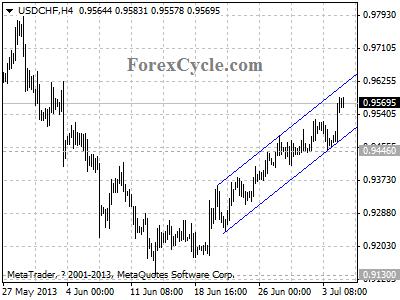
USDCHF stays within a upward price channel on 4-hour chart, and remains in uptrend from 0.9130, and the rise extends to as high as 0.9583. Initial support is at the lower line of the price channel on 4-hour chart, and the key support is now at 0.9446, as long as this support holds, the uptrend could be expected to continue, and next target would be at 0.9650 area. On the downside, a breakdown below 0.9446 support will indicate that the uptrend from 0.9130 had completed, then the following downward movement could bring price back to 0.9000 zone.

usdchf

Provided by ForexCycle.com

How to Take Advantage of the Panic in the Bond Market

By Profit Confidential

Bond MarketInvestors beware: the bond market is treading in very rough waters. The sell-off we have seen of U.S. bonds might just lead to more troubles ahead for the bond market. Just take a look at the chart below.

Thirty-year U.S. bonds look to be in a freefall. They have declined a little more than nine percent since the beginning of May—plunging from around $148.50 to below $135.00 now. As I have said before, the sell-off might just pick up speed as the losses of bond investors start to accumulate.

USB 30-Year US Treasury Bond Price (EOD) INDX

Chart courtesy of www.StockCharts.com

Keep in mind that long-term U.S. bonds are used as a benchmark on how other bonds (such as corporate bonds) will be priced. If the U.S. bonds decline in value, other types of bonds in the bond market follow suit.

Central banks, which normally buy U.S. bonds to protect their reserves, are selling them. Holdings of U.S. bonds held by the Federal Reserve fell by $32.4 billion to $2.93 trillion for the week ended June 26. That was the steepest reduction in their U.S. bonds holdings since August of 2007. And central banks have been reducing their U.S. bonds holdings for three out of the last four weeks. (Source: CNBC, June 28, 2013.)

That’s not all. Individual bond investors are running for the door as well. According to the Investment Company Institute, the long-term bond mutual funds have been witnessing a continuous outflow. For the week ended on June 5, bond mutual funds had an outflow of $10.9 billion; for the week ended on June 12, the outflow was $13.4 billion; and for the week ended on June 19, bond investors pulled out $7.9 billion worth of bond mutual funds. (Source: Investment Company Institute, June 26, 2013.)

While some are calling the recent plunge in the bond market a buying opportunity, some major problems still persist.

Fitch Ratings recently provided a credit rating for the U.S. economy, keeping the rating at AAA—prime investment grade—but remaining pessimistic about the country’s outlook. The credit rating firm reasoned that without cutting the budget deficit, the high national debt level will keep the country vulnerable. The firm said, “The outlook remains negative due to continuing uncertainty over the prospects for additional deficit-reduction measures necessary…over the medium to long term.” (Source: “Fitch affirms U.S. AAA rating but outlook still negative,” Reuters, June 28, 2013.)

Increasing national debt and the government’s expenses are making the country’s debt questionable, and the situation in U.S. bonds will be no different.

On top of all this, the Federal Reserve, which has provided the U.S. government with a line of credit by buying a significant amount of U.S. bonds, is becoming hesitant to buy any more. It has already hinted it will be slowing its U.S. bonds purchases later this year and will end its quantitative easing program by mid-2014.

If that does happen, a major buyer of U.S. bonds will be out of the market, and this departure—along with many other investors selling—will leave the bond market even more vulnerable.

I’ve been warning my readers about the risk of a bond market collapse for some time now. What does that mean for you? If the bond market continues to fall, it means interest rates are going up. Corporations that borrow heavily will see higher costs and lower profits.

One of my colleagues, George Leong, believes stocks will ultimately rise as investors leave the bond market and move into stocks. But from where I sit, I’ve never seen a stock market rise as interest rates rise. If you are invested in stocks, and I assume you are if you are reading Profit Confidential, my suggestion is to review each of your holdings to see how higher interest rates will affect them. I’d lower my exposure to companies sensitive to rate increases.

Michael’s Personal Notes:

The Chinese economy is showing traits that you should be watching. The country is experiencing an economic slowdown unlike any it has ever seen before.

The HSBC Purchasing Managers’ Index (PMI) for China has been contracting for two consecutive months. In June, the indicator, which provides an overview of manufacturing in the Chinese economy, registered at 48.2—down from 49.2 in May. (Any reading below 50 on the PMI suggests a contraction in the manufacturing sector.)

New business from the global economy to China declined, and companies in China have slashed their workforces.

The country’s new export orders in June fell at the fastest rate since March of 2009. (Source: Markit, July 1, 2013.)

In 2013, the Chinese economy is expected to grow at a pace slower than its historical growth rate. For example, Barclays PLC expects the gross domestic product (GDP) in the Chinese economy to grow at 7.4% this year. If this turns out to be the case, then this rate of GDP growth would be the slowest since 1990. (Source: Bloomberg, June 13, 2013.)

But that’s not all. Other banks, like Morgan Stanley (NYSE/MS), have also lowered their expectations of growth in the Chinese economy as well. Morgan Stanley now expects the GDP of China to grow 7.6% in 2013, down from its original forecast of 8.2%.

The Chinese economy was able to show some improvement after the global crisis in 2009. The country’s central bank reacted fast and flooded the financial system with liquidity. But the effects of all those efforts seem to be dissipating.

What many don’t realize is that the Chinese economy can actually be considered an indicator of growth for the global economy.

Not only is China the second-largest economic hub in the global economy, but China also exports a significant amount of its products to the global economy. If the country experiences a GDP decline, it’s because there isn’t demand in the global economy.

An economic slowdown in China can have many consequences throughout the world. One of them is a toll on the growth of smaller nations. Consider this: in the first four months of this year, China consumed 12% of all exports from Thailand. If the economic troubles in China continue, then countries like Thailand—countries that depend on exports to the Chinese economy—will see their own GDPs decline. (Source: The Nation, June 26, 2013.)

A similar principle applies to the U.S. economy as well. China is one of our trading partners. If demand in the Chinese economy declines, our exports will be hurt as well—and this will have an impact on our GDP, as U.S.-based companies that depend on exports to China will suffer due to a persisting economic slowdown. Keeping a close eye on the Chinese economy can keep you ahead of the curve when it comes to investing—even in American companies.

What He Said:

“Recipe for Catastrophe: To me, the accelerated rate at which American consumers are spending, coupled with the drastic decline in the amount of their savings is a recipe for a financial catastrophe.” Michael Lombardi in Profit Confidential, September 7, 2005. Michael started talking about and predicting the financial catastrophe we started experiencing in 2008 long before anyone else.

Article by profitconfidential.com

Why It’s Important to Watch the Changes in the Chinese Economy

By Profit Confidential

The Chinese economy is showing traits that you should be watching. The country is experiencing an economic slowdown unlike any it has ever seen before.

The HSBC Purchasing Managers’ Index (PMI) for China has been contracting for two consecutive months. In June, the indicator, which provides an overview of manufacturing in the Chinese economy, registered at 48.2—down from 49.2 in May. (Any reading below 50 on the PMI suggests a contraction in the manufacturing sector.)

New business from the global economy to China declined, and companies in China have slashed their workforces.

The country’s new export orders in June fell at the fastest rate since March of 2009. (Source: Markit, July 1, 2013.)

In 2013, the Chinese economy is expected to grow at a pace slower than its historical growth rate. For example, Barclays PLC expects the gross domestic product (GDP) in the Chinese economy to grow at 7.4% this year. If this turns out to be the case, then this rate of GDP growth would be the slowest since 1990. (Source: Bloomberg, June 13, 2013.)

But that’s not all. Other banks, like Morgan Stanley (NYSE/MS), have also lowered their expectations of growth in the Chinese economy as well. Morgan Stanley now expects the GDP of China to grow 7.6% in 2013, down from its original forecast of 8.2%.

The Chinese economy was able to show some improvement after the global crisis in 2009. The country’s central bank reacted fast and flooded the financial system with liquidity. But the effects of all those efforts seem to be dissipating.

What many don’t realize is that the Chinese economy can actually be considered an indicator of growth for the global economy.

Not only is China the second-largest economic hub in the global economy, but China also exports a significant amount of its products to the global economy. If the country experiences a GDP decline, it’s because there isn’t demand in the global economy.

An economic slowdown in China can have many consequences throughout the world. One of them is a toll on the growth of smaller nations. Consider this: in the first four months of this year, China consumed 12% of all exports from Thailand. If the economic troubles in China continue, then countries like Thailand—countries that depend on exports to the Chinese economy—will see their own GDPs decline. (Source: The Nation, June 26, 2013.)

A similar principle applies to the U.S. economy as well. China is one of our trading partners. If demand in the Chinese economy declines, our exports will be hurt as well—and this will have an impact on our GDP, as U.S.-based companies that depend on exports to China will suffer due to a persisting economic slowdown. Keeping a close eye on the Chinese economy can keep you ahead of the curve when it comes to investing—even in American companies.

What He Said:

“Recipe for Catastrophe: To me, the accelerated rate at which American consumers are spending, coupled with the drastic decline in the amount of their savings is a recipe for a financial catastrophe.” Michael Lombardi in Profit Confidential, September 7, 2005. Michael started talking about and predicting the financial catastrophe we started experiencing in 2008 long before anyone else.

Article by profitconfidential.com

The Few Sectors That Will Continue to Gain in This Unpredictable Market

By Profit Confidential

Unpredictable MarketThere is still a solid resilience to the stock market; and it’s based on global monetary stimulus combined with a sprinkling of economic news that institutional investors like.

The willingness that institutional investors have to be buyers is still quite remarkable. But then again, with bond yields creeping up, there really isn’t anywhere else to go. Investors know there’s no reason to keep money in cash.

The pronounced stock market breakout at the beginning of the year has shown very little willingness to experience a meaningful correction and, historically, that bodes well for the rest of the year.

Institutional investors don’t need a lot of motivation to buy in this market, aside from the certainty that things aren’t coming apart.

There is a Wall Street expectation that the bottom half of the year will be stronger economically, and institutional investors are buying this with the continued expectation of quantitative easing going into 2014.

The doom-and-gloomers certainly have some valid points, but they haven’t proved to be profitable in relation to the stock market or gold recently.

The Dow Jones Transportation Average looks to be experiencing a mini head-and-shoulders technical trading pattern, balancing itself out after a run of more than 6,500. There still remains a potential for rising share prices if earnings can be maintained or bettered.

It’s far too early into second-quarter earnings season to draw conclusions. It’s been a mixed bag of overperformance and underperformance.

This stock market continues to be a big hold from my perspective. There’s no particular reason to buy or sell. There continues to be difficulty in precious metal stocks as miners are experiencing much higher costs. I think the gold trade is over for quite a while, as institutional investors continue to avoid the sector.

Oil and natural gas are trading range-bound, but many big oil stocks are holding up well and yields are robust.

I favor dividend-paying blue chips, but I’m not a big advocate of buying this market given the current information.

The shine has come off the utility sector, but there are some worthy buys for new money.

Because of all the monetary manipulation around the world, this is an extremely tough environment for making forecasts. While the case can be made on both the bullish and bearish sides for the stock market, the old rule applies: it typically doesn’t pay to fight the Federal Reserve. Institutional investors have definitely taken this to heart.

The gyrations in the bond and currency markets seem to have settled down and full on corporate earnings will soon be the main catalyst. (See “The Only Way to Protect Your Investments from the Turmoil in China.”)

Wall Street analysts have brought down earnings expectations at many large-cap companies, but this hasn’t affected the resolve of institutional investors.

Sectoral stock market strength is still pronounced in biotechnology and healthcare—pullbacks in what have become the market’s strongest positions have been minimal.

The expectation for a meaningful stock market correction has diminished on the part of institutional investors.

Wall Street is still a direct conduit for Federal Reserve policy. The stock market remains a hold.

Article by profitconfidential.com