Monetary Policy Week in Review – Jul 1-5, 2013: ECB, BOE launch forward guidance, Poland, Romania cut rates

By www.CentralBankNews.info
    This week the European Central Bank (ECB) and the Bank of England (BOE) expanded their arsenal of monetary policy tools to counter the spillover from the Federal Reserve’s decision to wind down quantitative easing and prevent the subsequent rise in interest rates from snuffing out Europe’ economic recovery.
    The ECB and BOE wanted to convey a similar message to financial markets: We are a long way away from tightening our policy and the rise in global bond yields will have a negative impact on our economies.
    The move by the ECB and BOE follows recent attempts by central banks in emerging markets to tackle the spillover from the change in U.S. monetary policy, illustrating the power of globalized financial markets to challenge central banks that base their policies on domestic economic conditions.
    While markets and analysts were focused on the launch of forward guidance and a continuation of easy policy by the BOE, along with a possible rate cut by the ECB, the central banks of Sweden and Poland took the opposite tack, signaling that their policy won’t be eased any further.
    Even the Reserve Bank of Australia (RBA), which expects to see the benefits of a 10 percent fall in its dollar, appeared to pull back on its readiness to cut rates. In this week’s statement, the RBA said it saw “some scope for further easing,” compared with June’s statement of “scope for further easing,” signaling that the room to cut rates had narrowed ever so slightly.
    This week featured seven central bank policy decisions, with two cutting rates: The National Bank of Poland’s (NBP) third rate cut in a row along with the National Bank of Romania’s (NBR) first rate cut this year.
   The other five central banks that took policy decisions this week maintained their policy rates: the RBA, the BOE, the ECB, Sweden’s Riksbank and the Bank of Uganda (BOU).
      Through the first 27 weeks of this year, central bank policy rates have been cut 66 times, or 25.4 percent of the 260 policy decisions taken by the 90 central banks followed by Central Bank News, slightly up from 24.9 percent last week, indicating that the global trend toward lower policy rates remains firmly in place.
   
    LAST WEEK’S (WEEK 27) MONETARY POLICY DECISIONS:

COUNTRYMSCI    NEW RATE          OLD RATE       1 YEAR AGO
ROMANIAFM5.00%5.25%5.25%
AUSTRALIADM2.75%2.75%3.50%
SWEDENDM1.00%1.00%1.50%
POLANDEM2.50%2.75%4.75%
UGANDA11.00%11.00%19.00%
UNITED KINGDOMDM0.50%0.50%0.50%
EURO AREADM0.50%0.50%1.00%

    NEXT WEEK  (week 28) features 11 scheduled central bank policy meetings, including Malawi, Thailand, Croatia, Brazil, Japan, South Korea, Serbia, Indonesia, Malaysia, Peru and Mexico.

COUNTRYMSCI             DATE              RATE       1 YEAR AGO
MALAWI9-Jul25.00%21.00%
THAILANDEM10-Jul2.50%3.00%
CROATIAFM10-Jul6.25%6.25%
BRAZILEM10-Jul8.00%8.00%
JAPANDM11-Jul                N/A0.10%
KOREAEM11-Jul2.50%3.00%
SERBIAFM11-Jul11.00%10.25%
INDONESIAEM11-Jul6.00%5.75%
MALAYSIAEM11-Jul3.00%3.00%
PERUEM11-Jul4.25%4.25%
MEXICOEM12-Jul4.00%4.50%

     www,CentralBankNews.info

How Troubles in the Eurozone Will Eventually Affect Your Investments

By Profit Confidential

I can’t say this often enough: the eurozone debt crisis is here to stay for a long time. The key stock indices might have given investors false hope, but we are still standing at square one of any economic recovery.

Greece, which was at the epicenter of the eurozone debt crisis, may be required to issue Treasury bills to stay solvent. The country has to convince the International Monetary Fund (IMF) and its eurozone peers that it has made the changes required by the bailout conditions it agreed to. If it fails to do so, Greece will not receive any aid from its eurozone partners for the next three months. (Source: MNI Deutche Borse Group, July 3, 2013.)

But Greece has actually failed to follow through on two conditions set by its creditors: cutting 12,500 jobs from the government sector and reducing a small but significant fiscal gap.

And Greece is hardly the only troublesome nation when it comes to the eurozone debt crisis. Look at Portugal—problems are emerging in that eurozone nation as both its finance minister and its foreign minister recently resigned. There are fears that the Portuguese government might collapse and put the 78-billion-euro bailout it received in 2011 in jeopardy. (Source: Reuters, July 3, 2013.) Those fears have caused the key stock index in Portugal to plummet and bond yields to soar.

And it doesn’t end here. The third-biggest economic hub in the eurozone, Italy, is facing troubles of its own. Antonio Guglielmi, an analyst at the second-biggest bank in the country, Mediobanca, in a confidential report to clients wrote, “The Italian macro situation has not improved over the last quarter, rather the contrary. Some 160 large corporates in Italy are now in special crisis administration.” (Source: “Italy could need EU rescue within six months, warns Mediobanca,” Telegraph, June 24, 2013.)

The report also indicated that the eurozone country will “inevitably end up in an EU bailout request” in the next six months unless it is able to lower its borrowing costs and recover from economic chaos. (Source: Ibid.)

Keep in mind that Italy is the country with the most debt in the region and third worldwide, after the U.S. and Japan. The debt crisis that the mainstream media claimed was over or under control could easily shake the global economy again.

All of this shouldn’t come as a surprise to my readers. I have been warning about the debt crisis in the eurozone for some time now. The common currency region still has some major problems that need to be fixed before it can be said that it’s in good economic shape.

What worries me even more is that the nations with stronger economies, such as France, have also fallen prey to the troubles in the eurozone. France is currently in a recession and the country’s unemployment rate remains high. The longer the debt crisis continues in the eurozone, the deeper its impact will be on the stronger economies like that of France.

I can’t stress this enough: the eurozone is critical to our own economy, because a significant number of American-based companies operate and gain revenues from the eurozone. Troubles in that region could hurt the profitability of North American companies, which could eventually cause the key stock indices here at home to slide lower.

Article by profitconfidential.com

What the Worst Jobs Report of the Year Means to You

By Profit Confidential

jobs marketOn the surface, today’s jobs market report looks good…

195,000 jobs were created in the U.S. economy during the month of June, with the “official” unemployment rate for the month sitting at 7.6%, unchanged from May. (Source: Bureau of Labor Statistics, July 5, 2013.)

But look a little closer and this jobs market report is a catastrophe…

Look at the underemployment rate, which includes people who have given up looking for work in the jobs market and those who are working part-time because they can’t get full-time work—based on this number, the picture looks drastically different. In June, the underemployment rate rose from 13.8% to 14.3%—the highest level since February! That means that one out of every seven Americans who want to work can’t get a job. (And the politicians keep telling me the economy is improving?)

And if that wasn’t bad enough…

Most of the jobs created in June were part-time jobs; the number of people working part-time in the U.S. jobs market rose by 322,000 to 8.2 million. These people aren’t working part-time because they want to—it’s because they can’t find full-time work.

And there’s still more…

Of the jobs created in June, 60% were in low-paying positions: 75,000 jobs were created in the leisure and hospitality sector, and 37,000 jobs were created in the retail sector! Low-paying jobs do not create economic growth.

The numbers don’t lie. The jobs market report today loudly screams, “Not a lot has changed in the U.S. economy.” Let’s get real, politicians; the way the government creates the unemployment rate is misleading. Millions of Americans are resorting to food stamps for one reason—they can’t find a job and have run out of savings.

I remain very skeptical about the so-called “economic recovery.” There is no growth in the U.S. economy. Today’s jobs market report affirms my belief.

A healthy jobs market can give the U.S. economy the economic growth we so desperately need. When Americans have jobs, they buy more goods, they spend on durable goods, first-time home buyers enter the housing market, and consumers generally spend more—but none of this is happening. A worsening jobs market puts the brakes on consumer spending and ultimately causes the U.S. economy to suffer, even contract. (Remember: consumer spending makes up almost 70% of U.S. gross domestic product.)

Dear reader, the question has become: “How can we not avoid a recession in late 2013 or in 2014?” Get ready for it.

Michael’s Personal Notes:

I can’t say this often enough: the eurozone debt crisis is here to stay for a long time. The key stock indices might have given investors false hope, but we are still standing at square one of any economic recovery.

Greece, which was at the epicenter of the eurozone debt crisis, may be required to issue Treasury bills to stay solvent. The country has to convince the International Monetary Fund (IMF) and its eurozone peers that it has made the changes required by the bailout conditions it agreed to. If it fails to do so, Greece will not receive any aid from its eurozone partners for the next three months. (Source: MNI Deutche Borse Group, July 3, 2013.)

But Greece has actually failed to follow through on two conditions set by its creditors: cutting 12,500 jobs from the government sector and reducing a small but significant fiscal gap.

And Greece is hardly the only troublesome nation when it comes to the eurozone debt crisis. Look at Portugal—problems are emerging in that eurozone nation as both its finance minister and its foreign minister recently resigned. There are fears that the Portuguese government might collapse and put the 78-billion-euro bailout it received in 2011 in jeopardy. (Source: Reuters, July 3, 2013.) Those fears have caused the key stock index in Portugal to plummet and bond yields to soar.

And it doesn’t end here. The third-biggest economic hub in the eurozone, Italy, is facing troubles of its own. Antonio Guglielmi, an analyst at the second-biggest bank in the country, Mediobanca, in a confidential report to clients wrote, “The Italian macro situation has not improved over the last quarter, rather the contrary. Some 160 large corporates in Italy are now in special crisis administration.” (Source: “Italy could need EU rescue within six months, warns Mediobanca,” Telegraph, June 24, 2013.)

The report also indicated that the eurozone country will “inevitably end up in an EU bailout request” in the next six months unless it is able to lower its borrowing costs and recover from economic chaos. (Source: Ibid.)

Keep in mind that Italy is the country with the most debt in the region and third worldwide, after the U.S. and Japan. The debt crisis that the mainstream media claimed was over or under control could easily shake the global economy again.

All of this shouldn’t come as a surprise to my readers. I have been warning about the debt crisis in the eurozone for some time now. The common currency region still has some major problems that need to be fixed before it can be said that it’s in good economic shape.

What worries me even more is that the nations with stronger economies, such as France, have also fallen prey to the troubles in the eurozone. France is currently in a recession and the country’s unemployment rate remains high. The longer the debt crisis continues in the eurozone, the deeper its impact will be on the stronger economies like that of France.

I can’t stress this enough: the eurozone is critical to our own economy, because a significant number of American-based companies operate and gain revenues from the eurozone. Troubles in that region could hurt the profitability of North American companies, which could eventually cause the key stock indices here at home to slide lower.

Article by profitconfidential.com

How to Spot Hot Sectors’ Even Hotter Spin-Offs

By Profit Confidential

How to Spot Hot Sectors’ Even Hotter Spin-OffsWhen a stock market sector is hot, it always pays to look for spin-off trades. These are investments related to the underlying strength in a particular industry and stock market sector.

Housing, construction, and new home builder stocks have been soaring for quite some time now. And many businesses related to this sector strength have been powerhouse wealth creators.

In commercial and industrial building, large contractors haven’t been nearly as robust on the stock market as new homebuilders, but there are plenty of spin-off companies doing well.

Jacobs Engineering Group Inc. (JEC) is a $7.0-billion technical services company out of Pasadena, California that sells design, engineering, architectural, environment, and consulting services to clients in the oil and gas, aerospace, defense, infrastructure, and manufacturing industries.

The company has experienced a strong recovery rally on the stock market as momentum is returning to operations.

As we all know, new initial public offerings (IPOs) are plentiful when the stock market is hot. One interesting small company is Textura Corporation (TXTR) out of Deerfield, Illinois.

This company sells collaboration software that’s used specifically in the commercial construction industry. Products include efficiency software to help with invoicing and payments and bid preparation and testing software; the company also provides online environments in which participants in a construction project can collaborate and manage the massive scheduling efforts required among professionals and contractors.

The company recently sold 5.75 million common shares, including a full overallotment of 750,000 shares for $15.00 each. Total shares outstanding on the day of listing were 21.9 million. The position closed at $20.91 on its first day and is currently trading around $29.00.

Certainly the enthusiasm in the stock market is apparent in new IPOs. This was a strong start for a developing micro-cap like Textura. Wall Street expects the company to generate around $35.0 million in revenues this year. The 2014 revenue estimate is approximately $56.0 million with continued operating losses.

Founded by three former partners from PricewaterhouseCoopers, the company’s offering prospectus is a worthy read, and while it is a business plan with something to sell you, reading a prospectus is always useful.

According to the company, clients have used one or more of its on-demand collaboration products to help manage over 13,000 commercial construction projects worth over $125 billion.

Clients include 41 of the 100 largest general contractors in North America.

In the fiscal years ended September 30, 2010, 2011, and 2012, the company’s revenues were $6.0 million, $10.5 million, and $21.7 million, respectively. Net losses for the same fiscal periods were $15.9 million, $18.9 million, and $18.8 million, respectively.

While there is quite a bit of supposition in financial documents like prospectuses, they do offer details on the general business conditions in specific industries with which you may not be familiar. Like other U.S. Securities and Exchange Commission (SEC) documents, a prospectus can help shape your overall stock market view, even if you aren’t interested in the company.

While IPOs are typically overpriced, a strong debut on the stock market is helpful in legitimizing the story.

Textura’s strong stock market performance so far helps it stand out, and because of this, more investors are getting to know the company’s story. (See “New IPOs Hitting the Tech Sector; Microsoft and Intel Struggling.”)

Most micro-cap companies have a strong entrepreneurial founder leading the enterprise. But businesses founded by people who identify a niche that isn’t being fully served in the marketplace can be very successful. Textura is the perfect example of that.

Article by profitconfidential.com

Gloom Always Follows Boom…

By MoneyMorning.com.au

The single most effective marketing message the investment industry has peddled over the past three decades is, ‘In the long term the share market always goes up.’

My retort to this widely accepted statement is, ‘But will it go up in my investment timeframe?’

In 2006, global share markets ran hot. Three straight years of 20%+ gains.  In the same year, my weekly newspaper column, ‘The Big Picture’, began warning readers the good times wouldn’t last and a prudent investor should consider taking profits.

Such talk in the midst of a boom was met with a fair degree of derision.

With hindsight my warning of an impending market correction was too early and the longer the market performed, the easier it was to dismiss my viewpoint. In 2007, share markets posted another 20%+ gain. The lesson learned from this experience is it can be very lonely waiting for a trend to fully express itself. Self-doubt is a constant companion.

My belief in the secular market model remained steadfast and in 2008/09 global share markets behaved as expected.

So what is the secular market model? In simple terms it’s the old ‘two steps forward, one step back’ principle.

The following chart of the Dow Jones index from 1900 to present highlights the staircase pattern of the market’s advancement.

Secular Bear Markets are the periods when the lines are flat. Conversely, Secular Bull Markets are the ascending lines.

The century old market pattern is a cycle of undervalued to overvalued and back to undervalued. This is a well-established market pattern.

The following two charts courtesy of Crestmont Research show how this valuation cycle occurs.

But before we take an in-depth look at the charts, I need to give you some mathematical background.

One of the main valuation tools in the share market is the Price to Earnings (P/E) Ratio. The long-term P/E average for the market is around 16.

If you’re not familiar with P/E’s, here’s a simple example…

If a company earns $1 Billion, its fair price based on the long-term P/E average is $16 Billion ($1 Billion earnings x 16).

While the long-term average is 16, there are times in the market’s history when the P/E is higher than average (periods of boom and exuberance) and times when it’s lower than average (periods of bust and gloominess).

This high, medium and low range are what constitutes the average.

The first chart is the P/E ranges for the various Secular Bull Market periods. NOTE – all Secular Bull Markets have started with a below average P/E (the green shaded area between 5 and 10). The blue line (representing the latest Secular Bull Market from 1982 to 1999) started with a P/E around 8 and finished at a stratospheric 48.

To put this into context, a company earning $1 Billion in 1982 was valued at $8 Billion (8 times). Even if the company didn’t increase earnings over the next 17 years it was valued at $48 Billion in 1999. This was an eye-popping 600% increase in value simply due to investor exuberance.

By comparison all previous Secular Bull Markets overshot the average and went into the 20 to 25 range. The 1982 to 1999 boom (fuelled by the greatest credit bubble in history) took valuations into nosebleed territory.

The other side of the boom coin is the bust. The following chart traces the retreat of P/E’s from their boom time highs. These periods are Secular Bear Markets.

Again let’s focus on the blue line – the market P/E from 2000 to 2012. After the P/E peak of 48 in 1999/2000 it has gradually reduced down to around 20.

A stagnant period of share values is a result of falling P/E’s being offset by rising company earnings.

For example a company earning $1 billion in 2000 was valued at $48 Billion. The company could increase earnings to $2.4 billion (140% increase in earnings) but with a P/E of 20, the company is still valued at $48 billion ($2.4b x 20).

The combination of shrinking P/E’s (from extreme highs to lower lows) and rising earnings is why markets trend sideways for an extended period of time – usually 10 to 20 years. Waiting for this trend to play out requires patience.

(NOTE:  The blue line – current Secular Bear Market – has only retreated into the 20 to 25 range. This is where all previous Secular Bull Markets have ended and started to fall. The unwinding the 1982-1999 period of excess has been prolonged due to a manic desire by central banks to pervert the natural course of markets.)

If history repeats itself, the current Secular Bear Market is a long way from finished.

We know markets never ascend or descend in a linear fashion. They zig and zag.

In looking at previous secular markets, there are several phases (zigs and zags) that contribute to the overall performance of the market.

The following chart of the 1966-1982 Secular Bear Market shows there were 9 phases – 5 negative and 4 positive – over the 14 year period. Collectively the fall and rise of these phases resulted in a zero sum game.

Whereas the 1982-1999 Secular Bull Market consisted of 7 phases – 4 positive and 3 negative. The positive phases were so strong they make the 1987 ‘crash’ look like a mere speed bump. The credit bubble took hold in the 1990′s and its influence is clearly evident from 1990 to 1998.

The following chart of the S&P 500 index shows the current (2000-present) Secular Bear Market has had 4 distinctive phases so far – 2 negative and 2 positive.
 

Based on history it is hard to conclude global share markets are set for a continued run upwards – here are a few reasons why:

  1. P/E ratios remain high compared to previous Secular Bear Markets
  2. There does not appear to be enough negative phases to create investor fatigue – market sentiment is still too bullish. Previous Secular Bear Markets have completely sapped investor confidence.
  3. The current recovery (from Mar 2009 to present) is now four years old and has recorded a 100% gain. This is well above average.
  4. The current recovery (2009 to present) has been strongly aided by unprecedented Central Bank intervention.  This intervention is producing far less bang for the printed buck.
  5. The 1982 to 1999 Secular Bull Market was the greatest period of extended performance in share market history due to the greatest credit bubble in history. The US Federal Reserve has aggressively fought the bursting of this bubble – firstly, in 2001 when Chairman Greenspan provided cheap credit to fuel the US housing bubble and secondly, in 2009 Chairman Bernanke provided cheap credit to investment banks to repair their balance sheets and support asset (shares, bonds and commodities) prices. Defying gravity can only last for so long.

The centrifugal force created by wholesale money printing has kept markets spinning to date. The recent market wobbles suggest the energy force is waning. The Secular Bear Market’s gravitational pull is set to take the market through its next down phase.

Vern Gowdie
Contributing Writer, Money Weekend

From the Port Phillip Publishing Library

Special Report: Panic of 2013

Daily Reckoning: QE is Dead, Long Live QE

Money Morning: We’re Buying This Crashing Stock Market

Pursuit of Happiness: The Single Biggest Mistake a Technology Investor Can Make

Money Weekend’s FutureWatch — Tour de France 2013 Special Edition

By MoneyMorning.com.au

This year marks the 100th event of the Tour de France. For Australians it means late nights, bleary-eyed mornings and the optimism Cadel Evans can once again reign supreme. But no other sporting event in the world combines such high levels of technology, health and energy as ‘Le Tour’. Therefore this week’s FutureWatch is a Tour de France Special.

TECHNOLOGY: Whatever You Do, Don’t Call It a Bike

To call a Tour de France (TDF) Racing Bike ‘a bike’ is like calling a Le Mans Racing Car ‘a car’. In all reality a race bike is closer to being a SCUD missile than a bike that you might see on your daily commute to work.

But for simplicity’s sake I’m going to refer to these TDF weapons as bikes. Now you might be wondering at this point what is an introduction about a TDF bike got to do with technology? A lot more than you think.

Let’s have a look at the new time-trial bike in use this year by Team Sky Racing. Last year they used a bike called the Graal, manufactured by a company called Pinarello. This bike helped Bradley Wiggins smash the field in the time trails and contributed to his place on the top step of the podium in Paris.

Pinarello just last month unveiled a new piece of bike technology that has been 12 months in the making. In collaboration with the riders that hope to power to victory in the 100th running of the TDF the new Boldie time-trial bike is a piece of technology perfection.


Source: Pinarello

Here’s some of the length’s Pinarello’s technicians went to in crafting the Boldie. They put every component through a wind tunnel to investigate airflow. Subsequently this year’s bike has a reduced aerodynamic impact by 15% compared to last years’ bike. The brakes are ‘hidden’. Meaning the brakes are also integrated into the carbon fibre frame, keeping the bike very slick.

Add to that the electronic shifter controls integrate into the handles bars. And the battery pack and electronic derailleurs are…you guessed it, built into the frame.

Let’s just touch on something there. We mentioned electronic controllers and shifters…on a bike.

That’s because current racing bikes use wireless, electronic gear shifters. With a ‘mouse-click-like’ touch on the gear selector the e-shifter on the gears instantaneously selects the next gear.

Basically it’s like having ‘flappy paddle’ changers on your sports car. It’s semi-automatic gear selection on a bike with microchips and sensors galore.

Current TDF bikes cost upwards of $11,500 for the daily bike and over $16,000 for time-trial bike. You can see these machines are the most technologically advanced bikes ever made.

No matter how much carbon fibre, electronics or money is spent on these bikes they still need leg power to go. Makes you wonder what will happen when the first bionic rider enters the TDF…?

Until then, I look forward to the next three weeks of bleary eyed mornings.

HEALTH: Check Your DNA, You Might Be A TDF Rider Too

Over the years about 10,000 individuals have contested the TDF. Of these just over 6,000 have been able to actually complete it

And there’s good reason the failure rate is about 40%. To finish it you need to be either a cheat (which unfortunately many have been over the years) or a genetic freak.

Each day these athletes burn 6,000 calories. Over the total race, about 126,000 calories. That’s why often you’ll see them down a can of coke on the road, just to keep their calorie intake up. To compare, an average sedate person will burn about 2000 calories a day.

It’s a testament to genetic predisposition and elite level training regimes that these guys are even capable of completing this gruelling race.

Physiologically every organ within their bodies must be in top condition, coordinated and working harder and longer than any other activity on earth.

The average TDF rider will have a heart rate over half as low as a typical person, lung capacity at least twice as large and a heart often up to 40% bigger than yours or ours.

Genetically these athletes are gifted, but hours of day after day training will also get them to ‘tour’ levels of elitism. But don’t neglect the powers of the mind also.

One of the great voices and most knowledgeable people in the world of cycling, Phil Ligget, says riders of ‘Le Tour’ need,

‘Recuperative powers and the ability to suffer more than anyone else. When you and I might say, ‘This is ridiculous, I’m going home’, these guys just close their eyes and screw their face and try a bit harder,

Thanks to a combination of great technology, great training regimes and some gifted genetics these guys drag themselves through the mountain passes of France every year.

It highlights the benefit of a genetic test at an early age. Maybe with the right mix of DNA your kids might end up as elite athletes like the TDF riders we see today.

ENERGY:  Is the Answer for Renewable Energy Cycling up the Alpe d’Huez?

While we’re on our TDF special we should also consider the huge energy potential of the field each year.

It’d be a good idea if a smart scientist or researcher could come up with a way to harness the energy that the TDF riders generate each tour.

Because one of the world’s best sources of renewable energy is the pedal power that comes from the genetically gifted legs of the 198 riders that contest the race.

At peak performance a TDF rider going uphill can produce about 400 to 500 watts. Riding in the peloton, about 250 watts.

Now let’s say they maintain that power for an hour. If we add it all up and average it out, they average about 380 watts over an hour, so about 0.38 kilowatts per hour

In 2012 Bradley Wiggins spent 87 hours 34 minutes and 37 seconds in the saddle over the whole length of the tour. He won it with that time.

If you multiply that out by the average kilowatt hours above, Wiggins generated about 33.25 kW over his tour. If every rider (198 of them) generated the same energy, that’s a whopping 6,533 kW for the entire field of the TDF.

To put that into perspective, 7,449 kW would be enough to roughly power 140 homes for a month, or 11 homes for a year.

The other thought is that the TDF isn’t the only professional tour race in the year. There’s also the Giro d’Italia and the Vuelta a Espana, which both also go for multiple weeks. Plus all the other week long or weekend long bike races around the world.

All combined, thats a lot of energy gone to waste. If an inventor could find a way to harness that power, we’d have another great renewable energy source.

If you add all the professional bike races around the world together and you’d probably have enough power to keep a whole city running every year.

Regards,

Sam Volkering
Technology Analyst

From the Archives…

Don’t Make Investing a Chore… Invest in an Innovative Business
14-06-2013 – Kris Sayce

The Technology Revolution Begins in Four Days…
13-06-2013 – Kris Sayce

Zero G for the Australian Dollar is a Shot in the Arm for Miners
12-06-2013 – Dr Alex Cowie

There’s More to Technology Than Facebook and Spying
11-06-2013 – Sam Volkering

Four Great Australian Technological Achievements
10-06-2013 – Sam Volkering

2013 Second Quarter Investment Outlook and Commentary

By The Sizemore Letter

The second quarter gave us quite the thrill.  I’m calling it “The Great Bernanke Scare of 2013.”

After a monster first-quarter rally in income-paying securities, comments from the Fed Chairman that he might—just might—taper quantitative easing by early next year led to the worst correction in bonds, MLPs, REITs and other “income focused” investments in nearly two years.

Interestingly, “high beta” sectors such as emerging markets and “periphery” European markets also took a beating.  It was something of a barbell correction in which both the most conservative and the most risky sectors got hit the hardest, while what you might think of as “mainstream stocks” held up relatively well.

Emerging markets were affected by more than just Fed fears, however.  Unrest in Turkey caused a collapse in the Turkish stock market—which had previously been one of the best-performing markets in the world and a source of relative return for the Sizemore Capital Tactical ETF Portfolio.

Slower growth in China and fears of a Chinese banking crisis also helped to push emerging market stocks sharply lower.

Where do we go from here?

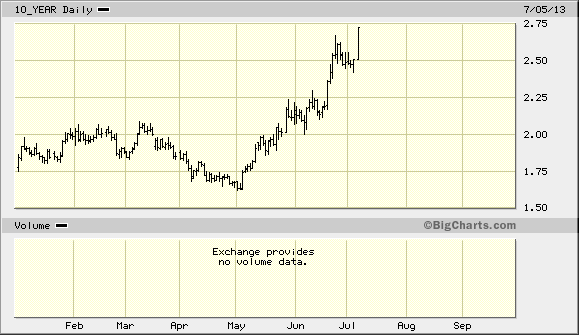
10 Year

I stand by my original view that the bond market overreacted to Bernanke’s comments and did so by a wide margin. I expect the ten-year Treasury yield, which at time of writing had just shot above 2.7% on a positive jobs report release, to settle into a fairly long-term range of 1.9% to 2.3%—a view that bond market legends Bill Gross and Jeffrey Gundlach would seem to share given their recent bullish  comments on the sector.

The income sectors that got hit the hardest—such as REITs and MLPs—are off their recent lows, and I expect investors to return to these sectors in the second half.  In the Dividend Growth Portfolio, Sizemore Capital took advantage of the selloff to add to our long-term positions in National Retail Properties ($NNN) and Realty Income ($O) and to initiate new positions in competing retail retails Cole Properties ($COLE) and American Realty Capital Properties ($ACRP).

Each of these meets my basic criteria as a dividend growth investment.  They pay a relatively high current yield, and their property portfolios are structured to make an increasing cash payout very likely over time.  They also fall into a “sweet spot” in that their portfolios are defensive yet also offer decent protection in the event of higher-than-expected inflation.

I additionally made multiple changes to the Tactical ETF Portfolio.  I initiated a short position in Japanese government debt via the Powershares DB 3x Inver Japanese Gov Bond ETN ($JGBD). 

I also shifted the equity portion of the portfolio away from the “mega caps” in the WisdomTree Large Cap Dividend ETF ($DLN) to a more growth-oriented alternative: the Cambria Shareholder Yield ETF ($SYLD).  And consistent with my view that more cyclical sectors will lead in the second half, I initiated a position in the Technology Select Sector SPDR ($XLK).

In both the Dividend Growth Portfolio and the Sizemore Investment Letter Portfolio, I sold the position in Silver Bay Realty Trust ($SBY), which has failed to meet expectations.  I remain wildly bullish about the prospects for the rental housing market, but I fear that a flood of new traded Wall Street alternatives has created something of a glut in the supply of the stocks themselves (though not of the underlying houses).

Where do we go from here?

After the recent rout in emerging markets, several are beginning to look attractive to me again.  European markets—and particularly periphery markets—also look attractive based on price and investor sentiment.  I consider these fertile areas for investment in the second half.


The 3 Essential Parts of an Elliott Wave Trade

A NEW series of educational trading lessons from “Visual Guide to Elliott Wave Trading” — Part 1 of 3

By Elliott Wave International

When it comes to improving your wave-based analysis and technical trades, three steps may sound simple enough. Yet if you have any experience trading, you know that nothing about trading is easy.

Senior Analyst Jeffrey Kennedy knows that it takes skill, discipline and courage to execute a successful trade. In the new book he has coauthored with EWI’s Wayne Gorman (now a No.1 Amazon Bestseller), Visual Guide to Elliott Wave Trading, he picks up where Frost and Prechter’s classic textbook Elliott Wave Principle leaves off to give you the perfect blend of traditional textbook analysis and real-world application.

According to Kennedy, there are three key components of a successful trade:

  • Analyze the price charts.
  • Formulate a trading plan.
  • Manage the trade.

In this excerpt (Part 1 of 3), Kennedy examines a high-confidence trade setup in Caterpillar (CAT).

Part One: Analyze the Price Charts


When it comes to trade setups, it doesn’t get much easier than the price chart of CAT from April and May 2011. As you can see in Figure 2.1, prices fell in five waves from 116.55 to 108.39. This wave pattern was significant because impulse waves identify the direction of the larger trend. Thus, this five-wave decline in CAT implied further selling to come that would take prices below 108.39 in either wave (C) or wave (3).

The subsequent rally in CAT that developed in three waves supported this analysis. Countertrend price action typically consists of three waves, so I knew to expect another move down in CAT. Moreover, the three-wave advance in CAT traveled to 112.47 to retrace 50 percent of the previous sell-off. That 50 percent is a common retracement for corrective waves. Also nearby was 112.84, the price level at which wave C equaled a .618 multiple of wave A, which is a common Fibonacci relationship between waves C and A of corrective wave patterns.

The only question at this point was whether the move up from 108.39 should be labeled as wave (B) or wave (2). From a short-term trading perspective, this question was academic because, either way, the trade objective was a price move just under 108.39. A final observation about the corrective rally: The slope of wave C in this case was shallower than the slope of wave A. A shallow wave C slope, which demonstrates a decrease in momentum, is a harbinger that the larger trend is resuming. These shallower slopes within zigzags are so common that they are almost a qualifying characteristic of the pattern.

By applying the most basic Elliott wave analysis to the price chart of CAT, I could see five waves down and three waves up into Fibonacci and structural resistance at 112.47-112.84. That meant that odds strongly favored a sell-off below 108.39 from near current levels. So, the question at that point was how best to capitalize on this information.

Stay tuned for parts 2 and 3 of this lesson.


The Ultimate Wave Trading Crash CoursePut yourself on the fast track to applying the Elliott Wave Principle successfully with a FREE one-week primer: The Ultimate Wave Trading Crash Course. Learn the basics with 5 FREE trading lessons from EWI Trading Instructor and Senior Analyst Jeffrey Kennedy — including insightful excerpts from his Amazon No. 1 Bestseller, Visual Guide to Elliott Wave Trading.

Learn more and start your crash course now >>


This article was syndicated by Elliott Wave International and was originally published under the headline The 3 Essential Parts of an Elliott Wave Trade . EWI is the world’s largest market forecasting firm. Its staff of full-time analysts led by Chartered Market Technician Robert Prechter provides 24-hour-a-day market analysis to institutional and private investors around the world.


Auto Sales Continue to Surge to Pre-Recession Highs

By WallStreetDaily.com

Auto Sales Continue to Surge to Pre-Recession Highs

wistiaEmbed = Wistia.embed(“o3sx8pr3ew”, {
version: “v1”,
videoWidth: 525,
videoHeight: 295,
volumeControl: true,
endVideoBehavior: “reset”,
plugin: {
“socialbar-v1”: {
buttons: “email-twitter-reddit-stumbleUpon-facebook”,
logo: true,
badgeUrl: “http://www.wallstreetdaily.com/wall-street-research/”,
badgeImage: “http://embed.wistia.com/deliveries/ae6edb685caefd59e311e37ae8ffafad7a41152d.jpg?image_crop_resized=100×20”
}
}
});

 
Chief Investment Strategist, Louis Basenese, said recently that “small business owners account for a large portion of pickup sales, particularly Ford (F) F-Series trucks. That means, by gauging sales of F-Series trucks, we can track the health of the economy.”

Well, the economy must be doing just fine…

“Ford sold a total of 72,000 trucks in May, which brings the year-to-date total up to almost 300,000. That’s a 21.5% increase over last year – and the highest total since the recession hit,” says Louis.

Indeed, auto sales continue to increase across the board…

Both Ford and General Motors (GM) posted stronger-than-expected sales in June. GM’s sales were at their highest level for June since 2008. Ford had its best June since 2006.

And although Chrysler’s sales were in line with forecasts, the company still posted its best June total since 2007.

The reason for the latest surge?

So many people held onto their rusted-out jalopies during the recession that they just can’t wait to get a shiny new car any longer…

According to Edmunds.com’s Senior Analyst, Jessica Caldwell, “Cars out there on the road are very old, and we are seeing record levels of vehicle ages that are being traded in to buy new cars. So I think a lot of people can’t wait.”

To top it off, even though rates are increasing, car companies want to keep consumers coming in. So they’re keeping rates low…

“A lot of the rates are subsidized by the auto companies themselves,” says Caldwell. “So even though the interest rates are getting higher, auto companies still want to advertise those low interest rates because that is what is driving them. A lot of people buy on monthly payments, so if you have a low interest rate, monthly payments become a lot friendlier.”


The post Auto Sales Continue to Surge to Pre-Recession Highs appeared first on  | Wall Street Daily.

Article By WallStreetDaily.com

Original Article: Auto Sales Continue to Surge to Pre-Recession Highs

Dollar Jumps on NFP Data, Sends Gold & Silver to Lowest Weekly Close in 3 Years

London Gold Market Report
from Adrian Ash
BullionVault
Friday, 5 July 09:00 EST

The DOLLAR PRICE of gold dropped $20 per ounce lunchtime Friday in London, briefly dropping through $1220 per ounce after the release of June’s US non-farm payrolls data.

Non-farm payrolls growth came in at 195,000 against consensus forecasts of 165,000.

 The US jobless rate stayed at 7.6% however, rather than slipping as forecast. But average hourly earnings rose 2.2% annually against the 2.0% analysts predicted.

“With the US economy improving, US interest rates rising and the Dollar no longer perceived to be at risk,” says the latest Commodities Weekly from French investment and bullion bank Natixis, “the need for a safe haven against currency debasement and inflation dissipated.

 “Should the Dollar continue to strengthen, so gold prices will remain under pressure,” says the note, as Western investors continue to sell exchange-traded gold funds.

 ETF gold sales since February now total 572 tonnes, says Natixis – “equivalent to increasing annual gold [mining] production by almost 13%.”

 Chinese gold buyers, in contrast, imported the second-largest volume of bullion on record in May, new data showed Friday.

 Net imports of gold bullion to China through Hong Kong totaled almost 109 tonnes, the Hong Kong Census Bureau said, greater by more than one third from April.

 Over the 1st five months of the year, China’s net gold imports stood at twice the level of 2012.

 Across in India meantime – likely to be overtaken by China this year as the world’s No.1 gold consumer – “It is difficult to sell even 5 kilograms per day as the marriage season is almost over,” said Chennai wholesalers MNC Bullion to Reuters on Friday.

 Fighting both the typical gold summer lull of Chaturmas and new government curbs on imports of gold bullion, India’s major retail chains “are aggressively promoting diamond jewellery” says the newswire, as well as expanding overseas in Singapore and Dubai.

 “Gold has been the traditional form of savings among Indian households for many years,” says B.Venkatesh, founder of financial advisors Navera Consulting, writing in The Hindu.

 “Buying gold gives you a feeling of comfort…Gold is accepted at all times, [giving] you feeling that it is a ‘safe’ asset.”

 European stock markets meantime failed to follow Asian shares higher on Friday, while weaker Eurozone bonds recovered more of the week’s drop.

 Silver prices fell faster than gold, losing some 3.0% for the week after the non-farm payrolls data.

Both gold and silver neared the end of London trade Friday with lowest weekly finish against the Dollar since August 2010.

The US Dollar also rose Friday against the Euro and Sterling after the non-farms jobs data, touching 6 and 17-week highs respectively.

 The European Central Bank and Bank of England had confirmed their record-low interest rates for the foreseeable future on Thursday.

By Friday afternoon in London, both Euro and Sterling gold prices had cut their earlier gains, but were heading for their first weekly gain in six.

“The stronger Dollar is adding to the downward drag in metal prices,” says Standard Bank’s daily note.

 “Even if the NFP data [had come] out below expectations, we would look for rallies in gold and other precious metals to fade.”

Adrian Ash

BullionVault

Gold price chart, no delay | Buy gold online


Adrian Ash is head of research at BullionVault, the secure, low-cost gold and silver market for private investors online, where you can buy gold and silver in Zurich, Switzerland for just 0.5% commission.


(c) BullionVault 2013

Please Note: This article is to inform your thinking, not lead it. Only you can decide the best place for your money, and any decision you make will put your money at risk. Information or data included here may have already been overtaken by events – and must be verified elsewhere – should you choose to act on it.