The One Company to Watch as the U.S. Dollar Strengthens

By

With corporate earnings season starting today, many investors will eagerly be looking at the results to determine if there is an investment opportunity for the next six to 12 months.

But wise investors will also be keeping an eye on the macroeconomic situation: we are entering a period of time in which the U.S. dollar will remain strong as our economy is set to outperform those of most other developed nations. As I’ve previously mentioned in these pages before, the outlook for the eurozone remains weak, China’s economy is slowing, and Japan’s economy is just now trying to emerge from having virtually no growth over the past decade.

The strength of the U.S. economy is relative—though it is better than its competitors, it is not growing at a very rapid rate. However, remember: the strength of a currency is based on relative value, not absolute.

That relative strength in the U.S. economy will translate into a stronger dollar, higher corporate earnings and investment opportunities. As a large investor, for example, I would much rather be invested in U.S. assets than European assets.

While a stronger dollar hurts exports, it improves the corporate earnings of importers. A perfect example of the recent shift is Starbucks Corporation (NASDAQ/SBUX).

The investment opportunity that Starbucks is able to monetize is the strength of the U.S. dollar as compared to currencies like the Brazilian real. Combining record-level harvests of coffee beans this year and last year with the real hitting a four-year low, the price of Brazilian coffee beans has dropped dramatically. Similarly, Columbia’s currency has also dropped significantly against the dollar, and has seen exports of its coffee beans increase significantly this year.

That lower cost of imported commodities for companies like Starbucks is creating an investment opportunity by generating higher corporate earnings. It’s a perfect example of a U.S. company benefiting from a stronger dollar.

Chart courtesy of www.StockCharts.com

Clearly, I am not alone in thinking that Starbucks will generate strong corporate earnings, as indicated by the strength of the above chart.

Starbucks is a company that continues to grow worldwide, as it sees an investment opportunity in building its brand globally. The reduction in the input cost of coffee beans will also help the company improve its corporate earnings, in addition to top-line revenue growth from expanding into new markets.

The point I would like to make is that, as investors, our goal is to look for companies that can increase their corporate earnings through an investment opportunity that suits their business models. Whether it is a higher dollar or a weaker dollar, it really doesn’t matter, as there are firms that can generate higher corporate earnings in either case. The key is to shift and reallocate assets into companies with higher probabilities of generating corporate earnings.

This article The One Company to Watch as the U.S. Dollar Strengthens was originally published at Investment Contrarians.

 

Precious Metals Enter “Summer Lull”, Will Miss “Commodity Supercycle” Says SocGen

London Gold Market Report
from Adrian Ash
BullionVault
Monday, 8 July 08:00 EST

The GOLD PRICE ticked higher in London trade Monday morning, rising from its lowest weekly close in three years as Asian stock markets fell but Eurozone shares jumped over 2% higher.

 Major government bonds ticked higher, easing interest rates down, while the US Dollar held steady after last week’s strong gains on the currency market.

 A Wall Street Journal survey says the majority of economists think that Friday’s jobs data mean the US Federal Reserve will start reducing its quantitative easing program as early as September.

Silver bullion today ticked back above $19.22 per ounce, regaining half of last week’s 3.6% drop.

“Unlike the April rout [in gold prices],” says the latest monthly report from brokers INTL FCStone, “which drew out a slew of buyers, we are not seeing the same type of reaction this time around.

 “[This suggests] the complex remains vulnerable from the physical side as well.”

 The gold price is now “near the lows of the year,” says David Govett at fellow brokers Marex Spectron, but “For the moment at least, I do think we have done enough.

 “I now think we are moving into the good old summer lull. Overall direction will be sideways.”

 New curbs on gold bullion imports to India – where the Hindu calendar’s Chaturmas will now keep gold demand low until September – cut legal inflows by 81% in June from May’s record high of 162 tonnes, a government official told journalists today.

 Sales are however “expected to go up again” because of the gold price, the official added.

 “India’s gold imports will be somewhat the same or slightly more for July,” agrees Commtrendz Research’s Gnanasekar Thiagarajan, quoted by Reuters, “as some bargain hunting interest was seen.”

 The Indian Rupee fell Monday to fresh all-time lows against the Dollar, reducing the gold price discount for buyers in the world’s No.1 consumer market.

 “The [Reserve Bank of India] is definitely concerned about Rupee weakness,” says Nick Verdi at Barclays in Singapore.

 Rather than intervening to support the Rupee with cash trades, however, “It will look to combat this mostly through verbal intervention,” he reckons.

 Meantime in Egypt, the 12th largest private gold consumer in 2012, the main stock market sank almost 3% as fighting continued after more than 40 supporters of ousted president Morsi were killed at the weekend.

 “Tensions in Egypt put pressure on local [gold] demand,” says German refining group Umicore in a quarterly trading update, “as some retailers started to think of closing their shops for fears of looting.”

 With the gold price now 36% below its Dollar record of September 2011, Russia’s state treasury Gokhran – the official trader of gems and precious metals – is preparing to buy gold on the domestic market after a two-year gap, Reuters reports.

 Invited to sell gold onto the open market when prices neared their 2011 peak, “We were forbidden to buy gold directly [from Russian miners],” a source tells the newswire.

 “If we receive permission, we will be happy to start buying gold again,” the source added.

 Russia’s central has continued to acquire gold bullion for its own reserves, adding more than 78 tonnes in the last 12 months and rising to 7th place amongst the largest nation-state holders.

 Western Europe’s central banks, in contrast, have so far sold only 4.3 tonnes of the 400-tonne limit set by their Central Bank Gold Agreement this year.

 Running from September, the agreement was first signed in 1999 to cap erratic sales by European governments as the gold price sank to three decade lows.

 “Gold prices are going to generally drop down throughout the year,” reckons Société Générale’s head of commodities research, Michael Haigh, speaking today at a media briefing in Singapore.

 Pointing to possible “price hedging” by gold-mining producers, “They’ll start selling into the market,” Haigh warned, “which puts more downward pressure on gold prices.”

 SocGen’s outlook for gold is in stark contrast to its broader view of the commodities “super cycle”, which Haigh believes will continue for another 15-20 years thanks to “population and urbanization” in emerging Asian economies.

 “But it’s not going to be an upward price for all.”

 Forecast by many analysts to overtake India as the world’s No.1 gold consumer in 2013, China imported its second greatest monthly volume of gold bullion through Hong Kong in May, data showed last week.

 Through the first 6 months of the year, separate data showed Friday, gold bullion deliveries made to traders using the Shanghai Gold Exchange totalled 1058 tonnes.

 That was precisely 50% of the 2012 full-year total.

 The plunging gold price however saw shares in Zijin Mining – the largest gold miner in world No.1 mining nation China – today drop 11% after it forecast “very poor results, below expectations.”

 “The fact that the gold price has fallen is actually going to be very healthy,” said gold-mining fund manager Evy Hambro of Blackrock to Bloomberg last week.

 “We need to see costs taken out of the industry; we need to see the companies stop producing the ounces that don’t make money and focusing on the ones that do.”

Adrian Ash

BullionVault

Gold price chart, no delay | Buy gold online


Adrian Ash is head of research at BullionVault, the secure, low-cost gold and silver market for private investors online, where you can buy gold and silver in Zurich, Switzerland for just 0.5% commission.


(c) BullionVault 2013


Please Note: This article is to inform your thinking, not lead it. Only you can decide the best place for your money, and any decision you make will put your money at risk. Information or data included here may have already been overtaken by events – and must be verified elsewhere – should you choose to act on it.

The Biggest Myth About Emerging Markets

By WallStreetDaily.com

File this one under “Much ado about nothing!”

As I pointed out on Friday, stocks in the most popular emerging markets are getting clobbered. Truthfully, the entire emerging markets space is taking it on the chin right now. Not just Brazil – but Russia, India and China, too.

Case in point: The MSCI Emerging Markets Index is down 10.7% this year, compared to a 13.2% rise for the S&P 500 Index.

The disconnect isn’t accidental, either. As Ruchir Sharma, Head of Emerging Markets at Morgan Stanley (MS), shared in our recent interview, the fundamentals in the United States actually outclass much of the world. (Shocker, right?)

Nevertheless, I’m already starting to hear chatter that the unfolding crisis in emerging markets is going to undercut the bull market here in the United States.

Some even liken the impact of emerging markets on the rest of the world to a worm spreading through bad apples.

Hogwash! And in honor of Myth-Busting Mondays, I’m going to prove it.

Remember the Alamo Euro Crisis!

You’ll recall, in late 2011 and much of 2012, investors worried that the crisis in Europe would sabotage the rally in the United States.

Such a belief wasn’t without merit, either.

As I shared at the time, U.S. companies rely heavily on international sales.

According to Standard & Poor’s Howard Silverblatt, foreign sales recently accounted for 46% of total revenue for S&P 500 companies. Of that, 29% came from Europe. That works out to about $0.14 out of every dollar in sales coming from Europe.

That’s significant enough that any slowdown in Europe promises to create a ripple effect in the United States. Indeed, this time last year, headlines like this one from Reuters cropped up everywhere: “U.S. Companies Blame Europe for Earnings Warnings.”

Did the euro crisis spell disaster for the bull market in U.S. stocks, though? Not at all.

But why bring any of this up? Because it’s necessary to put the impact of a slowdown in emerging markets on U.S. companies into perspective.

Whereas Europe accounts for about 14% of sales for S&P 500 companies, emerging markets only account for about 5%, according to Goldman Sachs’ (GS) David Kostin.

And emerging markets account for just 6% of total profits for U.S. economies. That figure is trending lower, too. Take a look:

The end result? “Weaker [emerging markets] growth poses little risk to S&P 500 earnings,” says Kostin.

Or, more plainly, don’t freak out!

Still scared?

Stick With “Made (and Sold) in the U.S.A”

If you’re still reluctant to believe that the United States can escape the slowdown in emerging markets (with profits intact), there is a solution.

Start looking for companies that derive the overwhelming majority (or all) of their sales from the United States.

Believe it or not, blue chips like McDonald’s (MCD) generate more than 50% of their sales from overseas.

However, an analysis by Bespoke Investment Group reveals that companies with mostly domestic sales exposure are outperforming companies with more than 50% of sales coming from overseas – by an average of five full percentage points this year (16% versus 11%).

Bottom line: The natural tendency is to assume that U.S. companies rely much more heavily on foreign sales than they really do. Now you know the truth. And there’s absolutely no reason to freak out about emerging markets sabotaging the bull market in the United States.

Ahead of the tape,

Louis Basenese

The post The Biggest Myth About Emerging Markets appeared first on  | Wall Street Daily.

Article By WallStreetDaily.com

Original Article: The Biggest Myth About Emerging Markets

Europe Market climbs as Euro group to discuss Greek’s tranche

By HY Markets Forex Blog

The European markets opened positive on Monday, while investors and the finance ministers in the euro zone are yet to conclude as they discuss Greece last aid tranche worth approximately 8.1 billion euros from its creditors.

The Stoxx 50 gained 1.12% to 2,625.00 just as the market opened, while the French CAC advanced 1.10% to 3,796.30 at the same time. In Germany, the DAX index rose 1.11% to 7,893.10, while UK FTSE 100 gained 0.82% to 6,428.50.

The finance ministers are expected to attend the meeting later today in Brussels, as the final conclusion is expected to be based on the Troika’s assessment of progress from the Greece government on its adjustment program.

Reports from the Federal Statistical Office (Destatis)   showed that the German’s trade surplus were at 13.1 billion euros in May, compared to the previous record of 18 million euros and estimated value of 17.6 billion euros.

The imports in Germany increased by 1.7%, while the exports fell 2.4% in May, according to reports released.

Analysts forecasted a fall of 0.5% for the month-to-month industrial production in Germany for the month of May, compared to previous record of 1.8% in April.

Meanwhile, the President of the European Central Bank Mario Draghi is expected to speak to the European parliament later today, which may hint when the central bank would change the rates from the record low.

Investors have raised concerns that the European market gains may fall if the Federal Reserve (Fed) decided to proceed with cut back of its asset –purchasing program, after the labor data showed that the US economy has improved.

The US data released showed the US non-farm payrolls boosted by 195,000 in the month of June, while the unemployment rate was at 7.6%, according to the Bureau of Labor Statistics.


The post Europe Market climbs as Euro group to discuss Greek’s tranche appeared first on | HY Markets Official blog.

Article provided by HY Markets Forex Blog

Asia Markets opens negative on China’s credit crunch

By HY Markets Forex Blog

The Asian Market opened at a negative territory on Monday, as investors raise concerns over the credit crunch in China and further concerns regarding the Federal Reserve’s plans to cut back on its asset-purchasing program.

The US data releases showed that the number of employment has increased and the Fed may proceed with slowing down the asset-purchasing program earlier than expected.

The Hong Kong Hang Seng, were lowered to 2.14% to 20,463.80, while the Topic Index fell 1.4% at 1,172.58. The Nikkei 225 lowered 1.40% at 14,109.34, while the Chinese Shanghai composite closed at 1.61% lower to 1,974.71 at the time of writing.

The Australian S&P/ASX 200 fell 0.65% lower at 4,810.20. In South Korea, the Kospi index lowered 0.90% at 1,816.85.

The Chinese State council announced it would toughen up supervision of the wealth management products and build up stability in the financial market.

Analysts predict that the money-market in China is likely to lower its credit growth by the end of the year to 750 billion.

In Japan, the weaker yen grew the import costs, while Japan’s account surplus lowered 540.7 billion in May, according to reports from the Ministry of Finance.

Exports in the month of May increased by 9.1%, as Japan’s service sentiment index dropped 53 points in June, from previous record of 55.7 in May.

The post Asia Markets opens negative on China’s credit crunch appeared first on | HY Markets Official blog.

Article provided by HY Markets Forex Blog

Time to Plan for the Year-End Stock Rally?

By MoneyMorning.com.au

You may be tired of hearing it, but we’re not tired of saying it.

Our job is to give you our best investment ideas.

That means giving you advice you may not want to hear.

Sometimes it means giving you advice you ardently disagree with.

But we give you the advice anyway. It’s then up to you to decide if you want to follow it or not.

Well, today we’ll give you more advice…that you may not want to hear. But, for the sake of your investments, hopefully you’ll do exactly as we say…

For months we’ve told you to buy stocks.

For months we’ve told you the market was and would be volatile.

So when the market crashed through May and June we didn’t panic.

Hopefully you didn’t panic either.

We won’t claim we knew stocks would crash, but we knew all along a price drop was possible.

We told you that in advance. That’s why we suggested you should ‘average in’ or ‘scale in’ to the market.

That means buying – say – one-half or one-third of your normal position size and then adding to it over the following weeks.

Granted, in the short term it may not seem like great advice as stocks fell. But in the longer term, if we’re right about the direction the stock market will take over the next two years then you should be ahead of the game…well ahead of the game.

Besides, if you’d followed our advice before that, you would have bought stocks through the second half of 2012 and into 2013. So your blue-chip income portfolio should look super healthy…despite the recent price falls.

The one thing we didn’t want you to do was panic sell. As we say, we warned you about the potential volatility so it shouldn’t have surprised you.

But regardless of how you’ve managed your portfolio in recent weeks, what should you do next? That’s easy…

‘Contrarians, Start Your Engines’

Our view is that the market is on course for a strong rebound. Some of the big blue-chip stocks are already moving higher from the recent lows. Saying that, they’re still below the May peak.

For example – AGL Energy [ASX: AGK] is down 7.8% since the start of May; Westpac Banking Corporation [ASX: WBC] is down 14.3% since the start of May; and Commonwealth Bank of Australia [ASX: CBA] is down 3.5%.

Another blue-chip favourite among Australian investors – CSL Ltd [ASX: CSL] – has already rebounded. It had fallen 8.8% from May before recovering just two weeks ago.

And you thought it was the end of the world for stocks eh?

But it’s not just your editor calling for stocks to gain from here. According to MarketWatch:

Investors in international stock mutual funds and ETFs have been in a world of hurt. But now the managers of those funds are spinning the globe and finding bargains among the bramble.

“Contrarians, start your engines,” trumpeted the headline of a recent Bank of America Merrill Lynch report on global fund manager sentiment. Investors’ exodus from emerging-market stocks, which accelerated in the second quarter, has created a buying opportunity in those areas, BofA strategists asserted.

It won’t surprise you to know that much of the selling in recent weeks was panic selling. A lot of it came from funds selling down positions as investors withdraw their money.

But margin lending and other leveraged investments such as CFDs (contracts for difference), and not to mention institutional trading magnified the volatility too.

There’s No Excuse Not to Own Stocks

Of course, selling by the panic-merchants creates opportunities for calm investors like you. As far as we’re concerned, it should be business as usual.

If you’ve taken our advice and ‘averaged in’ to the market in recent weeks, we see no reason to stop and change course.

Keep averaging in for as long as central banks keep printing money, for as long as quality businesses can keep paying dividends, and for as long as entrepreneurial companies can disrupt markets with new ideas.

The Australian market is now trading right at the bottom of a range we predict it will stay within for the rest of this year.

Providing the market doesn’t experience any catastrophic events between now and December, we expect stocks to begin building up to a strong year-end stock rally. That should see the market take out this year’s high above 5,200 points and perhaps finish even higher.

And if that happens, it won’t just be dividend stocks. In fact, our bet is growth stocks will start to make up for the gains they missed out on in the first half of this year – so look out for resource stocks to contribute strongly to the gains.

If you already own stocks, think about adding to your positions…you’re probably already in that frame of mind. Good. If you don’t own any yet, what are you waiting for? Really, what are you waiting for?

Sorry to be blunt, but there’s no excuse not to have at least some of your savings in stocks. All cash? All gold? All term deposits? That’s no way to build wealth and save for a comfortable retirement.

If you want any chance of building your savings, you’ve got to take risks. And as we see it, with the market down from the recent peak, now is a great time to build more exposure to stocks.

Cheers,
Kris
+

From the Port Phillip Publishing Library

Special Report: Panic of 2103

Daily Reckoning: Central Bankers in Driving Seat

Money Morning: Gloom Always Follows Boom…

Pursuit of Happiness: Reasons to Embrace the Future and Technology

Australian Small-Cap Investigator:
How to Make Big Money from Small-Cap Stocks

All Eyes on the US Federal Reserve

By MoneyMorning.com.au

Emerging markets have felt the effect of monetary tightening emanating from the world’s largest economy and manager of the global reserve currency.

Since peaking in January this year, the Brazilian market is down a whopping 22% and Mexico’s bourse is off 14%. Asia is not far behind. Chinese stocks are down 13.5% from the peak in February, while Thailand (-10.8%), the Philippines (-15.6%), Indonesia (-8.7%) and India (-6.1%) are all down from their highs in May.

Now this might just be a correction and nothing to worry about. After all, interest rates are still incredibly low from a historical point of view. You could just be seeing a pullback following a central bank induced liquidity melt-up earlier in the year.

But given the inherent instability in the system…and the fact that nothing has changed to correct the problems that brought about the first big credit crisis in 2007, we would be inclined to take the recent market action as a warning sign of trouble to come.

To Understand Why…

You need to understand how the financial system ‘works’. The US is the source of global liquidity. Due to massive US budget and trade deficits, US dollars (in the form of Treasury and mortgage securities) flow out into the world.

Countries that stand to benefit the most from the deficit spending soak up the flow of dollars with, in many cases, newly created domestic money and credit.

This has the effect of both financing over-consumption in the US and building up the foreign exchange reserves of the country in question…reserves which that domestic banking system can then use as a base to expand its own credit creation activities. It’s a liquidity-creating positive feedback loop.

While ever the US, buoyed by cheap money, continues to spew ever increasing amounts of greenbacks into the financial system, and emerging market export-dependent countries continue to mop up those greenbacks and increase their ‘foreign-exchange’ reserves, credit and equity markets will tend to inflate.

But this global dynamic relies on confidence in the ‘system’ to go on creating enough dollars and credit to keep the asset inflation going. And we think that confidence is beginning to wane.

So even though interest rates may still be historically low, it’s the change in rates you should be looking at. And compared to a few months ago, financial conditions are now tighter. And tighter conditions in the US mean tighter conditions around the world. Monetary tightening doesn’t usually inspire confidence amongst financial speculators.

Don’t forget, the US fiscal consolidation plays a large part in this too. For the past five years, the US government has churned out $1 trillion plus budget deficits. But government spending is set to contract sharply following the repeal of the Bush-era tax cuts and some changes to spending.

The Congressional Budget Office (CBO) now projects that the federal budget deficit will total $642 billion in 2013 and $560 billion in 2014. Last year, the CBO estimated that the deficit would remain over $1 trillion in 2013 and reach $924 billion in 2014.

That’s quite a tightening. The supply of new treasuries is still high, but it’s the change that’s important and if the government can hit the CBO forecasts (unlikely) it will represent a significant fiscal contraction over this year and the next.

So you’ve got monetary and fiscal tightening going on behind the scenes, combined with hugely inflated, derivative driven asset market casinos where the players want to keep on rolling the dice.

But maybe not all the players. Perhaps what we’ve seen over the past month or so is the ‘smart money’ taking their chips off the table and exiting the building. When this occurred in past tightening phases, it was a prelude to a crash.

Greg Canavan
Editor, The Daily Reckoning Australia

[Ed note: To read more of Greg’s in depth macro-economic analysis, click here to subscribe to the free daily e-letter The Daily Reckoning.]

From the Archives…

The Power of Low Interest Rates Coming to the Aussie Market
5-07-2013 – Kris Sayce

S+P 500 Downtrend Looms? Counting Down The Days…
4-07-2013 – Murray Dawes

Here’s Your Six-Point Stock Buying Checklist
3-07-2013 – Kris Sayce

Are the Credit Rating Agencies at it Again?
2-07-2013 – Kris Sayce

Why This Could be Another Great Year for Australian Stocks…
1-07-2013 – Kris Sayce

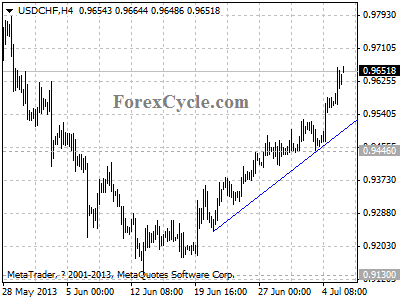
USDCHF’s upward movement extends to 0.9664

USDCHF’s upward movement from 0.9130 extends to as high as 0.9664. Support is at the upward trend line on 4-hour chart, as long as the trend line support holds, the uptrend could be expected to continue, and further rise towards 0.9800 area could be seen over the next several days. On the downside, a clear break below the trend line support will suggest that consolidation of the uptrend is underway, then the pair will find support around 0.9450.

usdchf

Written by ForexCycle.com

Weekly Wrap Up for EURUSD, Euro Dropped 1.48%

Article by Investazor.com

A really important week has passed for the EURUSD currency pair. As we know, in the first week of the month the ECB has the monetary statement and the press conference and the Non-Farm Payrolls is published for the United States.

At this press conference Mario Draghi pointed some things regarding the positioning of the ECB in what concerns the economy of the Euro Zone:

  • Euro Area growth risks remain on the downside
  • Inflation risks are broadly balanced, inflation rates may be volatile throughout the year
  • Economy should recover at subdued pace
  • 0.50% interest rate was maintained, but it is not the lower bound
  • The rates to stay low for extended period of time
  • ECB keeps an open mind on negative deposit rates

If this wasn’t enough, S&P lowered Portugal’s outlook to negative from stable. The country’s current grade is BB and rating company sees one in three chance of ratings cut within the next 12 months, and the also see a deficit about 5.8% of the GDP for 2013.

For the United States the story is a bit different. Several weeks ago Ben Bernanke said that the Federal Reserve is preparing for tapering the Quantitative Easing Program by the end of 2013, and stop it in 2014. The conditions for these measures were that the economy to head towards their forecast and the unemployment rate to drop to or under 7%.

One day after the ECB’s press conference, the Non-Farm Payrolls was published. It surprised the market with a value of 195K vs. 165K expected, and the previous value revised to 195K. Even though the Unemployment Rate did not come as expected and stagnated at 7.6%, the biggest impact came from the NFP.

eurusd-at-1.28-support-after-ecb-and-nfp-07.07.2013

Chart: EURUSD, Daily

This week Euro dropped almost 1.5%. The biggest fall took place on Thursday and Friday. The speech of Mario Draghi did not encourage the investors to buy euros and the dollar continued its trend. Next day, the economic data showed an improvement in the US labor market, the dollar continued to appreciate.

From the technical point of view EURUSD got to a good support area, formed by 1.28 level and a trend line. The probability for the down trend to continue it is quite high. If this area will fall the next good support it is at 1.2650. Before a breakout we could see a bounce back to 1.29 or somewhere near 1.30.

The post Weekly Wrap Up for EURUSD, Euro Dropped 1.48% appeared first on investazor.com.