Surge in Auto Sales Not Proof of Real Economic Growth

By Profit Confidential

Suddenly, the automotive sector is red hot. According to Autodata Corporation, 1.4 million cars and light trucks were sold in the U.S. economy in the month of June. In fact, auto sales in the U.S. economy have increased 9.2% over the same period a year ago, and they are on pace to have their best year since 2007. (Source: Wall Street Journal, July 2, 2013.)

Since the beginning of the year, 7.7 million cars and light trucks have been sold in the U.S. economy.

But is that proof there’s real economic growth? Should we break out our “Dow to 20,000” party hats?

Based on our opinion, those numbers represent a good step in the right direction for the U.S. economy. Traditionally, auto sales figures are a strong indicator of consumer spending. The current trend indicates that Americans are spending money again. But there are a few reasons why I remain skeptical about any real economic growth in the U.S. economy.

The first reason is that according to TransUnion Corp., a credit information company, in the first quarter of 2013, the delinquency rate on auto loans 60 days or more past due increased from 0.82% a year ago to 0.88%.

Even more troubling is the fact that sub-prime borrowers—individuals with lower credit ratings—made up 15% of all auto loans made during the first quarter of 2013. (Source: MarketWatch, June 25, 2013.)

Could we see a sub-prime auto loan crisis in the U.S. economy? It’s not impossible. Over the last two years, balances in accounts from sub-prime auto loans borrowers have increased 11%.

The second reason is that consumer spending, aside from autos, is still very much suppressed in the U.S. economy. And the jobs market report from June showed that the number of people working part-time increased, with the majority of the jobs created in the low-wage sectors. That’s not likely to be a force that drives the U.S. economy towards economic growth.

And finally, while we have already heard enough about how the Federal Reserve will be stepping away from its quantitative easing, it will have a profound effect on interest rates. As I have said many times in these pages, the housing market in the U.S. economy will suffer as lower-wage earners will be faced with higher mortgage costs. And auto sales will be no different; just as it will become more expensive to buy a home, it will become expensive to buy a car.

In the short term, I expect automakers in the U.S. economy to continue to profit from this increased demand created by easy monetary policy; but in the long run, their troubles will become more evident. For example, the eurozone is still a mess, and China’s economic growth continues to become less stable.

Of course, basing your opinion on economic growth on one number—like auto sales—is not advisable when other indicators are suggesting the opposite.

Article by profitconfidential.com

Corporate Earnings Weakness Should Send You to These Equities

By Profit Confidential

Corporate Earnings Weakness Should Send You to These EquitiesAfter the stock market closes today, benchmark stock Alcoa Inc. (AA) is set to report. Expected consensus-adjusted earnings are $0.06 a share, with revenues averaging $5.86 billion. That’s about flat with the comparable quarter.

Like many other benchmarks, Alcoa’s position has been drifting lower lately on slowing economic news, especially from China.

Also reporting is WD-40 Company (WDFC)—you probably have more than one of this company’s products in your garage. This dividend-paying lubricant company has been doing very well on the stock market since 2010 as investors sought earnings safety and yield. Earnings are expected to be flat with the comparable quarter on only a slight gain in revenues.

There isn’t a lot of double-digit growth out there, especially with large-cap, multinational corporations. So when the numbers get close, the stock market chases the positions. Johnson & Johnson (JNJ) is the perfect example of this.

I have to say that the stock market is holding itself together very well, considering the lack of earnings growth over the last several quarters. The system is very much a leading indicator—or perhaps, a leading gambler—on the prospect of earnings.

Institutional investors are still buying in this market and, at the same time, there have been plenty of withdrawals from the bond market. The stock market can still move higher from its current level if corporations provide an outlook of either earnings growth or stability, peppered with the expectation of improving revenues.

Companies are naturally very reluctant to make bold predictions regarding operations, since they want to avoid missing expectations. Instead, earnings forecasting is very much a game between corporations and the stock market.

Both Oracle Corporation (ORCL) and Apple Inc. (AAPL) tried to sweeten the attractiveness of their shares with big dividend increases. So far, it hasn’t worked.

The bottom half of the year (particularly the fourth quarter) is always the time when companies post their strongest quarters. The last few months have kind of been a “sell in May and go away” scenario—the stock market turned lower at the beginning of the last week of May.

If I had to guess, I’d say the stock market is likely to tread water until the end of the summer. Without question, Federal Reserve policy holds the keys to any trend. (See “Little Gain Now for Lots of Pain Later: Fed Policies Will Hold the Economy Down.”)

Clearly, the stock market is due for an extended break. A natural period of consolidation or correction would be a healthy development. If speculation regarding the end of quantitative easing was the reason for the market’s latest retrenchment, flat earnings and revenues could easily be the next reason.

This earnings season, I have very little in the way of expectations for outperformance. Global economic news has definitely provided weakness abroad in the second quarter, especially in China. That should be reflected in earnings.

Since the stock market remains a big hold, I have to reiterate my view that utilities are becoming more attractive for new positions.

Article by profitconfidential.com

Gold Breaks A Record

By MoneyMorning.com.au

What a quarter that was for the gold bugs. Most would rather forget it ever happened.

The metal fell 23% in the last three months, which was an all-time record. Failing a miracle, gold will be down this year for the first time in over a decade.

Gold stocks fared worse still. The Aussie gold stock index is down 55%, while smaller stocks fell further. It has been nothing less than a train wreck on par with the end of the uranium boom.

The question is where does the market go from here? Is this the end of an era, or is a huge opportunity brewing?

A few weeks ago, I advised Diggers and Drillers subscribers to sell our silver position, and also that I was selling my own.

I had to axe a number of gold stocks too as they had fallen unacceptably far. After being a major precious metals bull, there were plenty of emails using words like ‘unacceptable’, ‘major U-turn’, and ‘lost the plot’.

The bottom line was that the market has changed.

As conditions change, views have to change. Right now, the driving force for much of the market, not least in precious metals, is the action in the US bond market.

Yields on US 10-years have jumped from 1.6% to 2.7% in just two months.

Let me tell you, this is a massive jump.

But why is this jump such a big deal. And why has this forced me to reluctantly change my tune, and sell the family silver?

The direction of gold has a lot to do with bond yields; specifically real bond yields, which are now very comfortably into positive territory.

Gold pays no yield. This isn’t an issue when bonds don’t either, but for some investors at least, gold looks less attractive when bonds have real yield.

US Ten-Year Bond Yield Soaring


Source: Bloomberg

The Federal Reserve previously warned of bond yields creeping up, and possibly getting to the current level sometime in late 2014. It only took just a few months and this surge has happened much faster than even they expected.

The bottom line is that it looks as though they have lost their grip on the bond market.

It won’t be just precious metals holders watching these bond yields, because the whole global market is underpinned by the bond market.

Even just talk of tapering has caused rates to soar, so what happens when they actually do it? It looks likely that rates could rise further as the bond market gets out of control, and this would put more pressure on metal prices.

But this brings us to…

A Conundrum for the Gold Producers

At the moment, gold is now trading around its cost of production.

In other words, at the current price of US$1,230 /ounce, about half of the global gold mining industry is losing money.

They have to cut costs just to survive, and we are now seeing many gold producers announce layoffs, pay-cuts, drops in production, and in some cases close their doors. It’s brutal, and from what I’ve heard on the grapevine, more is on the way.

For many Aussie midcap gold stocks, companies’ ‘all in costs’, are generally around the $1,100-$1,200 level.

This chart is from an Argonaut Securities presentation at the Mines and Money conference I spoke at in Hong Kong earlier this year. It shows their estimates of the ‘all in costs’ for some ASX gold producers. You can see that most of them will be having a tough time at current price levels:

Gold Now Trading Around the All-In Cost of Production


Source: Argonaut Securities

We’ll probably see supply of mined gold fall in the coming quarters, and years as the medicine works through the system.

And I’ve heard the supply of scrap gold (the cash-for-gold stalls in your local shopping centre) has dried up as well – because it’s not considered worth selling at these low prices.

And as a year twelve economics student will tell you: falling supply feeds through to higher prices.

And so the merry go round starts all over again.

So, although the current market hardly feels like it, it will lay the foundations for, and ultimately lead to, the next bull market.

The only question is how long will we have to wait for a full recovery?

I suspect…

It May Take a While

If you look back to the three major corrections in the last ten years and also the epic 45% fall in the 1970′s bull market, in each case the recovery took longer than the correction.

Seeing as this current correction is almost two years long already, it could take two years or more to reclaim lost ground.

But that doesn’t mean there isn’t opportunity out there today.

The last time the turnaround was triggered, and then sustained, by the Fed’s Quantitative Easing programs.

What could trigger a turnaround this time? A black swan event like war in the Middle East? A new version/scale of QE thanks to a new Fed President? In these markets, anything can and will happen. 

The lower prices go, the bigger the opportunity brewing in precious metals for the brave and the patient investor.

In the meantime, I’ll be exploring the rubble of the resource sector for other opportunities. After thirty months of falls for the small resource sector, prices are the lowest I’ve seen them. Some deserve to be cheap, but many others don’t. This situation is giving investors an incredible opportunity to buy quality companies at fire-sale prices.

Energy stocks are lining up to be the next big thing, with oil prices bucking the bearish trend in commodities today. It’s a diverse sector with some good short-term, and long-term, opportunities out there.

One small-cap energy stock I tipped recently with projects in the East African Rift System, the most sought after energy ‘post code’ today, has side-stepped the market carnage to quietly notch up 24% in a month.

While we wait for precious metals to find their feet again, and industrial commodities to see what China will do next, energy is one sector we can be more confident punting on: oil, gas, and don’t forget uranium too…

Dr Alex Cowie+
Editor, Diggers & Drillers

From the Port Phillip Publishing Library

Special Report: Panic of 2013

Daily Reckoning: The End of a Share Market Correction… or the Beginning?

Money Morning: Time to Plan for the Year-End Stock Rally?

Pursuit of Happiness: Make Sure You’re Not a Property Investing ‘Loser’

Diggers and Drillers:
Why You Should Invest in Junior Mining Stocks Now

The Wagon and the China Dragon

By MoneyMorning.com.au

We get plenty of criticism for banging on about China.

But don’t mistake our China bashing for anything more than concern for the enormity of the problems there and the potential impact on Australia. Because the impact will be huge. It’s just that we’ve had it so good for so long, the Australian commentariat have no imagination when it comes to the potential economic problems we face.

We’re not trying to fear-monger or drop a bucket of faeces on the place. We’re trying to dig deep into the morass created by a credit boom and trying to work out what it means for you.

The rise of China began around 2003. Ultra-low interest rates in the US kick-started the boom. Because China pegged its currency to the US dollar, it effectively imported easy US monetary policy.

The World Has Never Seen This Before

You can see the effect of this in China’s accumulation of foreign exchange reserves (mostly US dollars, and euros too). China began 2003 with reserves of around $US350 billion. In the space of just 10 years, those reserves have ballooned to around US$3.5 trillion – a 10-fold increase.

These reserves, purchased with newly printed yuan in order to keep the exchange rate low, provided the fuel for China to engineer its own credit boom in response to the 2008 credit crisis.

The boom got underway in 2009 and is still going. Fitch ratings agency says it’s ‘unprecedented in modern world history‘.

Credit bubbles can continue for longer than nearly anyone expects them too. And they go on so long that most observers simply cannot see a catalyst to end the boom. But Federal Reserve tapering, or simply threats to taper, could be the catalyst that sends the China boom bust.

That’s because the threat of tighter monetary policy, or, to be more precise, the threat of ‘less loose’ monetary policy, causes a reversal in speculative capital flows. Such a reversal puts pressure on the most fragile parts of the financial sector.

And you’re seeing evidence of that pressure in China’s economy right now. A key measure of banking sector liquidity, the interbank lending rate known as SHIBOR, has surged in recent weeks. That tells you that cash is tight, and no one really wants to lend to each other at low rates. The higher lending rates reflect the higher perceived risk in the system.

And it’s not just perceived risk. A few weeks ago, there was a technical default in the banking system as China Everbright Bank couldn’t come up with the cash to repay a loan on time.

These are warning signs, in the same way that the failure of various sub-prime lending vehicles in 2007 was a warning sign of the looming credit crisis. If it follows the same path China’s economy will have a very hard landing and Australia will feel the full brunt of it.

For better or worse, we’ve hitched our iron ore wagon onto the tail of the red dragon. What happens in China’s economy will matter here…big time.

That’s not fear-mongering. That’s reality. If you think China can manage the fallout you’re not thinking. The US, with the most sophisticated capital markets in the world and a huge amount of self-interested parties trying to save the system, only just managed to pull it off. How is it that China will avert a similar fate?

We don’t know how events will pan out from here. We just know it’s better to have your eyes wide open than eyes wide shut. Ignorance is bliss while the going is good…but it can be a wealth destroyer when things change.
 
Greg Canavan+
Editor, The Daily Reckoning Australia

[Ed Note: To read more of Greg’s in depth macro-economic analysis, click here to subscribe to the free daily e-letter The Daily Reckoning.]

From the Archives…

The Power of Low Interest Rates Coming to the Aussie Market
5-07-2013 – Kris Sayce

S+P 500 Downtrend Looms? Counting Down The Days…
4-07-2013 – Murray Dawes

Here’s Your Six-Point Stock Buying Checklist
3-07-2013 – Kris Sayce

Are the Credit Rating Agencies at it Again?
2-07-2013 – Kris Sayce

Why This Could be Another Great Year for Australian Stocks…
1-07-2013 – Kris Sayce

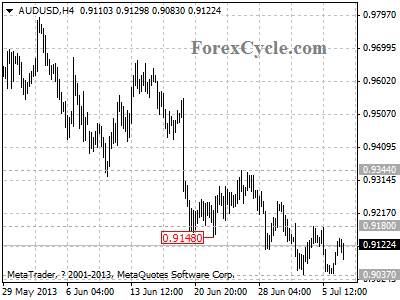
AUDUSD moves sideways between 0.9037 and 0.9180

AUDUSD moves sideways in a narrow range between 0.9037 and 0.9180. The price action in the range is likely consolidation of the downtrend from 0.9344. Another fall to test 0.9037 support could be expected, a break down below this level will signal resumption of the downtrend, then next target would be at 0.8950 area. On the upside, a break above 0.9180 resistance will suggest that lengthier consolidation of the longer term downtrend from 1.0582 (Apr 11 high) is underway, then further rally to 0.9270 area could be seen.

audusd

Provided by ForexCycle.com

Europe Is Still Struggling

Article by Investazor.com

In his speech today, Mario Draghi maintained the structure of his last talk. Constrained by the obvious reality, he had to admit the lent pace of recovery and the long list of problems that are not yet solved, as the weak conditions in the labour market and the economic slowdown. On the other hand, the accommodative position of the monetary policy together with the improvements made since mid-2012 and the banking union system should keep the stability of the euro zone.

The heart of Euro zone, Germany, is pumping the same weak and negative sentiment about the current economic situation, announcing a contraction of -0.1% in the industrial production as well as a decreasing trade balance (14.1B). It is difficult to expect positive results in an environment dominated by instability and lack of trust in the Government’s institutions. On the long term, we may be witnessing of improved conditions if the pace of restructuring is maintained.

The post Europe Is Still Struggling appeared first on investazor.com.

WTI Crude Oil Rallies above 100$ per Barrel

Article by Investazor.com

Dis you missed an analysis on commodities? Well, we thought of updating an older analysis on WTI Crude Oil, because a lot of interesting things have happened since then.

In our last analysis, WTI Crude Oil Looking Bullish More than Ever, we have made a technical analysis on the evolution of the WTI Crude Oil and we were expecting a breakout through 97.45$ per barrel. Our setup was helped by a series of fundamental events.

In Egypt a riot started against the President Mohamed Mursi which couldn’t be settled not even after a clash between the security forces and the supporters of the president.  This political problem had a big impact over the WTI Crude oil prices because there are shipments which go through the Egypt’s Suez Canal.

Last week because of the problems in Egypt, combined with a fall of 10.3 million barrel in the US stocks, the price of WTI broke 100$ per barrel. The up move was sustained by the good US labor market data and got up to 104.50$ per barrel this week. Tomorrow the API (American Petroleum Institute) will release their estimates for this week and it is possible for the price to react again.

wti-crude-oil-broke-100-level-08.07.2013

Chart: WTI Crude Oil, Monthly

Getting to the technical analysis part, we will see that this month the price has broken the 97.45 resistance and got up to 104.50. If the direction would be maintained the next resistance it is found at 110$ per barrel. It is pretty important to look for a throwback to 100$ per barrel level and also to see how this month would end.

If the breakout will be confirmed we should project the target of the triangle on the upside, while if it will be only a false breakout we should look for a drop back under 90$ per barrel.

The post WTI Crude Oil Rallies above 100$ per Barrel appeared first on investazor.com.

Central Bank News Link List – Jul 8, 2013: Turkish central bank starts ‘strong’ tightening to bolster lira

By www.CentralBankNews.info Here’s today’s Central Bank News’ link list, click through if you missed the previous link list. The list comprises news about central banks that is not covered by Central Bank News. The list is updated during the day with the latest developments so readers don’t miss any important news.

Guru in Focus: What is Mohnish Pabrai Buying?

By The Sizemore Letter

Warren Buffett is known for keeping the investment process simple.  He avoids complex models, and once joked that if calculus were required, he’d have to give up the money business and go back to his childhood job of delivering papers.

But not even Warren Buffett can match Mohnish Pabrai when it comes to having a Spartan investment philosophy.  Pabrai has effectively boiled the entire process down to the logic of a coin flip: “Heads, I win.  Tails, I don’t lose too much.”

I love it.  Short, simple, and yet profound.


For anyone not familiar with Pabrai, he is the principal of Pabrai Funds and the author of The Dhando Investor, a book on value investing I strongly recommend.

Pabrai is a Warren Buffett disciple who takes Buffett’s comments on diversification seriously:  “Diversification is a protection against ignorance. It makes very little sense for those who know what they’re doing.”

According to his latest SEC filings, Pabrai has just six stocks in his $340 million portfolio—and half of its value in just two stocks: Citigroup ($C) and Bank of America ($BAC).

So what is Mr. Pabrai buying these days?

Zinc…and a lot of it.

Throughout the month of June, Pabrai made several large additions to his holdings in Horsehead Holding Corporation ($ZINC), a producer and seller of zinc- and nickel-based products and the leading supplier of zinc in North America.

This is not a sexy business…as there is nothing particularly interesting or exciting about a company that mines zinc or produces zinc power…and it’s not even a particularly profitable one.  In fact, ZINC posted a loss in its last full year of reporting.

It’s not exceptionally cheap for a commodity producer either.  Horsehead sells for 13 times forward earnings and at 1.5 times book.  To put that in perspective, Teck Resources ($TCK), a diversified miner, trades for 8 times forward earnings and 0.63 times book.

I’m having a hard time seeing Pabrai’s angle here.  He has a long track record of buying distressed companies and what he calls “low-risk, high-uncertainty businesses.”   Horsehead could certainly fall into this latter camp, as commodities businesses are anything if not uncertain.

But this essentially looks like a large bullish call on the price of zinc.  It appears that Pabrai is making a large bet that zinc—which has drifted lower for most of the past three years—is about to get a lot more valuable.

He might have another angle, and I expect that he does.  It would be unlike Pabrai to wager a decent chunk of his investors’ capital on the price of a traded commodity.  But because I can’t figure out what that angle is, I’m not going to follow suit.

But might any of Pabrai’s other holdings have potential?

I’m somewhat bullish on Chesapeake Energy ($CHK), as I am bullish about the long-term prospects for natural gas and I see this as a “scandal stock” with most of the bad news long ago priced in.  I also like Pabrai’s bet on General Motors ($GM) via long-term warrants

Otherwise, Pabrai is essentially just long financials in a big way.  Buying Citi or Bank of America at substantially below book value should be a fairly low-risk investment.  Bank stocks will continue to get knocked around with every Fed announcement, but if you are content to “buy and forget” for a few years, it’s hard to see losing a lot of money on that trade.  And the upside could easily be 100% or more over the course of the next 2-3 years.

Or, as Pabrai likes to say, this is a case of heads, you win.  Tails, you’re not likely to lose too much.

This Resilient Commodity to Ready for a Big Comeback

For many investors, 2013 was supposed to be the year that silver regained its luster. Most economists thought silver would climb as a hedge against inflation and be a devalued dollar on the heels of continued economic turmoil. Or, assuming the economic rebound was in full swing, it would grow due to industrial demand for everything from solar panels to electronics, batteries to the automotive industry.

Strangely, none of that happened. Silver benefits by being both a precious metal and an industrial metal. As an industrial metal, investors need to actually see enough economic growth before they can ride that bandwagon. As a precious metal, silver is being taken along for the ride by investors fleeing gold.

In fact, silver is being treated more like a precious metal than an industrial one these days. The following chart shows that silver, over a 50-day period, shares a 0.98 correlation coefficient with gold (a 1.00 result would mean the two move in perfect step with each other).

Instead of being the 2013 star of the precious metals community, silver has turned into the dog. Trading near $19.70 an ounce, silver has lost more than 35% of its value since the beginning of the year (and on track for its worst performance in almost 30 years). Gold, on the other hand, has dropped just 25%, while platinum is down about 13%.

Chart courtesy of www.StockCharts.com

But for contrarian investors, silver has never lost its shine—its role as a safe haven hasn’t really changed. The U.S. economy continues to be fragile. Unemployment is hovering at 7.5%, first-quarter gross domestic product (GDP) growth came in well below expectations, home values are still 25% below their pre-market crash levels, wages are stagnant, and the number of Americans relying on food stamps is at record levels. On top of that, the eurozone continues to be in trouble with Portugal surfacing as the latest victim, China’s economy is stalling, and global bailouts are still in place.

In spite of silver’s retreat, all of the ingredients for a rally are still set—a fact that has not been lost on the average American investor. According to the U.S. Mint, during the first half of 2012, it sold approximately 17.37 million one-ounce American Eagle silver coins. During the same period in 2013, it sold 25.0 million Eagles—a year-over-year increase of 43.9%. In fact, the U.S. Mint is predicting that its gold and silver coin sales could reach record numbers in 2013. (Source: “2013 American Eagle Bullion/Sales Figures,” U.S. Mint web site, July 4, 2013.)

Investors who have been watching silver for a number of years know that the precious metal can bounce back. In March 2008, silver was trading near $21.00 an ounce, and by October, it had fallen 60% to around $8.40; however, by April 2011, it had bounced back, soaring over 400%.

Interestingly, if you look at silver’s long-term trend dating back to 2002, you’ll see that it currently is nearing its support level.

While silver has clearly declined, as long as the global economy remains uncertain and central banks continue to print more and more money, silver will continue to be in demand as a store of value.

This article This Resilient Commodity to Ready for a Big Comeback was originally published at Investment Contrarians