The Big Banks On Trial Again

By MoneyMorning.com.au

You want to know why the entire global financial system almost collapsed in 2008?

There seems to be a simple answer. Not encouraging, but simple: The European Commission is exploring the possibility that there was a conspiracy among 13 of the world’s major banks that colluded to keep the entire house of cards a secret.

In a press release Monday the European Commission announced it sent a ‘statement of objections’ to Bank of America Merrill Lynch (BAC), Barclays (BARC), Bear Stearns , BNP Paribas (BNP), Citigroup (C), Credit Suisse (CS), Deutsche Bank (DB), Goldman Sachs (GS), HSBC (HBC), JP Morgan (JPM), Morgan Stanley (MS), Royal Bank of Scotland (RBS), UBS (UBS) as well as the International Swaps and Derivatives Association (ISDA) and data service provider Markit.

This statement of objections is a formal step in EU investigations that charges the banks, the dealers’ association, and the swaps pricing agent and index controller of ‘colluding to prevent exchanges from entering the credit derivatives business between 2006 and 2009.

The companies are then expected to answer the charges.

If, after the parties have exercised their rights of defence, the Commission concludes that there is sufficient evidence of an infringement, it can issue a decision prohibiting the conduct and impose a fine of up to 10% of a company’s annual worldwide turnover.’

Part of the antitrust behaviour of the accused, besides controlling pricing of derivatives to their exclusive benefit, would likely address their complicity in veiling the entire market to deflect fears of counterparty exposure, concentration of risks and leverage in the financial system.

Behind the Veil: Where the Elite Meet

The ISDA, the trade and lobbying group for users of over-the-Counter (OTC) derivatives that was named as a colluding partner, said last August that after eliminating more than $200 trillion in notional value of interest rate and credit-default swaps by cancelling offsetting trades, on an adjusted basis interest rate swaps totalled $262 trillion.

According to the ISDA’s website it has 840 members. There are 196 ‘primary members’ that include all the big banks in the statement of objections and most of the world’s trading banks.

Associate members include banks, corporations and some of the most powerful law firms around the world. Among them: Washington power lobbying firm Patton Boggs LLP, bank and securities law firms Davis Polk & Wardwell, Wachtell, Lipton, Rosen & Katz, and Weil Gotshal & Manges.

The ISDA’s ‘subscriber members’ include the 12 Federal Home Loan Banks, Freddie Mac and Fannie Mae, the Student Loan Marketing Association (Sallie Mae), New York Life Insurance Company, Intel Corporation (INTC), the Bank of England, Luxembourg and GMAC Inc. are all subscriber members.

Markit, according to its website, ‘is a private company headquartered in London. The company is owned by employees, private investors, private equity investors and numerous buy-side and sell-side financial institutions.

But Markit wants to change that. The company, which competes with Bloomberg and Thomson Reuters Corp, has been planning a public offering to raise $1 billion.

Outrage Upon Outrage

A Reuters story on June 25 quoted a source saying, ‘A registration statement for the deal could be filed with U.S. regulators during the fourth quarter of this year, although timing is still in flux and could change depending on market conditions.

The story names Goldman Sachs as the lead coordinator for the deal, but points out Markit’s other large stakeholders, including JPMorgan Chase and Bank of America Merrill Lynch want to be lead syndicate partners.

An IPO may be a long way off if Markit, in large part owned by the big banks who also are all primary members of the ISDA, are all accused of antitrust violations and face potential multi-billion dollar fines.

In addition to its current woes, Markit would have to disclose that back in July 2009 the Justice Department’s antitrust division had sent civil notices to banks that own Markit to find out if they had unfair access to price information.

Justice, or Just Cold Comfort?

A July 14, 2009 New York Times Dealbook post pointed to William Cohan, a former investment banker and financial crisis commentator, who said any potential investigation into Markit and its owners was overdue.

The fact that they control Markit and it provides information about the prices of credit default swaps and they’ve benefited from this for many years without any challenge or investigation was outrageous,‘ he was quoted as saying by Bloomberg News.

To date, nothing has come out of the Justice Department’s investigation.

Yet again, the world’s biggest banks, those principally responsible for driving the global financial system off a cliff, are being exposed for what they’ve done and how they did it. That’s the bad news – for them.

The good news – for them – is they still have the earnings power to pay whatever fines are levied against them and that no one at the top of any of these criminal enterprises has gone to jail.

Shah Gilani
Contributing Editor, Money Morning

This article first appeared in US Money Morning on 3 July, 2013

Join Money Morning on Google+

From the Archives…

Why Your Financial Advisor Won’t Like This Investment Advice…
28-06-2013 –  Kris Sayce

Is This Your Last Chance to Sell Before the Stock Market Sinks?
27-06-2013 – Murray Dawes

Is This the Ultimate Contrarian Opportunity…Or a Death Wish?
26-06-2013 – Dr Alex Cowie

How Central Bank Zombies Control the Stock Market
25-06-2013 – Dr Alex Cowie

Why The ‘Asia-Zone’ Crisis Makes Australian Stocks a Buy…
24-06-2013 – Kris Sayce

Central Bank News Link List – Jul 3, 2013: Fed ready for September taper after shocking market, Meyer says

By www.CentralBankNews.info Here’s today’s Central Bank News’ link list, click through if you missed the previous link list. The list comprises news about central banks that is not covered by Central Bank News. The list is updated during the day with the latest developments so readers don’t miss any important news.

Sizemore Insights 2013-07-03 13:39:16

By The Sizemore Letter

Uh oh…more bad political news out of Europe.  Portugal’s government is at risk of falling, as two key ministers resigned in protest over the EU’s mandated austerity policies.  This follows a massive protest in Greece after budget cuts forced the government to shut down the bloated state broadcaster (and fire all of its employees) and the conviction and sentencing of Silvio Berlusconi on sex and abuse of power charges.

Is it time to start worrying about Europe again?

No, or at least not yet.

The Portugal developments are a little worrying but not exactly unexpected.  This is politics, and if the Portuguese believe they get a better deal by challenging their creditors by taking this to the brink, then that is exactly what they will do.  Spain and Ireland are also negotiating a retroactive bank bailout that would shift the debts taken on to the EU’s bank bailout mechanism and off of Ireland and Spain’s governments.  Negotiations are still dragging on…and I don’t expect a definitive conclusion this year.

All of that is fine and good, but surely there will come a point to panic, right?

Figure 1: Italy 10-Year Yield

Figure 1: Italy 10-Year Yield

Spain

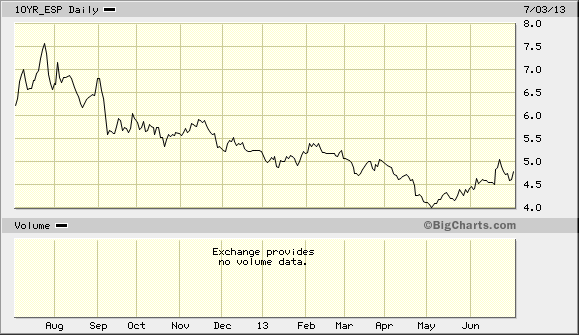
Figure 2: Spain 10-Year Yield

Maybe.  And that is why I am watching Spain and Italy’s 10-year bond yields (Figures 1 and 2).

Spanish and Italian bond yields have been trending downward for the past year.  If you might recall, ECB President Mario Draghi make his now infamous “do whatever it takes” comments almost exactly a year ago, and they had the desired effect.  Except for a brief blip in February, yields have falling almost continuously.

This, until now.  Starting in May, Italian and Spanish bond yields have started to creep up again.  Spain’s 10-year yield briefly popped over the psychologically important 5% mark last month, and Italy’s came close.

Is this cause for concern?

At first glance, I would say yes.  But let’s keep it context.  Virtually all yields everywhere in the world rose in May and June over fears that the Fed would be tapering its quantitative easing programs.  But once the dust settled, it became obvious very quickly that the bond market had jumped the gun.  The tapering—if it happens—is still 6-12 months away.  And even when it does come, it is not likely to be as harsh as the bond bears fear.

That’s nice.  But what does it mean for Spain and Italy, and when do we panic?

This will be the signal for me: if yields in the U.S. and Germany continue to drift lower, but Italian and Spanish yields rise, that would be a divergence that got my attention.  It wouldn’t mean that a crisis was imminent, but it would mean that the bond market had lost confidence in the Eurozone again and that Draghi’s “whatever it takes” is simply not enough.

I don’t see that happening, and I am viewing any dips in the prices of European stocks as buying opportunities.

But if I’m wrong—and Spanish and Italian yields shoot above 5% again—it will be time to take a little risk off the table and get at least partially defensive.

Uganda holds rate to boost growth, higher inflation risks

By www.CentralBankNews.info     Uganda’s central bank held its central bank rate (CBR) rate steady at 11.0 percent, saying it was maintaining a neutral policy stance to support private sector credit growth without jeopardizing its inflation objective.
    The Bank of Uganda (BOU), which cut its rate by 100 basis points last month, said the macroeconomic outlook was largely unchanged from last month “with the exception that we believe that the balance of risks to the inflation forecast have shifted slightly upward, mainly due to the threat posed to food prices by drought.”
    Uganda’s headline and core inflation rates eased to 3.4 percent and 5.5 percent, respectively, in May from 3.7 and 5.6 percent, and the BOU expects inflation to rise slightly over the next two to three months but then decline towards the bank’s target of 5.0 percent by June 2014.
    “However, the adverse weather conditions currently being experiences in most parts of the country could push-up prices in the near term and this poses an upward risk to the inflation forecast,” it said in a statement from July 2.

    Output from Uganda’s economy is forecast to increase to 6 percent in the 2013/14 financial year, which began July 1, from a preliminary estimate of 5.1 percent in 2012/13. In May the BOU had forecast 2013/14 growth of 6-7 percent.
    But the BOU said the pick-up in real economic growth is unlikely to pose a risk to inflation as output is still below potential growth rate of about 7 percent.
   
    www.CentralBankNews.info

Why You Still Shouldn’t Listen to “Gold Bugs”

By Investment U

Many gold bugs are pounding the table for investors to buy gold – now that it’s dropped to roughly $1,200 – and sell stocks.

Don’t listen to them. Not because gold won’t rally from here or stocks won’t sell off – or both. But because – unbeknownst to many of their listeners – this is what they always say. Gold bugs don’t offer an investment analysis. They offer a world view that changes over the decades about as much as the constellation Orion.

The economy may expand or contract. The dollar may rise or fall. Governments may fail. Currencies may collapse. But one thing is constant: their advice. Sell paper assets and buy gold.

To their credit, they said this in 1999 when gold slid to a 20-year low of $257.60 an ounce and stocks were about to enter their worst decade in modern times. But to their shame, they were still saying it a few years ago when gold was peaking at $1,900 and stocks were a screaming buy.

If you love broken clocks, you have to love gold bugs. Both are lovely antiques.

But what if they’re right this time? What if we’re headed into an inflationary spiral?

Not likely. Why? Well, for one thing, look at the price of Treasury Inflation-Protected Securities (TIPS). They have swooned in recent months. Or look at the price of gold. In the second quarter, it posted its largest quarterly decline since the start of modern gold trading. Gold fell 23% in the period to close at $1,223.80 a troy ounce.

If the trend is your friend, look out below.

But the truth is gold isn’t such a hot inflation hedge, anyway. It hit a high of $875 an ounce in January 1980. And even though we experienced double-digit inflation that year, it lost a third of its value by Dec. 31. And it kept dropping for almost 20 years.

Gold bugs who purchased gold at the high 33.5 years ago still haven’t broken even in inflation-adjusted terms. Heck, they still hadn’t even broken even when gold peaked above $1,900. If that’s an inflation hedge, I’m Woodrow Wilson.

But just wait, the gold bugs insist. “We’ll be vindicated in the long run.” This is when I’m reminded of the one thing John Maynard Keynes said that I actually agree with: In the long run, we’re all dead.

A 50-year old who bought gold at the peak in 1980 is now 83 years old. I’m guessing he wishes he had done something smarter with his money, like invest it in common stocks, a genuine inflation hedge.

Gold hasn’t just badly underperformed stocks and bonds over the last 30+ years. It has badly underperformed stocks and bonds for the last 200+ years.

The long run can be very long indeed.

Am I suggesting you shouldn’t own gold? Absolutely not. Gold is an excellent portfolio diversifier and – occasionally – an explosive mover. Blue chip gold equities, in particular, have only underperformed the S&P 500 by about one half of one percent annually.

However, if you’re one of those investors who has 30%… 50%… or more of his portfolio in gold, you’re really rolling the dice.

And probably listening to the wrong source.

Good investing,

Alex

Article By Investment U

Original Article: Why You Still Shouldn’t Listen to “Gold Bugs”

Poland says cycle of easier monetary policy has ended

By www.CentralBankNews.info
    Poland’s central bank said its latest rate cut, which should help the economy recover in the second half of this year and limit the risk of inflation remaining below its target, ends its cycle of easing monetary policy.
    The National Bank of Poland (NBP), which earlier today cut its benchmark reference rate for the third time in a row, said domestic economic activity remained weak in the second quarter, which will support weak wage growth, though some indicators had improved lately, including a halt in the fall of employment in the corporate sector and a slight fall in the seasonally-adjusted unemployment rate.
     Although the central bank cut its forecast for economic growth and inflation, it said growth should gradually pick up from the second half of this year and this should also help boost inflation.
    “The Council assesses that the significant reduction of NBP interest rates implemented since November 2012 supports economic recovery and limits the risk of inflation running below the NBP target in the medium term. The decision to lower NBP interest rates made at the current meeting ends the loosening cycle of monetary policy,” the NBP said in statement.
    The NBP cut its reference rate, along with other key rates, by 25 basis to 2.50 percent, bringing this year’s rate reduction to 175 basis points.

    Since the central bank started cutting rates in November last year – a move that was criticized as too late to cushion the economy from the euro area’s recession – the NBP has cut rates by 225 points. In April the bank froze rates to assess the impact but then started cutting again in May.
    Global economic activity remained low in the first half of this year, the NBP said, noting that “signals of a possible tapering of monetary expansion by the Federal Reserve have recently led to a deterioration of sentiment in financial markets.”
    “This, in turn, resulted in some outflow of capital from emerging markets and depreciation of their currencies, including the zloty,” it added.
    Like other emerging markets, Poland’s zloty has weakened since early May, having depreciated some 6.0 percent since the start of the year, with a marked decline since late May. It was quoted at 4.34 to the euro today. Last month the central bank intervened in foreign exchange markets to limit volatility in zloty trading.
    Last month a member of the bank’s monetary council had said further rate cuts should be avoided due to the risk of weakening the zloty further and triggering capital outflows.
    Poland’s inflation fell further in May to 0.5 percent from 0.8 percent in April, sharply below the central bank’s 2.5 percent target, due to lower energy prices.
    A strong fall in producer prices and low core inflation confirms “persistently low demand and cost pressures in the economy,” the NBP said, with inflation expectations by households and businesses also falling further.
    The NBP’s latest forecast calls for inflation in a range of 0.6 to 1.1 percent this year, lower than the March forecast of 1.3-1.9 percent, then between 0.4 and 2.0 percent in 2014, as against the previous forecast of 0.8 to 2.4 percent, and between 0.7 and 2.4 percent in 2015, steady from 0.7-2.4 percent.
    Poland’s Gross Domestic Product is forecast to grow between 0.5 and 1.7 percent this year, down from the March forecast of 0.6-2.0 percent, rising to 1.2-3.5 percent in 2014, compared with 1.4-3.7 percent, and within 1.6-4.2 percent in 2015, down from the March forecast of 1.9-4.4 percent.
    “The July projection, however, indicates that from the second half of 2013 – together with the expected improvement of global economic activity – a gradual acceleration of GDP growth can be expected, which will be conducive to rising inflation in the coming years,” the bank said.
    In the first quarter of this year, Poland’s economy expanded by only 0.1 percent from the fourth quarter for annual growth of 0.5 percent, the weakest rate in four years.

       www.CentralBankNews.info

Gold futures climbs as investors concerns on sentiment rises

By HY Markets Forex Blog

Gold futures advanced from its previous loss, surpassing $1,250 per ounce. The yellow metal futures for August delivery jumped to 0.96% trading at $1,255.44 per ounce as of 7:28 GMT, while the silver futures for September delivery gained 2.54% to $19.79 per ounce and the same time.

Earlier, the precious metal dropped, opening at a negative territory. However, the gold futures picked up at the early hours of the European trading session at $1,248 an ounce.

After the announcement the Federal Reserve made regarding possible cut to its $85 billion bond-buying monthly program, investors are concerned the precious metal may weaken and loose its safe-haven status.

In the previous week, gold fell steeply, losing more than 7%. While on Friday, the precious metal reached its three-year low of $1,182.85 an ounce.

The Shanghai Gold benchmark contract has surpassed 14,000 kilograms, after an all-time high of 43,272 kilograms on April 22, while the SPDR Gold Trust, lowered to 964.69 metric tons on Tuesday.

Gold may be heading to its worst quarterly performance in over 90 years, after losing 25% in its second quarter so far, according to data released from the US central bank. The Goldman Sachs predicted that gold may reach $1,050 an ounce by next year, while the Credit Suisse Group predicted prices will drop to $1,150 an ounce next year.

The post Gold futures climbs as investors concerns on sentiment rises appeared first on | HY Markets Official blog.

Article provided by HY Markets Forex Blog

WTI crude climbs above $100 on Egypt’s political turmoil

By HY Markets Forex Blog

The West Texas Intermediate crude futures climbed above $100 a barrel during the late Asian trading session, the highest since September on concerns over the tension in Egypt’s political turmoil.

WTI crude futures jumped 2.27% to $101.80 a barrel as of 4:43am GMT, while Brent crude rose 1% to $105.20 a barrel at the same time.

Egypt’s President Mohammed Morsi rejected the use of the army forces to resolve the country’s political turmoil. The ongoing protest have raised concerns that the crises may affect the oil transported through the country , as the U.S crude futures dropped by 9.4 million barrels last week , according to reports from the American Petroleum Institute.

“Given that Mursi is rejecting the army’s demand to step down, this is going to, in my opinion, throw the country into a crisis with no clear resolution,” said Andy Lipow, the president of Lipow Oil Associates LLC in Houston. “The market reaction will be bullish due to the uncertainty of the event and of what may ultimately happen,” he added.

Egypt controls the Suez’s canal and the Suez-Mediterranean pipeline, which is important for the transportation of crude oil and petroleum products. According to the US Energy Information Administration (EIA), 2.24 million barrels of oil a day was shipped through Suez’s canal to Europe and North America in 2011. Signifying, approximately 3.2% of daily transportation of crude oil.

The post WTI crude climbs above $100 on Egypt’s political turmoil appeared first on | HY Markets Official blog.

Article provided by HY Markets Forex Blog

Gold Drop “Done Enough”, Traders “Too Short” as Bears Turn “Slightly” Bullish

London Gold Market Report
from Adrian Ash
BullionVault
Wednesday, 3 July 08:15 EST

GOLD ROSE more than 1.4% from an overnight low at $1242 per ounce in London on Wednesday morning as world stock markets sank and the US Dollar rose.

Commodity prices ticked higher with major government bonds. Silver rallied 2.8% to rise again above last week’s finish at $19.69 before dropping with gold.

New private-sector data meantime showed 188,000 jobs being added in the US last month.

Friday’s official Non-Farm Payrolls report is expected to show unemployment at 7.5%, a full percentage point above the Federal Reserve’s stated target for reconsidering its loose monetary stance.

“We’ve changed our view on gold slightly,” says Macquarie Secutiries analyst Matt Turner in a CNBC interview, and now forecasting a rise to $1370 by end-2013.

 “Markets have been getting ahead of themselves on the end of QE,” says Turner. “Gold in particular factored in a lot of this, but our economists don’t think it will happen until later in 2014 and 2015.”

More urgently, says Turner, investment positioning in Comex gold futures is now “too short – the smallest net long position since 2002.”

 Outflows from exchange-traded gold investment trusts have meantime totaled 600 tonnes already this year, equal says Turner to mining production from Africa and Latin America combined.

 Gold ETF holdings fell a further 1.4 tonnes Tuesday to 2042.5 tonnes, according to Bloomberg data, “the lowest since May 2010.”

 “Gold has fallen because 3 things are up,” said Morgan Stanley’s chief investment strategist David Darst in a separate interview Tuesday – “interest rates, stock markets, and the US Dollar.”

 The Dollar today spiked to a near-5 week high against the Euro currency, helping the gold price in Euros reach a 1-week high above €971 per ounce – more than 7% above last week’s 34-month low.

 Dollar-gold around $1200 per ounce offers a “good entry point”, reckons private-bank Coutts’ Gary Dugan, chief investment officer for Asia and the Middle East.

 “At this point [however] it is too early to tell whether we have formed a bottom,” says the latest chart analysis from bullion market-maker Scotia Mocatta.

“Given the bearishness of the overall technicals, the risk remains for another test to the downside.”

 Sixteen pro-government protesters were meantime reported killed overnight in Cairo, where the Egyptian army’s deadline for elected-president Mohammed Morse to open talks with demonstrators is set to expire at 14:30 GMT.

 Cairo yesterday sold only half a planned auction of new 5-year debt to investors, and at a sharply higher interest of 15.8% per annum.

 Portuguese bond yields led weaker Eurozone rates higher on Wednesday, breaking 8-month highs above 8% after a minority member of the coalition government stepped down in protest at continued budget cuts.

 “It sounds the alarm bell of austerity fatigue,” reckons Commerzbank strategist David Schnautz in New York.

 Officials from Eurozone lenders and the IMF yesterday gave the Greek government 3 days to confirm its budget cuts, or risk losing €2.2 billion needed to repay bonds maturing next month.

 Athens stock market fell to new 2013 lows, down 1.9% on the day. Lisbon’s main stock index lost 5.5% to its lowest level since November.

 “After a year and a half of relentless gold selling, earlier this week I turned bullish for the first time in a long while,” said trader and publisher Dennis Gartman on CNBC last night.

 Saying only last week that gold could fall to perhaps $900 per ounce, “I’m bullish of gold but I’m not a true believer,” Gartman now explains. “I think that the worst is over.”

 Gold futures in China – forecast to become the world’s No.1 consumer market thanks to India’s import restrictions – today held steady, with Shanghai premiums holding around $30 per ounce above international benchmark prices.

Premiums in Hong Kong and also Singapore, where Swiss bank UBS has now followed Deutsche Bank in offering Singapore gold storage to clients, also held steady and “elevated”, according to Reuters.

 “Asian buyers believe that gold has probably done enough on the downside for now,” the newswire quotes broker Marex Spectron.

Adrian Ash

BullionVault

Gold price chart, no delay | Buy gold online


Adrian Ash is head of research at BullionVault, the secure, low-cost gold and silver market for private investors online, where you can buy gold and silver in Zurich, Switzerland for just 0.5% commission.


(c) BullionVault 2013

Please Note: This article is to inform your thinking, not lead it. Only you can decide the best place for your money, and any decision you make will put your money at risk. Information or data included here may have already been overtaken by events – and must be verified elsewhere – should you choose to act on it.


Poland cuts rate by 25 bps for third time in a row

By www.CentralBankNews.info     Poland’s central bank cut its policy rate by 25 basis points to 2.50 percent, its third cut in a row, along with its other main interest rates. The National Bank of Poland’s (NBP) monetary policy council will explain its decision at a press conference later today.
    The NBP’s reference rate was cut to 2.50 percent, the lombard rate was cut  to 4.0 percent, the deposit rate to 1.0 percent, and  the rediscount rate to 2.75 percent.
    The central bank has now cut rates by 175 basis points this year in response to weaker-than-expected economic growth due to the drag from recession in the euro area.
    In June, the NBP said uncertainty over the scale and timing of the euro area’s economic recovery could adversely affect the Polish economy but it did not issue a specific guidance for rates though the central bank’s governor, Mark Belka at the news conference said the easing cycle may be ending.
    However, he also added that a clearer direction for policy would be issued after today’s meeting after the council reviews the latest economic projections.
    Earlier this month, a member of the monetary council said the central bank should avoid cutting rates further due to the risk of weakening the Polish zloty further and triggering capital outflows.

    Like other emerging markets, the zloty has weakened since early May and is down almost 6.0 percent this year, quoted today at 4.34 to the euro. The NBP intervened in early June to limit volatility.
    Poland’s Gross Domestic Product rose by only 0.1 percent in the first quarter from the fourth quarter for annual growth of 0.5 percent, the weakest rate in four years. Last month the central bank said indicators showed that second quarter growth was also weak.
    Poland’s economy recovered from the global financial crises with growth rising in 2010 but in 2012 growth slowed sharply due to lower exports to the euro area, with average economic growth slowing to 1.9 percent growth, down from 4.5 percent in 2011.
    The central bank started cutting rates in November 2012 but this was criticized as being too late to cushion the impact from the euro zone recession. In April this year the NBP froze rates to review the impact of its easing but then started cutting rates again in May.
    The NBP has forecast growth this year of 1.3 percent.
    Poland’s inflation rate fell further to 0.5 percent in May from 0.8 percent in April, well below the central bank’s target of 2.5 percent, plus/minus one percentage point.

    www.CentralBankNews.info