China’s Surging Demand “Supporting Gold” as Retail Sales Defy GDP Slowdown

London Gold Market Report
from Adrian Ash
BullionVault
Monday, 15 July 08:05 EST

LONDON prices for physical gold held little changed Monday morning, edging lower from the best weekly finish in three as new data showed China’s economic growth slowing but retail sales rising sharply.

 Asian and European stock markets ticked higher, but commodity prices fell back, with crude oil dropping 0.7%.

 A rise in the US Dollar saw gold for Euro and UK investors briefly touch three- and four-week highs respectively.

 Silver prices ticked down to $19.84 per ounce, some 3.4% higher from Monday lunchtime last week.

 “There’s support from Asian interest in gold,” says Standard Bank’s weekly market positioning note, citing reports of “strong physical buying in China.

 “Reportedly, some retailers ran out of gold bars and gold jewellery. Confirming this are the physical flows we have seen in Asia.”

 “Investors here remained big buyers this year,” says strategist Fu Peng at the state-owned Galaxy Futures Co. brokerage in Beijing, commenting to Bloomberg on strong deliveries of physical gold from the Shanghai Gold Exchange.

 New data Monday showed the SGE supplying 1,098 tonnes of gold in the first half of 2013, more than 94% of last year’s entire total.

 China’s economy meantime grew by 7.5% in the second quarter, the official data agency said this morning, the slowest rate in three years.

 Industrial production slowed to 8.9% growth.

 Retail spending, in contrast, grew faster than analysts forecast at 13.3% year-on-year.

 “Household consumption is very low as a proportion of GDP,” said China specialist and Peking University professor Michael Pettis in an interview with the Financial Times last week.

 “There’s a myth this is because households save a large proportion of their income,” he explained. “But it’s because the household share of GDP is very low.”

 To rebalance away from exports and government investment without causing civil strife, Pettis believes, Beijing has to keep household income growing strongly whilst total GDP slows towards 3% annual growth.

 “It’s possible but difficult.”

 For Renminbi buyers, the price of gold fell 24% in the second quarter of 2013.

 Shanghai premiums on gold bullion today held more than $30 per ounce above the international benchmark set by London pricing.

 “The strength in China and India gold premiums,” says a note from bullion market-makers Deutsche Bank, “[plus] the recent move higher in gold lease rates and central bank gold buying indicate physical demand for gold may provide some support in the near term.”

 Lease rates to borrow gold have risen this month, whilst the “swap rate” – offered by large gold holders in exchange for cash, which can earn them interest and then be swapped back at the end of the contract – has gone negative, also forcing would-be borrowers to pay more.

 But whether “from miners’ hedges or from investors rolling short positions,” says a note from another London market maker’s trading desk, “the move on gold rates (swaps down, lease up) have been well documented and is clearly the result of that activity involving bearish strategies.”

 “Although gold lease rates [have] moved moderately higher,” adds Jonathan Butler at Japanese conglomerate Mitsubishi, “the effect of this is insignificant in an historical context and reflects a short term rebalancing of ‘paper’ and physical gold demand.”

 Latest data from US regulator the CFTC showed Friday that speculative traders cut their bullish position to new multi-year lows as a group.

 Taking all professional traders’ bearish bets away from their bullish bets, so-called “net speculative length” fell below the equivalent of 87 tonnes in the week-ending last Tuesday.

 That’s a drop of 82% from the start of the year, and more than 90% below the record peak of August 2011 – hit just before the gold price reached its record high of $1920 per ounce.

 This latest drop in speculative length came after stronger-than-expected US jobs data, says Standard Bank’s commodity team, calling the 11.1 tonnes lost a “more muted reaction” than previous “Fed-related” sell offs

 “[This] points to a market that is becoming more comfortable with the prospect of a paring of Fed quantitative easing.”

 Meantime in Turkey today – the world’s 4th largest gold buying nation – central bank chief Erdem Basci it will consider raising Lira interest rates at its next meeting, as well as extending easier credit to export companies, to defend the country against sharp outflows of foreign investment cash.

 Last Monday alone, the State Bank sold dollars to buy $2.25 billion of Lira – spending some 5% of its FX reserves – as the Turkish currency fell to new record lows, down 20% since February.

 With Basci blaming “elevated global uncertainty and volatility” today, the Lira rose from fresh all-time lows.

 Since late 2011, Turkey has risen from 26th to 13th place amongst central-bank gold bullion holders by allowing commercial banks to hold some of their reserve requirements in physical gold, gathered in turn from household gold depositors.

 The domestic gold price for Turkish investors has dropped 19% so far in 2013.

Adrian Ash

BullionVault

Gold price chart, no delay | Buy gold online


Adrian Ash is head of research at BullionVault, the secure, low-cost gold and silver market for private investors online, where you can buy gold and silver in Zurich, Switzerland for just 0.5% commission.


(c) BullionVault 2013

Please Note: This article is to inform your thinking, not lead it. Only you can decide the best place for your money, and any decision you make will put your money at risk. Information or data included here may have already been overtaken by events – and must be verified elsewhere – should you choose to act on it.



Europe stocks climbs on China’s GDP

By HY Markets Forex Blog

Markets in Europe rose, as the Chinese economic growth for the second quarter matched the analysts’ forecasts of 7.5%.

The pan-European Euro Stoxx 50 advanced 0.59% higher 2,690.67, while the French CAC 40 gained 0.76% to 3,884.29. The German DAX added 0.61% to 8,263.52 and the UK FTSE 100 climbed 0.74% higher to 6,592.30. Standard & Poor’s 500 Index rose 0.2 %, as the MSCI Asia Pacific gained 0.1 %..

Earlier, reports released from the National Bureau of Statistics (NBS) showed that the Chinese gross domestic product (GDP) for the second quarter expanded by 7.5% as predicted by the analysts, down from the economic growth 7.7 % for the first quarter.

NBS spokesman Sheng Laiyun said he had a positive prospect on the Chinese economic growth and the economic fundamentals behind the world’s second biggest economy.

According to Sheng Laiyun, the National Bureau of Statistics (NBS) carried out a survey with over 200,000 Chinese companies, which showed more than two-thirds of the companies that took part of the survey had a positive outlook for the Chinese economy.

Stocks in the Asian market were also seen higher, after the Chinese GDP matched analysts’ predictions, while the markets in Japan were closed for public holiday.

The Chinese Shanghai Composite advanced 0.80%, closing at 2,059.39, while the Hong Kong Hang Seng gained 0.01% to 21,280.51.


The post Europe stocks climbs on China’s GDP appeared first on | HY Markets Official blog.

Article provided by HY Markets Forex Blog

China stocks climbs as GDP matches forecasts

By HY Markets Forex Blog

In Asia, stocks were seen opening green on Monday, after the Chinese gross domestic product (GDP) for the second quarter corresponded with analysts’ predictions, expanding by 7.5 percent. However, the GDP reports showed the Chinese economy was growing at a slower pace compared to the first quarter.

The Markets in Japan were closed for a public holiday.

The Chinese Shanghai Composite gained 1.07% to 2,069.16 at the time of writing, while the Hong Kong Hang Seng advanced by 0.43% to 21,310.95.

The Australian S&P/ASX 200 rose 0.12% at 4,979.80, as the South Kospi advanced 0.28%, closing at 1,875.98.

The Chinese gross domestic product (GDP) advanced 7.5%, compared to previous quarter’s economic growth of 7.7 %, according to reports from the National Bureau of Statistics (NBS). Indicating a slow growth in the past three months, due to the low international and domestic demand.

Sheng Laiyun spokesman to NBS said that the National Bureau of Statistics (NBS) carried out a survey with over 200,000 Chinese firms and companies, which indicated more than two-thirds of the people that took the survey, had a positive outlook on the Chinese economy.

The Chinese economy is expected to grow to an average 6.9% next year, compared to previous forecast of 7.8%, according to the financial group.

The Chinese industrial sector, showed an average year-on-year growth of 8.9% in June, down from previous forecast of 9.1%, according to the National Bureau of Statistics.

The post China stocks climbs as GDP matches forecasts appeared first on | HY Markets Official blog.

Article provided by HY Markets Forex Blog

Central Bank News Link List – Jul 15, 2013: China central bank chief says growth under downward pressure

By www.CentralBankNews.info Here’s today’s Central Bank News’ link list, click through if you missed the previous link list. The list comprises news about central banks that is not covered by Central Bank News. The list is updated during the day with the latest developments so readers don’t miss any important news.

Why the Australian Share Market is Heading Even Higher

By MoneyMorning.com.au

Well, what did we tell you?

If you need a reminder, we told you not to panic.

We told you not to sell stocks…in fact, we told you to buy stocks.

And it’s a good thing too. The main Aussie index has regained about half the ground it had lost from the May peak.

So, are you paying attention yet?

When we say not to panic, and to focus on the important things, we don’t say it for fun. We say it because we know what we’re talking about. We’ll take you back to the Winter/Spring of 2005 to explain what we mean…

By the middle of 2005 we had been bullish on crude oil for well over a year. It was why we had advised our clients at the time to buy oil stocks.

It was a good move. Oil stocks were going through a purple patch. At the time, crude oil was around USD$50 per barrel. That was almost double where it was two years earlier.

Our view was that oil had a big risk premium built into the stock price and that was only likely to increase as political risk worsened in the Middle East, and demand for crude oil increased from the US and China.

What we hadn’t banked on was the advent of a ‘little storm’ called Hurricane Katrina and the impact it would have on oil production in the Gulf of Mexico. Few others understood the impact either.

Would that be good news for oil and oil stocks? Or would lost production time harm the earnings of oil stocks and cause the sector to fall?

You’d think it would be easy to figure that out and move on. But investors can be funny souls. The only thing on investors’ minds during the next year was when the next hurricane would arrive and if it would cause as much damage.

We remember at the time that CNBC almost turned into the Weather Channel as pundits eyed-off the next major storm. There seemed to be disappointment every time the weather guys downgraded a potential Category 5 storm to a puny 2 or 3.

On it went. Even after the hurricane season finished, all the talk was of a repeat in 2006. For many investors it became an obsession…

Lightning Didn’t Strike Twice Here

Anyway, to cut a long story short, as you know there wasn’t a repeat of Hurricane Katrina. The 2006 Gulf of Mexico hurricane season came and went without another terrible storm.

Maybe it’s just a coincidence, but from that point – once investors realised Hurricane Katrina Mk II wasn’t on the way – stock prices took off. They barely looked back as the bull stock market rallied to the November 2007 peak:


Source: Google Finance

So, what does this have to do with today’s stock market action?

From late 2005 through to mid- to late-2006 investors were almost literally waiting for lightning (or a hurricane) to strike twice.

They remembered the last disaster that had buffeted stocks about and wanted to make sure they were prepared in case a similar disaster struck again. They sure didn’t want another hurricane to catch them out…only, the hurricane never came.

Not the ‘Big One’ anyway. And you know what? With the 2006 hurricane season over, investors weren’t about to wait on the sidelines for another hurricane that might not come.

As we see it, investors are about to make a similar switch. For the most part they’re still looking back at 2008, afraid that another subprime style catastrophe is about to hit…but not for long. For the past year, while they’ve focused on bond yields and interest rates, they’ve missed out on some great investment opportunities.

And they won’t want to make that mistake again…

Why You Can’t Afford to Sit on the Sidelines of the Stock Market for too Long

Look, we aren’t saying everything is fine. But it’s also important to keep things in perspective.

Sure, higher bond yields and interest rates could have an impact on the economy. We get the thinking behind that. But we also know there’s no guarantee you’ll see the impact this week, next month or even next year.

Think about it this way. Most people think the US subprime disaster was a product of the 2000′s. But it wasn’t. It all kicked off in the mid-1980s. In other words it took over 20 years for the full impact of subprime mortgages to wreak havoc on the US and world economies.

Or go back further. Some economists pin the blame for the 2008 crash on the manipulation of interest rates by the US Federal Reserve. Well, the Fed has manipulated rates ever since its creation in 1913.

If the 2008 crash really was the ultimate fault of the Fed, then it took 95 years for it to finally filter through to the markets. So who’s to say it won’t take 95 years for the current crisis to wreak havoc? OK, it doesn’t seem likely, but you can’t tell for certain until it happens.

All this is why we don’t want you hanging around waiting for lightning to strike twice.

It’s OK to be cautious. That’s why we don’t want you investing all your savings in stocks. But as we’ve explained many times in Money Morning, you’ve got to have some exposure to the stock market.

For all its faults, the stock market is still the best place to build wealth.

Yes, there are risks. But while most others have fretted over the supposed dangers of rising bond yields, we’ve kept on telling you to buy stocks. And a good job too as the Australian share market has rallied over 300 points in just three weeks.

So the next time you’re tempted to panic and sell the market, just stop for a moment and think. We’re still betting on the Australian stock market finishing the year at a level much higher than it is at today. We’d hate to think you missed out due to a rash decision.

Cheers,
Kris+

Join Money Morning on Google+

From the Port Phillip Publishing Library

Special Report: The Sixth Revolution

Daily Reckoning: Why You Should Back Your Own Personal Gold Standard

Money Morning: Money Weekend’s Technology FutureWatch 13 July 2013

Pursuit of Happiness: Make Sure You’re Not a Property Investing ‘Loser’

What if the Price of Oil Collapses This Year?

By MoneyMorning.com.au

Could the price of oil fall to $50? Jan Stuart and Stefan Revielle of Credit Suisse think so. Just think about the implications here: it would touch just about every industry on the planet; many speculators would be ruined; hordes of drillers and prospectors would go out of business.

Drivers, meanwhile, would be thrilled. And it would be a boon for companies struggling to keep their fuel costs down, such as hauliers.

But is it likely to happen? According to these two analysts, investors are becoming increasingly concerned about an oil price collapse. ‘How bad can things get?’ is the question, and their answer is ‘very bad!’

But only if the global economy implodes once again…

The argument runs like this: global imbalances have not been fixed; indeed, in some cases they have got worse ‘and much of the available political and real capital has merely been squandered in the interim‘.

The cost of fixing things has now escalated, and the inevitably painful process of cutting debt has merely been postponed. But the painful reckoning cannot be put off forever.

For its doomsday scenario, Credit Suisse assumes ‘a repeat of the collapse in trading and global activity that accompanied the Great Financial Recession of 2008‘. ‘It could happen [very soon] and a recovery would be decidedly sluggish‘.

Oil demand would deflate sharply, there would be plentiful supply and a recovery would be ‘halting, fragile, and painfully slow‘.

The US dollar would strengthen and oil prices would fail to recover to much beyond $80 a barrel in the next few years.

The World is Awash With Oil

Part of the problem (if you see it as such) is the increase in supply from the USA. Francisco Blanche, head of commodity research at Merrill Lynch, has said that ‘nobody expected output to grow by a million barrels per day last year‘.
Thanks to fracking, oil is starting to flow from onshore fields in the USA. This technological breakthrough has already crushed the price of natural gas and the drill rigs have moved over to the oil fields.

Unlike with natural gas, this has a global impact. Because gas is best transported through pipelines, it tends to serve only the local market – although investment in liquefied natural gas is increasingly creating a global natural gas market.

But oil is already a global market. There is an international price for oil and this is now being affected by what Credit Suisse calls ‘stunning large exports streams from the US Gulf that are finding their way into Europe, Latin America, and Africa‘.

The bottom line is that supply is tending to increase and, as this is taking place outside the Middle East, it is weakening OPEC’s grip on the market. As ever, the picture is complicated. The Chinese economy is at best in transition, but at worst is facing a severe contraction.

The troubles in Egypt, which controls the Suez Canal, are a further sign of tension in the Middle East. And while I would not dispute that many European leaders are doing good ostrich impressions with their heads buried firmly in the sand, other countries are starting to tackle deficits without doing much harm to growth prospects.

Who Would Win and Who Would Lose?

The future of energy prices is important, however. While nervous traders might fear a falling oil price, consumers around the world would welcome it hugely. Except for those countries that rely upon oil production, a lower oil price would surely boost activity, free up cash to be spent elsewhere and, by cutting inflation, allow interest rates to remain low.

I can imagine the joy of hard pressed road hauliers, but I can also envisage anxiety elsewhere.

Government and corporate policy assumes a high oil price. Oil is not only dirty, but it is expensive and in declining supply. For the last decade, countries have been trying to wean themselves off their dependence on oil.

Alternative energy projects from wind to wave have been promoted; nuclear looks cheap, if dangerous; underground coal gasification has been touted.

Above all, natural gas is enjoying a renaissance.

Here’s another complication: whole industries have been built around the need to cut oil consumption. Vehicles are being modified to use less of it, or are being powered by electricity or gas. Innovative technologies can convert gas into liquid fuel. Waste-to-energy projects look increasingly appealing.

But all of these trends have one motivation – the high price of oil. A collapse of the oil price might please you and me as we refuel at the petrol station, but it would wreck the plans of many. Having just got used to the shock of $100 oil, a sudden price slump would cause fresh consternation.

Tom Bulford
Contributing Editor, Money Morning

Publisher’s Note: This article originally appeared in MoneyWeek.

Join Money Morning on Google+

From the Archives…

Quantam Computers – Why It’s Time to Believe the Unbelievable
12-07-2013 – Sam Volkering

Red Alert: Why This Stock Market Rally is a Trap
11-07-2013 – Murray Dawes

Why Oil Could be the One Commodity to Defy the Doom…
10-07-2013 – Dr Alex Cowie

Gold Breaks A Record
9-07-2013 – Dr Alex Cowie

Time to Plan for the Year-End Stock Rally?
8-07-2013 – Kris Sayce

USDCAD remains in downtrend from 1.0608

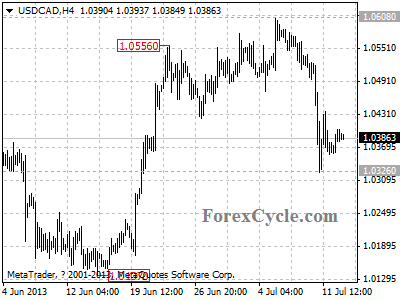
USDCAD remains in downtrend from 1.0608, the rise from 1.0326 is treated as consolidation of the downtrend. Resistance is at 1.0440, as long as this level holds, the downtrend could be expected to resume, and next target would be at 1.0300 area. On the upside, a break above 1.0440 resistance will suggest that the lengthier correction of the downtrend is underway, then the target would be at 1.0480 – 1.0500 area.

usdcad

Provided by ForexCycle.com

EUR/USD – Will The Mighty Jump Survive?

By ForexAbode

EUR/USD had a very strong upward jump during last week when the pair moved up from 1.2755 to 1.3207 i.e. 452 pips in a matter of a single day. This move broke above the 200-day moving average resistance but could not sustain and the price action fell below this resistance once again.

EUR/USD and 200-day moving average

As we see that a decisive break over 1.3121 is needed once again to indicate that this resistance has been overcome.

Not only the 200-day moving average but we may need to keep an eye on the daily Ichimoku cloud also. The last week’s resistance also came just below the upper edge level of the daily Ichimoku cloud. Please note that the price action is no more within the cloud but fell below the cloud once again.

EUR/USD with daily Ichimoku cloud

While the above chart indicates that any decisive break over 1.3230 will be the end of this resistance but the story does not end there. Quite interestingly the resistance was also below the weekly Ichimoku cloud and till a break of 1.3300 resistance takes place we need to consider any upward gains just as a consolidation and not reversal of any kind.

EUR/USD with weekly Ichimoku cloud

Connect to the Author at Google +Himanshu Jain or at ForexAbode.com.


EURUSD Was Not Yet Ready for…

Article by Investazor.com

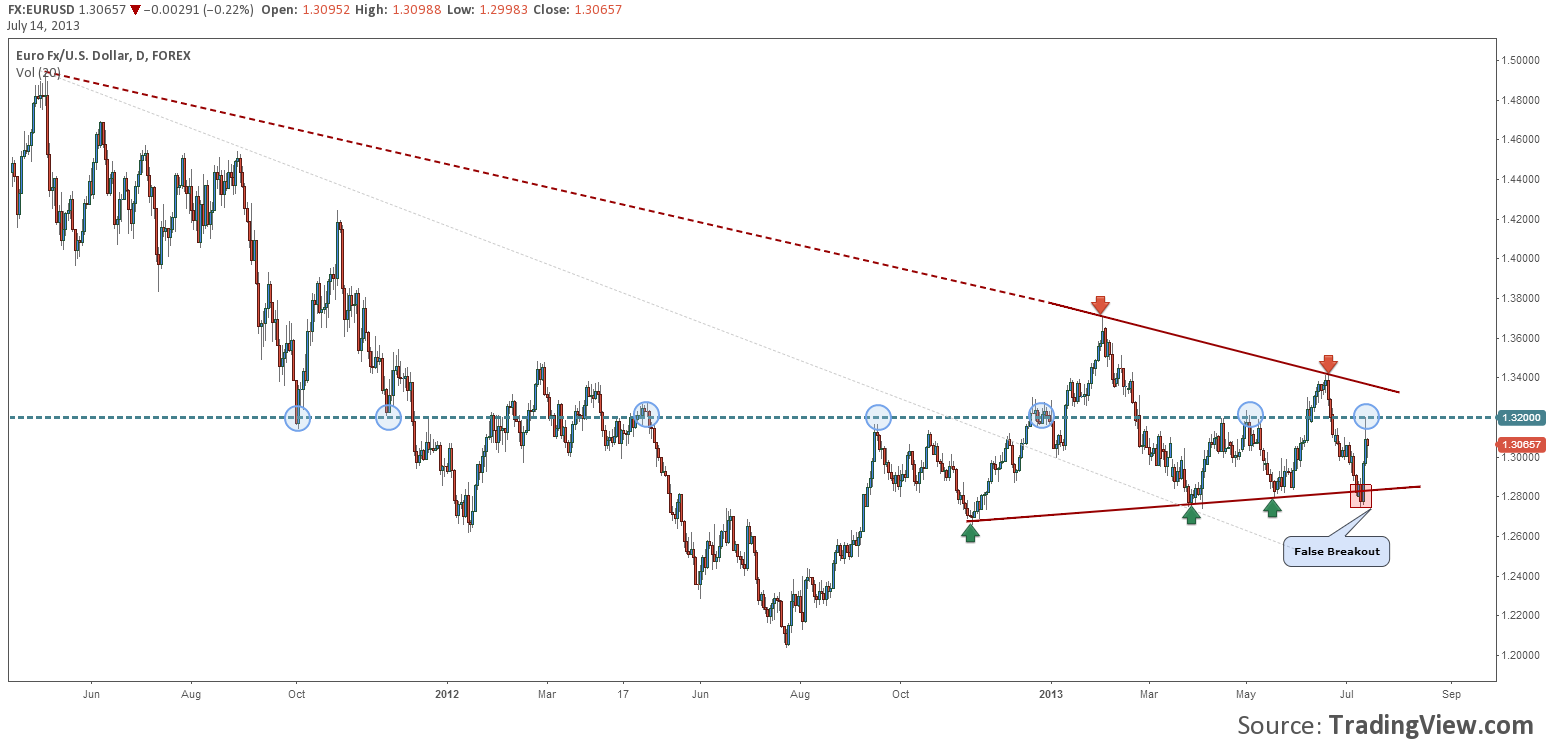
In the first week of June, Mario Draghi said that ECB will keep the interest rates at record low for an extended period of time and there are arguments for it to be cut even more. In the same week, on Friday the Non-Farm Payrolls surprised the market with a value above all forecasts. The dollar got stronger and stronger, managing to get the EURUSD quotation under 1.2800.

The story does not end here. Last week, the second week of the month, were published the FOMC Meeting Minutes and Ben Bernanke had a speech titled “A Century of US Central Banking: Goals, Frameworks, and Accountability”. Investors were disappointed to see that, in the minutes, there was no date from which Fed will start tapering the monetary easing program. The full attention was moved to Ben’s speech, but nothing was said about any dates. This time the dollar started to lose and in several hours EURUSD got back over 300 pips.

Next week Ben Bernanke will testify on the Semiannual Monetary Policy Report before the House Financial Services Committee, in Washington DC

eurusd-was-not-ready-for-a-breakout-14.07.2013

Chart: EURUSD, Daily

Looking at the price action of EURUSD we can say that it wasn’t ready to break out from the consolidation pattern, which is actually a symmetrical triangle.  The lower boundary is around 1.28 level while the upper one sits at 1.34. The main axis, as it can be seen on the chart, is 1.3200. This level seems to be the equilibrium one.

If the price breaks above 1.32 we can expect for it to test the upper line of the triangle, while if it drops or remains under the pressure rises on the lower line of the pattern.  This currency pair will remain sensible to the economic data published from the United States and will the volatility will increase during the speeches of Mario Draghi and Ben Bernanke.

The post EURUSD Was Not Yet Ready for… appeared first on investazor.com.