WTI crude futures drop as oil stockpiles shrink

By HY Markets Forex Blog

The West Texas Intermediate crude futures were seen in red on Tuesday, while the markets were expecting the US crude stockpiles to be released by the American Petroleum Institute (API) later today and another report by the Energy Information Administration (EIA). Investors were also expecting oil inventories to decrease for the third week.

The fall in the WTI crude futures was due to the weak US retail sales data which knocked down the US dollar, sending the crude prices down..

The WTI futures are still high regardless, with help from the high demand in the Northern Hemisphere as the market fears the political turmoil in Egypt is affecting the overall trend.

WTI crude oil futures dropped by 0.20% to $106.11 at the time of writing, while the Brent futures lowered 0.29% to $108.78 at the same time.

The markets continue to raise concerns regarding the futures for the US monetary policy, as a recent released data showed that the US economy is improving and may lead to the Federal Reserve slowing down the asset-buying program, which may push the US dollar higher.

Over the past two weeks, the US oil inventories have decreased by over 20 million barrels, according to the Energy Information Administration (EIA). Investors are expecting the US oil stockpiles to drop.

According to data released from the Chinese National Bureau of Statistics, China processed an estimated 40% or crude in the first half of the year, with a total of 236.79 million metric tons of crude oil.

The post WTI crude futures drop as oil stockpiles shrink appeared first on | HY Markets Official blog.

Article provided by HY Markets Forex Blog

Europe stock falls ahead of German ZEW

By HY Markets Forex Blog

The European market were seen in red  on Tuesday ahead of Germany’s investor confidence report , as investors predicts the report to show an improvement of up to 40 points from the previous record of 38.5 point . An increase in the current situation index is expected to show, up from 8.6 to 9 points.

The European Stoxx 50 dropped 0.72% lower to 2,667.44 as of 8:05am GMT, while the French CAC 40 fell 0.66% to 3,852.90 at the same time. The German’s DAX declined 0.61% to 8,184.87, with the UK’s FTSE 100 losing 0.17% to 6,575.30.

The Spain government its set to auction Treasury bills maturing in 189 and 364 days, with an aim to raise four billion euros.

According to reports from the National Institute for statistics, the government in Italy’s trade balance for the month of May is posting 3.9 billion euros, increased from previous month record of 2.03 billion.

The Euro zone’s ZEW economic sentiment is expected to increase from previous record of 30.6 to 31.8 in July.

The consumer Price Index (CPI) for the euro zone as a whole for the month of June is expected to show a 0.1% rise on a month-to-month basis.

The post Europe stock falls ahead of German ZEW appeared first on | HY Markets Official blog.

Article provided by HY Markets Forex Blog

Central Bank News Link List – Jul 16, 2013: RBA says rate appropriate after Aussie drop; currency gains

By www.CentralBankNews.info Here’s today’s Central Bank News’ link list, click through if you missed the previous link list. The list comprises news about central banks that is not covered by Central Bank News. The list is updated during the day with the latest developments so readers don’t miss any important news.

Why Resources and Mining Stocks Could Be Your Trade of a Lifetime

By MoneyMorning.com.au

If Ringo Starr walked into your office, you’d think you’d recognise him, wouldn’t you?

After all, he had one of the most distinctive voices in the Beatles, the All-Starr Band, and not to mention as narrator of Thomas the Tank Engine.

And so it was, one sunny day in 1999 in Cranleigh, England, one of my musical idols walked in…and I totally failed to recognise him.

I’d like to blame this lapse on three things: his sizeable beard, some heavy-duty sunglasses, and most importantly, the fact that Ringo Starr walking into the joint was the last thing in the world I had expected! I mean… seriously, how often does that kind of thing happen?

Anyway we got chatting away quite amicably. Firstly about Liverpool as his ‘scouse’ accent was clear as day, and I had lived there for a few years in the recent past.

Back in my Liverpool days my house had been on Greenbank Lane, which I asked Ringo if he knew. I explained helpfully that ‘…it was near Penny Lane, if you’re familiar with that’?

I wondered why he thought that was so funny, but ploughed on none the wiser. Then I asked what he did. ‘Oh you’re a musician, that’s cool’ I replied, following with ‘…are you in a band’?

He was eyeing the door by this point, so I finished off by telling Ringo that I played the guitar a bit. Then sealing my embarrassment forever, told him that ‘…I’m up for a jam if you’re free some time.’

As he left in hysterics, the whole office burst into laughter too, and finally the penny dropped for me. And as you can imagine…the fact I totally failed to recognise a major celebrity has gone down forever in family folklore.

Anyway, where am I going with this tale, you ask?

Well, today’s question is…am I about to do something similar?

Only this time am I staring into the eyes of the best opportunity in mining stocks that I’ll ever see, but just not seeing it…?

Here’s why.

Mining stocks have been falling for thirty months now, and the falls we’ve seen have been so severe, that like Ringo Starr walking into your office, a resources rally is just about the last thing you expect to see.

Since early 2011, the metals and mining index is down 50%, and the small resources index is down by more like 80%. Morale out there is the lowest I can recall.

But here’s the thing: nothing can fall forever.

In fact, the contrarian investors’ handbook tells you that this is the time to buy: when the sector is on its knees, prices are at structural lows, and no one wants to know about it. Put another way, you should buy when no-one else is buying.

After all, the lower the sector goes, the closer it is to the bottom. But spotting the bottom is the trick. And for now, institutional investors and punters alike are still throwing in the towel and heading for the door, particularly as China continues to slow.

In fact the market heard from China yesterday, with the growth rate for the second quarter. There had been some earlier panic thinking it could come in between 6.5% to 7.0%, as one Chinese official fluffed his lines in a speech to that effect.

The official figure proved this was a storm in a teacup, as it came in at 7.5%.

And when you step back at look at how China has slowed down in the last three years, the fall from 11.9% to 7.5% is hard to miss.

Chinese Growth – Heading Back Down Again


Source: forexfactory

My old mate and colleague, Greg Canavan, Editor of Sound Money, Sound Investments, has been calling for China’s wheels to fall off for some time. The reason being that he expects the immense credit splurge to catch up with China soon.

The big spike in China’s interest rates recently is exactly the kind of warning sign he has expected. His argument is gathering momentum, and his latest report is well worth a read.

The truth is, after starting the year quite bullish on China, I have to concede the data has since gone the other way, especially over the last few months.

With falling PMI’s (Purchasing Managers Indices), the recent interbank credit scare, and some dodgy import data last week, the pieces were all in place for yesterday’s uninspiring economic growth figure. More China anxiety is part of the reason why resources could be in for another rough patch before things swing the other way.

I know this old bull is sounding bearish, but after thirty months of falls, if we see another rough patch, then it could be the last. And in the midst of all the bearishness, a few voices are starting to break rank and forecast better times for commodities.

Take for instance a recent report from JPMorgan, ‘Ten reasons to start getting bullish on commodities’.

In a number of commodities, prices have fallen far enough for long enough to force involuntary cuts in production and to spur fresh demand… Risk is now skewed toward demand growth surprise and production disappointment. Our analysis concludes that it is in the best interests of most commodity index investors to buy immediately.

In the report, JPMorgan were more bullish on energy, which makes sense when there is a new tide of trouble in the Middle East. I wrote about this bullish picture for oil in Money Morning last week. JPMorgan weren’t so hot on precious metals.

But JPMorgan aren’t the only ones. Merrill Lynch liked the look of beaten up mining stocks after this two-year bear market. Its analysts say, ‘contrarians start your engines’. And local funds like EMR Capital are getting ready for the next resources rally as well, expecting the new Chinese government to step in later this year.

However, it will take far more of these brave voices to turn the resource market around. But if they’re right, history has shown again and again that this has been the way to make life-changing gains.

Of course it takes a great deal of courage, patience, and risk capital (punting money), but if you get it right…being the earliest person in a trade that ultimately goes the right way is often a life changing experience.

Dr Alex Cowie+
Editor, Diggers & Drillers

Join Money Morning on Google+

From the Port Phillip Publishing Library

Special Report: The Sixth Revolution

Daily Reckoning: Why You Should Back Your Own Personal Gold Standard

Money Morning: Money Weekend’s Technology FutureWatch 13 July 2013

Pursuit of Happiness: Make Sure You’re Not a Property Investing ‘Loser’

Asteroid Mining and the Commercialisation of Space

By MoneyMorning.com.au

A key person we’ve spoken to recently is involved in an industry at the cutting edge of human capability. If successful, this particular industry will turn the world on its head. It could open up amazing new opportunities for job creation and wealth creation over the next five to ten years and beyond.

It’s part of the trend we’ve written about in Revolutionary Tech Investorthe Commercialisation of Space.

More specifically we spoke with Mark Sonter from Deep Space Industries (DSI) about Asteroid Mining.

The Director of Mining and Processing for DSI, Mark has been involved in the study and development of Asteroid mining for over 25 years. (And here you were thinking the concept of Asteroid mining was new!)

In the mid-1990′s Mark got involved with some of the brightest minds in space research. One of those was Professor John S Lewis. He’s one of the world’s experts on the composition and chemistry of asteroids.

During this time Mark developed a thesis on the Technical and Economic Feasibility of Mining ‘Near Earth Asteroids’. Upon the development of his thesis Mark received a call from Rick Tumlinson, (one of Space News magazine’s 100 most influential people in the space industry) wanting to fund his research.

After ongoing research into the possibility of mining asteroids, in mid-2011 a group including Mark and Rick decided to incorporate a company.

Barrack Obama had just outlined a new vision for NASA which assisted their vision. This included sending astronauts to nearby asteroids and encouraging the commercialisation of space.

However, one of the group members came to the conclusion that perhaps the answer wasn’t sending astronauts to an asteroid but bringing a small asteroid to the astronauts.

Maybe it would be easier, and safer, to bring an asteroid into high-earth orbit and investigate it there. (High-earth orbit is an orbit above where typical communications satellites sit at 36,000kms.)

They spent about six months ‘brain-bashing’ how they might do it. It became clear to them you can take an ordinary com-sat (communications satellite) design, put in a bigger fuel tank, take out the antenna and put in something to ‘grab’ or ‘net’ the asteroid.

And if you can pick one small enough (as Mark said about the size of a small house, truck or car) and grab it, you’ve got enough capability to bring it back to high earth orbit.

Mark explained the technical aspect isn’t that daunting once people get past the ‘giggle-factor’. Importantly the abilities we have now mean this could be possible today if the funding was there.

With the group gaining momentum and the idea quickly coming to early reality they attended a workshop at California Institute of Technology (Caltech) in October 2011. It was here they came across a team from Planetary Resources (PR). (PR is another company looking at mining asteroids.)

Whereas the group Mark was involved in had a small team of about five at the time, PR had a full squad of about 30 with greater resources, and more financial backing.

Interestingly, with greater resources PR had come to the same conclusion. As Mark put it, ‘it was a convergence.’

Mark’s group submitted an abstract at an American Institute of Aeronautics and Astronautics conference and at the International Space Development conference in May 2012. Their aim was to present and seek to show they had clearly and independently arrived at the same conclusions of the CalTech study.

It was at this time Rick Tumlinson approached again with David Gump and Rick Kirby. This time to discuss how to get a space industry company up and going. This was the birth of Deep Space Industries (DSI). It officially launched as an asteroid mining company in January 2013.

The next steps involve sending a small probe into space to do a fly-by and reconnaissance of an asteroid. After that, the plan is to send a probe to rendezvous with an asteroid, take samples and return to earth.

Obviously the big picture goal is to identify asteroids, land on them, mine and process the materials. Then to use that material for in-space industry and to ferry the resources back to earth.

However, as Mark highlighted asteroid mining has the potential to really get traction when the ‘in-space’ market develops. By that we mean as commercial activities increase (space tourism, space stations, and scientific expeditions) there will be a greater need for in-space materials and propellants.

Any commercial entity building things like space stations (such as Bigelow Aerospace) will have a need for construction materials, propellants and metals. That’s the kind of activity that needs companies like DSI to provide them with supplies.

Until that happens though its likely asteroid mining will be a very niche market. That’s not to say it won’t happen. It’s just that the economics of processing and mining these resources is difficult to do when you have to bring them back to earth all the time.

What excites us is the in-space industry is evolving at a great pace.

That means the timeframes for this to become a reality will be much sooner than people realise. The technical aspect of it isn’t all that hard. It’s about making sure the right business plan, the right team and the right ideas come together to make it happen.

Thanks to companies like DSI we’re confident asteroid mining will happen. And at the right time it will open up a new world of opportunity for investors too.

Sam Volkering+
Technology Analyst, Revolutionary Tech Investor

Ed note: The commercialisation of space is just one of the things Sam Volkering and Kris Sayce are exploring in Revolutionary Tech Investor. It’s part of the trend Sam and Kris have identified as the ‘Sixth Revolution’ in human history, and there are a remarkable number of companies looking to exploit it. You can check out more details in this special feature presentation here

From the Archives…

Quantam Computers – Why It’s Time to Believe the Unbelievable
12-07-2013 – Sam Volkering

Red Alert: Why This Stock Market Rally is a Trap
11-07-2013 – Murray Dawes

Why Oil Could be the One Commodity to Defy the Doom…
10-07-2013 – Dr Alex Cowie

Gold Breaks A Record
9-07-2013 – Dr Alex Cowie

Time to Plan for the Year-End Stock Rally?
8-07-2013 – Kris Sayce

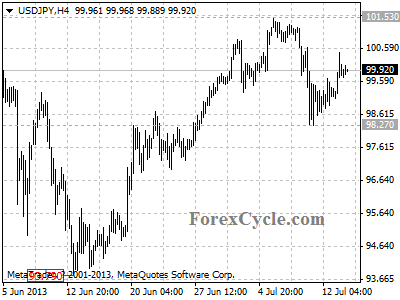
USDJPY broke above 100.00 resistance

USDJPY broke above 100.00 resistance and reaches as high as 100.48, suggesting that the downward movement from 101.53 had completed. Further rise to test 101.53 resistance could be expected in a couple of days, a break above this level will indicate that the uptrend from 93.79 has resume, then the following upward movement could bring price to 110.00 area. On the downside, as long as 101.53 resistance holds, the rise from 98.27 would possibly be correction of the downtrend from 101.53, one more fall to 95.00 to compete the downward move is still possible.

usdjpy

Provided by ForexCycle.com

The Arabic World, Nuclear Discussions?

Article by Investazor.com

One month ago, Hassan Rowhani was elected president in Iran raising hopes for the beginning of a more stable and peaceful period. A clarification concerning the nuclear dispute with the West represented one of the main expectations. Today, Iran comes again to the attention of the world, being suspected about never interrupting its nuclear program, even more, developing it at considerable proportions. The doubts were given by the weak collaboration of Iran with IAEA (International Atomic Energy Agency).

Israel is threatening to step in, without waiting for a possible intervention of the U.S., understanding the risks to which it is subject. The third actor of the Arabic world, Saudi Arabia, is perceiving both Iran and Israel as possible dangers. In this regard, it is suspected to prepare a military attack over the two countries. The Arab states are trying to prevent each other from building nuclear weapons. This not only that would start a new trend concerning the acquisition of weapons among the Arabic countries, but it would also increase the risk of a nuclear war that would be devastating for the entire planet.

The post The Arabic World, Nuclear Discussions? appeared first on investazor.com.

The Turkcell Fiasco: What Can We Learn?

By The Sizemore Letter

It’s been a long couple of years, but the three-ring circus that is Turkcell’s ($TKC) boardroom power struggle is finally (sort of) coming to an end.

Queen Elizabeth’s Privy Council—which had jurisdiction because the holding company in question was domiciled in the British Virgin Islands (LONG story there…)—ruled last week that Mehmet Karamehmet may reacquire control of the company if he pays the $1.56 billion owed to a Russian-backed investor group.  This little spat dates back to the 2007 default on a loan in which the Turkcell shares were used as collateral.

Turkcell’s board of directors has been paralyzed by this squabble between its two biggest shareholder groups to the point that it hasn’t paid a dividend since 2010.  The company never actually cut its dividend, mind you.  Turkcell’s underlying operations have chugged along just fine, and it has plenty of cash available.  The dividend hasn’t been paid because the board of directors is so dysfunctional, they can’t sit in a room together long enough to declare it.

But while Mr. Karamehmet is busily getting the funds together to repay the debt,  the story doesn’t end here.  To start, Karamehmet was recently sentenced to seven years in Turkish prison due to completely unrelated charges dating back to the financial crisis of 2000-2001.  And even with the shift in controlling ownership, the board is still deadlocked…at least pending intervention by the Turkish government.  Turkish regulators have promised to appoint new directors and effectively take over control of the company to break the impasse.

While this story may have comedic value, there are actually some valuable lessons we can learn.

In InvestorPlace’s Best Stocks of 2012 contest, I came within a single percentage point of winning with my selection of Turkcell—which returned 37% on the year.  A major plank in my bullish argument was that a resolution of the boardroom crisis—which I expected in early 2012, over a year too soon—would mean a major short-term boost to the share price and the possibility of a massive, multi-year dividend payment.

I was dead wrong about that.  Yet Turkcell still had a great year.  Why?

It comes back to that old concept of margin of safety—or what Warren Buffett and Charlie Munger playfully call a “belt and suspenders” approach.  If an investment is strong enough and offers enough value, you can afford for large parts of your investment thesis to be wrong or for some unexpected bump in the road to happen.  If the belt fails, the suspenders will keep your pants from falling down.

Turkcell’s corporate governance at the board level was a joke.  But operationally, its management team was led by top-notch, Western-educated professionals.   Turkcell had (and still has) a dominant position in a critical industry in one of the fastest-growing emerging markets, and is a major player across Eastern Europe and the Middle East.  And the company consistently ranks as one of the highest-quality telecom providers in Europe—meaning it compares favorably with international giants like Spain’s Telefonica ($TEF) and Britain’s Vodafone ($VOD).

Furthermore, Turkey was an underrated emerging market at the time.  In early 2012, “emerging markets” meant the “BRIC” countries of Brazil, Russia, India and China.  But as that investment theme was looking a little long in the tooth to me, I expected investors to expand into lesser-followed markets like Turkey.  And until the recent Taksim Square political crisis, that is exactly what happened.

I expected a quick (ha!) resolution of the boardroom crisis to be the catalyst that caught investors’ attention but that the great underlying fundamentals would be what ultimately drove the stock higher.  I was wrong about the catalyst…but in the end, it didn’t matter.  Often, a quality stock trading at an attractive price creates its own catalyst.

DDAIF

My choice in InvestorPlace’s 2013 Best Stocks contest is German automaker Daimler ($DDAIF).  And again, it looks like I am wrong about the catalyst (strong Chinese growth) but right about the stock.

China’s growth continues to slow—and Europe is in outright recession—yet Daimler has cruised to 27% returns year to date, including dividends.

When I first recommended Daimler, a third of its market cap was in cash and it traded at a single-digit price earnings ratio.  At its then-current valuation, it was hard for me to imagine a scenario whereby I could lose money in Daimler over any reasonable time horizon.

Again, a quality stock trading at an attractive price has proved to be catalyst enough.

Sizemore Capital is long TEF and DDAIF.

SUBSCRIBE to Sizemore Insights via e-mail today.

Why Great Stocks Drop Hard and Reverse

By David Banister – Chief Strategist- ActiveTradingPartners.com

Institutional sell programs and bots cause disruptions:

One thing that will always over rule charts and technical analysis is fundamentals in the long run.  To be sure, I love technical analysis but I always combine my work there with fundamental research. I rarely if ever buy a stock just because the chart looks nice, that is almost always a recipe for disaster.

With that said, how many times have you seen a good company with strong fundamentals and a seemingly great looking chart break down over 1-2 weeks and take everyone out of the trade?  Then for sure, the stock reverses right back up all the way back to where the decline began?  To make matters worse, this happens without any real news or any bad news as it were.  What is it that causes these crazy down the mountain and up the mountain moves anyways?

Insitutional Sell Programs— sometimes referred to as “Bots” or “Algo” program trading

How does it work?

In an apparently strong fundamental growth stock with no apparent issues, an institution will have a pre-defined price at which point instructions are triggered to liquidate the entire position almost at any price once that price point is hit. They protect themselves ahead of time with Puts, which give them profits if the targeted stock drops hard while they are selling out of the position, thereby locking in their targeted sell price.

Lets take several examples below with 3 month charts to show you exactly how they look on paper. If you can learn to spot these moves you will be more likely to add to positions on big declines rather than selling out at a loss as all the stops trigger along with the margin calls:

The stocks we will chart out here are AMBA, DATA, DECK, and GILD.  All strong companies with good growth profiles:


715 amba


715 data


715 deck


715 gild


So what have we learned?  In a Bull cycle buy the dips on the stronger fundamental stories when the Algo and Institutional programs start kicking in.  Don’t panic out of your position at a loss, study the fundamentals and trust your instinct.

Join us at ActiveTradingPartners.com as we take advantage of exactly these types of swings all the time. Learn more at www.activetradingpartners.com


Continuous Commodity Index Points to Rally in Gold & Silver

By Chris Vermeulen, GoldAndOilGuy.com

During the recent weeks we have seen commodities especially precious metals continue to drop in value. Market participant sentiment has become more bearish on commodities and couple that with a rising dollar it’s no wonder why we continue to see commodities as a whole fall in value.

Money has been flowing out of bonds at record levels this summer telling us most of market participants are feeling bullish on the stock market. This shift in sentiment of the masses are typical as they move their money from the risk on safer assets (bonds & commodities) and rotate into risk-on assets like stocks. While this is a bearish (contrarian sign) stocks could easily continue to rally for an extended period of time and possibly several more months before they actually top out.


Let’s take a look at the financial market business cycle diagram:

Bond prices have been falling for months and they typically lead the stock market lower. I feel we are starting to enter the phase where stocks will soon top and head lower also. Once this starts money will naturally flow into safer assets that are more tangible like commodities.

Keep in mind this cycle is very slow moving and rotation from one phase to another takes months. This is a process not an event but it is still very tradable.

JMCycle


Now let’s fast forward to precious metals both gold and silver are likely to do in the next couple months. If you review the charts below you will see gold and silver bullion prices are looking primed for a bounce/rally from these deep oversold levels.


Gold Weekly Price

gold


Silver Weekly Price

sil;ver

Take a look at a basket of commodities through the GCC ETF.

GreenHaven Continuous Commodity Index Fund (GCC) is an Exchange-Traded Fund (ETF) that provides an innovative and efficient way to deliver broad based, diversified commodity exposure. It aims to achieve this by using futures contracts to track the Thomson Reuters Equal Weight Continuous Commodity Total Return Index (CCI). The CCI-TR is an equal weighted index of 17 commodities plus an additional Treasury Bill yield. Because of the equal weighting, GCC offers significant exposure to grains, livestock, and soft commodities and a lower energy weighting than many of its peers. In addition, GCC is rebalanced every day in order to maintain each commodity’s weight as close to 1/17th of the total as possible.

So, knowing metals are 24% of the index it bodes well for a bounce in the overall commodity index. Keep in mind this report is only focusing on precious metals, but many other commodities look ready to rally also like natural gas.

GCC-H


GCC – Continuous Commodity Index Fund Weekly Trading Chart

The chart below shows a very bullish 4 year chart pattern. At the very minimum a bounce to the $29 is highly.

gcc


Commodity Basket Trading Conclusion:

In short, commodities as a whole remain in a down trend. Until they show signs of real strength I will not be trying to pick a bottom. Several commodities are starting to look oversold and ready for a bounce like sugar, coffee, copper and natural gas.

Last month I talked about how a major market top is likely to unfold during the second half of this year. I still believe this to be true. But keep in mind these major market tops which only happen every few years are a MAJOR PROCESS. They take time to form and often we will see a series of new highs followed by quick sell offs as the market gets more people long as they big money distributes their shares/contracts into the new money rotating into the market.

If you want more reports and trade ideas join me at www.GoldAndOilGuy.com

Chris Vermeulen