The Results Are (Almost) In for Rare Earth Competitors: Alex Knox

Source: Brian Sylvester of The Metals Report (7/16/13)

http://www.theaureport.com/pub/na/15442

Western rare earth companies are in a conditioning period, optimizing on every front to get the leanest capital costs possible. In the next six months, Geologist Alex Knox expects a big shakeout across the rare earth space as companies release amended PEAs and feasibility studies. “That,” says Knox in this interview with The Metals Report, “is when smart investors will be able to look at the numbers and pick out the winners.” Knox helps us jump the gun by identifying companies with lean, mean stats.

The Metals Report: Alex, what is your overview of the rare earth element (REE) space?

Alex Knox: The highlight is that two large deposits of light rare earth elements (LREEs) are coming into production: Molycorp Inc.’s (MCP:NYSE) Mountain Pass and Lynas Corp.’s (LYC:ASX) Mt. Weld deposit. The considerable increase in LREE production has eliminated the need for any market niche for these types of deposits, at least for the short-term.

I see a dramatic need for development of heavy rare earth element (HREE) deposits in the western world, now that China’s crackdown on illegal mining has presumably cut into its production of HREEs. A number of companies have reached prefeasibility or preliminary economic assessment (PEA), and one already has a feasibility study. Overall, I believe this space offers the most potential growth and the most potential to add new deposits.

TMR: Can investors make money in REEs?

AK: Certainly. On the HREE side, the deposits coming on stream will be profitable. At the present prices of the companies that own these deposits, there is substantial upside. I think the market will pick two or three of these companies and make them the winners in the HREE space.

TMR: Rare earth expert Jack Lifton has written that, “non-Chinese sources of heavy rare earths must now be brought into production under all circumstances. Non-Chinese manufacturing centers and regions need to attain self-sufficiency as soon as possible.” What’s your view?

AK: I totally agree. The Chinese will protect their low-cost resources, the South China ionic clays. End users operating outside of China will need to secure supplies elsewhere. There is a good market opportunity for companies that can get these deposits to market in a profitable state.

TMR: Yet in 2012, half of China’s export quota on REEs wasn’t used. The 2013 quota is 5 tons higher than 2012. Doesn’t that suggest there is less demand?

AK: Again, there is a distinction between LREEs and HREEs. Given China’s crackdown on illegal mining and illegal export of HREEs, those exports are volumetrically small compared to the LREEs. There is not a lot of tonnage, but there is high value. The tonnage mainly comes from the LREEs.

The fact that the overall quota has risen doesn’t mean that the output of HREEs will increase. I believe the supply of HREEs from China may actually decrease, while the overall quota for all REEs increases.

TMR: Can illegal Chinese exports meet the world’s supply needs for HREEs?

AK: The South China clays are a finite resource. They lack vertical extent. Some are only 10 meters thick and are often fairly low grade. To extract significant quantities requires immense surface disturbance because you have to strip off a lot of land to take out the top 10 or so meters. This surface destruction is unsustainable. The Chinese recognize that and are trying to eliminate illegal mining to save these resources for themselves.

TMR: Lifton noted that, even if non-Chinese HREE costs become level or lower than prices in China, the cost of building new separation and alloy-making facilities would be in the billions. He argues that the problem can be solved by “central, regionally deployed tolling facilities for separation.” How likely is that?

AK: These facilities are expensive to build. Also, the expertise to design and run them is very thin on the ground. The facilities largely depend on Chinese technology or Chinese expertise. For a western company to build its own rare earth separation plant seems to me inefficient.

One would hope that companies could agree to reduce their individual capital costs by creating a central, large-volume, efficient and well-managed separation plant as Lifton suggests. However, these companies are competitors. One wonders whether they could collaborate to bring this vision into reality.

TMR: Could a company with deep pockets and expertise take that on?

AK: It’s a bit of a chicken-and-egg situation. A company would have to have secure sources of supply for a proposed processing plant before it had the economic justification to build it.

TMR: If there were steady supplies of REEs, especially HREEs, would manufacturers start changing the way they build high-tech devices, such as cars and lighting systems?

AK: This is another chicken-and-egg situation. Lack of reliable supplies of, say, dysprosium, terbium or lutetium inhibits research into their uses. As deposits come on stream and the supply becomes stable and predictable, people will do more research and find uses for these elements.

There are certain HREEs—holmium and lutetium, to name a couple—for which there are almost no known uses because the supply is virtually zero. If supplies could be found, people would research how to use them and they would gain in value.

TMR: Could governments get involved in building regional facilities or backing loans for their construction?

AK: The U.S. government might do it, because it takes a more strategic view of things. Some of these HREEs have military applications, and a secure source might be desirable. This might be an advantage to a company like Ucore Rare Metals Inc. (UCU:TSX.V; UURAF:OTCQX) whose HREE deposit is in the U.S. There are a number of HREE deposits in Québec, so the Québec government might fund something or offer tax advantages to the Québec producers to secure a supply.

TMR: The Tech Metals Research Advanced Rare-Earth Projects Index identifies 56 advanced-stage REE projects and almost that many companies. How many of these companies do you reckon will develop their projects into mines in the next 6 to 10 years?

AK: The REE space is microscopic compared to other metals markets. Market capacity can be satisfied by a handful of REE deposits coming into production. On the LREE side, many would argue that demand has already been more than met by the Mt. Weld and Mountain Pass deposits. There may be room for one or two more if they’re very cost effective. On the HREE side, four or five deposits might saturate the market. Out of that list of 56, I suspect no more than 10 would find the market share to get into production. Anybody who enters the market after that will have to compete on price and knock out existing producers.

TMR: What’s the name of the game now in this space? Part of the game has to be financing, but what else?

AK: Metallurgy. In many cases, the metallurgy is based on assumptions that may no longer be valid. Some of these companies have been working on the metallurgy of their deposits since 2009.

Looking at the HREE space, only Avalon Rare Metals Inc. (AVL:TSX; AVL:NYSE; AVARF:OTCQX) has done a feasibility study. That’s on its Nechalacho deposit up in the Northwest Territories.

Another half dozen or so companies have released a PEA or are close to it and are working toward a feasibility study. Of note would be Tasman Metals Ltd. (TSM:TSX.V; TAS:NYSE.MKT; TASXF:OTCPK; T61:FSE) and Ucore. Matamec Explorations Inc. (MAT:TSX.V; MRHEF:OTCQX) plans to release a feasability study this month. Search Minerals Inc. (SMY:TSX.V) has a PEA out on its Fox River deposit in Labrador.

Since 2009, some companies have changed their processes to take advantage of advances in filtration technology. For example, Ucore has apparently completed successful trials on using X-ray technology to concentrate its ore and reject 50% of the material with virtually no loss of rare earths.

It’s important to use the metallurgy to extract as much of the REES as you can and coproduce the byproducts that will add value to the bottom line. The more money you’ve got coming out of your process the better. For example, Quest Rare Minerals Ltd. (QRM:TSX; QRM:NYSE.MKT) recently announced a preliminary understanding with a ceramics company to buy Quest’s zirconium offtake at the Strange Lake deposit.

TMR: Does that materially add to the economics for Strange Lake?

AK: I think it does. We don’t yet know what price Quest is getting. The supply of high-purity zirconium that can be used in ceramics is limited. Most zirconium is produced as zircon concentrate and is made into paint. This is another example of uses being found for elements as the supply increase and becomes reliable.

TMR: Will other companies follow Quest’s lead regarding byproducts?

AK: I would hope so. Granite-based HREE deposits can be quite treasure troves of other minerals: niobium, tantalum, uranium, even thorium. There are lots of little cash registers in these deposits. If they can be extracted and marketed profitably, they could add substantially to the revenue from the same amount of ore. That is nothing but great for the bottom line.

The idea of thorium reactors is getting a lot of play in the nuclear industry. To date, byproduct thorium has been a detriment. If it could be sold for use in a thorium reactor, it would be a real benefit.

TMR: If you were an investor with $100 million ($100M) to invest in the REE space, how would you deploy it among those equities and what company characteristics would you look for?

AK: I would certainly go toward the HREEs or look for an LREE producer with significant byproduct credits to ensure another revenue source.

Looking at the five principal deposits, Avalon and Quest are high-grade, but rather remote. Tasman is bigger than Ucore and Matamec. Ucore is right on tide water. Matamec has an ideal location and the metallurgy is good, but to fund the feasibility study, the company gave away half of the deposit in an offtake agreement.

There are substantial opportunities in the sector once you we see who has the upper hand in terms of metallurgy and who can keep costs down and revenues up. The prices of the HREE producers are so depressed now that the companies—maybe as many as three of them—that get into production will be profitable investments in the long run.

TMR: You plan to do some work in Québec this summer. Tell us about that.

AK: Commerce Resources Corp. (CCE:TSX.V; D7H:FSE; CMRZF:OTCQX) has a large carbonatite-hosted deposit in the Labrador Trough in northern Québec. The company is doing a low-cost drilling program this summer to upgrade its resources.

This carbonatite deposit contains substantial, separate showings of high-grade niobium and tantalum. The property could produce both elements from the same carbonatite, thus getting byproduct credits in through the back door. Even though this is an LREE deposit, it has zones enriched in the mediums and heavies. The potential production of niobium, tantalum and even other minerals makes this an attractive carbonatite deposit. My role this summer will be to help Commerce Resources explore and to work on the niobium and tantalum zones.

TMR: Orbite Aluminae Inc. (ORT:TSX; EORBF:OTXQX) is another Québec-based company you have worked with, yes?

AK: I helped Orbite with the REE part of its PEA last year. As I became familiar with the Orbite process, I realized it would have great potential for the metallurgical extraction of non-carbonatite-type, REE-bearing ores.

Most of the ore minerals in REE deposits are silicate minerals. Presently, producers bake the silicates with sulfuric acid to fix the silica, which affects the recoveries. The sulfuric acid bake also can consume large amounts of reagent.

Orbite developed a process to break down the silicate minerals and filter off the silica more effectively, making it possible to extract many or all of the byproducts, not just the REEs. Plus, the acid can be recycled.

Orbite is using its process to extract alumina, scandium and gallium from its deposit. If Orbite has actually solved the silicate mineral problem, its process could be used to extract REES in a very purified form that would be imminently suitable for separation technology. It would dramatically reduce the operating costs for all granite-based HREE deposits.

TMR: The Orbite process is used primarily to recover alumina from bauxite. Does that make Orbite a technology play or an aluminum play?

AK: In the short term, Orbite intends to make money from extracting aluminum from any aluminum-bearing rock, not just bauxite. That includes shale, red mud or fly ash, anything that doesn’t have high carbonate content.

The potential for crossover into extracting REEs and other elements is a satellite to the main aluminum play. Orbite’s ore contains 500 parts per million rare earth oxides, which the company has proved on a bench scale can be concentrated and extracted even at low levels as a byproduct of aluminum extraction. The technology seems to be applicable outside of the aluminum space and could, in the future, provide another source of revenue for Orbite.

TMR: Of the top-tier, advanced-stage rare earth projects, which deposits would be most amenable to Orbite’s processing technology?

AK: Tasman and Matamec’s deposits both have eudialyte, which is extremely acid soluble. It dissolves in vinegar at room temperature. These would be the ideal. The process also would be useful to Quest and Ucore. In fact, all of the granite-type, non-carbonate REE deposits could potentially benefit.

TMR: Are other companies developing similar recovery technologies?

AK: Yes, but not many details have been made public. Matamec intends to finish its feasibility study this month; it should give us a good look at what that company has accomplished. Tasman, with a similar metallurgy, has obtained decent recoveries from its processes.

Quest must be able to extract zirconium from its deposit or the ceramics company wouldn’t be involved there. Ucore has an ore-sorting technology that appears to be applicable and successful in reducing the throughput to the mill with little or no loss of rare earth potential.

TMR: Let’s look at Tasman. The company recently got a mining lease for its Norra Kärr project. Is that meaningful for investors?

AK: To me it is. It means that the Swedish government believes the company can operate safely and control emissions, in a relatively populated area. That is a major hurdle to get over.

TMR: What are the most dramatic changes investors should expect in this space over the next 6 to 10 years?

AK: It is a given that you will start to see major western REE producers. If a consistent supply of rare earths causes a rise in demand, there will be space in the market for additional producers. That may spur exploration.

Exploration for rare earth deposits has been in the doldrums for the last couple of years. Many of the deposits we’ve been talking about are 30–40% HREEs. That leaves a substantial quantity of LREEs that will have to be gotten rid of. Neodymium is easy to sell because there’s a demand. But the deposits will also produce substantial quantities of lanthanum and cerium, which are not in short supply at all.

A couple of recently announced deposits contain ore that more than 90% HREEs. If these get to production, they will be producing exactly what the marketplace wants and none of the stuff that’s in oversupply.

For example, Namibia Rare Earths Inc. (NRE:TSX, NMREF:OTCQX) has a small NI-43-101-compliant resource in Namibia: Measured and Indicated and Inferred of about 2 million tons of a nice, HREE-rich deposit. The company is well financed, with something like $20M in the bank.

TMR: What did you make of Namibia’s recent metallurgical tests?

AK: Namibia’s mineral is called xenotime, a fairly heavy mineral that has the potential to be concentrated by gravity methods. Namibia also has some carbonate in its ore that can be removed by acid dissolution.

TMR: Could the fact that it’s in Namibia be its biggest advantage?

AK: I would suspect the company won’t have as many environmental hoops to jump through and that labor could be less expensive. Compared to the long lead times and permitting processes in North America, that can’t hurt.

TMR: What do you know about Pro-Or Inc.’s (POI:TSX.V) chlorinator recovery technology?

AK: Right now, Pro-Or is targeting the platinum group elements. There is nothing to suggest the company is looking at the rare earth side, but certainly any new recovery technique is worth looking into.

TMR: Do you have a parting thought or two for our readers?

AK: There is very little news in the REE sector now because everybody’s doing their metallurgical testing, their optimization. It’s not a very exciting time in the rare earth space because there’s not much exploration. Companies are hunkered down to boost the value of their products and lower their capital costs.

In the next six months, I expect to see a real shakeout as companies release amended PEAs, prefeasibility studies and feasibility studies across the REE space. That is when smart investors will be able to look at the numbers and pick out the winners. At these depressed prices, there will be substantial profit potential when the winners and losers emerge. This is a good time to keep your eyes open and sharpen your pencil to crunch some numbers.

TMR: Alex, thank you for your time and your insights.

Geologist Alex Knox has been involved in the mineral exploration industry since 1970. He served in the mineral exploration division at Unocal Canada Ltd., the exploration arm of Molycorp, where he was involved in the discovery of the Kipawa deposit in western Quebec. Knox has explored for uranium, gold, rare earths, niobium, diamonds, slate and limestone in Canada, the U.S., Mongolia, Bolivia, Peru and Argentina. Highlights include Matamec’s Kipawa deposit, Commerce Resources’ Eldor and Blue River properties and Quantum Rare Metal’s Elk Creek deposit. Knox is on the REE Advisory Board of three publicly traded Canadian junior mineral exploration companies.

Want to read more Metals Report interviews like this? Sign up for our free e-newsletter, and you’ll learn when new articles have been published. To see a list of recent interviews with industry analysts and commentators, visit our Metals Report <href=”#interviews” target=”_blank”>homepage.

DISCLOSURE:

1) Brian Sylvester conducted this interview for The Metals Report and provides services to The Metals Report as an independent contractor. He or his family own shares of the following companies mentioned in this interview: None.

2) The following companies mentioned in the interview are sponsors of The Metals Report: Commerce Resources Corp., Pro-Or Inc., Namibia Rare Earths Inc., Tasman Metals Inc. and Orbite Aluminae Inc. Streetwise Reports does not accept stock in exchange for its services or as sponsorship payment.

3) Alex Knox: I was not paid by Streetwise Reports for participating in this interview. Comments and opinions expressed are my own comments and opinions. I had the opportunity to review the interview for accuracy as of the date of the interview and am responsible for the content of the interview.

4) Interviews are edited for clarity. Streetwise Reports does not make editorial comments or change experts’ statements without their consent.

5) The interview does not constitute investment advice. Each reader is encouraged to consult with his or her individual financial professional and any action a reader takes as a result of information presented here is his or her own responsibility. By opening this page, each reader accepts and agrees to Streetwise Reports’ terms of use and full legal disclaimer.

6) From time to time, Streetwise Reports LLC and its directors, officers, employees or members of their families, as well as persons interviewed for articles and interviews on the site, may have a long or short position in securities mentioned and may make purchases and/or sales of those securities in the open market or otherwise.

Streetwise – The Gold Report is Copyright © 2013 by Streetwise Reports LLC. All rights are reserved. Streetwise Reports LLC hereby grants an unrestricted license to use or disseminate this copyrighted material (i) only in whole (and always including this disclaimer), but (ii) never in part.

Streetwise Reports LLC does not guarantee the accuracy or thoroughness of the information reported.

Streetwise Reports LLC receives a fee from companies that are listed on the home page in the In This Issue section. Their sponsor pages may be considered advertising for the purposes of 18 U.S.C. 1734.

Participating companies provide the logos used in The Gold Report. These logos are trademarks and are the property of the individual companies.

101 Second St., Suite 110

Petaluma, CA 94952

Tel.: (707) 981-8999

Fax: (707) 981-8998

Email: [email protected]


Part Three: The 3 Essential Parts of an Elliott Wave Trade

Our last piece in this educational series excerpted from Visual Guide to Elliott Wave Trading

By Elliott Wave International

Would you like to improve your ability to trade — not only with a clear understanding of the Elliott Wave Principle, but also by learning how and when to act on your wave count?
According to Senior Analyst Jeffrey Kennedy, there are the three key components of a successful trade.

In this final lesson — adapted from the Visual Guide to Elliott Wave Trading, a No.1 Bestseller on Amazon — Kennedy explains his third step for a high-confidence trade setup in Caterpillar: Manage the Trade (You can read Parts 1 and 2 by clicking below):

  1. Analyze the price charts >>.
  2. Formulate a trading plan >>.
  3. Manage the trade.

————————-

The day following our analysis and entry, CAT fell sharply (see Figure 2.3). As a result, the value of the position increased substantially. In retrospect, it would have been prudent to exit the trade entirely or at least partially the day after the swift decline. However, since the original analysis called for a move below 108.39, I decided to hold the position.

During the next few days, CAT continued lower. On Friday, May 13, 2011, I exited the position for a 336.05 percent return (see Figure 2.4), selling the options that were originally purchased at 86 cents for $3.75 apiece.

The Ultimate Wave Trading Crash CoursePut yourself on the fast track to applying the Elliott Wave Principle successfully with a FREE one-week primer: The Ultimate Wave Trading Crash Course. Learn the basics with 5 FREE trading lessons from EWI Trading Instructor and Senior Analyst Jeffrey Kennedy — including insightful excerpts from his Amazon No. 1 Bestseller, Visual Guide to Elliott Wave Trading.

Learn more and start your crash course now >>

This article was syndicated by Elliott Wave International and was originally published under the headline Part Three: The 3 Essential Parts of an Elliott Wave Trade. EWI is the world’s largest market forecasting firm. Its staff of full-time analysts led by Chartered Market Technician Robert Prechter provides 24-hour-a-day market analysis to institutional and private investors around the world.


Contaminated Water has been Leaking into Ocean for Two Years at Fukushima

By OilPrice.com

Shunichi Tanaka, the head of the Nuclear Regulation Authority in Japan, and the country’s chief nuclear regulator announced on Wednesday, that the nuclear power plant at Fukushima, has been leaking contaminated water into the ocean for the two years since the accident that saw three of the plants six reactors suffer a meltdown.

The problem stems from the fact that ground water is leaking into the basement of the damaged reactors, and becoming contaminated, and whilst that water is being pumped out and stored in huge tanks on site, the inflow has not yet been stopped, meaning that ever more ground water enters the basement and becomes contaminated.

Tanaka explains that neither his staff, nor those working for the plant’s operator have discovered where the leaks are coming from, and therefore have not been able to stop them.

Tokyo Electric Power (Tepco), the power plants operator, has constantly denied that any of that water heas been leaking into the Ocean, but in the last few days it has switched its position and finally admitted that it can’t actually say for sure that the water is not leaking into the sea.

Tepco has also admitted that the amounts of radioactive cesium, tritium, and strontium detected in groundwater around the plant has been growing, making the job of sealing the leaks even more urgent. Cesium and Strontium are especially dangerous to humans.

Tanaka claims that the evidence that the water is reaching the sea is overwhelming. “We’ve seen for a fact that levels of radioactivity in the seawater remain high, and contamination continues — I don’t think anyone can deny that. We must take action as soon as possible.

That said, considering the state of the plant, it’s difficult to find a solution today or tomorrow. That’s probably not satisfactory to many of you. But that’s the reality we face after an accident like this.”

For some time now experts have worried that the plant has been constantly continuing to leak radiated material into the ocean, and these latest announcements have only helped to confirm those suspicions.

By. Joao Peixe of Oilprice.com

Source: http://oilprice.com/Latest-Energy-News/World-News/Contaminated-Water-has-been-Leaking-into-Ocean-for-Two-Years-at-Fukushima.html


A Short Seller’s Investment Guide to Obama’s Climate Change Initiatives

Source: Tom Armistead of The Energy Report (7/16/13)

http://www.theenergyreport.com/pub/na/15435

“Regulation” is a dirty word among most investors, but for speculators like Rodney Stevens, portfolio manager at Wolverton Securities Ltd. and author of The Disciplined Speculator newsletter, state-mandated emissions caps and renewable energy goals present an extraordinary opportunity for growth. In this interview with The Energy Report, Stevens makes a bullish case for solar stocks and offers several names for traders playing offense or defense. But whatever your strategy, Stevens says get the heck out of bonds and into equities.
The Energy Report: What can retail investors learn from the speculator’s perspective and methods?

Rodney Stevens: “Investing” is one of the most misused terms in finance. When you’re an investor, the typical strategy would be to buy cash-cow businesses at low prices and hold them forever, like the Warren Buffett strategy. Most of us don’t have that time horizon. Very few companies actually fit that particular definition of an investment. Our main strategy is to buy speculative companies, but if you apply the Warren Buffett strategy to speculative stocks, that scenario is fraught with danger. But you can speculate with a process that puts the odds in your favor. The first thing to determine is whether you are indeed speculating.

Another approach to stock speculation is to integrate short selling into your strategy. A lot of people view short selling as more risky, but when you combine a long and short portfolio, it actually serves to reduce the overall portfolio risk.

TER: Why do you advise getting out of bonds and into equities?

RS: The U.S. bond market—the treasuries—has recently turned bearish. The cause is the perception of growth in the U.S. economy combined with the potential for Federal Reserve Chairman Ben Bernanke to begin reducing his stimulus. If he does reduce his stimulus, interest rates should rise. A rising interest rate is going to negatively impact bonds. We certainly view those as underperformers going forward.

TER: What conditions would justify a Fed decision to reduce stimulus?

RS: Ben Bernanke has always said that he would reduce stimulus if the economic growth in the U.S. could support that. His key metrics are the unemployment rate and, more important, the inflation rate. So long as Bernanke is supporting U.S. growth, U.S. stocks are the most favorable place to be right now.

TER: Why do you think “offensive” stocks and sectors that include energy will outperform utilities and other “defensive” stocks?

RS: Defensive stocks refer to the bond-like stocks, such as utilities, which might have consistent dividends and marginal growth, but essentially trade like bonds. In the face of rising interest rates, these assets should underperform. The more offensive stocks, which are more impacted by growth in the U.S. economy, can support low rates or small increases in rates, but also have the growth potential to outperform.

TER: How will President Obama’s climate change program affect the solar energy industry?

RS: The key takeaway is that Obama would like to double renewable electricity generation by 2020. This could be beneficial for nuclear energy, which doesn’t have carbon emissions, but I think the prime beneficiary would be the solar space, because right now solar is the cheapest form of green energy to install and maintain. Solar energy, with its lower upfront cost and low energy rates, is positioned to be one of the prime beneficiaries.

TER: You say it has lower costs. Is that in the materials? The construction?

RS: That’s the upfront cost for materials and installation, and those costs are much lower compared to wind power or geothermal. In terms of upfront costs and ongoing costs, solar is in the position to benefit most for political incentives towards clean energy or renewable energy.

TER: Is the solar industry threatened by the low price of natural gas?

RS: Typically, in the past, solar companies’ equities would trade inversely to natural gas, but it’s becoming less of an impact now because the technology in the solar space has improved so significantly that it’s almost economic without government subsidies. The natural gas price, if it declines, can of course result in lower utility costs assuming the utility companies transfer that reduction to the customers.

TER: Can solar thrive if it’s not installed for utility-scale generation?

RS: Yes, it already is thriving. Right now they’re actually competing with the utilities, whereas previously there was no real competition for these companies. Yes, it can and it is happening in a large way now.

TER: What solar companies could thrive in this environment?

RS: The main companies that we’re interested in are SunPower Corp. (SPWR:NASDAQ), SolarCity Corp. (SCTY:NASDAQ) and Real Goods Solar Inc. (RSOL:NASDAQ). SunPower we like because not only does it manufacture the solar panels, but it also has a leasing program for the retail space, similar to SolarCity. SunPower has one of the best products available on the market and it should benefit from the incentives utility companies have to add renewable sources of energy to their business. SunPower could play a big role in the utility space, but also grab the retail markets. It should benefit from the growth in solar and also it has an international base, although its operations are primarily in the U.S.

SolarCity, for example, leases electricity to both retail and institutional customers, but it is focusing on the more profitable retail segment. Its strategy is to provide solar panels at no upfront costs to the customer. It’s a business proposal of, “let us save you money right now at no cost.” The company has put together a maximum market-penetration strategy. It is definitely the most aggressive strategy in the industry and the company is positioned to capture a large market share. Of course, its leasing strategy is fraught with default risk and interest rate risk as it is financing sales, but so far, the company’s business plan has been working and the company is set to grow considerably.

Real Goods Solar simply installs the panels, but it doesn’t finance, as SolarCity does. However, it recently hired new management and has a very competitive product as well. It has been around for a long time and is now on the cusp of turning to profitability and growing sales considerably. I think these three companies are well positioned to benefit from the growth in the solar space, which is probably one of the largest growing sectors in the energy sector.

TER: Why has Real Goods Solar’s stock been so volatile recently?

RS: It’s been volatile recently because it has good liquidity, but not a very large float. The recent move to $7/share was basically due to a positive article on the company. Right now the price has settled down into a more reasonable range of 0.9 times sales and we expect profitability and sales to grow over the next 12 months, which should result in fairly decent performance of the share price.

TER: And SunPower Corp. has rallied from $5/share to $20/share since the beginning of this year. What’s driving that?

RS: I think decent quarterly results drove the stock. Its revenues beat expectations and its losses have narrowed. Going forward, SunPower is staged for further growth and profitability. I think that’s been the main catalyst driving the share price. We expect that revenue growth to continue.

TER: I understand you like the energy service industry. What are some examples of good service plays?

RS: I’m looking at businesses peripheral to the E&Ps (exploration and production companies) and less related to the commodity price. The midstream segment—services, storage and transportation—should benefit from low interest rates. These companies don’t have the same growth potential, but the ones I look for are those that have support, a sustained dividend and the potential to grow those dividends. They’re not quite like bond companies, although they do provide a good balance in a portfolio with less risk, but still have that growth aspect to them. Some of the companies that I like in the sector are Canadian Pacific Railway Ltd. (CP:NYSE), Martin Midstream Partners L.P. (MMLP:NASDAQ) and Targa Resources Partners L.P. (NGLS:NYSE). They’ve all got good growth potential. Targa and Martin Midstream Partners have great dividend-growth potential.

TER: Canadian Pacific Rail’s stock has tripled in four years. What part has the energy industry played in that growth?

RS: Canadian Pacific Rail and the rails in general are great, very simple business models. They are like toll bridges. They have the position where, if you don’t use their services, you potentially have to pay a higher price for the alternative. They can raise prices and people will still pay them. That supports a good long-term growing business. They’re cash cows.

Canadian Pacific Rail more recently brought on a new CEO, E. Hunter Harrison. He came from Canadian National Railway Co. (CNR:TSX; CNI:NYSE), CP’s larger peer. His mission has been to grow the company’s earnings significantly. His first initiative was to grow by 40% this year and then another 20% growth in the next few years. He’s primarily achieving this through cost cutting. That’s been driving CP’s share price, and we want to benefit from that program. It is a great business and has one of the best growth profiles in the space.

TER: Is Targa’s midstream service to the unconventional gas and oil industry risky in the long-term?

RS: There’s always a lot of risk with these companies. The primary risks are they have large capex for their growth initiatives and that capex is subject to cost overruns and delays. There’s permitting risk. They could set up their terminals in a location where the market demand dissipates. They acquire companies that may or may not end up being good investments. They risk credit rating reductions if they make poor investments. And it’s a highly regulated industry. But these risks are offset by Targa’s strong, solid cash flow and growth potential.

TER: Martin Midstream Partners’ stock plateaued in the $30–40/share range throughout the last two years. Soon after the general election in 2012, it began a surge and seems now to have reached a new high. What’s behind that?

RS: There are probably two primary drivers behind that. One might be the Obama administration’s decision on tax status of the master limited partnership structures. There’s more clarity now that the tax status is determined. The second reason is its yield. It does have a high yield and an expected growing dividend distribution. Investors are still hungry for yield and yield growth. I still think Martin Midstream Partners is going to benefit from the low interest rates that we’re seeing in the U.S., but the market’s going to appreciate the growth potential that it has in its dividend payouts.

TER: You have also expressed interest in Cheniere Energy Partners L.P. (CQP:NYSE.MKT). That company has two gas liquefaction trains under construction right now at its Sabine Pass liquefaction and just began construction of two more trains. The first liquefied natural gas is not expected before 2016. Why are you interested now?

RS: It’s not necessarily my top pick, but what I do like about it is that it does have that stable dividend and a good yield. There is a price discrepancy between U.S. local and overseas natural gas prices. The bottleneck for that has been in the liquefaction plants that they’re building right now. They stand to benefit from premium prices when these trains are built. That could be a positive near-term catalyst for the stock. This company has a good track record of building its projects on time and on budget as well. I’m happy to hold onto it so long as the company continues achieving its project development targets.

TER: Are there any other companies that you would recommend?

RS: There are a few others in the space as well that we’re interested in. Another midstream company we like is Energy Transfer Partners L.P. (ETP:NYSE). In the solar space, First Solar Inc. (FSLR:NYSE) andCanadian Solar Inc. (CSIQ:NASDAQ) look appealing to us as well. I think the combination of the midstreams and solar makes a good portfolio balance when you’re weighing dividend growth and corporate growth.

TER: Do you have any final words of advice for investors in the energy space?

RS: We like to invest on strength and sell on weakness and not tolerate any losses or losing positions. The other key would be to have a disciplined approach so that you reduce your losses and maximize your gains. We do that by using our progressive stop-losses to monitor portfolio operational risk. We also have a balance of long and short positions, which makes for a more conservative portfolio. The most important things to look for are stocks that should benefit from the current economic conditions. Just make sure to have effective risk control.

TER: You’ve given us a lot of good stuff to think about. I appreciate your time.

Rodney Stevens, CFA, is a registered representative and portfolio manager at Wolverton Securities Ltd. Since 2001, Stevens has worked in the mining securities industry, initially as an investment analyst with Salman Partners Inc. Stevens became a top-rated analyst by StarMine on July 17, 2007, for the metals and mining industry based on the profitability of stock recommendations and the accuracy of earnings estimates, generating an excess return of 7.9% over the corresponding industry benchmark.

Want to read more Energy Report interviews like this? Sign up for our free e-newsletter, and you’ll learn when new articles have been published. To see a list of recent interviews with industry analysts and commentators, visit our Interviews page.

DISCLOSURE:

1) Tom Armistead conducted this interview for The Energy Report and provides services to The Energy Report as an independent contractor. He or his family own shares of the following companies mentioned in this interview: None.

2) The following companies mentioned in the interview are sponsors of The Energy Report: Energy Transfer Partners L.P. Streetwise Reports does not accept stock in exchange for its services or as sponsorship payment.

3) Rodney Stevens: I or my family own shares of the following companies mentioned in this interview: Canadian Pacific Railway Ltd. I personally am or my family is paid by the following companies mentioned in this interview: None. My company has a financial relationship with the following companies mentioned in this interview: None. I was not paid by Streetwise Reports for participating in this interview. Comments and opinions expressed are my own comments and opinions. I had the opportunity to review the interview for accuracy as of the date of the interview and am responsible for the content of the interview. 4) Interviews are edited for clarity. Streetwise Reports does not make editorial comments or change experts’ statements without their consent.

5) The interview does not constitute investment advice. Each reader is encouraged to consult with his or her individual financial professional and any action a reader takes as a result of information presented here is his or her own responsibility. By opening this page, each reader accepts and agrees to Streetwise Reports’ terms of use and full legal disclaimer.

6) From time to time, Streetwise Reports LLC and its directors, officers, employees or members of their families, as well as persons interviewed for articles and interviews on the site, may have a long or short position in securities mentioned and may make purchases and/or sales of those securities in the open market or otherwise.

Streetwise – The Energy Report is Copyright © 2013 by Streetwise Reports LLC. All rights are reserved. Streetwise Reports LLC hereby grants an unrestricted license to use or disseminate this copyrighted material (i) only in whole (and always including this disclaimer), but (ii) never in part.

Streetwise Reports LLC does not guarantee the accuracy or thoroughness of the information reported.

Streetwise Reports LLC receives a fee from companies that are listed on the home page in the In This Issue section. Their sponsor pages may be considered advertising for the purposes of 18 U.S.C. 1734.

Participating companies provide the logos used in The Energy Report. These logos are trademarks and are the property of the individual companies.

101 Second St., Suite 110

Petaluma, CA 94952

Tel.: (707) 981-8204

Fax: (707) 981-8998

Email: [email protected]


Gold (XAUUSD) might Bottom around Current Levels

Article by Investazor.com

gold-sitting-under-ichimoku-resistance-16.07.2013

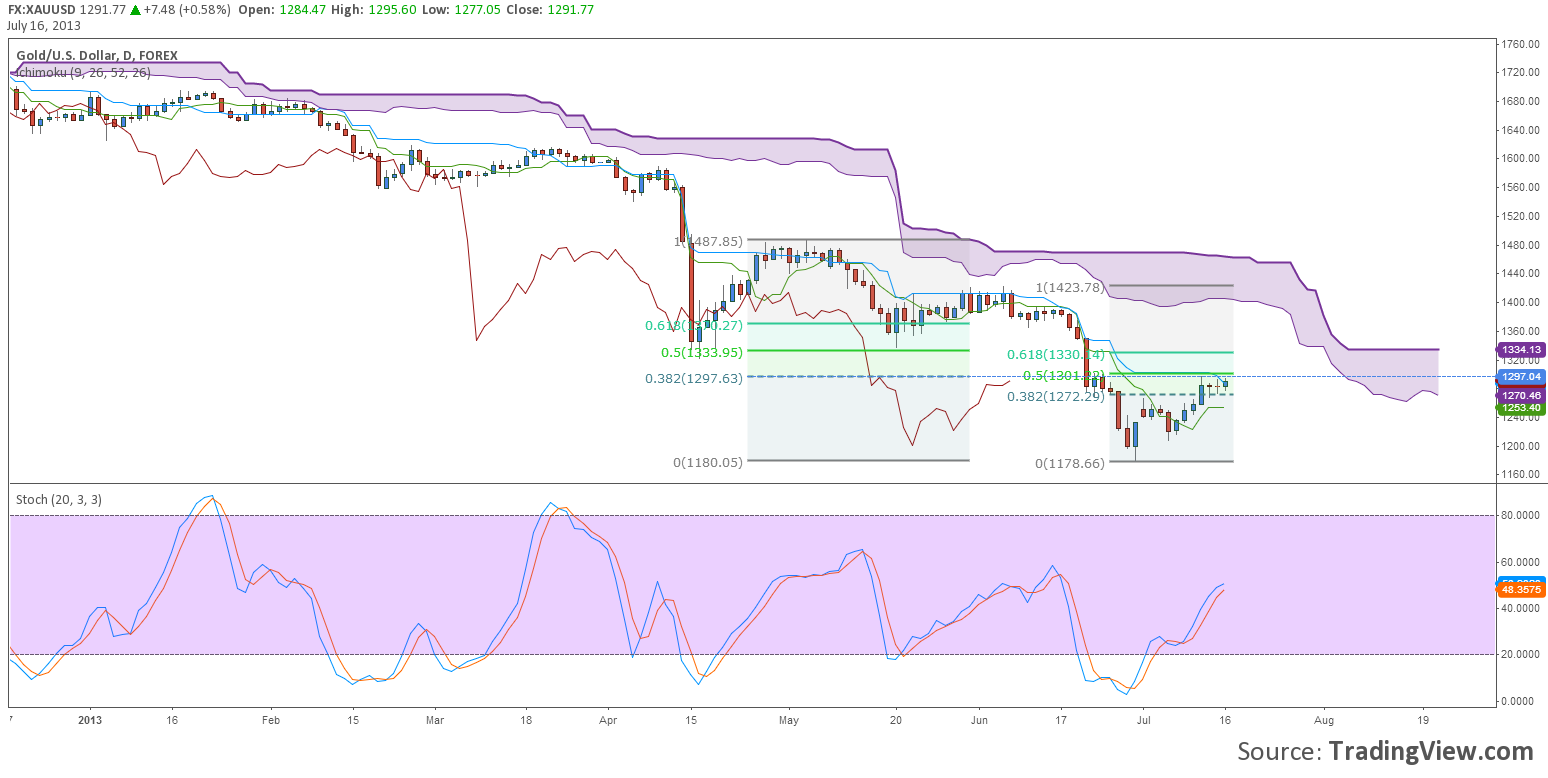
Chart: XAUUSD, Daily

After hitting a low under 1180$ per ounce the price of Gold bounced back to 1290$ per ounce. The most interesting thing about this throwback is that the commercials are still net short on this instrument, but the open interest is on the up move. This might mean that the precious metal is being bought by private investors more, and less by Central Banks and Hedge Funds.

Tomorrow Ben Bernanke is expected to have another speech. Investors will look for signals regarding the Quantitative Easing. If the Fed will start tapering it later than September, we might see another rally in the price of gold, while if this date will be maintained there is a possibility for the price to drop suddenly.

Looking at the technical analysis of gold’s price chart using a system based on Ichimoku Kinko Hyo, we observed that the price is now in the layer between the Tenkan-sen and Kijun-sen averages. Adding a Fibonacci retrace we can conclude that 1300$ per ounce is a very good resistance level. If the price will break and close above this level we can expect for it to rally to 1350$ per ounce, where it will find itself in the Kumo.

Even though the signals are bullish, keep an eye on the 1270$ support. A break under this level could mean another drop for the price of gold. The target levels for a down move are 1210$ and 1180$ per ounce.

The post Gold (XAUUSD) might Bottom around Current Levels appeared first on investazor.com.

Why Ending QE3?

Article by Investazor.com

The Federal Reserve received today encouraging signals from the U.S. economy. The Consumer Price Index indicated a rise (0.5%) in the price of goods, mainly sustained by the higher cost of gasoline, fact confirmed by the Core Consumer Prices Index that was reported in line with expectations at 0.2% (the last index excludes the energy and food’s costs). It is important to see the inflation being kept under control but on the other side, low values of the index of prices are not much help for the economy. The industrial production has taken a balanced value, particularly sustained by more confident homebuilders. Since January 2006 the house building industry started to lose its pulse and now it seems that it may regain its rhythm.

The positive outlook was maintained by the speech of one of the FOMC members today. Even if the growing rate is not as high as expected, it is stable and represents the ground for the monetary policies that are implemented. If the economy is continuing at this pace, the tapering of QE3 is expected to start later this year with an end in the first quarter of 2014. Further improvements are expected especially in the job and housing market. It is important to remember the fact that United States is seriously affect by the global negative sentiment (recently, the IMF revised down its global growth projections) and the fact that economies like China are slowing down.

The post Why Ending QE3? appeared first on investazor.com.

Why Stephan Bogner Believes You Should Be 100% Invested in Precious Metals

Source: Brian Sylvester of The Gold Report (7/15/13)

http://www.theaureport.com/pub/na/15439

Now is the time to be brave, to buy when everyone else is selling, advises Stephan Bogner, analyst with Rockstone Research and CEO of bullion dealer Elementum International. Content to go against the grain, Bogner believes investors should be 100% invested in precious metals, both in physical metals and equities. He is interested not only in companies that are profitable now but also in ones that will someday be in the black again. In this interview with The Gold Report, he describes his ideal portfolio, which includes companies operating in far-flung places.

The Gold Report: You are more bullish on gold and silver now than when the bull market started in precious metals nearly 13 years ago. Yet Swiss bank UBS says the commodities super cycle is over.

Stephan Bogner: I was pretty bullish on gold and silver in 2002 when I completed my university diploma thesis on the exotic topic “Gold in a Macroeconomic Context.” I’m even more bullish today because the macroeconomics did not change; it got worse.

The fundamentals for gold and silver have never been as bullish as they are today. Money is much more likely to flow into the sector, as there’s no other place to hide from the increasing uncertainty and excesses of our financial and economic system. The recent crisis in Cyprus has shown that money in a bank account is not safe anymore and yet this does not even take inflation into account.

TGR: Have gold bulls like yourself underestimated the ability of the world’s largest banks and most powerful governments to control the gold price?

SB: Gold and silver are the only barometers of the health of our monetary system. Those who want to maintain the current system may try to manipulate the barometers so that the masses misinterpret the situation as long as possible. But prices will not remain low for long; the fundamentals of supply and demand will cause them to appreciate. Professor Dr. Hans Bocker, my diploma thesis supervisor and a renowned economics expert in Europe, emphasizes that nothing and no one are stronger than the market.

TGR: How should investors break down their portfolios for this new world order?

SB: Liquidate all available assets and move at least 70% out of the banking system by purchasing physical gold and silver bullion and storing it in an independent vault within a free zone of a safe country.

I do not recommend that anyone buy paper gold and silver in the form of certificates, options or futures. These are the most dangerous markets and the most manipulated. This includes exchange-traded funds (ETFs). You can’t be certain that they are really buying physical gold and silver with all the money you put into ETFs or that you will get the physical bullion when you want to sell. Professor Bocker, who is also the chairman of Elementum, emphasizes that it’s crucial to physically hold bullion in order to survive the upcoming financial crisis.

Mining equities fit very well into a portfolio consisting of physical bullion. You can pour some 70% of your funds into bullion as a crucial life insurance or security deposit and invest 30% of your total assets in mining equities, vehicles that typically generate exorbitant profits during a bull market in gold and silver.

TGR: What about cash? That leaves you with almost no liquidity in your portfolio.

SB: I consider investments in mining equities as cash equivalents. You can sell part of your holdings anytime and use that cash immediately.

TGR: Doesn’t the size of the precious metals equities market make it difficult to get in and out and reduce the market’s liquidity?

SB: You should diversify and focus on stocks that are liquid so you can get out quickly without much “noise.” Have a healthy diversification between junior and senior mining stocks and trade frequently within your core portfolio.

TGR: What are the basics of your thesis for precious metals equities?

SB: At Rockstone Research I not only analyze the general markets, I analyze junior and senior mining stocks. Mining provides unique possibilities for great profits. If you know a bit about geology, chemistry, metallurgy, technology and the general mining business, you can identify mining stocks on the verge of rising, regardless of the underlying metal prices.

The share price for a small exploration company with great drill results will rise even if gold is in a bear market. Keep in mind that increasingly fewer stocks will appreciate through the next collective upswing; many projects and management teams have not proven to be viable. These companies will go out of business and make the market a better, more consolidated place than it was during the last decade.

From an investor perspective, you can view the current temporary bear market as a good thing because only the best companies will survive. Finding these companies before other investors find them can be the chance of a lifetime. Now is the time to start buying mining equities when they are heavily discounted and priced down. Take all your courage, go out there and buy when everyone else is selling as if there was no tomorrow.

TGR: What do you think is an effective approach to buying these equities? Should investors buy on drops and pullbacks?

SB: Yes, buying on dips and pullbacks is a good way to get into an investment. If you are in the red with an investment, you can either try to be patient and wait for a general recovery or you can sell and buy different mining stocks now because the market has changed severely in the last seven months. It has created ridiculously low valuations of certain mining stocks that I would not have bought seven months ago. I am no fan of strict “buy and hold” approaches as whole markets, expectations and single opportunities change over time. Selling some positions even with a loss to buy others that appear to be much more of a bargain can be very lucrative.

TGR: What stories are you following?

SB: In a depressed mining market such as today’s with low metals prices and most producers operating unprofitably, investors already, and will increasingly, favor not only the few profitable mining companies that are left but also mining equities with the following six characteristics: 1) have experienced management, 2) are cashed-up, 3) have an advanced-stage exploration and/or mine development project, 4) have low capital expenditures (capex) to achieve high internal rates of return, 5) have high-grade deposits, 6) are operating in a stable mining jurisdiction.

Miners that meet all these premises in an outstanding way are First Majestic Silver Corp. (FR:TSX; AG:NYSE; FMV:FSE), Avino Silver & Gold Mines Ltd. (ASM:TSX.V; ASM:NYSE.MKT; GV6:FSE), Great Panther Silver Ltd. (GPR:TSX; GPL:NYSE.MKT), Fortuna Silver Mines Inc. (FSM:NYSE; FVI:TSX; FVI:BVL; F4S:FSE), Silver Wheaton Corp. (SLW:TSX; SLW:NYSE), SilverCrest Mines Inc. (SVL:TSX.V; SVLC:NYSE.MKT) and Silver Standard Resources Inc. (SSO:TSX; SSRI:NASDAQ). They all are mining companies that are flexible enough in size, operations design and corporate politics to steer through the extreme market phases we are currently experiencing. These companies are currently producing silver more or less profitably in resource-rich and underexplored regions of Latin America, enjoying some of the lowest production costs in the sector.

A Mexican silver producer that meets all of the above criteria, and is a prime example of how to do it right in today’s difficult mining environment, is Santacruz Silver Mining Ltd. (SCZ:TSX.V; 1SZ:FSE), which has succeeded in bringing into production a mine during the period of low metal prices in Q2/13. Average mill throughput currently “only” stands at around 120 tonnes per day (120 tpd), ramping up to 200 tpd in Q4/13 and 500 tpd in 2014 to achieve an output of around 2 million ounces (2 Moz) silver equivalent per year. When Rosario starts running at full capacity in 2014, silver prices may have recovered to higher levels. This could provide huge leverage on the share price because the company is currently producing relatively few ounces during this period of low silver prices, an estimated 2013 output of around 400,000–500,000 ounces (400–500 Koz) silver equivalent. Normally, a comparable 2 Moz per year silver mine requires $60–80 million ($60–80M) capex, but Santacruz only spent $10M to construct Rosario, and Santacruz is ready to do it again with its San Felipe project, for which a capex of only around $20M is anticipated.

San Felipe will be at feasibility stage by late 2013; three rigs are drilling as we speak. The initial drilling exceeds all expectations, exhibiting higher grades than historic drill results and superb core recoveries of around 95%, compared to historic records that show poor core recoveries of around 70%. Santacruz is getting the picture now, exploring and developing another world-class deposit that is easy to mine and highly profitable even during these depressed times.

Imagine how such a business will do during high silver prices and then try to imagine how the share price will develop from its current low levels. For the upcoming weeks and months, we anticipate an increased newsflow on San Felipe: the reporting of assays from around 10,000 meters (10,000m) of drilling. We expect San Felipe to start production in 2014, and it being much larger in scale than Rosario because Santacruz plans a 700 tpd mill throughput for its second mine.

The third mine on Santacruz’s agenda is Gavilanes, which is even higher grade than the average 200–250 grams/ton (200–250 g/t) silver at Rosario and San Felipe. Gavilanes has a historic Inferred resource of 1.2 million tons ore averaging 420 g/t silver, representing some 15+ Moz silver. However, this historic resource calculation is based only on 500m of the known 1,000m strike length of the single GSA vein that was drilled for only 3,200m in 1990. Santacruz has already successfully identified six other veins on Gavilanes with the Descubridora vein being the most promising one right now.

I speculate that Tahoe Resources Inc. (THO:TSX; TAHO:NYSE) will also become an exciting story; its world-class Escobal deposit in Guatemala is averaging around 490 g/t silver equivalent, resulting in fantastic all-in production costs estimated to be below $15/oz. That is quite remarkable considering that Hecla Mining Co. (HL:NYSE) is now pretty much underwater at $26/oz and Pan American Silver Corp. (PAA:TSX; PAAS:NASDAQ) at $22/oz. Santacruz is set to achieve all-in production costs of an estimated $11/oz by 2014 with its Rosario mine, and its two other silver deposits are ready to follow an even larger path into highly profitable and low-risk silver mining. Cash is king, even more notably in tough times, so I now look for newborn cash-flow machines that are poised to grow big during the next few years as I bet on much higher gold and silver prices.

While Santacruz, a profitable producer with huge growth potential, has a current market cap of only $85M, there are also very attractive undeveloped projects like those of MAG Silver Corp. (MAG:TSX; MVG:NYSE). The company has a market cap of only $350M but is sitting on a large, 100+ Moz high-grade silver deposit that may to turn out to become Mexico’s largest silver mine. MAG Silver is also in great shape to put into production other properties during the upcoming years. You want to look out for companies that right now are successfully developing world-class deposits; when production kicks off in a few years, metal prices are expected to be much higher than today.

TGR: What other companies are you following?

SB: Other stocks that I like in this respect are Roxgold Inc. (ROG:TSX.V) and Orezone Gold Corporation (ORE:TSX), with their high-grade and large gold deposits both located in Burkina Faso, as well as ASX-listed Ampella Mining Ltd. (AMX;ASX), which has the 3+ Moz Batie West Gold deposit, Burkina Faso’s largest undeveloped gold resource at a 1 g/t cut-off.

I also follow Central African low-cost gold producer Endeavour Mining Corp. (EDV:TSX; EVR:ASX) in Ghana and ASX-listed Tiger Resources Ltd. (TGS:TSX; TGS:ASX), which has an excellent exploration and production portfolio of properties strategically located on the world-renowned Katanga Copper Belt in the Democratic Republic of the Congo (DRC). Tiger is a well-run company with experienced and well-connected management successful in the highly lucrative but somewhat risky-appearing regions of the world where others fail on a regular basis. Tiger’s Kipoi stockpiles of high-grade copper have a market value of $500M+ with production costs in the area of only $0.30/pound targeted for 2014; the company’s other properties enjoy extremely good exploration potential.

Alacer Gold Corp. (ASR:TSX: AQG:ASX), with its gold operation in Turkey, is also an interesting story to follow. Management is working successfully on cutting costs on all fronts.

I am certain that these companies will not only survive the current slaughtering of mining equities but will also evolve into better and much more profitable companies than they would have been without this crash, thus maximizing shareholder value even more if metal prices recover substantially.

I also like Levon Resources Ltd. (LVN:TSX.V; L09:FSE; LVNVF:OTC), with its 400+ Moz Cordero silver deposit in Mexico; Silver Bull Resources Inc. (SVB:TSX; SVBL:NYSE.MKT) and Golden Arrow Resources Corp. (GRG:TSX.V; GAC:FSE; GARWF:OTCPK), with their 100+ Moz silver equivalent deposits;NOVAGOLD (NG:TSX; NG:NYSE.MKT), with its 40+ Moz Donlin gold deposit in Alaska; Prophecy Platinum Corp. (NKL:TSX.V; PNIKF:OTCPK; P94P:FSE), with its multimillion ounce platinum group metals deposit in the Yukon; and Western Potash Corp. (WPX:TSX.V), with Milestone being developed into a modern, cost-effective mine in Saskatchewan.

I also follow closely with great interest the development of Sunridge Gold Corp. (SGC:TSX.V), Sulliden Gold Corp. (SUE:TSX; SDDDF:OTCQX; SUE:BVL), Aurcana Corporation (AUN:TSX.V; AUNFF:OTCQX) andIMPACT Silver Corp. (IPT:TSX.V), and prospective juniors like Vendome Resources Corp. (VDR:TSX.V),Meadow Bay Gold Corp. (MAY:TSX.V; MAYGF:OTCQX), La Ronge Gold Corp. (LAR:TSX.V) andComstock Metals Ltd. (CSL:TSX.V).

Comstock recently made a promising discovery in the prolific White Gold district in the Yukon. The area has very similar geology and mineralization with Kinross Gold Corp.’s (K:TSX; KGC:NYSE) Golden Saddle deposit, which is just 10 kilometers (10km) to the northwest, as well with Kaminak Gold Corp.’s (KAM:TSX.V) Coffee project 40km to the south. Comstock’s initial drill results of grades of 1+ g/t gold over 80m+ exceeded all expectations.

Comstock just announced the assays of two stepout drillings: Hole 12 returned 2.1 g/t gold over 36m starting right at surface at 9m depth including an 11m interval averaging 3.2 g/t at 22m depth below surface. Hole 11 returned 43m averaging 1.4 g/t gold including an 13m intercept averaging 3.4 g/t. Both drill holes will increase the NI 43-101 resource base significantly as the footprint of the VG Zone has now been extended by some 350x350m, whereas the zone remains open in all directions. The results of five other drill holes will be released shortly.

I highly respect Comstock’s CEO, Rasool Mohammad, who is also the driving force behind La Ronge. La Ronge is exploring its Preview SW property in the prolific La Ronge Gold Belt of Saskatchewan. With an NI 43-101 Indicated and Inferred gold resource of nearly 400 Koz with an average grade of 2+ g/t and a 0.5 g/t cut-off, La Ronge is in a great position to expand the resource base of this deposit in the upcoming months. I am confident that Rasool will produce loads of positive drill reports that I anticipate will affect both stocks greatly in the near future.

TGR: Are there other companies you would like to talk about?

SB: Rubicon Minerals Corp. (RBY:NYSE.MKT; RMX:TSX) has successfully developed the highly interesting 3+ Moz Phoenix gold deposit toward the preliminary economic assessment level. The deposit is located in Red Lake, Ontario. Production can commence as soon as 2014 or whenever the gold price has recovered.

Another advanced gold project in its final permitting stage is Lydian International Ltd.’s (LYD:TSX) flagship Amulsar gold deposit in Armenia. It looks remarkable: simple and easy to mine, having a low capex of only $250M, yet valued at $1+ billion in the latest feasibility study.

Colossus Minerals Inc. (CSI:TSX; COLUF:OTCQX) owns an advanced-stage gold project in Brazil that may go into production at the right time within the next few years when metal prices have recovered, making such a large gold deposit increase in value even more.

Luna Gold Corp. (LGC:TSX) also has a well-advanced deposit in Brazil with great NI 43-101 upside potential targeting gold production starting at 125 Koz in 2014.

I follow Brazil Resources Inc. (BRI:TSX.V; BRIZF:OTCQX) closely because I like the management team around Chairman Amir Adnani and his well-established contacts around the world.

TGR: Do you follow rare earths?

SB: Yes. I am positive that Australia-based Alkane Resources Ltd. (ANLKY:OTCQX; ALK:ASX) will bring into production its Dubbo rare earths project in New South Wales in early 2016. Management is right on track demonstrating how to successfully develop a large deposit into a profitable mine quickly, namely with memorandums of understanding, agreements and strategic alliances. Dubbo represents a world-class deposit enriched with zirconium, hafnium, niobium, tantalum, yttrium, as well as light and heavy rare earths elements (REEs). Chinese production dominates these materials, providing over 90% of yearly supply and it is increasingly limiting its exports. Alkane already seems to have found the right partners to advance this project. The financing of around $1 billion is planned to be arranged by Sumitomo Mitsui Bank of Japan, Credit Suisse Australia and Sydney-based Petra Capital, and is expected to coincide with the final project approvals, allowing mine construction to commence in Q2/14.

Alkane’s Definite Feasibility Study of April 2013 shows Dubbo being a “technically and financially robust project.” A base case of a 20-year mine life gave a net present value of $1.23 billion, yet mine life is likely to be in excess of 70 years, which makes this deposit an important strategic asset for REE world supply. What makes Alkane a great investment today is that shareholders do not have to wait two or three years until REE production at Dubbo starts; shareholder value is likely to be increased substantially within the next few months as construction on the company’s Tomingley gold mine is underway and commissioning is anticipated in late 2013. With a resource of 800+ Koz, a head-grade of 2 g/t, a yearly gold production of around 50 Koz for a minimum of eight years and operating costs at only $1,000/oz, this project is set to generate important cash flow in the near future to advance the Dubbo project successfully without the need for excessive dilution.

Strategically, I also like Rare Element Resources Ltd. (RES:TSX; REE:NYSE.MKT), which has a 100% interest in the Bear Lodge property in Wyoming, U.S. This is one of the largest disseminated REE deposits in North America; it is high grade with favorable metallurgy and excellent infrastructure within one of the world’s best mining jurisdictions. When the time is right, it will most certainly be put into production.

Woulfe Mining Corp. (WOF:TSX.V) owns a large tungsten-molybdenum deposit in South Korea; I like these metals thanks to their great price appreciation potential in this decade.

I also like companies such as Rio Alto Mining Ltd. (RIO:TSX.V; RIO:BVL), whose stock experienced heavy selloffs during the last months, trading at around $2/share down from $6/share, and Monument Mining Ltd. (MMY:TSX.V), whose stock has been holding remarkably stable at the $0.30/share level assuming that strong hands try to not let the price go below this level. Both operators own world-class gold mines and infrastructure plus offer great growth potential for the upcoming years.

Rio Alto is reporting higher than expected head grades, which is a rare trend in today’s mining business—most seniors like BHP Billiton Ltd. (BHP:NYSE; BHPLF:OTCPK), Barrick Gold Corp. (ABX:TSX; ABX:NYSE) and Newmont Mining Corp. (NEM:NYSE) are struggling as their grades decrease more than expected and they are unable to keep up production levels while costs rise. Their only chance of maintaining market value is to acquire other resources, properties and companies. Rio Alto does not have such problems and stands well even in today’s depressed markets, thanks to the superb management around CEO Alex Black. The company has developed the La Arena deposit in Peru into a world-class gold mine with production costs well below $1,000/oz and an output of around 200 Koz/year. Rio Alto at $2/share seems like a great bargain and not only for the short term.

Monument plans to bring into production a second, polymetallic mine shortly, Mengapur, which I anticipate to emerge as a much larger than expected mine that may be ramped up with a strategic partner. I hope the partner is no one less than the government of Malaysia; management has established respectable relationships with high-ranking officials over the last years. A successful model would be Australia-based Tiger Resources’ 60/40%-partnership with the DRC government.

Golden Arrow is another company with great management relationships with governmental officials. Joe Grosso is doing it again big with this latest Argentinian success story that may become in the foreseeable future a very large and easily mineable resource of 100+ Moz silver equivalent with outstanding NI 43-101 upgrade potential. That’s the sort of junior mining stock with a $10–50M market cap that you want to be involved with from an early stage.

TGR: Do you want to talk about any other companies?

SB: Another great management story may be Gold Standard Ventures Corp. (GSV:TSX.V; GSV:NYSE), whose chief geologist, Dave Mathewson, explained to me in an interview in 2011 the background and geological settings of the Railroad property. Railroad is located just south of the productive Rain mine operated by Newmont in Nevada. Dave Mathewson discovered the Rain deposit when working for Newmont. This is the kind of unique management story that can be decisive when looking out for the right people who made the right choices at the right time. I am optimistic that Railroad eventually will turn out to be a larger gold deposit than Rain, which itself contains 6+ Moz. No one knows the rich but tough Carlin Trend better than Dave Mathewson.

Another deposit I value highly—in addition to being a potential takeover candidate—is Gold Reach Resources Ltd. (GRV:TSX.V). The company’s copper-gold-molybdenum deposit is adjacent to the renowned Huckleberry copper-molybdenum mine in British Columbia. Copper Mountain Mining Corp. (CUM:TSX) restarted a large copper mine near Princeton, 250km northeast of Vancouver, in 2011, producing some 80 million pounds per year. Mitsubishi Materials Corp. (MMC:FSE) has a 25% stake and mining giants like Xstrata Plc (XTA:LSE) are potentially looking for companies like these to take over, especially during times of ridiculously low market valuations that we have at the moment.

Some 3km south of the Copper Mountain mine and mill lies a large and quite prospective property that belongs to junior explorer Anglo-Canadian Mining Corp. (URA:TSX.V). I have been following this company for years, eagerly waiting to find out that it is actually sitting on a mineable porphyry copper gold deposit (or skarn) right on trend and right next to the prolific Copper Mountain porphyry plug.

Another such small junior mining stock that we followed was Urastar Gold Corp., which was active in Mexico where it held a highly prospective property adjacent to mining, infrastructure and large seniors. Urastar was acquired a few months ago by Agnico-Eagle Mines Ltd. (AEM:TSX; AEM:NYSE).

The following is mining news wording I believe we are about to see increase notably with so many highly undervalued but highly prospective junior mining stocks being acquired basically for peanuts. This is sad but true in terms of shareholder value, yet still worth an investment nonetheless if you discover the ones to target at the right time:

“Under the terms of the Agreement, each Urastar shareholder will receive in exchange for each Urastar Share held, C$0.25 in cash. The cash consideration offered represents a premium of approximately 42.9% based on the closing price of the Urastar Shares on the TSX Venture Exchange (“TSXV”) of C$0.175 on March 25, 2013 and a premium of approximately 46.8% over the 20-day volume weighted average price of the Urastar Shares on the TSXV for the period ending March 25, 2013. The transaction value on a basic shares outstanding basis, and assuming exercise of in-the-money share purchase warrants, is approximately C$10.70 million.”

TGR: Thank you for speaking with us today.

Stephan Bogner is a mining analyst at Rockstone Research, where he has independently analyzed capital markets and resource stocks for more than 11 years. He is also CEO of Elementum International AG of Switzerland. Bogner earned his degree in economics in 2004 at the International School of Management in Dortmund, Germany. He spent five years in Dubai brokering and reselling physical commodities and now resides in Zurich, Switzerland.

Want to read more Gold Report interviews like this? Sign up for our free e-newsletter, and you’ll learn when new articles have been published. To see a list of recent interviews with industry analysts and commentators, visit our Streetwise Interviews page.

DISCLOSURE:

1) Brian Sylvester conducted this interview for The Gold Report and provides services to The Gold Report as an independent contractor. He or his family own shares of the following companies mentioned in this interview: None.

2) The following companies mentioned in the interview are sponsors of The Gold Report: Santacruz Silver Mining Ltd., Colossus Minerals Inc., Golden Arrow Resources Corp., Gold Standard Ventures Corp., Sunridge Gold Corp., Rubicon Minerals Corp., MAG Silver Corp., Tahoe Resources Inc., Roxgold Inc., Silver Bull Resources Inc. NOVAGOLD, Prophecy Platinum Corp., Sulliden Gold Corp., IMPACT Silver Corp., Lydian International Ltd., Brazil Resources Inc., Alkane Resources Ltd., Silver Standard Resources Inc., Fortuna Silver Mines Inc., SilverCrest Mines Inc., Comstock Metals Ltd. and Great Panther Silver Ltd. Streetwise Reports does not accept stock in exchange for its services or as sponsorship payment.

3) Stephan Bogner: I or my family own shares of the following companies mentioned in this interview: All except Credit Suisse, Mitsubishi Materials Corp., Sumitomo Mitsui Bank of Japan, Xstrata Plc, BHP Billiton Ltd., Barrick Gold Corp., Newmont Mining Corp., Hecla Mining Corp. and Urastar Gold Corp. I personally am or my family is paid by the following companies mentioned in this interview: None. My company has a financial relationship with the following companies mentioned in this interview: None. I was not paid by Streetwise Reports for participating in this interview. Comments and opinions expressed are my own comments and opinions. I had the opportunity to review the interview for accuracy as of the date of the interview and am responsible for the content of the interview.

4) Interviews are edited for clarity. Streetwise Reports does not make editorial comments or change experts’ statements without their consent.

5) The interview does not constitute investment advice. Each reader is encouraged to consult with his or her individual financial professional and any action a reader takes as a result of information presented here is his or her own responsibility. By opening this page, each reader accepts and agrees to Streetwise Reports’ terms of use and full legal disclaimer.

6) From time to time, Streetwise Reports LLC and its directors, officers, employees or members of their families, as well as persons interviewed for articles and interviews on the site, may have a long or short position in securities mentioned and may make purchases and/or sales of those securities in the open market or otherwise.

Streetwise – The Gold Report is Copyright © 2013 by Streetwise Reports LLC. All rights are reserved. Streetwise Reports LLC hereby grants an unrestricted license to use or disseminate this copyrighted material (i) only in whole (and always including this disclaimer), but (ii) never in part.

Streetwise Reports LLC does not guarantee the accuracy or thoroughness of the information reported.

Streetwise Reports LLC receives a fee from companies that are listed on the home page in the In This Issue section. Their sponsor pages may be considered advertising for the purposes of 18 U.S.C. 1734.

Participating companies provide the logos used in The Gold Report. These logos are trademarks and are the property of the individual companies.

101 Second St., Suite 110

Petaluma, CA 94952

Tel.: (707) 981-8999

Fax: (707) 981-8998

Email: [email protected]


Plain Packaging: An Assault on Big Tobacco Branding

By The Sizemore Letter

Last month, I wrote that Australia’s plain-packaging law was one of the worst setbacks for Big Tobacco in decades because it attacked the companies’ single most valuable asset: their brands.

Big Tobacco has strong enough moats to survive high taxes, punishing lawsuits, and an aging and declining customer base intact.  But plain packaging threatens the industry at its very core, and this is something underappreciated by investors in the sector.

James Dean

Cigarette Marketing 101

Long-time chain smokers light up for one very obvious reason—they are addicted to the nicotine.  But for casual smokers—those who may light up while drinking, for example—the experience matter too.  I call it the Rebel Without a Cause effect”; the devil-may-care image that goes along with smoking is part of what makes it pleasurable.

There is a certain appeal to Altria’s ($MO) familiar Marlboro logo.  But there is most certainly no romance in a plain white box with a picture of a diseased lung on the flipside.

If you think I’m making this up, consider the recent grumbles coming out of Australia.  Following the implementation of the plain packaging law at the beginning of this year, Aussie smokers  have complained that their cigarettes taste different.

The Australian health minister, quoted by the New York Times, insisted that there had been no change to the cigarettes themselves but that “people being confronted with the ugly packaging made the psychological leap to disgusting taste.”

I’m not a cigarette smoker, though I do enjoy the occasional cigar.  And I would insist that a cigar does indeed taste better when the smoker is wearing a suit and sitting in a comfortable leather chair surrounded by wall-to-wall shelves of old books.  The very same cigar smoked in a plastic lawn chair while wearing Crocs just isn’t the same (and shame on any grown man for wearing Crocs outside of the pool, but I digress).

Rational?  No.  But nonetheless true.

It remains to be seen whether plain packaging laws spread outside of Australia; they are being considered in Canada, India, the UK and in the European Union as a whole.  Big Tobacco wll argue that the ban violates their trademarks and seizes their intellectual property, and they may find a few sympathetic judges.  But given the history of the anti-tobacco movement, it’s a lot more likely that Big Tobacco will fight a rearguard action for years before ultimately losing.

So, if the future is bleak, does this mean that you should avoid tobacco stocks like Altria, Reynolds American ($RAI) or Lorillard ($LO)?

Not necessarily.  As I’ve written before, industries in decline can be fantastically profitable investments under the right set of conditions.  But the most important condition is price, and on this count Big Tobacco looks far from attractive.  Altria, Reynolds American and Lorillard trade for 17, 19, and 15 times earnings, respectively.  Their dividends, while high by broad market standards, are all lower than 5%, and all are trading near their 52-week highs.

Dividend income is a major consideration in my investment process, but I am avoiding Big Tobacco at this time.  I can get higher yields with comparable dividend growth rates in select REITs and MLPs, and I can get a much higher dividend growth rate in Big Tech names like Microsoft ($MSFT), Intel ($INTC) and Cisco Systems ($CSCO).

Do I expect Big Tobacco stocks to take a nosedive in the immediate future?

No, I don’t.  I expect the sector to more or less track the market in the short term.  But Big Tobacco investors should be aware that the single biggest factor in the sector’s outperformance of recent years—price—is no longer in their favor.

Sizemore Capital is long MSFT, INTC, and CSCO.

SUBSCRIBE to Sizemore Insights via e-mail today.

Доллар США под давлением

EURUSD Евро/доллар пытается развить рост

eurusd16.07.2013

Несмотря на отсутствие каких-либо фундаментальных факторов, поддерживающих рост единой валюты, она в паре с долларом США уверенно держится выше 30-й фигуры, более того — уже приближается к 31-й. На дневном таймфрейме Parabolic SAR расположен ниже графика цены, сохраняя позитивный взгляд на технические перспективы пары, но на 4-часовом, несмотря на текущее укрепление, Parabolic выше графика цены, что порождает некоторые сомнения в способности быков развить восходящий тренд. Тем не менее пробой максимумов в районе 32-й фигуры развеет все сомнения, а евро/доллар вырастет как минимум к 1.3264. Потеря 1.3000 будет означать возобновление нисходящего тренда.


GBPUSD Фунт/доллар может вырасти к 1.5300

gbpusd16.07.2013

Фунт/доллар вчера снижался, но поддержка в районе 1.5040 справилась со своей задачей, и от нее пара теперь пытается развить рост в направлении 1.5200. В целом похоже на то, что пара сформировала основание и может в скором времени протестировать сопротивление у 53-й фигуры, где на дневном графике проходят 100-дневная и 50-дневная скользящие средние. Пробой уровня повлечет за собой дальнейшее развитие восходящего тренда. На 4-часовом таймфрейме фунт пытается пробиться выше 100-дневной скользящей, но Parabolic SAR находится выше графика цены, что ставит под сомнение текущий рост. Потеря 1.5040—1.5000 вернет на рынки негативный настрой, а текущий минимум 1.4813 снова окажется под прессингом медведей.


USDCHF Доллар/франк держится у поддержки на уровне 0.9477

usdchf16.07.2013

Рост евро/франка удерживает от падения пару доллар/франк, которая вчера совершила попытку роста, но, наткнувшись на сопротивление на уровне 0.9533, вынуждена была отступить к поддержке 0.9477, вблизи которой торгуется на данный момент. На 4-часовом таймфрейме доллар/франк держится ниже 95-й фигуры и 100-дневной скользящей средней, но Parabolic SAR, находясь ниже графика цены, пока не подтверждает наличие нисходящей динамики в паре. В свою очередь, на дневном таймфрейме Parabolic выше графика цены, но доллар торгуется выше 100-дневной скользящей средней, которая проходит на уровне 0.9443. Падение ниже подтвердит развитие нисходящего тренда, а рост выше 0.9555 будет означать возобновление восходящего.


USDJPY Пара доллар/иена не смогла подняться выше 100.49

usdjpy16.07.2013

Пара доллар/иена вчера выросла до 100.49. Здесь она подверглась распродаже, и доллар был вынужден отступить к поддержке в районе 99.70, где пытается сформировать промежуточное основание. Если ему это удастся, то курс пары вырастет к 100.49—100.68. Пробой последнего уровня вызовет усиление восходящего импульса. В пользу такого развития событий говорит находящийся ниже графика цены Parabolic SAR. Но на дневном таймфрейме он все еще расположен выше графика, а значит, сохраняются шансы на тестирование поддержки 98.67. Падение ниже подтвердит развитие нисходящей коррекции.

provided by IAFT


Precious Metals Gain as Cyprus Back-Tracks on Selling Reserves

London Gold Market Report
from Adrian Ash
BullionVault
Tuesday, 16 July 08:25 EST

PRECIOUS METAL prices rose Tuesday morning in London, after the finance minister of Cyprus said selling some of the debt-laden Mediterranean island’s gold reserves was “only an option” for raising cash.

 “The possibility of selling gold is known, but only as an option,” Harris Georgiades told journalists in Nicosia.

 “It will be considered, when the time comes, with options, or rather, all other options.”

 Last week the Cypriot president Nicos Anastasiades said that “I want to believe there will never be such a need” for selling some gold reserves.

 “The issue is not being discussed by the government, it is a responsibility of the central bank,” he was quoted by Reuters.

Mid-April’s proposal that Cyprus should sell some of its small gold reserves saw the metal drop more than 15% over the next two trading days.

 Despite holding only 13.9 tonnes of gold bullion, the idea was seen by some analysts and traders as “the thin end of the wedge” for other debt-laden countries in the Eurozone.

All told, Eurozone central-bank gold reserves total 10,783 tonnes.

That’s more than one ounce in every three held in official-sector bullion vaults according to data compiled by the World Gold Council.

 “The April price moves [after talk of Cyprus’ gold sale] severely damaged the notion that gold provides any degree of risk protection or really acts as a safe haven,” says a new gold price forecast from analysts at Citigroup.

 “We see little prospect of investors returning to gold in the short or medium term,” they add, forecasting a fresh 3-year low of $1100 per ounce by end-2013.

 Technical analysis of the gold price charts by Barclays sees gold falling to that level in just the next two months.

 Meantime Tuesday, silver followed the gold price higher, regaining the $20 per ounce level, while European stock markets ticked up.

 Commodity prices also rose, as did major government bond prices.

 “[Gold] investors remain sidelined,” reckons Xiang Nan, analyst at CITIC Securities Futures Co. in Shanghai, quoted by Bloomberg, “before Bernanke’s testimony [to Congress on Wednesday] for clues on the Fed’s stance on monetary stimulus.”

 “Gold price gains are expected to stall around $1300 as physical buyers stay away.”

Ahead of the US Fed chairman’s twice-yearly appearance before the House Financial Services Committee on Wednesday, the US Dollar slipped against the Euro single currency.

That capped gains in the Euro price of gold at €986 per ounce, in line with last week’s close.

April’s initial gold sales plan, proposed by Cyprus’ other Eurozone partners, the European Central Bank and the International Monetary Fund, was intended to raise €400 million of a total €10 billion rescue package.

 The same quantity of gold bullion if sold at Tuesday’s AM London Gold Fix would have raised only €314 million.

Adrian Ash

BullionVault

Gold price chart, no delay | Buy gold online

Adrian Ash is head of research at BullionVault, the secure, low-cost gold and silver market for private investors online, where you can buy gold and silver in Zurich, Switzerland for just 0.5% commission.

(c) BullionVault 2013

Please Note: This article is to inform your thinking, not lead it. Only you can decide the best place for your money, and any decision you make will put your money at risk. Information or data included here may have already been overtaken by events – and must be verified elsewhere – should you choose to act on it.