Why Investors Should Be More Concerned About the Chinese Economy

By Profit Confidential

Chinese EconomyI told you so.

According to the National Bureau of Statistics, the Chinese economy grew at an annual pace of 7.5% in the second quarter of this year from a year earlier—down from 7.7% in the first quarter. (Source: Bloomberg, July 15, 2013.)

Regular readers of Profit Confidential shouldn’t be surprised by that; I have warned about the slowing of the Chinese economy many times in these pages, and I continue to expect more weakness ahead. In fact, what we have seen so far might just be the tip of the iceberg.

While some might say that 7.5% is a decent amount of growth when comparing it to the gross domestic product (GDP) growth in countries like the United States, for the Chinese economy, it’s embarrassing. It’s well below its historical average growth rate.

And that’s not all. Earlier this year, the Chinese government set a target for GDP growth of 7.5% for 2013 and an even seven percent through to 2015—so what we are witnessing now is here to stay for some time.

Keep in mind that the International Monetary Fund (IMF) expects the Chinese economy to grow 7.8% this year—that’s a lowered expectation from April. And The Goldman Sachs Group, Inc. (NYSE/GS) and other major banks, like HSBC Holdings Plc (NYSE/HBC) and Barclays PLC (NYSE/BCS), have all reduced their forecasts for the Chinese economy. They expect China’s GDP to grow 7.4% this year—the worst growth rate for the Chinese economy since 1990.

What many don’t realize is that a slowdown of the Chinese economy has many global consequences. It will send ripple effects into the global economy. More problems will emerge in the short term as the second-biggest economy in the world slows.

Consider Australia, for example. In recent years, its economy has benefited significantly by exporting raw material to the Chinese economy. Now, the tides are changing, and Australia’s GDP might be in trouble. Australian Prime Minister Kevin Rudd said: “The truth is that the China resources boom is over.” The unemployment rate in Australia has reached a four-year high of 5.7%. (Source: “China Slump Ripples Globally,” Wall Street Journal, July 15, 2013.)

And Australia isn’t the only economy affected by slow GDP growth in the Chinese economy. Here’s what the Deputy President of AgriSA—a farmers’ association in South Africa—said of China: “We are more and more dependent on how their stomachs turn when they get out of bed in the morning.” (Source: Ibid.) Any more slowdown in the Chinese economy will result in a greater impact on South Africa’s economy as well.

Of course, we in North America are no different. Any slowdown of the Chinese economy would result in significant problems for the U.S. economy as well. For example, we export airplanes and computer goods to the Chinese economy. Slow demand from China will yield lower profits for companies in those and many other industries.

I still see too much optimism in the markets as the problems from the slowing Chinese economy are starting to creep up to the surface. As it stands, the key stock indices are rising because many investors apparently think bad news is good news.

I remain skeptical of the performance of the key stock indices as GDP in China is slowing, countries around the global economy are facing an anemic economic future, and the U.S. economy continues to be in a period of dismal growth.

Article by profitconfidential.com

How to Make Sense of This Mixed-Up Market

By Profit Confidential

Home PricesThe current market action will soon turn to selling. I’ve come to that conclusion because what the current stock market is doing is really not normal, and a correction will certainly come.

I’m not saying the end is near. In fact, I feel there are more gains to come, but the ride will likely be bumpy and riddled with risk.

When I objectively evaluate the market, I see many stocks, even those that have horrible fundamentals, rising to levels that just don’t make any sense to me.

I’m actually perplexed. The higher market trading has proven to be much more sustainable than I thought it would be at the end of the first quarter. You can thank the Federal Reserve for a boost in your 401(k).

The new records set last Wednesday by the S&P 500 and the Dow Jones Industrial Average were really not warranted. Or at least not yet, unless the economic recovery picks up and corporate America delivers strong revenue and earnings growth and not the diluted results that have kept Wall Street happy.

Because of the Street’s reduced expectations, I would expect companies to report some blow-away quarters. We will see for sure when the earnings parade picks up starting this week. Don’t just settle for an inline or slightly better-than-expected quarter. If there’s any real growth, you’ll see much more.

And then there’s the housing sector, which will be in the limelight tomorrow when the housing starts and building permits readings for June are released. We saw some stalling in the housing sector in May, so it will be interesting to see if the housing sector continues to stall or renew its growth.

Then there are the home prices across the nation. The S&P Case-Shiller Home Price Index has been on a nice rally since early 2012 as reflected in the following chart:

HPI S and P Case-Shiller Home price Index

Chart courtesy of www.StockCharts.com

Despite the steady rise, home prices continue to be well below their peak in 2006, which, of course, was driven by easy money and the subprime mortgage fiasco in the housing sector, when the banks were lending out money to anyone and everyone who wanted a house.

The housing sector has improved since then, but there’s still some froth in the current housing market, given the advance as shown in the chart below:

XHB SPDR S and P Homebuilders Index ETF NYSE

Chart courtesy of www.StockCharts.com

Note the recent upside gap as indicated by the blue oval in the chart of the SPDR S&P Homebuilders Index above. It appears housing sector stocks want to push higher after the correction in May and June, but I really do expect to see resistance, based on my technical analysis. I still feel the best gains in the housing sector are behind us for now.

At these current levels, I would be a seller in the housing sector—not a buyer.

Article by profitconfidential.com

This Sector Is Far Outperforming the Street’s Consensus

By Profit Confidential

Earnings GrowthTwo important banks just reported very solid numbers. That’s important because the financials are a very significant stock market sector that contributes tremendously to investor sentiment and the overall tone for trading action in the capital markets.

Wells Fargo & Company (WFC) beat the Street with a 19% gain in quarterly earnings. The company is the fourth-largest U.S. bank by assets and controls almost 30% of the U.S. mortgage market.

The company’s diluted earnings per share (EPS) grew for the 14th consecutive quarter. Second-quarter earnings were a record $5.5 billion, or $0.98 per diluted share, compared to $4.6 billion, or $0.82 per diluted share, in the second quarter of 2012; second-quarter 2013 earnings are also up from $5.2 billion, or $0.92 per diluted share, in the first quarter.

First-half earnings were a record $10.7 billion, or $1.90 per share, up from $8.9 billion, or $1.57 per share, in the first half of 2012.

Compared to the second quarter of last year, company management cited growth in loans, deposits, and net interest income, and an improvement in credit quality.

Also reporting very good numbers was JPMorgan Chase & Co. (JPM). The company announced second-quarter earnings of $6.5 billion, way up from $5.0 billion in the comparable quarter last year.

EPS grew 32% to $1.60, up from $1.21 in the second quarter of 2012. Total net revenues were $25.2 billion, up solidly from $22.2 billion comparatively.

The company’s total assets under management grew 10% to $2.2 trillion, while total loan balances rose to a record $86.0 billion.

The company also boosted its quarterly dividend payment to $0.38 a share, up from the previous $0.30 a share. JPMorgan handedly beat Wall Street consensus.

The company’s CEO, Jamie Dimon, cited “broad-based signs that the U.S. economy is improving” as the reason for its Wall Street-consensus victory.

But quarterly comparables can be somewhat misleading when it comes to the financial sector. In JPMorgan’s case, the company was forced to increase its loss estimate due to a bad trade in the second quarter of 2012, thereby reducing that quarter’s earnings.

But the company’s latest revenue growth was surprisingly solid.

Individuals may not be enthused about the big banks doing well, but their financial strength is a very important part of confidence in the global capital markets. Their revenue and earnings growth is a reflection of economic conditions, both for Main Street and Wall Street. Improvement in loan losses is also a positive development.

With strength in financials comes greater certainty for the stock market. Good numbers from Wells Fargo and JPMorgan most certainly help to legitimize the stock market’s recent run-up. (See “Corporate Earnings Weakness Should Send You to These Equities.”)

As more earnings pour in, I think it is increasingly likely that the broader market will consolidate on positive results. The main market indices have come a long way already.

With the numbers, company outlooks are critical. Most corporations and Wall Street earnings estimates are weighted to the bottom half of the year, and the market will be looking at company outlooks to reassure this expectation.

Article by profitconfidential.com

The Real Reason Investors Aren’t Afraid of Risk These Days

By Profit Confidential

Investors RiskThe Chicago Board Options Exchange (CBOE) Market Volatility Index—better known as the “VIX” or even the “fear gauge”—sits just above 14. That means investors are continuing to ignore stock market risks and, in the process, are actually assuming even more risk.

All you have to do to see how much risk there is in the stock market is to take a look and see which areas are faring the best.

We are seeing some rotation into higher-risk assets like small-cap, growth, and technology issues. As long as the potential return is high, investors appear willing to assume the risk.

The NASDAQ 100, for instance, closed at a multiyear high of 3,530.76 last Wednesday, easily surpassing its previous multiyear high of 3,502.12 nearly two months ago.

Small-cap stocks have been the life of the party this year, with the Russell 2000 up by more than 20% and achieving three consecutive record-highs at over 1,000.

It’s becoming evident that investors just aren’t scared of risk right now. Even the warning from the Federal Reserve at its June meeting failed to sour the mood, although the stock market did correct by about four percent after the news of an upcoming reduction in bond buying.

When I look at the current situation, I see even greater risk in China and Europe. I also view the future of the U.S. economy as lackluster. And that means the Fed may hold off cutting back on its asset-purchase program for now.

The reality is that this stock market is obsessed with assuming risk in hopes of making some great returns. Investors don’t appear to be able to control themselves, afraid to miss out on any potential gains to come.

While the current euphoric situation reminds me a bit of the Wall Street party in 1999 and early 2000, just before the technology implosion, it’s not quite as crazy. The upward push in the stock market is actually quite orderly compared to those wild days.

But, of course, the investment environment was a whole lot different back in 2000. The federal funds rate stood at 6.24% in 2000, while certificates of deposit (CDs) returned 5.09% over six months and 5.46% over a year. Since there were options in the bond market in 2000, the massive run-up in the stock market looks even more amazing.

Today, the federal funds rate is nearly non-existent at 0.10%, while CDs yield about 0.65% for six months and an even one percent for one year. I’m sure not running to the bank and depositing my money anytime soon. You can understand why the shift to the stock market and higher-risk assets is still happening.

So enjoy the ride. At some point on the horizon, the party will begin to wind down, but now is not the time; in spite of the risk, there’s no real alternative to the stock market. (Read “Why Dow Jones 30,000 Will Become Reality; But What You Should Know First.”)

Article by profitconfidential.com

Why the Prediction I Got Wrong Back Then Is So Vital Today

By Profit Confidential

stock market crashBack in late 2011, I created a widely circulated video that included six predictions. I hit it on the head with five of those predictions. But the winners are not what are important to my readers today; it’s the prediction I didn’t get right that’s vital now

Back then, I said the U.S. dollar was “dead” and wouldn’t go anywhere. I pointed out that if it were not for the continued crisis in the eurozone, the greenback would fall flat on its face. The dollar hasn’t gone anywhere since. And if it were not for investors taking their money out of European banks and moving them into U.S. dollars, our dollar could have collapsed.

My second prediction back then was that the euro would decline in value. And it has. Prediction three was that both interest rates and inflation would rise. The yield on the 10-year U.S. Treasury has risen about 50% since then. As for inflation, if we calculate it the way the Consumer Price Index (CPI) was calculated when Jimmy Carter was president, it would be almost three times the rate the government tells us it is today.

I compared the rally in stocks that started in 2009 to the period following the 1929 stock market crash (1934 to 1937) and warned that stock prices would eventually follow the same fate they did after the “fake” stock market rally that followed the 1929 crash. I still have that opinion today.

What I got wrong in my “Critical Warning Number Six” was my prediction on gold bullion—and I believe that equates to a bigger opportunity for my readers today.

At the end of 2011, gold bullion was selling at $1,550 an ounce. Today, gold bullion prices sit at $1,280. So what’s happened to gold bullion, and what do you do if you bought gold stocks?

If you are into gold coins, you know the premium on them is at the highest level in memory. Demand for gold coins is going through the roof. Meanwhile, central banks are buying gold bullion at the quickest pace in years. Germany wants the gold bullion it keeps at the U.S. Fed back, but it can’t get it. So with all this demand, why have gold bullion prices fallen?

Yes, I’ve heard all the conspiracy theories that the Federal Reserve and major banks want gold bullion prices depressed. But I have no real first-hand proof of that. I’ve heard the manipulation accusations, but again I have no proof.

As a 30-year student of the markets and as an investor, I do know prices of any investment do not march straight up during a bull market. Nor do they go straight down during a bear market.

I started telling my readers to accumulate gold bullion-related investments when gold bullion traded under $300.00 an ounce (2001). Since then, gold bullion prices moved up to as high as $1,900 an ounce. The mid-point between those two numbers is $1,100.

If gold bullion prices fell decisively below $1,100 an ounce, I’d be worried. But in the light of all the demand for gold coins from the retail public and the gold bullion demand from the central banks, I’m not worried about gold. In fact, I see today’s current, depressed gold prices as a huge opportunity for investors to dollar cost average down with their gold investments. I know that’s exactly what I’m doing.

Years from now, I believe we will look back to 2013 and the low prices of gold stocks and say, “I should have bought more gold stocks back then.”

Michael’s Personal Notes:

Mark my words—gold bullion has a great future ahead.

As the prices for gold bullion face severe headwinds in the short term, the fundamentals are getting stronger. The most important sign that makes me believe it is that central banks continue to buy more in spite of a sharp decline.

It’s not mentioned in the mainstream media very often, but central banks from countries like Russia, Turkey, and others have been continuously adding gold bullion to their reserves.

I wouldn’t be surprised to see these countries continue to buy even more as their currencies—their primary holdings—continue to become prone to wild swings. Have you seen the charts of the U.S. dollar, Japanese yen, Canadian dollar, and euro lately?

Consider this: From January 2011 to May 2013, the Russian central bank purchased gold in 22 of 25 months. Altogether, the Russian central bank has purchased 207.4 tons of gold bullion. (Source: World Gold Council web site, July 2013.)

The central bank of Turkey, which became a buyer in October 2011, has added 329.2 tons of gold bullion to its balance sheet for 16 of the 20 months since then. The central bank of Turkey has started to use gold as collateral. (Source: Ibid.)

Dear reader, you must keep in mind that central banks are very conservative investors and try to preserve their wealth. If they continue to buy gold bullion as the prices come down, it only tells me one thing—they like the precious metal’s future prospects.

As I always say, and it is very well documented in these pages, the central banks will never say when they are going to buy, but their actions are speaking louder than their words. Central banks have turned into net buyers as a whole—and have been buying large amounts quarter after quarter.

This shouldn’t go unnoticed because it’s significant—those who wanted to get rid of gold bullion will soon be running back to it.

It is unprecedented for a commodity to have a bull run like gold bullion has experienced over the last 12 years. I see the current decline as just another buying opportunity—a predictable and very normal part of the economy’s nature.

We are seeing many irrational sellers and speculators putting pressures on gold bullion prices, but what I do notice is that selling has calmed, and the remarks from the Federal Reserve have caused shorts some pain.

Article by profitconfidential.com

Guess What Commodity the World’s Central Banks Are Betting On

By Profit Confidential

Mark my words—gold bullion has a great future ahead.

As the prices for gold bullion face severe headwinds in the short term, the fundamentals are getting stronger. The most important sign that makes me believe it is that central banks continue to buy more in spite of a sharp decline.

It’s not mentioned in the mainstream media very often, but central banks from countries like Russia, Turkey, and others have been continuously adding gold bullion to their reserves.

I wouldn’t be surprised to see these countries continue to buy even more as their currencies—their primary holdings—continue to become prone to wild swings. Have you seen the charts of the U.S. dollar, Japanese yen, Canadian dollar, and euro lately?

Consider this: From January 2011 to May 2013, the Russian central bank purchased gold in 22 of 25 months. Altogether, the Russian central bank has purchased 207.4 tons of gold bullion. (Source: World Gold Council web site, July 2013.)

The central bank of Turkey, which became a buyer in October 2011, has added 329.2 tons of gold bullion to its balance sheet for 16 of the 20 months since then. The central bank of Turkey has started to use gold as collateral. (Source: Ibid.)

Dear reader, you must keep in mind that central banks are very conservative investors and try to preserve their wealth. If they continue to buy gold bullion as the prices come down, it only tells me one thing—they like the precious metal’s future prospects.

As I always say, and it is very well documented in these pages, the central banks will never say when they are going to buy, but their actions are speaking louder than their words. Central banks have turned into net buyers as a whole—and have been buying large amounts quarter after quarter.

This shouldn’t go unnoticed because it’s significant—those who wanted to get rid of gold bullion will soon be running back to it.

It is unprecedented for a commodity to have a bull run like gold bullion has experienced over the last 12 years. I see the current decline as just another buying opportunity—a predictable and very normal part of the economy’s nature.

We are seeing many irrational sellers and speculators putting pressures on gold bullion prices, but what I do notice is that selling has calmed, and the remarks from the Federal Reserve have caused shorts some pain.

Article by profitconfidential.com

Why Investor Sentiment Is Still Bullish in the Face of Lackluster Economic News

By Profit Confidential

Economic NewsThe equity market continues to trade while hanging on the Federal Reserve’s every word. There continues to be buoyancy in investor sentiment, and it’s flying in the face of what can only be described as modest earnings results so far. And the fervor that institutional investors have to be buyers in this market remains unabated, thanks to the Fed’s policies.

There’s been a positive take on economic news lately, even if the data is below consensus. There has also been some decent news from individual companies that can be thought of as Main-Street gauges on the U.S. economy.

Costco Wholesale Corporation (COST) reported a solid eight-percent gain in total sales—six percent on a comparable sales basis—for the five weeks ended July 7, including fuel and foreign exchange.

Investor sentiment is strong enough among large investors to continue buying in this equity market, so long as there is stability from the Federal Reserve and earnings results meet consensus.

It is a peculiar environment not to have had a meaningful retrenchment in the equity market. While the Street (and I) totally expected a healthy correction in share prices after the January breakout, it didn’t happen.

The market did have a small pullback on wavering investor sentiment, but I think the equity market overreacted and misinterpreted the Federal Reserve’s statement regarding quantitative easing. Recent minutes from the central bank meeting made note of this.

Investor sentiment among individual investors still seems very reluctant. There have been new cash inflows dedicated to stocks, but a lot of investors are wary of buying in an equity market that is trading right around its all-time high.

Of course, that is how the stock market has performed historically: long periods of consolidation are met with a breakout and subsequent bull market in anticipation of economic acceleration.

The equity market continues to be very much a leading system of speculation regarding earnings and general economic growth.

Investor sentiment is very different than investment risk, and it is worthwhile separating those two factors in terms of shaping your market view.

In an environment of extreme monetary assistance to capital markets, investor sentiment is emboldened. The result is a substantially rising stock market in the face of only modest revenue and earnings growth.

With the certainty from the Federal Reserve regarding continued quantitative easing, it is very possible that the equity market could keep right on ticking higher until the end of the year for a major double-digit gain.

Investor sentiment among institutional investors is so influenced by monetary policy, that we even have days when the equity market goes up substantially on bad economic news. The idea is that bad data increases the likelihood of continued quantitative easing and artificially low interest rates, which boosts investor sentiment. It really is an outrageous set of circumstances. (See “The Few Sectors That Will Continue to Gain in This Unpredictable Market.”)

Article by profitconfidential.com
Could Uranium be the Best Investment in 2013

By MoneyMorning.com.au

Question: which commodity has had more false starts than a cane toad race?

Here’s another one: Which part of the mining sector has broken even more hearts than gold?

And a last one to round it up: What investment is possibly the toughest sell of 2013?

You’ve guessed it…the answer is the same for all three. But despite all these things, it could still be the biggest winner on the market over the next 24 months…

The answer is: uranium.

That’s right. Uranium is coming back.

No one will see it coming…but all the pieces are now in place for uranium to stage a big comeback – and soon.

Don’t believe me?

I know. Like I said, it’s a tough sell.

But before you disregard what I’m saying, know that Australia’s two biggest uranium stocks: Paladin (ASX: PDN) and Energy Resources of Australia (ASX: ERA) have both quietly crept up by more than 40% over the last three months.

For context, the metals and mining index (XMM) has gone nowhere in the same period.

Mining stocks have a habit of predicting the coming move for its underlying commodity. So when uranium stocks start picking up, it can be a good signal that uranium is getting ready to move.

But if you look at the uranium chart, that’s about the last thing you would expect to happen. The price has fallen for two and half years, with no bottom in sight just yet. It has broken under $40 to hit $38.25 this week.

Uranium – Now Down to $38 Per Pound

Source: Cameco

Of course, the uranium spot price is just one side of the coin. Most deals are done at long-term prices, many at prices from $72 just a few years ago to $57 where they had stayed for most of the year.

But are Things About to Change for Uranium?

Well, I think it’s quite possible, because of three things happening now that could transform the shape of the uranium market in the next twelve months.

Any of them alone could send uranium back up. But if they all come together then uranium stocks could be a simply fantastic trade over the next year or two.

Not least because uranium stocks are incredibly cheap today, and if history is our guide, they can put in enormous returns from these levels.

For example, back in 2002, ERA traded at the same price as it is today…then as uranium gained in price, the ERA share price gained 1,900% over the next five years.

Now I’m not saying it’s about to gain 1,900% again. But I am saying the possibility of uranium stocks being a good trade from here makes the sector worth watching.

The first potential trigger in the uranium market is the end of the ‘megatons to megawatts’ program. This catchy name describes the process whereby, for twenty years, old soviet warheads have been recycled to make reactor grade uranium.

At the end of this year, the program is due to expire. This will remove about 15% of global supply from the market quite suddenly. A deficit of 1% or 2% is enough to cause prices to rise in any commodity market. So a 15% deficit should see prices soar.

But this isn’t news. We have been on track to hit this iceberg for years, but like uranium itself, the collision just seems to have fallen off investors’ radars.

It now seems as though savvy investors have just been biding their time, and are only now buying stocks in preparation for the chaos ahead.

There is a second reason to expect a step-change in uranium demand that could cause a shift in the market dynamic.

Japan.

It’s been coming up to two and a half years since Japan’s nuclear reactors were switched off in the wake of the Fukushima accident.

As a major uranium user, Japan’s absence from the uranium market has been noticed.

There has been a lot of talk going back and forth about whether Japan is coming back into the market. If they do ever start buying again, the uranium price will find a new gear.

We may not have long to wait. The operators of ten Japanese reactors have just put in requests to flick the switch back on.

This is pretty big news. Assuming the process is successful, this will create a resurgent demand in the uranium market.

Why Uranium Should Be On Your Radar

There’s also a third reason unfolding right as you read this that could hit the uranium market.

Now, you may have heard that China is building a fleet of nuclear reactors. They have 15 reactors in action already and have another 30 coming on line in the next three or four years. This will add huge demand, but is not news in itself.

What’s just gone down in China, which could change the market much sooner, is the cancellation of a processing plant in Guangdong Province. Environmental protesters against its construction got their way, which is quite unusual in China, and the construction has been shelved.

So without this plant, China will have to get processed uranium from other suppliers in the future, which will have to scale up production and source more uranium to do that. This will in turn increase demand on the uranium market.

That’s unless China can divert the raw uranium to foreign plants cheaply, which is doubtful as they are not close; Areva’s Tricastin plant is halfway round the world in France for example.

Nothing stays the same in markets for long, and after being in the dog house for long enough, it looks like the situation could change for uranium before too long. Verdict: keep it on your radar.

Dr Alex Cowie+
Editor, Diggers & Drillers

Join Money Morning on Google+

From the Port Phillip Publishing Library

Special Report: The Sixth Revolution

Daily Reckoning: A Credible Threat to Gold?

Money Morning: Why Resources and Mining Stocks Could Be Your Trade of a Lifetime

Pursuit of Happiness: Freedom of Thought: Don’t Take it for Granted

With Gold, Don’t Miss the Top

By MoneyMorning.com.au

During a recent interview, we couldn’t let Jim Rickards (author of Currency Wars) go without asking him about our ‘Zero Hour’ scenario.

As you’ll recall, Zero Hour is the moment the price of physical gold starts to run away from the ‘paper price’ you see on CNBC’s ticker

The most likely catalyst is a chain of events that goes like this…

  • Western central banks have leased their gold to commercial banks like JPMorgan Chase at an interest rate of less than 1%
  • The commercial banks have sold that metal and ploughed the proceeds into assets that earn more than 1%
  • The chain of custody on gold bars has become so cloudy that a major exchange like the Comex in New York is liable to ‘default’ on a gold contract – settling in cash, instead of metal
  • A rush for real metal would then be underway, with its price far outstripping the paper price.

It’s a scenario Jim Rickards finds entirely plausible.

‘How many people in the gold market – whether it’s LBMA standard contracts, forward gold, allocated, unallocated, Comex – think of all the players who would raise their hand and if you say to them do you own gold, they say yes I do, and then when you press them you find out they don’t own physical gold – at all. Not even close. They own some claim of some kind. People don’t read contracts, they don’t read the exchange rulebooks – I actually have.

‘People don’t understand leasing,’ he adds. ‘They somehow think that if the federal government leases gold to JPMorgan, that JPMorgan backs up a truck and drives away. That is not what happens. The gold stays where it is. The gold doesn’t go anywhere. The gold’s in Fort Knox, the gold’s at West Point, the gold’s at the Federal Reserve.

‘When you look at all this, it’s very clear that the losers are not going to be the banks and the government. The losers are going to be the institutions and the individuals who think they own gold and don’t.’

Even the banks aren’t totally safe.

‘If I’m a contract holder and I have read the fine print, and I have allocated gold, and I insist on physical delivery and I won’t take anything else and I come in with my pickup truck and back up the truck and say give me my gold, the banks are going to be the ones that are embarrassed. Because it’s likely the government will be calling back its gold at the same time in this kind of super-spike high-stress atmosphere.

‘And the banks are going to find they don’t have it. So the banks are going to be the ones that come up short. Because remember, it never left the vaults. If I’m the Fed, or I’m the Treasury, and I’ve leased my gold to you, and I call it back, and you can’t deliver to me, you can’t honor the contract, I’ll just terminate the contract, keep the gold, reconvert title to my name and send you a bill.

‘Everybody’s going to default on everybody else. The banks will default on their obligations to their customers…and to the government. The people who had the paper gold, who thought they were protected, are going to find out they participated in part of the price increase – but not the whole thing. They’ll get a nice run-up, they’ll get a nice check, but in this environment, gold will continue to surge way beyond their contract price. They’ll get closed out at a lower level and miss the top.’

Three More Experts Weigh In…as Comex Inventories Plunge

Several other distinguished experts shed additional light on the Zero Hour scenario as new developments unfold.

‘There has been considerable throughput of gold in Western capital markets, with substantial buying from all round the world following the April price crash,’ says Alasdair Macleod from GoldMoney. ‘The supply can only have come from two sources: the general public, or one or more governments.’

That is, for all the metal that’s exited exchange-traded funds like GLD this year – it’s nowhere near enough to meet the staggering demand for physical metal in China and India. ‘Physical demand cannot have been entirely satisfied by ETF liquidations,’ Macleod says, ‘confirming governments are involved.’

Tocqueville Gold Fund manager John Hathaway agrees. ‘Since the beginning of 2013,’ he writes in his latest shareholder letter, ‘physical gold held by ETFs such as GLD has dropped by 586 tonnes.

‘Where does the liquidated gold go? The final destination is impossible to know, but the first stop is into the accounts of ‘authorized participants,’ aka, bullion dealers such as JPMorgan and Goldman Sachs.

‘There are quite a few dots to connect here,’ Hathaway concedes, ‘but in our opinion (and it is admittedly our speculation), a historic short squeeze is looming, and the insiders (bullion dealers) see it coming. By using the paper market to crush the price of gold, they have attempted to shake loose physical gold to reduce their short exposure in order to minimize the damage from what lies ahead.’

‘I suspect that the Western central banks have surreptitiously been supplying the market,’ concurs Sprott Asset Management’s Eric Sprott – who did much to help us flesh out the Zero Hour scenario earlier this year.

He points to a telling figure: Gold inventories at the Comex in New York have plunged from 11 million ounces to 7.6 million in recent months. ‘It seems to me that people are finally taking their gold out of the system’.

‘I’m a huge believer that you should own physical,’ Mr. Sprott reiterates. ‘I don’t like the fact that someone with a lot of money can affect the price in the short term when I see the fundamentals for physical gold as very positive.’

In other words, when Zero Hour arrives, you don’t want to be one of the people Jim Rickards says will ‘get a nice cheque’ owning a vehicle like GLD. You want the real thing.

Addison Wiggin
Contributing Editor, Money Morning

Join Money Morning on Google+

From the Archives…

Quantam Computers – Why It’s Time to Believe the Unbelievable
12-07-2013 – Sam Volkering

Red Alert: Why This Stock Market Rally is a Trap
11-07-2013 – Murray Dawes

Why Oil Could be the One Commodity to Defy the Doom…
10-07-2013 – Dr Alex Cowie

Gold Breaks A Record
9-07-2013 – Dr Alex Cowie

Time to Plan for the Year-End Stock Rally?
8-07-2013 – Kris Sayce

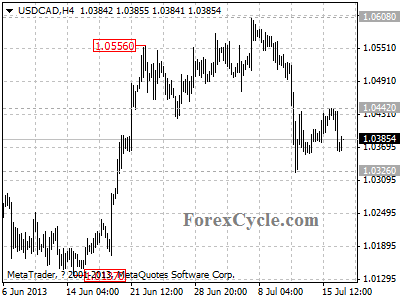
USDCAD stays in a trading range between 1.0326 and 1.0442

USDCAD stays in a trading range between 1.0326 and 1.0442. As long as 1.0442 resistance holds, the price action in the range could be treated as consolidation of the downtrend from 1.0608, another fall towards 1.0150 is still possible after consolidation. On the upside, a break above 1.0442 resistance will indicate that lengthier correction of the downtrend from 1.0608 is underway, then further rally to 1.0480 – 1.0500 area could be seen.

usdcad

Provide by ForexCycle.com