Monetary Policy Week in Review – Jul 8-12, 2013: 2 major banks raise rates, 2 cut as markets yo-yo over Fed policy

By www.CentralBankNews.info
    This week two major emerging market central banks raised rates while two minor banks cut rates as global financial markets continued to yo-yo in response to the U.S. Federal Reserve’s valiant attempts to be transparent over its plan to normalize monetary policy and exit quantitative easing.
    It was always clear that the process of winding down asset purchases would be tricky, not only because financial markets have grown accustomed to the steady supply of free money but also because there is no road map for central banks to follow.
    But to observe Federal Reserve Chairman Ben Bernanke’s heroic attempts to explain the difference between a “highly accommodative” policy stance (a reference to the exceptionally low federal funds rate) and “increased policy accommodation” (a reference to asset purchases) is bordering on the surreal.
    While there are many benefits to investors and financial markets from central banks’ move toward more open communication, greater asset price volatility seems to be one of the drawbacks when policy makers are navigating unchartered waters and basing decisions on real-time economic data.
    As a general rule, financial markets typically overreact to unexpected changes in central banks’ policy so the sharp rise in bond yields in May and June – probably an excessive rise – was entirely rational as Bernanke’s consistent message was that the days of ultra-easy U.S. monetary policy are on the wane.
    But to ensure that the rise in bond yields doesn’t derail the economic recovery – a fear already voiced by the Bank of England and the European Central Bank – Bernanke then reminded markets that the “highly accommodative monetary policy” (i.e. short-term rates) will be needed for the foreseeable future, and the Fed would respond if financial conditions tighten too much – a clear reminder that the “Bernanke Put” is still alive and well.
    The spillover from the change in U.S. monetary policy to emerging markets has been widespread since early May, triggering intervention in foreign exchange markets and contributing to at least one rate hike to dampen the outflow of capital and a sharp decline in currencies.
    This week the central banks of South Korea, Mexico and Serbia – which all held their rates steady  – referred to the tapering of U.S. asset purchases as a downside risk to growth due to the rise in local bond yields and currency depreciation.
    But it was interesting that Mexico described the rise in bond yields and a decline in its currency as taking place in “orderly fashion” and this would not lead to inflationary pressures due to the slack in the economy.
    By downplaying the impact of the fall in the peso in May and early June – the peso rebounded in late June – the Mexican central bank confirmed that the impact on emerging markets from an eventual tightening of U.S. monetary policy is unlikely to be as dramatic as in the 1980s and 1990s when financial crises followed.
    The Bank of Thailand, which also held rates steady this week, looked at the other side of the coin of an expected tapering of U.S. asset purchases, noting improvements in the U.S. economy from better housing and labour market conditions.
    Another central bank to look at the bright side was the Bank of Japan, which for the first time in two years used the word “recovery” to describe its economy. And while it is clear that the economy is strengthening, it is still early days and prices are still falling. The BOJ’s confidence may be growing, but it still adds the adjective of “moderate” to the describe the recovery.
    But while the U.S. and Japanese economies appear to be strengthening, the slowdown in China has hit economies worldwide. The Bank of Korea, which also held rates steady, and Thailand specifically pointed to the negative impact of China while the central banks of Malaysia, Chile and Russia – which also maintained their rates – merely referred to the weak global environment.
    The surprise of the week came from the Bank of Indonesia, which raised rates by 50 basis points – markets had expected a 25 point rise – signaling that it will go to great lengths to contain inflationary expectations and stop any second-round effects from the government’s long-awaited rise in fuel prices.
    The Central Bank of Brazil also hiked rates by 50 basis points, a move that was largely expected, illustrating the same determination to avoid a further rise in inflation, an even more present danger due to the recent depreciation of Brazil’s real and Indonesia’s rupiah.
    This week’s two rate cuts came from Latvia and Tajikistan, with both central banks taking advantage of low inflation to stimulate growth. Latvia, which cut its rate by 50 basis points to 2.0 percent, also needs to slowly narrow the gap to the European Central Bank’s 0.50 percent refinancing rate, before becoming the 18th nation to use the euro from January 1, 2014.
    Through the first 28 weeks of this year, central bank policy rates have been cut 69 times, or 24.8 percent of the 274 policy decisions taken by the 90 central banks followed by Central Bank News, slightly down from 25.4 percent last week and 24.9 percent the previous week.
    While the global trend remains firmly toward lower policy rates, the number of rate rises has been inching up ever so slowly. Policy rates have been raised 14 times this year, accounting for 5.1 percent of all decisions, up from 4.6 percent last week.
     Last week 10 central banks maintained their rates, including the central banks of Thailand, Kenya, Japan, Korea, Serbia, Malaysia, Peru, Mexico, Russia and Chile.

    LAST WEEK’S (WEEK 28) MONETARY POLICY DECISIONS:

COUNTRYMSCI    NEW RATE          OLD RATE       1 YEAR AGO
THAILANDEM2.50%2.50%3.00%
KENYAFM8.50%8.50%16.50%
TAJIKISTAN6.10%6.50%6.80%
BRAZILEM8.50%8.00%8.00%
JAPANDM                N/A                N/A0.10%
KOREAEM2.50%2.50%3.00%
SERBIAFM11.00%11.00%10.25%
INDONESIAEM6.50%6.00%5.75%
MALAYSIAEM3.00%3.00%3.00%
LATVIA2.00%2.50%3.00%
PERUEM4.25%4.25%4.25%
MEXICOEM4.00%4.00%4.50%
RUSSIAEM8.25%8.25%8.00%
CHILEEM5.00%5.00%5.00%

    Next week (week 29) is quiet on the monetary policy front, with only two banks scheduled to hold policy meetings: Canada and South Africa. On Friday the 19th, finance and labor ministers from the Group of 20 meet in Moscow.

COUNTRYMSCI             DATE              RATE       1 YEAR AGO
CANADADM 17-Jul1.00%1.00%
SOUTH AFRICAEM18-Jul5.00%5.00%

    www.CentralBankNews.info

Why a Recession for the U.S. Economy Within the Next 12 Months Is Inevitable

By Profit Confidential

120713_PC_lombardiOne fact has become quite clear: if we want to see robust growth in our gross domestic product (GDP), then there needs to be a significant change in consumer spending.

But current consumer spending in the U.S. economy is looking bleak, and it makes me skeptical about the GDP growth ahead. We’ve already seen GDP in the first quarter revised lower due to consumer spending; and it won’t be a surprise to me if something similar happens in the second quarter.

Don’t just take my word for it. Look at what the CEO of Family Dollar Stores, Inc (NYSE/FDO), Howard R. Levine, said about consumer spending while presenting his company’s corporate earnings for its fiscal third quarter (ended June 1, 2013):

“Our consumables sales remained strong and we continued to gain market share. However, our discretionary sales remained challenged as our customers have been forced to make spending choices between basic needs and wants. Consistent with market trends, we expect that our customers will continue to face financial headwinds…” (Source: “Press Release; Family Dollar reports Third Quarter Results,” Family Dollar Stores, Inc. web site, July 10, 2013.)

Remember: retailers like Family Dollar Stores see the patterns of consumer spending first-hand—their opinions shouldn’t be taken lightly.

More proof that consumer spending (which makes up a major portion of our GDP) isn’t as robust is the fact that wholesale trade sales are down and inventory figures are up. Inventories at wholesalers in May were up 3.3% as compared to a year ago. And inventories of durable goods were up 4.8% in the same period. (Source: U.S. Census Bureau, July 10, 2013.)

Inventory build-up is an indicator suggesting consumer spending isn’t what it was expected to be. In addition, surging durable goods inventories also suggest that consumers are not spending on their wants, but instead focusing on their needs for now.

Consumer spending on nondurable goods—goods that don’t last for long periods of time, like clothing—isn’t great either. From the fourth quarter of 2012 to the first quarter of 2013, real personal consumption—consumer spending adjusted for price changes—increased by just $14.6 billion, or 0.7%. (Source: Federal Reserve Bank of St. Louis web site, last accessed July 11, 2013.)

I can’t stress this enough: consumer spending won’t improve and the GDP will remain depressed until the average Joe American feels confident spending money.

Nothing has changed in the U.S. economy. The daily struggle for many Americans continues. Following the financial crisis, many Americans are now working at jobs that pay minimum wage or have part-time positions, while others are losing their skills the longer they are out of work.

That’s why I’m predicting the opposite of what so many analysts and economists are forecasting: they see growth, while I see the U.S. headed back to a recession within the next 12 months.

Michael’s Personal Notes:

Did the Federal Reserve just tell us it wants much higher inflation?

In the most recent meeting minutes from the Federal Open Market Committee (FOMC), it said:

“Most [members], however, now anticipated that the Committee would not sell agency mortgage-backed securities (MBS) as part of the normalization process, although some indicated that limited sales might be warranted in the longer run to reduce or eliminate residual holdings. A couple of participants stated that they preferred that the Committee make no decision about sales of MBS until closer to the start of the normalization process.” (Source: “FOMC Minutes,” Federal Reserve, July 10, 2013.)

Simply put, the majority of the members of the FOMC think the Federal Reserve shouldn’t sell the MBS it has accumulated on its balance sheet through its multiple rounds of quantitative easing.

While the key stock indices rally, and stock advisors continue to say we are going much higher, if the Federal Reserve doesn’t go ahead with this action and keeps the MBS on its balance sheet, this move could have serious implications ahead.

Mark my words: the biggest problem will be inflation.

This is how it works: if the Federal Reserve keeps the MBS it has bought from banks for the sake of providing liquidity to the financial system, then that will increase the money supply—which always causes inflation.

Take a look at the chart below. This chart sums up the relationship between the money supply and inflation. It compares M2 money stock (a measure of money supply and the consumer price index as indicated by the black line) and the “official” measure of inflation (marked by the red line).

M2-Money-Supply-Index

   Chart courtesy of www.StockCharts.com

Clearly, the correlation between money supply and inflation is very high and shouldn’t go unnoticed.

My problem is that the Federal Reserve still hasn’t stopped quantitative easing. The damage has already been done—through quantitative easing, the Federal Reserve has inflated its balance sheet to more than $3.0 trillion, and the money supply has increased significantly. Just like throwing more fuel on a fire, the continuation of quantitative easing will only make inflation soar higher.

We are already seeing some inflation, even if the official numbers suggest otherwise. Some mainstream economists are even saying we may see deflation ahead. They will soon find out they are wrong.

Dear reader, I am a consumer, and I go out and shop. I notice that the price of gas has increased substantially, and containers of our favorite foods are shrinking in size with a “no price change” tag slapped on them. Inflation will get much worse, and possibly even get out of control, unless the Federal Reserve starts pulling back on its $85.0 billion-a-month printing program.

Article by profitconfidential.com

Why the Federal Reserve’s Latest Announcement Should Worry You

By Profit Confidential

Did the Federal Reserve just tell us it wants much higher inflation?

In the most recent meeting minutes from the Federal Open Market Committee (FOMC), it said:

“Most [members], however, now anticipated that the Committee would not sell agency mortgage-backed securities (MBS) as part of the normalization process, although some indicated that limited sales might be warranted in the longer run to reduce or eliminate residual holdings. A couple of participants stated that they preferred that the Committee make no decision about sales of MBS until closer to the start of the normalization process.” (Source: “FOMC Minutes,” Federal Reserve, July 10, 2013.)

Simply put, the majority of the members of the FOMC think the Federal Reserve shouldn’t sell the MBS it has accumulated on its balance sheet through its multiple rounds of quantitative easing.

While the key stock indices rally, and stock advisors continue to say we are going much higher, if the Federal Reserve doesn’t go ahead with this action and keeps the MBS on its balance sheet, this move could have serious implications ahead.

Mark my words: the biggest problem will be inflation.

This is how it works: if the Federal Reserve keeps the MBS it has bought from banks for the sake of providing liquidity to the financial system, then that will increase the money supply—which always causes inflation.

Take a look at the chart below. This chart sums up the relationship between the money supply and inflation. It compares M2 money stock (a measure of money supply and the consumer price index as indicated by the black line) and the “official” measure of inflation (marked by the red line).

M2-Money-Supply-Index

               Chart courtesy of www.StockCharts.com

Clearly, the correlation between money supply and inflation is very high and shouldn’t go unnoticed.

My problem is that the Federal Reserve still hasn’t stopped quantitative easing. The damage has already been done—through quantitative easing, the Federal Reserve has inflated its balance sheet to more than $3.0 trillion, and the money supply has increased significantly. Just like throwing more fuel on a fire, the continuation of quantitative easing will only make inflation soar higher.

We are already seeing some inflation, even if the official numbers suggest otherwise. Some mainstream economists are even saying we may see deflation ahead. They will soon find out they are wrong.

Dear reader, I am a consumer, and I go out and shop. I notice that the price of gas has increased substantially, and containers of our favorite foods are shrinking in size with a “no price change” tag slapped on them. Inflation will get much worse, and possibly even get out of control, unless the Federal Reserve starts pulling back on its $85.0 billion-a-month printing program.

Article by profitconfidential.com

How to Make the Current Oil Situation Work for You

By Profit Confidential

How to Make the Current Oil Situation Work for YouThe spot price of oil is worth keeping a sharp eye on. With West Texas Intermediate (WTI) oil having jumped past $105.00 a barrel, oil stocks are moving again.

Geopolitical tensions certainly have added a bit of a premium to oil prices, but there’s been resilience in spot well over the last couple of months, and it’s based on the prospects of a stronger U.S. economy.

And that strength in oil prices, while never helpful for consumers, is happening in the face of the highest amount of U.S. crude oil production in 20 years.

The primary consequence of stronger oil prices for the consumer is obviously the bill at the pump. But it’s also in the infrastructure that is struggling to keep up with the production boom. U.S. oil production has overtaken pipeline capacity and railroads are making up for the transportation gap.

In the first half of 2013, 356,000 carloads of crude oil and refined petroleum products were moved by rail, according to the Association of American Railroads (AAR). This equates to 1.37 million barrels of oil being shipped every day, according to the U.S. Energy Information Administration (EIA).

There is now a 60,000-car order backlog for oil railcars in the U.S. market.

Based on the latest 2013 monthly output numbers, the EIA says the U.S. is producing 7.2 million barrels of crude oil per day. The majority of the increase in rail transportation of the commodity is due to the huge growth in Bakken oil production, mostly in North Dakota—which doesn’t have enough pipeline capacity. (I’ll be travelling to the Bakken oil region shortly for a first-hand account of the production boom.)

The EIA recently noted that the increased transport of Bakken oil by rail has narrowed the difference in oil prices between Bakken crude and international benchmark Brent crude oil to less than $5.00 a barrel. According to the agency, a declining spread between benchmarks reduces the incentive to ship oil to coastal refineries.

So the numbers are very clear: U.S. oil production is rising, along with the fast-growing trend of transporting oil by rail; but oil prices are not falling with the increased supply. The consumer is paying more, while investors reap the profits.

And oil stocks are moving commensurate with stronger oil prices. I still maintain the view that most investors should definitely consider some exposure to the large-cap oil and gas energy industry as part of a long-term equity portfolio.

Alternative energy is also attractive, but definitely more speculative and often without dividend income. (See “How Rising Oil Prices Can Help Your Portfolio.”)

Keep in mind that WTI oil prices are up approximately $20.00 per barrel from this time last year. With the summer driving season in full swing and lasting geopolitical tensions in the Middle East, oil prices are likely to stay high.

Solely from the investor’s perspective, it should continue to be a good year for the large, integrated energy companies. But it’s not one consumers will enjoy.

Article by profitconfidential.com

Why This Cold Prairie State Is an Investment Hotspot

By Profit Confidential

Why This Cold Prairie State Is an Investment HotspotWhen it comes to petro-dollars, North Dakota isn’t the first place you might think of—but soon it will be. The aggressive efforts to develop shale oil have turned North Dakota into one of the top states for growth and employment nationwide.

Since oil first started to be processed from shale formations, the development has been rapid. And today, the amount of oil produced from shale via the fracking technique (the breaking of shale formation using a water, sand, and chemical mixture to access the commodity below) has intensified.

In fact, if you add the proposed oil from Canada’s oil sands, the U.S. will become much less dependent on oil from the volatile Middle East. Texas oil magnate T. Boone Pickens is probably giddily thinking of the investment opportunities, as he has long been an opponent of oil from the Organization of the Petroleum Exporting Countries (OPEC), the largely Middle Eastern oil cartel.

A clear indication of the impact of shale oil can be seen in the monthly report from OPEC. According to the report, OPEC predicts a decline in its market share due to the influx of shale oil (Source: Lawler, A., “OPEC to lose market share to shale oil in 2014,” Reuters, July 10, 2013.)

The growth of shale oil will likely only quicken as new sites are developed and related technology improves. In fact, after Texas, North Dakota is the next biggest producer of oil nationwide—accounting for roughly 10% of the U.S.’s current daily production. (Source: Austin, S., “North Dakota Oil Boom,” Oil-Price.net, August 13, 2012, last accessed July 11, 2013.)

And while there are numerous players in the production of shale oil, one of the key ones in North Dakota’s Bakken oil fields is Continental Resources, Inc. (NYSE/CLR). The company controls nearly one million net acres in the region.

Continental Resources Inc Chart

Chart courtesy of www.StockCharts.com

In the first quarter, Continental Resources reported net production of about 121,500 barrels oil equivalent (BOE) daily, which included 76,900 BOE from its Bakken shale play in North Dakota and Montana. And the projections are extremely bullish, as the company has targeted a whopping 603,000 BOE for its North Dakota wells, along with 430,000 BOE for its wells in Montana. (Source: “Continental Resources Reports First Quarter 2013 Results,” Yahoo! Finance, May 8, 2013, last accessed July 11, 2013.)

If these numbers pan out, it would become one of the world’s top oil-producing areas, accounting for around 3.3% of OPEC’s current total daily production.

Another key player in the Bakken region is Whiting Petroleum Corporation (NYSE/WLL), with close to 600,000 net acres in North Dakota.

So while OPEC will continue to dominate the global oil market, the state of North Dakota is becoming the biggest big-oil sensation in North America since the tar sands in Alberta. That’s bad news for OPEC, but good news for investors.

Article by profitconfidential.com

Money Weekend’s Technology FutureWatch 13 July 2013

By MoneyMorning.com.au

TECHNOLOGY:

If You Think 3D is Cool, 5D Will Blow Your Mind!

We’re not specifically talking about a new type of visual wizardry here. It’s not about going to the movies to watch Ironman 4 or Fast and The Furious 7 in the 5th dimension.

What we’re talking about is a new breakthrough that could mean all your digital data is safe and secure, forever. Well actually the timeframe is more like one million years, but that’s pretty much forever right?

Scientists at the University of Southampton have recorded and retrieved five-dimensional digital data. They’re saying that this technique means, ‘360 TB/disc data capacity, thermal stability up to 1000°C and practically unlimited lifetime.’

This kind of breakthrough is nanotech science at its finest. Using nanoscale lasers in glass crystals they were able to store a 300kb digital text file in all five dimensions. Just in case you weren’t sure, the extra two dimensions aside from the normal three are size and orientation.

The scientists have coined the crystals the ‘Superman Crystals’ for their resemblance to the ‘memory crystals’ from the Superman movies.

But superheroes aside, the university is now looking for commercial partners to bring this new kind of data storage to commercial reality.

Commercialisation of this tech is a part of the explosion of Big Data. If you’re unaware, Big Data is the term given to the unbelievable amounts of data we now generate in the world.

To understand how much data, we’re talking in the realm of Zetabytes. One Zetabyte is the equivalent of streaming the entire Netflix catalogue 3.17 million times. With all that data, it needs to be stored somewhere. And traditional storage systems are simply running out of space.

Thankfully scientific research will more often than not help solve our problems. And with this kind of breakthrough our Big Data problem will stop becoming a problem and start becoming a benefit.

ENERGY:

You Can Rely on The Dutch to Try Something the Rest of The World Won’t

The Netherlands is a progressive country, from the liberal city of Amsterdam to piezo-electric dancefloors. They’ve always had a very forward approach towards the liberties and living standards of their citizens.

As well as having (on average) the tallest citizens in the world, certain studies also suggest they’re the happiest country in the world. And we’re starting to see why.

Imagine living in a country that looks to the future and thinks about the big issues that face its people. A country where they do their upmost to plan and implement the means to allow free and happy living for all citizens. We’d be pretty happy too in that environment.

Don’t get me wrong, the Netherlands have their fair share of issues too. But on the balance of it, it’s an innovative, progressive country. And the same goes for Dutch companies too. There are a number of innovative Dutch companies that look to the future and think about ways to make the world a better place.

Fastned is one of those progressive companies. Back in January 2012, Fastned approached the Dutch Ministry of Infrastructure. Their goal was to get permits to deploy 245 electric charging points at services stations across the Netherlands.

By the 16th of January (within a couple of weeks) Fastned had approval for 173 stations. Straight away they began the process to build electric charge-stations across the country. Now that’s how the application process should work in all government!


electric car charging station

 Source: Fastned

Fastned are currently in progress with their lofty goal. All stations are due for completion at the end of 2015. When it’s finished you’ll be able to drive across the Netherlands in an electric car and never be more than 50kms away from a charging station.

As Fastned explain on their company website, ‘Chicken-or-egg — If you cannot charge your battery, you will not be able to drive an electric car. As long as there are few fast-charging stations, electric vehicle adoption will be limited and vice versa.

They’re on track to make the Netherlands the most populous nation to roll out an electric car charging network. It’s this kind of forward thinking and innovation that hopefully sets the scene for other countries to follow.

HEALTH:

This Could Be the Silver Bullet for Cancer Treatment

It seems as though there are a lot of very smart scientists at the University of Southampton. Aside from the ‘Superman Crystals’ mentioned earlier, another group of scientists from the University have discovered a new way to kill cancer cells.

This particular method of cancer fighting is different to traditional methods. This new way keeps healthy cells alive and only attacks the cancerous cells.

Importantly this isn’t a target treatment for one particular type of cancer cell. The discovery includes the ability to attack various types of cancer.

What the researchers have done is use a molecule from our own body, the CD27 molecule, manipulate it and have it fight cancer. Not only is this discovery breakthrough, the university now holds it as a patent in the US.

With a new method to fight cancer and now a patent under their belt, this means a spin-off company is likely, which means commercial opportunities. This is one we’d be keeping an eye on.

There are numerous efforts to rid the world of cancer, or at least make a big dent in its occurence. Inevitably there will be a cure, but it might not necessarily come in the way we’d all hope.

When most people think of a cure for cancer, the vision is of a pill or injection. In this case and in all reality it’s likely that we’ll have multiple cures of cancer in the future. And it will be nano sized techniques and methods of going about it.

However, we all hope for a ‘silver bullet’. As unlikely as that may be, this kind of research from the University of Southampton is the first step in maybe one day getting the complete cure we need.

Sam Volkering+
Technology Analyst, Revolutionary Tech Investor

From the Archives…

The Power of Low Interest Rates Coming to the Aussie Market
5-07-2013 – Kris Sayce

S+P 500 Downtrend Looms? Counting Down The Days…
4-07-2013 – Murray Dawes

Here’s Your Six-Point Stock Buying Checklist
3-07-2013 – Kris Sayce

Are the Credit Rating Agencies at it Again?
2-07-2013 – Kris Sayce

Why This Could be Another Great Year for Australian Stocks…
1-07-2013 – Kris Sayce 

On the Hunt for the Next Great Elephant Oilfield

By MoneyMorning.com.au

There’s no law in the market that oil and gold have to move together. But when they begin to diverge in a big way, like now, it pays to wonder why. Maybe BHP has the answer. It’s put Texas tea on the drinks menu, at the top of the list. So today’s Money Weekend will journey across the Pacific to visit the great American energy boom looking for answers…

Behind the Numbers, a Changing World

Actually, it’s wrong to suggest all the energy action in North America is in Texas. The new drilling technology is unlocking supply from Canada to North Dakota to the Atlantic states.

To get an idea of the North American energy boom, check this out: 2012 saw the largest growth in oil production in US history. That’s according to the June release of the BP Statistical Review of World Energy. The oil biz in the US goes all the way back to Colonel Drake in 1859.

To be clear, BP is looking at the figures from 2012. But stepping back from the day to day data and news is probably more fruitful for tracking the big trends.

Here’s a curious point: on a net basis last year, the oil market didn’t change that much in 2012. Growth was a pretty meagre 1.3%. But in a regional sense, it’s no exaggeration to say the oil market is being completely remade, or in the spirit of Joan Rivers, ‘reworked’.

A Visual Metaphor For the Oil Market?


Source: Google

You can boil it down to this: US net imports have fallen 36% from their 2005 high. Meanwhile, China accounts for 86% of the growth in net imports in the same period. That’s huge. While North America drives the supply boom, China revs the demand.

But the thing that jumped out at us from this report is the fact that oil is actually losing market share. That’s as a percentage of global energy consumption. It’s at 33.1% and in the 13th consecutive year of decline. 

Why that jumped out at us is because nobody seems to be telling the oil traders. The West Texas benchmark hit a 12 month high during the week. 

Oil on the Up


Source: StockCharts

Do they know something we don’t?

For now, that rising chart looks very lucrative if you happen to be a shareholder in a company operating in the energy business. As we said, one of those happens to be BHP.

They told investors at the Global Metals, Mining and Steel Conference a few months back that a US$1 move in the oil price moves their net profit by 45 million either way. The only commodity with a bigger impact on the bottom line is iron ore. 

The brass at BHP maintains that the outlook for iron ore is more robust than the market expects. But they have a pretty handy hedge by having a foot well and truly in the door of the oil and gas industry in the USA.

There’s a kind of tussle between the spreading chaos in the Middle East and other oil producing countries against the uplift in production from North America. There might be a big premium to be had for good reserves in countries that are outside the possible danger zones.  

That’s an idea Dan Denning over at The Denning Report says is worth following. That’s largely what he’s positioned his readers for. Norway, USA and Australia look a lot less risky and a whole lot more lucrative than Venezuela, Iran or the Sudan when it comes to speculating in energy on higher oil prices

BHP’s Big Oil Play in the USA

Of course, you need to have the reserves in place to capitalise if oil does go higher. For BHP, the most exciting prospect today is in the South Midland section of the ancient Permian basin in West Texas.

Apparently it’s no exaggeration to say this might be the biggest oilfield after Ghawar, Saudi Arabia. Ghawar has been producing for decades — the biggest ‘elephant’ oilfield of all time. 

You probably already know that the Permian basin can’t replicate the cost base of Saudi Arabia. The oil of the Permian is very deep plus hard and expensive to access. But it makes up for it in possible size. It’s estimated to be 50 billion barrels. It could be triple that. Nobody knows for sure.

According to the International Energy Institute, the world currently uses 89 million barrels a day. That’s 32 billion barrels a year. So the Permian could have over one year of global supply, at least.

That’s the industry aspect of it. The geopolitical side is even more intriguing. Take this from the Australian Financial Review on Tuesday:

‘[Oil production from the Permian basin] would speed America on its path to topple Saudi Arabia as the largest oil producer, slash US imports, mute price spikes from Middle East unrest and even make substantial US oil exports feasible.’

That’s pretty high stakes in anyone’s books. That reminds us of something rogue economist Phil Anderson said in his Remembering the Future presentation: lower energy costs thanks to North America (if the Middle East can stay stable) could allow Ben Bernanke to get away with prodigious money printing. Phil argued deflation in energy costs will nullify the inflation of the US money supply. There seems to be some big assumptions in THAT argument.

We suppose there usually is in any investing case. For now, it’s telling that the world’s largest diversified miner has made oil and gas one of its four major pillars. It might pay for investors to think on similar lines.

Callum Newman+
Editor, Money Weekend

Join Money Morning on Google+

From the Port Phillip Publishing Library

Special Report: The Sixth Revolution

Daily Reckoning: Why Natural Gas Could Save Us From an Impending Energy Crisis

Money Morning: Red Alert: Why This Stock Market Rally is a Trap

Pursuit of Happiness: Make Sure You’re Not a Property Investing ‘Loser’

Central Bank News Link List – Jul 12, 2013: China may scrap floor for bank lending rates – paper

By www.CentralBankNews.info Here’s today’s Central Bank News’ link list, click through if you missed the previous link list. The list comprises news about central banks that is not covered by Central Bank News. The list is updated during the day with the latest developments so readers don’t miss any important news.

Mexico holds rate steady as downside growth risks rise

By www.CentralBankNews.info     Mexico’s central bank held its benchmark target for the overnight rate steady at 4.0 percent, saying this policy stance is consistent with a lack of inflationary pressures,  slower economic growth and the fragile and volatile international financial markets.
    The Bank of Mexico, which cut its rate in March, said recent information suggest that the economic slowdown since the second half of last year “worsened significantly” in the second quarter of this year, reflecting lower exports and weak domestic spending.
    Like other emerging market economies, Mexico’s peso has depreciated in recent months due to expectations of changes to U.S. monetary policy and long-term interest rates have “increased considerably,” increasing the downside risks to Mexico’s economy, the bank said.
    However, the central bank said the rise market interest rates and the decline in the peso had been in an orderly fashion and economic activity is expected to improve in the next half year, a slightly less pessimistic outlook than in its previous statement from June.
    Although the fall in peso will generate some inflationary pressures, the central bank was not overly concerned and said the overall balance of risks to inflation had improved with the slack in the economy limiting the transfer of exchange rate changes to overall prices.


    Mexico’s inflation rate eased to 4.09 percent in June from 4.63 percent in May, and the central bank – known as Banxico – said it expects the downward trend to continue in coming months with inflation between 3 and 4 percent in the third and fourth quarters of this year.
    Next year, inflation is expected to be “very close to 3 percent” – the central bank’s target – the same forecast the bank gave in June.
    Mexico’s peso rose gradually in the first four months of the year but from early May to late June it fell by 10 percent against the U.S. dollar, along with other emerging market currencies, as major investors re-evaluated their exposure to riskier markets, withdrawing capital.
    But since June 24, Mexico’s peso has rebounded and is largely unchanged from the beginning of the year, quoted at 12.82 to the U.S. dollar today compared with 12.84 on January 1.
    Mexico’s economy slowed sharply in the first quarter with Gross Domestic Product up by only 0.45 percent from the fourth quarter, and annual growth of only 0.8 percent, down from a rate of 3.2 percent in the previous quarter, the slowest rate since the 2009 recession.

    www.CentralBankNews.info

Apple Inc. Is Signaling a 5% Drop on Rising Wedge

Article by Investazor.com

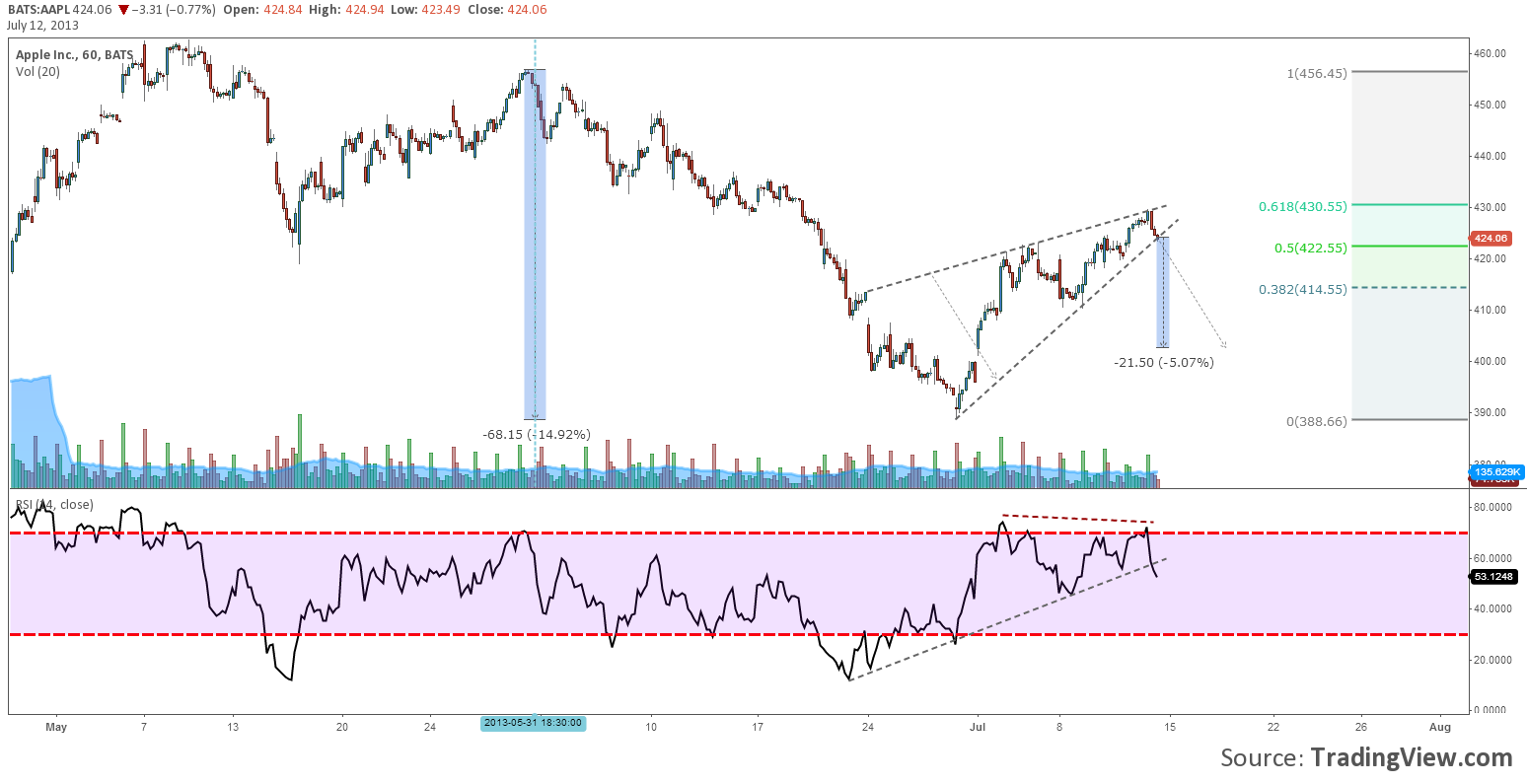
aapl-might-fall-5-percent-12.07.2013

Chart: AAPL, H1

The stock of the week is Apple Inc. with a pretty interesting price pattern.  After the 15% drop started at the beginning of June the stock managed to gain back 61.8.

On the way up the price started drawing a Rising Wedge, which topped at 430.50$ per share. The price pattern was formed during the last 3 weeks. In all this time it can be observed that the volume started to drop. Next to this signals we can also add the 14 periods RSI which has made a negative divergence and it dropped under its trend line.

Now the price got very close to the apex of the pattern. The width of the Wedge is 21.50 dollars. If the pattern will be confirmed by a close, on a one hour chart, under the lower line, we can expect for the stock to lose at least 5%. Why at least? Because if we look at the trend, it is descending, so a new drop might become another impulse for the current main trend.

Even though our favorite scenario is on the down side, we have a backup. If the price will break and close above 431$ per share we will revise our analysis.

The post Apple Inc. Is Signaling a 5% Drop on Rising Wedge appeared first on investazor.com.