Is the ‘Abe Trade’ Still in Play?

By The Sizemore Letter

The votes have been counted.  Japan’s Liberal Democrats—the party of Prime Minister Shinzo Abe—won a landslide victory over the weekend, securing control of both houses of parliament.

The implications here are huge.  Abe is as close as you can get in modern Japan to a militant nationalist, and the win will only encourage him to escalate his war of words with China.  Abe is pushing for a re-write of Japan’s constitution that would scrap some of the pacifist language written in by the United States after Japan’s surrender in World War II.

All of that is fine and good, but the question on most investors’s minds is far more focused: what does this mean for Abenomics and the “Abe Trade” of going long Japanese equities and short the yen?

Japanese stocks were mostly flat after the news, suggesting that there were no real surprises.

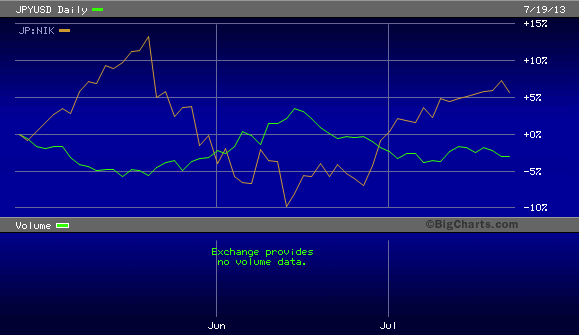
Japan

Looking over the past few months, we get a more interesting story.  The Japanese Nikkei Index (orange line above) took a tumble in May and early June, falling into bear market territory.  Yet taking a lot of investors by surprise, the Nikkei has since rallied and gained back most of its losses.

The yen (green line), which has moved the opposite direction, rallied over the period before giving most of the gains back.

So, it would appear that the Abe Trade is back on…at least for the time being.

If you are a short-term trader or trend follower, then there may be a little money left to be made in this trade.  By all means, go for it. But be careful, and make sure you have some kind of risk management in place.

If you are a longer-term investor or if you are less-inclined to monitor your positions closely, stay out of Japan.  Being long Japan is comparable to picking up nickels in front of the proverbial steam roller.  If you linger too long, you will get crushed.

While I try to stay objective and avoid looking at the markets through biased eyes, I admit fully that I have become something of a Japan permabear.  When I look at the country’s macro environment, I do not see any set of circumstances whereby this doesn’t end poorly.  At 240% of GDP, Japan’s sovereign debts are the highest in the developed world, and by a wide margin.  Its population is aging and shrinking (see Jeff Reeves’ recent article about the Japanese boom in adult diaper sales) meaning its tax base to support its debts gets smaller every year.  And it adds to this mountain of debt with a budget deficit of nearly 10% of GDP.

All it would take for Japan to descend into a financial meltdown would be for its bond yields to rise by a couple percentage points…which is a virtual inevitability given the country’s borrowing needs.

And topping it off, after their torrid run, Japanese shares are no longer cheap.  The Nikkei trades for 16 times expected 2014 earnings.

When will Japan’s day of reckoning come?  Frankly, I have no idea.  It will come when investor sentiment shifts and investors suddenly perceive the risk that has been there all along.  It could happen tomorrow…or it could happen in a few years’ time.  But happen it will.

If you want to continue to play the Abe trade, the second half—shorting the yen—is the less risky option.  If I am correct about Japan eventually blowing up, then the yen will fall to zero…or close to it.

If you decide to play the first half—going long Japanese equities—do so with the mentality of a short-term trader and use proper risk management.  Japan is not a long-term buy because Japan has no long-term future.  If you need a reminder, print off Jeff’s article on Japanese adult diapers and tape it to your wall.

SUBSCRIBE to Sizemore Insights via e-mail today.

Hungary cuts rate 12th time, pace of easing may change

By www.CentralBankNews.info     Hungary’s central bank cut its base rate for the 12th time in a row to help boost economic activity and inflation but added that it may change the “pace or extent of policy easing over the coming months” due to “the significant reductions in interest rates so far and the volatile conditions in financial markets.”
    The National Bank of Hungary, which has now cut rates by 175 basis points this year alone, said inflationary pressures are likely to remain moderate in the medium term due to the “significant degree of spare capacity in the Hungarian economy” and data confirm that weak demand has exerted a strong disinflationary impact as firms have limited ability to raise their prices.
    A 25 basis point cut in the bank’s base rate to 4.0 percent should help ensure that inflation rises toward’s the central bank’s 3.0 percent target, but the increased volatility in financial markets and the uncertain outlook for global growth pose a risk and this “calls for maintaining a cautious approach to policy,” the bank said, adding:
    “A sustained and marked shift in perceptions of the risks associated with the economy may influence the room for manoeuvre in monetary policy,” the central bank said, signaling that it is getting closer to a more neutral policy stance and the aggressive pace of easing is drawing to a close.
    Since August last year, the bank has cut its base rate by 300 basis points but it is now becoming more cautious about the effect that further rate cuts may have on capital flows and the forint currency.
    In June the central bank also noted that its room for manoeuvre was affected by the shift in market’s perception of risk but it added that it would cut rates as long as the outlook for inflation and the real economy justified such a move. The reference to further rate cuts was omitted in today’s statement.
    Like most other emerging market currencies, Hungary’s forint weakened in May as major investors started to withdraw funds from riskier markets, with the forint falling 4 percent against the euro during the month. But by early June the forint bounced back and is down only 1.6 percent against the euro since the start of this year, quoted at 295.8 to the euro today versus 291 in early January.
    The central bank said there had not been any significant sell-off in domestic assets during the past month and domestic indicators of risk had declined despite uncertain global financial markets.
    Hungary’s inflation rate has been pushed down due to weak demand and the central bank expects underlying inflation to remain subdued in the medium term and the risks are moderate.
    Inflation in June was 1.9 percent, slightly up from 1.8 percent the previous month. The bank said the impact of regulatory price measures from 2002 to 2009 on consumer prices had halved after 2010, indicating a change in the approach of economic policy to inflation.
    “Consequently, inflation in 2013 is expected to fall back to around 3 percent even excluding the effect of the reduction in utilities prices,” the bank said.
    Hungary’s economy, which has been in a deep recession, is showing signs of improvement and the bank said growth is likely to resume this year though it will remain weak.
     In the first quarter of this year, Hungary’s Gross Domestic Product expanded by 0.7 percent from the previous quarter – the strongest quarterly growth rate in eight quarters. However, on an annual basis, the economy contracted by 0.9 percent, the firth quarter with a negative growth rate.

    www.CentralBankNews.info

Gold “Now Heavy” After Historically Strong 1-Month Rally

London Gold Market Report
from Adrian Ash
BullionVault
Tuesday, 23 July 08:55 EST

The PRICE OF GOLD eased back to $1330 per ounce Tuesday morning in London, dropping 0.7% from yesterday’s 5-week highs as commodities slipped with major government bond prices.

 Asian stock markets rose as the Japanese Yen edged lower. European stocks and US equity futures crept 0.2% higher.

 “We believe there is a strong element of short covering behind the recent buying in gold,” says one broker’s note, pointing to the record-large number of bearish bets held by speculative traders in gold futures.

 “Precious metals are looking heavy,” says Standard Bank’s commodity team in London, saying that gold prices are “sitting on support at $1330.”

 Gold demand in China – the world’s No.2 consumer nation – eased off Tuesday, with premiums for 0.995 fine gold bars traded in Shanghai slipping to $20 per ounce above benchmark London prices, down from $37 a fortnight ago.

Yesterday saw new gold bullion import rules in India, with the Reserve Bank demanding that importers set aside one-fifth of new shipments for re-export.

 India’s Rupee rallied from record lows, widely blamed on the country’s widening current account deficit.

 Gold imports will fall nearly two-thirds in July-December from 2012, reckons the All India Gems & Jewellery Trade Federation. But “this is an overly pessimistic appraisal,” says Commerzbank, “probably aimed at encouraging the Indian central bank and government to loosen the restrictions.”

 The central bank of world No.4 gold consumer Turkey meantime raised interest rates on overnight loans by 0.25% on Tuesday.

 The Turkish Lira rose from its weakest level to the US Dollar since the revaluation of 2005 knocked 6 zeroes from the currency.

 Rising 12% from June 28th, US gold prices have now beaten the average 1-month gold rally of the last 45 years following drops as bad or worse than April-June 2013.

 Speaking Monday to CNBC, “Gold wants to go higher,” reckons Dennis Gartman, “probably predicated on a continued expectation that the Fed will continue to expand reserves, and so shall too other central banks.”

 The US Federal Reserve meets Tuesday and Wednesday next week to set policy until September.

 “You don’t sell backwardations in any market,” adds Gartman – who said gold was “going lower” on June 24th, but said it was “time to go to the sidelines” 4 days later when gold bottomed at $1181 – “and you specifically don’t sell backwardation in the gold market.”

 Backwardation is when prices for nearer-term delivery are more expensive than future settlement – a rare situation in gold, which incurs storage costs and lost interest on cash over time.

 That creates what’s called “contango”, with prices rising the further ahead settlement is scheduled.

 “[But] I complain about the current claims of backwardation in gold,” counters Nick Laird of gold-chart site ShareLynx, “[because] the spread between the Last/Near Future needs to go below zero for a full inversion.

 “In gold there is little to see except the first couple of months dipping.”

 July gold futures settled Monday at $1336.40 per ounce, 40¢ above the August contract, equal to September, and below all other contract prices.

 “After falling sharply in June on a re-pricing of Fed easing policies, gold prices have [only] stabilized in July,” reckons analysis from investment bank Goldman Sachs.

 Holding its 12-month forecast for the gold price at $1175 per ounce – the 3-year low hit at the end of June – “medium term we expect that gold prices will decline further given our US economists’ forecast for improving economic activity and a less accommodative monetary policy stance.”

 Ending QE and raising rates “is simply a reversal of the process that drove up gold prices from the end of 2008 to mid-2011,” says commodities analyst Gary Clark at Roubini Global Economics.

 “Investors piled into gold ETFs under precisely the opposite conditions: falling real [interest] rates and rising tail risk.”

 US Treasury yields rose Tuesday as gold prices slipped, rising to a 3-session high of 2.52%.

 Inflation was last pegged on the official US Consumer Price Index at 1.8%.

Adrian Ash

BullionVault

Gold price chart, no delay | Buy gold online


Adrian Ash is head of research at BullionVault, the secure, low-cost gold and silver market for private investors online, where you can buy gold and silver in Zurich, Switzerland for just 0.5% commission.


(c) BullionVault 2013

Please Note: This article is to inform your thinking, not lead it. Only you can decide the best place for your money, and any decision you make will put your money at risk. Information or data included here may have already been overtaken by events – and must be verified elsewhere – should you choose to act on it.


Mineral Rich Australia May Contain World’s Next Major Oil Find

By OilPrice.com

Australia’s massive mineral exports allowed it to weather the global recession, which began in 2008, quite nicely.

The U.S. government’s Energy Information Administration noted in its country’s analysis for Australia, “Australia, rich in hydrocarbons and uranium, was the world’s second largest coal exporter in 2011 and the third largest liquefied natural gas (LNG) exporter in 2012. Australia is rich in commodities, including fossil fuel and uranium reserves, and is one of the few countries belonging to the Organization for Economic Cooperation and Development (OECD) that is a significant net hydrocarbon exporter, exporting over 70 percent of its total energy production according to government sources. Australia was the world’s second largest coal exporter based on weight in 2011 and the third largest exporter of liquefied natural gas (LNG) in 2012.”

Six months ago Brisbane company Linc Energy Ltd.Energy released two reports, based on drilling and seismic exploration, estimating the amount of shale oil in the as yet untapped 30,000 square mile Arckaringa Basin surrounding Coober Pedy ranging from 3.5 billion to a mind boggling 233 billion barrels of oil.

If the upper end estimates are correct then it means that the Arckaringa Basin is six times larger than the Bakken, seventeen times the size of the Marcellus formation, and 80 times larger than the Eagle Ford U.S. shale deposits.

To put the potential of the Arckaringa Basin in context, Saudi Arabian reserves are estimated at 263 billion barrels.

So, what next for Linc Energy Ltd.? The company has been in discussions to find a partner to develop the Arckaringa Basin after hiring Barclays Plc to help with the process and expects to narrow the talks to one group in a “few weeks,” according to Linc Energy Ltd. chief executive officer Peter Bond. Bond added that Linc Energy Ltd.is talking with at least four parties from outside Australia interested in the shale oil project in the Arckaringa Basin.

Linc Energy Ltd . said that the characteristics of its Australian acreage “compare favorably” to the prolific Bakken and Eagle Ford shale regions of the U.S. Global energy companies including Chevron, ConocoPhillips, Statoil ASA and BG Group Plc are already making shale investments in Australia.

Australian State Mineral Resources Development Minister Tom Koutsantonis said, “Shale gas and shale oil will be a key part to securing Australia’s energy security now and into the future. We have seen the hugely positive impact shale projects like Bakken and Eagle Ford have had on the U.S. economy. There is still a long way to go, but investment in unconventional liquid projects in South Australia will accelerate as more and more companies such as Linc Energy Ltd.Energy and Altona prove up their resources.”

Natural gas?

Six basins in Australia stretching from coastal Queensland to Western Australia’s far northwest contain recoverable shale resources of as much as 437 trillion cubic feet of gas, all of which was previously inaccessible because it is contained in shale formations, which could be unlocked by “hydraulic fracturing.” But the U.S. Department of Energy predicts that Australia’s shale gas industry will develop at a “moderate pace” because the nation’s shale oil and gas resources do not as yet have the advanced production infrastructure that has underwritten the U.S. production boom.

And what if estimates for the Arckaringa Basin basin pan out? We’ll leave the final word to the EIA, which notes, “Australia’s stable political environment, relatively transparent regulatory structure, substantial hydrocarbon reserves, and proximity to Asian markets make it an attractive place for foreign investment. The government published an Energy White Paper in 2012 that outlines its energy policy including balancing its priority of maintaining energy security with increasing exports to help supply Asia’s growing demand for fuel.”

Accordingly, Adelaide had better upgrade its airport to handle all those energy company corporate jets that may well be visiting soon.

Source: http://oilprice.com/Energy/Crude-Oil/Australia-Next-Petro-Superstate.html

By. John C.K. Daly of Oilprice.com


Turkey raises lending rate, will tighten more if needed

By www.CentralBankNews.info     Turkey’s central bank held its benchmark one-week repurchase rate steady at 4.5 percent but raised its overnight lending rate by a sharp 75 basis points and said it would tighten monetary policy further if necessary to support financial stability.
    The Central Bank of the Republic of Turkey (CBRT), which has been battling to stem the fall in its lira currency, said recent developments had an adverse affect on inflation, including a surge in unprocessed food prices, rising oil prices and the increased exchange rate volatility may continue to adversely impact inflation in the short term.
    “Although the Committee sees these developments as temporary to a large extent, a measured tightening is deemed necessary in order to contain a deterioration in the pricing behaviour,” the central bank said after a meeting of its monetary policy committee.
    “A cautious stance will be maintained until the inflation outlook is in line with the medium term targets. In this respect, additional monetary tightening will be implemented when necessary,” it added.
   

Three Qualities That Separate Junior Gold Winners from Losers: Eric Coffin

Source: Kevin Michael Grace of The Gold Report (7/22/13)

http://www.theaureport.com/pub/na/15458

Gold juniors need to get back to the basics, says Eric Coffin, and it is going to take large discoveries to get the market excited again. In this interview with The Gold Report, the publisher of Hard Rock Analyst explains how the new economics of gold production require investors to concentrate on companies with three specific qualities, and names companies and the regions that could generate breakout projects.
The Gold Report: Federal Reserve Chairman Ben Bernanke indicated last month that the Fed would begin to taper quantitative easing in September. The equity markets responded quite negatively to this. In the wake of this response, do you think the Fed is committed to this new policy?

Eric Coffin: I think the Fed is committed to tapering, but I suspect it will happen a little more slowly than some people think. Bernanke’s quite cognizant that when he does taper it’s going to have an impact on the markets. But you can’t keep buying $85 billion worth of bonds a month forever. Bernanke has backed off a bit himself on this issue and was back to using 6.5% as his unemployment target. If the U.S. keeps creating jobs at the pace of 175,000 to 200,000 per month, it will take a long time to get unemployment to 6.5%—probably 18 months or more.

TGR: We’ve seen these hints about a slowing down or an end to quantitative easing (QE) for some time now, haven’t we?

EC: A lot of people in the goldbug community can’t stand Bernanke and I think they give him less credit than he deserves. I think these occasional hints he drops about ending QE early are completely intentional. He’s testing the market to see how it will react and indirectly talking bond yields up in a way that doesn’t induce some full blown panic. I think if we see him say he might move up the QE schedule and the market doesn’t freak out—that will be the time he starts tapering. He’s trying to get us used to the idea.

TGR: We’ve seen gold rebound in July. Why do you think this is happening, and do you think it’s likely to continue?

EC: Some of it, a lot of it really, is due to the Fed backing off on its short-term tapering comments. And it’s partially due to gold falling to $1,180/ounce ($1,180/oz). That’s getting into the range a lot of the technicians were calling as a bottom. I don’t completely accept technical analysis, but a lot of people who trade gold and commodities are chart traders, so you can’t ignore those patterns.

The other factor is that we’ve been getting down to pricing that’s below the all-in cost for the gold mining sector, which means we’re going to see cutbacks in production. This will flush out the supply pipeline pretty quickly. Ironically, it seems the gold market is taking the end of QE more seriously than other markets. I would like to think that means QE ending is partially or even largely priced into the gold market. Unfortunately, we won’t know that for sure until the Fed actually pulls the trigger and decreases the bond buying.

TGR: Do you think that one big discovery could excite the whole market and bring investors back to the table?

EC: This market feels more and more like the markets I saw back in the 1980s and 1990s. That’s not to say I think that the commodity cycle is necessarily over. If you go back to those markets, it was quite common that what would ignite them wasn’t big moves in the commodities. It was almost always two or three big discoveries that really got traders excited and reminded them why they buy these crazy stocks.

I’ve talked myself into chasing companies with resources just because their ounces have gotten cheaper and cheaper over the last two years. While I think those companies will definitely catch bids if the gold price starts moving substantially, my gut feeling is that if you’re looking for really large percentage gains in the near-term, they’re going to come from discoveries.

TGR: Do you think that some regions will come back faster than others?

EC: Areas that are easier from a logistical and permitting point of view, areas that are mining friendly, will probably come back faster. This basically means North America or large swaths of it. Other areas like Central and Eastern Europe also look interesting and have a lot of discovery potential. A number of Central and South American countries—even though they’re good areas geologically—will have a much more difficult time.

TGR: What about Mexico?

EC: Mexico has a couple of pretty big advantages. It has a good mining act and a well-understood and fair permitting system. It has gotten a lot better security-wise. Infrastructure is good in a lot of areas, and basic costs are also good. Mexico’s geology has generated many highly oxidized and relatively soft and brittle deposits. This enables companies to set up heap-leach operations, which means that capital expenditures (capexes) are relatively low.

In the state of Sonora, a half-dozen gold mines have opened up in the last three or four years with average cash costs in the $400–450/oz range. The all-in costs probably aren’t much more than $600–650/oz. By world standards that’s really, really good.

TGR: Could you name some companies in Mexico that you like?

EC: One early-stage company I’m following is San Marco Resources Inc. (SMN.TSX.V). I like the management and I like the targets. San Marco did a joint venture agreement in March with Exeter Resource Corp. (XRC:TSX) that will give it a lot of spending on two of its three projects. I like the La Buena project, which the company probably won’t get to until September, because it’s a nice bulk-tonnage target. If drilled successfully, it could show a lot of ounces quite quickly.

SilverCrest Mines Inc. (SVL:TSX.V; SVLC:NYSE.MKT) is now a producer. The company has really strong management and very good cash costs. It did a great job of building a very successful gold-silver mine, Santa Elena, very cheaply by today’s standards. SilverCrest got the initial heap leach into production for under $30 million ($30M). I’m waiting for a feasibility study on the expansion of Santa Elena with the addition of a conventional mill and underground mining. I know the company has already made the expansion decision, so the report is almost an afterthought. The company will also rerun some of the tailings from the heap-leach operation through that mill because the mill has much higher gold-silver recoveries than a heap leach does. That should bring production up by probably another 50% without bringing cash costs up that much. Current guidance for cash costs is $8.50 per silver equivalent ounce this year, which is pretty good.

SilverCrest also has a bulk-tonnage silver project called La Joya, which it has been drilling for about a year now. The resource is already up to close to 150 million ounces (150 Moz), and the company is not yet done expanding it. SilverCrest has been successful on a lot of fronts.

A company I have a significant holding in, Precipitate Gold Corp. (PRG:TSX.V), recently picked up an option on a gold project in northwest Sonora called Cecilia. I don’t rate Precipitate in the newsletter because I’m too close to it but I like the fact the company is looking in Mexico.

TGR: Do you think the Yukon is still an area play?

EC: Not in the sense that just being in the Yukon is going to give you market cap and financing. It basically comes down to individual companies now and many of the companies involved there a couple of years ago have moved on. There certainly are successful explorers there. Kaminak Gold Corp. (KAM:TSX.V)continues to drill and continues to grow the ounces at its Coffee gold project. ATAC Resources Ltd. (ATC:TSX.V) is still drilling and adding ounces at the Nadaleen Trend in its Rackla gold project. Both of these are mature stories, however, so I do not expect big gains from them unless they add a new discovery or we see a good bump in the gold price.

One company we started following last summer is Comstock Metals Ltd. (CSL:TSX.V). The company has made a discovery that is right across the river from the original Golden Saddle discovery, which Kinross Gold Corp (K:TSX) bought for $140M in 2010 and which really kicked off the area play. Comstock has generated a number of pretty good holes from the VG zone of the QV project, basically 2–3 grams per ton (2–3 g/t) material, up to 4–6 g/t per tens of meters in a flat lying zone or close to a flat lying zone. I think there’s a good chance Comstock will have repetitions of that zone.

Comstock QV Project, Yukon Territory

Comstock has just finished doing a lot of structural mapping, which is helping it sort out the discovery zone. The company just finished its phase 1 drill program and has started phase 2. It just reported the first results from phase 1, which included a couple of holes with 40–50 meters (40–50m) grading about 1.5 g/t. Those were both 150m stepouts. More interestingly, Comstock reported intercepting the zone with hole 17, which you can see on the upper left of the map above. That is a huge stepout—over 600m. There are no assays reported yet from this hole. If it contains even moderate grade that would be important because the hole greatly increased the scale potential of the zone.

I think that if Comstock can find 1–1.5 Moz, that would be enough to push the combined economics of its QV project and Golden Saddle across the river over the finish line. I think the combination of those two deposits would result in something with enough scale for development.

TGR: What other companies are you following in the region?

EC: Just south of the Yukon, in northern British Columbia, is Colorado Resources Ltd. (CXO:TSX.V). It’s trading at about $0.87/share right now, and I was recommending it all through the winter at about $0.15 or $0.20/share. Colorado Resources has the three qualities I look for in mining companies. First, the company has really good technical management. The board of directors is made up of geologists who really know what they are doing.

Second, Colorado Resources has strong projects, one of which, Oro in the Yukon, has been optioned to Gold Fields Ltd. (GFI:NYSE). That project is probably a Carlin model like ATAC’s, but at a much earlier stage. Gold Fields is committed for up to $20M in exploration and just began a $2M exploration program there that will include 3,000m of drilling. Colorado Resources also has a copper-gold porphyry project, North ROK, 10 miles from Imperial Metals Corp.’s (III:TSX) Red Chris mine in British Columbia. The company announced a hole of 242m with 0.85 g/t gold and 0.63% copper in April. Those are very high grades for that area.

Colorado North ROK Geophysics

Third, Colorado Resources has cash. Part of the reason it traded so well was because it had $8M when it started the North ROK drill program. Unlike 80% of the companies out there, Colorado Resources wasn’t at the mercy of the brokers once it made a discovery. It closed a $4M flow-through placement July 11, which should bring it up to about $11M in the bank. The company only has 45M shares out.

There’s lots of room for North ROK to grow. Induced polarization (IP) surveys show about 1.2 kilometers by about 200–300m with coincident anomalies. Plus, the project has a northern anomaly that Colorado Resources hasn’t even touched yet. The “main” anomaly where drilling is ongoing and the new “north” anomaly are shown in the map above. This is a story with legs. The market wants some excitement. Investors want something that they can trade.

To receive a transcript of my recent interview with Adam Travis, president and CEO of Colorado Resources, click here to access it for free.

TGR: What about the other companies in the Red Chris area?

EC: There’s a couple of early-stage ones I’m keeping an eye on. Peter Bernier and some of the other people behind the Blackwater discovery, which was taken out by New Gold Inc. (NGD:TSX; NGD:NYSE.MKT), have started a company called Prosper Gold Corp. (PGX.H:TSX.V), which is now going through the Qualified Transaction process. The company is raising $2.5M, which is earmarked for its project in the Iskut region. Prosper’s neighbor to the east, Doubleview Capital Corp. (DBV:TSX.V), just reported an interesting but subeconomic drill intercept. Doubleview plans to return to its project for more IP and drilling once it has raised some money.

Redhill Resources Corp. (RHR:TSX.V) is interesting because it has about $6–7M in cash and investments. There’s probably 10 to 15 companies that have been able to raise anywhere from $500,000 to $1.5M in the last month thanks to Colorado Resources’ discovery. That is the sort of thing that gets traders to pay attention again.

TGR: Let’s talk about the Dominican Republic. On July 9 GoldQuest Mining Corp. (GQC:TSX.V) reported 260m grading 2.54 g/t gold and 0.6% copper at its Romero property. How significant is this?

EC: It’s pretty hard not to like a hole like that. It was one of two infill holes, both of which add ounces and open up the discovery area. I believe there are two more infill holes coming. They were chosen by the engineers that are going to be doing the resource estimate, so after these are released, they will probably start crunching numbers. It’s not an easy guess to determine how many ounces GoldQuest has because a lot is going to depend on the cutoff grade. I’m going to stick my neck out and say 1.5–2 Moz will get reported in a maiden resource. I think the bulk will be in high-grade core, which could be treated either as an open-pit or as bulk tonnage underground. The latter would probably make for a lot easier permitting.

GoldQuest also has another discovery just south of Romero. That one’s pretty much drilled off. It’s called the Escandalosa and has maybe 300,000–400,000 oz, but the grades are quite high, and it’s right at surface. That discovery at Escandalosa is really what kept my late brother Dave and I in this stock because the people that run the company—Chairman Bill Fisher and CEO Julio Espaillat—have put a mine in production in the Dominican Republic (DR). They are the same people who got the Cerro de Maimón mine into production before the company that they were running was taken over by Perilya Ltd. (PEM:ASX). That shows that these people know how to get something all the way across the finish line in that jurisdiction.

TGR: What do you think of other companies in the DR?

EC: Precipitate Gold is there, and I had something to do with that decision. I really like the Dominican Republic, and I think this belt of rocks, the Tireo Belt, is going to generate more discoveries. Precipitate has spent a relatively small amount of money to fund its concession. It is waiting for the final approval of the concession, which should come in a month or so.

TGR: Does Precipitate have enough cash to drill its concession?

EC: The company has about $1.25M right now. One tool that has been quite successful for GoldQuest and Unigold Inc. (UGD:TSX.V), which is working to the north of GoldQuest, is IP surveys. IP picks up sulphide concentrations that may indicate economic mineralization. That’s the next obvious step for Precipitate. It wouldn’t be that expensive. Then some trenching, which would have to wait until the permit is fully granted. But even without trenching, on the Ginger Ridge area Precipitate has found about 14m of 1.5 g/t gold and 20 g/t silver. That’s a pretty good start.

TGR: This spring Unigold announced some drill results: 1.33 g/t gold over 74m, 1.9 g/t gold over 35m and 1.33 g/t gold over 94.5m. How do you rate Unigold’s progress at Candelones?

EC: I think the project is doing well, but marketwise Unigold seems to be having some issues. I’m not sure why a major investor decided he needed so desperately to sell the stock just recently as there has been no bad news from Unigold. The company has found a lot of ounces there. Some of the ounces are a little bit on the deep side for the grades it got, but a lot of targets haven’t even been drilled yet. Some of the more recent better holes in a couple of the zones look a lot more Romero-ish. You’re starting to see copper in some of those holes and some higher gold grades.

TGR: Can you tell us about some companies a little farther afield?

EC: Lion One Metals Ltd. (LIO:TSX.V; LOMLF:OTCQX; LY1:FSE) in Fiji merged with Avocet Mining. There were a couple of reasons for the merger. One was to bring onboard a nice-looking iron ore project in Australia. This has already been optioned to a Chinese group that controls a steel-making operation, so apparently the group wants the iron ore for themselves. Lion One seems to be fairly intent on trying to get it developed. Another reason was Avocet’s uranium projects, some of which are joint ventured with Cameco Corp. (CCO:TSX; CCJ:NYSE). There’s also a fairly interesting gold project in Australia. And Lion One liked that Avocet had about $5M, which was about its market cap at the time.

Lion One Tuvatu Drill Plan

The reason why we started following Lion One in the first place was Tuvatu, its main project in Fiji. It’s just a nice old-fashioned, good-grade underground gold deposit that still has quite a bit of room to grow. Right now it’s roughly 600,000 oz at about 5–6 g/t. There doesn’t appear to be anything terribly complicated about it. No messy metallurgy, and most of the structures are fairly vertical.

Tuvatu is the kind of low-capex, straightforward deposit that the majors are looking for these days. Don’t talk to Goldcorp Inc. (G:TSX; GG:NYSE) or Newmont Mining Corp. (NEM:NYSE) or Kinross about 20 Moz on top of the Andes at 0.5 g/t. Been there, done that, don’t want to do it again. Bring them something that’s 4–5 g/t underground, has no big environmental issues and a small footprint that can generate 100,000–200,000 oz/year. Tuvatu is not big enough for that, but maybe it will be at some point. Even if it isn’t, it is the sort of project that can be developed by a smaller company. Capex for that sort of small underground operation runs at about $100M+, not billions like the vast low grade operation may of the majors were focused on until recently.

After the merger with Avocet, Lion One’s got about 60M shares out and probably $15M in the bank. It has to work its way through a preliminary economic assessment and a feasibility plan for Tuvatu but a previous operator took Tuvatu all the way to feasibility so Lion One has a lot of data in hand already. A new resource number should be out in a couple of months, and I would think it’s probably up around 1 Moz now.

TGR: Any companies elsewhere?

EC: Mundoro Capital Inc. (MUN:TSX.V) is in Serbia. I like that area. Hard Rock Analyst was already following Reservoir Minerals Inc. (RMC:TSX.V) when it and its partner, Freeport-McMoRan Copper & Gold Inc. (FCX:NYSE), made a very impressive high sulphidation copper-gold discovery at Timok in Serbia. It’s just south of what’s called the Bor mine, which most people have probably never heard about because it was behind the Iron Curtain for decades. Reservoir drilled blind targets and discovered some incredible mineralization. The best hole was 5.13% copper and 3.4 g/t gold over 291m. Reservoir has discovered several holes like that.

Mundoro has six or seven concessions that more or less surround the Reservoir/Freeport discovery. It is applying the same discovery techniques, the same geophysics. I like the targets. I also like that the company has $15M. Mundoro is still trading at about 20% less than the value of the cash in its bank account. In this market that is kind of the perfect speculation. It still has to hit something, but the downside is quite limited. Mundoro has other targets in Serbia and in Bulgaria as well. I like that region. There have been a lot of big deposits discovered through that belt. Serbia’s quite welcoming of foreign investment. Anybody I’ve talked to who has worked over there raves about the place.

TGR: Are there any other companies that we haven’t mentioned that you think are well positioned to thrive with gold at its current price?

EC: I think you’ve got to look for companies that are looking for relatively simple, low-capex situations. I think that’s what the mining business has gone back to.

TGR: The three criteria you cited for successful companies are strong management, strong projects and cash. Given how difficult it has been and will be to raise financing, would you say cash is the most important criterion?

EC: It’s definitely a really important one, but I wouldn’t value a company solely in terms of cash. Unless a company has strong targets and management that’s willing to be proactive about those targets, there’s no real rush to buy it.

TGR: Considering how bad it has been for junior mining equities, what is it that keeps you excited? What is it that keeps you in the market?

EC: I’ve always been a discovery guy, and I’m always looking for good development stories. Being there for the big drill hole and swinging for the fences is probably what keeps me interested. I don’t think we’re done discovering new deposits. It has never been easy, and it is probably getting harder, but the big discoveries are what get everybody excited. When they work, you see these stocks going up 400%, 500%, 1,000%. That’s what keeps people in the game.

TGR: Eric, thank you, for speaking to us today.

EC: The Gold Report readers can access my exclusive interview with a company that has made HRA subscribers gains of 750% over the past seven months. Click here to access this and our special subscription offer now.

Eric Coffin is the editor of the HRA (Hard Rock Analyst) family of publications. Responsible for the “financial analysis” side of HRA, Coffin has a degree in corporate and investment finance. He has extensive experience in merger and acquisitions and small-company financing and promotion. For many years, he tracked the financial performance and funding of all exchange-listed Canadian mining companies and has helped with the formation of several successful exploration ventures. Coffin was one of the first analysts to point out the disastrous effects of gold hedging and gold loan-capital financing in 1997. He also predicted the start of the current secular bull market in commodities based on the movement of the U.S. dollar in 2001 and the acceleration of growth in Asia and India. Coffin can be reached at [email protected] or the website www.hraadvisory.com.

Want to read more Gold Report interviews like this? Sign up for our free e-newsletter, and you’ll learn when new articles have been published. To see a list of recent interviews with industry analysts and commentators, visit our Streetwise Interviews page.

DISCLOSURE:

1) Kevin Michael Grace conducted this interview for The Gold Report and provides services to The Gold Report as an independent contractor. He or his family own shares of the following companies mentioned in this interview: None.

2) The following companies mentioned in the interview are sponsors of The Gold Report: SilverCrest Mines Inc., Comstock Metals Ltd., Unigold Inc., Lion One Metals Ltd. and Mundoro Capital Inc. Streetwise Reports does not accept stock in exchange for its services or as sponsorship payment.

3) Eric Coffin: I or my family own shares of the following companies mentioned in this interview: San Marco Resources Inc., SilverCrest Mines Inc., ATAC Resources Ltd., Kaminak Gold Corp., Comstock Metals Ltd., Colorado Resources Ltd., GoldQuest Mining Corp., Precipitate Gold Corp., Lion One Metals Ltd., Mundoro Capital Inc. and Reservoir Minerals Inc. I personally am or my family is paid by the following companies mentioned in this interview: None. My company has a financial relationship with the following companies mentioned in this interview: None. HRA does not request or accept payment from any companies for their inclusion in HRA publications. HRA publications are subscriber supported. I was not paid by Streetwise Reports for participating in this interview. Comments and opinions expressed are my own comments and opinions. I had the opportunity to review the interview for accuracy as of the date of the interview and am responsible for the content of the interview.

4) Interviews are edited for clarity. Streetwise Reports does not make editorial comments or change experts’ statements without their consent.

5) The interview does not constitute investment advice. Each reader is encouraged to consult with his or her individual financial professional and any action a reader takes as a result of information presented here is his or her own responsibility. By opening this page, each reader accepts and agrees to Streetwise Reports’ terms of use and full legal disclaimer.

6) From time to time, Streetwise Reports LLC and its directors, officers, employees or members of their families, as well as persons interviewed for articles and interviews on the site, may have a long or short position in securities mentioned and may make purchases and/or sales of those securities in the open market or otherwise.

Streetwise – The Gold Report is Copyright © 2013 by Streetwise Reports LLC. All rights are reserved. Streetwise Reports LLC hereby grants an unrestricted license to use or disseminate this copyrighted material (i) only in whole (and always including this disclaimer), but (ii) never in part.

Streetwise Reports LLC does not guarantee the accuracy or thoroughness of the information reported.

Streetwise Reports LLC receives a fee from companies that are listed on the home page in the In This Issue section. Their sponsor pages may be considered advertising for the purposes of 18 U.S.C. 1734.

Participating companies provide the logos used in The Gold Report. These logos are trademarks and are the property of the individual companies.

101 Second St., Suite 110

Petaluma, CA 94952

Tel.: (707) 981-8999

Fax: (707) 981-8998

Email: [email protected]
 

WTI falls below Brent crude again

By HY Markets Forex Blog

The West Texas Intermediate were seen traded flat on Tuesday, after its prices fluctuated earlier on Monday ,while  data revealed under-forecast from the US housing sector .

The WTI crude futures were seen falling slightly 0.05% to $106.89 a barrel, as the European benchmark crude exceeded WTI crude futures, after its fall and rise in the previous sessions. Brent crude rose 0.20% to $108.37 on the London ICE Futures Europe exchange.

Earlier on Monday, the North American crude were seen falling sharply, the most in a week in reaction to concerns raised that the US economy may not be recovering as the National Association of Realtors revealed in its monthly housing re-sales data .

The North American crude revealed a 1.2% fall of re-sales in the previous month to the new yearly figures of 5.08 million, below analysts’ expectations of 5.25 million.

The WTI crude futures and the Brent crude started the week with a bullish reaction, for the fourth day in a row, increasing in response to the fall in US oil inventories, the positive US data ( such as the fall in unemployment )  and the high-demand season in the Northern Hemisphere , signifying the US will increase its demand for crude .

However, markets were impressed with Monday reports, which revealed the second strongest figure since 2009.

The post WTI falls below Brent crude again appeared first on | HY Markets Official blog.

Article provided by HY Markets Forex Blog

Asian stocks rises on Fed stimulus

By HY Markets Forex Blog

Stocks in the Asian market continued rising to a two-month high on Tuesday , after the Federal Reserve (fed) hinted that cuts to the bond-purchasing program , would not begin any time soon .

The Chinese Premier Li Kegiang assured that the country’s economy will not slow down in any circumstances below a 7% economic growth rate.

“The bottom line for gross domestic product (GDP) growth is 7 percent and the nation can’t let growth go below that,” the Chinese Premier Li announced on Tuesday.

Investors are expecting a weak US home re-sale data will delay the Federal Reserve (Fed) from slowing down its monthly $ 85-billion purchasing program.

In Japan, the Nikkei 225 gained 0.80% to 14,778.51 at the closing bell, while the broader Topix index closed 0.48% higher to 1,222.72.

The Hong Kong’s Hang Seng climbed 2.20% to 21,886.69 and the Chinese mainland Shanghai Composite jumped 1.95% to 2,043.88 at the closing bell.

The Australian S&P/ASX 200 remained unchanged, with a slight gain of 0.10% to 5,007.10, while in South Korea; the Kospi advanced 1.12% to 4,034.69.

The Chinese economy is expected to slowdown to approximately 7.5% on an annual rate in the second quarter this year, and a second quarterly slowdown with a forecasted growth of a low 1.8%.

The North American crude reacted to the disappointing US data published on Monday , revealing home sales for June declined 1.2% in re-sales   , with an annual adjusted figure  of 5.08 million.

However, the markets were pleased with the Figures from Monday’s reading, the second strongest figure since 2009, showing the housing sector is strengthening from its weakness.

The post Asian stocks rises on Fed stimulus appeared first on | HY Markets Official blog.

Article provided by HY Markets Forex Blog

Is Microsoft Suddenly a Screaming Bargain?

By WallStreetDaily.com

Talk about whiffing!

Computing giant Microsoft (MSFT) reported results last Thursday, and it missed guidance for every single division.

Making matters worse, the company announced a $900-million write-down on the value of unsold Surface tablets because, well… they weren’t selling.

Not surprisingly, investors hightailed it to the exits on the heels of such a “dismal” report, as Reuters described it.

At one point, shares dropped 12%, marking the biggest single-day selloff for the stock since the dot-com bubble burst. We’re talking about $30 billion in market value – equal to all of Yahoo! (YHOO) – being destroyed in the blink of an eye.

Given all the carnage, it’s natural to wonder if investors overreacted – and, more importantly, if Microsoft is suddenly a timely contrarian investment.

Not a chance! And here’s why, with a little help from some charts…

PC Sales: Down for the Count

Enjoying a monopoly is killer when the industry you dominate is growing at a healthy, double-digit clip. But when the industry is in a state of rapid decline? Not so much.

And that’s essentially what’s going on with Microsoft.

The majority of the company’s sales (58%) and operating income (72%) come from the PC industry, which is getting hammered.

Case in point: Shipments fell 10.9% in the most recent quarter, according to IDC.

That’s the fifth consecutive quarter of declines, too. So we’re witnessing a full-blown downturn, not just a short-term hiccup.

Even as an industry giant, Microsoft can’t overcome the trend. Indeed, Windows-based PC shipments are falling at an increasingly alarming rate.

Of course, we already know what’s driving the PC industry towards extinction – tablets and smartphones.

They’re selling at almost three times the quarterly rate of PCs. In fact, since late 2008, total unit sales for Android and Apple (AAPL) iOS devices have almost surpassed PCs.


Or, put another way, we’re talking about “a computing category that did not exist six years ago [that] has come to overtake one that has been around for 38 years,” says Asymco’s Horace Dediu.

Even a fifth grader is smart enough to know this is a trend that’s not going to reverse itself.

Failure to Launch

Microsoft’s launch of the Surface RT last fall was supposed to resurrect the company by tapping into the blistering demand for tablets. I’d love to put CEO Steve Ballmer on Dr. Phil’s show to hear him ask, “How’s that working out for you?”

Not so good. Microsoft recently announced that it’s slashing prices by 30% to entice buyers. Suffice it to say, when you have to drastically cut prices within one year of the original launch to drum up demand, things aren’t going as planned.

Or, to put it more bluntly, as Yahoo! News’ Jason Gilbert says, “Microsoft’s Surface RT launch was an absolute and total disaster.” Indeed!

So the PC business, which accounts for the overwhelming majority of Microsoft’s business, is sucking wind. And the company’s efforts to branch out into mobile devices have belly flopped.

Could the investment case possibly get worse for Microsoft? Yes, it can!

Despite aggressive advertising efforts to try to convince us to use Bing instead of Google, the company’s Online Services Division is nothing but a money pit. Take a look:


Since 2005, Microsoft has reported losses of almost $12 billion from its online operations. Perhaps one day management will finally figure out how the internet works. For now, though, the division promises to keep weighing on the company’s overall results.

Will Patience Pay Off?

It’s true that CEO Steve Ballmer recently announced a “reorganization plan.” But that’s nothing more than a plea for investors to be patient.

It’s also true that activist investor, ValueAct Capital – which purchased $2-billion worth of shares in April – is stepping up its efforts to unlock value for shareholders. And, historically, activist investors succeed…

The latest research out of S&P Capital IQ reveals that investors who follow the lead of activists can expect an excess return of 14.1% over the S&P 500 Index over the course of a year.

But is that really enough compensation to put your hard-earned capital on the line in Microsoft?

Remember, turning around a tanker takes time. And when it comes to a company with a $265-billion market cap, it could take a lot more time than it’s worth – given all the trends working against the company.

Bottom line: Microsoft’s monopoly isn’t worth nearly as much as it used to be. Even after the sudden selloff, I wouldn’t bet on the company’s ability to reinvent itself and reenergize profit growth. It’d be a stupid bet, not a contrarian one.

Ahead of the tape,

Louis Basenese

The post Is Microsoft Suddenly a Screaming Bargain? appeared first on  | Wall Street Daily.

Article By WallStreetDaily.com

Original Article: Is Microsoft Suddenly a Screaming Bargain?

Central Bank News Link List – Jul 23, 2013: Judgement day for Turkish central bank, rate hike expected

By www.CentralBankNews.info Here’s today’s Central Bank News’ link list, click through if you missed the previous link list. The list comprises news about central banks that is not covered by Central Bank News. The list is updated during the day with the latest developments so readers don’t miss any important news.