Stocks in Asia declines after China Industry slowdown

By HY Markets Forex Blog

Stocks in the Asian market closed negative on Wednesday, as the region benchmark index withdrew from its two-month high, after it was revealed that the Chinese manufacturing sector was contracting faster-than-expected.

The Japanese benchmark Nikkei 225 fell 0.32% to 14,731.28, while Hong Kong’s Hang Seng closed 0.07% lower to 21,896.42.

Tokyo’s broader Topix gauge edged down 0.20% to 1,219.92 , while the China’s mainland Shanghai composite dropped 0.73%  to 2,029.00.

However, the South Korean Kospi closed flat, with a slight gain of 0.42% to 1,912.08, while the Australian S&P/ASX 200 rose slightly by 0.35% to 5,034.50.

Analysts are predicting the Chinese manufacturing sector to shrink even more after reports revealed the struggling sector weakened further in July, contracting at a faster-than-expected a pace.

The preliminary reading for the month of July stood at 47.7, revealing the weak economic slowdown. Reading below 50, indicates contradiction.

The preliminary reading released by HSBC Holdings Plc and Markit Economics was lower than expected and if it’s confirmed in the ports to be released on August 1st, it would be the lowest in 11 months.

“The recent survey suggests a continuous slowdown in manufacturing sectors, thanks to weaker new orders and faster destocking. This adds more pressure on the labor market,” Chief economist of China economic research at HSBC Hongbin Qu wrote in a note following the readings released.

“As Beijing has recently stressed to secure the minimum level of growth required to ensure stable employment, the flash PMI reinforces the need to introduce additional fine-tuning measures to stabilize growth,” Qu wrote.

The post Stocks in Asia declines after China Industry slowdown appeared first on | HY Markets Official blog.

Article provided by HY Markets Forex Blog

Europe shares open higher ahead of PMI reports

By HY Markets Forex Blog

In Europe, shares were seen opening in green on Wednesday, while investors remain focused on the flash manufacturing and services survey for the month of July from Germany, France and the rest of the euro zone.

The pan-European Euro Stoxx 50 opened the market advancing to 0.27% to 2,730.80, while the German DAX rose 0.20% to 8,331.71. The French CAC 40 edged up 0.34% to 3,939.30, as the UK FTSE 100 was up 0.33% to 6,619.50.

The flash manufacturing PMI for France edged up to 49.8 in July, exceeding estimates of 48.8, while the services sector rose to 48.3 from previous record of 47.2 in the previous month, according to reports from the Markit Economics.

The rest of the euro zone is expected to report preliminary readings of manufacturing and services Purchasing Managers’ Indices (PMI) for July.

Germany, the euro zone’s current strongest economy, preliminary manufacturing and service PMIs is expected to show a growth for the month of July. Germany’s flash manufacturing PMI is expected to rise to 49.2 points in July from previous record of 48.6 in June , while the flash services PMI is projected to edge up to 50.7 points from previous record of 50.4 in June .

The Preliminary manufacturing report for the euro zone as a whole is expected to go up 49.1 for the month of July, while the service PMI data for euro zone is expected to show an improvement, with a forecast of 48.7 for July, up from previous month record of 48.3.

According to reports from the National Statistics Institute for Spain, the country producer prices picked up slightly by 1.3% in the month of June an annual basis , following the fall of the previous low record of 0.6% in May .

In Italy, the retail sales were seen trading flat in the month of May on a monthly basis, compared to previous record of 0.1% in April.


The post Europe shares open higher ahead of PMI reports appeared first on | HY Markets Official blog.

Article provided by HY Markets Forex Blog

Sri Lanka holds rate steady, inflation seen in single digits

By www.CentralBankNews.info    Sri Lanka’s central bank maintained its benchmark repurchase rate at 7.0 percent, saying inflation is expected to remain at single digit levels for the remainder of the year, apart from minimal seasonal variations, due to improved inflation expectations, supply side improvements and an absence of demand driven pressures.
    The Central Bank of Sri Lanka, which cut rates in May and December, also said the recent 200 basis point cut in the Statutory Reserve Ratio (SRR) had contributed to the monetary policy relaxation process and provided financial markets with further stimulus to support economic growth, leading to a downward momentum in Treasury yields and lower short term and deposit rates at commercial banks.
    Sri Lanka’s trade deficit has also narrowed but the central bank added that “weaker than expected economic performance in advanced economies may yet prove to be a dampener in revitalising external demand and would need to be watched carefully in the months ahead.”
    Like other emerging markets, Sri Lanka’s rupee weakened in May, though less than many other currencies. It was quoted at 131.7 to the U.S. dollar today, down 3 percent this year. The central bank made no reference to foreign exchange in its statement.

    Credit to the Sri Lanka’s private sector has also been expanding following the central bank’s easing, with credit up by 18.3 billion rupees in May from 7.6 billion in the previous month while credit to the government decelerated, as expected, helping release funds from the banking sector to provide additional stimulus to the private sector.
    The central bank’s decision was widely expected following an interview by the bank’s governor last week in which he said that monetary policy was likely on hold until September or October when the bank would “be a little more inclined to relax further” if inflation continues to fall.
    Last month the central bank also said it expected inflation to remain in single digits due to supply side improvements and the absence of demand driven pressures. This month it added the reference to inflation expectations.
    In June Sri Lanka’s headline inflation rate eased to 6.8 percent from 7.3 percent and core inflation fell to 4.3 percent, the lowest since its inception.
    The central bank is aiming for inflation to ease to 5.0-5.5 percent by the end of the year and average 7 percent for the year.
    Sri Lanka’s Gross Domestic Product grew by an annual 6.0 percent in the first quarter, down from 6.3 percent in the previous quarter and the central bank is targeting growth of 7.5 percent this year, up from 6.4 percent in 2012.
   
    www.CentralBankNews.info

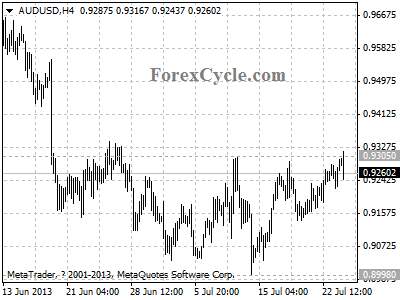
AUDUSD pulls back from 0.9317

After touching 0.9305 resistance, AUDUSD pulls back from 0.9317, suggesting that the pair remains in consolidation of the downtrend from 1.0582 (Apr 11 high). Another fall to test 0.8998 previous low support is still possible, and a breakdown below this level could signal resumption of the downtrend. On the upside, a clear break and hold of 0.9305 resistance will indicate that the downtrend from 1.0582 had completed at 0.8998 already, then the following upward movement could bring price to 1.0000 zone.

audusd

Provided by ForexCycle.com

Why You Must Avoid This Big Investing Mistake…

By MoneyMorning.com.au

Gold has made it to the business news pages again.

Only this time it’s good news.

Overnight the gold price climbed above USD$1,347 per ounce…a gain of more than 10% in a matter of days.

That’s still a long way from the USD$1,900 peak in 2011. But it’s better than the sub-USD$1,200 level it slumped to last month.

This quick move shows why we tell you to stop thinking about it so much and just buy it. But is it fair to say that after a 10% move? Surely it’s much better to wait for it to fall again and then buy gold

This is one of the biggest dilemmas for investors.

Do you go with the trend or do you assume the short-term price rise is just that – short term, and that the price will soon come back down to a fair level?

We’re quite certain that figuring this out has cost investors more money in missed investment opportunities and actual losses than anything else.

So, what do you do?

Are You an Investor or a Trader?

This is really important. If you can get this right (or even half right) you’ll save yourself a lot of stress as you build your investment portfolio.

The first thing to work out is whether you’re an investor or a share trader. We say this because sometimes it’s easy to forget. A fast moving market can catch out even the most disciplined of Warren Buffett wannabe investors, and make them do things they shouldn’t.

If you’re not sure, the best way to think of it is like this. If you’re a trader you probably don’t much care what shares you buy and sell. The inner workings of a company and what it does don’t interest you.

You look at a chart, work out the odds of a stock price rising or falling and then place the trade accordingly. Regardless of whether it’s a good or a bad trade, odds are you’re out of the position in a week.

On the other hand, investors usually do care which shares they buy and sell. Investors tend to look into the background of a company, study the financials, gauge the market’s likely reaction to good or bad news, and then buy the shares.

Odds are the investor will still own the stock three months from now, and most probably in six or 12 months’ time. The really committed investor will hold the stock for many years.

And yet, from time to time, it’s as though some investors and share traders switch bodies. An investor who bought a stock for the long-term (maybe it pays a dividend) is spooked by a 5% or 10% fall just after they bought it and so they sell.

Conversely, sometimes a quick move against them will equally spook a trader. But rather than doing what they normally do – sell – they decide to hang on to the stock because it’s ‘now a long-term investment’.

This is why it’s important to set boundaries for an investment or trade at the beginning. And that’s another important point; you don’t have to be one or the other. You can set aside part of your portfolio for long-term investments, and part of it for shorter-term punts or trades.

You just have to remember the reason for buying each stock in the first place.

Beware of ‘Emotional Analysis’ When Investing

If you bought a stock for fundamental reasons, you should keep hold of it for fundamental reasons – and not sell just because of a short-term price move.

If you’re a fundamental investor and you sell an investment just after you’ve bought it that tells us you probably didn’t really buy it for fundamental reasons.

Most likely you quickly looked at the chart, checked out the dividend yield and PE ratio and thought, ‘That looks cheap, I’ll buy that.’

Come on, admit it, we’re sure you’ve done that at least once in your investing life. We know we have. We call it ‘emotional analysis’, and it rarely works out well.

In fact, when you invest that way you’ve got the worst of both worlds. It’s slap-dash fundamental analysis. And it’s slapdash technical analysis. It’s no surprise no-one makes a living or a fortune from stocks that way.

So, in short, if you want to make anything out of the stock market, you can’t do it in half measures. You’ve got to put the time in regardless of whether you prefer fundamental or technical analysis.

But what about the asset we mentioned at the top of this email – gold?

Right. Everything we’ve said up to this point, in the case of gold investing (and only gold investing), throw it away.

Gold is a completely different story. It’s an asset you should buy at almost any time…unless you see exceptionally better value elsewhere. We wrote last week that we saw the current market as a 50/50 choice between stocks and gold.

That hasn’t changed. We see gold as the ultimate long-term investment and long-term insurance policy. That’s why gold is the only investment where technical or fundamental analysis doesn’t apply.

Does a 10% Move Really Matter When You Invest in Gold?

We don’t care if the price rises or falls in the short-term because we didn’t buy it for the short-term. We bought gold before it hit USD$1,900 and we’ve bought gold after it hit USD$1,900.

We’re yet to sell even a single fraction of an ounce…and it’ll be a long time (if ever) before selling even crosses our mind.

So if you’re waiting for gold to fall before you buy it, ask for what reason you’re buying gold. If it’s to make a 10% or 20% gain, forget it. There are much better ways to make those returns – the stock market.

But if you’re buying gold for the long-term (30, 40 or 50 years), then will a $100 difference really make a difference over that timeframe? If you think $100 will make a difference, then you aren’t a serious long-term gold buyer.

Remember, we only apply this attitude to gold. It’s different with stocks because you’re dealing with businesses and revenues and profits that can change from month to month and year to year.

But gold is just gold. It was gold five years ago and it’s gold today. If you’re serious about buying gold for the long-term then forget about the short-term price moves and just buy an ounce or two at regular intervals.

As we’ve long said, when it comes to gold investing, don’t make it any more complicated than necessary.

Cheers,
Kris+

Join Money Morning on Google+

From the Port Phillip Publishing Library

Special Report: The Sixth Revolution

Daily Reckoning: What Three Grumpy Old Men Think of an Australian Recession

Money Morning: The Hunt for the Next Tech Stock Superstars

Pursuit of Happiness: The Exciting Move From Globalisation to Localisation

Genomics and Personalised Medicine: Why One Test Could Change Your Life

By MoneyMorning.com.au

Imagine a world where your medical treatment is 100% unique. Every diagnosis, treatment, drug and dietary change is tailored to you and you alone. Every treatment works in a predictable way, with a predictable timeframe and with predictable and minimised side effects.

In other words, imagine not worrying when you walk into the hospital. Instead of feeling like a car on an assembly line, you’ll be treated like the unique human being you are. Instead of seeing a specialist in a field of medicine, the information in your genome can turn any GP into a specialist in the field of ‘you’.

They’ll know what you’re at risk of and what symptoms to look for. They’ll know precisely what’s wrong with you instead of matching up your symptoms to a disease. They’ll know how to treat you, not the average human being.

Changing medicine in this way would fundamentally alter your quality of life in retirement.
It makes sense to individualise medicine. Your body is unique, after all. But to provide personalised medicine would surely require absurd amounts of tests, knowledge and expertise. Can you imagine the cost?

Well, thanks to the science of genomics, the cost is rapidly falling. You won’t believe how much. And you may only have to take one test…ever.

How Medicine is Broken

But what’s wrong with medicine now? A lot. Right now, patients tend to receive a standardised treatment.

You can see the problem – everyone is different, but our treatments are the same. Drugs often only work in certain people. They actually end up harming others. But it is often possible to predict for whom a drug will work, and whether it will have side effects.

For example, a commonly used drug called Carbamazepine is prescribed for a variety of neurological conditions. It has a six in 10,000 chance of a potentially fatal side effect. But we can identify who that 6 in 10,000 are using genetics, by looking for the tell tale genetic pattern of ‘Stevens Johnson syndrome’.

In Taiwan, where the probability of the syndrome is much higher for racial reasons, the genetic test is compulsory before you can take the drug.

Taiwan is showing how genomics can be used to prevent devastating side effects, and literally save lives. But the power of genomics is far greater. You see, despite the Hippocratic Oath doctors take to ‘do no harm’, they often unconsciously do more harm than good.

For example, a number of studies have shown that the number of false positive PSA tests (for prostate cancer) is so high that the damage done from widespread testing outweighs the benefits.

The Cost of Being Healthy in Retirement Research has shown a male retiree has a 50-50 chance of incurring more than $109,000 of medical expenditure in retirement.

Women face a 50% higher cost at the same level of probability. On another estimate, the
average 65 year old couple will need $220,000 to pay for their life’s healthcare. Understanding your genome could help you cut these costs dramatically by avoiding diseases you’re at risk of, adjusting treatments and predicting debilitating side effects.

The same applies to mammography testing for breast cancer. The pain, cost, emotional hardship, surgical complications and anxiety of false positives is so large that widespread testing should be stopped.

I know this goes against conventional wisdom, but the researchers aren’t saying there should be no testing at all. Instead, targeted testing based on genetics and family history should be used. If you sequence your genome and the risk of breast or prostate cancer is elevated, then you should get tested regularly.

Of course, pharmaceutical companies and doctors won’t tell you this. There’s too much profit involved. The world’s most successful drug class based on revenue (statins) only works properly in one to two people in 100 according to Eric Topol of the Scripps Research Institute.

In short, something is seriously wrong in the world of medicine…

Fixing Medicine in Your Favour

The solution to problems like these is personalised medicine. And genetics is a key part of that.

Knowing your patient so well that you can personalise their treatment is the Holy Grail for
doctors. That’s because rather than just hoping you’ll stay healthy or react well to drugs, gene sequencing looks at the real you. It paints a picture, which doctors can refer to for the rest of your life.

Apart from improving medicine, saving lives and preventing discomfort, genomics could help save vast amounts of money. If people stopped taking drugs that don’t work for them, or which create side effects worse than the disease, that would save enormous amounts of wasted drugs and treatments.

Of course, there is also the opposite risk. If you’re a hypochondriac, you might choose to interpret your sequenced genome in a way that does more harm than good. If you think you might panic at the slightest sign you’re likely to get a disease, don’t get the test done in the first place. It’s not for you.

Scientists are now able to sequence, or map, your genome. Your genome is what makes you
unique. It’s what sets each of us apart.

Hidden inside your cells are strands of DNA. And inside your DNA are your genes. They are the combinations of four types of ‘bases’. The sequences of the bases are what spell out your genome and determine your characteristics. Your appearance, immune system, allergies, and much more are determined by your genome.

Certain patterns in your genome give scientists information about you. They can identify diseases you’re at risk of, diseases you’re a ‘silent carrier’ of, your physical traits and much more.

Yes, this leads to all sorts of moral, ethical and practical questions. How much information about your future health do you really want to know? How much of it will be accurate? Will your worrying exceed your peace of mind? You are perfectly right to be worried about the implications.

But there are also enormous benefits.

Nick Hubble+
Editor, The Money for Life Letter

Ed Note: If you’re interested in learning more about getting your genome sequenced, including how to do it, you can check out the latest issue of the The Money for Life Letter by clicking here

From the Archives…

Why Invest ‘Hard’ When You Can Invest ‘Easy’?
19-07-2013 – Kris Sayce

Read This Before You Buy Another Stock or Bond…
18-07-2013 – Murray Dawes

Could Uranium be the Best Investment in 2013?
17-07-2013 – Dr Alex Cowie

Asteroid Mining and the Commercialisation of Space
16-07-2013 – Sam Volkering

Why the Australian Share Market is Heading Even Higher
15-07-2013 – Kris Sayce

Central Bank News Link List – Jul 24, 2013: Indian central bank takes new steps to prop up rupee

By www.CentralBankNews.info

Here’s today’s Central Bank News’ link list, click through if you missed the previous link list. The list comprises news about central banks that is not covered by Central Bank News. The list is updated during the day with the latest developments so readers don’t miss any important news.

Nigeria holds rate, sets 50% CRR on government deposits

By www.CentralBankNews.info     Nigeria’s central bank maintained its Monetary Policy Rate (MPR) at 12.0 percent, as expected, but warned of the key risks from rising government deficits, pressure on the exchange rate from excess liquidity in the banking system and a possible reversal of capital flows.
    The Central Bank of Nigeria (CBN), which has held rates steady since October 2011, said its Monetary Policy Committee had voted by 9-1 to maintain the policy rate but also agreed to introduce a 50 percent Cash Reserve Requirement on public sector deposits, i.e. deposits from federal, state and local governments and all ministries, department and agencies (MDAs).
    The central bank said it was satisfied with the recent stable macroeconomic conditions and its ability to “defend the currency in the face of capital flow reversal and significant revenue attrition has stemmed from the depreciation of the naira.”
    While the inflation rate is expected to remain within single digits due over the next six months due to base effects and tight monetary policy, the central bank said government spending is likely to lead to increased borrowing and warned about liquidity in the banking system.

   “The Committee observed the build-up in excess liquidity in the banking system, and expressed concern over the rising cost of liquidity management as well as the sluggish growth in private sector credit, which was traced to DMB’s (deposit money banks) appetite for government securities,” the CBN said, adding:
    “The situation is made more serious by the perverse incentive structure under which banks source huge amounts of public sector deposits and lend same to the government (through securities) and the CBN (via OMO bills) at high rates of interest.”
    Nigeria’s inflation rate eased to 8.4 percent in June from 9 percent in May, below the central bank’s target of 10.0 percent.
    The Nigerian naira has dropped just over 3 percent against the U.S. dollar this year, trading at 161.8 to the U.S. dollar today and the central bank said its external reserves had risen by 9.49 percent to  $47.99 billion from end-2012, cover for around 11 months of imports.
    Nigeria’s economy is estimated by the statistics office to have expanded by an annual rate of 6.72 percent in the second quarter, up from 6.56 percent in the first quarter, and overall Gross Domestic Product growth is estimated at 6.91 percent for fiscal 2013, up from 6.58 percent in 2012.
    The contribution of oil to GDP is continuing to decline due to sustained oil theft, which has led to lower output due at a time of uncertain international oil market, weak infrastructure and downside risks due to the discovery of shale oil and the emergence of other African oil exporters that are now competing for Nigeria’s traditional oil market.

    www.CentralBankNews.info


Ron Struthers: Have Flake Graphite Prices Bottomed?

Source: Brian Sylvester of The Metals Report (7/23/13)

http://www.theaureport.com/pub/na/15460

After a spike in flake graphite in 2011, have prices finally reached bottom? Ron Struthers, the publisher and editor of Struthers’ Resource Stock Report, believes so. In this interview with The Metals Report, Struthers talks about how market psychology and fundamentals may play out in the graphite and rare earths spaces as new mines inch toward production.

The Metals Report: In 2011, there was a spike in flake graphite prices, a proliferation of publicly traded graphite equities and some speculation by investors. Since then, graphite prices have fallen and most investors lost money. How do graphite investors make money now?

Ron Struthers: If you’ve already bought in, the best thing is to hold right now. Graphite equities have probably hit a bottom. Going forward, investors should stick with companies that have good odds of getting to production in the near term. It’s a very small market, so if a few new mines come on, production can make a difference.

TMR: Do you believe the price of flake graphite has bottomed?

RS: I think so. But it’s a different market compared to other mining sectors in that the price is mainly set by negotiated contract. There is no futures exchange. In 2011, when prices were rising, buyers, who for the most part are end users, got scared. They thought prices were going to climb higher still, so they bought more to lock in at a relatively lower price and keep ample supplies for their manufacturing requirements. Of course, because they were buying more, it drove demand—and the price—higher, until the market got to a point where buying slowed as inventories were built higher.

Then the exact opposite happens. Buyers become leery and prices start to drop off. The buyers say, “Well, I have a year’s supply of this stuff because I bought it on the way up. I’m just going to sit back now.” The demand drop-off in 2012 wasn’t about less graphite being used. It was more about a change in the market psychology. The fundamentals haven’t changed. There have been no new mines come on. In fact, supply probably has come down a bit as China has consolidated some of its industry. At this point, prices have been stable for a few months. That’s an indication that the market is at equilibrium.

TMR: What price range do you expect flake graphite to trade at for the rest of this year and through 2014?

RS: It will probably trade within a couple hundred dollars of the current price—$1,200–1,600—but more than likely, it won’t fluctuate that much. There will be more of an upward bias next year if we get through this change in the market psychology and the fundamentals come back into focus. Demand is still growing from new areas like electric cars. And although a lot of companies are advancing their projects, we still haven’t seen a new significant mine, especially in North America, where new mines are still a few years from production.

TMR: Most gold and silver companies tell specifics about how they will make money and grow production in company presentations. But graphite companies don’t really talk so much about the specifics of their project or mine. Do they believe that investors don’t understand this space yet?

RS: It’s early on in the industry for public graphite companies. We don’t have a good handful of pure graphite companies in production that we can point to for historical information on costs. We have the preliminary economic assessments (PEAs) from some of the explorers, but unlike gold and silver, we don’t have any pure public producers in North America to use as comparables. There are just two producing mines in North America and they are private.

TMR: What don’t investors understand about the graphite space?

RS: The main thing is understanding the percentage of carbon content in the deposit, the flake size distribution and purity on recovery. An ounce of gold is an ounce of gold—we know what the price is. It’s simple. But graphite value involves more variables. Recovery rates are very important in evaluating a graphite project. Some gold mines can operate with 60–80% recoveries and produce valuable byproducts that refiners can handle like silver and copper, but graphite needs 94% purity on recovery or better to get the proper pricing, and then that pricing varies by flake size—the larger the flake, the better the price.

TMR: What about production costs? An average ton of flake graphite is going for about $1,500. Are there companies that can profitably produce graphite at that price?

RS: Northern Graphite Corporation (NGC:TSX.V; NGPHF:OTCQX) is the most advanced. It can make money, as most of its graphite is large and jumbo flake. There will be others, too. Graphite is actually fairly easy to mine. The costs aren’t much compared to other mining projects, it’s all about the flake size distribution and purity.

TMR: Northern Graphite estimates that it is going to cost about $103 million ($103M) to build its flagship project Bissett Creek. How much of that money does Northern Graphite have?

RS: Northern Graphite has $7M in cash and a $17.5M financing from Caterpillar for equipment. So it’s part of the way there, but realistically the company needs the mine permit first to secure the debt portion of the financing. It can’t put the cart before the horse, so to speak.

TMR: What’s the earliest this mine could be in production?

RS: It is waiting on a final permit and will need a final round of financing. It could be into production in H2/14 at the earliest.

TMR: There is some speculation that TIMCAL Graphite & Carbon, a division of Imerys (NK:PA), is probably going to need a new mine before long when the Lac-des-Îles mine comes to the end of its life cycle. Could TIMCAL buy an emerging graphite asset in Ontario or Quebec?

RS: It’s interesting that you mention TIMCAL as they just temporarily shut down production, so that will help tighten the supply side of the market. It would make a lot of sense to me. Producers in gold and other sectors where the market has come down are taking advantage of low prices. It wouldn’t surprise me at all to see the same thing in graphite.

TMR: Which company do you think will be the first one to ship flake graphite?

RS: Northern Graphite is fairly close and should be the first of its peers to ship graphite. Focus Graphite Inc. (FMS:TSX.V) has a project with a PEA. Focus is a little different than most projects. It is the only one directly invested in the graphene market with a private company called Grafoid Inc., which is devoted to developing a standard for economically scalable, affordable graphene. It’s unique in that it is both a play on graphite and graphene. Focus is well financed with $17M and over $5M in Grafoid.

TMR: Do you believe that it can commercially produce graphene profitably?

RS: It’s been demonstrated on small bench-scale tests that it can be done. They’re getting refining purity levels up to 99.9% using natural graphite, which is the level needed for graphene. They’re practically there now. However, we need to see this on a commercial scale to know for sure. There’s been bench-scale testing from a number of projects and from renowned metallurgy companies. It’s something we’ll see down the road.

TMR: How is the grade at Focus’ Lac Knife graphite project?

RS: That’s another advantage that it has. It does have a higher grade than most projects, around 15–17%, which goes quite a way in reducing mining costs. Its graphite occurs in pod-like formations, so there might be a little more overburden in the removal process, but the grade definitely makes up for that and more. Focus has the potential to be the lowest-cost producer based on its recent PEA.

TMR: Are there any other graphite stories you’re following?

RS: Valterra Resource Corp. (VQA:TSX.V) has a project in Bobcaygeon, Ontario, with high grades and from the initial sampling, about 24–28% carbon. In Valterra’s metallurgy testing, purity levels ran as high as 99.96%, so there’s graphene potential in this project.

Valterra approached its project differently than other companies might have. It took some bulk samples right off the bat and found it had the high-purity, high-grade graphite. That made it a very interesting story. Now it has to prove it has enough graphite there for a mine.

It’s at the point of mapping out the zones, and then it will be drill testing to see if it can put some tonnage together. It’s an early-stage stock with a very low price, and a lot of blue sky in front of it.

Also Alabama Graphite Co. (ALP:CNSX) just announced its first NI 43-101 resource of 38.2 million tons at 2.6% carbon. The deposit is on surface and the company should get mine permitting very quickly in Alabama. If the metallurgy and feasibility studies come back positive, Alabama Graphite could be among the first to production. The company just completed a $335,000 financing at $0.15 above the market price and is well subscribed by management, which is a very good sign of confidence in the project.

TMR: Is there enough room in the graphite space for multiple players, after the first project makes it to production?

RS: There is room for a few new mines to come in, probably enough for three and four, depending on how much they produce. But they’re going to trickle in over the next several years; it’s not going to be a flood onto the market anytime soon.

TMR: Could there be a consolidation phase in the graphite space?

RS: Quite a few juniors have come into the market, but quite a number will fade away because it’s difficult to raise money right now and the nature of exploration means that most projects will not be economically viable.

TMR: What’s your near- to medium-term outlook for the rare earth element (REE) space?

RS: There’s potential here. A lot of the REE prices haven’t gone down nearly as much as other minerals. There’s some good stories, like Pacific Wildcat Resources Corp. (PAW:TSX.V).

TMR: That project is located in Kenya, East Africa. Are there jurisdictional advantages there?

RS: Kenya is right on the coast. There is good infrastructure near Pacific Wildcat’s project, including hydropower, paved highway and ports. It’s one of the more advanced countries in Africa. It has expanded strongly in tourism, telecommunications and its traditional tea market. It is a liberal market with minimum government involvement and British-based common and mining law.

TMR: Does Pacific Wildcat’s project lean more toward the heavy rare earth elements (HREEs)?

RS: It has a good mixture of HREEs and light rare earth elements. At about 5%, it is a high-grade deposit. Its basket of REEs is valued at around $35–45/kilogram (kg). It also has a 100 million tonne niobium deposit that’s quite advanced.

TMR: Why should investors be interested in niobium?

RS: It’s not a well-known material, but it’s a strategic element and has been used a long time in the steel industry for strength in different alloys and super alloys. Some of these super alloys are used in jet engines and space programs. There are only a few producing mines in the world, as it is very rare to find niobium in economic concentrations. At $40/Kg, it provides a very attractive potential return on investment for miners. It’s a fairly stable market price wise.

TMR: What got you interested in Pacific Wildcat?

RS: It has a lot going for it. It has a large niobium project with a high-grade zone that could be a cash cow. It has a smaller tantalum project that’s already proven out. It has a processing plant. It just needs a little bit more money to finish some spiral concentrators and can go into production this year. It has a world-class REE project that could have 5% grade or better. Recent assays show 105 meters (105m) at 6.97%, 105m at 7.17% and 100m at 6.18%, all starting from surface.

TMR: What about management?

RS: It is very strong in that regard. Management has a lot of experience in putting mines into production. CEO Darren Townsend is an engineer and previously worked as general manager of Sons of Gwalia, which operated the world’s largest tantulum mine. Terry Lyons, who is the chairman, has more than 30 years’ experience. He was a past chairman of Northgate Minerals Corp. (NGX:TSX, NGX:NYSE.MKT). The company has management with experience in the tantalum industry. It also has some directors with experience in Africa.

TMR: What is tantalum used for?

RS: Tantalum is used in alloys but mostly in capacitors for electronics like computers and phones. It is highly corrosion resistant. The tantalum price has moved up quite a bit, from about $80/pound (lb) last year to $130/lb currently. It’s one of the few metals or minerals that has seen an increase in price this year.

TMR: Why should investors be interested in this space overall right now?

RS: A lot these materials are an important part of our future. Technology we’re developing requires more graphite and REEs. If you can find companies that can put these into production soon, you’ll see strong cash-flow, earnings and even dividends.

TMR: Dividends in the REE space? That’s interesting.

RS: I’m talking down the road, after companies outside of China go into production. A number of the graphite stocks—Focus, Northern Graphite, Alabama, Valterra—have come down in price. So has Pacific Wildcat. Any of those would be a good place for investors in the graphite or REE spaces.

TMR: Thanks Ron.

Ron Struthers founded Struthers’ Resource Stock Report almost 20 years ago. The report covers senior and junior companies with ample trading liquidity. Since 2000, $1,000 invested in Struthers’ Model Portfolio ended 2012 at $9,251. Struthers Newsletter Stocks went from $1,000 to $20,934. Struther’s Millennium Index, which started in 2003, began at $1,000 and was worth $4,133 at the end of 2012.

Want to read more Metals Report interviews like this? Sign up for our free e-newsletter, and you’ll learn when new articles have been published. To see a list of recent interviews with industry analysts and commentators, visit our Metals Report <href=”#interviews” target=”_blank”>homepage.

DISCLOSURE:

1) Brian Sylvester conducted this interview for The Metals Report and provides services to The Metals Report as an independent contractor. He or his family own shares of the following companies mentioned in this interview: None.

2) The following companies mentioned in the interview are sponsors of The Metals Report: Northern Graphite Corporation. Streetwise Reports does not accept stock in exchange for its services or as sponsorship payment.

3) Ron Struthers: I or my family own shares of the following companies mentioned in this interview:Northern Graphite, Focus Metals, Valterra Resources, Alabama Graphite, Pacific Wildcat. I personally am or my family is paid by the following companies mentioned in this interview: None. My company has a financial relationship with the following companies mentioned in this interview: None. I was not paid by Streetwise Reports for participating in this interview. Comments and opinions expressed are my own comments and opinions. I had the opportunity to review the interview for accuracy as of the date of the interview and am responsible for the content of the interview.

4) Interviews are edited for clarity. Streetwise Reports does not make editorial comments or change experts’ statements without their consent.

5) The interview does not constitute investment advice. Each reader is encouraged to consult with his or her individual financial professional and any action a reader takes as a result of information presented here is his or her own responsibility. By opening this page, each reader accepts and agrees to Streetwise Reports’ terms of use and full legal disclaimer.

6) From time to time, Streetwise Reports LLC and its directors, officers, employees or members of their families, as well as persons interviewed for articles and interviews on the site, may have a long or short position in securities mentioned and may make purchases and/or sales of those securities in the open market or otherwise.

Streetwise – The Gold Report is Copyright © 2013 by Streetwise Reports LLC. All rights are reserved. Streetwise Reports LLC hereby grants an unrestricted license to use or disseminate this copyrighted material (i) only in whole (and always including this disclaimer), but (ii) never in part.

Streetwise Reports LLC does not guarantee the accuracy or thoroughness of the information reported.

Streetwise Reports LLC receives a fee from companies that are listed on the home page in the In This Issue section. Their sponsor pages may be considered advertising for the purposes of 18 U.S.C. 1734.

Participating companies provide the logos used in The Gold Report. These logos are trademarks and are the property of the individual companies.

101 Second St., Suite 110

Petaluma, CA 94952

Tel.: (707) 981-8999

Fax: (707) 981-8998

Email: [email protected]
 

Forget Yield; Dividend Growth is the Metric that Matters

By The Sizemore Letter

Income investors had a little scare in May and June.  Bond prices took a tumble and dragged down assets that have come to be viewed as bond substitutes—including popular dividend-paying stocks, MLPs and REITs.

Now that the dust has settled and the income markets have regained some semblance of normalcy, let’s take a step back and review the case for income stocks.  With the Fed’s quantitative easing eventually coming to an end and with bond yields likely to rise in the years ahead, does it still make sense to look to the stock market for income?  Or might investors be better off buying and rolling over a bond ladder to meet their income needs?

Let’s take a look at the numbers.  Consider the options you had as an investor ten years ago.  In 2003, the 10-year Treasury yielded 3.97%.  We’ll be generous and say 4% to keep the math simple.  A million-dollar portfolio invested in Treasuries would have paid out an income of $40,000 in the year you bought it…and ten years later, it still would have paid you $40,000 per year on your original purchase price. (Math purists will point out that the yield to maturity calculation is a little more complicated than that, but it’s close enough for our purposes here.  We’ll assume you bought the bonds at par and that capital gains are a moot point.)

Over the ten year life of the investment, you would have received $40,000 per year.  Of course, $40,000 went a lot further in 2003 than it does in 2013, but we’ll get to that a little later.

Now, let’s do the same math on one of my favorite REITs—Realty Income ($O).

I chose Realty Income for a very specific set of reasons.  First, in 2003, its dividend yield—at 3.5%—was close enough to the 10-year Treasury yield to make these two viable competitors for the would-be income investor’s portfolio.  Secondly, as a low-risk, triple-net retail REIT, Realty Income is a prime example of a stock that has come to be viewed as a “bond substitute” by income investors.

So, how did Realty Income stack up?

The math here is a little more detailed, but I’ll do my best to keep it simple.  A million-dollar portfolio invested in Realty Income at the beginning of 2003 would have bought you 29,516 shares paying $1.17 per share in annualized dividends.  That works out to $34,534 in income in the first year—or about $5,500 less than the 10-year Treasury.

But this is where it gets fun.  Unlike the bond, Realty Income actually raised its payout every year.  By 2013, those 29,516 shares were paying out $2.18 per share in annual dividends.  That works out to $64,345 in annual income—or $24,345 more than the interest from the bond.

In 2013, Realty Income sported a dividend yield of 4.8%, which isn’t shabby.  But your yield based on your purchase price would have been a much more impressive 6.45%.  And remember, we haven’t said a word about capital gains; we’re focusing purely on the cash payout, which is ultimately what pays your bills in retirement.

Stepping away from REITs, let’s take a look at two widely-held blue chips that have more or less tracked the market over the past ten years—Johnson & Johnson ($JNJ) and Wal-Mart ($WMT).  I included both of these names for one critical reason—both paid comparably low dividends back in 2003.  Yet despite paying a modest yield at the time, both had been serial dividend raisers for a long time—and still are.  Their stock prices have had wild swings over the years, but their dividends have been a source of rock-solid stability.

In 2003, Johnson & Johnson and Wal-Mart yielded 1.5% and 0.65% in dividends, respectively.  A million dollars invested in each would have paid out $15,296 and $6,538.  That stacks up pretty poorly in comparison to the $40,000 you could have received in bond interest by investing in Treasuries.

But let’s fast forward ten years.  Those original million-dollar investments in Johnson & Johnson and Wal-Mart would be paying you $49,244 and $34,144, respectively.  Wal-Mart’s total cash payout is still a little lower than the payout from the Treasury note, though it rose by more than a factor of 5—and will likely keep rising at a blistering pace for the foreseeable future.   And again, this says nothing about capital gains—or about the reinvestment of dividends, which would have boosted the number of shares you owned and thus your ultimate payout.

Income on $1 million invested in 2003Income in 2013 on original 2003 investment
10-Year Treasury $40,000 $40,000
Realty Income $34,534 $64,345
Johnson & Johnson $15,296 $49,244
Wal-Mart $6,538 $34,144


What lessons can we learn from this?

Dividend growth matters far more than current yield.  When building an income portfolio, accept a lower payout today in the interest of generating a far bigger payout tomorrow.  As in so many other areas of investing, delayed gratification has its rewards.

I’ll leave you with one final point on inflation and taxes.  The first is obvious.  Prices rise over time, and the only way you can avoid getting progressively poorer in retirement is to have an income stream that at least keeps pace with inflation.

Finally, depending on how you are invested (IRA vs. taxable account), taxes will play a role in your “take home” income.  If investing in a taxable account, you will pay 15-20% on your dividend income, depending on your income bracket and whether the dividends are “qualified.”  Bond interest is taxed as ordinary income, meaning you could be paying a substantially higher rate, depending on your tax bracket.

Disclosures: Sizemore Capital is long O, WMT, and JNJ.

SUBSCRIBE to Sizemore Insights via e-mail today.