Gold Prices Flat as Inflation Runs at 6%: How Long Will That Last?

By Profit Confidential

Gold PricesWe are told by the “gold bears” that we are headed for a period of deflation ahead, so we should sell gold bullion because it doesn’t have any purpose in your portfolio. But these “gold bears” might be surprised to know that inflation in the U.S. economy is already much higher than what the official numbers tell us.

Long ago, I explained in these pages how the Consumer Price Index (CPI) doesn’t really take into consideration things that actually matter to consumers.

We need to look at alternative measures of inflation, like the Everyday Price Index (EPI) reported by the American Institute for Economic Research. It considers goods and services that Americans buy frequently.

The EPI, a better indicator of inflation, increased 0.5% in June, following an increase of 0.3% in May. (Source: American Institute for Economic Research, July 17, 2013.) Based on June’s inflation number, inflation is running at an annualized rate of six percent, according to the American Institute for Economic Research. (It feels more like 10% to me.)

I also read articles that say there is no demand for gold bullion. I don’t understand this notion. Look at the facts: the majority of the selling we witnessed in May was in the “gold” paper market. Looking at the physical market, demand has never been stronger.

So far this month, the U.S. Mint has sold 36,500 ounces of gold bullion in coins. Last year, for the entire month of July, the U.S. mint sold 30,500 ounces of gold bullion in coins. The month of July is not even over yet and the U.S. Mint has already sold about 20% more gold bullion than it did in all of July 2012. (Source: U.S. Mint web site, last accessed July 23, 2013.)

China, the second-biggest gold bullion-consuming nation after India, hasn’t seen a change in demand as the precious metal prices have come down. According to Stifel Nicolaus, a brokerage and investment banking firm, China has already imported 20 million ounces of gold bullion this year. In 2012, for the whole year, the country imported 26.7 million ounces and for 2011, it imported 13.8 million ounces of the precious metal. (Source: Financial Post, July 13, 2013.)

If the import of gold bullion into China keeps at this pace, then this year, China will consume 50% of global mine production or 35% of total supply of the precious metal in the global economy.

All of this shouldn’t be a surprise to my readers. I write about these facts as I see them happening, and will continue to do so. I remain bullish on the yellow precious metal’s price.

Quietly, gold bullion prices are increasing. After making their lows below $1,200, they are now above $1,300 again. Have the precious metal prices bottomed? It is still too early to ask that question, but this bull remains unfretted.

Michael’s Personal Notes:

I completely disagree with the notion that the housing market in the U.S. economy is improving.

No doubt, we have seen home prices increase, but the price increases have been minor and restricted to certain geographical areas—but by no means do the price increases suggest there are actual improvements in the real estate market. In fact, the housing market may face even more trouble ahead.

For the housing market to see real recovery, we need to witness increased participation from home buyers. While an increase in home prices may suggest to some that there are actual home buyers coming into the market and pushing prices higher, the truth is the opposite.

When I say “home buyers,” I don’t mean institutional investors who have been buying homes in the U.S. housing market to rent. I mean those individuals who actually buy a house to live in it—they are not there to speculate.

In June, first-time home buyers accounted for 29% of all the existing-home sales in the U.S. housing market—down more than nine percent from the same period a year ago. According to the National Association of Realtors, in a healthy housing market, first-time home buyers should account for 40% of all existing-home sales. (Source: National Association of Realtors, July 22, 2013.)

I can see the number of real home buyers decline even further.

The national average commitment rate for 30-year mortgages, reported by Freddie Mac, was 4.07% in June. In the same period last year, it was 3.68%. As mortgage rates continue to rise—and they will as the Federal Reserve prepares to “taper” quantitative easing—it will become more difficult for home buyers to afford a home.

Consider this: the Housing Affordability Index, from January to May of 2013, has fallen 18%. It stood at 172.7 in May and was 210.7 in January. (Source: Federal Reserve Bank of St. Louis web site, last accessed July 23, 2013.)

I wish I could say the U.S. housing market is witnessing a recovery, but the statistics suggest otherwise. I will consider the housing market to be improving when I see real home buyers returning to the market and buying homes. As it stands, with interest rates on the rise, I can’t see them returning for years.

The yield on the U.S. 10-year Treasury stands at 2.55% this morning—116 basis points higher than one year ago. As rates continue to rise, the dynamics for institutional investors change. At one point, they will become sellers of homes, not buyers. And this will put more pressure on the housing market.

Article by profitconfidential.com

Why More Troubles Lie Ahead for the Housing Market

By Profit Confidential

I completely disagree with the notion that the housing market in the U.S. economy is improving.

No doubt, we have seen home prices increase, but the price increases have been minor and restricted to certain geographical areas—but by no means do the price increases suggest there are actual improvements in the real estate market. In fact, the housing market may face even more trouble ahead.

For the housing market to see real recovery, we need to witness increased participation from home buyers. While an increase in home prices may suggest to some that there are actual home buyers coming into the market and pushing prices higher, the truth is the opposite.

When I say “home buyers,” I don’t mean institutional investors who have been buying homes in the U.S. housing market to rent. I mean those individuals who actually buy a house to live in it—they are not there to speculate.

In June, first-time home buyers accounted for 29% of all the existing-home sales in the U.S. housing market—down more than nine percent from the same period a year ago. According to the National Association of Realtors, in a healthy housing market, first-time home buyers should account for 40% of all existing-home sales. (Source: National Association of Realtors, July 22, 2013.)

I can see the number of real home buyers decline even further.

The national average commitment rate for 30-year mortgages, reported by Freddie Mac, was 4.07% in June. In the same period last year, it was 3.68%. As mortgage rates continue to rise—and they will as the Federal Reserve prepares to “taper” quantitative easing—it will become more difficult for home buyers to afford a home.

Consider this: the Housing Affordability Index, from January to May of 2013, has fallen 18%. It stood at 172.7 in May and was 210.7 in January. (Source: Federal Reserve Bank of St. Louis web site, last accessed July 23, 2013.)

I wish I could say the U.S. housing market is witnessing a recovery, but the statistics suggest otherwise. I will consider the housing market to be improving when I see real home buyers returning to the market and buying homes. As it stands, with interest rates on the rise, I can’t see them returning for years.

The yield on the U.S. 10-year Treasury stands at 2.55% this morning—116 basis points higher than one year ago. As rates continue to rise, the dynamics for institutional investors change. At one point, they will become sellers of homes, not buyers. And this will put more pressure on the housing market.

Article by profitconfidential.com

The Next Big Cyclical Play

By Profit Confidential

Next Big Cyclical PlayWhat’s old is new again, and the current cycle is very much about specific sectors that can be thought of as “old economy.”

Transportation, freight, energy production, and transmission—it seems that basic infrastructure corporations are the new stock market darlings. It’s not uniform and not all old economy industries are participating, but many of these stocks are soaring, breaking the indifference that institutional investors had shown toward the markets for so many years.

Nothing exemplifies the old economy resurgence better than the stock market strength of Union Pacific Corporation (UNP).

In the last secular bull market, Union Pacific did virtually nothing on the stock market, except pay its dividends. This old economy company wasn’t stagnant in terms of growth; rather, investors just weren’t interested in the seemingly boring business of hauling freight by rail.

It wasn’t until the secular bull market ended that shares in the company began to really accelerate, as the marketplace wanted safety and predictability. Sentiment toward reliable, old economy names with realistic earnings forecasts changed on a dime.

Union Pacific’s long-term stock chart is featured below:

Union Pacific Corporation Chart

Chart courtesy of www.StockCharts.com

It really is a stunning reversal of fortunes among sectors with industrial, old economy names seemingly taking the place of the previous fad in fast-growing technology stocks.

As tastes and expectations among investors change over the long-term, so does investment risk. Just before the financial crisis of 2008/2009, Chinese equities became a hot-ticket item. Then alternative energy stocks, specifically solar panel companies, rocketed higher. Then the enthusiasm quickly disappeared.

Safety took over as the number-one issue and dividend-paying blue chips, including old economy industrial companies, became the primary focus of institutional investors.

With sustainability in the blue-chip rally, investors slowly began to loosen their tolerance for risk and expanded their willingness to speculate in other stock market sectors over Dow components. The rally broadened out to the NASDAQ and small-caps, and the last two years produced a powerful performance in biotechnology stocks, with annual Food & Drug Administration [FDA] approvals at a high.

Playing investment themes is a very difficult business to be in. Like timing the stock market, you can’t foresee what shocks, geopolitical events, or smooth sailing might be on the horizon.

But in this slow growth environment, I do see a market where existing winners will continue to produce solid returns plus dividends. Old economy names that have already done well should keep doing so. This really is a “hold” type of market.

I’m definitely not an advocate of loading up on new positions. The stock market is still due for a substantial correction. But the certainty that the Federal Reserve recently provided (right or wrong) is a major vote of confidence for institutional investors who most definitely will keep buying this market if earnings don’t disappoint.

In terms of investment themes, the old economy has staying power, as the outlook for basic infrastructure is improving.

One longer-term theme that I think is worthy of consideration as part of a portfolio strategy is the cycle in natural gas. (See “This Is an Investment Theme Worth Paying Attention To.”)

Prices are down now, but the natural gas build-out is happening. It definitely is an old economy energy infrastructure theme with excellent up-cycle potential.

Article by profitconfidential.com

My Top Picks for Restaurant Stocks

By Profit Confidential

Top Picks for Restaurant StocksI love watching Chef Gordon Ramsay blowing a gasket in one of his many cooking shows, including Master Chef and Hell’s Kitchen.

While the outbreaks are often quite hilarious, the popularity of cooking shows has grown over the past years since we first saw Iron Chef come on air over a decade ago.

The restaurant sector is big business, and it’s set to pick up again following the recession that has generated a buying opportunity.

The chart of the Dow Jones US Restaurants & Bars Index below shows the run-up in the sector since early 2011. The chart is highlighted by several breakouts (blue horizontal lines), based on my technical analysis, and a potential buying opportunity.

Dow Jones US Restaurants Chart

Chart courtesy of www.StockCharts.com

And as the economy continues to forge ahead, the housing market drives up property wealth, and jobs growth picks up, I expect the restaurant sector to pick up steam and create a buying opportunity.

A couple of my favorite non-fast-food restaurant stocks that are a potential buying opportunity are Chipotle Mexican Grill, Inc. (NYSE/CMG) and Texas Roadhouse, Inc. (NASDAQ/TXRH).

I enjoy the Mexican-style foods at Chipotle, which for many restaurant goers is a much better alternative than eating the cheap burritos and tacos at Taco Bell.

For Chipotle, there was an excellent buying opportunity in October 2012 when the stock fell to a 52-week low of $233.82; it has since rallied 75%. (Read “Big Mac, Burritos, Fried Chicken: My Favorite Fast Food Stocks.”) At its current price, Chipotle is fairly valued, but it’s worth more of a look on weakness, as was the case in 2012.

Chipotle Mexican Grill Inc Chart

Chart courtesy of www.StockCharts.com

If you prefer steaks and beer, a restaurant stock to consider is Texas Roadhouse. The network includes over 400 restaurants across 48 states and two countries.

If you are looking for a nice, relaxed sit-down meal, Texas Roadhouse is for you. The menu is similar to what you would find at other comparable restaurants, such as steaks, burgers, seafood, salads, and other common menu items.

TXRH_chart_leong

Chart courtesy of www.StockCharts.com

The company is a model of consistency, reporting higher sequential revenue growth over the past 11 years, from $159.91 million in 2001 to $1.26 billion in 2012. The growth is estimated by Thomson Financial to continue into 2013 and 2014.

Texas Roadhouse has also delivered on the earnings end, reporting higher earnings growth in 10 of the last 11 years and continuing into 2013 and 2014, which could present a buying opportunity.

Other restaurant stocks that are a potential buying opportunity include The Cheesecake Factory Incorporated (NASDAQ/CAKE) and Ruths Hospitality Group, Inc. (NASDAQ/RUTH).

Article by profitconfidential.com

Fall-Out from Detroit’s Bankruptcy Far Too Underestimated

By Profit Confidential

Fall-Out from Detroit’s BankruptcyBy now, we all know Detroit, once a notorious manufacturing hub in the U.S. economy, filed for bankruptcy. The city defaulted on its municipal bonds simply because it didn’t have the money to give its creditors. The city had three main reasons for filing bankruptcy: out-of-control budget deficits, declining revenues, and staggering pension liabilities.

Municipal bonds investors beware.

Detroit isn’t the first city to file for bankruptcy due to a budget deficit and default on its municipal bonds. We have already seen multiple cities in California and Jefferson County, Alabama do the same thing. Unfortunately, we might see similar troubles going forward—more cities are headed into a downward spiral due to budget deficits and pension liabilities, resulting in severe scrutiny for municipal bonds investors.

A senior fellow at the Brookings Institution (a public-policy not-for-profit research organization), Alan Mallach agrees with this notion. He said, “None of the other cities are far along, but there are dozens, if not hundreds of cities that have similar issues… Every other industrial city has problems that could send them down the same path.” (Source: Selway, W., “Detroit’s Bankruptcy Reveals Dysfunction Common in Cities,” Bloomberg, July 21, 2013.)

Chicago just witnessed a downgrade in its municipal bonds by credit reporting agency Moody’s Investors Service. The main reasons for the downgrade? Its budget deficit and rising pension liabilities. Analysts at the credit rating firm said, “The current administration has made efforts to reduce costs and achieve operational efficiencies, but the magnitude of the city’s pension obligations has precluded any meaningful financial improvements.” (Source: “UPDATE 1-Moody’s cuts rating on Chicago’s bonds, cites pensions,” Reuters, July 17, 2013.)

Keep in mind, dear reader, that the size of the municipal bonds market in the U.S. economy has increased significantly. In 1980, only $399.4 billion worth of municipal bonds were outstanding. Fast-forward to the first quarter of 2013, and there were $3.72 trillion worth of municipal bonds outstanding—an increase of more than 833%. (Source: Securities Industry and Financial Markets Association web site, last accessed July 22, 2013.) But all this could be on the line if we hear more of the same from other prominent cities in the U.S. economy.

The mainstream often forgets one thing: when cities, states, or even countries for that matter, register a budget deficit, they need to borrow money to pay for those expenses—thus, they issue bonds. Sadly, if the municipal bonds market declines and the cost of borrowing increases, the struggling cities will have troubles raising money to pay for their expenses.

This takes me back to my original belief. As cities struggle, they will eventually seek help from the federal government, which has already registered trillion-dollar budget deficits for each of the past four years. But have no fear, because the stock market is rising, right?

Article by profitconfidential.com

New Restaurant Stocks Plentiful, but This Old Name Delivers

By Profit Confidential

New Restaurant Stocks Plentiful, but This Old Name DeliversThere is a simple fact in the stock market: restaurant stocks can make good money.

Not only are restaurant stocks a sector in which you can do well as a speculator/trader, but they’re also a sector that provides a great barometer on consumer spending. Always follow both the established names in this sector and all new initial public offerings (IPOs). New concepts often have trouble catching on, but when the right concept comes along, it can pay big time.

Chipotle Mexican Grill, Inc. (CMG) reported excellent financial growth in its latest earnings results. The company said its second-quarter revenues grew 18% to $816.8 million on a comparable restaurant sales increase of 5.5%. That’s very material for such an established chain.

Net earnings increased 7.6% to $87.9 million, while earnings per share grew 10.2% to $2.82.

The company opened 44 new restaurants during the second quarter for a total count of 1,502. Management expects to open between 165 and 180 new locations this year with low- to mid-single-digit growth in total comparable restaurant sales.

Chipotle’s revenue growth was significant and represents more than operational tweaking. Consumers are spending more on dinner out. Other restaurant stocks support this view.

On the stock market, Chipotle moved significantly higher from 2010 to the first quarter of 2012. Then the company experienced a major retrenchment from $440.00 a share to $240.00, followed by a substantial rise in its share price to its current level around $400.00 a share.

The company’s stock chart is featured below:

Chipotle Mexican Grill Inc Chart

Chart courtesy of www.StockCharts.com

With the stock market at its high, new IPOs are everywhere and many new restaurant stocks have recently been listed.

But as is usually the case, stock market valuations are extreme and representative of a speculative fervor that is overly optimistic at best. Countless new names in restaurant stocks are trading at astronomical valuations considering their sales and often lack of earnings. (See “Why This Popular Restaurant Could Be a Wise Investment.”)

That’s the way it works with IPOs. Nobody is ever really sure whether they’ve been had or if it’s the beginning of a profitable new business relationship. Wall Street doesn’t care either way; the Street cares only about its cut.

Looking at the numbers, Chipotle looks richly valued on the stock market. But earnings estimates are going up across the board—for 2013 and next year. With this earnings momentum, the company’s lofty valuation will probably remain intact.

Notably, in the company’s latest earnings report, Chipotle cited rising food costs in all areas with the exception of avocado prices.

Operating margins actually decreased slightly because of the higher food costs and there was more expenditure on marketing. But there was still a solid gain in bottom-line earnings and shareholders’ equity rose markedly.

All in all, Chipotle reported solid second-quarter earnings results. With a more reasonable valuation, this proven restaurant operator would make for a great pick.

Article by profitconfidential.com

If Microsoft Does Just This One Thing, Its Stock Price Will Rise

By Profit Confidential

If Microsoft Does Just This One Thing, Its Stock Price Will RiseWow, what the heck just happened at Microsoft Corporation (NASDAQ/MSFT)? The company reported earnings that missed the target by a whopping $0.23 per diluted share.

I should also add to that question: what explanation did CEO Steven A. Ballmer offer? Could you imagine the look on Bill Gates’ face when he found out the numbers were so dismal?

The company, which I have discussed in the past, missed the boat on the mobility movement and is now trying to catch up. Its tablets appear to be overpriced and have not been well received.

And as I wrote in a previous article, I believe the best business under Microsoft at this time is its gaming and entertainment unit, which is responsible for the “Xbox” platform. (Read “Has Microsoft Found Its Savior?”)

The problem is that the entertainment console unit is still a small part considering the size of the overall business. In fact, I think Microsoft would probably better reward investors by creating a separate company to focus on the Xbox and spin it out to investors. Microsoft said it shipped out one million “Xbox 360” consoles in its fiscal fourth quarter.

The immediate concern is still the company’s missteps. Its touchscreen “Windows 8” operating system was supposed to be the next big thing, but so far, sales have been disappointing, and the company has had to update the software to provide fixes.

The problem is clearly one of vision and execution. Microsoft missed the move to mobility and is now paying for it, as it tries to play catch-up.

As the company’s earnings report details, “Windows continued its transition in the evolving device market,” and “the consumer PC [personal computer] market remains challenged and declined again this quarter.” I mean, no kidding. Everyone seemed to have known the shift to mobile devices was coming ever since Apple Inc. (NASDAQ/AAPL) first launched its “iPad.” Microsoft seems to have been asleep on this one.

Now, Microsoft will need to look at its strategy again. The stock is not dead, but there are better growth opportunities elsewhere—they’re just surely not here.

A start should begin with the examination of Ballmer at the helm. As I said, it may be time to change the leadership and try to steer the company back around. It may be too late, but this option could be superior to watching Microsoft do nothing for another decade.

Article by profitconfidential.com

Gold Slips But Up 13 Days Running on “Stop-Loss Fiesta”

London Gold Market Report
from Adrian Ash
BullionVault
Wednesday, 24 July 08:25 EST

The PRICE OF GOLD fell $10 per ounce from a new 5-week high in London on Wednesday morning, but stood higher for the 13th session running amid what one trading desk called “a stop-loss fiesta”.

 “There [is] still a lot of short positioning to unwind,” says a note from finance and refining group MKS in Geneva, “with very little seen in terms of any pullbacks.”

 Stop-losses are orders set in advance to close a position if prices hit a certain level.

 The number of bearish bets against gold held by speculative traders in US futures contracts last week dropped 10% according to latest data from US regulator the CFTC.

 Trading volume in gold futures has fallen this month from the two-year records of April-June.

 Options on gold futures, in contrast, have seen what exchange operator the CME Group yesterday called “huge” volume in August contracts over the last week, nearly one-third higher from year-ago levels.

 All told, open interest in gold options has jumped to record levels. The August options contract expires Friday.

 “While the breakout in gold is bullish,” says the latest technical analysis from London market-maker Scotia Mocatta, “given the bearishness of the trend that has been in full force since 2012, we would prefer to see a weekly close higher.

 “However, short-term signals are encouraging.”

 Asian and European stock markets meantime edged higher, while commodities were flat.

 Silver prices meantime edged back with gold, cutting their gains for the week-to-date to 3.4%.

 Gold investment prices stood 3.0% higher in Dollar terms by Wednesday lunchtime in London.

 Projecting a 1-3 month target of $1150 per ounce, “Gold breached the upper part of the previous range at 1303 and reached the one-month channel upper limit at 1341/43,” says technical analysis from Societe Generale.

 “A consolidation remains overdue.”

 The US Dollar meantime fell to a 1-month low vs. the Euro after stronger-than-expected PMI data showed Eurozone manufacturing activity expanding last month for the first time since January 2012.

 That pulled gold investment prices for Euro buyers back down to €1013 per ounce.

 UK investors meantime saw gold near £877 per ounce, just above the level where June’s crash began in Sterling terms.

 “A hold above the 50-day moving average of $1331 an ounce…may have provided some support for bullion prices,” says London bullion market-maker HSBC’s analyst James Steel.

 “We suspect,” agrees broker INTL FCStone’s analyst Edward Meir, “that gold will likely find an element of support over the next several weeks, at least until investors start to focus on the key Federal Reserve meeting slated for September.”

 The US central bank announces summer policy next Wednesday, but bond investment analysts expect no change until September – when the majority now forecast a cut from $85 billion to $65bn in the Federal Reserve’s monthly quantitative easing purchases of Treasury and mortgage bonds using newly-created money.

 US Treasury bonds slipped overnight, nudging 10-year interest rates up to 2.56% – a 1-week high more than two-fifths above the start of 2013.

 Gold investment positions in exchange-traded trust funds fell again yesterday, taking global holdings in gold ETFs to new 3-year lows.

 Meantime in India – the world’s No.1 gold consumer – the Reserve Bank’s announcement forcing gold importers to re-export 20% of any shipments is “the most dangerous circular [for the jewelry business] we have witnessed in the last 20 years,” says Bachhraj Bamalwa, director of the All India Gems & Jewellery Trade Federation, speaking to Reuters.

 India began relaxing tight gold import restrictions in the early 1990s, making legal what was already the world’s heaviest flows of physical gold.

 “It’s going to be chaos,” agrees a Bangalore jewelry producer, pointing to the post-summer surge in Indian gold demand due when the festival and wedding season recommences.

Adrian Ash

BullionVault

Gold price chart, no delay | Buy gold online


Adrian Ash is head of research at BullionVault, the secure, low-cost gold and silver market for private investors online, where you can buy gold and silver in Zurich, Switzerland for just 0.5% commission.


(c) BullionVault 2013

Please Note: This article is to inform your thinking, not lead it. Only you can decide the best place for your money, and any decision you make will put your money at risk. Information or data included here may have already been overtaken by events – and must be verified elsewhere – should you choose to act on it.


U.S. Dollar Pressure Weakens

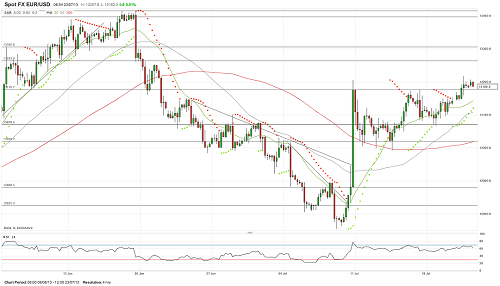
EURUSD – The EURUSD Unable to Consolidate Above 1.3206


eurusd23.07.2013

The EURUSD continued to rise yesterday, having increased above the resistance 1.3176 and tested the 1.3217 level – it is slightly above the highs reached on July 10 after Ben Bernanke’s speech. Despite lingering positive and the Parabolic SAR, which is still below the price chart, the pair’s dynamics is not credible, and if the euro fails to hold above 1.3176, the pair risks of decreasing at least to 1.3100-1.3070. The loss of the 30th figure will mean the downtrend resumption. In case the current highs are broken down, the bulls’ next target will be the 1.3264 and 1.3306 levels (each of them can provide a strong resistance).


GBPUSD – The GBPUSD Hits Resistance at 1.5376


gbpusd23.07.2013

Similar to the EURUSD situation, the GBPUSD pair was increasing yesterday, remaining positive. The pair broke down 1.5290 and increased to 1.5376 resistance, which successfully holds back the bulls’ onslaught so far. It is wise to note, that the RSI has entered the overbought zone that may hinder the ascending movement. However, the Parabolic SAR is below the price chart, and the 50-day MA has crossed the 100-day MA upwards, indicating the speculators’ positive sentiment towards the GBPUSD. Thus, it is wise not to rule out the breakdown of the current high with the following pair’s increase to 1.5485.


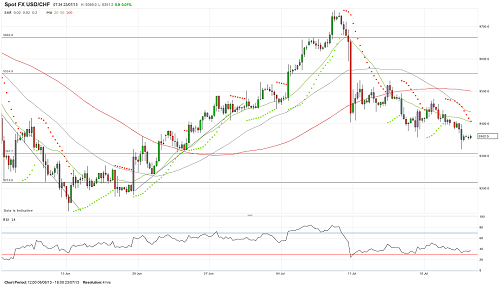
USDCHF – The USDCHF Pulls Back from Support Near Figure 93


usdchf23.07.2013

The USDCHF is gradually decreasing, having found the support at 0.9371, which was later successfully punched. As a result, the dollar dropped to 0.9321 (the high of the previous trading day) with the following pair’s pullback to 0.9366, where the pair is trading at the moment. So far, the pair manages to stay above the support at the 93rd figure that leaves hope for the bulls to resume the increase. The loss of the support would deprive them of that hope and make the pair drop to 0.9220. In case of the pair’s increase and consolidation above 0.9400, its outlook would be improved.


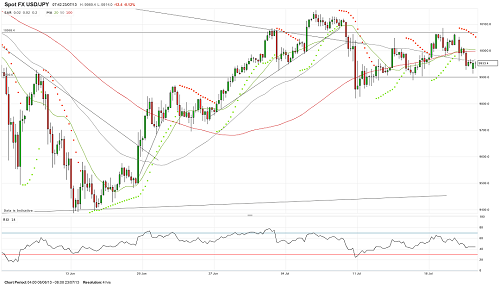
USDJPY – The USDJPY at Risk of Decreasing Below


usdjpy23.07.2013

Despite the positive closure of the previous week, the dollar managed to continue increasing against the Japanese yen and was under pressure during the whole day yesterday. First, its rate dropped to 99.61. After a slight pullback, the decrease was resumed and the dollar approached the support near the 99th figure. The pair became in demand at 99.14 that allowed the dollar pull back to 99.64. The pair’s inability to increase and consolidate above 100.70 with a subsequent decrease near the 99th figure has increased risks of the renewed downward correction. However, the bears will have to pass not only 99.00, but also the support at 98.20. The loss of 98.20 would mean the development of a medium-term downtrend. The increase above 100.70 would resume the pair’s increase.

provided by IAFT


Forex Vs. Stock Trading

By Equity-Research.com

Many people are interested in financial trading and in recent years the rise of internet technology has allowed for unprecedented access to the financial markets. When considering trading many prospective traders are unsure what instrument they should trade. This is perfectly understandable considering the range of instruments available to trade. Forex and Stock trading are particularly popular with retail traders. In this article we are going to outline the important differences between Forex and Stock trading. Whether you ultimately opt to trade Forex or Stocks will depend largely on your risk appetite and the type of trading you intend to engage in. Of course both Forex and Stock trading involve considerable risk and those interested in trading should seriously consider whether Stock and Forex trading is suitable for their needs.

The Foreign Exchange and Stock Market Explained

Forex

As some of you may already be aware the Foreign exchange market is the world’s largest financial market, with an estimated daily volume total of $5 trillion US dollars. About 30% of this daily volume occurs on the Spot forex markets, with spot Forex being the most popular form of Forex trading for retail investors. The size of global Foreign exchange market is huge and dwarfs even the world’s biggest stock exchanges. For instance the New York Stock Exchange has a daily volume of around $22 billion dollars. This is partly why the market is so popular with retail traders, who wish to take advantage of high liquidity, 24/5 trading and significant amounts of leverage.

Stocks

Stocks are generally traded on major exchanges and you will find a number of household names being traded on the world’s major stock exchanges. Many laymen are much more familiar with Stock trading than Forex trading, due to the fact that Forex is generally considered an exotic instrument. Everyone who has a pension will probably hold Stocks, if only in an indirect way. While the majority of Stock traders focus on large blue chip companies, it is also possible to trade smaller companies. The reason that many investors focus on blue chip companies, is due to the fact that these well established companies may be able to operate profitability even during tough economic times. Blue chip stocks tend to be less volatile than other more exotic financial instruments and are often traded with the long term goal of growing a
substantial investment portfolio.

Trading Hours

As the Foreign exchange market is an interbank over-the-counter market, during the week the marketplace trades 24 hours a day. This means that the Foreign exchange market opens on Sunday night GMT and doesn’t close until Friday evening GMT. This makes the market very popular with part-time traders, who are able to trade around their work commitments.

Stocks are traded on exchanges which have set opening times. For instance Stocks listed on the London Stock exchange can only be traded 8am to 4:30pm GMT. This can make it difficult for part time traders to access the markets when they need too. It is possible to trade some Stock markets out-of-hours, but such trading generally carries greater risk due to higher spreads and less liquidity.

Leverage

Leverage allows a trader to take on bigger positions, giving traders a chance to maximize their profits. Leverage however is a double edged sword with leverage also increasing your losses should the market move against you. In the United States, leverage on Stocks is limited to 2:1 while Forex traders are able to take advantage of 10:1 leverage. In Europe traders are able to trade stocks with significantly more leverage behind them, but still Foreign exchange brokerages tend to offer vastly more leverage. While this great leverage increases a traders risk it at the same time allows a trader the chance to make larger profits. For this reason many less risk adverse traders are attracted to Forex trading.

Volatility

Volatility is a measure of short-term price changes. Highly volatile instruments will experience significant price fluctuations, while less volatile instruments will be more stable in terms of price. Foreign exchange pairings tend to be more volatile than Stocks, though this not always the case particular when it comes to smaller cap or penny stocks. The combination of significant leverage and high daily volatility allows traders to make very big returns in a short space of time. Of course volatility increases risk while giving the trader ample short term trading opportunities. Stocks tend to be less volatile suiting traders who take a hold and buy strategy.

Capital Requirements

The significant amounts of leverage offered by many Forex brokerages means that traders can often begin trading the financial markets with lower capital requirements. In Europe it is possible to open a real money trading account with a regulated brokerage for as little as $25. While this is probably not advisable, it is certainly true that Forex trading tends to require less capital. To trade Stocks successfully, a trader is likely to need significant capital backing this is partly due to the fixed commissions charged by Stock brokers which eat into the profits of smaller traders.  This is why in Europe a large number of retail traders opt to trade stocks through CFD’s, allowing them to take on significant leverage. Unfortunately US traders are unable to trade CFD’s due to US regulation.

Concluding Thoughts

Foreign exchange trading is generally considered more risky than Stock trading. Forex trading is often embraced by short term traders who want to take advantage of the significant amounts of leverage on offer. While Stock trading lends itself to investors who are more risk adverse and would prefer to adopt a buy and hold approach. Readers are recommended to do further research into Stock and Forex trading in order to decide whether either would be suitable for their needs.

Article by equity-research.com