Central Bank News Link List – Jul 25, 2013: China fires growth salvo, is monetary easing next?

By www.CentralBankNews.info Here’s today’s Central Bank News’ link list, click through if you missed the previous link list. The list comprises news about central banks that is not covered by Central Bank News. The list is updated during the day with the latest developments so readers don’t miss any important news.

Philippines maintains all rates on balanced inflation risk

By www.CentralBankNews.info     The Philippine central bank held its policy rates steady, including the Special Deposit Account (SDA), saying the risks to inflation remain broadly balanced, economic growth is strong and recent market volatility calls for caution in assessing the policy stance.
    The Central Bank of the Philippines (BSP) said inflation is expected to remain within the bank’s target range in the next two years, supported by well-contained inflation expectations and subdued global economic prospects that will temper upward pressures on commodity prices.
    “Nonetheless, upside risks to the inflation outlook remain, including pending utility rate adjustments as well as the recent depreciation of the peso,” the bank said.
    The BSP held its benchmark overnight borrowing rate, or reverse repurchase facility rate, steady at 3.50 percent – unchanged since October 2012 – along with its overnight lending rate at 5.5 percent, and the SDA rate at 2.0 percent.
    The decision to hold rates was widely expected following a statement last week by the bank governor who said there was “no urgency to change policy because inflation remains under control.”
    While keeping its main rates steady this year, the BSP has cut the SDA rate by 150 basis points to make it less attractive for foreign funds to park their money there, putting upward pressure on the peso. Last year the peso rose by almost 7 percent against the U.S. dollar.

    But since early May, the peso and other emerging market currencies has come under pressure from capital outflows, dropping 7 percent against the U.S. dollar from May 10 to June 25. The lower peso tends to raise import prices, putting upward pressure on inflation. 

    But since last June, the peso has bounced back and is now only down 5.4 percent since the start of the year, quoted at 41 peso to the U.S. dollar today.
    In June the Philippine inflation rate rose slightly to 2.8 percent from 2.6 percent in May and April.
    Last month the BSP also said inflation was expected to remain within the bank’s target for 2013 and 2014 – 4.0 percent plus/minus one percentage point – and the 2015 target of 3.0 percent, plus/minus one percentage point.
    In April the BSP forecast 2013 inflation of 3.3 percent.
    The Philippine economy continues to be robust, the bank said, supported by domestic demand and buoyant market confidence, strong domestic liquidity and bank lending
     Gross Domestic Product was up 2.2 percent in the first quarter from the fourth quarter for annual growth of 7.8 percent, the fastest rate since the second quarter of 2010. The government has forecast growth this year of 6-7 percent compared with 6.6 percent in 2012.
   
    www.CentralBankNews.info

Fiji holds rate steady on positive economic outlook

By www.CentralBankNews.info     Fiji’s central bank held its Overnight Policy Rate (OPR) steady at 0.5 percent, saying the current accommodative stance was appropriate as inflationary pressures remained in check, foreign reserves were at a comfortable level and the economic outlook was positive.
   The Reserve Bank of Fiji, which has maintained its rate since December 2011, said investment activity was “extremely buoyant” with cement sales higher along with increased lending to the manufacturing, building, construction and real estate sectors, confirming the bank’s estimate that investment to GDP ratio this year will exceed the government’s target of 25 percent.
    “Domestic economic conditions were very positive and there was a growing sense of optimism and confidence about our economy,” the bank’s governor, Barry Whiteside said.
    Fiji’s inflation rate was steady at 1.5 percent in June from May and the Reserve Bank has forecast Gross Domestic Product growth of 2.7 percent this year, up from 2012’s 2.5 percent.
    The bank also said that liquidity in the banking system was adequate, putting downward pressure on market interest rates and commercial banks’ deposit and lending rates were at historical lows.
    “Against this background, domestic credit has continued to gain momentum with robust commercial bank lending accounting for much of the surge in private sector credit,” the bank said.

    www.CentralBankNews.info
   

Why it’s Deflation…Not Inflation, that’s Heading Our Way

By MoneyMorning.com.au

I don’t think the Fed can get interest rates up very much, because the economy is weak, inflation rates are low. If we were to tighten policy, the economy would tank. Ben Bernanke’s response to a question from the House Financial Services Committee hearing held on Wednesday 17 July 2013

After increasing the money supply at a rate of 33% per year for the past five years, the best US Federal Reserve chairman, Dr Ben Bernanke can manage to achieve is ‘the economy is weak.

The sheer volume of newly minted dollars has financial experts and gold bugs searching the horizon for evidence of inflation and even hyperinflation. The theory is, ‘Surely with this much money being added to the system, higher inflation must soon appear on the horizon?’

Conventional wisdom suggests inflation should be a by-product of the central bankers’ efforts with the printing press.

However, the fact is we aren’t in conventional times. Therefore the world as we know (or think we know) it may not act in its usual ‘Pavlovian’ way.

The following chart on UK inflation rates dating back to 1265 shows persistent inflation is only a 20th century phenomena.

Prior to 1900, the UK and other developed economies experienced the ebb and flow that happens when humans interact in a buying and selling process.

Supply, demand, greed, fear and a host of other variables drive our decision-making process. This in turn moves the economy in certain directions – positively and negatively.

Source: Credit Suisse

The negative period in the early 1900′s was a result of ‘The Panic of 1907′. This severe downturn gave the authorities and big banking interests an excuse to set up a central bank.

Lesson number one for the rich and powerful is ‘never let a good disaster go to waste’. They sold the central bank concept to the public as a tool to stabilise the economy.

Ever since then, central bankers have ‘controlled’ the economy. But the value of a dollar has been anything but stable. Inflation has all but vaporised the buying power of a dollar issued a century ago.

Due to central bank meddling intervention, inflation is all we have known for the past century. Little wonder we expect inflation – especially when the Fed now prints more money in a year than it did for the previous century.

Yet in spite of all we think we know about the economy, ‘inflation rates are low.‘ The following graph confirms Bernanke’s testimony.

The core personal consumption expenditures deflator (an indicator the US Fed watches closely) is at a fifty year low with just a 1% year-over-year change.

Bernanke is fervently following the manual written by those who went before him. However, it’s not producing the outcomes they achieved.

A hundred years is a long time for an experiment (and that’s what central banking is) to show consistent and reasonably predictable results. However, they can only repeat the results if the lab conditions are the same each and every time.

And that’s the subtle but key missing piece of the puzzle that most people have overlooked – the lab conditions aren’t the same.

  • World population quadrupled in the past century – finite resources mean this is unlikely to happen in the next century.
  • Population growth in the western world has stabilised compared to the growth rates of the past century.
  • Household balance sheets are dripping in red ink – capacity for more personal debt is declining.
  • Compared to a century ago, government welfare, healthcare and warfare obligations are ‘through the roof’. A sustained period of consumption (producing higher tax revenues) won’t rescue heavily indebted and over-obligated governments this time.

For the time-being the days of excess consumption are in the past.

The following chart (dating back to 1965) shows over the past five years there has been a 90% correlation between what consumers earn and what they spend.

Compare this to the 2002 to 2007 period (the credit bubble period) when there was next to no correlation between earnings and expenditure.

Why was that? This was when consumers treated their home as an ATM – using home equity loans to fund consumption.

The next chart on Mortgage Equity Withdrawals (MEW) shows the debt feeding frenzy that occurred from 2002-2007. Since the GFC hit it has been all downhill. The consumer focus has been on living within their means and repaying (or, defaulting on) debt.

Inflation is the by-product of money creation plus credit.

In the past five years the Fed has produced around US$2.5 trillion of new money. Over the same time, the private sector has cut debt levels by US$4 trillion.

There are a couple of other telltale signs of inflation that are pointing in the wrong direction. Commodities prices have trended down for the past two years, and the Baltic Dry Index (an indicator of global shipping activity) is down to levels last seen during the GFC.

The Great Credit Contraction is producing the equal and opposite effect of The Great Credit Expansion. The inner tube of the global economy has a puncture – more air is escaping then the central bankers can pump in.

When a tyre loses pressure it is DEFLATING.

But the deflationary outlook isn’t unique to the US. Look at this chart from a recent Societe Generale report:

Here is an edited version of the commentary accompanying the chart (emphasis mine):

Perhaps, though, the most decisive macro factor for all markets will be any slide into deflation in China…. The recent Q2 GDP data contains the surprising fact that China’s implicit GDP deflator had slowed to only 0.5% yoy – noticeably weaker than the CPI data… The fact that China is on the verge of outright deflation may prove more important than even Fed tapering.

But don’t worry. Bernanke has it all under ‘control’ – after all isn’t that what central bankers believe?

How’s this for supreme confidence. When asked how the Fed will exit its QE (quick & easy) money experiment he said:

We know how to exit. We know how to do it without inflation… We have all the tools we need to exit without any concern about inflation.

The only tools Ben has at his disposal are the other board members sitting around the Fed’s boardroom table.

Four years of money printing have done nothing but damage the integrity of markets. By distorting interest rates they have forced investors into high risk investments paying low returns. Let’s face it, for the average punter a few percent from anything looks a whole lot better than 0.25% in the bank.

The longer this experiment is allowed to continue (and Fed hubris means it will be for longer than anyone expects), the greater the dislocation in markets. When GFC Mk II hits, consumers will retreat even further into the cave of cautious spending and debt reduction or default.

The irony is the Fed’s money printing has increased the odds of a deflationary outcome.

A century of central bank meddling in markets has produced another type of inflation – in the form of central banker egos and belief in their abilities.

The pending market upheaval will hopefully deflate these puffed up theorists.

Vern Gowdie
Editor, Gowdie Family Wealth

Join Money Morning on Google+
From the Archives…

Why Invest ‘Hard’ When You Can Invest ‘Easy’?
19-07-2013 – Kris Sayce

Read This Before You Buy Another Stock or Bond…
18-07-2013 – Murray Dawes

Could Uranium be the Best Investment in 2013?
17-07-2013 – Dr Alex Cowie

Asteroid Mining and the Commercialisation of Space
16-07-2013 – Sam Volkering

Why the Australian Share Market is Heading Even Higher
15-07-2013 – Kris Sayce

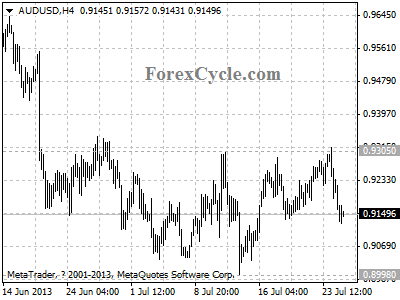
AUDUSD failed to break above 0.9305 resistance

AUDUSD failed to break above 0.9305 resistance, and stays in a trading range between 0.8998 and 0.9305, suggesting that the pair remains in consolidation of the downtrend from 1.0582 (Apr 11 high). The range trading could be expected to continue in a couple of days. Support is at 0.8998, a breakdown below this level will signal resumption of the downtrend from 1.0582, then further decline towards 0.8500 could be seen. Key resistance is at 0.9305, only a clear break and hold of this level could indicate that the downtrend from 1.0582 had completed at 0.8998 already, then the following upward movement could bring price back to 1.0000 zone.

audusd

Provided by ForexCycle.com

This is Why the Australian Market Could Reach 7,000 by 2015…

By MoneyMorning.com.au

Inflation is the most capricious of economic variables and central banks are cursed with the responsibility for it. It has defied all predictions in the US during the past five years and, once again, inflation’s general perversity is complicating life for the Federal Reserve.‘ – Financial Times

The US Federal Reserve board members are wearing a puzzled look right now.

Despite the tens of billions of dollars the Fed has pumped into the market, prices aren’t rising as much as the Fed had hoped.

In fact, according to the FT, US inflation is only up 1.1% versus the Fed’s objective of 2%. And you thought it was a good thing when prices don’t go up.

Not if you’re a central banker.

But if the Fed board members are puzzled by the low inflation rate, new member of the Money Morning team Vern Gowdie isn’t. Later on, Vern reveals the reasons for the low inflation number and what it means for the markets.

To give you a clue, it starts with a ‘D’ and it’s bad news for banks. But before that we’ll take a different slant on the issue and explain why this news confirms our view that stocks are on the verge of another super-rally…

We’re sure you remember the hullaballoo about a bond market crash and rising bond yields.

It was only a few weeks ago. Not only did the bond market crash, but the stock market crashed too.

The reason? Most folks (but not your editor) thought US Federal Reserve chairman, Dr Ben S Bernanke was about to raise interest rates.

As most investors know, generally, higher interest rates are bad for stock prices. But why is that?

We Bought While Others Sold

There are two reasons why share investors don’t like higher interest rates.

First, higher central bank interest rates usually mean higher bank deposit rates. If banks can pay more interest on deposits it means investors may prefer the safety of a bank account compared to the comparative risk of a share investment.

And second, higher interest rates are bad news for companies with large borrowings. The more the company has to pay in loan interest repayments, the less there is to feed through to the company’s profits.

That’s why stocks collapsed a few weeks ago. The collapse came after the recent surge into dividend-paying stocks. Any chance of rising bank savings rates could have put paid to the dividend rally and therefore cause stock prices to fall.

Even though there’s absolutely no chance of the US Fed or the Reserve Bank of Australia (RBA) raising interest rates, investors weren’t about to take that risk. Hence falling stocks.

While it’s frustrating to see stocks fall for no reason, it also created an opportunity. We told Australian Small-Cap Investigator subscribers to ignore the fear-mongering and use the lower prices to buy good stocks – especially any beaten down dividend payers.

In fact, while most investors looked for an excuse to get out of the market, we explained to Australian Small-Cap Investigator subscribers that we were raising the buy-up-to price on eight of our stock tips.

Our reason was that stocks could surge again and we wanted to make sure they could get in on the action if we were right.

And so far, things have gone to plan. Stocks that took a pounding just a few weeks ago are now back to or near their pre-crash levels. We feel sorry for the worry-warts who didn’t stay the course and who probably sold right at the bottom.

But while they may feel bad about that after seeing the market rally, it’s not half as bad as they’ll feel if they don’t buy back in now…before it’s too late.

You Should Buy Stocks Now or You’ll Regret It

Our view on the direction of this market is the same as it has been since late last year. It’s a great time to buy stocks as the Australian market climbs towards 7,000 points.

But as we’ve also warned you, don’t expect the market to go up in a straight line. The market never does that. It always pauses, and sometimes falls before going higher.

That’s when nervous investors tend to bail out fearing the rally is over. Our guess is the Australian market is in that phase now. After the big rally from late June to mid-July, the market has gone sideways over the past week.

This is the bail out time for the impatient. But it’s also the perfect time to get in if you missed the recent run up. As we see it, there is absolutely no danger of interest rates going up anytime soon.

Remember, Japan has had zero percent interest rates for 20 years. What makes you think the Fed will start raising rates after just four years? The same goes for the RBA.

Most people haven’t figured that out yet. They think this is a short-term problem and that rates will go up again soon. That’s not happening, so get used to it.

So if we’re right about that, think of the logical conclusion. If higher interest rates are bad news for stock prices, then lower interest rates should be…good news for stock prices.

All it will take is for most investors to catch on that this low interest rate period will last for years and buyers should push the market to a record high before you know it.

OK, nothing is certain. That’s why we don’t want you investing every last cent in stocks. But we’ll be blunt. If you still don’t have exposure to stocks, or you’re not adding to an existing portfolio now, we fear you’ll come to regret it two years from now when the Australian market hits 7,000 points.

Cheers,
Kris
+

From the Port Phillip Publishing Library

Special Report: The Sixth Revolution

Daily Reckoning: Australia’s Mysterious Natural Gas Shortage

Money Morning: Why You Must Avoid This Big Investing Mistake…

Pursuit of Happiness: Foreign Family in Taxpayer Rort…Or Royal Celebration?

New Zealand holds rate steady but adopts tightening bias

By www.CentralBankNews.info
    New Zealand’s central bank maintained its official cash rate at 2.5 percent and repeated that it would hold the rate steady through the year, but warned that it would probably have to tighten policy in the future, depending on how much the housing market and construction sector fuels inflation pressures.
    The introduction of a tightening bias by The Reserve Bank of New Zealand (RBNZ) was not expected by economists, though the central bank has often voiced its concern over the strength of the housing market and the effect this may have on inflation.
    The RBNZ, which has held its its policy rate steady since March 2011, said inflation had been very low over the past year, helped by the strong New Zealand dollar and international and domestic competition, but it was now expected to trend upwards towards the midpoint of the bank’s 1-3 percent target band as growth accelerates over the coming year.
    “The extent of the monetary policy response will depend largely on the degree to which the growing momentum in the housing market and construction sector spills over into inflation pressures,” the bank’s governor, Graeme Wheeler, said in a statement.
    “Although removal of monetary stimulus will likely be needed in the future, we expect to keep the OCR unchanged through the end of the year,” he added.

Should Tobacco Investors Fear the FDA?

By The Sizemore Letter

The US Food and Drug Administration announces it is considering banning or strictly regulating menthol cigarettes…and the share prices of the companies that make and sell those menthol cigarettes take a tumble.  Haven’t we seen this movie before?

Midday Tuesday, the share prices of Altria ($MO), Reynolds American ($RAI) and Lorillard ($LO) were down by 2.8%, 1.9% and 4.1%, respectively, on the news that the FDA was considering stiffening the regulation on menthol-flavored cigarettes.  Apparently, despite decades of anti-smoking educational campaigns and prohibitively expensive taxation in many American cities, the flavored cigarettes encourage non-smokers to pick up the habit.  Who knew.

Lorillard took a bigger beating from the market than Altria or Reynolds American because menthol-flavored cigarettes make up a much bigger chunk of sales.  Newport—Lorilard’s premium menthol-flavored brand—is the top selling menthol brand and the second-largest-selling cigarette brand overall.

Should investors be concerned about this?

I wouldn’t worry too much about a menthol ban, per se.  We went through this same song and dance back in 2011.  The FDA made noise about banning or strictly regulating menthol cigarettes, which depressed Lorillard’s stock price—and created the conditions for one of the best trades of my career.  The FDA’s case—that menthol-flavored cigarettes taste better and thus encourage more people to smoke—is a weak one.  By the same logic a screwdriver should be illegal because the orange juice masks the taste of the vodka.  It’s hard to see something like this holding up in court.

But don’t mistake my downplaying of the risk of anti-menthol regulations for bullishness on tobacco stocks.  The last “menthol scare” created a fantastic investment opportunity in Lorillard shares because it made them fantastically cheap.  They traded for less than 12 times earnings and yielded nearly 7% in dividends.  Today, Lorillard changes hands at 15 times earnings and yield a much less impressive 4.7%.  Altria and Reynolds American sport earnings ratios that are considerably higher—and higher than the S&P 500 average—while also yielding about the same as Lorillard in dividends.

And while I believe this menthol scare will pass, there are other regulatory challenges that are likely to linger for a while—including the move to plain packaging.

I wrote last week that plain packaging laws attack Big Tobacco’s most valuable asset:  its companies’ brands.

Cigarettes in Australia now come in plain boxes with identical plain-type fonts on the front and grotesque pictures of cancerous death on the back; no logos or branding is allowed.  Aussie smokers have complained that their cigarettes now “taste different,” and early indications are that the rules are reducing cigarette consumption at the margin.  Most of the developed world is considering implementing similar plain-packaging rules.

Does this mean imminent death for Big Tobacco?  Of course not.  This is an industry that has survived decades of regulatory attacks and lawsuits and yet still goes about its business profitably.  But at the margin, plain packaging rules will erode the value of Big Tobacco’s business.

Tobacco stocks have had a great run over the past decade, beating the market on a total return basis by a wide margin.   But that outperformance was made possible by their cheap valuations and astronomically high dividend yields, and these conditions are not in place today.   If you want to buy Big Tobacco for its still higher-than-average dividend payouts, be my guest.  But be realistic and don’t expect the same kind of outperformance going forward.

SUBSCRIBE to Sizemore Insights via e-mail today.


Six-Baggers for the Next Decade: Part 2

By Investment U

Investors looking for a high-growth sector within the energy industry for the next 10 years need look no further than renewables. No sector is set up for explosive growth like renewable energy is.

As we discussed yesterday, renewable energy sources are being adopted by governments and businesses around the world at a pace that has vastly outstripped projections.

It’s true that renewable energy has had many detractors throughout its brief history. Many politicians believe renewable technologies are immature and require further research in order to be viable.

Not surprisingly, some of these views are pushed by the fossil fuel industry. After all, they stand to lose big if renewables are adopted much faster than anticipated. Here are a couple of examples…

Exxon Mobil (NYSE:XOM), in its recent 2012 Outlook for Energy to 2040, said, “advances in technology will be necessary to make [renewable] fuels more practical and economic… geothermal and solar will remain relatively expensive.”

Chevron Corporation (NYSE:CVX) said, “because of major technical hurdles such as scalability, performance, and costs as well as market-based barriers, broader adoption [of renewables] can’t happen overnight.”

What about cost?

Comments like “Renewable energy is too expensive” or “Public subsidies for renewables will be required for the foreseeable future” are typical. The reality is fossil fuel subsidies far exceed those for renewables.

The International Energy Agency (IEA) 2012 World Energy Outlook estimates global fossil fuel subsidies at more than $520 billion in 2011. This compares to approximately $90 billion for renewable energy.

What about environmental costs?

Those associated with nuclear and fossil fuels aren’t typically included when doing cost comparisons with renewables.

Then there is the risk associated with fossil fuel price swings. Some experts say that between 1-3 cents per kilowatt hour should be added to power costs associated with natural gas.

The bottom line on renewables is that their future growth is entirely underestimated by today’s investment community.

Shining Bright

I’m particularly bullish about solar energy. Who wouldn’t want to get rid of their gas and electric bill, and replace it with something that’s clean, natural and cheaper? The problem has always been equipping homes and business with solar panels and other necessary hardware – no small expense.

But some great companies are charging ahead to solve that problem. We discussed one of them, SolarCity Corporation (NYSE: SCTY), yesterday. Another is Canadian Solar Inc. (Nasdaq:CSIQ).

Canadian Solar, like SolarCity, is poised to become a “six-bagger” – a stock whose value jumps sixfold over a 10-year period.

Canadian Solar is a vertically integrated player in the sector. Starting with raw polysilicon, the company manufactures its own ingots, wafers, cells, modules, systems and solutions.

Based on 2012 shipments, Canadian Solar is the world’s fourth-largest solar manufacturer. Due to its vertical integration, Canadian Solar has one of the lowest installed costs of any module manufacturer.

The company covers the spectrum of the solar market. It offers residential system kits as well as commercial rooftop installations. In addition, it actively develops and constructs utility-scale power plants.

The company’s industry-leading cost structure means its all-in module cost was $0.57 per watt at the end of March. Right now, Canadian Solar has more than 5.0 GW of modules installed in more than 50 countries.

Business Is Good

Another big differentiator for Canadian Solar is its business model. In 2012 its system and solution business was approximately 13% of the company’s revenue. In 2013, that number is expected to grow to approximately 50%.

One of the largest growth opportunities for the company comes from its utility-scale projects. It has several in the works:

  • It has expanded its utility-scale pipeline in the U.S. to 255 Megawatts (MW).
  • Its Japanese market utility-scale projects total 125 MW.
  • It recently won a contract to supply 91 MW of modules for projects in Thailand.

The deal that stands out to me is a plan signed on June 10 with Grand Renewable Solar LP to build a 130 MW utility-scale solar power plant. The company expects the deal to generate over $300 million.

With the addition of these two projects, Canadian Solar has nearly 1 GW of utility-scale projects in its pipeline. In Canada alone, it has identified 29 solar power plants it expects to complete between now and 2015, with a cumulative value exceeding $1.5 billion.

In the Japanese residential market, business is booming. The company started selling residential system kits there in 2009. After the Fukushima disaster, business surged. In 2012, the company booked $120 million in Japan.

Canadian Solar expects to ship between 1.6-1.8 GW of modules in 2013. In Q1 2013, 17.9% of module shipments went to the Americas, 24.7% to Europe and 57.4% to Asia and others.

We believe Canadian Solar will be another disruptor stock 10 years from now.

Good Investing,

Dave Fessler

Article By Investment U

Original Article: Six-Baggers for the Next Decade: Part 2

Global banks boost lending to Asia, but cut in Europe – BIS

By www.CentralBankNews.info
    Major international banks continued to reduce their lending to European borrowers in favor of increased business with emerging economies, especially China, leaving the total stock of international claims steady at $28.6 trillion at the end of the first quarter of 2013, according to the Bank for International Settlements (BIS).
    Preliminary data for international bank lending showed that claims on banks and related offices in advanced economies fell by an annual 9 percent, or by $329 billion, from end-2012 to end-March, the sixth consecutive quarterly decline.
    Since the end of September 2011, the total drop in interbank lending to advanced economies amounts to $1.9 trillion, with most of the decline in the first quarter of this year to banks in the United Kingdom, Germany and the Netherlands, BIS said. Interbank lending with the United States and Japan also shrank, but only marginally.
    Meanwhile, internationally-active banks are finding plenty of borrowers in emerging markets, with claims up 9 percent, or by $265 billion, from the first quarter of 2012 to the end of March.
    Total outstanding cross-border claims on borrowers from emerging markets now amount to $3.4 trillion, of which Asia accounts for 45 percent, or $1.52 trillion, and Latin America for 20 percent. But that still pales in comparison to outstanding claims on all developed countries of $21.3 trillion.

    The expansion in lending in the first quarter was especially strong to borrowers from China, with loans up by $160 billion, a jump of 30 percent year-on-year, with loans concentrated in short-term maturities and to the bank sector, BIS said.
    “BIS reporting banks’ exposure to Asian credit risk has increased even more rapidly than their lending to Asian borrowers,” said BIS, which compiles statistics on international banking activity based on data from at least 31 different countries.
    Apart from showing the diverging trend in the pattern of global credit, the BIS data also reveal how banks transfer credit risk from one borrowing country to another.  
    Historically, banks have sought to transfer the risk from a loan to a borrower in an emerging country onto a guarantor in another country, limiting their exposure to countries that in some cases were characterized by social and political risks.
    But reflecting the rapid political and economic transformation in many emerging countries, BIS found a decline in credit risk transfers out of Asia in recent years. By the end of March the transfer of risk into the region for the first time exceeded the transfer of risk away from the region.
   The development was driven by credit to the large economies in emerging Asia, such as India, China and Korea.
    “A similar, if less pronounced, development is visible in the Latin American region, driven by credit to Brazil in particular,” BIS said.
    In contrast, major global banks continued to shift credit risk out of emerging Europe, Africa and the Middle East, though the trend had started to reverse for emerging Europe, particularly in the first quarter, BIS said.