Prem Watsa’s BlackBerry Nightmare: What Can We Learn?

By The Sizemore Letter

Even the greats make mistakes.  I wrote a piece two years ago with those words as the headline with a very specific purpose: to show that, over time, the market has a way of humbling us all.  Even investment demigods like George Soros or John Paulson.

I bring this up because one of my favorite investors—the “Warren Buffett of Canada” Prem Watsa—has quite a bit of egg on his face following his experience with BlackBerry ($BBRY). 

As Blackberry launches a strategic review of its alternatives—which could include selling the company or going private—Watsa has resigned from the board of directors citing potential conflicts of interests.

Watsa—who invests, like Buffett, via his ownership in an insurance company—has had a rough couple of years, underperforming the S&P 500 by about 7% per year over the past three years (measured here as performance of Fairfax Financial Holding’s ($FRFHF) book value; see performance here).

But his longer-term record is nothing short of incredible.  He’s grown Fairfax’s book value by 18.9% per year over the past 25 years, more than doubling the S&P 500’s annual returns over that period.

Yet despite his unquestioned investment acumen, not even Watsa is immune from making the occasional catastrophically bad mistake.

Fairfax is the largest institutional shareholder of  BlackBerry, owning about 10% of the company’s outstanding shares.  BlackBerry makes up a shocking 28% of Fairfax’s long equity portfolio.  Fairfax uses a variety of hedges that make its true portfolio exposures complicated and hard to decipher, but we can at least say that Fairfax has bet big on BlackBerry…and lost.

Reporting Date

Action

Avg Price

Comment

Total Shares Held

9/30/2010

Buy

50.19

New holding

2,065,000

6/30/2011

Add

43.84

Add 305.49%

8,373,300

9/30/2011

Add

26.78

Add 40.9%

11,798,300

12/31/2011

Add

18.88

Add 8.48%

12,798,300

3/31/2012

Add

14.13

Add 109.78%

26,848,500

9/30/2012

Add

7.22

Add 93.14%

51,854,700


Roughly half of Watsa’s BBRY purchases were made at “going out of business” prices in the $7.00-$8.00 dollar per share range, giving him gains of 20%-30% on those lots.  But his initial purchases back in 2010 were at an average cost over $50.00…making him down nearly 80% at current prices.

The current value of Watsa’s BlackBerry position is around $570 million.  His cost basis?  Nearly $900 million.

What lessons can we learn from this?

To start, averaging down is generally a bad idea.

There are exceptions, of course.  If a company is highly predictable, its fundamentals are chugging along just fine, and there are no realistic possibilities of financial distress , then a dip in the share price can be a great opportunity to scoop up more shares or, at the very least, reinvest any dividends.

But this is far less true in evolving industries or in technology companies—and particularly those where platforms and networking effects are a large part of what gives the company value.

Last year, I wrote a short piece on “How to Spot a Value Trap” using my own experience with BlackBerry (then Research in Motion) as an example.   While there are things to look for that can mitigate your risk of falling into a value trap—such as a reasonably high and growing dividend—I reached the conclusion that:

As much as we would like for it to be, this is not an exact science, and you’re not going to get it right every time. In the end, the best defense against a value trap is emotional discipline. Look at your investments critically and don’t make excuses when they fail to perform. Use stop losses when appropriate. And be honest with yourself when you ask the question, “If I didn’t already own this stock, is this something I would want to buy today, knowing what I know?

And to this I would add “never let your personal feelings about a product affect your judgment about the investment merits of its maker.”

It’s no coincidence that when I was bullish on BlackBerry, I also happened to carry one of their phones in my pocket.  I’m willing to bet Mr. Watsa did as well.

SUBSCRIBE to Sizemore Insights via e-mail today.

Join the Sizemore Investment Letter – Premium Edition

Miners with the Grade to Survive the Silver Downturn: Chris Lichtenheldt

Source: Kevin Michael Grace of The Gold Report (8/12/13)

http://www.theaureport.com/pub/na/miners-with-the-grade-to-survive-the-silver-downturn-chris-lichtenheldt

It’s one thing for a silver producer to make a profit at $28/oz and quite another to do the same at $20/oz, declares Chris Lichtenheldt, senior mining analyst at Dundee Capital Markets. In this interview with The Gold Report, Lichtenheldt examines eight silver companies, detailing which ones will be rewarded for high-grade assets and which ones punished for high costs. And he explains why one of his favorites is a silver company that doesn’t actually produce silver.

The Gold Report: Silver seems to have stabilized at $20/ounce ($20/oz). Is this significant? If this support holds, can we expect upward movement?

Chris Lichtenheldt: I think $20/oz is a psychological level. Once we’ve stabilized above that, it’s somewhat reaffirming that the drop could be over. But it is hard to say if it’s all over and we’re now back to upward moving prices because the price drop was rather unexpected and dramatic to begin with, so comfort will be slow to return.

It’s too early to say definitively on the upward movement of prices. Some of the indicators we look at are futures positions and exchange-traded fund (ETF) positions. In futures, there has been a significant drop throughout the year in net long positions on the Comex. That has stabilized, indicating that the desire to short silver seems to be subsiding. On the ETF side, positions have been relatively stable. Taken together, those indicators suggest that perhaps the worst is behind us.

It’s too early, however, to call for another bull run. The best we can hope for now is that volatility subsides and prices remain stable so that investors and companies alike can begin planning for this new environment.

TGR: We’ve seen many stories about shortages of physical silver, coins being sold out, etc. Do you think it surprising that the paper price of silver has fallen so substantially, notwithstanding this apparent hunger for the physical?

CL: It’s a bit of a disconnect, no doubt, and it’s difficult to reconcile. A lot of the information we get on the physical side is anecdotal, but it suggests physical silver supply is tight and in the long run, you would think that the physical silver market should determine price movement. That’s why we tend to think that, over the long run, we will have higher prices; there is only so much silver to go around.

TGR: The silver-gold price ratio remains at a historic high of 65:1. Eric Sprott has said that the ratio should be closer to 16:1. Why does it remain so high? Do you think it’s going to change, and, if so, in which direction?

CL: Over the past decade, the ratio has ranged from the low 30s to over 80. The average since the beginning of 2000 is around 60:1, so we’re a little bit above that now. But silver tends to underperform relative to gold during times when both metals are moving down. Underperformance means an increase in that ratio. While anything is possible, I don’t see a catalyst to take us back to 16:1 in the foreseeable future.

TGR: If the ratio has been 60–65:1 since 2000, as you mentioned, doesn’t this suggest that silver has been moving and will continue to move in lockstep with the price of gold?

CL: While the average ratio has been around 60:1, it rarely spends any time there. Silver is usually either outperforming or underperforming. The crash in 2008 is a good example. Initially, silver dramatically underperformed gold, and that ratio reached into the 80s. Then over the subsequent couple of years, silver dramatically outperformed gold, and the ratio fell into the low 30s. So I don’t think silver will move in lockstep with gold, but for a significant move outside the recent ratio range, I’ll say again that we’d need some sort of catalyst.

TGR: From February to June, silver lost about 40% of its value. Were all the silver producers caught napping?

CL: The drop in price was many standard deviations beyond silver’s normal behavior, so I don’t think anyone could have fully expected it. Companies try to plan based on a range of possible metal prices, but the drop below $20/oz would have been outside any company’s conceivable range. Significant changes aren’t necessarily required by the very low-cost producers. But for a company with all-in cash costs in the low 20s and all of a sudden the silver price falls as it did, then a lot of changes are required.

TGR: How would you compare what has happened this year with the Hunt brothers’ attempt to corner the market in 1980, when silver hit $50/oz and then fell to $11/oz two months later?

CL: It’s a difficult comparison to make. The 1980 spike was much more short-lived and the drop was steeper and quicker, so I don’t think any companies then would have been operating on the assumption of $50/oz silver. For the past several years, however, we’ve had very strong prices, which allowed for a lot of silver-dominant mines that likely would not have come into production otherwise.

TGR: Is there a “doomsday price” at which the possibility of silver production becomes tenuous? What if silver were to fall below $15/oz?

CL: Silver is a unique commodity in that nearly three-quarters of it comes from non-primary silver mines: mines that get their silver as a byproduct. This means they would likely produce this silver no matter the price. So the 40% drop in the silver price really impacts the 25% of production that comes from primary silver mines.

At $15/oz you would no doubt begin to experience a noticeable number of mine closures within the primary silver sector. We estimate that the all-in operating costs required to run an already-producing silver mine are somewhere in the high teens. So at $15/oz a lot of companies would be underwater.

TGR: Is the falling price of silver likely to result in political jurisdictions becoming more mining friendly? Have you noticed any changes in the attitudes of specific Central and South American countries since the price collapse began?

CL: It would certainly make sense for countries that have silver mines in their jurisdictions to help make those companies more profitable. Governments should help sustain struggling mines to maintain employment and tax revenue, but it’s a bit early to say that I’ve seen any significant changes.

TGR: A lower silver price forces companies to cut costs to maintain profits. What are the easy ways to cut costs, and what are the more difficult ways?

CL: The easiest ways involve discretionary capital expenditures (capex). A company may hold off on buying that new truck and postpone additional development. It can lower general and administrative (G&A) expenses by laying off employees at site and at the head office.

The more difficult ways involve significant changes to mine plans, such as abandoning lower-grade areas in favor of higher-grade areas to improve near-term margins. A multi-asset company may be forced to consider putting some of its higher-cost mines on care and maintenance or even closing them. But if a company starts abandoning areas of the mine that made sense at $28/oz silver, it may not necessarily be able to go back to them later.

TGR: So if a company proceeds on the basis of projected silver prices that turn out to be lower than the actual prices, it can make decisions that will cut into its profits for years to come?

CL: Absolutely. A company doesn’t want to hastily and drastically change its approach to how it is going to mine. It’s a balance between the long-term profitability and the short-term needs. No company wants to base its future on $20/oz silver, but it must make plans. It will probably spend three to six months making that assessment, and, hopefully, by the time it is done, prices will be higher, and the company won’t actually need to make the difficult changes. No company wants to abandon ounces, but at the end of the day, it is in the business of making money, and sometimes tough choices need to be made.

TGR: Doesn’t a lower silver price mean an even greater premium for higher-grade ore?

CL: The funny thing about valuation is if you look at all the assets out there under spot metal prices, some of those that aren’t generating any cash are still carrying a value. That’s reflective of the market’s willingness to ascribe some option value to these assets in the hopes that someday they’ll generate meaningful cash again.

There is no question that investors will tend to flock to the higher-grade assets now because they are probably better off owning the mine that has to make few or no changes to survive $20/oz (or even lower) silver.

TGR: Looking at the companies that you cover, which ones will benefit from higher grade?

CL: Tahoe Resources Inc. (THO:TSX; TAHO:NYSE) is one. The company is uniquely positioned in that its grade is significantly higher than most of the other primary silver producers. At a silver-equivalent grade of over 450 grams per tonne, Tahoe’s Escobal project in Guatemala has about twice the average in the space. So the company has to make few or no changes to its mine plans to survive $20/oz or below. It is a company that is clearly well positioned despite the lower price environment. It has to be mentioned that Escobal is not in production yet, so Tahoe still has to execute what has been planned. But grade goes a long way to achieve the plan.

TGR: You have estimated Tahoe’s all-in cash costs at $12–14/oz through 2024 and you have suggested that this figure could be lowered by targeting only higher-grade areas. Is targeting higher grade something that could be done short term?

CL: Tahoe could do that, but I don’t think it has to. Most deposits have higher-grade and lower-grade areas, so if prices dropped even further, Tahoe could lower that all-in cash cost even further, at least on a short-term basis. But I wouldn’t expect a company with such low costs to make changes to its mine plan.

TGR: What is your target price for Tahoe?

CL: Right now it is CA$21.50.

TGR: Tahoe is a single-asset company. Is this an advantage, a disadvantage or is it irrelevant?

CL: It’s an advantage for Tahoe because its entire asset is high-grade ore. Multi-asset companies typically will not have this good fortune. Generally speaking, however, a single asset is a disadvantage because a diversified portfolio of assets means that if you have a significant issue at one of your mines, your entire company’s cash flow stream is not at risk.

TGR: What other companies could continue to thrive in a low-price environment?

CL: Silver Wheaton Corp. (SLW:TSX; SLW:NYSE) is worth mentioning. The all-in cost to run it, including payment for its silver streams and its G&A costs, is around $6/oz, which, most importantly, is relatively fixed. It is in very good shape as well. Silver Wheaton is not always included in the conversation because it’s a streaming company that doesn’t actually produce silver, but it offers similar exposure to the silver price when compared to the producers, but at a very low, fixed cost.

TGR: What is your target price for Silver Wheaton?

CL: It is CA$30.

TGR: You have written that some silver companies will require “more significant alterations to their current business plan.” Which companies did you mean?

CL: This is largely a function of where the price settles. For instance, if silver stays below $20/oz, bothPan American Silver Corp. (PAA:TSX; PAAS:NASDAQ) and Endeavour Silver Corp. (EDR:TSX; EXK:NYSE; EJD:FSE) would have to seriously consider putting at least one mine on care and maintenance. At around $20/oz, Endeavour Silver, Pan American Silver, Coeur Mining Inc. (CDM:TSX; CDE:NYSE) and potentially Fortuna Silver Mines Inc. (FSM:NYSE; FVI:TSX; FVI:BVL; F4S:FSE) would have to consider changes to mine plans at their higher-cost mines: targeting higher-grade areas or finding ways to lower cost/tonne and cost/ounce.

TGR: Among the companies we just discussed, Coeur is your only Sell recommendation. Why?

CL: It comes down to valuation. We tend to look at these both from a perspective of price/net asset value (NAV), as well as price/cash flow. When using our approach, our target price for Coeur comes out at $11, noticeably below today’s share price. So it’s just a function of valuation. As you pointed out, many companies are facing the same challenges as Coeur, and I have no doubt it will do the best it can to preserve cash flow. However, that could ultimately mean a slightly lower share price.

TGR: What are your target prices for Endeavour and Pan American?

CL: Our target price for Endeavour is CA$3.75; Pan American is CA$12.

TGR: What are the companies that you have Buy recommendations on?

CL: We have Buys on Tahoe, Silver Wheaton, First Majestic Silver Corp. (FR:TSX; AG:NYSE; FMV:FSE), Fortuna Silver and SilverCrest Mines Inc. (SVL:TSX.V; SVLC:NYSE.MKT).

TGR: How do you rate the prospects of the last three?

CL: First Majestic has earned the reputation of being a very solid operator in Mexico. I’d say none of its assets there are exceptionally high grade, but the company does a very good job maximizing cash flow from its portfolio of mines. It, too, is in the process of making changes, lowering G&A costs, etc., to improve its outlook. We like First Majestic because it has one of the best growth profiles within the silver sector, it has a strong operating track record and it has overall cash costs that are slightly better than average.

Fortuna Silver is a company with two assets. Its Caylloma mine in Peru is probably around the break-even point at today’s lower prices. San Jose in Mexico is a pure silver-gold mine with good margins and very exciting exploration potential. We recommend Fortuna based largely on its Mexican potential.

SilverCrest is a single-asset company. Its Santa Elena silver-gold mine in Mexico will increase production as it moves underground next year. The main reason we like it is because it is trading at a valuation discount of more than 25% relative to the rest of the group both on a price/NAV, as well as a price/cash-flow basis. We believe that SilverCrest will either rerate higher as it executes on its growth plans, or it will become a takeover target, given its discounted valuation and relatively low market cap.

TGR: What are your target prices for First Majestic, Fortuna and SilverCrest?

CL: First Majestic is CA$14, Fortuna is CA$5 and SilverCrest is CA$2.50.

TGR: You remain optimistic about silver and silver producers. What are the fundamentals that have led you to this optimism?

CL: More than anything else, what happened in 2008. The global financial crisis and the subsequent strength of silver and gold served as a reminder that both these metals should play an important role in anyone’s investment portfolio. We continue to believe that both metals will appreciate over time. Silver, however, is very volatile and best suited for long-term investment. We can’t predict the price this quarter or necessarily even this year, but over the course of many years, we think precious metals will continue to do what they’ve done in the past, which is appreciate steadily but for these corrections. So we’re optimistic over the long term, but part of the reason we tend to favor companies with higher-grade mines or low-cost structures is so that they can weather these periods of lower prices.

TGR: In recent years, many people have bought physical silver to protect themselves against a deteriorating economy. Do you see silver becoming an alternative currency?

CL: Silver being treated as a store of value or quasi-currency is a realistic scenario over the medium and long term. I don’t think silver will be an actual currency again, but nonetheless I think silver and gold will remain a hedge against inflation and currency devaluation.

TGR: Chris, thanks for your time and your insights.

Chris Lichtenheldt is a vice president and senior mining analyst with Dundee Capital Markets in Toronto. He has 10 years of capital markets experience and has been covering mining stocks since 2006, with a focus on silver and silver equities. Lichtenheldt has been ranked a Top 3 Stock Picker in Canadian Metals/mining by the Globe and Mail and Starmine. He holds an honors business degree and is a CFA charterholder.

Want to read more Gold Report interviews like this? Sign up for our free e-newsletter, and you’ll learn when new articles have been published. To see a list of recent interviews with industry analysts and commentators, visit our Streetwise Interviews page.

DISCLOSURE:

1) Kevin Michael Grace conducted this interview for The Gold Report and provides services to The Gold Report as an independent contractor. He or his family own shares of the following companies mentioned in this interview: None.

2) The following companies mentioned in the interview are sponsors of The Gold Report: Tahoe Resources Inc., Fortuna Silver Mines Inc. and SilverCrest Mines Inc. Streetwise Reports does not accept stock in exchange for its services or as sponsorship payment.

3) Chris Lichtenheldt beneficially owns, has a financial interest in or exercises investment discretion or control over companies mentioned in this interview: None.

Dundee Capital Markets and its affiliates, in the aggregate, beneficially own 1% or more of a class of equity securities mentioned in this interview: None.

Dundee Capital Markets has provided investment banking services to companies mentioned in this interview in the past 12 months: First Majestic Silver Corp. and SilverCrest Mines Inc.

All disclosures and disclaimers are available on the Internet at www.dundeecapitalmarkets.com. Please refer to formal published research reports for all disclosures and disclaimers pertaining to companies under coverage and Dundee Capital Markets. The policy of Dundee Capital Markets with respect to Research reports is available on the Internet at www.dundeecapitalmarkets.com.

4) Chris Lichtenheldt: I was not paid by Streetwise Reports for participating in this interview. Comments and opinions expressed are my own comments and opinions. I had the opportunity to review the interview for accuracy as of the date of the interview and am responsible for the content of the interview.

5) Interviews are edited for clarity. Streetwise Reports does not make editorial comments or change experts’ statements without their consent.

6) The interview does not constitute investment advice. Each reader is encouraged to consult with his or her individual financial professional and any action a reader takes as a result of information presented here is his or her own responsibility. By opening this page, each reader accepts and agrees to Streetwise Reports’ terms of use and full legal disclaimer.

7) From time to time, Streetwise Reports LLC and its directors, officers, employees or members of their families, as well as persons interviewed for articles and interviews on the site, may have a long or short position in securities mentioned and may make purchases and/or sales of those securities in the open market or otherwise.

Streetwise – The Gold Report is Copyright © 2013 by Streetwise Reports LLC. All rights are reserved. Streetwise Reports LLC hereby grants an unrestricted license to use or disseminate this copyrighted material (i) only in whole (and always including this disclaimer), but (ii) never in part.

Streetwise Reports LLC does not guarantee the accuracy or thoroughness of the information reported.

Streetwise Reports LLC receives a fee from companies that are listed on the home page in the In This Issue section. Their sponsor pages may be considered advertising for the purposes of 18 U.S.C. 1734.

Participating companies provide the logos used in The Gold Report. These logos are trademarks and are the property of the individual companies.

101 Second St., Suite 110

Petaluma, CA 94952

Tel.: (707) 981-8999

Fax: (707) 981-8998

Email: [email protected]
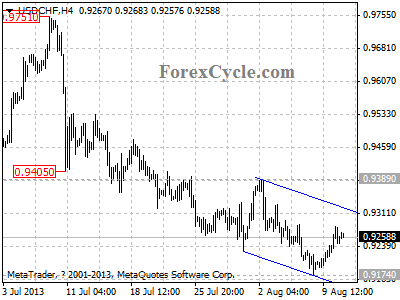
 

USDCHF remains in downtrend from 0.9751

USDCHF remains in downtrend from 0.9751, the rise from 0.9174 could be treated as consolidation of the downtrend. Resistance is at the upper line of the downward price channel on 4-hour chart, as long as the channel resistance holds, the downtrend could be expected to resumed, and another fall towards 0.9000 is still possible. On the upside, a clear break above the channel resistance will indicate that the downtrend from 0.9751 had completed at 0.9174 already, then the following upward movement could bring price to 0.9500 zone.

usdchf

Provided by ForexCycle.com

Why I’m Glad I Missed a Dividend Stock That Doubled…

By MoneyMorning.com.au

On and on the craze continues for dividend stocks.

We’d be lying if we said it didn’t concern us.

We’d be lying if we said the thought of an asset bubble hadn’t crossed our mind.

But that doesn’t mean the dividend craze will end soon.

The simple message is be alert but not afraid…

A big theme we’ve touched on in Australian Small-Cap Investigator is the way managers have had to change the way they run their businesses.

In some cases it’s a subtle change. In others it’s a blatant and desperate bid for shareholders to invest.

When most investors think about dividend payments they only look at it from the investors’ perspective. They don’t look at it from the businesses perspective.

That can be dangerous. That’s because a healthy looking dividend isn’t all it seems…

When a High Dividend isn’t all it Seems

You’re probably familiar with the saying ‘mutton dressed as lamb’. It’s the idea that something ugly or unappealing has been dressed up to look more appealing.

A healthy looking dividend can have the same effect. It can make an unappealing business appear to be attractive and worth investing in. And worse, plenty of investors will fall for it.

So, what’s the problem?

Companies have figured out that investors are craving dividends. You don’t need to be Einstein to work that one out. And so companies have figured out that they can use this dividend craze to attract investors to their company’s shares.

All they need to do is raise the dividend. Normally a company would raise its dividend if profits go up. But now you’ll find some companies are raising their dividend even if profits don’t go up…and sometimes when profits go down.

That’s because they know investors are more interested in the size of the dividend payout rather than the size of the company’s profits.

A classic example is Australian Securities Exchange (ASX) listed company Infomedia Ltd [ASX: IFM]. This is a stock we looked at about two years ago.

It was paying a fairly high dividend, but revenue was falling. Importantly, so was net profit. In fact, net profit had fallen so much the company had cut its dividend for four straight years.

But then something changed. Even though profits kept falling, the dividend didn’t.

You can see how the company’s numbers have stacked up over the past seven years in the table below:

Year

2006

2007

2008

2009

2010

2011

2012

Sales

17

17

16

16

15

15

15

Earnings

5.6

4.7

4.0

3.3

3.7

3.3

2.8

Dividend

11.0

7.5

3.2

2.8

2.4

2.4

2.4

NB: All numbers are cents per share

In short, despite earnings falling from 3.7 cents per share in 2010 to just 2.8 cents per share in 2012, the company has maintained a dividend of 2.4 cents per share.

To our mind, we’d rather stay clear of a business like that. Soon the market will start to think the dividend is unsustainable.

That’s why we’ve been careful with the small-cap dividend stocks recommended in Australian Small-Cap Investigator. We want stocks with room to pay or raise a dividend, but which also have the ability to grow revenue and earnings.

Looking at the numbers in the above table maybe you can see why we didn’t recommend this stock. It just isn’t a good business. However, we were (and still are) in the minority.

Why? Because the stock has more than doubled over the past year.

It’s Important to Question Your Investing Beliefs

That tells us some investors are just looking at one thing – the dividend yield. They’re ignoring everything else. They’re ignoring company fundamentals.

That’s why elements of this dividend rally have us on edge. And it’s why we’re glad we missed out on Infomedia.

It’s also another example of why we don’t want you to go head first into the stock market without thinking it through and properly analysing your investments.

Sure, folks who bought Infomedia at 25 cents must be feeling pretty smart now that it’s 62 cents. But we’ll stick with tipping stocks with rising revenue, profits and dividends.

So, why are we mentioning all this when we’ve told you we’re confident the stock market is going higher – to hit a record high in 2015?

Well, it’s important to remember that investing isn’t just about proving you’re right with an investment strategy. It’s also about making sure you’re not wrong…if you get what we mean.

That’s why we constantly question our own approach to stock investing. We believe we’re right about the demand for yield and that stocks will go higher from here.

But that doesn’t mean every stock will follow the same path. If we see things that cause us to pause we’ll stop, reassess and let you know what we’ve found. It’s then up to you to decide if it’s enough evidence to change your approach now or if you’re prepared to stick to the plan for a while longer.

Right now, we’ll just repeat what we said at the top of this letter: be alert but not afraid. We’ll just add one caveat to the end of that sentence, ‘yet’.

Cheers,
Kris+

From the Port Phillip Publishing Library

Join Money Morning on Google+

Special Report: The Sixth Revolution

Daily Reckoning: China’s Economy… Stabilising, Bottoming, Rebounding

Money Morning: Cash and Stocks Aren’t the Same

Pursuit of Happiness: Innovation Where You Least Expect… In the Shale Gas Industry

Australian Small-Cap Investigator:
How to Make Big Money from Small-Cap Stocks

Why Now is the Time to Buy Gold Stocks

By MoneyMorning.com.au

The time has finally arrived to step up to the plate and buy some beaten up gold stocks. I’ve been waiting for what seems like an eternity for the long term charts on gold to turn more bullish after a gut wrenching fall over the past year.
 
I’m going to stick my neck out and say that moment has arrived.

The first thing I needed to see was for the weekly MACD to cross above its signal line. You can see from the chart below that the last two times we saw the weekly MACD cross its signal line from below zero the gold price took off to the upside over the next few months.

Gold Price Weekly Chart


Click to enlarge

The first time was actually the beginning of a huge leg up in gold after the crash in 2008.

I also wanted to see a weekly close in the gold price above the 10-week moving average. I currently have the 10-week moving average sitting at US$1319 and yesterday’s rally in the gold price took it to US$1330 and above.

If prices can hold above the 10-week MA this week then it will increase my conviction levels that gold has seen an intermediate bottom.

Gold stocks saw good buying across the board yesterday. Silver Lake Resources (SLR), Troy Resources (TRY), Perseus Mining (PRU), Medusa Mining (MML), Kingsgate Consolidated (KCN), Gryphon Minerals (GRY), Resolute Mining (RSG), Newcrest Mining (NCM), Ramelius Resources (RMS), Saint Barbara Mines (SBM) and Oceana Gold (OGC) were all up by more than 7% yesterday.

The Aussie Gold Miners Index (XGD) is looking particularly interesting on the weekly chart. The thick blue line in the chart below is the low in the XGD after the crash in 2008. The false break of that low could prove to be a great buying opportunity in gold stocks for the long term. At the very least we should see a bit of a bounce in gold stocks in the short to medium term if we get the weekly close above that level.

XGD Weekly Chart

Click to enlarge

Another thing that has me interested is the fact that Newcrest Mining (NCM) announced a horrible annual result yesterday with a loss of $5.78 billion but spiked higher by 8% over the day. In other words, investors have now taken into account the bad news and they’re now looking forward to the future rather than fretting about the past.

There has been a lot of press lately about the fact that the GOFO (gold forward offered rate) has gone negative. The Gold Forward Offered Rate (GOFO) is the rate used for gold/U.S. dollar swap transactions.

That is, if you own gold and you need to borrow dollars, you can use your gold as collateral and pay a much smaller rate of interest to borrow the cash than otherwise. This is a common transaction in London. The LBMA (London Bullion Marketing Association) publishes the GOFO daily.

A 10 July article on Seeking Alpha said that:

The only reason a negative GOFO would occur is if someone desperately needs to get their hands on gold but thinks they’ll be able to return it within the time frame of the loan. A negative rate out to three months tells us that there’s a big delivery shortage and bullion banks or large investment funds are willing to pay an interest rate to borrow gold and put up dollars as collateral.

The Time to Look at Gold is Now

If some big investors are finding it hard to get their hands on physical gold then we shouldn’t be surprised to see the gold price starting to catch a bid. A negative GOFO rate is a bit of a canary in the coal mine that something big could be happening behind the scenes that we aren’t privy to.

You’ve probably heard the conspiracy theory that traders took down gold over the past year to shake as many weak hands out of physical gold as possible. It has also been pretty clear that demand for physical gold has actually been skyrocketing the lower prices have fallen. Not really what you would be expecting to see at the end of a bull market.

Gold stocks have had one of the biggest crashes I have seen in many years. The Aussie Gold Mining index fell from 8,500 to 2,000 in a little over two years. That’s a fall of 76% in the whole index in 26 months! Quite extraordinary.

With margins dropping to zero for most gold stocks we’re either heading to a situation where gold mines will begin to get mothballed or gold prices will have to rise to a level where production can continue to fulfil demand. In either situation we should be getting close to a low in gold prices, because if a lot of production goes offline then prices should naturally rise.

Any gold stock that’s producing in the bottom quartile and priced on the current razor thin margins has got to be looking pretty cheap right here.

It’s pretty clear from yesterday’s price rises that other investors are starting to think the same thing. The opportunity is still there but it won’t last forever.

Murray Dawes+
Editor, Slipstream Trader

Join Money Morning on Google+

From the Archives…

Should You Still Buy Stocks Here? Yes, but…
09-08-2013 – Kris Sayce

The Secret to China’s $7 Billion Milk Market
08-08-2013 – Nick Hubble

RBA (Retirees Below Average)
07-08-2013 – Vern Gowdie

Have Australian Stocks Broken Free from China?
06-08-2013 – Kris Sayce

When Should You Sell Your ‘Loser’ Stocks?
05-08-2013 – Kris Sayce

Technical Overview on the Forex Majors before the Show

Article by Investazor.com

As we wrote in our post “What is to be Expected Next Week for the Forex Market?” this week’s economic calendar will be more crowded starting with Tuesday. Today the most important data came from Japan. It’s GDP rise only 0.6%, despite the expectations of 0.9%.

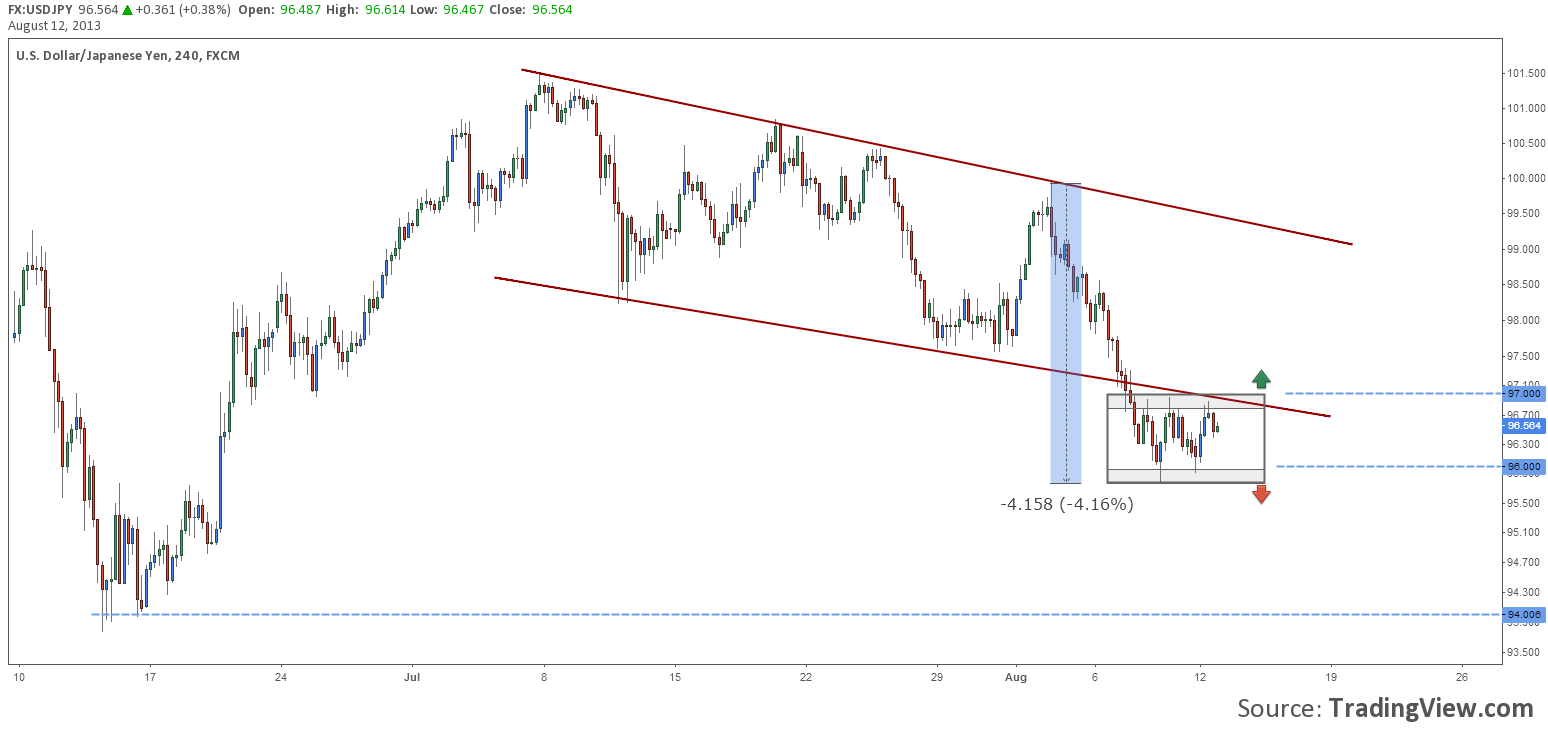
USDJPY has consolidated between 96.00 and 97.00 after a falling 4.16% from almost 100.00. The drop broke the rejection line of the down trend and started to draw a rectangle. From the current price action the higher probability is on the down side. A 240 minutes candle close under 96.00 could trigger another drop which will target the 94.00 level.

A recovery of the US dollar would mean a breakout above the 97.00 level. If this will occur we should look also for a close, to have a certain confirmation. On this scenario, the upper target sits around 98.50.

usdjpy-consolidated-under-rejection-line-12.08.2013

Chart: USDJPY, H4

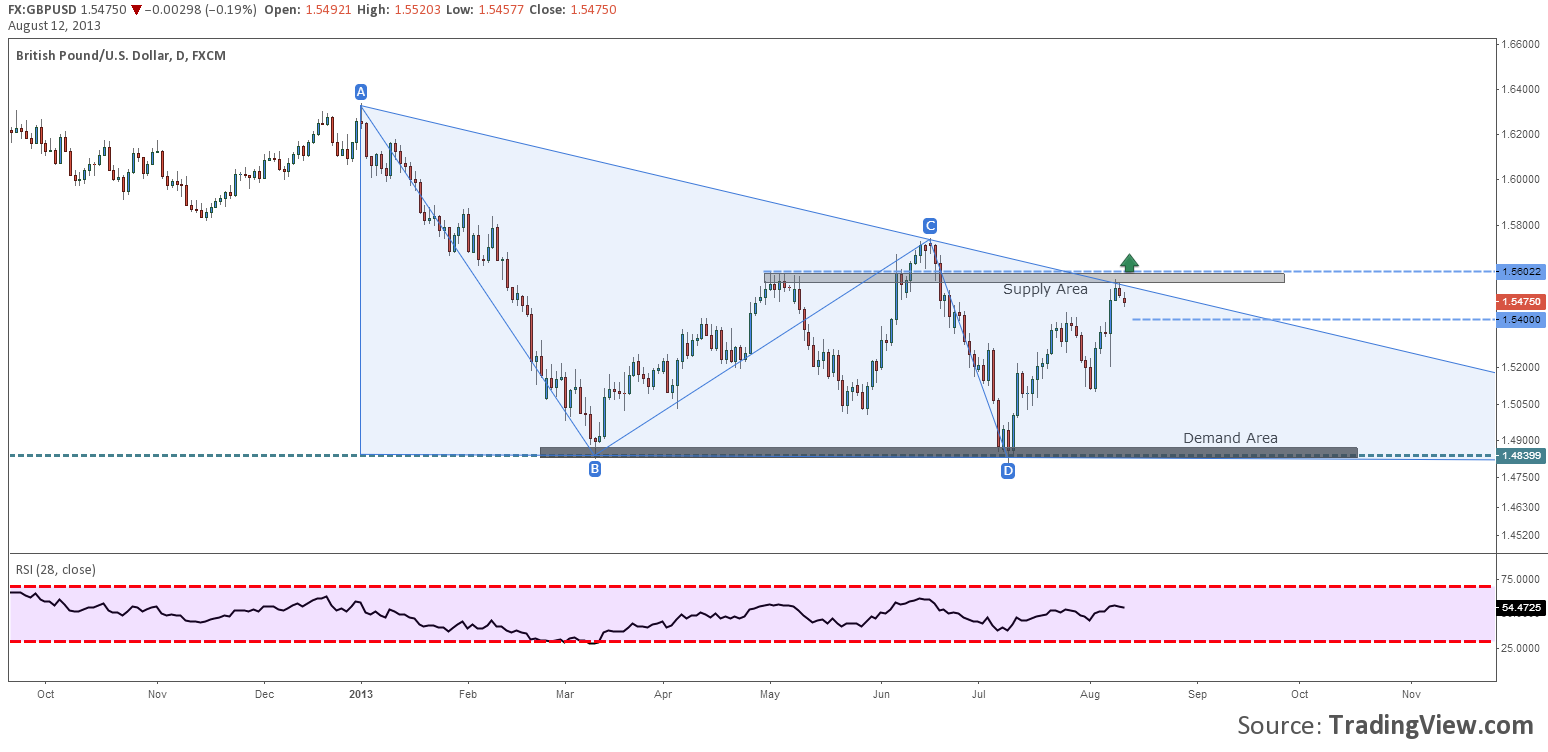
Next is GBPUSD. This currency pair had an interesting evolution during the past moves. The up move was not straight but the price managed to get back to 1.5600. Here it has found a pretty good supply enforced by the round level and a down trend’s line.

Looking at the price action from January 2013 we will observe a consolidation that resembles pretty much with a Descending Triangle. This pattern would be confirmed only by a breakout under its base line or above the upper line. At the current moment the most probable would be a break above the upper line. If the price falls under 1.54 then we should look for a target around the demand area at 1.4840.

gbpusd-forcing-the-upper-line-12.08.2013

Chart: GBPUSD, Daily

A good technical image for AUDUSD would give us the 240 minutes time frame. Here we spot two converging lines that were respected by the fall of the price. On Friday, the trend line was broken, but because the price did not go too far, it was quickly retested today.

At this point we can say that the Australian dollar it is at a cross road. Even though it broke an important line, a fall back under it could signal a false breakout, which will end up with a drop. If the US dollar will not strengthen during the next days we should see a break above the 0.9215, the local resistance, and by the end of the week a retest of the demand/supply area from 0.9300.

audusd-consolidated-above-trendline-12.08.2013

Chart: AUDUSD, H4

And we got to the most traded currency pair in nowadays, EURUSD. For the past month the single European currency has gained 5%. The rally seems to have stopped for the moment at 1.3400. The price was bounced back to 1.3300. At this point EURUSD is on thin line. A daily close under 1.33 could start a bigger corrective move, targeting 1.3200 or even lower.

On the other hand if the price will rally back to 1.34, the probability for a breakout from under this level will be even higher.

The trend is up as long as there are no clear reversal signals, but do not forget that the evolution of the US dollar is very sensible to the economic news published for the United States and especially those from the labor market. The better the news, the close Fed will get to tapering and shutting down the Quantitative Easing program.

eurusud-rallied-one-month-12.08.2013

Chart: EURUSD, Daily

The post Technical Overview on the Forex Majors before the Show appeared first on investazor.com.

Is the Baby Bust Over?

By The Sizemore Letter

Americans stopped having babies when the financial crisis hit in 2008.

I exaggerate, of course; there were nearly 4 million babies born in 2012.  Yet this number was an 8% decline over the pre-crisis level, and this despite a rise in the number of women of peak childbearing age.

When you look at the fertility rate (births per 1,000 women aged 15-44), which takes into account the rise in the number of women in peak childbearing age, the story looks a lot worse.  American fertility hit a new all-time low in 2011, at barely 63 births per 1,000 potential mothers.

Those of us who are not professional demographers have a hard time conceptualizing  “births per 1,000 women,” but the “total fertility rate” is a little easier to understand.  This is the total number of children the average woman can expect to have over her lifetime.  In the developed world, the “replacement” rate is 2.1 babies per woman.

By this measure too, American fertility had sunken to new recent lows at 1.9 babies per woman.  As I wrote last year, the American birthrate—long the pride of red-meat-eating Americans—is below the level of France.  France!

If you’ve read my work for any length of time, then you know I believe this trend to be temporary.  The Baby Boomers of the 1950s and 1960s had a baby boom of their own in the 1980s and early 1990s.  Now this generation—alternatively called the “Millennials,” the “Echo Boomers” or “Generation Y”—are entering their family formation years, and you can expect another baby boom as a result.  The sheer number of potential mothers makes it all but inevitable.

New birth data suggests that the post-crisis baby bust may be ending.  Preliminary data for 2012 shows births and the birth rate essentially unchanged from 2011 after declining every year since 2007.

This is a big deal.  And let me tell you why.

Children and family formation have a massive, disproportionate effect on the economy.  There are the obvious beneficiaries—makers of everything from diapers to baby formula to cribs—but the most important effects show up elsewhere.

Consider housing.  Before my first son came along, I was living the life of a frivolous urbanite, renting an uptown apartment and happily avoiding the responsibilities of homeownership.  Today, I own a house in the suburbs…along with the mortgage albatross hung around my neck.   I even have a tree swing in the front yard…and a bouncing house with a slide in the back.

The point here should be clear: an uptick in the birthrate should mean a boom in the starter home market, which in turn means a return to normalcy for banks.  This is a sustainable, virtuous cycle that has yet to really begin.  Get ready for it.

Less directly—though by no means less importantly—are harder-to-quantify metrics such as productivity.  I’m more productive that I was pre-kids.  I have no choice.  I have hungry mouths to feed.

Before you dismiss the last point as fluff, consider that the biggest productivity boom (and consequently the biggest drop in inflation) in the lifetimes of anyone reading this article came in the early 1980s, as the Baby Boomers were in the early stages of their family formation cycle.  Yes, Fed monetary policy under Paul Volcker had a lot to do with the drop in inflation.  But don’t underestimate the long-term effects on productivity growth. of the Baby Boomers getting haircuts and real jobs.

Generation Y’s peak birth year was 1990.  The average age of mother at first birth is around 26 years…which is a number that continues to rise due to would-be mothers staying in school longer and getting a larger share of advanced degrees.

So, doing a little math here, we can add 26 to 30 years to 1990 and come up with an estimate for a boom in new mothers peaking in the years 2016-2020.

All babies are roughly equal in terms of demand for staple items like formula, diapers and clothes.  But first babies are more economically significant than their later siblings because they are the ones that force their parents’ lifestyle change.  If I may oversimplify a little, they are the reason we buy homes and furnish them.

What are we to do with this information?

You could buy shares of infant formula makers such as Abbot Labs ($ABT) or Mead Johnson ($MJN), of course.  Though being global companies, these companies tend to be as affected by births in China as births here in the United States.  And you could also buy shares of diaper producers such as Procter & Gamble ($PG) and Kimberly-Clark ($KMB), though the same logic applies.

For more direct exposure to an American baby boom, consider buying a portfolio of starter homes with a goal of eventually selling out to a Gen Y family in a couple years.  Or better yet, consider starting a new business that caters to new mothers and their kids.

You want some examples of low-hanging fruit?  How about a website with product reviews of strollers, cribs and other baby products with an online store that links to a major retailer like Amazon ($AMZN)?  It is a business with very little in start-up costs and a manageable amount of “sweat equity.”

Or better yet, start a handyman service for assembling baby gear to save fathers like myself hours of late nights of cursing and reading undecipherable instruction manuals upside down.

Disclosures: Sizemore Capital is long ABT, MJN, PG, and KMB

See also:  U.S. Births “essentially unchanged” in 2012 after Declining for Four Consecutive Years

SUBSCRIBE to Sizemore Insights via e-mail today.

Join the Sizemore Investment Letter – Premium Edition