New York’s top banking regulator sent subpoenas to 22 digital currency companies, including BitInstant and Dwolla, to determine whether new regulations should be adopted to govern the emerging industry, according to a person familiar with the matter…
The SP 500 Enters Major Correction Period
Market close to confirming new correction
David A. Banister- www.markettrendforecast.com 1685 support is KEY!
The SP 500 has been on a tear since late 2012 with the SP 500 bottoming at 1266. The rally though we have been charting out as part of a “Primary wave 3″ uptrend for this Bull market cycle from March 2009, and we are likely entering a Major correction or what we would label “Major wave 4″. Since the 1266 lows, we have had Major Wave 1, 2, and now 3 completed at 1710. We are entering Major wave 4 which should correct 23-38% of the entirety of Major wave 3, which was 444 points.
This correction will be confirmed with any close below 1674 and nails in the coffin begin with any close below 1685 on the SP 500 index. Primary wave 1 of this super bull cycle ended at 1370, a 704 point rally. Primary wave 3 will likely be larger than Primary wave 1 and I am projecting a top between 1900-2000 on the SP 500 before it’s completed. The current correction is Major wave 4 of Primary wave 3, which has 5 Major waves required. With that said, our projections are for 1605 on the shallow side and 1540 on the deeper side for Major wave 4 of Primary wave 3.
Now it is possible that we may extend a bit higher yet in Major wave 3 to 1736-1772, but only if we hold the 1685 support lines which the market is basing around currently. In any event, at our Trading service we have been aggressively taking profits in the past two weeks on multiple positions while still holding a few open at this time.
Below is a chart showing our projected correction pivots of 1605 and 1540, subscribers will be updated on a regular basis. Join us with a 33% discount at www.markettrendforecast.com and also receive Precious Metals (GOLD) forecasts on a regular basis every week.
Written by David A. Banister- www.markettrendforecast.com
Central Bank News Link List – Aug 12, 2013: Indian rupee forwards touch one-week high on RBI auction plan
By www.CentralBankNews.info Here’s today’s Central Bank News’ link list, click through if you missed the previous link list. The list comprises news about central banks that is not covered by Central Bank News. The list is updated during the day with the latest developments so readers don’t miss any important news.
- Indian rupee forwards touch one-week high on RBI auction plan (Bloomberg)
- Bank of Israel held rates given likely Fed tapering: minutes (Reuters)
- SNB’s Danthine says rate increase would mean end of franc cap (Bloomberg)
- Memories of 1997 cast long shadow over yen (WSJ)
- Venezuela’s central bank records 30% drop in liquid reserves (El Universal)
- Colombia’s cenbank sees 2014 GDP growth at 3-5 pct (Reuters)
- Peru’s central bank says no reason to change inflation target (WSJ)
- Carney call to end men-only club puts pressure on Osborne (Bloomberg)
- Nigeria central bank withdrawal of N1 trln good for naira stability (allafrica)
- Not all central bankers love QE (WSJ blog)
- www.CentralBankNews.info
Europe shares falls during morning trade
The European shares was seen turning lower from its early gains on the first day of the trading week, ahead of the Italian bond auction and Greece GDP report for the second quarter.
The European Euro Stoxx 50 edged down 0.33% lower to 2,814.51 as of 8:24am GMT, while the German’s DAX index declined 0.44% lower to 8,302.66 at the same time. The French CAC 40 fell 0.23% lower at 4,067.56, while the UK FTSE 100 dropped 0.17% to 6,572.81.
Greece is expected to release its gross domestic product (GDP) report for the second quarter, which is expected to show a fall in the country’s economy by 4.8%.
While in Italy, the Italian government is expected to hold the auctions of Treasury bonds maturing in 12 months with its highest target of €7.5 billion.
Telekom Austria edged down by 2% in its second quarter report, resulting to 1.04 billion euros, according to reports.
While German industrial and engineering company Bilfinger, operating profit dropped to 96 million euros between the month of April and June due to the struggling economy, while analysts forecasted a 94.3 million profit.
Meanwhile, stocks in Asia were seen in green on Monday, following the release of the below-forecasted data for the second quarter.
The data showed that the Japanese economy grew by 0.6% in the second quarter , below the expected growth of 0.9%, after the country’s economy grew in the first three months of the year.
Hong Kong’s Hang Seng rose by 2.17% to 22,281.00 points at the time of writing, while the Chinese Shanghai Composite jumped 2.39% higher to close at 2,101.28 points.
The post Europe shares falls during morning trade appeared first on | HY Markets Official blog.
Article provided by HY Markets Forex Blog
Asian stock mixed, China jump on stimulus news
The Asian stock market began the trading week mixed, as the stock was hit by the Japan’s less-than-forecasted second quarter GDP. However, other stocks were seen in green, with the Chinese stock gains on the local stimulus news.
Stocks in China gains sent the benchmark index to its highest level in over a month .The Chinese communist government intends to offer financial stimulus to large cities to boost local economies that are struggling with its growth.
The Agricultural Bank of China concluded an agreement with Shanghai City to offer the municipality a loan that is worth up to 250 million yuan ($40.7 billion) to form a free-trade zone.
The Japanese benchmark Nikkei 225 edged down 0.70% closing at 13,519.43, while the broader Topix index dropped 0.55% to 1,134.62.
Hong Kong’s Hang Seng advanced 2.04 to 22,257.71 at the time of writing, while the Chinese mainland Shanghai composite jumped 1.32% to 2,087.23 at the same time.
South Korean Kospi index jumped 0.22% higher to 1,884.83%, while the Australian S&P/ASX 200 advanced 1.07% to 5,109.20.
Australian equities gained from the rise of metal prices, with mining companies rising.
Most of Japan’s stocks were affected by the weak second quarter GDP report that revealed that the struggling economy lowered below the forecasted suggestions , as the government and private sector cut down on investments .
The country’s GDP advanced 2.6% on a yearly basis during the second quarter. A separate report released showed that the country’s central bank measured corporate good price indicated a rise of 2.2% in the month of July; it’s highest since August 2011.
The post Asian stock mixed, China jump on stimulus news appeared first on | HY Markets Official blog.
Article provided by HY Markets Forex Blog
How to Choose The Right Broker For Scalping ?
Article by Investazor.com
Dear Scalper,
Please, rightly choose your Broker!
Sincerely, Investazor
All scalpers, beginners or experienced, need to have an overview of how this area is and how it works. Beyond the scope of making money, known by everybody, it is important to know under what circumstances this passion can be pursued. There are 3 main entities that promote and give access to the trading world: exchange (New York, London, depending on the trading instrument), banks and investment funds (commercial banks) and brokerage houses. Obviously, access is guaranteed depending on the amount of money invested.
A forex scalper will always need to work with a brokerage house in order to have access to a server, a trading platform, quotes and liquidity. Therefore, it is mandatory to rightly choose the broker you work with. In this article you will find out how to choose your broker and to what details you need to pay attention when doing this. Apart from what this person can offer to you as primary conditions to start trading, one big advantage is that is you do not dispose of a big amount of money, a broker can offer lower costs than a bank.
Still, the great job about will be yours, don’t forget that! The broker is only an important factor, willing to give you the possibility, chance and profitability of the forex scalping strategy chosen by the trader. This actor will only create the great environment for your profits, success and gains, while the scalper is fully controlling his / her own time frame for trading, strategies, stop loss and take profit orders.
Technically speaking, what brokerage houses offer to traders are hundreds of offers, depending on his/ her profile. For the day traders and scalpers the business model can be explained simply by the distinction between profit and loss: a tax paid to the broker for his services, on profits and losses. However, the broker remains an important actor contributing to the scalpers success, and this makes the relationship between the two partners a lot deeper than this technical details.
Analyze spreads and offers
As we defined this relationship as starting from the business making point of view, it is important to rightly analyze the offer of the brokerage house. At the end of the day, the broker also has to make money according to your profit and loss.
But the goal of the scalper (short and very short term type of trader) is to obtain profit by repeated short transactions, which is way different from the strategies used by medium to long term traders. Since the scalper will open and close tens of positions during a trading day, the costs will be proportional. So, it is desirable to analyze all the brokerage houses’ offers available on the market before choosing the right one as well as choosing the lowest spread for the currency pair you want to trade. The broker himself, will then be only a matter of preference and intuition.
Scalping is not for brokers, it is for scalpers!
Apart from being the partner of every client, the broker also has to establish some kind of stability between the scalpers, before passing them to the banks. That is why, most of the times, brokers do not appreciate scalping strategies and brokerage houses do not accept scalpers.
Making it short, because of his mission of netting out trader positions against each other in order to maintain liability against banks, brokers do not find scalpers easy to follow. Given the fact that they enter trades that only last a few minutes and are not constant, brokers lacking experience are not able to counter- balance the profits. Add the lack of speed of the servers and the slow outdated systems used by the brokerage houses, profitable scalpers can become the most redoubtable clients. There are not few the cases when scalpers are not liked by brokers, or brokerage houses do not allow scalpers between its clients, because of this reasons.
That is why, successful scalping strategies are not enough for a good scalper, but he/ she also needs an innovative and technologically competent broker as partner. If you have the chance to find with a no-dealing desk broker, he can be all you need.
Advanced trading tools may be the key to success
A good scalper also needs to use improved versions of technical tools, in order to have access to all details he needs existing in the market. For this reason, it is important for scalpers to look for and choose the brokerage houses that offer sophisticated technical packages and show respect for the client’s needs.
Also, it is almost mandatory to have access to simultaneous display of multiple time frames in order to have an overview of all price movements and price action in the same time, in order to have a good money management and to build strong strategical planning.
Last but not least, take care of your eyes’ health and choose the interface and platforms that fit your own needs and pleasures. Feeling comfortable and not having your eyes tired and stressed up after a trading session will give you the force to open new transactions.
Choose professional brokers
Scalpers need support from the broker, in order to have timely execution and precise quotes at his/ her disposal. Not only the systems and modern platforms are needed, but also a highly prepared and competent broker to work with. But remember, the broker is there only to support the scalper, who still has to choose the right scalping strategy for him/ her and use strong knowledge in order to achieve long term profit.
Previous << 6 Essential Scalping Tips For Beginners <<
The post How to Choose The Right Broker For Scalping ? appeared first on investazor.com.
Cash and Stocks Aren’t the Same
‘The shares of the big banks are on a grossed-up yield of between 7 and 9 per cent…
‘A lot of money is in term deposits and more of that is likely to be rotated from these when the deposits mature into the higher-yielding shares.‘ – The Age
We’ve said for some time that the yield rally isn’t over.
These numbers prove our point. Thanks to the tax benefits from franking credits (see Vern Gowdie’s article here explaining franked dividends) shares can give you more than twice the return of term deposits – which will pay you 4% if you’re lucky.
It’s not surprising investors are dumping term deposits left, right and centre to buy dividend stocks. And as someone who’s so ardently bullish about the stock market, you may think we back that view.
If that’s what you think, you couldn’t be more wrong. Here’s why…
We love the stock market.
It’s the single best, biggest, most affordable and easiest way for ordinary investors to build wealth.
But it can be incredibly risky too if you don’t understand how markets work and why share prices move.
That’s why you should ignore anyone who says you should take all your money from term deposits and stick it in the stock market. Term deposits and the stock market are like chalk and cheese in terms of investing.
One is about as safe as it gets (cash term deposits) and the other is about as risky as it gets (shares).
Cash and Stocks Aren’t the Same
In a normal market we don’t like heavily diversified portfolios – it’s a cop out. We say that investors should take a clear view on the market’s direction and then back that view.
The trouble is this isn’t a ‘normal’ market. There is so much manipulation propping up the market with low interest rates and money printing, it’s too risky to bet everything you’ve got on stocks.
That’s why, even though interest rates are low and heading lower, it’s absolutely vital you don’t lose your head and put all your money in the stock market. As frustrating as it may be to see the earned interest from your term deposit or savings account fall, it’s important you keep part of your wealth in cash.
We know that from personal experience. A letter arrived in the post last week informing us that a six-month term deposit is due to mature in mid-August. We’re 99% certain the interest rate to renew for another six months will be lower than last time.
We’ll grumble about it. But we’ll live with it. It’s part of our permanent cash portfolio. We know we could get a better return if we put the money in stocks. But that part of our portfolio isn’t about making big returns. It’s about having a secure base.
Our cash portfolio is like our gold portfolio. We’ll never reduce it below a set minimum. In fact, from time to time we’ll add to it if we don’t see good value in other investments.
When it comes to adding to our share portfolio, our preference is to use new cash flow rather than taking from our core cash savings.
Of course, if you’re rebalancing your whole portfolio, it’s fine to cut your cash exposure in order to buy stocks. But be sensible about it. Don’t do it for the wrong reasons: e.g. because you’re afraid of missing out.
So, if you’re worried about falling interest rates and the impact it will have on your income, you should look to get the best bang for your buck from your stock investments…
The Future of Aussie Share Dividends?
How low will the Reserve Bank of Australia (RBA) cut interest rates? It’s hard to say. We’re not convinced they’ll fall to the levels seen in the US, Europe and Japan. But you shouldn’t rule it out.
If that happens, term deposit interest rates of 4% will be history. You’ll be lucky to find anything above 2%. And blue-chip stocks paying a grossed up dividend above 4% will be few and far between too.
You only have to look at a few examples from overseas to see the impact of low interest rates on dividend yields:
- BT Group plc [LON: BT.A], telecommunications 2.87% yield
- Verizon Communications [NYSE: VZ], telecommunications 4.18%
- Wells Fargo & Co [NYSE: WFC], bank 2.78%
- Barclays plc [LON: BARC], bank 2.26%
- JP Morgan Chase & Co [NYSE: JPM], bank 2.79%
- Toyota Motor Corp [TYO: 7203], auto 1.46%
These are gross yields.
Remember, Australian banks and telco companies have grossed up yields between 7% and 9%. Can you really expect those yields to last as the RBA keeps cutting rates?
We don’t think so. If we’re right it means investors will need to start revaluing stocks to take into account lower yields. Assuming profits and dividends don’t change, all else being equal that should mean higher share prices.
That could be a problem for the big banks. They’re already trading at a higher earnings multiple compared to their UK and US counterparts.
In short, this is why even though we believe you should invest in stocks to get higher yields, you shouldn’t think that stocks are a comparable risk to a cash investment.
If Aussie blue-chip income stocks can keep growing profits and maintain their dividends, that should be enough to keep attracting dividend-hungry investors.
It’s still a great time to buy stocks, but to use an old cliché, make sure you do it with your eyes wide open.
Cheers,
Kris+
From the Port Phillip Publishing Library
Special Report: The Sixth Revolution
Daily Reckoning: The Global Trend Towards Wealth Protection
Money Morning: Two Approaches to Investing…
Pursuit of Happiness: Learning to Avoid the Governments ‘Noble Wealth Trap’
Australian Small-Cap Investigator:
How to Make Big Money from Small-Cap Stocks
No Profit in the Federal Reserve Divination
It is beneficial to your health to tune out the noise and clutter that passes for information in the financial markets.
A good example is trying to divine the importance of words uttered by US Federal Reserve Chairman Ben Bernanke. With China showing no signs of a stock-market-boosting stimulus plan, the punters will hang on the lips of the Federal Reserve chairman for clues about ‘tapering’.
But let me ask you this, do you think your investment plan can benefit from trying to guess what Bernanke is going to do next? Is there any advantage to be gained by correctly guessing his internal emotional state? If not, then why bother?
The most important words ever penned by Ben Bernanke with regard to deflation and the effectiveness of quantitative easing to ‘stimulate’ aggregate demand were penned in a paper he published with Vincent Reinhart and Brian Sack in 2004. It’s called Monetary Policy Alternatives at the Zero Bound: An Empirical Assessment.
I encourage you not to read it. It’s absolutely insane. More importantly, in confirms that Bernanke has been reduced to trying to influence investor expectations through communication. This is what happens when you can’t pull the interest rate lever. You have to try talk therapy. The fact that Bernanke et al. dedicate so much of their paper to it is evidence of how deep down the rabbit hole they are in their monetary thinking. But let me show you some specific quotations, with my emphasis added:
‘Given that the ability to commit to precisely specified rules is limited, central bankers have found it useful in practice to supplement their actions with talk, communicating regularly with the public about the outlook for the economy and for policy. Even in normal times, such communication can be helpful in achieving a closer alignment between the policy expectations of the public and the plans of the central bank. If the central bank places a cost on being seen to renege on earlier statements, communication in advance may also enhance the central bank’s ability to commit to certain policies or courses of action…
‘Although communication is always important, its importance may be elevated when the policy rate is constrained by the ZLB. In particular, even with the overnight rate at zero, the central bank may be able to impart additional stimulus to the economy by persuading the public that the policy rate will remain low for a longer period than was previously expected. One means of doing so would be to shade interest-rate expectations downward is by making a commitment to the public to follow a policy of extended monetary ease. This commitment, if credible and not previously expected, should lower longer-term rates, support other asset prices, and boost aggregate demand.
‘Shaping investor expectations through communication does appear to be a viable strategy, as suggested by Eggertsson and Woodford (2003a,b). By persuading the public that the policy rate will remain low for a longer period than expected, central bankers can reduce long-term rates and provide some impetus to the economy, even if the short-term rate is close to zero. However, for credibility to be maintained, the central bank’s commitments must be consistent with the public’s understanding of the policymakers’ objectives and outlook for the economy.’
This is by far the clearest explanation – in his own words – of how Bernanke thinks the Fed can promote growth through words and QE. It’s quite impressive how much time and thought he put into using words to influence expectations once rate cuts were no longer a policy tool. The zero bound – where official interest rates were effectively zero in nominal terms and actually negative in real terms – was a long way away back then.
The Federal Reserve’s goal with QE is to keep 30-year mortgage rates low in the US by targeting the yield on 10-year Treasury notes. The 30-year mortgage rate is derived from the 10-year yield. As you can see from the chart above, 10-year yields were above 4% for most of 2004. That’s 400 basis points above zero.
When the rate cutting began in earnest in 2008, 10-year yields dove. Quantitative easing has since pushed them down to historic lows. But as you can see, the recent rise in yields is formidable. This is not an indication of Ben Bernanke’s success, where he allows rates to rise. It’s the markets repudiation of his attempt to rig the price of the most important security in the world.
Why does all this matter? The US Federal government is just one of many governments that cannot afford to service its outstanding debt at higher interest rates. If the bull market in government bonds that began in the early 1980s is over, then rates will head higher as bond prices fall, whether Bernanke likes it or not.
In fact, Ben Bernanke can talk until he’s blue in the face. Market participants will have rendered their verdict. QE is every bit as bogus as the actions of China’s communists to produce growth by command. It’s an exercise in intellectual arrogance with real world costs to savers. Its end is just beginning.
Dan Denning+
Editor, The Denning Report
From the Archives…
Should You Still Buy Stocks Here? Yes, but…
09-08-2013 – Kris Sayce
The Secret to China’s $7 Billion Milk Market
08-08-2013 – Nick Hubble
RBA (Retirees Below Average)
07-08-2013 – Vern Gowdie
Have Australian Stocks Broken Free from China?
06-08-2013 – Kris Sayce
When Should You Sell Your ‘Loser’ Stocks?
05-08-2013 – Kris Sayce
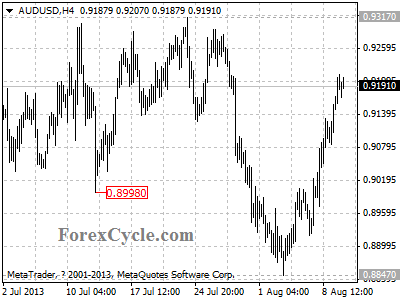
AUDUSD continues its upward movement from 0.8847
AUDUSD continues its upward movement from 0.8847, and the rise extends to as high as 0.9213. Further rise to test 0.9317 key resistance is possible, as long as this level holds, the rise could be treated as consolidation of the downtrend from 1.0582 (Apr 11 high), and sideways movement in a range between 0.8847 and 0.9317 would likely be seen over the next several days. However, a break above 0.9317 resistance will indicate that the downtrend from 1.0582 had completed at 0.8847 already, then the following upward movement could bring price to 1.0000 zone.

Provided by ForexCycle.com
Who Is The Next Leader Of The Oil Industry?
Article by Investazor.com
The oil industry, as one of the most important industries, is mainly driven by North America, Russia and the Arabic States (most important countries being Saudi Arabia and Iraq). Why is this industry so important? Considering the fact that is responsible for about 2.5% of the world’s GDP, it’s also pumping life in all other important fields as transportation, agriculture, army and any other branch that supports the human life. If the oil industry would collapse now, it wouldn’t take a few months to see the world’s economy on the ground. Nowadays, the supply of energy tends to increase because of the continuous increase in demand, which results in the development of the economies in question (reflected by their GDPs).
Meanwhile, North America is seriously gaining ground in the oil industry, threatening to become the biggest oil producer by 2030, as last year recorded the world’s biggest increase in oil and gas production (80% of which came from North Dakota and Texas). It is also likely to become self-sufficient around 2020 as the production will increase and the demand will fall, due to the efficient use of resources. The “power shift” will probably happen in the near future and the dominator is likely to be the United States which will for sure cause an energy boom by its drilling technology that can reveal important quantities of oil. This situation is thought to cause the defeat of the OPEC states which will be required to accept new regulations and will have diminished their power of making the market (as a secondary effect it is believed that the Arabic nuclear programs will lose momentum). Obviously, the U.S.’s economy will benefit from this power shift, leaving behind the quantitative easing programs.
In the area of the Arab States, where important oil producers are found, we encounter significant turbulences. The internal conflict between Iraq and Kurdistan, a semi-autonomous zone within Iraq, poses problems to the production of oil, as Kurdistan and Iraq have an interdependent infrastructure. The two countries are also fighting about the rights upon the oil reserves and the benefits resulting from exploiting those resources. As a general view over the Arabic’s oil production, things are likely to go in a negative direction, as conflicts between countries are worsening and the lack of technology may result in an ineffective business (leading to higher costs of production).
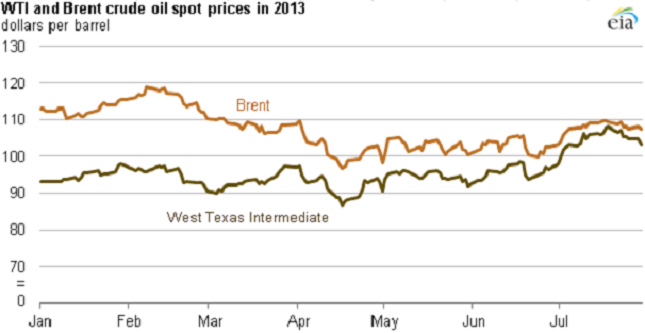
Recently, the narrowing between benchmark prices of Brent and WTI crude oil got in the viewfinder. The price of WTI crude oil is thought to have been increased due to several factors as the projects for the oil transportation which came online, making it available in new areas, fact that lead to an increase in demand. On the other hand, the narrowing of prices also derives from the downward pressure on the Brent oil caused by the access to domestic light sweet oil which can easily replace the imported Brent oil.
Chart: WTI and brent crude oil spot prices in 2013
The outlook for the next year concerning the oil market awaits some improvements as economic growth in 2014 is expected to reach 3.5%. Non-OECD countries are projected to continue to lead the oil demand growth, while OECD economies are expected to remain in decline mode.
The post Who Is The Next Leader Of The Oil Industry? appeared first on investazor.com.