Anthony Mariano: Calling Next-Generation REE Investors

Source: Brian Sylvester of The Metals Report (8/27/13)

http://www.theaureport.com/pub/na/anthony-mariano-calling-next-generation-ree-investors

If you thought you had rare earth element mining all figured out, think again. Dr. Anthony Mariano and his son, Anthony Jr., work as geological consultants to many rare earth companies, and say even they have more to learn. But if you’re looking for a sector that will nurture your inner nerd, rare earth elements may be the play for you. In this interview with The Metals Report, geek out with the Marianos as they talk rare earths and igneous, metamorphic and sedimentary rocks.

The Metals Report: Without heavy rare earth elements (REEs), can the worlds’ chemists and engineers develop metal alloys sufficient to meet the demands of today’s high-tech devices? If not, why not?

Anthony Mariano: My son and I are neither chemists nor engineers—our expertise lies in the area of geology and mineralogy of REE deposits, which are much more complicated than that of other commodities, such as base metals or precious metals.

However, we do believe REEs have unique properties that may be difficult to obtain from other elements.

TMR: How has the REE space changed for investors?

AM: The buzz of the high-demand years was a result of political or economical implications surrounding REEs, which were largely controlled by China. Investors then became interested in REEs. Now the drop in REE prices has changed the game. At this point, investors are not getting as involved, so companies that were attempting to explore potential deposits can’t. You need a budget for that. But a lot of our technology requires the use of REEs. The demand is going to be there. There’s been a period of quiescence because people have been acquiring REEs from stockpiles, but when those stockpiles are diminished, REE demand is going to pick up again.

TMR: Tony Jr., anything to add at this point?

Tony Mariano Jr.: I am certainly not a market analyst, but we have seen ups and downs in the REE market, as with any commodity. I suspect investors may have also realized that the development of REE deposits often happens at a slower pace than other commodities. The beneficiation of REEs can be very complex. REEs occur in many varied mineral hosts. Complex rock textures, complex mineralogy and mineral chemistry, and varied lanthanide distribution in the REE minerals all contribute to complexities in physical concentration and chemical processing. Many companies are developing innovative techniques to concentrate and process REEs. This takes time and can slow progress toward taking these commodities to the marketplace. Investors may be developing a better awareness of these complexities.

TMR: Apart from money, what’s the single biggest hurdle to the development of HREE deposits outside of China?

AM: First and foremost, miners have to understand the type of igneous, metamorphic or sedimentary rock they’re dealing with in order to determine if the geology and mineralogy are amenable to economic processing. Some deposits may not even occur within rocks, but soils, sands or river placers. The mineralogy will decide whether you have something with potential. On top of that, miners have to pay attention to permitting, environmental restrictions, the cost of energy and the cost of reagents.

TMR: How would you rank the various mineral sources for REEs, like bastnaesite?

AM: Bastnaesite has historically been a source of light lanthanides or light rare earth elements (LREEs), and it will probably continue to be the best source for LREEs. HREEs and yittrium can be obtained from other REE deposits in North America, such as Kipawa, Quebec; Pajarito, New Mexico; Mineville, New York; and Bokan Mountain, Alaska. Some will be very costly. These are not bastnäsite deposits but contain various HREE minerals. No development has been conducted on Pajarito or Mineville, whereasMatamec Explorations Inc. (MAT:TSX.V; MRHEF:OTCQX) has conducted a considerable amount of exploration work at Kipawa, as has Ucore Rare Metals Inc. (UCU:TSX.V; UURAF:OTCQX) at Bokan Mountain.

TMR: And monazite?

AM: Monazite could be an even more important source than bastnaesite for LREEs. It could also be a low source for HREEs and yittrium if it’s mined on a large level. It occurs in many places in the world, but there is a problem associated with it—the presence of thorium. From the ’50s to the early ’80s, there was a lot of environmental leniency, and you could transport monazite in ships even though it was radioactive. That’s no longer the case. Much of it was brought to La Rochelle in France, and they ended up with a large accumulation of radioactive thorium. They finally decided they could no longer pursue this direction and switched from monazite to bastnaesite. Monazite is an LREE phosphate. It runs around 70% rare earth oxide (REO), whereas bastnaesite runs at around 75% REO.

TMR: What about fergusonite?

AM: A beautiful and relatively rare mineral. If you have a garden or a plant on your fire escape and get your fingernails dirty and analyze what’s under them, you may run into fergusonite. You may find fergusonite in many places using the current advanced technology. Although fergusonite occurrences are being investigated in a few areas in the world, we’ve never established a deposit that could provide a sustained source to the marketplace. Fergusonite is an oxide mineral rich in yittrium, HREEs and niobium.

TMJ: Another mineral source worth mentioning is xenotime. Xenotime is an yttrium, HREE phosphate, rich in HREEs. The techniques for chemical processing to extract the yttrium and HREEs have already been established. The problem is finding a deposit with enough xenotime to be economic. There are a few potential xenotime deposits being evaluated now outside of North America.

In addition, eudialyte is a silicate mineral and has not traditionally been a resource for providing HREEs to the marketplace. In the past, there were problems in the chemical processing to extract the REEs, but several companies claim to have resolved these issues. In North America, eudialyte is known to exist at the Kipawa, Quebec deposit, at Pajarito Mountain, New Mexico, at the Red Wine deposit in Labrador and at Dora Bay, Alaska.

There are many other potential REE mineral sources, but for the HREEs, the minerals we have mentioned are those that are being most actively pursued.

TMR: If you were an investor looking at companies with various types of mineral sources, what would be your top names?

AM: The best source for a sustained quantity of HREEs is Matamec Exploration Inc.’s HREE mineral-bearing deposit in Kipawa, Quebec. And the best bastnaesite deposit in the world outside of China isMolycorp Inc.’s (MCP:NYSE) Mountain Pass facility, which is a tremendous source of LREEs, although problems may exist there around permitting, environmental restrictions and energy and reagents costs.

TMR: Matamec is about to come out with a feasibility study. Would your mineralogy studies on the Kipawa deposit be included in that study?

AM: I imagine much of it may be based on that. I can speak for the REE industry when I say that we are anxiously awaiting the results of this study, which will be released September 4. This deposit is the best source for the heavy lanthanides and is one for which we’re able to obtain the quickest results.

TMR: Can Matamec make money just making a concentrate and not creating oxides?

AM: That’s something it has to figure out. I’m not an insider on Matamec, though I did commence the first REE exploration in Kipawa, Quebec, in 1985.

TMR: Tony Jr., can you comment further on Kipawa project economics?

TMJ: I am not knowledgeable on the Kipawa project economics but I agree with my father that geologically, the Kipawa deposit is very impressive. The textural properties of the Kipawa rocks and the abundance of several HREE minerals make Kipawa uniquely attractive.

TMR: If there were a crisis tomorrow―if, for example, China completely eliminated REE exports, what projects could reach production quickly?

AM: North America would need a domestic source. Although deposits outside of North America could be suppliers, that could be a problem in that a ship carrying critical source concentrate across the ocean may not make it to North American shores. But if we’re in critical need, economics are no longer as important. If you need it, you pay for it. We’ve got sources in the United States, and we’ve got sources in Canada. To draw a historical parallel, during the beginning of World War II, the U.S. desperately needed quartz, which was used in military submarines. North America was getting all of its quartz crystals from Brazil. Brazil had always transported quartz crystals to the U.S. by ship, until U-boats began to bombard the ships. So the U.S. government supported Bell Labs in developing an immediate technique to synthesize high-purity, optical-quality quartz. That became the basis of all the quartz that’s used nowadays.

TMR: Tony Jr., to expand on this scenario, which companies other than Matamec are currently furthest along in developing North American REE projects?

TMJ: The companies furthest along in developing North American REE projects are clearly led by Molycorp. Molycorp holds an existing REE mine in Mountain Pass, CA and, as I understand it, is currently working on process developments and permitting to move toward production. Also, Rare Element Resources Ltd. (RES:TSX; REE:NYSE.MKT) is well on its way toward developing its Bear Lodge, Wyoming deposit. But, these projects are chiefly dominated by the LREEs. For HREE’s, other than Matamec, Ucore is probably the furthest along in developing its Bokan Mountain, Alaska deposit.

TMR: What do you make of Ucore Rare Metals Inc.’s Bokan Mountain project?

AM: It’s made up of very interesting minerals. Many are fine grain and complex, made up of several different minerals that cannot be concentrated independently; a multi-mineral concentrate must be treated chemically in order to process the multi-mineral concentrate. The chemical treatment and the costs involved at the final stages of chemical processing are important factors.

TMR: Does Ucore’s relationship with the Department of Defense give it a leg up?

AM: It should, because the project is in the U.S. There are some very interesting heavy lanthanide minerals at that site. They’re fine grain, inextricably associated with quartz and other gang material that has to be removed. Crushing costs will be expensive, and it will be difficult to come up with an independent mineral concentrate. Ucore could probably do a good job by chemically processing a multimineral concentrate. And Bokan Mountain’s logistics are excellent. The deposit is less than a kilometer uphill from the shores. You could fill up a ship with concentrate with ease.

TMR: Some analysts estimate that, at current rates of consumption, China’s supply of HREEs could evaporate within 15 years. Does that seem realistic to you?

AM: It’s hard to tell. China has a tremendous source in the Bayan Obo mining district. It also has a good source of LREEs in Mianning, Sichuan. I did a detailed field and laboratory study there in 1994, so I’m very familiar with this bastnaesite deposit. I can tell you a lot about the nature of the South China clays in the laboratory but not about how long they’re going to last. Are they going to be allowed to mine South China clays and put up with the problems that exist? Will any other continent be allowed to process South China clay-type deposits without affecting the environment and while keeping the prices down?

TMR: Is permitting strictly an environmental issue?

AM: No, not strictly. For example, there are some very interesting monazite deposits in the United States, but they’re situated in places where people have nice homes, so exploration and development are out of the question. What if you found a beautiful deposit right in New York City? Forget about it. But it’s true that some very interesting deposits in the United States and Canada are in conservation areas and national parks. In those cases, permitting hurdles exist for environmental and other restriction reasons.

TMR: What can you tell investors based on your experience in this space?

AM: Investors need to get information from people who are familiar with the nature of REE mineralization that has fed the marketplace. Early in the game, I was told that if I wanted to evaluate a deposit on a world level, I needed to get lots of experience in deposits that actually feed the marketplace. I did that, and it made a huge difference in my ability to make evaluations. Academics may have written excellent papers outlining a particular deposit’s geology, but the challenges miners face in approaching exploration or, later down the road, processing—are critical factors academic work doesn’t necessarily address.

TMR: Do you see it as part of your job to explain REE mineralization for non-experts?

AM: We try to do that to the extent that we can. It’s still very complicated even among experts. It’s sometimes difficult to simplify economic geology even for academics who specialize in mineralogy, petrology and geochemistry. It’s not enough to run out to Mountain Pass and come back and say, “We went to Mountain Pass. We understand everything.” Good luck. I’ve been working extensively at Mountain Pass since 1965, and I still have a lot to learn.

Anthony N. (Tony) Mariano, PhD, is a geological consultant on rare earths and other rare metals. For decades, he has been the go-to expert on the geology and mineralogy on rare earths, niobium-tantalum and other rare metals. Companies around the world depend on his professional opinions on the potential economic viability of deposits based on mineralogical examination, lab work and field visits.

Tony Mariano Jr. is a geological consultant on rare earths and other rare metals. He also spent several years as an environmental geologist/consultant. He currently works exclusively in conjunction with his father, Anthony N. (Tony) Mariano, consulting on rare earth mineral exploration and evaluation worldwide.

Want to read more Metals Report interviews like this? Sign up for our free e-newsletter, and you’ll learn when new articles have been published. To see a list of recent interviews with industry analysts and commentators, visit our Metals Report <href=”#interviews” target=”_blank”>homepage.

DISCLOSURE:

1) Brian Sylvester conducted this interview for The Metals Report and provides services to The Metals Report as an employee or as an independent contractor. He or his family own shares of the following companies mentioned in this interview: None.

2) The following companies mentioned in the interview are sponsors of The Metals Report: Matamec Explorations Inc. Streetwise Reports does not accept stock in exchange for its services or as sponsorship payment.

3) Anthony Mariano: I or my family own shares of the following companies mentioned in this interview: None. I personally am or my family is am paid by the following companies mentioned in this interview: None. My company has a financial relationship with the following companies mentioned in this interview: None. I was not paid by Streetwise Reports for participating in this interview. Comments and opinions expressed are my own comments and opinions. I had the opportunity to review the interview for accuracy as of the date of the interview and am responsible for the content of the interview.

4) Tony Mariano Jr.: I or my family own shares of the following companies mentioned in this interview: Matamec Explorations Inc. I personally am or my family is paid by the following companies mentioned in this interview: None. My company has a financial relationship with the following companies mentioned in this interview: None. I was not paid by Streetwise Reports for participating in this interview. Comments and opinions expressed are my own comments and opinions. I had the opportunity to review the interview for accuracy as of the date of the interview and am responsible for the content of the interview.

5) Interviews are edited for clarity. Streetwise Reports does not make editorial comments or change experts’ statements without their consent.

6) The interview does not constitute investment advice. Each reader is encouraged to consult with his or her individual financial professional and any action a reader takes as a result of information presented here is his or her own responsibility. By opening this page, each reader accepts and agrees to Streetwise Reports’ terms of use and full legal disclaimer.

7) From time to time, Streetwise Reports LLC and its directors, officers, employees or members of their families, as well as persons interviewed for articles and interviews on the site, may have a long or short position in securities mentioned and may make purchases and/or sales of those securities in the open market or otherwise.

Streetwise – The Gold Report is Copyright © 2013 by Streetwise Reports LLC. All rights are reserved. Streetwise Reports LLC hereby grants an unrestricted license to use or disseminate this copyrighted material (i) only in whole (and always including this disclaimer), but (ii) never in part.

Streetwise Reports LLC does not guarantee the accuracy or thoroughness of the information reported.

Streetwise Reports LLC receives a fee from companies that are listed on the home page in the In This Issue section. Their sponsor pages may be considered advertising for the purposes of 18 U.S.C. 1734.

Participating companies provide the logos used in The Gold Report. These logos are trademarks and are the property of the individual companies.

101 Second St., Suite 110

Petaluma, CA 94952

Tel.: (707) 981-8999

Fax: (707) 981-8998

Email: [email protected]


Hungary says scope to cut more, slower pace warranted

By www.CentralBankNews.info     Hungary’s central bank, which earlier today trimmed its base rate by 20 basis points, said the rate of inflation and growth gave it “scope to ease monetary conditions further” but a slower pace of easing is warranted given the significant reduction in rates so far and financial market’s perception of risks associated with the country’s economy.
    The National Bank of Hungary, which earlier today cut its rate for the 13th time in a row to 3.80 percent, said there were no significant inflationary pressures and the risks to inflation should remain moderate in the medium term, which will help anchor inflation expectations.
    “In the current environment, monetary conditions can contribute to meeting the inflation target over the medium term by maintaining accommodative monetary conditions,” the bank said.
    The central bank’s reference to a slower pace of future monetary easing signals that the bank is getting closer to a more neutral policy stance. Last month the bank said it would change the pace or extent of future easing, the first major shift since the bank embarked on its easing cycle in August last year. Since then, it has cut rates by 320 basis points, including 195 points this year alone.
    The central bank said it still expects Hungary’s economy to recover gradually this year but the level of output remains below its potential and unemployment exceeds it long-term levels.

    “The council expects weak demand conditions to persist, which ensures that inflationary pressures in the economy remain muted in the medium term,” the bank said.
    Hungary’s inflation rate eased to 1.8 percent in July from 1.9 percent in June, reflecting the strong downward pressure of weak domestic demand on prices, the bank said. The central bank targets inflation of 3.0 percent.
    Hungary’s Gross Domestic Product expanded by 0.1 percent in the second quarter from the first for annual growth of 0.5 percent, up from a contraction in the previous five quarters.
    But the central bank said it expects an improvement in domestic demand to be slow and gradual due to ongoing deleveraging and cautious behaviour by households while activity in external demand is showing signs of a revival despite the slowdown in growth in emerging regions.
    Like other emerging markets, Hungary has been hit by an outflow of capital and currency depreciation and after a temporary stabilisation, global financial markets have become volatile again.
    “Perceptions of the risks associated with the Hungarian economy have increased slightly in the uncertain global financial environment,” the bank said, adding the volatile sentiment continues to pose a risk and this calls for a cautious approach in monetary policy.
    After weakening in early 2011, Hunary’s forint depreciated in late 2011 and the rose during most of 2012. But in the second half of last year through late March this year, the forint weakened. It then strengthened until market sentiment changed in May when investors started to shift their portfolios ahead of stronger growth in advanced economies and a wind down of asset purchases by the U.S. Federal Reserve.
    Since the start of the year, the forint has depreciated by 3.4 percent against the euro, trading at 301.6 to the euro today.

    www.CentralBankNews.info

Hungary cuts rate by 20 bps to 3.80%, 13th cut in a row

By www.CentralBankNews.info     Hungary’s central bank cut its base rate for the 13th time in a row, this time by 20 basis points, as the central bank lived up to its word that it would change the pace of its easing in coming months.
    The National Bank of Hungary, which has cut rates by 195 basis points this year, did not release any further statements.
    To stimulate economic growth, Hungary’s central bank embarked on an easing cycle in August last year, cutting rates each month by 25 basis points for a total reduction of 320 basis points.
    But last month the bank said it would change the pace or extent of policy easing in light of the significant cuts already executed. The volatile condition in financial markets is also calling fora more cautious approach in policy, the bank said.
    Economists had expected the central bank to cut rates again, but by a smaller amount as in the past as Hungary, like other emerging markets, are faced with an outflow of capital as investors prepare for a tapering of asset purchases by the U.S. Federal Reserve.
    Last month the bank also said that the rate cuts would help inflation return towards the bank’s target of 3.0 percent. Hungary’s inflation rate eased to 1.8 percent in July from 1.9 percent in June.
    In the second quarter of this year, Hungary’s economy expanded by 0.1 percent from the first quarter for annual growth of 0.5 percent, up from a contraction in the previous five quarters.

    www.CentralBankNews.info


Asian Stocks Mixed On Firm Yen

By HY Markets Forex Blog

Asian stocks closed mixed on Tuesday, with stocks dragged down by the yen firming on the ongoing heated tension in Syria, after the US hinted a possible need for military action against the country’s government over the alleged use of chemical weapons in their attacks. The Chinese mainland Shanghai composite closed higher with the help of the industry data released and the Shanghai free-trade zone news.

Equities in Asia followed Monday’s gains on Wall Street as stocks were seen trading higher, which were followed by losses after the US Secretary of State hinted a possible military intervention against the Syrian government over the alleged chemical weapons attack.


Asian Stocks – Japan Down On Strong Yen

Japan’s benchmark Nikkei 225 declined 0.69% to 13,542.37 points but picked up gains for a while. The Nikkei 225 index weighed on the firm yen which edged 0.38% higher at ¥98.12 at the time of writing.

The Strong yen hurts the nation’s exporters and reduces the overseas income of Japanese companies. Tokyo Electric Power rose the highest during the session, gaining 12.3%, rebounding from previous losses. While shares from the infamous Fukuschina Daiichi nuclear power plant declined 27% over the past six sessions.

Real estate developer Tokyo Tatemono dropped the lowest as it closed with 43% lower. While Toyota Motor declined 0.8%, Isuzu Motors retreated 2%, while tire manufacturers Yokohama Rubber lost 3.6% on the firm yen.

Tokyo’s broader Topix index dropped 0.51% to 1,134.17.


Asian Stocks – Abe’s Tax Comments

The Prime Minister Shinzo Abe discussed about the proposed tax rise on Monday, with a plan to increase sales tax from 5% to 8% from April next year. Abe suggested the government should consider reducing corporate taxes and raise the consumption tax.

During Abe’s visit to Africa and the Middle East, Abe said his main goals were to recover the economic growth and overcoming deflation.

In the trading session in China, stocks were seen mixed with the Hong Kong’s Hang Seng rebounding 0.59% to 21,874.77 points, while the mainland Shanghai advanced 0.34% to 2103.57 point, assisted by the news regarding a planned free-trade zone.

Earlier today, the world’s second biggest economy released some better-than-expected macroeconomic figures, as the Chinese National Bureau of Statistics posted industrial profits and firms in China edged up 11.6% in July from previous record of 6.3% in June.


Interested in trading Asian Stocks Online?

Visit www.hymarkets.com and start trading with the award-winning broker today with only $50 and receive a 20% bonus on your deposits until September.


The post Asian Stocks Mixed On Firm Yen appeared first on | HY Markets Official blog.

Article provided by HY Markets Forex Blog

Gold Futures Rebounds On Weak US Dollar

By HY Markets Forex Blog

Gold futures rose slightly higher, rebounding from Monday minor loss, while the US dollar was weakened by the recent economic data as investors raise concerns over speculations that the US Federal Reserve may begin to taper its bond-buying program earlier than expected.

The December delivery for the yellow metals were up 0.55% and trading at $1,400.80 per ounce at the time of writing, as it closed Monday’s trading session with $1,393.10 per ounce.

The US central bank’s $85 billion monthly bond-buying program weakened the US dollar by dragging the interest rate down, making the yellow metal an attractive hedge fund.

Gold Futures – Weak US dollar

The weaker-than-expected new homes sales data released last week along with the weak core durable goods orders dragged the greenback lower against major of its counterparts on Monday. Towards the end of the Asian trading session on Tuesday, the US dollar remained down against the Japanese yen, Australian dollar and the euro.

Analysts expected a 0.6% rise in July’s core durable goods orders, which dropped at the same rate, reports from the Census Bureau confirmed. The New orders for manufactured durable goods dropped 7.3%, falling from three monthly gains.

The U.S. Commerce Department reported the drop in the new homes sales for July as the highest level in over three years. Realtors closed new home contract rates at a low 13.4%, bringing down the total number of purchased new units to 394,000.

Gold Futures – Fed Doubts

The ongoing speculation over the tapering of the Federal Reserve’s (Fed) bond-buying program have stirred unsteadiness in the market and worries among investors in the recent months, as investors continue to focus on the Fed’s next meeting on September 17-18 for more clues.

Despite the recent better-than-expected economic data spurring predictions that the US central bank could begin to taper its stimulus program as early as September, investors are hoping the tapering of the bond-buying program would be pushed back to December with the release of the weak housing data.

Minutes from the FOMC August gathering, showed that policymakers from the Federal Open Market Committee (FOMC) were at ease with the tapering of the $85 billion monthly bond-buying program later this year, however the minutes did not indicate when exactly they intend to begin.

The second estimate for the second-quarter US gross domestic product is expected to be released on Thursday with predictions to show a rise of 2.3%.


Interested in trading Metals Online?

Visit www.hymarkets.com and start trading today from only $50!

The post Gold Futures Rebounds On Weak US Dollar appeared first on | HY Markets Official blog.

Article provided by HY Markets Forex Blog

Central Bank News Link List – Aug 27, 2013: Basci says Turkey won’t raise interest rates to defend lira

By www.CentralBankNews.info Here’s today’s Central Bank News’ link list, click through if you missed the previous link list. The list comprises news about central banks that is not covered by Central Bank News. The list is updated during the day with the latest developments so readers don’t miss any important news.

Why The 30/20 Tax Rule May Rise Again

By MoneyMorning.com.au

The debt binge of the past 30 years certainly expanded the waistlines of the banks. The banks grew fatter each year as consumers and corporates gorged on debt.

But will the future be the same as the past? Probably not, according to a major study by the Australian Centre for Financial Studies titled Funding Australia’s Future.

Cash is oxygen to banks. Without it they cannot function. The study highlighted two potential choke points for banks:

1) Restrictions on the ability to source funds from overseas and
2) The increase in compulsory superannuation contributions from 9 to 12 percent.

Starved of oxygen, the banks may not be able to fill the traditional lending role in society.

Follow the money trail and superannuation is the new cash cow.

With all this money flowing into superannuation, is there a danger of government ‘sequestering’ some of the funds to ‘nation building’ projects i.e. infrastructure spending and financing government debt?

Cash strapped governments in South and Central America have past form on seizing control of their citizens savings, but surely Australia is more democratic than that? This is true. But there is more than one way to skin the cat.

30/20 is not a new form of cricket. It was a rule that was in force in Australia from 1961 to 1984. To quote from www.cmac.gov.au

Under the 30/20 rule life insurance companies and superannuation schemes received tax concessions if they held at least 30% of their assets in public securities with at least 20% of their total assets in securities issued by the Commonwealth.

With a widening gap between tax revenues and escalating expenditure (welfare and health entitlements), government debt levels are destined to climb. Could we see the re-introduction of a 30/20 type rule i.e. tax incentives for funds to underwrite government debt at lower than market rates and/or ‘nation building’ projects?

Remember, the most dangerous place to stand is between a politician and a pile of money – mining tax, carbon tax, tobacco tax (need I go on?).  Do not discount the possibility of future governments becoming creative in what they want to do with your retirement capital.

The prospect of institutions and governments using super money as their plaything is certain to drive more people to establish self managed super funds. The trap here is the perception of personal control due to the title ‘self managed’.

The reality is the government, via legislation and the ATO, actually controls what you can do with your ‘self managed’ fund. A self-managed fund will not necessarily afford you protection from any cash grab by Canberra.

No need to be concerned at this stage.  Just be aware the ‘authorities’ are looking where the future pockets of oxygen are going to be and how they can access them.

Vern Gowdie+
Editor, Gowdie Family Wealth

Join Money Morning on Google+

From the Archives…

Why Risky Stocks are Best in Risky Markets
23-08-2013 –  Kris Sayce

Why Al Gore Won’t Like Big Data
22-08-2013 –  Kris Sayce

Debt and the the Patient Investor
21-08-2013 – Vern Gowdie

How to Apply Reynold’s Law to Your Retirement Savings
20-08-2013 – Nick Hubble

Holding Cash is an Investment Strategy Too
19-08-2013 – Vern Gowdie

What Resource Investors Could Learn from the Tech Bust…

By MoneyMorning.com.au

The most precious asset of the commodities business is the character weakness of this generation of central bankers. Forget talk of tapering, conditionality or data dependence; they’ll run from deflation at the first shot of the next crisis.‘ – Financial Times

That quote perfectly sums up our market view.

It’s good to see that what we’ve said for the past ten months has now made it to the mainstream.

The article is right. Does anyone really believe the men in charge of the central banks will do anything that would mean the next financial crisis happens on their watch?

Of course not. Why would they? They know they’re only in the role for five or maybe ten years max. It’s no time to be a hero and do what’s right when there’s a future high-paying private sector job on the line. They’re not likely to get on the board of a big bank if they’ve just caused the biggest financial collapse in history.

So, forget the idea of asset prices falling and deflation taking hold. This rally has plenty more to run. In fact, according to one controversial analysis, it could have another 50 years to run…

Remember that this week we’re showing you both sides of the coin.

In the lead article (this bit) you’ll hear arguments for the bullish case – reasons why we believe stocks are set to enjoy a multi-year rally.

In the second article (below) all through this week you’ll hear from 26-year financial planning veteran, and newest member of the Money Morning team, Vern Gowdie. Vern’s view is that investors should remain cautious as the Great Contraction takes hold.

In today’s article, Vern warns that if federal budget deficits continue, watch out. The government could begin to cast its eye over your retirement savings.

But that’s for later. First, let’s get back to this multi-year…scratch that, multi-decade rally

A Blip on the Road to a Resource Boom

You’ve probably heard that the resources boom is over.

You’ve probably heard that because, heck, we’re pretty sure we’ve told you that once or twice in recent months.

We’re not the only ones to give you that message. The death of the commodity boom or resources boom is all over the mainstream press.

And even though we’ve recommended buying beaten-down resource stocks since the market bottomed in late-June, we’ve been careful to point out that we’re not predicting the birth of a new resources boom.

We simply see the resource sector returning to ‘more normal’ conditions. By that we mean that not every resource stock will go up. Instead, given recent history, investors will be fussy about which stocks to back.

That’s good news for small-cap mining stocks with a potentially quality resource.

However, there is a school of thought – a small school of thought – that believes the recent resource stock rout is just a blip on a multi-decade boom. If true, it could be a spectacular change of fortune for resource stocks.

But what’s the source of the belief in a new commodity boom? Well, it’s all thanks to a man the Soviet Union murdered in 1938…

Is it ‘Ludicrous’ to Say the Resource Boom is Over?

We’re talking about Nikolai Kondratiev, the Russian economist who developed a theory based on 45-60 year economic cycles. He’s a mostly forgotten character in history. But Stalin didn’t like Kondratiev’s free market tendency and so executed him.

But there are a handful of advocates who follow his theories and put them into practice today. One of those is investment analyst Dennis Gartman. He told the Financial Times:

It’s ludicrous to talk about an end to a supercycle that only started a decade ago. [Bank divestitures and mining firm losses] are just the sort of stories that accumulate at the end of a downward move.

In other words, Gartman is saying that if this really is a supercycle, it’s far too early to pronounce it dead.

Of course, as you may remember, we’ve profiled another analyst who follows Kondratiev’s theories – Phillip J Anderson. Anderson says the resources boom isn’t even half over. And it’s not just the resource sector that Anderson analyses using Kondratiev’s cycle theory.

Anderson has also shown that a similar ‘supercycle’ is about to play out somewhere else – the US and Australian housing markets. In fact, Anderson says Australian housing is at the start of a 14-year boom.

If he’s right, it would mean the Aussie housing sector has missed out on the bust that was inflicted on most other economies. While it’s difficult for your editor as a housing market bear to accept that, we have to acknowledge the possibility.

Resources to Follow the Tech Boom Model

Think about something else too. In 2001 most folks thought the technology boom had ended following the dotcom boom and bust. In reality, the dotcom bust was a cleansing exercise. The market purged malinvestments that investors should never have made. Companies went bust and investors lost money.

Sound familiar?

That’s what has happened in the resource sector over the past two years. But the technology boom didn’t end in 2001. It recovered. It boomed again with the rest of the market leading up to 2007, and following the 2008 crash technology stocks are booming again.

In fact, many tech stocks are now at an all-time high – 12 years after the dotcom bust. If good quality resource stocks can give investors even half the gains that tech stocks have given investors, then far from being the end of the resource boom, we could well be at the beginning of a multi-decade boom.

Cheers,
Kris+

Join Money Morning on Google+

From the Port Phillip Publishing Library

Special Report: Panic of 2013
 
Daily Reckoning: Superannuation Overtakes Bank Deposits

Money Morning:  Why I’m Certain Stocks Are Going Higher

Pursuit of Happiness: War: The Reason to Own Gold

Australian Small-Cap Investigator:
How to Make Big Money from Small-Cap Stocks

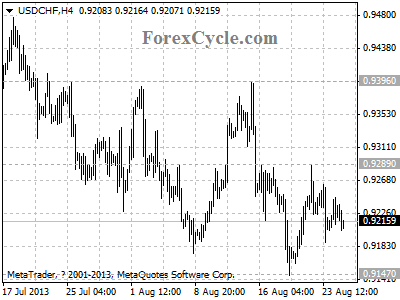
USDCHF moved sideways in a range between 0.9147 and 0.9289

Being contained by 0.9130 (Jun 13 low) support, USDCHF rebounded from 0.9147, and moved sideways in a range between 0.9147 and 0.9289. Initial resistance is at 0.9289, as long as this level holds, the price action in the range could be treated as consolidation of the downtrend from 0.9396, another fall to re-test 0.9130 could be seen. On the upside, a break above 0.9289 resistance will indicate that lengthier consolidation of the longer term downtrend from 0.9751 is underway, then further rise to 0.9350 area is possible.

usdchf

Provided by ForexCycle.com

Central Bank News Link List – Aug 26, 2013: ECB not set to keep rates low for years: Bundesbank chief Weidmann

By www.CentralBankNews.info Here’s today’s Central Bank News’ link list, click through if you missed the previous link list. The list comprises news about central banks that is not covered by Central Bank News. The list is updated during the day with the latest developments so readers don’t miss any important news.