How Will Investors React to a War in Syria?

By MoneyMorning.com.au

Local investors stuck to the sidelines today amid global worries about an escalation of the conflict in Syria coupled with lingering expectations the Federal Reserve will soon cut its massive stimulus.‘ – The Age

If you follow us on Google+ you’ll know we’ve had a lot to say about the bloodthirsty clamour for war in Syria.

The Age says that investors are sitting on the sidelines waiting for news of a potential war in Syria.

We remember the beginning of the Iraq War in 2003. It coincided with the bottom of the market. George W Bush declared war…stocks took off, barely looking back for more than four years.

So, can investors read anything into the current bout of war mongering? We’ll give you our take now…

Last night the Dow Jones Industrial Average fell 170 points and the NASDAQ fell 2.2%. But the reality is that you can never be 100% certain how investors will react to certain news.

Proof of that has been the ‘good news is bad news’ and ‘bad news is good news’ market mentality of the past few years. (Although sometimes it has been ‘good news is good news and bad news is better news!’)

Now, some will say that it’s somewhat distasteful to think about investing in the context of war. But heck, you can’t put your head in the sand and pretend it’s not happening. By not doing something you’re effectively taking an investment position, so doing something about it isn’t that much different.

As we see it, it all adds to our reasons for not having too much exposure to the stock market. If another war has a negative impact on stocks you need to make sure you don’t have too much of your wealth tied up in the market.

On the other hand, if the past few years have taught you anything, it’s that investors are a plucky bunch who have a habit of brushing aside perceived problems…

If in Doubt, Blame Greece

Look at the following chart of the S&P/ASX 200 index:


Source: Google Finance

Since stocks bottomed in March 2009 the ASX has gained 63.5%. That’s an average annual gain of 14.1%. Although we will acknowledge that three-quarters of that gain came within six months of the market bottom.

Even so, with everything that has happened since then, only the grouchiest of bears could say the market’s performance hasn’t been impressive.

We can’t even remember the entire roll call of problems that have hit the market over the past five years…

Portugal, Ireland, Italy, Greece, Spain, Greece, Dubai, US debt ceiling, Greece, China, Japan, Greece, QEI, QEII, Greece, Operation Twist, Greece, the Sequester…Greece.

That’s not to mention all the problems around the European Central Bank and its various debt programs. Oh, and let’s not forget Cyprus…which in a way is connected to Greece too.

Blame the Greeks. They’re as good a scapegoat as anyone.

Despite all that, the Australian stock market is 63.5% higher than it was in March 2009. Anyone who missed out on those gains because they focused on all the negatives mentioned above (plus the ones we’ve forgotten about) must surely be kicking themselves.

US Consumers Looking on the Bright Side

This is exactly what we mean when we say it’s hard to know how the market and investors will react to certain events.

So far, despite a lot of volatility, the overall response by investors has been positive. Only time will tell if investors will keep feeling that way. But if this report from Bloomberg is any indication, the good times for markets may not be over yet…despite last night’s action:

The U.S. is weathering federal budget cuts and higher payroll taxes, growth is picking up and some economists predict the expansion, now in its fifth year, may last longer than most.

The signs of resilience are everywhere: Households continue to spend. Businesses are investing and hiring. Home sales are rebounding, and the automobile industry is surging. Banks have healthier balance sheets, and credit is easing. All this coincides with the economy shedding the excesses of the past, such as unmanageable levels of consumer and corporate debt.

Don’t worry, we’re not falling for all that spin hook, line and sinker. For a start, according to the Federal Reserve Bank of St Louis, while US household debt to GDP is much lower than it was four years ago, in dollar terms it has only fallen from around USD$14 trillion to USD$13 trillion.

So we would hardly call that ‘shedding the excesses of the past‘.

But what we think about that doesn’t matter. What’s important is to understand what others think and how they may react.

Right now, with the market poised as it is, our sense is that investors are looking for any excuse to keep buying the market. Whether they will or not is another story. Remember, the market never rises or falls in a straight line.

But as things stand, even another war in the Middle East may not be enough to knock the market from its upward trend. The US indices fell last night, but they fell just before the Iraq War started too.

For stocks, it could be 2003 all over again.

We’ll see.

Cheers,
Kris+

Join Money Morning on Google+

From the Port Phillip Publishing Library

Special Report: Panic of 2013

Daily Reckoning: The Federal Reserve’s Crucial Next Step

Money Morning:  Why The 30/20 Tax Rule May Rise Again

Pursuit of Happiness: War: The Reason to Own Gold

Australian Small-Cap Investigator:
How to Make Big Money from Small-Cap Stocks

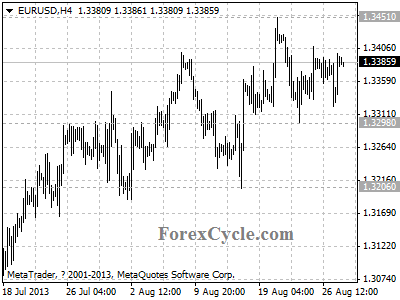
EURUSD stays a in trading range between 1.3298 and 1.3451

EURUSD stays a in trading range between 1.3298 and 1.3451. The price action in the range is likely consolidation of the uptrend from 1.3206. As long as 1.3298 support holds, the uptrend could be expected to resume, and further rise to 1.3500 area is possible after consolidation. On the downside, a breakdown below 1.3298 support will indicate that lengthier consolidation of the longer term uptrend from 1.2756 is underway, then deeper decline to test 1.3206 support could be seen.

eurusd

Provided by ForexCycle.com

The Bull in the China Shop

By MoneyMorning.com.au

The mainstream view is that China can smoothly transition its economy from construction to consumption. This is a dangerous illusion.

China’s rapid rise through the economic ranks was due to the twin drivers of infrastructure building and exports.

Stories abound on China’s ‘ghost cities’. The Chinese obsession with all things property has led to a possible credit bubble in the shadow banking system. The prospect of this bubble bursting is making cautious investors very worried.

And the anemic numbers on the Baltic Dry Index (which measures shipping rates) indicate the export business isn’t as robust as the Chinese authorities would like.

One of the stimulus measures touted by Beijing is the push for more urbanisation. That means moving citizens from rural areas to soak up the excessive supply in existing urban areas and to create fresh demand to justify more development.

An Unstable and Unsustainable Model

The transition to consumption will take time. So the authorities have resorted to the tried and true practice of building more ‘stuff’. This is an easy way to create the jobs needed to maintain social stability and retain their power base.

There is no question this formula has been successful in achieving this objective.

Over the past five years, the IMF estimates emerging economies (of which China is by far the largest) have accounted for three quarters of global growth. Little wonder the west is so keen for this ‘growth’ story to continue.

However, the economic platform China has built isn’t a stable or sustainable model for the future. At some point (and some argue this has already happened) they’ll reach saturation point – they won’t need any more train lines, shopping centres, skyscrapers etc.

Nouriel Roubini recently observed (emphasis mine):

China’s leaders face plenty of other enormously complicated challenges, like managing the risks created by a shrinking labor force, the increasingly free flow of information within the country’s borders, the degradation of its air and water, and the costs and complexities of providing for a rapidly ageing population. And given China’s outsize importance …its success and failures will be felt globally.

When thinking about the problems facing China, few analysts discuss its ageing population.

The fact is demographics are destiny. The gradual retirement of millions of baby boomers in the West is destined to reshape economic growth.

China faces a similar demographic time bomb. According to China’s Ministry of Education more than 13,600 schools closed in 2012. This is a result of the one child policy. Apparently the number of primary school students fell from 200 million to 145 million between 2011 and 2012. Remember, these school children are supposed to be the future taxpayers.

At the other end of the spectrum China has an impending social security crisis. The People’s Daily newspaper published an article recently warning the number of elderly could rise from 194 million in 2012 to 300 million by 2025.

A diminishing future tax base to support a growing future pension base. Does that sound familiar?

According to the article, Beijing is toying with changes to the one-child policy and lifting the retirement ages from 55 to 60 for women and 60 to 65 for men.

As always when politicians tinker, there are consequences.

There will be the obvious backlash to the prospect of increasing the retirement age. This is the first hurdle to cross. Assuming they do this, the policy really only buys time but doesn’t deliver a solution. The people are still in the system.

The other consequence is the impact on the rising level of unemployed university graduates. With older people staying in the workforce longer, this will only frustrate the employment prospects of the younger demographic.

The other thing is whether modern Chinese couples want to have more than one child or any children for that matter. Like their western counterparts, they too face the pressures of modern living. So the pitter patter of more Chinese feet isn’t a given.

China is facing a demographic problem similar to the West, but it doesn’t have the middle-class income to tap into. China’s demographic problem is its citizens are growing older faster than they are growing wealthier.

China: Vulnerable and in Trouble

China built its success on cheap labour. Ironically it needs to fund its future from a shrinking pool of more highly paid younger workers paying higher taxes.

Transitioning to a consumption based economy is a great theory but in reality it’s not easy with a rapidly ageing (and relatively poor) population.

Consider how much more difficult that situation would become if China experienced a hard landing from a property bubble bursting. Millions would hit the unemployment queues and take to the internet to vent their anger (similar to the Arab Spring). How do you tame 1.3 billion people? With great difficulty!

The bull in China is nothing to do with a raging market. It’s everything to do with the highly massaged economic data that the gullible West accepts. The West accepts it because they don’t want to think about the alternative.

No doubt China will become a much larger economic power. It could even surpass the US by the end of this decade.

However, no empire – Roman, British, US – has ever grown linearly. They all experience growing pains. China’s State-managed economy has been on a tear for two decades without pausing for breath.

The imbalances (property and credit bubbles) embedded in the system from this rapid growth and a demographic time bomb make China vulnerable to the contracting forces in the West.

You know the damage caused by the Bull in a China shop. So make sure you get your valuables out of the shop before the rampage begins.

Vern Gowdie+
Editor, Gowdie Family Wealth


Join Money Morning on Google+

From the Archives…

Why Risky Stocks are Best in Risky Markets
23-08-2013 –  Kris Sayce

Why Al Gore Won’t Like Big Data
22-08-2013 –  Kris Sayce

Debt and the the Patient Investor
21-08-2013 – Vern Gowdie

How to Apply Reynold’s Law to Your Retirement Savings
20-08-2013 – Nick Hubble

Holding Cash is an Investment Strategy Too
19-08-2013 – Vern Gowdie

Central Bank News Link List – Aug 28, 2013: Indonesia central bank calls new board meeting

By www.CentralBankNews.info

Here’s today’s Central Bank News’ link list, click through if you missed the previous link list. The list comprises news about central banks that is not covered by Central Bank News. The list is updated during the day with the latest developments so readers don’t miss any important news.

The Low-Cost, High-Yield Strategy Making Oil Investors Money: Josh Young

Source: Peter Byrne of The Energy Report (8/27/13)

http://www.theenergyreport.com/pub/na/the-low-cost-high-yield-strategy-making-oil-investors-money-josh-young

Sometimes success is about making the most of what you’ve already got. The same holds true for North America’s shale plays: Companies are saving development dollars by reworking old wells. When it’s done right, the rates of return are astounding. That’s why Young Capital Management founder Josh Young is investing in redevelopment plays. In this interview with The Energy Report, Young explains redrilling economics and highlights off-the-radar shale basins outperforming those in the limelight.

The Energy Report: Josh, political tension in the Middle East always prompts speculation over potentially rising oil process. What has the price action been since violence in Egypt intensified?

Josh Young: Prior to the turmoil in Egypt, oil was in the $90–95 per barrel ($90–95/bbl) range; it is now trading over $106/bbl. Prices will continue to rise if political instability spreads into the oil-producing neighbors of Egypt, or disrupts shipping on the Suez Canal.

TER: Do you see a potential for turmoil in Saudi Arabia?

JY: The possibility of protests turning violent is real across the Arab world. In the eastern part of Saudi Arabia, resistance by Shia has a taken on a violent undertone—nothing like the dramatic upswing in violence in Egypt, but it has the potential to fester and spread. Remember, the Arab Spring first got hot in Tunisia, and then spread like wildfire to Morocco and Libya. One of the big political factors that has destabilized the region of late has been a combination of a concentration of wealth generated by oil production along with inflation, particularly of food prices, which has made life a lot worse for the poor people in those countries.

TER: Turning to North America, are we looking at weaker earnings and higher interest rates for next year, as many economic pundits suggest? If so, will this trend affect oil and gas prices?

JY: There is a lot of price support for oil and natural gas. The marginal cost of production for oil continues to rise. Marginal oil is being produced in secondary areas in the Bakken and other peripheral shale plays where oil is economic above $100/bbl. Producers are drilling in the Arctic and in deepwater and ultra-deepwater, where offshore rigs and related facilities can cost billions of dollars. The trend is progressively higher production costs, and that requires higher oil prices. Worldwide rising marginal production costs indicate the price direction going forward.

TER: For investors who want to take advantage of a potentially large spike in oil and gas prices, can you explain what is meant by “contango” and “backwardation”?

JY: These terms describe the shape of the forward price curve of futures contracts for resource commodities. “Contango” is when the current price for oil is cheaper than the futures price for oil delivered in a year or two. “Backwardation” is the opposite: The current price for oil is higher than the price to buy oil later.

For example, if a trader wants to buy West Texas Intermediate (WTI) oil five years out, it costs roughly $85/bbl versus the current price of ~$106.50/bbl. I know commodity traders who profit from trading futures contracts based on analyzing the changing shape of these curves over time. But I prefer to invest in value-priced equities as there is a more clearly defined intrinsic value.

TER: What are the relative benefits of investing in oil and gas ETFs and master limited partnerships (MLPs) versus buying more stock in the majors or looking for solid juniors?

JY: Things don’t look great for Exxon (XOM:NYSE), Conoco (COP:NYSE) and other majors who are being hit hard by cost escalation, particularly in offshore exploration and development. These firms are aggressively buying and drilling around the globe, yet production is not increasing much—and in some cases it is declining—despite their unprecedented capital expenditures on drilling and production.

And with the ETFs, which are subject to contango and backwardation, the challenge is simply that you have no crystal ball. Most retail ETF investors are not able to understand the shape of the futures curve better than the commodity trading specialists who do this for a living. I look to the smaller, value-priced oil companies as the foundation of my investment strategy.

TER: You are a proponent of redeveloping mature basins. Why?

JY: There is less risk in redeveloping existing fields than in exploring for new fields, conventional or unconventional. Many exploratory wells, even shale wells, lose money. But there is good money—and less risk—in redeveloping fields in, say, Oklahoma.

TER: Which junior explorers and producers interest you in the mature basins?

JY: I like Gastar Exploration Ltd. (GST:NYSE). During the past year, the company has seriously reshaped itself. And it has cleaned up its balance sheet. It has signed onto accretive deals. Gastar is redeveloping the Hunton play in the Sooner Trend in Oklahoma and is drilling horizontal wells for $5 million ($5M). It had an excellent well come on-line with production at 200 barrels per day (200 b/d) and incline to more than 1,000 b/d for nearly 60 days before it started to decline, which is really exciting. The economics of that type of flow is unparalleled among the onshore resource plays.

TER: What is the rate of return on that particular well?

JY: Perhaps as high as 200%. And that means getting $10M back in the first year and maybe $3–4M in the second year. The net present value on that well is somewhere between $25M and $50M. The exact value depends on how rapidly the well declines and, obviously, the forward price for oil. But it is a phenomenal well by any measure.

TER: What makes the Hunton special?

JY: Consider this scenario: The stock of Goodrich Petroleum Corp. (GDP:NYSE) is shooting up because it is in a resource play that people are very excited about called the Tuscaloosa Marine Shale (TMS). The big difference between the Hunton and the TMS is that multiple well-known public companies are active in the TMS. The most prominent one is Goodrich, but Sanchez Energy Corp. (SN:NYSE)recently bought into the play. Devon Energy Corp. (DVN:NYSE) had a big position and recently sold out.EOG Resources Inc. (EOG:NYSE) has drilled a number of wells in the TMS.

At this point, investors are focused on the TMS and are generally unaware of what is really happening with Gastar’s redevelopment play in the Hunton. In the Hunton, about 50 horizontal wells with results have been drilled in the last three years. In the TMS, there have been about 20 results during the same time frame. In the Hunton, about 45 out of the 50 wells indicate a roughly 60% rate of return. But in the TMS, there are only about four wells that might be economic so far. The well announced by Goodrich is producing 1,500 b/d and cost about $14M. The Hunton wells are costing about $5M and some are producing more than 1,000 b/d. Gastar estimates that it will be able to get the cost per well down to $4.5M, which will drive returns even higher.

The Hunton is somewhat proven from an industry perspective. There is way more well data, way more outperformance, and the play shows a fundamentally lower risk profile than the TMS. Gastar has a good idea of where to drill, in other words. One would think that because the Hunton is working out so nicely, Gastar should be trading at a high multiple. But Gastar is trading at less than six times its 2013 enterprise value to EBITDA. Goodrich, on the other hand, trades at about 12 times its 2013 enterprise value to EBITDA. As people wake up to what is happening in the Hunton, there is the potential for Gastar’s stock to radically re-rate. I bought some Gastar stock today, and yesterday, and the day before—and I may just keep buying it!

TER: Gastar is also operating in the Marcellus.

JY: It is important to understand that Gastar has developed its main field in the Marcellus. Even if Gastar did not have the Hunton, its six times EBITDA is very cheap relative to the other Marcellus-focused companies with similar rates of return. Those companies include Rex Energy Corp. (REXX:NASDAQ),Cabot Oil & Gas Corp. (COG:NYSE), Range Resources Corp. (RRC:NYSE) and EQT Corp. (EQT:NYSE)—and they are trading at approximately 12 times enterprise value to 2013 EBITDA. Gastar’s CEO recently estimated that its Marcellus asset alone could be worth $7 per share, which highlights how cheap he thinks the stock could be at around $3 per share.

TER: What is the story with Range, Rex Energy, EQT and Cabot?

JY: They have all shown increasingly good results in the Marcellus and are trading at multiples. Their rates of return are reasonably high despite low natural gas prices. Range and EQT have massive inventory. Cabot has exceptionally high production from its dry gas well. Rex has some exposure to the Utica. Each of them is trading at a reasonably fair price. Each is run by good managers. They have beat expectations quarter after quarter. They are at or near being free cash flow positive, which is attracting generalist investors, because it is easier for a generalist to evaluate a company that is generating free cash flow, as opposed to a company, like Gastar, which is outspending its cash flow on capex for now. That should change by the end of 2014, which could further re-rate Gastar stock.

TER: What is the situation with Lucas Energy Inc. (LEI:NYSE.MKT)?

JY: I was on the board of directors of Lucas Energy for about six months, which restricts what I can say to a certain extent, but I can talk about the facts. Lucas recently secured new financing at about 11%, which is a higher interest rate than a typical bank loan, but lower than a typical mezzanine financing. Lucas has announced that it will use the loan to partially pay off short-term debt. That will improve its working capital situation. And it will deploy the cash to re-drill wells in known producing oil zones in its main fields. Generally, expenditures on workovers produce high rates of return by completing existing wells and opening wells into new zones.

TER: How does that work?

JY: Let us say that a company is producing oil from a well at a depth of 15,000 feet. It spends a relatively small amount of money to open up the nearer well. And if it produces even 10 or 20 b/d and the operator only spent $50,000 to open it, the rate of return can be well over 100%.

TER: Do you have an update on GeoMet Inc. (GMET:NASDAQ)?

JY: Geomet recently sold an asset, paid down debt and got back into compliance with its lending facility. Surprisingly, despite higher natural gas prices and a fully compliant debt facility, the equity and the preferred stock have not traded up since then. In particular, the preferred stock seems appealing with a 12.5% current payment in kind (PIK) yield and trading at a 25% discount to “par.” This could be an interesting way to get exposure to high yields with upside to natural gas prices, which could potentially recover over time.

TER: I noticed that EQT has joined other large and small oil and gas firms in the Center for Sustainable Shale Development (CSSD). And Range Resources has been releasing information about the chemical composition of its fracking liquid. Are there problems with water pollution in hydraulic fracturing that will bite investors sooner or later?

JY: Range has disclosed the contents of its frack fluid as 99.5% water and sand. It adds four chemicals to the fluid, which are all found in household cleaning supplies. Range’s view is that its fluid contains nothing in it to contaminate water. To my knowledge, there are no cases of fracking leading to water contamination. The cases that have been cited are related to water wells that were drilled into coal bed methane reservoirs. In the film Gasland, people were able to light their tap water on fire because there was natural gas mixed in with it. That water well was drilled 80 feet down into a coal seam, and as the water was used up, the pressure on the coal eased and allowed the release of natural gas.

There are cases where chemicals found in drinking water were related to truck crashes. Unfortunately, in parts of the Marcellus it is hilly. Occasionally, trucks transporting chemicals crash and those chemicals spill into the water. That is not different from any other industrial activity. Our ability to live modern lifestyles is contingent on certain levels of manufacturing activity and industrial activity that leads to some level of pollution of the environment.

TER: Thanks for sharing your perspective, Josh.

JY: Anytime.

Josh Young is the founder and portfolio manager of Young Capital Management, LLC. He is also a board member of Lucas Energy Inc. He previously served as an analyst at a multi billion-dollar single-family office in Los Angeles. Prior to that, he was an investment analyst at Triton Pacific Capital Partners. He was also a corporate strategy consultant at Mercer Management Consulting and DiamondCluster. He holds a Bachelor of Arts in economics from the University of Chicago.

Want to read more Energy Report interviews like this? Sign up for our free e-newsletter, and you’ll learn when new articles have been published. To see a list of recent interviews with industry analysts and commentators, visit our Interviews page.

DISCLOSURE:

1) Peter Byrne conducted this interview for The Energy Report and provides services to The Energy Report as an independent contractor. He or his family own shares of the following companies mentioned in this interview: None.

2) The following companies mentioned in the interview are sponsors of The Energy Report: None. Streetwise Reports does not accept stock in exchange for its services or as sponsorship payment.

3) Josh Young: I or my family own shares of the following companies mentioned in this interview: Gastar Exploration, Lucas Energy and Geomet. I personally am or my family is paid by the following companies mentioned in this interview: None. My company has a financial relationship with the following companies mentioned in this interview: None. I was not paid by Streetwise Reports for participating in this interview. Comments and opinions expressed are my own comments and opinions. I had the opportunity to review the interview for accuracy as of the date of the interview and am responsible for the content of the interview.

4) Interviews are edited for clarity. Streetwise Reports does not make editorial comments or change experts’ statements without their consent.

5) The interview does not constitute investment advice. Each reader is encouraged to consult with his or her individual financial professional and any action a reader takes as a result of information presented here is his or her own responsibility. By opening this page, each reader accepts and agrees to Streetwise Reports’ terms of use and full legal disclaimer.

6) From time to time, Streetwise Reports LLC and its directors, officers, employees or members of their families, as well as persons interviewed for articles and interviews on the site, may have a long or short position in securities mentioned and may make purchases and/or sales of those securities in the open market or otherwise.

Streetwise – The Energy Report is Copyright © 2013 by Streetwise Reports LLC. All rights are reserved. Streetwise Reports LLC hereby grants an unrestricted license to use or disseminate this copyrighted material (i) only in whole (and always including this disclaimer), but (ii) never in part.

Streetwise Reports LLC does not guarantee the accuracy or thoroughness of the information reported.

Streetwise Reports LLC receives a fee from companies that are listed on the home page in the In This Issue section. Their sponsor pages may be considered advertising for the purposes of 18 U.S.C. 1734.

Participating companies provide the logos used in The Energy Report. These logos are trademarks and are the property of the individual companies.

101 Second St., Suite 110

Petaluma, CA 94952

Tel.: (707) 981-8204

Fax: (707) 981-8998

Email: [email protected]


Magic Formula Stocks for August

By The Sizemore Letter

Last month, I ran a screen of “Magic Formula” stocks from hedge fund guru Joel Greenblatt’s screener.

I recommend you read the original piece because I explain what the Magic Formula is and how it works.  But for the sake of simplicity, I can summarize it like this:  the Magic Formula is a list of highly-profitable companies trading at cheap valuations. 

The list isn’t fool-proof, of course, and it is subject to lag times in information.  For example, profitability (based on Greenblatt’s favorite metric, return on capital) is based on the most recent quarterly filings, and a lot can change from quarter to quarter.

So, the Magic Formula screen should be viewed as a great starting point for your investment research and as a great fishing pond for potential value plays.  But you shouldn’t assume that every stock on the list is a bargain.

With that said, I re-ran the screen for August with the same parameters as July: top 30 Magic Formula stocks with a market cap of $1 billion or more.

We have several familiar names that have been on the list off and on for the past several years—Microsoft (MSFT), Cisco (CSCO) and Lorillard (LO), for example.  Dell (DELL), which—as I noted last month—is tied up in a fight for control of the company between founder Michael Dell and a group of sharesholders led by Carl Icahn, also made the cut.

On a list of 30 names, 25 were unchanged from July.  But we did have five subtractions and five new additions:

Off the List:
Abbott Labs

$ABT

CF Industries Holdings Inc

$CF

GameStop Corp

$GME

Questcor Pharmaceuticals Inc.

$QCOR

Weight Watchers International Inc

$WTW

New Additions:
Coach Inc

$COH

Express Inc

$EXPR

PDL BioPharma

$PDLI

Sturm Ruger & Co

$RGR

ValueClick Inc

$VCLK


Of the five stocks bounced from the list from last month, it’s worth noting that all but Abbott Labs (ABT) and Weight Watchers (WTW) still made the cut on the expanded 50-stock list (I encourage you to play with the list here.  Adjusting the portfolio size and minimum market cap can produce almost infinite numbers of portfolios.)

It’s also worth noting the stock price performance over the past month.  Weight Watchers is down by nearly a quarter from its August 2 highs while Questcor Pharmaceuticals (QCOR) is up almost 40% in the past month, and GameStop (GME) is up about 12%.

The new additions for August will have a few familiar names.  Coach (COH) has been off and on the Magic Formula list for years.  Coach is a monstrously profitable company with a return on equity of 47%.  Yet the success of upstart rival Michael Kors (KORS) has dampened enthusiasm for the stock, which is down by over 30% from its old 2012 highs.

Fashion retailer Express (EXPR) also made the cut, as did firearm maker Sturm Ruger (RGR).  With President Obama—perceived by many to be “anti-gun”—now in office for nearly five years and with the tragic Newton school shooting fading from the headlines, the possibility of immediate and comprehensive gun control is receding.  Perversely, this is actually bad for handgun makers, which have enjoyed a windfall from panicked gun owners fearing that their window of opportunity to buy a gun was closing.  Handgun makers like Sturm Ruger should not expect to see the kinds of revenue gains they’ve enjoyed for the past several years.

Still, Sturm Ruger is attractively priced at 11 times earnings and sports a 4.6% dividend yield.

And lastly, online marketing company ValueClick (VCLK) and biotechnology firm PDL BioPharma made the cut in August as well.

Disclosures: Sizemore Capital is long MSFT, CSCO and ABT


This article first appeared on Sizemore Insights as Magic Formula Stocks for August

Join the Sizemore Investment Letter – Premium Edition

A Nervous Day Today

Article by Investazor.com

The conflicts taking place in Syria combined with the turmoil in Egipt lead to important movements in the price of oil. Besides this situation, United States intervened and wants to held responsible Syria for using chemical weapons against civilians. This intervention betrayed the U.S.’s intention to step in the arab issues which provokes so many turbulences so far. Even if Syria isn’t an important player in the oil industries, the biggest fears are realted to the possibility of arousing a conflict which would cover the entire Middle East zone. An important ally of United States in this matter is United Kingdom. British Prime Minister David Cameron will indicate its position tomorrow after meeting with the Britain’s National Security Council. In its view, this problem requires a group involvment and collaboration in order to avoid any international conflicts.

In the United States the situation seems to agitate as in the Middle East. Tensions were caused by the tapering of the Quantitative Easing program and the pressures on the Congress, which may be bound to act and to raise debt limit again, even if the economy became very sensitive to this change. The last news about U.S. indicated a decrease in the consumers’ orders of core durable goods -0.6% which indicates a awareness of the production. On the other side, the consumer’s confidence keep improving and stabilizing in this area (last release of the confidence index of Conference Board indicated 81.5 points ).

For the next period it is important to closely watch the data coming from the labor market in U.S. ( unemployment claims on Thursday) and the NFP next week. These two indicators may give important hints concerning the future evolution of QE3.

The post A Nervous Day Today appeared first on investazor.com.

Syria, an Oil Bomb Ready to Explode

Article by Investazor.com

Syria is the main subject at the current moment. United States are holding the Syrian government accountable for killing their own citizens with chemical weapons last week. Not only the United States, but also UK and France are blaming Assad for the killings in Ghouta and all of them are willing to intervene.

It didn’t take long for protestants to appear. The protests in Libya had a negative impact on the oil production. A shortage in the oil offer brought higher prices for both WTI and Brent oils. But this is just the beginning. Syria itself produces around 164000 barrels a day, so it is not that important for the oil market. But if United States will intervene, here, to get rid of the Bashar al-Assad, the conflict will be ramified and the entire Middle East will be engulfed in a war.

While USA has allies like U.K. and France, the Syrians have their own allies. Iran is a longtime Syrian ally and they warned the US that they will back them up, and they are not alone because Russia is also backing up the Syrians. If only of these two allies would enter a war the price of oil would rally at a fast pace and could touch new highs.

syria-an-oil-bomb-ready-to-explode-27.08.2013

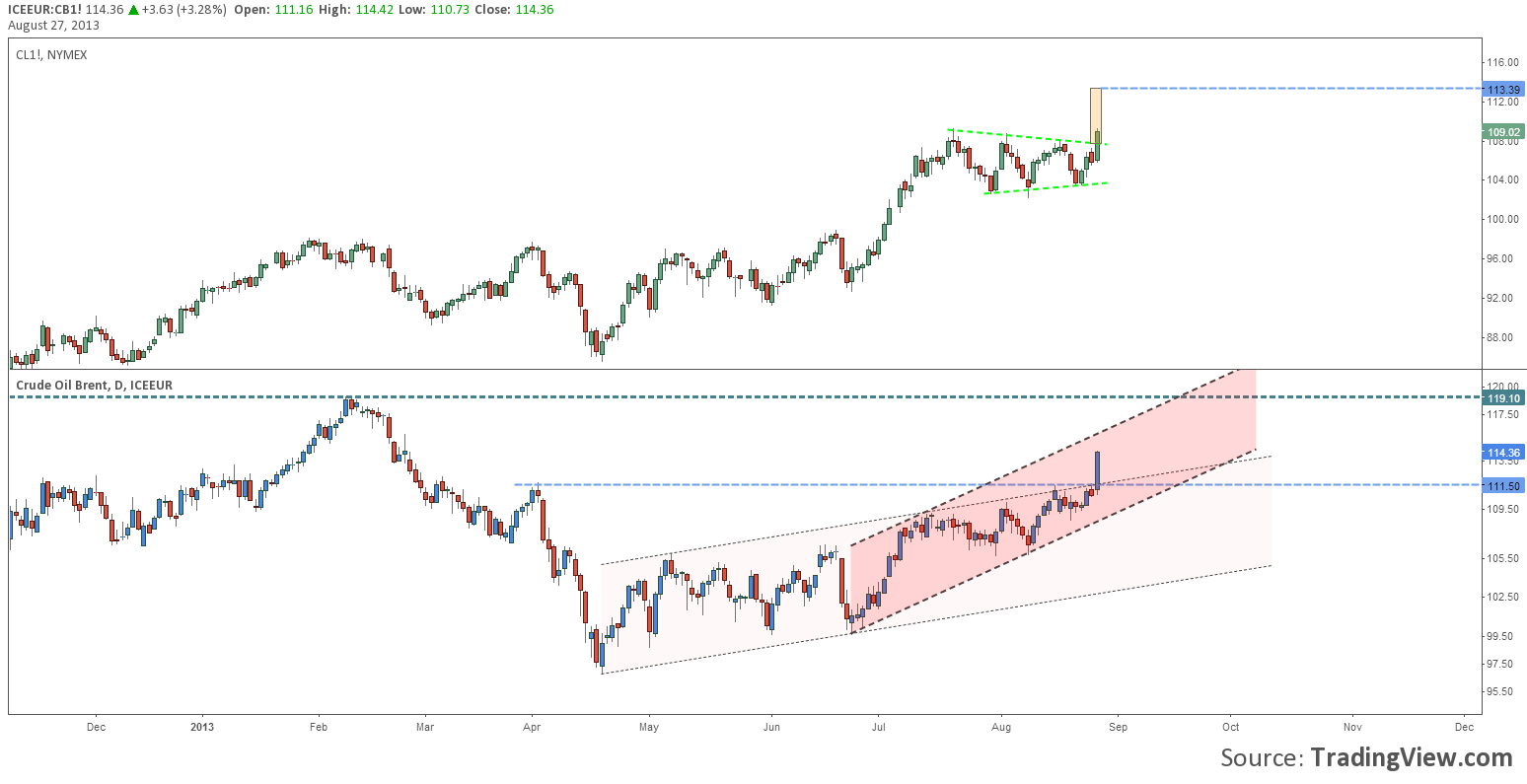
Chart: Brent Oil, WTI Oil (Daily)

For the moment Brent Oil, lower part of the chart, has broken today the rejection line of an up channel and rallied almost 3 percent today, touching the highest level in the past 6 months at 114.42$ per barrel. If today the closing price will be around this level and the United States, U.K. and France would still want to intervene in Syria, we might see the Brent oil going towards 119$ per barrel, since there are no other visible resistance until there.

The WTI has broken the upper line of a symmetrical triangle, which was drawn during the last month. A close of the day above the upper line of the triangle as well as a continuation of this conflict could easily push its price towards the target of the triangle at 113.40$ per barrel.

The probability for the US to intervene in Syrian and to try to get rid of Assad is big. It matters now when and how they will do this.

The post Syria, an Oil Bomb Ready to Explode appeared first on investazor.com.

Political, Religious and Economical Problems Invade Syria

Article by Investazor.com

These days we are attacked by a lot of news about the conflicts in Syria. Of course, the United States of America are this time, again, one of the main characters. Is it new, this whole situation of conflict?

Let’s go to the roots…

Syria is a small country in the Western Asia. Not rich, but enjoining its fertile plains and geographical diversity from high mountains to deserts, it had (or not) the opportunity to be the birthplace for many population, such as: Armenians, Turks, Kurds, Assyrians and some other more. Of course, the religious diversity is also a characteristic of the country: Christians, Muslims, Druze, Alawite Shias or Arab Sunnis are sharing the territory.

Which is the main cause of conflict in the area? The response is simple: behind any political reasons pretended by the elites or economical reasons claimed by the whole world but denied by the US, there is religion. We are not going to enter into details regarding each and every Islamic branch (Sunnites, Shiites, extremists, fanatics, or simply opponents of something) but we want to emphasize the fact that nowadays we are made to believe that a new world war can break out because of some civil wars, ethnic and religious misunderstandings; and that a quick intervention of external military powers will finally (God knows when) be able to re-establish peace in the area. But the interests are hidden behind clichés like “world peace” or “fight against terrorism”.

From ancient times, Syria has both Christian and Islamic history. Under the Islamic rulers, starting in the 7th century, the country passed through totalitarian political regimes, revolutions, oppressions, Crusades (Christian missions due to liberate the Holy Lands) and massacres. Later on, in the 16th century it was invaded by the Ottoman Empire and incorporated into it, period that brought peace because of system adopted by the ottoman administration. However, a peaceful coexistence between so various nations and religions is hard to be maintained, given the concept of Holly War (Jihad) that is misunderstood and misinterpreted by extremist groups, and other practices derived from the Islamic teachings of Koran. After World War I Syria was put under a French mandate, which lead to new conflicts between Sultan al-Atrash and French administration. Since its independence in 1936 Syria always tried to keep close the local allies, struggling to face internal conflicts.Syria-oil-ressources

 Why is the West involved in all these ethnic and religious conflicts? It has always been like that, because in this world there are hidden interests, strategic views, unknown distribution of the natural resources of the planet, between the so called powerful countries, and hidden purposes of solving as old as mankind conflicts. After World War 2, Arab countries become more and more interesting for the Western powers, such as US and UK. However, Syria kept close some powerful traditional allies like Russia, Venezuela, China and Iran, which have supported the Syrian government during the civil war.

 The fact that the US, closely sustained by the UK and France, are trying these days to bring peace by making war in the area is a nonsense. The Jihad is defined in the Koran as being both internal and external struggle of the Muslim to be in peace with God, to preach God’s word and Muhammad’s teachings. The so called Terrorism, against which US and its allies are fighting, is not a product of the Islamic religion, but their own propaganda product behind which they cover untold purposes of dominating the world. How could the US dominate the world is they did not dominate world’s natural resources…?

 In other words, Syria is just a new victim of the US struggle to dominate the world, economically speaking, whose internal, older than the US history conflicts are not going to be resolved by a quick or slow intervention of the Western- bringing- peace countries.


The post Political, Religious and Economical Problems Invade Syria appeared first on investazor.com.