Small (Capex) Is Beautiful in Silver and Gold, Says Salman’s Ash Guglani

Source: Kevin Michael Grace of The Gold Report (8/26/13)

http://www.theaureport.com/pub/na/small-capex-is-beautiful-in-silver-and-gold-says-salmans-ash-guglani

Multibillion-dollar capital expenditures for precious metals projects have gone the way of the dinosaur, says Ash Guglani, research analyst at Salman Partners. In this interview with The Gold Report, Guglani delivers a report card for eight gold and silver companies, with the highest grades going to those that have kept down costs and have kept capital requirements modest.

TGR: The traditional market advice is sell in May and go away. This period of market restraint typically lasts until November. Why should investors in precious metals come back then?

Ash Guglani: What we’re seeing now is companies adapting to a new environment. The big theme this past quarter was cost containment. Many companies have followed through on that and reported good operating numbers. Going into the fall, investors will have the opportunity to pick companies that have shown improvement.

TGR: We’ve had a recovery in bullion, with silver over $23/ounce ($23/oz) and gold over $1,350/oz. Do you expect silver and gold equities to increase to match the increases in bullion?

AG: Yes. We’re seeing it now. The main thing is that we need some sort of price stability so that companies can adapt to this new price-point environment. If you go through the quarterly earnings, a lot of companies are cutting headcounts, capital expenditures (capexes) and exploration budgets. They are focusing on operating efficiency. I’m finding that miners are very quick to react.

TGR: I’ve been looking at your coverage list and see Pretium Resources Inc. (PVG:TSX; PVG:NYSE). Its Brucejack project in British Columbia has been an investors’ darling for years. The company put out a feasibility study in June, and you visited the site that month. In your opinion, is the promise justified?

AG: Pretium’s flagship asset is its high-grade Brucejack project. In the Brucejack feasibility study, the capex was $663.5 million ($663.5M). For that amount of money it would produce 7.1 million ounces of gold over a 22-year mine life. This bodes well for the project. There are not a lot of high-grade discoveries like this out there right now. The feasibility study showed the numbers are very strong. In our visit, Pretium outlined a little bit more of what it is doing with underground development. The bulk sampling remains the major catalyst for the story and we’re hoping to see that by the end of 2013.

TGR: Why is the bulk sample so important?

AG: When you get a high-grade asset like Brucejack, there’s always the question of what kind of grades we are actually going to see consistently. The main reason for the bulk sample is to verify the strength of the economics of this project.

TGR: How is Pretium’s cash position?

AG: At the end of June it had $33M in cash. The company is in a position now where it doesn’t need a lot of cash at this moment. The feasibility is done and most of the exploration work is finished. Pretium has excavated most of the bulk sample now. Cash-wise, the company is okay for now, but at some point, if it decides to go ahead and develop Brucejack, it will need more cash. But given what we’ve seen with this project, I don’t expect it will have any problem getting the capital it needs.

TGR: British Columbia is not known as the easiest place to open a mine in Canada. What suggests to you that Pretium will succeed where others (for environmental and First Nations reasons) have failed?

AG: I don’t foresee any environmental problems because Brucejack Lake is not a fish habitat. I believe the company is talking to three different First Nations groups in that area, and the talks have been going well. The company hopes to have agreements in place by the end of the year. Seabridge Gold Inc. (SEA:TSX; SA:NYSE.MKT), which is nearby, also reports positive talks with First Nations. I don’t see any real permitting issues here; the area has been permitted before. The Tahltan tribe worked with Barrick Gold Corp. (ABX:TSX; ABX:NYSE) during the Eskay Creek days.

TGR: You rate Pretium a Buy. What’s your target price?

AG: $17.50.

TGR: Turning to Mexico, you rate Almaden Minerals Ltd. (AMM:TSX; AAU:NYSE) a Speculative Buy. This is a company that has about $24M in working capital and owns its drills. Does that put it in pretty good shape?

AG: Definitely. Almaden has a history of raising money in challenging times. It was able to raise another $5.5M in July. It has a strong cash position, and, as you said, it owns its own drills, so the drilling cost per meter is a lot cheaper than its peers. Almaden is in a great position.

TGR: Almaden has pursued a policy of drill, drill, drill at the Ixtaca gold-silver zone of its Tuligtic property. How close is this to bearing fruit?

AG: Almaden has drilled about 80,000 meters so far and has done a great job at filling in the blanks. It is a project generator, so I’m pretty sure Almaden’s management is out there generating interest in this story. It will be interesting to see what people think. Ixtaca is a decent gold story with a nice silver byproduct credit.

TGR: The Poliquin family, which runs Almaden, finds properties, develops them and then sells them. Do any companies come to mind as possible acquirers?

AG: Recently we’ve seen Alamos Gold Inc. (AGI:TSX) make a bid for Esperanza Resources Corp. (EPZ:TSX.V). Mexico being what it is, there would be a lot of producers there that would be looking at a project with this kind of scope. It’s just that we need a little bit of consolidation to start happening in the market first.

TGR: What is your target price for Almaden?

AG: $3.75.

TGR: What other companies have you rated Speculative Buy?

AG: Red Eagle Mining Corp. (RD:TSX.V) has pushed for near-term production at its Santa Rosa gold project in Colombia. That’s what I like about this story. It’s not a massive deposit, but it is something that could be producing within a couple of years. It is an open-pit scenario, so Red Eagle could look at different alternatives to get Santa Rosa into production. The company is deciding now whether to go underground first. Red Eagle’s market cap is about $12M. I think it has about $10M in cash. It has some great strategic investors, including Liberty Metals & Mining Holdings and Appian Capital Advisory out of London. Both groups have pretty good technical backgrounds. I don’t expect to see a massive capex for Santa Rosa, and that’s another reason I like it.

TGR: What’s your target price for Red Eagle?

AG: $0.55.

TGR: These days, is small beautiful with regard to capex?

AG: Yes, it is. Small is beautiful now. Until we have stabilization in gold and silver prices, the days of looking at multibillion-dollar capexes are over. There are a lot of them out there already, and I don’t think we’re going to see a lot being developed any time soon.

TGR: What other companies do you rate as Buys?

AG: Silver Standard Resources Inc. (SSO:TSX; SSRI:NASDAQ) and Great Panther Silver Ltd. (GPR:TSX; GPL:NYSE.MKT) are both Buys. My target prices are $16.50 for Silver Standard and $1.30 for Great Panther.

TGR: Has Silver Standard met the challenge of the lower silver price?

AG: It just reported a good operational quarter. The theme for all these producers is to take the right steps in containing costs. We need to see that continuing over the next few quarters as we figure out where gold and silver prices are going.

TGR: What do you think of Silver Standard’s projects?

AG: Silver Standard has one operating mine, Pirquitas in Argentina. The company has the big Pitarilla silver-lead-zinc project in Mexico and it has a whole bunch of little projects in its portfolio that it could potentially develop. I think Silver Standard’s main focus right now is increasing efficiency at Pirquitas. I believe it is looking for a partner for Pitarilla.

The beauty of Silver Standard is that it has a pretty sizeable cash position that allows it control over its production profile. The company also has projects that it could divest, if it needed more cash, including a sizeable position in Pretium. I think Silver Standard is actually in a great position right now.

TGR: And Great Panther?

AG: It is a higher cost producer, but it showed some promise this past quarter. The company needs to demonstrate consistent operating efficiency.

TGR: You have a Buy recommendation for Silvercorp Metals Inc. (SVM:TSX; SVM:NYSE), correct?

AG: Yes, and a $4.60 target price. Silvercorp has done a good job at scaling back costs wherever it can and shutting down some of its high-cost mines in the Ying mining district.

TGR: Has Silvercorp triumphed over those who claimed it had exaggerated its resources in China?

AG: I think the company did a good job fighting those allegations and in getting back to what it does best: operating mines in China. So now there is more focus on the actual numbers coming out of the company.

TGR: What other companies are in your coverage universe?

AG: Kimber Resources Inc. (KBR:TSX; KBX:NYSE.MKT) is a Speculative Buy with a price target of $1.25. The company’s Monterde gold-silver project in Mexico is interesting, but it has been the victim of funding. Its cash position limits what it can do. Kimber needs the market to improve so that investors can open up their wallets to get Monterde back on track. The company needs to do a lot more work to delineate its underground resource. But it does have both open-pit and underground mining scenarios.

TGR: Is there one more company you would like to discuss?

AG: Endeavour Silver Corp. (EDR:TSX; EXK:NYSE; EJD:FSE) is a Buy recommendation at $5.50. The company has two mines in Mexico, Guanaceví and Bolañitos, that are profitable and cash-flow positive even with $20/oz silver. Its El Cubo acquisition has hampered the company a little bit, but it has taken the right steps to control grade there, and it will be interesting to see how that plays out.

TGR: What will it take for investors in gold and silver equities to become excited about the market again?

AG: I’ll say again that we need price stability. Also, we need producers continuing to show that they’ve adapted to the new commodity price environment. That’s when investors will begin to see that valuations are ridiculously cheap. That’s when people will start getting excited again.

TGR: Many of these companies have been ridiculously cheap for quite some time, but investors have been waiting for a bottom. Have we gotten to the point where investors can’t resist these bargains any longer?

AG: I think we’re seeing it now.

TGR: Ash, thank you for your time and insights.

Ash Guglani is a research analyst with Salman Partners, covering precious metals companies in the mining sector. He has been with Salman Partners since 2004. Guglani holds a Bachelor of Business Administration degree with a focus in finance from BCIT.

Want to read more Gold Report interviews like this? Sign up for our free e-newsletter, and you’ll learn when new articles have been published. To see a list of recent interviews with industry analysts and commentators, visit our Streetwise Interviews page.

DISCLOSURE:

1) Kevin Michael Grace conducted this interview for The Gold Report and provides services to The Gold Report as an independent contractor. He or his family own shares of the following companies mentioned in this interview: None.

2) The following companies mentioned in the interview are sponsors of The Gold Report: Pretium Resources Inc., Almaden Minerals Ltd., Red Eagle Mining Corp., Silver Standard Resources Inc. and Great Panther Silver Ltd. Streetwise Reports does not accept stock in exchange for its services or as sponsorship payment.

3) Ash Guglani: I own or my family owns shares of the following companies mentioned in this interview: None. I personally am or my family is paid by the following companies mentioned in this interview: None. My company has a financial relationship with the following companies mentioned in this interview: None. I was not paid by Streetwise Reports for participating in this interview. Comments and opinions expressed are my own comments and opinions. I had the opportunity to review the interview for accuracy as of the date of the interview and am responsible for the content of the interview.

4) Interviews are edited for clarity. Streetwise Reports does not make editorial comments or change experts’ statements without their consent.

5) The interview does not constitute investment advice. Each reader is encouraged to consult with his or her individual financial professional and any action a reader takes as a result of information presented here is his or her own responsibility. By opening this page, each reader accepts and agrees to Streetwise Reports’ terms of use and full legal disclaimer.

6) From time to time, Streetwise Reports LLC and its directors, officers, employees or members of their families, as well as persons interviewed for articles and interviews on the site, may have a long or short position in securities mentioned and may make purchases and/or sales of those securities in the open market or otherwise.

Streetwise – The Gold Report is Copyright © 2013 by Streetwise Reports LLC. All rights are reserved. Streetwise Reports LLC hereby grants an unrestricted license to use or disseminate this copyrighted material (i) only in whole (and always including this disclaimer), but (ii) never in part.

Streetwise Reports LLC does not guarantee the accuracy or thoroughness of the information reported.

Streetwise Reports LLC receives a fee from companies that are listed on the home page in the In This Issue section. Their sponsor pages may be considered advertising for the purposes of 18 U.S.C. 1734.

Participating companies provide the logos used in The Gold Report. These logos are trademarks and are the property of the individual companies.

101 Second St., Suite 110

Petaluma, CA 94952

Tel.: (707) 981-8999

Fax: (707) 981-8998

Email: [email protected]

 

So Brazil, About That Currency War…

By The Sizemore Letter

In the international currency war, it would appear that Guido Mantega has turned traitor and gone over to the other side.

If you’re not familiar with Mr. Mantega, he is the colorful—and quotable—finance minister of Brazil and one of the most vocal critics of the easy money policies pursued by the United States, Europe, and Japan.  It was Mantega who introduced us to the term “international currency war” in 2010 and—with a touch of bravado—promised that Brazil wouldn’t lose.

What did he mean by that?  Mantega was concerned that the soaring price of the Brazilian real (or the plunging price of the dollar, euro and yen, depending on your perspective) due to loose monetary policy in the developed world put Brazilian exporters at a disadvantage and ran the risk of hollowing out the economy by making manufactured imports artificially cheap.

Brazilian_Real

Source: tradingeconomics.com

For perspective, take a look at the embedded chart. I set the start date to 2003, which happens to correspond to the year I went to Brazil for the first time.  It almost brings a tear to my eye to think that I could buy a steak dinner for the price of a Big Mac then.

Alas, those days are over.  In 2003, a dollar would buy you 3.5 Brazilian reais.  But as yield-hungry investors and speculators jumped into the market throughout the 2000s emerging markets boom, the real more than doubled in value in dollar terms.  By the beginning of 2011, a dollar would barely buy you 1.5 Brazilian reais (for those unfamiliar with the terminology, “reais” is the plural of the “real,” Brazil’s currency).

As the real continued to strengthen, Mantega did everything in his power to weaken it.  In an attempt to deter “hot money” speculators and Western fund managers, he instituted a tax on foreign investment…and then raised it to 6%. He also encouraged the central bank governor to go on an aggressive dollar buying spree.

Generally speaking, it’s a bad idea to bet against a country that is determined to weaken its currency.  Strengthening a currency is tough; it requires a fat stash of hard currency reserves and an ability to instill confidence in a fickle, temperamental market.  But weakening a currency requires nothing more than a willingness to print money and flood the international currency markets with it.

Brazil won the currency war.  The real had been steadily weakening since mid-2011…until the U.S. Fed’s “taper scare” turned the decline into a rout. Now the victory is looking like a Pyrrhic one, and Mantega and his compatriots are more concerned about a destabilizing currency collapse.  The foreign transaction tax has been scrapped, and the central bank is actively intervening to prop up the real with a new $60 billion program.

All of this has sent investors running for the door.  The iShares MSCI Brazil ETF ($EWZ) is down 21% year to date in a year when the S&P 500 is up 20%.  The Brazilian Bovespa, in local currency terms, is down only 14%.  Most of the damage came in the May/June “taper” scare, which rattled India, Turkey, and most of the rest of the emerging world as well.

So, what are we to do with this information?  Is Brazil cheap enough to warrant a look after the recent rout?

iShares MSCI Brazil (EWZ)

iShares MSCI Brazil (EWZ)

Brazil is reasonably cheap.  By Financial Times estimates, the broad market trades for about 15 times earnings and yields 4%.  And after the recent slide, the real is sitting near five-year lows.  The currency could always go lower, of course.  But it would appear that the hot money has largely already fled the coup.

Brazil has also been rattled by the slowdown in China, which has hit all commodity-producing countries hard.  Yet the recent data coming out of China suggests that the worst might be behind us.  Industrial production and fixed investment both saw improvement in the latest data release.

Finally, we get to market psychology.  This is notoriously hard to measure and subject to change at the drop of a hat.  But in general, investors haven’t exactly been lining up to buy emerging market stocks.  Emerging market mutual funds and ETFs have lost nearly $6 billion in outflows this year, suggesting that investors have given up hope.  All else equal, that’s a contrarian bullish sign.

I may be a little early on this trade, but I would recommend accumulating shares of Brazilian and other emerging market stocks at these prices.  It’s not time to back up the truck just yet, but I would start with a small position and average in over the course of the next several weeks.

Charles Lewis Sizemore, CFA, is the editor of the Sizemore Investment Letter and the chief investment officer of investments firm Sizemore Capital Management. As of this writing, he had no position in any stock mentioned. Click here to learn about his top 5 global investing trends and get your copy of “The Top 5 Million Dollar Trends of 2013.”

Join the Sizemore Investment Letter – Premium Edition

Tapering QE3 Challenges the Whole World

Article by Investazor.com

As the time of modifying the Quantitative Easing program is nearing, the possible effects started to be analyzed. Jackson Hole Symposium was the main event of the last days as central bankers, finance ministers, academics, and financial market participants from all over the world gathered to discuss the most important issues of the actual economic situation. Even if the man with the answers (Ben Bernanke) missed this even, other important persons came to draw a warning signal. Thereby, we can list Christine Lagarde, Janet L. Yellen and Haruhiko Kuroda.

Another worry that was added to the existing basket of problems is the way that QE3 influences countries from around the world. In the context of tapering this program, emerging markets could be affected. It’s true that the countries that have supported unconventional monetary policies have also been able to maintain a balanced economic climate and financial stability, and the whole system get used with this pulse, but stopping a program that calmed an entire world, may stir things up. This is what Christine Lagarde suggested and tried to draw the attention on the necessity to find the best way to make this change. On one side U.S. is doing well, making its economy to go more fast offers it the power to interrupt this program while emerging countries have to deal with these conditions and find solutions to face new challenging conditions.

Somehow or other, the “September moment” was also confirmed by Jackson Hole Symposium. Ben Bernanke wants to see its job finished until he ends its mandate and the current economic conditions seem to offer him the right moment to end his plan. On the other side of the ocean, the Europe and Japan may still enjoy the ultra-easy monetary policies they have already integrated so far.

The post Tapering QE3 Challenges the Whole World appeared first on investazor.com.

Israel holds rate steady, keeps watch on housing market

By www.CentralBankNews.info     Israel’s central bank held its policy rate steady at 1.25 percent, as expected, in light of the shekel’s steady exchange rate, inflationary expectations that are slightly below the midpoint of the central bank’s target range and economic activity that is similar to the past two years.
     But the Bank of Israel (BOI) also noted that home prices had begun to rise again and mortgages continue to be taken out in large volumes so it would “keep a close watch on developments in asset markets, including the housing market.”
    Last week the BOI continued its campaign to cool the Israeli housing market, unveiling draft guidelines that cap the share of mortgage repayments out of household income, limits the share of a loan that may have a variable interest rate and bans mortgages in excess of 30 years.
    In June banks granted some 5 billion shekels of new mortgages, up from a monthly average of 4.4 billion since the beginning of this year, and the housing component of the consumer price index rose by 1.0 percent in July, up from 0.3 percent in June, for an annual rise of 3.1 percent.
    This compares with a 0.3 percent rise in overall consumer price inflation in July from June for an annual rate of 2.2 percent, within the bank’s target range of 1-3 percent.
    Last month the BOI had taken note of a slight decline in home prices in April-May but it had also said that it was too early to determine if that represented a change in trend.
   Inflationary expectations of private forecasters rose slightly to 1.9 percent for the next 12 months while expectations based on bank’s internal interest rates eased to 1.5 percent and capital market prices showed unchanged expectations of 1.4 percent, the BOI said.
    Expectations for August inflation average 0.4 percent and expectations for the BOI’s policy rate one year from now rose slightly to 1.3 percent.
    Gauges of economic activity in Israel are being boosted by the recent start of natural gas production, but excluding that effect, the BOI said the economy is expanding at a rate that is similar to the previous two years as higher domestic demand offsets the decline in exports.
    Initial estimates of second quarter growth shows Israel’s Gross Domestic Product rising by an annual 5.1 percent, boosted by the start of gas production, with private consumption up by 6.7 percent while exports declined by 8.2 percent, excluding diamonds and start-up companies. In the first quarter, the economy expanded by 2.7 percent.
    In May the BOI cut rates twice to weaken the strong shekel, but since the bank’s last policy meeting in late July, the shekel has remained largely stable, weakening 0.8 percent against the euro. The shekel’s effective exchange rate has risen by 5.7 percent against the euro since the start of 2013.
   Globally, the BOI said advanced economies continue to show improvement compared “with moderation, and in some cases deterioration, in emerging economies.”
    “Global capital markets operated under the shadow of concerns over the tapering process and there is still uncertainty about when the process will begin, and its strength, ” the BOI said, adding that this uncertainty surrounding the Federal Reserve’s quantitative easing policies is “expected to increase financial market volatility.”

    www.CentralBankNews.info

Have Income Stocks Stopped Reacting to Rising Bond Yields?

By The Sizemore Letter

There is no precise or fool-proof way to know that a stock has bottomed out after a large decline.  Successful timing is often more of an art than a science.  All the same, there are certain signs you can look for.  And in my view, one of the most useful signs is the way a stock reacts to bad news.  If a stock stops reacting to bad news, then chances are good that the selling is exhausted.  The less-committed holders have already sold out.

big

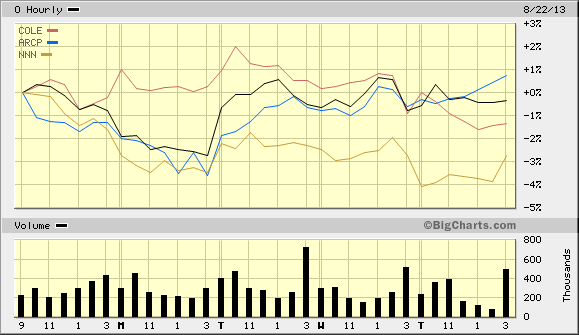
This is where I see triple-net REITs today.  Triple-net REITs are some of the most conservative and stable dividend payers you can find, which is why they became bond substitutes for millions of investors desperate for yield.  So, when bond yields started to rise in May, this sector got hit a lot harder than most.  Prices on some of the most popular triple-net REITs fell by as much as 20-30% from their 2013 highs…at a time when the broader market held up relatively well.

Take a look at the chart above, which includes four of the most popular triple net REITs.  Over the last five trading days, at a time when the 10-year Treasury has yield has continued to push higher—and now yields a few basis points away from 3%–Realty Income (O), Cole Properties (COLE) and American Realty Capital Properties (ARCP) are all flat.  National Retail Properties (NNN) is down slightly, but again, it has reacted far less dramatically than recent weeks.

Does this mean that the bottom is in?  Maybe, maybe not.  Markets are fickle, and there are no guarantees that investors won’t find a new reason to dump these.  Prices are attractive, however, and in my view it makes sense to start aggressively buying.  Each of these REITs pays a dividend in the 5-7% range and I expect all to aggressively raise their dividends in the years to come.

Disclosures: Sizemore Capital is long O, NNN, ARCP, COLE. This article first appeared on TraderPlanet.

Join the Sizemore Investment Letter – Premium Edition

Monetary Policy Week in Review – Aug 19-23, 2013: Jackson Hole suggests QE path for Fed, Turkey tightens

By www.CentralBankNews.info
    Last week three central banks (Thailand, Namibia and Iceland) held their rates steady while Turkey again raised its short-term lending rate to ease the pressure on its currency as investors have become increasingly jittery over next month’s possible reduction in asset purchases by the U.S. Federal Reserve.
    Emerging markets – especially Turkey, India and Brazil – continue to respond to an outflow of capital and currency depreciation through a combination of foreign exchange market  intervention, regulatory or macro prudential measures and interest rate hikes.
    An explanation of why investors have reacted with such force and determination to the Fed’s plan to slowly wind down quantitative easing (QE) came from papers delivered this week to the Jackson Hole Economic Symposium.
   The papers didn’t just dissect the recent and past volatility in global markets, they also made specific proposals on how the Fed should unwind its large-scale asset purchases (LSAPs), why central banks should strengthen their cooperation on exiting QE and how nations can limit some of the negative consequences of the global financial cycle.
   
    Due to uncertainty of how large-scale asset purchases precisely affect economic activity, the Fed has been deliberately vague in spelling out the conditions for increasing or decreasing asset purchases. This contrasts with the specific thresholds it has set for changing the fed funds rate.
    One of the distinguishing features of the Fed’s large-scale asset purchases (LSAPs) is that they focus on longer maturity assets in an attempt to keep those yields low. But yields on longer assets are much more sensitive to expectations than shorter assets, putting the onus on the Fed to control those expectations.
    The consequence of this deliberately vague and flexible stance is that investors have linked a gradual and measured tapering of these purchases – in itself a monetary stance that is looser than ever before – to the much more drastic step of raising the fed funds rate.
    “By being imprecise in the state-dependence of LSAP policy, the Fed has left it to investors to form expectations over the future of LSAPs,” according to a paper presented by Arvind Krishnamurthy and Annette Vissing-Jorgensen.
     “Investors only understand that LSAPs are a tool to be used when the zero-lower-bound is binding. Thus when the Fed communicates that it plans on not using LSAPs, investors assume that the zero-lower-bound will not be binding and that rate hikes will follow,” they wrote.
    Krishnamurhy and Vissing-Jorgensen also proposed a specific plan for how the Fed should exit QE.
    First, it should stop buying Treasury bonds and then sell its portfolio as this would have the least negative impact on economic activity. Secondly, the Fed should sell its higher-coupon, older mortgage backed securities and the final step is halting the purchases of current-coupon housing debt, the area where its asset purchases have had the largest economic impact.
    In his paper, Robert E. Hall was relatively optimistic about the prospects for economic recovery given that most of the factors that led the U.S. into the 2007-2009 crises were self-correcting and were finally improving. However, he also cautioned the Fed against contracting its policy too early and raising the rate its pays on its reserves. 

    Another important point to emerge from Jackson Hole was the Fed’s influence on the movement of global financial assets.
    In her paper, Helene Rey showed how global capital flows, asset prices, credit growth and financial leverage tend to move in sync with the VIX, a proxy for risk aversion in financial markets.
   Rey then looks at the factors that drive the VIX and the global financial cycle and finds that it’s mainly the Fed’s policy stance.
    In his paper, Jean-Pierre Landau touches on the same theme as Rey and finds that the flow of capital from investors’ portfolios has become much more volatile in recent years in comparison with banking flows and is now part of global liquidity.
   Portfolio flows are thus also driven by risk appetite – reflected in the VIX – rather than interest rate differentials. Another recent feature is the growth in funds that focus on emerging markets. This allows investors to easily arbitrage between advanced and emerging economies.
    The ultra-easy monetary policy in advanced economies in recent years means that risk appetite has become much more important in influencing the direction of global liquidity, amplifying the spillover of monetary policy from advanced to emerging markets.
   Landau acknowledges that portfolio flows may be much smaller than direct investment or banking flows, but importantly they represent the “marginal investor, the one that instantly determines the market equilibrium and its price, with huge impact in times of stress when market liquidity dries up.”
    The combination of daily fluctuations in the value of dedicated funds and their limited volume sets up the perfect conditions for runs by investors when risk perceptions shift, much as investors right now are repricing the risk of investing in emerging markets by demanding higher yields to compensate for likely currency losses in those countries faced with high current account deficits.

    Once again, the papers presented at the Jackson Hole symposium were highly relevant to current economic challenges, just like Michael Woodford’s paper last year heralded the popularity of forward guidance.
    If last year is any guide, there are three likely outcomes from this year’s symposium.
    First, the Fed is likely to become much more specific in its guidance around the tapering of asset purchases.
    Second, attempts to manage and control the free flow of capital across borders is likely to rise. Rey showed how the Fed’s policy is transmitted worldwide and she raises serious questions about the benefits countries have derived from the massive rise in cross-border investments.
    Third, central banks worldwide are likely to strengthen their cross-border cooperation in coming years to better internalize the global spillover of domestic monetary policy, especially from advanced economies.

LAST WEEK’S (WEEK 34) MONETARY POLICY DECISIONS:

COUNTRYMSCI    NEW RATE          OLD RATE       1 YEAR AGO
TURKEYEM4.50%4.50%5.75%
NAMIBIA5.50%5.50%5.50%
THAILANDEM2.50%2.50%3.00%
ICELAND6.00%6.00%5.75%

 This week (week 35) seven central banks are scheduled to hold policy meetings, including Israel, Hungary, Pakistan, Brazil, Moldova, Fiji and Angola.

COUNTRYMSCI             DATE              RATE       1 YEAR AGO
ISRAELDM26-Aug1.25%2.25%
HUNGARYEM27-Aug4.00%6.75%
PAKISTANFM27-Aug9.00%10.50%
BRAZILEM28-Aug7.50%8.50%
MOLDOVA29-Aug3.50%4.50%
FIJI29-Aug0.50%0.50%
ANGOLA30-Aug10.00%10.25%

    www.CentralBankNews.info

Elliott Wave Analysis: Tracking USD Long Set-Ups While EUR Is Below 1.3450 and USDCHF above 0.9145

EURUSD also now reversing from our »do or die« level placed at 1.3400, but still need a channel break and impulsive structure (five waves down) from above 1.3400 to make sure we are going lower.

EURUSD 1h Elliott Wave Analysis


For now we are sitting on our hands, no official trades, but we are watching USDCHF, EURUSD and AUDUSD very closely for possible USD long set-ups. But at the moment however, I think it’s too soon for trades, it’s still only Monday and also holiday in the UK, so I believe it’s better to wait on more price action and see it then if USD rally has already began or no, and then go with the flow.

Try EW-Forecast.com’s Services Free for 7 Days – http://www.ew-forecast.com


Euro Flat Amid Disappointing US Housing Data

By HY Markets Forex Blog

The euro started the trading week a little changed against the greenback during the early hours of the European session, as the currency advanced to $1.3880 from $1.3330 in the previous session when the disappointing US housing data dragged the US dollar lower. As of 6:52am GMT, the euro was selling at $1.3366 against the US dollar.

The euro rose to $1.3451, its highest level in over six months. The euro was assisted by the statement released by Bundesbank, which showed that the low rates that were set by the European Central Bank on Monday may not be guaranteed.

In the statement released by Bundesbank it statedThe actual key ECB interest rates will continue to depend on the medium-term outlook for inflation, which is based on expectations regarding future developments in the real economy and on credit and monetary aggregates.”

The ongoing speculation over the Federal Reserve tapering its quantitative easing program later this year, has been affecting the market, as investors focus on the next Fed meeting on September 17-18 for more clues.

The minutes from the previous Federal Open Market Committee (FOMC) gathering, indicated that the policymakers were at ease with the tapering of the bond-buying program by the end of year.

According to discussions that were held in July, Fed members were looking into presenting more specific details regarding the tapering of its $85 monthly bond-buying program, but decided to withdraw from doing so because of the possibility of stirring uncertainty about the policy’s aim.

Weak US Housing Data

The housing sector were disappointed by the biggest monthly fall in over three years. According to the housing data released, the realtors’ contracts closed in 13.4% on some of the new homes, summing up a total number of sold units to 394, 000, the US department of Commerce reported.

To find out more on our product offerings, visit www.hymarkets.com and start trading today with only $50!

The post Euro Flat Amid Disappointing US Housing Data appeared first on | HY Markets Official blog.

Article provided by HY Markets Forex Blog

Asian Stocks In Green On Weak US Housing Data

By HY Markets Forex Blog

Majority of the Asian stocks started the trading week in green for the second time in row, assisted by analysts’ predictions that the Fed may delay tapering its stimulus bond-buying program till December, after the release of the US housing data.

Sales of new houses in the US advanced 13.4% on an adjusted annual rate of 394,000 in July, while the other four regions showed declines, the released government data confirmed. The weak housing data released pushed commodity prices higher, as investors saw it as a indication that the Federal Reserve (Fed) is likely to postpone its tapering of its bond-buying program until December.

Asian Stocks – Japan’s Tax-Hike Worries

Japan’s benchmark Nikkei 225 index was seen at a low 13,636.28 points, declining 0.18%. The choppy trade occurred due to worries on whether Tokyo would proceed with increasing the consumption tax as predicted.

The Prime Minister Shinzo Abe discussed about the proposed tax rise on Monday, with a plan to increase sales tax from5% to 8% from April next year. The construction and real-estate shares rose with Sumitomo Realty & Development by 3.9%. The improvement in the housing market was assisted by the government stimulus and purchases before the expected consumption tax boost in April.

However, the Japanese yen was strengthened, hurting the country’s exporters. Out of the exporters that were affected are Mitsubishi Electric edged down 0.4%, the carmakers Suzuki Motors lost 1.9% and Konica Minolta fell 3.3% as the US dollar still remained under the ¥99-threshold.

Tokyo’s broader gauge, the Topix index fell 0.23% to 1,139.06.


Majority of the stocks in the trading session in China were seen in green, with Hong Kong’s Hang Seng edged up 0.66% to 22,007.30 points, while China’s mainland Shanghai Composite rose1.45% to 2,087.29 points. Shares of China Construction Bank in Hong Kong rose 1.2%, while in Shanghai edged up 0.9%, after the bank posted an increase of 13% in its first-half profit.


Interested in trading Asian Stocks Online?

Visit www.hymarkets.com and start trading with the award-winning broker today with only $50 and receive a 20% bonus on your deposits until September.


The post Asian Stocks In Green On Weak US Housing Data appeared first on | HY Markets Official blog.

Article provided by HY Markets Forex Blog