Why America May Be Fabricating Its Jobs Numbers

By for Investment Contrarians

Fabricating Its Jobs NumbersMany accuse China of manipulating its economic data to fit what the market wants to see, yet this kind of behavior doesn’t appear to be isolated to China. It even occurs here—if you believe what the New York Post reported in a recent editorial. If it were true, to be honest, I wouldn’t be that surprised.

According to the article, there are allegations that the Census Bureau fabricated jobs market data reflected in the non-farm payrolls reading in 2010 and that this continues to occur. (CNBC, “Faked data may have boosted 2012 job reports: NY Post,” CNBC web site, November 19, 2013.)

But whether there may or may not be manipulated data within the monthly jobs market reading, I’m not here to determine that. All I can say on the matter is that how the jobs market data is reported and what is reported has always been suspect to me.

The government tells us there are about 11.3 million Americans unemployed in the jobs market, representing an unemployment rate of 7.3% in October. Now think about it; what does the reference “unemployed” really mean? The government seems to let you think it implies the number of individuals looking for work in the jobs market—but that’s not the case.

There are millions of workers not included in the unemployed numbers because they have dropped out of the workforce or have given up looking for work four weeks prior to the report. The problem is these people should still be considered unemployed regardless of the criteria used by the U.S. Department of Labor. But we all know that the number of unemployed in the jobs market is probably in excess of 20 million workers—and even more if you count those who are underemployed or working part-time because they cannot find full-time work.

While you may not think it’s an issue, the rise in the unemployed in the jobs market and the widening disparity in income levels between the bottom and top earners is a real problem that will eventually boil over. It’s not good for the country, and it could wreak havoc down the road should the problem continue.

A major issue is the group of workers classified as “long-term unemployed.” These are generally the workers who have been pounding the pavement and sending out hundreds or even thousands of resumes only to face continued rejection. Just consider the study by the Federal Reserve Bank of San Francisco, which noted that those who have been unemployed for at least six months have a 10% chance of landing a new job each month versus a 20%–30% probability for the newly unemployed. (Source: Lowrey, A., “Caught in unemployment’s revolving door,” New York Times, November 17, 2013.)

Folks, there’s a jobs market crisis out there. Don’t fall for the 7.3% unemployment rate reported. The underlying number should be in the double digits, like what we’re seeing in the eurozone. If the jobs market was healthy, we would see stronger corporate revenue growth, but we’re not. This is a red flag that indicates corporations are stalling, which suggests an overblown stock market. Given this, I would suggest investors take some profits off the table and/or have put options in place. The reality is that if it wasn’t for the Fed’s easy money, the stock market rally would not have been as strong.

Massaging the reported numbers may make them look better on the surface, but we all know that the jobs market situation is much worse than reported.


Original: www.investmentcontrarians.com/recession/why-america-may-be-fabricating-its-jobs-numbers/3327/


This Sector the Only Bright Spot in October Retail Sales

By for Daily Gains Letter

October Retail SalesOctober U.S. retail sector sales numbers are in, but are they worth getting excited about?

The Census Bureau announced on Wednesday that October retail sector sales increased 0.4% month-over-month and 3.9% year-over-year to $428.1 billion. From a shorter-term perspective, the 0.4% increase really isn’t anything to get excited about; that 3.9% year-over-year increase, though, looks pretty good. (Source: “Advance Monthly Sales for Retail and Food Services October 2013,” U.S. Census Bureau web site, November 20, 2013.)

Or does it? Take a step back, and you can see we’ve been in a downtrend for the last few years.

In October 2010, U.S. retail sector sales were up 6.9% month-over-month. This isn’t a big surprise when you consider the so-called economic recovery only began in mid-2009. In October 2011, U.S. retail sector sales were up 7.6% year-over-year, another strong gain on the back of ongoing optimism that the economy would rebound. (Source: “Retail and Food Services Sales,” Federal Reserve Bank of St. Louis Economic Research web site, November 20, 2013.)

But then we realized the economic recovery wasn’t much of a recovery at all. In 2012, October retail sector sales were up just 4.4%, almost half the gain of the previous year, and in October 2013, U.S. retail sector sales were up just 3.9%. Looking at it from a longer-term perspective, even the recent October year-over-year numbers aren’t anything to get worked up about.

Today, we’re more than 50 months and $3.0-plus trillion into the Federal Reserve-guided recovery, and we really don’t have much to show for it. In fact, you could argue that the economy might have done better without any intervention from the Federal Reserve—it certainly couldn’t look much worse.

Sadly, the October U.S. retail sector sales figures are a little skewed. They include automotive sales, which can account for about 20% of retail sector sales. They also include building supplies and gas, which tend to be volatile and can distort the underlying trend; for example, the bulk of third-quarter gains were driven by dealers of autos and other motor vehicles, which posted an impressive 11.9% year-over-year gain.

As a result, the core U.S. retail sector sales are considered to be a better gauge of spending trends—and that gauge is almost running on empty. Core U.S. retail sector sales increased just 0.2% month-over-month, topping weak projections of just 0.1%.

Yes, auto sales are up, but so, too, is auto loan debt. In fact, U.S. auto loan debt is currently sitting at $845 billion, the highest level since the Federal Reserve starting keeping track of car loans in 1999. (Source “Quarterly Report on Household Debt and Credit,” Federal Reserve Bank of New York web site, November 2013.)

But it’s not all doom and gloom; U.S. car buyers are, for the most part, paying their loans off. The share of vehicle loans more than three months past due slipped to 3.4% in the third quarter. Mortgage delinquencies, on the other hand, stand at 4.3%, while student loans are at a detention-setting 11.8%.

When it comes to U.S. retail sector sales, the automotive industry might be one of the bright spots as we head into 2014. Two affordable automotive stocks for small investors to consider are Ford Motor Company (NYSE/F) and auto parts store The Pep Boys Manny, Moe & Jack (NYSE/PBY). At the other end of the scale, two major automotive stocks include Toyota Motor Corporation (NYSE/TM) and auto parts store OReilly Automotive, Inc. (NASDAQ/ORLY).

If you’re looking for the underlying horsepower driving U.S. economic growth right now, you can’t help but thank the auto industry.


http://www.dailygainsletter.com/stock-market/this-sector-the-only-bright-spot-in-october-retail-sales/2131/


Wal-Mart Asking Employees to Donate Food to Fellow Employees in Need?

By for Daily Gains Letter

Wal-Mart Asking Employees to Donate FoodThe recent rise on the key stock indices might just be masking a fundamentally flawed economic recovery. Since the beginning of the year, the S&P 500 has gained 25%, the Dow Jones Industrial Average is up 21%, and the NASDAQ is 27% higher. At the same time, unemployment remains high, wages are stagnant, and our day-to-day life costs more.

With the S&P 500 on pace for the best yearly gain in a decade, well-heeled shareholders are rejoicing—at the other end of the scale, many employees aren’t.

You know it’s a touchy economic climate when Wal-Mart Stores, Inc. (NYSE/WMT), the world’s biggest retailer, which reported third-quarter profits of $3.7 billion, is asking employees to donate food to fellow associates in need, so they can enjoy Thanksgiving this year.

A weak economy and stiff competition is taking a toll on Wal-Mart. While Wal-Mart reported third-quarter earnings that beat Wall Street estimates by a mere penny, revenues of $114.9 billion were shy of the $116.8-billion mark Wall Street was hoping for. Not surprisingly, perhaps, Wal-Mart said holiday sales would be flat. (Source: “Walmart reports Q3 EPS of $1.14, updates full year guidance; Aggressive holiday plans to drive sales,” Wal-Mart Stores, Inc. web site, last accessed November 14, 2013.)

In light of Wal-Mart’s recent employee Thanksgiving food drive, it’s interesting to note that third-quarter sales from Neighborhood Market, Wal-Mart’s chain of grocery stores, rose a solid 3.4%.

Where other grocery store chains have reported underwhelming third-quarter results, Wal-Mart’s grocery chain actually bucked the trend. Fourth-quarter results may be muted. Thanks to a U.S. economy that continues to look fragile, grocery store stocks are competing this Thanksgiving and in the subsequent holiday season by actually lowering their prices.

Aside from wanting a better marketing edge, retailers and grocers are lowering their prices because wholesales prices unexpended slipped in September with falling food costs, suggesting that inflation, a barometer of growth, remains weak. The 0.1% decrease in the producer price index in September comes on the heels of gains of 0.3% in August, 0.8% in June, and 0.5% in May. (Source: “Producer Price Indexes – September 2013,” Bureau of Labor Statistics, October 29, 2013.)

Lower prices don’t necessarily mean lower profits. After all, discount stores like Wal-Mart make their money by offering products at more competitive prices. But Wal-Mart aside, there are a large number of grocery store stocks and food retailers out there that could be bargains for both consumers and investors.

The Kroger Co.’s (NYSE/KR) share price is up 61% year-to-date and provides a 1.5% dividend yield. On September 12, Kroger reported record second-quarter net earnings of $317 million, or $0.60 per share; total sales increased 4.6% year-over-year to $22.7 billion. (Source: “Kroger Reports Record Second Quarter Results,” The Kroger Co. web site, September 12, 2013.)

The share price of Caseys General Stores, Inc. (NASDAQ/CASY) is up 39% year-to-date. The company recently reported record sales for the first quarter of fiscal 2014, with strong gas and inside sales. In 2014, the company expects to replace 20 existing stores and to add to its 1,750 locations by building or acquiring 70–105 stores. The company also provides an annual one-percent dividend. (Source: “Casey’s Reports Record Quarter with Strong Gas and Inside Sales,” Caseys General Stores, Inc., September 9, 2013.)

Both of these grocery store stocks have already experienced solid gains this year.


http://www.dailygainsletter.com/stock-market/wal-mart-asking-employees-to-donate-food-to-fellow-employees-in-need/2126/


How Investors Are Profiting as the Eurozone Crisis Makes a Comeback

By for Daily Gains Letter

Investors Are Profiting as the Eurozone CrisisMajor economic hubs in the global economy are in outright trouble, and each passing day there’s more economic data suggesting the slowdown is holding its own. Investors need to be wary about what’s happening, because it can affect their portfolio significantly.

The eurozone crisis, which sent ripple effects into the global economy, is rising again. In the early days of the eurozone crisis, we heard how the economies of such nations like Greece, Spain, and Portugal were suffering. Now, the bigger nations in the euro region are showing signs of stress. Consider France, the second-biggest economy in the eurozone, for example. This major economic hub in the global economy witnessed contraction in the third quarter. On top of this, France’s unemployment rate continues to increase.

Germany, the biggest economy in the eurozone and the fourth-biggest economic hub in the global economy, slowed in the third quarter. The gross domestic product (GDP) of the country increased just 0.3% in the third quarter. In the second quarter, Germany’s GDP increased by 0.7%. (Source: “Gross domestic product up 0.3% in 3rd quarter of 2013,” Destatis, November 14, 2013.)

Similarly, Japan, the third-biggest nation in the global economy, continues to struggle, despite the extraordinary measures the central bank and Japanese government have taken to boost the economy. In the third quarter, the growth rate of the Japanese economy slowed down. The GDP grew 0.5% from the previous quarter. The annual GDP growth rate of the Japanese economy was 1.9% in the third quarter. (Source: “Gross Domestic Product: Third Quarter 2013,” Cabinet Office, Government of Japan web site, November 14, 2013.)

Adding more to the misery of the global economy, we have the U.S. economy and the Chinese economy, the two biggest economic hubs in the global economy, struggling to find growth.

The Chinese economy is slowing at a very dramatic pace. This year, China’s GDP growth will be much slower than its historical average. Likewise, the U.S. economy, the largest in the global economy, remains far from any economic growth. The GDP growth is embarrassing for the amount of money that has been printed, and key issues like unemployment and a weak housing market still remain.

Looking at all this, one question comes to mind: how can one profit from a situation in which the global economy is witnessing an economic slowdown?

If the slowdown in the global economy strengthens, then companies on key stock indices will see their earnings decline—and their stock prices will reflect this. In this situation, investors may be able to short stocks and profit.

Another way investors can profit is through exchange-traded funds (ETFs) like ProShares UltraShort DJ-UBS Crude Oil (NYSEArca/SCO). At the very core, this ETF provides investors with exposure to oil prices—when the price of oil declines by one percent, this ETF increases by two percent.

The reasoning behind this investment strategy is that as the global economy slows down, the demand for oil will slow, too. This will cause less demand for crude oil, therefore leading to lower prices.


Fibonacci Retracements Analysis 22.11.2013 (EUR/USD, USD/CHF)

Article By RoboForex.com

Analysis for November 22nd, 2013

EUR/USD

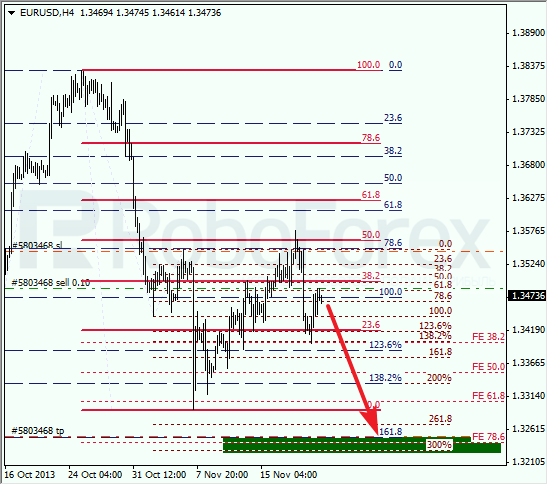
After rebounding from local correctional level of 50%, Euro started falling down again. so far, bears slowed down a little bit, but they are expected to start new descending movement very soon. Target is still in lower area, where there are several fibo-levels.

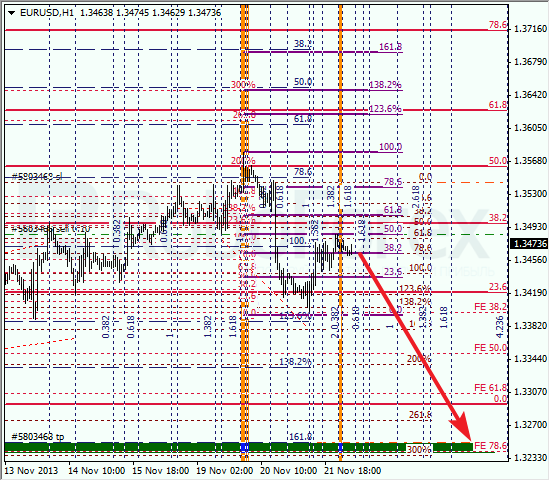
As we can see at H1 chart, local correction reached level of 50% and right now is trying to rebound from it. In addition to that, here we can see that pair is rebounding from temporary fibo-zone, thus increasing chances for reverse. Possibly, bears may return to the market during the day.

USD/CHF

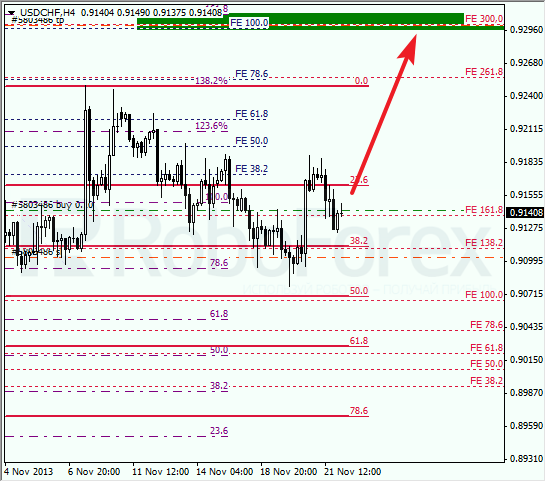
Franc was able to rebound from level of 38.2% and right now is starting new ascending movement. I have only one buy order so far, but plan to increase my long position after completion of local correction. Target is in upper area, where we can see several fibo-levels.

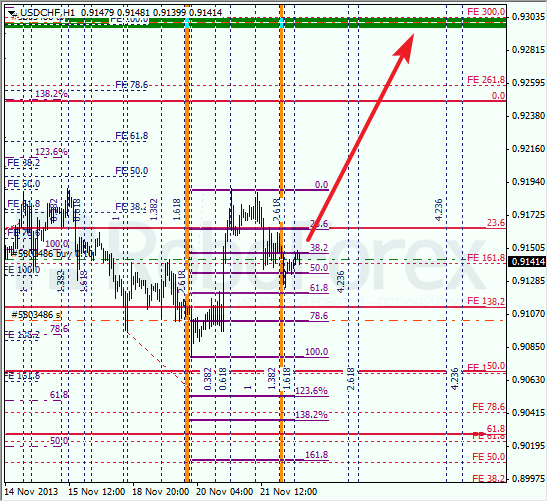
At H1 chart, we can see that current correction almost reached local level of 61.8%. Pair rebounded from this level almost inside temporary fibo-zone, which means that price may start new ascending movement.

RoboForex Analytical Department

Attention!
Forecasts presented in this section only reflect the author’s private opinion and should not be considered as guidance for trading. RoboForex LP bears no responsibility for trading results based on trading recommendations described in these analytical reviews.

Article By RoboForex.com


Forex Technical Analysis 22.11.2013 (EUR/USD, GBP/USD, USD/CHF, USD/JPY, AUD/USD, GOLD)

Article By RoboForex.com

Analysis for November 22nd, 2013

EUR/USD

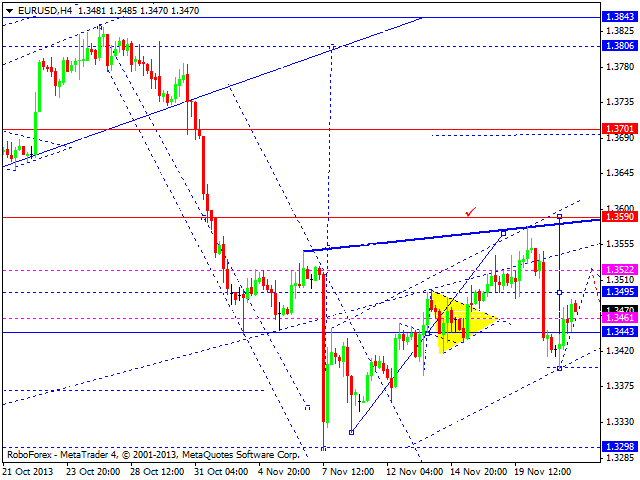
Euro is forming the first ascending structure of the fifth wave with target at 1.3590. We think, today price may form continuation pattern by reaching 1.3520 and then consolidating near 1.3495. Later, in our opinion, pair may leave this consolidation channel upwards to reach above-mentioned target.

GBP/USD

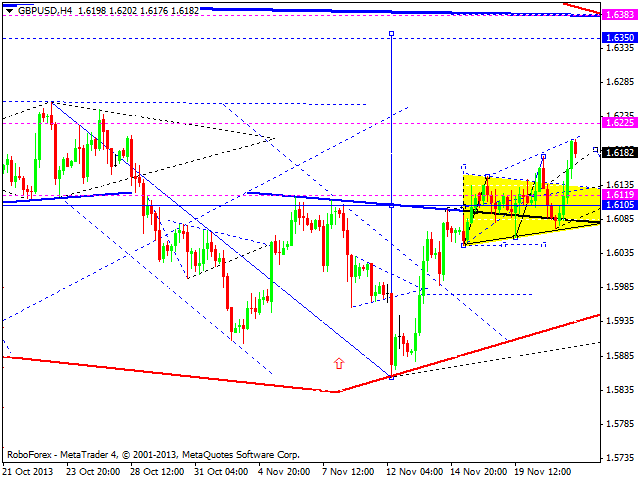
Pound continues moving upwards; market has formed central part of continuation pattern. We think, today price may fall down towards 1.6120 and then start growing up to reach 1.6350 (at least). Later, in our opinion, pair may form new descending correction to return to 1.6120.

USD/CHF

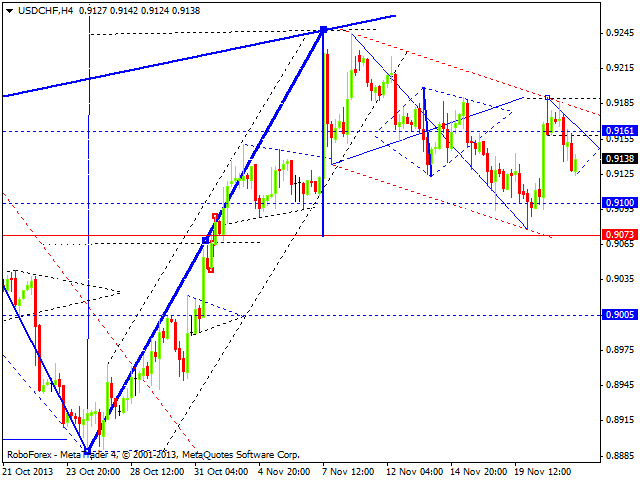
Franc is still moving downwards; market is forming the fifth descending wave with target at 0.9070. We think, today price may return to 0.9160 and then start another descending movement to form continuation pattern near 0.9130.

USD/JPY

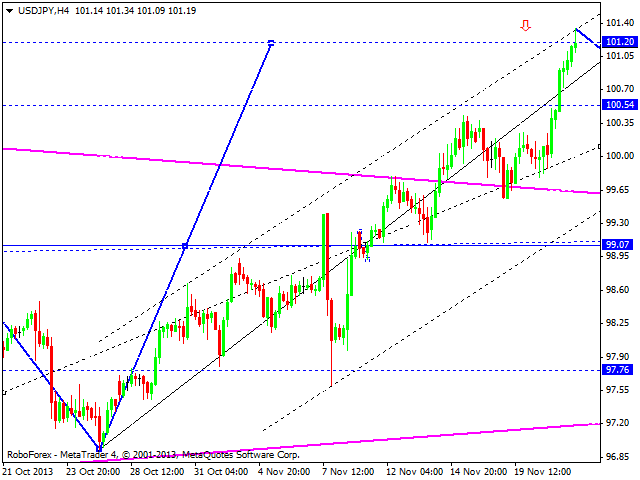
Yen extended its structure, which may be considered as the third wave; market is expected to form the fifth wave of this correction with target at 101.60. We think, today price may start correction to return to 99.10 and form the first wave of this correction with target at 100.20.

AUD/USD

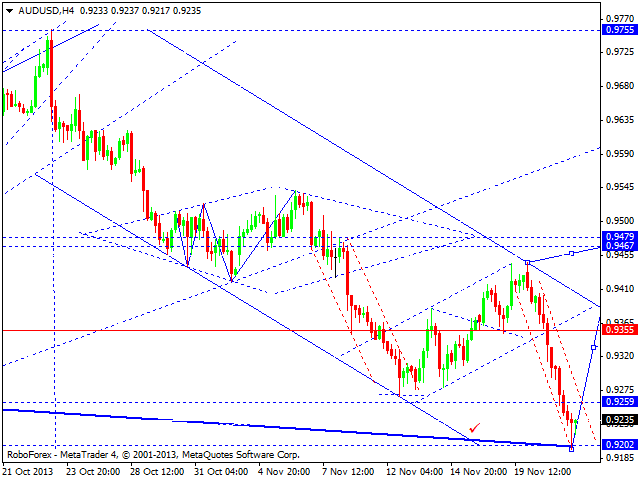
Australian Dollar finished its descending correction. We think, today price may start forming new wave return to 0.9470. This structure may help to define future scenario. Pair is expected to form the first structure of this wave with target at 0.9330.

GOLD

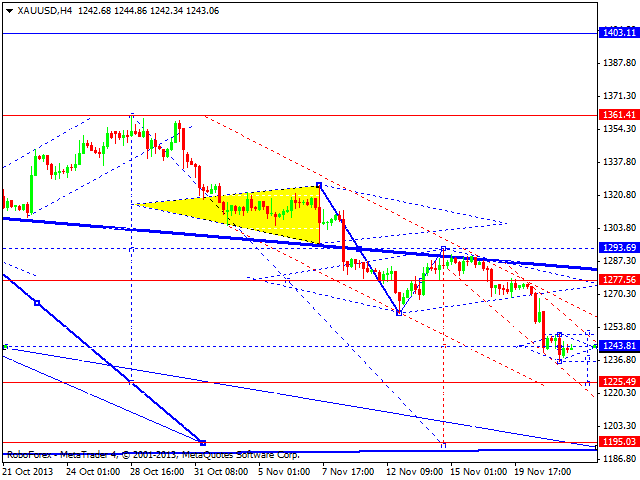
Gold is still moving downwards with target at 1195; right now, market is consolidating near 1240. We think, today price may continue falling down towards target at 1225, consolidate for a while, and then move downwards again to complete this descending wave. Alternative scenario implies that instrument may start correction towards upper border of this consolidation channel and then continue falling down.

RoboForex Analytical Department

Attention!
Forecasts presented in this section only reflect the author’s private opinion and should not be considered as guidance for trading. RoboForex LP bears no responsibility for trading results based on trading recommendations described in these analytical reviews.

Article By RoboForex.com


Friday Charts: Market Timing, Fool’s Gold and the Mobile Mantra

By WallStreetDaily.com

Words mean little on Fridays in the Wall Street Daily Nation.

Instead, we let pretty pictures do most of the talking for us. Each week, I select a handful of graphics specifically designed for you to beat the market next week.

Call them “cheat codes,” if you will.

It’s time for me to shut up now…

Cheat Code #1: Market Time This!

Although the S&P 500 Index is up almost 30% year-to-date, it’s suffering from a bad case of the Mondays.

Stocks are averaging a decline of 0.11% on Mondays, compared to gains every other day of the week, according to the number crunchers at Bespoke Investment Group.

The key takeaway?

If you’re looking to put new money to work, do it on Monday when there’s blood in the streets. By Tuesday, you should be sitting on profits.

Cheat Code #2: The Mobile Mantra

Repeat after me, “It’s all about mobile. It’s all about mobile. It’s all about mobile!”

And here’s the latest proof…

For the first time in recorded history, smartphone and tablet revenue will exceed revenue for the entire consumer electronics market, according to the Application Market Forecast Tool from IHS Inc. (IHS).

Mind you, only a year ago, the consumer electronics market was 30% larger than the mobile market.

As Randy Lawson, Senior Principal Analyst for Semiconductors at IHS, says, “Consumers simply are finding more value in the versatility and usefulness of smartphones and tablets, which now serve as the go-to devices for everything.”

The implication is about as subtle as a punch in the kisser…

If you don’t overweight your portfolio with the best and fastest-growing mobile companies, you’ll never live it down.

Because where there’s value for the consumer, there’s value for the investor.

Cheat Code #3: No Need for Gold

Unless you’re like Mr. T and can never own enough gold necklaces, I wouldn’t be buying gold right now.

Why? Because the No. 1 investment reason to own gold – inflation protection – is totally irrelevant.

Consumer price inflation fell to a measly 1% in October on a year-over-year basis.

Excluding the financial crisis, that’s the lowest year-over-year CPI reading since 1965, according to interest rate strategist, Vincent Foster.

So the already horrible year for gold could get even worse.

That’s it for this week. Before you go, though, let us know what you think of this weekly column – or any of our recent work at Wall Street Daily – by going here.

Ahead of the tape,

Louis Basenese

The post Friday Charts: Market Timing, Fool’s Gold and the Mobile Mantra appeared first on Wall Street Daily.

Article By WallStreetDaily.com

Original Article: Friday Charts: Market Timing, Fool’s Gold and the Mobile Mantra

Recent surge in USD/JPY illustrates importance of central bank stimulus

By HY Markets Forex Blog

The surge that happened in the value of the U.S. dollar relative to the Japanese yen on Nov. 21 illustrates the importance of the policy decisions made by the central banks of these two nations.

The movement of the two currencies – and the fact that it was attributed by several market experts as being caused by the announcements of the central banks of both the Asian nation and the United States – could provide those who trade forex with helpful information.

Individuals who want to take part in such activities can utilize this knowledge and combine it with the announcements that these financial institutions make further down the line to produce educated predictions of where the currencies of the two nations will go.

USD/JPY rises to four-month high
The importance of such announcements was illustrated by the upward movement that the USD/JPY experienced on Nov. 21, after the Bank of Japan indicated that it plans to harness a monetary policy that is very loose for some time, according to Bloomberg. The greenback rose to as much as 101.11 yen. This figure represented the highest value for the USD/JPY since July 10.

This financial institution announced that it will not make any changes to its current stimulus plans after holding a meeting that lasted for two days, CNBC reported. Ed Rogers, chief executive officer of Rogers Investment Advisors, told the media outlet that this outcome was in-line with the expectations of many. Analysts had predicted that the Asian nation's central bank would not change its plans.

"The BOJ meeting – no surprises there and no surprises were expected," Rogers told the news source. "We think the policy makers feel very comfortable right now and are very confident. We think we will see more accommodative policy if needed but don't expect any dramatic changes any time soon." 

Fed minutes boost dollar
While the yen received downward pressure from the announcement made by Japan's central bank, the minutes provided for the most recent Federal Reserve policy meeting helped to push the dollar higher, according to Reuters. These minutes indicated that if the economy is strong enough to justify doing so, the Fed could potentially begin reducing its quantitative easing from its current level of $85 billion per month.

"The Fed minutes did help the dollar a lot, especially against the yen, as it puts a December taper back onto the table," Vassili Serebriakov, who works in New York as a currency strategist for BNP Paribas, told the news source.

Lowering the amount of bonds that the central bank buys every month could help provide upward pressure for the greenback by helping to slow down the current expansion of the money supply. The Fed has increased its balance sheet to more than $3 trillion with bond purchases, and some have voiced their concerns that such stimulus could be inflationary because of putting so much money in people's hands.

Individuals who want to make money by trading currency pairs such as the USD/JPY might benefit from knowing about how the greenback can potentially be affected by the money supply and also QE.

Michael Woolfolk, who works as a global-markets strategist at Bank of New York Mellon, told Bloomberg how the recent decisions made by both the BOJ and the Fed could impact the currencies of the two nations.

"The Federal Open Market Committee minutes yesterday have opened the door for December tapering again, and you're seeing some dollar support," Woolfolk told the media outlet. "On the other hand in Japan, there seems no end in sight for their monetary easing."

BOJ has maintained current stimulus for months
The market expert's statement about the BOJ keeping its stimulus unchanged for some time is certainly not unwarranted, as the financial institution has kept this policy static for nine meetings since April, according to The Financial Times.

In addition, Haruhiko Kuroda, who is the governor of the BOJ, emphasized that the financial institution could potentially increase its current stimulus, the media outlet reported. The central bank "has room to act against upside and downside risks," he told the news source.

Another factor that could serve to push the value of the USD/JPY higher is the difference between the yields of the nation's government bonds, according to Bloomberg. On Nov. 20, the difference between the yields in 10-year U.S. Treasuries and similar securities provided by the government of Japan surged to 2.19. This figure represented the largest difference since Sept. 12.

"The yield differential is a key driver of dollar-yen," Brian Daingerfield, who works for Royal Bank of Scotland Group Plc's RBS Securities unit in Stamford, Conn.ecticut, told the media outlet. "The dollar, reacting positively towards the possibility of an earlier taper and yields moving higher, are pushing dollar-yen higher."

Individuals who want to trade forex might benefit from knowing about the role that the yield differential plays in the value of the USD/JPY.

The post Recent surge in USD/JPY illustrates importance of central bank stimulus appeared first on | HY Markets Official blog.

Article provided by HY Markets Forex Blog

USDCAD breaks above 1.0525 resistance

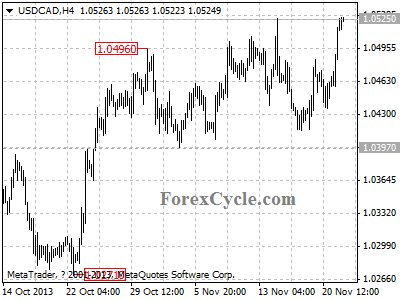
USDCAD breaks above 1.0525 resistance, suggesting that the uptrend from 1.0182 (Sep 19 low) has resumed. Support is now at 1.0470, as long as this level holds, the uptrend could be expected to continue, and next target would be at 1.0600 area. On the downside, a breakdown below 1.0470 support will indicate that lengthier consolidation of the uptrend is underway, then deeper decline to test 1.0397 key support could be seen to follow.

usdcad

Provided by ForexCycle.com

Why There’s Still Opportunity in the Resource Sector

By MoneyMorning.com.au

Here’s a headline that should send shivers down the collective spine of the Aussie resources industry:

Goldman Sees at Least 15% Losses for Gold, Iron Ore

So says Bloomberg, reporting on the Goldman Sachs commodity outlook for 2014. It takes a brave investor to bet against Goldman Sachs.

For resource companies, a bearish commodities report from Goldman Sachs is like bumping into the Grim Reaper in a dark alley.

So, what does this mean for commodities and commodity stocks next year? It may surprise. It means one word: opportunity. But it won’t be for everyone…

There’s an old saying that investors shouldn’t bet against central banks because they can last longer in the market than you.

Those investors who tried to short sell the market over the past few years have learned that lesson to their cost. Just when it seemed as though the market was about to collapse, the central bank cavalry came to the rescue.

We expect that to continue for a long time to come as they try to manipulate stock prices gradually higher.

So if you shouldn’t bet against central banks, the same goes for betting against Goldman Sachs. In short, if you think you’ve got a lot of money to bet on the market, just know that Goldman Sachs has way more…way more.

The trick is not to bet against them but rather to anticipate their next move.

Expect a Knee-Jerk Sell-Off

According to the report in Bloomberg, Goldman Sachs is bearish on a whole bunch of commodities: gold, iron ore, copper and corn.

Of most interest, Goldman sees gold falling to US$1,050 – about US$200 below today’s price. And it figures iron ore will fall to US$108 per tonne next year, from around US$135 today.

The natural reaction to this will be for investors to sell commodity stocks.

It’s almost certain that will happen. You can bet that Goldman Sachs will help anyone who wants to sell.

But while it may be the natural reaction, that doesn’t necessarily make it the right reaction. What do we mean by that?

Well, as we’ve explained before, a lower commodity price isn’t always bad news for commodities stocks. For a producer it naturally depends; they need to cut fixed and variable production costs in order to maintain a profit margin on the lower priced commodity.

Another reason is that many resources companies forward sell their product or hedge their selling price. Locking in a forward rate contract means the producer locks in a price for the commodity today even though they may not deliver the commodity for another 12 months.

In that case a short-term price fall doesn’t matter so much.

This is what we mean when we say it will create an opportunity…

Will All Mining Stop?

Let’s be blunt about this.

Unless you think all building will stop, there will still be demand for iron ore.

Unless you think the electronics industry will grind to a halt, there will still be demand for copper.

Unless you think no one will ever again want to wear jewellery, there will still be demand for gold.

And unless you think the entire population of the world will starve to death, there will still be demand for corn.

In other words, these commodities don’t appear from nowhere. They require exploration, extraction, and production into finished goods. There’s only so far an industry can go by relying on scrap material. That means companies will still need to find a resource and dig the stuff from the ground.

Those companies are obviously resource plays. Providing companies can continue to produce these goods with a decent profit margin, they’re likely to still attract investor interest.

But you shouldn’t think it’s just profitable producers that will do well. There’s one other thing to remember. Regardless of the underlying commodity price, if an explorer stumbles across a huge potential resource, the share price will still shoot higher regardless of the overall market.

Putting Resource Stocks Back in Our Arsenal

This is why we see the Goldman Sachs’ commodity report as an opportunity rather than a threat.

We’ve recommended very few resource stocks over the past 18 months. The simple reason was our research and analysis suggested there were better opportunities elsewhere in terms of risk and reward.

That’s why we focused most of our time on dividend paying stocks and technology stocks. But after a terrible two years for the resource sector we recently added resource stocks back to our investing arsenal.

As we said at the top, this won’t be for everyone. Even though resource stocks have taken a pounding over the past two years, there’s still a chance these stocks could fall further.

That’s where speculators have a chance to start building an exposure to this sector as other investors finally give up after years of pain.

Giving up on resource stocks now is a mistake. By the same token, it’s a mistake to think you can invest in any old resource stock and do well. It’s a buyer’s market right now, but you’ve got to be selective with the stocks you buy.

Cheers,
Kris+

Special Report: The ‘Wonder Weld’ That Could Triple Your Money

Join Money Morning on Google+


By MoneyMorning.com.au