How My Friend’s New Cadillac Suggests Stock Market Vulnerability in 2014

By George Leong, B.Comm.

Never mind the record breaks on Monday. The bulls are screaming “higher.” Dow 20,000, S&P 500 2,000, here we come. Wall Street is giddily raking up profits. There’s going to be some happy Wall Street workers when the year-end bonuses are announced.

One of my friends works at a major brokerage, and he just bought himself a brand new Cadillac “Escalade,” complete with the 22-inch wheels and every conceivable option. As my friend said, it was that kind of year when everything was going higher and the flow of capital into his accounts grew exponentially as his clients wanted big gains. The higher the stock market advance, the more money flowed into his accounts as clients chased returns.

Heck, he couldn’t even sell bonds as even his more conservative clients wanted more of the stock market action, rotating funds away from bonds and into equities.

The reality is that what’s happening at my friend’s brokerage is occurring everywhere. Not only with full-service brokers, but with DIY online discount trading accounts, too, which is why we have seen some big gains with the likes of The Charles Schwab Corporation (NYSE/SCHW), up 88% over 52 weeks, and E*TRADE Financial Corporation (NASDAQ/ETFC), up 118%.

And based on all the bullish investor sentiment, it looks as though, regardless of the rapid rise in the markets and valuations, investors still want to chase gains higher. My broker friend confirms this, as he noted that despite the amazing advance so far this year, money continues to flow in.

When I begin to hear that everyone is chasing the stock market higher, including the more conservative investors, alarms begin to ring in my ears. I heard the same thing in late 1999, prior to the Internet implosion in early 2000—these are the same bells that I’m hearing now.

Of course, the stock market could head higher prior to a stock market correction. Bond yields are relatively low compared to what we saw in 1999, so the alternative is not there now.

How high the stock market will rise is unclear, but the Federal Reserve’s apparent strategy to continue its easy money and low interest rates will help support the stock market.

I’m not going to say jump off. It may be the wrong call. Imagine those who were told to divest holdings at the end of 2012? They would have missed out on one of the best years for the stock market, so I really don’t want to be telling you to run for the exits now. What I will say is to walk slowly toward the exits. Take some profits off the table and cut some of your losing positions prior to year-end, as I still sense there is a stock market adjustment on the horizon. (Read “Nomura calls for 50% Correction in Global Stock Markets.”) You’ll also want to make sure you have some put options in place as a hedge.

This article How My Friend’s New Cadillac Suggests Stock Market Vulnerability in 2014 is originally publish at Profitconfidential


Why This Food Processor’s Numbers Are a Good Indicator for 2014

By Mitchell Clark, B.Comm.

There are records being set everywhere, but where it counts—the financial results from corporations. However, there are some exceptions to this trend.

Tyson Foods, Inc. (TSN) is one of the biggest processors and sellers of meat and countless prepared food products sold in more than 90 countries. John W. Tyson founded the company in 1935 by hauling chickens to market in Kansas City and St. Louis.

Tyson’s total sales last year were $33.0 billion, with the sale of beef products representing 41% of total revenues, followed by chicken at 35%, pork at 14%, and sales in prepared foods at 10%.

Tyson’s most recent quarter (fourth fiscal quarter of 2013), turned out to be a record in terms of sales and earnings per share. The company beat its own expectations for fiscal 2013, handily beating its previous outlook for international sales; operating margins, especially for chicken and beef, also grew substantially. This contributed to a marked improvement in bottom-line earnings and adjusted earnings per share attributable to the company.

Management reported increased demand as well as higher prices in the most recent quarter. Input costs for fiscal 2014 are expected to drop due to higher grain supplies. The company continues to buy back shares, and it recently increased its quarterly dividend by a substantial 50%.

The numbers were exactly what Wall Street wanted to hear. The stock is up approximately 50% since the beginning of the year and has actually broken out of a long consolidation, which is a bullish signal. The company’s long-term stock chart is featured below:

Chart courtesy of www.StockCharts.com

The company’s fiscal fourth-quarter revenues grew seven percent to a record $8.9 billion, while earnings per share grew 37% to $0.70.

The company’s share price had been in the doldrums for years, and its huge quarterly dividend increase represents a renewed sense of confidence from management.

I think this stock has more upside near-term; $35.00 per share wouldn’t be an unreasonable 12-month price target. The stock isn’t expensively priced, and company management says it plans to beat its expected 10% gain in earnings next year.

Investors may not have a lot of enthusiasm for a company like this, and there are certainly higher dividend paying stocks available in the marketplace. However, Tyson is a good benchmark stock on consumer spending and consumption in the U.S. market, with one in every five pounds of chicken, beef, and pork in the U.S. being produced by Tyson.

All in all, it was a record quarter for the company and expectations going into 2014 are solid. With a 50% quarterly dividend increase, Tyson’s financial performance is a good indicator of consumer spending and consumption, making it the type of stock investors should watch going into the New Year.

This article Why This Food Processor’s Numbers Are a Good Indicator for 2014 is originally publish at Profitconfidential


Economic Recovery Doubtful as New Survey Shows Downturn in Manufacturing

By for Investment Contrarians

Economic Recovery DoubtfulAfter so many years following the Great Recession, it’s still quite astounding that job creation remains so slow. This obviously indicates the lack of economic growth, even after trillions of dollars have been pumped into the U.S. economy.

While there has been a lot of optimistic talk in the mainstream media, there have been an increasing number of data points indicating America’s economic growth is still very fragile.

Recently, the Federal Reserve Bank of New York released the results of its November 2013 “Empire State Manufacturing Survey,” and they didn’t support the economic growth theory.

This report is an indication of the state of manufacturing in New York. The net result is that overall business conditions fell to their first negative reading since May. New orders also fell 13 points into negative territory at -5.5. Labor conditions worsened, indicating a decline in the average number of hours worked per week. (Source: “Empire State Manufacturing Survey,” Federal Reserve Bank of New York web site, November 15, 2013.)

It’s no wonder that job creation is still lagging: the manufacturing industry is still experiencing a lack of economic growth. In fact, these results indicate that manufacturing is beginning to weaken once again.

We can’t have economic growth if large sectors of the U.S. economy are experiencing a decline in business activity.

On top of the decline in manufacturing, the level of prices paid is beginning to increase to a level above what firms are able to charge clients.

In 2013, prices paid by manufacturing firms increased 3.4% on average, and they are expected to increase four percent in 2014. Manufacturing firms estimate that they can only increase prices charged to customers by 1.8% in 2014.

So not only is the manufacturing sector witnessing weak economic growth, but profit margins will be under pressure as input costs are rising faster than the price consumers are willing to pay; this means businesses will incur those costs.

In this scenario, I think it is very unlikely that we will see a huge boom in job creation like the one the mainstream is trying to sell. If you are a business owner of a manufacturing firm looking at this data, would you really begin hiring new employees en masse? I certainly wouldn’t.

But while we are seeing many signs of a lack of economic growth and relatively muted job creation, the stock markets continue to power higher. This has been my worry for some time, that investors are putting all their hope into the possibility that economic growth will emerge without really looking at the data.

S&P 500 SPDRs Chart

Chart courtesy of www.StockCharts.com

With this in mind, it might be wise for investors to hedge against a possible correction in the absence of economic growth. One way to hedge a portfolio is through the use of an inverse exchange-traded fund (ETF), such as ProShares UltraShort S&P500 (NYSEArca/SDS), which moves two times the inverse of the S&P 500.

As you can see in the chart above, this ETF (solid black line) moves down when the S&P 500 (red and black line) moves up; when the stock market sells off, the ETF goes up.

One note of caution: this ETF can be very volatile, which means that this type of strategy should only be used by seasoned investors and with only a small portion of funds for hedging purposes.

No one can predict the top of a market, but in my opinion, we’re in the late innings. Taking appropriate steps to hedge one’s portfolio, or at least partially, is a prudent strategy at this point.


http://www.investmentcontrarians.com/stock-market/news-survey-shows-downturn-in-manufacturing/3331/


ECB Calling U.S. Out on Its QE Mistakes

By for Investment Contrarians

U.S. Out on Its QE MistakesRecently, European Central Bank (ECB) policymaker Jens Weidmann said the strategy of printing money was not the solution to the eurozone crisis. (Source: Carrel, P., “Printing money not the way out of crisis: ECB’s Weidmann,” Yahoo! Finance, November 20, 2013.) Ya, no joke!
Of course, Weidmann was not referring to the Federal Reserve, but to thoughts from within the ECB that perhaps buying assets was another tool to use. He may as well be talking about the Federal Reserve’s quantitative easing strategy, though. I’m sure he’s been looking at the Federal Reserve’s massive money printing and its overall ineffectiveness; he’s likely studying the U.S. situation and realizing that the act of simply printing money is not the end-all for achieving success in rebuilding an economy.

There’s that old saying that you learn from other people’s mistakes—that’s what we have here.

The Federal Reserve continues to balk at stopping the money printing. Current Federal Reserve Chairman Ben Bernanke expressed his disappointment in the recent jobs market readings in a recent speech, saying there were insufficient reasons to stop the quantitative easing.

Five years of quantitative easing by the Federal Reserve and, while it clearly helped the country from a much deeper recession and breakdown, the benefits are stalling.

So I say to Weidmann, fight against the use of quantitative easing via printing money in the eurozone, as it will simply cost the eurozone hundreds of billions of euros and would likely do very little for the economy. The already historically record-low interest rates in the eurozone will suffice.

The same thing should be the case on this side of the Atlantic. We already have interest rates at record lows; that should be sufficient to allow consumers and businesses to borrow, spend, and drive the economic renewal.

In other words, the Federal Reserve should begin to rein in its bond buying in December, or at the latest, at the January Federal Open Market Committee (FOMC) meeting. Its impact on the economy is not that significant at this point, so let’s begin to taper. Of course, the Federal Reserve will likely reject this idea. Expected to take over as head of the Federal Reserve in January, Janet Yellen is even more dovish than Bernanke—and that is scary.

The ECB is finally out of its second recession since 2008. Things are beginning to look better, but it will take time. Printing money is not the answer.

As an investor, I would begin to look at Europe for some investment opportunities through exchange-traded funds (ETFs) as the region comes out of its recession. You could consider playing small-cap European companies, such as WisdomTree Europe SmallCap Dividend (NYSEArca/DFE), a small-cap rebound play in Europe. These investments should perform well as the economy recovers.

Alternatively, to play the region’s two top economies, you could take a look at iShares MSCI Germany Small-Cap (NYSEArca/EWGS) and iShares MSCI United Kingdom Small-Cap (NYSEArca/EWUS).


http://www.investmentcontrarians.com/recession/ecb-calling-u-s-out-on-its-qe-mistakes/3329/


The Netflix Saga, Part 2: Fundamental and Technical Analysis

Article by Investazor.com

Going from the business model to the key growth drivers

If in the first part we took the business model blocks piece by piece and we analyze how these make Netflix click, now it’s time to see the key growth drivers which are behind the company profitability and future prospects. These key growth drivers can be found in Netflix annual report and I am going to analyze them one by one. Also, the source of the financial numbers that I have used throughout this article is Netflix 2013 third quarter financial statements.

1. Investment in Streaming Content

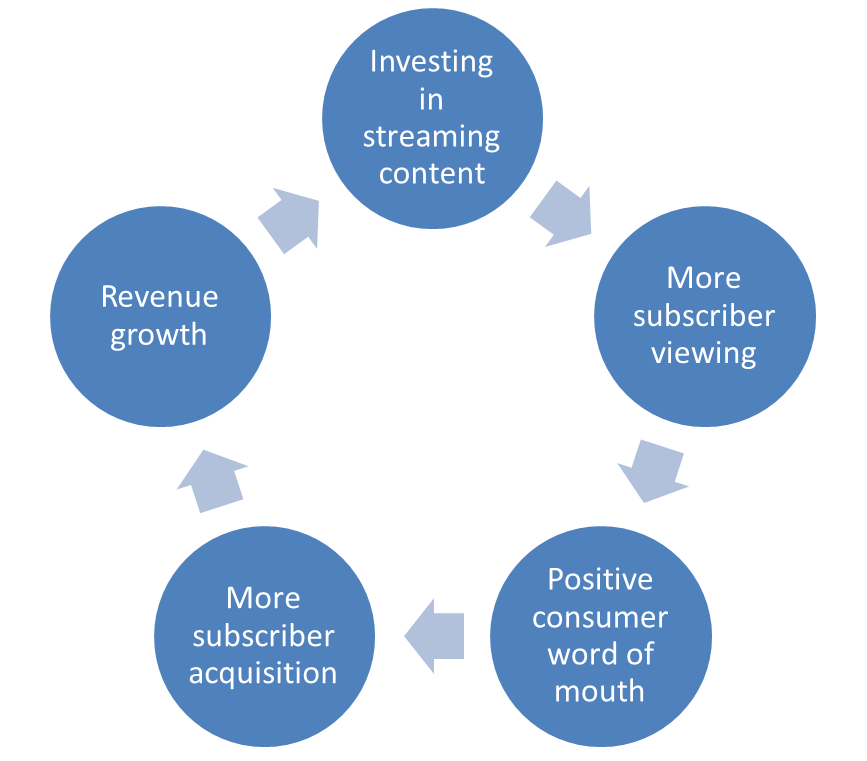
As you can read in their annual report, Netflix rationale behind investing in streaming content is explained in the next virtuous cycle:

inv in stream content

In order to differentiate itself from the competition and to gain more market share, Netflix heavily invests in streaming content. Through this strategy, the company aims to keep its customers delighted and to boost both subscribers and revenue growth.

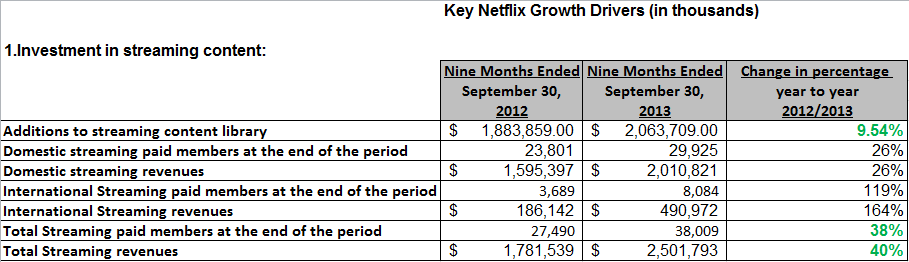
Now let’s see how investing in streaming content really turns into more customer acquisition and revenue growth and how profitable is customer acquisition relative to the revenue growth?

inv in stream content excel

Comparing the results from last year first nine months to this year’s, we can observe that while  additions of new streaming content spending increased by 9.54%, total streaming paid members surged by 38% and total streaming revenues saw a 40% advance. So, for every additional dollar invested in new streaming content Netflix brought in 4 subscribers more, which is a very good conversion rate and indicates that Netflix strategy, is showing great results.

2. Continuous Service Improvements

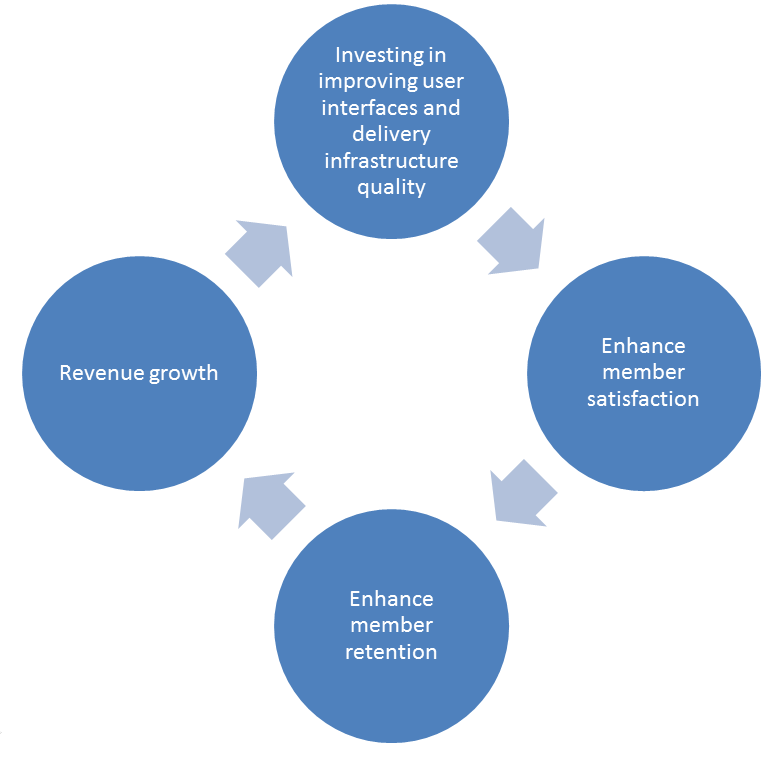
The second key growth driver rationale behind investing in improving online infrastructure is conveyed in the following cycle.

inv in service improv

Continue reading “The Netflix Saga, Part 2: Fundamental and Technical Analysis”

The Day People Woke Up and Said, “I Need to Rush Out and Buy Stocks”

By Michael Lombardi, MBA

Can you believe the mainstream headlines these days? I’m reading about the Dow Jones Industrial Average going to 19,000… I’m reading that stocks are rising because the amount of stocks for investors to buy has diminished…

It’s all rubbish!

The chart below of the Dow Jones Industrial Average breaking above 16,000 makes it look like people just woke up the morning of November 18 and said, “I need to rush out and buy stocks today!”

In my opinion, we are looking at the biggest bear market trap we’ve ever seen. The year 2008 is a distant memory. The notion of fear of “missing out” is back.

Investors are pouring billions into stocks…

Chart courtesy of www.StockCharts.com

According to the Investment Company Institute, long-term U.S. equity mutual funds had a net inflow of $5.4 billion for the week ended November 6. In the prior week, which ended on October 30, investors bought $4.2 billion worth of long-term U.S. equity mutual funds. (Source: Investment Company Institute, November 13, 2013.)

As investors are pouring back into stocks, the fundamentals that drive the key stock indices are dissipating. Each day, we hear weak economic news, which suggests key stock indices are moving beyond reality. And the disparity between the performance of key stock indices and the most basic fundamentals continues to grow.

Corporate earnings of companies in key stock indices are very weak. The corporate earnings “surprise” rate (this is the rate that shows how much higher or lower corporate earnings were registered) came in at 1.8% in the third quarter—far below the four-year average of 6.5%.

S&P 500 companies posted an increase in profit in the third quarter of 3.5% more than the third quarter of 2012. But the S&P 500 is up 30% since then! How does that make sense?

It gets worse if we take out all the stock buybacks the S&P 500 companies have executed over the past 12 months. Take stock buybacks out of the equation, and there was no earnings growth in the third quarter!

And we just hit a new milestone in the amount of money investors have borrowed to buy stocks on the NYSE.

Investors are not interested in hearing all this negative stuff on stocks; all they know is the Federal Reserve is printing $85.0 billion a month in new paper money and somehow, that’s good for the stock market. Nothing else really matters.

But history has taught the smart money people one lesson well…and I want my readers to heed this time-proven phenomena: key stock indices have always plunged when the majority of investors and stock advisors have become bullish. We are close to that point now.

Yes, I may be ridiculed today for being one of the remaining bears on key stock indices. But I was also ridiculed in November 2007 when I said, “The Dow Jones Industrial Average, the S&P 500 and the other major stock market indices finished yesterday with the best two-day showing since 2002. I’m looking at the market rally of the past two days as a classic stock market bear trap.” By March 2009, the Dow Jones had fallen by more than 50%, and all of a sudden, I was a hero.

Bottom line: picking an exact stock market top is next to impossible…but we are almost there.

Michael’s Personal Notes:

For its fiscal year (ended September 30, 2013), the U.S. government posted a budget deficit of $680 billion…that’s after four years of annual trillion-dollar budget deficits. And with the onset of a new fiscal year, the trend continues. (There are projections the U.S. government will have a budget deficit each year until at least 2038.)

The Department of the Treasury’s Bureau of the Fiscal Service reported the U.S. government registered a budget deficit of $92.0 billion in the first month of its fiscal year 2014 (October 2013). The government’s revenues were $199 billion, and its spending amounted to $291 billion. (Source: Bureau of the Fiscal Service, Department of the Treasury, November 13, 2013.)

As a result of continuous budget deficits, the national debt has skyrocketed to $17.0 trillion, and with the crises that are currently taking place in the U.S. economy—municipal bankruptcies, soaring pension liabilities, and student debt delinquencies—I expect it to go to $34.0 trillion.

On the other hand, there’s the Canadian government. According to its most recent economic and fiscal projection, it expects to have a budget surplus (when revenues are more than expenses) by its fiscal year 2015-2016. It then plans to use this surplus to start paying off the small national debt it has accumulated. (Source: Department of Finance Canada, November 12, 2013.)

Note the difference: while the U.S. government expects to post budget deficits for a very long time to come, Canada—a major player in the global economy—is very close to a budget surplus.

If the U.S. government continues to follow the same trajectory (spending more and borrowing more), it’s not sustainable in the long run, as there comes a point when creditors question the value of the currency they have lent against. If it ever comes to that situation—and one day, it will—the bond market will not be the only victim; the U.S. dollar will face an identity crisis, and the buying power of Americans will be destroyed.

Obviously, all of this won’t come into play right away, but we’re getting there.

This article The Day People Woke Up and Said, “I Need to Rush Out and Buy Stocks” is originally publish at Profitconfidential


Equity Boom Sees Gold Down 25% vs. Sterling in 2013, Central Banks Buying

London Gold Market Report

from Adrian Ash

BullionVault

Fri 22 Nov 08:45 EST

FOUR-MONTH lows in gold continued vs. the Dollar and Euro in London on Friday, with the metal heading for its lowest weekly finish in British Pounds since early August 2010.

 World stock markets rose meantime, extending 2013’s 30% gain on the MSCI index, as did commodities and government bond prices, after the Dow Jones index in New York ended last night above 16,000 for the first time.

 “People are finding it hard to find a reason to own gold,” the Wall Street Journal quotes one analyst today.

 “Precious metals markets,” says David Govett at brokers Marex Spectron, also speaking to the WSJ, “are out of favor with investors and set to stay that way,”

 Silver tracked gold’s Dollar-price drop of 3.6% to $1245 this week, failing to hold a rally above $20 per ounce lunchtime Friday.

 Averaging 14% annual gains since 1999, the Sterling gold price has so far dropped 25% in 2013, dipping below £770 per ounce overnight.

 New data from the International Monetary Fund meantime showed central banks as a group adding slightly to their gold reserves in October.

 Turkey led the rise, with nearly 13 tonnes being added – most likely by commercial banks putting more client property on deposit, as part of their liquidity reserves – to the country’s previous holdings of 491.

 Germany sold 3.4 tonnes from its 3,391 reserves, again for production of gold coin.

 The United States added 33 kilograms, the largest change to its world-leading 8,133-tonne hoard since the 840kg added in the third quarter of 2012.

 “Our bullish view has proven incorrect,” said Bank of America-Merrill Lynch technical strategist MacNeil Curry on Thursday, pointing to the drop through $1251 per ounce.

 Whilst $1270 will now “limit the topside,” his chart analysis says, “bears need a break [below] $1155 and $1087 to confirm a long-term top and secular turn in trend from bullish to bearish.”

 Targeting averaging prices of $1150 per ounce across the second quarter of 2014, TD Securities’ analyst Mike Dragosits says “Spec positioning” in the futures market “could also precipitate an overshoot, with gold hitting sub-$1000/oz on an intraday basis.”

 Speculative traders in the US gold futures market have this year built the biggest “short” bet against prices since the bear-market lows of 1999.

 “We will continue to watch Comex specs activity as a major contributing driver for this move,” says TD’s note.

 Gold prices in India, formerly the world’s No.1 consumer but now overtaken by China, pushed higher above international benchmarks Friday, reports Reuters.

 “Premiums are still on the higher side at about $120 per ounce,” the newswire quotes All India Gems & Jewellery Federation chairman Haresh Soni.

 Thanks to the Indian government’s strict anti-gold import rules, aimed at cutting the country’s large trade deficit, “Still there is scarcity of gold,” Soni adds. “This problem will continue for another 5-6 months till the elections.”

 Physical gold will meantime be traded between China’s biggest banks in formal “swaps” contracts starting Monday, the National Interbank Funding Center said today.

 Used by large gold owners and traders to raise cash, and with a small rate of interest typically offered to borrowers as an incentive, gold swaps hit the headlines in 2010 after European central banks were identified as the source of 349 tonnes swapped with the Bank for International Settlements during the 1st half of the year, raising cash amid the growing Eurozone debt crisis.

 Announcing a raft of reforms this week after the 3rd plenum of the current politburo, policymakers in Beijing have put China’s gold-market liberalization at the heart of financial deregulation.

 US derivatives exchange the CME yesterday cut the margin payments needed to trade gold and silver futures contracts, halving the sharp hike made in June as prices ended their worst quarterly drop in three decades.


Adrian Ash

BullionVault

Gold price chart, no delay | Buy gold online


Adrian Ash is head of research at BullionVault, the secure, low-cost gold and silver market for private investors online, where you can fully allocated bullion already vaulted in your choice of London, New York, Singapore, Toronto or Zurich for just 0.5% commission.


(c) BullionVault 2013

Please Note: This article is to inform your thinking, not lead it. Only you can decide the best place for your money, and any decision you make will put your money at risk. Information or data included here may have already been overtaken by events – and must be verified elsewhere – should you choose to act on it.


More Evidence Housing Market Is Turning Cold

By for Daily Gains Letter

Evidence Housing MarketThe U.S. housing market is in trouble, and it’s foolish to believe that it’s going to show gains like it did earlier this year and in 2012. More and more evidence is lining up in favor of the housing market in the U.S. economy seeing stagnant growth, or maybe even heading for a downturn.

It is not stressed enough that the housing market depends on home buyers; if they don’t buy, robust growth doesn’t occur.

This phenomenon is currently taking place in the U.S. housing market—the home buyers are shying away. According to the National Association of Realtors, sales for existing (already built) homes declined for the second consecutive month in October. For that month, first-time home buyers only accounted for 28% of the existing home sales in the U.S. housing market. This amount is equal to September and lower than October of 2012, when first-time home buyers made up 31% of all existing home sales. (Source: “October Existing-Home Sales Cool but Low Inventory Drives Prices,” National Association of Realtors web site, November 9, 2013.)

The reason this is happening is because the mortgage rates are continuously increasing. In October, the Freddie Mac 30-year fixed mortgage rate was 4.19%, while this rate was 3.38% a year ago—an increase of 24%.

Sadly, rates are expected to increase further. In a statement, the Federal Reserve implied that it might be moving ahead with the tapering of quantitative easing in the upcoming months, though no date was provided; when we heard something similar in May, we saw an increase in bonds yield, which mortgage rates are highly correlated upon. This time will be no different.

As the mortgage rates start to increase, it becomes increasingly difficult to own a home. I am not the only one saying this: Lawrence Yun, chief economist for the National Association of Realtors, agrees with this notion as well. While presenting the existing homes sales report he said that “The erosion in buying power is dampening home sales.”(Source: Ibid.)

With all this in mind; I remain skeptical of the U.S. housing market. My reasoning is very simple: if home buyers don’t come in and buy, where will the homes that are on market go? One would say investors can buy them up, but I ask how much they can actually buy.

If the home buyers keep shying away from the housing market; we will see homes staying on the market for an extended period of time. I wouldn’t be surprised if the sellers start to lower their prices.

As the housing market shows sign of stress, I continue to keep a bearish view on homebuilder stocks. They are very dependent on the housing market; if it faces a slowdown, it will have an impact on their sales and profits, and their stock prices will ultimately reflect this.


http://www.dailygainsletter.com/real-estate/more-evidence-housing-market-is-turning-cold/2133/


European Stocks Advances on Upbeat US Jobs

By HY Markets Forex Blog

European stocks opened higher on Friday following the release of the upbeat US jobs data from Thursday. Investors are looking forward to the upcoming German IFO Business Climate report and the ECB’s president Draghi’s speech at the European Banking Congress.

The pan-European Euro Stoxx 50 gained 0.21% higher at 3,050.76, while the German DAX index opened 0.15% higher at 9,210.06 at the time of writing.

At the same time, the French CAC 40 rose 0.24% higher; opening at 4,264.04 and the UK FTSE 100 edged 0.03% lower, standing at 6,696.70.

Germany is expected to release its Business Climate indicator by 9:00am GMT with forecasts of a rise of 107.7 points in November, slightly higher from the 107.4 recorded in October.

In Italy, the National Institute for Statistics (ISTAT) is expected to report retail sales data for September by 9:00am GMT.

European Stocks – German GDP

In Germany, the economic growth slowed in the third quarter, recording a lower gross domestic product (GDP) growth rate, reports from Germany’s federal statistics office Destatis confirmed.

Germany expanded its GDP at a pace of 0.3% on a quarterly basis in the period from July to September, slower than the 0.7% seen in the final reading from the previous quarter.

US Macro data

According to the International Energy Agency in France, the US will account for approximately 21% of global oil demand this year. Jobless claims dropped by 21,000 to 323,000 in the week ended November 15, reports from the US Department of Labour confirmed on Thursday.

Draghi’s Speech

European Central Bank President Mario Draghi denied rumors of negative deposit interest rates for the euro and commented on the economic growth, emphasizing on the downside for the future economic outlook that remains weak.

Draghi pointed out that Germany’s economic growth should be a model for all the other nations in the eurozone.

Draghi is expected to give another speech at the European Banking Congress on Friday.


Visit www.hymarkets.com   to find out more about our products and start trading today with only $50 using the latest trading technology today.

The post European Stocks Advances on Upbeat US Jobs appeared first on | HY Markets Official blog.

Article provided by HY Markets Forex Blog

Crude Oil Prices Drops Amid Iran Ongoing Talks

By HY Markets Forex Blog

Crude oil prices traded lower during Asian session on Friday as the ongoing talks between Iran and Western powers continues, the western powers  includes France, Germany, Russia, China, UK and the US.

The North American crude dropped 0.31% lower, trading at $95.14 per barrel at the time of writing, while the European benchmark crude Brent fell 0.12%, trading at $109.95 per barrel at the same time.

Crude Oil – Iran

Five members of the United Nations Security Council including Germany resumed talks with Iran over its nuclear program in Geneva on Thursday.

Iran has said that its nuclear program is for only civilian purposes for medical and energy use; however western powers are accusing the Persian Gulf nation of covertly seeking atomic-weapons capability.

Crude Oil – US

According to the International Energy Agency in France, the US will account for approximately 21% of global oil demand this year. Jobless claims dropped by 21,000 to 323,000 in the week ended November 15, reports from the US Department of Labour confirmed on Thursday.

WTI has dropped in the past six weeks, marking its longest losing streak in fifteen years, while stockpiles rose by 375,000 barrels to 388.5 million in the past week ended Nov. 15th, the Energy Information Administration confirmed.

Meanwhile, the Senate Committee on Housing, Banking and Urban Affairs granted the nomination of Janet Yellen as the next Federal Reserve Chairperson for the next four years.

“Yellen understands the challenges facing our economy and the balance the Fed must strike as we navigate the path back to full employment,” the committee’s Chairman Tim Johnson said on Thursday.

Janet Yellen is currently the vice-chairperson of the Federal Reserve (Fed) and has commented on supporting the economy and expanding the job market.

Meanwhile the recent turmoil in Iraq continues to weigh on the country’s crude supply.


Visit www.hymarkets.com  today and find out more on how you can how you can trade Energy products with only $50.

The post Crude Oil Prices Drops Amid Iran Ongoing Talks appeared first on | HY Markets Official blog.

Article provided by HY Markets Forex Blog