The Product that Will Send 3D Printing Into High Gear

By MoneyMorning.com.au

Once or twice in every generation, a new invention will change the trajectory of entire industries – the assembly line during the industrial revolution, for example, or the Internet in the ’90s.

We, and many others in the technology community, believe that ‘3D Printing‘, or ‘Personal Manufacturing’, is our generation’s next big thing… 

Imagine one day, rather than trekking to the mall or a big-box store to buy a toy for your son or daughter, you simply ‘print it’ from home. The printer would look similar to the one you might already have – but instead of printing ink on paper, it would use an amazing process where successive layers of material, like plastic, are gradually laid down into various shapes.

It would be like building a castle – or a toy or a truck – out of magic legos.

Taking this concept a step further, imagine your doctor printing you a new kneecap, or a new tooth. The possibilities are endless.

But here’s the thing. These scenarios are happening right now.

The Future Has Arrived

We’re not the only ones who believe in the power of Personal Manufacturing. Take a look at the performance of some of the stocks in the sector:

3D Systems (DDD) is up over 50% year-to-date with a $5.4 billion market cap. And Stratasys (SSYS) – the company that recently acquired consumer 3D-Printer manufacturer, MakerBot, for $403 million – is up over 28% year-to-date, giving it a market cap of over $4 billion.

The industry has begun to gather steam – in fact, as it relates to making money in 3D Printing stocks, many would argue it’s already reached maximum speed.

They may be right, but we’re not here today to discuss another 3D-Printing stock. Today we’re going to show you an early-stage private company that could be a major beneficiary of 3D printing – and soon, they’ll be raising capital from investors like you.

Based in Mountain View, California, the company is called Meta.

Meta makes a product called ‘Space Glasses’.

Imagine for a moment putting on a pair of glasses, and instantly seeing a 3D model of a flowerpot in front of you. Using your hands, you are able to modify the size, shape, colour and design of the pot. When it looks just right, you can ‘move’ it into your 3D printer – and the next day you’ll have your custom-made flower pot ready and waiting for you.

The scenario I’m describing is just one of the many examples Meta shows in their latest demonstration video.

This is the stuff of futuristic dreams and Hollywood, but its implications for everything from 3D Printing to Gaming is already a reality.

The technology has been getting rave reviews from the press and investors alike.

Some of the smartest money in Venture Capital is hopping on board and backing Meta – everyone from Yuri Milner, an early Facebook investor, to Andreesen Horowitz, a top-notch venture firm.

Soon, Meta is going to be raising money on an equity crowdfunding portal called WeFunder. WeFunder is unique in that it only accepts companies that have graduated from high-quality start-up ‘accelerators’. (This is similar to how big investment banks try to attract Ivy League graduates: there’s no guarantee these ‘high-quality graduates’ will work out, but it can increase the odds.)

Start-up accelerators are essentially a boot camp for new companies. Each company that is accepted (acceptance rates are in the 1% range) is put through a rigorous 3-month program where their idea is refined, key hires and introductions are made, and initial capital is raised.

The top-tier accelerators – think of them as the ‘Ivy Leagues for Start-ups’ – generally try to help companies hone their product, raise funding, and accelerate their transition to become successful businesses (as well as successful investments for the accelerators).

In the case of Meta, they’re an alum of an accelerator called YCombinator. Notable alums from YCombinator include Heroku, which was acquired by SalesForce.com for $250 million, and Airbnb, which has gone on to raise over $120 million.

But as always, if our goal is to approach early-stage investing like a professional, we can’t simply put our money behind a ‘cool’ technology or a ‘brand name’ start-up accelerator. We also have to make sure the business makes sense as an investment.

To do this, let’s refer to our 10 Crowd Commandments checklist from the Resources section of Crowdability.com

Watch This Space

After a quick perusal, we see that Meta meets many of the criteria we look for in an early-stage investment opportunity:

Simple business model? Check! (Meta will sell its glasses and software both to businesses and consumers)

Following smart money? Check!

Already showing signs of progress? Double check (Meta has almost $1 million in pre-orders!)

What about its valuation? Or, put another way, ‘What’s the price of its stock?’

As mentioned above, Meta isn’t raising funding quite yet. As soon as it starts, this question about its valuation will be answered. Keep in mind that standard start-up valuations are in the range of $2 million to $5 million.

If you invest at too high a valuation (i.e., the price of its stock is too high), it’ll be difficult to make money even if the investment does well. Imagine a company being acquired for $100 million, but you invested when the valuation was $95 million. That doesn’t leave much room for profit – especially given the risk.

So keep Meta on your watchlist and pay attention to what its valuation turns out to be. If they’re raising funds at the right price, this company could provide the next leap forward for 3D printing…and a healthy return for its investors.

Wayne Mulligan
Contributing Writer, Money Morning

Publisher’s Note: The Product that Will Send 3D Printing Into High Gear originally appeared in The Daily Reckoning USA

Join Money Morning on Google+


By MoneyMorning.com.au

Plenty of Opportunities Still Left in International Junior E&Ps: Amin Haque

Source: Peter Byrne of The Energy Report (11/21/13)

http://www.theenergyreport.com/pub/na/plenty-of-opportunities-still-left-in-international-junior-e-ps-amin-haque

You may not think “oil” when you hear “Albania,” but the once war-torn nation is home to the largest onshore oil field in Europe, says MGI Securities Analyst Amin Haque. Furthermore, the underexplored jurisdiction is likely hosting large undiscovered oil reserves. In this interview with The Energy Report, Haque explains the political and fiscal environment in this transitioning country and profiles some promising companies making headway there. He also brings us up to speed on some plays in Nigeria that could return big bucks for patient investors.

The Energy Report: Your firm, MGI Securities, recently initiated coverage of three E&P companies in Albania ranging from Buy to Speculative Buy to Hold. What makes Albania attractive to energy investors?

Amin Haque: Geographically, Albania is close to the southern European oil markets. Even though the volume of the country’s oil and gas production is not very significant—about 20,000 barrels per day—it is finding a ready market. Albania has some large oil and gas prospects that have not been explored in the last five decades. Because of the country’s long history as a strict Stalinist regime and because of the subsequent upheaval during transition to a democracy, there was not much infusion of capital and technology. However, independent international oil companies are going back to Albania that have the ability to spend large amounts of capital and bring new technology on-line. We expect production to grow significantly during the next few years—and would not be surprised if there are some major discoveries. This prospect makes Albania quite an attractive country for those who invest in junior energy companies.

TER: Are foreign companies partnering with the Albanian government?

AH: The arrangement is typically a production sharing contract (PSC). The Albanian government works as an inactive partner. It actively encourages foreign oil and gas companies to invest capital in the Albanian oil and gas sector.

TER: What are the obstacles to oil and gas field development in Albania?

AH: First, a large part of the country’s geology is complex and not very well understood. Albania has the largest discovered onshore oil field in all of Europe, which was discovered over 80 years ago. Exploration beyond the known fields has been sporadic at best, so there is not much in terms of analogues. Second, there is not much in the way of oilfield services infrastructure and skilled local staff available in Albania. Most of the equipment has to be brought in country, which increases the cost of exploration.

TER: Are these companies using hydraulic fracking techniques?

AH: No. Permeability in the known fields is such that fracturing is not necessary. However, these fields produce heavy oil, where the application of enhanced recovery techniques is more relevant. Horizontal drilling is already being used with great success, while waterflood and polymer-flood projects have only recently been initiated. Besides, these companies are not pursuing shale or tight natural gas, which is fracking intensive.

TER: How does the cost of production of Albanian oil compare to North America?

AH: Albanian crude is heavy and sells at a discount to Brent, for about $80/bbl ($80/bbl). The two producing companies in our coverage list realize between $35–45/bbl in operating netback. Bankers Petroleum Ltd. (BNK:TSX), with the largest and most stable production profile in Albania, realizes about $40/bbl in cash netback whereas the median intermediate Canadian producers reported a cash netback of $20.37/bbl in Q2/13. It is not only the high netback but also the low finding and development cost that make Albania so compelling. Good cost-benefit results are emerging from short lateral horizontal wells.

TER: What firms do you like in the Albanian space?

AH: I have initiated coverage on three names: Bankers Petroleum, Petromanas Energy Inc. (PMI:TSX.V) and Stream Oil and Gas Ltd. (SKO:TSX.V). I have a Buy rating on Bankers and a Speculative Buy on Petromanas. Stream has some large resources, but it has had quite a few operational and financial challenges during the last three years. Management needs to demonstrate that they can grow production by resolving these hurdles. If management can do so successfully, Stream will become an interesting company.

TER: Tell us more about Bankers Petroleum.

AH: Bankers Petroleum has successfully grown its production by 25% annually for the last five years. Bankers has a strong management team. The original management team that took up the play operated a successful heavy oil company in Egypt, which increased production by six-fold in four years and was sold to a local company. Management applied this experience to Bankers’ operations in Albania. The main producing field in Albania, Patos-Marinza, is the largest discovered onshore oil field in all of Europe. Between the two fields held by Bankers—Patos-Marinza and Kuçova—there is 5.4 billion barrels (5.4 Bbbl) of oil in place, which is a huge number.

The challenge for Bankers is to improve its recovery rate, which has been historically quite low. Bankers Petroleum has been making incremental improvements in recovery rate as is evidenced by its production growth. The company is successfully trying new technologies that include horizontal drilling.

Bankers Petroleum is projecting a 15% annual production growth, which seems to be achievable. With close to 250 million barrels in proven reserves, as well as such large quantity of original oil in place to tap, Bankers has the potential to dramatically grow its production.

TER: How has its stock been performing?

AH: Banker’s stock has been doing quite well in the last six months—up by 50%! But, there is still room to do better. There have been some changes in the Albanian political scene that favor a more transparent business climate, which is one of the reasons that investors are being drawn toward Bankers.

TER: What about Petromanas?

AH: Petromanas is purely an exploration company. It has four blocks in Albania. Of these, the company is conducting an active exploration program on blocks two and three. One well on these blocks just completed drilling and testing and showed very positive test results. The company is drilling another well on these blocks. Between the two wells, Petromanas is expected to identify and partially delineate the large carbonate structure it is pursuing. The company is partnered with Royal Dutch Shell Plc (RDS.A:NYSE; RDS.B:NYSE) in these blocks under favorable terms.

TER: How is the Petromanas share price performing?

AH: After the release of the drill results, the share price rose 18%. The first well took much longer to drill than had been anticipated and overran budget by almost 100%. Consequently, the share prices slid continuously during the past year. I believe that Petromanas has now turned a corner with the successful drilling of the first well. With further success from their other wells—this will be a portfolio stock.

TER: Is the market for Albanian oil partly domestic and regional or does it reach beyond?

AH: Foreign oil companies in Albania are allowed to export 100% of their produced oil. The government usually sends its royalty oil to the local refineries. The rest of the oil is exported to refineries in the Adriatic and the Mediterranean area, including Spain, France and Italy. As Bankers grows its production capacity, it is improving the infrastructure around the export facility, which will eventually widen the market reach for Albanian oil.

TER: Amin, you also follow E&P firms in Nigeria. In past interviews with The Energy Report you were bullish on Mart Resources Inc. (MMT:TSX.V). Would successful construction of a new pipeline revive the stock price?

AH: Mart’s new pipeline was proposed quite a while ago. The company’s initial guidance said the pipeline should be in commission by late 2013, which has not happened. In its latest press releases, Mart indicates that the pipeline could be delayed until H1/14. It has, however, made progress in building the pipeline, and remains optimistic. Mart should be able to complete it next year, but it still has challenges to address, which will take time.

TER: What are the challenges?

AH: One challenge concerns the right of way for the pipeline. The local communities want to receive financial benefits by allowing the pipeline to proceed, which is not unjustified. However, it all comes down to how much the participating companies are willing to yield to the communities. The second challenge is more of a procedural delay in receiving government approval for twinning a part of an existing pipeline. That is a matter of completing negotiations with the government and the NPDC, Nigerian Petroleum Development Company.

Time is of the essence, because losses in the oil pipeline that Mart is currently using are rising incrementally. In 2011, the losses were about 8% of produced oil. That loss now stands at over 22%. Mart is losing almost 1 barrel of oil of every four or five barrels produced. Bringing an alternative pipeline online will seriously decrease these losses. Another challenge is that Mart is producing at less than its capacity. An alternative pipeline will allow it to produce more, to generate more cash, and at the end of the day, increase its dividend.

TER: Is Royal Dutch Shell helping Mart with the pipeline?

AH: Shell used to own the oil mining license that the pipeline is going to cross. But Shell sold it to an indigenous company and is not in the picture anymore. Consequently, the control of that field has reverted to Nigerian Petroleum Development Company (NPDC). There are other producers in the same region who are partnering with Mart to construct the pipeline, including a small producer named Energia. Energia’s partner is Oando Energy Resources Inc. (OER:TSX). Mart also has two other indigenous partners in its Umusadege oil field.

TER: You cover Oanda Energy Resources as a Speculative Buy. Are there new developments in the historically troubled oil fields of Nigeria that make this company particularly worthwhile?

AH: Oanda is trying to purchase the entire Nigerian oil and gas portfolio of ConocoPhillips (COP:NYSE) for about $1.8 billion. A month ago, Oanda secured $815 million ($815M) in debt financing for the transaction, which is scheduled to complete on November 30th. Oanda has already put down $450M in deposit. Arranging the debt financing was a big hurdle, which the company has cleared. Oanda must come up with another several hundred million dollars in equity financing—a tremendous achievement in this market, if it happens.

TER: Are the post-2005 changes of political climate in Nigeria holding up as favorable for outside companies contemplating the once-troubled oil fields?

AH: The headline troubles in the Niger Delta have subsided, but there are many challenges. After years of marginalization, the local communities want their share of oil benefits. So they hold out when they can and that holds back the full development of the region’s resources. There has been a concerted effort within the government, including the defense forces to join hands and reduce bunkering.

One thing that has definitely changed is that there is more participation by Nigerian indigenous companies, both on the producing side as well as in providing services and logistics. Engaging the local population helps stabilize the troubled environment in the Niger Delta. In the proposed Petroleum Industry Bill (PIB), there are new provisions intended to benefit the local population.

TER: Tell us the latest developments with the Nigerian operations of Heritage Oil Corp. (HOC:TSX; HOIL:LSE).

AH: Heritage has acquired a major Nigerian asset, OML 30, which is a large field holding in excess of 1 Bbbl of reserves. This acquisition has transformed Heritage from an explorer to a developer. Leading up to the acquisition, Heritage sold two of its exploration assets in Uganda and Tunisia for very large sums. Heritage came to Nigeria with a large war chest.

TER: Are there any interesting E&P companies in North Africa?

AH: I like Longreach Oil & Gas Ltd. (LOI:TSX.V), located onshore in Morocco. It will shortly commence drilling one of two wells in the general area that has produced in excess of 31 billion cubic feet of natural gas. Longreach is looking into a slightly deeper formation that has not been explored before due to technological limitations at that time. Given the high local energy demand, especially in the phosphate industry, a successful exploration will be good for both the company and for Morocco.

The other North African name that I like is DualEx Energy International Inc. (DXE:TSX.V). There has been movement in its stock price in anticipation of results for the company’s BHN-1 well in Tunisia—another North African country that is underexplored, but carries a lot of upside potential. A third company I have been following with a great deal of interest is Serinus Energy (SEN:TSX), formerly Kulczyk Oil Ventures. After establishing a successful gas production operation in Ukraine, the company is pursuing larger upsides in Tunisia. Interestingly, it is also the only oil and gas company operating onshore Brunei.

TER: Thanks for being with us today, Amin.

AH: Thank you, Peter.

Amin Haque provides MGI Securities with research coverage of international explorers, producers and oilfield service companies. Haque brings 14 years of financial market experience, seven of which have been devoted to equity research analysis. He worked as an analyst both on the buy and the sell sides focusing on energy and other resource sectors. Prior to joining MGI, Haque provided independent valuation services to oilfield services, logistics and related companies to Stonecap. Before making his career as an analyst in the energy and the resources sector, he worked in risk management for a New York-based global credit card company. He also worked as a management consultant providing consulting services to a variety of U.S. and international financial organizations including Ginnie Mae and the World Bank. Haque is an electrical engineer by training, and holds a Master of Business Administration degree from Georgetown University in Washington, D.C. He is a CFA charter holder.

Want to read more Energy Report interviews like this? Sign up for our free e-newsletter, and you’ll learn when new articles have been published. To see a list of recent interviews with industry analysts and commentators, visit our Interviews page.

DISCLOSURE:

1) Peter Byrne conducted this interview for The Energy Report and provides services to The Energy Report as an independent contractor. He or his family own shares of the following companies mentioned in this interview: None.

2) The following companies mentioned in the interview are sponsors of The Energy Report: Mart Resources Inc. and Royal Dutch Shell Plc. Streetwise Reports does not accept stock in exchange for its services or as sponsorship payment.

3) Amin Haque: I or my family own shares of the following companies mentioned in this interview: None. I personally am or my family is paid by the following companies mentioned in this interview: None. My company has a financial relationship with the following companies mentioned in this interview: None. I was not paid by Streetwise Reports for participating in this interview. Comments and opinions expressed are my own comments and opinions. I had the opportunity to review the interview for accuracy as of the date of the interview and am responsible for the content of the interview.

4) Interviews are edited for clarity. Streetwise Reports does not make editorial comments or change experts’ statements without their consent.

5) The interview does not constitute investment advice. Each reader is encouraged to consult with his or her individual financial professional and any action a reader takes as a result of information presented here is his or her own responsibility. By opening this page, each reader accepts and agrees to Streetwise Reports’ terms of use and full legal disclaimer.

6) From time to time, Streetwise Reports LLC and its directors, officers, employees or members of their families, as well as persons interviewed for articles and interviews on the site, may have a long or short position in securities mentioned and may make purchases and/or sales of those securities in the open market or otherwise.

Streetwise – The Energy Report is Copyright © 2013 by Streetwise Reports LLC. All rights are reserved. Streetwise Reports LLC hereby grants an unrestricted license to use or disseminate this copyrighted material (i) only in whole (and always including this disclaimer), but (ii) never in part.

Streetwise Reports LLC does not guarantee the accuracy or thoroughness of the information reported.

Streetwise Reports LLC receives a fee from companies that are listed on the home page in the In This Issue section. Their sponsor pages may be considered advertising for the purposes of 18 U.S.C. 1734.

Participating companies provide the logos used in The Energy Report. These logos are trademarks and are the property of the individual companies.

101 Second St., Suite 110

Petaluma, CA 94952

Tel.: (707) 981-8204

Fax: (707) 981-8998

Email: [email protected]


Dollar Index ETF Trading Strategy

By Chris Vermeulen – www.GoldAndOilGuy.com

We all know quantitative easing devalues the Dollar but contrary to that general statement it looks as though we could see the dollar index continue to rise for a few more weeks.

If we analyze the chart of the Dollar ETF (UUP) it is clear that the short term momentum has turned up. The break above the down trend line and recent bounce off support bodes well for the dollar index.

The bull flag chart pattern that has formed in the past month has a measured move price target of roughly $22.30. The level also happens to be a key pivot point on the chart along with high volume resistance.

I expect the dollar to continue to work its way higher over the next week or two with $22.30 being the line in the sand where sellers will jump on price and drive it back down, or at minimum force price to consolidate for a few days.


US Dollar ETF Trading Strategy – Daily Chart Analysis

ETF Trading Strategy


Article by Chris Vermeulen – www.GoldAndOilGuy.com – Free Trading Ideas


Five Dividend Stocks Owned by the Masters of the Universe

By The Sizemore Letter

Now and then it is nice to take a peek over the shoulder of a “master of the universe” to see what their high-conviction buys are.  When you read a headline that “Warren Buffett is buying Company X,” you’re naturally inclined to do a little digging into Company X’s financials.  After all, if it’s good enough for Buffett, it might be good enough for you.

Related: What’s Warren Buffett Up To?

You have to be careful with this line of thinking, of course.   The SEC 13-F filings that disclose these holdings are generally pretty dated by the time we have access to them.  For all we know, the conditions that made a guru buy a given stock may no longer be valid by the time we read about it, and there are no guarantees that they haven’t already sold it.  There is also no way to track hedges or off-setting short positions in the event that the stock is part of a pair trade, nor are derivatives or options positions mentioned at all.

For these reasons, I tend to focus on larger holdings, the conviction buys that they are likely to hold onto for a while.

Today, I’m going to look at one high-conviction dividend stocks each from five well-known superinvestors.  My criteria is simple enough: the stock must be a significant holding in the guru’s portfolio and it must pay a respectable dividend.

I’ll start with Mr. Buffett.  Earlier this week I wrote a short piece that gave the rundown on Berkshire Hathaway’s latest portfolio moves, and particularly its accumulation of dialysis provider DaVita (DVA).  Well, as much as I like DaVita, it doesn’t pay a dividend, so it is off limits for this particular article.  But Exxon  Mobil (XOM) is a very different story.

Berkshire Hathaway made a $3.5 billion investment in Exxon, reinforcing my belief that the global oil majors are a bargain after a disappointing couple of years in the market.  Yes, earnings growth has been modest.  But at just 12.4 times earnings and 1.1 times sales, Exxon is being priced as if it will never grow again.

Exxon also happens to be a dividend-raising powerhouse.  It has raised its dividend for 31 consecutive years, and counting, at an average annual rate of 6.3% over the period.  And there is plenty of room for more; its dividend payout ratio is a modest 31%.

At current prices, Exxon sports a dividend yield of 2.6%, just slightly less than what you can get from a 10-year Treasury note.  But 10 years from now, Exxon’s payout is likely to be 80%-90% than it is today, whereas the Treasury’s coupon payment will be unchanged.  If those are my two choices, I’m going with Exxon.

Next, let’s take a look at the portfolio of Hayman Advisors’ Kyle Bass.  Bass is a Dallas-based hedgie best known as a macro trader and as a major long-term bear on Japan.  I share Bass’s view on Japan (see The Case to Short Japanese Bonds Lives), but that is another story for another day.

But while Bass is best known as a “big picture” macro guy, he’s also a talented stock picker.  And he happens to share my current enthusiasm for mortgage REITs.  His stake in PennyMac Mortgage Investment Trust (PMT) makes up 20% of his long portfolio.

I should clarify one point—I’m not a big fan of mortgage REITs as a long-term asset class.  Unlike equity REITs, which invest in real property, mortgage REITs do nothing but buy and sell mortgages and mortgage securities.  They’re essentially variable-rate bonds with all the risks of equities.

But to everything there is a season, and right now mortgage REITs are attractive.  The spread between their borrowing and lending rates are some of the highest in years, and many trade for significantly below their book value.  It’s hard to lose money buying dollar bills for 80 or 90 cents.

PennyMac currently pays a dividend of 10.2%, and it trades at book value.  Rather than buy a single mortgage REIT like this, I would be inclined to buy a basket of several or to go the “one stop shop” route and buy a mortgage REIT ETF such as iShares Mortgage Real Estate Capped (REM).

Next on the list is Prem Watsa, the founder of Fairfax Financial Holdings (FRFHF).  Watsa is sometimes called the “Warren Buffett of Canada” due to both his value investing prowess and the fact that, like Buffett, he uses an insurance powerhouse as the foundation of his investment empire.

Watsa has a little egg on his face at the moment.  He accumulated an enormous position in BlackBerry (BBRY) that now makes up a full quarter of his long stock portfolio.

Related: BlackBerry Makes Even Investing’s Greats Look Foolish

I wouldn’t touch BlackBerry, even at current prices.  But one of Watsa’s newer buys caught my attention: British oil major BP (BP).

Like Warren Buffett, the Warren Buffett of Canada appears to see value in Big Oil.  And BP is one of the highest-yielding mega-caps on the market—the company sports a dividend yield of 4.8%.

BP slashed its dividend in half after the 2010 Deepwater Horizon oil spill in the Gulf of Mexico hit the company like a wrecking ball.  Total criminal and civil settlements and payments have already totaled over $40 billion, and the final total may not be known until 2014 or later.

Yet the company has managed to get on with business, and it has raised its dividend in each of the past two years.

Let’s now jump to the portfolio of Oaktree Capital’s Howard Marks.  Marks is one of the most respected investors in the business, and I reviewed his most recent book, The Most Important Thing Illuminated, earlier this year.   Warren Buffett, incidentally, laconically called it “that rarity, a useful book.”)

Marks initiated a position last quarter in the mother of all dividend payers: Big Tobacco giant Altria (MO).
I’ve been fairly bearish on Big Tobacco for the past year (see Big Tobacco Botches the E-Cig Name Game as a recent example), and I consider Altria to be a little on the pricey side given its lack of growth prospects.

That said, if the market cools off after its recent blistering rise, a defensive name like Altria will probably hold up better than most.   And its 5.1% dividend yield is nearly double the yield on the 10-year Treasury.

Altria is not my favorite dividend stock.  But you could do worse.

And finally, we get to the granddaddy of all macro traders, the legendary George Soros himself.

Soros is best known as the man who bankrupted the Bank of England (and pocketed a cool billion for himself in a single day) by shorting the pound in 1992.

Soros’s funds are no longer open to outside investors, and that is a shame.  During the Quantum Fund’s heyday between 1969 and 2000, Soros generated 32% average annual returns.

So what are Mr. Soros and his associates buying these days?

One recent addition that caught my eye was Microsoft (MSFT).

Microsoft has really stepped up its game in recent years as a premier dividend payer.  It currently yields 3.0%, which is among the highest on the market for a tech stock.

Microsoft grew its dividend 15% in 2013…after growing it 25% in 2012 and 23% in 2011. The dividend has more than doubled since 2008, and there is plenty of room for more.  The dividend payout ratio is only 34%.

The company has taken heat for botching the Windows 8 rollout with a user interface that alienates its core clientele—desktop and laptop PC users.  More broadly, investors hate the fact that Microsoft “missed” mobile and is stuck in a long uphill fight playing catch-up.

All of this is true.  Yet the company has still managed to grow its earnings at a healthy clip through robust sales of its Office suite, its server business, and its other services for enterprise clients.  If the company ever catches up in mobile—and they appear to be making headway—consider it icing on the cake.

Charles Lewis Sizemore, CFA, is the chief investment officer of the investment firm Sizemore Capital Management. As of this writing, he was long DVA, MO and MSFT. Click here to receive his FREE 8-part investing series that will not only show you which sectors will soar, but also which stocks will deliver the highest returns. This series starts Nov. 5 and includes a FREE copy of his 2014 Macro Trend Profit Report.

This article first appeared on Sizemore Insights as Five Dividend Stocks Owned by the Masters of the Universe

Join the Sizemore Investment Letter – Premium Edition

Crocodile Gold CEO Says a Focus on Value over Ounces Will Boost Prospects in 2014

Source: Dan Lonkevich of The Gold Report (11/20/13)

http://www.theaureport.com/pub/na/crocodile-gold-ceo-says-a-focus-on-value-over-ounces-will-boost-its-prospects-in-2014

After posting record production and recovery rates at its three mines in Australia and significantly raising its production guidance for the year, Crocodile Gold Corp. may be poised for an even better 2014. Thanks to a quickening ramp-up of its early-stage Cosmo mine, its new Big Hill project and noncore asset divestiture plans, Crocodile CEO Rodney Lamond tells The Gold Report that his company has ample funding and the proper focus on value over ounces to succeed even in today’s challenging pricing environment.

MANAGEMENT Q&A: VIEW FROM THE TOP
The Gold Report: Rod, you were named president and CEO of Crocodile Gold Corp. (CRK:TSX; CROCF:OTCQX) in July after previously serving as the group general manager of exploration and mining development at Nyrstar NV in Canada and before that as general manager of Nyrstar in Peru. How has running Crocodile been different than working at Nyrstar?

Rodney Lamond: The main differences obviously are the size of the companies and the cash reserves. Crocodile Gold is a relatively small company while Nyrstar is significantly larger and has stronger cash reserves, which allow it to ride out any bumps along the way. The other difference is that Crocodile is focused on gold while Nyrstar was focused on zinc. What is similar is the approach to the actual mining activities. We’re primarily focused on value as opposed to just the ounces themselves. We’re looking at the mineral resources and geological modeling in such a way that we get a better understanding of the metal distribution within the mine. It helps us build confidence in our mine plans so that they can be adjusted in line with the changing metals prices that influence our profitability.

TGR: Tell us about Crocodile Gold’s Northern Territory operations general manager, Jason Morin. Jason was previously general manager of Nyrstar’s Langlois mine—what does he bring to the table and how closely did you work with him when you were at Nyrstar?

RL: I worked very closely with Jason at Nyrstar. Jason comes to us with a business administration background and has several years of experience in senior management roles in the metals and mining industry. Jason brings to the table a structured approach to running a business and building teams of people who understand what value is being generated by decisions they make on the property.

This is exactly what our Cosmo mine needs at this point, as it has successfully completed the ramp-up to commercial production. A mine that is coming out of ramp-up tends to be focused on trying to achieve the final outputs and far too often overlooks the integration of the policies, procedures and guidelines necessary to run a sustainable operation. Jason provides the leadership and a commitment to the integration of the procedures that need to be followed.

TGR: Please tell us about the production and recovery rates Crocodile Gold Corp. reported in the third quarter for your Cosmo mine.

RL: At Cosmo mine, we mined a total of 201,897 tonnes at an average grade of 3.71 grams per ton (3.71 g/t) gold for the third quarter. That was the highest quarterly total for underground ore mined. This production level contributed to a 20% increase in production over the second quarter. Recovery rates from the Union Reefs mill had been an issue in the past, but we now have them stabilized to normal levels.

The mill processed 188,758 tonnes at an average grade of 3.83 g/t gold and a recovery of 91.8%, which resulted in gold production of 22,316 ounces (22,316 oz). Our operational cash costs decreased to just $981/oz and estimated total cash costs also decreased to $1,226/oz, which we can attribute to a reduction in development and capital expenditures while still supporting operational requirements.

Cosmo mine had a great third quarter and we are confident that this trend will continue.

TGR: Tell us about the improvements at the Union Reefs mill that cut treatment times and increased recovery rates to 90–92%.

RL: The critical first step in producing good processing results is to deliver the right combination of tonnes and grade to the processing plant. The management and employees at Union Reef did a great job to achieve these recovery levels. They focused on improving three specific areas: Gravity gold improvements, an optimized and more consistent leach feed size and maximized oxygen dosing. Coarse gold is recovered with the use of a gravity concentrator and improvements in water quality in the process increased the utilization of the circuit whereby increasing gold recovery. The size of the rock particles is extremely important in gold recovery. Controlling the size to within a small range has a positive impact on gold recovery. Finally, during the gold leaching process, oxygen is added (dosing) to the leach tanks. Balancing the increased cost of adding oxygen with the increased gold recovery is an ongoing optimization program.

TGR: What about production at your Fosterville and Stawell projects?

RL: At Fosterville, we mined a total of 210,360 tonnes at an average grade of 4.61 g/t gold for the third quarter. That’s the second highest quarterly total for underground ore tons mined in the mine’s history and was the result of continued focus on productivity improvements throughout the mining operation.

A few productivity improvements include better equipment utilization and improved production drilling performance. The mill processed 204,231 tonnes at an average grade of 4.44 g/t gold and a recovery of 86.7%, which resulted in gold production of 25,539 oz. This was a record recovery quarter for Fosterville and featured a September that broke our single-month recovery record at 87.3%, all of which was made possible by improved blending practices and optimization of the leaching circuit.

The Stawell gold mine is now focused on mining out the upper level of the mine, trying to further extend the underground mine life. As a result, we’ve been able to extend the underground mining schedule into 2014. At Stawell, we mined a total of 147,345 tonnes at an average grade of 2.27 g/t gold for the third quarter. That was a 56% increase over the second quarter results; however, the grades were lower. The mill processed 222,322 tonnes at an average grade of 1.62 g/t gold and a recovery of 73.4%, which resulted in gold production of 8,531 oz.

Approximately 50,000 tonnes of low-grade oxide material was added to the underground production to achieve the high processed tonnage. Some of the underground areas being mined presented recovery difficulties in the processing plant and impacted total gold recovery. We have identified these areas and recoveries are now back at normal levels.

TGR: What’s the status of the ongoing review of the Stawell mine? How old is the mine and how long do you hope to extend its life?

RL: The mine commenced operations in Victoria, Australia, in 1981, with first gold pours in 1984 and since then, about 2.3 million ounces have been poured. The review is looking at two areas of the mine, the first of which includes the remnant mining areas in the upper levels. Last February, we shut down the lower levels and began pulling out major infrastructure. Our focus now is to review all the upper levels of the mine for mineralized areas that have been overlooked or left behind to preserve infrastructure, such as main ventilation systems and/or maintenance service areas.

The second area of focus is the extension to an area called the Mariner’s Lode. We’ve started a small diamond drill program to explore the extension of known mineralization. This program has built confidence in our understanding of the area and has added a small reserve base that we are building on. While the gold price will ultimately define how long the underground mine will remain open, we’re hopeful to extend the mining activities into the second half of 2014.

TGR: What about the Big Hill project? Where is it located and what is the net present value of the mine? What are the capital needs?

RL: The Big Hill project area is located adjacent to the Stawell gold mine’s operation in the township of Stawell. The Big Hill Enhanced Development Project is a four to five year project including the rehabilitation program that will create 80 to 100 jobs and produce 2.3 million tonnes of ore. We’re progressing with the Big Hill permitting process and are aiming to fund these expenditures from cash flow. We’re also responding to all the questions and concerns surrounding the project and have worked closely with the community to provide answers in a timely manner. The project has a net present value of $39 million ($39M) using a $1,400/oz gold price model, with start-up capital expected to be about $15M and total capital of about $22M subject to a full environmental bond commitment.

TGR: Crocodile raised its 2013 production guidance from 170,000–180,000 oz to 200,000–205,000 oz. What made that possible? What guidance have you given for 2014?

RL: The increase in production guidance is a reflection of our confidence in the near-term production levels coming from the Cosmo mine. Additional throughput at the Fosterville mine and the extension of the underground mining at Stawell were the fundamental reasons we are able to increase our full year guidance. We’re finalizing our 2014 budgets right now and plan to release our 2014 guidance by mid-January.

TGR: At Stawell, you had 825 days of lost-time injury-free operations—how did you achieve these safety results? How does your safety record compare at Cosmo and Fosterville?

RL: A safety record like Stawell’s doesn’t happen by chance. Safety performance there has been commendable and reflects the dedication and commitments of our management and employees to live and work in a heightened state of safety awareness. We combine systems-based management with high participation levels throughout the workplace; we have health and safety representatives, steering committees, regular toolbox and department safety forums and consistent participation. Of course, none of this would be possible without an experienced workforce. It’s a lot of effort, but it delivers a great result.

Fosterville saw a significant decrease in injury rates in 2013; the lost-time injury frequency rate dropped by 28% over the course of the year until the end of October. Additionally, the total reportable injury frequency rate, which covers lost-time, medically-treated and minor injuries, fell by 53% over the same period. This is the result of our continued focus on systems and behavior-based safety programs and initiatives.

The majority of the underground workforce at Cosmo is made up of private contractors, but we continue to work with them to integrate the proven safety systems we employ at our other two operations. During 2013, the Cosmo mine also significantly improved injury rates by 50%. Despite all this safety success, we’re always looking for ways to further improve.

TGR: What about your capital raising needs? As of Sept. 30, you had cash and cash equivalents of $27.9M and working capital of $14M. How long will this money last? Can you fund operations out of cash flow or will you need to raise new money?

RL: Based on our plans for the remainder of the year and our internal preliminary budget for 2014, we have no intention of raising new funds at this time. We’re focused on being cash-flow positive at all of our operations after capital, with sufficient positive cash flow to service our remaining credit facility and corporate overhead.

TGR: You’ve also committed to making the first payment for CA$34.5M in convertible debentures in cash, stating that you wish to avoid diluting shareholders’ stock. Will you need to raise money to do that or can you fund debt maturities and operations out of cash flow?

RL: We’re watching this very closely as the gold price weakens. We currently have no plans to raise money, but would rather work on reducing site operating costs and adjusting our mine plans to remain cash-flow positive. The results thus far in the fourth quarter support this.

TGR: Crocodile Gold has indicated it is exploring opportunities to divest non-core assets. Please tell us about those assets. How much money do you expect these divestitures to raise?

RL: We are reviewing all non-core assets and prioritizing our list for divestment. These assets tend to be those distal to the operations, base metal in nature and with long development timelines. We are anticipating net proceed of about US$7M from the divestment program in the first half of 2014.

TGR: What are some of the catalysts that drive Crocodile Gold to reach new share price highs?

RL: A lot of support for the stock will be driven by consistently delivering what we say we are going to do (ounces) and what we’re projecting as our cash costs profile quarter over quarter. Obviously, we’re susceptible to fluctuating gold prices, but we’re looking to grow and possibly diversify our business through opportunities in polymetallic mines, as opposed to unimetallic gold mining. This would lessen the exposure and volatility of the gold price.

TGR: Take out your crystal ball and tell us where you see the gold price going over the next 12–18 months.

RL: In the short term, my projection for gold is flat; I see it staying around AU$1,400/oz for 2014. Our three mines operate in Australia, so we have the benefit of a devaluing Australian dollar, which works in our favor as our costs are Australia based and our production is sold in Australia as well. Obviously, the world economies play a huge factor in the gold price. I see prices becoming favorable (increasing) over the longer term beyond 2014.

Another fundamental and important point is that more transparency is needed to convince investors about the true, actual cost to produce an ounce of gold. The all-in-sustaining cash cost to produce an ounce of gold appears to be where the industry is heading; however, there currently is no clear definition of what this measure includes, especially relating to capital development and corporate G&A expenses. Once the industry adopts a clear cost measure, new base costs for gold will be established.

Both of these factors will drive the gold price, but I am not sure what will happen next year. My thinking is that in 2015, we may see a strengthening of the gold price to the levels of $1,500–$1,700/oz.

TGR: Rodney, thank you for speaking with us.

Rodney Lamond was appointed president and chief executive officer of Crocodile Gold in July 2013. Lamond is a professional mining engineer with over 25 years of operational experience in the mining industry. Prior to joining Crocodile Gold, Lamond was the group general manager responsible for the exploration and mine development strategies for the mining division of Nyrstar NV, which included nine mine operations in six different countries in North, Central and South America. Prior to the group general manager role, he held the position of general manager in Peru. Lamond was vice president of operations and general manager of Golden Hawk Resources prior to the acquisition by Nyrstar. He gained substantial operational experience in senior mine management roles for Breakwater Resources at the Nanisivik, El Mochito and Myra Falls mines. Lamond holds a bachelor degree in mining engineering from Laurentian University in Sudbury, Ontario, Canada.

Want to read more Gold Report interviews like this? Sign up for our free e-newsletter, and you’ll learn when new articles have been published. To see a list of recent interviews with industry analysts and commentators, visit our Interviews page.

DISCLOSURE:

1) Dan Lonkevich conducted this interview for The Gold Report and provides services to The Gold Report as an independent contractor. He or his family own shares of the following companies mentioned in this interview: None.

2) Crocodile Gold Corp. paid The Gold Report to conduct, produce and distribute the interview.

3) Crocodile Gold Corp. had final approval of the content and is wholly responsible for the validity of the statements. Opinions expressed are the opinions of Crocodile Gold Corp. and not Streetwise Reports or The Gold Report or its officers.

4) The interview does not constitute investment advice. Each reader is encouraged to consult with his or her individual financial professional and any action a reader takes as a result of information presented here is his or her own responsibility. By opening this page, each reader accepts and agrees to Streetwise Reports’ terms of use and full legal disclaimer.

5) From time to time, Streetwise Reports LLC and its directors, officers, employees or members of their families, as well as persons interviewed for articles and interviews on the site, may have a long or short position in securities mentioned and may make purchases and/or sales of those securities in the open market or otherwise.

Streetwise – The Gold Report is Copyright © 2013 by Streetwise Reports LLC. All rights are reserved. Streetwise Reports LLC hereby grants an unrestricted license to use or disseminate this copyrighted material (i) only in whole (and always including this disclaimer), but (ii) never in part.

Streetwise Reports LLC does not guarantee the accuracy or thoroughness of the information reported.

Streetwise Reports LLC receives a fee from companies that are listed on the home page in the In This Issue section. Their sponsor pages may be considered advertising for the purposes of 18 U.S.C. 1734.

Participating companies provide the logos used in The Gold Report. These logos are trademarks and are the property of the individual companies.

101 Second St., Suite 110

Petaluma, CA 94952

Tel.: (707) 981-8999

Fax: (707) 981-8998

Email: [email protected]


“Bad News Bias” Sees Gold Near 3-Year Low as Fed “Trapped by QE”, China Ends Dollar Hoarding

London Gold Market Report

from Adrian Ash

BullionVault

Thurs 21 Nov 08:55 EST

LONDON dealing in gold saw prices retreat towards last night’s new 4-month lows Thursday morning, failing to rally above $1250 per ounce as world stocks markets held flat – and major government bonds continued to slip – following publication of minutes from the US Federal Reserve’s last policy meeting.

For Dollar investors, gold came within 5% of end-June’s 3-year low at $1182, and stood only 2% above that level for Eurozone traders.

In Pounds Sterling, gold edged back Thursday lunchtime to last night’s new 3-year lows at £771 per ounce.

 Again tracking but extending the moves in gold, silver failed to hold a brief rally above $20 per ounce, trading at its lowest Dollar values since early August.

 “It is difficult to get too bullish on gold…while investors continue to remain bearish,” says one Asian bank’s dealing desk, noting yesterday’s fresh 57-month low in the volume of gold bullion needed to back shares in the SPDR Gold Trust (ticker: GLD).

 Despite a small rise in Asian premiums above London’s benchmark gold pricing today, “Consumers are waiting,” Reuters quotes a Singapore dealer, “and are holding off big purchases

 “There is no strong demand. There is no shortage in supply so premiums haven’t moved in several weeks.”

 Trading action after yesterday’s publication of Fed minutes “highlights that the market is biased towards negative news to push gold lower,” says analysis from Dutch bank ABN Amro.

 “In addition, inflation expectations have eased and this has also taken the wind out of gold prices.”

 “[Wednesday’s] very low October inflation rate contributed to the gold slide,” says Eugen Weinberg at Commerzbank’s commodities team, “as this causes real interest rates to rise.”

 Investors then continued to “sell gold and silver on a grand scale” after the Fed minutes, he adds, even though “the minutes did not actually contain much in the way of news.”

But in truth, reckons economics professor Tim Duy on his Fed Watch blog, “The Fed is desperate to taper,” signalling through Wednesday’s minutes that only communication (the “hot topic” at this month’s meeting) now stands between the central bank and a cut in the monthly sum of quantitative easing.

The Fed “wants to taper,” Duy goes on, “and is becoming increasingly nervous they will need to pull the trigger on that option before the data allows…And that sounds like a recipe for the kind of volatility the Fed is looking to avoid.”

US Treasury bonds fell so hard in price Wednesday, the 10-year yield jumped 0.1 percentage points.

“One of the costs of quantitative easing,” says Duy, “seems to be the inability to exit quantitative easing.”

Meantime in China, now the world #1 consumer market for gold, “It’s no longer in China’s favor to accumulate foreign-exchange reserves,” said Yi Gang, a deputy governor at the People’s Bank, in a speech Wednesday at Tsinghua University.

“We will increase the role of market exchange rates,” his boss, PBoC governor Zhou Xiaochuan said earlier this week, after the much-anticipated 3rd plenum of the politburo, “and the central bank will basically exit from normal foreign exchange market intervention.”

Pegging its Yuan to the US Dollar, the People’s Bank of China has now accumulated more than $3 trillion in FX reserves, parking one-third in US government debt – the largest holding of US Treasury bonds outside the Federal Reserve.

“No superlative,” reckons FX strategist Neil Mellor at Bank of New York Mellon, quoted by the FT’s Alphaville blog, “would overstate [the] significance” of the People’s Bank’s comments.


Adrian Ash

BullionVault

Gold price chart, no delay | Buy gold online


Adrian Ash is head of research at BullionVault, the secure, low-cost gold and silver market for private investors online, where you can fully allocated bullion already vaulted in your choice of London, New York, Singapore, Toronto or Zurich for just 0.5% commission.


(c) BullionVault 2013

Please Note: This article is to inform your thinking, not lead it. Only you can decide the best place for your money, and any decision you make will put your money at risk. Information or data included here may have already been overtaken by events – and must be verified elsewhere – should you choose to act on it.


South Africa holds rate on inflation risks from Fed tapering

By CentralBankNews.info
    South Africa’s central bank held its benchmark repurchase rate steady at 5.0 percent, as expected, and said that “given the increased upside risks to the outlook, we do not see room for further monetary accommodation.”
    The South African Reserve Bank (SARB), which has held its rate steady since July 2012, said the outlook for domestic growth remained fragile, with low business and consumer confidence and third quarter activity was expected to have been adversely affected by protracted work stoppages in the motor vehicle sector and this contributed to a decline in exports.
    But the upside risks to inflation and a possible further deprecation of the South African Rand from a reduction in the U.S. Federal Reserve’s asset purchases outweighs this weak outlook for growth.
     “The upside risks to the inflation outlook remain elevated, dominated by uncertainties primarily relating to both the timing and the speed of the tapering of the US Fed’s bond purchasing program me,” said Gill Marcus, SARB governor.

EURUSD Within Downtrend – Elliott Wave

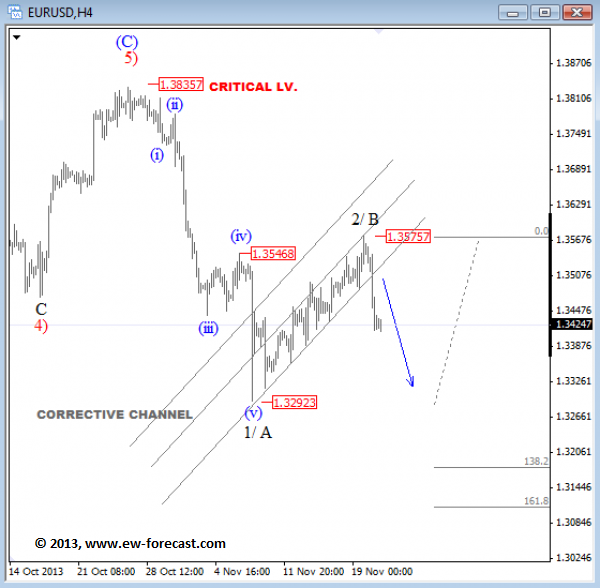
EURUSD has finally turned bearish after very complex and slow recovery from 1.3293 low. We believe this is a corrective move that is now showing signs of completion around 1.3576. The reason is latest sharp decline through the lower support line of a corrective channel which is important break for a continuation in the direction of a trend, which is down. We expect a revisit of 1.3293 in the next few days.

EURUSD

2 Week Trial


Euro Supported by Germany’s PMI

By HY Markets Forex Blog

The euro bounced back from its previous losses after the release of France and Germany’s manufacturing data on Thursday.

The euro edged 0.10% lower to $1.3424 at the time of writing. The German PMI dragged the currency back from its losses and traded around $1.35 earlier this week.

German PMI

The German manufacturing sector expanded in November, advancing above the 50-level for the fifth month in a row, a preliminary data released on Thursday confirmed. Germany’s services sector expanded for the sixth straight month.

The flash Purchasing Managers’ Index (PMI) for Germany’s manufacturing sector advanced to 52.5 points in November, up from a final reading of 51.7 seen in the previous month, data from Markit Economics confirmed. Flash reading in the services sector rose to 54.5 in November, picking up from 52.9 seen in October.

France

Meanwhile in France, the manufacturing and services sector recorded a drop in November, with the flash Purchasing Managers’ Index (PMI) coming in at 47.8 and 48.8 respectively, according to data compiled by Markit Economics.

The manufacturing sector recorded a six-month low, while the services sector marked a four-month low.

Fed Tapering

The Federal Open Market Committee (FOMC) official minutes showed that the Fed policymakers were looking for a way to lower or end its bond-buying program in the future.

Senior Fed member and St Louis Fed Chief James Bullard said that the Federal Reserve could reduce its asset purchases at its December meeting scheduled to take place from December 17-18; if the Federal Reserve (Fed) sees an upbeat data from the jobs sector in November.


Visit www.hymarkets.com   to find out more about our products and start trading today with only $50 using the latest trading technology today.

The post Euro Supported by Germany’s PMI appeared first on | HY Markets Official blog.

Article provided by HY Markets Forex Blog

USD/JPY: Yen Drops to Two-month Low on Taper Worries

By HY Markets Forex Blog

The Japanese yen dropped against the US dollar on Thursday, as the greenback strengthens with support from the Federal Open Market Committee (FOMC) minutes which revealed that the Federal Reserve could begin to taper its monthly asset purchases as early as December.

The Japanese yen dropped to a two-month low after Japan’s central bank decided to maintain its stimulus program.

The US dollar gained 0.67% to ¥100.70 as of 6:30am GMT, while the Japanese yen fell after the Bank of Japan (BoJ) maintained its stimulus program intact to achieve its 2% inflation target

“The BoJ will conduct money market operations so that the monetary base will increase at an annual pace of about 60-70 trillion yen,” according to the statement from the bank.

FOMC Meeting Minutes

The FOMC meeting minutes revealed that the Federal Reserve could begin to taper its quantitative easing as early as December. The minutes stated “many members stressed the data-dependent nature of the current asset purchase program, and some pointed out that, if economic conditions warranted, the committee could decide to slow the pace of purchases at one of its next few meetings”.

The minutes also hinted the central back is looking for a way to lower or end its bond-buying program in the future. Fed policymakers have seen some improvement in the labour market but still expecting a pick-up in the economy.

On Wednesday, St Louis Fed President James Bullard also hinted tapering could begin in December and said if the Federal Reserve (Fed) see an upbeat data from the jobs sector in November, the US central bank might decide to scale-back on its monthly asset purchasing program at the next FOMC meeting scheduled to take place from December 17-18.

James also commented on the inflation, as it remains low and said that there is not enough pressure on inflation.


Visit www.hymarkets.com   to find out more about our products and start trading today with only $50 using the latest trading technology today.

The post USD/JPY: Yen Drops to Two-month Low on Taper Worries appeared first on | HY Markets Official blog.

Article provided by HY Markets Forex Blog