Murray Math Lines 10.01.2014 (AUD/USD, EUR/JPY, SILVER)

Article By RoboForex.com

Analysis for January 10th, 2014

AUD/USD

Bears managed to keep price below Super Trends; earlier pair rebounded from trend line. Most likely, in the future pair will break the 0/8 level and enter “oversold zone”.

Pair is moving in the middle of H1 chart. During correction, I opened one more sell order. If later bears are able to keep price below the 3/8 level, pair will continue falling down towards the 0/8 one.

EUR/JPY

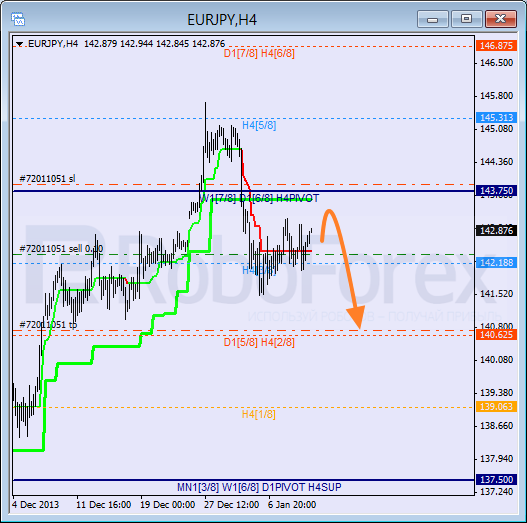
Pair is still being corrected; earlier Super Trends formed “bearish cross”. In the near term, price is expected to move towards the 2/8 level. However, if price breaks the 4/8 level, pair may start new ascending movement.

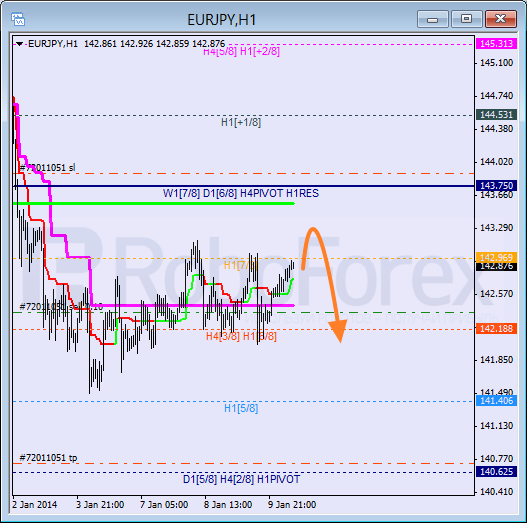
Pair is moving in upper part of H1 chart. Over the last couple of days, price has rebounded from the 7/8 level several times. If market is able to keep price below Super Trends, pair will start moving towards its closest target at the 4/8 level.

SILVER

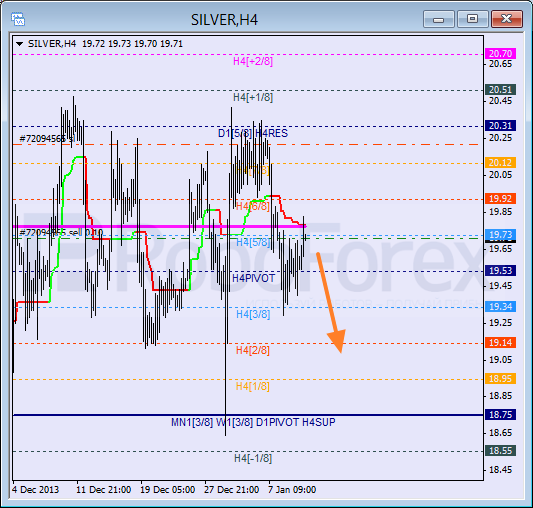
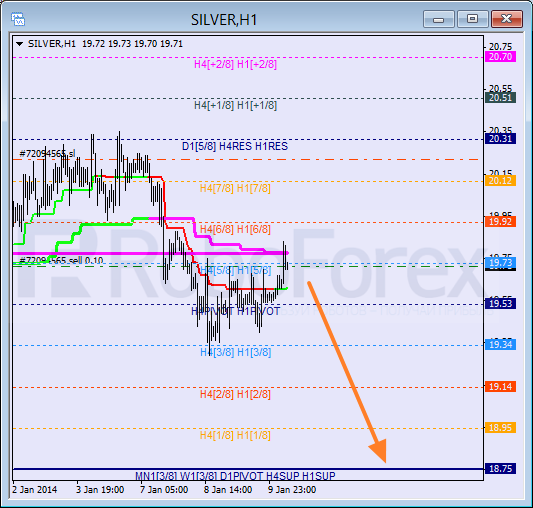
Silver is still being corrected; price wasn’t able to stay above Super Trends, which may form “bearish cross” in the nearest future. I’ve decided to close my buy order and open sell one. I’ll move stop into the black right after market starts moving downwards.

The lines at the H4 and H1 charts are completely the same. Possibly, market may rebound from the 5/8 level during the day. If later price is able to stay below the 3/8 level, instrument will continue falling down towards the 0/8 one.

RoboForex Analytical Department

Article By RoboForex.com

Attention!
Forecasts presented in this section only reflect the author’s private opinion and should not be considered as guidance for trading. RoboForex LP bears no responsibility for trading results based on trading recommendations described in these analytical reviews.


Japanese Candlesticks Analysis 10.01.2014 (EUR/USD, USD/JPY)

Article By RoboForex.com

Analysis for January 10th, 2014

EUR/USD

H4 chart of EUR/USD shows bearish tendency, which is confirmed by Three Methods pattern and Three Line Break chart. Heiken Ashi candlesticks indicate bullish pullback.

H1 chart of EUR/USD shows correction within descending trend, which is indicated by Morning Doji Star and Tweezers patterns. Three Line Break chart confirms that correction continues; Heiken Ashi candlesticks indicate bearish pullback.

USD/JPY

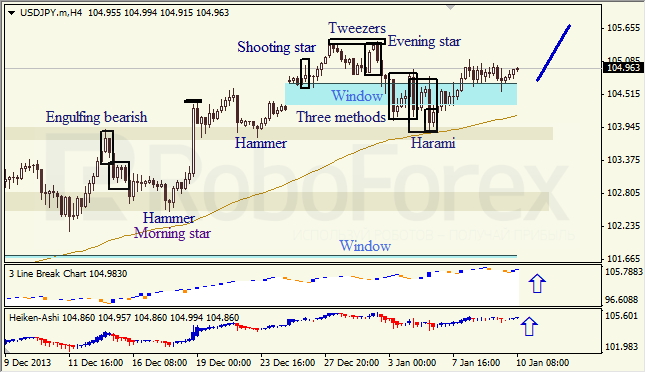
H4 chart of USD/JPY shows end of correction, which is indicated by bullish Harami pattern. Closest Window is support level. Three Line Break chart and Heiken Ashi candlesticks confirm ascending movement.

H1 chart of USD/JPY shows sideways correction, which started after Hanging Man pattern. Closest Window is support level. Three Line Break chart indicates that correction continues; Hammer pattern and Heiken Ashi candlesticks confirm ascending movement.

RoboForex Analytical Department

Article By RoboForex.com

Attention!
Forecasts presented in this section only reflect the author’s private opinion and should not be considered as guidance for trading. RoboForex LP bears no responsibility for trading results based on trading recommendations described in these analytical reviews.


Banking on Ethanol and High-Tech Fracking: Keith Schaefer

Source: Peter Byrne of The Energy Report  (1/9/14)

http://www.theenergyreport.com/pub/na/banking-on-ethanol-and-high-tech-fracking-keith-schaefer

Keith Schaefer, editor and publisher of Oil & Gas Investments Bulletin, has built an impressive track record of foreseeing structural changes in the energy industry. Schaefer knows when to take or refuse opportunities in the volatile ethanol industry, as he demonstrates in this interview with The Energy Report. And he knows how to bide his time while waiting for catalytic moments—the singular events that can make all the difference between survival and extinction for a junior oil and gas company struggling to raise above the fray in the fracking fields.

The Energy Report: Keith, why do you say that there is an ethanol “renaissance?”

Keith Schaefer: Ethanol is one of the most volatile sectors in the energy complex. The industry almost went bankrupt during the crash of ’08. It rebounded; 2010 and 2011 were fantastic years for ethanol, with great profits. Then, the drought of 2012 caused corn prices to soar and ethanol profitability collapsed. But here we are a mere year later, enjoying the largest bumper crop of corn in American history. Corn is the main input price for ethanol; its cost determines the rate of profit. With corn locked into low costs for a few quarters, ethanol companies are minting money.

TER: Are ethanol prices always at the mercy of the weather?

KS: Well, yes, but there have been very few droughts in the last 15-20 years, so the swing over the last two years in crop sizes—and therefore pricing and profitability for ethanol—is not normal. I don’t see weather as a big statistical factor over the long term. But in the short run, prices will continue to fluctuate in tandem with drought-reduced crops or bumper crops.

TER: Are costs stable in the chain of ethanol supply, from the farm to the storage facility to the distribution networks?

KS: There is not a lot of existing corn storage capacity for the bumper crop excess, but the ethanol industry is building up more storage capacity. The distribution system is tightening, however, because ethanol and corn are shipped in railcars. Due to the large price differential between American oil and international oil, the Brent/WTI spread, the oil companies are renting most of the available tankers to move fossil fuel product. That has negatively impacted the availability of tankers to move ethanol, and there is an actual shortage of ethanol in some areas. I view that as a bullish factor for ethanol going into 2014.

TER: Do you like any particular ethanol companies?

KS: The company that needs to be on everybody’s radar screen is Green Plains Renewable Energy Inc. (GPRE:NASDAQ). It is hitting new highs close to $20/share. It was just included in the S&P 600. Green Plains is producing a billion gallons of ethanol per year. To put that in context: The U.S. produces 13 billion gallons per year, so Green Plains has one-thirteenth of the ethanol industry. It is the largest independent ethanol pure play. It has one of the top management teams in the entire business—a very competent, smart set of players. They hedge out a huge amount of their production, as much as possible.

TER: Is hedging a good idea?

KS: Oil can be hedged out two, three or four years. Due to supply variability, ethanol cannot be hedged out more than nine months. And as the new corn crop gets ready for reaping, there is no visibility beyond three months. It is an incredibly volatile sector.

But, right now we have about an eight-month pathway of visibility with unbelievable margins. Including the byproducts—corn, oil and distiller’s grain—the margin for ethanol, which is commonly called the crush spread, is higher than forty cents per gallon.

To put that in context, Green Plains produces a billion gallons, so do the math: Forty cents a gallon times a billion gallons is $400 million ($400M) in cash flow. A conservative multiple of five times cash flow generates a valuation of $2 billion ($2B) for a company with only 35 million shares out. The numbers have quickly become very compelling.

Now the reality is that Green Plains is not going to realize that kind of margin because it is such an active hedger. It is willing to mitigate risk by taking a reduced margin. But the large players in the ethanol spot market are just rolling in cash.


TER: Prices in the domestic ethanol market are related to oil supply, politics and also to environmental concerns. Is hydraulic fracturing becoming more sustainable?


KS: Fracking is definitely becoming more sustainable as time goes by. Thanks to pressures from the environmental industry, the oil industry has responded with the creation of food-grade fracking fluid, for example. There is an increasing consensus that fracking does cause micro seismic events, and high-quality baseline studies are being done to assess how best to respond to that issue. Popular opinion polls show that fracking is increasingly accepted by the American public. But, for years, the industry missed the boat on how to sell fracking to the public—particularly on how to calm down fears of poisoned drinking water. Frankly, the industry is still a bit behind on that issue, but it is coming around and slowly adjusting to directly addressing these fears, as opposed to dismissing the concerns outright and just saying, “Well, we create lots of jobs.”


TER: What are some of the improvements in fracking technology you’re talking about?


KS: There are two different kinds of underground water. Everyone gets excited about the potable groundwater that resides at a very shallow level. The casing for the frack that goes through that groundwater is very regulated. When there has been a problem with groundwater contamination, it’s either been tied to naturally occurring methane at shallow levels or to a bad cement job.


But fracking takes place down to two miles below the surface, so that activity has nothing to do with groundwater safety. In fact, there is such a massive amount of water underground that the frackers could be net water producers. Of course, that water is very briny, full of chemicals and dirt, and is not potable. It would take quite a bit of cleaning for this down-deep water to become drinkable.


However, during the last year, the industry has started to change the chemical composition of its fracking fluids, which allows it to use a lot more of the naturally occurring briny water to frack way down deep—reducing the need to use fresh water.


Because the meters being drilled is increasing, the amount of fresh water being used for fracking is still increasing, but the amount of recycled water and deep briny water being used to frack is increasing much more rapidly.


TER: Any other important improvements in hydraulic fracturing technologies?


KS: It’s really interesting to see what pioneers like EOG Resources Inc. (EOG:NYSE) and Whiting Petroleum (WLL:NYSE) are doing. Both firms have made simple but very profound changes in their fracking methodology, principally going with short, wide fracks instead of long skinny fracks. The fairly small sets of data available on this approach show the drillers are getting slightly higher initial production (IP) rates compared to the norm. But the real game changer is that the decline rate on the shale wells and the tight oil wells were at 65–80% in year one. With this simple change in fracking from long and skinny to short and fat, those decline rates are now showing at 15–20%. Slower decline rates mean that wells will pay out faster.


TER: Will the U.S.-based shale reserves hold up?


KS: There is a lot of new oil production in the U.S. It seems like every quarter, the experts underestimatehow much oil the U.S. industry is producing. And almost none of these experts are looking at the new wider, shorter methodology being pioneered by Whiting and EOG. Once that method starts to gain widespread acceptance—look out—there could be an unbelievable increase in U.S. oil production in the very near-term.


TER: Have any recent IPOs caught your eye?


KS: Cardinal Energy Group Inc. (CEGX:OTCBB) is a new IPO put out by Scott Ratushny who did Midway Energy, which was bought by Whitecap Resources Inc. (WCP:TSX.V) in early 2012. Scott is one of the top guys on the street in Calgary and his Cardinal sports an A+ management team. It raised public money at $2/share, $4/share and as high as $8/share privately. The Cardinal IPO launched at $10.50/share and the stock is trading at $11.50/share.


TER: What is so attractive about Cardinal?


KS: It controls light oil assets with very low decline rates. But it is breaking ground in the dividend arena. I am not a fan of junior dividend companies—the overall payout ratio between drilling and dividend is usually between 95% and 120% of cash flow. Many juniors spend more than they take in, and then they are forced to rely upon their debt lines and equity to fill in the operating gap. But Cardinal’s policy is that the all-in payout ratio, including dividends and drilling, is set at 60% of cash flow. That means that management can use the extra money to pay down debt, or to grow a little more aggressively. And, right now, the market is rewarding that strategy.


TER: Will that joy last?


KS: As time progresses, it will be interesting to see (a) what the Cardinal managers do with the extra free cash flow and (b) if the market will continue to reward them for being conservative. Now the big issue here is that Cardinal does not have a huge growth model ahead, so it will have to employ its cash money to figure out the next best move. In Cardinal’s favor, its assets have a low decline rate. It is an example of a different approach from the “grow baby, drill baby” model of the last three years. The market is turning from rewarding growth to rewarding sustainability in the junior sector. Management teams that cannot grow and keep their debt to cash flow ratio steady will be punished.


TER: Is providing energy services for drillers and refiners proving to be a profitable, sustainable sector?


KS: Energy service firms are the no-brainers of the energy market, because nobody really knows where commodity prices are going. It is hard to see oil and gas prices climbing much higher. In fact, I expect to see a 10% drop in commodity prices during the next year. And a 10% drop in commodity prices is a 20–25% drop in profitability for most of the producers, which will blow a big headwind for their stocks. On the services side, the drillers will continue to require chemicals, fluids and equipment.


On paper, the service sector sounds great. But there is not a lot of pricing power in it at the moment. On the ground, utilization rates are perking up, but not to the point where prices are perking up, too.


TER: What service firms should investors look at to survive the next period?


KS: Both Precision Drilling Corp. (PD:TSX) and CanElson Drilling Inc. (CDI:TSX.V) are well-run companies with leverage to an increased cycle. CanElson is a junior with a great team. It is a “forget about it” kind of stock and I have enough confidence in management that I do not watch it day-to-day.


On the fracking side, I am a big believer in the Canyon Services Group Inc. (FRC:TSX) team. They are talking about being close to 100% utilization in Q1/14; that means pricing power should enter the market. I am not long on Canyon stock right this second. I am waiting to see how the winds are blowing. But I love that it has a disciplined team that really understands the business. Management is not willing to take on any job at any price, like some of its American counterparts that throw caution to the wind and lowball prices. I am patiently waiting for a dramatic catalyst to drive that sector in western Canada. It should be liquefied natural gas (LNG).


On the junior side, investors could look to Petrowest Corp. (PRW:TSX). It does a great job with logistics and heavy hauling out in the bush—trailblazing the way for the energy industry to develop the newest areas. Its CEO, Ian Hogg, is doing a champion job and the stock is close to a 50% gain since inception. As it attracts new business, its cash flow increases.


I also cover Enterprise Group Inc. (E:TSX.V). It has had real success in buying what I call “oddball” service companies with proprietary technologies and higher profit margins than the service sector as a whole. Enterprise’s managers are good at convincing the oddball firms to sell out to them, and then they grow these acquisitions very quickly under their corporate umbrella. I love that aspect. And the stock is trading great. It is definitely one to watch for 2014. Enterprise could see up to 30% organic growth every year for the next three or four years.


TER: Thanks for the tips, Keith.


Keith Schaefer is editor and publisher of the Oil & Gas Investments Bulletin, which finds, researches and profiles growing oil and gas companies that Schaefer buys himself, so Bulletin subscribers know he has his own money on the line. He identifies oil and gas companies that have high or potentially high growth rates and that are covered by several research analysts. He has a degree in journalism and has worked for several Canadian dailies but has spent over 15 years assisting public resource companies in raising exploration and expansion capital.


Want to read more Energy Report interviews like this? Sign up for our free e-newsletter, and you’ll learn when new articles have been published. To see a list of recent interviews with industry analysts and commentators, visit our Streetwise Interviews page.


DISCLOSURE:
1) Peter Byrne conducted this interview for The Energy Report and provides services to The Energy Report as an independent contractor. He or his family own shares of the following companies mentioned in this interview: none.
2) The following companies mentioned in the interview are sponsors of The Energy Report: None. Streetwise Reports does not accept stock in exchange for its services or as sponsorship payment.
3) Keith Schaefer: I or my family own shares of the following companies mentioned in this interview: Enterprise Group Inc., CanElson Drilling Inc., Precision Drilling Corp. and Green Plains Renewable Energy Inc. I personally am or my family is paid by the following companies mentioned in this interview: None. My company has a financial relationship with the following companies mentioned in this interview: None. I was not paid by Streetwise Reports for participating in this interview. Comments and opinions expressed are my own comments and opinions. I had the opportunity to review the interview for accuracy as of the date of the interview and am responsible for the content of the interview.
4) Interviews are edited for clarity. Streetwise Reports does not make editorial comments or change experts’ statements without their consent.
5) The interview does not constitute investment advice. Each reader is encouraged to consult with his or her individual financial professional and any action a reader takes as a result of information presented here is his or her own responsibility. By opening this page, each reader accepts and agrees to Streetwise Reports’ terms of use and full legal disclaimer.
6) From time to time, Streetwise Reports LLC and its directors, officers, employees or members of their families, as well as persons interviewed for articles and interviews on the site, may have a long or short position in securities mentioned and may make purchases and/or sales of those securities in the open market or otherwise.


Streetwise – The Energy Report is Copyright © 2014 by Streetwise Reports LLC. All rights are reserved. Streetwise Reports LLC hereby grants an unrestricted license to use or disseminate this copyrighted material (i) only in whole (and always including this disclaimer), but (ii) never in part.


Streetwise Reports LLC does not guarantee the accuracy or thoroughness of the information reported.


Streetwise Reports LLC receives a fee from companies that are listed on the home page in the In This Issue section. Their sponsor pages may be considered advertising for the purposes of 18 U.S.C. 1734.


Participating companies provide the logos used in The Energy Report. These logos are trademarks and are the property of the individual companies.


101 Second St., Suite 110
Petaluma, CA 94952

Tel.: (707) 981-8204
Fax: (707) 981-8998
Email: [email protected]


Cut Down Car Pollution and Profit

By MoneyMorning.com.au

What was that about China’s economic collapse?

Oh, that’s right, China’s economy hasn’t collapsed.

That doesn’t mean it won’t.

But it hasn’t happened yet.

So, when will it collapse? Will it ever collapse? It probably will…one day.

But until then, we’ve found two ways to profit if the China boom keeps on booming…

Before we give you some financial advice, we’ve got some advice for Holden.

Go sell cars in China.

What are they doing wasting their time in the Aussie market? Well, we guess that’s what they’re doing. Holden’s parent company General Motors is going to China.

And who can blame them? As Bloomberg News reports:

China became the first country in which more than 20 million vehicles were sold in any given year as Toyota Motor Corp. (7293) to General Motors Co. (GM) and Volkswagen AG (VOW) delivered a record number of cars there.

Total deliveries rose 14 percent to 21.98 million units last year and may exceed 24 million in 2014…

That’s a big number by anyone’s standards – nearly 22 million cars sold in just one year. That’s equal to 1.6% of the population buying a new car. In comparison, last year saw 1.14 million new cars sold in Australia, equal to 5.4% of the population buying a new car.

It’s no wonder the car makers are ditching Australia and heading to a market with real growth. While that may be bad for one part of the Aussie economy, for two other markets the news couldn’t be better.

All the Strength but Not the Weight of Steel

/p>

The car sales numbers are great. Second to none. But that’s not the only reason the story caught our eye. This next bit of news is just as important:

With air quality deteriorating so much that children and the elderly are regularly warned to stay indoors, Beijing is tightening its vehicle quotas and Tianjin is capping the number of licences issued this year.

So, what’s so good about that?

Well, it obviously isn’t good news for the folks living in Tianjin. But what can they do? There’s clearly a huge demand for cars and other forms of private transport. If car sales keep rising, won’t that make pollution levels even worse?

Not necessarily.

This is where the story gets exciting. It’s something we’ve followed since the middle of last year.

Many people don’t realise this, but the best way to cut polluting emissions from cars is to reduce a car’s weight. It’s also a way to cut fuel costs. If you drive a small car, odds are it will cost you less in fuel than a big car.

But not everyone wants a small car. For some people, they just aren’t practical. Plus, there’s the status symbol side of it. Many people like big cars. Until recently, that has been a problem in terms of cutting pollution.

Not anymore. An innovation by Japanese carmaker Honda has resulted in a neat way for the company to cut up to 25% of a car’s weight without having a negative impact on the size or structural integrity of the car.

How has it done this? Well, most cars have a steel chassis. The reason for that is, as everyone knows, that steel is super-strong. The problem is it’s also heavy. Honda has the solution. It has developed a process that enables the company to bond heavy steel to lightweight aluminium.

The result is a structure that’s at least as strong as a fully-steel chassis, but only three-quarters of the weight.

It’s an amazing breakthrough, and will likely have a big impact on the car industry. The CEO of Alcoa reckons this innovation, if replicated across the entire car industry, could quadruple the demand for aluminium in the industry. And with China’s cities suffocating under a cloud of smog, anything that can help reduce pollution will be welcome.

That’s why we’ve taken a unique approach to investing in this innovation in the car industry – it doesn’t involve buying a carmaker. But there’s another development that could impact this industry. And it could be a boon for one Aussie company…

The Only Way to Beat China’s Pollution Problem

The Financial Times reports:

…it now looks likely that Indonesia, one of the world’s most important sources of minerals used to produce industrial metals, will implement an export ban on unprocessed mineral ore…

The move, expected to be announced on Sunday, will be most keenly felt in China, which relies heavily on Indonesian ore to produce nickel pig iron, a key ingredient in stainless steel. More than a fifth of China’s aluminium is produced from bauxite imports from Indonesia.

The last sentence interests us most. Aluminium is a big input into the car industry even without Honda’s steel-aluminium bonding technique.

If Indonesia acts to slap an export ban on bauxite, that will have a big supply impact on industries that use aluminium. That’s where things get interesting. Australia has one of the world’s biggest reserves of bauxite.

Any Indonesian export ban should have a positive impact on Australia’s bauxite producers. And that should be good news for the stock we’ve recommended in Australian Small-Cap Investigator to take advantage of increased demands for bauxite.

The way we look at it is simple. The demand from China for resources still doesn’t show any sign of slowing down. Chinese consumers bought nearly 22 million cars last year, and estimates are this will grow by 10% this year.

If China’s cities are serious about cutting pollution, one of the best ways it can do so is to encourage carmakers to build lighter and more fuel-efficient cars. That would mean more demand for aluminium and bauxite, and a great opportunity for the companies that can meet that demand.

Cheers,
Kris+


By MoneyMorning.com.au

Could DNA be the Future of Computing?

By MoneyMorning.com.au

Did you know that DNA when it is being copied can spin at speeds of 10,000 revolutions per minute?

The DNA in the nucleus of a human cell packs over 3 gigabytes of data, all on a ‘drive’ so small a powerful microscope is needed to see it. However, if you unraveled the threads of these fascinating spiral, twisted structures and stretched them out, they’d be some six feet long. And that’s just for a single cell.

The typical person is walking around with some 10 trillion human cells making up his or her body. If we would stretch out all of that nuclear DNA end to end, from each and every cell, it would be enough to cover the distance to the moon and back tens of thousands of times.

DNA is amazing stuff. It’s also a surprisingly durable molecule. It’s been used to clear innocent people of criminal charges years after incarceration. We can still sometimes read information encoded in fragments of DNA molecules tens of thousands of years old, while, at the same time, we might sit and fret whether or not our computer drive will survive the year without crashing and losing its data.

DNA’s also tough in other ways, such that nanoresearchers and computer scientists are using it to build 3-D structures and possible biology-based computers in the future.

The future of computing might not belong to hardware and software, but to wetware – biologically derived computing machines. The ‘iPhone 20′, years from now, might be based more on biological technology than the silicon we’ve been working with for the past 50 years. The next Steve Jobs, in fact, might be tinkering in his parents’ garage right now with DNA molecules instead of circuit boards.

We’ve come a long way since Watson and Crick first described the structure of our DNA in 1953. But there’s still so much to learn about the DNA present in your cells. When we first started to read the human genome – the actual data written on those amazing molecules – it was a real head scratcher in some ways.

The vast majority of the code appeared to serve no purpose whatsoever; 98% of it, in fact, doesn’t appear to contain code for manufacturing protein – the building blocks of cells – what was long considered to be the primary function of genomic data.

This noncoding DNA was, in fact, considered ‘junk’, and the term ‘junk DNA’ entered the genetics vocabulary. But maintaining a huge database carries considerable costs. It needs to be maintained and protected from data corruption. Whenever it is replicated, it requires a longer period of time and more proteins to build a fresh copy than if DNA were smaller. This doesn’t fit too well with the tendency of biological systems toward efficiency. What’s not needed is usually discarded eventually, which is why we have animals that have lost their sense of sight from spending many generations living in caves.

So clearly, something was going on with this ‘junk DNA’ we didn’t yet fully understand. We are already learning, for example, that many of the noncoding regions exert a regulatory role on the ones that actually code for proteins.

A recent discovery by researchers at the University of Washington, however, points to DNA possibly doing more things in ways we haven’t realised.

According to Dr. John Stamatoyannopoulos at the university, there are actually two codes written in a DNA strand. The first one science is already very familiar with. It uses an alphabet of 64 letters, written in units called codons, each of which is made up of three of the four nucleotides that make up DNA.

According to Stamatoyannopoulos, however, there appears to be a dual meaning to some codons, so that they actually present a second piece of genetic data. He calls these sequences duons and believes they may help regulate the activity of genes.

The fact that the genetic code can simultaneously write two kinds of information means that many DNA changes that appear to alter protein sequences may actually cause disease by disrupting gene control programs or even both mechanisms simultaneously.

This discovery might help in future medical research, since the regulation and control of protein production within cells can be related to disease.

Ad lucrum per scientia (toward wealth through science),

Ray Blanco,
Contributing Editor, Money Morning

Ed note: ‘Could DNA be the Future of Computing?’ was originally published in Tomorrow in Review.


By MoneyMorning.com.au

Sorting Through the Chaff: The Michael J. Fox Foundation’s Tracey Mumford on the Quest to Cure Parkinson’s Disease

Source: George S. Mack of The Life Sciences Report  (1/9/14)

http://www.thelifesciencesreport.com/pub/na/sorting-through-the-chaff-the-michael-j-fox-foundations-tracey-mumford-on-the-quest-to-cure-parkinsons-disease

The business of drug development survives by saving lives, but sometimes nonprofit, private activism is needed to kick-start a new medicine into development. The Michael J. Fox Foundation for Parkinson’s Research is the world’s largest nonprofit funder of Parkinson’s disease research, having awarded more than $400 million in grants during its 13-year existence. Senior Associate Director of Research Partnerships Tracey Mumford is the foundation’s link to companies with good ideas. In this interview with The Life Sciences Report, Mumford discusses exciting companies that have warranted foundation support—companies that investors might find very interesting.

The Life Sciences Report: Tracey, you’re responsible for industry strategy at The Michael J. Fox Foundation for Parkinson’s Research (MJFF). You engage and deal with companies, large and small. Can you give me a very brief overview of what that means?

Tracey Mumford: We at MJFF have always engaged with industry groups because we feel they are a very important component of the drug development process. Over the years we have approached businesses by opening up discussions, whether strictly intellectual or targeted to specific programs. The company could be a startup biotech, a large pharma or something in between. We are open to working with all groups to advance our mission of accelerating the development of therapies and finding a cure for Parkinson’s disease.

TLSR: I’m guessing that you get hundreds of proposals each year from companies and academics. Is that reasonable?

TM: We receive between 900 and 1,000 applications each year, and they are all Parkinson’s disease-specific. We are in a very unique spot given that high volume.

TLSR: How do you sort through that number of ideas? A thousand proposals would work out to about four each workday. How do you manage that?

TM: That’s a very good question. I’ll start by saying that our research team includes more than 30 people, and 10 of those are scientists—nine Ph.D.s and one M.D. Those scientists are coupled with business strategists, myself included, to ensure that we fund the most exciting research scientifically and also apply sound business principles to the projects we select. The goal is to ensure the highest likelihood of success. The marriage of business and science also applies to our overall strategy—how to lay that strategy out in any given year and adjust accordingly.

In terms of specifics, we typically employ a two-step application process. We ask for a short letter of intent or pre-proposal, which is reviewed internally by our team of scientists and business strategists. Depending on the project, we may ask an external expert—perhaps a member of our scientific advisory board—to give his or her thoughts.

TLSR: You narrow the pre-proposals down, and then what?


TM: Once we have gone through all the pre-proposals, we come up with a list and invite those on the list to submit a full application. We then begin a second review and, again, ask external reviewers to give their thoughts and feedback. The MJFF team is very involved in this review. We consider the opinions and advice of the external reviewers vis-à-vis what we know about the field, the projects that we have funded in the past, the makeup of our current portfolio and what we’re focused on in a given year and/or funding program. All final funding decisions rest with The Michael J. Fox Foundation staff.


TLSR: You were an analyst at Deutsche Bank. Were you a sellside analyst?

TM: I wasn’t a sellside analyst; I was on the traditional investment banking side.

TLSR: I’m wondering if you apply the same type of diligence to a proposed product as you would when you were looking at drug development companies as an investment banker.

TM: There is a vein of that, but the process is certainly different. We see ourselves as a group funding within the valley of death, so we are willing to take on more risk than other groups might have the appetite for.

TLSR: Tracey, when you look at a proposed therapy—perhaps a preclinical idea—are you determining whether it has a certain percentage chance of being efficacious, getting approved and getting marketed?


TM: While those factors ultimately come into play, we’re really assessing the scientific rationale and the data generated so far, particularly if we are considering a preclinical project. When we’re funding a therapeutic project, particularly if it’s early on in the approval process, we do need to understand what the commercial landscape looks like.


TLSR: You could give a company a grant of $75,000 ($75K) or $1 million ($1M), and you have to be quite careful about how you allocate your funds. However, drug developers see you as a source of nondilutive financing, and cash is fungible. How do you make certain that progress is being made on your targets? How do you ensure that the funds are applied to your goals?


TM: We are not a group that just writes checks. More often than not, before funding a project, we call the principal investigator and say we’re very interested, but we have these suggestions, and this is how we would like to move forward with the proposal. We ultimately develop a project plan together with that investigator, and we are very clear in laying out the milestones that should be achieved over the course of the grant. We tie our payments to those scientific milestones.


We are not only worried about achieving the scientific steps, we also want to ensure that there is a sense of urgency in our awardees as they execute their projects. We’re very thoughtful about the timelines we set out and what must be done to achieve funding.


TLSR: How do you prioritize your projects? Do you go to the areas of greatest need, or do you prioritize in favor of projects that can be developed expediently?


TM: It is a bit of a mix. At the very highest level, the needs of Parkinson’s disease patients today drive our strategy. We look at the entire continuum of disease, and there are symptoms and targets that we particularly focus on.


TLSR: Please break that down for me.


TM: In the disease-modifying space, we have spent the most time and effort on alpha-synuclein and leucine-rich repeat kinase 2 (LRRK2). In the symptomatic realm, we’ve been very focused on improving motor function and alleviating dyskinesia, which is a very common side effect of the gold-standard symptomatic treatment for Parkinson’s disease, L-dopa (levodopa).


Another priority area for MJFF is the alleviation of cognitive impairment in Parkinson’s disease. We feel that understanding and further verifying biomarkers as research tools and diagnostics for Parkinson’s disease is very important, and so we have prioritized that. Other challenges that we are addressing will accelerate the field widely.


TLSR: Do you have preferred mechanisms of action?


TM: We don’t. We are generally agnostic to the approaches that groups take. We are open to exploring any interesting idea that seems to have legs and potential efficacy. Looking at our portfolio, you’ll see we support projects across all different types of mechanisms.


TLSR: You mentioned biomarkers as a priority goal. Are biomarkers currently in use in the Parkinson’s space?


TM: There are currently no fully validated biomarkers for Parkinson’s disease, but we are working hard on that. We are sponsoring a large study called the Parkinson’s Progression Markers Initiative (PPMI), an observational clinical study in which we use advanced, standardized imaging, biological sampling and clinical and behavioral assessments to see if we can come up with a constellation of progression biomarkers for Parkinson’s disease.


TLSR: It sounds like we’re a long way from having biomarkers that could be used as endpoints in clinical trials. Would that be fair to say?


TM: We hope that, via PPMI, we will have validated biomarkers in a few years’ time. Whether or not we can utilize those biomarkers as endpoints is difficult to say. Perhaps they could be utilized as secondary endpoints.


The goal is, of course, to have these serve as primary endpoints one day. But we need to generate more data around the biomarkers before they can be adequately utilized in that way.


TLSR: Can we talk about some companies? I’d love to hear about what particular companies are working on with MJFF.


TM: I’m happy to talk about more than one. Civitas Therapeutics Inc. (private) is a biotech based in Chelsea, Mass., right outside of Boston. We have been working with Civitas for a few years on its inhaled L-dopa project. The proposed product is CVT-301 (dry powder levodopa for inhalation), which is currently in a phase 2b clinical trial. It comes in a small inhaler and is meant to be a rescue therapy for Parkinson’s patients with motor response fluctuations, which are known as “off” phenomena. If you feel that you are going “off” from your L-dopa, and you are going into a meeting or have something you need to do, you can take a puff from the inhaler, after which your L-dopa plasma levels go back up and you regain motor functionality.


TLSR: How much support have you granted Civitas?


TM: We’ve supported it through phase 1 and into phase 2, to the tune of more than $1.3M. We’ve worked with the company very closely on its approach to the Parkinson’s patient population, and see ourselves as a true partner in how Civitas has designed its studies. Earlier this year, following our investment in its phase 2 study, the company was able to raise $38M in venture capital funding. This is a wonderful example of how the MJFF works with industry to help companies advance their programs and get more data, so that other investors get interested.


TLSR: With that level of investment from venture capital, I would imagine Civitas is close to proof of concept.


TM: This phase 2b trial of CVT-301, with a proposed enrollment of 80 patients, started in April 2013 and is scheduled for completion in February 2014.


TLSR: Another company you might speak to?


TM: Amicus Therapeutics Inc. (FOLD:NASDAQ) is a biotech working in the preclinical realm on a compound that increases the activity of the lysosomal enzyme glucocerebrosidase (GCase), which would lower alpha-synuclein levels within a patient’s system. We have funded Amicus to the tune of about $700K over the years. In September the company announced a partnership with Biogen Idec Inc. (BIIB:NASDAQ) around GCase and the alpha-synuclein pathology associated with Parkinson’s. This was very exciting for us, particularly for a product that is still in the preclinical realm.


TLSR: Biogen Idec has made tremendous inroads into neurodegenerative disease, and has a global network of connections with clinicians. I’m thinking that its interest in Amicus and the GCase/alpha-synuclein pathway must be a very hopeful sign.


TM: Just to dovetail, the Amicus collaboration is the first of two deals that Biogen Idec did in the alpha-synuclein space this year. On Dec. 9 the company announced a deal with Proteostasis Therapeutics Inc. (private), another company we have funded that’s working in the preclinical space on alpha-synuclein disaggregation.


TLSR: Another company?


TM: We are working with Canada-based MedGenesis Therapeutix Inc. (private), which we have supported since 2010 to the tune of about $2M. MedGenesis is currently running a phase 2 study on a surgical approach for glial cell line-derived neurotrophic factor (GDNF) delivery. This exciting project is potentially disease modifying. The trophic factor space has been interesting in Parkinson’s disease over the past few years. The results of MedGenesis’ study are due mid-2014, and we hope it is successful. A lot hinges on the results of the trial, given some failures in the trophic factor space recently—namely Ceregene Inc. (a unit of Sangamo BioSciences Inc. [SGMO:NASDAQ]), which announced in mid-April that its phase 2b trial of the CERE-120 (AAV2-vector expressing neurturin) gene therapy product did not meet the endpoint.


TLSR: Is there another name you might mention?


TM: Cynapsus Therapeutics Inc. (CYNAF:OTCQX; CTH:TSX.V) is new to MJFF. We started funding the company in 2012. Cynapsus is working on a dissolvable apomorphine sublingual film as a rescue therapy for patients, again, having “off” episodes. Apomorphine is available in the European Union via injection, but is not available here in the U.S. Cynapsus’ under-the-tongue administration is certainly preferable to an injection, which would be difficult for patients suffering an off episode since the episode may include muscle stiffness and/or the patient having trouble just starting movement. The Cynapsus product is in a phase 1b clinical trial in healthy volunteers to see if blood levels of apomorphine can be achieved via the film delivery system. We’ve funded the company for about $1M, and it has been able to raise some additional funding on the back of our investment.


TLSR: Tracey, MJFF also serves to connect drug developers, academics and others in the field. Can you tell me about that?


TM: Yes. We are working to enable groups to find larger funders and partners to work with. The foundation does this via two formal mechanisms. One is our Annual Parkinson’s Disease Therapeutics Conference, which was held in October 2013 in New York City. The event actually sold out—we had almost 280 attendees. It was a very healthy mix of industry groups and academic investigators. Many conversations and partnerships came out of that meeting, which was the purpose.


We also host the Partnering Program. At the request of investors and business development folks within the pharmaceutical and larger biotech industry, we decided to launch an e-mail version of the Annual Parkinson’s Disease Therapeutics Conference, with a bit of a different slant. We cull through our portfolio and handpick those projects we feel have the most promising results. We then ask those companies to fill out two pages of nonconfidential information, which we share with the investment and pharma communities. It’s a nice way to keep Parkinson’s at the top of people’s minds, and also to share with potential investors our thoughts on the companies we think they should be paying attention to.


TLSR: I’ve enjoyed learning a bit about MJFF. Thank you for this overview.


TM: Thank you so much, George.


Tracey Mumford joined The Michael J. Fox Foundation in 2011. In her current role, she is responsible for MJFF’s industry strategy and is focused on increasing engagement and developing partnerships with various industry groups, including pharma, biotechs and venture capital firms. Prior to joining MJFF, Mumford was an associate in the Capital Services Group within the Equities Division at Credit Suisse AG, where she was responsible for the relationship management of hedge fund clients in regard to capital raising activities. Prior to joining Credit Suisse, Mumford was an investment bank analyst at Deutsche Bank, in the Global Consumer Group. Mumford graduated from Bucknell University with a bachelor’s degree in economics.


Want to read more Life Sciences Report interviews like this? Sign up for our free e-newsletter, and you’ll learn when new articles have been published. To see a list of recent interviews with industry analysts and commentators, visit our Streetwise Interviews page.


DISCLOSURE:
1) George S. Mack conducted this interview for The Life Sciences Report and provides services to The Life Sciences Report as an independent contractor. He or his family own shares of the following companies mentioned in this interview: None.
2) The following companies mentioned in the interview are sponsors of Streetwise Reports: Cynapsus Therapeutics Inc. Streetwise Reports does not accept stock in exchange for its services.
3) Tracey Mumford: I own, or my family owns, shares of the following companies mentioned in this interview: None. I personally am, or my family is, paid by the following companies mentioned in this interview: None. My company has a financial relationship with the following companies mentioned in this interview: Civitas Therapeutics Inc., Amicus Therapeutics Inc., Biogen Idec Inc., Proteostasis Therapeutics Inc., MedGenesis Therapeutix Inc., Sangamo BioSciences Inc. and Cynapsus Therapeutics Inc. I was not paid by Streetwise Reports for participating in this interview. Comments and opinions expressed are my own comments and opinions. I had the opportunity to review the interview for accuracy as of the date of the interview and am responsible for the content of the interview.
4) Interviews are edited for clarity. Streetwise Reports does not make editorial comments or change experts’ statements without their consent.
5) The interview does not constitute investment advice. Each reader is encouraged to consult with his or her individual financial professional and any action a reader takes as a result of information presented here is his or her own responsibility. By opening this page, each reader accepts and agrees to Streetwise Reports’ terms of use and full legal disclaimer.
6) From time to time, Streetwise Reports LLC and its directors, officers, employees or members of their families, as well as persons interviewed for articles and interviews on the site, may have a long or short position in securities mentioned and may make purchases and/or sales of those securities in the open market or otherwise.


Streetwise – The Life Sciences Report is Copyright © 2014 by Streetwise Reports LLC. All rights are reserved. Streetwise Reports LLC hereby grants an unrestricted license to use or disseminate this copyrighted material (i) only in whole (and always including this disclaimer), but (ii) never in part..


Streetwise Reports LLC does not guarantee the accuracy or thoroughness of the information reported.


Streetwise Reports LLC receives a fee from companies that are listed on the home page in the In This Issue section. Their sponsor pages may be considered advertising for the purposes of 18 U.S.C. 1734.


Participating companies provide the logos used in The Life Sciences Report. These logos are trademarks and are the property of the individual companies.


101 Second St., Suite 110
Petaluma, CA 94952

Tel.: (707) 981-8204
Fax: (707) 981-8998
Email: [email protected]


Global Monetary Policy Rates – Dec 2013: Rates hit year-low on 9 rate cuts, 2013 average falls to 3-yr low of 5.61%

By CentralBankNews.info
    Central banks’ interest rates hit a new low for 2013 in December as nine central banks cut policy rates while only one bank raised its rate, pushing down the Global Monetary Policy Rate (GMPR) for the full year of 2013 to 5.61 percent, the lowest average rate in three years.
    For the month of December, GMPR – the average policy rate for the 90 central banks tracked by Central Bank News – fell to 5.42 percent as 2013 was characterized by declining rates each and every month from January’s 5.85 percent.
    Global monetary policy in 2013 was characterized by a high degree of monetary activism, with central banks in advanced economies pulling out all stops to stimulate economic growth, illustrated by the Bank of Japan’s (BOJ) aggressive easing campaign, rate cuts by the European Central Bank (ECB) and the adoption of forward guidance by the ECB and Bank of England (BOE) to help suppress rising bond yields.
     But amidst the general trend of monetary easing, the U.S. Federal Reserve started preparing markets for a gradual retreat from its extraordinary accommodative policy due to an improving economy, a likely sign that global policy rates reached a nadir in 2013.
    After a false start in September, the Federal Reserve finally decided in December to start trimming asset purchases by a $10 billion to $75 billion a month – the undisputed highlight of global monetary policy in December, and arguably the main feature of 2013.
    In order to take the sting out of its message that it would wind down its extraordinary accommodative policy, the Fed also said its policy rate, the fed funds rate, would be held at essentially zero “well past the time” that U.S. unemployment drops below 6.5 percent, the Fed’s previous threshold for considering changes to its policy rate.
    In addition to the Fed’s shift to a less expansive policy, the Reserve Bank of New Zealand on Dec. 11 signaled that it will be raising rates in 2014 and several Asian central banks, such as those of Malaysia, the Philippines and Taiwan are expected to follow suit during 2014.
    Indonesia, India and Turkey already tightened policy in 2013 and may continue this year, depending how currency and capital markets, and thus inflation, adjust to the Fed’s reduction in asset purchases. Brazil, which raised rates by a total of 275 basis points in 2013, is expected to end its tightening cycle in the near future.
    Other highlights of monetary policy in December include the Reserve Bank of India’s (RBI) surprise decision to hold off on any rate rises in the expectation that inflation will start to decline. Describing its decision as a close one, with obvious risks of market disruptions while waiting for fresh data, the RBI says it doesn’t want to tighten policy unless it has to for fear of damaging the economy.
    Sweden’s central bank, the Riksbank, was also a highlight of December, cutting its rate by 25 basis points and pushing back any rate rise until early 2015 from a previously-targeted late 2014 due to lower than expected inflation.
    In December policy rates fell by a total of 495 basis points due to rate reductions by the central banks of Albania, Armenia, Botswana, Egypt, Hungary, Serbia, Sweden, Uganda and Uzbekistan.
    The lone rate riser in December was Tunisia, which raised its rate by 50 basis points, resulting in a net decline in rates of 445 points.

    The gradual unwinding of the Fed’s asset purchases will remain the dominant theme of 2014 global monetary policy, along with the ECB’s handling of the threat of deflation, the BOJ’s response to an increase in sales taxes and the BOE’s answer to a drop in unemployment towards its threshold for considering changing its policy stance.
    In 2013 44 central banks cut their policy rates by a total of 5,651 basis points – an average of 128 basis points – while eight raised rates by a total of 1,450 points – an average of 181 points – for a net reduction of 4,202 points.
    This compares with 2012 when policy rates were cut by a net 6,475 basis points as 47 central banks cut rates by an average of 180 basis points while 11 banks raised rates by an average of 182 points.
   But 2012 was also characterized by a rise in GMPR to 6.2 percent from 6.0 percent in 2011 with the 2012 average skewed by some very large rate hikes – Malawi raised rates by 1200 basis points – and the fact that some central banks first starting cutting rates in the second half of the year when the global economy started to decelerate.
    Global policy rates tumbled in 2009 and 2010, with GMPR falling to 5.22 percent and 4.27 percent respectively, as central banks slashed rates as the global financial crises spread.
    Interest rates then moved higher in early 2011 on optimism that the global economy was on the mend, with GMPR rising to 6.0 percent. But it proved to be a false dawn with Europe’s sovereign debt crises, Japan’s tsunami, unrest in the Mideast and political gridlock in the U.S. souring hopes for a speedy recovery.
    In 2013 Gambia was the world’s largest rate riser, boosting rates by 600 basis points, or 40 percent of the total rise in global rates. Brazil was the second largest rate riser with 275 basis points followed by Indonesia with 175 basis points.
    Sierra Leone was the world’s largest rate cutter last year, reducing its rate by 800 basis points, followed by Belarus’ reduction of 650 basis points. Belarus was 2012’s top rate cutter with 1500 basis points.

GLOBAL MONETARY POLICY RATES (GMPR) 

                   (Changes in December 2013 and year-to-date, in basis points)

COUNTRYMSCI          DECEMBER            2013 CHANGE
RATE CUTS:
SIERRA LEONE-800
BELARUS-650
HUNGARYEM-20-275
MONGOLIA-275
KENYAFM-250
LATVIA-225
BOTSWANA-50-200
UZBEKISTAN-200-200
VIETNAMFM-200
POLANDEM-175
SERBIAFM-50-175
GEORGIA-150
MOZAMBIQUE-125
ROMANIAFM-125
ALBANIA-25-100
ANGOLA-100
COLOMBIAEM-100
CONGO DEM. REP.-100
EGYPTEM-50-100
MEXICOEM-100
MOLDOVA-100
SRI LANKAFM-100
TAJIKISTAN-100
TURKEYEM-100
UKRAINEFM-100
ISRAELDM-75
AUSTRALIADM-50
CHILEEM-50
EURO AREADM-50
JAMAICA-50
JORDANFM-50
RWANDA-50
THAILANDEM-50
UGANDA-50-50
WEST AFRICAN STATES-50
ARMENIA-25-25
AZERBAIJAN-25
INDIAEM-25
MACEDONIA-25
MAURITIUSFM-25
PERUEM-25
SOUTH KOREAEM-25
SWEDENDM-25-25
BULGARIAFM-1
SUM:495-5651
RATE RISES
PAKISTANFM50
ZAMBIA50
TUNISIAFM5075
GHANA100
DOMINICAN REPUBLIC125
INDONESIAEM175
BRAZILEM275
GAMBIA600
SUM:501450
NET CHANGE:-445-4201

Outside the Box: Knowledge and Power

By John Mauldin – Outside the Box: Knowledge and Power

In last week’s Thoughts from the Frontline I talked about the Age of Transformation, attempting to refute Robert’s Gordon rather stark and gloomy view of the future growth potential of the economy. That letter generated a rather significant amount of reader response, both pro and con, as not everyone agrees with my decidedly optimistic long-term view of the future.  It might be fun and thought-provoking, in fact, to do a letter that deals with some of the issues you raised. I really do have some of the smartest readers of any economics and investing letter out there.

Inside what was a long letter even for me, I buried a few quotes from George Gilder’s latest book, Knowledge and Power. I am not simply reading this book, I am thinking through it, as some of what he writes is truly pivotal for my own thought process.

For this week’s Outside the Box, George has graciously allowed me to reproduce chapters 1 and 3 from his book. It helps that George is a gifted wordsmith and a raconteur of the highest order. He doesn’t bury his insights in dry economics-speak that demands intense concentration if you are to stay focused on the topic. Rather, he draws you into and through the topic, until you find yourself on a delightful Slip ‘n Slide of thought. I think you will get a lot out of reading these chapters, and I strongly suggest you consider reading the whole book. It is an important one.

I write this note as I am wrapping up three days of meetings with my partners at Altegris Investments and Mauldin Economics, focusing on how to deliver better products and services to you. And we’ve enjoyed a few late-night conversations about where the world is going and how to surf the inevitable and the profitable.

In a few hours I will be off to Dubai and Riyadh, with maybe even a side trip to Abu Dhabi, after a very long layover in London, where I will jump into town to have lunch with Simon Hunt and delve deep into the happenings in China and Europe. I’ll also bounce a few ideas off him for this weekend’s letter.

I am really kind of excited about this trip, as all these places are new territory for me. You have a great week, and I will send you this weekend’s letter from Dubai.

Your wondering what I will find out there analyst,

John Mauldin, Editor
Outside the Box
[email protected]

Stay Ahead of the Latest Tech News and Investing Trends…

Click here to sign up for Patrick Cox’s free daily tech news digest.

Each day, you get the three tech news stories with the biggest potential impact.

Knowledge and Power

By George Gilder

Chapter One: The Need for a New Economics

Economic life is full of surprises. We cannot predict the value of our homes or prices on the stock market from day to day. We cannot anticipate illness or automobile accidents, the behavior of our children or the incomes of our parents. We cannot know the weather beyond a week or so. We cannot gauge what course of college study will yield the best lifetime earnings or career. We are constantly startled by newspaper headlines or the eruptions of TV events. We are almost entirely incapable of predicting the future.

Yet from Adam Smith’s day to our own the chief concern of the discipline has been to render economic events unsurprising. Given a supply x of corn and a demand y, the price will be z. Change x or y and hold all else equal and the price will instead be a predictable z′. The discernment of orderly rules governing the apparent chaos of life was a remarkable achievement and continues to amaze. Economists such as Steven Leavitt of Freakonomics fame and Gary Becker of the University of Chicago became media stars for their uncanny ability to unveil what “we should have known.” Closer investigation, however, reveals that even these ingenious analysts are gifted chiefly with 20-20 hindsight. They prosper by explaining to us what has happened more than by anticipating the future with prescient investments.

The passion for finding the system in experience, replacing surprise with order, is a persistent part of human nature. In the late eighteenth century, when Smith wrote The Wealth of Nations, the passion for order found its fulfillment in the most astonishing intellectual event of the seventeenth century: the invention of the calculus. Powered by the calculus, the new physics of Isaac Newton and his followers wrought mathematical order from what was previously a muddle of alchemy and astronomy, projection and prayer. The new physics depicted a universe governed by tersely stated rules that could yield exquisitely accurate predictions. Science came to mean the elimination of surprise. It outlawed miracles, because miracles are above all unexpected.

The elimination of surprise in some fields is the condition for creativity in others. If the compass fails to track North, no one can discover America. The world shrinks to a mystery of weather and waves. The breakthroughs of determinism in physics provided a reliable compass for three centuries of human progress.

Inspired by Newton’s vision of the universe as “a great machine,” Smith’s theory—launched in The Wealth of Nations in 1776—sought to find similarly mechanical predictability in economics. In this case, the “invisible hand” of market incentives plays the role of gravity in classical physics. Codified over the subsequent 150 years and capped in Alfred Marshall’s Principles of Economics, the classical model remains a triumph of the human mind, an arrestingly clear and useful description of economic systems and the core principles that allow them to thrive.

Ignored in all this luminous achievement, however, was the one unbridgeable gap between physics and any such science of human behavior: the surprises that arise from free will and human creativity. The miracles forbidden in deterministic physics are not only routine in economics, they constitute the most important economic events. For a miracle is simply an innovation, a sudden and bountiful addition of information to the system. Newtonian physics does not admit of new information of this kind—describe a system and you are pretty much done. Describe an economic system and you have described only the circumstances—favorable or unfavorable—for future innovation.

In Newton’s physics, the equations encompass and describe change, but there is no need to describe the agent of this change, the creator of new information. (Newton was a devout Christian but his system relieved God or his angels of the need to steer the spheres.) In an economy, however, everything useful or interesting depends on agents of change called entrepreneurs. An economics of systems only—an economics of markets but not of men—is fatally flawed.

As the eminent mathematician Gregory Chaitin has pointed out, for human and biological processes, the calculus does not suffice. He writes: “Life is plastic, creative! How can we build this out of static, eternal, perfect mathematics? We shall use post-modern math…open not closed math, the math of creativity…”

Flawed from its foundation, economics as a whole has failed to improve much with time. As it both ossified into an academic establishment and mutated into mathematics, the Newtonian scheme became a mirage of determinism in a tempestuous world of human actions. Economists became preoccupied with mechanical models of markets and uninterested in the willful people who inhabit them.

Some economists become obsessed with market efficiency and others with market failure. Generally held to be members of opposite schools—“freshwater” and “saltwater,” Chicago and Cambridge, liberal and conservative, Austrian and Keynesian—both sides share an essential economic vision. They see their discipline as successful insofar as it eliminates surprise—insofar, that is, as the inexorable workings of the machine override the initiatives of the human actors.

“Free market” economists believe in the triumph of the system and want to let it alone to find its equilibrium, the stasis of optimum allocation of resources. Socialists see the failures of the system and want to impose equilibrium from above. Neither spends much time thinking about the miracles that repeatedly save us from the equilibrium of starvation and death.

The late financial crisis was perhaps the first in history actually to be caused by economists. Entranced by statistical models, they ignored the larger dimensions of human creativity and freedom. To cite an obvious example, “structured finance”—the conglomerations of thousands of dubious mortgages diced and sliced and recombined and all trebly insured against failure—was supposed to eliminate the surprise of mortgage defaults. The mortgage defaults that came anyway and triggered the collapse came not from the aggregate inability of debtors to pay as calculated by the economists, but from the free acts of home buyers. Having bet on constantly rising home prices, they simply folded their hands and walked away when the value of their houses collapsed. The bankers had accounted for everything but free will.

The real error, however, was a divorce between the people on the ground who understood the situation and the people who made the decisions. John Allison is the former CEO of a North Carolina bank, BB&T, which profitably surmounted the crisis after growing from $4.5 billion of assets in 1989 when he took over to $152 billion in 2008. Allison ascribed his success to decentralization of power in the branches of his bank.

But decentralized power, he warned, has to be guarded from the well-meaning elites “who like to run their system and hate deviations.” So as CEO, Allison had to insist to his managers that with localized decision-making, “We get better information, we get faster decisions, we understand the market better.”

Allison was espousing a central insight of the new economics of information. At the heart of capitalism is the unification of knowledge and power.  As Friedrich Hayek, leader of the Austrian school of economics, put it, “To assume all the knowledge to be given to a single mind … is to disregard everything that is important and significant in the real world.” Because knowledge is dispersed, so must be power. Leading classical thinkers such as Thomas Sowell and supply-siders such as Robert Mundell refined the theory. All saw that the crucial knowledge in economies originated in individual human minds and thus was intrinsically centrifugal, dispersed and distributed.

Enforced by genetics, sexual reproduction, perspective and experience, the most manifest characteristic of human beings is their diversity. The freer an economy is, the more this human diversity of knowledge will be manifested. By contrast, political power originates in top-down processes—governments, monopolies, regulators, elite institutions, all attempting to quell human diversity and impose order. Thus power always seeks centralization.

The war between the centrifuge of knowledge and the centripetal pull of power remains the prime conflict in all economies. Reconciling the two impulses is a new economics, an economics that puts free will and the innovating entrepreneur not on the periphery but at the center of the system. It is an economics of surprise that distributes power as it extends knowledge. It is an economics of disequilibrium and disruption that tests its inventions in the crucible of a competitive marketplace. It is an economics that accords with the constantly surprising fluctuations of our lives.

In a sense, I introduced such an economics more than 30 years ago in my book Wealth&Poverty and reintroduced it in 2012 in a new edition. It spoke of economics as “a largely spontaneous and mostly unpredictable flow of increasing diversity and differentiation and new products and modes of production…full of the mystery of all living and growing things (like ideas and businesses).” Heralding what was called “supply side economics” (for its disparagement of mere monetary demand), it celebrated the surprises of entrepreneurial creativity. The original work was widely popular around the globe, published in 15 languages and for six months reigning as the number one book in France. President Ronald Reagan made me his most quoted living author.

In the decades between the publication of the two editions of Wealth&Poverty, I became a venture capitalist and deeply engaged myself in studying the dynamics of computer and networking technologies and the theories of information behind them. In the process, I began to see a new way of addressing the issues of economics and surprise.

Explicitly focusing on knowledge and power allows us to transcend rancorous charges of socialism and fascism, greed and graft, “voodoo economics” and “trickle down” theory, callous austerity and wanton prodigality, conservative dogmatism and libertarian license.

We begin with the proposition that capitalism is not chiefly an incentive system but an information system. We continue with the recognition, explained by the most powerful science of the epoch, that information itself is best defined as surprise: by what we cannot predict rather than by what we can. The key to economic growth is not acquisition of things by the pursuit of monetary rewards but the expansion of wealth through learning and discovery. The economy grows not by manipulating greed and fear through bribes and punishments but by accumulating surprising knowledge through the conduct of the falsifiable experiments of free enterprises. Crucial to this learning process is the possibility of failure and bankruptcy. In this model, wealth is defined as knowledge, and growth is defined as learning.

Because the system is based more on ideas than on incentives, it is not a process changeable only over generations of Sisysphean effort. An economy is a noosphere (a mind-based system) and it can revive as fast as minds and policies can change.

That new economics—the information theory of capitalism—is already at work in disguise. Concealed behind an elaborate mathematical apparatus, sequestered by its creators in what is called information technology, the new theory drives the most powerful machines and networks of the era. Information theory treats human creations or communications as transmissions through a channel, whether a wire or the world, in the face of the power of noise, and gauges the outcomes by their news or surprise, defined as “entropy” and consummated as knowledge. Now it is ready to come out into the open and to transform economics as it has already transformed the world economy itself.

[Now, skipping some interesting work in chapter two, let’s jump to chapter 3.]

Chapter Three: The Science of Information

The current crisis of economic policy cannot be understood as simply the failure of either conservative or socialist economics to triumph over its rival.  It cannot be understood as New York Times Nobelist Paul Krugman or Ron Paul and the libertarians might wish, as a revival of the debate between Keynesian and Austrian schools—John Maynard Keynes and Paul Samuelson against Friedrich Hayek and Ludwig Von Mises. The hard science that is the key to the current crisis had not been invented when Keynes or Hayek were doing their seminal work.

This new science is the science of information. In its full flower, information theory is densely complex and mathematical. But its implications for economics can be expressed in a number of simple and intelligible propositions.

All information is surprise; only surprise qualifies as information. This is the fundamental axiom of information theory. Information is the change between what we knew before the transmission and what we know after it.

From Adam Smith’s day to ours, economics has focused on the nature of economic order. Much of the classical and neo-classical work was devoted to observing the mechanisms by which markets, confronted with change—especially change in prices—restored a new order, a new equilibrium. Smith and his successors followed in the metaphorical paths of Newton and Leibniz, mounting a science of systems.

What they lacked was a science of disorder and randomness, a mathematics of innovation, a rigorous measure and mandate for freedom of choice. In economics, the relevant science has arrived just in time. The great economic crisis of our day, a crisis of theory as well as practice, is a crisis of information. It can be grasped and resolved only by an economics of information. Pioneered by such titans as Kurt Gödel, John von Neumann, and Alan Turing, the mathematical structure for this new economics was consummated by one of the paramount minds of the 20th century, Claude Elwood Shannon.

In a long career at MIT and AT&T’s Bell Laboratories, Shannon was a man of toys, games, and surprises. They all tended to be underestimated at first and then become resonant themes of his time and technology—from computer science and Artificial Intelligence to investment strategy and Internet architecture. As a boy during the roaring twenties in snowy northern Michigan, young Claude—grandson of a tinkering farmer who held a patent for a washing machine—made a telegraph line using the barbed-wire fence between his house and a friend’s half a mile away. “Later,” he said, “we scrounged telephone equipment from the local exchange and connected up a telephone.” Thus he recapitulated the pivotal moment in the history of his later employer: from telegraph to telephone.

There is no record of what Shannon and the world would come to call the “channel capacity” of the fence. But later in the era Shannon’s followers at industry conferences would ascribe a “Shannon capacity” of gigabits per second to barbed wire, and joke about the “Shannon limit” of a long strand of linguini.

Shannon’s contributions in telephony would follow his contributions in computing, all of which in turn were subsumed by higher abstractions in a theory of information. His award-winning Master’s thesis from MIT kick-started the computer age by demonstrating that the existing “relay” switching circuits from telephone exchanges could express the nineteenth-century algebra of logic invented by George Boole, which became the prevailing logic of computing. A key insight came from an analogy with the game of Twenty Questions: paring down a complex problem to a chain of binary, yes-no choices, which Shannon may have been first to dub “bits”. Then this telephonic tinkerer went to work for Bell Labs at its creative height, when it was a place where a young genius could comfortably unicycle down the hallways juggling several balls over his head.

During the war, he worked on cryptography there and talked about thinking machines over tea with the great tragic figure Alan Turing. Conceiving a generic abstract computer architecture, Turing is arguably the progenitor of information theory broadly conceived. At Bletchley Park in Britain, his contributions to breaking German codes were critical to the Allied victory. Following the war, he committed suicide by eating a poisoned apple after having undergone court-mandated estrogen therapy to rein in his public homosexuality. (The Apple logo, with its missing bite, is seen by some as an homage to Turing, but Steve Jobs said he only wished he had been that smart).

The two computing-obsessed cryptographers, Shannon and Turing, also discussed during these wartime teas what Shannon described as his burgeoning “notions on Information Theory” (for which Turing provided “a fair amount of negative feedback”).

In 1948, Shannon published those notions on Information Theory in The Bell System Technical Journal as a 78-page monograph, “The Mathematical Theory of Communication.”  (The next year—with an introduction by Warren Weaver, one of America’s leading wartime scientists—it reappeared as a book.) It became the central document of the dominant technology of the age and still resonates today as the theoretical underpinning for the Internet.

Shannon’s first wife described the arresting magnetism of his countenance as “Christ-like.” Like Leonardo and fellow computing pioneer Charles Babbage, he was said by one purported witness to have built floating shoes for walking on water. With his second wife, herself a “computer” when he met her at AT&T, he created a home full of pianos, unicycles, chess-playing machines, and his own surprising congeries of seriously playful gadgets. These included a mechanical white mouse named Theseus—built soon after the information theory monograph—which could learn its way through a maze; a calculator that worked in Roman numerals; a rocket-powered Frisbee; a chair lift to take his children down to the nearby lake; a diorama in which three tiny clowns juggled 11 rings, 10 balls, and 7 clubs; and an analog computer and radio apparatus, built with the help of blackjack card-counter and fellow MIT professor Edward Thorp, to beat the roulette wheels at Las Vegas (it worked in Shannon’s basement but suffered technical failure in the casino). Later an uncannily successful investor in technology stocks, Shannon insisted on the crucial differences between a casino and a stock exchange that eluded some of his followers.

When I wrote my book, Microcosm, on the rise of the microchip, I was entranced with physics and was sure that the invention of the transistor at Bell Labs in 1948 was the paramount event of the post-war decade. Today, I find that physicists are entranced with the theory of information. I believe, with his biographer James Gleick, that Shannon’s Information Theory was a breakthrough comparable to the transistor. While the transistor is today ubiquitous in information technology, Shannon’s theories are immanent in all the ascendant systems of the age. As universal principles, they grow ever more fruitful and fertile as time passes. Every few weeks, I encounter another company crucially rooted in Shannon’s theories, full of earnest young engineers conspiring to beat the Shannon limit. The technology of our age seems to be at once both Shannon limited and Shannon enabled. So is the modern world.

Let us imagine the lineaments of an economics of disorder, disequilibrium, and surprise that could explain and measure the contributions of entrepreneurs. Such an economics would begin with the Smithian mold of order and equilibrium. Smith himself spoke of property rights, free trade, sound currency, and modest taxation as crucial elements of an environment for prosperity. Smith was right: An arena of disorder, disequilibrium, chaos, and noise would drown the feats of creation that engender growth. The ultimate physical entropy envisaged as the heat death of the universe, in its total disorder, affords no room for invention or surprise. But entrepreneurial disorder is not chaos or mere noise. Entrepreneurial disorder is some combination of order and upheaval that might be termed “informative disorder.”

Shannon defined information in terms of digital bits and measured it by the concept of information entropy: unexpected or surprising bits. Reported to have been the source of the name was John von Neumann, inventor of computer architectures, game theory, quantum math, nuclear devices, military strategies, cellular automata, among other ingenious phenomena. Encountering von Neumann in a corridor at MIT, Shannon allegedly told him about his new idea. Von Neumann suggested that he name it “entropy” after the thermodynamic concept (according to Shannon, von Neumann said it would be a great word to use because no one knows what it means).

Shannon’s entropy is governed by a logarithmic equation nearly identical to the thermodynamic equation of Rudolf Clausius that describes physical entropy. But the parallels between the two entropies conceal several pitfalls that have ensnared many. Physical entropy is maximized when all the molecules in a physical system are at an equal temperature (and thus cannot yield any more energy). Shannon entropy is maximized when all the bits in a message are equally improbable (and thus cannot be further compressed without loss of information). These two identical equations point to a deeper affinity that MIT physicist Seth Lloyd identifies as the foundation of all material reality—at the beginning was the entropic bit.

For the purposes of economics, the key insight of information theory is that information is measured by the degree to which it is unexpected. Information is “news,” gauged by its surprisal, which is the entropy. A stream of predictable bits conveys no information at all. A stream of uncoded chaotic noise conveys no information, either.

In the Shannon scheme, a source selects a message from a portfolio of possible messages, encodes it through resort to a dictionary or lookup table using a specified alphabet, then transcribes the encoded message into a form that can be transmitted down a channel. Afflicting that channel is always some level of noise or interference. At the destination, the receiver decodes the message, translating it back into its original form. This is what is happening when a radio station modulates electromagnetic waves, and your car radio demodulates those waves, translating them back into the original sounds or voices at the radio station.

Part of the genius of information theory is its understanding that this ordinary concept of communication through space extends also through time. A compact disk, iPod memory, or Tivo personal video recorder also conducts a transmission from a source (the original song or other content) through a channel (the CD, DVD, microchip memory, or “hard drive”) to a receiver chiefly separated by time. In all these cases, the success of the transmission depends on the existence of a channel that does not change significantly during the course of the communication, either in space or in time.

Change in the channel is called noise and an ideal channel is perfectly linear.  What comes out is identical to what goes in. A good channel, whether for telephony, television, or data storage, does not change in significant ways during the period between the transmission and receipt of the message. Because the channel is changeless, the message in the channel can communicate changes. The message of change can be distinguished from the unchanging parameters of the channel.

In that radio transmission, a voice or other acoustic signal is imposed on a band of electromagnetic waves through a modulation scheme. This set of rules allows a relatively high-frequency non-mechanical wave (measured in kilohertz to gigahertz and traveling at the speed of light) to carry a translated version of the desired sound, which the human ear can receive only in the form of a lower frequency mechanical wave (measured in acoustic hertz to low kilohertz and traveling close to a million times slower).  The receiver can recover the modulation changes of amplitude or frequency or phase (timing) that encode the voice merely by subtracting the changeless radio waves. This process of recovery can occur years later if the modulated waves are sampled and stored on a disk or long term memory.

The accomplishment of Information Theory was to create a rigorous mathematical discipline for the definition and measurement of the information in the message sent down the channel. Shannon entropy or surprisal defines and quantifies the information in a message. In close similarity with physical entropy, information entropy is always a positive number measured by minus the base two logarithm of its probability.

Information in Shannon’s scheme is quantified in terms of a probability because Shannon interpreted the message as a selection or choice from a limited alphabet. Entropy is thus a measure of freedom of choice. In the simplest case of maximum entropy of equally probable elements, the uncertainty is merely the inverse of the number of elements or symbols. A coin toss offers two possibilities, heads or tails; the probability of either is one out of two; the logarithm of one half is minus one. With the minus canceled by Shannon’s minus, a coin toss can yield one bit of information or surprisal. A series of bits of probability one out of two does not provide a 50 percent correct transmission. If it did, the communicator could replace the source with a random transmitter and get half the information right. The probability alone does not tell the receiver which bits are correct. It is the entropy that measures the information.

For another familiar example, the likelihood that any particular facet of a die turns up in a throw of dice is one sixth, because there are six possibilities all equally improbable. The communication power, though, is gauged not by its likelihood of one in six, but by the uncertainty resolved or dispersed by the message. One out of six is two to the minus 2.58, yielding an entropy or surprisal of 2.58 bits per throw.

Shannon’s entropy gauged the surprisal of any communication event taking place over space or time. By quantifying the amount of information, he also was able to define both the capacity of a given channel for carrying information and the impact of noise on that carrying capacity.

From Shannon’s Information Theory—his definition of the bit, his explanation and calculation of surprisal or entropy, his gauge of channel capacity, as well as his profound explorations of the impact and nature of noise or interference, his abstract theory of cryptography, his projections for multi-user channels, his rules of redundancy and error correction, and his elaborate understanding of codes—would stem most of the technology of this information age.

Working at Bell Labs, Shannon focused on the concerns of the world’s largest telephone company. But he offered cues for the application of his ideas in larger domains. His 1940 Ph.D. thesis had treated “An Algebra for Theoretical Genetics”. Armed with his later information theory insights, he included genetic transmissions as an example of communication over evolutionary time through the channel of the world. He estimated the total information complement in a human being’s chromosomes to be hundreds of thousands of bits. He vastly underestimated of the size of the genome, missing the now estimated six billion bits by a factor of four thousand. But he was the first to assert that the human genetic inheritance consisted of encoded information measurable in bits.

Thus Shannon boldly extended the sway of his theory to biological phenomena and perhaps implicitly authorized its extension into economics, though to the end of his life in 2001 he remained cautious about the larger social applications of his mathematical concept.

Ironically it was his caution, his disciplined reluctance to contaminate his pure theory with wider concepts of semantic meaning and creative content, that gives his formulations their huge generality and applicability. Shannon did not create a science of any specific kind of communication. It is not tied to telephone communication or television communications or physical transmission over radio waves or down wires, or transmission of English language messages or numerical messages, or measurement of the properties of music or genomes or poems or political speeches or business letters. He did not supply a theory for communicating any particular language or code, though he was fascinated by measures of the redundancy of English.

Shannon offered a theory of messengers and messages, without a theory of the ultimate source of the message in a particular human mind with specific purposes, meanings, projects, goals, and philosophies. Because Shannon was remorselessly rigorous and restrained, his theory became a carrier that could bear almost anything transmitted over time and space in the presence of noise or interference—including business ideas, entrepreneurial creations, economic profits, monetary currency values, private property protections, and innovative processes that impel economic growth.

An entrepreneur is the creator and manager of a business concept that he wishes to instantiate or reify—make real—over time and space. Let us envisage the canonical Steve Jobs and the iPod: when he conceives the idea in his head, he must then move to encode it in a particular physical form that can be transmitted into a marketplace. This requires design, engineering, manufacturing, marketing and distribution. It is an ineffably complex endeavor dense with information at every stage.

As an entrepreneur and CEO of Apple, Jobs controlled many of the stages. But the ultimate success of such a project depends on the existence of a channel that can enable the process to be consummated over nearly a decade, during which many other companies, outside his control, produce multifarious competitive or complementary creations. Vital to all Apple’s wireless advances are achievements in ceramic and plastic packaging, in digital signal processing, in radio communications, in miniaturization of hard disks, in non-volatile “flash” silicon memories, in digital compression codes, and in innumerable other technologies feeding an unfathomably long and roundabout chain of interdependent creations.

In biology itself, chemical and physical laws define many of the enabling regularities of the channel of the world. In the world of economics in which Jobs operated, he needs the stable existence of a “channel” that can enable the idea he conceives at one point in time and space to arrive at another point years later.  Essential to the channel is the existence of the Smithian order.  Jobs must be sure that the economic system that is in place at the beginning of the process remains in its essential parameters at the end. Smith defined the essential parameters of the channel as free trade, reasonable regulations, sound currencies, modest taxation, and reliable protection of property rights.  No one has much improved on this list.

In other words, the entrepreneur needs a channel that in these critical respects does not drastically change.  The technologies that accomplish these goals can radically change. But the characteristics of the basic channel for free entrepreneurial creativity cannot change significantly. A radical rise in tax rates, or imposition of laws against ownership of rights to music, or regulations gravely inhibiting international trade would all have tended to close off the channel for the iPod.

One fundamental information-theory principle distills all these considerations of the state of the channel: to transmit a high entropy, surprising product, requires a low entropy, unsurprising channel, largely free of interference. Interference can come from many sources. Acts of God, tsunamis, and class five hurricanes have been known to do the job, though otherwise vigorous economies quickly recover from these. For a particular entrepreneurial idea, a more powerful competing technology, though a clear signal in itself and a boon to the world, can inflict overwhelming interference.

The most common and destructive purveyor of noise, however, is precisely the institution on which we most depend to provide a clear and stable channel in the first place. When government either neglects its role as guardian of the channel, or still worse, tries to help by becoming a transmitter and raising the power on certain favored signals, the noise can be deafening.

A friendly government that excluded all Jobs’ rivals from the channel or mandated his iPod model alone as a way to distribute music might have benefited Jobs for one product. But a government that could ban competitive products would thwart all the necessary technological advances that could endow Jobs’ future products. By definition such a government would create a high-entropy, government-dominated channel, full of unpredictable political interference and noise, which would balk sacrificial long-term investment of capital. The horizons of the economy would shrink to the bounds of political expediency, and short term arbitrage and trading would prevail over investment and innovation.

As the entrepreneur contemplates his invention, crucial to the prospects for success is an estimate of its potential profitability. Profit is the name that economics assigns to the yield of investments. Expressing the average yield across an entire economy, the level of interest rates and their time and risk structure will reflect the existing pattern of production and expected values of currencies. Interest rates will define the opportunity cost of investments in new products: what other opportunities are missed on average as a result of pursuing one in particular.

In information theoretic terms, interest rates are a critical index of real economic conditions. If they are manipulated by government, they will issue false signals and create confusion that undermines entrepreneurial activity. If low interest rates, for example, are targeted to institutions that finance the government—as has been the case in the United States—they represent a serious distortion of the channel. They are noise rather than signal. Zero-interest-rate money enables a hypertrophy of finance as privileged borrowers reinvest government funds in government securities, only a minority of which finance even putatively useful “infrastructure” while the rest is burned off in consumption beyond our means.

An entrepreneur making large outlays to bring a major product to market over a process taking years will normally have to promise a profit, perhaps to venture capitalists or a board of directors, far exceeding the interest rate. This entrepreneurial profit is not expected by the economy at large. It is unanticipated by the large established companies that dominate the marketplace at the time. Profits differentiate between the normally predictable yield of commodities and the unexpected returns of creativity. Reflecting the surprisal in the new product or business, this payback will be surprising, disruptive, and disequilibriating to the existing order. If established companies can manipulate the channel to protect their own products and businesses and margins, a new product cannot pass through.

The unexpected financial profit is surprisal or entropy—what Peter Drucker termed an “upside surprise.” Drucker pointed out that most measured financial “profits” are not real in this sense. They merely cover the cost of capital—the return of interest. Innovation is the source of real profit, entropic profit, which derives from the upside surprises of entrepreneurial creativity.

In order for the entrepreneur to succeed, he must know that if his creation generates an upside surprise, the related profits will not be confiscated or taxed away. If they may be confiscated, his entire project will not be able to command the necessary resources to bring it to market in volume. Thwarted are the crucial processes of learning and knowledge-creation that constitute economic growth and progress.

Linking innovation, surprise, and profit, learning and growth, Shannon entropy stands at the heart of the economics of information theory. Signaling the arrival of an invention or disruptive innovation is first its surprisal, then its yield beyond the interest rate—its profit, a further form of Shannon entropy. As a new item is absorbed by the market, however, its entropy declines until its margins converge with prevailing risk-adjusted interest rates. The entrepreneur must move on to new surprises.

The economics of entropy depict the process by which the entrepreneur translates his idea into a practical form from the realms of imaginative creation. In those visionary realms, entropy is essentially infinite and unconstrained, and thus irrelevant to economic models.  But to make the imagined practical, the entrepreneur must make specific choices among existing resources and strategic possibilities. Entropy here signifies his freedom of choice.

As Shannon understood, the creation process itself escapes every logical and mathematical system. It springs not from secure knowledge but from falsifiable tests of commercial hypotheses. It is not an expression of past knowledge but of the fertility of consciousness, will, discipline, imagination, and art.

Like all logical systems founded on mathematical reasoning, information theory is dependent on axioms that it cannot prove. These comprise the content flowing through the conduits of the economy and they come from the minds of creators, endowed with freedom of choice. Once the entrepreneur reifies his plans in the world, projecting them into the channel of the economy as falsifiable experiments, they fall into the Shannon scheme. Measured by their entropy—their content and surprisal—new products face the test of the market that they create. They converge learning, knowledge and power in an experimental economy of freedom.

Like Outside the Box?
Sign up today and get each new issue delivered free to your inbox.
It’s your opportunity to get the news John Mauldin thinks matters most to your finances.

© 2013 Mauldin Economics. All Rights Reserved.
Outside the Box is a free weekly economic e-letter by best-selling author and renowned financial expert, John Mauldin. You can learn more and get your free subscription by visiting www.MauldinEconomics.com.
Please write to [email protected] to inform us of any reproductions, including when and where copy will be reproduced. You must keep the letter intact, from introduction to disclaimers. If you would like to quote brief portions only, please reference www.MauldinEconomics.com.
To subscribe to John Mauldin’s e-letter, please click here: http://www.mauldineconomics.com/subscribe
To change your email address, please click here: http://www.mauldineconomics.com/change-address

Outside the Box and MauldinEconomics.com is not an offering for any investment. It represents only the opinions of John Mauldin and those that he interviews. Any views expressed are provided for information purposes only and should not be construed in any way as an offer, an endorsement, or inducement to invest and is not in any way a testimony of, or associated with, Mauldin’s other firms. John Mauldin is the Chairman of Mauldin Economics, LLC. He also is the President of Millennium Wave Advisors, LLC (MWA) which is an investment advisory firm registered with multiple states, President and registered representative of Millennium Wave Securities, LLC, (MWS) member FINRA, SIPC, through which securities may be offered . MWS is also a Commodity Pool Operator (CPO) and a Commodity Trading Advisor (CTA) registered with the CFTC, as well as an Introducing Broker (IB) and NFA Member. Millennium Wave Investments is a dba of MWA LLC and MWS LLC. This message may contain information that is confidential or privileged and is intended only for the individual or entity named above and does not constitute an offer for or advice about any alternative investment product. Such advice can only be made when accompanied by a prospectus or similar offering document. Past performance is not indicative of future performance. Please make sure to review important disclosures at the end of each article. Mauldin companies may have a marketing relationship with products and services mentioned in this letter for a fee.

Note: Joining The Mauldin Circle is not an offering for any investment. It represents only the opinions of John Mauldin and Millennium Wave Investments. It is intended solely for investors who have registered with Millennium Wave Investments and its partners at http://www.MauldinCircle.com (formerly AccreditedInvestor.ws) or directly related websites. The Mauldin Circle may send out material that is provided on a confidential basis, and subscribers to the Mauldin Circle are not to send this letter to anyone other than their professional investment counselors. Investors should discuss any investment with their personal investment counsel. You are advised to discuss with your financial advisers your investment options and whether any investment is suitable for your specific needs prior to making any investments. John Mauldin is the President of Millennium Wave Advisors, LLC (MWA), which is an investment advisory firm registered with multiple states. John Mauldin is a registered representative of Millennium Wave Securities, LLC, (MWS), an FINRA registered broker-dealer. MWS is also a Commodity Pool Operator (CPO) and a Commodity Trading Advisor (CTA) registered with the CFTC, as well as an Introducing Broker (IB). Millennium Wave Investments is a dba of MWA LLC and MWS LLC. Millennium Wave Investments cooperates in the consulting on and marketing of private and non-private investment offerings with other independent firms such as Altegris Investments; Capital Management Group; Absolute Return Partners, LLP; Fynn Capital; Nicola Wealth Management; and Plexus Asset Management. Investment offerings recommended by Mauldin may pay a portion of their fees to these independent firms, who will share 1/3 of those fees with MWS and thus with Mauldin. Any views expressed herein are provided for information purposes only and should not be construed in any way as an offer, an endorsement, or inducement to invest with any CTA, fund, or program mentioned here or elsewhere. Before seeking any advisor’s services or making an investment in a fund, investors must read and examine thoroughly the respective disclosure document or offering memorandum. Since these firms and Mauldin receive fees from the funds they recommend/market, they only recommend/market products with which they have been able to negotiate fee arrangements.

PAST RESULTS ARE NOT INDICATIVE OF FUTURE RESULTS. THERE IS RISK OF LOSS AS WELL AS THE OPPORTUNITY FOR GAIN WHEN INVESTING IN MANAGED FUNDS. WHEN CONSIDERING ALTERNATIVE INVESTMENTS, INCLUDING HEDGE FUNDS, YOU SHOULD CONSIDER VARIOUS RISKS INCLUDING THE FACT THAT SOME PRODUCTS: OFTEN ENGAGE IN LEVERAGING AND OTHER SPECULATIVE INVESTMENT PRACTICES THAT MAY INCREASE THE RISK OF INVESTMENT LOSS, CAN BE ILLIQUID, ARE NOT REQUIRED TO PROVIDE PERIODIC PRICING OR VALUATION INFORMATION TO INVESTORS, MAY INVOLVE COMPLEX TAX STRUCTURES AND DELAYS IN DISTRIBUTING IMPORTANT TAX INFORMATION, ARE NOT SUBJECT TO THE SAME REGULATORY REQUIREMENTS AS MUTUAL FUNDS, OFTEN CHARGE HIGH FEES, AND IN MANY CASES THE UNDERLYING INVESTMENTS ARE NOT TRANSPARENT AND ARE KNOWN ONLY TO THE INVESTMENT MANAGER. Alternative investment performance can be volatile. An investor could lose all or a substantial amount of his or her investment. Often, alternative investment fund and account managers have total trading authority over their funds or accounts; the use of a single advisor applying generally similar trading programs could mean lack of diversification and, consequently, higher risk. There is often no secondary market for an investor’s interest in alternative investments, and none is expected to develop.
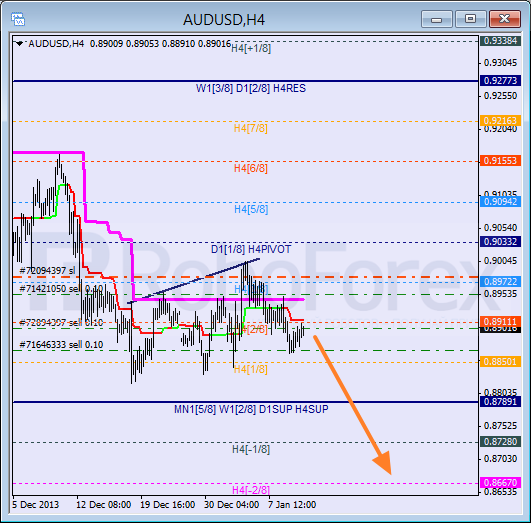



Some Lessons Cannot Be Learned from an iPad

Guest Post By Dennis Miller – Some Lessons Cannot Be Learned from an iPad

My wife Jo and I spent a weekend last fall at our daughter Holly’s house, enjoying time with our two young grandchildren, three-year-old Brock and eight-year-old Braidyn. With two young boys, the house can get pretty loud. Not only do they run and shout like all little boys, the noisy games they play on my iPad also cause quite a racket. My wife grins when she sees me reach up and turn my hearing aids off… Ah! Relief from the noise.

When I was Braidyn’s age, my great-grandmother was still alive. She would sit on her front porch swing with her walker set to the side, and we would snap peas and shuck lima beans together. I remember her telling me her childhood memories about life after the Civil War. As I watched my young grandsons, I thought to myself: I wonder if my great-grandmother, who was born in 1860, or my grandmother, who was born 1890, ever looked at me and wondered what the world would be like when I got to their age.

As I watched Brock play games on my iPad, I was not only amazed, but I also struggled to imagine what his world would be like 70 years from now, when he will be the age I am today. Will he and his brother still be working? Will they be able to retire? How long can they expect to live?

When I mentioned to my daughter Holly how amazing it is to watch a three-year-old navigate an iPad, she reminded me of how I teased her when she was in grade school, saying that all the kids getting off the bus looked like midget paratroopers with their backpacks full of schoolbooks. She told me that middle-school students now receive iPads from the schools. All their books are downloaded, and they take all their tests on the iPads. She also lamented the fact that they are not learning how to write or communicate to her satisfaction.

Preparing for an Unknown World

And then, like any loving grandparent, my thoughts took a turn: How can I help prepare my grandchildren for a world I am unable to imagine? Once the answer hit me, it seemed alarmingly obvious.

While I cannot imagine every detail about the state of the world in 70 years, I am willing to offer one prediction. According to the Employee Benefit Research Institute (EBRI), only 3% of employees in the private sector have a pension program. Basically, the other 97% of folks in the private sector have to save for retirement through elective, tax-deferred savings accounts like IRAs and 401(k)s.

So, while government employees still have generous pensions, I predict that by the time Braidyn and Brock reach my age, a tax revolt will mean that those guaranteed-income pensions no longer exist. From that perspective, the world my great-grandmother lived in and the one my grandchildren will live in may someday have something in common.

One Big Generation Gap

If folks of my great-grandmother’s generation wanted to even think about retiring, they had to learn to live within their means and save their money. Even people with significant amounts of inherited wealth had to pace their spending if they didn’t want to die as paupers. There was simply no such thing as Social Security, nor anything like it, when they were growing up.

My grandmother lived through the Great Depression, and she never trusted banks – for good reason. As a youngster, I knew that what money she had was hidden in a coffee can in the pantry and under the underwear in her dresser drawer. It was many years before she could bring herself to put money in a bank account. We were not a wealthy family, but my grandmother had managed to save $20,000. That might not sound like much now, but at the time that was about the price of a house.

So, with these two women in mind, I reread the 2013 EBRI Confidence Survey, which offers up some real eye-openers:

  • The percentage of workers confident about having enough money for a comfortable retirement is essentially unchanged from the record lows observed in 2011.
  • One reason that retirement confidence has remained low may be that some workers are realizing just how much they may need to save each year in order to live comfortably during retirement. One-third think they need to save 20% or less of their total household income, one-fifth put that target at 20%-29%, and nearly one quarter report that they need to save 30% or more.

While the government offers some tax incentives to save through IRAs and 401(k)s, no one is forcing people to live within their means and save their money. In other words, saving for retirement is an option that more people should be taking. Social Security is not going to get the job done. The EBRI had some comments on that subject, too:

  • One of the primary vehicles that workers use to save for retirement is an employer-sponsored retirement savings plan, such as a 401(k). Eighty-two percent of eligible workers (38% of all workers) say they participate in such a plan with their current employer, and another 8% of eligible workers report they have money in such a plan, although they are not currently contributing.
  • Cost of living and day-to-day expenses head the list of reasons why workers do not contribute (or contribute more) to their employer’s plan, with 41% of eligible workers citing these factors.

The report went on to say that only 10% of those working are contributing the legal maximum to their plan. Excuse me! The government is giving us a tax-deferred opportunity to save money here. If you are in the 25% tax bracket, you would save $2,500 on taxes for every $10,000 you save, and only 10% of those eligible are taking full advantage of this?

When I read statistics like that, it really drives home what I hope my legacy for my grandchildren will be… lessons not likely to learned in school or off an iPad:

  • The virtues of saving, allowing interest to compound, and accumulating wealth.
  • The value of staying out of debt and living within your means.
  • The timeworn truth that they cannot trust the government to keep its promises.
  • The knowledge that the safest investment they can make is in themselves.

Our grandchildren need to learn how to accumulate capital and make it grow. Then, someday, that money will give them many more cool life choices, like not having to work, particularly in a job they may not like. These are lessons on values and discipline that are unlikely to be taught satisfactorily outside of the home. As grandparents and parents, we must continue to remind ourselves that teaching these lessons is our job.

I have a friend who, every year, gave his children a gift of common stock in a well-known US company. Each year he would sit down with them and explain how much they had earned in dividends, and how the stock had appreciated. His children are now in their 40s, and still own some of that stock today. This friend sure had the right idea.

I urge you to pass this article on to your children and grandchildren; they will thank you for it… eventually. For further learning on investing that could help the next generation, I urge you to read our special reports or, even better, to get a risk-free subscription to Money Forever.

In addition to our regular weekly and premium monthly issues, we’ve been hard at work producing a series of special reports on need-to-know retirement topics: financial advisorsreverse mortgagesincome-producing stocks and low-fee ETFs, to name a few. You can download each of these timely special reports individually; or, if you really want to kick-start your financial education, you can begin your Money Forever premium subscription now and receive access to all of our special reports, our current issue, and the Money Forever archives.


ECB says will take “decisive action” if needed

By CentralBankNews.info
    The European Central Bank (ECB), which earlier today left its refinancing rate steady at a historic low of 0.25 percent, sharpened its message that it was ready to act to counter any rise in market interest rates and underlined that it would maintain an accommodative policy stance for as long as its takes while its policy rates would remain at the current, or lower levels, for an extended period.
    ECB President Mario Draghi expressed his continued concern over the potential for higher money market rates to blunt the impact of the ECB’s low policy rates on economic activity, saying the ECB was “monitoring developments closely and are ready to consider all available instruments.”
    “Overall, we remain determined to maintain the high degree of monetary accommodation and to take further decisive action if required,” Draghi told a press conference, sharpening his message by adding the words of “decisive action” to earlier statements.
    Draghi repeated that the ECB expects inflation to remain low for a “prolonged period” before gradually moving up towards the bank’s target of inflation below, but close to 2 percent.
    A drop in euro area inflation to 0.8 percent in December from November’s 0.9 percent, was expected by the ECB, and due to lower service prices, and Draghi said he expects inflation to remain around current levels in coming months. Inflation expectations remain anchored to the ECB’s target.

    “Against this background, the governing council strongly emphasizes that it will maintain an accommodative stance of monetary policy for as long as necessary, which will assist the gradual economic recovery in the euro area,” Draghi said, ratcheting up the guidance adopted by the ECB in July last year by adding the words of “strongly emphasizes” to the previous statements of maintaining an accommodative stance.
    “Accordingly, we firmly reiterate our forward guidance that we continue to expect the key ECB interest rates to remain at present or lower levels for an extended period of time,” he said, adding the words of “firmly reiterate” to past statements.
    Economic activity in the euro area – enlarged to 18 states from Jan. 1 following Latvia’s membership – is expected to continue to gradually improve though data for industrial production point to a weak start to the fourth quarter while confidence indicators have improved, Draghi said.
    “Looking at 2014 and 2015, output is expected to recover at a slow pace,” Draghi said. The ECB forecasts growth of 1.1 percent in 2014 and 1.5 percent in 2015 after a contraction of 0.4 percent in 2013 following 2012’s drop in Gross Domestic Product of 0.6 percent.
    The euro area’s GDP rose by only 0.1 percent in the third quarter from the second quarter for annual contraction of 0.4 percent, the seventh quarter of a shrinking economy.
    “The risks surrounding the economic outlook for the euro area continue to be on the downside,” Draghi said, adding that financial markets have the potential to negatively affect economic conditions along with the risk of higher commodity prices, weaker-than-expected domestic demand and exports, and slow implementation of structural reforms.
   
    www.CentralBankNews.info