ECB holds rate, as expected, Draghi to comment later

By CentralBankNews.info
    The European Central Bank (ECB) held its refinancing rate steady at 0.25 percent, along with its other main rates and said its president, Mario Draghi, would comment at a press conference later today.
    The ECB was widely expected to maintain its rates after having cut rates for a second time in 2013 in  November to the current level. The ECB cut rates by 50 basis points in 2013.
    But economists are also looking to the ECB for further ways to stimulate the euro zone economy.
    Earlier this week data showed that the unemployment rate remained steady at 12.1 percent in November, the eight month of unchanged jobless numbers, with youth unemployment also steady at 24.2 percent and even ring in some countries, such as Spain, with jobless rate of 57.7 percent.
    Inflation is also very low, with headline inflation falling to 0.8 percent in December from November’s 0.9 percent, adding to worries over deflation. A surprisingly-large drop in inflation to 0.7 percent in October prompted the ECB’s rate cut in November. The ECB targets inflation that is below, but close to 2.0 percent.
   The euro area’s Gross Domestic Product rose by only 0.1 percent in the third quarter from the second for annual contraction of 0.4 percent, the seventh quarter of a shrinking economy.

    www.CentralBankNews.info


BOE maintains rate, QE target, add no further comments

By CentralBankNews.info
    The Bank of England (BOE) maintained its bank rate at 0.5 percent and the size of its asset purchases at 375 billion pounds, as widely expected.
    The BOE, the U.K.’s central bank, made no further comments in its brief statement following a meeting of its Monetary Policy Committee, dashing some expectations that it would change its threshold for changing interest rates in light of the recent improvement in the UK economy.
 

Indonesia holds rate, sees inflation in target 2014 and 2015

By CentralBankNews.info
    Indonesia’s central bank held its benchmark BI rate steady at 7.50 percent, along with its other policy rates, saying this stance should ensure that inflation remains under control and moves back into the bank’s target range this year and in 2015.
    Bank Indonesia (BI), which raised its BI rate by 175 basis points in 2013 to curb inflation and defend its embattled rupiah currency, added that the country’s current account deficit should also narrow and this should reduce the pressure on the exchange rate.
    “Monetary policy will remain consistently directed towards controlling inflation within its target corridor and bringing the current account deficit to a healthier level through interest rate policy and exchange rate stabilisation according to economic fundamentals,” the BI said.
    Indonesia faced what the BI described as “a number of arduous challenges” in 2013 as a global slowdown pushed down the prices of its export of commodities, inflation jumped due to higher fuel prices and is currency dropped as investors withdrew funds following expectations that the U.S. Federal Reserve would start to wind down its asset purchases.
    Economic growth is forecast by the central bank to have dropped to 5.7 percent in 2013, down from 2012’s 6.2 percent, inflation soared to 8.38 percent from 4.30 percent and the current account deficit swelled to 3.5 percent of Gross Domestic Product from 2012’s 2.8 percent.

   But the central bank sees better times ahead, expecting an improvement in the global economy in 2014 “hence propping up the Indonesian economy looking ahead, both in terms of the trade channel and the financial channel.”
   Indonesia’s inflation rate jumped in July and has remained in a range of between 8 percent and 9 percent since then. But the BI expects inflation to drop into its target corridor of 4.5 percent, plus/minus one percentage point, in 2014, and then ease further toward its 2015 corridor of 4.0 percent, plus/minus one percentage point.
   The decline in economic growth last year was partly due to lower exports due to the tepid global economy but domestic demand and investments also slowed while household consumption remained the primary driver of growth, the BI said.
   “Bank Indonesia considers the ongoing downward economic growth trend as conguous with the current direction of Bank of Indoenesia and Government stabilization policy instituted to bring the domestic economy back towards a healthier and more balanced growth trajectory,” the BI said.
    Growth this year is forecast to strengthen to the lower end of a forecast 5.8-6.2 percent.
    Indonesia’s Gross Domestic Product rose by 2.96 percent in the third quarter from the second quarter for annual growth of 5.62 percent, the fifth quarter with a declining growth rate.


Euro Climbs Against Dollar Ahead of ECB Meeting

By HY Markets Forex Blog

The euro added gains on Thursday from near a five-week low against the greenback, following the release of the Federal Reserve (Fed) minutes from the December meeting and ahead of the ECB meeting.

The euro rose 0.24% higher at $1.3607 against the US dollar at the time of writing, after dropping to $1.3554 yesterday, the lower since Dec 5. The euro was 0.4% higher to 142.90 yen.

Minutes from the Federal Reserve’s (Fed) December meeting showed that officials supported tapering its stimulus, boosting the US dollar.

“A majority of participants judged that the marginal efficacy of purchases was likely declining as purchases continue, although some noted the difficulty inherent in making such an assessment,” the Fed minutes stated.

The European Central Bank (ECB) meeting in Frankfurt is scheduled to commence today, with predictions that the bank will keep their benchmark rate unchanged at a record low 0.25% and their rate of marginal lending facility at 0.75%, according to analysts.

“Any indication that new liquidity will be provided may prove slightly short term euro negative by pushing term euro rates lower (our preferred view), but if his comments suggest no new liquidity measures, any short term euro gains that result from higher euro yields seem unlikely to be sustained, as credit concerns seem likely to emerge. The euro bias may consequently be slightly to the downside,” Lloyds Bank commented on Thursday.

Labour Report

The US labour market is one of the main factors which persuade the Fed’s monetary decisions. Market participants are focused on the labour report which is expected to be released on Friday, as analysts forecast 195,000 jobs was added in December after adding positions by 203,000 in November.

According to the ADP employment report, the US private sector hired 238,000 new employees in December, compared to 200,000 forecasted by analysts.


Visit www.hymarkets.com   to find out more about our products and start trading today with only $50 using the latest trading technology today.

The post Euro Climbs Against Dollar Ahead of ECB Meeting appeared first on | HY Markets Official blog.

Article provided by HY Markets Forex Blog

Stocks in Asia Decline After Fed Minutes

By HY Markets Forex Blog

Stocks in the Asian region declined on Thursday, after China’s consumer inflation dropped to a seven-month low in December and the Federal Reserve minutes showed that the central bank is ready to scale-back on its monthly bond purchases even further.

“Reading the minutes, we feel that the bias is for a faster reduction in asset purchases,” UniCredit wrote in a statement. “It would, on the other hand, probably take hugely negative surprises on the data front, to halt the tapering train.”

Minutes from the Federal Reserve’s (Fed) December meeting showed that officials supported tapering its stimulus, however some of the officials suggested the move was premature. Most members recommended the central bank should reduce its asset buying program even further.

Members of the Federal Open Market Committee (FOMC) will meet up Jan 28-29 to consider the next move for the central bank’s asset purchases as the US economy strengthens.

Meanwhile in Europe, most of the stocks closed the session flat, while shares in Asia advanced on Wednesday.

Stocks- Japan

The Japanese benchmark Nikkei 225 index declined 1.50% to 15,880.33, while Tokyo’s broader Topix index edged 0.73% lower to 1,296.75.

The Nikkei benchmark dropped to a one-week low, while the yen weakened 0.05% lower at ¥104.89 as of the time of writing.

Meanwhile, the Bank of Japan (BoJ) quarterly survey revealed that the Japan’s consumer sentiment dropped December. The Country’s consumer sentiment index declined 0.9 points to -9.2 in December.

“I personally consider that it may take some time before the full impact of QQE (quantitative and qualitative monetary easing) materializes,” Sayuri Shirai, BoJ board member said in a speech.

Stocks – China

Hong Kong’s Hang Seng index dropped 0.79% to 22,815.05 at the time of writing, while the Chinese mainland’s index in Shanghai fell 0.82% lower at 2,027.62.

China’s Consumer Price Index (CPI) climbed 2.5% higher in December, the National Bureau of Statistics (NBS) confirmed on Thursday. Analysts forecasted a 2.7% rise in the CPI, because of vegetable price. The producer price index dropped 1.4% lower.

The National Bureau of Statistics reported the country’s gross domestic product (GDP) growth forecast unchanged at 7.7%.


Win a luxurious trip to the Maldives & up to $30,000 cash for trading with us!

Visit for details http://alturl.com/2kysk 

The post Stocks in Asia Decline After Fed Minutes appeared first on | HY Markets Official blog.

Article provided by HY Markets Forex Blog

Forex Technical Analysis 09.01.2013 (EUR/USD, GBP/USD, USD/CHF, USD/JPY, AUD/USD, GOLD)

Article By RoboForex.com

Analysis for January 9th, 2013

EUR/USD

Euro completed descending structure towards level of 1.3555 and right now is forming new ascending structure. We think, today price may form reversal pattern and start moving upwards to reach target at 1.4100.

GBP/USD

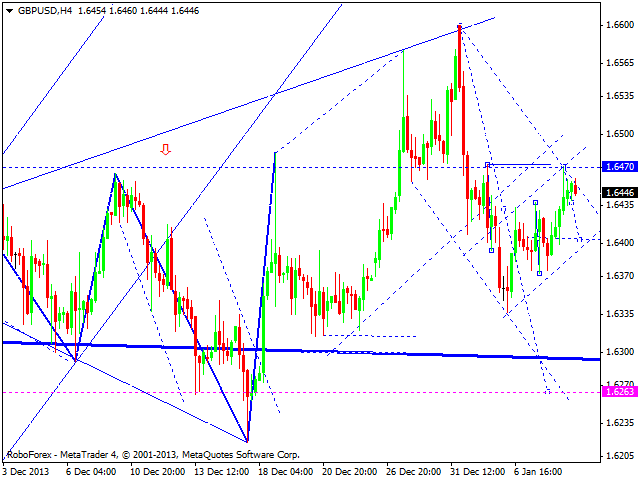
Pound finished ascending structure towards level of 1.6470 and right now is starting new descending movement to return to level of 1.6400. Later, in our opinion, pair may continue growing up inside ascending trend to reach 1.7470.

USD/CHF

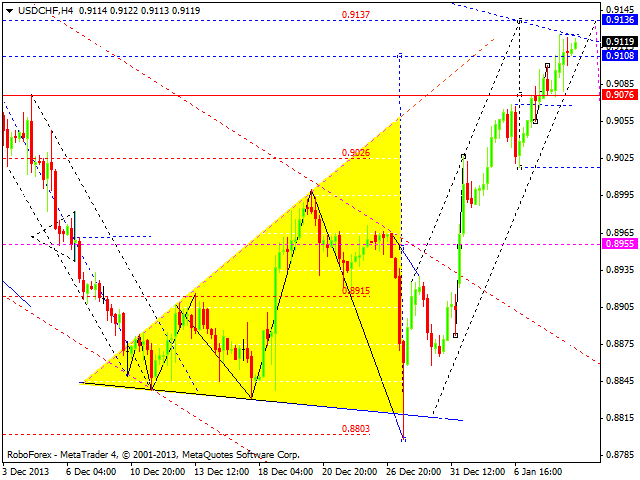
Franc is trying to reach its resistance level at 0.9137. Later, in our opinion, instrument may fall down and form reversal pattern to continue moving downwards. Target is at level of 0.8300.

USD/JPY

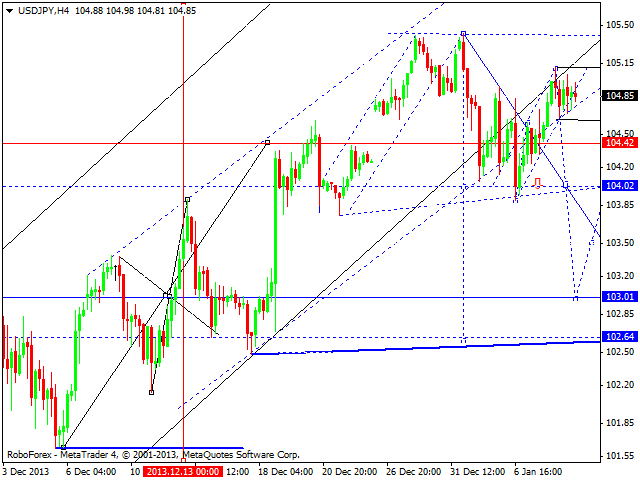
After completing another ascending impulse, Yen is consolidating. We think, today price may leave this consolidation channel downwards to reach target at 103.00 and then return to level of 104.00.

AUD/USD

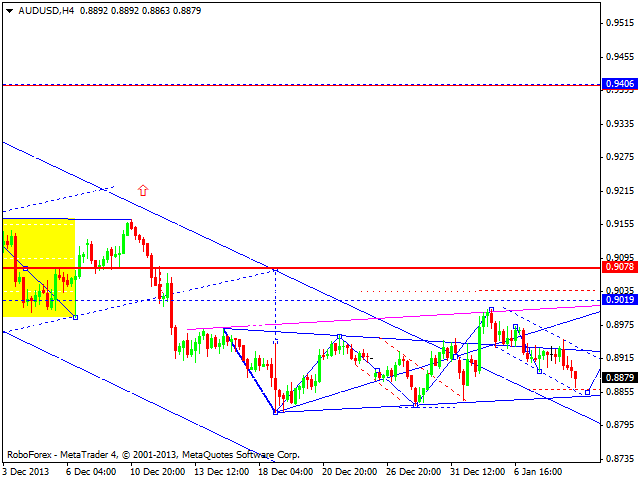
Australian Dollar is still forming correctional structure. We think, today price may complete this correction in the form of flag pattern by forming its fifth wave with target at 0.9020. Later, in our opinion, pair may continue falling down. Target is at level of 0.8400.

GOLD

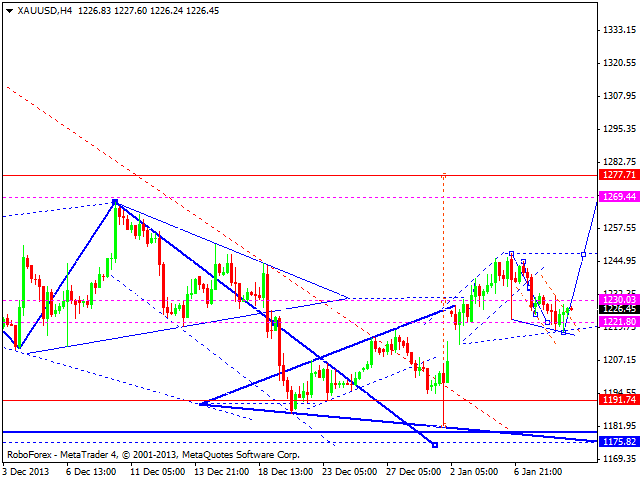
Gold reached level of 1220. We think, today price may start forming new ascending structure towards level of 1277.

RoboForex Analytical Department

Article By RoboForex.com

Attention!
Forecasts presented in this section only reflect the author’s private opinion and should not be considered as guidance for trading. RoboForex LP bears no responsibility for trading results based on trading recommendations described in these analytical reviews.


The Cold War Over Airspace Gets Nasty

By WallStreetDaily.com The Cold War Over Airspace Gets Nasty

2013 was full of records. So many, in fact, that we’re prone to grow numb to their significance.

But don’t let that be the case with this one, otherwise you’re certain to miss out on the next big profit opportunity in the technology market.

For the first time ever, smartphones outsold feature phones.

What’s the big whoop? Well, pick up your smartphone, put it in airplane mode, and then try to use all of your favorite applications.

Now you understand. Without a data connection, smartphones are completely useless.

We can’t browse the web, post on Facebook (FB), stream video, access maps – nothing.

Simply put, smartphones and mobile data access go hand-in-hand. And that’s a big problem…

“As more and more folks jump on the smartphone bandwagon, the demand for data will continue to grow exponentially,” says Engadget’s Michael Gorman. Precisely!

Yet, as I alluded to yesterday, telecoms never expected mobile technology to be this big.

In the words of Verizon Communications (VZ) Chief Financial Officer, “[We] did not anticipate that amount of growth in the network.”

Or, more bluntly, they got caught with their pants down. They didn’t invest in an infrastructure that could handle the demand, and now they’re playing a nasty game of catch-up.

So much so, that RootMetrics CEO, Bill Moore, says a mobile “arms race” is underway among the major telecoms. But there’s only one way to win the race. And therein lies the biggest opportunity in the tech market for 2014…

The Small Solution to the Big Mobile Data Problem

Cisco (CSCO) estimates that mobile data traffic will grow nearly 60% per year in North America through 2017. Meanwhile, other industry insiders believe that there’s a need to prepare for 1,000 times more growth.

But building out the infrastructure to enable more and more high-speed mobile internet access takes time and costs a ton. Companies can’t put up a macro cell tower overnight.

Enter small-cells, which fill in gaps in mobile coverage quickly and on the cheap.

For those of you who are unaware, small-cells are basically miniature cell towers that can be mounted on street posts or rooftops to expand mobile coverage – from as little as 10 meters to as much as one or two kilometers. And multiple small-cells can easily link together to form an extra layer of capacity.

Without them, there’s simply no way for telecoms to keep up with the demand for mobile broadband connectivity.

So, yes, the next big thing in technology, ironically, will be small.

But don’t just take my word for it.

“Small-cells are a big deal,” says former FCC Chairman and current private equity honcho, Julius Genachowski. He’s convinced that they’re the next step toward increasing coverage and speeds, and he thinks they’ll drive enormous change in the industry. Agreed!

Meanwhile, AT&T’s (T) Senior Vice President of Technology and Network Operations, John Donovan, says, “Over half of our [network] densification over the next three years is going to be the result of deploying small-cell technology.”

Of course, talk is cheap. Money matters most, which is why Qualcomm’s (QCOM) actions are most instructive.

Last July, the company invested roughly $113 million in small-cell vendor, Alcatel-Lucent (ALU).

At the time, Executive Chairman Paul Jacobs said, “When you get a partner like [Alcatel], other companies see that and accelerate their plans, too. It’s our way to catalyze change in the industry.”

And guess what? It’s working.

Let the Small-Cell Revolution Begin

As Ina Fried of AllThingsD noted in December 2013, “Much of the attention is starting to shift to the ways in which carriers are improving LTE speeds and capacity.”

The latest comments from AT&T’s Associate VP of Small-Cells, Gordon Mansfield, underscore this reality: “Right now I can say we’re in a fast walk. But we’re right at the cusp of stepping on the gas and going into a full-blown sprint.”

Brace yourself! Industry-wide, we’re talking about upwards of 75 million new small-cells being deployed over the next three years.

So what’s the best way to profit from the growth? I thought you’d never ask…

Rest assured, he’s not exaggerating to make headlines.

A Track Record of Proven Winners

We’re all too familiar with small-cells at WSD Insider. And I say that because we’ve been investing (profitably) in the space since 2009.

First with Airvana, which was acquired one month after our recommendation by a private equity firm (one backed by SAC Capital and the Blackstone Group).

Then with Zarlink, which was ultimately acquired, too.

For years, we waited anxiously for PicoChip to go public. But it didn’t get a chance because semiconductor firm, Mindspeed Technologies Inc. (MSPD), bought the company outright in early 2012.

At the time, Mindspeed was publicly traded, so we pushed our chips in on the company’s stock.

Sure enough, in November 2013, M/A-Com Technology Solutions Holdings, Inc. (MTSI) announced that it was acquiring Mindspeed for $272 million – or about a 65% premium to the current price.

Notice a pattern? So do we. Time and time again, the leading small-cell firms get gobbled up. I expect that trend to continue, too.

That makes $700-million M/A-Com an attractive acquisition candidate. Ditto for Alcatel-Lucent. In fact, Qualcomm is sitting on enough cash to bump up its ownership of Alcatel to 100%.

Other companies with leverage to the small-cell revolution include PMC-Sierra Inc. (PMCS), Vitesse Semiconductor Corp. (VTSS), Cavium Inc. (CAVM) and Semtech Corporation (SMTC).

Although solid choices, none of these companies represent the most profitable option. Why? Because they fail to address another critical factor in the mobile market.

It’s important to understand that small-cells aren’t a silver bullet. In order for them to truly ease mobile bottlenecks, carriers must also figure out a way to link those dispersed cells back to their core networks. These vital connections are referred to as “backhaul.”

Therefore, a company providing backhaul services, with existing broadband infrastructure, and available real estate in the most densely populated markets represents the absolute best way to play the boom.

And yes, such a company exists.

In fact, we added it to our WSD Insider Innovators & Disruptors Portfolio last month.

This portfolio is reserved for the market’s most innovative companies with the greatest upside potential. By virtue of that, only the world’s top “visionary” companies make the cut.

This small-cell play – with a $200-million market cap, trading for about $3 per share – is already living up to our high expectations. In less than a month, the stock is up 35%.

By my estimates, though, shares could still easily double in price from here.

Bottom line: Small-cells are the next big thing in technology.

After years of testing them in every way imaginable, major telecoms are embarking on a large-scale rollout starting right now. Thanks to exponential growth in mobile data demand, they don’t have a choice.

If you want to find out the identity of the very best opportunity in the space and access our full research report on the company, all you have to do is sign up for a risk-free trial to WSD Insider here.

Ahead of the tape,

Louis Basenese

The post The Cold War Over Airspace Gets Nasty appeared first on Wall Street Daily.

Article By WallStreetDaily.com

Original Article: The Cold War Over Airspace Gets Nasty
Japanese Candlesticks Analysis 09.01.2014 (EUR/USD, USD/JPY)

Article By RoboForex.com

Analysis for January 9th, 2014

EUR/USD

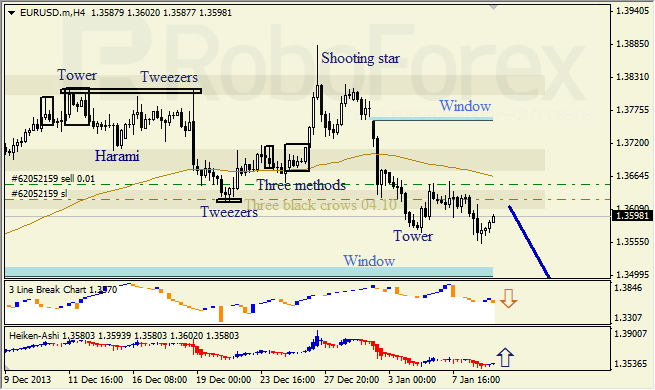
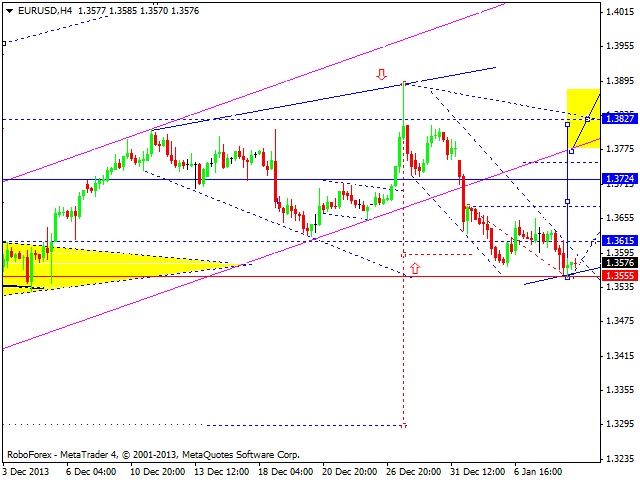
H4 chart of EUR/USD shows bearish tendency. Three Line Break chart confirms descending movement; Heiken Ashi candlesticks indicate bullish pullback towards resistance level.

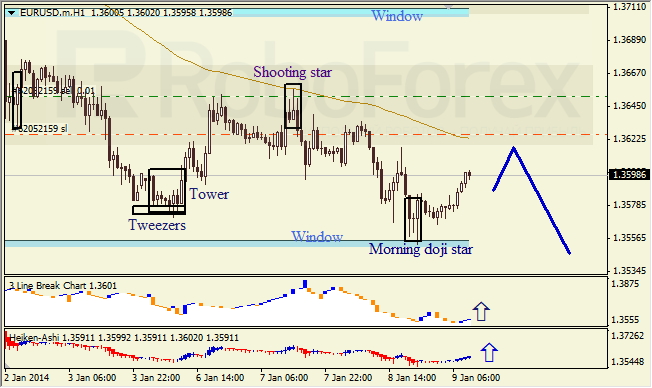
H1 chart of EUR/USD shows correction within descending trend, which is indicated by Morning Doji Star pattern. Three Line Break chart and Heiken Ashi candlesticks confirm that ascending correction continues.

USD/JPY

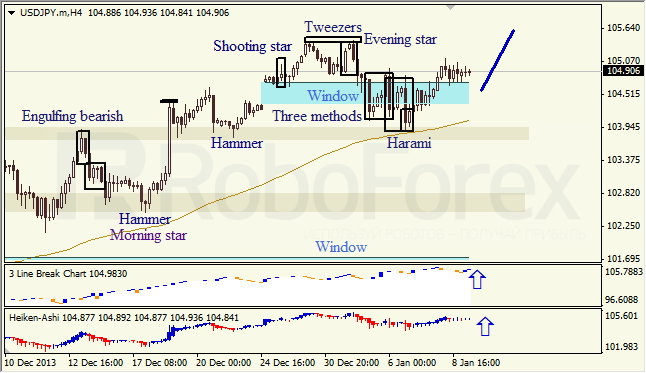
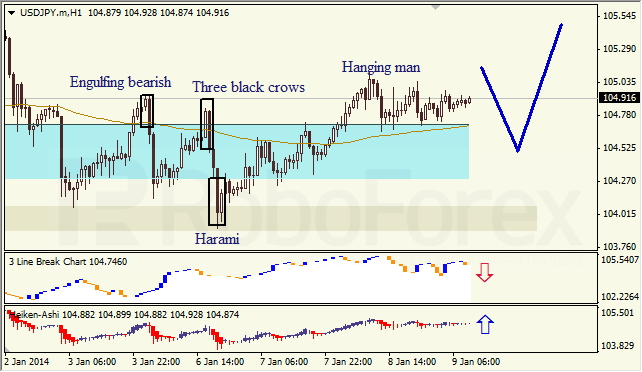
H4 chart of USD/JPY shows end of correction, which is indicated by Harami pattern. Closest Window is support level. Three Line Break chart and Heiken Ashi candlesticks confirm ascending movement.

H1 chart of USD/JPY shows sideways correction, which is indicated by Hanging Man pattern. Closest Window is support level. Three Line Break chart indicates that correction continues; Heiken Ashi candlesticks confirm ascending movement.

RoboForex Analytical Department

Article By RoboForex.com

Attention!
Forecasts presented in this section only reflect the author’s private opinion and should not be considered as guidance for trading. RoboForex LP bears no responsibility for trading results based on trading recommendations described in these analytical reviews.


Korea holds rate steady, sees recovery, higher inflation

By CentralBankNews.info
    South Korea’s central bank held its base rate steady at 2.5 percent, as expected, and maintained its recent view that the country’s economic recovery is continuing in line with its growth trend while exports and consumption have continued to improve.
    The Bank of Korea (BOK), which cut its rate by 25 basis points in 2013, also said it expects inflation to gradually rise but remain low for the time being, largely due to stable international agricultural prices.
    Korea’s headline inflation rate eased to 1.1 percent in December from 1.2 percent in November for an average rate of 1.3 percent for 2013, down from 2.2 percent in 2012.
    The BOK targets annual inflation of 2.5-3.5 percent and in October forecast 2013 inflation of 1.2 percent and 2.5 percent inflation in 2014.
     Last month the BOK said it expects inflation to rise in 2014 as the domestic economy improves.
    Korea’s Gross Domestic Product rose by 1.1 percent in the third quarter from the second quarter for annual growth of 3.3 percent, up from a 2.3 percent growth rate in the second quarter and 1.5 percent in the first quarter.

    “The Committee expects that the domestic economy will maintain a negative output gap for the time being going forward, although it forecasts that the gap will gradually narrow,” the BOK said.
    The central bank said the global economy will sustain its modest recovery going forward though it added that this could be affected by changes in global financial markets from the U.S. Federal Reserve’s tapering of quantitative easing.
     “Looking ahead, while paying close attention to developments in and the influences of external risk factors arising from shifts in major countries’ monetary policies, the Committee will conduct monetary policy so as to keep consumer price inflation within the inflation target range over a medium-term horizon while supporting the continued recovery of economic growth,” the BOK said.
     
    www.CentralBankNews.info

USDJPY failed to break below channel support

USDJPY failed to break below the lower line of the price channel on 4-hour chart, and rebounded from 103.91. Further rise to test 105.44 resistance would likely be seen, a break above this level will signal resumption of the the uptrend from 96.94 (Oct 25, 2013 low), then next target would be at 110.00 area. Key support is now at 103.91, only break below this level will indicate that the uptrend from 96.94 is complete.

usdjpy

Provided by ForexCycle.com