By CentralBankNews.info
Mozambique’s central bank held its benchmark rate on the standing facility steady at 8.25 percent, maintaining what it described as “a scenario the requires caution and prudence.”
The Bank of Mozambique, which cut its rate by 125 basis points in 2013, also said it would ensure that the monetary base during January does not exceed 45.892 billion meticais, down from the December target of 47.493 billion.
Mozambique’s inflation rate eased to 3.54 percent in December from November’s 4.04 percent.
The bank said the government’s inflation target for 2014 was 6.0 percent, along with real growth in Gross Domestic Product of 8 percent and international reserves that can cover four months of imports.
“The MPC considered that the achievement of these objectives will allow the country to remain in the forefront of the fastest growing countries with macroeconomic stability in sub-Saharan Africa,” the bank said.
Mozambique’s GDP expanded by an annual 8.1 percent in the third quarter, in line with the bank’s revised projections. Economic activity was helped by an 8.8 percent rise in the tertiary sector, while the primary sector grew 7.0 percent, driven by mining.
Net international reserves rose by US$ 81 million to $3.009 billion in December, in line with the target, while gross reserves were enough to cover 5.1 months of imports.
Mozambique’s medical ended the year at 29.95 to the U.S. dollar, representing a monthly depreciation of 0.07 percent and an annual drop of 1.49 percent, after a 0.2 percent decline in November.
http://ift.tt/1iP0FNb
New EPA Rule Requires Chemical Disclosure for Offshore Fracking
By OilPrice.com
The U.S. Environmental Protection Agency published a rule on January 9, 2014 requiring oil and gas companies using hydraulic fracturing off the coast of California to disclose the chemicals they discharge into the ocean. Oil and gas companies have been fracking offshore California for perhaps as long as two decades, but they largely flew under the radar until recently.
An Associated Press story in August 2013 revealed that oil and gas companies had engaged in hydraulic fracturing at least a dozen times in the Santa Barbara Channel – the site of the nation’s first offshore drilling site as well as the first major oil spill. The 1969 well blowout in the Santa Barbara Channel became the impetus for a series of environmental laws such as the National Environmental Policy Act and the Clean Water Act.
Documents published through a Freedom of Information Act request showed that federal regulators have allowed drillers to dump chemicals into the ocean without an environmental impact statement assessing the effects of doing so. This was largely unknown to California regulators and the general public. The Bureau of Safety and Environmental Enforcement – the federal regulator responsible for regulating offshore oil drilling – has issued “categorical exclusions” for fracking offshore California, essentially giving frack jobs a pass on environmental assessments. The logic is that offshore fracking has largely occurred in existing wells, locations for which companies already jumped through all the environmental hoops long ago.
Offshore fracking could be much more widespread than even federal regulators are aware. According to the Environmental Defense Center, BSEE only began to learn about the extent to which fracking was occurring offshore when pressed to respond to FOIA requests.
The industry maintains that hydraulic fracturing is safe, and BSEE officials point to the fact that fracking offshore requires only a fraction of the water needed to do the job onshore.
But offshore fracking differs from the onshore practice in at least one important way. After an onshore well is fracked, the waste water is often re-injected into the ground for storage. However, offshore drillers often simply dump the waste water into the ocean – although the industry claims the water is treated before entering the marine environment.
The latest EPA rule would merely require companies to report the chemicals that they are discharging into the ocean. The rule is a weak one because relies upon companies to self-report their activities.
EPA’s announcement is a new wrinkle in the story of fracking in California, which has been much more raucously debated onshore. Last year, the state passed a controversial law that introduced the first regulations on fracking. It requires companies to disclose the chemicals used in the drilling process, obtain permits, and monitor air and water quality. Environmentalists rejected the law and are calling for a full moratorium.
Governor Jerry Brown does not support a ban on fracking and insists the new law is rigorous. Despite the complex geology that could prevent California from ever living up to its oil and gas potential, the industry and many policymakers remain in favor of trying to exploit the vast oil and gas reserves in California – both on and offshore.
By. Nick Cunningham of Oilprice.com
How to Profit During High Inflation
By Dennis Miller – How to Profit During High Inflation
Anyone with a technical degree will admit that college programmed them to consider “sell” a dirty word—to think salespeople use trickery to lure consumers into buying things they don’t need. It makes no difference whether it’s an investment product or a Pet Rock; anyone involved with selling or its evil twin marketing is guilty until proven innocent.
I spent the majority of my first career in sales and marketing, where I focused on negotiations and pricing. My clients included 40 of the top 500 US corporations. Now I work alongside some of the best economists and analysts in the world, and well, let’s just say I bring a different perspective and experience base to our meetings.
That difference became apparent during a recent discussion on how our subscribers can protect themselves and even profit from inflation. We were all in agreement on several key points:
- The government cannot continue to print money as it is without high inflation resulting.
- Traditional investments like precious metals will soar when the world finally discovers the US dollar is worthless. Own them, be patient, and when it hits, what a ride it will be.
- Billions of dollars will flow out of the stock market as interest rates begin to rise.
Certain companies and industries fare better than others in an inflationary environment. Success means investing in those companies whose stock prices and dividend appreciation will grow ahead of the rate of inflation, giving investors true gains.
Investors should look for:
- Companies with a worldwide presence to hedge against the US dollar;
- Companies with a history of regular dividend increases ahead of the inflation rate; and
- Companies that can quickly pass through their cost increases to the market.
Take oil companies and airlines, for example. When oil companies notice some saber-rattling in the Middle East, the price at the pump can go up a nickel or more the next day. Contrast that with the airline industry, which does a very poor job in this regard.
Why do air travel and gasoline—both considered commodities—perform so differently when their costs are rising? The major oil companies understand market dynamics as well as any industry I’ve served. If an event is going to cause their costs to rise for whatever reason, it only takes one company to raise its prices, and the competition immediately follows. Market share is generally unaffected, but the entire industry makes money.
Price fixing is illegal, and that’s not what oil companies are doing. Go to the Weather Channel, surf around, and you can find the best gas prices in any given ZIP code. If you’re a dealer, you adjust your prices accordingly. After all, how far is a customer going to drive to save a couple cents per gallon when gas is priced over $3/gallon? It sounds crazy, but gas customers don’t have as much mobility as one might think. They risk spending more in gas driving around than they might save at the pump.
The airlines used to do the same thing when they were a regulated industry. One company would announce a fare increase, and all the competition would follow. Now unregulated, some airlines have significant cost advantages over their competition. A few years ago, Southwest Airlines made a huge bet on the direction of fuel prices and guessed right. It had a terrific advantage over the competition, and it was reflected in its pricing.
Unlike a driver needing gas, an air traveler has time to hop on the Internet and compare airfares quite easily, and price is a major factor when buying a plane ticket. While costs increase in the industry, those who maintain a cost advantage over their competition use that as an opportunity to increase their load factor. Instead of raising prices quickly, they lag behind. Fill just two or three more empty seats on a flight, and that income is straight profit. It is a very difficult industry in which to pass through cost increases quickly. Instead, for years the industry has scrambled to cut costs to remain profitable.
At this point, I shared what I consider to be the best place to look for companies that will beat inflation with the team. I started with two fundamental truths about cost and pricing:
- In business, the cost of producing your product or service should tell you only one thing about how you should set your price: specifically, the price you don’t want to sell it for.
- The selling price should be the value of your goods or services in the mind of the customer, as tempered by competition.
Too many businesses set their selling price as a formula called “cost plus,” which is the wrong way to go about it. Your cost information tells you when you’re losing money on every sale. There are companies that price their goods below cost with the intention of building up enough volume to bring their unit cost down in order to become profitable. Sometimes it works. But the sooner it does so the better, because these companies cannot continue losing money forever.
Take Amazon.com, for example. It used price as its main competitive advantage for years, delivering few if any profits for the better part of a decade as it grew. There can really be only one strong price leader, and that leader will condemn itself to being a low-margin, low-profit business so long as it competes on price alone.
From a marketing perspective, there are two different types of markets: concept and brand markets. In a concept market, a new idea, technology, philosophy, or methodology is sold. A brand market is an established market where competitors are fighting for market share.
The iPad is an easy example. The iPad was a new concept called a tablet computer. The competition was a different technology—an expensive notebook computer, your home computer, or a smartphone. In a concept market, many times you’re creating a market (tablets) at the expense of another market (portable computers). Personal computers, for their part, completely destroyed the typewriter market.
Apple is a great marketing company, its technology is excellent, and it understood it could price the new gadget below its true competition (computers) and still make terrific margins.
As a new market is created, competition sees the opportunity and jumps in. In the early stages, it validates the concept, and the total market growth accelerates even faster. Competition normally prices its product under the pricing umbrella of the market leader. At the same time, they may drop off a feature or two to keep their costs down. That further reinforces the market leader as the technology leader.
Eventually the market is created, and competition begins fighting for market share. Look at what’s happened to the printer business. Printers have now turned into a commodity—almost a disposable product, really. The market is now a brand market. Capitalism creates competition, which benefits the consumer. Each competitor is trying to convince consumers that their brand is better than the competition’s, and price is an important factor in that contest.
The next thing I look at is who dominates the market. You may be surprised to find the company with the highest quality and highest price is also a low-cost producer because they have the lion’s share of the market. Rather than cut price, Apple continues to upgrade the quality of its products to keep the competition in continual catch-up mode as opposed to leapfrogging their technology.
Because the dominant market leader provides the pricing umbrella for the industry, this creates an interesting Catch-22 in an inflationary environment. As production costs rise, the longer the dominant player hangs on, the more difficult it is for the competition, because they cannot pass on their cost increases to the consumer. If they raise prices, they will lose market share. Once the big boy announces a price increase, the rest of the market generally follows.
The dominant market leader also recognizes there are certain segments where price is a major consideration. There is now a market niche for basic, low-cost tablets. If the leader tries to cut its price to capture that segment, it has to determine how much additional share it would gain to offset the margin loss on the share it currently has. In addition, there are laws concerning predatory pricing, meaning pricing your products with the intention of driving your competition out of business. Concept sellers are generally content to open up a new market, and expect some loss of market share as it matures.
Let’s look at some real numbers:


Apple’s share price rose with the iPad very well, and it’s holding good margins. Now the iPhone5 is out, and the company is hoping for similar results.
There are many examples of concept sales in the technology sector; however, concept sales take place in many markets. One of our holdings in the Money Forever portfolio has developed a new type of noninvasive medical test that gives better results with much less trauma to the patient. Its main competition is not a similar test, but rather the older, less-effective technology. As this new test becomes the standard, various brands will begin fighting over market share. In the meantime, the company is rapidly growing and maintaining excellent profit margins along the way. In turn, its shareholder value is really accelerating.
There are countless TV commercials for products and services like online dating services, reverse mortgages, or hair color for men, all of which are still in the concept stage. The companies are all still selling their idea as opposed to why they are better than the competition. Much of their success will depend on the size of the market they create with their ideas. Direct competitors offering a lower price to garner market share is of little concern.
Companies that create new concepts by finding large markets with needs begging for solutions will prosper. That’s one reason the technology sector is ripe with these success stories. How many products do we use today that were not even invented 20 years ago?
Our research team is constantly on the lookout for concept sellers in all markets throughout the world. Those who recognize the opportunity ahead of the crowd (before we learn about them on television) will see some extraordinary gains. They will thrive in any market, even during high inflation.
Concept sellers range from smaller companies with new ideas or technologies to huge companies like Apple or Sony that develop new products to fill needs they see in the market. When one finds a need and develops a product that’s in high consumer demand, its stock will generally rise, even in a tough market, and its gross margins will be protected because it can more easily pass cost increases to the customers.
You can beat inflation. While the market is a lot tougher than it was a decade ago, those who make the modest time commitment necessary to research and learn can stay ahead of the curve. It is my personal mission to give our subscribers the tools to do just that—efficiently and effectively.
That’s why I put together a short explanation of what it means to retire successfully, and how Money Forever can help you get on track. You do not have to go it alone. I urge you to take a few minutes, sit back, and read all about it. Start your retirement education right now by clicking here.
Tajikistan cuts rate 70 bps to 4.8 percent
By CentralBankNews.info
Tajikistan’s central bank cut its benchmark refinancing rate by 70 basis points to 4.8 percent, reflecting lower inflationary pressures and the impact of external factors.
The National Bank of Tajikistan, which cut rates by 100 basis points in 2013, said the cut should help lower the average rate of loans in the banking system.
The central bank said on its website that monthly inflation in December was 0.3 percent for an annual rate of 3.7 percent.
Tajikistan’s Gross Domestic Product expanded by an annual 7.4 percent in the third quarter, slightly down from the second quarter’s rate of 7.5 percent. The government had forecast 2013 growth of 7.4 percent following growth of 7.5 percent in 2012.
Kenya holds rate as inflation eases, strong confidence
By CentralBankNews.info
Kenya’s central bank held its Central Bank Rate (CBR) stable at 8.50 percent to “encourage a full impact of this monetary policy path to be felt throughout the economy.”
The Central Bank of Kenya (CBK), which has maintained its rate since May last year after cutting it by 250 basis points in the first few months, said its policy stance had anchored inflationary expectations and continues to result in the desired objective of price stability.
Kenya’s inflation rate eased further to 7.15 percent in December from November’s 7.36 percent, continuing the drop since September’s 8.29 percent when it breached the central bank’s upper limit. CBK targets inflation of 5.0 percent, plus/minus 2.5 percentage points.
Inflation jumped in September after a 16 percent value-added-tax (VAT) was added to a wide range of goods.
The central bank said confidence in Kenya’s economy remains strong, with remittances from abroad resilient and averaging US$ 110.6 million a month from July to November a and market perceptions’ survey from December showing that the private sector expects inflation and the exchange rate to remain stable and growth strong in 2014.
The central bank also said the recent visit and statements by International Monetary Fund (IMF) Managing Director Christine Lagarde had provided a “positive signal to potential investors.”
Kenya is preparing to launch its first Eurobond, hoping to raise as much as $2 billion, and the CBK said this would further bolster the country’s foreign exchange reserves and support exchange rate stability.
The central bank’s foreign exchange reserves rose to $6.164 billion at the end of December from 5.868 billion end-October with the bank attributing the build-up of reserves to the disbursement of $110 million by the IMF.
Kenya’s shilling has been largely stable since the central bank’s last meeting in November, fluctuating in a range from 85.72 and 86.72 against the U.S. dollar in December. Last year the shilling rose strongly in the first few months of the year from 86.76 to the dollar end-2012 but then dropped in early May as investors reassessed the prospects for emerging markets.
Kenya’s Gross Domestic Product expanded by 1.6 percent in the third quarter from the second quarter for annual growth of 4.4 percent, slightly up from 4.3 percent in the second quarter.
During her visit to Kenya, Lagarde on Jan. 6 said the country’s economic gains over the past few years “have been nothing short of remarkable” and economic reforms had laid the foundations to lift the country to middle-income status within the next decade.
Lagarde added that sub-saharan Africa remains the second-fastest growing region in the world and the IMF expects this region to enjoy growth of close to 6 percent in 2014.
“A more modern framework for monetary policy has helped keep inflation expectations in check, despite adverser shocks,” Lagarde said about Kenya’s monetary policy, adding this had put the country in a favorable condition to tap international financial markets with its planned Eurobond.
But as the country becomes more integrated into the global economy, it will also be more exposed to external shocks through spillovers from trading partners’ economies or volatility in financial markets, with stronger foreign exchange reserves and a lower debt helping ensure the country can remain resilient to such shocks.
The U.S. Dollar Is Trying to Resume Growth
The EURUSD Is Unable to Continue Growing
The EURUSD increased to 1.3687 on weak non-farms and ended the week slightly below this level. With a start of the new trading week the pair has not managed to continue increasing, instead of this it consolidated in a tight range. Attempts to decline were limited by support around the level of 1.3637. Inability to grow above current resistance creates risks for a downward momentum resumption. A breakout of support at 1.3618 will lead to a decline of the pair`s currency rate to 1.3569—1.3545. A loss of the latter will put passing of 1.3475 at risk. To improve prospects the bulls should overcome the 37th figure and consolidate higher.

The GBPUSD Drops to 1.6346
With a start of the new trading week the GBPUSD pair has attacked the 65th figure, but it failed again. After testing 1.6507 the British pound was sold out that led to a breakout of support at 1.6380 and a fall to 1.6346. Now pullbacks are attracting a buying interest and they are limited by resistance near the 64th figure. A loss of current support will lead to a decline to 1.6306 and a breakout of the level will open the way to the 62nd figure. On the whole, short term outlooks look bleak and in order to improve them the bulls need to return and consolidate above the 64th figure.

The USDCHF Finds Support at the Level of 0.8985
The USDCHF continued declining yesterday but found support around the level of 0.8985. Now it is trying to develop growth above 0.9000. Ability to consolidate above this level will indicate that the bulls continue to control the situation and then growth should be expected to continue and testing of the 91st figure. A loss of current support will worsen prospects of the dollar and will open the way to the 89th figure. So far the dollar has failed to consolidate above 0.9100, risks of the fall resumption are kept.

The USDJPY Is Under Pressure
Pressure on the USDJPY has remained that led to the rate decline to the level of 102.85, where the pair was able to find support. Now the dollar is trying to rise above the 103.56 level ( which serves as support) but unsuccessfully. Undoubtedly, a current fall of the pair is corrective. The yen has oversold heavily, so its rise can be a large-scale, but still the dollar is trading above 102.00—101.59, an uptrend is not at risk. A loss of the last level will significantly weaken positions of the bulls to a decline to 100.68-100.00.

provided by IAFT
WTI Little Changed Ahead US Stockpiles Report
Crude oil futures were little changed on Tuesday after losing 1% yesterday, the most since Jan 8. The Western powers and Iran reached an agreement over the Persian nation’s nuclear program on Sunday.
North American WTI for February delivery rose 0.13%, trading at $92.13 per barrel on the New York Mercantile Exchange at the time of writing. While the European benchmark Brent crude for February settlement added 4 cents to $106.79 per barrel on the ICE Futures Europe exchange. Brent was at a premium of $14.87 to WTI.
WTI – US Supply
The US crude oil stockpiles report is expected to be released by the Energy Information Administration on Wednesday. Analysts are predicting the report to show a drop by 1.15 million barrels in the week ended January 10, following the previous decline of 2.7 million barrels in the previous week.
The North American WTI crude dropped to an eight-month low of $91.66 per barrel on Jan 9 as production rose by 24,000 barrels a day to 8.15 million in the week ended Jan 3, according to reports from the EIA.
Distillate inventories, including diesel and heating oil is expected to show a rise by 1.38 million barrels last week. While Gasoline supplies are predicted to have advanced by 2.2 million.
A separate report from the American Petroleum Institute is expected to be released later during the day.
WTI – Iran Agreement
Over the weekend, the Western powers including the US, China, Russia, France, Germany and the UK finalized a six-month deal with Iran, over the country’s nuclear program; which will be implemented from January 20. As part of the deal, the Persian nation will scale back its nuclear developments, while the US will ease economic sanctions.
“Iran will also continue to take steps throughout the six months to live up to its commitments, such as rendering the entire stockpile of its 20% enriched uranium unusable for further enrichment,” Secretary of State , John Kerry said.
Iran have only been producing approximately 1 million barrel a day, the lowest in nearly 30 years; due to the sanctions imposed on the country.
WTI – Libya
Libya’s production has risen to 650,000 barrels per day (bdp) as the country’s largest oil fields, El Sharara restarted and production reached 300,000 barrels per day. However, production in the country is still below July’s level of 1.2 million barrels.
Win a luxurious trip to the Maldives & up to $30,000 cash for trading with us!
Visit for details http://alturl.com/2kysk
The post WTI Little Changed Ahead US Stockpiles Report appeared first on | HY Markets Official blog.
Article provided by HY Markets Forex Blog
Yen Drops From 3-day Rally on Current Account Deficit
The Japanese yen dropped from its recent gains against all of its 16 major peers including the US dollar and the euro after Japan’s current account widened in November.
The yen traded 0.3% lower at 103.39 yen against the US dollar at the time of writing, after touching 103.51 yen earlier in the day.
The USD/JPY currency pair opened the session 103.10 yen, dropping from previous gains of 102.86 yen, and the highest level since December 18, following the Federal Reserve (Fed) announcement to reduce its $85 billion monthly purchases by $10 billion.
The greenback marked a third-session decline against the yen on Monday, dragged lower by the disappointing non-farm payrolls data.
The yen dropped 0.32% to 141.19 yen against the euro. The EUR/JPY currency pair reached 141.46 yen earlier in the day, following the release from the Ministry of Finance. The yen later dropped from its previous gains against the shared currency.
Yen – Japanese Data
The nation posted its current account balance for November, dropping more than analysts forecasted, according to the Ministry of Finance. Japan posted a record of 592.8 billion yen, after showing a deficit of 127.9 billion in the previous month.
A separate data released revealed the nation’s economy bought a new 1.48 trillion yen of dollar bonds in November. The data also revealed that investors in Asia increased holdings of dollar bonds for the fifth month in a row, while analysts predict the Bank of Japan will increase asset purchases this year.
“The current-account deficit is one of the reasons why yen won’t strengthen,” said Daisuke Karakama, a market economist in Tokyo “People are wondering when the BOJ will expand monetary easing, so yield differentials will only continue to widen between Japan and the U.S,” he added.
Visit www.hymarkets.com to find out more about our products and start trading today with only $50 using the latest trading technology today.
The post Yen Drops From 3-day Rally on Current Account Deficit appeared first on | HY Markets Official blog.
Article provided by HY Markets Forex Blog
Forex Technical Analysis 14.01.2014 (EUR/USD, GBP/USD, USD/CHF, USD/JPY, AUD/USD, GOLD)
Article By RoboForex.com
Analysis for January 14th, 2014
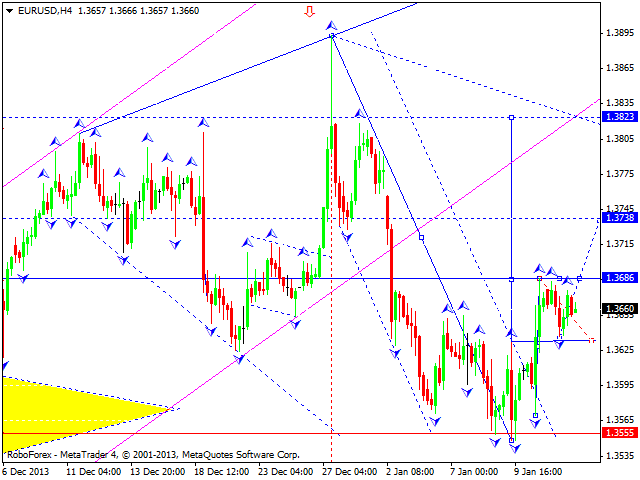
EUR/USD
Euro is falling down a little bit; this movement may be considered as correction towards ascending structure formed last Friday. We think, today price may continue growing up to break level of 1.3686, form consolidation channel near this levels, and then continue moving upwards to reach target at 1.3800.
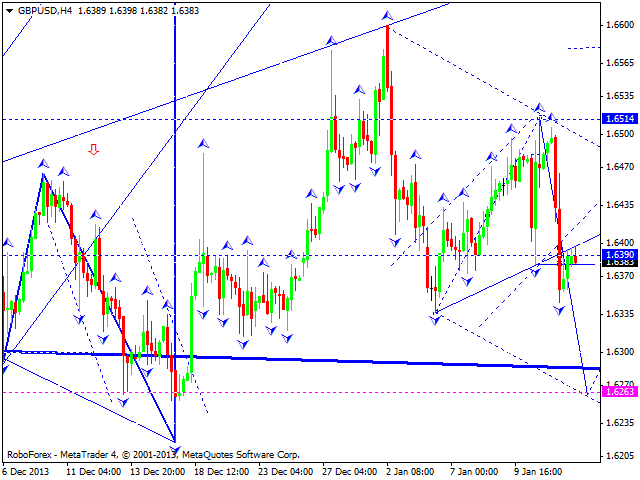
GBP/USD
Pound is still being corrected. We think, today price may continue falling down towards level of 1.6265, move upwards to reach level of 1.6440, and then complete this correction by finishing its fifth wave at level of 1.6185. Later, in our opinion, pair may form reversal pattern to start new ascending structure inside up trend.
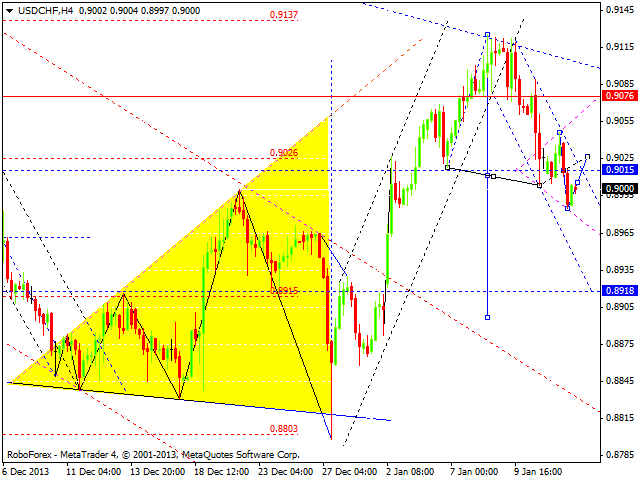
USD/CHF
Franc is still consolidating; market is forming continuation pattern to continue falling down. Price has already formed central structure near level of 0.9015. We think, today pair may continue moving downwards to reach level of 0.8920.
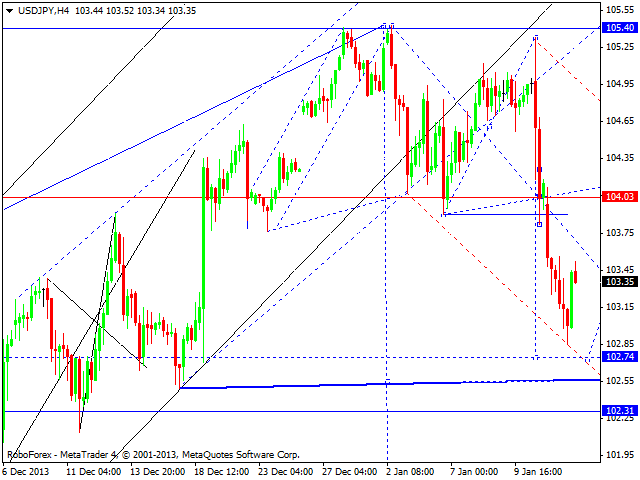
USD/JPY
Yen is still forming the third descending structure with target at 102.74. We think, today price may reach this target and then move upwards to 104.00. Later, in our opinion, pair may complete this correction by forming the fifth descending structure to reach level of 102.60 and then start new ascending movement to return to level of 104.00.
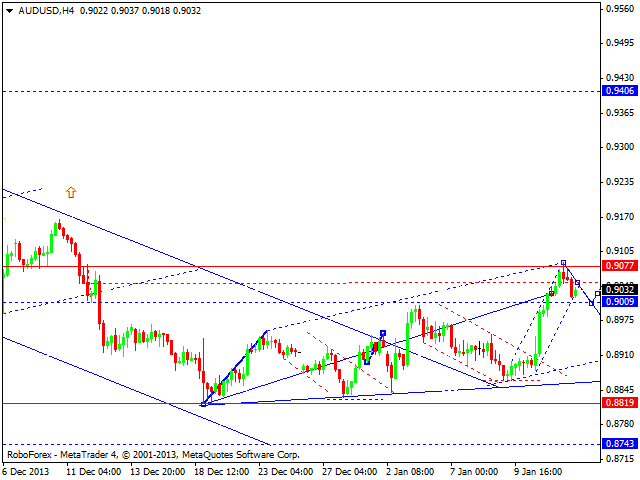
AUD/USD
Australian Dollar started forming new impulse to continue descending movement. We think, today price may fall down towards level of 0.9000, return to 0.9045, and then start forming another descending structure inside down trend. Main target of this wave is at 0.8400.
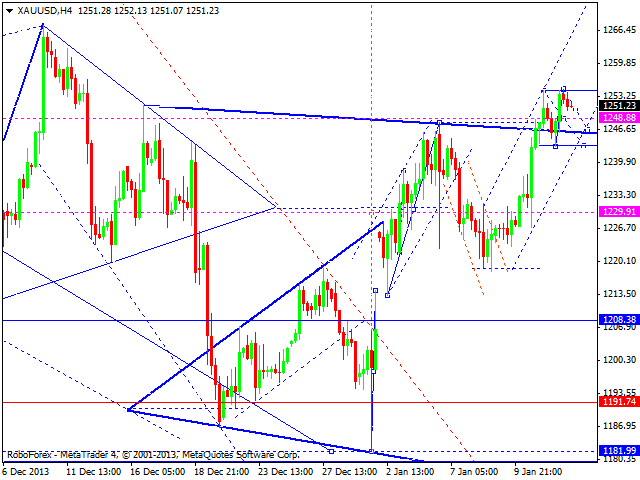
GOLD
Gold is still consolidating; market has formed central part of continuation pattern near level of 1248.88. We think, today price may continue forming this ascending structure towards level of 1277.
RoboForex Analytical Department
Article By RoboForex.com
Attention!
Forecasts presented in this section only reflect the author’s private opinion and should not be considered as guidance for trading. RoboForex LP bears no responsibility for trading results based on trading recommendations described in these analytical reviews.
Fibonacci Retracements Analysis 14.01.2014 (EUR/USD, USD/CHF)
Article By RoboForex.com
Analysis for January 14th, 2014
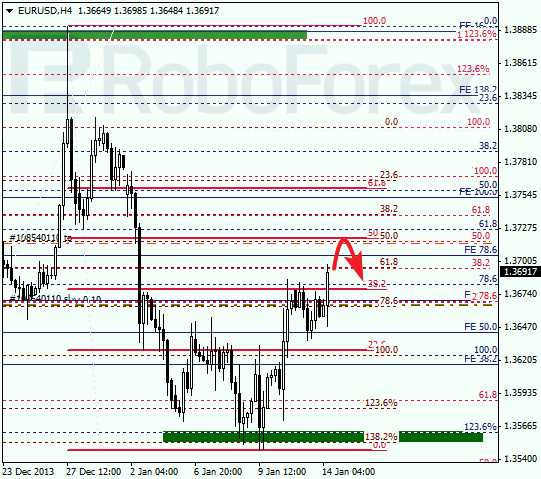
EUR/USD
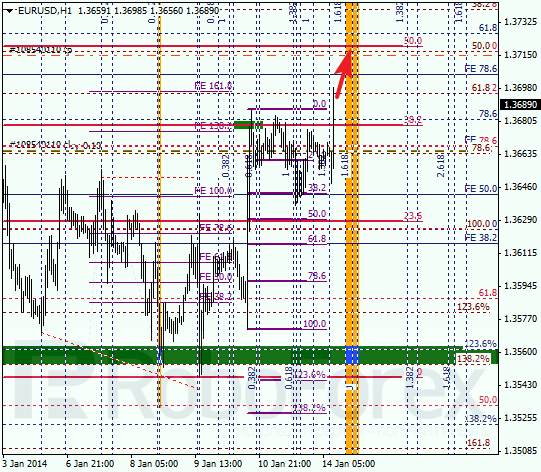
Just as we expected, Eurodollar continued moving upwards and reached new maximum. Yesterday I opened buy order; stop is already in the black. Closest target is at correctional level of 50%. If price rebounds from it, pair may reverse downwards.
At H1 chart, local correction reached level of 38.2% and then pair rebounded from it. According to analysis of temporary fibo-zones, predicted target at level of 50% may be reached during the next several hours.
USD/CHF
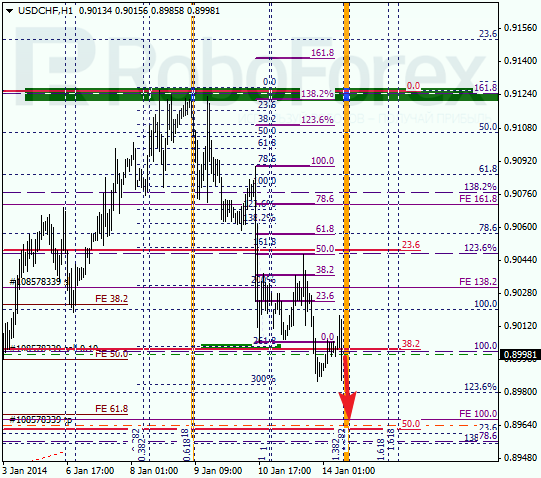
Franc is also still being corrected; target is at level of 50%. If later price rebounds from it, market may start new ascending movement.
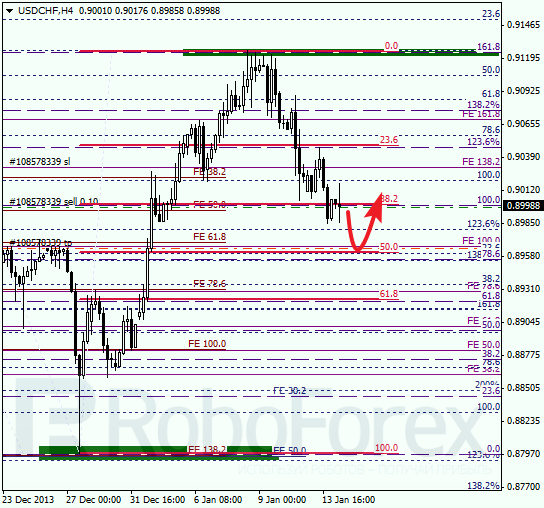
Correction reached local level of 50%. Bears’ first attempt to break minimum failed, but they may try again and succeed in the nearest future. Possibly, price may reach its main target during the day.
RoboForex Analytical Department
Article By RoboForex.com
Attention!
Forecasts presented in this section only reflect the author’s private opinion and should not be considered as guidance for trading. RoboForex LP bears no responsibility for trading results based on trading recommendations described in these analytical reviews.
