Price Action trading – the ‘holy grail’ of Forex trading strategies

Trading can be one of the most frustrating things a trader will experience in their life. Despite what most people think, a person’s chances of success in the market does not come down to their IQ level, in fact studies have shown some of the biggest losers in the market are doctors, dentists, engineers, mathematicians etc.

The reason is simple, the markets require a different mindset from everyday life. Logic that we’ve learned from our upbringing has the opposite effect in the markets. For example; ‘The more advanced, or complicated something is, the better it will work’. Or, ‘the harder I work, the more results I will get’. These are common logic paradoxes that trap a lot of new traders and have them spiralling out of control from day 1.

What you need to realize is the simple approach works better in the market. There are all these traders out there loading up their charts with indicators or ‘magic’ chart analysis tools, and all that’s doing is bringing in unnecessary variables into the traders system. Quite often all these extra variables will conflict with one another. It’s time to stop the pain, remove these indicators, clean up your charts and start trading with the raw price action.

Make the switch to price action

Once upon a time, fundamental analysis ruled the markets. Traders would only take trades based off economic data like interest rates, GDP data and job reports. Technical analysis was considered ‘voodoo’ and any trader who took part in it was considered crazy.

Today, the tables have turned. Technical analysis dominates the industry, and it’s hard pressed to find traders who are die hard fundamental analysts. Even if you do find one, you will likely find they also use technical analysis mixed in with their trading as well.

The reason for this is simple, technical analysis works. It is far superior, it allows you focus what the market is doing ‘NOW’ in relation to its past rather than what you ‘THINK’ the market should be doing based on economic data.

Many systems are created from technical analysis, which opens up the opportunity for traders to turn the market into an endless stream of opportunities. This leads to frustrated traders who keep jumping from system to system looking for that miracle indicator or trading robot. All they do is continuously bleed out their money to these exotic systems when the real answer has been staring them in the face all along – Price action.

What is Price action?

Price action is the ‘language’ of the market, learning this language is the best approach to understanding market movements. Price action is one of the best trading methodologies out there, and is often regarded as the ‘king’ of all trading systems.

‘Price’ is the single most important piece of data on your chart, it allows you to get into the ‘mind’ of the market to anticipate what’s going to happen next on the charts. You see, the market is full of people who are built just like you and me. Some are millionaires, some are just ordinary people. But we are all doing the same things over and over to generate income from the markets. What this does is create re-occurring patterns in the market which present themselves time and time again.

As a price action trader you can capitalize on these trading opportunities by looking for the individual candles that signal these moves before they happen.  It’s easy to do this without the need to use external variables like indicators, or economic data.

So price action is the art, or skill of reading plain price charts to identify patterns which have continuously worked in the past, that you can use to anticipate future price movements. Price action trading is ‘the’ edge in the markets.

Benefits of Trading with Price Action Strategies

For a start, you don’t ever have to worry about complicated indicators again. Indicators make a chart looks too ‘busy’ and in some cases make the chart look like the control panel for the next NASA space mission.

Indicators lag behind price anyway, providing you with second had information and usually won’t signal you into a move until it’s over. The whole idea is to keep your trading simple, logical and stress free. The best way to do this is trade with price action on a clean chart to provide you with better clarity in the markets.

Because price action is the simple approach to the market, it’s very easy to learn. The high school dropout could learn to trade with price action and have just as good of a chance as everyone else to do well.

Simple strategies are the most effective in the market and the simplicity of price action makes it one of the most powerful ways to approach the market.

The Pin Bar

The Pin Bar is the most common price action signal used by traders today. They are powerful reversal indicators which also are diverse with the way they can be traded. Pin bar reversal signals can be used to enter in with a trend, signal a complete market reversal and even used to identify breakout traps.

The Pin Bar has a small body and a long upper, or lower wick producing from the body, making them very easy to spot on the charts. It demonstrates the market has moved to a certain area on the chart where the move has terminated and been rejected. This signals a shift in the balance of power between the bulls and bears.

When pin bars are approached correctly they can produce very high return trades. It’s best to trade pin bars with the core market pressure, or trend momentum. The Pin Bar Reversal is one of my favourite price action trading strategies, and I know once you discover it’s potential, you will fall in love with it too.

Conclusion

If you’re looking for a trading system that is logical, effective and a stress free way to trade the market, look no further. I consider price action trading to be the ‘holy grail’ of trading strategies in today’s markets.

Nearly every trading system will benefit from a good foundation of price action knowledge, and to be honest, once you start trading with it, you will wonder how you ever managed without it.


About the Author

Graham from ‘The Forex Guy’, is a very passionate Forex trader that specializes in price action trading. If you would like to learn more about price action, then feel free to check them out and discover some more of their price action strategies.


My Favorite Chinese “Car” Company

By George Leong, B. Comm.

If you don’t believe China is the world’s largest auto market, then you probably have never been to Beijing or Shanghai, where the traffic gridlock makes Congress here seem pretty lax.

Despite the Chinese government’s ongoing efforts to regulate the number of vehicles on the country’s roads, especially in the bigger megacities, the Chinese auto market continues to be a major growth market for many foreign automakers, including General Motors Company (NYSE/GM) and Ford Motor Company (NYSE/F), which I have discussed in the past. (Read “Where to Find the Best Potential Growth in the Automotive Industry.”)

The statistics don’t lie. In 2013, sales of vehicles in the country surged a staggering 13.9%, according to the China Association of Automobile Manufacturers. The growth was welcomed by Chinese auto sellers, given that growth stalled to 2.45% and 4.33% in 2011 and 2012, respectively. The folks at General Motors and Ford are probably salivating at these numbers.

For a more conservative approach to play the Chinese auto market, you could keep things in the U.S. and play the growth through General Motors and Ford. Or, if you are willing to accept the higher risk, you could look to U.S.-listed Chinese companies to play the market directly.

A small Chinese auto parts play that you should take a look at is Zhangzhou City-based China Zenix Auto International Limited (NASDAQ/ZX, $2.53, market cap: $131 million). The company designs and makes commercial vehicle wheels for China’s aftermarket and original equipment manufacturers (OEM) market.

            Chart courtesy of www.StockCharts.com

The company has been around a little more than a decade. Its products are of high quality, involving more than 430 series of tube, tubeless, and off-road steel wheels. Zenix is also working on diversifying its product line to include higher-priced aluminum wheels.

At this time, the company runs five plants that together manufacture more than 15 million wheel units per annum as of September 30, 2013.

The company is the largest maker of commercial vehicle wheels in China based on sales volume in both the aftermarket and OEM market, according to market research firm Frost & Sullivan. In China, the company makes wheels for more than 90 OEM automotive manufacturers. The aftermarket business in China is massive. Its network includes more than 5,000 distributors, comprising 23 tier-one distributors, 2,143 exclusive tier-two distributors, and 2,492 non-exclusive tier-two distributors. (Source: “Company Profile,” China Zenix Auto International Limited web site, last accessed January 13, 2014.)

Zenix also holds about 97 patents, including three invention patents, 74 utility model patents, 20 design patents, and 532 trademarks in China.

The company sells its wheels to more than 30 countries in North and South America, Africa, Europe, and Asia. The company’s biggest foreign market is India, where Zenix has business with TATA Motors.

The sole analyst covering the company estimates revenues to rise 11% to $680.77 million in 2013, according to Thomson Financial.

So with the massive growth in Chinese vehicle sales and each vehicle requiring four wheels, it’s a no-brainer to take a look at some of the auto plays in China like Zenix. However, investors should note that Zenix is a highly speculative contrarian play that could rally much higher if it can grow its business and execute.

This article My Favorite Chinese “Car” Company was originally posted at Profit Confidential


Why the NASDAQ Will Outperform the Other Major Indices in 2014

By Mitchell Clark, B. Comm.

So far this year, the NASDAQ Composite Index has outperformed the other large-cap averages, and this is a positive indicator.

At the beginning of last year, blue chips shot out of the gate with uncommon capital gains, and as confidence in the rally grew, investors slowly felt more comfortable with more speculative issues, which are often listed on the NASDAQ.

After a pronounced consolidation during the summer of last year, large-cap NASDAQ stocks, like Microsoft Corporation (MSFT), Juniper Networks, Inc. (JNPR), and even Intel Corporation (INTC), reaccelerated.

I view the price reacceleration in large-cap technology stocks as a combination of attractive valuations and yields and improved expectations for growth. Microsoft’s fourth-quarter sales are expected to grow some 10%.

While blue-chip strength is always helpful, large-cap technology stocks must be a big part of the long-term trend, as they are such a large part of the daily economy now.

The Russell 2000 Index of small-caps is also holding up extremely well and is another positive indicator for the broader market. While stocks are very much in need of a correction, it won’t happen without a major catalyst, and trading action among large-cap technology and small-caps is reason enough to expect more capital gains. The chart of the Russell 2000 Small Cap Index is featured below:

            Chart courtesy of www.StockCharts.com


Also not to be forgotten is the Dow Jones Transportation Average, which is still just a hair off its all-time record-high. Transportations stocks are always a leading indicator, and if you attribute any worth to the performance of airline stocks, their year-to-date performance is also a positive signal.

Given current information, a major retrenchment in the stock market would be a buying opportunity. With this in mind, the U.S. economy can experience its next technical recession within the context of a secular bull market. This is entirely possible this year.

But the positive dynamics for equities remain intact. Low short-term interest rates are a certainty this year. The health of U.S. corporations, especially brand-name large-caps, is extremely good and at a minimum; earnings maintenance is a high likelihood, as higher prices have demonstrated not to adversely affect demand.

And finally, while there has been frothy initial public offering (IPO) trading, countless blue chips are not expensively priced. Their stocks might be at all-time record-highs on slow prospects for growth, but valuations aren’t out of their norms yet for many of these companies. (See “If You Don’t Want to Leave This Market, Stick with These Proven Winners.”)

So, my 2014 outlook for equities is still positive given current data, especially if corporations can meet or beat consensus in the first half of the year.

Stocks are due for a correction, but technically, I don’t see it happening with the current relative price strength from the NASDAQ, Russell 2000, and transportation stocks.

I wouldn’t chase after any position in this market, and that goes for yields as well. But with corporate balance sheets in such strong shape and the cost of money being so cheap, increased dividends and share buybacks once again bode well for blue-chip stocks.

This article Why the NASDAQ Will Outperform the Other Major Indices in 2014 was originally posted at Profit Confidential


US Dollar Picks up from Two Weeks Low

By HY Markets Forex Blog

The US dollar climbed against 15 out of 16 major peers on Wednesday, bouncing back from its two-week low against the euro, after two voting members of the Federal Open Market Committee (FOMC) hinted the central bank could end its quantitative easing program early.

The World Bank raised its growth forecast for the world’s biggest economy, while a gauge for future market volatility was close to a one-year low.

The greenback advanced 0.30% higher, trading at $1.3637 against the euro at the time of writing, while the World Bank raised its global growth forecast to 3.2% this year, 3.4% by 2015 and 3.5% the year after.

The US gross domestic product (GDP) is forecasted to increase by 2.8%, while Japan and the eurozone will expand by 1.4% and 1.1% respectively.

US Dollar – Fed Speakers

Philadelphia’s Federal Reserve (Fed) President Charles Plosser said he recommend the central bank should end its quantitative easing before late 2014. Plosser also said he forecast the unemployment rate would reach 6.2% by the end of the year.

Charles Plosser supports the Fed’s decision to scale-back its stimulus and commented on the labour marking performing better than expected.

Dallas Fed President Richard Fisher also supported the Fed’s December decision to begin to taper the quantitative easing program and said he would prefer the program gets eliminated entirely.

Fed chiefs for Chicago, Charles Evans and Atlanta Dennis Lockhart are expected to make their speeches today. In December, the Federal Reserve announced they will cut its monthly bond purchases to $75 billion from $85 billion.

Members of the Federal Open Market Committee (FOMC) will gather for their next meeting on January 28-29.

US Dollar – US Data

US retail sales rose 0.2% higher in December on a monthly basis, compared to 0.4% reported in November. The retail trade volume advanced 0.7% higher, picking up from the revised 0.1% rise reported in the previous month.

US businesses’ inventories advanced 0.4% higher in November, reports from the US Department of Commerce confirmed on Tuesday.


Win a luxurious trip to the Maldives & up to $30,000 cash for trading with us!

Visit for details http://ift.tt/L42Q3q

The post US Dollar Picks up from Two Weeks Low appeared first on | HY Markets Official blog.

Article provided by HY Markets Forex Blog

Gold Declines Further on Fed Stimulus Outlook

By HY Markets Forex Blog

Gold declined for a second day from the highest level in a month on Wednesday as investors speculate that the Federal Reserve will reduce its bond purchases further, adding pressure on the bullion.

The Yellow metal’s contract for February dropped 0.36% lower to $1,240.50 an ounce on New York’s Comex at the time of writing. While silver futures dropped for the second straight session, trading 0.75% lower at $20.135 an ounce.

Assets in the world’s biggest bullion-backed exchanged-traded fund came in 789.56 tones on Tuesday, dropping to a five-year low.

Gold – US Dollar, US Stocks

The US dollar index edged 0.24% higher to 80.858 points at the time of writing.

Stocks in New York advanced on Tuesday, boosted by the US macro data. The market was driven by the upbeat US retail sales report for December, rising 0.2% higher and beating analysts’ forecasts.

Meanwhile, the US businesses’ inventories also reported positive figures, showing a rise of 0.4% higher in November.

Gold – Fed Tapering

In December, the Federal Reserve announced they will cut its monthly bond purchases to $75 billion from $85 billion.

Philadelphia’s Federal Reserve (Fed) President Charles Plosser said he recommend the central bank should end its quantitative easing before late 2014. Plosser also said he forecast the unemployment rate would reach 6.2% by the end of the year.

Charles Plosser supports the Fed’s decision to scale-back its stimulus and commented on the labour marking performing better than expected.

Dallas Fed President Richard Fisher also supported the Fed’s December decision to begin to taper the quantitative easing program and said he would prefer the program scaled-back further by $20 billion.

Members of the Federal Open Market Committee (FOMC) will gather for their next meeting on January 28-29.


Visit www.hymarkets.com   to find out more about our products and start trading today with only $50 using the latest trading technology today.

The post Gold Declines Further on Fed Stimulus Outlook appeared first on | HY Markets Official blog.

Article provided by HY Markets Forex Blog

Ichimoku Cloud Analysis 15.01.2014 (GBP/USD, GOLD)

Article By RoboForex.com

Analysis for January 15th, 2014

GBP/USD

GBPUSD, Time Frame H4. Tenkan-Sen and Kijun-Sen intersected and formed “Dead Cross” (1). Ichimoku Cloud is going down (2), and the price is on Tenkan-Sen. Short‑term forecast: we can expect resistance from Tenkan-Sen – Kijun-Sen, and decline of the price towards D Senkou Span A.

GBPUSD, Time Frame H1. Tenkan-Sen and Kijun-Sen are influenced by “Dead Cross” (1); all lines are directed downwards. Ichimoku Cloud is closed (2), Chinkou Lagging Span is on the chart, and the price is on Tenkan-Sen, inside Kumo Cloud. Short‑term forecast: we can expect resistance from Kijun-Sen and decline of the price.

GOLD

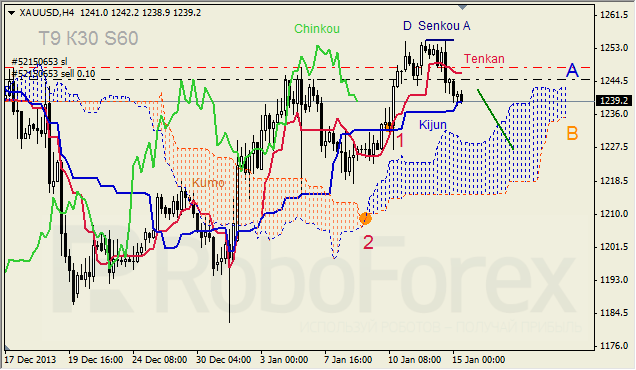
XAUUSD, Time Frame H4. Tenkan-Sen and Kijun-Sen are influenced by “Golden Cross” (1). Ichimoku Cloud is going up (2), Chinkou Lagging Span is above the chart, and the price is inside Tenkan-Sen – Kijun‑Sen channel. Short-term forecast: we can expect attempts of the price to enter Kumo and stay inside it.

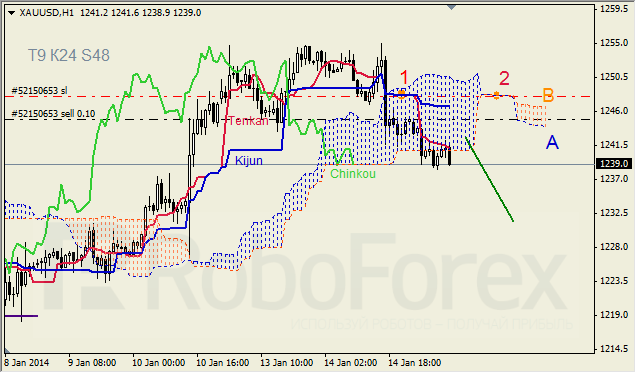
XAUUSD, Time Frame H1. Tenkan-Sen and Kijun-Sen intersected and formed “Dead Cross” (1). Ichimoku Cloud is going up (2), Chinkou Lagging Span is below the chart, and the price is on Tenkan-Sen. Short‑term forecast: we can expect decline of the price.

RoboForex Analytical Department

Article By RoboForex.com

Attention!
Forecasts presented in this section only reflect the author’s private opinion and should not be considered as guidance for trading. RoboForex LP bears no responsibility for trading results based on trading recommendations described in these analytical reviews.


Japanese Candlesticks Analysis 15.01.2014 (EUR/USD, USD/JPY)

Article By RoboForex.com

Analysis for January 15th, 2014

EUR/USD

H4 chart of EUR/USD shows sideways correction between support and resistance levels. Three Line Break chart and Heiken Ashi candlesticks indicate descending movement.

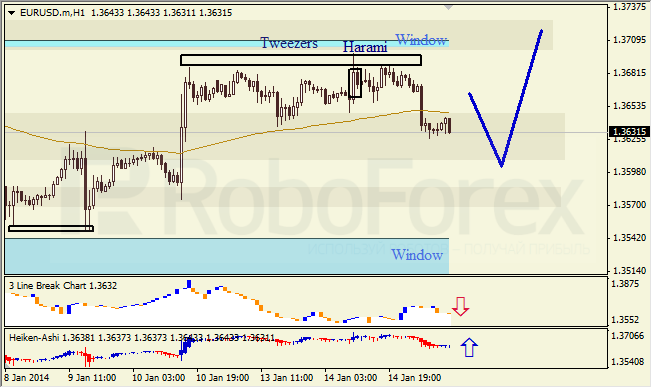
H1 chart of EUR/USD shows bearish tendency, which is indicated by Harami and Tweezers patterns. Three Line Break chart confirms descending tendency; Heiken Ashi candlesticks indicate ascending movement.

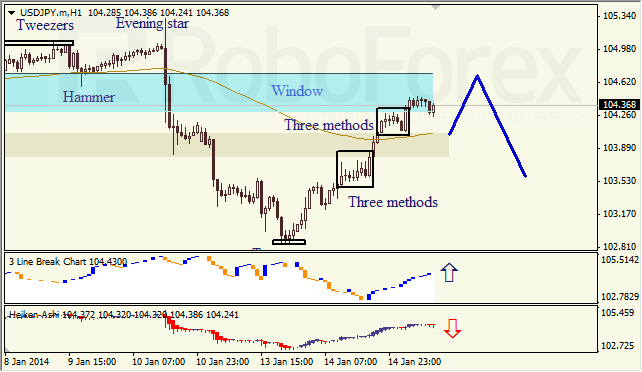
USD/JPY

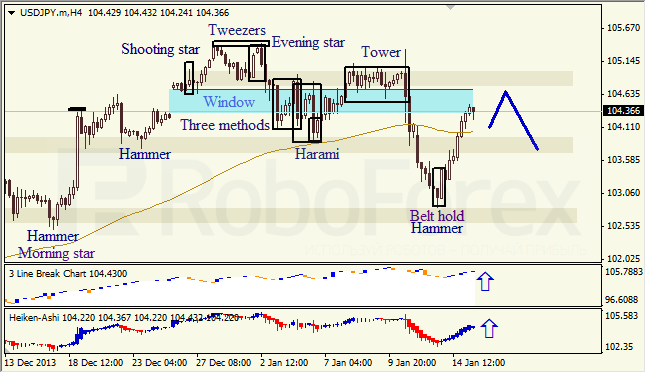
H4 chart of USD/JPY shows bullish tendency. Closest Window is resistance level. Three Line Break chart and Heiken Ashi candlesticks confirm ascending movement.

H1 chart of USD/JPY shows bullish tendency, which is indicated by Three Methods pattern. Three Line Break chart confirms ascending movement; Heiken Ashi candlesticks indicate bearish pullback.

RoboForex Analytical Department

Article By RoboForex.com

Attention!
Forecasts presented in this section only reflect the author’s private opinion and should not be considered as guidance for trading. RoboForex LP bears no responsibility for trading results based on trading recommendations described in these analytical reviews.


Missed Last Year’s Stock Market Rally? It’s Time to Play Catch-Up…

By MoneyMorning.com.au

We bet you didn’t realise this about the Aussie market.

Apparently investors have been asleep since the start of the year.

That was until yesterday.

According to the Sydney Morning Herald, that was when there was a ‘Wake-up call for investors as shares plunge’.

The Aussie S&P/ASX 200 fell 1.5%. It was the biggest drop for the year so far. Get ready for the hollerin’. You’ll start to hear the same stories as last year about tapering and falling markets.

The same stories that caused many investors to miss out on the big stock rally.

If that sort of talk stopped you from making the most of the stock rally last year, you’ve got a decision to make. Will you let the same talk stop you from investing now? And importantly, if you do, will it be the right thing to do…?

It was the same old story from the Sydney Morning Herald yesterday:

The Australian sharemarket has shed $24 billion in value in its worst trading day since September, as investor worries ahead of the US earnings season reverberated across global stocks.

Every time the stock market tumbles the mainstream press wails about the billions wiped off stocks. Rarely do you see the story on the other side of the ledger when stocks rise 1.5%.

It’s no wonder so many investors become ‘paralysed’, too scared to invest at a time when there are so many exciting opportunities around.

Fewer Stocks to Take Bigger Risks

That’s what kept so many people out of stocks last year. Maybe you were one of those investors to miss out. That was a shame. The S&P/ASX 200 index gained 15.1% last year.

While that was below the performance of many overseas markets, it was certainly a better option than many other investments – gold, property, and of course, cash.

So, is now the time to switch to cash or something else other than stocks? Remember the old saying, ‘past performance isn’t always a reliable indicator of future performance’. In other words, just because Aussie stocks went up last year, it doesn’t mean they’ll go up this year.

The simple answer: for most investors, now is not the right time to get out of stocks.

As you should know by now, we advocate a relatively conservative approach to asset allocation. But we do that for a reason. The more conservative your asset allocation strategy, the more risks you can take.

That probably sounds like gobbledygook, and counterintuitive.

After all, in order to take more risks, don’t you need to have a high-risk asset allocation strategy? Not necessarily. Not if you follow our approach.

It all comes down to how you invest and where. For instance, we recommend a maximum stock allocation of 50%. That should consist of at least 30% in dividend stocks and the rest in a mixture of large-cap and small-cap growth stocks.

The other 50% should be in a combination of cash and gold.

Exactly how much you allocate to each of these investment classes is up to you. It’s not that hard to work out; you’ll soon get the feel of it. But what about the idea of increasing your risk by becoming a more conservative investor?

Speculating With Small Stakes

The reason we can recommend such a high cash balance is because of the type of stocks we recommend investors hold in their share portfolio.

Most financial advisors recommend big blue chip stocks and nothing else. Many financial advisors have no choice. A condition of their affiliation with a financial planning group may stop them from recommending stocks outside the 200 biggest ones.

That’s terrible. It means the financial planner can’t recommend 90% of the stocks listed on the ASX.

We recommend something most financial advisors wouldn’t dare recommend. That is, we recommend investors get into some of the riskiest stocks on the market. There’s a simple reason for that. These stocks are so risky that if you back the right one, it can return many times your original investment.

That means you only need to invest a relatively small amount in each stock. Of course, there’s a flipside to investing in these risky stocks. There’s the risk you could lose some or all of your investment.

Using this approach is a great way to get into the market if you’re unsure of whether to buy stocks or not. And it’s a great way to get access to potentially big returns without risking a lot of money. Let’s say you have $100,000 of investible cash. You could choose to keep $95,000 in the bank to earn interest.

With the remaining $5,000 you could invest in a small handful of speculative small-cap stocks. The worst case is you lose the $5,000 you speculated (and that’s unlikely if you split the money between three or four well-researched stocks). On the positive side, the interest you earn on the cash should make that back.

Do you see what we mean? Just because you’re a conservative investor with a conservative asset allocation strategy, doesn’t mean you can’t make speculative investments. We’ve shown you an extreme example. The same principle for speculating applies for investors prepared to invest more in stocks – blue-chip and small-cap growth.

The only question remaining is where should you invest your speculative portfolio? There are a number of choices with a lot of potential. We’ll give you a couple of ideas on that tomorrow.

Cheers,
Kris+

Special Report:  574 Years in the Making


Join Money Morning on Google+


By MoneyMorning.com.au

Taking 3D Printing to 4D

By MoneyMorning.com.au

If you’ve been a longtime reader, you know how 3D printing is a revolution poised to change how things are made across the globe.

But do you know about 4D printing?

4D printing is 3D printing with ‘smart’ ink…that evolves over one more dimension: time.
‘Smart ink’ is basically different materials combined together that adapt to their environment. They could change shape or appearance in response to heat, light, air, fluid or pressure. How it happens depends on their smaller parts and how they’re programmed. In other words, 4D printing is not about the technology that manipulates materials, but rather, the materials that manipulate themselves.

Like a seed following the instructions of its DNA, we can 3D print materials that self-assemble into the fourth dimension. They can camouflage themselves with ‘skins’ that ‘heal’ or coatings that self-repair. Submarines could cloak themselves based on the water they passed through. Airplane wings could change like metal origami based on where they fly and what they carry.

Right now, 4D printing is in its experimental phase, but some companies have already shown interest. The US Army Research Office awarded $855,000 in 2013 to three universities to make advances in 4D printing. The most well-known project, however, is going on at MIT.

The idea behind 4-D printing,‘ says director of MIT’s Self-Assembly Lab Skylar Tibbits, ‘is that you take multimaterial 3-D printing…and you add a new capability, which is transformation. Part of my work had been writing code to digitally design things. If we can write code to operate a machine, why can’t we also use code to get things to assemble themselves?

Tibbits believes materials could contain the ‘software’ needed for self-assembly, saving time and money. The materials would mimic the movements of machine-assembled devices driven by actuators, motors and sensors. In an interview with Scientific American, he uses the example of a thermostat, one that’s not digital:

If you pull off the cover of that thermostat, there’s a coil with a bimetallic strip. You have two metals sandwiched together with different expansion rates. When subtle temperature changes happen, it turns the coil to the left or right. That turns a dial to either increase or reduce heat. There’s no motor or traditional sensor. It’s just a material that’s expanding and contracting and turning a dial.

Already, he’s tested 4D printing on a fairly large scale, printing a 50-foot strand material and then placing it in a pool. The angles and orientation of the black, rigid plastic changed over time as it was submerged. Attached to this strand was a white plastic that expanded 150%, causing it to fold.

But despite all of the excitement, Tibbits admits that 4D printing is still in the early states, and that he’s just one research lab: ‘Our job is to push knowledge and discover new things. We don’t develop new products; we rely on industry for that. The development of new 4-D printing applications depends on strong collaboration with businesses interested in pursuing this technology.

Those at his Self-Assembly Lab believe the tech is powerful enough to disrupt ‘biology, material science, software, robotics, manufacturing, transportation, infrastructure, construction, the arts and even space exploration.‘ He believes two segments hold the most promise in the near term: extreme environments and large-scale infrastructure. Space, where oxygen lacks and temperatures freeze, is one example. Underground is one more.

Harsh environments like outer space would, indeed, be made more accommodating. And with that, let’s check out my personal favourite space where a more immediate, more practical application is: underground.

One Potential Application: A Solution to a $350 Billion Problem

It’s time to rescue the most vital resource on the planet: water.

We take water for granted all the time. About 60% of your body is made up of it.

You can survive three weeks without food.

But without water? Try three days. We don’t recommend it…

Throughout history, the great civilisations understood its value: Egypt, with its pyramids by the Nile, and Rome, with its monumental aqueducts. But here in the US, our modern-day empire is in serious trouble. Many of the big water systems were built not long after the Second World War. In fact, 30% of water pipes are 40-80 years old. 10% are older.

That’s why if you listen closely, dear reader, you may be able to hear it…

Water mains breaking around the country every two minutes – 700 a day, on average.

A few months ago around our Baltimore office, the city’s main street was flowing like a river. Still, that was nothing compared with what happened on the Potomac. A pipe erupted so fiercely helicopters had to be called in to rescue people before they drowned.

It’s the same everywhere else. In Philadelphia, cars and homes have been flooded. On the West Coast, Los Angeles’ famous Ventura Boulevard has been swamped.

When something like that happens, you tend to be asked by local officials to stop watering your lawn and washing your car. Cut back on using toilets, they recommend. Same with dishwashers and washing machines. The fire departments need all they can get in case chaos breaks out. But it becomes more than an inconvenience when it gets really bad. Even worse than property loss, bacteria and viruses can enter the greater water supply through broken pipes. The 2008 salmonella outbreak that sickened over 250 people in Alamosa, Colo., is a small example.

In fact, the nation’s drinking water system is so troubled the American Society of Civil Engineers gave it a grade of D-plus in its 2013 Report Card for America’s Infrastructure.

You can’t have jobs, you can’t have businesses, homes, you can’t have hotels, homes, if this infrastructure isn’t in place,‘ says Eric Goldstein of the Natural Resources Defense Council.

And guess where action needs to be taken most? I’ll give you a clue: It also has among the highest crime rates – official and unofficial.

Washington, DC’s, average pipe is 77 years old. In the wake of the Great Recession, funds dried up to fix the water problem. Some $10 billion were allocated from the stimulus package. But according to CNN, the funds needed over the next 20 years are $334.8 billion. The more we wait, the worse it gets. So much for the government taking care of the public’s single most basic service: drinking water…

Fortunately, our friend at MIT, Mr. Tibbits, has shown the potential of 4D printing as a solution. Tibbits is working more than a tad bit with a Boston company called Geosyntec to develop a new paradigm in water infrastructure. Rather than use fixed-capacity water pipes, they’re experimenting with nanoscale adaptive materials built from the environment. The best 4D printing tech is based on the work nature has already spent billions of years producing. 4D printing with adaptive pipes to correct our water piping reminds me a lot of how human veins expand and contract to accommodate blood flow. The 4-D printing solution is similar.

Imagine if water pipes could expand or contract to change capacity or change flow rate,‘ Tibbits said in a recent TED talk. ‘Or maybe [they] undulate like peristaltics to move the water themselves,‘ he said. ‘This isn’t expensive pumps or valves,‘ he continues. ‘This is a completely programmable and adaptive pipe on its own.‘ This is, of course, only the beginning. ‘Manufacturing could be more like growing,‘ he said in a BBC interview in July, 2013. ‘Maybe the construction sites in the future, we play Beethoven and structures build themselves.

Regards,

Josh Grasmick,
Contributing Editor, Money Morning

Ed Note: The above is an edited version of an article originally published in The Daily Reckoning America.

Join Money Morning on Google+


By MoneyMorning.com.au

2014 Graphite Outlook: Price Rebound, Supply Shift and New End Uses

Source: Brian Sylvester of The Mining Report  (1/14/14)

http://www.theaureport.com/pub/na/no-title-15798

China’s recent halting of flake graphite production in Pingdu, Shandong, made headlines, and has many investors wondering how supply may shift. Simon Moores, manager of Industrial Minerals Data, tells The Mining Report that he sees an interesting dynamic unfolding in the graphite space over the next five years. As buyers for steel and battery markets compete for limited graphite supplies, the winners will be companies that can deliver the best, tailor-made products. In the meantime, offtake agreements are signaling a new confidence in the sector.

The Mining Report: Simon, China is putting mining on the back burner while it cleans up damage done to the environment by mining and other industrial work. Graphite processing facilities, including those in Shandong Province, have halted flake graphite production. Will that affect prices?

Simon Moores: For sure. We expect the immediate price impact will be minimal. Typically, graphite mining stops during the winter in China, so most international buying already happened in the autumn.

Inside China, we’ve heard that some producers are raising their list prices, taking advantage of the story. The key will be whether those prices stick when buying begins again after the Chinese spring festival in late January/early February. At that point, I anticipate a price reaction.

TMR: It’s estimated that China controls 70% of the world’s graphite production. Is its grasp on the graphite business loosening?

SM: China’s macro policies, certainly on environmental responsibility (including the use of natural resources and improving air quality), are leading to a crackdown on the mining industry. Halting graphite mining, as we’ve seen in Pingdu, is a perfect example of that.

As a result, we could easily see some shift of supply. The temporary closures in Pingdu could be enough to scare buyers into looking elsewhere. That’s already happening. Major graphite buyers are looking all over the world for new sources. If the Pingdu restrictions extend into Heilongjiang Province, buyers could move—not just look—to sources outside of China for the first time since the 1980s.

TMR: In your May 2013 interview, you suggested that prices for flake graphite had bottomed. What happened to the price for standard-grade graphite over the latter half of 2013?

SM: Prices remained flat. We saw slight decreases, but ultimately the trend was flat. We expect to see price improvement in Q1/14 or Q2/14 because of the supply-demand situation. If that’s the case, we’ll know that the second half of H2/12 was the bottom, but there’s been no upturn yet to confirm that.

TMR: What’s your price outlook for 2014 and into 2015 for flake graphite, plus-80 mesh, 94–97% carbon?

SM: This year we expect some improvement, maybe to $1,400-1,500/ton. Should that momentum carry into 2015, prices could improve further, to $1,600-1,800/ton. We don’t expect to see the huge increases we saw back in 2010-2011. That was a unique situation.

TMR: What’s the biggest wildcard facing the graphite space this year?

SM: On the supply side, it’s still China. On the demand side, the wild card is demand from a new sector and that’s batteries.

TMR: What should get investors excited and involved in graphite in 2014?


SM: The fundamentals haven’t changed since the price spike and exploration boom of 2010-2011. The key elements are China’s dominance, China’s mining regulation plans and the emergence of new markets.

I would look at refractories versus batteries. Manufacturers of refractories are trying to get higher quality graphite. Battery manufactures are competing for the same grade—large flake, higher purity graphite. Most of the mines around the world can’t supply sufficient volumes. That presents a great opportunity for anyone trying to build a new mine.

TMR: Readers of The Mining Report are mostly familiar with small-cap graphite explorers and developers. In that sector, what makes a good graphite project?

SM: It’s a balancing act. It comes down to the product the project can produce, who would want to buy it and how economical the resource is. Grade is important. Typically, higher purity in the ground translates directly into a more economical resource. Flake size is also key, because buyers are demanding larger flake (plus-80 mesh and higher) and higher purity (95%, 96%, 97% and 98% C).

The size of the resource is somewhat less important from end user and industry perspectives. After all, industry consumes a maximum of 450,000 tons per year, in a good year. But I can understand that an investor would want to see large, confirmed resources for long-term business plans.


TMR: The first offtake deal has been signed with a junior graphite developer in Canada, Focus Graphite Inc. (FMS:TSX.V). Does that deal legitimize graphite juniors by giving them a role in the bigger picture?


SM: It legitimizes some of them. The deal was a vote of confidence in the exploration sector. It showed the world that the exploration and development sector have some very good projects and can create a product the market wants and needs.


The Focus Graphite deal covered nearly 100% of the company’s planned production, including fines. Fines are usually a very difficult product to ship because they’re always in excess supply and are of lower quality carbon. There’s less of a market for fines and it has more product competition.


What stood out for me in the Focus Graphite deal is that it came from China. It shows the big buyers in China are looking elsewhere for new supplies. I thought that was the big takeaway, not just for Focus Graphite, but for the whole exploration sector. Focus showed its willingness to work with China as a customer, not necessarily as a competitor.


I think if the exploration industry starts to see China as a market—an opportunity, rather than a threat—more progress would be made.


TMR: How much of an advantage does the offtake deal give Focus over other players in similar positions?


SM: It’s an advantage now, because Focus was the first to announce and it shows a serious, large-scale partner in China. Only one other company has had an offtake since, and that’s Kibaran Resources Ltd. (KNL:ASX) with a Europe-based trader.


TMR: Do you think we will see other, similar deals?


SM: We could, yes. A lot of buyers want to get long-term supply. A lot of players are waiting to get the best deal, whether that means buying a project outright or signing offtake agreements.


TMR: Across the mining space, but particularly in the graphite space, a number of companies are running low on cash. Do you expect any mergers of survival?


SM: I expect the biggest and the best projects will survive. The top companies, the ones you read about, have the best projects. The smaller ones will have to look at merging or folding if they can’t get funding.


As I’ve said before, some in the industry—both producers and buyers—are waiting for a good time to buy a project. It doesn’t have to be a leading project, which could be quite expensive. It could be a smaller project. They’re just waiting for a good deal. So I expect to see some activity in 2014.


TMR: Does Industrial Minerals Data keep track of companies’ cash on hand and the burn rates?


SM: No, we focus on collecting prices and supply-and-demand figures. We track the industry, not individual companies.


TMR: What was the funding scene for the industry in 2013?


SM: Clearly, it was a difficult year for funding. One financing that stood out was Syrah Resources Ltd.’s (ASX: SYR) raising AU$35 million (AU$35M) for its project in Mozambique. I know how difficult it was for all the other projects in the industry, so that was an achievement. It was a big step toward actually building a mine.


TMR: Were there other events that got your attention? I’m thinking of the Sri Lankan government opening up to graphite mining, for example.


SM: Sri Lanka did open up exploration throughout the year by loosening legislation to welcome foreign investment. Many more companies are active there now and they tend to be Australian. The nature of Sri Lanka’s graphite means, in volume terms, it will remain a niche.


TMR: What about the efforts of a research team trying to develop condoms made of latex graphene? Is that possible?


SM: Only theoretically. You can be the first to try it. I won’t.


TMR: So, batteries and steel will remain the primary demand drivers for graphite?


SM: Yes, definitely. Steel refractories will remain the staple for a long time, but the potential for explosive growth will come from batteries. If you have a big market from steel plus big growth percentages coming from batteries—and everyone is competing for the same raw material—it could create an interesting dynamic over the next five years.


TMR: In terms of company news, does any company stand out for doing something different from its competitors?


SM: It was a quiet year in terms of stories. Juniors battled it out on a few fronts, especially the carbon purity stakes of the end product.


The battlegrounds now are over resource size, purity and upgrading the size of reserves.


For example, Canada Carbon Inc. (CCB:TSX.V) has a vein graphite deposit in North America and it has one of the more original approaches. It’s one of the smaller companies, but the company’s niche approach is refreshing and more suited to the graphite industry outside of China.


TMR: Do you prefer a vein deposit to other types of deposits?


SM: Not really; it depends on the market you’re going for.


Canada Carbon is going for a niche, not to take on the whole market. The company is thinking sensibly about alternatives. It doesn’t plan to produce more than 10,000 tons a year.


TMR: Northern Graphite Corporation (NGC:TSX.V; NGPHF:OTCQX) was once the darling of the sector. Its share price had a good run, but has since come off quite a bit. Why?


SM: Northern Graphite did a great job of getting out ahead in the race, publishing a lot of information first. It led the industry in that perspective. Obviously, as more projects come on-stream, there is more competition. If you stick your neck out, some people will have a go at you and other people will respect that. That’s just the hazard of leading the pack, as Northern Graphite did.


Investors should be considering all the serious graphite companies, and that includes Northern Graphite.


TMR: What’s next for graphite investors?


SM: You never quite know in this space, but I think the worst is over. I think we’ll see improvement in 2014 for everyone in the graphite industry. The fundamentals haven’t changed since the boom of 2011: China still dominates. New supply is needed for high-tech markets, which are competing with the traditional steel refractories. No new mines have been built since the 1980s.


Add on to that the diminishing supply, given the new situation in Pingdu, China. Supply, especially for large-flake, high-purity grades, is tighter. Premium products—large-flake, plus-80 and bigger, at purity levels of 95–99% carbon—will be in demand.


We should see some price improvement as well. Usually, when prices improve, that sentiment translates to the rest of the industry. That gets reflected in the investment arena. If that happens, it should encourage more people to return to graphite investing, because the fundamentals are pretty clear.


TMR: In addition to the high-purity producers, what about companies that can provide a value-added product?


SM: This is important. The industry needs value-added products that are hot and fresh out of the kitchen.


But for the pure mining companies, that will be difficult to achieve. Producing spherical graphite, for example, is effectively a second business requiring more capital.


From the raw material perspective, it’s not just about purity. It’s really about the large flake and the purity together. If you look at the plus-45 mesh or higher—the next step down from plus-80—in conjunction with purity in the 95-99% ranges—that product will be in demand. We’ve actually seen a shortage of some of these higher grades in a market where not many people are buying.


TMR: Have management teams in the graphite space adjusted their business models to be more accommodating to the market?


SM: Beginning last year, they started listening more to industry. The responsible companies were asking people what they actually wanted. It’s nearly all about processing technology to get the true value. Companies that follow that route aren’t just making flake graphite; they’re making spherical graphite for batteries. That is a big investment, and also a significant step forward.


TMR: I have to ask about the graphene-graphite debate. Has this industry made progress in developing graphene made from mined graphite?


SM: To be honest, not much. The exploration sector has done most of the legwork on this and has made some inroads, but it’s still a young industry. It’s still risky to say you can make all graphene from flake graphite because there are so many different production routes. It remains a theoretical product without a market.


It’s not necessarily the best company in scientific terms that wins in these things. It’s whoever makes the market inroads now. The graphite-to-graphene companies out there now—Grafoid Inc. (private) would be a good example—are doing the work and creating the market. If those companies are linked to flake graphite projects, that’s a plus for this side of the industry.


TMR: In that case, is Focus providing a model for others to follow?


SM: I think Focus is concentrating on the processing and the technical aspects of it. In the end, it doesn’t matter too much where you get your raw material; it’s about the processing technology that you develop.


I said a few years back that those that hold the technology cards will lead the pack and I still believe that.


TMR: In effect, if you could provide a steady consistent supply of graphene, there will be markets for it. Without the steady supply, there are no markets for graphene. It’s a chicken-and-the-egg situation.


SM: Definitely. That’s why the graphene supply side is pushing to create a market. Some companies are working with paint manufacturers, plastics manufacturers. The first step is discussion between graphene companies and end users about how to use it. You can create a graphene powder, but how do you get it into the end product? How will it improve that product? By how much? What will it cost? Will their customers buy it? Someone will get there eventually, but these things take time.


TMR: And we’ll be here to talk about it. Simon, thanks for your time and your insights.


Simon Moores is manager of Industrial Minerals Data, a business that sets prices for natural graphite and fluorspar industries from offices in London and Shanghai. He has been reporting on, researching and analyzing the non-metallic minerals sector since 2006, when he joined London-based publishing and research house Industrial Minerals. He has specialist knowledge in critical and strategic minerals including graphite, lithium, rare earths and titanium. He led the research and publication of the market study, “The Natural Graphite Report 2012: Data, Analysis and Forecast for the Next Five Years.” He has chaired conferences and given keynote presentations around the world. He has also been interviewed by international press including the London Times regarding Chinese control on world graphite production, and The New York Times with regard to rare earths after breaking the story that China blocked exports to Japan in 2009.


Want to read more Mining Report interviews like this? Sign up for our free e-newsletter, and you’ll learn when new articles have been published. To see a list of recent interviews with industry analysts and commentators, visit our Streetwise Interviews page.


DISCLOSURE:
1) Brian Sylvester conducted this interview for The Mining Report and provides services to The Mining Report as an independent contractor. He or his family own shares of the following companies mentioned in this interview: None.
2) The following companies mentioned in the interview are sponsors of The Mining Report: Northern Graphite Corporation and Focus Graphite Inc. Streetwise Reports does not accept stock in exchange for its services or as sponsorship payment.
3) Simon Moores: I or my family own shares of the following companies mentioned in this interview: None. I personally am or my family is paid by the following companies mentioned in this interview: None. My company has a financial relationship with the following companies mentioned in this interview: None. I was not paid by Streetwise Reports for participating in this interview. Comments and opinions expressed are my own comments and opinions. I had the opportunity to review the interview for accuracy as of the date of the interview and am responsible for the content of the interview.
4) Interviews are edited for clarity. Streetwise Reports does not make editorial comments or change experts’ statements without their consent.
5) The interview does not constitute investment advice. Each reader is encouraged to consult with his or her individual financial professional and any action a reader takes as a result of information presented here is his or her own responsibility. By opening this page, each reader accepts and agrees to Streetwise Reports’ terms of use and full legal disclaimer.
6) From time to time, Streetwise Reports LLC and its directors, officers, employees or members of their families, as well as persons interviewed for articles and interviews on the site, may have a long or short position in securities mentioned and may make purchases and/or sales of those securities in the open market or otherwise.


Streetwise – The Gold Report is Copyright © 2014 by Streetwise Reports LLC. All rights are reserved. Streetwise Reports LLC hereby grants an unrestricted license to use or disseminate this copyrighted material (i) only in whole (and always including this disclaimer), but (ii) never in part.


Streetwise Reports LLC does not guarantee the accuracy or thoroughness of the information reported.


Streetwise Reports LLC receives a fee from companies that are listed on the home page in the In This Issue section. Their sponsor pages may be considered advertising for the purposes of 18 U.S.C. 1734.


Participating companies provide the logos used in The Gold Report. These logos are trademarks and are the property of the individual companies.


101 Second St., Suite 110
Petaluma, CA 94952

Tel.: (707) 981-8999
Fax: (707) 981-8998
Email: [email protected]