EUR/USD – 14 January Morning Overview

Article by Investazor.com

Yesterday I mentioned the EURUSD – Short term Rectangle Pattern analysis that near the 1.3630 support area it might be some good buying potential. It seems that the Euro bounced really nice from the 1.3636 low and touched today 1.3697. This morning rally was mainly caused by the declaration of ECB’s Nowotny who said that the outlook for Europe as a whole is much better than a year ago and that the monetary policy has contributed substantially to economic recovery.

In the economic calendar today are scheduled to be released the European Area Industrial Production and for the United States the Core Retail Sales and Retail Sales, Import Prices, Business Inventories and the FOMC members Plosser and Fisher speeches.

eurusd-14-january-morning-overview-resize-14.01.2014

From the technical analysis point of view, the Euro bounced from a good support area and gave some good reasons for bulls to continue buying. A close on the 60 minutes chart above 1.3685 would be a good bullish signal which could lead to a test on 1.3700 or, why not, if fundamentals sustain the Euro, a rally to 1.3720.

The post EUR/USD – 14 January Morning Overview appeared first on investazor.com.

USDCAD remains in uptrend from 1.0588

USDCAD remains in uptrend from 1.0588, the fall from 1.0945 could be treated as consolidation of the uptrend. Range trading between 1.0800 and 1.0945 would likely be seen in a couple of days. Key support is at 1.0800, as long as this level holds, the uptrend could be expected to resume, and one more rise towards 1.1000 is still possible. Only break below 1.0800 support could signal completion of the uptrend.

usdcad

Provided by ForexCycle.com

A Biotech Bubble or Biotech Catch-up?

By MoneyMorning.com.au

My colleagues and I are a little worried about overvaluation of a lot of biotech stocks, especially some of the new initial public offerings this year.

Those who warn of a biotech bubble are correct to think that a lot of biotech stocks seem to keep going up without any good reason. Despite mightily thin pipelines and drugs still stuck in Phase 2 trials, a lot of biotechs seem to have climbed on pure hope. But my experience with biotech stocks is that it’s not wise to think of them as a group. As is true with most things, generalizations don’t offer good information – specifics do.

So yes, this was a banner year for IPOs of biotech companies – at least 34 of them, at last count. But frankly, I wish it had been more of a blowout and that the blowout had started five years ago. Biotechs have been depressed for a decade. The truth is that there are hundreds of small startup companies that have great ideas, great products and great futures – but they haven’t gone public. In many cases, the reason is purposeful – so they won’t get gobbled up by a Big Pharma company before they’ve had a chance to show what they can do.

Many of the researchers and scientists developing new drugs and procedures and instruments are immensely proud of their accomplishments and have a passion to prove their ideas are correct. They don’t want to lose control of their direction and their work.

Examples abound of companies with great drugs that went public too soon and got eaten by a pharma giant. Then the originators watched helplessly as their drug – which actually worked and was sailing through to Food and Drug Administration approval – was canned by marketing pros and bean counters who decided the return on investment just wasn’t good enough. Big companies think very differently from startups.

Biotech IPOs: Don’t Lose Sight of These Two Takeaways

What’s lost in the hubbub about all these new IPOs soaring are two things.

First, a lot of them have gone down in value, not up.

Second, and more importantly, the surge of IPOs now only reflects the dearth of biotech IPOs in the last 10 years. It has been a desert out there for investors in this critical field. And 35 or so IPOs in one year for biotechs may seem like a lot, but averaged out over the last 10 years, it’s nothing. Predictions are for another 35-40 to go public in 2014.

Having said all that, I too am worried about a January-April sell-off in 2014 of the overall market. And we all know that stocks floating on hope get hit the hardest in downturns.

If there’s a market downturn, almost all biotech stocks will drop for the time being. But that may also represent another buying opportunity, and that reminds me of one of Warren Buffett’s most famous speeches, supposedly given during a talk at Columbia University when he was 21:

A simple rule dictates my buying: Be fearful when others are greedy, and be greedy when others are fearful… Let me be clear on one point: I can’t predict the short-term movements of the stock market. I haven’t the faintest idea as to whether stocks will be higher or lower a month or a year from now. What is likely, however, is that the market will move higher, perhaps substantially so, well before either sentiment or the economy turns up. So if you wait for the robins, spring will be over.

Even in a severe downturn, specific biotech stocks can move dramatically upward, because success in this area depends on success in trials research and FDA decisions.

Regards,

Stephen Petranek
Contributing Editor, Money Morning

Join Money Morning on Google+


By MoneyMorning.com.au

Could Ford’s ‘Bombshell’ Cause a Resource Stock Rebound?

By MoneyMorning.com.au

Last week we told you about a major story that was set to break in the world’s metals markets.

Not only that, but it could have a big impact on a select few Aussie mining stocks.

As it turns out, what we thought would happen has happened.

And now it’s up to these Aussie stocks – and one stock in particular – to make the most of it.

Here’s the lowdown…

As we revealed last week, Indonesia had threatened to slap a ban on the export of certain minerals. One of the minerals included in the ban is bauxite. Bauxite is the mineral ore for aluminium.

Any such ban would be a big problem for China, which is the world’s largest consumer of bauxite. It relies on Indonesia for around 20% of its bauxite supply.

Well, yesterday Indonesia did what few truly expected it to do – it went through with the mineral export ban. Now China has to find a source for one-fifth of its bauxite demand.

Indonesia’s Ban is Great News for Small-Cap Aussie Miner

The initial knee-jerk reaction by many folks will be to go on about how this is terrible news for China. They’ll say how the Chinese economy could collapse as prices rise for metals and demand for consumer goods falls.

The alternative is to look at the positives. That’s what we prefer to do.

And when it comes to the positives, well, to state the obvious, there’s a lot to be positive about…especially for Aussie mining firms that could be in a great position to benefit from the Indonesian shutdown.

If you add this shutdown to the expected huge growth in demand for aluminium from carmakers looking to make lighter cars, it should be perfect timing for any company that’s close to production. That includes the tiny Aussie mining stock we keep close tabs on in Australian Small-Cap Investigator.

Of course, it’s not as easy as turning on a machine to begin churning out bauxite and turning it into aluminium. There’s the issue of project finance, offtake agreements, plant construction, and then mining the stuff.

Even so, China understands how much it relies on stable and regular imports from overseas. The actions by Indonesia’s government will likely cause the Chinese government to diversify its import partners.

Australia is already a big exporter of bauxite. Australia also has one of the world’s biggest reserves of bauxite. So for all the strained relations between Australia and China in the past, Aussie mining stocks are still in a strong position to benefit from what’s going on in Indonesia.

But it’s not just about Chinese demand and Indonesian export bans. One of the world’s biggest car producers has just potentially set off a rocket under the aluminium market…

Ford’s Weight Loss Program

We woke up this morning to see the news on Ford’s [NYSE: F] latest F-150 truck. The F-150 is the top selling vehicle in the US. If you’ve seen any of Ford’s F Series trucks you’ll know they’re big. Think of a Toyota Hilux and then imagine something roughly 20% bigger. That’s how big they are.

But now, thanks to Ford’s planned use of aluminium in its body panels, the 2015 model F-150 is about to shed a whole bunch of weight compared to the current model:

The 2015 Ford F-150 pickup truck is on target to shed 700 pounds thanks to aluminium body panels and will get as much as 30 mpg in highway driving, Ford says. It will also get virtually every driver assist Ford offers on passenger cars: blind spot detection, lane departure warning, surround-view cameras, adaptive cruise control, collision warning, LED headlamps, and automated parallel parking.

This goes back to what we’ve explained for a while now. You can take almost any company or industry in the economy and you’ll find that it’s just as much a technology business as it is a manufacturer, retailer or other service company.

This move by Ford is important. Ford is still one of the biggest car companies in the world. This could be a bombshell for the car sector as it will no doubt encourage other firms to make lighter and more fuel efficient cars.

Of course, Japanese carmaker Honda [TYO: 7267] is already ahead of the game. It has developed what we call a ‘wonder weld‘ that combines steel and aluminium to produce a compound that’s stronger and lighter than using steel by itself.

This looks set to be a great boon for the resource sector, and flies in the face of those who claim resource stocks will never recover.

Enough Opportunities for Two Years of Ideas

Last week we sat down for a strategy meeting with Diggers and Drillers resource analyst Jason Stevenson.

We told Jason to bring his brain and nothing else. If you read the headlines surrounding the resource sector you’d probably think we had a glum, woe-is-me type of meeting.

Nothing could be further from the truth.

Everywhere you look folks are talking down the prospects of the resource sector. They’re talking about China’s supposedly slowing economy. They’re talking about the potential for falling iron ore and gold prices. And they’re talking about the resource sector never recovering after the boom.

And yet within five minutes of sitting down for our strategy meeting, we’d come up with more than a dozen exciting opportunities in the resource market. By the end of our meeting an hour later we had racked up more than two dozen exciting opportunities .

That should be enough to keep Diggers and Drillers readers in investment ideas for the next two years.

So much for the notion that the resource sector is dead. Far from it.

The reality is that the current market action is what you should expect after a boom. Prices fall, and overcapacity and overinvestment need to be purged from the market. You’ve seen that happen. So it should be no surprise. That’s why the Newcrest [ASX: NCM] share price has fallen 78% since the 2011 peak.

It’s why small-cap mining stock Discovery Metals [ASX: DML] is down around 97% from its peak. During a boom, investors get overexcited and make bad investment decisions.

Now is the time for investors to get on the other side. Resource stocks won’t go down forever. In fact, some have already started to bounce. Newcrest has gained 24% since early December.

In short, there are plenty of people around who will tell you that you can’t make money from stocks today, because the market is too risky. We take a different view. We say you can make money from stocks (potentially a lot of money) for the precise reason that it’s a risky market.

When investors are scared they tend to panic and sell. If you’re in the buying mood that gives you a great opportunity to buy select stocks on the cheap.

Cheers,
Kris+

Join Money Morning on Google+


By MoneyMorning.com.au

How Putin Conquered South Africa

By Marin Katusa, Chief Energy Investment Strategist, Casey Research – How Putin Conquered South Africa

In the global war for energy supremacy, Russia has won another victory over the United States.

This time, the battleground has been South Africa, where Russia’s state-owned nuclear power company, Rosatom, has just signed an agreement to build eight new reactors. Once all of them are operational, South Africa’s nuclear capacity will increase more than sixfold—from 1.8 gigawatts (GW) to 11.4 GW over the next 15 years.

This means that Russia will help develop the entirety of South Africa’s nuclear energy sector, including financing and training.

And just as importantly, South Africa will be using Russia’s nuclear fuel.

Rosatom has been busy signing these types of deals with other foreign countries as well—Finland, Turkey, Ukraine, even the United Kingdom—which guarantees that Russia will be able to keep a stranglehold on these countries’ nuclear industries.

The strategy is clear: Rosatom is aiming to become the world’s largest supplier of uranium in the coming years.

Remember what we said about the ongoing “Putinization” of Europe’s oil and gas; how Russia is planning to leverage its control over Europe’s energy to gain political and economic benefits?

The same thing is happening in uranium, except the stakes are even higher—because Putin is now looking to dominate the global nuclear market.

Russia and the former Soviet nations (colloquially called “the -stans”) already control nearly half of the world’s uranium supply:

Similarly, they hold more than half of the world’s capacity for uranium enrichment, a necessary part of fuel fabrication:

Note that the United States only controls 3% of global uranium supply—and less than 15% of the enrichment capacity, despite the fact that it’s the largest consumer of uranium in the world.

While nuclear energy powers one out of every five homes in America, the US currently imports more than 90% of the uranium required for its nuclear reactors.

So what happens when one day Rosatom says “Nyet” to the American utilities? You can be sure that they’ll be scrambling to find any source of uranium they can get their hands on.

And they’ll pay far more than the current spot price of US$34.50/lb. You should know that the price of uranium accounts for just 3% of the total costs of a nuclear power plant, so whether the utilities pay $100 or even $200 per pound of yellowcake is irrelevant, as long as they can keep the reactors running and the lights on in America.

As the US and other countries scramble to get out from under Putin’s heavy thumb, for the right uranium producers outside of Russia’s sphere of influence, this will be a bonanza for the history books.

***

You just read an article from the Casey Daily Dispatch, Casey Research’s informative daily e-letter. Get the Daily Dispatch in your inbox every day and stay in the loop on the ever-changing energy, gold, and technology sectors, as well as big-picture economic trends… all completely free of charge. Click here to get it now.


Monetary Policy Week in Review – Jan 6 -10, 2014: ECB sharpens guidance as BOE likely to tweak its guidance

By CentralBankNews.info
    Last week’s main event in global monetary policy was the European Central Bank’s (ECB) sharpening of its commitment to maintain an accommodative monetary policy, illustrating the advantage of its so-called ‘open-ended guidance’ and the contrast to the Bank of England’s (BOE) version of ‘state-contingent’ guidance.
    The ECB on Thursday underlined its readiness to “take further decisive action” if the inflation outlook worsens or money market rates rise. It also added the words of “strongly emphasizes” and “firmly reiterate” to its guidance from July that it will maintain an accommodative stance for a long as necessary and that rates are expected to remain at their current, or lower levels, for an extended period of time.
    For the ECB, it was relatively simple to adjust its forward guidance to financial markets and investors seemed to understand the ECB’s message.
    Major central banks are currently employing their own versions of forward guidance with the ECB’s version a qualitative indication of the length of time that it believes its policy rates will remain at current levels. The ECB has been very deliberate in not defining what it means by “extended period,” even going so far as to issue a statement last July that corrected statements by board member Joerg Asmussen who said the period goes beyond 12 months.
    The advantage of this open-ended guidance is clearly the flexibility it gives the ECB in adjusting its message to new economic data.
    However, the drawback is the lack of specific information that can affect expectations about short-term interest rates.

    The pros and cons of the BOE version of forward guidance, known as ‘state-contingent’ guidance, was also a topic of much public debate last week.
    In August the BOE adopted this form of forward guidance, saying it would not raise its bank rate from its current level of 0.5 percent at least until the unemployment rate had fallen to “a threshold of 7%.”
    But UK unemployment rate has fallen much faster than the BOE had projected so financial markets are now wondering whether the BOE will raise rates sooner than expected.
    When the BOE set out its unemployment threshold in August, the UK unemployment rate was 7.8 percent and the rate was first forecast to hit the threshold in late 2016, implying the bank rate would first be raised that year.
    But the economy has improved much faster than projected and the jobless rate already fell to 7.4 percent in October and is forecast by some economists to hit the 7.0 percent threshold in coming months, raising the possibility that the BOE could raise rates already this year.
    This has ignited speculation that the BOE could lower its unemployment threshold to 6.5 percent as the governor, and other BOE officials and most economists, do not believe the UK economy is strong enough right now to handle higher rates.

    The UK debate echoes the debate within and around the Federal Reserve for most of last year.
    Like the BOE, the Fed picked unemployment as its threshold for considering any rate rise, with the Fed setting its eye on a jobless rate of 6.5 percent, a lower number given its dual mandate.
    A discussion over the Fed’s forward guidance was triggered by its statement May 2013 that it may to start to reduce its asset purchases “in the next few meetings.” Financial markets interpreted a tapering of asset purchases as sign that the Fed was getting ready to raise rates.
    But this was not the Fed’s intention and Fed officials spent the next months making sure the markets understood that it was still a long way away from considering rate rises. Fed policymakers then debated how to strengthen the guidance surrounding its fed funds rate to avoid another spike in market rates when the eventual decision to trim asset purchases was taken.
    The result was that in December, when the Fed announced it would start trimming asset purchases, it adjusted the guidance by adding the phrase that rates would be held at its current level “well past the time” that the unemployment rate reaches the 6.5 percent threshold.

    So how is the BOE likely to respond based on the Fed’s experience?
    The first point is that the BOE in August and in its latest November inflation report described the 7.0 percent unemployment rate as a “threshold” and not a “trigger” for a rate rise. Reaching the threshold will therefore not automatically result in a rate rise but rather merely open the discussion.
    The second point is that the BOE, like the Fed, has been engaged in asset purchases, so-called quantitative easing.
    A few economists had expected the BOE to issue a comment on its guidance last week following its policy meeting, but most are looking for the BOE to use the publication of its inflation report on Feb. 12 as the right occasion to fine-tune its guidance.
    Based on the Fed’s experience, the BOE is likely to do two things.
    First, it will reiterate and possibly tweak the guidance surrounding the unemployment threshold, emphasizing and repeating that the threshold is a “way station” – as Governor Mark Carney said in August – at which the bank will reassess its appropriate stance.
    Lowering the unemployment threshold, as some commentators have suggested, after only six months seems very unlikely as it would damage the BOE’s credibility.
    Second, the BOE is likely to draw a distinction between its asset purchases and the bank rate. As the Fed’s experience showed, investors and markets are not always adept at distinguishing between less monetary accommodation, i.e. taking the foot slightly off the gas pedal, and an actual tightening of the policy stance.
    The BOE has been undertaking quantitative easing since March 2009 and last boosted the volume of its asset purchases in July 2012 to the current total of 375 billion pounds. At this point, the BOE is maintaining the stock of assets purchases, meaning that it reinvest bonds that mature.
    Describing the conditions for winding down asset purchases as a prelude to normalizing policy would be an obvious first step by the BOE to ensure that investors don’t confuse fewer asset purchases with monetary tightening and also strengthen the BOE’s forward guidance.

    In addition to the ECB and the BOE, the central banks that maintained rates last week included Poland, South Korea, Indonesia and Peru. The only bank that cut rates was Romania.
    Through the first two weeks of the year, 2 central banks have cut their rates, or 20 percent of this year’s 10 policy decisions taken by the 90 central banks followed by Central Bank News. The other 80 percent of decisions have favored unchanged rates. This compares with the end of 2013 when 23.2 percent of last year’s 505 policy decision resulted in rate cuts.
   

LIST OF LAST WEEK’S (WEEK 2) DECISIONS: 

TABLE WITH LAST WEEK’S MONETARY POLICY DECISIONS:

COUNTRYMSCI             DATE CURRENT  RATE        1 YEAR AGO
ROMANIAFM3.75%4.00%5.25%
POLANDEM2.50%2.50%4.00%
SOUTH KOREAEM2.50%2.50%2.75%
INDONESIAEM7.50%7.50%5.75%
UNITED KINGDOMDM0.50%0.50%0.50%
EUROSYSTEMDM0.25%0.25%0.75%
PERUEM4.00%4.00%4.25%
This week (Week 3) four central banks will be deciding on monetary policy, including Brazil, Serbia, Chile and Egypt.

COUNTRYMSCI     NEW RATE           OLD RATE        1 YEAR AGO
BRAZILEM15-Jan10.00%7.25%
SERBIAFM16-Jan9.50%11.50%
CHILEEM16-Jan4.50%5.00%
EGYPTEM16-Jan8.25%9.25%


Chen Lin Says Investors Should Bank on Balance Sheets While Waiting for the Next Wave in Gold and Gold Miners

Source: Kevin Michael Grace of The Gold Report  (1/13/14)

http://www.theaureport.com/pub/na/chen-lin-says-investors-should-bank-on-balance-sheets-while-waiting-for-the-next-wave-in-gold-and-gold-miners

For over a decade, mining companies have relied on a rising gold price to reward their decisions, regardless of whether they were good decisions. Those days are over, and Chen Lin, author of the What is Chen Buying? What is Chen Selling? newsletter, says that investors must embrace companies that can grow their balance sheets even with gold as low as $1,000/ounce. Companies that can generate cash flow and acquire assets at fire sale prices today will likely be the winners in the next wave. In this interview with The Gold Report, Lin identifies a handful of producers that meet this threshold and one explorer well positioned to join their ranks.

The Gold Report: You told The Gold Report in June that you were still bullish on gold “in the long run.” Are you still bullish? And how soon is the long run?

Chen Lin: Gold may continue to correct in 2014 and maybe even longer. There is a chance it will hit $1,000/ounce ($1,000/oz). However, inflation will pick up as the result of all the money printing by the central banks. That’s when gold’s run will really begin.

TGR: You’ve said that the price of gold is being controlled by the “paper market on Wall Street.” Could you elaborate on that?

CL: You can use very little money down to buy gold using the future markets. This leverage is guaranteed by the biggest financial institutions in the United States and the world. In turn, those financial institutions are guaranteed by taxpayers. So the gold price has really been controlled by the paper-market traders. But this could change.

TGR: Isn’t gold supposed to be a real thing that cannot be duplicated endlessly?

CL: There is a difference between physical gold and paper gold. But traders see gold as no different from other stocks. There are a lot of things going on we won’t know until later.

Right now, China is the biggest gold bullion buyer. And the gold price will probably peak around the Chinese New Year, which is at the end of January. How much further it will bounce from there, it’s hard to say.

TGR: Are you worried about China’s future?

CL: I’m very concerned. The housing bubble is showing signs of bursting. A lot of empty apartments have been built and are still being built. The strain on the Chinese banking system is very high. In the past few months, most of the banks have not been able to issue mortgages because they don’t have the money to lend.

TGR: I’ve seen it reported that there is far more quantitative easing in China than anywhere else, most of it unofficial.

CL: China’s central bank is not very transparent. At least with Ben Bernanke we know how much money the Federal Reserve is creating. In China, this is a state secret. But the money printing in China is enormous, really massive. The Chinese private investor is right to buy physical gold, just in case something blows up.

My concern is that if China really runs into some trouble, the gold price will get hit because China is the largest gold buyer. We saw this during the Asia crisis of 1997–1998. Back then, people were selling gold, silver and even kidneys, believe it or not, to survive.

TGR: How much of the current woes of the precious metal equities can be blamed on low prices and how much on mismanagement?

CL: Bad management teams deserve a lot of the blame. They pay themselves a lot of money. They live lavishly. Most are overaggressive. They buy properties at the top of the market, and they raise money at the bottom. They constantly issue more shares, which kills investor confidence.

But the brokers are guilty, too. Every day they try to talk management into raising capital because they get commissions. And if management doesn’t issue shares, it usually get less coverage. That’s the link. It’s as if miners are paying commissions for coverage.

TGR: Is there a herd mentality at work?

CL: As they say, when everybody’s buying, you should consider selling. When gold reached its peak in 2011, everyone thought the price would go up forever.

TGR: Do you think tax-loss selling will depress mining equities even further?

CL: A little, especially for the small caps.

TGR: Could this bottom lead to a rally?

CL: It’s possible. Some of the better gold companies are quite cheap. Unfortunately, they are not buy-and-hold candidates because if this market climate continues, it will be very difficult for them to raise money. And when companies raise money in this market, existing shareholders get taken to the cleaners.

TGR: What are the fundamentals mining companies need to possess in order to prosper in volatile metals markets?

CL: A prudent management that can execute and deliver. A property that can produce at low cost, can withstand gold’s volatility and can generate free cash flow, even at $1,000/oz gold.

It’s not just about cheap ounces. It’s about seeing a balance sheet that increases every quarter. Companies like that can expand their operations and buy neighboring properties now at very depressed prices. Companies like that will make a lot of money in the long run.


TGR: Name a company that demonstrates these fundamentals.


CL: One company I like a lot is OceanaGold Corp. (OGC:TSX; OGC:ASX). Its management has been very prudent and owns a lot of shares. The company has done everything possible to avoid dilution. Its stock is now at $1.80/share. It raised its last private placement at $3/share. The one before that was at $4/share. And OceanaGold hasn’t wasted its money on foolish acquisitions.


TGR: Oceana’s Didipio gold-copper mine in the Philippines began commercial production in April. How do you rate that project?


CL: Didipio is a very, very low-cost producer. Because of the copper credits, the cost of gold is actually negative. The ramp up has been very smooth—one of the best I’ve seen. OceanaGold is generating a lot of cash flow, paying off its debt and talking about a dividend next year.


Interestingly, Oceana also hedged gold earlier this year. In this manner, management was able to strengthen its balance sheet by locking in gold prices at much higher levels than today’s price.


TGR: OceanaGold has made an acquisition: Pacific Rim Mining Corp. and its El Dorado gold project in El Salvador. Was this a sound buy?


CL: There have been permitting problems on the property, but this is high-grade, more than 10 grams per ton (10 g/t) gold equivalent, and it can be mined very profitably. OceanaGold is generating so much cash that I expect it will make more acquisitions in the future.


TGR: Would you like to talk about other companies you are following?


CL: I follow Pretium Resources Inc. (PVG:TSX; PVG:NYSE), which has the Brucejack project in northern British Columbia. I think this project is relatively straightforward. The company already had a permit on another part of the property. That expired years ago, but we are talking about a reapplied permit situation. This is an already disturbed area—it’s not greenfields. There has been a mine in this area before. There are no fish in the nearby lake. Right now, the real controversy is the grade of the mine.


TGR: How so?


CL: There was a big dispute between two geological companies—Strathcona and Snowden—about the Valley of the Kings portion of Brucejack. Strathcona quit working for Pretium because it believes Snowden’s resource estimate was overaggressive. Of course, Snowden believes otherwise.


TGR: How did the bulk sampling turn out?


CL: Fantastic. Pretium mined 10,300 tons and produced 5,865 oz gold and 4,950 oz silver. As a result, its stock rebounded very nicely. I and some of my subscribers made good money buying those shares at a dip. In 2014, the company will do a better-defined reserve estimate and a prefeasibility study.


Eventually, I think Pretium will probably be sold to a major. Bottom line, I feel that permits should not be a problem. The deposit has very high-grade but very thin veins, and there is a dispute about how to measure this resource. Having been to the property, I take the side of Snowden and Pretium’s management.


TGR: One low-cost gold producer you have followed closely for some time is Petaquilla Minerals Ltd. (PTQ:TSX; PTQMF:OTCBB; P7Z:FSE). It has a big decision coming up, right?


CL: Petaquilla has the producing Molejon mine in Panama and the Lomero-Poyatos polymetallic mine in Spain, which is at the bulk-sampling stage. Previously, the company was talking about shipping the bulk sampling from Spain to Panama to process. That would be expensive because it’s not very efficient: across the Atlantic Ocean and from one end of the Panama Canal to the other.


The company is mining gold at $500–600/oz. At the current gold price, Petaquilla should be able to generate some cash flow and improve its balance sheet.


TGR: Molejon is adjacent to First Quantum Minerals Ltd.’s (FM:TSX; FQM:LSE) $6.2-billion Cobre Panama copper project. How does this affect Petaquilla?


CL: Petaquilla has a big contract—up to $100 million ($100M)—with First Quantum to provide aggregate mining.


TGR: Do you think there’s a possibility of Petaquilla being bought out by First Quantum?


CL: I feel there’s a real chance this could happen. After all, Inmet, which got bought out by First Quantum, tried to buy Petaquilla twice.


TGR: Which established producers show good potential at the start of 2014?


CL: I like Orvana Minerals Corp. (ORV:TSX). The company has two producing properties: the El Valle-Boinás/Carlés gold-copper mine in Spain and the Don Mario gold mine in Bolivia. Both are doing well, especially the mine in Spain, which I have visited. The company is generating good cash flow. It’s paying off the debt, so its balance sheet is improving. It gets better quarter by quarter.


TGR: Orvana’s latest quarterly report, released Dec. 6, shows adjusted net income of $12.4M.


CL: To generate cash flow under these market conditions—that’s pretty good, I would say. And this is a cash flow story because Orvana has got two mines going—one in 2011 and one in 2012—which are running smoothly and being improved. Orvana has another property in Michigan, Copperwood, which is copper and silver. I think Orvana will either joint venture it or sell it. If it can sell it at a good price, it can further improve the balance sheet.


TGR: What other producers do you like?


CL: Alacer Gold Corp. (ASR:TSX: AQG:ASX). I’ve visited the company’s Çöpler gold mine in Turkey. It’s very low cost at $425/oz all-in. Right now, Alacer is still mining the oxide and generating a lot of cash flow.


In a few years, Alacer begins mining the sulphide. So it will need to build up its sulfide plant and so forth. When you take the current cash balance plus the cash flow it will generate from the mine life of Çöpler, this equals, if not tops, Alacer’s current market cap. So then investors get the rest of its operations basically for free. This is a quite undervalued stock.


TGR: Any other producers you’d like to comment on?


CL: I don’t own Agnico-Eagle Mines Ltd. (AEM:TSX; AEM:NYSE) or cover it in my newsletter, but I keep up with it. The company has had some fantastic results. I like the management, and I’ve been impressed by what Agnico has done in the last few years. I think the stock could be a good one in the long term.


TGR: How about the majors?


CL: I like Goldcorp Inc. (G:TSX; GG:NYSE) and Yamana Gold Inc. (YRI:TSX; AUY:NYSE; YAU:LSE): low-cost gold producers that can generate a lot of cash flow in this market. But I’m really into the juniors and not the majors.


TGR: Can we expect more junior success stories from Nevada?


CL: I own some companies there, but their performance has not been up to par in the past year or so.


TGR: Who do you like in particular?


CL: Gold Standard Ventures Corp. (GSV:TSX.V; GSV:NYSE) has a good discovery, the Railroad gold project. I was surprised the stock didn’t go up further in November, when the company announced 4.01 g/t over 13.6 meters (13.6m) and 0.86 g/t over 102.1m.


The question the market is asking companies like this is: Do you need to raise money? That’s the problem with a lot of juniors. Gold Standard is one of the better juniors out there, but it got hit pretty hard, just like so many others.


TGR: Going back to the topic of takeovers, are you surprised we haven’t seen more, especially considering how prices for juniors and mid-caps have fallen?


CL: Most of the majors are in disarray and are not in the position to acquire properties, even though, as you say, prices are cheap. But, if the price of gold remains stable for the next year or two, I would think that many of the majors may be able to repair their balance sheets and start buying again.


When the market is bad, we hear about the problems associated with new projects: permitting, feasibility studies, etc. But in a good market, a lot of these properties would already have been bought out. It all depends on the market, and right now the market is very tough.


TGR: Could some of the juniors that have been battered in 2013 make big comebacks in 2014?


CL: To make big comebacks requires a change of market sentiment. Will the market sentiment change this year? I do not know. It’s an open question. Obviously, investors want to see their stocks come back big time. They want to make all their losses back in one year. I think investors need to be patient.


TGR: Considering a bear market of longer than 2.5 years, many investors think they’ve been more than patient already.


CL: But only time will cure a lot of the mistakes that have been committed in this market. When you have companies that keep their heads down, generate cash flow and continually improve their balance sheets—that’s what will ensure big winners when the market sentiment changes.


As I said before, companies like these are in the position to acquire good properties on the cheap. OceanaGold is one of these companies. It has tremendous cash flow coming. Orvana is also in this position. I’ve talked to its new CEO, Michael Winship, and I know the company is looking to acquire new properties.


Companies like Oceana and Orvana are positioning themselves to be the big winners when the next cycle begins.


TGR: Did you personally take a big hit this year?


CL: I’ve taken a lot of hits in the gold miners. In gold bullion, I bought in the summer when the price was low. Then, when it hit $1,400/oz, I told my subscribers I was selling. That was a very nice trade. Also, I got Pretium when it was down to $3/share. I sold out on the bounce and made good money.


In general, I’ve been fortunate because I’ve been trading my position, and I’ve been underweighting gold since 2011 because I saw some subtle problems with the gold mining industry in general.


TGR: What have you learned this year?


CL: I’ve been trying to trade more actively instead of buying and holding. I’ve held some miners that have been hit very hard. Do I look back and wish I’d sold all my shares of gold companies in 2011? Probably. But I want to keep some positions, even though it’s painful. When the market turns, I expect to be rewarded for all this pain and suffering.


TGR: Chen, thank you for your time and your insights.


Chen Lin writes the popular stock newsletter What Is Chen Buying? What Is Chen Selling?, published and distributed by Taylor Hard Money Advisors, Inc. While a doctoral candidate in aeronautical engineering at Princeton, Lin found his investment strategies were so profitable that he put his Ph.D. on the back burner. He employs a value-oriented approach and often demonstrates excellent market timing due to his exceptional technical analysis.


Want to read more Gold Report interviews like this? Sign up for our free e-newsletter, and you’ll learn when new articles have been published. To see a list of recent interviews with industry analysts and commentators, visit our Streetwise Interviews page.


DISCLOSURE:
1) Kevin Michael Grace conducted this interview for The Gold Report and provides services to The Gold Report as an independent contractor. He or his family own shares of the following companies mentioned in this interview: None.
2) The following companies mentioned in the interview are sponsors of The Gold Report: Pretium Resources Inc., Orvana Minerals Corp. and Gold Standard Ventures Corp. Goldcorp Inc. is not associated with The Gold Report. Streetwise Reports does not accept stock in exchange for its services or as sponsorship payment.
3) Chen Lin: I or my family own shares of the following companies mentioned in this interview: Alacer Gold Corp., Gold Standard Ventures Corp., OceanaGold Corp., Orvana Minerals Corp., Petaquilla Minerals Ltd. and Pretium Resources Inc. I personally am or my family is paid by the following companies mentioned in this interview: None. My company has a financial relationship with the following companies mentioned in this interview: None. I was not paid by Streetwise Reports for participating in this interview. Comments and opinions expressed are my own comments and opinions. I had the opportunity to review the interview for accuracy as of the date of the interview and am responsible for the content of the interview.
4) Interviews are edited for clarity. Streetwise Reports does not make editorial comments or change experts’ statements without their consent.
5) The interview does not constitute investment advice. Each reader is encouraged to consult with his or her individual financial professional and any action a reader takes as a result of information presented here is his or her own responsibility. By opening this page, each reader accepts and agrees to Streetwise Reports’ terms of use and full legal disclaimer.
6) From time to time, Streetwise Reports LLC and its directors, officers, employees or members of their families, as well as persons interviewed for articles and interviews on the site, may have a long or short position in securities mentioned and may make purchases and/or sales of those securities in the open market or otherwise.


Streetwise – The Gold Report is Copyright © 2014 by Streetwise Reports LLC. All rights are reserved. Streetwise Reports LLC hereby grants an unrestricted license to use or disseminate this copyrighted material (i) only in whole (and always including this disclaimer), but (ii) never in part.


Streetwise Reports LLC does not guarantee the accuracy or thoroughness of the information reported.


Streetwise Reports LLC receives a fee from companies that are listed on the home page in the In This Issue section. Their sponsor pages may be considered advertising for the purposes of 18 U.S.C. 1734.


Participating companies provide the logos used in The Gold Report. These logos are trademarks and are the property of the individual companies.


101 Second St., Suite 110
Petaluma, CA 94952

Tel.: (707) 981-8999
Fax: (707) 981-8998
Email: [email protected]


NZD/USD Forecast For January 13-17

Article by Investazor.com

The New Zealand Dollar started 2014 on positive ground in pair with the American dollar. This week’s top release is the NZIER business confidence. If you would like to find more, you will find in this article analysis on the fundamental releases and a technical view over the price action of the NZD/USD currency pair.

Last week the NZD started with the left foot, but it managed to recover on Friday after the bad labor market releases from the USA, which pushed investors to sell the US dollar and buy safer assets like the Euro, Japanese yen and the NZD.

This week’s economic calendar is low on macro releases for the NZD.

Economical Calendar

NZIER Business Confidence – Monday (21:00 GMT). Scheduled to be released in an hour, NZIER Business Confidence is a level of diffusion based on surveyed manufacturers, builders, wholesalers, retailers and service provider and it is the most important release of this week. Last month reading was of 38.

FPI – Tuesday (21:45). It is a low impact indicator which shows the change in the price of food and food services purchased by householders. Last month dropped with 0.2%.

Technical View

Chart: NZDUSD, Daily

nzdusd-daily-forecast-13-17-13.01.2014-resize

Support: 0.8235, 0.8100;

Resistance: 0.8400, 0.8543

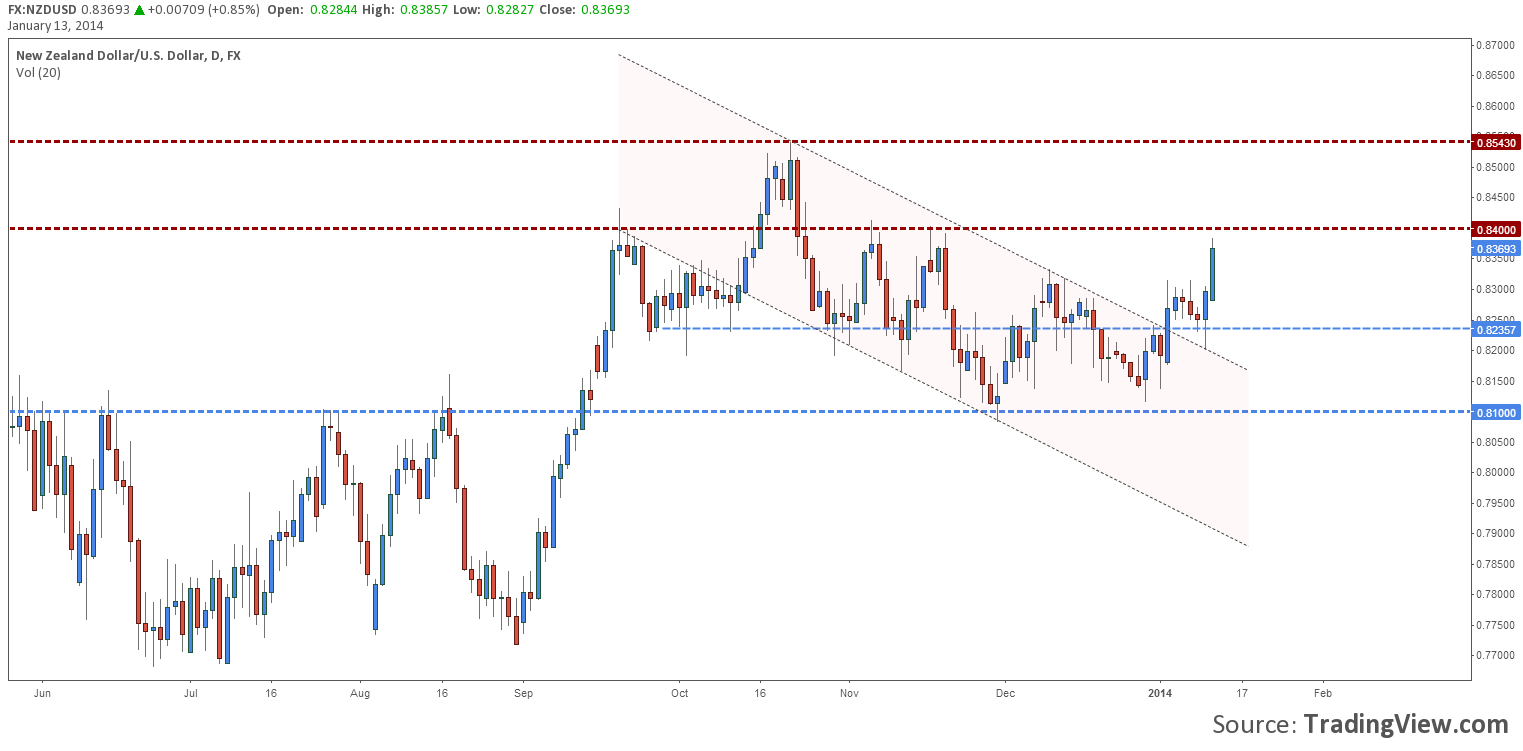
On the daily chart we can see that the price has rallied to 0.8400, which is also the next important resistance, after it broke the down trend channel and retested it. At this point bulls seem to be in control and might put some pressure on the price. A break through the next resistance could open the door for new highs and the new rally could target 0.8543.

Chart: NZDUSD, H1

nzdusd-h1-forecast-13-17-13.01.2014 - resize

Support: 0.8355, 0.8313, 0.8235, 0.8202;

Resistance: 0.8400;

On the H1 chart, the price action gives some pretty interesting bearish signals. The 14 periods RSI has drawn a rising wedge as well as the price evolution and a Shooting Star pattern has given the high of the day. Presuming that the current trend will continue, the upside move will find a good resistance from the daily chart at 0.8400 (also round number). On the other had a drop under the local support, 0.8355, could confirm the bearish signals and the price might fall back to 0.8235.

Bullish or Bearish?

On the medium term I am still bullish on the NZD. Fundamentals from the US dollar will probably trigger some high volatility and whipsaws but in my opinion 0.8400 will be touched until the end of this week. On the lower time frame I would really keep a close eye over the technical analysis and the bearish signals.

The post NZD/USD Forecast For January 13-17 appeared first on investazor.com.

USD/JPY Forecast For January 13-17

Article by Investazor.com

Last week the USDJPY currency pair posted a small loss, even though in the first part of the week the dollar had more buyers. Here is a wrap up of what happened and this week’s forecast on macro and technical analysis.

The Japanese Yen lost some ground in the beginning of last week, in front of the US dollar mainly because of the good economic releases from the United States. Thursday the yen started to be bought right after the ECB press conference. It gained some speed in its recovery on Friday after the Non-Farm Payroll release but it didn’t stop there because today the price of the USD/JPY currency pair dropped even more, touching a low at 102.85.

Next you will find several economic releases that might influence the USDJPY in the current week:

Current Account – Monday (23:50 GMT). Last month it dropped by 0.06T even though it was expected to rise with 0.12T. This month Japan’s Current Account it is expected to drop again with 0.02T.

Economy Watchers Sentiment – Tuesday (05:00 GMT). Readings above 50 mean that watchers are optimists in what concerns the economy’s evolution. For the past three publications the values were above expectations. Tomorrow economists are forecasting a value of 54.2 for this indicator.

Core Machine Orders m/m – Wednesday (23.50 GMT). This indicator is referring to changes in the total value of new private-sector purchase orders placed with manufacturers for machines, excluding ships and utilities. Last month’s publication was of 0.6% growth and the current expectations are of a 1.2 percent rise.

Tertiary Industry Activity – Wednesday (23:50 GMT). After a 0.7% drop in the December’s publication, this week it is forecast at 0.8% rise.

Consumer Confidence – Friday (05:00 GMT). For this indicator a high of the past 6 months was hit in October at 45.4. This week’s estimations are of a 43.4.

Economical Calendar

Current Account – Monday (23:50 GMT). Last month it dropped by 0.06T even though it was expected to rise with 0.12T. This month Japan’s Current Account it is expected to drop again with 0.02T.

Economy Watchers Sentiment – Tuesday (05:00 GMT). Readings above 50 mean that watchers are optimists in what concerns the economy’s evolution. For the past three publications the values were above expectations. Tomorrow economists are forecasting a value of 54.2 for this indicator.

Core Machine Orders m/m – Wednesday (23.50 GMT). This indicator is referring to changes in the total value of new private-sector purchase orders placed with manufacturers for machines, excluding ships and utilities. Last month’s publication was of 0.6% growth and the current expectations are of a 1.2 percent rise.

Tertiary Industry Activity – Wednesday (23:50 GMT). After a 0.7% drop in the December’s publication, this week it is forecast at 0.8% rise.

Consumer Confidence – Friday (05:00 GMT). For this indicator a high of the past 6 months was hit in October at 45.4. This week’s estimations are of a 43.4.

Technical View

Chart: USDJPY Daily

usdjpy-daily-forecast-week13-17-13.01.2014 resize

Support: 102.00, 101.00;

Resistance: 103.82, 105.41;

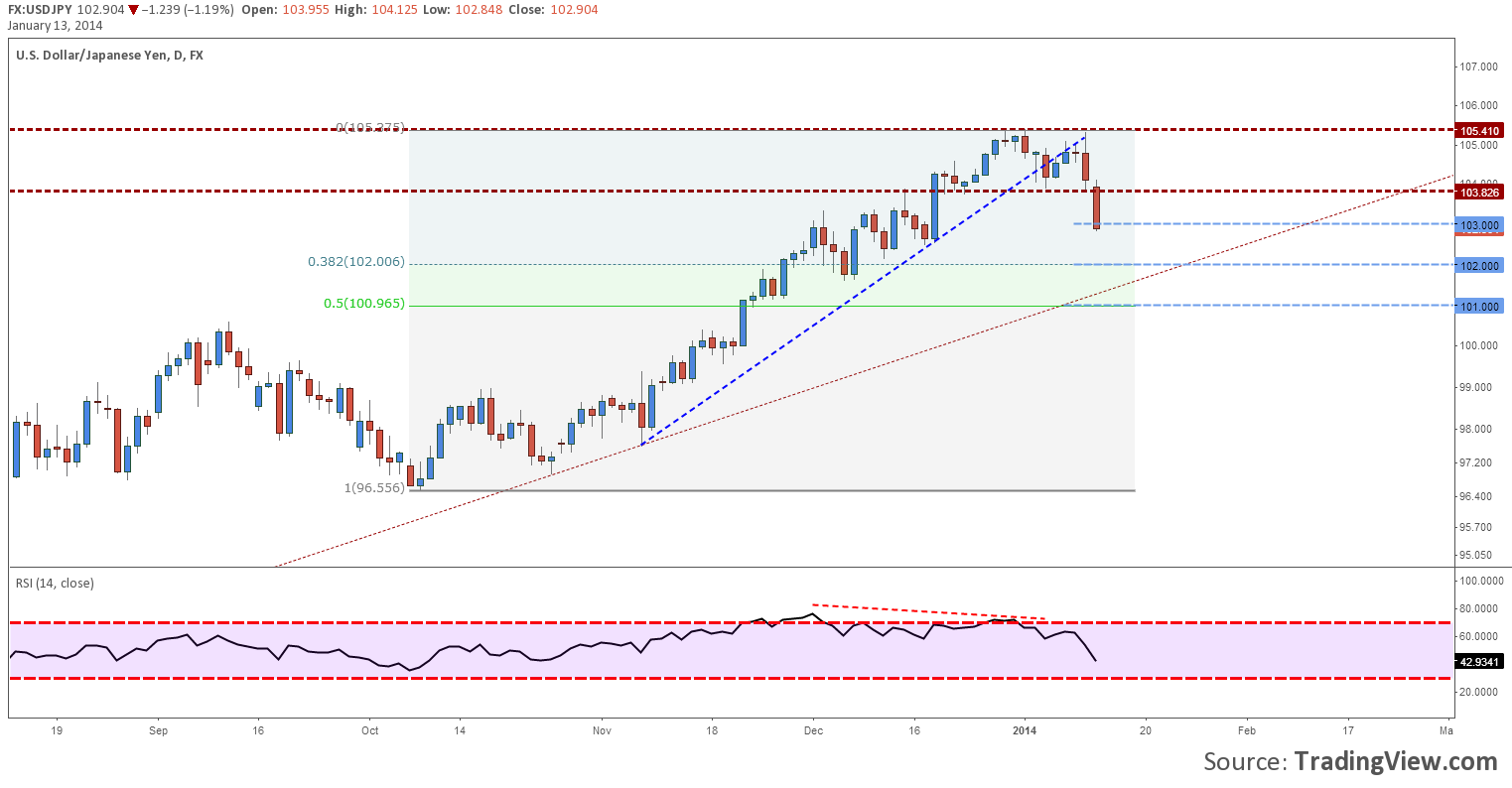
On the daily chart we can see that the uptrend line was broken after the RSI signaled a negative divergence. Friday and today were pretty good days for the Japanese yen which has fallen from a high of 105.33 all the way to 102.85. If the current day will close under 103.00 the probability for the price to continue the fall will be quite big. Next downside targets could be 102.00 and 101.00.

Chart: USDJPY H1

usdjpy-h1-forecast-week13-17-13.01.2014 - resize

Support: 102.00;

Resistance: 103.80

After the price confirmed the Double Top pattern by a breakout under 103.80, it continued the downside move all the way to 102.85 low, hit today. The price pattern’s target it is found at 102.14, really close to the daily support from 102.00 (which is actually the 38.2 Fibonacci retrace from the entire uptrend.) A recovery of the US dollar can find a good resistance area around the daily resistance at 103.80.

Bullish or Bearish?

I believe that the Japanese yen will continue its rally in front of the US dollar during this week time. But I would be very attentive to a throwback that could aim to retest 103.80, which was a pretty support level. This last one mentioned could be a good selling level (in case of a retrace) if other bearish signals appear.


The post USD/JPY Forecast For January 13-17 appeared first on investazor.com.

Why Macy’s Is Such a “Good” Retail Play

By George Leong, B. Comm.

In the retail sector, it’s all about vision and execution. The reality is it’s all in the details, especially in the department store sector, where it’s all about product offerings and marketing.

Of the department stores in the retail sector, Macy’s, Inc. (NYSE/M) is probably the best-managed and best-performing company. Simply take a look at rival J. C. Penney Company, Inc. (NYSE/JCP), and you’ll understand why it has been a lot better for Macy’s investors than J. C. Penney’s. (Read more of my thoughts on this in “J. C. Penney, Coach Joining the Losers in the Retail Sector?”)

While Macy’s continues to look for ways to continue its sales growth and profitability, J. C. Penney is just trying to stay afloat in the retail sector and avoid a possible bankruptcy down the road.

The chart below shows the divergence in share price between Macy’s and J. C. Penney since October 2012. Macy’s has steadily climbed, as reflected by the red candlesticks, compared to J. C. Penney, as shown by the dark green line, based on my technical analysis.

            Chart courtesy of www.StockCharts.com


It’s amazing how the wrong strategy could backfire in the retail sector and cost a company like J. C. Penney billions of dollars, while rewarding a company like Macy’s for excellent execution.

Macy’s announced it would cut about 2,500 workers, which is a small fraction of its total headcount of about 175,000. The company will also look at other cost cuts that could shave about $100 million off the expense side beginning this year. (Source: “Macy’s, Inc. Outlines Cost Reduction Initiatives to Support Continued Profitable Sales Growth,” Yahoo! Finance, January 9, 2014.)

While J. C. Penney is showing some encouraging metrics, the likelihood of the company to turn around its sinking ship and try to catch up with the likes of Macy’s is a long shot at best.

The retail sector is ruthless. One wrong move and it could leave you with years of declines and a difficult path to retrace.

In the department store sector, I would stick with Macy’s.

The current difficulty in the retail sector is made even clearer when Family Dollar Stores, Inc. (NYSE/FDO), one of my favorite discount stocks, fails to deliver. When this seller of cheap merchandise is struggling, you really have to take a step back and wonder about the overall retail sector.

In the case of Family Dollar Stores, not only did the company fall short on earnings, but it also made a downward revision of its fiscal second-quarter earnings guidance to below the consensus estimate. The discounter also lowered its sales and earnings guidance for fiscal 2014 to below guidance. Revenue growth was a mere 3.2%, while the key same-store sales fell 2.8%.

The key over the next few months will be to monitor the retail sector and see which companies can deliver like Macy’s does in a tough economic climate.

This article Why Macy’s Is Such a “Good” Retail Play was originally posted at Profit Confidential