Commodities Priced For Perfection?

By MoneyMorning.com.au

It’s taken me nearly 10 years but I’ve finally found a way to profit from global warming (and other extreme weather events.)

In the past I’ve simply lamented about the global warming pandemic. Fact is, with all of the back and forth in the media it’s hard to discern any real truth in the matter. But, regardless of which side of the argument you’re on, you’ve got to admit one thing: there’s a lot of money sloshing around. (Think: billions and billions.)

Let’s look at what could be the year’s best contrarian commodities play…
This from Bloomberg:

The past decade included Europe’s hottest summer in at least 500 years in 2003, while 2010 brought western Russia’s hottest summer in centuries and record rain in Pakistan and Australia, according to the Potsdam study published in the journal Nature Climate Change. Japan and some states registered all-time-high rainfall in 2011, while the Yangtze River basin in China had a record drought.

Weather extremes may cause agricultural production to move away from “extreme specialization,” where farmers who can no longer be certain of spring rain for a particular crop may grow four or five different ones instead, according to Hermann Lotze-Campen, a researcher at the Potsdam institute.

Over the past few years, commodity farmers dealt with the reality of extreme weather events – from 100-year droughts to 100-year floods. Growing staples like corn, wheat, soybeans, rice, coffee, cocoa, orange juice and more, farmers have seen many ups and downs – and I expect to see a lot more of these large-scale weather events in the coming years.

For our purposes here it doesn’t matter much if these events are caused directly by global warming or not – in fact, we’ll leave that up to the experts to debate.

Indeed, it almost doesn’t matter that heat waves, droughts, tsunamis or other volatile weather patterns wreak havoc on crops. Just the threat of these 100-year weather events is enough to goose prices.

The idea behind my thesis is simple. A heat wave or cold snap across the globe could urge farmers to up their ante on crop insurance, buy more resilient seeds, try a stronger type of fertiliser or go to any other further measures to prevent crop spoilage. In short, farmers are paying more to protect their crops from one-off events.

Furthermore, each year the world is demanding more and more foodstuffs. Demand is ratcheting up in emerging markets for grains and feed for livestock. Add it all up and demand is pushing farmers to their limits. In that sense farmers MUST get everything they can out of each crop.

When it comes to preparing for extreme weather events, the cost of farming is likely to rise. And that will lead to a simple but surefire rise in the price of many commodities.

Never Bet On Perfection

The debate surrounding global warming and volatile weather is just one example of things that can go wrong in the world of growable commodities. It’s a clear-cut reminder that no matter how much we think we’re set for another year of the status quo, we may not get what we expect.

Indeed, over the past few years, even in the face of on-and-off weather events we’ve seen bumper crops world over. Whether it’s coffee in Vietnam and Brazil or wheat in Russia and the US, we’ve seen stockpiles consistently grow over the past few years.

Lately, the market has started to factor in all but perfection for many of the most common staple commodities.

But today I’d like to warn you not to bet on this ‘perfect’ scenario.

I’ve said this in the past but it’s worth reiterating today: all it takes is one bad season for prices to rise. Drought, flood, crop-plague, strike, political up rise…any of these events could lead to a short-term disaster.

And when ‘perfection’ is built into the price of commodities, there’s a straight forward opportunity for investors like us.

This looks to be the case in the corn market…

A Contrarian Commodities Play

2012 is a distant memory for corn traders these days. Back then, a summer drought (one of the worst seen in generations) wreaked havoc on the corn crop – cutting the year’s crop by 13%.

2013, however, was a bumper crop. The US produced the most corn on record – and stock houses were filled to the brim.

Today traders are pricing in perfection – a perfect, bumper crop – for the corn market. A quick look at the price of corn, and you’ll see that prices are the lowest they’ve been since 2010.

Add together the recent string of weather volatility and an all but perfect estimate for this year’s yet to be planted crop, and you’ll see that we could be in for a pop in corn prices.

Matt Insley,
Contributing Editor, Money Morning

Ed Note: The above is an edited version of an article originally published in Daily Resource Hunter.

Join Money Morning on Google+


By MoneyMorning.com.au

Binary Options in MT4 What You Should Know

By clmforex.com

Since binary options were introduced back in 2011 they have definitely exceeded expectations in terms of popularity. As a result the number of binary option brokers has increased exponentially to help meet Public demand. Brokers and exchanges like NADEX have reported record volumes for 2013 and from all indications the trend will continue into 2014.

Recently some of the largest FX brokers in the world have begun to offer their clients the ability to trade binary options.  The vast majority of these brokers are using web-based platforms to offer their clients binary options trading. This puts the binary options trader at a big disadvantage as they do not have any of the analytical tools necessary to make trading decisions. Another issue with these platforms is that most of them require the trader to open a real account in order to see the platform work. It can be very frustrating to see a platform work and then have a message

Over the past several years FX traders have become accustomed to using software like MT4. This software which is not just known for its analytical tools but also for its ability to allow automated trading systems with expert advisors.  A new recent technology regarding binary options allows traders trade through select brokers binary options on MT four. This gives the binary options trader full transparency of the market as well as access to the tools necessary in making a trading decision. Traders are also welcomed to test out the Binary Options MT4 as a demo account.

Some of the advantages of trading binary options MT4 are:

  • The ability to trade both FX and Binary Options in the same platform
  • Easily change expirations from 1 minute to 1 hour
  • Trade with a little as $5
  • The ability to trade binary options using expert advisors
  • Trading Binary Options in MT4 offers a greater level of security

To learn about trading binary options in MT4 please visit www.clmforex.com


Disclaimer: Trading of foreign exchange contracts, contracts for difference, derivatives and other investment products which are leveraged, can carry a high level of risk. These products may not be suitable for all investors. It is possible to lose more than your initial investment. All funds committed should be risk capital. Past performance is not necessarily indicative of future results. A Product Disclosure Statement (PDS) is available from the company website . Please read and consider the PDS before making any decision to trade Core Liquidity Markets’ products. The risks must be understood prior to trading. Core Liquidity Markets refers to Core Liquidity Markets Pty Ltd. Core Liquidity Markets is an Australian company which is registered with ASIC, ACN 164 994 049. Core Liquidity Markets is an authorized representative of Direct FX Trading Pty Ltd (AFSL) Number 305539, which is the authorizing Licensee and Principal.


Peak Over for U.S. Travel Stocks, but China’s Travel and Lodging Stocks Just Getting Started

by George Leong, B. Comm.

The Chinese are on the move and unless you enjoy crowds and mass chaos on the roads, rails, and in the sky, I don’t advise you ever go and visit China during this time of the year.

This very intensive travel period is the busiest in the Chinese calendar year—akin to Christmas and Thanksgiving Day, but much more chaotic when you consider the size of the population. In China, it’s known as “Chunyun”—a 40-day period around the Chinese New Year when the masses (and we mean masses when talking about China) scramble to travel. This is the time when families reunite for big dinners, to set off fireworks, and to share their plans for the year ahead.

If you think Black Friday or New York City at their peaks were bad, it’s nothing compared to what happens in China during this stretch, which would even make the native NYC commuter queasy.

According to the National Development and Reform Commission (NDRC), about 3.62 billion passenger trips will be undertaken during this 40-day stretch. (Source: “Transport system to be fully stretched for ‘Chunyun,’” ChinaDaily.com, January 14, 2014.) That’s a lot of people.

And whether it’s the roads, rails, or sky, everything will be one big massive network of travel: Approximately 258 million train rides will occur during the period, according to the China Railway Corporation. In the sky, there are estimated to be around 42 million flights, based on predictions from the Civil Aviation Administration of China. And the roads…well, think “parking lot.” (Read “My Favorite Chinese Car Company.”)

Yet while we can avoid this somewhat-organized chaos, you can rest assured that the Chinese hotel and travel industry is going to make money off of it.

In the rail area, a mid-cap U.S.-listed Chinese railroad stock that I follow is Guangshen Railroad Company Limited (NYSE/GSH, $19.93, market cap: $2.81 billion), which trades as American depositary shares (ADS). The company is focused on the passenger segment, which includes the Guangzhou–Shenzhen inter-city train service in southern China, which connects these two economic and manufacturing hubs, along with the Hong Kong Through Train passenger service, operated in conjunction with MTR Corporation in Hong Kong.

Guangshen Railroad provides a possible longer-term buying opportunity with above-average growth for the aggressive investor.

            Chart courtesy of www.StockCharts.com

Now many of the travelers also need a place to hunker down unless, of course, they don’t mind squeezing in with their families or relatives. (Personally, I would opt for the hotel.)

On this note, a value-oriented U.S.-listed Chinese hotel chain worth a look is China Lodging Group, Limited (NASDAQ/HTHT, $29.79, market cap: $1.83 billion). You could say that China Lodging is kind of like the “Super 8,” “Howard Johnson,” or “Comfort Inn” of China.

            Chart courtesy of www.StockCharts.com


China Lodging operates more than 1,200 high-quality, conveniently located, and reasonably priced economy to mid-scale hotels. While I haven’t stayed at one of the company’s hotels, I have stayed at other major Chinese hotel chains and can say they are a pretty good value, which makes them an attractive choice to travelers.

So for the next 40 days, stay away from China unless you want to vaporize into the traveling masses that promise to take hold. Instead, experience the joys of Chunyun from the comfort of your own home through U.S.-listed Chinese travel and lodging stocks.

This article Peak Over for U.S. Travel Stocks, but China’s Travel and Lodging Stocks Just Getting Started  was originally posted at Profit Confidential


Canada holds rate, notes growing downside inflation risks

By CentralBankNews.info
    The Bank of Canada (BOC) maintained its policy rate at 1.0 percent, as widely expected, but cautioned that inflation “is expected to remain well below target for some time, and therefore the downside risks to inflation have grown in importance” despite an apparent strengthening of the fundamental drivers of economic growth and future inflation.
    The BOC, which has maintained its target for the overnight rate at 1.0 percent since September 2010,  said inflation was now expected to be lower than previously expected and first return to the bank’s target in about two years as the effect of heightened competition in the retail sector and excess capacity in the economy is absorbed.
    The central bank, which dropped a slightly tightening bias in November, was neutral in its guidance, saying the “timing and direction of the next change to the policy rate will depend on how new information influences this balance of risks.”
    Among the risks identified by the BOC is high household debt, which the BOC said had not materially changed, though it added that recent data confirmed that the housing market is undergoing a soft landing and the ratio of household debt to income is stabilizing.
   In its latest policy report, the BOC trimmed its forecast for inflation this year compared with its October projection but maintained the forecast that headline inflation would hit the bank’s 2.0 percent target by the fourth quarter of 2015.

    The forecast of economic growth this year was raised while the forecast for 2015 was lowered.
    “Real GDP growth is projected to pick up from 1.8 percent in 2013 to 2.5 percent in both 2014 and 2015. This implies that the economy will return gradually to capacity over the next two years,” the BOC said.

Thailand holds rate, political situation weighs on growth

By CentralBankNews.info
    Thailand’s central bank maintained its policy rate at 2.25 percent but cautioned that the current political unrest was denting confidence and weighing on the outlook for growth.
    The Bank of Thailand (BOT), which cut rates twice last year by a total of 50 basis points, said its monetary policy committee deemed the current stance to be accommodative and “appropriately supporting of economic recovery” and while the political situation posed a risk to growth, “sound economic fundamentals should help the economy weather these short-term risks.”
    The committee voted by a narrow majority of 4 to 3 to maintain rates, with three voting to cut the rate by 25 basis points “to cushion the economy against rising downside risks to growth, given contained inflationary pressure.”
    But the BOT said safeguarding financial stability remained a cornerstone for economic recovery and said it would “closely monitor developments of the Thai economy and stands ready to take appropriate actions as warranted.”
    Economists were split in their expectations to the BOT’s decision following months of political protests and the imposition of state of emergency in the capital of Bangkok.

    Protesters accuse the prime minister, Yingluck Shinawatra, of corruption and want to remove the influence of her brother, ex-premier Thaksin Shinawatra, who was ousted by the army in 2006 and is in exile in Dubai after being convicted of abuse of power in 2008.
   The prime minister dissolved parliament in December and called for a general election on Feb. 2 but protesters have rejected the election, calling for changes to the electoral system.
    The unrest since late October has hurt tourism and business confidence, with the Thai baht currency falling as nervous international investors have sold Thai assets.
    The central bank said the Thai economy was expected to grow less than previously assumed due to soft domestic demand and this would lead to lower-than-expected growth for 2013.
   The BOT’s latest forecast calls for growth of 3.7 percent in 2013 and 4.8 percent in 2014. Thailand’s Gross Domestic Product expanded by 1.3 percent in the third quarter from the second for annual growth of 2.7 percent, down from 2.9 percent.
   Exports are expanding at a subdued pace, the BOT said, adding that the global economy is continuing to recover, with the U.S. economy expanding on the back of strong domestic demand, China’s economy expanding steadily and exports of Asian economies recovering at a gradual pace.
   Along with many other emerging market currencies, the baht fell from late April 2013 to early September but then rebounded. But from late October through the end of December the baht fell by 5.2 percent. Today the baht was trading at 32.9 to the U.S. dollar, down 7 percent since end-2012.
   Thailand’s headline inflation rate eased to 1.67 percent in December, down from 1.92 percent in November, and core inflation was 0.91 percent. The BOT targets core inflation of 0.5-3.0 percent.

    http://ift.tt/1iP0FNb

Ten Pillars of Financial Independence

Guest Post By Dennis Miller – Ten Pillars of Financial Independence

Young folks can usually digest a difficult message more easily when it comes from someone who is not: (a) their parent; (b) their teacher; nor (c) anyone else whose lectures they are sick of hearing. In that spirit, we’re starting out 2014 with 10 ways people of any age can safeguard their financial independence. Please feel free to pass it along to anyone in your life who could use a nudge in the right direction from someone other than Mom and Dad.

Wealth is not gauged by how much money you make, but rather how much you keep. Accumulating wealth, regardless of your age, gives you options and independence. It’s sad when people toil in jobs they hate because they need the money. Anyone in that position finds their employer controls their time and, sad to say, much of their happiness (or lack thereof).

We all want to be free to enjoy our lives in the manner we choose. Those who manage to achieve this state of nirvana have internalized these 10 pillars.

Pillar #1: Do Not Make Debt a Way of Life

Debt is enemy number one of financial independence. Let’s take a look at the most common form of debt, a home mortgage.

Joe and Suzy are in their late 20s with a young family. They’re tired of paying ever-increasing rent and want to buy a home. They sacrifice and save $50,000 for a down payment on a $250,000 home.

Joe and Suzy chose from two mortgages, both charging 5% interest. One is based on a 20-year amortization, and one has a 30-year amortization. How much will the home really cost them?

If they choose the 20-year mortgage, their payments are $1,319.91 per month. If they choose the 30-year mortgage, their payments are $1,073.64 month—$246.27 lower. By choosing the lower payment, they’re adding $69,732.00 to the cost of their house. Why did it cost so much more? Because of the rent they paid on the money they borrowed for another decade. Had they been able to make the higher payments, they would have 10 years with no house payments to accumulate wealth for retirement.

If, instead of paying the mortgage, they saved $1,319.91 a month for the next 10 years after they’re done with the home loan and earned 5% interest on their savings, they’d end up with $204,958.63 in savings at the end of the tenth year.

Therefore, their choices are to sacrifice a bit now so that in 30 years they have a home paid for and $204,958.63 in the bank, or a slightly smaller house payment and a home paid for without a good start on their nest egg. Many of the choices you make 10-20 years ahead of retirement can pay off very well when you want to retire.

I’m a firm believer in paying for your home as soon as possible. Unfortunately, beginning with a starter home and moving up to McMansion after McMansion has become commonplace; this habit can make it practically impossible to pay off your home in a timely fashion.

Pillar #2: Saving and Wealth Accumulation Are Different

Some of the happiest folks at our 50th high school class reunion still lived in modest homes in nice neighborhoods which they had bought in their 20s and 30s. These homes had been paid off for years, and they managed to accumulate a lot of wealth when they no longer had to make house payments.

On the other hand, those who bought McMansions were trying to sell and downsize in a down market. They needed equity from their homes to enjoy financial independence in their golden years.

Financial independence and happiness comes to those who live within their means and make wealth accumulation a major priority. Financial independence is relative, and your attitude plays a big role. For some, financial independence means living in a doublewide in a 55-plus community; for others, it means million-dollar homes and five-star travel. My wife and I have friends in both camps, and it makes no difference: they have all put themselves in a position to enjoy a lifestyle they can afford without major financial worry.

Pillar #3: Never Go into Debt to Buy a Toy

This is a personal favorite. Whatever your toy of choice—a boat, motorhome, four-wheeler, you name it—if you want it badly enough, save the money to buy it. Interest rates on toys are exorbitant because they depreciate so rapidly. I have too many friends who borrowed thousands of dollars for a boat, made extra payments, and still had to write a check to the loan company when they sold it. I get it! It’s damn tempting, but just don’t do it.

Pillar #4: Consider the True Cost, Not the Monthly Payment

This is tough when you have the hots to buy something. If you cannot purchase something outright, its true cost includes the price of renting someone else’s money, plus the depreciation.

Thinking in terms of monthly payments can keep a person in economic slavery for life. We’ve all seen folks get a nice raise and immediately buy more cool stuff because they now can afford more monthly payments. This is nothing more than a treadmill of earning income and making payments, with little chance of real wealth accumulation.

We’re investors in Lending Club and see hundreds of loan applications from people who’ve finally realized that financial independence requires accumulation of wealth, not stuff. They borrow money to consolidate their debt, cut up their credit cards, and try to get back on track. This can easily take 5-10 years for folks with massive debt. If they finally get it at 50, they may have to set retirement back a full decade or more.

Pillar #5: Wants Are Not Needs

Wealth accumulation and financial independence must trump the “need” for stuff. Throw off the economic shackles! Financial freedom is attainable if you free yourself from stuff.

Pillar #6: You Are Responsible for Your Own Behavior

If you’ve ever been the parent of a teenage driver, at one point or another that teenager likely received a speeding ticket. The commonsense solution: make the teenager pay the ticket and any increase in the insurance. He who creates the problem should create the solution.

Pillar #7: Behavior Has Both Short- and Long-Term Consequences

By our 50th class reunion, we’d lost many classmates to lung cancer. These were the same kids who’d laugh as they lit up a cigarette and call them “cancer sticks.” They were quite right. Incredibly, many of them, knowing the risk, smoked right up until the end; they didn’t change their behavior and suffered the consequences.

It’s not like big spenders don’t know the consequences of not saving; they’ve heard the message before. Yet they continue the same behavior and end up with a predictable result: little to show for their efforts at the end of their working career. Some people justify their behavior by thinking they can live on Social Security post-retirement. The few I know who are in that situation are not financially independent; they’re back working at lower-paying jobs they can ill afford to lose.

Pillar #8: No One Owes You Squat!

If you think anything is owed to you, prepare yourself for a rude awakening. Yes, that means you are responsible for your own retirement, health care, and everything else you need. While you may have a pension or guaranteed healthcare plan today, check the promises made by the government or your employer. Many of those promises are impossible to keep.

Too many people retired counting on their pensions—public and private. These folks kept up their end of the bargain, but that makes little difference when there’s no money to pay them. Future generations need to learn from those mistakes.

Some friends recently told us their children got jobs at the police and fire departments. They were pleased because they thought they could work hard, earn a decent living, and have a nice pension waiting for them in a few decades. Ask anyone who worked for the City of Detroit what they think about that plan.

Don’t spend your money thinking you can count on others to support you in your old age. They might, but you’ll lose your independence and probably not be happy. Too many people in this situation have never learned to save; they allowed someone else to do it for them. Save more than the minimum. You will never regret it.

Pillar #9: Something for Nothing Teaches a Bad Lesson

We’ve all heard stories of people winning millions in the lottery and quickly going broke. Ever heard of “Sudden Wealth Syndrome?” There is such a thing, and it’s completely related to a huge (often unearned) windfall.

Why do seemingly intelligent people who suddenly have a lot of money blow it? Their first reaction is to look at all the cool stuff they can buy. If you win $10 million and buy a $2 million home, you still have $8 million left. Then again, if you also bought a $1 million boat you still have $7 million left, much more than you ever had before. That rationale soon leads people right down the drain, and the money is gone.

Pillar #10: Live off the Interest and Never Touch the Principal

I saved the most important pillar for last.

In the case of lottery winners going bust, it’s almost always the same: If you won $10 million and invested it wisely, you could easily net $500,000 a year while your portfolio grew ahead of inflation. In most cases, the income from their winnings could provide a phenomenal lifestyle. And they could pass along the money and sound financial principles to their children.

I recall Johnny Carson discussing having a lot of money with Bert Reynolds. Carson commented, “Having money means you never have to worry about money.” While that contains some truth, it’s an oversimplification. You also don’t have to worry about all the things you have to do to earn money. That’s what causes stress and takes years off of our lives.

Having money is important, but it’s only part of the puzzle. Understanding what money means, what it can do for you, and prioritizing wealth accumulation are also critical pieces.

If I have to make a choice between leaving my children and grandchildren with money or the basic principles of growing and maintaining wealth, I’d choose the education every time. It will make them hell-bent on keeping the money they earn and educating the next generation to do the same.

If you’re of a like mind and want to give the gift of a financial education, click here to share a premium subscription to Miller’s Money Forever with a loved one. Call it a belated holiday gift—no wrapping required.


A Must-Read for Long-Term Equity Investors

by Mitchell Clark, B. Comm.

The business section of any bookstore is littered with leadership stories of big corporations, musings on personal finance, and countless how-to manuals.

However, there are very few books that deal specifically with capital markets and how to improve your skills in picking stocks and honing your market view. Jim Cramer’s latest book, Get Rich Carefully, is a worthwhile read, especially if you’re not a full-time investor/speculator and you’re either saving for retirement or you’re in retirement and looking to improve your portfolio.

Cramer always has a lot to say, and like his shows on CNBC, his latest book is wordy and somewhat laborious. But he offers a lot of tips that he’s garnered through his experiences in trading and picking stocks, with each chapter offering a summary of lessons learned—the dos and don’ts.

The first chapter offers what 99% of all business books do not—“What Moves a Stock.” Cramer examines the pricing mechanism for all securities—supply and demand—and demonstrates the power that buy-side institutional investors and professional Wall Street traders have over stocks. As evidenced in the stock market crash of 1987, index futures have now overwhelmed traditional share price movements. Cramer says that stocks now trade like commodities, and individual investors are basically helpless in the face of such vast amounts of institutional money.

Cramer talks about a number of companies that he thinks make for excellent long-term holdings. He’s a big fan of dividend paying stocks and the domestic energy sector revolution, which he feels will generate good investment returns for the rest of this decade.

He also likes technology—not pure-play technology, but rather technological innovation that’s happening in companies like Colgate-Palmolive Company (CL) and Under Armour, Inc. (UA). (See “Top Sectors for 2014.”)

In addition to Colgate-Palmolive and Under Armour, some of the stocks Cramer likes for the long-term include: Johnson & Johnson (JNJ), V.F. Corporation (VFC), EOG Resources, Inc. (EOG), Becton, Dickinson and Company (BDX), PepsiCo, Inc. (PEP), Schlumberger Limited (SLB), Union Pacific Corporation (UNP), Starbucks Corporation (SBUX), Costco Wholesale Corporation (COST), salesforce.com, inc. (CRM), Google Inc. (GOOG), and Kinder Morgan Energy Partners, L.P. (KMP).

Cramer breaks down seven big investment themes going forward, which he feels will last over the coming years. They are:

  • Technology for social, mobile, and cloud-based applications, not products that are easily commoditized

  • Food chain health and wellness stocks, like Whole Foods Market, Inc. (WFM) and The Hain Celestial Group, Inc. (HAIN)

  • Post-recession value in goods and services stocks, like Costco, The TJX Companies, Inc. (TJX), priceline.com Incorporated (PCLN), and Cedar Fair, L.P. (FUN)

  • Companies that merge with others or divest operating divisions

  • Stealth technology plays in food, consumer packaged goods, and apparel

  • Large-cap biotechnology stocks, like Celgene Corporation (CELG), Biogen Idec Inc. (BIIB), Gilead Sciences, Inc. (GILD), and Regeneron Pharmaceuticals, Inc. (REGN)

  • The energy revolution: According to Cramer, shale success is in its infancy, with very good investment returns to be had for a number of years

Cramer makes a point of highlighting the wealth effect that is often created by companies that break themselves up. Stocks like Phillips 66 (PSX) and Kraft Foods Group, Inc. (KRFT) were powerful spin-offs from their parent companies. These stocks (and their previous parent companies) created a lot of wealth after being spun off.

Finally, Cramer reiterates (over and over) the most valuable information available to investors—what corporations actually say about their businesses. The only economic statistic with lasting impact on share prices is the unemployment report. Everything else is just noise.

He recommends the conference calls/transcripts of big, international companies like Caterpillar Inc. (CAT) and General Electric Company (GE). Even if you aren’t interested in these stocks, the quarterly information they provide is unique, global, and very valuable for honing your market view.

Cramer likes to talk and he likes to write. Many of his observations about investing and the way institutional investors trade stocks are spot-on.

Get Rich Carefully is a worthy read and the chapter summaries are excellent. It’s no Market Wizards, by Jack Schwager, but it fits today’s world for long-term equity investors.


This article A Must-Read for Long-Term Equity Investors was originally posted at Profit Confidential


Australian Dollar Advances as Inflation Accelerates

By HY Markets Forex Blog

The Australian dollar climbed to its highest level in a week against the US dollar during the Asian trading session on Wednesday, after the nation’s inflation data for the fourth-quarter accelerated higher than expected.

The aussie added 0.59% to $0.8859 against the US dollar at the time of writing, while the Consumer-price inflation advanced 0.8% higher in the fourth quarter.

The Consumer Price Index (CPI) rose 2.7% higher, rising above analysts forecast of a 2.4% increase. Investors reduced their expectations that the Reserve Bank of Australia Governor Glenn Stevens will cut the record-low 2.5% benchmark rate further and lower borrowing costs at its next meeting scheduled for February 4.

According to the statement from the last monetary policy meeting, RBA Governor Glenn Stevens said the bank is committed to rebalancing growth in the manufacturing, construction, retail and residential sectors. The central bank’s target for inflation is between 2% and 3% on average.

“The Australian dollar, while below its level earlier in the year, is still uncomfortably high. A lower level of the exchange rate is likely to be needed to achieve balanced growth in the economy,” Stevens said on December 3.

The aussie currency dropped to its lowest level in nearly four years on Monday, when dropped $0.8756; following reports which revealed the country lost approximately 22,600 in December.

Australian Dollar – IMF Growth Outlook

The global economy will expand by 3.7% in 2014, slightly faster compared with October forecasts of 3.6%, according to the IMF latest World Economic Outlook (WEO). Market participants are speculating this could persuade the central bank to end its stimulus program this year.

“financial conditions in advanced economies have eased since the release of the October 2013 WEO – with little change since the announcement by the US Federal Reserve on December 18 that it will begin tapering its quantitative easing measures this month,” according to the report released.


Win a luxurious trip to the Maldives & up to $30,000 cash for trading with us!

Visit for details http://ift.tt/L42Q3q

The post Australian Dollar Advances as Inflation Accelerates appeared first on | HY Markets Official blog.

Article provided by HY Markets Forex Blog

Gold Futures Extend Losses on Taper Speculation

By HY Markets Forex Blog

Gold futures extended declines seen on Tuesday as speculations on the US central bank’s next move may hurt the commodity market.

Gold futures traded 0.21% lower at $1,239.10 per ounce. The yellow metal is expected to extend declines this year as gains in the stock markets lower the need for the metal, according to Morgan Stanley, which reduced silver prices forecasts for 2014 to $19 and in 2015 to $18.86.

Gold prices are expected to drop to $1,050 in 12 months as the Federal Reserve reduces its monthly bond buying program, according to Goldman Sachs.

The US dollar index, which measures the strength of the currency against six of its major peers; advanced 0.06% higher to 81.150 points at the time of writing.

Gold – Fed Meeting in Spotlight

Members of the Federal Open Market Committee (FOMC) are expected to meet for the next policy meeting scheduled for January 28-29.  In the last fed-meeting, the central bank decided to reduce its monthly bond purchases by $10 billion to $75 billion a month.

Investors are expecting the Federal Reserve to scale-back its monthly bond purchases even further at its next meeting, after the release of the non-farm payrolls data came in lower than expected.

“We’re likely to continue on a path of gradual, measured reductions in the pace of purchases, assuming the economy tracks as we expect it to,” San Francisco Fed President John Williams said in an interview with Wall Street Journal.

Philadelphia’s Federal Reserve (Fed) President Charles Plosser said he recommend the central bank should end its quantitative easing before late 2014. Plosser also said he expects the unemployment rate would reach 6.2% by the end of the year.

“The December employment report has not changed my belief that the economy has already met the criteria of substantial improvement in labor market conditions. So my preference would be that we conclude the purchases sooner [than the end of 2014],” Plosser said.


Visit www.hymarkets.com   to find out more about our products and start trading today with only $50 using the latest trading technology today.

The post Gold Futures Extend Losses on Taper Speculation appeared first on | HY Markets Official blog.

Article provided by HY Markets Forex Blog

Wave Analysis 22.01.2014 (DJIA Index, Crude Oil)

Article By RoboForex.com

Analysis for January 22nd, 2014

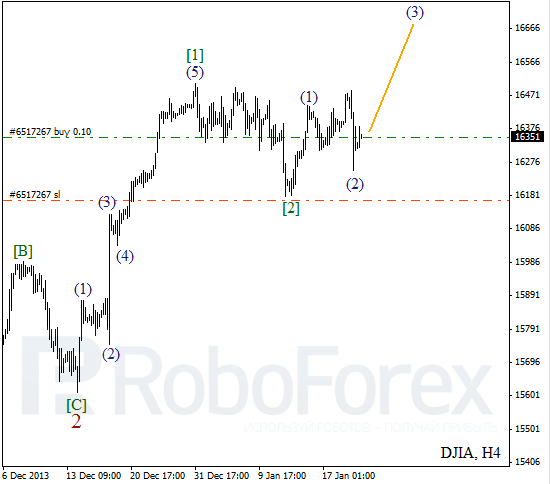
DJIA Index

It looks like wave structure is becoming more and more complicated. Possibly, Index formed several initial bullish waves and right now market is being corrected inside wave (2), which is taking the form of flat pattern. In the near term, instrument is expected to start growing up inside the third wave.

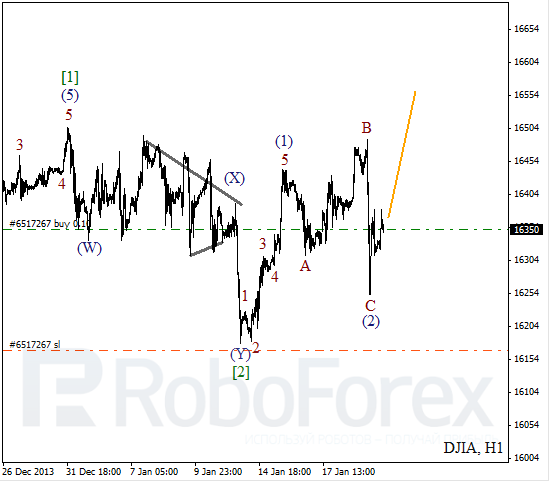
As we can see at the H1 chart, Index completed descending impulse inside wave C. Possibly, right now market is forming initial waves inside wave (3). Critical level is at minimum of initial wave (1).

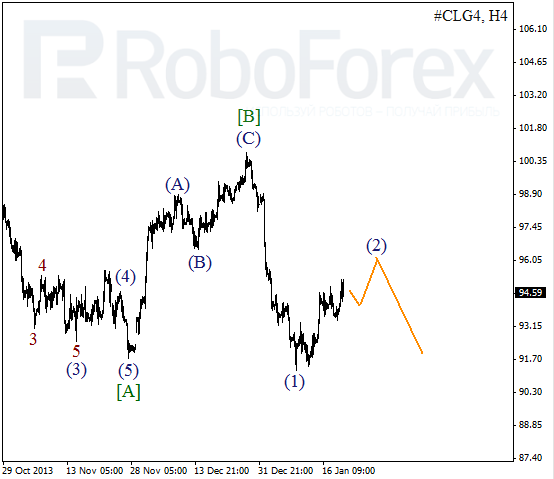
Crude Oil

Correction is taking more time than we expected. Most likely, during the next several days Oil will continue forming wave (2). Forecast is still bearish and implies that instrument may start new descending movement inside the third wave.

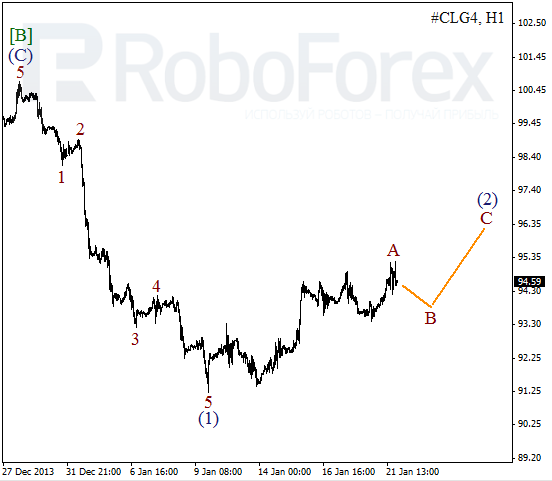
More detailed wave structure is shown on H1 chart. After completing descending impulse inside wave 1, Oil formed five-wave structure inside wave A. In the near term, instrument is expected to start short-term correction inside wave B.

RoboForex Analytical Department

Article By RoboForex.com

Attention!
Forecasts presented in this section only reflect the author’s private opinion and should not be considered as guidance for trading. RoboForex LP bears no responsibility for trading results based on trading recommendations described in these analytical reviews.