Forex Technical Analysis 22.01.2014 (EUR/USD, GBP/USD, USD/CHF, USD/JPY, AUD/USD, GOLD)

Article By RoboForex.com

Analysis for January 22nd, 2014

EUR/USD

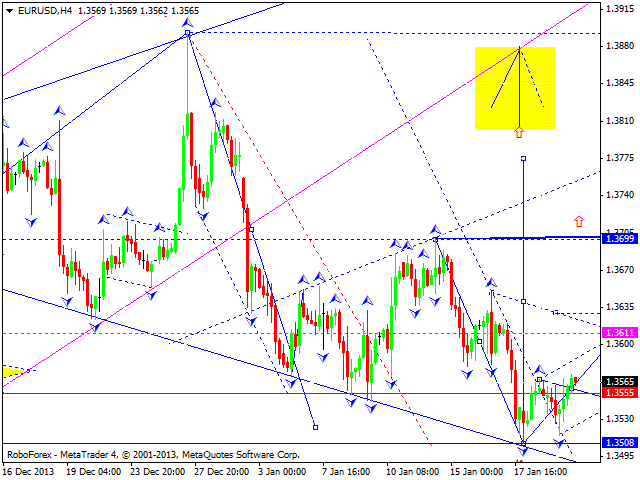
Euro continues growing up. We think, today price may return to level of 1.3600 and then fall down towards 1.3550. Later, in our opinion, pair may start forming another ascending structure to reach target at 1.3700.

GBP/USD

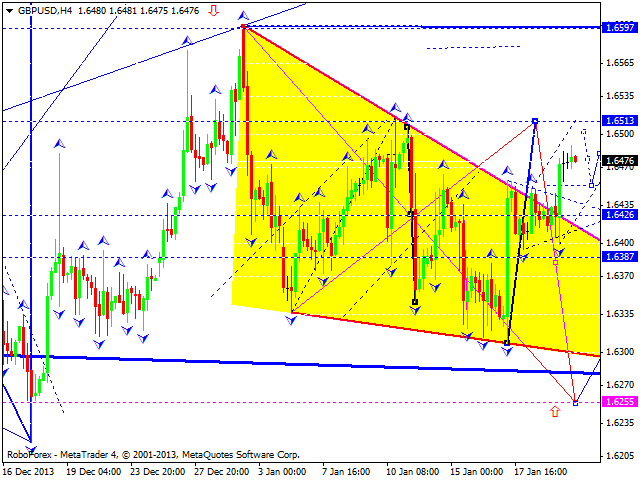
Pound is still moving inside the fourth wave of bullish wedge pattern. We think, today price may reach level of 1.6500 and then start new descending movement towards level of 1.6255. Later, in our opinion, pair may form reversal structure to continue ascending trend.

USD/CHF

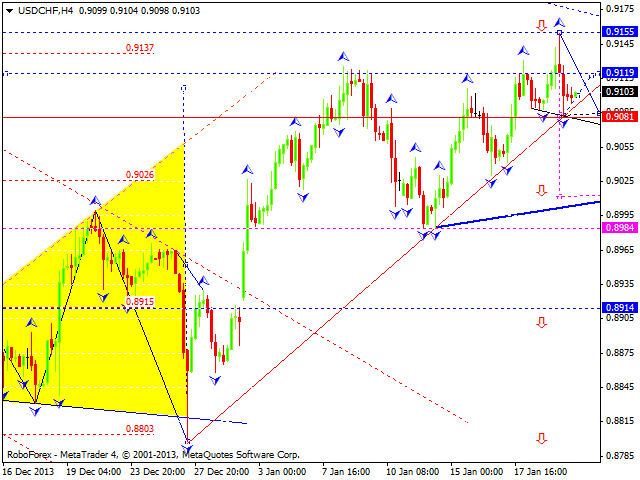
Franc is still forming head & shoulders reversal pattern. We think, today pair may break ascending channel, fall down to reach level of 0.9000, and then return to 0.9080.  Later, in our opinion, pair may continue moving inside descending trend to break minimums and reach level of 0.8300.

USD/JPY

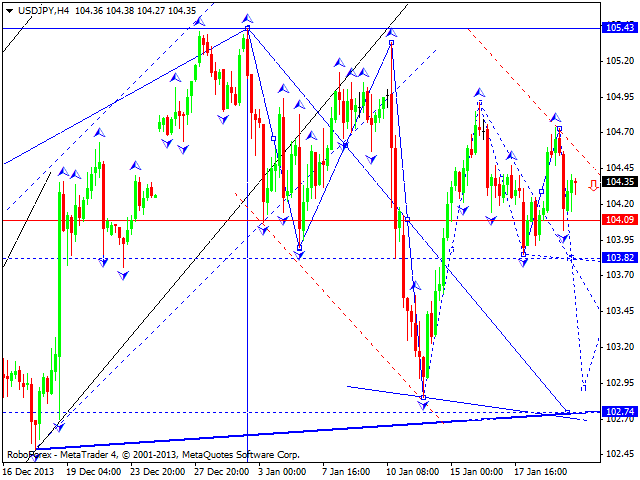
Yen is still falling down. We think, today price may continue moving downwards to reach level of 103.80. Later, in our opinion, pair may form consolidation channel, break it downwards, and continue falling down towards target at 102.75.

AUD/USD

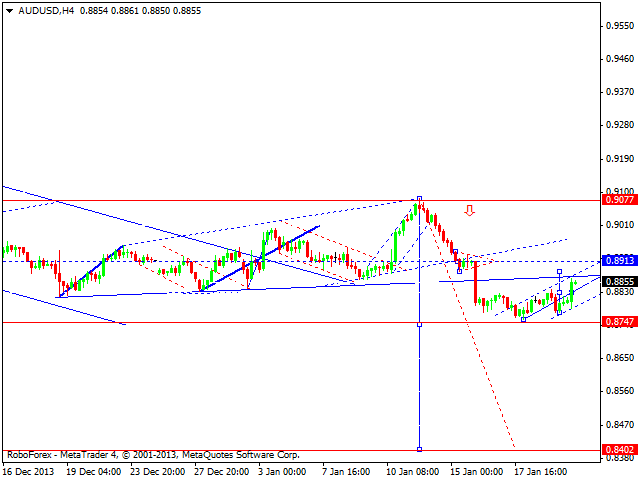
Australian Dollar is moving towards level of 0.8900; this movement may be considered as correction. After reaching it, pair start forming another descending structure to reach main target at level of 0.8400.

GOLD

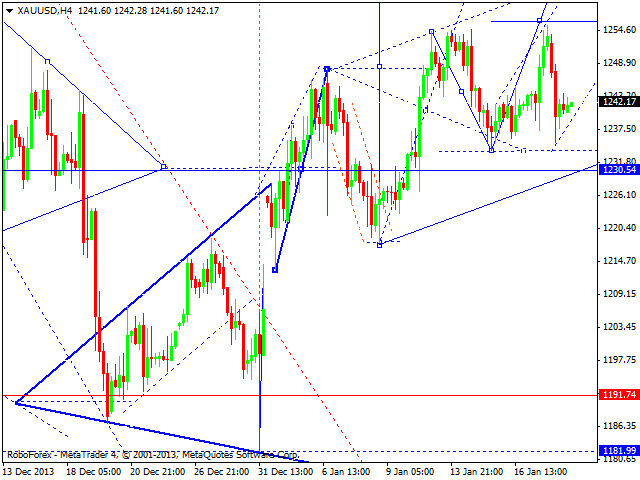
Gold is still consolidating inside the fifth ascending wave. We think, today price may break this consolidation channel upwards and continue growing up towards level of 1277. Later, after reaching this level, instrument may start new descending movement towards target at 1230.

RoboForex Analytical Department

Article By RoboForex.com

Attention!
Forecasts presented in this section only reflect the author’s private opinion and should not be considered as guidance for trading. RoboForex LP bears no responsibility for trading results based on trading recommendations described in these analytical reviews.


Netflix Reports, Are You Ready For High Volatility?

Article by Investazor.com

I continue the earnings reports series with the leading Internet television network, Netflix. In a former article about Netflix, back in November, I said that I expect the stock not to go under the support area from $324 until February and with a couple of days until then the price is around $323, which was a pretty close forecast. Before going into the earnings report specifics, let’s take a look at some statistics.

According to NPD’s “The State of SVOD” report, 32 percent of U.S. households were subscribed to premium-TV channels in August of 2013, compared to 27 percent of U.S. households that subscribed to SVOD services. Netflix remains the clear leader in SVOD (subscription video-on-demand).

nflx-internet-house-holders-22.01.2014

Also, Netflix is now available on yet another device. A video service launched an app on TiVo boxes leased by a Swedish pay TV operator, where results from Netflix’s local catalog are now being displayed alongside live TV programming.

nflx-quarterly-earnings-surprisez-22.01.2014

Speaking about quarterly earnings, Netflix managed to surprise investors, in a “profitable” way, for the most recent four quarters. On the other hand, on a percentage basis, the surprise factor has been constantly decreasing and it wouldn’t be a shock if these time the surprise to be negative. The consensus EPS for the last quarter of 2013 is $0.66.

nflx-earnings-history-22.01.2014

The important thing is that Netflix has a “habit” of moving quickly and on major volume post-earnings. Whether the earnings will surprise the market on a positive or a negative note,  we’re likely to see some major volatility in Netflix.

netflix-prie-chart-resize-22.01.2014

On a daily time frame, Netflix post-earnings evolution if the EPS is better than the consensus could be marked by a +10% rise of the share towards the resistance zone from $348-$353, which is also backed up by a 50 day EMA. Conversely, a disappointing EPS could drove the price under the support line from $319 and heading towards the 50.0 or even 61.8 Fibonacci level, with the mention that the 61.8 one has an important psychological meaning because the 200 day EMA is hanging around this level.

The post Netflix Reports, Are You Ready For High Volatility? appeared first on investazor.com.

Gold Price Pushes to 6-Week High as Market Grows More Hopeful

By HY Markets Forex Blog

Those who trade gold caused the precious metal to rise to it highest price in six weeks on Jan. 20, as global market participants became more optimistic about the commodity.

Gold futures scheduled for February delivery rose to as much as $1,261.30 per ounce on the Comex division of the New York Mercantile Exchange, according to Investing.com. This represented the highest price for this particular contract since Dec. 11. Later, February gold futures pared these gains, trading at $1,256.00 an ounce. This represented a 0.35 percent increase for the day.

Gold has been rising steadily in 2014

The precious metal has been performing well lately, as thus far in January, it has risen 4.4 percent, Bloomberg reported. In addition to enjoying this return for the month, the precious metal experienced four consecutive weeks of gains. Also, industry data has revealed that lately, market participants increased their wagers that the commodity will continue to rise in price.

Figures provided by the U.S. Commodity Futures Trading Commission indicated that during the week that ended on Jan. 14, the net length position held for gold was 43,277 futures and options, according to the news source. This figure was 7.6 percent higher than the prior period. While short wagers increased by 2.9 percent during the week, bets that the precious metal will appreciate rose by 4.7 percent.

Expert notes importance of Chinese demand

Several factors have been cited as helping to provide upward pressure on the price of the precious metal. Gold is likely benefiting from expectations that Chinese demand for the commodity will probably strengthen in the future, Fawad Razaqzada, who works for Forex.com as a technical analyst, wrote in a note, MarketWatch reported.

The market expert cited the sharp drop in value that the precious metal experienced in 2013, as prices fell roughly 28 percent, according to the news source. He said that seasonal demand for the commodity would be robust, since it has experienced such severe price declines recently. Market participants in the Asian nation have been flocking to the precious metal, and last year, there was an almost 100 percent surge in the number of deliveries made by the Shanghai Gold Exchange, Bloomberg reported.

“There’s a tremendous divide in the gold market,” Jeff Sica, who serves as the president of Sica Wealth Management, told the news source. “Demand for jewelry in China is still relatively strong, and I think it will remain strong. The bears ignore physical demand and think that gold is not relevant when there’s no economic crisis.”

ETF inflows

Another factor that could serve to bolster the price of the precious metal is the robust inflows that exchange-traded products backed by gold have attracted recently, according to the news source. On Jan. 17, the holdings of SPDR Gold Trust, which is the largest ETP backed by the commodity, experienced their sharpest increase since November 2011. Comparatively, on Jan. 16, the investment vehicle held the least amount of gold since 2009. Analysts working for Commerzbank released a note on Jan. 20, in which they noted that the precious metal could move higher in price in the event that the recent strong inflows that gold ETFs have been enjoying are indicative of changing interest in the metal, MarketWatch reported.

“If this turns out to signal a trend reversal, it is likely to lend buoyancy to the gold price,” the analysts wrote in the note, according to the news source. “The high outflows from the gold ETFs observed since the beginning of last year were one major reason for the weak gold price.”

These market experts are not the only ones who believe that gold prices could do well in the near future, as Danny Laidler, who runs the Australia and New Zealand business of ETF Securities, told Reuters that there are higher odds that the metal will appreciate than depreciate.

“A lot of our clients are still holding onto gold as a risk-event hedge,” he told the media outlet. “I think the worst of the outflows is behind us. We think there is a greater potential for modest gains (in gold prices) this year than for a downside risk.”

In the event that the turbulent price performance that the precious metal experienced last year will be followed by a correction in 2014, gold could easily appreciate. In 2013, the commodity had a rough ride, falling into a bear market in April, after having dropped more than 20 percent from its all-time high. This lackluster performance continued for the next few months, and in June, gold plunged below $1,200 per ounce.

The precious metal then managed to enjoy a few months of gains following this recent low. Even after enjoying some appreciation after dropping to an almost three-year low in June, gold finished 2013 down almost 30 percent.

The post Gold Price Pushes to 6-Week High as Market Grows More Hopeful appeared first on | HY Markets Official blog.

Article provided by HY Markets Forex Blog

Crude Oil Trading Causes Commodity to Depreciate amid China Growth Concerns

By HY Markets Forex Blog

Crude oil trading resulted in the commodity falling in price on Jan. 20, as global market participants responded to data pointing to lackluster economic conditions in China.

February U.S. crude futures reached $93.70 per barrel during the day on the New York Mercantile Exchange, according to The Associated Press. In addition, March Brent crude contracts trading on the London-based ICE Futures exchange were 20 cents lower at $106.28 a barrel.

It is also important to note that while the price of the commodity fell on Jan. 20, investment managers have recently become less bullish in their predictions for the raw material, according to data provided by London-based exchange ICE Futures Europe and reported by Bloomberg.

Figures provided by the bourse in its Commitments of Traders report revealed that during the week that ended on Jan. 14, combined bets that Brent crude will rise in price dropped by 14 percent, according to the news source. However, even after this decline in bullish wagers, net long positions were still greater than bets that the commodity will fall in value.

Both the decline in price, and also the drop in wagers being made that the commodity will be pushed higher as a result of crude oil trading, were made at a time when there are concerns about China’s demand for the key energy source, Reuters reported.

Concerns about demand in China

Calculations conducted by the media outlet harnessing preliminary government data revealed that in 2013, implied demand for oil increased by a meager 150,000 barrels per day. As a result, this key measure rose only 1.6 percent year-over-year. Such figures may be of interest to those who trade the raw material, since China is the world’s second-largest consumer of oil.

“The long term oil demand trend is certainly not what it used to be,” Alex Yap, who works for Facts Global Energy as an oil analyst, told the news source. “But I think 2014 could be better with new refineries starting and Strategic Petroleum Reserve stockpiling.”

China economic growth slows

In addition to this report on the Asian nation’s demand for the energy source, separate data was released, which helped paint a picture of deteriorating business conditions in China, according to AP. Figures revealed that during the final quarter of last year, gross domestic product grew at an annualized rate of 7.7 percent, which was slower than the prior period.

“The modest Chinese economic data weighed on market sentiment … adding pressure to crude oil prices,” analysts at international derivatives broker Sucden Financial Research wrote in a note to clients, the media outlet reported.

While these particular market experts asserted that the figures released for the Asian nation would help push the price of the commodity lower, not everyone was negative in their interpretation of the data, as Ben Le Brun, who works for OptionsXpress in Sydney as a market analyst, provided a more optimistic view of the figures, according to Reuters.

It is important to note that while China’s GDP grew a bit more slowly during the fourth quarter than it did during the prior three months, the 7.7 percent rate was higher than the 7.6 percent that as predicted by the broader market, the media outlet reported.

“The data is a cause for relief, as it eases some of the fears over the Chinese economy,” he told the news source.

Global supply concerns

Another factor that has been noted as providing downward pressure for oil prices is hopes that the global supply of the energy source could rise soon if key areas such as facilities in Libya start producing once again, according to AP. The production if oil could receive a boost in the event that crucial locations in the Eastern section of the African nation fall into the hands of government officials. Thus far, these key areas have been hindered by rebel activity.

“The prospect of a growing oil supply is continuing to weigh on prices,” major financial services firm Commerzbank wrote in a research note, the media outlet reported. “Any seizure of the oil terminals by force would mean escalating the crisis and make it more difficult – if not impossible – to find any permanent solution to it.”

Global supply could also be bolstered in the event that the removal of economic sanctions allows the Iranian production of oil to operate at its full potential, according to Reuters. During the last 18 months, the amount of the raw material contributed by the Western Asian nation has plunged by more than 50 percent, falling to 1 million barrels per day.

However, the amount of oil supplied by the country could potentially move far higher, at least if the information contained in a United Nations report obtained by the media outlet is accurate. This document indicated that nuclear activity in Iran has ceased for the most part. If the current economic sanctions that were previously imposed because of these activities are lifted, it could have a significant impact on crude oil trading.

The post Crude Oil Trading Causes Commodity to Depreciate amid China Growth Concerns appeared first on | HY Markets Official blog.

Article provided by HY Markets Forex Blog

BOJ maintains QE, inflation and growth forecasts

By CentralBankNews.info
    The Bank of Japan (BOJ) maintained its target for raising the monetary base by an annual pace of 60-70 trillion yen and still expects inflation to rise in the next two years as “inflation expectations appear to be rising on the whole.”
    A majority of the BOJ’s board members maintained their forecast from October, expecting economic growth of 3.3 percent in fiscal 2014, which begins April 1, and 2.6 percent in fiscal 2015.
    Inflation is forecast to rise to 3.3 percent in fiscal 2014 and then ease to 2.6 percent in 2015. Excluding the impact of sales tax hikes in April this year and October 2015 to cut budget deficits, inflation is forecast at 1.3 percent in fiscal 2014 and 1.9 percent in fiscal 2015.
    For fiscal 2013 Gross Domestic Product is forecast to rise by 2.7 percent and inflation of 0.7 percent.
    The BOJ, which embarked on an aggressive easing campaign last April to rid the country of some 15 years of deflation, said Japan’s economy was “expected to continue a moderate recovery” – a phrase it has used in recent months – and has noticed front-loaded increases in demand ahead of the tax rises.
    “The year-on-year rate of increase in the CPI, excluding the direct effects of the consumption tax hike, is likely to be around 1-1/4 percent for some time,” the BOJ said.

    Japan’s headline inflation rate jumped to 1.61 percent in November from 1.1 percent in October, the sixth month in a row with higher prices after 12 straight months of deflation.
    “The Bank will continue with quantitative and qualitative monetary easing, aiming to achieve the price stability target of 2 percent, as long as it is necessary for maintaining that target in a stable manner,” the BOJ said, adding that it would examine both upside and downside risks and make adjustments as appropriate.
     On Monday Japan’s economics minister, Akira Amari, said that Japan appeared to have escaped deflation but warned that a return of deflation could not be ruled out. While the BOJ aims to reach its inflation target in about two years, some of its board members have said this is too ambitious.
    Japan’s GDP rose by 0.3 percent in the third calendar quarter from the second for annual growth of 2.4 percent, up from 1.2 percent.
    While maintaining its growth and inflation forecasts from October, the BOJ also largely repeated its view of the economy, saying exports had been picking up along with fixed investment and corporate profits. Housing investment has also continued to rise while private consumption has remained resilient, an area where the BOJ has observed a front-loading of demand ahead of the tax rises.

    http://ift.tt/1iP0FNb

Last Year Was Great for Stock Investors, But 2014 Could Be Even Better

By MoneyMorning.com.au

Yesterday turned out to be a good day for stocks, just as we thought it would. The Australian share market closed up 36.5 points.

But it wasn’t the first good day for stocks over the past 12 months.

Recently released research shows that the whole of 2013 was good for stocks…just as we told you it would be.

Now of course we’re looking ahead to this year’s stock market performance. Will it be as good?

It could be. There’s even a chance it could be better than last year…

A research report from superannuation consultants Chant West revealed the performance of super funds in 2013.

The Australian reported:

Superannuation funds posted their best performance on average for the past 20 calendar years in 2013, according to new figures.

Super consultants Chant West said Australia’s most common superannuation funds finished calendar 2013 with a return of 17.5 per cent for the year, up from 12.8 per cent in 2012.

It’s the second highest return since the introduction of compulsory super in 1992, bettered only by the 23.9 per cent return in calendar 1993.

We’ve said it a million times already, but we’ll say it again – so much for the idea that rising interest rates would kill stocks last year. We told you to ignore those stories at the time. We bet you’re glad you did.

A quick stocktake of the 31 stocks we tipped in Australian Small-Cap Investigator and Revolutionary Tech Investor last year shows that 23 are currently up, one is flat and seven are down.

Importantly, the average result across all those stocks is a gain of 24.8%.

Rising Japanese Interest Rates? Stocks Still Went Up

That’s a good return by anyone’s standards. Even if you bought into the S&P/ASX 200 index at the low point for the year on 25 June, you couldn’t have beat that return. That would have only made you a 14.2% return.

That’s the beauty of investing in individual stocks. Sure, it can be risky, because there’s always a chance you’ll pick a dud stock. But if you spread your money across a small selection of carefully researched stocks (don’t pick too many, or you’ll just get index returns) your winners should more than beat your losers.

So, there’s your confirmation. Despite the wailing about China’s slowing economy and the supposed disaster of rising interest rates in Japan, guess what?

Stocks went up.

And not only did they go up, but they helped retirement savers build the best gains in 20 years.

Now, some folks will say that’s all well and good with the benefit of hindsight. But it’s not hindsight. If you’ve read Money Morning for the past year you’ll know we told you to ignore the shrill cries about a crashing market.

We told you to buy stocks on the cheap, before they went higher.

But that, as the saying goes, is history. What about the future?

Well, it seems that finally other folks are starting to jump on the ‘buy stocks’ bandwagon.

Big Bonus on Their Minds

A report from Bloomberg yesterday noted that:

International investors are the most upbeat about the global economy that at any time in almost five years, buoyed by the US-led revival of industrial nations, according to the Bloomberg Global Poll.

On the eve of the World Economic Forum’s annual meeting in Davos, Switzerland, 59 percent of Bloomberg subscribers surveyed last week said the economic outlook is improving. That’s up from 33 percent in November and marks the most optimistic result since the poll began in July 2009.

This is the kind of news that gives us more confidence in our call that the stock market is heading for another bumper year. If so, it would help push the market towards our 7,000-point target for 2015.

But doubtless the Bloomberg report will have the bubble watchers up in arms again. They’ll likely claim this is another ‘top of the market’ sign.

Naturally, we’ll argue that it’s not at all. Bloomberg surveys professional investors, including those at the big financial institutions. These aren’t the mug retail investors who arrive to the party too late, just as the market is about to turn.

These are the guys (and gals) who arrive just as things are getting exciting. You can bet your bottom dollar that a bunch of these investors missed out on the gains last year.

They now regret it. And in a world where returns against the benchmark index mean everything (and by everything we mean their bonuses depend on it), they’ll want to make sure they aren’t left behind for a second year running.

This is another reason why we’re convinced stocks are heading for a great year.

The Best Result for 20 Years

Of course, it’s all well and good to bang on about another great year for stocks, but where should you put your money?

We’ve got two or three (actually, a few more than that) ideas in Australian Small-Cap Investigator.

<Small-cap analyst Tim Dohrmann wrote to subscribers last week filling them in on a new 'Turbo Cap' stock that he says has a bright future. We agree.

A ‘Turbo Cap’ stock is simply a small-cap stock that’s profitable and that either pays a dividend, is about to pay a dividend, or is on the verge of raising its dividend.

We call it a ‘Turbo Cap’ because in this current market, where investors are searching for growth and dividends, a company that can increase its dividend payout can reward investors with capital gains and a higher income stream.

Most mainstream analysts and investors seem to think the hunt for yield is over. We’ve got no idea why they think that. It can only be because they think interest rates are going up.

That’s not going to happen. The dividend and ‘Turbo Cap’ play is still active, and if investors gain more confidence about the global economy then even regular growth stocks look set to clock up more gains – on top of those achieved last year.

The financial world may still have a lot of problems to face and solve, but don’t for a moment think it will be a handbrake on stock prices.

According to Chant West, 2013 was the best year for retirement savers in 20 years. The way things are going, 2014 has a real chance of trumping that result.

Cheers,
Kris

Special Report: Five Fatal Stocks

Join Money Morning on Google+


By MoneyMorning.com.au
2013 was great for stock investors, but this year could be even better

By MoneyMorning.com.au

Yesterday turned out to be a good day for stocks, just as we thought it would. The Australian share market closed up 36.5 points.

But it wasn’t the first good day for stocks over the past 12 months.

Recently released research shows that the whole of 2013 was good for stocks…just as we told you it would be.

Now of course we’re looking ahead to this year’s stock market performance. Will it be as good?

It could be. There’s even a chance it could be better than last year…

A research report from superannuation consultants Chant West revealed the performance of super funds in 2013.

The Australian reported:

Superannuation funds posted their best performance on average for the past 20 calendar years in 2013, according to new figures.

Super consultants Chant West said Australia’s most common superannuation funds finished calendar 2013 with a return of 17.5 per cent for the year, up from 12.8 per cent in 2012.

It’s the second highest return since the introduction of compulsory super in 1992, bettered only by the 23.9 per cent return in calendar 1993.

We’ve said it a million times already, but we’ll say it again – so much for the idea that rising interest rates would kill stocks last year. We told you to ignore those stories at the time. We bet you’re glad you did.

A quick stocktake of the 31 stocks we tipped in Australian Small-Cap Investigator and Revolutionary Tech Investor last year shows that 23 are currently up, one is flat and seven are down.

Importantly, the average result across all those stocks is a gain of 24.8%.

Rising Japanese Interest Rates? Stocks Still Went Up

That’s a good return by anyone’s standards. Even if you bought into the S&P/ASX 200 index at the low point for the year on 25 June, you couldn’t have beat that return. That would have only made you a 14.2% return.

That’s the beauty of investing in individual stocks. Sure, it can be risky, because there’s always a chance you’ll pick a dud stock. But if you spread your money across a small selection of carefully researched stocks (don’t pick too many, or you’ll just get index returns) your winners should more than beat your losers.

So, there’s your confirmation. Despite the wailing about China’s slowing economy and the supposed disaster of rising interest rates in Japan, guess what?

Stocks went up.

And not only did they go up, but they helped retirement savers build the best gains in 20 years.

Now, some folks will say that’s all well and good with the benefit of hindsight. But it’s not hindsight. If you’ve read Money Morning for the past year you’ll know we told you to ignore the shrill cries about a crashing market.

We told you to buy stocks on the cheap, before they went higher.

But that, as the saying goes, is history. What about the future?

Well, it seems that finally other folks are starting to jump on the ‘buy stocks’ bandwagon.

Big Bonus on Their Minds

A report from Bloomberg yesterday noted that:

International investors are the most upbeat about the global economy that at any time in almost five years, buoyed by the US-led revival of industrial nations, according to the Bloomberg Global Poll.

On the eve of the World Economic Forum’s annual meeting in Davos, Switzerland, 59 percent of Bloomberg subscribers surveyed last week said the economic outlook is improving. That’s up from 33 percent in November and marks the most optimistic result since the poll began in July 2009.

This is the kind of news that gives us more confidence in our call that the stock market is heading for another bumper year. If so, it would help push the market towards our 7,000-point target for 2015.

But doubtless the Bloomberg report will have the bubble watchers up in arms again. They’ll likely claim this is another ‘top of the market’ sign.

Naturally, we’ll argue that it’s not at all. Bloomberg surveys professional investors, including those at the big financial institutions. These aren’t the mug retail investors who arrive to the party too late, just as the market is about to turn.

These are the guys (and gals) who arrive just as things are getting exciting. You can bet your bottom dollar that a bunch of these investors missed out on the gains last year.

They now regret it. And in a world where returns against the benchmark index mean everything (and by everything we mean their bonuses depend on it), they’ll want to make sure they aren’t left behind for a second year running.

This is another reason why we’re convinced stocks are heading for a great year.

The Best Result for 20 Years

Of course, it’s all well and good to bang on about another great year for stocks, but where should you put your money?

We’ve got two or three (actually, a few more than that) ideas in Australian Small-Cap Investigator.

<Small-cap analyst Tim Dohrmann wrote to subscribers last week filling them in on a new 'Turbo Cap' stock that he says has a bright future. We agree.

A ‘Turbo Cap’ stock is simply a small-cap stock that’s profitable and that either pays a dividend, is about to pay a dividend, or is on the verge of raising its dividend.

We call it a ‘Turbo Cap’ because in this current market, where investors are searching for growth and dividends, a company that can increase its dividend payout can reward investors with capital gains and a higher income stream.

Most mainstream analysts and investors seem to think the hunt for yield is over. We’ve got no idea why they think that. It can only be because they think interest rates are going up.

That’s not going to happen. The dividend and ‘Turbo Cap’ play is still active, and if investors gain more confidence about the global economy then even regular growth stocks look set to clock up more gains – on top of those achieved last year.

The financial world may still have a lot of problems to face and solve, but don’t for a moment think it will be a handbrake on stock prices.

According to Chant West, 2013 was the best year for retirement savers in 20 years. The way things are going, 2014 has a real chance of trumping that result.

Cheers,
Kris


By MoneyMorning.com.au

Finding Gold’s True Value (part two)

By MoneyMorning.com.au

An interview with Paul van Eeden, founder of Cranberry Capital

Yesterday, we published part one of an interview from our US sister publication, The Daily Reckoning America, with Paul van Eeden. He explained to you how he discovers gold’s intrinsic value; the key, according to him, is using his ‘Actual Money Supply’ measure, which he described yesterday. (If you missed Part One of the interview, you can read it on our website, right here.) Below, the conversation continues…

The Daily Reckoning: Today, we’re here again with Mr. van Eeden.

Paul, thanks for joining us.

Paul van Eeden: Thank you for having me again…

The Daily Reckoning: Since the Fed’s started inflating its balance sheet by trillions, there have been many calls, especially here in the DR, that, eventually, gold will have to shoot into the stratosphere. Why, in your opinion, has this ‘gold to the moon’ scenario not played out?

Paul van Eeden: That’s a very complicated question. One of the reasons is that the people who were expecting the gold price to go up dramatically were looking almost exclusively at the Federal Reserve balance sheet. They looked at the tremendous expansion of the Federal Reserve balance sheet and they said, ‘Well, if the Federal Reserve balance sheet goes from $500 billion to $3 trillion, what’s that – a sixfold increase? – then that should imply a sixfold increase in the value of gold.’

Well, no, it doesn’t. Because you have to look at how that money flows into the economy and into the ‘Actual Money Supply’ that’s available to the economy.

See, the Federal Reserve balance sheet counts deposits that commercial banks have at the Federal Reserve Bank. When the Federal Reserve creates money, they typically do so by buying US government Treasuries in the open market. So let’s say the Fed goes and buys $1 billion worth of US government Treasuries. The counterparty to the Fed is a bank. There’s a select group of banks that can be counterparties to the Fed.

So the bank is selling a government Treasury to the Fed, and the Fed pays the bank. But the money that the Fed pays doesn’t actually go into the bank’s general bank account, where it can spend it; it goes into that bank’s account at the Federal Reserve Bank. That money the bank has on deposit with the Federal Reserve is unavailable to the bank. The bank cannot draw on that money. It cannot spend that money. The only thing the bank can do is use that money as a reserve asset when it does its reserve asset calculations. That’s it. It cannot withdraw it ever.

The only way that money gets out of the Federal Reserve account is if the Fed sells any Treasury or debt instrument back to the bank. The bank can now use that money in its deposit account at the Fed to pay for that Treasury; that’s how the money comes out of the money supply.

So the creation and destruction of money, the mechanism by which the Fed is creating and destroying this money, is intimately tied to the commercial bank accounts at the Federal Reserve, called reserve accounts. But because that money cannot be spent by the bank or by you or by me or by anybody, that money isn’t functionally in the money supply.

Let’s say that an investment company has $1 billion worth of government Treasuries, and they want to sell these Treasuries. So the Federal Reserve buys $1 billion worth of Treasuries from the bank, that money gets into the reserve account; the bank buys a Treasury from an entity, from the investment company and pays the investment company. That money that was created by the Fed wasn’t created and went straight to into the economy; it got stuck there in the reserve accounts. So you cannot look at the increase in the reserve account balances and make an extrapolation or make a deduction as to what that means to the money supply. You have to actually count the money supply to see what impact it has, and that data is on my website. I update it every week.

So what went wrong for these guys is they looked at the Federal Reserve Bank balance sheet and they said, ‘My God, look at the money printing. This is massive, this is hyperinflation, this is Armageddon.’ But it wasn’t, because it wasn’t in the money supply. What the Fed was doing was actually changing the structure of Federal Reserve Bank balance sheets, and they were creating the ability for banks to create money in the economy.

The Daily Reckoning: So just to reiterate, the potential is there for the money supply to increase, but going off of your Actual Money Supply measure, which you explained yesterday, you just don’t buy the hyperinflation story.

Paul van Eeden: Right. But the banks cannot create the money if the demand for the money isn’t there or if the match between credit demand and creditworthiness isn’t there. So the other part you have to understand and think about is when the Federal Reserve prints money, as I said, it goes into the reserve bank account.

The entity that actually creates the money supply is not the Federal Reserve Bank. It’s the normal commercial banks. It’s when you take out a car loan, that creation of the loan is the creation of money. When you pay back a car loan, that’s deflation, that’s destruction of money. That’s how the money supply increases and decreases. So all the Federal Reserve Bank did was enable the banks to create a whole bunch of money. But the rate at which the banks actually created the money depended on the economic demand for that money. And we can measure what the increase in the money supply is very accurately. So while everybody was talking about this massive hyperinflation and the gold price going to $2,000, $3,000, $5,000 an ounce, I was looking at the money supply and saying there’s no basis for that.


By MoneyMorning.com.au

Nigeria holds policy rate, raises public sector CRR to 75%

By CentralBankNews.info
    Nigeria’s central bank maintained its Monetary Policy Rate (MPR) at 12 percent but raised the cash reserve requirement (CRR) on public sector deposits by a further 25 basis points to 75 percent to tighten monetary conditions and support the naira’s exchange rate.
    The Central Bank of Nigeria (CBN), which has held its policy rate steady since October 2011, voiced its concern over the continuous fall in revenue from oil and a depletion of reserves, saying this was “undermining the ability of the Central Bank to sustain exchange rate stability.”
    “The Committee therefore, urged the fiscal authorities to block revenue leakages and rebuild fiscal savings need to sustain confidence and preserve the value of the naira,” said the CBN, which has often called attention to the damaging effect of oil theft.
    Nigeria’s gross external reserves fell by 2.23 percent, or $980 million, to US$ 42.85 billion at the end of 2013 from end-2012 due to a slowdown in portfolio and direct investment inflows in the fourth quarter, resulting in a higher cost to the CBN of stabilizing the naira.
     The central bank attributed a reduction in portfolio inflows to the start of the U.S. Federal Reserve’s tapering of quantitative easing, concern over the naming of a new central bank governor and continued depletion of the Excess Crude Account (ECA).
    “The reduction of the US stimulus especially, could in addition, trigger capital flow reversals and put greater pressure on the naira exchange rate,” the CBN said.

     Nigeria’s ECA – a government account that was set up in 2004 to save oil revenues and provide a buffer against lower-than-projected oil prices on budgets –  fell to $2.5 billion as of Jan. 17 from $11.5 billion in December 2012.
    The central bank spent some $26.6 billion to support the naira last year, according to local press reports, with the naira falling by 2.3 percent against the U.S. dollar on the inter-bank market against the U.S. dollar, trading at 159.90 today. But on the bureau de change (BDC) segment of the market, the naira was quoted at 172 to the dollar, a depreciation of 7.8 percent.
    The central bank said its policy committee had considered allowing a further depreciation of the naira currency to avoid further policy tightening and depletion of reserves but decided that “the cost of a weaker naira far outweigh the benefits to the Nigerian economy and the core mandate of the CBN,” and thus re-affirmed its commitment to a stable exchange rate.
    “Furthermore, having looked at all the options, the Committee decided against excessive reliance on external reserves to supper the exchange rate and opted for monetary tightening until fiscal buffers are rebuilt,” the CBN said.
    While all members of the monetary policy committee voted to raise the CRR on public sector deposits, three members voted to raise the CRR on private sector deposits to 15 percent from 12 percent while five voted to retain it.
    Helped by the relatively stable exchange rate and tight policy stance, Nigeria’s inflation rate remained in single digits throughout 2013 – the first time since 2007 – with inflation ending the year at 8.0 percent in December, marginally up from November’s 7.9 percent but down from a year high of 9.5 percent in February.
    The central bank, which had targeted inflation of 6-9 percent in the second half of 2013, said it took note of the pressure on core inflation and said this could be due to the widening spread between the official and BDC exchange rates.
    “In order to head off the specter of rising inflation in 2014, concrete actions will be needed to stabilize the currency and minimize the divergence between the two segments of the foreign exchange market,” the CBN said.
    Nigeria’s Gross Domestic Product is estimated to have risen by an annual rate of 7.67 percent in the fourth quarter, up from 6.81 percent in the second quarter, with the growth rate for fiscal 2013 estimated at 6.87 percent, up from 6.58 percent in 2012.
   
    http://ift.tt/1iP0FNb


USDCHF remains in uptrend from 0.8986

USDCHF remains in uptrend from 0.8986, the fall from 0.9156 could be treated as consolidation of the uptrend. Support is located at the lower line of the price channel on 4-hour chart. As long as the channel support holds, the uptrend could be expected to resume, and one more rise towards 0.9400 is still possible. On the downside,a clear break below the channel support will indicate that lengthier consolidation of the longer term uptrend from 0.8799 is underway, then pullback to 0.9000 area could be seen.

usdchf

Provided by ForexCycle.com