Commodities Falling Despite QE: What Does That Mean?

Robert Prechter: “Charts tell the truth. Let’s look at some charts.”

By Elliott Wave International

During QE3, the latest round of the Fed’s quantitative easing, the stock market rose. We all know that.

But did you also know that commodities fell?

That’s right: QE3 had zero effect on commodities — or maybe even a negative effect. In fact, an unbiased observer of the trend might conclude that the Fed drove commodity prices down.

That, of course, would be heresy to investors who believe that the Fed’s actions have been inflating all financial markets.

What should you make of the fact that commodities have failed to respond to the massive, historic, unprecedented central-bank stimulus? We see it as a red flag.

What’s more, you may be surprised to know that not one of the Fed’s stimulus programs — QE1, QE2 and QE3 — pushed up commodity prices.

As Robert Prechter, the president of Elliott Wave International, wrote in his November 2013 Elliott Wave Theorist, “Charts tell the truth. Let’s look at some charts.” These four charts and analysis that he published in May, July, and November 2013 tell the story:

(Robert Prechter, July 2013 Elliott Wave Theorist)

The CRB index of commodities has been losing ground for more than two years, as shown in Figure 3. Notice the four short arrows on the chart. Based on their positions, you might think they would mark the timing of accurate sell signals generated by a secret indicator. But there’s no secret indicator. These happen to be the times at which the Fed launched its inflationary QE programs!

Investors almost universally take news at face value rather than paradoxically as they should. So they believed the Fed’s QE actions would be bullish for commodities. But — ironically yet naturally — every launch of a new QE program provided an opportunity to sell commodities near a high.

The first time the Fed bought a slew of new assets (QE0) was in 2008, and commodities went straight down during the entire buying spree.

QE1 (see below) was just a swapping of assets, not new buying, so it wasn’t inflationary; ironically, commodities rose during this time.

Commodities rose a little bit after the inflationary QE2 started but ultimately went lower. Since QE3 and QE4 — the two most aggressive programs of inflating the Fed has ever initiated — commodity prices have been trending lower as well.

Are commodities just late and poised to soar? I don’t think so. Figure 4 shows a chart of the CRB index published in The Elliott Wave Theorist back in May 2011.

It shows a three-step, countertrend rally … inside of a parallel trend channel … at a [Fibonacci] 62% retracement … thus giving three reasons to expect a peak at that time. [Indeed] the CRB index has trended moderately but persistently lower since then.

Prechter gave another update in his November 2013 Elliott Wave Theorist:

Commodities are in a bear market. Figure 1 proves that the Fed’s feverish quantitative easing (QE) — i.e. record fiat-money inflating — is not driving overall prices of goods higher.

The bear market in commodities began two months before the Fed’s massive asset-buying program began. Despite the Fed’s inflating at a 33% rate annually for five straight years, commodities are still slipping lower.

Prechter’s final point from the November 2013 Elliott Wave Theorist summarizes it best:

None of the believers in omnipotent monetary authorities and their pledges to inflate saw any of those changes coming. Meanwhile, we couldn’t see how it could turn out any other way.

The largest inverted debt pyramid in the history of the world is the reason that QE won’t work. The future is already fully mortgaged.


15 Hand-Picked Charts to Help You See What’s Coming in the Markets

Prepare for 2014 with a complimentary issue of Robert Prechter’s Elliott Wave TheoristHave you ever seen price charts that tell a story clearly? Prechter chose 15 charts to explain to his subscribers where the financial markets are headed in 2014. They cover markets like the S&P 500, NASDAQ, the Dow, commodities, gold, and mutual funds. With this information, they are now prepared to be on the right side of the financial markets. You can be, too, because, in a rare opportunity, we can offer you a look at the whole issue — FREE.

Prechter says that “charts tell the truth.” Here is your chance to see what truths these charts are telling. If a picture is worth a thousand words, then this latest publication is like reading more than 15,000 words of his market analysis.

Get your FREE 10 page issue of Robert Prechter’s Theorist now >>


Earnings Finally Catching Up to Stocks This Reporting Season?

by Mitchell Clark, B. Comm.

With U.S. oil and gas production surging, you’d expect a company like Halliburton Company (HAL) to be doing well. The company is a major provider of hydraulic fracturing services, otherwise known as “fracking.”

However, the surprise in the company’s latest results wasn’t financial strength in domestic operations, but in business conditions in the Middle East and Asian markets. The company’s 2013 fourth-quarter revenues grew to a record $7.6 billion, up two percent sequentially.

For the year, the company noted that Eastern hemisphere operations provided 17% year-over-year growth, while also contributing a 23% gain to adjusted operating income.

In comparison, North American fourth-quarter sales fell one percent and adjusted operating income dropped six percent due to weather-related disruptions and holidays.

The company just slightly beat consensus and the stock sold off on the news.

We’ve been getting quite a few stocks selling off after reporting, which is more normal trading action.

Johnson & Johnson (JNJ), a benchmark stock, also sold off after reporting fourth-quarter revenue and earnings that beat consensus, conservatively guiding 2014 earnings per share to the low end of the forecast.

Delta Air Lines, Inc. (DAL) moved a point higher after the company announced a strong fourth quarter on lower fuel costs. Management expects meaningful margin expansion this quarter. This stock has doubled since last April and is a bullish indicator for the U.S. economy.

On balance, the numbers, so far, are decent, but they aren’t really strong enough to warrant new bidding action, largely because stocks are already fully valued.

If anything, fourth-quarter earnings results should be justifying current share prices. A company’s latest financial results are like confirmation of last year’s share price appreciation. Strong share price action should really only occur if corporate outlooks exceed previous forecasts.

With this in mind, this stock market is very much a hold. As companies often do, dividend increases were announced in the fourth quarter, so there shouldn’t be a lot of big dividend news this earnings season. I find company dividend increases are often more prevalent in the bottom half of the year. For now, we’ll probably get more share buyback announcements and more stock splits.

Stocks selling off after meeting fourth-quarter guidance is perfectly healthy. (See “Top Market Sectors for 2014.”) If there isn’t going to be a correction, then prolonged consolidation is useful in terms of allowing earnings to catch up with share prices.

Dividend-paying blue chips are still a favorite place to be, and I see no reason why they can’t tick higher over the next several years, given current information. Large corporations have the economies of scale, the pricing power, and the best potential for margin expansion.

But generally speaking, a fully invested, balanced portfolio of stocks doesn’t require much in the way of new positions after 2013’s incredible performance. Valuations among more speculative issues are extreme and while the market’s top growth stories can always tick higher if the broader market is strong, current trading is pretty subdued.

The adage “sell in May, and go away” is a real possibility again this year in terms of price consolidation. There’s no need to sell blue chips; there’s not much reason for big new positions either.

This article Earnings Finally Catching Up to Stocks This Reporting Season? Was originally posted at Profit Confidential.


Crude Oil Drops on Weak China Manufacturing Data

By HY Markets Forex Blog

Crude prices fell during Asian trading hours on Thursday, dropping for the first time in four days amid speculation fuel demand from China will slowdown, following the release of the downbeat manufacturing data from China.

The North American West Texas Intermediate for March delivery lost 0.04% to $96.70 per barrel on the New York Mercantile Exchange at the time of writing. While Brent for March settlement slid 0.24% low, trading at $108.02 per barrel on the ICE Futures Europe exchange at the same time. The European Benchmark crude stood at $11.36 premium to WTI.

Crude – China

China’s PMI for January came in lower than expected, standing at 49.6, data from HSBC Holding PLC and Markit Economics confirmed. Dropping below the previous month’s flash reading of 50.5 and down from analysts forecast of 50.3; a reading below the 50-mark indicates contraction.

The downbeat manufacturing data reveals demand for crude from the world’s second biggest economy will slow.

“Weaker PMI will translate to slowing China oil demand,” said Gordon Kwan , the regional head of oil and gas research at Nomura Holdings Inc. in Hong Kong “Expect oil prices to drift much lower after the ‘U.S. Arctic Express’ cold weather departure.”

Crude – US Stockpiles

In the US, crude stockpiles rose by 4.86 million barrels in the week ended January 17, according to the report released by the American Petroleum Institute (API). The report was delayed due to the Martin Luther King Jr. Day holiday in the US.

Distillate stockpiles, including heating oil and diesel declined by 2.29 million barrels last week, reports from API confirmed.

Stockpiles report from the Energy Information Administration (EIA) is expected to be released later in the day.


Win a luxurious trip to the Maldives & up to $30,000 cash for trading with us!

Visit for details http://ift.tt/L42Q3q

The post Crude Oil Drops on Weak China Manufacturing Data appeared first on | HY Markets Official blog.

Article provided by HY Markets Forex Blog

Stocks In Europe Drops Ahead PMIs

By HY Markets Forex Blog

Stocks in Europe opened lower on Thursday as market participants focus on the release of Purchasing Managers’ Index (PMI) deliveries from Germany and the eurozone as a whole.

The European Euro Stoxx 50 slid 0.22% lower at 3,145.50, while the French CAC 40 opened 0.05% lower at 4,322.80. At the same time the German DAX edged 0.29% lower to 9,691.50 and the UK FTSE 100 declined 0.12%, standing at 6,817.80.

On Wednesday, major stocks in Europe closed in negative territory following the release of the earnings deliveries from three major companies.

Meanwhile in Spain, the Labour Ministry for the country posted the unemployment rate which rose 26.03% higher in the fourth quarter of last year.

Stocks – Europe PMIs

The flash Manufacturing Purchasing Managers’ Index (PMI) for France advanced to 48.8 points in January, rising from the previous month’s final reading of 47.0 and beating analysts forecast of 47.5 points; reports from Markit Economic confirmed.

In Germany, the manufacturing sector and services PMI are expected to show an improvement this month.

The manufacturing sector for the eurozone is expected to show a slight improvement while services PMI for the eurozone is forecasted to show a rise to 51.2 in January, slightly higher from the reading of 51 seen in the previous month.

Flash PMIs for will be released later during the day.

Stocks – China

China’s PMI for January came in lower than expected, standing at 49.6, data from HSBC Holding PLC and Markit Economics confirmed. Dropping below the previous month’s flash reading of 50.5 and down from analysts forecast of 50.3; a reading below the 50-mark indicates contraction.


Visit www.hymarkets.com   to find out more about our products and start trading today with only $50 using the latest trading technology today.

The post Stocks In Europe Drops Ahead PMIs appeared first on | HY Markets Official blog.

Article provided by HY Markets Forex Blog

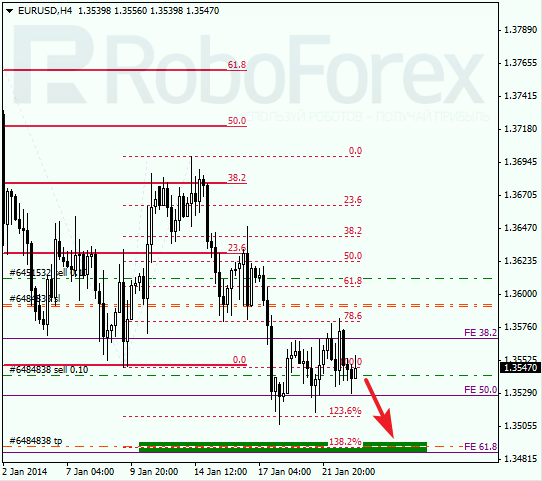
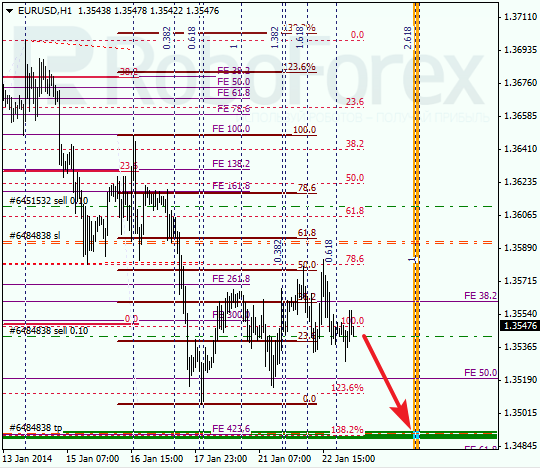
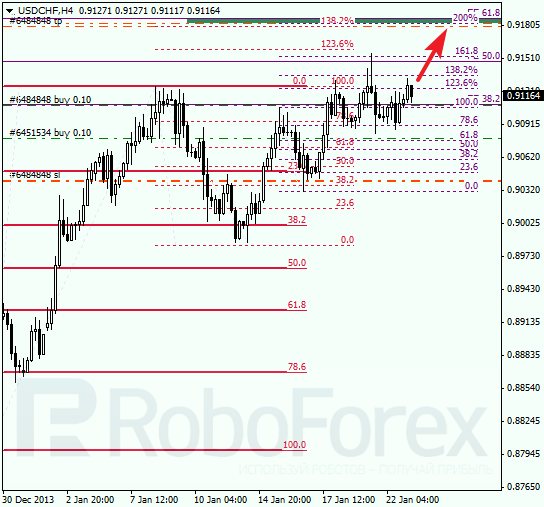
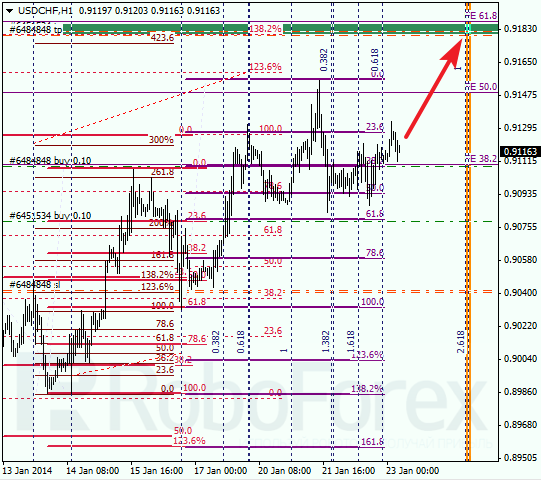
Fibonacci Retracements Analysis 23.01.2014 (EUR/USD, USD/CHF)

Article By RoboForex.com

Analysis for January 23rd, 2014

EUR/USD

Euro is still consolidating, but may yet start new descending movement. Main target is still in lower area close to 1.3490, where there are several fibo-levels. Possibly, price may break local minimum during the day.

At H1 chart we can see, that market tested local correctional level of 50% one more time and rebounded from it again. According to analysis of temporary fibo-zones, predicted targets may be reached during the next 24 hours.

USD/CHF

Franc is also moving sideways so far; upper target area is formed by three fibo-levels. If later price rebounds from it, pair may start new and more significant correction.

As we can see at H1 chart, yesterday market rebounded from level of 50% again. I’m keeping two buy orders with target near upper levels. According to analysis of temporary fibo-zones, bulls may reach them by Friday.

RoboForex Analytical Department

Article By RoboForex.com

Attention!
Forecasts presented in this section only reflect the author’s private opinion and should not be considered as guidance for trading. RoboForex LP bears no responsibility for trading results based on trading recommendations described in these analytical reviews.


Ichimoku Cloud Analysis 23.01.2014 (GBP/USD, GOLD)

Article By RoboForex.com

Analysis for January 23rd, 2014

GBP/USD

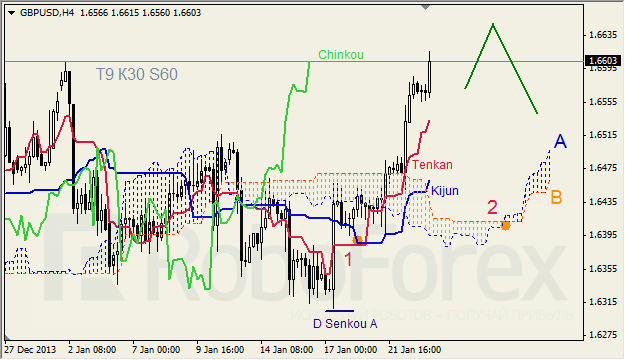
GBPUSD, Time Frame H4. Tenkan-Sen and Kijun-Sen intersected below Kumo Cloud and formed “Golden Cross” (1). Ichimoku Cloud is going up (2), and the price is above the lines. Short‑term forecast: we can expect support from Tenkan-Sen, and growth of the price.

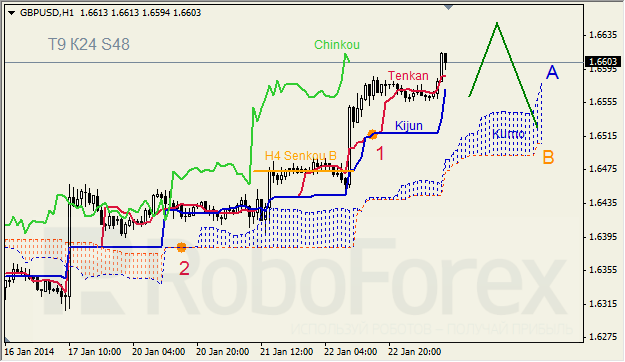
GBPUSD, Time Frame H1. Tenkan-Sen and Kijun-Sen are influenced by “Golden Cross” (1). Ichimoku Cloud is going up (2), Chinkou Lagging Span is above the chart. Short‑term forecast: we can expect support from Tenkan-Sen – Kijun-Sen, and growth of the price.

GOLD

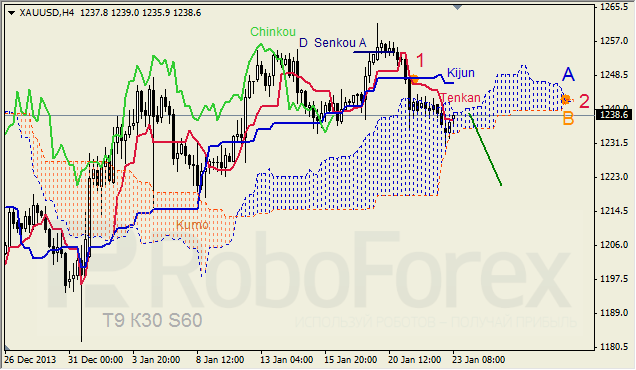
XAUUSD, Time Frame H4. Tenkan-Sen and Kijun-Sen intersected above Kumo Cloud and formed “Dead Cross” (1). Ichimoku Cloud is closed (2); Chinkou Lagging Span is on the chart, and the price is inside Kumo. Short-term forecast: we can expect resistance from Senkou Span A – Tenkan-Sen, and attempts of the price to stay below Kumo Cloud.

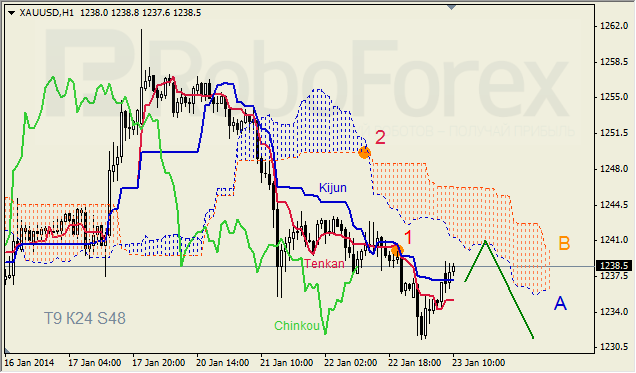
XAUUSD, Time Frame H1. Tenkan-Sen and Kijun-Sen are influenced by “Dead Cross” (1). Ichimoku Cloud is going down (2), Chinkou Lagging Span is on the chart, and the price is below Kumo Cloud. Short‑term forecast: we can expect resistance from Senkou Span A, and decline of the price.

RoboForex Analytical Department

Article By RoboForex.com

Attention!
Forecasts presented in this section only reflect the author’s private opinion and should not be considered as guidance for trading. RoboForex LP bears no responsibility for trading results based on trading recommendations described in these analytical reviews.


The United States: Are the Seeds Already Sown for the Next Macro-Market Deflation Crisis?

By John Mauldin

Greg Weldon has long been my favorite slicer and dicer of data – his charts and insights on charts really help me keep my eyes peeled. But in order to get across to us the drastic state of the economy as we plunge headlong into 2014 – a year that we all know will be pivotal – Greg has felt it necessary to resort to a rather trenchant metaphor from the year just past. Yes, says Greg, the economy is … Breaking Bad.

But – listen up now – bad is now good. At least temporarily.

Good, because bad macroeconomic data means an ongoing (if slightly tapering) supply of monetary steroids (Greg’s term) will be forthcoming from our pushers, the central banks of the developed world.

Greg reminds us that the “Breaking Bad Era” actually got underway decades ago. He traces its history back to pre-WWII manipulation of the bullion market; to the historic post-WWII Bretton Woods agreement that gave the US currency “seigniorage,” thus setting it up to become the world’s reserve currency; and right on through to the closing of the gold window by Richard Nixon in 1971.

Since then, the US economy has been dependent on steady – and of course ever-growing – doses of monetary steroids, with only one brief drug-free stint in the Paul Volcker Rehabilitation Center in the 1980s.

And of course the Greenspan Fed did try to do the tighten-up from time to time; but each attempt brought greater pain during withdrawal … and the ever-compassionate Dr. Greenspan took pity on us and increased our monetary prescription.

Now, Greg really socks it to us (and we haven’t even gotten to those charts yet … but we will):

Who, even a short ten years ago, would have ever thought that the most popular shows on US television would be about hero-serial-killers and methamphetamine ‘cooks’?? We could extrapolate to suggest that this reflects the intensifying socio-economic impact of the secular trend related to the polarization of wealth, the expanding production-output efficiency generated by technology, the rise in the level of poverty in the US, and the increased social unrest evidenced by ever more incidents of seemingly random, premeditated violence.

The story line in the award-winning US television show Breaking Bad is ‘Milton-esque’, in that it explores the internal war between good and evil as manifest within the lead character, a high school chemistry teacher who contracts brain cancer. In need of money to pay bills that his health insurance will not cover, the teacher turns to the nefarious underworld of ‘cooking’ crystal-meth.

Greed leads to violence, which in turn leads to chaos and intensifying desperation. Ultimately, things spin out of control, as the teacher-turned-meth-cook finds it impossible to maintain a balance between family values and the ruthlessness of his business.

Therein lies the analogy, as the global situation finally reached the desperation point and threatened to spiral out of control in 2008-09 … when withdrawal from Fed monetary tightening led to organ failure in the housing market, which nearly spilled over into the banking system, [leaving] the US economy perilously close to ‘death’.

We are tempted to say that the US has been in and out of a coma ever since, in the sense that “real” reflation remains flat-lined.

You get the picture.

But now Greg wants us to dig even deeper. Yes, the Fed has “saved” the banking system – for now. And yes, the Fed has refloated the US consumer – on the bloated back of the stock market. (“Note,” says Greg, “the exceptionally ‘tight’ positive-correlation between the Fed’s Balance Sheet, the US S&P 500 stock index, and US Household Net Worth” – great chart follows.)

But in doing all this saving of the economy from itself, Greg wants to argue, the Fed has already sown the seeds of the next macro-market deflationary wave. So let’s give Greg the floor and let him paint the Big Bad Picture for 2014. And be sure to catch his special offer for Outside the Box readers, at the end.

I write this note from Vancouver where I will shortly be speaking to the local CFA organization before traveling on to Edmonton and Regina to speak for their respective CFA groups. I came in to Vancouver early yesterday so that I could finally get the opportunity to meet Frank Giustra, one of the more storied and colorful names in the natural resources field. We have many mutual friends who had been suggesting we get together. The son of an immigrant miner, he is one of those wonderful rags to riches stories that you see from time to time.

Frank hosted a small dinner at his home. Randomly, there was a natural resources conference going on in Vancouver the same day, so Frank was able to get decades-long friend Frank Holmes of US Global to come along, as well as my business partner Olivier Garret, energy maven and speculator Marin Katusa, and a few others. It was one of those special nights where the conversation flowed vibrantly from one topic to the next. Of course we talked about natural resources, but also about robotics and the still-approaching Singularity, the future of work, and the nature of progress – etc. For those who aren’t familiar with Frank, he made most of his money investing in natural resources, was also a founder of the movie production giant Lionsgate, and is a running buddy of Bill Clinton’s. So naturally the talk turned to politics and movies. (Turns out Frank just purchased half the rights to Blade Runner, which may be my pick for all-time best science fiction movie. I am ready for an updated remake!)

Vancouver is one of the most beautiful cities I get to visit. The weather has been spectacular, although I’m told it will turn cold just about as soon as I head east to Edmonton and Regina.

(Wow! I just got word that my old friend Ross Beatty is in town and would like to get together. It’s been a long time. I first met him in the ’80s when he was trying to figure out how to get a little silver out of the ground. I understand that he’s made a few billion here or there in the meantime, mining all sorts of minerals and creating lots of wealth for his investors. Ross Beatty was always and still is a winner. It will be fun to catch up.)

You have a great week and stay warm.

You’re looking for his Under Armor gear analyst,

John Mauldin, Editor
Outside the Box
[email protected]

Stay Ahead of the Latest Tech News and Investing Trends…

Click here to sign up for Patrick Cox’s free daily tech news digest.

Each day, you get the three tech news stories with the biggest potential impact.


Fourteen-For-Fourteen

Fourteen Macro-Market Trading Themes to Watch For During 2014

A Preview of Our Number-One Theme: The United States

The United States: Are the Seeds Already Sown for the Next Macro-Market Deflation Crisis?

We recently finished our 2014 outlook piece entitled “Fourteen-For-Fourteen”, with fourteen separate macro-market ‘trading themes’, all of which offer numerous specific ways in which to participate in a broad and diversified batch of global markets. Our coverage extends from stock indexes, individual equities, ETFs and ETNS, foreign exchange, fixed-income, precious and industrial metals, energy, and agricultural commodities, sectors we discuss every day in our Weldon LIVE research publication.

I have teamed up with my golf buddy John Mauldin to offer a slice (no pun intended) of our first, and perhaps most important, macro-market trading-theme for 2014, as it relates to US Federal Reserve policy, the US consumer, the US stock market, and US Bonds.

(Details on how to get our “Fourteen-For-Fourteen“, at a special, discounted, Outside the Box price, can be found at the end of our preview.)

We begin with a headline that caught my eye the other morning, culled from Bloomberg …

… “India’s SENSEX rose 1.8 percent today, the most in three weeks, after an unexpected drop in factory output spurred optimism that the central bank will not raise interest rates.”

We might call this the ‘Breaking Bad Era’.

Bad is now good.

Good, because bad macro-data means … a continued flow of monetary steroids from Central Banks.

Indeed, whether it be India, the UK, Japan, the EU, or the US, bad economic data is celebrated, as is so grossly evidenced by the reaction seen on television, amid stock market exuberance and the resultant extension in net worth/wealth reflation.

Indeed, just like any addict, the global markets, not to mention the underlying global macro-economy, have come to RELY ON a steady dose of monetary steroids, without which withdrawal kicks in, muscle atrophy intensifies, and eventually organ failure ensues.

We see this already, within the US labor market … atrophy without a steady, if not ever increasing, dose of monetary “roids”.

Our regular readers know that we have been all over this ‘theme’ for years.

In my book “Gold Trading Boot Camp” (Nov-2006) I examined the then-intensifying trend towards a blow-out in the massive credit bubble in US Housing facilitated by the Fed’s response to the 1997-98 global crisis, and the 2000-01 tech-bubble-bursting crash. I laid out the scenarios in which the Federal Reserve would need to ride their monetary white-horse to the rescue, to avert a full-blown credit crash and debt deflation …

… by conducting outright purchases of US Treasury securities.

Even as late as 2006, anyone opining such a blasphemous thought was considered a monetary heretic.

Now the history books are being ‘re-written’, while the un-written mandate of the US Federal Reserve and other global Central Banks  has subtly-yet-significantly shifted, exactly as we said it would way back in the nineties, from preventing a repeat of the 1970’s inflation, to circumventing a full-blown debt deflation and macro-economic depression.

We said quite blatantly, two decades ago, that … “someday the Fed will pursue inflation.”

Blasphemy !!! Pure monetary heresy !!!

Now it’s called the “new normal”.

But, as we laid-out in “Gold Trading Boot Camp”, what we now call the ‘Breaking Bad Era’ began decades ago.

We traced the history back to pre-WWII manipulation of the bullion market, the historic post-WWII Bretton Woods agreement that gave the US currency ‘seigniorage’, thus setting it up to become the ‘world’s reserve currency’, right through to the closing of the Gold window by US President Richard Nixon in August of 1971, the spark that truly started this ‘fire’.

The US macro-market has been taking monetary steroids since 1971, with a brief stint spent ‘drug free’, while residing in the Paul Volcker rehab center.

Each successive tightening brings greater pain during withdrawal, which then drives Central Bankers to increase the monetary dosage, to the point where the once unthinkable has occurred, and the Assets Held Outright by the Fed will balloon to more than $4 trillion, most of which is held in US government debt.

Indeed, consider this … who, even a short ten-years ago, would have ever thought that the most popular shows on US television would be about hero-serial-killers and methamphetamine ‘cooks’ ?? We could extrapolate to suggest that this reflects the intensifying socio-economic impact of the secular trend related to the polarization of wealth, the expanding production-output efficiency generated by technology, the rise in the level of poverty in the US, and the increased social unrest evidenced by evermore incidents of seemingly random, pre-meditated violence.

The story line in the award-winning US television show “Breaking Bad” is ‘Milton-esque’, in that it explores the internal war between good and evil as manifest within the lead character, a high school chemistry teacher who contracts brain cancer. In need of money to pay bills that his health insurance will not cover, the teacher turns to the nefarious underworld of ‘cooking’ crystal-meth.

Greed leads to violence, which in turn leads to chaos and intensifying desperation. Ultimately, things spin out of control, as the teacher-turned-meth-cook finds it impossible to maintain a balance between family values, and the ruthlessness of his business.

Therein lies the analogy, as the global situation finally reached the desperation point, and threatened to spiral out of control in 2008-09 … when withdrawal from Fed monetary tightening led to organ failure in the housing market, which nearly spilled over into the banking system, putting the US economy perilously close to ‘death’.

We are tempted to say that the US has been in and out of a coma ever since, in the sense that “real” reflation remains flat-lined.

Yet, there have been some bright spots, some limb movements and facial expressions emanating specifically from the US consumer, and from corporate America as it relates to streamlined efficiency and increased competitiveness.

The Fed successfully ‘saved’ the banking system, for now.

The Fed successfully kept the US consumer afloat.

Moreover, the Fed has facilitated an unprecedented reflation in US Net Worth. But, this reflation comes in PAPER wealth, NOT wage-income, which is still glaringly lacking.

Witness the chart below plotting the path of US Household Net Worth, which has spiked to a new all-time high, with a near-$22 trillion expansion from the 2009 secular crisis low.

But in so doing, we could argue that the Fed has already sown the seeds for the next macro-market deflationary wave.

We can directly connect the dots.

It all starts with Fed purchases of government debt …

… which has led to the reflation in the US equity market …

… almost single-handedly generating a huge expansion in US Net Worth.

From there we can continue to draw a straight-line to the fact that the strongest improvement within the underlying macro-economy has been seen specifically in sentiment-derived numbers …

… which leads us directly to the virtually unnoticed renewed blow-out in US consumer credit…

… which has ‘funded’ the robust recovery in retail sales and US final household demand.

And finally, it is an easy link to the upside outperformance and leadership exhibited in the stock market since the advent of QE, by the Consumer Discretionary sector.

Note the exceptionally ‘tight’ positive-correlation between the Fed’s Balance Sheet, the US S+P 500 stock index, and US Household Net Worth, as evidenced in the overlay chart below. Indeed, since the advent of QE-III the movements of the US stock market and the Fed’s Balance Sheet have become almost identical.

With US Households ‘feeling’ STRONG thanks to massive injections of monetary steroids, and a renewed feeling of invincibility among stock market investors, consumers are flexing their muscles by borrowing significant amounts of ‘cash’.

We offer hard-core data as evidence. As seen in the chart below, we can identify more months of double-digit (as in more than $10 billion) growth in the Fed’s own measure of Consumer Credit over the last three-years, than during ANY other period in the post-WWII timeline.

Note further, that the 5-Year Average of monthly borrowing has almost returned to the pre-2007 crisis highs.

In essence, we can very comfortably argue that the Fed has facilitated another credit-fueled recovery, wherein the US consumer is, again, borrowing aggressively against a collateral base that is ‘defined’ by paper wealth, rather than ‘real’ income growth.

The stock market has replaced the housing market as that collateral base against which the US consumer is now borrowing hand-over-fist.

Yes, there are differences, the ”breadth’ of this ‘reflation’ is not the same as it was with the mortgage market debacle. Banks are (allegedly) not involved, with bank lending growth remaining less than overtly reflationary.

But the similarities are intriguing, if not somewhat frightening, as US households place massive bets, again, that the stock market is in a Nirvana-like, perma-bull market, and that ‘tapering’ is not a threat …

… just like US households placed massive bets that housing prices were incapable of deflating.

Not only that, but tapering has a major impact on the US bond market, with buyers having become increasingly scarce, against which the tide of supply does NOT recede for several years, if even then.

A rise in interest rates that has a negative impact on the US stock market would require another dose of monetary steroids, because the implications of a deflation in stocks would be too significant for the underlying macro-economy to handle.

To simplify, the unwritten mandate of the Fed is now singular; to prevent the stock market from failing.

The greater fear stems from thoughts that the macro-market dynamic has been internally ravaged by years of steroid abuse, and anything less than an increase in ‘roid’ dosage from the Fed may lose its effectiveness in fighting macro-muscle atrophy.

We could say we see evidence of this already, in the expanding and recently developed divergences exhibited within the overlay chart on display below.

Notice how Gold led the charge into QE-II, peaked first, and rolled over first, breaking down, and plunging amid disinvestment and a rotation out of safety, and into risk assets.

Next it was Home Prices, peaking, and most recently … breaking down.

We could add Emerging Market stock indexes, Emerging Market Bond prices, Emerging Market currencies … and … the CRB Index … all of which have followed Gold to the downside, in a GLARING example of the ‘internal atrophy’ taking place, as per the global market’s narrowing response to Fed QE.

Subsequently, we theorize that there is significant risk associated with tapering, particularly when tapering turns into ‘tapping out’, when the Fed reaches the point where they are no longer buying-to-accumulate any assets. There is risk that ‘extends’ to the stock market, for its tight, reliant relationship with the Fed’s Balance Sheet (our detailed “Fourteen-For-Fourteen” digs deeper into this dynamic, with specific ‘predictions’ for the path of the S+P 500 in 2014, based on the pace of tapering).

But more pointedly the risk emanates from the potential impact on US Treasury Bond and Note yields, as a result of an eventual ‘tap out’ by the Fed.

We find it most interesting to observe the overlay chart below in which we plot the Fed’s Assets Held Outright (black line) versus Custody Holdings (foreign official holdings of US Treasury securities, red line). We first focus on the rise in the Fed’s Balance sheet associated with QE-III, during which time bond and note yields in the US have risen.

Secondly, and most importantly, we shine the spotlight on the peak in Custody Holdings, and the DECLINE in 2013. For sure, it is NOT a coincidence that foreign officialdom turned NET SELLERS of US Treasuries in May, precisely on the back of Fed Chair Ben Bernanke’s first mention of ‘taper’.

Demand from foreign officialdom is flat, at best.

The US ‘public’ is not buying bonds.

The US ‘public’ has followed the lead of the Pied Piper Ben Bernanke, the monetary maestro, who has carried the day on his back with some spectacular flute playing, calming the masses, resurrecting confidence, and facilitating a rotation out of safety (bonds, gold) and back into risk assets, stocks specifically.

So, from where will the marginal buyer of US Treasury bonds appear ??

No doubt, there is NO dearth of supply.

We examine the ‘schedule’ of ‘Treasury Obligations’ seen below.

Need we say more ??

A tsunami of Treasury supply, no matter how you slice-and-dice it.

And the Fed is potentially, probably, pulling the plug on a half-trillion a year in ‘support’??

Moreover, that ‘support’ which is to be removed represents pure monetization, actual evaporation of debt (for all intents and purposes).

Tapering to a ‘tap-out’ also means more supply in ‘perpetual roll-over’.

Over the next five-years, that is virtually $2.5 trillion.

When we add the new debt, needed to finance this year’s (fiscal) deficit, well the numbers start to add up very quickly. Yes, seeing the annual US deficit ‘shrink’ (laughter) by half, from $1 trillion, to something closer to $500 billion, could be labeled ‘improvement’. But, just five years ago the current deficits would have been record breaking, and still represent a significant, on-going, supply side issue.

So, who is the ‘marginal’ buyer of US debt ?? Who will help maintain ‘equilibrium’ to where Treasury yields will not rise ??

From a simple supply-demand dynamic, the risk-reward skew is to the upside in bond yields.

Of course things are never simple.

Especially in the Breaking Bad Era, where BAD is GOOD !!!

Evidence last week’s US payroll data … and the hundreds of thousands of chronically unemployed who simply fell out of the ‘equation’. This alone speaks volumes to the dysfunction in the US labor market.

But still, even during any initial ‘positive’ reaction to the ‘negative’ news, we might offer a thought: any macro-economic deflation that is deep enough to sway the Fed, will also have an impact on the fiscal side of this dual-headed coin … most probably towards increased bond supply.

Yet still, some might hypothesize that there is a major difference now, than during the housing-credit-deflation induced event of 2008-09, the banking system was saved, and is now solid.

As evidenced, of course, in this new era … by rising bank share prices.

For sure, banks are more ‘liquid’.

No debate.

Thanks to the Fed, and the Fed only, as is clear upon a survey of the overlay chart below revealing the link in Bank Balance Sheets, a distinctively direct link … to the Fed’s Balance Sheet.

And while bullish for the bank shares, this dynamic is not ‘positive’.

Indeed, only in the ‘Breaking Bad Era’ could this be construed as ‘positive’. But it is not positive, not when it means banks sit on their own mountain of ‘cash’ (aka, US Treasury securities), instead of lending that money.

Moreover, with huge holdings of US Treasuries, In the advent of another deflationary wave banks could well turn net sellers of government debt.

In other words, do not look to US financial institutions to plug any hole that might develop in the US bond market.

Another, less obvious reason that we say the rise in ‘cash’ held by banks is not ‘positive’, has to do with what is happening in the background with Bank Balance Sheets. The level of cash-securities held by US Commercial Banks, about $2.7 trillion, is peanuts compared to the level of risk banks are carrying in terms of ‘Derivative Holdings’.

In fact, as we try to comprehend the figures shown in the chart below, extracted from the FDIC’s Quarterly Banking Profile’s breakdown of Commercial Bank Balance Sheets … we are continually shocked.

Shocked to think that during this period of Fed largesse, during this period where the banks are allegedly healing as they do dispose of some non-performing assets … the risk is rising again, and rising rapidly.

Most troubling is the fact that the vast majority of the rise in, and the total of, Derivative holdings, roughly $225 trillion, yes trillion, are labeled as Derivatives Held for “Trading Purposes”, as opposed to being held for “Hedging Purposes’.

Indeed, it appears that risk and leverage in the banking system is still alive and well. No wonder the biggest banks, who hold the lion’s share of the derivative risk, now carry the moniker of ‘too big to fail.

They are called that because they are, literally … “too big” … specifically as it applies to their holdings of Derivatives for Trading Purposes (again, pegged at $225 trillion).

The simple fact that in the twelve-months ending June-2013 (data release lagged by the FDIC, one reason it goes largely unnoticed), Bank holdings of Derivative contracts linked to ‘trading'(aka profit generation) rose by more than $11 trillion …

… which dwarfs the expansion in Bank cash holdings …

… dwarfs the expansion in Bank Deposits …

… and, even more ‘tellingly’, dwarfs the expansion in the Fed’s Balance Sheet, over that same period, by about ten-to-one.

And most acutely frightening is the fact that the expansion in derivative exposure is most focused in Fixed-Income derivatives, by far, as seen below ($188.3 trillion, yes, trillion, in Fixed-Income contracts alone).

Clearly, the Fed is walking a tightrope.

Again, in our view, the risk-reward skew in the US Treasury market, for 2014, is tilted towards rising yields, which points us in the direction of strategies that accept that premise.

In our “Fourteen-For-Fourteen” we offer an even more detailed look at the US Treasury market specifically, from a technical perspective, and a strategic perspective.

We also take a closer look at the US consumer, household net worth, retail sales, and even gasoline prices, as factors that will play into the US based theme during 2014.

And that, is just our first of fourteen major macro-market themes for 2014, which encompass more than 200 pages of charts, graphs, and data slides covering both fundamental and technical analysis.

It is with a heartfelt thank-you that I nod in the direction of my colleague and conference-golf buddy John Mauldin; the man behind the curtain, Ed D’Agostino; the gang at Mauldin Economics; and my Kiawah Island golf buddy Grant Williams, for their willingness to participate with us in offering this preview of our 2014 Outlook.

Our fourteen market themes for 2014 include careful examinations of the monetary policy challenges faced by multiple Central Banks’ and the potential impact on the bond, FX and stock markets (including Exchange Traded Funds).

We also highlight some very specific currency challenges in some key regions especially as it relates to devaluations and competitive depreciation, and how that will impact the global markets. And, we shine the spotlight on a few very specific metals and energy opportunities with some compelling market charts and inter-market analysis.

Finally, we offer a few commodity plays in line with their underlying supply-demand fundamentals, including focus on the parallel opportunities within the commodity ETN universe.

All fourteen themes have been produced as separate chapters in video form (and come with a printable pdf version), all of which include detailed market charts and audio commentary.

ACT NOW to get all Fourteen Macro Themes at a special discounted rate (over 15% off) for readers of John Mauldin’s Outside the Box.

SEND $249.99 to [email protected] via www.paypal.com

Or email [email protected] and get special access now.

Like Outside the Box?
Sign up today and get each new issue delivered free to your inbox.
It’s your opportunity to get the news John Mauldin thinks matters most to your finances.

© 2013 Mauldin Economics. All Rights Reserved.
Outside the Box is a free weekly economic e-letter by best-selling author and renowned financial expert, John Mauldin. You can learn more and get your free subscription by visiting www.MauldinEconomics.com.
Please write to [email protected] to inform us of any reproductions, including when and where copy will be reproduced. You must keep the letter intact, from introduction to disclaimers. If you would like to quote brief portions only, please reference www.MauldinEconomics.com.
To subscribe to John Mauldin’s e-letter, please click here: http://www.mauldineconomics.com/subscribe
To change your email address, please click here: http://www.mauldineconomics.com/change-address

Outside the Box and MauldinEconomics.com is not an offering for any investment. It represents only the opinions of John Mauldin and those that he interviews. Any views expressed are provided for information purposes only and should not be construed in any way as an offer, an endorsement, or inducement to invest and is not in any way a testimony of, or associated with, Mauldin’s other firms. John Mauldin is the Chairman of Mauldin Economics, LLC. He also is the President of Millennium Wave Advisors, LLC (MWA) which is an investment advisory firm registered with multiple states, President and registered representative of Millennium Wave Securities, LLC, (MWS) member FINRA, SIPC, through which securities may be offered . MWS is also a Commodity Pool Operator (CPO) and a Commodity Trading Advisor (CTA) registered with the CFTC, as well as an Introducing Broker (IB) and NFA Member. Millennium Wave Investments is a dba of MWA LLC and MWS LLC. This message may contain information that is confidential or privileged and is intended only for the individual or entity named above and does not constitute an offer for or advice about any alternative investment product. Such advice can only be made when accompanied by a prospectus or similar offering document. Past performance is not indicative of future performance. Please make sure to review important disclosures at the end of each article. Mauldin companies may have a marketing relationship with products and services mentioned in this letter for a fee.

Note: Joining The Mauldin Circle is not an offering for any investment. It represents only the opinions of John Mauldin and Millennium Wave Investments. It is intended solely for investors who have registered with Millennium Wave Investments and its partners at http://www.MauldinCircle.com (formerly AccreditedInvestor.ws) or directly related websites. The Mauldin Circle may send out material that is provided on a confidential basis, and subscribers to the Mauldin Circle are not to send this letter to anyone other than their professional investment counselors. Investors should discuss any investment with their personal investment counsel. You are advised to discuss with your financial advisers your investment options and whether any investment is suitable for your specific needs prior to making any investments. John Mauldin is the President of Millennium Wave Advisors, LLC (MWA), which is an investment advisory firm registered with multiple states. John Mauldin is a registered representative of Millennium Wave Securities, LLC, (MWS), an FINRA registered broker-dealer. MWS is also a Commodity Pool Operator (CPO) and a Commodity Trading Advisor (CTA) registered with the CFTC, as well as an Introducing Broker (IB). Millennium Wave Investments is a dba of MWA LLC and MWS LLC. Millennium Wave Investments cooperates in the consulting on and marketing of private and non-private investment offerings with other independent firms such as Altegris Investments; Capital Management Group; Absolute Return Partners, LLP; Fynn Capital; Nicola Wealth Management; and Plexus Asset Management. Investment offerings recommended by Mauldin may pay a portion of their fees to these independent firms, who will share 1/3 of those fees with MWS and thus with Mauldin. Any views expressed herein are provided for information purposes only and should not be construed in any way as an offer, an endorsement, or inducement to invest with any CTA, fund, or program mentioned here or elsewhere. Before seeking any advisor’s services or making an investment in a fund, investors must read and examine thoroughly the respective disclosure document or offering memorandum. Since these firms and Mauldin receive fees from the funds they recommend/market, they only recommend/market products with which they have been able to negotiate fee arrangements.

PAST RESULTS ARE NOT INDICATIVE OF FUTURE RESULTS. THERE IS RISK OF LOSS AS WELL AS THE OPPORTUNITY FOR GAIN WHEN INVESTING IN MANAGED FUNDS. WHEN CONSIDERING ALTERNATIVE INVESTMENTS, INCLUDING HEDGE FUNDS, YOU SHOULD CONSIDER VARIOUS RISKS INCLUDING THE FACT THAT SOME PRODUCTS: OFTEN ENGAGE IN LEVERAGING AND OTHER SPECULATIVE INVESTMENT PRACTICES THAT MAY INCREASE THE RISK OF INVESTMENT LOSS, CAN BE ILLIQUID, ARE NOT REQUIRED TO PROVIDE PERIODIC PRICING OR VALUATION INFORMATION TO INVESTORS, MAY INVOLVE COMPLEX TAX STRUCTURES AND DELAYS IN DISTRIBUTING IMPORTANT TAX INFORMATION, ARE NOT SUBJECT TO THE SAME REGULATORY REQUIREMENTS AS MUTUAL FUNDS, OFTEN CHARGE HIGH FEES, AND IN MANY CASES THE UNDERLYING INVESTMENTS ARE NOT TRANSPARENT AND ARE KNOWN ONLY TO THE INVESTMENT MANAGER. Alternative investment performance can be volatile. An investor could lose all or a substantial amount of his or her investment. Often, alternative investment fund and account managers have total trading authority over their funds or accounts; the use of a single advisor applying generally similar trading programs could mean lack of diversification and, consequently, higher risk. There is often no secondary market for an investor’s interest in alternative investments, and none is expected to develop.


Eric Lemieux: What Does 2014 Hold for Metals?

Source: Brian Sylvester of The Gold Report  (1/22/14)

http://www.theaureport.com/pub/na/eric-lemieux-what-does-2014-hold-for-metals

Eric Lemieux, a mining analyst with Laurentian Bank Securities in Québec, is a realist, which makes his optimistic outlook for miners in 2014 that much more compelling. Lemieux believes that with the wheat separated from the chaff over the past tumultuous year, the truly strong companies have emerged. But you may be surprised by the jurisdictions he predicts will come to life in 2014. Lemieux makes some startling, but happy forecasts in this interview with The Gold Report.

The Mining Report: Eric, your top stock pick in 2013— Virginia Mines Inc. (VGQ:TSX)—outperformed the S&P/TSX SmallCap Index. What’s your recipe for picking stocks in 2014?

Eric Lemieux: The secret to success in picking stocks in 2014 will be simple: management. The senior vice president of Laurentian Bank Securities, who recruited me, asked me a question during my interview way back in 2007: What was the most important element when I was looking at a company? I started to talk about some financial ratios, etc. He began to laugh. He said there are three things: management, management and management. I know that’s easy to say, but it is true. It is the team that’s behind the company. That’s the most important secret for success.

TMR: What’s your top pick for 2014?

EL: It remains Virginia Mines because the company has an exceptionally well-managed team and a focused business model. CEO André Gaumond has said he wants to be at the beginning of the food chain and the end of the food chain with a royalty portfolio. I think he is adamant about applying what he’s good at and that’s being a top explorer and being able to decipher royalty portfolio opportunities. He has always said he is not a producer and I respect that. So far he has been proven right. That should remain the same in 2014.

TMR: The royalty that you’re referring to is Goldcorp Inc.’s (G:TSX; GG:NYSE) Éléonore project in the James Bay region of Québec, which should go into production in 2014. What’s interesting is that some exploration done by Goldcorp seems to have delineated an entirely new zone of mineralization. What do you know about that?

EL: Goldcorp disclosed a new zone called 494, which would be about 500 meters (500m) north of the Roberto zones. It appears as a new ore shoot. It still has to be fully defined, but the hypothesis is that its geometry looks to be another Roberto. It’s most interesting because it’s not too far from the mining infrastructure that’s being built. It could effectively double the size of Éléonore; which is also wide open at depth. That deposit is set to grow.

The key catalysts for the Éléonore royalty in 2014 are 1) new reserve and resource numbers that most likely will be disclosed by Goldcorp in February and 2) the start of production by the end of the year. There could be a major rerating of the value of Virginia’s royalty. It is tremendous. I think it is going to be a world-class operation soon.

TMR: You’re predicting an average gold price of $1,400/ounce ($1,400/oz) in 2014. That’s down from the previous estimate of $1,750/oz. Nonetheless, most observers would call $1,400/oz optimistic given the current spot price. What gives you confidence that the gold price will rise in 2014?

EL: I’m fairly optimistic. The price of gold is gravitating around $1,200/oz, so there’s a substantial difference. I’m looking at the global picture. Yes, the price of gold has gone down, but it’s approaching a floor of production costs. By midyear the price of gold will be higher.

TMR: Many of the companies you cover operate in Québec, which just passed a new mining act. Is that good news for investors?

EL: By and large, all this is good news for companies operating in Québec. It’s not perfect. There are a few irritants, but it is a middle ground—a relatively well-balanced law.

TMR: An application for a mining lease now requires a feasibility study. What do you make of that?

EL: Well, feasibility studies are necessary. A company needs to go through the steps of a feasibility study for the normal process of calling a mineral reserve and getting financing, etc. The industry has to realize certain levels of obtainment and it is a normal process to have feasibility studies to receive the proper permits to achieve the proper level. The new act (as amended) states that an application for a mining lease must be accompanied with a scoping study and market study; note that previous Bill 43 had proposed a feasibility study for securing second and third transformation. The new dispositions are fair and less burdensome.

TMR: Does Québec remain the best jurisdiction in Canada in which to operate a junior mining exploration company?

EL: I would simply say no, but I would point out the positive is that Québec has stopped dropping in the standings. We’ve gained clarity with the Québec mining law and royalty revisions. All in all, we’re not the best jurisdiction anymore, but at least we’re not falling down the slope. I would highlight, however, that Goldcorp’s recent offer to acquire Osisko suggests that Québec has seen the worst, and perception is improving.

TMR: What would you say is the best jurisdiction?

EL: This is an ever-evolving element. What is considered the best jurisdiction today could not be so a year from now. Québec is a case-in-point. It was one of the best jurisdictions a few years ago and it slid down. At least with the passage of the royalty and mining law, the worst is over.

TMR: Despite your optimism for precious metals, you’ve rolled back almost all of the target prices on the companies you cover, some by as much as 35%. What prompted that action?

EL: General market sentiment has obliged me to remove or decrease substantially my exploration goodwill, which was a proxy of the quality of the teams, the quality of the projects and the general market sentiment. I had to bring that goodwill down, and for certain explorers I had to completely remove it. Having said that, companies that are well managed, have a good portfolio of projects and are able to sustain a minimum of activities will be poised to bounce back eventually. Although I brought down the target price, I kept my recommendations. That’s a powerful statement. I just needed to effectively downsize some of the expectations.

TMR: What are some of the companies you cover with speculative buy ratings?

EL: There are quality explorers in Québec, Balmoral Resources Ltd. (BAR:TSX; BAMLF:OTCQX) andMidland Exploration Inc. (MD:TSX.V), for example.

Midland has more than $4 million ($4M) in its coffers. That is not a lot compared to other strong companies, but Midland uses the partnership model so its exploration costs are quite low as its partners are funding the programs. Partners for Midland are the likes of Teck Resources Ltd. (TCK:TSX; TCK:NYSE), Agnico-Eagle Mines Ltd. (AEM:TSX; AEM:NYSE) and the Japanese consortium JOGMEC. Midland has the financial capacity to maintain some level of good activity. That’s a testament to a well-managed company.

TMR: Which of its projects are you most excited about?

EL: There are a few of them. You never know which one will be the star that will finally emerge. Maritime-Cadillac, a partnership with Agnico-Eagle, is right beside Agnico’s Lapa mine, which has just a few years left of production. Agnico would want to sustain, or at least continue to build on, the infrastructure that it has invested in there. Anything that’s found in the Maritime-Cadillac project will probably go through the Lapa head frame.

The Éléonore Centre project is 100% owned by Midland, but it could eventually find a partner. It’s working slowly but surely and as Goldcorp’s Éléonore mine is about to go into production; that whole area will reignite interest once people realize Éléonore is a world-class deposit. Any acreage around there will gain value directly. Midland will have to decide if it wants to find a partner before it drills Éléonore; it has the financial capacity to do that. No matter what happens, that area will light up from Éléonore’s conservative production of 40,000 to 60,000 oz of gold in 2014.

TMR: Tell us about what those potential partners could look like.

EL: Midland has a diversified portfolio of properties: a palladium-platinum project in the northern part of the Labrador Trough near Kuujjuaq, some base metal projects in areas not known as mining camps, some early-stage zinc projects. Midland has a lot of arrows in its quiver. Any time some of these arrows could attract some attention. It also has a track record of good relationships in current and previous partnerships. Midland is well positioned to find new strategic partners for its different portfolio of projects.

TMR: Let’s delve into Balmoral.

EL: Balmoral has done a very good job in amassing a strong portfolio of properties in the Detour Trend. Balmoral is a shining star right now in Québec. The company was nominated as the prospector of the year in November 2013, a testament to the good work that CEO Darin Wagner and his team are doing.

The Martiniere project along the Detour Trend holds some more surprises. The drilling Balmoral has done—about 90 holes—has shown that there’s a gold system there. The deepest hole, at about 400m, is just scratching the surface.

Balmoral is well positioned to continue to work in 2014, with about $8M in cash and equivalents. It has a hot project, the financial capacity, a good team and the geological knowledge—it’s a very well-positioned project in 2014.

TMR: Balmoral received a $6M private placement in October. Did that surprise you?

EL: A little bit. I found the timing a bit questionable. Having said that, when the money is on the table, maybe you take it.

TMR: Have some of the struggles at Detour Gold Corp. (DGC:TSX) trickled down to Balmoral?

EL: The Detour story has had a major impact. The whole area has lost its shine with the difficulties (for example a slower ramp-up) going on at the Detour Lake mining operations. There’s a direct impact for Balmoral, Midland and Adventure Gold Inc. (AGE:TSX.V), which is another company I cover.

Having said that, the target is of a higher grade on the Québec side. So far, Balmoral has been hitting high grade. Midland’s drilling last winter with Osisko Mining Corp. (OSK:TSX) did not hit a homerun, but it was a solid single. Smoke could lead to fire. All in all, the Québec Detour Trend will be able to hold its own in 2014.

While the Detour Lake operations have had an impact, it’s more of a step back to eventually take two steps forward.

TMR: Detour Gold recently closed its mill and scaled back its guidance again for 2013.

EL: Detour is going through hardships. Ramping up a mining operation takes time and there are always some surprises. I still believe that it has the capacity to make this a winning proposition. There’ll be hiccups, but it should be able to press all the wrinkles and make this a viable operation.

TMR: What about outside of Québec?

EL: Every jurisdiction has its issues and Ontario is no exception, but overall it is one of the better places in the world to work. Goldcorp and other majors are there, but there is still mining to be done in Ontario.

Premier Gold Mines Ltd. (PG:TSX) is in Ontario. The company’s assets in the Red Lake and Geraldton areas and its Hardrock and Trans Canada projects are sitting on solid footing. It also has projects in Nevada. Premier has the financial capacity to remain active. It’s my understanding that in 2014 Premier will come out with a scoping study for the Hardrock project, which will be able to move quickly into the prefeasibility stage.


TMR: What did you make of the initial resource estimate on the Helen zone, which is part of the Cove project in Nevada?


EL: It was a little bit below my expectations, but it’s important to underpromise and overdeliver in this business. The Helen zone was Premier’s first resource estimate. It is an improvement from what was done previously by Victoria Goldfields, which was a terrible saga where the company had to restate its numbers. Premier’s numbers should be rock solid. There’s potential to increase that internally, in infill drilling and with some proximal works. I feel comfortable with the Helen zone for the Cove property.


TMR: Is that the same case for Eastmain Resources Inc. (ER:TSX)?


EL: I have to confess that there was some disappointment over the pace of work in 2013 and 2012. I’ve always been quite forthright about thinking Eau Claire is an excellent project, but I’m still in the dark about how Eastmain can mine it. It’s something that I’ve been pestering management about for the last few years. There was an expectation that there would be a new mineral resource estimate in 2013 and that hasn’t come out yet. Eastmain did put out a press release recently saying that it had retained mining engineer Serge Bureau, who has a background with Barrick Gold Corp. (ABX:TSX; ABX:NYSE), as a special adviser. It’s very positive news that Eastmain realizes the importance of bringing Eau Claire to the next level. I take a lot of comfort in Serge Bureau counseling Eastmain CEO Donald Robinson and his team on how to best advance Eau Claire, as well as the Eastmain-Ruby Hill project.


Eastmain is focused in the James Bay area near Éléonore, again the area that I believe might reignite. Éléonore will become a world-class operation and anything that’s around there will gain from that. Hopefully Eau Claire will be able to monetize that.


TMR: What’s going to keep you optimistic in 2014?


EL: I’m optimistic. It was a difficult year for the mining industry in 2013. The fundamentals are still strong and the long-term story is solid. I believe that this will be able to set in during 2014. Companies have been tightening their belts and streamlining operations. Juniors are going back to the basics. There’s no more waste. There’s been a reality check. The companies that have been able to survive and sustain a minimum of operations and activities are going to be set for 2014.


The mining industry is a necessity. There’s always a reason to go out and search for metals and commodities because the population continues to grow and needs resources. It may be through electronic devices. It may be through food or infrastructure. The overall portrait is interesting and positive. I’m optimistic for 2014.


TMR: Thanks for chatting today. I’ve enjoyed it.


EL: You’re certainly welcome and as we say in French—merci!


Eric Lemieux is a mining analyst who joined Laurentian Bank Securities in 2008. He worked for nine years as a consultant responsible for applying Regulation NI 43-101. He has worked at the Montreal Exchange, and prior to that managed exploration projects for Cambior, Noranda and Soquem. He holds two masters degrees, in mineral economics from the Colorado School of Mines and in metamorphic-structural geology from Laval University.


Want to read more Gold Report interviews like this? Sign up for our free e-newsletter, and you’ll learn when new articles have been published. To see a list of recent interviews with industry analysts and commentators, visit our Streetwise Interviews page.


DISCLOSURE:
1) Brian Sylvester conducted this interview for The Gold Report and provides services to The Gold Report as an independent contractor. He or his family own shares of the following companies mentioned in this interview: None.
2) The following companies mentioned in the interview are sponsors of The Gold Report: Virginia Mines Inc., Balmoral Resources Ltd., Midland Exploration Inc. and Premier Gold Mines Ltd. Goldcorp Inc. is not affiliated with The Gold Report. Streetwise Reports does not accept stock in exchange for its services or as sponsorship payment.
3) Eric Lemieux: I or my family own shares of the following companies mentioned in this interview: Agnico-Eagle Mines Ltd., Barrick Gold Corp., Adventure Gold Inc., Eastmain Resources Inc., Midland Exploration Inc., Teck Resources Ltd. and Virginia Mines Inc. I personally am or my family is paid by the following companies mentioned in this interview: None. My company has a financial relationship with the following companies mentioned in this interview: None. I was not paid by Streetwise Reports for participating in this interview. Comments and opinions expressed are my own comments and opinions. I had the opportunity to review the interview for accuracy as of the date of the interview and am responsible for the content of the interview.
4) Interviews are edited for clarity. Streetwise Reports does not make editorial comments or change experts’ statements without their consent.
5) The interview does not constitute investment advice. Each reader is encouraged to consult with his or her individual financial professional and any action a reader takes as a result of information presented here is his or her own responsibility. By opening this page, each reader accepts and agrees to Streetwise Reports’ terms of use and full legal disclaimer.
6) From time to time, Streetwise Reports LLC and its directors, officers, employees or members of their families, as well as persons interviewed for articles and interviews on the site, may have a long or short position in securities mentioned and may make purchases and/or sales of those securities in the open market or otherwise.


Streetwise – The Gold Report is Copyright © 2014 by Streetwise Reports LLC. All rights are reserved. Streetwise Reports LLC hereby grants an unrestricted license to use or disseminate this copyrighted material (i) only in whole (and always including this disclaimer), but (ii) never in part.


Streetwise Reports LLC does not guarantee the accuracy or thoroughness of the information reported.


Streetwise Reports LLC receives a fee from companies that are listed on the home page in the In This Issue section. Their sponsor pages may be considered advertising for the purposes of 18 U.S.C. 1734.


Participating companies provide the logos used in The Gold Report. These logos are trademarks and are the property of the individual companies.


101 Second St., Suite 110
Petaluma, CA 94952

Tel.: (707) 981-8999
Fax: (707) 981-8998
Email: [email protected]


USDCHF stays within a upward price channel

USDCHF stays within a upward price channel on 4-hour chart, and remains in uptrend from 0.8986. As long as the channel support holds, further rise could be expected after a minor consolidation, and next target would be at 0.9200 area. On the downside, a clear break below the channel support will indicate that lengthier consolidation of the longer term uptrend from 0.8799 is underway, then pullback to 0.9000 area could be seen.

usdchf chart

Provided by ForexCycle.com

An Aggressive Way to Achieve Amazing Growth in the Market

By MoneyMorning.com.au

There’s one thing about the markets that strikes me a few weeks after Christmas, year after year.

As investors get back to work, they ponder the ways to beat the investment returns they achieved in the previous twelve months. They skim through the yearly outlook pieces that large brokerage firms and investment banks love to produce.

And they notice something. It’s the same thing they notice every year.

The authors of these yearly outlooks almost invariably predict that the Australian share market will move in the same direction as it did the previous year. And almost every time they predict the same returns ; somewhere in the region of 5 -10%.

Why is that?

It’s probably because that’s about the average return for stocks. If there’s one thing mainstream analysts want to avoid, it’s being an outlier. So it’s no surprise that the crystal balls the pin-striped analysts peer into always seem to tell such similar stories.

That was clear to me in the wake of the global financial crisis, when I worked on the London equity desk of an international investment bank. And it’s clear to me now as I cast my eye across Australia’s mainstream financial press.

You need look no further than the chart below. It’s a survey of five strategists from five of the world’s highest-profile investment banks. Their consensus: a 10% gain for the index in 2014.


Source: AFR Smart Investor
Click to enlarge

Here’s some food for thought. When polled at the end of 2012, the strategists from the five banks listed above forecast 2013 stock market returns averaging -3.2%. The analysts underestimated then, as they do now, the powerful effect of globally coordinated quantitative easing.

So much for the markets being forward-looking.

Let me tell you what’s also highly predictable. The factors that drive any year’s stock returns will be different from the factors that drove the previous year’s market.

That means the sectors, styles and stocks that outperform in 2014 are most likely poles apart from what worked well in 2013.

What do these two highly predictable outcomes tell us?

And how can they help keep your investment growth humming along after a successful year in the markets, like the one we’ve just witnessed?

The moral of the story is this…you can’t just set it and forget it.

Your portfolio, that is. That approach might work for your home air conditioning, but don’t try it here.

The secret to improving your returns is as simple as this: Take control. Get active. And when the facts change, so too should your investment strategy.

An Upturn in Profits?

Taking control is particularly important now that the S&P/ASX 200, at 14.9 times future earnings, is trading above its long-run average.

The easiest gains may have already been made.

There are still plenty of potential winners trading on the stock market. You just have to look harder to find them.

So, what’s changing, and how should you respond?

Let’s take a quick look at two important data points.

First, let’s look at employment. The ANZ index of monthly job ads for December was released last week. It showed that the number of jobs advertised online – which covers more than 95% of all jobs advertised – fell 0.7% month-on-month. That means this series has fallen by 9% over the course of 2013.

At face value, fewer job ad listings is bad news. You might argue that this points to rising unemployment in coming months. But it’s important to look behind the headlines.

Job ads in certain markets have been rising for months now. There’s been a real pick-up in the non-mining sectors of the economy. And it’s companies in New South Wales that are leading the charge.

That 0.7% monthly decline is the smallest fall recorded in months. That means we’re looking at signs of a turnaround. And it means companies whose earnings are sensitive to employment trends could be set for an upturn in profits.

That’s a topic I covered in some detail in this month’s issue of Australian Small-Cap Investigator.

A Key Money-Multiplying Theme for 2014

Second, the valuations of the ‘Big Four’ banks look stretched. The banks have had a charmed run. If you’ve taken the view that the best time to sell Aussie bank stocks is ‘never’, then you have probably done well over the past year.

The banks have done so well, in fact, that their valuations have blown out to a historic premium against their peers.

Bloomberg data shows that the share prices of the Commonwealth Bank [ASX: CBA], Westpac [ASX: WBC], Australia & New Zealand Banking Group [ASX: ANZ] and National Australia Bank [ASX: NAB] are at their most expensive since before the global financial crisis.

The big banks now trade at 2.1 times the net value of their assets. They’re more expensive than they’ve been at any point since 2007. And as measured by the MSCI World Bank index, they’re 75% more expensive than their global peers!

Given the run they’ve had, the major banks will probably struggle to deliver the level of earnings in the future that’s implied by their share prices today. Although this group drove the S&P/ASX 200 in 2013 with a 22% stock price surge, you’ll have to dig a little deeper to find the sectors and stocks that will lead growth in 2014.

If you’re looking for growth in 2014, I prefer smaller financial firms that are flexible enough to embrace alternative lines of business. I’m talking about anything from purchasing non-performing debt, to short-term lending, to coming up with innovative structured transactions.

In other words: places where the big banks fear to tread.

These are the areas where nimble, aggressive firms can rack up amazing growth in a matter of months. The company I profiled in the latest issue of Australian Small-Cap Investigator fits into this mould. It grew revenues by 40% last year and has just expanded into a highly attractive complimentary business.

This will be a key theme for investors this year. And in a market where investors are eager to find value, opportunities like this tend to be short-lived.

Tim Dohrmann
Analyst, Australian Small-Cap Investigator

From the Port Phillip Publishing Library

Special Report: 2014 Predicted

Join Money Morning on Google+


By MoneyMorning.com.au