Japanese Candlesticks Analysis 29.01.2014 (EUR/USD, USD/JPY)

Article By RoboForex.com

Analysis for January 29th, 2014

EUR/USD

H4 chart of EUR/USD shows sideways correction, which is indicated by Shooting Star pattern. Upper Window is resistance level. Three Line Break chart and Heiken Ashi candlesticks confirm ascending movement.

H1 chart of EUR/USD also shows sideways correction. Closest Window is resistance level. Tower pattern, Three Line Break chart, and Heiken Ashi candlesticks confirm ascending movement.

USD/JPY

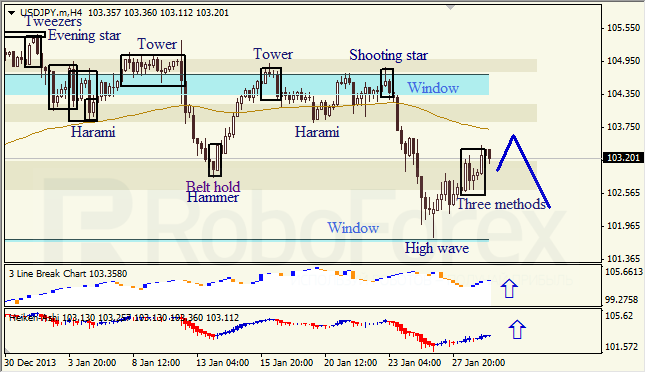
H4 chart of USD/JPY shows correction within descending trend. Lower Window is support level. Bullish Three Methods pattern, Three Line Break chart, and Heiken Ashi candlesticks confirm that ascending correction continues.

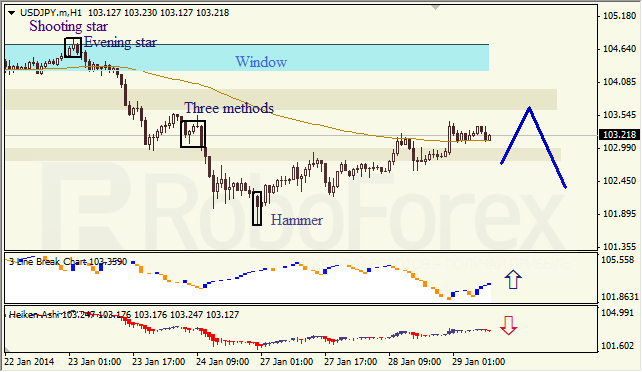
H1 chart of USD/JPY shows bullish tendency, which started after Hammer pattern. Three Line Break chart confirms ascending movement; Heiken Ashi candlesticks indicate bearish pullback.

RoboForex Analytical Department

Article By RoboForex.com

Attention!
Forecasts presented in this section only reflect the author’s private opinion and should not be considered as guidance for trading. RoboForex LP bears no responsibility for trading results based on trading recommendations described in these analytical reviews.


Oil Could Push Higher if Bullish Economic Growth Forecasts Ring True

By HY Markets Forex Blog

Crude oil trading could result in the price of the commodity experiencing substantial gains if the predictions of widespread economic growth provided by market participants end up having some accuracy.

The forecasts that have been made about how well global business conditions will fare in 2014 and after could play a key role in the performance of crude oil, as the expectations that investors have for the worldwide economy are a crucial contributor to the price of the commodity.

The global economy should expand more rapidly this year than it did in 2013, at least according to the most recent estimates released by the International Monetary Fund in the latest update to its World Economic Outlook.

IMF bolsters 2014 global growth estimate

The organization forecast that in 2014, gross domestic product will grow at a rate of 3.7 percent. This figure was 0.1 percent higher than the estimate that it provided in the prior update to the WEO, which was made in October. In addition, this pace will hasten slightly in 2015, reaching an annual rate of 3.9 percent.

While the financial institution increased its forecast for global growth, a recent poll conducted by Bloomberg revealed that the majority of participants believe that the global economic outlook is getting better. The survey, which involved close to 500 traders, investors and analysts who subscribe to the media outlet, revealed that 59 percent of participants had this optimistic view.

“Developed countries are playing by far the most important part of the recovery in confidence, in markets and in the economy,” Wilhelm Schroeder, who works in Munich as managing director of Schroeder Equities GmbH and contributed to the poll, told the news source. “Without doubt, confidence is the single most important determinant for growth.”

Growth forecasts increased for several nations

The IMF also increased its growth predictions for the economies of several nations, including that of the U.S., Reuters reported. The organization forecast that in 2014, the GDP of the world’s largest economy would grow at a rate of 2.8 percent.

Such growth would certainly represent an improvement, as the nation’s economy expanded at a 1.9 percent pace in 2013, according to figures provided in the IMF report. The document released by the organization noted that declining headwinds from fiscal policy, and the subsequent impact that this should have on domestic demand, will help speed up the U.S. recovery.

Conference Board provides encouraging data for U.S.

This prediction that the American economy will grow more quickly in 2014 is supported by a December measure of leading indicators for the North American nation, Bloomberg reported. Data provided by the Conference Board revealed that during the month, the organization’s outlook for the coming three-to-six month period was 0.1 percent higher than the most recent rendition.

“It’s still consistent with a stronger economy in 2014,” Scott Anderson, who works in San Francisco at Bank of the West as chief economist, stated before the report was released, according to the news source. “We expect a healthier consumer, better business spending and somewhat faster job growth.”

The perception that economic conditions are improving was also supported by the most recent jobless claims report, which was released on Jan. 23, and revealed that during the prior week, the number of people who filed initial applications for these benefits lingered close to its lowest in six weeks, according to the news source.

The labor market is seen by many as being a key indicator of the strength of the economy. The improvement in this crucial measure was noted by Jim Diffley, a senior director at IHS and also the lead author of a report on U.S. metropolitan areas that was recently released, according to USA Today. The document, which was generated by IHS Global Insight, forecast that in 2014, 356 of the 363 metropolitan areas will expand.

“We’re finally on an upward trajectory with good job growth,” Diffley told the media outlet. “The recovery has started to affect substantially everywhere.” He added that many regions will need to recover substantially to get back to the level they were at before the financial crisis. “Two thirds of metros have still not gotten back to 2007 or 2008 peak levels of employment, and half of those won’t get there for another three years,” Diffley told the news source. “Financial crises do not produce normal recessions in the U.S.”

Additional data provided by the Conference Board pointed to the U.S. economy being strong at the present time, according to Bloomberg. The December index of coincident indicators released by The Conference Board was 0.2 percent higher than during the month before.

“This latest report suggests steady growth this spring, but some uncertainties remain,” Ken Goldstein, who works for the Conference Board as an economist, said in a statement today, the media outlet reported. “Business caution and concern about unresolved federal budget battles persist, but the better-than-expected holiday season might point to

The post Oil Could Push Higher if Bullish Economic Growth Forecasts Ring True appeared first on | HY Markets Official blog.

Article provided by HY Markets Forex Blog

Gold Decline Shows Key Role of Fed Speculation

By HY Markets Forex Blog

Those who trade gold caused the price of the precious metal to decline on Jan. 27, and many market experts attributed this depreciation to speculation that the Federal Reserve would announce additional tapering of stimulus at the conclusion of its upcoming policy meeting scheduled for later in the week.

In addition, the resilient nature of the stock market was cited as helping to push the precious metal lower, Reuters reported. Equities have faced substantial headwinds so far this year, and their lack of performance has motivated many market participants to flock to gold. This situation of investors seeking the precious metal amid the poor results of stocks did not happen on Jan. 27.

Gold drops as equities rise

Spot gold rose to as much as $1,278.01 per ounce, according to the news source. This represented the highest value for the contract in two months. However, spot gold reversed direction after the S&P 500 Index managed to enjoy some gains, which represented a contrast to the sharp losses that the benchmark group of stocks suffered during the prior week.

This recovery was credited with drawing investors away from the precious metal, the media outlet reported. As a result of the strong performance of the index, spot gold erased the gains it had made earlier in the session, and was 1.2 percent lower at $1,253.69 an ounce by 3:35 p.m. EST (20:35 GMT).

April futures for the precious metal also declined, falling to as little as $1,257.20 per ounce on the Comex division of the New York Mercantile Exchange, according to Investing.com. The contract managed to recover from some of these losses, but was still down 0.1 percent at $1,263.20 per ounce.

Tapering speculation impacts metal

These contracts moved lower as those who trade gold speculated that when the Federal Open Market Committee concludes its meeting later in the week, the current pace of bond purchases will be reduced further, the media outlet reported.

The Fed purchased $85 billion worth of these debt-based securities every month starting in 2012. Then, at the conclusion of the central bank’s policy meeting in December, it was announced that starting in January, the financial institution would purchase $75 billion of these bonds per month.

The precious metal has been doing well so far this year, having reached a six-month low on Dec. 31, but there are concerns that it has become overvalued as a result of the appreciation that it has enjoyed in 2014, according to Bloomberg. If the Fed continues to gradually taper its bond purchases, this development could result in those who trade gold causing the precious metal to suffer further losses.

It is likely that the central bank will lower the monthly amount of debt-based securities that it buys by $10 billion at every one of the upcoming meetings of the FOMC, according to the median forecast of economists who took part in a Bloomberg poll. Regardless of what happens at the policy meeting, one analyst told the news source that he expects significant volatility from the precious metal in the near future.

“Those who worry about emerging markets want gold, and those who are optimistic about developed markets don’t want gold,” Xue Na, who works for Nanhua Futures Co. as an analyst at Nanhua Futures Co., told the media outlet. “We continue to expect price swings going into the FOMC meeting this week.”

Economic data and tapering

Whether the FOMC meeting results in further tapering of bond purchases relies largely on the strength of economic data, as the speculation that the Fed will soon opt to reduce QE further is based substantially on the robust nature of the reports that have been released, according to Investing.com.

However, some of the data that has been issued lately has drawn the strength of economic conditions into question, the media outlet reported. For example, a report released by the Census Bureau revealed lackluster home-buying activity in December. The activity fell short of the expectations of market experts. The data provided by the organization indicated that during the month, single-family home sales were made at a seasonally-adjusted annual rate of 414,000.

While this was well above the rate of 396,000 that happened in December 2012, it was far below the market prediction of homes being sold at an annual rate of 475,000 in the final month of 2013, according to the news source.

Another factor that could help to undermine confidence in the current U.S. recovery is the January jobs report, which will be released on Feb. 7, Brien Lundin, editor of Gold Newsletter, told MarketWatch.

The strength of the labor market is one key economic indicator that was noted by Ben Bernanke, chairman of the Fed, as having a crucial impact on the timeline that the central bank uses to taper stimulus. If the coming jobs report is lackluster, it could make the FOMC reluctant to further lower its bond purchases. Such a situation could motivate those who trade gold to push the precious metal higher.

The post Gold Decline Shows Key Role of Fed Speculation appeared first on | HY Markets Official blog.

Article provided by HY Markets Forex Blog

Forex Trading Causes AUD/USD to Recover From 3.5-Year Low

By HY Markets Forex Blog

Forex trading resulted in the AUD/USD recovering on Jan. 27, after it recently dropped to its lowest point in three-and-one-half years.

The currency pair managed to appreciate during the day, as the downward pressure on the Aussie – that was created by concerns about emerging markets – started to dissipate, according to Investing.com. The AUD/USD was valued at 0.8730. This represented a 0.55 percent gain for the day, and happened after the exchange rate for the pair fell to as little as 0.8659 on Friday, Dec. 24. This was the lowest value for the currency pair since July 2010.

AUD/USD encounters challenges

The Aussie managed to encounter some serious challenges late in the prior week, after data revealed that in January, Chinese manufacturing contracted by more than expected, the media outlet reported. This report was important to the value of the AUD/USD since China is the largest trading partner of Australia, and emerging market economies could face headwinds as a result of Chinese business conditions deteriorating.

The AUD/USD did well earlier last week, rising to 0.8850 on Jan. 22 as global market participants speculated that another interest rate cut from the Reserve Bank of Australia would be less likely to happen as a result of a sharp rise in inflation, according to Reuters.

In addition, since the state of the Aussie is expected to be largely dependent on the actions taken by the RBA, some believe that the emerging-market currency will continue to decline in value this year, the media outlet reported.

Fed tapering key to emerging-market currencies

The currencies of these fledgling nations could encounter additional headwinds based on how quickly the Federal Reserve opts to reduce its bond purchases. They have already been pushed lower in value as a result of the Federal Open Market Committee announcing in December that it would cut its stimulus, according to Investing.com. The pace of tapering that is used by the central bank to lower these transactions could have a significant impact on the value of the U.S. dollar.

The more bonds the Fed buys every month to stimulate the economy, the more rapidly the U.S. money supply will grow. This expansion of the amount of money in circulation could easily put downward pressure on the greenback. If the central bank moves to lower these purchases more quickly, it could help provide tailwinds to the U.S. dollar. This, in turn, could result in those who engage in forex trading pushing the AUD/USD higher.

The post Forex Trading Causes AUD/USD to Recover From 3.5-Year Low appeared first on | HY Markets Official blog.

Article provided by HY Markets Forex Blog

How Iceland Got it Half Right…

By MoneyMorning.com.au

Iceland isn’t famous for much.

It fought the ‘Cod Wars’ with Britain during the 1950′s and 1970′s, over, that’s it, fishing rights in the North Atlantic.

It’s the home of screechy singer Bjork.

And who can forget the eruption of Iceland’s Eyjafjallajökull volcano. It shut down Europe’s airspace in 2011 causing flight delays and cancellations for a week.

But Iceland is famous for something else. While governments and central banks around the world ran to prop up failing banks using taxpayer money, Iceland’s government did the unthinkable — it let its banks fail…

Now, you may think, ‘So what, it’s Iceland. Big deal.’

Remember, everything is relative. Sure, we’re not about to compare Iceland’s banking system with that of the US, Europe, or even Australia.

But for Iceland, the collapse of the banking system was a big deal in terms of the size of the banking system relative to the size of the economy. A report from Bloomberg News spells this out:

‘The island’s sudden economic meltdown in October 2008 made international headlines as a debt-fueled banking boom ended in a matter of weeks when funding markets froze. Policy makers overseeing the $14 billion economy refused to back the banks, which subsequently defaulted on $85 billion.’

What’s happened since then? It turns out Iceland’s economy is doing just fine. The unemployment rate in Iceland stands at just 4%. Compare that to many parts of Europe where the unemployment rate remains in the double digits.

Banks Fail, Life Goes On

Now, we won’t give Iceland a complete pass. Letting the banks fail was a great idea. What isn’t so great is the rest of the government’s plan. Again, Bloomberg News notes:

‘Of creditor claims against the banks, [Prime Minister] Gunnlaugsson says “this is not public debt and never will be.” He says his main goal while in office is “to rebuild the Icelandic welfare state.”‘

Yuk!

For ‘welfare state’ read ‘redistribution of wealth’. Although we guess a bunch of the people who benefited from the welfare handouts were taxpayers too. So in a way they simply got back some of the cash the government had taken from them in the first place.

And if we had to express a preference, we’d rather the cash went to Icelanders than to investors who deserved to lose money for taking part in a giant banking Ponzi scheme.

Even so, it still leaves us with somewhat of a bitter taste in our mouth. Especially when we read that Iceland’s policies have the full support Keynesian economist-in-chief, Paul Krugman.

But whatever you think of the fine details, the fact that Iceland let its banks collapse proves the deception of those in the US, Europe and Australia who claimed allowing banks to collapse would be catastrophic.

The opposite is true. Iceland now has the lowest unemployment rate in Europe, and a rate that’s even lower than Australia’s ‘miracle’ economy!

Mass Selling Creates Buying Opportunity

It’s a cast iron fact that markets (by markets we mean the free interaction of individuals just like you) will always come to a better solution on anything than a bureaucracy that always acts with a vested interest in mind.

This is what other Western nations should have done. If they had followed Iceland’s lead it’s more than likely that the ‘Crash of 2008′ would be a distant memory.

Everyone could have moved on with their lives. Those who wanted work would have work. Interest rates would be at a level determined by the market — high enough to encourage savers, but low enough to encourage borrowers.

The rates would fluctuate according to supply and demand, just as every other price fluctuates according to supply and demand.

Importantly, you wouldn’t have the constant ebb and flow of booming and busting markets. You wouldn’t have the paradox of bad economic news being good for the market and vice versa.

But, it is what it is. As we’ve explained for at least the past three years, it’s important for investors to acknowledge the situation and deal with it. There’s no point whinging about the manipulators. Make a note of it and then look for great investments that the market has unfairly beat into the ground.

One of those investments is the emerging markets investments we wrote to you about yesterday. Another is the resource sector — more on that later in the week.

The market is treating emerging market economies as though they are still economic backwaters full of good-for-nothing layabouts. The reality is far different.

Many — if not all — of the emerging market economies have an exciting story to tell and a promising future. And yet the markets are selling these economies in droves. And for what? That’s right, they’re after the safety of the US dollar.

To us this looks like a great opportunity to speculate on emerging markets and other beaten-down stories. In fact, we can’t think of too many other places where we’d rather put our money for a punt today.

Cheers,
Kris.

PS. Our old pal Nick Hubble likes the emerging markets story too. He has identified five ways to invest in some of the most exciting (and risky) of these opportunities. He calls these investment his ‘Tiger Cubs’ portfolio. Check out more here

Special Report: 2014 Predicted

Join Money Morning on Google+


By MoneyMorning.com.au

3 Front-Runners in the Global Shale Race

By MoneyMorning.com.au

The next stage of the shale boom is underway…overseas.

While US producers are going gangbusters — shale oil and gas production are way up year over year — the rest of the world is getting its collective act together.

Where’s the next Bakken or Eagle Ford? It’s time to think globally….

According to the US Energy Information Administration (EIA), the rest of the world is littered with ‘technically recoverable’ shale. Concentrating on shale gas, for many import-heavy countries there’s huge incentive to get production underway. After all, importing liquefied natural gas (LNG) from the Middle East or piping gas from the likes of Russia isn’t high on anyone’s list. It’s only a matter of time before swaths of the ‘trapped’ shale gas start making a mark.

How much gas is hiding underground? According to the US EIA, a lot!

Using the Advanced Resources International (ARI) estimate for US shale reserves, the US has 1.16 quadrillion (with a Q) cubic feet of recoverable resource. At current consumption levels that represents nearly 40 years’ worth of shale gas (not counting our remaining conventional resources.)

However that huge resource only represents 14% of the world’s recoverable shale gas. There are massive deposits located in China, Argentina, Algeria, Australia and Russia. The way I see it, it’s not ‘if’ this shale gas will be produced, but rather ‘when.’

Demand for clean-burning natural gas is one the rise. Indeed, when it comes to this abundant resource we’re quite literally talking about the energy of the future.

Asia, Europe, South America and even the Middle East are poised to ramp up natural gas demand. Besides being an abundant fuel of choice, natural gas is also much cleaner burning than coal. It’s only a matter of time before the climate-change crowd starts backing this bridge fossil fuel.

Add these two trends together (abundant underground supply, burgeoning demand) and you’ll see there’s a huge pressure gradient at work — that is, the incentive for countries outside of North America to develop shale is getting higher by the day.

The mainstream is starting to ramp up the coverage, too. This time last week, several stories hit the airwaves about some of the most promising non-US shale plays. Let’s separate the wheat from the chaff.

In no particular order Russia, China and the UK have the capability (and underground assets) to become the next game-changing shale players. Here’s why…

We’ll start with the most shocking front-runner: the UK.

‘Hey Matt, the UK isn’t even on the top 10 list for recoverable resources,’ you say. Well, that’s true! But, sometimes the demand/need for gas can boost an opportunity to the forefront. That’s precisely the case with the UK.

As it stands the United Kingdom is a net importer of natural gas, which has been the case for the past eight years or so. That said, the 26 trillion cubic feet (tcf) of recoverable gas that lays under the soil in Northern England could be a crucial part to balancing the nat gas trade deficit. When you do the math that 26 trillion — all else held equal — could make the UK “import free” for an additional 17 years.

And last week, the politicos showed their aggressive hand…

According to the Wall Street Journal, ‘U.K. Prime Minister David Cameron said on Monday that local authorities that allow shale-gas development to go ahead will be able to keep the entirety of business taxes they collect from shale gas sites, up from the current 50%. This commitment will be directly funded by the government, the prime minister’s office said in a statement.’

Tax benefits, to the tune of $2.8 million per well? That could get things kick-started in short order. Keep an eye out, here.

Next on the hit parade is a no-brainer in the case of future shale development, China.

As you can see on the table above, China is #1 or #2 on the list of recoverable shale reserves (depending on what estimate you use for the US). Either way, China is in the ‘quadrillion’ club, which means the natural gas under their soil is an absolute game changer.

What’s more, the gas isn’t in some far off ‘middle of nowhere’ deposit. As of the latest US EIA estimates, much of the gas lies in the Sichuan Basin, smack dab in the middle of the country.

Once China cracks the code on this massive shale find, you better believe producers, service companies and pipeline players are all going to play a role. With China’s net imports of natural gas skyrocketing in the past few — from a trade balance in 2006 to current net imports of nearly a trillion cubic feet — you better believe the Chinese will be making moves towards shale production.

The last country we’ll highlight shouldn’t come as a surprise, either. After all the Russians are just as strategic as the Chinese, and they’ve got plenty of shale gas to go around!

‘Russia alone has the technology, infrastructure, water and political will to be the next revolutionary shale venue — not to mention a lot of sparsely-populated space in which to drill without public backlash,’ Oil Price reports.

The other factor that will add to Russia’s soon-to-boom shale gas is the country’s abundant shale OIL reserves. With more shale oil production on the docket from the state-owned Rosneft, you can expect to see more “byproduct” shale gas production. A trend very similar to what we saw here in the US — with booming Eagle Ford oil, the natural gas started to flow as well.

Once an economic model is figured out, expect to see a blast of production from Russia.

There are several ‘runners up’ awards to hand out here, too…

Canada – The only reason I didn’t mention Canada in the top-3 was that the country already very closely resembles the US shale boom. Massive resources, established resource laws and an able and willing workforce make Canada the natural extension to what’s happening in the US. That said, the opportunities in the US are currently overshadowing any plays up north. Once we see a changing of the guard it’ll be time to take our greenbacks north!

Mexico – Above I asked where the next Bakken or Eagle Ford will be found. Well, clearly since the Eagle Ford formation runs past our southern border, the easy answer is Mexico! If Mexico’s plan to open its energy markets to outside investment holds true, it’s only a matter of time before the big players from the U.S. start jumping over the Rio Grande. When that happens, this black horse in the shale game will gallop ahead.

Argentina – Over the past five years Argentina went from being a natural gas exporter to a natural gas importer. You better believe that Argentina’s government wants nothing more than to tap the massive shale gas reserves hiding below much of the southern part of the country. Behind only China and the US, Argentina has massive recoverable resources, and upside in this shale game.

Australia – If it wasn’t for Australia’s conventional and offshore natural gas production I think the country would have much more incentive to crack the shale code beneath its resource-rich soil. Australia has the gas and the know-how, but unlike the US Australia is (and has been) a very strong exporter of natural gas. Keep an eye on this player, but wait for incentive or a mother lode-type deposit for this shale game to kick into high-gear.

Getting an outside opinion on the global shale race, our resident geologist, Byron King, has this to say:

‘In many other locales around the world, governments want to promote development, and especially repeat U.S. success in fracking. For example, there are large areas of Russia, China, the Middle East and Argentina that look promising in terms of geology and shale deposits, etc.

‘But “just” good geology is not enough. Outside of the US, most other nations lack the legal environment — let alone the oil service industry and equipment — to make fracking for shale oil and gas worth the cost.

‘Consider this metric. In 2012 in the US and Canada, the energy industry drilled over 6,000 wells for unconventional oil. Outside North America, fewer than 100 unconventional wells poked the earth in 2012. So the rest of the world has much catching up to do.

‘Indeed, the key behind the US’s success in shale was the free market, plain and simple.

‘Property rights, resource rights, transparency in the law, tax breaks for energy producers, lack of early government intervention, tons of private seed capital and a willing and able workforce. Without that, and bountiful underground assets, this boom wouldn’t been a bust.

‘Will other countries be able to replicate the exact same run? Of course not. But we’re in the early innings of the global shale gas game, and as the players take the field there will surely be some investable action.

Although the production numbers may not come fast and furious, there will be a lot of long-term opportunities flashing across our screen in the coming years. The global shale game is underway!

Keep your boots muddy,’

Matt Insley,
Contributing Editor, Money Morning

Ed Note: The above article was originally published in Tomorrow in Review.

Join Money Morning on Google+


By MoneyMorning.com.au

The Numbers Don’t Lie: Why the Industrial Minerals Sector Is Here to Stay

Source: Brian Sylvester of The Mining Report  (1/28/14)

http://www.theaureport.com/pub/na/the-numbers-dont-lie-why-the-industrial-minerals-sector-is-here-to-stay

There are two ways to visualize the critical metals and industrial minerals sector. Some see a hostile climate, where junior mining companies compete for scarce financing dollars. But there’s a sunnier side to this story: more than ever, companies, government and academia are forming partnerships to solve a global problem—the ongoing need for scarce critical materials. In this Mining Report interview, Luisa Moreno, industrial minerals analyst with Euro Pacific Capital, discusses the challenges and the prospects for players in a sector she insists is here to stay.

The Mining Report: Let’s start with some macro events in the rare earth elements (REE) space. The Wall Street Journal recently reported that Inner Mongolia Baotou Steel, the world’s largest REE supplier, bought nine regional REE mining companies in a move to consolidate China’s REE industry. The article called that consolidation a sign of market weakness. Do you agree?

Luisa Moreno: I don’t necessarily agree. China set a domestic REE production quota of about 90,000 tons in 2011, according to United States Geological Survey (USGS) Chinese production was about 120,000-130,000 tons per year, between 2006 and 2010. The production ceiling represents more than a 25% decrease in production from the world’s largest producer of REEs.

The move to consolidation in China has two aspects: First, China expects to control domestic output and prices through consolidation. Second, China wants to decrease the negative environmental impact of mining and processing. There are many artisanal miners in China across the different metals and minerals and in particular REEs. Many are working with toxic reagents and chemicals that when poorly handled and disposed off, have a very negative impact on the environment. I think consolidation is positive and bullish in the long-term for the mining space. When there is less production in China, it opens up opportunities for producers elsewhere.

TMR: A recent Euro Pacific Capital research report suggests REE demand will grow 6-10% annually through 2020. Is that enough growth to bring investment capital back into the sector?

LM: It should be. A 6–10% growth profile means that to meet demand, production should reach 175,000 tons to north of 200,000 tons by 2020. If China maintains its output at 90,000 tons, it will give new players the opportunity to come in and fill the gap.

I think that opportunity for new producers is tremendously bullish for the sector. It should attract investment capital once the capital markets understand and believe in this potential.

We may see signs of market improvement when prices stabilize or when prices of the less common REEs, like some of the heavy rare earth elements (HREEs) start increasing, as we believe they might. Rise in demand and prices over the next couple of months should give the capital markets confidence that this sector is here to stay.

TMR: Along those lines, a December 2013 Pentagon report suggested that U.S. reliance on Chinese rare earths is waning. That is a big change from a few years ago. What changed?

LM: Yes, the world’s reliance on Chinese REEs may be waning with the increase in production from a number of countries, including Molycorp Inc. (MCP:NYSE) in the U.S. and Lynas Corp. (LYC:ASX) in Australia, but China is still the largest producer (80–85%) and consumer, and still controls most of the supply (>95%) of HREEs. The Pentagon is likely dependent on a number of HREEs. It has been suggested that the Pentagon may be uncomfortable letting the rest of the world know that there are elements that are critical, that a shortage of these elements could affect them. It is likely that when REE prices were climbing in 2011, the Pentagon may have stockpiled at the time, like many other end-users. The Pentagon may have continued stockpiling when prices fell, to the point that it may be self-sufficient for a number of years, thanks to stockpiling, but we really don’t know.

The U.S. Department of Energy (DOE) has always sent a different message. It works with a different budget and its forecasts are usually very long-term, especially those related to the adoption of emerging energy technologies that are expected to support the America energy needs and economy. It has to be thinking about the available supply of elements in sustainable amounts for long periods of time.

TMR: Reports suggest that the Canadian government wants to control 20% of the global REE market by 2018. Is this political grandstanding or is there any substance to that idea?

LM: That idea emerged from a series of workshops put together by Natural Resources Canada (NRCan) over the last two years; I was fortunate to participate. These meetings brought together a number of industry players: junior companies in the Canadian REE space, end-users like General Electric Co. (GE:NYSE) and academics. They created what is called the Canadian Rare Earth Elements Network (C.R.E.E.N.). The objective is to bring the industry and academia together to fast-track solutions to the common challenges the industry is facing.

The guideline for reaching 20% of the global REE market came from C.R.E.E.N. The group met with Canada’s Minister of Natural Resources, Joe Oliver, to discuss the plan ahead and seek support. As you mentioned, reports out of Ottawa seem to suggest that there is significant interest on the part of the government to support the REE industry across the supply chain, which is promising.

TMR: What could that mean for Canada-based companies and their investors?

LM: If demand does increase 6–10% annually, there will be a need for additional REE production outside China. Canada has deposits with high percentages of the less common elements. It’s a unique opportunity for Canada to contribute to the global supply of HREEs in particular.

If everything goes according to plan, the miners, the end-users and the academics will be able to collaborate to fast-track solutions to some of the most pertinent issues, such as those related to chemical processing. Players like GE, Siemens and others can educate future producers as to their needs. REEs are not exactly commodities; they’re specialty materials. It is important for producers to understand how to customize the materials for different applications to properly accommodate end-users’ needs.

I think the industry is doing the right thing: coming together to solve the critical issues, and interacting with end-users to better understand the global market’s needs.

TMR: Has that changed your analysis or your outlook on some of the Canadian REE deposits?

LM: At first, there was a great deal of competition among junior mining companies, which is not totally unusual. By coming together and combining their technical resources, there is a real opportunity for the Canadian and international companies to solve some major issues. C.R.E.E.N. will also be looking at the impact that these processes might have on the environment and how to minimize that impact.

TMR: What are some companies with projects in Canada that you have Speculative Buy ratings on?

LM: I cover Matamec Explorations Inc. (MAT:TSX.V; MRHEF:OTCQX). We have a Speculative Buy recommendation for $0.22/share. Matamec is one of the most developed companies in the REE junior mining space. The company is developing the Kipawa deposit in Quebec, which contains the HREE-enriched eudialyte mineral. Matamec has completed its bankable feasibility study and is optimizing its flow sheet.

Matamec has a collaboration with Toyota Tsusho Group (TYHOF:OTCPK), a partner that is co-funding the development of the project and is providing technical support. Matamec expects to complete optimization in H1/14 and start working on the financing to build the mine and processing facilities.

Because this project reaches into the HREEs, it will give Toyota and potentially other end-users a supply of elements in addition to the light rare earth elements (LREEs). It should be noted that Molycorp and Lynas both produce predominantly LREEs, and do not refine individual HREEs.

TMR: Do you have other companies with Speculative Buy ratings that you would like to talk about?

LM: We cover Tasman Metals Ltd. (TSM:TSX.V; TAS:NYSE.MKT; TASXF:OTCPK; T61:FSE). Tasman operates in Sweden. We have a Speculative Buy recommendation and $1.70/share target price. Eudialyte is also the main mineral at its Norra Kärr deposit. If Matamec can develop an economic process, it will be highly positive for Tasman as well. Infrastructure around the Norra Kärr deposit is very good.

Tasman plans to merge with Flinders Resources Ltd. (FDR:TSX.V), a company with an advanced graphite project in Sweden. Tasman’s strategy is to become a diversified industrial minerals company. It already has a REE deposit and a tungsten deposit; it will have a graphite deposit after the merger. The stock performed well after the announcement of the merger negotiations.

TMR: Does the merger make Tasman more or less attractive to investors?

LM: More attractive—I think the stock’s good performance indicates that. It seems that the market sees a diversified portfolio of REEs, graphite and tungsten as a positive. A business combination with Flinders may be seen as a liquidity merger, as Flinders is relatively well cashed at the moment. The merger will strengthen the combined company’s balance sheet.

TMR: Is it likely that Tasman will be the name of the new entity?

LM: Yes. The surviving company is going to be Tasman. Flinders will cease to exist.

TMR: What else do you have a Speculative Buy rating on in the REE space?

LM: We have a Speculative Buy on Frontier Rare Earths Ltd. (FRO:TSX) at $1/share. The company has advanced the metallurgy at its Zandkopsdrift deposit in South Africa. The deposit is rich in monazite, a mineral that has been processed in the past to recover REEs, and thus the expectation is that there are less metallurgy challenges. Frontier is working on the prefeasibility study right now and has already issued a very comprehensive preliminary economic assessment (PEA).

It’s important to note that Frontier has KORES as a partner. Frontier and Matamec are the only companies in the REE space listed in Canada that have been able to secure strategic partners for project development.


TMR: We last spoke in detail about REEs nearly a year ago, in your April 2013 interview. Can you give us an update on some of the newsworthy events among the companies you talked about then?


LM: The financing market has been quite tough. As a result, a number of the junior mining companies, including those in the REE space, have slowed down their projects. Companies that had good cash positions were able to advance. Quest Rare Minerals Ltd. (QRM:TSX; QRM:NYSE.MKT) is an example. The company has completed a positive prefeasibility study, supported in part by the potential to recover a number of desirable byproducts, including zirconium and niobium.


Great Western Minerals Group Ltd. (GWG:TSX.V; GWMGF:OTCQX) also moved its project forward. The company started a metallurgy study after defining the resources in 2012. Earlier this month, Great Western announced that it had produced a rare earth carbonate product. The market reacted well to that. The company is moving with caution and minimizing expenses as much as possible, given that it has more than $90 million ($90M) in financial liabilities.


We also follow Northern Minerals Ltd. (NTU:ASX) in Australia. Its deposit contains xenotime, a rare mineral that is very high in HREEs, such as yttrium. Xenotime sometimes has as much as 90% HREEs. The company is continuing to define the resource. It has attracted a number of partners and investors, and has raised $30M in the last 12 months—which is positive, given the market conditions.


Namibia Rare Earths Inc. (NRE:TSX, NMREF:OTCQX)also has a xenotime deposit under development. Namibia’s Lofdal REE project is also attractive, as it has the potential to produce large amounts of these less common elements.


TMR: Commerce Resources Corp. (CCE:TSX.V; D7H:FSE; CMRZF:OTCQX) recently put out numbers on its total rare earth oxide concentrate and recovery of REEs on its Ashram REE deposit. What did you make of those results?


LM: I think they’re very positive. Being able to produce a mineral concentrate 43.6% TREO usually means using less reagents in the next processing step. That accomplishment is very positive, but it is not enough, on its own, to reach conclusions as to the economics of the whole project. The next step is to produce, for instance, a mixed REE carbonate product. Individual REEs may then be recovered in a separation plant (e.g. by solvent extraction). I noticed that in the production of the mineral concentrate, Commerce introduced what is described as a weak HCl step after floatation and before the magnetic separation. We don’t yet know the cost benefit of using a leaching step before magnetic separation. I am sure we will learn more when the new economic study results are released, giving investors a better idea of the economics of Commerce’s Ashram project. It seems that the company is happy about the project’s metallurgical improvements and the impact on operating and capital costs, which is encouraging.


TMR: Is there any news of a strategic partner for Commerce?


LM: I think the company is actively looking. I think there is less worry now than in early 2011, when many end-users thought China was going to further decrease exports. As demand increases and prices start to rise, end-users will start reconsidering their options and might be more willing to collaborate again. I expect that to happen between now and 2020.


TMR: Another noteworthy merger is Canada Lithium Corp.’s (CLQ:TSX; CLQMF:OTCQX) takeover ofSirocco Mining Inc. (SIM:TSX), which means Canada Lithium will become a supplier of both lithium and iodine. Are these mergers simply a result of market forces or is there a deeper theme at play?


LM: I think there is a combination of factors behind these mergers. When well cashed mining management teams look at the market, they may find interesting projects. Current valuations are attractive and it is a good opportunity to start consolidating some of these industrial mineral companies.


Sirocco, perhaps more so than Canada Lithium, might have seen that opportunity as well. Some have suggested that this business combination is almost a reverse takeover. The surviving company is indeed Canada Lithium, but the surviving management team is from Sirocco. Sirocco’s CEO, Richard Clark, will replace Peter Secker as CEO of Canada Lithium. Sirocco’s CFO will be CFO of Canada Lithium. The Sirocco team has a strong connection with Lundin Mining Corp. (LUN:TSX), and the company is partially owned by the Lundin Group.


From what we understand, this could be a vehicle for the Sirocco management team to consolidate projects in the industrial or energy minerals space. It already has the iodine; it has the lithium. We believe management may be looking to attract other projects, such as graphite, vanadium, manganese, you name it. That may be the theme for this management team. By the way, the new proposed name for Canada Lithium upon completion of the merger will be RB Energy Inc. (or Énergie RB Inc.in French).


TMR: Could you give us an overview of the lithium market in 2014?


LM: I think the market for lithium in 2014 will be very positive. Tesla recently announced that Q4/13 sales of its Model S electric cars were 20% higher than expected.


This month, the World Bank increased its estimates for global economic growth, particularly for developed countries. We might see that also reflected in an increase in demand for electric cars, tablets, cell phones—all powered by lithium. I think there will be increased demand for lithium, and potentially higher prices.


TMR: What amount of growth do you expect?


LM: Our base-case forecast is for an average of 5% demand growth per year until 2020.


TMR: What lithium companies do you cover with Speculative Buy ratings?


LM: We really like the to-be-formed RB Energy, meaning Canada Lithium, most of the revenues will still come from lithium.


We also like Nemaska Lithium Inc. (NMX:TSX.V; NMKEF:OTCQX). It has a good-sized, high-grade deposit in Québec. The company is working on its feasibility study and is looking to raise funds to build the first module commercial plant. Nemaska has an agreement with Phostech Lithium (private), which will take 100% of the production from its first plant. Sichuan Tianqi Lithium Industries Inc. (002466:Shenzhen), the leading Chinese lithium company, owns 16% of Nemaska shares.


Nemaska is targeting the hydroxide market, rather than the carbonated market that Canada Lithium is in. Lithium hydroxide sells at higher price than lithium carbonated. This story has great potential.


TMR: Do you have any parting thoughts on the industrial metals space?


LM: Demand for industrial minerals is returning. Demand for many of these minerals is connected to demand for emerging technologies and electronic devices, including health care and biotech devices. For instance, some industry estimates show that demand for smart devices will increase 7–8% in developed markets, and 17% in emerging markets between 2012 and 2017. If these sectors continue to perform as expected, the demand for key industrial minerals should follow.


We haven’t yet seen a comeback in prices, but as end-users deplete the stockpiles they built up in 2011, they will return to the market. As demand rises, we anticipate prices will go up. We anticipate this will send a positive signal to the capital markets and have a positive impact on junior mining companies, some of which are close to production. Just as importantly, it may support the many companies that are struggling with financing to advance to production.


TMR: Luisa, thanks for your time and your insights.


LM: My pleasure.


Luisa Moreno is a mining and metals analyst. She covers industry metals with a major focus on electric and energy metal companies. She has been a guest speaker on television and at international conferences. Luisa has published reports on rare earths and other critical metals and has been quoted in newspapers and industry blogs. She holds a bachelor’s and master’s in physics engineering as well as a Ph.D. in materials and mechanics from Imperial College, London.


Want to read more Mining Report interviews like this? Sign up for our free e-newsletter, and you’ll learn when new articles have been published. To see a list of recent interviews with industry analysts and commentators, visit our Streetwise Interviews page.


DISCLOSURE:
1) Brian Sylvester conducted this interview for The Mining Report and provides services to The Mining Report as an independent contractor. He or his family own shares of the following companies mentioned in this interview: None.
2) The following companies mentioned in the interview are sponsors of The Mining Report: Namibia Rare Earths Inc., Tasman Metals Ltd. and Commerce Resources Corp. Streetwise Reports does not accept stock in exchange for its services or as sponsorship payment.
3) Luisa Moreno: I or my family own shares of the following companies mentioned in this interview: None. I personally am or my family is paid by the following companies mentioned in this interview: None. My company has a financial relationship with the following companies mentioned in this interview: None. I was not paid by Streetwise Reports for participating in this interview. Comments and opinions expressed are my own comments and opinions. I had the opportunity to review the interview for accuracy as of the date of the interview and am responsible for the content of the interview.
4) Interviews are edited for clarity. Streetwise Reports does not make editorial comments or change experts’ statements without their consent.
5) The interview does not constitute investment advice. Each reader is encouraged to consult with his or her individual financial professional and any action a reader takes as a result of information presented here is his or her own responsibility. By opening this page, each reader accepts and agrees to Streetwise Reports’ terms of use and full legal disclaimer.
6) From time to time, Streetwise Reports LLC and its directors, officers, employees or members of their families, as well as persons interviewed for articles and interviews on the site, may have a long or short position in securities mentioned and may make purchases and/or sales of those securities in the open market or otherwise.


Streetwise – The Gold Report is Copyright © 2014 by Streetwise Reports LLC. All rights are reserved. Streetwise Reports LLC hereby grants an unrestricted license to use or disseminate this copyrighted material (i) only in whole (and always including this disclaimer), but (ii) never in part.


Streetwise Reports LLC does not guarantee the accuracy or thoroughness of the information reported.


Streetwise Reports LLC receives a fee from companies that are listed on the home page in the In This Issue section. Their sponsor pages may be considered advertising for the purposes of 18 U.S.C. 1734.


Participating companies provide the logos used in The Gold Report. These logos are trademarks and are the property of the individual companies.


101 Second St., Suite 110
Petaluma, CA 94952

Tel.: (707) 981-8999
Fax: (707) 981-8998
Email: [email protected]



USDCAD: Bullish, Tests Key Resistance.

USDCAD: With the pair ending its one–day weakness and strengthening for two days in a role, further bullish offensive is envisaged. However, it will have to break and hold above the 1.1172 level, its Jan 23’2014 high to trigger that trend. A turn above here will activate additional strength towards the 1.1200 level where a breach if seen will set off further gain towards the 1.1250 level. Further out, resistance comes in at the 1.1300 level followed by the 1.1350 level and subsequently the 1.1400 level. Its daily RSI is bullish and pointing higher suggesting further strength. On the other hand, support comes in at the 1.1116 level where a violation will aim at the 1.1050 level. Further down, support lies at the 1.1000 level and followed by the 1.0950 level and then the 1.0900 level, its psycho level. All in all, USDCAD continues to face further upside threats in the long term.

Article by fxtechstrategy.com


Will Facebook have the same fate as Apple?

Article by Investazor.com

Yesterday, I was expecting Apple to show some good earnings report and to put on a stellar performance, surging towards $588 in two days. An EPS better than expected didn’t matter as the revenue forecast for the second, $42-44 billion, fell short to the market expectation of $46 billion and the shares took a dive and reached $505 in after-market trading hours.

facebook-stats-28.01.2014

Today we have the social media giant, Facebook, ready to post its earnings report and the question is what should we look at? Definitely, revenues is the key word and for the 4Q 2013 period they are forecast to come in at $2.34 billion, an increase of about 47% over the year-ago period. Another key metric is represented by the mobile market as Facebook is one of the big names along Google and Twitter on this market. Mobile MAUs (monthly active users) are seen jumping from 874 mln last quarter to 928 mln.

facebook-chart-resize-28.01.2014

From a technical perspective, Facebook managed to make a new high around $58 after it completed a falling wedge pattern. The new high plays the role of a resistance line and it has been tested several times. The shares are 8% below the recent 52-week high, and up 75% over the past year, so the expectations for Facebook are pretty high coming into this quarter’s earnings release. So, if the Apple situation repeats, we can see a drop in Facebook shares price around 61.8 Fibonacci level at $49.22 and on the other hand, a pleasant surprise could be the trigger for setting a new high around the psychological level at $60.

The post Will Facebook have the same fate as Apple? appeared first on investazor.com.