Things That Make You Go Hmmm: Behold, Politics

By Grant Williams – Things That Make You Go Hmmm: Behold, Politics

Gibraltar is a British Overseas Territory.Description: ibraltar.psd

It has an area of 2.6 square miles and juts from the southern tip of the Iberian Peninsula, overlooking the entrance to the Mediterranean Sea. Roughly 30,000 people live in the territory, whose sole distinguishing feature is the very large rock which runs along the eastern edge of the territory and culminates in a dramatic promontory in the northeastern corner.

That’s it there, on the right … see?

Gibraltar was captured by an Anglo-Dutch force in 1704 during the War of the Spanish Succession, in which European countries fought each other over who had the right to succeed King Charles II as ruler of Spain.

Charles (or Carlos) had died without heirs, bringing to its final extinction the mighty House of Habsburg, which had dominated European royalty for three centuries. In his will, Charles had designated his 16-year-old grandnephew Philip, Duke of Anjou, as his successor.

Philip was the grandson of the reigning French king, Louis XIV, the famous “Sun King”; and the prospect of an early 18th-century Franco-Spanish alliance at the heart of Europe was unnerving to others, who saw it as potentially destabilizing the delicate balance of power; and so, as Europeans tended to do in the days before they got around to creating the EU, they opted to fight a war.

This war turned out to be quite the bar brawl, spilling out of Spain and into Germany, the Netherlands, and, somehow, America, as the French and the English fought each other in Florida, New England, Newfoundland (huh?), and Carolina.

(Thankfully, the prospect of an Hollande/Rajoy alliance at the heart of today’s Europe would provoke nothing more than uncontrollable laughter, so Europe is far safer now; but then it was a different world.)

Anyhoo, as part of the Treaty of Utrecht, which ended the Spanish War of Succession in 1713, Spain got a French king after all (Philip V), but he was required to relinquish all future claims by his family on the French throne; various French princelings were forced to give up all present and future claims to the Spanish throne; Savoy was given Sicily; Charles VI of Austria received the Spanish Netherlands, Naples, Sardinia, and most of Milan; Portugal was handed a chunk of the Amazon rainforest … and Great Britain got Gibraltar.

Big whoop!

Personally, if I’d been negotiating the deal, I’d have stuck it out for Naples, Sardinia, and Milan, but … whatever. Gibraltar was better than nothing. Probably.

Funnily enough, as the years have passed, the Spanish have from time to time reasserted their claims to the rocky promontory that juts out from mainland Spain, 80-odd miles southwest of another town annexed (albeitUNofficially) by the British — Marbella. And who can blame them?

Gibraltar is to Spain as Cape Cod is to Massachusetts or Baja is to California — only with more monkeys.

Referenda proposing a return to Spanish sovereignty were held in Gibraltar in 1967 and 2002, and one would have to say that the results could certainly be classified as “conclusive.”

The 1967 referendum on whether to pass under Spanish Sovereignty or remain part of Great Britain left little room for doubt:

Choice

Votes

%

British Sovereignty

12,138

99.64

Spanish Sovereignty

44

0.36

Invalid/Blank Votes

55

Total

12,237

100

Registered Voters/Turnout

12,672

95.67

Thirty-five years later, the 2002 referendum, which asked “Do you approve of the principle that Britain and Spain should share sovereignty over Gibraltar?” was equally one-sided:

Choice

Votes

%

No

17,900

98.48

Yes

187

1.03

Valid Votes

18,087

99.51

Invalid/Blank Votes

89

0.49

Total

18,176

100

Voter Turnout

87.9

Electorate

20,678

Whatever your view on the Gibraltar issue (assuming you can be bothered to have one), it’s pretty hard to argue with 98.48% of the voters in a (supposed) democracy; but with things in Spain being quite tight and Catalonia looking to become a new Gibraltar all of its own, the Rajoy government clearly felt that a little distraction was in order; and so “tensions” in the Strait have escalated in recent months, with Spanish-imposed delays at border crossings that would make Chris Christie’s staff salivate (no need for subterfuge HERE). And, of course, in response quite by coincidence, there have been the requisite “naval exercises” conducted by the British Royal Navy off the coast of “The Rock.”

In early January, however, after the mood had darkened considerably over waiting times to cross the border between the Territory and the Mainland having stretched to four hours (Fort Lee residents, the people of Gibraltar feel your pain), another amazing coincidence occurred when certain diplomatic documents relating to discussions on Gibraltar were declassified by the British Foreign Office. Within these documents detailing exchanges between King Juan Carlos of Spain and the then-British Ambassador to Madrid, Sir Richard Parsons (no relation to Nicholas), was a revelation:

(UK Daily Telegraph): King Juan Carlos of Spain told Britain that Spain “did not really want” Gibraltar back as it would lead to claims from Morocco for Spanish territories in North Africa, newly declassified documents from the 1980s released by the Foreign Office reveal.

The King of Spain admitted privately in a meeting with the then British ambassador to Madrid, Sir Richard Parsons, that it was “not in Spain’s interest to recover Gibraltar in the near future.”

If it did so, “King Hassan would immediately reactivate the Moroccan claim to Ceuta and Melilla,” the monarch, who celebrated his 76th birthday on Sunday, reportedly said during the meeting in Madrid in July 1983.

Fascinating stuff, but that’s not the passage that contains the revelation.

This is:

In a confidential dispatch from Madrid to Geoffrey Howe, the then Foreign Secretary, Ambassador Parsons wrote: “The King emphasised, as he had done with me before, that that requirement was to take some step over Gibraltar which would keep public opinion quiet for the time being.

“It should be clearly understood in private by both governments that in fact Spain did not really seek an early solution to the sovereignty problem.

“If [Spain] recovered Gibraltar, King Hassan of Morocco would immediately activate his claim to Ceuta and Melilla.

“The two foreign ministers should reach a private understanding between each other, differentiating between their actual aim and the methods used to propitiate public opinion on both sides.”

Did you spot it? No?

Well here it is again in slow motion:

“T h e t w o f o r e i g n m i n i s t e r s s h o u l d r e a c h a p r i v a t e
u n d e r s t a n d i n g b e t w e e n e a c h o t h e r, d i f f e r e n t i a t i n g
b e t w e e n t h e i r a c t u a l a i m a n d t h e m e t h o d s u s e d t o
p r o p i t i a t e p u b l i c o p i n i o n o n b o t h s i d e s.”

… and here’s the super-slo-mo close-up frame (if you have 3D glasses, put them on now):

“… P R O P I T I A T E P U B L I C O P I N I O N …”

Let’s go to the dictionary:

pro·pi·ti·ate transitive verb \prō-pi-shē-āt\ :
to make (someone) pleased or less angry by giving or saying something desired

Behold, politics.

To continue reading this article from Things That Make You Go Hmmm… – a free weekly newsletter by Grant Williams, a highly respected financial expert and current portfolio and strategy advisor at Vulpes Investment Management in Singapore – please click here.


India raises rate 25 bps, does not expect further tightening

By CentralBankNews.info
   India’s central bank raised its policy rate by 25 basis points to 8.0 percent, its third rate rise since September 2013, but said it did not expect to tighten its policy further in the near term as long as inflation evolves as expected.
    The Reserve Bank of India (RBI), which last month said it was poised to raise rates if inflation didn’t decline, acknowledged that wholesale price inflation had fallen significantly in December due to lower vegetable prices but excluding food and fuel inflation had risen.
    It is the second month in a row that the RBI has surprised financial markets. Economists had expected the RBI to maintain rates today given the drop in wholesale price inflation to 6.16 percent in December from 7.52 percent the previous month. The decision to maintain rates in December also took markets by surprise as November inflation had risen and the RBI was expected to raise rates.
    But the RBI has now adopted consumer prices instead of wholesale prices as its main inflation gauge, following a recommendation last week by a committee chaired by Urjit Patel.
    The committee recommended that the RBI should set an objective of CPI inflation below 8 percent by January 2015 and below 6 percent by January 2016. In the long term, the committee recommended an inflation target of 4 percent, plus/minus 2 percentage points.
    In December India’s CPI inflation fell to 9.87 percent from November’s 11.16 percent and the RBI said the projections “indicate that over the ensuing 12-month horizon, and with the current policy stance, there are upside risks to the central forecast of 8 percent.”
    “An increase in the policy rate will not only be consistent with the guidance given in the mid-quarter review but also will set the economy securely on the recommended disinflationary path,” the RBI said.
    It added that the “extend and direction of further policy steps will be data dependent, though if the disinflationary process evolves according to this baseline projection, further policy tightening in the near term is not anticipated at this juncture.”
    In its accompanying report on economic developments, the RBI said CPI inflation is expected to remain above 9 percent in the fourth quarter of the fiscal year 2013-14, which ends March 31, and range between 7.5 and 8.5 percent in the fourth quarter of FY 2014-15, with the balance of risks tilted to the upside.
    If the RBI is succeeds in reducing inflation to its target, India’s economic growth is expected to improve to around 5.5 percent in FY 2014-15, which begins on April 1, compared with a little below 5 percent for the current 2013-14 year.
    “A pick-up in investment in an environment in which external demand continues to be supportive of export performance could impact an upside to this forecast,” the RBI said.
    India’s Gross Domestic Product expanded by an annual 4.8 percent in the third calendar quarter, up from 4.4 percent in the second quarter.
    The RBI expects some loss of growth momentum in the October-December quarter with industrial activity still contracting, weaker consumer demand and lackluster capital goods production due to stalled investment demand. Fiscal tightening is also likely to exacerbate the weak demand.
    But although the global recovery is gaining traction that will help boost demand, the RBI said “uncertainty continues to surround the prospects for some emerging economies, with domestic fragilities getting accentuated. Financial market contagion is a clear potential risk.”
    India’s trade deficit for the first nine months of fiscal 2013-14 has shrunk by 25 percent from its level last year and the current account deficit for 2013-14 is expected to be below 2.5 percent of GDP compared with a deficit of 4.8 percent in 2012-13.
    “The recent resumption of portfolio flows, both equity and debt alongside the pick-up in FDI and external commercial borrowings that is underway should help finance the currency account deficit comfortably,” the RBI said.
    In its third quarter review, the RBI did not make any comments about the rupee.
    The rupee weakened sharply from May through August, along with many other emerging market currencies, before bouncing back in September. 
    Since then it has been largely stable until last week when concern over China triggered weakness in many emerging market currencies and the rupee again fell. Earlier today the rupee was trading at 63.07 to the U.S. dollar, down 1.8 percent since last Monday. Compared with the end of 2012, the rupee has lost 13 percent.
    While the RBI raised its policy rate, it held the cash reserve ratio (CRR) steady at 4.0 percent. But in line with the rise in the policy rate, the marginal standing facility rate and the Bank Rate were raised by 25 basis points to 9.0 percent and the reverse repo rate is now at 7.0 percent.
    In its economic report, the RBI also said there were foreign disinvestments of over US$13.4 billion ($10.5 billion in debt and $2.8 billion in equity) from the first sign of tapering of asset purchases by the U.S. Federal Reserve and Sept. 3, with the rupee depreciating by 17 percent and foreign exchange reserves depleting by nearly $17 billion.
    But since then, the rupee has appreciated by 6.7 percent, the loss of reserves has been more than fully recouped and capital flows have resumed, with net investment of $9.1 billion in equities from Sept. 3 to Jan. 24, and debt flows have turned positive, with net investments of $3.8 billion.

    http://ift.tt/1iP0FNb

Stock Market’s “Mustache Effect” Claims Its Latest Victim

By WallStreetDaily.com 01.27.2014 Mustache

You know that mustache you grew to raise awareness for prostate cancer as part of the “Movember” movement? Well, it just crushed Procter & Gamble’s (PG) business.

At least, that’s what the executives want us to believe.

Last Friday, Chief Financial Officer, Jon Moeller, tried to pin the company’s disappointing results for its grooming business on the fact that four million men ditched shaving for a month.

Puh-lease!

What’s next, Jon, the dog ate your homework?

I don’t expect this to be the last excuse offered up on an earnings call, either.

Thanks to the record cold temperatures that much of the country has been enduring for a solid month, I’m sure that the weather will get blamed a few times, too.

Why bring any of this up?

Because we’re about to get bombarded with earnings. This week alone, over 225 companies are scheduled to report results.

While I want you to be on the lookout for the most laughable excuses (please submit your candidates for consideration here), I also want to make sure that you understand why individual earnings reports are more important than they’ve ever been this entire bull market.

In the process, I promise to share one corner of the market that’s poised for outsized gains. Even if the broader market continues to stumble. So let’s get to it…

A Stock Picker’s Market

When it comes to discerning the future direction for the stock market, I typically tell you to focus on the averages. Specifically, the average percentage of companies that beat earnings expectations.

The higher, the better. After all, stock prices ultimately follow earnings.

So far, so good…

As Bespoke Investment Group notes, 64% of companies have beat expectations this quarter, which puts us on pace for the best quarter in nearly three years.

Under normal circumstances, I’d be ecstatic about the early reading. Not this time around, though. And that’s simply because the averages don’t matter this quarter.

As Chris Verrone at Strategas Research Partners notes, correlations among S&P 500 stocks rest at their lowest level in over a year.

That means stocks aren’t moving in unison anymore. Instead, companies are going to rise or fall on the merits of their individual fundamentals.

Or, more simply, we’re in a stock picker’s market. And we need to make sure we pick wisely.

You see, companies missing expectations are getting throttled, dropping an average of almost 4% on their report days.

Big misses, like Sallie Mae’s (SLM), are prompting double-digit selloffs.

Meanwhile, companies reporting better-than-expected results are responding to the upside. Like server technology company, Super Micro Computer, Inc. (SMCI).

Not only did it beat earnings expectations by tripling profits in the last quarter, it raised expectations for the next quarter. Shares jumped more than 24% on the news. And therein lies the opportunity for us…

Keep Betting on Tech

As investors scrutinize individual company results, earnings season is yielding clear-cut losers and winners. In such an environment, we need to tip the odds in our favor by focusing on the corner of the market with the highest probability of winners.

And that distinction belongs solely to the technology sector.

There’s no arguing with the data…

According to FactSet, a chart-topping 85% of technology companies have reported better-than-expected earnings and sales this quarter.

Not only that, but the technology sector is reporting the largest increase in earnings growth out of any sectors.

Bottom line: In this jittery and excuse-laden market, companies in the technology sector keep putting up impressive profit growth. That should translate into big profits for investors, too. So keep betting big on tech.

Ahead of the tape,

Louis Basenese

The post Stock Market’s “Mustache Effect” Claims Its Latest Victim appeared first on Wall Street Daily.

Article By WallStreetDaily.com

Original Article: Stock Market’s “Mustache Effect” Claims Its Latest Victim

Saxo Bank Unveils TradingFloor – The Innovative New Social Trading Portal

SaxoBank Launches New Social Trading Platform

On Thursday January 23rd, Saxo Bank, the award-winning online trading specialist, announced the beta-launch of TradingFloor.com, the first multi-asset social trading portal which will attract both expert traders and first-time investors.

The new site will integrate social media with the financial industry, building an online community of traders and facilitating a stream of quality content centered on Saxo’s multi-asset capabilities. The launch will revolutionize investment and promotes an innovative social element which connects like-minded traders online.

To mark the launch, Saxo hosted a global press conference on Thursday 23rd at Saxo Bank HQ, Copenhagen, with attendance from international journalists representing worldwide news agencies spanning seven different countries, including the BBC and Denmark’s Børsen. The announcement was followed by a live demonstration of TradingFloor to reveal the platform’s main features. This innovative release will signal new ground for investors, transforming trading into a social experience.

Saxo’s mission is to evolve TradingFloor, remodelling the service to become the definitive social trading market. By combining social features with Saxo’s leading trading platform, traders will be able to interact online with experienced investors, participating anonymously or sharing activity openly. Either way, the TradingFloor portal exclusively features full trading accounts to ensure a communal social trading base of serious investors. Social trading is a product which encourages idea sharing and intelligent interaction, and the new dashboard compares performance data with other investors in the #socialtrading community, meaning inexperienced traders can learn from big players.

This launch reinforces Saxo Bank’s status as the foremost online trading platform, with TradingFloor offering a unique blend of Community, Content and Trading. Trading strategies can be shared, comments can be posted, and performances can be evaluated. For the first time, a social trading portal will make sense of the relentless flow of social media insights, filtering pertinent trading analysis while assembling an audience from which it will be possible to draw inspiration and collect relevant data. TradingFloor will be the most sophisticated social trading hub online, building a forum in which investors can take advantage of Saxo’s multi-product offering.

Traders can circulate trading perspectives online and contribute to a real-time current of transient market sentiments. Performance data is evaluated, analysed and verified, developing a reliable compilation of practical information across all asset classes applicable to trading and fund management. Expert investors can streamline trading strategies to share with peers, while novice traders will access a ground-breaking social platform that promotes engagement and provides a foundation on which active trading talent can excel.

Major features will be announced over the coming months and, throughout 2014, Saxo will unveil several more language sites for the new TradingFloor. Fully functional sites in Russian, French, Spanish and German will become active and each language roll-out will signify a milestone in social trading. TradingFloor will change the way investors approach fund management, across all branches of trading: FX, options, futures, CFDs, bonds and equities.

In order to take full advantage of the social trading features, users can maximise the service by registering for an account. Non-account holders will still be able to access the online community, but Saxo recommends a full account to benefit from their valuable digital resources and rich spread of content, including up-to-date market news and data from Saxo’s own research teams and industry experts.

TradingFloor will grow as an agile industry player, penetrating online social space and assimilating fund management with social media. As a beta launch, Saxo Bank awaits feedback from the trading community when revealing exciting new features and upgrades over the next year.

Visit the New Social Network here.


Things That Make You Go Hmmm: That Was The Weak That Worked: Part 3

By Grant Williams


“What a year this has been for gold. 

“The price of the yellow metal fell almost 30% from its peak at the end of August a year earlier, to bombed-out lows amidst a wall of selling which included several very sharp and somewhat counterintuitive selloffs, including violent plunges in both the April-May time frame and again into year-end.

“Throughout the year, the spectre of manipulation was never far from the minds of all those involved in the gold market, whether they were crying ‘foul’ or asserting that, of course, there was no manipulation whatsoever and that those who suggested there might be were nothing more than conspiracy theorists, kooks, and whackos.

“The main suspects at the heart of the conspiracy theories were, naturally, the bullion banks and the central banks.

“The bullion banks, of course, have the eternal motive: profit; but what possible reason could central banks have for suppressing the price? None whatsoever, of course. The gold market is too small and too inconsequential for them to take an interest.

“And yet, rumours abounded that the bullion banks were in dire trouble and that a rising gold price could send one or more of them over the edge and into insolvency as a scramble for physical metal exposed massive short positions that had grown out of a fractional-reserve-based lending system backed (if not explicitly, then certainly complicitly) by central banks…”

2379.png

Now THAT, you may well have thought, was the heart-racking, pulse-pounding introduction to my year-end look at the gold market. No preamble, no carefully constructed narrative to entice you into my latest little web, just BOOM! Straight into it.

And every word of the above makes sense based upon what we’ve seen happen in the past twelve months in the topsy-turvy world of element 79, which holds down the spot in the periodic table just after platinum and just before mercury.

But of course, nothing is what it seems when we are discussing gold.

That quotation at the top is the intro to the year-end review of gold that I would have written in 1999 … had I been doing such things back then.

2013 was, in many ways, a case of been there, done that; and to understand what is happening today, it is extremely instructive to go back to 1999 and reexamine some very strange goings-on at the UK Treasury, AIG, Rothschild, Goldman Sachs, and Number 11 Downing Street.

(Cue dreamy harp music.)

The chart of the gold price between February 1996 and August 1999 will look eerily familiar to anybody who follows the gold market closely; and for those who don’t, just stick around and I’ll show you what you’ve been missing.

2394.png

Source: Bloomberg

After a run-up to a spike-high of $415.50 on February 2, 1996, gold began to fall. It fell fairly quickly at first, losing 3% in six trading sessions; and then the decline steadied for a while but remained consistent — until, around the end of the calendar year, gold suddenly and inexplicably spiked straight down. By the end of 1996, it had lost 11% of its value.

As 1996 turned into 1997 the price continued to fall; and the new year saw several inexplicable downdrafts of considerable size and alarming speed which, by the time the dust had settled at midnight on December 31st, 1997, had cut the value of an ounce of gold by almost a quarter.

Gold market watchers were baffled at the continued weakness in their beloved metal. They bemoaned their bad fortune and pleaded with the gods above, but neither activity made any difference — the price continued to fall. (Sound familiar?)

1998 was a fairly stable year, with the price moving little from January to December (though again, during the year there were several large falls in price that were hard to account for); and as the world entered the last year of the millennium, there was an air of stability around gold that gave hope to those battered by the consistent weakness in the gold price.

(To reiterate, I am talking about the late 1990s here, NOT the last couple of years — just in case there was any confusion.)

On the last day of 1998, gold closed at $288.25, down from $415.50 on February 2, 1996 — a fall of over 30% in three years.

You … yes, you with the glasses at the back…

(muffled question)

No, there is very little similarity to the 37% decline in the gold price from the August 2011 high to the close on December 31, 2013.

(muffled question)

What do I MEAN? Well, obviously, any similarity is completely coincidental because there were a number of strange things happening and rumours swirling back in 1998 about bullion banks being short gold in quantities that posed a risk to them and, of course, to “the system” — whatever THAT means — so those were once in a lifetime circumstances.

(muffled retort)

Well, yes, I suppose, now that you mention THAT, there MAY be some purely coincidental similarities between the two periods, but when you hear what happened next, you’ll realize that the time I’m talking about was nothing like today, because the following year (1999) a certain central bank did something quite bizarre that led directly to sharply lower gold prices and a dramatic increase in specula…

(muffled retort)

… oh look, stop it now. Keep your Bundesbank tale under your hat and we’ll discuss it when I’ve finished. We need to get back to the main story.

If I may? Thank you.

So, as I was saying before I was rudely interrupted by young Eric there, 1999 dawned with an awful lot of antipathy towards gold after three years of poor performance. The rumour mill was operating overtime as speculation about large shorts in physical metal moved towards a crescendo, and a group of central bankers either dismissed accusations of any involvement in price suppression or refused to discuss it at all.

The first five months of 1999 looked fairly familiar to anybody who happened to keep a watchful eye on the gold market.

2409.png

Source: Bloomberg

After three poor years, gold was scratching around trying to find a bottom, and it looked like it was succeeding. The path of least resistance was clearly upward, and it looked for all the world as though a bounce was in the cards, since sellers had become exhausted.

The gold price saw several quick spikes — all of which were followed immediately by sharp selloffs; but the net result was that on May 6, 1999, the gold price stood a fraction above where it had entered the year.

It was at this point that things started to get screwy.

The next day, May 7, 1999, then-Chancellor of the UK Exchequer, Gordon Brown, announced that he would sell almost 400 tons of Britain’s gold reserves in a series of auctions over the subsequent three-year period. Dates of those auctions were to be set well in advance.

Tense?

No, I don’t mean “Are you on the edge of your seat?” The “tense” I am questioning is that used by Brown in his announcement — it was, in this case, the future progressive.

Ordinarily, when people like Brown make statements, they use a tense exclusively reserved for use by government officials and those heading up the world’s major central banks: the future promissory.

This tense is constructed by taking an intended possibility and removing the words we hope and pray from the beginning of the sentence and inserting the word will in the middle.

Let me give you an example. When using the future promissory tense, the phrase “We hope and pray interest rates remain low until at least 2016” becomes:

“Interest rates will remain low until 2016.”

Likewise, “We hope and pray we can unwind QE without any problems” becomes

“We will unwind QE without any problems.”

Try it yourselves.

Anyway, Brown’s use of the future progressive tense was particularly bizarre, because anybody who knows anything about finance, and particularly about the purchase and sale in large quantities of a price-sensitive commodity, knows that you do NOT telegraph to the market what your intentions are, because the market will then front-run you and sell that commodity short in order to generate themselves a nice healthy profit (with every dime of that profit coming directly out of the seller’s proceeds).

Now, I may have been a bit naive here, but for the longest time I thought the entire set of “central bankers & treasury officials'” was a subset contained within the set of “people who understand a little about finance.”

Thanks to John Venn, we can express the harsh reality rather simply:

2423.png

Anyway, following Brown’s extraordinary statement, I’m sure all those of you who reside firmly in the left-hand circle of that diagram can guess what happened next:

2434.png

Source: Bloomberg

Yup! As anybody with even a rudimentary grasp of market dynamics could have predicted, the gold price fell off a cliff … and kept on falling.

Thomas Pascoe of the UK Daily Telegraph took up the story (several years later, after a battle with the UK government over a series of Freedom of Information requests); and I have to say that for a mainstream media journalist, he did a damned fine job:

(UK Daily Telegraph, June 2012): One decision [of Brown’s] stands out as downright bizarre, however: the sale of the majority of Britain’s gold reserves for prices between $256 and $296 an ounce, only to watch it soar so far as $1,615 per ounce today.

When Brown decided to dispose of almost 400 tonnes of gold between 1999 and 2002, he did two distinctly odd things.

First, he broke with convention and announced the sale well in advance, giving the market notice that it was shortly to be flooded and forcing down the spot price. This was apparently done in the interests of “open government”, but had the effect of sending the spot price of gold to a 20-year low, as implied by basic supply and demand theory.

Second, the Treasury elected to sell its gold via auction. Again, this broke with the standard model.

The price of gold was usually determined at a morning and afternoon “fix” between representatives of big banks whose network of smaller bank clients and private orders allowed them to determine the exact price at which demand met with supply.

The auction system again frequently achieved a lower price than the equivalent fix price. The first auction saw an auction price of $10c less per ounce than was achieved at the morning fix. It also acted to depress the price of the afternoon fix which fell by nearly $4.

Then, Pascoe dropped the hammer:

It seemed almost as if the Treasury was trying to achieve the lowest price possible for the public’s gold. It was.

We’ll come back to Pascoe’s article a little later, but in the meantime it’s back to 1999 and the rumour mill…

There was consternation in the gold community and anguished cries that, as usual, there was a vast conspiracy in play here. Those rumours of large shorts held by a couple of big players in the bullion market just wouldn’t go away, but nobody could quite put their finger on what was going on — although a couple of slightly curious names were being whispered in the gold pits: AIG (remember them?) and NM Rothschild.

Brown’s series of auctions over the following three years emptied most of the UK’s gold from the Bank of England’s vaults, depressed the price to levels previously unthought of and, according to those of a more conspiratorial mindset, achieved something else. Something hidden, something unknown.

But what?

The probable answer wouldn’t begin to appear from amidst the fog until mid-2004, when, a couple of months apart, a couple of very quiet and matter-of-fact announcements were made, which we will get to shortly. In the meantime, if the UK Treasury was trying to achieve the lowest possible price for its gold, it was doing admirably — right up until September 26, 1999, when a backlash against Brown’s actions crystallized in Washington DC through the signing of the Washington Agreement on Gold.

(Wikipedia): Under the agreement, the European Central Bank (ECB), the 11 national central banks of nations then participating in the new European currency, plus those of Sweden, Switzerland and the United Kingdom, agreed that gold should remain an important element of global monetary reserves and to limit their sales to no more than 400 tonnes (12.9 million oz) annually over the five years September 1999 to September 2004, being 2,000 tonnes (64.5 million oz) in all.

The agreement came in response to concerns in the gold market after the United Kingdom treasury announced that it was proposing to sell 58% of UK gold reserves through Bank of England auctions, coupled with the prospect of significant sales by the Swiss National Bank and the possibility of on-going sales by Austria and the Netherlands, plus proposals of sales by the IMF.

The UK announcement, in particular, had greatly unsettled the market because, unlike most other European sales by central banks in recent years, it was announced in advance. Sales by such countries as Belgium and the Netherlands had always been discreet and announced after the event. So the Washington/European Agreement was at least perceived as putting a cap on European sales.

So that’s clear. What is interesting are the criticisms of the agreement, as posted on the same Wikipedia page:

•The agreement is not an international treaty, as defined and governed by international law.

•The agreement is a sui generis, gentlemen’s agreement among Central Bankers, of doubtful legality given the objectives and public law nature of Central Banks.

•The agreement resembles a cartel that materially affects the supply of gold in the global market. In this regard, the agreement stretches the borders of antitrust legislation.

•The agreement was negotiated behind closed doors. Information was not provided to the public and relevant stakeholders were not afforded the opportunity to comment.

•The agreement does not contain formal mechanisms for re-negotiation. Trends in international law regarding public participation and access to information should inform the re-negotiation process, scheduled for 2004.

Sounds pretty much par for the course, if you ask me; but that’s the world we’ve allowed to be created by the governments and central banks of the world while we watch American Idol.

Anyway, with Brown’s sales well and truly underway and the market price suitably depressed, the announcement from Washington caused a small problem. Limiting sales of a commodity has the opposite effect to the pre-announced sales by the UK Treasury, and the inevitable ensued.

The gold price, freed temporarily from the shackles of the huge overhang Brown had created, soared, as you can see from the chart below:

2449.png

Source: Bloomberg

…and that — assuming the rumours were correct and there were a couple of entities short a lot of gold and looking to cover into a falling price — created another big problem.

The post-Washington Agreement spike would have caused severe problems for anybody short gold, and if those problems caused any kind of systemic risk, then they were problematic for central banks and governments, too.

Of course, all this was nothing more than conjecture … at the time.

BUT several years later a conversation surfaced that had involved Bank of England Governor Eddie George, shortly after the Washington agreement was signed in 1999. Whereupon many of the doubts surrounding the motives behind the strange doings in the gold markets disappeared like my buddy Whipper West 20 seconds before the bar tab is presented:

(Jesse’s Café Américain): In front of 3 witnesses, Bank of England Governor Eddie George spoke to Nicholas J. Morrell (CEO of Lonmin Plc) after the Washington Agreement gold price explosion in Sept/Oct 1999. Mr. George said “We looked into the abyss if the gold price rose further. A further rise would have taken down one or several trading houses, which might have taken down all the rest in their wake.

Therefore at any price, at any cost, the central banks had to quell the gold price, manage it. It was very difficult to get the gold price under control but we have now succeeded. The US Fed was very active in getting the gold price down. So was the U.K.

You want to find a smoking gun at the crime scene? Well this one has fingerprints on it and the words “Eddie George, Governor of the Bank of England” carved into the butt.

Case closed. Except…

With none of this ever having been officially acknowledged, the whole business has juuuuust enough uncertainty surrounding it to enable those who don’t want to know to put their fingers in their ears and repeat “la-la-la-la-la.”

As you can see from the chart above, the following 18 months saw the gold price “managed” steadily lower, despite several large spikes in price as the natural forces of supply and demand threatened to overrun the Bank of England — and US Federal Reserve-led intervention.

Eventually, enough force was brought to bear to get the gold price back to its pre-Washington Agreement level. This was in large part due to the sales by Brown of the UK’s gold stash. When the smoke had cleared and the auctions were completed, Brown’s Treasury conducted an autopsy review of the process that would end up costing the UK taxpayer roughly ₤17 bn in lost profits at gold’s peak in 2011, and even in the immediate aftermath a cool ₤175 mn.

That review was bound to be scathing, right? Wrong:

(UK Daily Telegraph): Chancellor Gordon Brown and his Treasury officials have used an internal review to pat themselves on the back for selling more than half of Britain’s gold reserves, despite the fact the process lost the taxpayer around £175m.

Huh? Say what?

The news that one of the world’s major central banks was selling its reserves contributed to a collapse in the gold price which was a serious blow to the market.

However, the Treasury argues that the auction was a great success. Its review, which has been published on an obscure part of the Treasury website, claims: “The UK Government’s sales programme has clearly demonstrated that auctions provide a transparent and fair method for selling gold and similar types of asset.”

Oh come ON!! Really?!

I know government officials have a predilection for trying the Jedi Mind Trick on us, but this is utterly ridiculous.

Luckily, not everybody was fooled:

Peter Hambro, who runs the eponymous gold company, said: “The idea the auction was a success is completely ridiculous. The point is the Treasury called the bottom of the market with uncanny accuracy. They have forgotten that gold is meant for times of trouble.”

Amazingly (though this is government we are talking about here, so the bar over which one has to hurdle to be classified as “amazing” is lower than Kim Kardashian’s level of self-respect), despite the fact that the price fell to a 20-year low after the auction process was announced and then soared 30% after its conclusion, the Treasury claimed success based solely upon the fact that “on average, they achieved a price within 75 cents, or 0.3pc, of the market price.”

I’m sorry, but when you conduct sales like that, you SET the market price. Idiots.

The article continues:

The review states: “It is not apparent from the data that the market was systematically depressing the price of gold in the run-up to the auctions. Nor is there any evidence that the price of gold systematically rose following the auctions.”

Not apparent? To WHOM?? As for evidence that the price of gold systematically rose following the auctions, I would suggest looking at …… the price!

IDIOTS.

The Bank of England sold 395 tonnes of gold, raising about $3.5 billion. The money has since been invested in euros, yen and dollars as a way of diversifying risk.

The review concludes: “Above all, the programme successfully delivered a one-off and permanent reduction in risk on the net reserves as a result of the better diversification achieved.”

It’s just too painful to listen to sometimes.

To continue reading this article from Things That Make You Go Hmmm… – a free weekly newsletter by Grant Williams, a highly respected financial expert and current portfolio and strategy advisor at Vulpes Investment Management in Singapore – please click here.


Thoughts from the Frontline: Forecast 2014: The CAPEs of Hope

By John Mauldin – Thoughts from the Frontline: Forecast 2014: The CAPEs of Hope


“Sooner or later everyone sits down to a banquet of consequences.”

– Robert Louis Stevenson

South Africa’s Cape of Good Hope is one of the most dangerous stretches of coastline anywhere in the world, where the warm Agulhas Current (also called the Mozambique Current), rushing down from the Indian Ocean, meets the cold Benguela Current, pushing up from Antarctica. The difference in water temperatures alone is a recipe for legendary storms, but the two opposing ocean currents just so happen to converge where the African Continental Shelf drops off into a deep abyss.

So not only do warm and cold pressure systems converge to create raging tempests, but the underwater topography – together with surging waves from the Indian and Atlantic Oceans and fierce winds from the west – frequently gives rise to rogue waves over 80 feet tall, capable of sinking even the largest supertankers and container ships.

Just imagine how terrifying it must have been for the first maritime explorers to brave such dark and dangerous waters. The mind truly boggles at the courage and daring it took.

In a day and age when superstition abounded, unknown and unmapped places were often said to hide the most terrifying beasts of myth and legend; but rounding the Cape must have been a particularly terrifying experience for any uneducated crew. Portuguese legend warned that the long-imprisoned Titan Adamaster, who was said to have been cast into the stone of Capetown’s Table Mountain, would never allow a captain and crew to pass the Cape without a fight.

Bartholomew Dias is the first European known to have braved the Cape, in 1488 (four years before Columbus stumbled on the Americas in 1492). Sent by Portuguese King John II to find an ocean route to India, Dias was more than 1,000 miles south of the edge of any known map when a storm blew his ship away from the coastline and out to sea. Little is known of his actual voyage, since the records were later destroyed in a fire, but historians believe Dias must somehow have had knowledge of the southeasterly winds that could blow him around the Cape and against the powerful Agulhas Current (the second fastest ocean current in the world) without crashing him against the rocky coastline. Although Dias survived the storm, successfully rounded the Cape, and unequivocally proved the Indian Ocean could be reached by sailing around the southern tip of Africa, he had not planned for such a long and treacherous journey. With supplies running low and the threat of mutiny in the air, Dias was forced to turn back to Portugal – braving the “Cape of Storms” once more on the way home.

But our story continues (building toward the inevitable, if tenuous, economic connection!). The next great Portuguese explorer to round the recently renamed “Cape of Good Hope” (given that positive moniker by Portuguese King John II, who wanted to encourage sailors to risk the voyage – he was one of the original spin doctors) was Vasco da Gama, who consulted closely with Dias in planning the long, hard voyage from Lisbon to India. With Adamaster’s pardon, da Gama successfully sailed around the Cape on the westerly South Atlantic winds Dias had discovered on his first voyage and finally reached Calicut, India, in 1497. Although he eventually died in India, da Gama had finally opened the trade route that European merchants had desperately sought.

Dias was not so lucky. Illustrating the soon to be learned 50-50 odds of challenging the Cape of Storms, Dias did not survive his second voyage. After voyaging to Brazil, the intrepid explorer crossed the South Atlantic Ocean on a follow-up expedition to India – and sailed right into a terrible storm just off the same Cape that had almost claimed his life a decade earlier. Four ships disappeared beneath the waves, and Adamaster had evened the score.

In the years that followed, more than two million Dutch settlers attempted to round the Cape of Good Hope, and more than one million of them fell victim to the high waves, violent storms, and nearly impossible navigating conditions. Naturally, such cataclysmic death and destruction gave rise to another dark myth: the Flying Dutchman.

Now, leaving both historical and supernatural tales aside, let’s turn to another CAPE that is deserving of exploration – and that may be signaling danger. As we will see in the pages ahead, buy-and-hold investors are clearly sailing in dangerous waters, where the strong, cold current of deleveraging converges with the warm, fast rush of quantitative easing. Not only does this clash of forces create the potential for epic storms and fateful accidents, it dramatically increases the chances for sudden loss as rogue waves crash unwary investment vehicles against the underwater demographic reef!

Yes, the equity markets are an increasingly treacherous environment, but investors have an opportunity to diversify away from historically expensive equity markets into other asset classes that respond differently to changing economic conditions, and into other countries that may experience very different economic outcomes in the years ahead.

(Please note that this letter will print rather long as there are more than the usual number of charts.)

The Second Most Expensive Stock Market in the World

Last week’s letter focused on my 2014 outlook for the US stock market and highlighted an important, but controversial, measure for long-term valuations: Robert Shiller’s cyclically adjusted price-to-earnings ratio (CAPE). Unlike the more common trailing 12-month P/E ratio, Shiller’s CAPE smooths out the earnings series and helps us avoid what could be false signals by dividing the market’s current price by the average inflation-adjusted earnings of the past 10 years. Historically, this range has peaked and given way to major market declines at around 29x on average (26x excluding the dot-com bubble), and it has usually bottomed in the mid-single digits. Except for relatively brief windows during the late 1920s, the late 1990s, and the mid-2000s, Shiller’s CAPE ratio has never been as expensive as it is today (see chart below).

As you can see, the S&P 500’s high and rising CAPE ratio signals that US stocks are sailing into a well-proven danger zone. Also note that if we get a repeat of the stock market prior to 2007, the market can stay at this elevated range long enough to make investors complacent.

Not only does today’s CAPE of 25.4x suggest a seriously overvalued market, but the rapid multiple expansion of the last few years coupled with sluggish earnings growth suggests that this market is also seriously overbought, as I pointed out last week and as we are seeing play out this week. Today’s CAPE is just slightly less expensive than the 27x level seen at the October 2007 market peak and modestly below the level seen before the stock market crash in 1929. Although we are nowhere near the all-time “stupid” valuation peak of 43x in March 2000, a powerful narrative drove the markets to clearly unsustainable levels 15 years ago and a powerful narrative is driving markets today. Then it was the myth of dotcom and new tech, and now it is the tale of QE and the Fed.

Unfortunately, the outlook for US stocks only looks more daunting when we examine CAPE ratios for foreign equity markets. Mebane Faber, chief investment officer of Cambria Investments and author of The Ivy Portfolio (2009) and Shareholder Yield (2013), regularly posts international CAPE updates to his research blog, The Idea Farm (www.theideafarm.com). Meb was kind enough to let me reprint his year-end 2013 update here.

A quick look reveals that the S&P 500 is the second most expensive stock market in the world today on both an absolute and a relative basis, second only to that of tiny Sri Lanka.

Expanding on recent valuations, Meb’s work highlights that the relationship between CAPE valuation and subsequent returns is still very much intact. This next table compares the relative returns of the most expensive and cheapest markets. Study it carefully.

On average, the cheapest 10 markets as 2013 opened returned over 21% last year, while the most expensive 10 markets lost more than 5%. This is just one year, but we would expect to see the same basic relationship over the course of the next decade, if history is a reliable guide. I want to draw your attention to a fascinating observation: look at the outliers.

Russian stocks lost almost 1% in 2013, despite showing the fourth lowest CAPE at the beginning of the year. That’s not a huge surprise. Valuations tell us a lot about long-term potential returns but not much about short-term timing. Momentum works until it doesn’t.

US stocks tell quite a different story. They returned over 30% last year, despite starting 2013 with the sixth highest CAPE valuation. Rather than reversing course in the face of sluggish earnings growth, CAPE multiples expanded from 21.1x to 25.4x. By comparison, every market that started 2013 with more expensive CAPEs than the US’s saw notable reversals of fortune, especially the top three: Peru’s CAPE fell from 33.7x to 19.7x; Colombia’s fell from 33.5x to 23.9x; and Indonesia’s fell from 24.7x to 20.1x.

The impressive thing about US stocks is not simply that positive sentiment and Fed liquidity continued to drive valuations higher, but that the market rallied as much as it did with very modest earnings in the face of historically dangerous valuations. I have said it before, and I will say it again: Sentiment, rather than fundamentals, is driving the US stock market, and sentiment can quickly reverse.

Since we have no idea when the inevitable correction will come, we must expect it at any time. Shiller’s CAPE can keep rising longer than any of us expect in the United States, but no one should be surprised if it corrects next week, next month, or next year. My friend, all-star analyst, and Business Insider Editor-In-Chief Henry Blodget makes a compelling point: Anyone who thinks we need a ‘catalyst’ for a market crash should brush up on their history… There was no ‘catalyst’ in 1929. Or 1966. Or 1987. Or 2000. Or 2008…”

So let’s take Henry’s advice and brush up on our history…

To continue reading this article from Thoughts from the Frontline – a free weekly publication by John Mauldin, renowned financial expert, best-selling author, and Chairman of Mauldin Economics – please click here.
© 2013 Mauldin Economics. All Rights Reserved.
Thoughts from the Frontline is a free weekly economic e-letter by best-selling author and renowned financial expert, John Mauldin. You can learn more and get your free subscription by visiting www.MauldinEconomics.com.

Please write to [email protected] to inform us of any reproductions, including when and where copy will be reproduced. You must keep the letter intact, from introduction to disclaimers. If you would like to quote brief portions only, please reference www.MauldinEconomics.com.

To subscribe to John Mauldin’s e-letter, please click here: www.mauldineconomics.com/subscribe
To change your email address, please click here: http://www.mauldineconomics.com/change-address

Thoughts From the Frontline and MauldinEconomics.com is not an offering for any investment. It represents only the opinions of John Mauldin and those that he interviews. Any views expressed are provided for information purposes only and should not be construed in any way as an offer, an endorsement, or inducement to invest and is not in any way a testimony of, or associated with, Mauldin’s other firms. John Mauldin is the Chairman of Mauldin Economics, LLC. He also is the President and registered representative of Millennium Wave Advisors, LLC (MWA) which is an investment advisory firm registered with multiple states, President and registered representative of Millennium Wave Securities, LLC, (MWS) member FINRA and SIPC, through which securities may be offered. MWS is also a Commodity Pool Operator (CPO) and a Commodity Trading Advisor (CTA) registered with the CFTC, as well as an Introducing Broker (IB) and NFA Member. Millennium Wave Investments is a dba of MWA LLC and MWS LLC. This message may contain information that is confidential or privileged and is intended only for the individual or entity named above and does not constitute an offer for or advice about any alternative investment product. Such advice can only be made when accompanied by a prospectus or similar offering document. Past performance is not indicative of future performance. Please make sure to review important disclosures at the end of each article. Mauldin companies may have a marketing relationship with products and services mentioned in this letter for a fee.

Note: Joining The Mauldin Circle is not an offering for any investment. It represents only the opinions of John Mauldin and Millennium Wave Investments. It is intended solely for investors who have registered with Millennium Wave Investments and its partners at http://www.MauldinCircle.com (formerly AccreditedInvestor.ws) or directly related websites. The Mauldin Circle may send out material that is provided on a confidential basis, and subscribers to the Mauldin Circle are not to send this letter to anyone other than their professional investment counselors. Investors should discuss any investment with their personal investment counsel. John Mauldin is the President of Millennium Wave Advisors, LLC (MWA), which is an investment advisory firm registered with multiple states. John Mauldin is a registered representative of Millennium Wave Securities, LLC, (MWS), an FINRA registered broker-dealer. MWS is also a Commodity Pool Operator (CPO) and a Commodity Trading Advisor (CTA) registered with the CFTC, as well as an Introducing Broker (IB). Millennium Wave Investments is a dba of MWA LLC and MWS LLC. Millennium Wave Investments cooperates in the consulting on and marketing of private and non-private investment offerings with other independent firms such as Altegris Investments; Capital Management Group; Absolute Return Partners, LLP; Fynn Capital; Nicola Wealth Management; and Plexus Asset Management. Investment offerings recommended by Mauldin may pay a portion of their fees to these independent firms, who will share 1/3 of those fees with MWS and thus with Mauldin. Any views expressed herein are provided for information purposes only and should not be construed in any way as an offer, an endorsement, or inducement to invest with any CTA, fund, or program mentioned here or elsewhere. Before seeking any advisor’s services or making an investment in a fund, investors must read and examine thoroughly the respective disclosure document or offering memorandum. Since these firms and Mauldin receive fees from the funds they recommend/market, they only recommend/market products with which they have been able to negotiate fee arrangements.

PAST RESULTS ARE NOT INDICATIVE OF FUTURE RESULTS. THERE IS RISK OF LOSS AS WELL AS THE OPPORTUNITY FOR GAIN WHEN INVESTING IN MANAGED FUNDS. WHEN CONSIDERING ALTERNATIVE INVESTMENTS, INCLUDING HEDGE FUNDS, YOU SHOULD CONSIDER VARIOUS RISKS INCLUDING THE FACT THAT SOME PRODUCTS: OFTEN ENGAGE IN LEVERAGING AND OTHER SPECULATIVE INVESTMENT PRACTICES THAT MAY INCREASE THE RISK OF INVESTMENT LOSS, CAN BE ILLIQUID, ARE NOT REQUIRED TO PROVIDE PERIODIC PRICING OR VALUATION INFORMATION TO INVESTORS, MAY INVOLVE COMPLEX TAX STRUCTURES AND DELAYS IN DISTRIBUTING IMPORTANT TAX INFORMATION, ARE NOT SUBJECT TO THE SAME REGULATORY REQUIREMENTS AS MUTUAL FUNDS, OFTEN CHARGE HIGH FEES, AND IN MANY CASES THE UNDERLYING INVESTMENTS ARE NOT TRANSPARENT AND ARE KNOWN ONLY TO THE INVESTMENT MANAGER. Alternative investment performance can be volatile. An investor could lose all or a substantial amount of his or her investment. Often, alternative investment fund and account managers have total trading authority over their funds or accounts; the use of a single advisor applying generally similar trading programs could mean lack of diversification and, consequently, higher risk. There is often no secondary market for an investor’s interest in alternative investments, and none is expected to develop. You are advised to discuss with your financial advisers your investment options and whether any investment is suitable for your specific needs prior to making any investments.

All material presented herein is believed to be reliable but we cannot attest to its accuracy. Opinions expressed in these reports may change without prior notice. John Mauldin and/or the staffs may or may not have investments in any funds cited above as well as economic interest. John Mauldin can be reached at 800-829-7273.


Pressure on the U.S. Dollar Remains

The EURUSD Is Unable to Consolidate Above 1.3709

After the Friday’s rise the EURUSD entered into a phase of consolidation and was trading within a tight range. The bulls timidly tried to raise the pair above resistance at 1.3709. Once the level of 1.3716 was tested, the bears also timidly returned the pair to 1.3653. Thus, any changes in the overall picture of the pair were not happened yesterday. Downside risks to the support at 1.3618 remain and a breakout of current resistance will lead to increase to 1.3800.

eurusd


The GBPUSD Returns Above 1.6600

The GBPUSD was bought on a fall again. Having found support around the level of 1.6474, the pound was able to rise to 1.6586 during the day and in the Tuesday’s Asian trading session to 1.6625. A rebound from 1.6474 and the resumption above the 66th figure is a quite positive factor for the pound, but in order to continue a rise, it needs to consolidate above 1.6600—1.6575, otherwise, the pair will not avoid a fall below the 65th figure. At current levels a possibility to sell the pair with minimum targets at 1.6478 and 1.6400 can be considered.

gbpusd


The USDCHF Sticks in a Tight Range

Yesterday, there were not almost any fluctuations in the EURUSD pair. The pair was fluctuating in a tight range, limited by the levels of 0.8930 and 0.8984. Since support around 0.8920—0.8900 holds the bulls, chances of resuming a rise and recovering to 0.9060—0.9100 remain rather high. A loss of support will testify that the bears continue to control the situation and will open the way to the 88th figure.

usdchf


The USDJPY Trying to Develop Resumption

The USDJPY bulls do not want to give up and continue to buy the pair. Owing to it the dollar was able to resume to 102.93, but it failed to rise higher. Stock indexes are also trying to recover after the plummet, that puts pressure on the Japanese yen. Nevertheless, in theory, growth attempts should be considered as the possibility to sell the pair at this stage. A rise above 103.80—104.00 will mean that an uptrend is still in force.

usdjpy


provided by IAFT


Market Disruptor: Nuclear Restarts Spells Trouble for LNG

By OilPrice.com

There are two major factors that have emerged in the last five years that have sparked a surge in LNG investments. First is the shale gas “revolution” in the United States, which allowed the U.S. to vault to the top spot in the world for natural gas production. This caused prices to crater to below $2 per million Btu (MMBTu) in 2012, down from their 2008 highs above $10/MMBtu. Natural gas became significantly cheaper in the U.S. than nearly everywhere else in the world.

The second major event that opened the floodgates for investment in new LNG capacity is the Fukushima nuclear crisis in Japan. Already the largest importer of LNG in the world before the triple meltdown in March 2011, Japan had to ratchet up LNG imports to make up for the power shortfall when it shut nearly all of its 49 gigawatts of nuclear capacity. In 2012, Japan accounted for 37% of total global LNG demand.

The combined effect of shale gas production in the U.S. and skyrocketing LNG demand from Japan opened up a wide gulf between the Henry Hub benchmark price in the U.S. and much higher oil-linked prices around the world. LNG markets, which are not liquid, could not meet the surge in Japanese demand. Platts’ Japan/Korea Marker (JKM) price for spot LNG floated between $4-$10/MMBTu the year and half before Fukushima. In the few months after the meltdown, the JKM price quickly jumped to $18/MMBTu. Almost three years later, the JKM price for month-ahead delivery in January 2014 hit $18.95/MMBTu.

In contrast, Henry Hub prices – despite reaching a more than two year high – were only $4.50/MMBTu for the first week of 2014. After factoring in the costs of liquefaction and transportation – somewhere in the range of $4-$5/MMBTu – companies could still make a substantial profit taking U.S. gas and exporting it to Asia.

Thus ensued a scramble to permit and build LNG export facilities in the U.S., often by retooling and turning around what were once import terminals. As of December 6, 2013, the U.S. Department of Energy had 28 applications for LNG export facilities to countries without which the U.S. has a free-trade agreement (five of them have been approved).

Cheniere Energy (NYSE: LNG) has been the primary beneficiary of DOE’s policy to incrementally approve LNG exports. Cheniere has already signed contracts to deliver gas to Britain’s BG Group, France’s Total, India’s Gail, Spain’s Gas Natural Fenosa, and South Korea’s Kogas. Its stock price has soared since it received permission to begin construction on its Sabine Pass liquefaction facility on the U.S. Gulf Coast, which would allow the export of 18 million tonnes of LNG per annum (MTPA) in Phase 1. From August 6, 2012 – the day before it received its permit – until the market close of January 10, 2014, Cheniere’s stock price climbed from $14.66 to $46.37 per share, more than a three-fold increase.

Other companies are lobbying the government to quickly approve more export terminals, but it is more than likely that only the first-movers will make some serious money with the stragglers left behind. While its competitors are awaiting permit approvals, construction is already underway at Cheniere’s Sabine Pass liquefaction facility.

LNG Expansions Around the World

Australia plans to triple its LNG capacity over the coming four or five years, which will allow it to surpass Qatar as the largest LNG exporter in the world. There are seven liquefaction facilities under construction in Australia, with a capacity of 62 million tonnes per year. This means that by 2017, according to the International Gas Union (IGU), Australia’s LNG export capacity will reach 83 MTPA.

Australia’s projects are further along and closer to their target market of Japan, so many will beat out U.S. proposals. Despite all the buzz in the U.S. about LNG export terminals, and the more than 190 MTPA of applications on backlog with the DOE, very little of that will be actually constructed (it is pretty easy to merely submit an application). The IGU estimates the U.S. will only bring online an additional 8 MTPA or so over the next four to five years, up from about 2 MTPA last year. Australia is where the action is.

Chevron (NYSE: CVX) is heavily invested in Australian LNG and already has several terminals up and running with more capacity coming online in 2015. BG Group (LON: BG) is scheduled to start exports of LNG at its Queensland Curtis facility this year. These companies are well-positioned to serve the insatiable demand from Japan.

Market Disruptor – Japan’s Nuclear Restarts

So conventional wisdom tells us that there is a boat load of cash to make riding the LNG wave. But aside from the historic price volatility for natural gas that should give investors reason for pause, looking over the horizon, there is one big factor that could disrupt LNG investments: if Japan moves to restart some or all of its nuclear reactors, many LNG terminals may cease to be profitable.

Japan was once the third largest producer of nuclear power after the U.S. and France. After the Fukushima meltdown, Japan replaced its 49 GW of nuclear capacity with imported LNG (which jumped 24%) as well as imported coal and oil. Yet Japan may be in the cusp of a return to nuclear. According to DNV GL’s LNG blog, the restart of all of Japan’s 50 nuclear reactors would mean it could displace about 51 million tonnes of imported LNG.

This amounts to about one-fifth of the entire global LNG trade, and would cause a significant drop in the JKM spot price. This means the spread between the landing price of LNG in Asia and the wellhead prices of say, Australia, or the United States, would narrow. Without that arbitrage, it wouldn’t make sense to send liquefied gas around the world from many places. Marginal projects would be forced out virtually overnight.

The Japanese government put in place new safety regulations last summer that utilities must meet in order to receive approval to restart their reactors. Japan’s Nuclear Regulatory Authority (NRA) is currently reviewing applications from seven utilities to restart a total of 16 nuclear reactors, or about one-fourth of Japan’s nuclear fleet. More applications are in the offing.

While anti-nuclear resentment runs strong in Japan these days, the government is facing quite a bit of pressure to return to its nukes. Post-Fukushima, Japan posted a trade deficit for the first time in decades due to the huge cost of importing coal, gas, and oil. By one estimate, turning half its nuclear fleet back online could save $20 billion per year, good enough to wipe out a big chunk of its trade deficit – which widened to $12.6 billion in November 2013. Prime Minister Shinzo Abe supports nuclear power, making a return to nuclear more likely.

If the Japanese public and government can begin to trust the new regulatory regime, and accept a return to nuclear power, its LNG demand will plummet. As the largest LNG importer in the world by far, this would leave many LNG projects stuck at sea.

In particular, LNG terminals in the U.S. – which are not the lowest cost producers – would be in trouble. Not all companies that have applied for permits will actually move forward with investment, and thus, would be less vulnerable to nuclear restarts. But the ones that do move forward are taking on the risk as well as the potential reward. But with LNG projects proliferating around the world, many companies will be competing for a smaller pie should Japan return to nuclear power.

Cheniere Energy is the first that comes to mind. Dominion Resources (NYSE: D) is another. Dominion hopes to move forward with a $3.8 billion retrofit of its Cove Point facility on the Chesapeake Bay, which is also the subject of a growing environmental backlash. Some Australian projects that are further behind may lose out as well, such as the Arrow LNG project, a 50-50 venture between Royal Dutch Shell (NYSE: RDS.A) and PetroChina (NYSE: PTR). Woodside Petroleum (WPL) has already scrapped its original plans for the Browse LNG project because of high costs. Its Sunrise project, mired in political disputes, may yet get off the ground, but would be vulnerable to Japanese reactors. Russia has major LNG expansion plans, which would face stiff competition if Japan’s reactors turn back on. Novatek (LON: NVTK) has plans to invest $15-$20 billion in its liquefaction facility on t he Yamal peninsula, and Gazprom hopes to put $13.5 billion into a facility at Vladivostok – although the latter would at least be in a very advantageous location.

The future of LNG may indeed be bright, especially when considering that global energy demand has nowhere to go but up. But, investors should be aware of the very large threat that Japanese nuclear reactors present to upstart LNG projects.

Source: http://oilprice.com/Energy/Natural-Gas/Market-Disruptor-Nuclear-Restarts-Spells-Trouble-for-LNG.html

By. Nick Cunningham of Oilprice.com


Ichimoku Cloud Analysis 28.01.2014 (GBP/USD, GOLD)

Article By RoboForex.com

Analysis for January 28th, 2014

GBP/USD

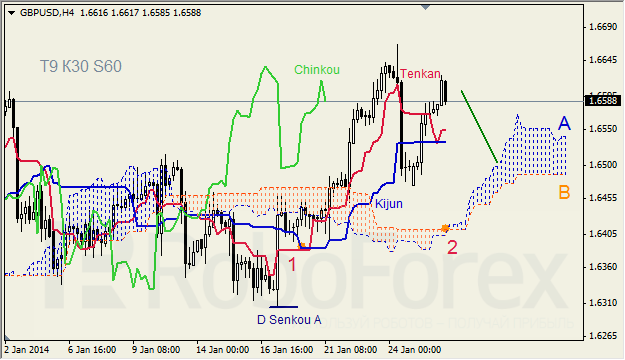
GBPUSD, Time Frame H4. Tenkan-Sen and Kijun-Sen are influenced by “Golden Cross” (1); both lines are horizontal and very close to each other. Ichimoku Cloud is still going up (2); Chinkou Lagging Span is above the chart. Short‑term forecast: we can expect decline of the price.

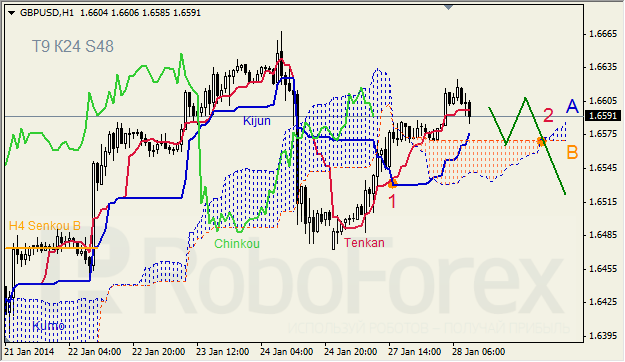
GBPUSD, Time Frame H1. Tenkan-Sen and Kijun-Sen are influenced by “Golden Cross” (1); Kijun-Sen and Senkou Span A are directed upwards. Ichimoku Cloud is going up (2). Short‑term forecast: we can expect support from Senkou Span B, and attempts of the price to stay below Kumo.

GOLD

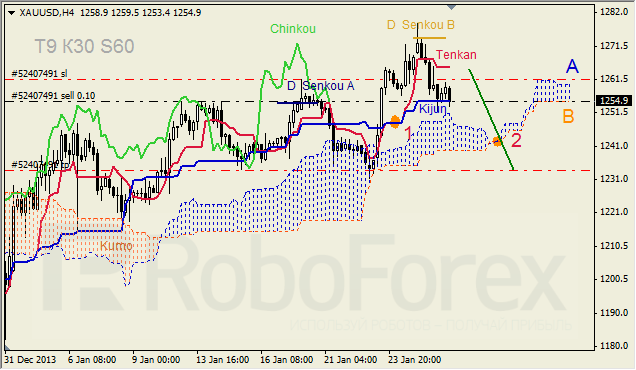
XAUUSD, Time Frame H4. Tenkan-Sen and Kijun-Sen intersected and formed “Golden Cross” (1). D Senkou Span B is resistance level; Ichimoku Cloud is going up (2); Chinkou Lagging Span is on the chart, and the price on Kijun-Sen. Short-term forecast: we can expect decline of the price.

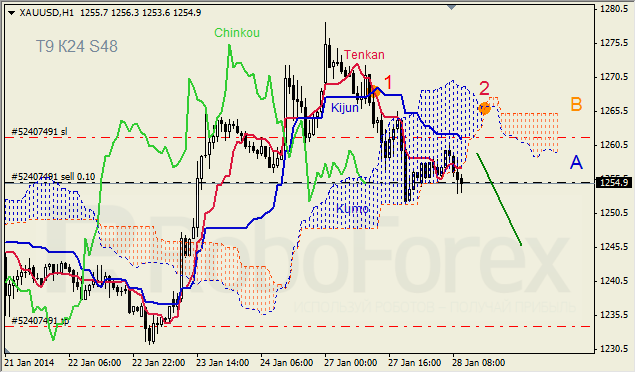
XAUUSD, Time Frame H1. Kijun-Sen is directed downwards. Ichimoku Cloud is going down (2), Chinkou Lagging Span is below the chart, and the price is below the lines. Short‑term forecast: we can expect resistance from Tenkan-Sen – Senkou Span B, and decline of the price.

RoboForex Analytical Department

Article By RoboForex.com

Attention!
Forecasts presented in this section only reflect the author’s private opinion and should not be considered as guidance for trading. RoboForex LP bears no responsibility for trading results based on trading recommendations described in these analytical reviews.


Fibonacci Retracements Analysis 28.01.2014 (EUR/USD, USD/CHF)

Article By RoboForex.com

Analysis for January 28th, 2014

EUR/USD

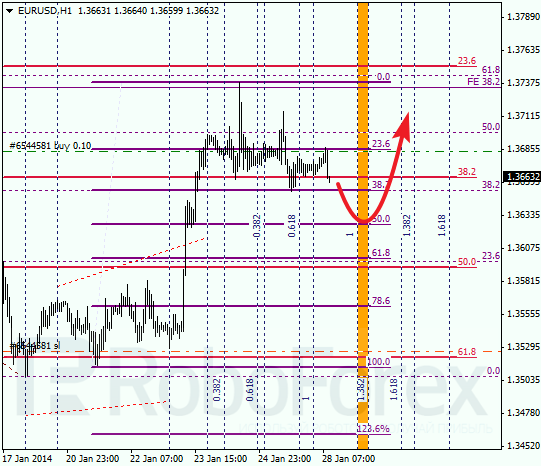
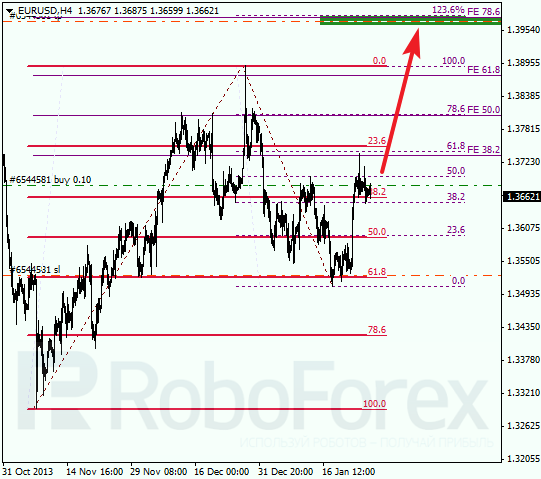
Euro is still moving inside flat pattern; earlier price rebounded from level of 61.8% and I decided to open buy order during the following correction. Main target for bulls is close to several upper fibo-levels, near 1.3960.

At H1 chart we can see, target of current correction is at local level of 50%. According to analysis of temporary fibo-zones, this level may be reached during the day. If later pair rebounds from it, I’ll increase my long position.

USD/CHF

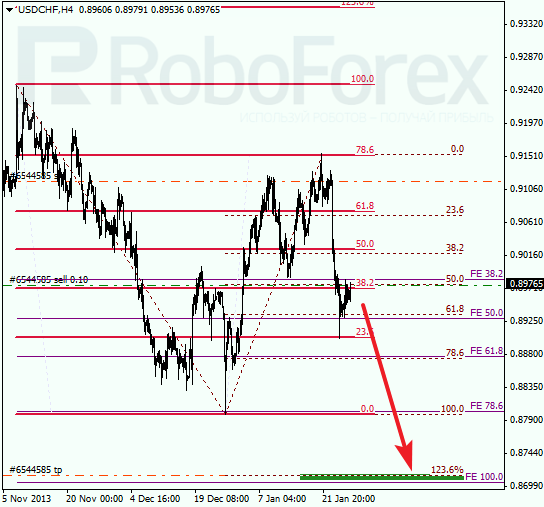
Franc is also still being corrected; pair rebounded from level of 78.6% and started falling down. Price may yet move upwards for a while, but later it is expected to start new descending movement towards several lower fibo-levels.

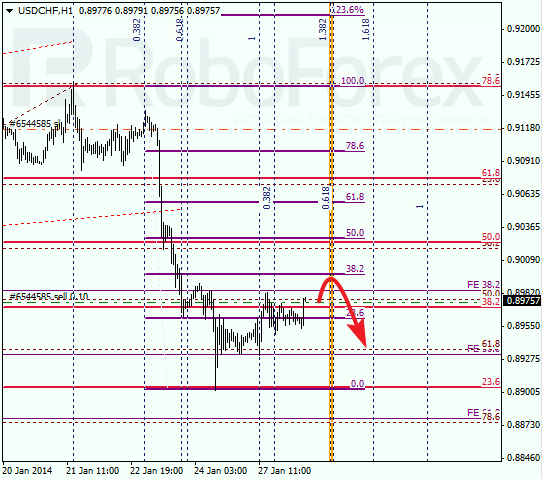
As we can see at H1 chart, bulls are pushing price towards level of 38.2%. According to analysis of temporary fibo-zones, market may reach and test this level during the day. If price rebounds from this level, I’ll open my second sell order during the following slight correction.

RoboForex Analytical Department

Article By RoboForex.com

Attention!
Forecasts presented in this section only reflect the author’s private opinion and should not be considered as guidance for trading. RoboForex LP bears no responsibility for trading results based on trading recommendations described in these analytical reviews.