New Zealand holds rate, warns of higher rates “soon”

By CentralBankNews.info
    New Zealand’s central bank maintained its benchmark Official Cash Rate (OCR) at 2.5 percent, as expected, but sharpened its recent warning about inflationary pressures and said interest rates had to return to more normal levels and it “expects to start this adjustment soon.”
    “The Bank remains committed to increasing the OCR as needed to keep future average inflation near the 2 percent target mid-point. The scale and speed of the rise in the OCR will depend on future economic indicators,” the Reserve Bank of New Zealand (RBNZ) said in a statement, quoting its governor, Graeme Wheeler.
    The RBNZ has been preparing financial markets and investors for higher rates for months. The bank cut its policy rate to the current level in March 2011 but then in July last year warned that it would have to start removing the stimulus. In September the bank said rate rises would likely be needed this year and then in December it said that it “will” raise rates to contain inflation.
    New Zealand’s headline inflation rate rose to 1.6 percent in December from 1.4 percent in November but the central bank said companies’ are increasingly looking to raise prices, and construction costs are increasing and risk feeding into the broader economy.
   “While headline inflation has been moderate, inflationary pressures are expected to increase over the next two years. In this environment, there is a need to return interest rates to more-normal levels. The Bank expects to start this adjustment soon,” Wheeler said.
    One of the central bank’s recent concerns has been rising home prices, but Wheeler said there appeared to have been some moderation in the housing market in recent months.
    The high exchange rate of the New Zealand dollar – known as the kiwi – has also been dampening inflation but Wheeler said he didn’t believe the current exchange rate was sustainable in the long run.
    The kiwi started appreciating in March 2009 as investors sought safe haven, rising from almost almost 2 to the U.S. dollar to 1.14 by July 2011. Since then it eased slightly and was largely stable last year around 1.22 to the dollar. But it has been under upward pressure against the yen and recently hit a six-year high of over 87 yen as investors look to take advantage of higher interest rates.
    “New Zealand’s economic expansion has considerable momentum,” Wheeler said, adding that consumer and business confidence was strong.
    New Zealand’s Gross Domestic Product grew by 1.4 percent in the third quarter from the second for annual growth of 3.5 percent, up from 2.3 percent, and Wheeler expects growth to continue around this level over the coming year.
    Improving growth in the global economy should benefit New Zealand’s agriculture sector, although Wheeler said export prices are likely to come off their current peaks.
    Last month the RBNZ forecast that the 90-day interest rate, which closely tracks the OCR rate, would rise to 3.8 percent by December this year, then to 4.6 percent by December 2015 and to 4.8 percent by March 2016.
    Many economists expect the RBNZ to raise rates in March. If it raises rates in March, the RBNZ will become the first central bank in the advanced economies to tighten policy since early 2011.

    http://ift.tt/1iP0FNb


Federal Reserve trims asset purchases by another $10 bln

By CentralBankNews.info
    The Federal Reserve, the U.S. central bank, will trim its monthly asset purchases by another $10 billion in February to a total of $65 billion and repeated that it expects to maintain its policy rate at the current 0-0.25 percent “well past the time that the unemployment rate declines below 6.5 percent, especially if projected inflation continues to run below the Committee’s 2 percent longer-run goal.”
    The Fed, which last month decided to wind down its extraordinary accommodative monetary policy by reducing monthly asset purchases to $75 billion from $85 billion, said it “will likely reduce the pace of asset purchases in further measured steps at future meetings” if the U.S. jobs market continues to improve and inflation moves back toward the Fed’s goal.
    The Fed acknowledged the improving U.S. economy, saying “growth in economic activity picked up in recent quarters,” dropping the description that activity was “expanding at a moderate pace.”
   The Fed also said spending by households and business investment “advanced more quickly in recent months,” a slightly more upbeat description than last month when the Fed said household spending and business investment “advanced.”
    The Fed’s decision was widely expected as economists had not expected the recent volatility in financial markets, including the plunge in emerging market currencies, to deter it from continuing to normalize monetary policy at the last meeting headed by Ben Bernanke before he hands over the reins to Fed vice chair Janet Yellen.
    The U.S. unemployment rate dropped to 6.7 percent in December from 7.0 percent in November, but  the Fed again said it remains elevated. Some of the decline in the unemployment rate is due to people leaving the workforce.
    In December the Fed pared its decision to start winding down quantitative easing by pledging to keep rates low even when the jobless rate dips below its threshold of 6.5 percent. Most economists first expect the Fed to start raising rates late 2015 while its asset purchases should finished by October.
    In its latest forecast from December, the Fed sees the U.S. jobless rate easing to between 6.3 and 6.6 percent this year before falling to 5.8-6.1 percent in 2015.  
     But the Fed again cautioned that its decision to reduce asset purchases in “measured steps”at future meetings was not on a “preset course” and remains contingent upon the outlook for the labor market, inflation and the likely efficacy and costs of continued purchases of U.S. government bonds and mortgage-backed securities.
    U.S. headline inflation remains well below the Fed’s 2.0 percent objective, though it rose in December to 1.5 percent from November’s 1.2 percent.
    The Fed again said that it considers inflation persistently below its objective as a risk to the economy.
    U.S. economic growth picked up in the third quarter, with Gross Domestic Product expanding by 2.0 percent from the same quarter in 2012, and economists expect stronger growth in the fourth quarter.
    The Fed started its third round of quantitative easing – known as QE3 – in September 2012 by purchasing $85 billion a month of U.S. Treasury bonds and mortgage-related debt. In May 2013 Bernanke then said the Fed was considering reducing the size of its purchases in the next few meetings.
   
    http://ift.tt/1iP0FNb


Gold and Silver Ready To Rumble Higher?

David A Banister- www.MarketTrendForecast.com

We have been writing about the bottoming process of the Gold Bear Cycle (Elliott Wave Theory) since December 4th 2013, and our most recent article on December 26th reiterated that the best time to accumulate the Gold/Silver stocks was in the December and January window. Specifically this is what we wrote:

“These types of indicators are coming to a pivot point where Gold is testing the summer 1181 lows…at the same time, we see bottoming 5th wave patterns combining with public sentiment, bullish percent indexes, and 5 year lows in Gold stocks.  This is how bottom in Bear cycles form and you are witnessing the makings of a huge bottom between now and early February 2014 if we are right. 

The time to buy Gold and Gold stocks is now during the next 4-5 weeks just as we were recommending stocks in late February 2009 with public articles that nobody paid attention to.  This is the time to start accumulating quality gold miner and also the precious metals themselves as the bear cycle winds down and the spring comes back to Gold and Silver in 2014.”

Since that article a few of our favorite stocks rallied 40-50% in just 3 weeks or so from the December timeframe of our article.  A recent pullback is pretty normal as we set up for Gold to take out the 1271 spot pricing area and run to the mid 1300’s over the next several weeks.  By that time, you will be kicking yourself for not being long either the metals themselves or the higher beta stock plays.

A few suggestions that we have already written about we will reiterate here again.  Aggressive investors can look at UGLD ETF, which is a 3x long Gold product that will give you upside leverage as Gold moves into elliott wave 3 up.  Other more aggressive plays we already recommend a lot lower include GLDX, JNUG, NUGT and others.  Picking individual stocks can be even better and we have recommended a few to our subscribers that are already doing very well.

What will trigger this next rally up is sentiment shifts to favor Gold and Silver over currency alternatives.  The precious metals move on sentiment, much more so than interest rates or GDP reports or anything else in our opinion.  Sentiment remains neutral to bearish as evidenced by the larger brokerage houses running around in January telling everyone to sell Gold, so we see that as a buy signal on top of our other indicators.


Elliott Wave Theory Analysis


We expect the mid 1500’s by sometime this summer, but by then your opportunity will be long in the rearview mirror.  Join us for frequent updates at www.MarketTrendForecast.com


Malaysia holds rate steady, sees higher inflation

By CentralBankNews.info
    Malaysia’s central bank held its benchmark Overnight Policy Rate (OPR) steady at 3.0 percent, as expected, and said the momentum in economic growth was expected to continue this year while inflation was expected to be higher than last year.
    Bank Negara Malaysia (BNM), which has maintained rates at this level since May 2011, also said global growth would be supported by emerging economies and the recovery in advanced economies but that “global economic and financial conditions remain vulnerable to shifts in sentiments and heightened volatility in the international financial markets.”
    Like many other emerging market currencies, Malaysia’s ringgit has weakened in the last year, though much less than for example India’s rupee and Turkey’s lira. In 2013 the ringgit lost around 7 percent against the U.S. dollar as the U.S. Federal Reserve signaled it was preparing to wind up asset purchases. Since the start of this year, the ringgit has depreciated a further 1.8 percent, trading at 3.34 to the dollar today.
    Malaysia’s inflation rate rose to 3.2 percent in December, a high for the year and continuing the acceleration seen since December 2012 when inflation was 1.2 percent.

    In 2013 Malaysia’s inflation averaged 2.1 percent with prices rising due to disruptions in supply following adverse weather and higher domestic costs due to the government’s cut in fuel subsidies in September that raised the price of certain gasolines and diesel fuel.
    “Going forward, inflation is expected to average higher largely due to domestic cost factors,” the central bank said, adding that moderate domestic demand and subdued external prices should help contain the impact on underlying inflation.
    Malaysia’s central bank has often said it expects inflation to rise this year and may even exceed the long-term average of 3.2 percent, partly due to the earlier cut in subsidies and coming changes to taxes in April. Economists are expecting the central bank to raise rates later this year to contain the growing inflationary pressures.
    “The MPC remains focused on ensuring medium-term price stability that would contribute to sustainable economic growth,” the central bank said.
    Malaysia’s Gross Domestic Product rose by 1.7 percent in the third quarter from the second quarter for annual growth of 5 percent, up from 4.4 percent in the previous quarter, and the central bank said it expects sustained performance in the fourth quarter as better exports and supported growth while domestic demand has remained firm.
    “Going forward, the growth momentum is expected to continue in 2014, amid better performance in the external sector,” the central bank said, adding that investment activity is projected to remain robust while domestic demand is expected to moderated due to the continuing fiscal consolidation and slower growth in private consumption.

    http://ift.tt/1iP0FNb
   

Aussie Climbs For a Third Day; Fed Decision in Spotlight

By HY Markets Forex Blog

The Aussie  extended gains against the US dollar for a third day on Wednesday, as investors continue to speculate that the US Federal Reserve (Fed) will continue to cut its monthly bond purchases further which will strengthen the greenback.

The currency pair climbed 0.37% to $0.8807 at the time of writing, after reaching $0.8825 earlier in the session. The Australian dollar touched 86.60 on Jan 24, the lowest since July 2010. Australia’s ten-year government bond yield added nine basis points to 4.12%, after dropping to a low 4.02%; the lowest since Oct 31.

Federal Reserve Meeting

Members of the Federal Open Market Committee (FOMC) are meeting up later today to continue the two-day policy meeting.

Market analysts are predicting members of the Federal Open Market Committee will continue to reduce its monthly bond purchases by $10 billion at every meeting to end the stimulus program by this year, despite the recent disappointing non-farm payrolls data for the previous month.

In the last fed-meeting, the central bank decided to reduce its monthly bond purchases by $10 billion to $75 billion a month. Minutes for the Federal Open Market Committee (FOMC) meeting will be released on Wednesday.

Australian Data

Reports released revealed the National Australia Bank Business Confidence Index stood at 6 in December, after the previous month’s reading was up from 5 to 6.

The same report revealed the Australian business conditions rose by seven points to 4; the highest since March 2011, from -3 recorded in November.

“Business conditions recorded a surprising jump to a more than a 2.5-year high in December – cementing the upward trend seen over recent months – supported by the low interest rate environment, higher asset prices and less elevated Australian dollar,” the NAB commented.


Visit www.hymarkets.com   to find out more about our products and start trading today with only $50 using the latest trading technology today.

The post Aussie Climbs For a Third Day; Fed Decision in Spotlight appeared first on | HY Markets Official blog.

Article provided by HY Markets Forex Blog

Crude Oil Mixed While Market Awaits Fed Decision

By HY Markets Forex Blog

Crude Futures were seen trading mixed on Wednesday, as market participants awaits news from the Federal Reserve (Fed) meeting later in the day with predictions of a further reduction to the central bank’s  monthly bond purchases.

The North American West Texas Intermediate (WTI) for March delivery came in 0.10% lower, trading at $97.32 per barrel on the New York Mercantile Exchange at the time of writing. On Tuesday, the contract rose $1.69 to $97.41, the highest since Dec 31.

At the same time, Brent crude for March settlement climbed 0.08%, at $107.50 per barrel on the London-based ICE Futures Europe exchange. The European benchmark was at a premium of $10.36 to WTI.

Crude – US Fuel Supplies

On Tuesday, the American Petroleum Institute (API) reports showed a rise in oil inventories by 4.7 million barrels in the week ending January 24, beating analysts forecast of 2.3 barrels.

The reports from API also revealed US distillate supplies; including heating oil and diesel, dropped by 1.79 million barrels in the previous week, while gasoline inventories added 363,000 barrels.

As the market awaits reports from the US Energy Information Administration (EIA) later in the day, investors are expecting to see a rise in supplies by 2.25 million.

Crude – Federal Reserve Meeting

Members of the Federal Open Market Committee (FOMC) are meeting up later today to continue the two-day policy meeting.

Market analysts are predicting members of the Federal Open Market Committee will continue to reduce its monthly bond purchases by $10 billion at every meeting to end the stimulus program by this year, despite the recent disappointing non-farm payrolls data for the previous month.

In the last fed-meeting, the central bank decided to reduce its monthly bond purchases by $10 billion to $75 billion a month. Minutes for the Federal Open Market Committee (FOMC) meeting will be released on Wednesday.


Visit www.hymarkets.com   to find out more about our products and start trading today with only $50 using the latest trading technology today.

The post Crude Oil Mixed While Market Awaits Fed Decision appeared first on | HY Markets Official blog.

Article provided by HY Markets Forex Blog

EURUSD: Hesitates Above Its Key Support

EURUSD: Although EUR may be struggling above its rising trendline, its broader upside bias remains intact in the medium term. However, it will have to retake the 1.3739 level, its Jan 24 2014 high to trigger further upside pressure towards the 1.3818 level, its Dec 30 2013 high. A turn above the 1.3818 level will set the stage for a move higher towards the 1.3897 level, its Dec 27 2013 high. Further out, the 1.3950 level comes in as the next upside. Its daily RSI is bullish and pointing higher supporting this view. On the other hand, any pullback will meet support standing at the 1.3628 level, its Jan 28’2014 low. That level is expected to provide support when tested. However, if this level is violated, further decline could follow towards the 1.3550 level and the 1.3489 level where a violation will aim at the 1.3400 level, its psycho level. All in all, EUR remains biased to the upside medium term.

Article by www.fxtechstrategy.com


Wave Analysis 29.01.2014 (EUR/USD, GBP/USD, USD/CHF, USD/JPY)

Article By RoboForex.com

Analysis for January 29th, 2014

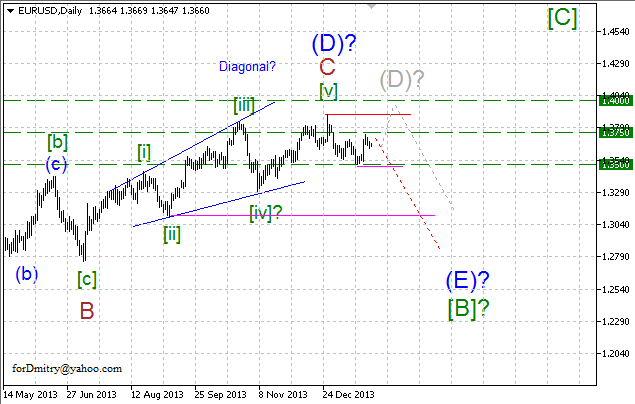
EUR/USD

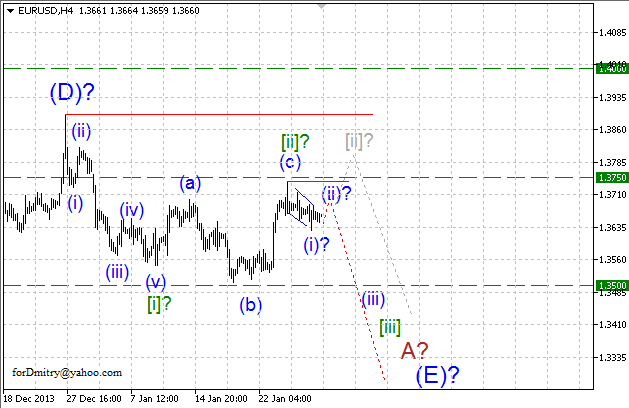
One of possible scenarios implies that Euro completed ascending zigzag (D) of [B] and started forming final descending zigzag (E) of [B]. However, this assumption hasn’t been confirmed and price may yet change structure of wave (D).

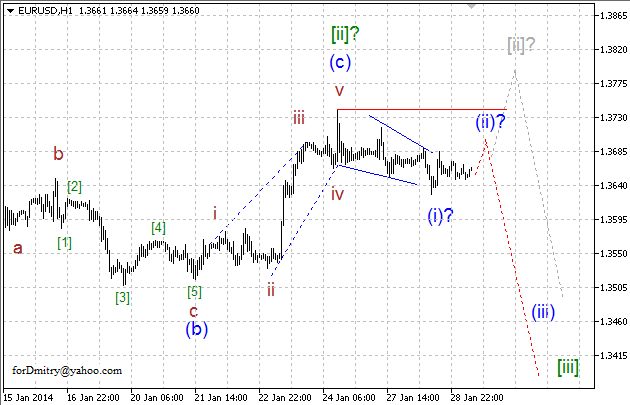
Possibly, price is forming the first “leg” A of (E) of descending zigzag (E). Probably, pair finished (or is finishing right now) ascending correction [ii] of A of (E), which may be followed by descending wave [iii] of A of (E).

Probably, pair completed (or is completing) ascending correction [ii]. In this case, later price is expected to start descending impulse [iii].

GBP/USD

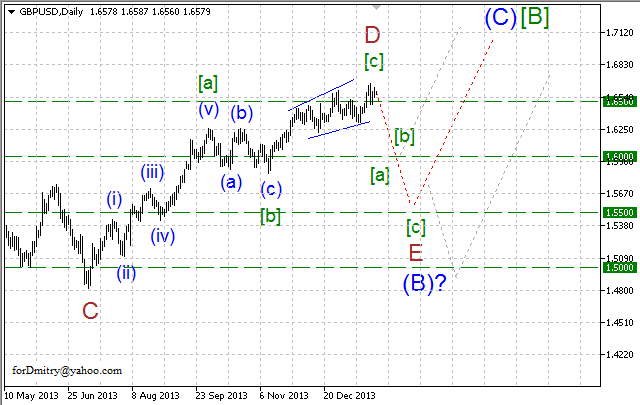
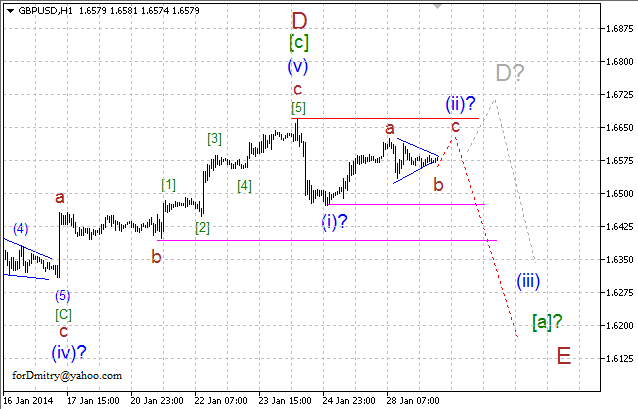
Current chart structure implies that Pound finished ascending zigzag D of (B). In this case, then later pair is expected to form final descending zigzag E of (B). However, this assumption hasn’t been confirmed and price may yet change structure of wave D of (B).

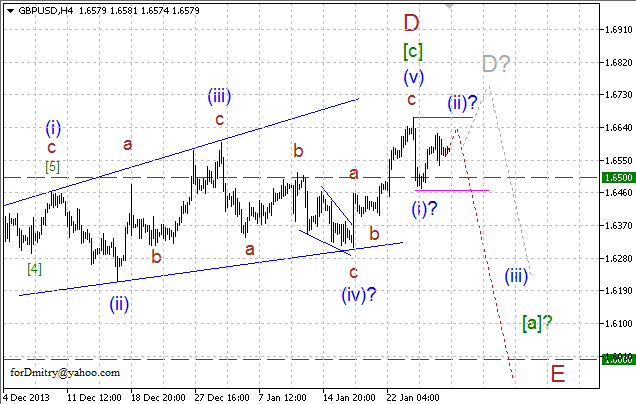
Probably, price completed ascending diagonal triangle [c] of D and started final descending zigzag E. However, we should remember that it’s not the only possible scenario of price movement.

Possibly, pair is forming descending wave E in the form of zigzag. Right now, Pound is finishing local ascending correction (ii) of [a] of E. In this case, price may continue falling down inside impulse (iii) of [a] of E without breaking closest critical level.

USD/CHF

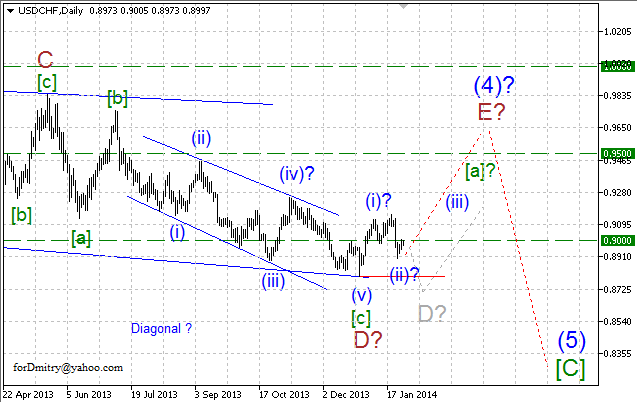
Current chart structure implies that Franc completed descending zigzag D of (4) and started forming final ascending zigzag E of (4) of [C].

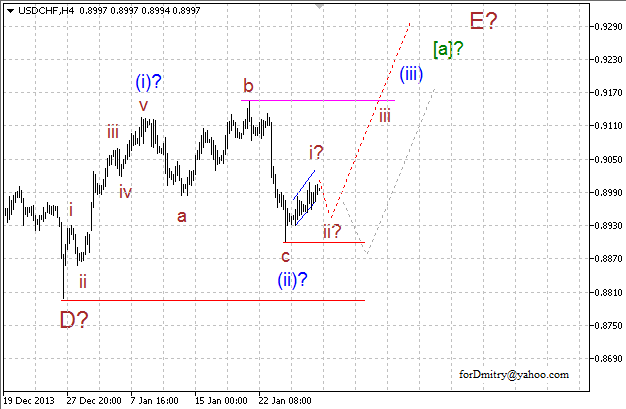
Probably, price formed impulse (i) of [a] of E of ascending zigzag E. Possibly, pair finished (or is finishing right now) local descending correction (ii) of [a] of E, which may be followed by ascending impulse (iii) of [a] of E.

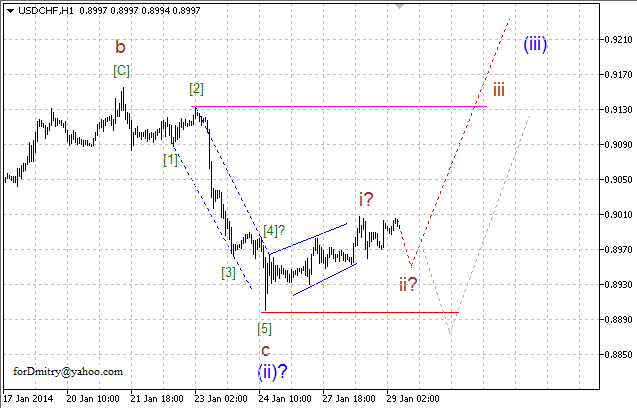
Possibly, pair completed (or is completing) descending correction (ii) and started forming ascending impulse (iii).

USD/JPY

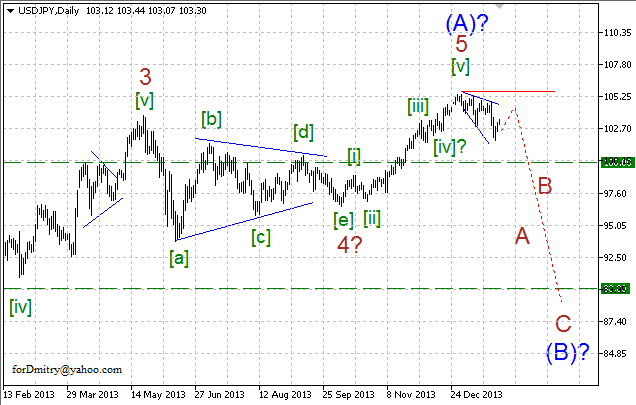
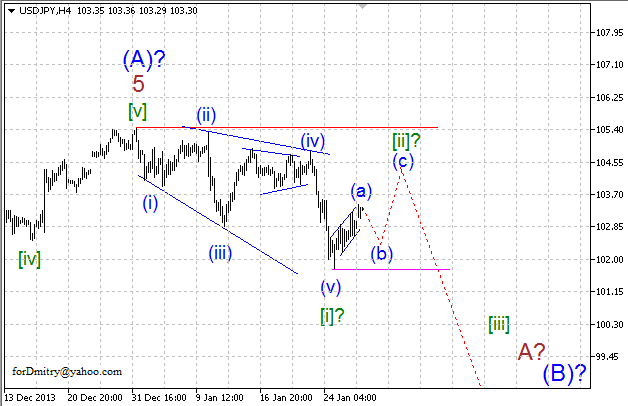
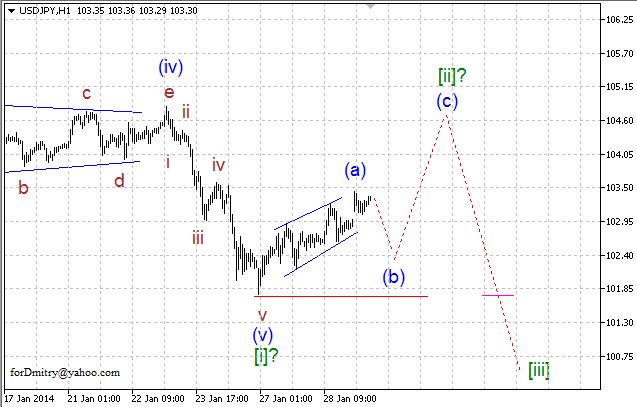
Current chart structure implies that Yen finished ascending impulse (A). In this case, later price is expected to start large descending correction (B), may be in the form of zigzag.

Probably, pair has already finished wedge [i] of A of (B) of horizontal correction (B). In this case, then after completing local ascending correction [ii] of A, price is expected to form descending impulse [iii] of A.

Possibly, price completed descending wedge [i] and started forming local ascending correction [ii], which may take the form of zigzag.

RoboForex Analytical Department

Article By RoboForex.com

Attention!
Forecasts presented in this section only reflect the author’s private opinion and should not be considered as guidance for trading. RoboForex LP bears no responsibility for trading results based on trading recommendations described in these analytical reviews.


Apple Forced to Pay a $40-Billion Ransom

By WallStreetDaily.com Apple Ransom

After the bell on Monday, tech icon, Apple (AAPL), reported results.

On the one hand, the company delivered record profits of $14.50 per share, when analysts were expecting $14.05.

But when it came to iPhone sales during the all-important holiday quarter, Apple whiffed hard enough that the fans in the bleacher seats could feel it.

The company only sold 51 million iPhones – a full four million shy of analysts’ estimates. At an average selling price of $637, that works out to $2.5 billion in missed sales. Like I said, big whiff!

As a result, the market has taken Apple hostage.

Following the report, shares fell as much as 9%, vaporizing roughly $40 billion in market value.

Now, by no means is Apple in danger of going out of business. Not with over $13 billion in quarterly profit and a cash stockpile closing in on $160 billion.

However, an ominous trend is developing, pointing to an imminent day of reckoning between CEO Tim Cook and shareholders.

Or as Forbes’ Robert Hof put it, “Investors are getting even more restless.”

Indeed! Here’s why it’s absolutely justified – and, most importantly, how you can safely leverage the situation for your ultimate profit…

How Do You Like Them (Rotten) Apples?

Apple’s unfathomable smartphone shortfall comes at a time when the rest of the industry is firing on all cylinders.

In the last 24 hours, in fact, technology research group, IDC, confirmed that global smartphone sales zoomed 38% last year. They topped one billion units for the first time ever.

Analysts are calling for similarly heady growth of 26% in 2014.

Now, you’d think that trend would be Apple’s friend. Think again!

The bulk of the expected smartphone sales will be “low-quality growth,” according to BNP Paribas analyst, Peter Yu.

Translation: Cheap smartphones, selling for less than $150, will account for the majority of smartphone sales this year.

Pardon the Captain Obvious statement here, but that’s a price point Apple can’t touch.

Consumers’ preference for lower-priced smartphones, and Apple’s inability to compete, is already materializing in the data, too.

Over the last three quarters, Apple’s iPhone sales growth rate plummeted from around 20% to less than 7%, on a year-over-year basis.

iPhone Sales by Quarter

Meanwhile, market share data reflects a similarly ominous trend. Whereas Apple sold nearly 20 million more iPhones in 2013 than 2012, its market share fell four percentage points to 15%.

Innovate or Die

Ever since the late Steve Jobs unveiled the company’s first iPhone in 2007, it’s been the main driver of Apple’s revenue. (In the last quarter, it accounted for 56% of sales.)

Based on the latest numbers, I’m afraid Apple’s eye-popping iPhone run is drawing to a close. That means it’s time to innovate (again) or die.

Of course, that’s always been the story with Apple. It needs to introduce new product categories – and instantly dominate the market. Otherwise, its stock is destined to fail.

When Steve Jobs was at the helm, no one ever questioned the company’s ability to do just that. With Tim Cook in charge, though, it’s not such a sure thing.

He’s just not the same type of visionary as Steve Jobs. Frankly, I don’t think anyone will ever be.

And the fact that shares are selling off after the quarterly report – even though Cook continues to promise Apple will launch new products this year (iWatch anyone?) – shows that the lack of confidence is widespread.

Now, Cook might not be able to match Jobs’ innovative abilities. But he’s no dummy. After all, you don’t become the successor at Apple for your lack of business acumen.

He made one comment during yesterday’s conference call that leads me to believe he’s about to make his mark on the world.

When pressed about mobile payments, he said, “We are seeing that people love being able to buy content, whether it’s music or movies or books, from their iPhone using Touch ID. It’s incredibly simple and easy and elegant – and it’s clear [that] there’s a lot of opportunity there.”

When asked about the same thing on the previous conference call, he curtly responded that mobile payment technology is “in its infancy.”

Apparently, it’s grown up (fast) in the span of several months. And therein lies his opportunity…

Get Ready for the Mobile Payment Boom

For years, I’ve contested that mobile payments would never take off until the security issues were resolved. Apple took care of that by incorporating biometric authentication into its latest iPhone.

So in order to take over the world, all Tim Cook needs to do now is start letting people use Touch ID to buy anything they want.

Think about it. Apple lays claim to one of the most valuable assets in the world – over 600 million user accounts, most of which are already linked to a credit card.

A Mobile Payment Juggernaut in the Making

That’s more than Amazon.com (AMZN) and PayPal combined, based on BI Intelligence’s estimates from late 2013.

So by letting users pay for goods and services from their iPhone with their Apple ID, verified by Touch ID, Apple would instantly dominate the mobile payment market.

While it wouldn’t be as simple as flipping a switch, it’d be pretty darn close.

And it would definitely be much easier for Cook than trying to come up with a completely new, must-own consumer electronic device.

Now, you know I’ve always advocated investing in Apple’s stock smartly, instead of simply buying the stock at any price. I have to admit, though, my colleague, Karim Rahemtulla, has come up with the most ingenious way yet to bet on the company’s next big innovation.

It’s an opportunity to put as much as $26,000 in your pocket, instantly.

Go here for all the details

Ahead of the tape,

Louis Basenese

The post Apple Forced to Pay a $40-Billion Ransom appeared first on Wall Street Daily.

Article By WallStreetDaily.com

Original Article: Apple Forced to Pay a $40-Billion Ransom