Euro Trades Lower After Germany’s PMI Release

By HY Markets Forex Blog

The euro traded lower against the US dollar on Thursday after reports revealed that Germany’s manufacturing sector slowed more than expected in February.

The 18-bloc currency fell 0.27% lower at $1.37 against the US dollar at the time of writing, after the euro opened around $1.3730.

Euro – Germany’s PMI

The manufacturing sector for the eurozone’s strongest economy came in lower than expected in February, compared to the 32-month high recorded in the previous month. Germany’s services sector picked up from a three-month low at a faster pace, according to reports released by Markit Economics on Thursday.

The preliminary manufacturing Purchasing Managers’ Index (PMI) dropped to 54.7 in February, sliding from January’s final reading of 56.5, while analysts forecasted a reading of 56.3.

Germany’s Services Sector

Germany’s services sector came in higher than expected in February and expanded for the ninth consecutive month.

The flash services PMI climbed to 55.4, picking up from the previous reading of 53.1 seen in January and above analysts forecast of 53.4.

A reading above 50.0 in both the services and manufacturing sector indicates an expansion, while a reading below 50.0 signifies contraction.

Fed Minutes

On Wednesday, the official minutes from the Federal Open Market Committee (FOMC) January meeting were released and revealed that Fed members backed the decision to reduce the central bank’s monthly bond purchases by another $10 billion to $65 billion a month.

The minutes suggested that the FOMC policymakers decided to modify their commitment to keep their benchmark interest rate near zero as the unemployment rate approaches its 6.5% target.

The news did not have an effect on the greenback; however the dollar slightly picked up from its seven-week low after the FOMC minutes release.

The next Federal Open Market Committee meeting is scheduled for March 18-19.


Visit www.hymarkets.com   to find out more about our products and start trading today with only $50 using the latest trading technology today

The post Euro Trades Lower After Germany’s PMI Release appeared first on | HY Markets Official blog.

Article provided by HY Markets Forex Blog

Wave Analysis 20.02.2014 (DJIA Index, Crude Oil)

Article By RoboForex.com

Analysis for February 20th, 2014

DJIA Index

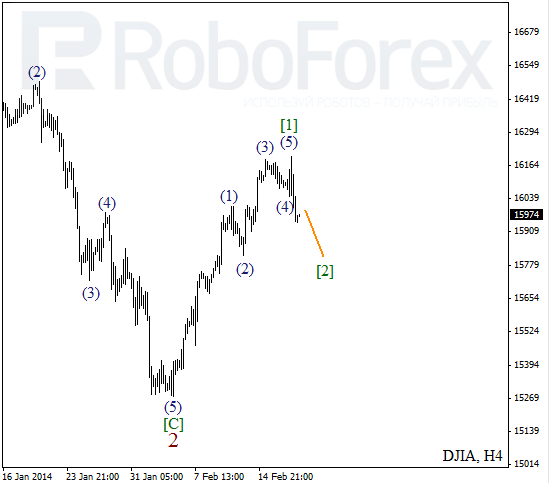
Probably, after completing correction inside the second wave, Index formed initial impulse inside wave [1]. In the nearest future, instrument may be corrected inside wave [2], but later it is expected to start growing up inside the third one.

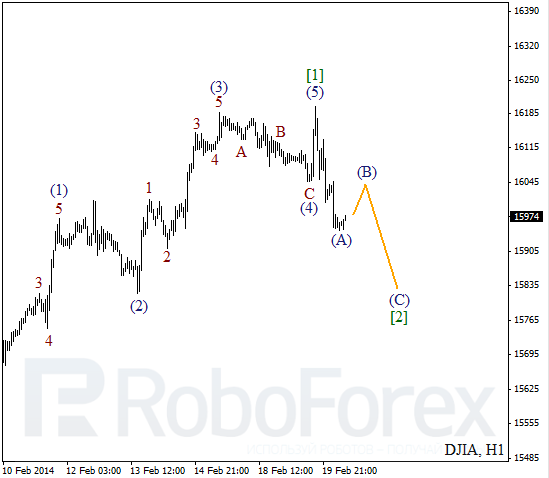
More detailed wave structure is shown on H1 chart. The fifth wave inside wave [1] turned out to be very long. It looks like wave (2) is taking the form of zigzag pattern. On the minor wave level, instrument is expected to complete wave (B) and start falling down inside wave (C) of [2].

Crude Oil

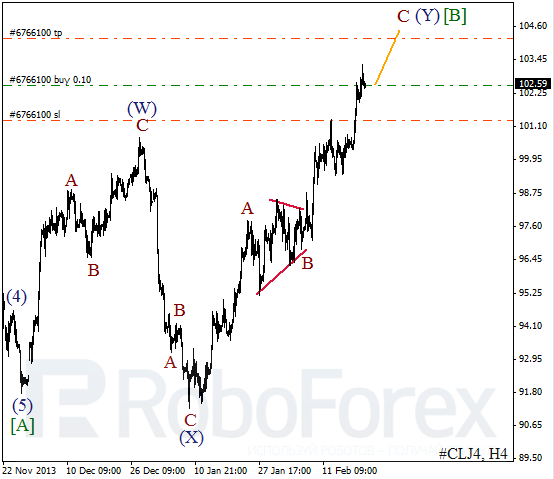
Oil continues moving upwards and reaching new maximums. Yesterday, my Take Profit worked and I decided to open another buy order during local correction. Possibly, instrument may reach new maximum by the end of the week.

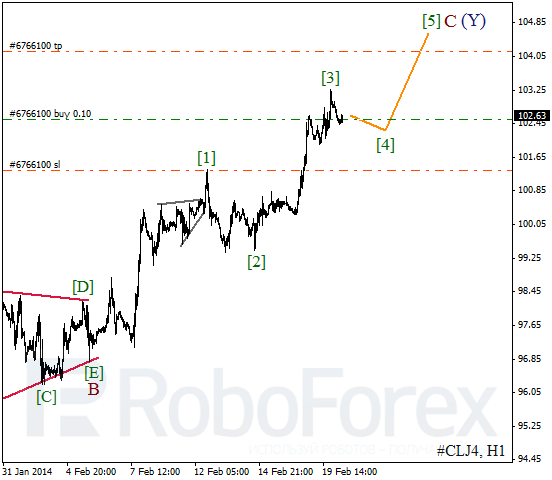
As we can see at the H1 chart, market is forming the fourth wave inside wave C. Instrument is expected to continue this correction during the day. I’m planning to increase my long positions right after price completes initial impulse inside the fifth wave.

RoboForex Analytical Department

Article By RoboForex.com

Attention!
Forecasts presented in this section only reflect the author’s private opinion and should not be considered as guidance for trading. RoboForex LP bears no responsibility for trading results based on trading recommendations described in these analytical reviews.


Forex Technical Analysis 20.02.2014 (EUR/USD, GBP/USD, USD/CHF, USD/JPY, AUD/USD, GOLD)

Article By RoboForex.com

Analysis for February 20th, 2014

EUR USD, “Euro vs US Dollar”

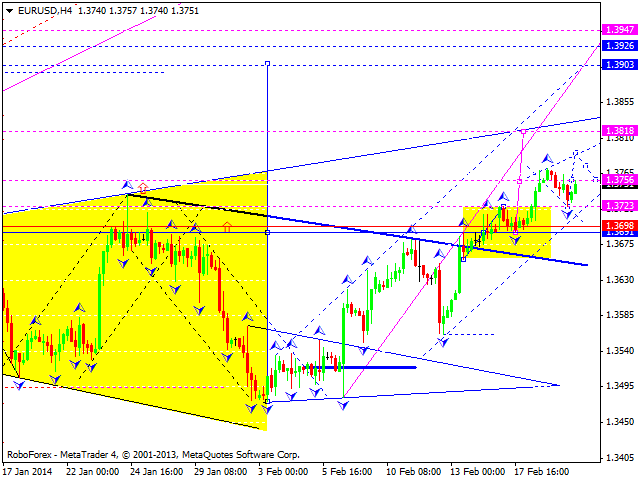
Euro is still consolidating. We think, today price may grow up towards level of 1.3815 and then fall down to test level of 1.3760 from above. Later, in our opinion, instrument may continue moving upwards to reach level of 1.3900.

GBP USD, “Great Britain Pound vs US Dollar”

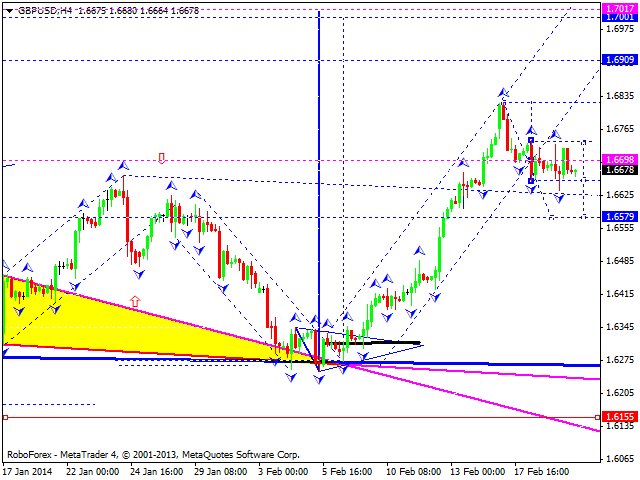
Pound is still consolidating near broken channel. Such market behavior implies that price may form another descending structure towards level of 1.6580. However, main scenario suggests that instrument may continue growing up towards level of 1.7000.

USD CHF, “US Dollar vs Swiss Franc”

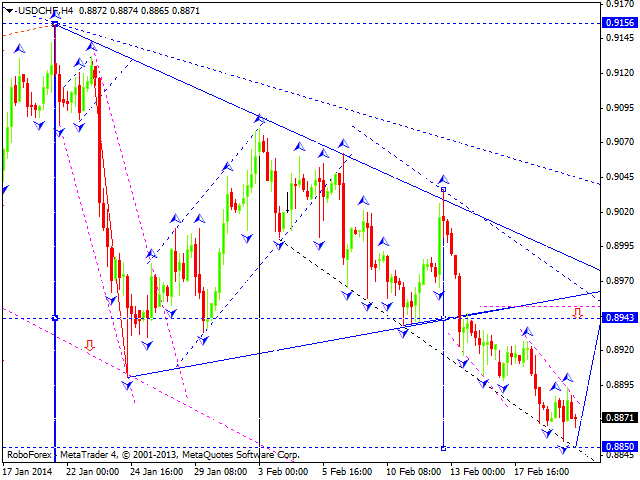
Franc continues moving downwards and right now is forming another consolidation channel. After that, price may continue falling down. Main target is at level of 0.8300; level of 0.8730 may be a strong resistance level.

USD JPY, “US Dollar vs Japanese Yen”

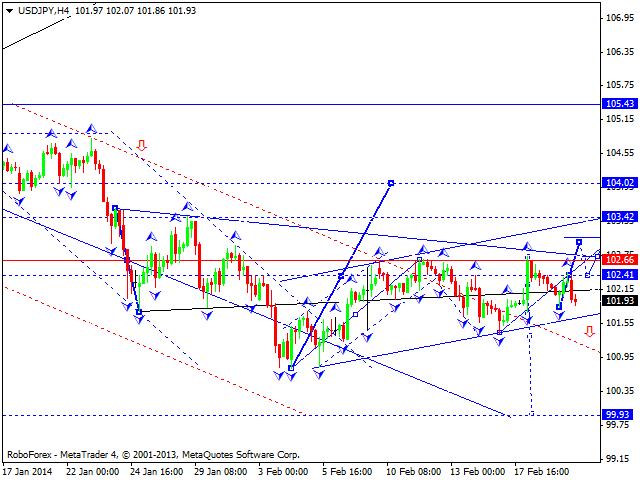
Yen is still consolidating. We think, today price may continue growing up to reach level of 104.00. Alternative scenario implies that pair may break level of 101.40 and then continue falling down towards level of 100.00.

AUD USD, “Australian Dollar vs US Dollar”

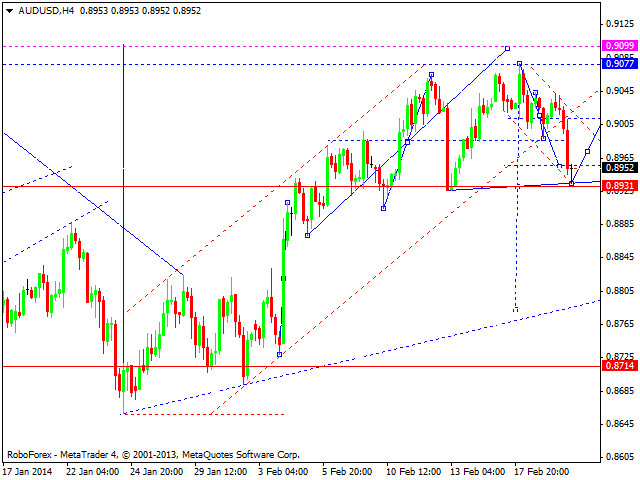
Australian Dollar is moving downwards; market completed descending wave with extension. We think, today price may form correction towards level of 0.9015 and then start forming another descending structure to reach level of 0.8780. Alternative scenario implies that pair may reach level of 0.9100 and then continue moving inside descending trend to reach level of 0.8400.

XAU USD, “Gold vs US Dollar”

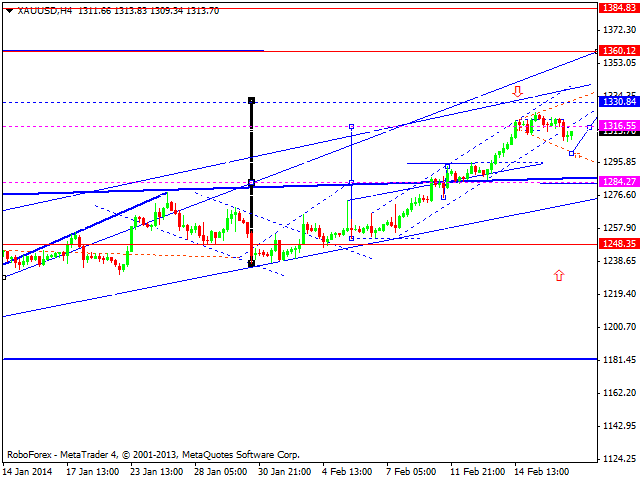
Gold is forming consolidation channel near level of 1316. We think, today price may grow up and reach level of 1330. Later, in our opinion, instrument may form new correction towards level of 1285 and then form the fifth ascending wave to reach level of 1360.

RoboForex Analytical Department

Article By RoboForex.com

Attention!
Forecasts presented in this section only reflect the author’s private opinion and should not be considered as guidance for trading. RoboForex LP bears no responsibility for trading results based on trading recommendations described in these analytical reviews.


USDCAD: Triggers Recovery, Eyes More Strength

USDCAD: With USDCAD rallying to close higher on Wednesday, further upside is likely. Resistance seen towards the 1.1172 level, its big psycho level. It may face bear threats at this level but if broken, further upside could occur towards the 1.1200 level. Support comes in at the 1.0900 level, its psycho level. A cut through here will aim at the 1.0842 level, its Jan 13 2014 low. A follow-through lower if seen will open the door for a run at the 1.0736 level, its Dec 20 2013 high. A reversal of roles as support is likely to occur here and turn the pair higher from this level. However, if this fails to happen expect more weakness towards the 1.0650 level. Its daily RSI is bearish and pointing lower supporting this view. All in all, USDCAD continues to face further bearishness on correction.

Article by www.fxtechstrategy.com


Why Warren Buffett Might Sue Me Tomorrow

By WallStreetDaily.com Investing in the Technology Sector

It’s far better to buy a good company in a great sector than a great company in a bad sector.

In other words, invest in companies with tailwinds, not headwinds. That way, even if your investment thesis isn’t spot on, you still stand to make money.

Sounds like a Warren Buffett maxim, I know. But it’s a Louis Basenese original. (At least, I think it is.)

It’s so good, in fact, that Buffett’s legal team is probably parsing my words right now.

In the end, I don’t care who gets credit for saying it. All I know is that today, we’re going to put the strategy to work…

Bet Big on Tech

As I shared earlier in the week, retail companies are facing a trio of hurricane-force headwinds.

Accordingly, retail qualifies as the proverbial bad sector right now – particularly for brick-and-mortar dominated businesses.

In contrast, the technology sector has nothing but the wind at its back.

Case in point: The Federal Reserve Bank of San Francisco’s Tech Pulse Index – which measures the health of investment, consumption, employment, production and shipments in the U.S. tech sector – rose for the 11th consecutive month in January. In December, the Index hit its highest level since 2008.

If you’re reluctant to accept government data at face value, consider the latest from an unbiased third party – Gartner Inc.

The tech research firm noted that information technology spending increased 0.4% last year. However, Gartner predicts that total spending will expand by 3.1% in 2014, to $3.8 trillion.

After all, an improving global economy always leads to increased capital spending.

And guess what? The favorable tailwinds are already materializing in individual company results.

Beat and Raise

Earnings season unofficially ends today with Wal-Mart’s (WMT) report. And after a quick look at the final data, it’s clear that technology stocks are leading the way.

Consider:

  • 81% of tech companies in the S&P 500 Index beat expectations. That compares to 71% for the entire Index, according to FactSet.
  • 73% of technology companies beat sales expectations, compared to just 66% for the S&P 500 and 53% for the consumer discretionary sector (which includes retail companies).
  • In terms of absolute growth, the technology sector reported the second-highest revenue growth rate (4.6%), led by the internet software and services industry, which delivered 20% growth. And earnings are increasing even faster, up an average of 7.4%.

Not surprisingly, investors are responding to the strong results by bidding up shares. As Bespoke Investment Group notes, technology stocks, along with materials stocks, are enjoying “the strongest one-day gains in reaction to earnings.”

They’re up an average of 1.27%. For tech companies that beat expectations, the average price jumps check in at 2.94%.

Remember, though, these are just the averages.

If we look at the Top 25 Best Performing Stocks in the entire market this earnings season, half of them are tech stocks. And they’ve all rallied 20% (or more).

Here’s the good news…

Even after the sharp moves, tech stocks are still downright affordable, trading at a forward price-to-earnings ratio of 15, which represents a 7% discount to their 10-year average multiple.

So how do we go about finding compelling tech stocks to buy? After all, there are almost 2,500 publicly traded ones to choose from.

I’m glad you asked…

A Quick Screen for Winners

I went ahead and set up a screen for “triple plays.” That is, technology companies that beat earnings expectations, beat sales expectations and raised guidance.

They’re obviously benefiting from the strongest tailwinds. On such merits, they’re likely to keep delivering solid results and rewarding shareholders with higher stock prices.

I also limited my search to small caps (i.e., companies with market caps of $2 billion or less).

Why? Because it puts another burgeoning trend on our side – the increase in mergers and acquisitions activity.

A takeover offer represents a surefire way to boost our profit potential by 40% (or more). And I’m pretty certain no one’s going to argue with that.

The end result? A trio of top-quality technology opportunities to consider: Glu Mobile (GLUU), Lattice Semiconductor Corporation (LSCC) and Super Micro Computer (SMCI).

By no means am I saying all three represent screaming “Buys.” More due diligence is required. But digging into three opportunities sure beats the alternative of individually analyzing thousands of technology stocks.

You can thank me later for the head start.

Ahead of the tape,

Louis Basenese

The post Why Warren Buffett Might Sue Me Tomorrow appeared first on Wall Street Daily.

Article By WallStreetDaily.com

Original Article: Why Warren Buffett Might Sue Me Tomorrow

Diverse Predictions: What is the Impact on the Gold Market?

By HY Markets Forex Blog

Those who trade gold might benefit from knowing about the wide range of predictions that market participants and experts have been making recently about where the precious metal will go further down the line.

In addition, anyone who is interested in investing in the commodity should know that not only does its value fluctuate substantially, but also that there is significant ambiguity surrounding how its price is determined. There is so much uncertainty regarding the various factors that contribute to the pricing of gold that Ben Bernanke testified before Washington lawmakers last year that he has no idea what gives the precious metal its value.

Gold had a rough year in 2013, plunging almost 30 percent in value. The precious metal declined enough in the beginning of the year to reach bear market status in April, as at that point, it had lost more than 20 percent of its value from the all-time high that it reached in 2011.

In the months after it technically entered a bear market, it continued to depreciate, and managed to fall to less than $1,200 per ounce in June. Around that point, the precious metal reached its lowest value in close to three years. The precious metal managed to recover later in 2013, and it moved into a bull market once again in August.

Gold does well early in 2014

The precious metal has managed to have a rather strong start to the new year, as gold-based exchange-traded funds attracted strong inflows and the commodity also enjoyed substantial appreciation, according to Bloomberg.

Futures for gold rose by 10 percent in 2014 through Feb. 18, the media outlet reported. As a result of this appreciation, these contracts increased to their highest level in three months. Earlier in the month, on Feb. 14, the precious metal rose to as much as $1,318.60 per ounce.

Gold managed to rise above this level on Feb. 19, as futures for the precious metal were valued at $1,320.60 an ounce, and spot gold traded at $1,319.99 per ounce, according to Reuters. In addition, some analysts have predicted that if the precious metal breaks through key areas of technical resistance – at $1,338 an ounce and the value of $1,348 per ounce that was reached in July – that it could enjoy more robust gains.

Accurate analysts bearish on metal

However, even amid this strong performance and the positive statements provided by some analysts, a handful of market experts who have a track record of making accurate predictions have forecast that gold will decline in value soon enough, Bloomberg reported.

One of these individuals, Robin Bhar, who works for Societe Generale SA in London as the head of metals research, told the news source that the recent uptick in the price of the precious metal was merely the market correcting itself. Bhar has predicted that gold will fall to an average price of $1,050 per ounce by the fourth quarter of this year.

The Societe Generale head of metals research is not alone in her bearish predictions for the precious metal, as Suki Cooper, an analyst at Barclays, predicted that in a note released on Feb. 14 that unless there is a substantial change in the attitude of global investors, the upward pressure that the precious metal has experienced thus far will eventually lose strength, the media outlet reported.

In addition, Steve Cortes, founder of research consulting firm Veracruz TJM, recently expressed similar sentiment, according to Talking Numbers, which is provided by both CNBC and Yahoo Finance.

“It’s had a very nice bounce so far in 2014,” Cortes said while on the Talking Numbers portion of CNBC’s Street Signs. However, he noted “but it’s really not that material when you put in the context of last year’s performance. If you bought it a year ago today, you’re still down almost 20 [percent] in gold.”

Hedge funds boost long exposure

While there many seem to be a lot of negative sentiment surrounding the precious metal, gold bugs need not despair, as hedge funds have been increasing their bullish bets on the commodity recently, according to Bloomberg. Data provided by the U.S. Commodity Futures Trading Commission revealed that during the week that ended on Feb. 11, the net-long position of these financial institutions stood at 69,291 futures and options.

This figure represented a 17 percent surge from the prior week, the media outlet reported. It is important to note that during the time frame, there was an 8.8 percent gain in long wagers, which represented the sharpest gain in this measure since March.

John Rutledge, who works for investment house Safanad as chief investment strategist, told the news source that economic weakness in both the U.S. and also in emerging-market nations has helped provide tailwinds for gold over the last few few weeks. Those who trade gold might benefit from knowing about the commentary of this market expert, as he noted that there is substantial ambiguity surrounding whether the precious metal will continue to extend its recent gains.

The post Diverse Predictions: What is the Impact on the Gold Market? appeared first on | HY Markets Official blog.

Article provided by HY Markets Forex Blog

What Distinguishes Forex Brokers?

Forex BrokersWhen one begins to trade the Forex market there are many decisions that need to be made. If works Trader will need to decide on what strategy he wants to implement what platform he wants to use and most important of all which Forex broker to choose. There are many types of Forex brokers out there and in many different jurisdictions.

When selecting a Forex broker there are the obvious things that one needs to consider like regulation and jurisdiction but there are also some other things that need to be taken into consideration. One very important factor in deciding which Forex broker to use is the service level of that broker. It is important to check how responsive your Forex broker is two emails and other inquiries. Is the support staff knowledgeable about their products and information. Is the Forex broker easily accessible either by email or chat. Does that before a broker offer support in multiple languages. These are just some of the items that need to be taken into consideration when selecting your Forex broker.

Having a high level of support and ease of communication can make your Forex trading experience that much better.

To learn more please visit www.clmforex.com


Disclaimer: Trading of foreign exchange contracts, contracts for difference, derivatives and other investment products which are leveraged, can carry a high level of risk. These products may not be suitable for all investors. It is possible to lose more than your initial investment. All funds committed should be risk capital. Past performance is not necessarily indicative of future results. A Product Disclosure Statement (PDS) is available from the company website. Please read and consider the PDS before making any decision to trade Core Liquidity Markets’ products. The risks must be understood prior to trading. Core Liquidity Markets refers to Core Liquidity Markets Pty Ltd. Core Liquidity Markets is an Australian company which is registered with ASIC, ACN 164 994 049. Core Liquidity Markets is an authorized representative of Direct FX Trading Pty Ltd (AFSL) Number 305539, which is the authorizing Licensee and Principal.


AUDUSD broke below channel support

AUDUSD broke below the lower line of the price channel on 4-hour chart. However, the price action in the trading range between 0.8906 and 0.9080 is likely consolidation of the uptrend from 0.8660, as long as 0.8906 support holds, another rise towards 0.9400 could be expected. On the downside, a breakdown below 0.8906 support will indicate that the upward movement from 0.8660 had completed at 0.9080 already, then the following downward movement could bring price to 0.8500 zone.

audusd

Provided by ForexCycle.com

Outside the Box: Notes to the FOMC

By John Mauldin

Janet Yellen, the new Fed chair, has her admirers and her detractors. One unabashed admirer is my good friend David Zervos, Jefferies’ chief market strategist, who during the past several months has taken to hollering “Dammit Janet, I love you!” He was at it again yesterday:

Last week was certainly a week for the lovers. Q’s broke to new cyclical highs, spoos moved to within just a few points of all time record highs, and Friday was St. Valentine’s day! It was all about LOVE, LOVE and LOVE! But for those folks still hiding out in the HATER camp – those who probably spent Friday evening watching Blue Valentine, War of the Roses or Scenes from Marriage – last week must have felt more like a St Valentine’s day massacre. These folks, and their econometrically deceitful overlay charts of 1927-1929 vs 2012-2014, were shredded by our new goddess of pleasure, beauty, love and of course easy money – Janet “Aphrodite” Yellen. She gave the haters a taste of the Hippolyos treatment!! And once again it was a triumph of love over hate!!

Janet delivered the perfect message for markets. Her focus on underemployment was unquestionable. Her commitment to eradicate joblessness via the power of monetary policy was also unwavering. And for anyone who thought she would be hawkish, or even middle of the road, this speech was a wake up call. The reality is that we are dealing with a die-hard Keynesian dove! It’s really not that complicated.

That said some folks seem to think the rally was mostly a function of the data. Weak ISM, payrolls, retail sales and IP were apparently the drivers of a 5 percent rally off the lows. Pullease!! That is preposterous. The reality is the market was jittery (and downright freaky) into the Fed chairmanship transition. Risk was pared back by folks who began to incorrectly price in a surprise from Janet! And leverage induced illiquidity created an overshoot to the downside. Weak hands sold, and all the usual haters came out of their bunkers to once again warn of impending doom. But as per the norm, their day in the sun was short-lived. The dust has settled and the haters lost again! Love is in the air my friends, and we owe a great deal of thanks to our new goddess of easy money. Dammit Janet, I love you! Good luck trading.

Take note of this phrase: “the new Goddess of Easy Money.” It is now in the lexicon. I wonder how many virgins will be sacrificed to this new deity. (Just kidding, Janet!)

Now, David is not above having a bit of fun in his always-entertaining commentaries, but for a somewhat more substantial take on the opening of the Yellen era, I suggest we turn to John Hussman. I wouldn’t call John a Yellen detractor, exactly, but he is certainly inclined to take the Fed down a notch or three. Check out these zingers:

While we all would like to see greater job creation and economic growth, there is little demonstrated cause-and-effect relationship between the Fed’s actions and the outcomes it seeks, other than provoking speculation in risk-assets by depriving investors of safe yield….

[T]he “dual mandate” of the Federal Reserve is much like charging the National Weather Service to balance the frequency of sunshine versus rainfall….

The FOMC should be slow to conclude that monetary policy is what ended the credit crisis…. The philosophy seems to be “If an unprecedented amount of ineffective intervention is not sufficient, one must always do more.”

At present, U.S. equity valuations are about double their norms, based on historically reliable measures.

The primary beneficiary of QE has been equity prices, where valuations are strenuously elevated. QE essentially robs the elderly and risk-averse of income, and encourages a speculative reach for yield.

I think John would agree with me that the current economic theory driving our monetary policy is both inadequate and outdated. Is it any wonder that he concludes that monetary policy as it is practiced today is simply part of the problem? It is as if we are trying to fly a 747 using the knowledge and skills we learned while driving a car, and all the while looking in the rearview mirror. (Do those things have rearview mirrors?)

You can find John’s “Weekly Market Comment” and other valuable analysis at the Hussman Funds website.

This weekend I will be writing about some of the recent analysis concerning income inequality. I’ve actually been thinking a lot about it in conjunction with the rise of the Age of Transformation. I think about it a lot, most personally in terms of my own seven kids. I’m not so concerned about income inequality as I am about income opportunity. It seems to me that we have an education system that was designed to meet the needs of the US and the Second Industrial Revolution that was grown atop the industrial British Empire.

We are simply not preparing most of our children for the challenges that lie ahead. Many of course are going to do quite well, but that will be in spite of the educational process, not because of it. The complete higher-academic and bureaucratic capture of the educational process is as much at the root of income inequality as the other usual suspects are. There is more than one cause, and another root is the manipulation of capitalism and free markets by vested interests.

But that’s all too serious, because now it’s time to hit the send button and think hard about an Italian dinner and the Miami Heat being in town. Even if Lebron James is on the other team, he is simply a pleasure to watch. Lebron, you should’ve come to Dallas to play with Dirk!

Your getting ready to sit courtside analyst,

John Mauldin, Editor
Outside the Box
[email protected]

Stay Ahead of the Latest Tech News and Investing Trends…

Click here to sign up for Patrick Cox’s free daily tech news digest.

Each day, you get the three tech news stories with the biggest potential impact.


Notes to the FOMC

John P. Hussman, Ph.D.

The following are a few observations regarding Dr. Yellen’s testimony to Congress. The objective is to broaden the discourse with alternative views and evidence, not to disparage FOMC members. We should all hope that Dr. Yellen does well in what can be expected to be a challenging position in the coming years.

  1. While we all would like to see greater job creation and economic growth, there is little demonstrated cause-and-effect relationship between the Fed’s actions and the outcomes it seeks, other than provoking speculation in risk-assets by depriving investors of safe yield. That’s essentially the same M.O. that got us into the housing crisis: yield-starved investors plowing money into mortgage-backed securities, and Wall Street scrambling to create “product” by lending to anyone with a pulse. To suggest that fresh economic weakness might justify further efforts at quantitative easing is to assume a cause-and-effect link that is unreliable, if evident at all, and to overlook the already elevated risks.
  1. In this context, the “dual mandate” of the Federal Reserve is much like charging the National Weather Service to balance the frequency of sunshine versus rainfall. If Congress was to require the Federal Reserve to change itself into a butterfly, it would not be the fault of the Federal Reserve to miss that objective. Moreover, what is absent from nearly every reference to the dual mandate is the phrase “long run” that is repeatedly included in that mandate. It seems probable that the cyclical response to economic weakness following the 2000-2001 recession – suppressing safe yields in a way that encouraged yield-seeking and housing speculation – was largely responsible for present, much longer-term difficulties.
  1. The FOMC should be slow to conclude that monetary policy is what ended the credit crisis. The main concern during that period was the risk of widespread bank insolvency, resulting from asset losses that were wiping out the razor-thin capital levels at banks. In the first weeks of March 2009, in response to Congressional pressure, the Financial Accounting Standards Board changed accounting standards (FAS 157) to allow “significant judgment” in the valuation of assets, instead of valuing them at market prices. That change coincided precisely with the low in the financial markets and the turn in leading economic measures. By overestimating the impact of its actions, the FOMC may underestimate the risks. The philosophy seems to be “If an unprecedented amount of ineffective intervention is not sufficient, one must always do more.”
  1. At present, excess reserves in the U.S. banking system amount to $2.4 trillion – more than double the total amount of demand deposits in the U.S. banking system, far more than all commercial and industrial loans combined, and 25% of total deposits in U.S. banks. Short term interest rates have averaged less than 10 basis points since late-2009, when the Fed’s balance sheet $2 trillion smaller. Based on the tight relationship between monetary base / nominal GDP and short-term interest rates, it is evident that even an immediate and persistent reduction in the Federal Reserve’s balance sheet of $20-25 billion per month would be unlikely to result in even 1% Treasury bill rates until 2020, absent much higher interest on reserves. The FOMC has done what it can – probably too much. A focus on the potential risks of equity leverage (where NYSE margin debt has surged to a record and the highest ratio of GDP in history aside from the March 2000 market peak), covenant lite lending, and other speculative outcomes should be high on the priorities of the FOMC.
  1. Dr. Yellen suggests that equity valuations are not “in bubble territory, or outside of normal historical ranges.” The historical record begs to differ on this. The first chart below reviews a variety of reliable valuation measures relative to their historical norms. The second shows the relationship of these measures with actual subsequent 10-year equity returns. With regard to alternate measures of valuation such as price/unadjusted forward operating earnings, or various “equity risk premium” models, it would be appropriate for the FOMC to estimate the relationship between those measures and actual subsequent market returns. Having done this, the spoiler alert is that these methods do not perform very well. In contrast, the correlation between the measures below and actual subsequent 7-10 year equity returns approaches 90%. At present, U.S. equity valuations are about double their norms, based on historically reliable measures.

The chart below shows how these measures are related with actual subsequent 10-year total returns in the S&P 500. The specific calculations are detailed in a variety of prior weekly comments (the price / revenue and Tobin’s Q models are straightforward variants of the others).

  1. Finally, when confronted with the difficulties that quantitative easing has posed for individuals on fixed incomes, Dr. Yellen asserted that interest rates are low not only because of Fed policy, but because of generally lackluster economic conditions. This argument is difficult to support, because there is an extraordinarily close relationship between the level of short-term interest rates and quantity of monetary base per dollar of nominal GDP (see the chart below). With regard to long-term interest rates, it’s notable that the 10-year Treasury yield is actually higher than when QE2 was initiated in 2010, and is also higher than the weighted average yield at which the Federal Reserve has accumulated its holdings. In order to restore even 1% Treasury bill yields without paying enormous interest on reserves, the Fed would not only have to taper its purchases, but actively contract its balance sheet by more than $1.5 trillion.

The primary beneficiary of QE has been equity prices, where valuations are strenuously elevated. QE essentially robs the elderly and risk-averse of income, and encourages a speculative reach for yield. Importantly, one should not equate elevated stock prices with aggregate “wealth” (as higher current prices are associated with lower future returns, but little change in long-term cash flows or final purchasing power). Rather, the effect of QE is to give investors the illusion that they are wealthier than they really are. It is certainly possible for any individual investor to realize wealth from an overvalued security by selling it, but this requires another investor to buy that overvalued security. The wealth of the seller is obtained by redistributing that wealth from the buyer. The constant hope is to encourage a trickle-down effect on spending that, in any event, is unsupported by a century of economic evidence.

The risks of continuing the recent policy course have accelerated far beyond the potential for benefit. The Fed is right to wind it down, and as it does so, the FOMC should focus on addressing the potential fallout from speculative losses that to a large degree are now unavoidable. Ultimately, the U.S. economy will be best served by a return to capital markets that allocate scarce savings toward productive investment rather than speculative activity. The transition to that environment will pose cyclical challenges, but is well worth achieving if the U.S. economy is to escape the grip of what is now more than 15 years of Fed-enabled capital misallocation.

Like Outside the Box?
Sign up today and get each new issue delivered free to your inbox.
It’s your opportunity to get the news John Mauldin thinks matters most to your finances.

© 2013 Mauldin Economics. All Rights Reserved.
Outside the Box is a free weekly economic e-letter by best-selling author and renowned financial expert, John Mauldin. You can learn more and get your free subscription by visiting www.MauldinEconomics.com.
Please write to [email protected] to inform us of any reproductions, including when and where copy will be reproduced. You must keep the letter intact, from introduction to disclaimers. If you would like to quote brief portions only, please reference www.MauldinEconomics.com.
To subscribe to John Mauldin’s e-letter, please click here: http://www.mauldineconomics.com/subscribe
To change your email address, please click here: http://www.mauldineconomics.com/change-address

Outside the Box and MauldinEconomics.com is not an offering for any investment. It represents only the opinions of John Mauldin and those that he interviews. Any views expressed are provided for information purposes only and should not be construed in any way as an offer, an endorsement, or inducement to invest and is not in any way a testimony of, or associated with, Mauldin’s other firms. John Mauldin is the Chairman of Mauldin Economics, LLC. He also is the President of Millennium Wave Advisors, LLC (MWA) which is an investment advisory firm registered with multiple states, President and registered representative of Millennium Wave Securities, LLC, (MWS) member FINRA, SIPC, through which securities may be offered . MWS is also a Commodity Pool Operator (CPO) and a Commodity Trading Advisor (CTA) registered with the CFTC, as well as an Introducing Broker (IB) and NFA Member. Millennium Wave Investments is a dba of MWA LLC and MWS LLC. This message may contain information that is confidential or privileged and is intended only for the individual or entity named above and does not constitute an offer for or advice about any alternative investment product. Such advice can only be made when accompanied by a prospectus or similar offering document. Past performance is not indicative of future performance. Please make sure to review important disclosures at the end of each article. Mauldin companies may have a marketing relationship with products and services mentioned in this letter for a fee.

Note: Joining The Mauldin Circle is not an offering for any investment. It represents only the opinions of John Mauldin and Millennium Wave Investments. It is intended solely for investors who have registered with Millennium Wave Investments and its partners at http://www.MauldinCircle.com (formerly AccreditedInvestor.ws) or directly related websites. The Mauldin Circle may send out material that is provided on a confidential basis, and subscribers to the Mauldin Circle are not to send this letter to anyone other than their professional investment counselors. Investors should discuss any investment with their personal investment counsel. You are advised to discuss with your financial advisers your investment options and whether any investment is suitable for your specific needs prior to making any investments. John Mauldin is the President of Millennium Wave Advisors, LLC (MWA), which is an investment advisory firm registered with multiple states. John Mauldin is a registered representative of Millennium Wave Securities, LLC, (MWS), an FINRA registered broker-dealer. MWS is also a Commodity Pool Operator (CPO) and a Commodity Trading Advisor (CTA) registered with the CFTC, as well as an Introducing Broker (IB). Millennium Wave Investments is a dba of MWA LLC and MWS LLC. Millennium Wave Investments cooperates in the consulting on and marketing of private and non-private investment offerings with other independent firms such as Altegris Investments; Capital Management Group; Absolute Return Partners, LLP; Fynn Capital; Nicola Wealth Management; and Plexus Asset Management. Investment offerings recommended by Mauldin may pay a portion of their fees to these independent firms, who will share 1/3 of those fees with MWS and thus with Mauldin. Any views expressed herein are provided for information purposes only and should not be construed in any way as an offer, an endorsement, or inducement to invest with any CTA, fund, or program mentioned here or elsewhere. Before seeking any advisor’s services or making an investment in a fund, investors must read and examine thoroughly the respective disclosure document or offering memorandum. Since these firms and Mauldin receive fees from the funds they recommend/market, they only recommend/market products with which they have been able to negotiate fee arrangements.

PAST RESULTS ARE NOT INDICATIVE OF FUTURE RESULTS. THERE IS RISK OF LOSS AS WELL AS THE OPPORTUNITY FOR GAIN WHEN INVESTING IN MANAGED FUNDS. WHEN CONSIDERING ALTERNATIVE INVESTMENTS, INCLUDING HEDGE FUNDS, YOU SHOULD CONSIDER VARIOUS RISKS INCLUDING THE FACT THAT SOME PRODUCTS: OFTEN ENGAGE IN LEVERAGING AND OTHER SPECULATIVE INVESTMENT PRACTICES THAT MAY INCREASE THE RISK OF INVESTMENT LOSS, CAN BE ILLIQUID, ARE NOT REQUIRED TO PROVIDE PERIODIC PRICING OR VALUATION INFORMATION TO INVESTORS, MAY INVOLVE COMPLEX TAX STRUCTURES AND DELAYS IN DISTRIBUTING IMPORTANT TAX INFORMATION, ARE NOT SUBJECT TO THE SAME REGULATORY REQUIREMENTS AS MUTUAL FUNDS, OFTEN CHARGE HIGH FEES, AND IN MANY CASES THE UNDERLYING INVESTMENTS ARE NOT TRANSPARENT AND ARE KNOWN ONLY TO THE INVESTMENT MANAGER. Alternative investment performance can be volatile. An investor could lose all or a substantial amount of his or her investment. Often, alternative investment fund and account managers have total trading authority over their funds or accounts; the use of a single advisor applying generally similar trading programs could mean lack of diversification and, consequently, higher risk. There is often no secondary market for an investor’s interest in alternative investments, and none is expected to develop.
The article Outside the Box: Notes to the FOMC was originally published at mauldineconomics.com.

How To Choose The Right Small-Cap Investment

By MoneyMorning.com.au

A funny thing happened in the stock market last year.

It was the first time we can remember it happening.

In fact, it was so rare we’re not sure it will happen again…or not for a long time anyway.

What was it that was so strange…?

It was the fact that large blue-chip stocks led the market higher rather than small-cap stocks.

That may not seem like such a big deal, but it had an important impact on stock prices last year, and could have an even bigger impact on stock prices this year.

Here’s why…

No Choice But to Buy Income

Normally during the beginning phase of a stock market rally, it’s the small-cap stocks that move first. There’s a simple reason for that.

Small-cap investors tend to be some of the biggest risk-takers in investing. Small-cap investors buy the kind of stocks most investors would never touch.

So when the market falls and looks ready for a rebound it’s no surprise that big risk-taking small-cap investors are among the first to look for bargains.

And because small-cap stocks have less volume (meaning fewer shares trade each day) than blue-chip stocks, it means small-cap stocks can rise in big moves quickly.

That’s how things normally work. But it didn’t work like that from late 2012 through to last year. In fact, the opposite happened. There was a simple reason for that – dividend stocks.

Rather than surge into risky small-cap stocks, investors had more important things on their mind – low interest rates. With the Reserve Bank of Australia (RBA) cutting rates to record lows, many investors who rely on cash or term deposits had no choice but to buy dividend-paying shares.

The impact of the demand for shares was that it drove up share prices. In many cases investors were able to get better capital growth from dividend stocks than they could from growth stocks.

In that environment it was no wonder small-cap stocks performed so poorly.

But that’s changing.

More Than Just Miners

The RBA has indicated it’s quite happy with where interest rates are today, thank you very much. That means you can’t expect to get the same kind of rocket-fuelled growth from boring old income stocks any more (unless the Aussie economy really takes off and company earnings improve more than the market expects).

That’s why we see cash starting to flow towards growth stocks. And the biggest beneficiary of a flow towards growth stocks should be small-cap stocks.

Sounds easy, right? Find a small-cap stock and put some money on it. Well, it’s not quite that easy. There are just under 2,000 stocks listed on the ASX. Of those, you could easily classify 1,800 of them as small-cap stocks.

But it’s not just the number, it’s the diversity.

When most people think of small-cap stocks they think of mining stocks – gold miners, iron ore miners, copper miners.

The truth is that there is much more than that, as small-cap analyst Tim Dohrmann would be only too happy to tell you. It all depends on the risks you’re prepared to take and the type of companies you’re prepared to invest in.

So, where should you look to invest, and which sectors are our top picks for the next three years?

Tim gave you some insight into his favourite small-cap sectors a few weeks ago. But in the interests of giving you a wider choice, here are our top sector ideas for this year.

First, we’d suggest you look at some of the quality low-risk small-cap stocks (remember this is relative, all small-cap stocks are higher risk than blue-chip stocks). You could look at one of the conservatively leveraged listed property trusts.

We like one in particular that we’ve had on the Australian Small-Cap Investigator buy list for nearly three years. It’s doing a nice job of producing a steady income and a bit of growth too.

Then there are the listed food stocks. A couple of our favourite plays are current Australian Small-Cap Investigator open recommendations, as are four small-cap non-bank lenders and finance companies.

China’s Boost for Small-cap Stocks

The great thing about these stocks is for the most part they’re profitable companies. Even better is the fact that many of them pay a dividend with the potential for dividend growth.

That may surprise you. We know it surprises a lot of investors to find out that many Aussie small-cap stocks are profitable, let alone that some of them pay a dividend.

But for many investors, small-cap stock investing is about one thing – speculation. That’s why we also suggest you add some ‘spice’ to your small-cap portfolio too. But even there you don’t just have to limit your small-cap portfolio to mining stocks.

Few realise it, but the Aussie market is home to some of the most exciting and innovative biotech and tech stocks in the world. Sure, the Aussie market can’t compete with NASDAQ in terms of the number of opportunities, but in terms of quality, the Aussie market is right up there.

Finally, remember that you’re investing in the Aussie market. That means you should invest in small-cap resource stocks. Australia has a huge comparative advantage in the resource sector due to the close proximity to China.

Whatever you may have heard in the news, there’s no doubt that China will continue to demand resources such as iron ore, copper and bauxite. We’re confident in that view because if China maintains its current growth rate above 7%, its economy will double in size within the next nine years.

That’s an opportunity Aussie investors shouldn’t miss. It may not be the last stock market boom you’ll see in your lifetime, but if China continues to grow as much as the forecasts suggest, it stands to be one of the best booms you’ll ever see. And one of the best ways to capitalise on that boom could well be in Aussie small-cap stocks.

Cheers,
Kris
+

Special Report: 2014 Predicted

Join Money Morning on Google+


By MoneyMorning.com.au