Fibonacci Retracements Analysis 21.02.2014 (EUR/USD, USD/CHF)

Article By RoboForex.com

Analysis for February 21st, 2014

EUR USD, “Euro vs US Dollar”

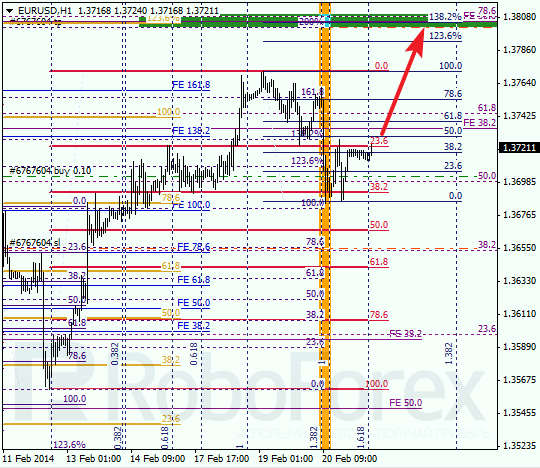
Euro is trying to finish current correction; pair rebounded from level of 78.6% and may start new ascending movement. Main target is still at 1.3800, where there are several important fibo-levels.

As we can see at H1 chart, current correction reached local level of 38.2%, which is right inside temporary fibo-zone. Main target is less than 100 pips away, so it may be reached by the end of the day.

USD CHF, “US Dollar vs Swiss Franc”

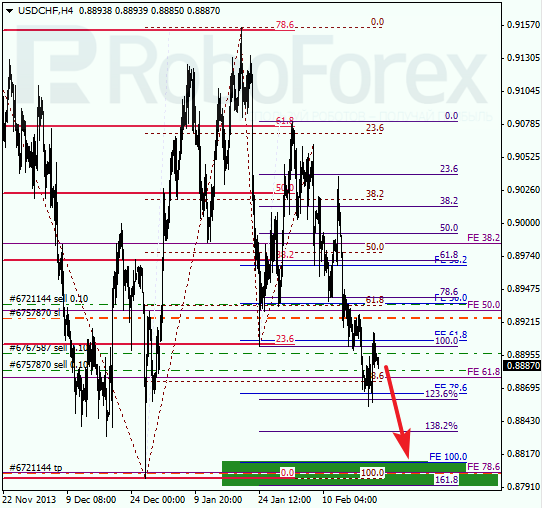
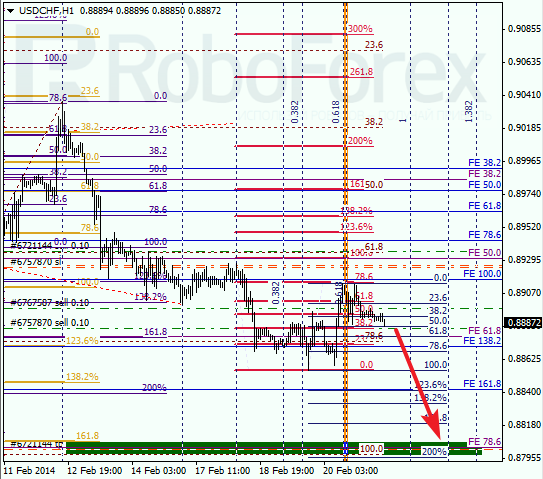
Franc is still controlled by bears; local correction was supported by one of intermediate fibo-levels. In the future, instrument is expected to start new descending movement towards 0.8800, where there are several fibo-levels.

As we can see at H1 chart, current correction reached local level of 78.6% and rebounded from it. In the nearest future, bears may reach new minimum and then continue pushing price downwards to reach targets in lower part of H1 chart. Later these levels may become starting point of new correction.

RoboForex Analytical Department

Article By RoboForex.com

Attention!
Forecasts presented in this section only reflect the author’s private opinion and should not be considered as guidance for trading. RoboForex LP bears no responsibility for trading results based on trading recommendations described in these analytical reviews.


Clerical Error Awards Every Employee $345 Million

By WallStreetDaily.com Clerical Error Awards Every Employee $345 Million

“Markets can remain irrational a lot longer than you and I can remain solvent.”

So said John Maynard Keynes, the famous British economist. And right now, irrationality certainly reigns in Silicon Valley.

So much so, in fact, that I’m officially renaming it “Silly Valley.” Because that’s the only way to characterize the valuations being paid.

In this week’s Friday Charts edition, I’m going to prove just how downright silly it’s gotten.

Prepare to be stupefied…

Nineteen. Billion. Dollars.

That’s an amount equal to the entire economy of Nicaragua, seven and a half Mark Cubans, roughly one-third of the market cap of leading automaker, Ford Motor (F)… and now, what Facebook (FB) is paying for text messaging service, WhatsApp.

Yes, a text messaging company, with only 55 employees, just fetched a $19-billion takeover offer. That works out to $345 million per employee.

It has to be a mistake, right? The biggest clerical error in history? An accidental extra digit in the offer sheet?

Nope! Fact is, the deal represents the largest venture-backed takeover in Silicon Valley. Ever.


Utter absurdity! So what is Facebook’s hoodie-wearing head honcho, Mark Zuckerberg, thinking?

Well, he knows long-term success in the social media world is all about engagement. Lose it and the next stop is the plot beside MySpace in the internet graveyard.

And WhatsApp definitely boasts engaged users. Way more than all the other fledging, social media startups. Take a look:


Even with 450 million active monthly users, though, the purchase price doesn’t jive with reality.

Consider: When Facebook acquired photo-sharing startup, Instagram, for $1 billion, it paid roughly $30 per user. Now, less than two years later, the company is paying $42 per user, or 40% more, for WhatsApp. That’s a hefty increase in such a short period of time.

The price tag becomes all the more absurd when you realize WhatsApp’s monetization strategy involves charging users a measly $1 per year after a year of free use.

Mind you, these are users who rely on WhatsApp to bypass charges from mobile phone companies to send text messages for free over the internet.

Now, paying $42 for the right to earn $1 doesn’t make any sense in a rational world. But paying that much for a bunch of freeloaders doesn’t make any sense – period.

Even Facebook executives can’t justify it.

When Jefferies’ analyst, Youssef Squali, asked how they came up with the purchase price, CFO David Ebersman said the primary thing was “how healthy this network is and how it’s growing.”

Funny. But I don’t see a formula in Excel that lets me take into account those variables to arrive at a valuation. Must be some newfangled math, practiced only in Silicon Valley, that’s going to be included in the next update.

The silly valuations in the valley don’t stop with Facebook, though. Tesla Motors (TSLA) is getting in on the action, too.

Too Far, Too Fast

I know it appears that I was completely wrong for taking a bearish stance toward Tesla on CNBC’s Closing Bell on December 16, 2013. (The stock is up 30% since then.)

But I stand by my conviction – a day of reckoning is inevitable. And the numbers prove it.

On the heels of its quarterly report this week, Tesla traded to a new all-time high of $215.12 per share, equal to a market cap of more than $26 billion.

Mind you, the company only sold 22,477 cars last year. If we do the math, that works out to $1.17 million in market cap per car sold.

I get that Tesla boasts gross margins that are 10% higher than Ford, for example. But that’s still way too much of a premium valuation.

Truth be told, at current levels, the stock’s not even trading in the same galaxy as every other major automaker. And remember, Tesla is still just a car manufacturer.


Naysayers will quip that it’s all about future growth. Oh yeah? If we take into account management’s estimates for up to 40,000 vehicle sales in 2014, the company is still valued at an absurd $654,000 per car.

Even if we assume that the company keeps increasing production at the same breakneck pace, it would take more than five years to grow into its current valuation and trade at a level on par with other premium automakers like BMW and Mercedes Daimler AG.

Like I said, absurdity reigns in Silicon Valley. In situations like this, I’ve found it’s best to keep my hard-earned capital out of harm’s way.

Care to disagree? Then let me know why by dropping us a line here. While you’re at it, feel free to let us know what you think about any of our recent work at Wall Street Daily, too.

Ahead of the tape,

Louis Basenese

The post Clerical Error Awards Every Employee $345 Million appeared first on Wall Street Daily.

Article By WallStreetDaily.com

Original Article: Clerical Error Awards Every Employee $345 Million

EUR/USD News Trading – US Labor Market

Article by Investazor.com

Do you know why the Non-Farm Payrolls is one of the most important macro indicators, if not THE most important? Well, it has always been considered of a major importance, but in the last six years it has become the most expected publication of the month among investors. So, how did this happen?

Shortly after Ben Bernanke became the chairman of the Federal Reserve, the financial crisis broke out and the Central Bank of the biggest economy of the world had to come up with some measures which should fix the “broken circuits”. The FED established two objectives, to improve the labor market by creating jobs (and also reducing the unemployment rate close to 6.5%) and stabilize inflation around 2%. The first one had a bigger consideration. Hence, which was the indicator that shows how many new jobs had been created in every month? Exactly, the Nonfarm Payrolls.

Now, let’s talk about this indicator in more detail. The Nonfarm Payrolls or NFP, how it is usually abbreviated, is the change in the number of the employed people during the previous month, excluding the farming industry and it is released monthly, usually on the first Friday after the month ends. So, this combination of importance and earliness of release contribute to the major impact it has on the markets. Why is this indicator so important and markets really care about it? Because job creation is a crucial leading indicator of consumer spending, which represents the majority of the overall economic activity.

Another aspect you should bear in mind is that with two days before the publication of NFP, a governmental report called ADP is issued, which is kind of a preface of NFP, but they are not always correlated. For an example, last month the ADP came above expectations and two days later the NFP heavily disappointed with a way below expectations figure.  Your trading strategies should follow the following fundamental logic and I will take as an example EURUSD as it is the most tradable instrument in the world with a 24.1% of the global trading volume in 2013.

First of all, as in the case of every macro indicator, we have to focus on the forecasted value and the actual value. If the actual value will be reported above the expectations, then the American labor market is improving which means a stronger economy. The effect will be that the US dollar appreciates because investors will buy USD and sell EUR, causing EURUSD to drop. On the other hand, if the actual value is below the expectations, the major objective of the FED is more far away, so the economy isn’t that healthy the markets were expecting and the disappointed investors will sell USD and buy EUR, which means that overall EURUSD will appreciate.

Also, it makes for a big difference in the trading game to not overrate the effect of the NFP report because its publication has to be judged in the economical context of every month. As an example, in both January and February the NFP disappointed investors with a way below expectations figure, but the February one had less impact than the January because the markets kind of expected it. Why? The answer is that these weak numbers were caused by a seasonal external factor, which is the extremely cold weather the United States experienced this winter.

It is important to master this kind of subtleties and apply them in your trading strategies as you will become more profitable in time. I am ending this article telling you to be careful with your trading strategies when the NFP is released next month and beware of the markets mood.

The post EUR/USD News Trading – US Labor Market appeared first on investazor.com.

A 19 Billion Dollar Small-Cap Winner

By MoneyMorning.com.au

As an investor, analyst and market-watcher there’s nothing we find more exciting in the world of finance than small-cap stocks.

We know, small-cap investing doesn’t sound very sophisticated.

It doesn’t have the same mystique as FX or bond trading. And you won’t find many small-cap analysts occupying the guest seat on Bloomberg or CNBC.

But give us small-cap stocks any day. Whatever the industry, we don’t care. All we want to know is that whatever company we analyse has the potential for investors to use small stakes to make big returns.

That’s exactly what we’re seeing in the small-cap sector today, and a US$19 billion ‘small-cap’ takeover proves it…

You probably think we’ve gone bonkers. How on earth can a US$19 billion takeover be a ‘small-cap’ opportunity?

After all, applied to the Aussie market, there are only 12 stocks on the ASX with a market cap greater than US$19 billion. Those stocks are the likes of BHP Billiton [ASX:BHP], Commonwealth Bank of Australia [ASX:CBA], and Woodside Petroleum [ASX:WPL].

And yet when we refer to a US$19 billion small-cap takeover we mean it. Let us explain.

A Great Deal if Revenue and Profits Don’t Worry You

You’ve probably seen the news. Social networking giant Facebook Inc [NASDAQ:FB] is paying US$19 billion for mobile messaging firm WhatsApp Inc.

Founders Jan Koum and Brian Acton set up WhatsApp in 2009. Since then they have built up a customer base of 450 million people around the world.

A measure of the company’s success and growth is that they’re adding one million new users per day to their messaging service.

It’s a great business. Well, OK, it’s only a great business if things like revenue and profits don’t concern you. WhatsApp has negligible revenue so far as it provides its messaging service for free in the first year and only charges a nominal $1 for each subsequent year.

For that, Facebook is paying – we’ll say it again – US$19 billion in cash and shares. That values WhatsApp at about one-tenth the size of Facebook, and even if we assumed all of WhatsApp’s users paid one dollar per year (which they don’t), it would still be barely one-twentieth of Facebook’s revenue last year of US$7.9 billion.

So, what’s going on and what’s the takeaway from this?

Most analysts and investors will look at those numbers and scoff.

They’ll laugh at the expensive valuation. They’ll scratch their heads and wonder just how WhatsApp and Facebook can possibly make any money from providing a free messaging service.

And they’ll raise their noses in the air and tell their clients not to invest in such crazy ideas.

Well, that’s up to them. But as a speculator, as someone who enjoys the thrill of finding tiny opportunities that could one day turn into multi-billion dollar takeover targets, we love it.

Because despite the current price tag, WhatsApp is a small-cap story from start to finish.

There’s Only One Way to Get These Returns

You may not remember this far back, but when Facebook floated on the NASDAQ exchange back in 2012, we were one of the few analysts who suggested investors should go ahead and have a punt. We said the same thing about the Twitter [NASDAQ:TWTR] float last year.

That flew right in the face of the mainstream, who said they’d never touch Facebook or Twitter shares with a bargepole.

For a while they were probably right. Facebook shares sank for the better part of a year after listing. But around the middle of last year things started to turn as the company’s mobile advertising strategy began to pay off.

Over the past year Facebook shares have gained 140%. That’s a poke in the eye to those who say there’s no money investing in tech and social networking stocks. And after a poor start, Twitter is up 26.1% since it listed, beating the S&P 500 by 21 percentage points.

But if you think that’s a pretty good return, consider the return for the private equity firms that invested in WhatsApp.

As we mentioned, WhatsApp has only been around since 2009. Two years later in 2011, venture capital firm Sequoia Capital poured $8 million into the company in return for a 15% stake in the company. If you do that maths, that investment effectively valued WhatsApp at US$53.3 million.

That’s a small-cap valuation.

Now Sequoia Capital’s investment is worth US$2.85 billion. So when it cashes in its chips following the Facebook takeover, it will have made a 35,525% return on the initial stake.

That’s a small-cap style return.

Big Returns are There for the Taking

Of course, everyone would like to make a 35,525% return. But not everyone has the bottle to take the risk in advance.

Think about it. If founders Jan Koum and Brian Acton had approached you in 2009 saying they were after investors for a product they would provide for free, that wouldn’t contain any advertising, and that if customers stuck around for a second year of using this service they would pay just one dollar, would you have invested in their business idea?

Most people wouldn’t. And yet that’s the kind of risk small-cap investors take on a daily basis.

Many small-cap stocks have little more to their name than the promise of future riches. Sometimes the companies break that promise as they don’t reach their potential.

But sometimes the companies keep their promise and the stock takes off. Maybe you don’t get the 35,525% returns. Those gains are hard to come by. But if you have the attitude to risk that you need to be a small-cap investor, then big triple- or quadruple digit percentage gains aren’t just possible, they’re there for the taking.

That’s what small-cap investors search for…constantly. They’re after the opportunity to make big gains. And as the Facebook and WhatsApp deal show, these kinds of big transactions can happen.

As a risk versus reward proposition that’s pretty good in our book. So, pin-stripers on Martin Place can deal with what they consider to be the ‘sexy’ stuff such as derivatives. Good luck to them. But we’ll stick with what we know best, and with what we know works best in terms of speculation…and that’s small-cap stocks.

You don’t get US$19 billion small-cap takeovers every day, but when you see them, and you see where the target company has come from, it’s a great vindication for those looking to <a
rel=”nofollow” href=”http://ift.tt/1dU9JQv” target=”_blank”>build speculative wealth in the tiny end of the market.

Cheers,
Kris+

Special Report: 2014 Predicted

Join Money Morning on Google+


By MoneyMorning.com.au

How the US Fed Conquered the Markets

By MoneyMorning.com.au

There’s something strangely appealing to me about a symmetrical chart. As an investor, I’m always looking to see what trends can tell me about the future. Is there method in the madness? …And how can I profit?

What follows is probably the most important chart for any investor today – the 10-year US treasury interest rate. It’s what investors demand in return for lending the US government their hard-earned cash for a period of 10 years.

Why is it so important? Well essentially, it’s this asset that determines the price of all other assets. If this chart takes off then – all other things being equal – just about every other asset will tumble.

So, what information can we glean from this wonderfully symmetrical chart? And should we be concerned about that little inflection you can see right at the end?

Up and Down: 60 years of Faith in the System


Source: St Louis Fed, MoneyWeek edits
Click to enlarge

The chart above pretty much plots our confidence in the system – that is, how much we investors trust the government. How much do we ask in compensation for lending to these guys?

Well as you can see, following the Second World War – the far left of the chart – belief in the US government was strong. The rate on the 10-year treasury was as low as it is today. The system was working…and working well.

From this point, it took some 27 years for successive governments to lose all faith.

The 70s were particularly unkind to the US. Both investors and the public lost confidence in the system and inflation spiralled. As you can see, rates on government bonds went through the roof as a result.

The situation was much the same in the UK. Higher rates led to recession (represented by the grey bars in the chart) and the outlook was grim.

First Came The Years of Plenty

Then in 1979, Paul Volcker took the reins at the US Fed. Together with Reagan’s government, he set about rebuilding faith in the system. Pursuing monetarist policies (a strong currency…the opposite of what we have today!) they began to restore confidence in money itself. No matter what your political opinion, the chart is pretty unequivocal…in the years that followed, investors were increasingly happy to lend to the government…and to do so at an ever-reducing rate.

Again, this downward slope on government yields was similar for much of the West. Triumph in the Cold War, the fall of socialism and growing faith in the capitalist system all helped to win over investors.

Academics even came out with hypotheses suggesting that lending to government was risk-free. As such, pension funds and insurers filled their boots. Rates on government bonds went down, governments borrowed with impunity…everyone was happy.

But our Time was up – and Markets Crashed

Well, following decades of falling yields on government bonds, the time finally came. A meltdown in the capital markets wiped trillions off the value of everything.

And as we all know – rather than risk shaking the faith – the central planners went about falsifying the yield curve. They printed more and more money to buy government bonds and force rates to stay low. That was, and is still, their plan.

Many players in the markets fear that the yield curve is about to break out and head north. Tapering talk has already started the process…you see, at the far right of the chart? Yields are rising!

The Central Planners Can’t Stop Now

But it is my contention that the yield curve cannot be allowed to be set loose. That would surely bring about a meltdown in the system. This is why I maintain my position that tapering is a con. 

Of course there will be ramifications to all of this money printing. In fact I suspect that’s what’s spurring on the gold market right now.

Now, let’s look at the chart again. Our central planners are hardly likely to let the last 27 years of hard work go to waste, are they? The last five years have proved that. Then again, if you think these guys really are about to let go – and many investors do – you should place your bets accordingly. What does that mean? Sell up…and sit on cash.

As for me, however, I’m staying put. I’m aboard the planners’ rollercoaster. It’s going to be quite a ride, as these boys fight the markets at every turn trying to keep that damned yield curve from rising! But I just don’t believe that after decades of keeping rates low, central planners are going to throw in the towel that easily…so I’m staying in the stocks game.

Bengt Saelensminde,
Contributing Editor, Money Morning

Ed note: The above article was originally published in MoneyWeek.

Join Money Morning on Google+


By MoneyMorning.com.au

Uranium Supply Disruptions Spell Opportunity for Investors: David Talbot

Source: Tom Armistead of The Energy Report  (2/20/14)

http://www.theenergyreport.com/pub/na/uranium-supply-disruptions-spell-opportunity-for-investors-david-talbot

A supply crisis is looming in the uranium industry, and today’s uranium price, stagnant at an eight-year low, will shoot up quickly when restarts of Japanese nuclear power plants bring back demand with a vengeance, David Talbot tells The Energy Report. Talbot, a geologist and senior mining analyst at Dundee Capital Markets, is excited about the potential of Canada’s Athabasca Basin, the world’s most prolific uranium source. But beyond the pounds in the ground, he sees money to be made in undervalued companies.

The Energy Report: David, welcome. Let’s start with the big picture: What is the general outlook for uranium in 2014?

David Talbot: Thank you, Tom. The long-term outlook on the uranium market remains the same at US$65/pound ($65/lb) U3O8. I think a new reality in the near term has set in. The uranium price has dropped significantly and now appears stable at levels not seen for almost eight years. We believe much of this has to do with the lagging Japanese restarts, cash-strapped sellers impacting the market and probably most important, near-term demand is lacking. We do expect uranium prices to rise, and relatively quickly when they do, but for right now, uranium prices will remain leveraged to the news of the Japanese reactor restarts and a return to term contracting by utilities.

Energy Fuels Inc. is one of our favorite stocks in a low uranium price environment.

This thesis underpins our $42/lb price estimate for the year, with prices to about $48/lb by Q4/14. When restarts might occur remains the million-dollar question, perhaps starting mid-2014, but the indicators out of Japan are that the government is committed to bringing its nuclear fleet back online now as the 17th and 18th reactors have applied for their restarts. We’ve had ongoing reviews. They were expected to take about three to six months, and now we’re in month eight. So when they start isn’t quite certain, but they are moving in the right direction. Their return should actually coincide with the return in contracting, almost completely absent last year as massive uranium requirements loom. We’re seeing about 180 million pounds (180 Mlb) due, expected by the 2016–2018 period.

TER: What are the major influences in the uranium market today?

DT: Supply remains a wild card and probably the most important factor, hence the focus of our recent comprehensive sector report. Mines are currently being taken offline, deferred or cancelled altogether. But long-term fundamentals underpin our belief that a uranium supply deficit starting in 2016 will likely increase by 2020, at which time we think we’ll see a deficit of about 16 Mlb. So we remain adamant that uranium supply is threatened by current uranium prices, regardless of the difficulties of the mining industry and challenges in permitting. This continues to set the stage for the supply crisis, particularly in light of dwindling secondary supplies as the Highly-Enriched Uranium (HEU) Purchase Agreement has come to a close, taking 24 Mlb/year with it.

The other part of the story is timing. We anticipate Japanese restarts to be the catalyst to kick-start uranium buying and contracting, but the lack of deals in 2013 resulted in the elevated uranium requirements that utilities have mentioned. This means that once the pendulum shifts back, it will shift quickly, and prices will probably rise at quite a torrid pace.

TER: Do you expect that 16-Mlb deficit in 2020 to draw more explorers and producers to the industry, or just to create more opportunity for the current players?

DT: Once the 16-Mlb deficit comes closer, we would expect development for some projects to perhaps expedite on the back of stronger uranium prices. But most of the new supply we see over the next few years is from existing producers, mainly expansion of existing projects, Ranger 3 Deeps, for example, or Cigar Lake. We do model some marginal players coming on-line, like Toro Resources Corp.’s (TRK:TSX.V) Wiluna project, or perhaps with some of Energy Fuels Inc.’s (EFR:TSX; EFRFF:OTCQX; UUUU:NYSE.MKT) conventional assets in the U.S. But that’s a relatively small amount of production and certainly not enough to close the gap. We do think that uranium prices are going to be what’s required to incentivize investors. Certainly, there will be a new set of explorers set up as exploration funding comes in. Just look at the explosion of junior exploration companies around the Patterson Lake South discovery. So should uranium prices rise, we would expect investment in the sector and exploration spending to increase.

TER: What was the mood at the NEI Nuclear Fuel Supply Forum in Washington, D.C., in January?

DT: Remember that the Nuclear Energy Institute is an American association that promotes nuclear power to Congress, the White House, state policy forums and the general public. So its message is typically well scripted and relatively even-keeled, and delivered nonpromotionally. I think that feelings were mixed. There were a few uranium-sector participants. In late January, the sector was flying high, so sentiment was generally positive. This was also after the Uranium Participation Corp. (U:TSX)financing, which more than suggests that investors will be coming into the sector shortly as Uranium Participation is mandated to spend about 85% of its raise on purchasing uranium. So at that time, the stocks were doing quite well, and the fundamentals of supply and demand are generally unquestioned by that group of people.

Richard Myers discussed the U.S. nuclear program. He’s vice president of policy development at NEI. His message was similar to the one he provided last year at the World Nuclear Association Symposium in London. He started by saying U.S. nuclear power plants are operating well at about 90% of their capacity factor.

Right now in the U.S., they are currently shutting five reactors. These are typically older, smaller, single units that are mostly at risk but, also, larger, multi-unit sites are struggling under current regulations. Essentially, electricity prices are being suppressed by state mandates and federal subsidies. So price signals right now are inadequate to support existing power plants and investment in new capacity. He suggested that all electricity should not be treated the same. Nuclear has some very important attributes that are not being monetized. It’s baseload; it provides grid stability, price stability, clean-air compliance, technical and fuel diversity and a huge tax base. So failure to address the importance of nuclear as baseload electricity will compromise reliability, introduce price volatility and frustrate efforts to decrease carbon emissions. This, of course, could have a negative impact on the U.S. uranium requirements, currently in the 45–50-Mlb range.

TER: Dundee Capital Markets was expecting 87 Mlb new production from 22 uranium operations between 2007 and 2013, but only 17.8 Mlb materialized. What happened there?

DT: I think this is the trend in the industry. You’ll see these plans to develop uranium projects and, ultimately, a fraction of that effort ever materializes. Many of those mines that we expected to come on-line in 2007 never started. In one or two instances, there were technical issues. The timing of that report also coincided with the global financial crisis in 2008, so that was certainly one of the main factors. Capital dried up. But in general, development is becoming much more expensive, with timelines for projects ranging up to 15 years or more between discovery and production. That’s because of several challenges that face the uranium space. You have increasing environmental and regulatory constraints. Public perception has darkened post-Fukushima. Significant community consultation is now required, and stringent radiological and groundwater controls are being put in place. Detailed tailings management plans are required, and comprehensive decommissioning strategies with upfront financial commitments are now commonplace.

TER: You mentioned the high costs of development. What role does the Canadian Non-Resident Ownership Policy play in that?

DT: That policy states that a foreign company cannot own 50% of a uranium project. This hasn’t concerned me too much in the past. It is just a policy. We have seen some companies get around that policy, not necessarily grandfathered but just moving toward the expectation that that policy will not be there when they need to go and get their licenses. For example, you have AREVA (AREVA:EPA) moving forward its Kiggavik development project in Nunavut Territory. You have Paladin Energy Ltd. (PDN:TSX; PDN:ASX) moving forward its big project in Labrador called Michelin, formerly an asset of Aurora Energy Resources Inc. More recently, we’ve seen Rio Tinto Plc (RIO:NYSE; RIO:ASX; RIO:LSE; RTPPF:OTCPK) come in and take out Hathor Exploration Ltd. for its Roughrider deposit. So there are foreign companies that are acting in Canada. They’re acting as if this policy will be overturned and, certainly, the Saskatchewan government would like to have it overturned.

TER: Is the uranium market heading for a wave of mergers and acquisitions (M&A) to achieve efficiencies of scale and maybe increase production capability in a low-price market?

DT: We do expect further consolidation. Financing is more difficult than ever. Project timelines are lengthy and costly. With some companies unable to secure supplies to advance projects, we expect further delays and/or corporate insolvencies. What often happens is the predator comes in and takes out its prey at pennies on the dollar relative to its underlying net asset value (NAV).

Many certainly look at Cameco (CCO:TSX; CCJ:NYSE) as the top predator. With about 1 billion pounds (1 Blb) in resources and reserves, it says it doesn’t need more pounds in the ground, but bolting on production makes a lot of sense to us. Cameco has long said it seeks more production growth in the U.S., and while some of that’s happening through organic growth, newer companies like Uranerz Energy Corp. (URZ:TSX; URZ:NYSE.MKT) and Ur-Energy Inc. (URE:TSX; URG:NYSE.MKT) look exciting to us. You also can’t count out Denison Mines Corp.’s (DML:TSX; DNN:NYSE.MKT) Phoenix project in the Athabasca Basin. Cameco is a partner there, but that’s the world’s third highest-grade project at 16% U3O8. There are about 60 Mlb there right now. Plus, Denison has interest in the McClean Lake mill, and I know Cameco would probably be interested in having a feed at the mill that is processing its own Cigar Lake ore.

TER: Energy Fuels is trading around CA$9.50 now, but your target is CA$17. Why is this company so undervalued?

DT: I think part of it has to do with the general downdraft in equities, but Energy Fuels, in particular, did have a few events leading into 2014 that put some pressure on the stock. That included a selloff after a four-month hold on its June 2013 private placement. Strathmore shareholders were selling post-deal, post-acquisition of Strathmore. There was also pressure after its 50:1 rollback, as expected. Another part of this could be just the general unfamiliarity with this name. This is a company that has a number of small-scale operations with different incentive price levels, all feeding into the White Mesa mill. So production is often not year-round, but happens in runs or batches. This combines with alternate feed material runs.

TER: What are Energy Fuels’ strengths and its weaknesses?

DT: I think Energy Fuels has several strengths that make it one of our top picks. It is one of our favorite stocks in a low uranium price environment, as the company is effectively 100% hedged at around $60/lb uranium. But we also like it for its significant leverage to rising uranium prices, given its ability to easily turn on its brownfield projects at minimal cost. Primary standby mines—Pandora, Beaver, Daneros—all have potential to produce between 200–500 thousand pounds (200–500 Klb)/year. Canyon could add another 500 Klb/year once it’s developed. So its White Mesa mill has a license capacity of 2,000 tons per day and can produce about 8 Mlb/year. Costs have also come down about 18% quarter over quarter to $32/lb.

But there are some risks, of course, with small, higher-cost conventional mines. The production profile hinges on milling and trucking costs. So with about 50% of our valuation dedicated to these projects and then 50% delegated to greenfield projects, development risks must also be taken into account. Those include permitting, financing, economics, timelines and so on.

TER: What is the significance of the Patterson Lake South discovery for Fission Uranium Corp. (FCU:TSX.V)?

DT: We believe the Patterson Lake South discovery is very significant, probably the largest since Hathor’s Roughrider discovery, and we all know what happened with that one. It sold for $680 million ($680 M) to Rio Tinto. At that time, it wasn’t much bigger than where we think Patterson Lake South is now. So we do have a Buy on Fission as a result of its Patterson Lake South project. It’s shallow, high grade, thick; it has all the hallmarks of a great project. Not only that, but it’s also located in the Athabasca Basin, which hosts a supportive government, excellent infrastructure, capacity at existing mills and a solid permitting framework.

At Patterson Lake South right now, all six zones lie at or near the surface, and they are only drill limited at this point; they’re not cut off. We anticipate that several of these zones will probably tie together, creating a much larger, single deposit. It’s still in the early stages of delineation. Aggressive drilling is underway in preparation for an initial resource. We speculate we might see that early next year. Right now, we estimate about 43 Mlb grading 2% uranium. The grade goes up significantly if we use a higher cutoff grade, but the pounds in the ground aren’t impacted that much. So right now, it’s looking like a great, high-grade uranium deposit.

TER: Does that make Fission Uranium a likely takeout target?

DT: We’ve always felt that Fission is a potential takeover target. Given its grades and shallow depth, Patterson Lake South has potential to become an economic deposit, capable of supporting not only construction of a mill. But, also, perhaps even more attractive is that this near-surface deposit may require relatively smaller upfront capital and could provide feed to an existing mill and be run at irregular intervals, essentially delivering high-value material over great distances when it’s necessary. So we believe that Patterson Lake South and Fission, for that matter, make sense as a target for anybody that wants to set up shop in what is the underexplored western side of the Athabasca Basin.

TER: You changed your rating on UEX Corp. (UEX:TSX) very quickly. Why?

DT: We did an about-face on UEX not long after reducing our target and recommending it as a Neutral due to unexpected news of a slowdown and competition from fresh discoveries, like Patterson Lake South. But we now rate UEX as a Buy with an $8 target price. While we didn’t change our discounted cash flow model, the new CEO, Roger Lemaitre, brings depth to this company that it hasn’t seen before. With his vast industry experience as Cameco’s exploration director and the fact that UEX has almost $9M in cash, I think he’s going to turn the company’s attention to new discoveries and potential M&A activity. His familiarity with Cameco is certainly an asset. But I think we still need to see some execution here by UEX to leverage its attributable 85 Mlb in resource plus its past exploration success into something new and accretive for shareholders. Meanwhile, Shea Creek is open in multiple directions. It does have a current resource of about 96 Mlb. As UEX decides to take its direction, I think it will remain focused on the Athabasca Basin. I think it will likely seek synergistic projects.

TER: Are you excited about any other uranium companies?

DT: There are two others. Ur-Energy—we have a Buy on this one. It has a $2.20 target price. Ur-Energy is our top pick in the sector right now. This is a U.S.-based, Wyoming-based, in-situ recovery producer. It officially entered production last year. Early indications are the well fields are performing exceptionally well. It produced 135 Klb last year. We expect about 1 Mlb this year, 1.2 Mlb next. Flow rates and front end are operating above expectations. The back end elution and precipitation circuits are performing as designed. Notably, head grades have been significantly above expectation, leading to less header houses and volumes that are required, pointing to lower costs. Right now, the company sells about 40% of its production forward at about $60/lb between 2014 and 2016, so it makes Ur-Energy less sensitive to spot price fluctuations than some of its peers. It’s actually getting prices much, much higher than spot. It was in the $63/lb range for last quarter. Shirley Basin is another project it just purchased. That could be up next. It could come online by 2017, ramping up to 1 Mlb/year within a couple years there. Ur-Energy trades at a discount to its producer peers.

Another company here: We recently initiated full coverage on NexGen Energy Ltd. (NXE:TSX.V). We’re recommending it as a Buy, no target price. The company has two high-quality assets in the right locations. Rook I is adjacent to Fission Uranium’s Patterson Lake South discovery. NexGen could potentially have the best claims in the area aside from Fission itself. The second project is the Radio property. That’s located on the Roughrider Midwest trend on the eastern side of the Athabasca Basin. That project is within 10 kilometers of 150 Mlb of uranium resources. First drilling at Rook I tested three conductors that lie directly east of Fission’s Patterson Lake South discovery in the Athabasca. With 12 holes, it hit the right graphitic basement rocks, shallow structures and modest alteration, and elevated uranium mineralization was confirmed in three holes and somewhat significant in one of those. Follow-up drilling has made a potential uranium discovery (pending assays) that is not only a game-changer for NexGen, but for the western side of the Athabasca Basin. What’s more impressive is that it was the first hole drilled into Target C, now called Arrow, that hit.

Further drilling is required and NexGen has suggested that it will commit more resources to follow up. The Radio project is essentially on hold with earn-in commitments delayed, allowing the company to focus on the Rook project. NexGen has experienced management and quite a deep technical team, including ex-Hathor and Rio Tinto geologists who really know the region.

TER: Do you have any parting thoughts to share on the uranium market generally?

DT: I think it all hinges on supply. Demand is relatively consistent. It’s predictable, Japan restarts notwithstanding. But I believe it’s the strengthening fundamentals based on supply that really drive this. Mines are closing. We’ve seen Zarechnoye close, La Sal, Beaver, Pandora, Daneros. Projects are being deferred, big projects including Olympic Dam, Trekkopje, Imouraren, Cameco’s Double U, plus no more Kazakhstan production. The HEU agreement is gone, and we’re getting unexpected disruptions, such as Ranger, Rossing, Cigar Lake and assets in Niger. So I think investors should focus on that. When uranium prices come back, I think they’re going to come back quite quickly, not because Japan is going to come back seeking supply but because the other 90% of the world hasn’t been buying like it should.

TER: Thanks for sharing your thoughts.

Dundee Capital Markets, V.P. and Senior Mining Analyst David Talbot worked for nine years as a geologist in the gold exploration industry in Northern Ontario. David joined Dundee’s research department in May 2003, and in the summer of 2007 he took over the role of analyzing the fast-growing uranium sector. David is a member of the Prospectors & Developers Association of Canada, the Society of Economic Geologists and graduated with distinction from the University of Western Ontario, with an Honors Bachelor of Science degree in geology.

Want to read more Energy Report interviews like this? Sign up for our free e-newsletter, and you’ll learn when new articles have been published. To see a list of recent interviews with industry analysts and commentators, visit our Interviews page.

DISCLOSURE:
1) Tom Armistead conducted this interview for The Energy Report and provides services to The Energy Report as an independent contractor. He or his family owns shares of the following companies mentioned in this interview: None.
2) The following companies mentioned in the interview are sponsors of The Energy Report: Energy Fuels Inc., Fission Uranium Corp., UEX Corp., Uranerz Energy Corp. Streetwise Reports does not accept stock in exchange for its services or as sponsorship payment.
3) David Talbot beneficially owns, has a financial interest in, or exercises investment discretion or control over, companies mentioned in this interview: Fission Uranium Corp. Dundee Capital Markets and its affiliates, in the aggregate, beneficially own 1% or more of a class of equity securities issued by, mentioned in this interview: Energy Fuels Inc. Dundee Capital Markets has provided investment banking services to companies mentioned in this interview in the past 12 months: Energy Fuels Inc., Uranerz Energy Corp., Denison Mines Corp. and Fission Uranium Corp. All disclosures and disclaimers are available on the Internet at www.dundeecapitalmarkets.com. Please refer to formal published research reports for all disclosures and disclaimers pertaining to companies under coverage and Dundee Capital Markets. The policy of Dundee Capital Markets with respect to Research reports is available on the Internet at www.dundeecapitalmarkets.com. I was not paid by Streetwise Reports for participating in this interview. Comments and opinions expressed are my own comments and opinions. I had the opportunity to review the interview for accuracy as of the date of the interview and am responsible for the content of the interview.
4) Interviews are edited for clarity. Streetwise Reports does not make editorial comments or change experts’ statements without their consent.
5) The interview does not constitute investment advice. Each reader is encouraged to consult with his or her individual financial professional and any action a reader takes as a result of information presented here is his or her own responsibility. By opening this page, each reader accepts and agrees to Streetwise Reports’ terms of use and full legal disclaimer.
6) From time to time, Streetwise Reports LLC and its directors, officers, employees or members of their families, as well as persons interviewed for articles and interviews on the site, may have a long or short position in securities mentioned and may make purchases and/or sales of those securities in the open market or otherwise.


Streetwise – The Energy Report is Copyright © 2014 by Streetwise Reports LLC. All rights are reserved. Streetwise Reports LLC hereby grants an unrestricted license to use or disseminate this copyrighted material (i) only in whole (and always including this disclaimer), but (ii) never in part.


Streetwise Reports LLC does not guarantee the accuracy or thoroughness of the information reported.


Streetwise Reports LLC receives a fee from companies that are listed on the home page in the In This Issue section. Their sponsor pages may be considered advertising for the purposes of 18 U.S.C. 1734.


Participating companies provide the logos used in The Energy Report. These logos are trademarks and are the property of the individual companies.


101 Second St., Suite 110
Petaluma, CA 94952

Tel.: (707) 981-8204
Fax: (707) 981-8998
Email: [email protected]


GBPJPY: Vulnerable But Retains Its Broader Long Term Uptrend Bias

GBPJPY – The cross remains biased to the upside in the medium and long terms but now faces corrective downside. In order for it to resume its uptrend, it will have to break above the 171.15/87 levels. A breach could force further upside towards the 172.50 level. Further out, resistance resides at the 173.64 level. Its daily RSI is bullish and pointing higher supporting this view. Conversely, support comes in at the 169.11 level where a break will aim at the 168.00 level and then the 167.19 level. Further down, support resides at the 166.14 level, its Feb 07 2014 low with a break targeting further downside towards the 166.00 level. All in all, the cross remains biased to the upside in the long term.

Article by www.fxtechstrategy.com


The Lay of the Land

Guest Post By Dennis Miller

Building your nest egg and managing it successfully takes more work than it did six years ago, but it isn’t a Sisyphean task. You can build a portfolio that will last the rest of your life.

Waiting for the political class to come to its senses is futile.

In 2008, Bloomberg reported:

“The S&P 500 slid 60.66 points … extending its 2008 tumble to 32 percent in the market’s worst yearly slump since 1937. The Dow Jones Industrial Average dropped 508.39, or 5.1 percent, to 9,447.11, giving it a 29 percent retreat in 2008 that would also be the worst in 71 years.”

Cut to the Fed’s economic rescue mission: anyone considering retirement found himself in bizarre world. Traditional, conservative investment options were wiped off the map. Millions of investors had no choice but to make drastically riskier investments and hope for the best. Which begs the question: Who was the Fed rescuing? Certainly not seniors and savers!

The recent book by John Mauldin and Jonathan Tepper, Code Red: How to Protect Your Savings from the Coming Crisis, confirmed my suspicion: the government forced us into this position by design. The authors write:

“Negative real rates act like a tax on savings. Inflation eats away at your money, and is in effect a tax by the (unelected!) central bankers on your hard-earned money. … Negative real rates force savers and investors to seek out riskier and riskier investments merely to tread water. … In fact, Bernanke openly acknowledges that his low interest-rate policy is designed to get savers and investors to take more chances with riskier investments. The fact that this is precisely the wrong thing for retirees and savers seems to be lost in their pursuit of market and economic gains.”

No wonder the stock market came back so quickly! Where else were seniors and savers going to go? Zero-interest-rate policy (ZIRP) means the yield on our safe CDs or Treasury bonds is negative, when inflation is factored in: we’re becoming poorer every day. Code Red tells us, “In a ZIRP world … savers are screwed.”

Hey, we get the point; we live it every day. There’s seemingly nowhere to go for ultra-safe yield. No matter how hard the government propaganda machine tries to convince us that happy days are here again, we know better.

The Federal Reserve has been telling us what to expect for the next several years.

In November 2013, Bloomberg reported:

“Federal Reserve Chairman Ben S. Bernanke said the Fed will probably hold down its target interest rate long after ending $85 billion in monthly bond buying, and possibly after unemployment falls below 6.5 percent.”

We are the targets. We are tired of inflation confiscating our life savings and damaging our standard of living. Our very economic survival requires a proactive stance.

Pushed by the Fed’s low-interest-rate policy, investors have poured billions into the stock and bond markets, creating a bubble.

The market is not trading on fundamentals. Savvy investors know the market is on thin ice, and as each passing month brings more treasury debt being bought by the Federal Reserve – , the ice gets thinner. But what is the alternative? Hope we are smart enough to get out ahead of everyone else when the bubble bursts? It’s as though the market has a hair trigger.

Look what happened when, in the summer of 2013, Chairman Bernanke hinted at “tapering.”

ShareCast tells us (emphasis in original):

“America’s three key US equity benchmarks ended the trading day firmly lower… after Federal Reserve Chairman Ben Bernanke signaled that the central bank could taper its quantitative easing program…

The Dow Jones Industrial Average contracted by 206 basis points to end the day at 15,112 while the Nasdaq Composite slid 39 basis points to 3,443 and the S&P 500 dropped by 23 basis points to 1,629.”

Talk about a hair trigger! He barely got those words out of his mouth before the market tanked. But this became a blessing for those who choose to look at reality.  The Federal Reserve has now resorted to a much softer message in order to calm the markets.  While they have decreased their rate of tapering, the fact remains they are still buying up $780 billion in US debt.  Many pundits are already predicting that, by mid summer, the Fed will pause their tapering as they realize the economy is not as strong as they may think.  We are a long way from having the market trade on business fundamentals.

How to Win in the New World Order

Some pundits suggest riding it out with a portfolio of the biggest, safest worldwide companies. After all, these companies have stayed in business through good and bad times and continued to pay their dividends. However, in a strong outgoing tide, even the best companies can take a beating.

If Bernanke’s comments can spook the market so easily, how can we expect investors to “hang in there” when the real bubble bursts? Can we count on a downturn of only 32%, as it was in 2008? Or will it be worse? Can we count on the market recovering in five short years? How long can investors hang on, hoping their stocks will come back?

The Dow peaked in September 1929 and didn’t fully recover until November 1954. Hang on for 25 years? Maybe younger folks can do that, but it’s much too risky for baby boomers and retirees.

Here’s my take-home statement: there is a better way.

The Lay of the Land

Let’s quickly review potential ways to invest.

  • Fixed-income investments alone will not do the job. Why tie up money for the long term when those investments are guaranteed to lag behind inflation?
  • Bonds have appreciated tremendously as interest rates tumbled. Should interest rates rise—which they will—our interest income will be overshadowed by losses in the share prices of the bonds in the aftermarket. Then we would have to hold the long-term bonds at below market interest rates or sell them at a loss; I’m not in love with either option.
  • The stock market is trading less on fundamentals and more on stimulus; it’s in a bubble and could easily collapse, and quickly. When everyone decides it’s time to head for the exits and beat the other guy, the computer trading platforms will not only put in sell orders, but also take massive short positions.

Margin debt is now at an all-time high; margin calls will trigger, and brokers will automatically sell from clients’ accounts to bring their margin back into balance. With computer trading, this could all happen in a matter of minutes… if not seconds.

Here’s how Code Red sums it up:

“If the government benefits from stealth taxes (meaning inflation), then who is the loser? … The biggest losers are savers and older people who rely on savings. Try retiring at 60 at today’s interest rates and watch as your buying power slowly erodes as you get older. It is down close to 25% in just ten years. But your taxes and fixed expenses will have gone up! … The Fed is not going to change its policy to help retirees and pension funds, so older people are left to fend for themselves. …

When central bankers give us words to describe their financial policies, they tell us exactly what they want their words to mean, but rarely do they tell us exactly the truth in plain English. They think we can’t handle the truth.

Who Is Screwed?

Three groups will be hurt. The first group will be those who don’t realize that the old ways of doing things no longer work and actually make things worse. Regular readers are familiar with the old “100 minus your age” rule. If you were 65, then 65% of your portfolio went in CDs and Treasuries, or so the story went. Try that today and watch your buying power vaporize by the hidden inflation tax!

The second group is those who go all in to the market. Their rationale is that stocks have outperformed other investment classes over the long term. This group will fly high while the Fed keeps them propped up, but will be taking huge risks when everyone tries to get out at the same time. With retirement money, you shouldn’t bet the farm hoping the market will recover quickly.

And finally, the third group is anyone who doesn’t see the writing on the wall and fails to take immediate, appropriate action. Unfortunately, this includes a lot of people.

So What Can Income Investors Do?

There are a number of solid investments out there that offer good return, with a minimal amount of risk exposure and that won’t move because of an arbitrary statement by the Fed. It’s not always easy to find them, but there is hope for people wondering what to do now that all of the old adages about retirement investing are no longer true.

There are three important facets of a strong portfolio: income, opportunities and safety measures. Miller’s Money Forever helps guide you through the better points of finance, and helps replace that income lost in our zero-interest-rate world – with minimal risk.

Pre-crash, if an investor bought a CD at the prevailing rate, and then interest rates rose during that period, he would not lament his loss in net asset value. He would be satisfied with the interest, and when his CD matured, he would buy another one at the current rate. So why do we look at bond funds, see our net asset value go down, and worry? Because most bond funds are always busy selling, baking in those losses along the way.

This is where the value of one of the best analyst teams in the world comes into focus. We focus on our subscribers’ income-investing needs, and I challenge our analysts to find safe, decent-yielding, fixed-income products that will not trade in tandem with the steroid-induced stock market—or alternatively, ones that will come back to life quickly if they do get knocked down with the market. They recently showed me seven different types of investments that met my criteria and still withstood our Five-Point Balancing Test.

My peers are of having holes blown in their retirement plans. While nuclear-bomb-shelter safe may be impossible, we still want a bulletproof plan.

This is what we’ve done at Money Forever: built a bulletproof, income-generating portfolio that will stand up to almost anything the market can throw at it.

It is time to evolve and learn about the vast market of income investments safe enough for even the most risk-wary retirees. Some investors may want to shoot for the moon, but we spent the bulk of our adult lives building our nest eggs; it’s time to let them work for us and enjoy retirement stress-free. Learn how to get in, now.


S&P500 Elliott Wave Analysis: Corrective Retracement

S&P500 has moved to a new high yesterday but then turned sharply down from 1845-1850 area where we were projecting a top zone for a complete five wave rally from 1732. As such, current reversal down is start of a minimum three wave retracement. Ideally this will be a simple zigzag that will look for a support around 1790-1800 zone after a retracement of 38.2% compared to recent bullish run.

S&P500 4h Elliott Wave Analysis

S&P500 One Hour

The S&P found some support ahead of the US session, but we see move up as small rally within incomplete bigger three wave decline. We see price now moving into Fibonacci resistance area. Be aware of a new push down as long as market trades beneath the yesterday highs.

S&P500 1h Elliott Wave Analysis

Written by www.ew-forecast.com

14 days trial just for €1 >> http://www.ew-forecast.com/register


WTI Falls from Four-Month High; China Manufacturing Drops

By HY Markets Forex Blog

West Texas Intermediate (WTI) futures were seen trading lower on Thursday, dropping from a four-month high seen in the previous session. Crude prices were dragged lower by China’s manufacturing data which dropped to a seven-month low. Crude traders will focus on the release of the US crude stockpiles report due later in the day.

The North American WTI crude for March delivery dropped 0.32% lower to $102.52 per barrel on the New York Mercantile Exchange at the time of writing, and was at $103.19 on Wednesday.

While Brent for April settlement slid 0.54% lower at $109.88 a barrel on the London-based ICE Futures Europe exchange at the same time. The European benchmark crude was at a premium of $7.33 to WTI for the same month.


WTI – China Manufacturing Data

HSBC Flash Purchasing Managers Index came in lower than expected as it dropped to a seven-month low of 48.3 points, compared to the previous reading of 49.6 points seen in January while analysts forecasted a reading of 49.5 points. Any reading below 50 indicates a reduction in activity.


US Crude Stockpiles

On Wednesday, the American Petroleum Institute (API) released the weekly petroleum stockpiles report which also showed a drop in crude stocks last week as imports declined and gasoline inventories increased.

Crude inventories declined by 473,000 barrels to 362.5 million in the week ending February 14, analysts forecasted an increase of 2 million barrels.

The report from the API also revealed crude inventories at Cushing, Oklahoma, declined by 1.8 million barrels.

Oil investors are focusing on the release of crude stockpiles report from the Energy Information Administration (EIA) for the previous week, which will be released later in the day.


Fed Minutes

On Wednesday, the official minutes from the Federal Open Market Committee (FOMC) January meeting were released and revealed that Fed members backed the decision to reduce the central bank’s monthly bond purchases by another $10 billion to $65 billion a month.

The minutes suggested that the FOMC policymakers decided to modify their commitment to keep their benchmark interest rate near zero as the unemployment rate approaches its 6.5% target.

The next Federal Open Market Committee meeting is scheduled for March 18-19.


Libya

The ongoing protest in Libya continues to weigh on the oil supply from the country’s largest oil field El Sharara as production dropped to 375,000 barrels per day, a spokesman from National Oil Corporation (NOC) confirmed.


Visit www.hymarkets.com   to find out more about our products and start trading today with only $50 using the latest trading technology today

The post WTI Falls from Four-Month High; China Manufacturing Drops appeared first on | HY Markets Official blog.

Article provided by HY Markets Forex Blog