Goodbye Banks, Hello the Future of Money: Crypto-currencies

By MoneyMorning.com.au

There’s a little known fact about crypto-currencies. Most people don’t realise they’re part of an entirely new global financial system, the ‘Cryptoconomy‘.

What If I were to tell you that there are 102 different crypto-currencies? And that around two weeks ago there were only 86? Their market caps range from $7.6 billion (Bitcoin) to $21,161 (RapidCoin). And then, just to make things even more interesting, 24 hour price fluctuations range from +253.19% to -26.74%.

On the 5th of February a new crypto-currency launched. Within the week MaxCoin had a market cap of $6.7 million. I’ve actually watched its market cap rise by $1 million in the last few hours…

Let me run you through a few of the crypto-currencies that are now available and exchangeable with ‘traditional money’. Of course there’s Bitcoin. Then there’s Ripples, the only other crypto-currency to exceed a $1 billion market cap. Then there’s Dogecoin, Quark, Vertcoin, SexCoin (I’m not joking) and…Unobtanium. These are just a few of the growing list.

With this many crypto-currencies, the billion dollar question is what does it all mean?

I’m going to set out three factors that answer that question, and explain why the new cryptoconomy is here to stay.

Factor #1 Bitcoin – the Big Bang of Crypto-currencies

You can attribute this explosion in crypto-currencies to Bitcoin. Bitcoin is the first crypto-currency; it’s the ‘Big Bang’. Bitcoin’s success has led to an entire universe of crypto-currency.

Bitcoin started because of the GFC. It’s an alternative medium of exchange based solely over the internet. Some call it a currency, some call it a digital commodity, some call it an investment. In reality it is – and isn’t – all of those at once.

It’s like nothing else the world has ever seen. And regulators and governments across the globe are struggling to make heads or tails of it.

Russia says Bitcoin is illegal, the US is looking to regulate it, and Norway has said it’s not real ‘money’. Meanwhile Bitcoin exchanges are being frozen and hacked while the price bounces around from $1,000 to $200 and everywhere in between. This morning it’s US$253, a long way from the peak of US$1,203 late last year.

No wonder people are confused.

Bitcoin gets a lot of media attention. Every major rise or fall is on the homepages of the Wall Street Journal, Bloomberg and the BBC. And both the positive and negative news make the price go up and down. It’s a bit of a self-fulfilling prophecy from time to time.

Regardless of the day to day insanity of Bitcoin, there’s a bigger picture in play. And that’s where the 101 other sizable crypto-currencies come into play. With any new kind of system, there has to be a pioneer. And in the case of the cryptoconomy, Bitcoin is that pioneer.

Factor #2 – The Rise of The Crowd

A reasonably important invention called the internet has completely changed everything. Its ability to connect everyone around the world is possibly the most influential technology ever.

And because of this connectivity, communities – ‘crowds’ – have grown all over the world. These crowds now place greater trust in each other than they do in any bank or government.

The evidence of this is in the success of companies like Zopa, SocietyOne and Lending Club. These are companies built on networks of people. The term used online is ‘peers’. And in this particular case people use the crowd to source loans from each other. Instead of going to banks, people are now getting loans from the crowd.

Then there’s CurrencyFair, MidPoint and TransferWise. These are all currency exchanges. You use them to exchange money. Except rather than getting stung by banks with margins and fees, they’re low cost, based online and also use peer-to-peer networks.

This explosion of peer-to-peer networks is possibly the most influential trend of the current decade.

It’s a concept of technology driven networks destabilising old, outdated bureaucratic systems.

You also see it with companies like AirBnb, Uber and AirTasker. They all use expanded, technology driven, social networks to connect online to get things done.

I personally use many of them. If I want a taxi, Uber is faster, safer and easier than most cabs (certainly the case in Melbourne). If I want accommodation anywhere in the world I turn to AirBnb. It offers simple, easy and affordable accommodation. And if I want to exchange AUD for GBP then I can do so with CurrencyFair. It’s cheaper, faster and easier than any of the Aussie banks.

In effect the internet has allowed people to regain power. Now more than ever we all have the ability to use the digital world to get things done. But that’s not all…

Factor #3 – The Financial Identity Crisis

The world has lost faith in banking systems around the world. In fact the entire global financial system looks and feels defunct. People don’t trust central banks, let alone the banks they have their hard earned savings sitting in day to day.

The whole financial system is suffering from an enormous identity crisis. Banks want to be tech companies. Why? Because that’s who we trust these days. Banks lost our trust about six years ago, and they never got it back.

The GFC crippled the world. It also crippled confidence in banks, central banks and governments. The effect is still rippling around the world. Global economies are in a perilous state and have been for a number of years.

People simply don’t trust that their money is secure…anywhere.

The banks don’t help themselves either. In September last year I attended one of the world’s biggest banking and finance conferences in the world, SIBOS. Held in Dubai, the likes of Barclays, CommBank, Wells Fargo and JP Morgan were there.

One of the clear takeaways from the conference was major banks don’t seriously appreciate the state they’re in. Financially some of them may have plenty of capital to be secure. But over the next 10 to 20 years they’re going to suffer from a bigger problem; having no customers.

I’m from generation Y, the beginning of a completely tech-dominated demographic. And each subsequent generation after Y is going to be more tech-savvy than the last.

Gen Y and subsequent generations are an enormous and growing consumer base. Banks need us as customers in the coming years, or they’ll die.

The interesting part is the lack of trust in banks, government and central banks.

The bank down the street is a necessity for now, but soon enough it won’t be. I have greater confidence in Amazon and PayPal than I do Lloyd’s or CommBank. And I can confidently say almost anyone born in the 1990s, 2000s and 2010s will have a similar feeling.

As each generation engages more with the technology available they start to drift away from the ‘traditional’ methods of the previous century. As mentioned before, what’s the point of a bank if you can store cash in an encrypted wallet, get a loan from the crowd, pay for goods online or even automatically with an app on your phone. What need is there for cash, cards…banks?

The Sum of All Parts Equals The Cryptoconomy

And these three factors come to a head with the current explosion of crypto-currency. If anything it’s the final piece of the puzzle for a whole new global economic system.

If you take the creation of Bitcoin, the rise of peer-to-peer and the great financial identity crisis, you get a perfect storm.

Now anyone with an understanding of cryptography and computer programming can ‘create’ their own unit of currency. Not only are these new crypto-currencies popping up everywhere, people are placing value in them.

Think about paper money, gold, and crypto-currencies. On the surface they’re all very different. But as money, or a store of wealth they’re all effectively the same thing. By that I mean the only value in each of them is what people believe their value to be.

If I place greater value in Bitcoin than gold, then that’s worth more to me. And if an entire community places greater value in Bitcoin than gold, then the value is even larger. And if the whole world places more value in it…you get the picture.

And that’s what’s happening now. People, peers – the crowd is placing greater value in these crypto-currencies than the paper money that sits in your wallet. As the community grows, so does the value attributed to these currencies.

Now the big problem in the short term is the saturation of new crypto-currencies. Too many varieties dilute the importance of the whole cryptoconomy.

However, many of them will die a quick and painless death. Security and safety issues will be the end of many. Government intervention and regulation might slow down others.

But crypto-currencies and the bigger cryptoconomy is here to stay. More and more merchants are accepting them as payment every day. All it takes is for an Amazon, Apple or Google to accept a crypto-currency for it to really take off.

20 years ago Bitcoin wouldn’t have worked. None of these crypto-currencies would have. The connected network wasn’t particularly dominant. There was no great global crisis. But now the perfect storm has arrived and the world is ready and desperate for a new, better economy.

The Cryptoconomy has arrived. It’s early days, but as it flourishes and simply becomes a way of life you’ll look back and wonder why anyone ever doubted it.

Regards,
Sam Volkering
Editor, Tech Insider

Join Money Morning on Google+


By MoneyMorning.com.au

Supply and Demand Key to Base Metals Success: Adam Low

Source: Kevin Michael Grace of The Gold Report  (2/19/14)

http://www.theaureport.com/pub/na/supply-and-demand-key-to-base-metals-success-adam-low

Adam Low of Raymond James believes that the outlook is excellent for zinc, good for copper and neutral for iron ore. In this interview with The Gold Report, he argues that it comes down to supply and demand. Copper supply may soon lag demand, and zinc demand, which is increasing steadily, will soon face a 10% decline in supply. Low suggests eight miners that should benefit from providing the metals the global economy will need to support future growth.

The Gold Report: Your 2014 prognosis for industrial metals is largely positive, correct?

Adam Low: Yes, although our view is not universal. We are most positive on copper and zinc, somewhat less enthusiastic about nickel. We’re fairly neutral on iron ore, although we do expect a bit of softening in iron ore prices.

TGR: Why do you like zinc?

AL: We are starting to see fundamental changes occurring in the market. This is a supply story. Zinc has been an unloved metal for decades. As a result, there has been very little investment, which means that six major mines in operation for decades have or will soon end production.

The first two, in Canada, closed in 2013. The next major shut down, scheduled for mid-2015, is MMG Inc.’s (1208:HK) Century mine in Australia, the world’s second-largest zinc mine.

TGR: How much global supply will be lost as a result?

AL: About 10%.

TGR: So prices will rise?

AL: Yes. Visible inventories on the London Metals Exchange, as well as on the Shanghai Futures Exchange, are down about 30% over the last year. And zinc demand is increasing steadily. There are some suggestions that we have a small zinc deficit already.

TGR: What are the supply and demand fundamentals in copper?

AL: I’d characterize the copper market as being infected with “short-termism.” Mine supply grew quite spectacularly in 2013: between 6% and 7%. How sustainable is that growth? In a couple of years, we could easily have the same problem we had a decade ago, when mine supply lagged behind demand.

TGR: Why would this happen?

AL: One-third of global copper supply comes from Chile. This country is increasingly constrained by power and water supplies; labor rates are rising as well. Chile’s state-owned copper enterprise, the Corporación Nacional del Cobre de Chile (CODELCO), produces about one-tenth of global copper, and it requires something on the order of $20–27 billion ($20–27B) in reinvestment over the next five or six years in order to maintain both current production and grow its production base. That will be quite difficult.

TGR: Why are you less enthusiastic about nickel?

AL: In the long term, we remain skeptical about that market. Indonesia, one of the world’s largest nickel miners, has implemented a ban on exports of raw ore, which curtailed a major source of global supply. Nevertheless, nickel has abundant visible inventories. It also has growing supply from long-beleaguered laterite projects now finally coming to fruition: Ambatovy, Koniambo and Onça Puma.

TGR: Why are iron ore prices softening?

AL: We expect supply growth from mines to outweigh demand growth, particularly as major mines start up in Australia and Brazil. At current prices, the industry is making phenomenal margins, more than 100%. At lower prices, companies at the high end of the cost curve will struggle, but the others should continue to do very well.

TGR: To what extent are higher base metal prices dependent on positive global economic news?

AL: Growth is a key factor. The U.S. economy appears to have improved, although I’m a little bit skeptical about just how robust or sustainable this growth is, especially now that the Federal Reserve has decided to reduce its bond buying.

TGR: How do you view the short-term economic prospects of China and Europe?

AL: In Europe, the latest purchasing manufacturers’ index is at its best since 2011. We are beginning to see some resurgence from some of the weakest economies, such as Greece. And Germany still looks good. Even so, I don’t think we can count on Europe being the key driver for world economic growth quite yet.

TGR: And China?

AL: China is still growing and from a larger base. So while its relative growth may be less impressive than it was, its absolute growth is still quite extraordinary. Any industrialized Western nation would be incredibly envious of “only” 6–7% GDP growth per year.

TGR: There is a growing concern that the equities markets are overheated, particularly with the Fed tapering quantitative easing. If there is a significant correction, will base metals equities follow suit, or could we see instead a flight to safety in metals?

AL: If there is a significant correction, we could see base metals equities follow suit, even though they didn’t enjoy the upside the rest of the market did. In the longer term, the widening gap between the growing demand and the dwindling supply of many base metals should spark a resurgence of investor interest in this sector.

TGR: Will base metals equities continue to lag prices in 2014?

AL: This trend should begin to correct. Base metals prices have been quite steady over the last year despite headlines that have generated fear and volatility. This steady price environment should provide investors with greater comfort about metals prices, which should, in turn, lead to greater confidence in investing in the equities.

TGR: What are Raymond James’ top base metals picks for 2014?

AL: In copper, our preferred stocks are Capstone Mining Corp. (CS:TSX)First Quantum Minerals Ltd. (FM:TSX; FQM:LSE)Nevsun Resources Ltd. (NSU:TSX; NSU:NYSE.MKT) and Rio Alto Mining Ltd. (RIO:TSX.V; RIO:BVL).

In zinc, Trevali Mining Corp. (TV:TSX; TREVF:OTCQX; TV:BVL), Nevsun and Lundin Mining Corp. (LUN:TSX).

In iron ore, Labrador Iron Ore Royalty Corporation (LIF.UN:TSX) and Alderon Iron Ore Corp. (ADV:TSX; AXX:NYSE.MKT).

TGR: First Quantum has announced production estimates for its Cobre Panama copper project significantly higher than those of previous owner Inmet Mining Corp. (IMN:TSX). Will this allay fears over its cost?

AL: The new Cobre Panama capital expenditure (capex) is $6.4B, only about 4% higher than Inmet’s former guidance. It has projected a design rate of 70 million tons (70 Mt)/year ore being processed versus Inmet’s 55 Mt/year. It is also projecting a higher throughput rate. So the capex is slightly higher, but the cash flows to be generated from the mine have been increased significantly.

Given the size of this project and the inflationary nature of this industry, the market has taken the view that Cobre Panama is actually very well managed.


TGR: When will Cobre Panama begin production?


AL: My colleague Alex Terentiew covers First Quantum, and he’s forecasting 2017–2018.


TGR: To what extent is the company’s future leveraged to Cobre Panama?


AL: First Quantum is now a fairly well-diversified company. It has done numerous acquisitions recently, and it has a base of operations that includes Australia, Africa, Europe and South America. Cobre Panama is certainly its largest growth project but not its only growth project; it has many other mines generating cash flow.


TGR: What distinguishes Cobre Panama from Barrick Gold Corp.’s (ABX:TSX; ABX:NYSE) Pascua Lama white elephant?


AL: First Quantum has a phenomenal record of executing major projects, including those that other companies have stumbled on. For instance, the Ravensthorpe nickel mine in Australia, which BHP Billiton Ltd. (BHP:NYSE; BHPLF:OTCPK), the world’s largest mining company, struggled with for many years. First Quantum bought it and got it operating at the rates it promised.


Unlike Barrick, First Quantum does much of its engineering and construction in-house. It uses teams it has used multiple times for projects around the world. It takes lessons from previous successes and replicates them elsewhere. It leverages a vast amount of experience and thus contains its costs.


TGR: What’s your rating for First Quantum?


AL: We have an Outperform rating and a $25 target price.


TGR: Nevsun has transitioned its Bisha mine in Eritrea from gold to copper. Has that been successful?


AL: Very much so. Bisha is a polymetallic volcanogenic massive sulfide deposit that had a gold oxide-rich cap. Nevsun was fortunate to produce that gold when prices were at their peak. It had a very successful commissioning period with the new copper plant in late 2013, with production coming in near the high end of its guidance and exceeding our estimates. It has already declared commercial production of copper.


TGR: And Nevsun pays a dividend of $0.07/share.


AL: Actually, it’s $0.07 twice annually, so you’re actually getting $0.14/year.


TGR: Why do you say that Nevsun trades at a significant discount?


AL: It trades at a significant discount relative to its peer group. Its valuation is cheaper based on key valuation metrics: price/cash flow, price/net asset value (NAV); enterprise value/earnings before interest, taxes, depreciation and amortization or price/earnings.


TGR: What explains this discount?


AL: Two key factors. First, country risk. Bisha is located in Eritrea, which suffers from a perception problem. I’ve been to Eritrea twice, and I’ve been impressed, both with Nevsun’s operation and its level of cooperation with the government, a 40% partner in Bisha.


Second, a mergers and acquisitions (M&A) overhang. This is probably a larger factor right now than geopolitical risk. Nevsun has about $300 million ($300M) in cash, no debt and it’s a one-asset company. This makes it a likely M&A suitor, and the company has been vocal about its intentions. M&A always involve risk, and we often see an acquirer’s share price trade down on an announcement, so investors are taking a cautious approach.


TGR: How does Nevsun overcome these obstacles?


AL: On Eritrea, we believe that the impressive cash flow accruing to the company over the next couple of years will force the market to re-evaluate its risk assessment.


With regard to M&A, Nevsun has been very prudent. It refrained from acquisitions when valuations were much higher than now. It doesn’t want to grow for growth’s sake. Its key criterion in evaluating potential acquisitions is return on investment. So a smart buy now could actually improve its valuation, as it would no longer be an all-eggs-in-one-basket company in a country that people don’t understand. If we look at recent examples, some base metals companies have had their share prices perform quite well after acquisitions, most notably Capstone and Lundin.


TGR: What’s your rating for Nevsun?


AL: We have an Outperform rating and a $5.50 target price.


TGR: Rio Alto’s La Arena mine in Peru is now a gold producer. When will it begin to mine copper, and what effect will that have on its future?


AL: Rio Alto has a relatively large copper-gold porphyry deposit at La Arena. Currently, it is a fairly significant gold producer, about 200,000 ounces per year. It has a gold oxide processing plant on site. That said, the future of La Arena really is more in copper. The transition will likely happen in 2016 or 2017. But if it were to find additional gold within its concessions, we could see the life of the gold mine extended.


We have a favorable view of La Arena’s copper project. We expect it to have a very low capital intensity, $11,000–14,000 per ton annual copper equivalent, about half the industry average. It can benefit from existing power and transportation infrastructure. As well, it can use the existing open-pit oxide deposit for the tailings during the startup of the copper. At current gold prices, it should be possible to fund the copper expansion using cash flow from the existing gold mine.


TGR: Will Rio Alto be aggressive in beginning new projects in Peru?


AL: La Arena is in a very prospective region of Peru. It is surrounded by many major gold mines, and its concession is relatively underexplored. Rio Alto most likely will look for potential gold oxide satellite deposits that could provide supplemental feed to its existing plant.


Longer term, future acquisitions wouldn’t surprise me, given its cash flow. But Rio Alto could be a potential acquisition target itself, given that we view it as an undervalued company with a good organic growth project.


TGR: What’s your rating for Rio Alto?


AL: Companies that transition to base metals from precious metals typically encounter trading volatility because these different sectors have different investor groups. However, companies with good projects should weather this volatility well. Nevsun managed a very similar transition quite well. We have an Outperform rating and a $3.50 target price.


TGR: Not long ago, Peru was seen as a country not friendly to mining. Has that changed?


AL: It’s hard to classify Peru as being friendly or unfriendly. Projects should be assessed on a case-by-case basis. Some areas have been opposed to mining, and we have seen violent protests. However, several mining companies have succeeded in Peru, despite its pitfalls of left-wing political parties and social community activism.


Rio Alto has flourished with a concentrated, hands-on, local approach, using a predominantly Peruvian management team. Even some members of its non-Peruvian management team have moved to the country.


TGR: Trevali is also in Peru, where its Santander zinc-lead-silver mine is about to begin commercial production.


AL: Trevali is the only pure-play producer listed on the Toronto Stock Exchange and one of a few in the world. By pure-play, I mean it will be generating the majority of its revenue from zinc. This is an enviable position. Because of the coming zinc scarcity I mentioned above, investors will be funneled into zinc equities to gain leverage to the zinc market. I’ve followed Trevali for about four years, and it is in a stronger position now than I’ve ever seen it. The Santander commissioning process has gone well, and its balance sheet is robust.


TGR: How do you rate its non-Peru operations?


AL: Trevali has quite a bit of organic growth potential through its other operations, particularly the Halfmile and Stratmat brownfield sites in New Brunswick, which it intends to restart in the next year or so. The bulk of our NAV for Trevali comes from New Brunswick. That’s where we’re going to see a lot of the value in this story start to accrue.


TGR: What’s your rating for Trevali?


AL: We have an Outperform rating and a $1.40 target price.


TGR: Capstone announced that it had met its overall 2013 copper production targets from its Pinto Valley, Cozamin and Minto mines in Arizona, Mexico and Yukon. Even so, shares fell 14% in January. Why?


AL: First, Capstone has been one of the best-performing stocks in the sector, so it faced some profit taking. Second, there has been some waning of momentum. Yes, it came in very close to its 2013 production guidance, but its 2014 production guidance was weaker, particularly for Minto, than we expected. Third, some lackluster economic data from China has caused a selloff in many base metals equities in the early part of this year.


TGR: What’s your rating for Capstone?


AL: We have a Strong Buy rating and a $4.25 target price.


TGR: What’s your outlook for Lundin?


AL: Lundin has a solid management team and a very steady portfolio of mining assets. It also has pretty good cash flow growth coming in soon from its stake in the Tenke Fungurume copper-cobalt mine in the Democratic Republic of the Congo, as well as from the startup of its Eagle copper-nickel mine in Michigan, recently acquired from Rio Tinto Plc (RIO:NYSE; RIO:ASX; RIO:LSE; RTPPF:OTCPK).


Like Nevsun and Trevali, Lundin should benefit from the coming zinc scarcity. It could leverage this by increasing production at its Neves-Corvo zinc-copper mine in Portugal.


TGR: What’s your rating for Lundin?


AL: We recently upgraded it from Market Perform to Outperform. Our target price is $6.25.


TGR: The various iron ore projects in the Labrador Trough have been bedeviled by transportation costs. How serious is this problem?


AL: I think it’s been overemphasized. There are already two existing railways in the region that supply existing ports, and both have upside capacity potential. Unfortunately, these railways are controlled by two companies that restrict access. The Cartier Railway is controlled by ArcelorMittal S.A. (MT:NYSE), and because it doesn’t cross any provincial boundaries, ArcelorMittal is under no obligation to provide third-party access.


The other route, Quebec North Shore and Labrador Railway, is owned by the privately held Iron Ore Company of Canada (IOC), Canada’s largest producer of iron ore pellets. That railway does cross provincial boundaries and is bound thereby to provide third-party access. But that access doesn’t come cheap. The challenge is to build a new railway to break the monopoly. Access to existing infrastructure is the reason why our preferred iron ore companies are Alderon and Labrador Iron Ore Royalty Corporation.


TGR: What do you like about Alderon?


AL: Alderon has a very good project, Kami, which, as noted, is close to an existing rail line. It has a top-notch management team poached from IOC and strong backing from China’s largest steel company, Hebei Iron & Steel Co. Ltd. (000709:CH). We think 2014 is going to be a monumental year for Alderon, as it will complete many milestones: receiving key permits, bringing on additional offtake and/or joint venture partners and securing financing for mine construction.


TGR: What’s your rating for Alderon?


AL: We have an Outperform rating and a target price of $2.60.


TGR: Why do you like Labrador Iron Ore Royalty?


AL: It owns 15.1% of IOC and gets a 7% revenue royalty on IOC’s production. So here you have a company that owns a stake in a mine that not only operates throughout the commodity cycle—IOC has been operating its current mine for five decades—but it also owns its own transportation infrastructure.


We see this company as one of the safer ways to play iron ore, and it’s also a dividend growth story due to an expansion that is underway at IOC. Its royalty payments should increase because IOC’s capital expenditures will decline, as that expansion is nearly completed.


TGR: What’s your rating for Labrador Iron Ore Royalty Corp.?


AL: We have an Outperform rating and a $37.25 target price.


TGR: Any other iron ore companies?


AL: Champion Iron Mines Limited (CHM:TSX) is still at the discovery stage. It has a very large tonnage but low-grade specular hematite and magnetite deposits at its Consolidated Fire Lake North project, which is close to the Cartier Railway. Its challenge is that its transition to production is hampered by a lack of interest from the capital markets in Canadian iron ore projects and ready access to infrastructure.


Mamba Minerals Ltd. (MAB:ASX) of Australia intends to buy Champion. Mamba’s chairman, Michael O’Keeffe, sold Riversdale Mining and its Mozambique coking coal project to Rio Tinto for $4B in 2011. Mamba will bring credibility and know-how to Champion in its transition from developer to producer.


TGR: What’s your rating for Champion?


AL: We have a Market Perform rating and a target price of $0.45.


TGR: What are the characteristics common to your top picks in base metals?


AL: Almost all are companies with current production. Cash flow is key to positive investor sentiment. We like companies with strong and stable balance sheets, such as you find with Nevsun, Capstone, First Quantum and Lundin.


TGR: Adam, thank you for your time and your insights.


Adam Low joined Raymond James Ltd. in April 2005 and is part of the equity research team covering mining and metals producers and developers. Prior to joining the firm, he was employed as a financial analyst with IBM. Low has a Bachelor of Commerce degree from the University of Manitoba and holds the Chartered Financial Analyst designation.


Want to read more Gold Report interviews like this? Sign up for our free e-newsletter, and you’ll learn when new articles have been published. To see a list of recent interviews with industry analysts and commentators, visit our Streetwise Interviews page.


DISCLOSURE:
1) Kevin Michael Grace conducted this interview for The Gold Report and provides services to The Gold Report as an independent contractor. He or his family own shares of the following companies mentioned in this interview: None.
2) The following companies mentioned in the interview are sponsors of The Gold Report: Trevali Mining Corp. and Champion Iron Ore Mines Ltd. Streetwise Reports does not accept stock in exchange for its services or as sponsorship payment.
3) Adam Low: I or my family own shares of the following companies mentioned in this interview: None. I personally am or my family is paid by the following companies mentioned in this interview: None. My company has a financial relationship with the following companies mentioned in this interview: Trevali Mining Corp. I was not paid by Streetwise Reports for participating in this interview. Comments and opinions expressed are my own comments and opinions. I had the opportunity to review the interview for accuracy as of the date of the interview and am responsible for the content of the interview.
4) Interviews are edited for clarity. Streetwise Reports does not make editorial comments or change experts’ statements without their consent.
5) The interview does not constitute investment advice. Each reader is encouraged to consult with his or her individual financial professional and any action a reader takes as a result of information presented here is his or her own responsibility. By opening this page, each reader accepts and agrees to Streetwise Reports’ terms of use and full legal disclaimer.
6) From time to time, Streetwise Reports LLC and its directors, officers, employees or members of their families, as well as persons interviewed for articles and interviews on the site, may have a long or short position in securities mentioned and may make purchases and/or sales of those securities in the open market or otherwise.


Streetwise – The Gold Report is Copyright © 2014 by Streetwise Reports LLC. All rights are reserved. Streetwise Reports LLC hereby grants an unrestricted license to use or disseminate this copyrighted material (i) only in whole (and always including this disclaimer), but (ii) never in part.


Streetwise Reports LLC does not guarantee the accuracy or thoroughness of the information reported.


Streetwise Reports LLC receives a fee from companies that are listed on the home page in the In This Issue section. Their sponsor pages may be considered advertising for the purposes of 18 U.S.C. 1734.


Participating companies provide the logos used in The Gold Report. These logos are trademarks and are the property of the individual companies.


101 Second St., Suite 110
Petaluma, CA 94952

Tel.: (707) 981-8999
Fax: (707) 981-8998
Email: [email protected]


Walking on the Moon

Guest Post By www.fxlight.co

Thinking about trading now I can see why many people fail. If you were born into a regular home with a regular upbringing then believe it or not you are at a disadvantage. Trying to operate in a trading environment and in a way that ordinarily brings success, a new trader will find himself in a constant state of anxiety, frustration and even fear.  Personally I remember ripping off a t-shirt in anger and frustration in 2009. It seems quite funny now!

It is funny because trading looks fairly simple on the face of it. However a trader’s frustration will continue until they acknowledge the simple fact that they are operating in a different environment. They must stop using methods that only work in the “normal” environment.  Astronauts on the moon at least had the rocket ship, the training and the hopes of a nation to persuade them that they were entering into a different environment.  However for a trader who still wakes up in the same bed and can walk around in his familiar physical environment, the only discernable clues that something is different is the different outcome.

You see old habits die hard and sometimes a new belief system can only be entertained after a trading disaster and a thorough mental reality check, which often coincides with a trading account being cleaned out too. Most of us have boundaries  where our lives are sort of predictable, and we go about the same tasks each day with little or no change and then sleep and wake up to another largely predictable day. Markets on the other hand are never ending and always changing. To borrow a well-worn phrase “Money Never Sleeps”. They are in constant motion and from the perspective of a new trader, almost without structure too. Each trading day is loaded with unlimited potential for profit and the effect is powerful. It can destroy a trader’s sense of security by forcing him in real time to confront reality. “The market is moving against me, I need to take a loss, but I can’t take another loss because I want to be a winner, so if I just stick with it like I did with other achievements in my life..” Where this need to win combined with old fashioned perseverance meets the fear of financial ruin, you will see a trader pacing up and down in the dark at night or getting into a car a driving far away, in order not to see the market prices changing. The need to face reality is being fought hard by other values that usually work in all other aspects of life. Sticking with it, not giving up etc.

In ordinary society time and effort are often associated with reward. “The harder I work the luckier I get” says the successful entrepreneur with a wink. Other jobs will offer a fixed salary which the worker will get irrespective of effort, the worker just needs to show up! In contrast the trading environment is not certain. Effort can be irrelevant and certainly there is no relationship between how many hours I looked at the screen and the amount of money I made, so sometimes even turning up to work doesn’t help. A trader can click a button just before non-farm payrolls and within seconds have his wildest dreams come true. Believe it or not even this can be a problem if the individual concerned was raised to think about money as a reward for effort. A sudden windfall may even conflict with their sense of religion. He may not say “I don’t deserve this” but through his subsequent trades he will find a way to “give the money back”.

So is it all doom and gloom? To perform in any activity whether it is a physical activity like a triathlon or a mental activity like trading forex you will need to learn specialised skills that allow us to see the environment for what it is, and operate effectively within it. Beyond how to click on the buy or sell button we also need to learn ways of thinking that allow us to excel in the activity. These thinking skills can be for example learning how to recognise the errors in your trading, and address the lack of skill rather than the money itself which is simply the bi-product of the skill. If you risk 10% on each trade then addressing that position sizing or wide stop error rather than thinking about the money itself may be a way to master the technique. Learning how to achieve and maintain a state of objectivity is a powerful skill imitated by many and mastered by few. Can you adapt your thinking when the evidence tells you that something is different? This is not so much a trading system as it is a way to interface with the market including any trading system that you may follow. It is a way to psychologically interface with the market so that even if your trading system is no longer working you will have the psychological ability to see it and act effectively.

Think differently. You are in zero gravity.


This was a Guest Post By www.fxlight.co


Namibia holds rate, to slow credit by targeted measures

By CentralBankNews.info
    Namibia’s central bank maintained its repo rate at 5.50 percent, saying an accommodative policy is still needed to support the economy while targeted measures should slow down the growth in installment credit, reduce imports of non-productive goods and address over-indebtedness.
    The Bank of Namibia, which last cut its rate in August 2012, said inflation is projected to increase to 6 percent in 2014 – a level it described as acceptable – from 5.6 percent in 2013, with upside risks mainly from a depreciation of the Namibia dollar.
    Namibia maintains a fixed exchange rate system with its dollar pegged at one to one to South Africa’s rand to ensure stable prices of imports from the anchor country. With last month’s rate rise by the South African Reserve Bank, the differential between the two countries has been eliminated.
    Namibia’s inflation rate was unchanged at 4.9 percent in January from December and the country’s international reserves rose to N$18.2 billion at the end of January from N$15.7 billion end December 2013, a level the central bank said was sufficient to support the fixed exchange rate.
    Prospects for Namibia’s economy this year “remain encouraging,” the bank said, forecasting growth of 5.3 percent in 2014, with growth supported by the construction sector, mining and strong consumer demand.

    In the fourth quarter of 2013, Namibia’s Gross Domestic Product expanded by a quarterly 4.3 percent after a contraction of 3.7 percent in the third quarter.
    In December the central bank revised down its 2013 growth forecast to around 4.0 percent from a previous forecast of 4.7 percent due to weak agriculture.
    Some economists had expected the central bank to raise its rates today to avoid the economy overheating and keep down inflation.

    Growth in 2013 – described as satisfactory – was mainly driven by construction, mining and wholesale and retail trade, with construction activities reflecting sizable mining investments in the country’s production of minerals, mainly diamonds and zinc concentrate, along with public sector spending. But agriculture remained weak due to drought.

    With its fixed exchange rate regime, any change in Nambia’s dollar mirrors the South African rand. Both the Namibia dollar and the rand have declined steadily against the U.S. dollar since early 2011 and in 2013 it fell 19 percent against the U.S. dollar as capital started to flow back to advanced economies from emerging economies.
    This year the Namibia dollar and rand continued to decline through January, falling by 8 percent to 11.37 to the U.S. dollar by Jan. 30 but since then the currencies have rebounded, trading at 10.87 earlier today.
   Growth in private sector credit eased to 14.3 percent by end-December 2013 from 17.0 percent end-December 2012, reflecting lower overdraft credit and no growth in loans and advances to the business sector. However, the central bank said growth in installment credit for individuals remains elevated and warrants “constant monitoring” and it has started targeted intervention to slow it down.
   
    http://ift.tt/1iP0FNb


Crude Prices Trades Flat on Chinese Credit Growth Data

By HY Markets Forex Blog

Crude prices traded flat on Wednesday, dropping from its highest level in four months on Chinese credit growth data and speculation that inventories in Cushing Oklahoma, declines in the previous week.

West Texas Intermediate (WTI) added 0.03% to $102.14 per barrel on the New York Mercantile Exchange at the time of writing, while Brent crude for April settlement came in 0.36% lower at $110.09 a barrel on the ICE Futures Europe exchange.

Crude – Cushing Inventories

A report from Genscape revealed crude stockpiles at Cushing, Oklahoma declined by 1.4 million barrels since Tuesday.

Analysts are expecting reports from the Energy Information Administration, which will be released on Thursday and the weekly crude stockpiles report from the American Petroleum Institute which will be delayed by a day.

The North American West Texas Intermediate crude climbed to a four-month high of $102.01 a barrel on Tuesday, as the world’s second largest oil consumer, China, reported its record new credit growth data.

According to a Citigroup Inc. analyst, the European benchmark Brent crude is turning into a “broken benchmark” due to the drop in supplies from the North Sea.

Crude – Libya

The ongoing protest in Libya continues to weigh on the oil supply from the country’s largest oil field El Sharara as production dropped to 375,000 barrels per day, a spokesman from National Oil Corporation (NOC) confirmed.

Iran

Meanwhile talks between Iran and the six world powers are expected to commence on Tuesday to finalize the settlement on the Persian Gulf’s nuclear program in the near future.


Visit www.hymarkets.com   to find out more about our products and start trading today with only $50 using the latest trading technology today.

The post Crude Prices Trades Flat on Chinese Credit Growth Data appeared first on | HY Markets Official blog.

Article provided by HY Markets Forex Blog

Gold Continues To Decline; Fed Minutes In Spotlight

By HY Markets Forex Blog

Gold prices continues to decline on Wednesday, from its highest level in more than three months as investors expect the Federal Reserve’s (Fed) minutes with predictions the minutes will reveal policy makers backing stimulus cuts despite the weak economic reports.

The increased demand for the metal from China; which overtook India as the world’s largest consumer for gold, remained close to a three and a half month high.

Gold futures for April delivery declined as much as 0.6%, trading at $1.317.10 an ounce at the time of writing, at the same time silver for immediate delivery edged up 0.5% to $22.0448 an ounce, the highest since Nov 6, before dropping to 1.1% at $21.7016 an ounce.

The dollar index, which measures the strength of the US dollar against six major currencies, dropped 0.07% lower at 79.950 at the time of writing.

Gold – Fed Minutes

Market participants are expecting the official minutes from the Federal Reserve’s January meeting later in the day. Market analysts forecast the central bank would proceed with tapering its monthly bond purchases despite the recent weak US economic reports.

The Federal Reserve (Fed) Bank of New York released a data on Tuesday, which showed a drop in the Empire State Manufacturing Index from its previous reading of 12.51 to 4.48 in February, compared to analysts forecast of 9.00.

High Demand from China

The World Gould council (WGC) confirmed global gold demand dropped by 15% last year as a high number of outflows from the investment fund outweighed record consumer demand.

The World Gold Council also confirmed China overtook India as the world’s largest gold consumer as the demand from China climbed by 4% in the final quarter of 2013.


Visit www.hymarkets.com   to find out more about our products and start trading today with only $50 using the latest trading technology today.

The post Gold Continues To Decline; Fed Minutes In Spotlight appeared first on | HY Markets Official blog.

Article provided by HY Markets Forex Blog

AUDUSD: Faces Consolidation Threats.

AUDUSD: With the pair’s failure to recapture the 0.9085 level triggering price consolidation, more downside pressure could be building up. Support lies at the 0.8926 level and then the 0.8900 level. However, in case it fails to follow through lower, expect AUDUSD to retake the 0.9080/5 levels. A cut through here will resume its short term uptrend towards the 0.9150 level where a break will pave the way for a run at the 0.9200 level and subsequently the 0.9250 level. Conversely, below the 0.8926/00 levels will mean further downside could be seen towards the 0.8887 level and followed by the 0.8800 level. All in all, the pair remains biased to the upside on corrective recovery.

Article by www.fxtechstrategy.com


Fibonacci Retracements Analysis 19.02.2014 (EUR/USD, USD/CHF)

Article By RoboForex.com

Analysis for February 19th, 2014

EUR USD, “Euro vs US Dollar”

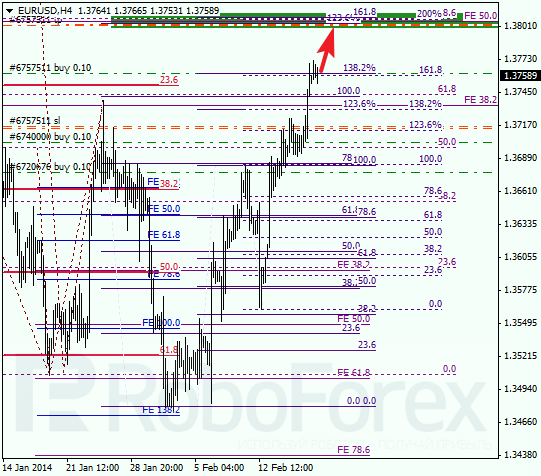
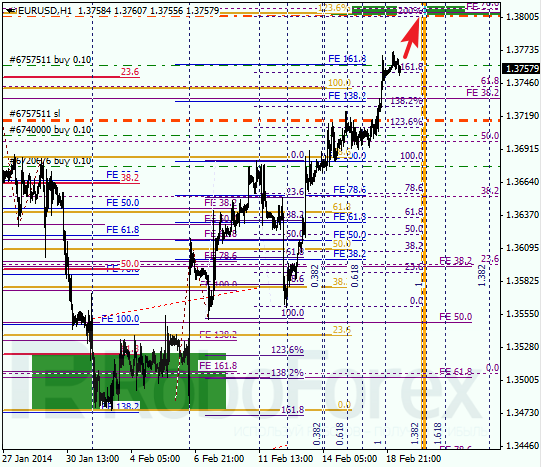
Euro continues moving upwards. Yesterday bulls broke maximum and right now are moving towards their main target, which is close to several upper fibo-levels near 1.3800. During correction, I opened another buy order.

According to the analysis of temporary fibo-zones at H1 chart, target levels may be reached during the day. If later price rebound from them, market may start new correction.

USD CHF, “US Dollar vs Swiss Franc”

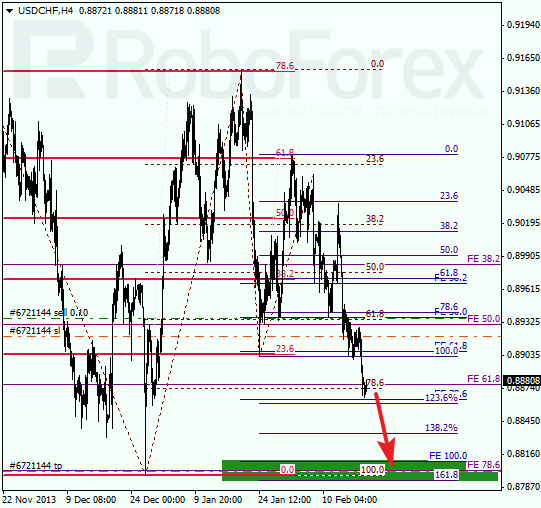
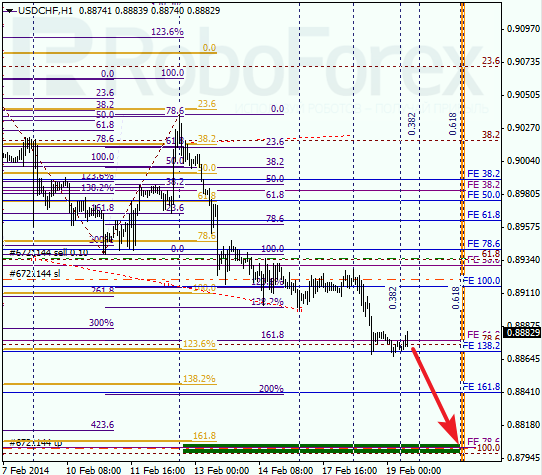
Franc is moving downwards quite fast, and I decided to move stop on my sell order into the black. If bears continue pushing price downwards, they may reach new minimum by the end of this week.

As we can see at H1 chart, price is consolidating. According to analysis of temporary fibo-zones, predicted targets may be reached by Thursday. However, one should remember that price may rebound from target area quite fast, that’s why I’m planning to use Take Profit to close my orders.

RoboForex Analytical Department

Article By RoboForex.com

Attention!
Forecasts presented in this section only reflect the author’s private opinion and should not be considered as guidance for trading. RoboForex LP bears no responsibility for trading results based on trading recommendations described in these analytical reviews.


Japanese Candlesticks Analysis 19.02.2014 (EUR/USD, USD/JPY)

Article By RoboForex.com

Analysis for February 19th, 2014

EUR USD, “Euro vs US Dollar”

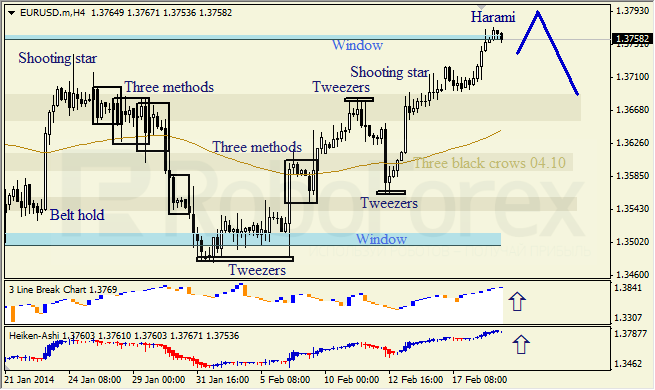
H4 chart of EUR USD shows bullish tendency. Harami pattern near upper Window indicates possibility of bearish pullback. Three Line Break chart and Heiken Ashi candlesticks confirm that bullish tendency continues.

H1 chart of EUR USD shows sideways correction within ascending trend. Upper Window is resistance level. Evening Star pattern, Three Line Break chart, and Heiken Ashi candlesticks confirm descending movement.

USD JPY, “US Dollar vs Japanese Yen”

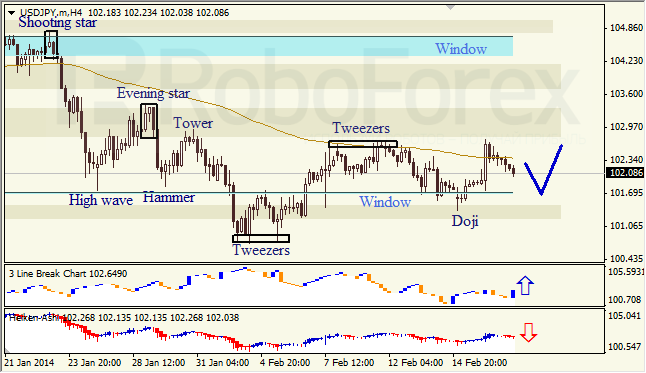
H4 chart of USD JPY shows correction within descending trend. Lower Window is support level. Doji pattern and Three Line Break chart confirm ascending movement; Heiken Ashi candlesticks indicate bearish pullback.

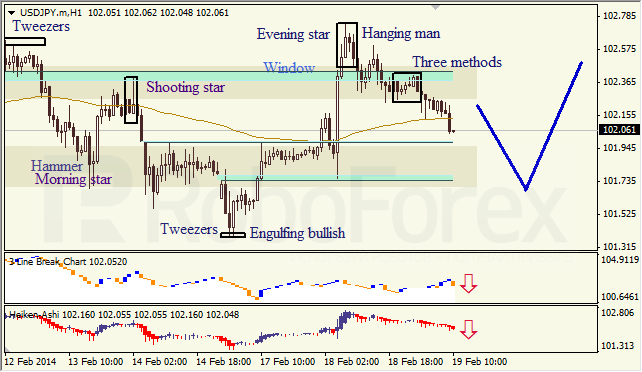
H1 chart of USD JPY shows bearish tendency within sideways trend. Three Methods pattern, Three Line Break chart, and Heiken Ashi candlesticks confirm descending movement.

RoboForex Analytical Department

Article By RoboForex.com

Attention!
Forecasts presented in this section only reflect the author’s private opinion and should not be considered as guidance for trading. RoboForex LP bears no responsibility for trading results based on trading recommendations described in these analytical reviews.


The Most Important Question Top Stock Pickers Keith Schaefer, Eric Coffin and Lawrence Roulston Ask Company Presidents

Source: JT Long of The Mining Report  (2/18/14)

http://www.theaureport.com/pub/na/the-most-important-question-top-stock-pickers-keith-schaefer-eric-coffin-and-lawrence-roulston-ask-company-presidents

Payback time? Fallback plan? Money in the bank? What would you ask the CEO of a company you were considering investing in? In advance of the Prospectors and Developers Association of Canada convention in March, newsletter writers Keith Schaefer, Eric Coffin and Lawrence Roulston are bringing 15 energy and mining companies together for a “meet the management” Subscriber Investment Summit in Toronto. In this interview with The Mining Report, the experts share their sometimes surprising responses to the state of the industry.

The Mining Report: Keith, in a recent e-mail to your subscribers, you mentioned that one of the secrets to successful investing is meeting the management. Would each of you share some of the questions you ask company heads to determine if they can be successful?

Keith Schaefer: I am very focused on paybacks. When a company drills a well, I want to know how long it takes for that well to pay for itself. In the larger oil sector, anything that has less than a two-year payback is good, but in the junior sector, where I play, payback needs to be no more than 15 months.

You could ask for the net back, or profit per barrel, or the net present value (NPV) or the production rate. But that doesn’t matter as much as the payback—how fast you get that money back so you can drill another well. That is, by far, No. 1. The information that goes into that answer encompasses the answers to many other questions.

The other big questions are how much money the company has and how big a deadline it has. How much liquidity does the company have before management has to raise money again? Those would be questions I would ask management out of the gate.

TMR: Do the secondary questions inform the first question? If a company is well funded is the payback time as important?

KS: Regardless, I want to see a 12–15 month payback. If management tells me it has a two-year payback, and it’s a really small company, that just doesn’t work. If the payback is right, I’ll ask how much the wells cost, and how much money is in the bank, because I can do some pretty simple math to figure out the next time the company will need to raise money. But if a company doesn’t have a 15-month payback and is really small, I don’t care to hear anything else about them.

TMR: Eric, what do you want to know?

Eric Coffin: Life is not so simple at Hard Rock Co., unfortunately. Obviously, how much money a company has is very important. It tells us how fast that company will need to go back to market.

But I need to know the background of management, and what kind of projects the management team has been involved with. I like to see that team members have had hands-on exploring experience. Some guys are very good at running exploration projects successfully, and others not so much.

I also want to hear about the target, the geological model, the upside if this works out and the fallback position if it doesn’t. Most of the time, the fallback position is either secondary projects and/or cash in the bank, so the company can go look for something else. You need to get an idea of the scale potential. If a company has a $20 million ($20M) capex and is drilling for 200–300,000 ounces (200–300 Koz) gold equivalent, there’s just not a lot of upside there. I want to see that, if management is successful, there’s a significant amount of upside. Explaining the target gives me some comfort that management knows what it is doing.

TMR: When it comes to a fallback position, do you like to see companies with multiple projects in the pipeline, or would you rather see them focused on just one project?

EC: I like to see other projects in the pipeline. There is some truth to the idea that you can try to do too many things at once. If I see a company that constantly switches over to whatever is hot that week, I basically just ignore it. I like to see that company management has a concept and a philosophy, like “We look for copper-gold porphyries,” or “We’re focused on epithermal gold projects.” I like to see other properties advancing to drill target stage while the main property actually is being drilled. That gives shareholders a stronger fallback position, because exploration isn’t going to work out on most projects. That’s just the math.

On the other hand, I like to see that a company has two or three projects it can fall back on, not 15 or 20, with management running around in circles. But if a company is focused on just one property, and if I really like the targets, I’m not going to be afraid of the company. I just know it comes with a bigger downside if the drilling doesn’t work out. You have to understand that going in. If that’s the case, the target has to be that much bigger.

TMR: Lawrence, what do you ask to determine whether a company will be successful?

Lawrence Roulston: Beyond all the basic questions about the financial situation, the project and management’s background, which are all important, I need to know whether management has the drive and determination to overcome the endless obstacles on the road to success. You can only get that sense if you talk to the people behind the company; spend a bit of time and get to know them.

Unfortunately, this industry has evolved away from old-style compensation, where members of management had low salaries and big stock positions, thereby aligning their interests with shareholders. We’ve moved way too far toward big salaries. There are a lot of people out there who are more interested in protecting their salaries than in adding shareholder value. Those intangible, subjective measures are critical to determining if a company will be successful.

TMR: What do you want to see in a CEO’s background? Would you rather see someone from finance/business, or a geologist?

LR: Mining requires some very specialized skills. A person also needs to be an entrepreneur. If someone has had a big success in the past, that can be a plus, but it’s also really exciting to find the young guys who are going to be the stars of next year. Both business and geology are important. A good company needs a well-rounded team that can cover all the bases.

TMR: The three of you are putting together a Subscriber Investment Summit the day before the Prospectors and Developers Association of Canada (PDAC) convention in March. You have picked a number of companies to present at the summit, and be available to talk to investors. The three of you will be there talking to investors and companies as well. Can each of you tell me why you picked the companies you did, and about the catalysts that make these companies worthwhile for investors?

KS: A company called rdx Technologies Corp. (RDX:TSX.V) has a novel way of treating wastewater. In addition to purifying the water so it can go back into the ground, the company extracts every little bit of energy from that water. That means any kind of oil, animal or plant residue. The company has the ability to shake that residue out, chemically separate it and create fuel. So rdx gets paid to take in the wastewater, and it gets paid to sell the fuel. So far, the company has two operations up and running.

This process is new and looks to be very cheap. Management has a very aggressive growth program, so the proof is going to be in the pudding on this one very quickly. The company has a very exciting story that they’re going to test within the next two quarters.

Madalena Energy Inc. (MVN:TSX.V; MDLNF:OTCPK) is a very simple producer story. It has a big land position in Argentina, a country that might scare a lot of people. But the reality is that big oil is spending big money in Argentina to buy up a lot of land. If you apply the transaction metrics that are going on in the country to Madalena’s land block, the stock is a triple from here. That’s exciting. I wanted to make sure management can tell investors that story.

TMR: Madalena is operating on the Vaca Muerta shale. How does that shale compare to the Bakken?

KS: So far, it’s the only play on earth that could be more oil-charged than the Bakken. Everyone is familiar with fracking. Usually companies will do 20 fracks in a well. In the Bakken, you might get 10 barrels (10 bbl) per frack. In the Vaca Muerta, explorers are seeing as many as 50 bbl per frack. It is very highly oil-charged. If it weren’t for the politics in Argentina, the stocks of all the companies in the region would be dramatically higher than they are now.

TMR: What other companies will be at the Subscriber Investment Summit?

KS: Petroforte International Ltd. (PFI:TSX.V) is a very lucky shot for retail investors, simply because one of the top operating teams in Calgary is recapitalizing the company with retail money at a very low valuation. That never happens anymore in Calgary. Usually these companies stay private for a long time and don’t come public until they are at about $10 per share. These guys recapitalized at about a nickel per share. Basically, Petroforte is a startup growing very fast at a cheap rate. I made it my largest position because those opportunities rarely come along.

TMR: Another one?

KS: Manitok Energy Inc. (MEI:TSX) is a conventional oil play with a lot of gas. Now that gas prices are starting to move up, the company has been given a huge bonus. Manitok has a lot of leverage because even at very low gas prices, its wells were paying out in 8 to 10 months. It still has very low valuation despite the fast payback, so it is something that investors should know about.

TMR: Does it also have an advantage because it has a conventional well and doesn’t have to deal with the depletion rates that some of the fracking wells have had?

KS: That’s right. You are looking at very low depletion rates compared to fracked wells. A tight shale well could decline 65% in year one; these guys are closer to 40%. It makes a big difference in how many times you can pay the well back over the course of the life of the well. It is a big advantage.

TMR: What other companies will be at the Summit?

KS: Entrec Corp. (ENT:TSX.V) is a call on oil sands development and liquid natural gas (LNG) development. The company is holding its own doing oil sands work, but if the government in British Columbia gets its fiscal framework set for LNG, Entrec owns the largest crane company in northwest British Columbia, and would be a huge beneficiary. I think the company would be a top stock for a pop once LNG gets going.

Iona Energy Inc. (INA:TSX.V) was the largest junior oil growth story in the world last year. The company went from 1,500 to 7,500 barrels per day—all beautiful, light, high-profitability oil. Sadly, the market didn’t end up caring too much. But in 2014, as the production profiles of these wells become consistent, the market is going to reward Iona. Basically, the company is trading at 1x cash flow. When you buy stock at 1x cash flow, you are going to make money.

TMR: This is in the North Sea. Will the company have an advantage because of higher European prices?


KS: Certainly, working in the North Sea gives you exposure to international pricing, which is $10 per barrel ($10/bbl) higher than in North America. The asset that Iona drilled last year pays out in a year. When a well pays out in a year, and you’re trading at 1x cash flow, you are going to make money.


TMR: How about a couple more?


KS: High North Resources Ltd. (HN:TSX.V) is a startup that’s just finding its legs. It has the Montney asset, which pays back in about a year. All the production around Montney is paying out in a year, and there’s a lot of it. There is good well control.


High North is pretty much a no-brainer. It has the next three years of low-risk to no-risk drilling in the Montney oil play, where there are lots of services and high profitability. It is set. It’s done. It will just plunk down holes like clockwork for the next few years, then watch the cash register ring.


Lastly, Enterprise Group Inc. (E:TSX.V) has done a fantastic job of buying highly specialized, niche companies that have higher-than-average profit margins. When you do a rollup play like this—an aggressive mergers and acquisitions (M&A) strategy—what makes the stock go up is being able to drive organic growth out of it. This company has been able to do that better than any I’ve seen. It has surprised to the upside, achieving revenue jumps quarter after quarter. Not just revenue jumps, but real positive cash flow.


I’m quite impressed with what the Enterprise team has been doing. The feedback the company is getting in the market suggests that cash flow is going to triple this year, which indicates the stock should be $2. It’s currently trading at about $1. We will see what happens this year, but I like what the team is doing.


TMR: It’s a very diversified company. Is there one area that will drive growth going forward?


KS: Yes. Enterprise has a bit of an odd product to those outside the industry—the Hydro-Vac, a water-jet cutter. Super high-pressure water is used to cut the ground to find oil pipes and electrical wires, without cutting the infrastructure itself. It is mucky work, but it’s incredibly profitable. The company has plenty of demand from customers if it can get enough product.


TMR: Eric, you have a couple of companies you’ve invited?


EC: Barisan Gold Corp. (BG:TSX.V) is a fairly straightforward story. This is a straight-up drill play. The company is drilling a porphyry discovery called Upper Tengkereng in Sumatra, Indonesia. I’m not a huge fan of the country. I made that fairly plain when I started following Barisan, but the company put out a couple of good-looking drill holes, the best of which was basically 900 meters (900m) of 0.4 grams per ton (0.4 g/t) gold and 0.25% copper, which is pretty damn good as porphyry holes go. The area has the potential to generate the kind of holes that can give you 100–200% jumps in one shot. The last hole was also a good one, though not as good as the one quoted above. Assays for the bottom third of this hole are still to come—but it’s the next couple of holes I’m focused on. These holes will be drilled to the east, back in the area that generated the 900m intercept. I’m hoping to see another long, high-grade intercept. The stock trades at $0.20/share, which leaves plenty of upside. The area being drilled now, on the eastern side of this project, is not governed by the forestry ministry, which is tough to deal with in Indonesia.


TMR: When do you expect the next drill results?


EC: These are 1,000m holes, so they take some time to turn around. The bottom third of the last hole should be out in the next week or two. The next hole should be just about done, so I hope to see those results in early to mid-March. If the stock gets a little bit of a jump, the company may finance so it can add a second rig. That would help results come faster. The target is not going away. It’s the real deal. It’s just a matter of how big it is, how high of grade it is.


TMR: Another company or two?


EC: I have followed Nevsun Resources Ltd. (NSU:TSX; NSU:NYSE.MKT) for years. I was pounding the table on this one pretty hard late last year, because it seemed like it was getting sold down with all the other gold stocks, even though Nevsun’s Bisha mine in Eritrea was switching to copper production.


Bisha is a high-grade volcanogenic sulfide deposit. And the mine is very unusual in that it has gone from being a gold producer to being a copper producer; the company has gone below the supergene gold mineralization in the same deposit. It is different levels of weathering and oxidation. Nevsun is now into the supergene copper. It will be mining that for the next three or four years. The gold and copper are both very high grade. After that, Bisha will become a zinc mine, also very high grade. This thing generates tons of money.


Nevsun has had a good run in the last three to four months. Its stock has more or less doubled, up to about $4 now. But I expect Nevsun to produce 200 million pounds copper this year, with some gold added in. I would think its cash costs are going to come in below $1. It already has about $1.50/share in cash. It is generating tons of cash flow. It is paying a dividend. I think there’s room for that dividend to be increased from $0.14 this year.


The other thing that’s always possible is a move on the M&A side, because the company has the cash to buy up assets. I know management has been looking around for a couple of years. Part of the problem is that its own project is so good that management just doesn’t run across many assets that look better. Nevsun is a solid base metal stock that I like quite a bit.


Sunridge Gold Corp. (SGC:TSX.V) is an earlier-stage company in Eritrea. It just put out an updated feasibility study, and finished negotiations with the government mining company on a deal to sell its 30% of the Asmara project property. Working with the government is something you have to do in Eritrea, so getting that deal announced was important for the company. The feasibility study looks quite good. I think it’s financeable, but Sunridge is also a very distinct takeover target. I know companies are sniffing around because the company would be a nice, long-term, low-cost, base metal producer, and there aren’t as many of those around as you might think. They are in demand by larger companies.


TMR: It does look like a lot of investors got interested in the last couple of weeks. Lawrence, is there still upside in Sunridge? Do you feel the same way about the company?


LR: There is huge upside potential in this company. It’s trading at about 10% of the NPV of the project, based on the feasibility numbers and even taking into account the partner interest. Typical retail investors are nervous about the country. But Nevsun demonstrates that Eritrea is actually a good place to be: Projects are good, things work and you can make a lot of money. While Nevsun could take on Sunridge as an acquisition, I think it would like to be diversified into another country. But it still proves Sunridge has upside potential.


TMR: Eric, do you want to continue with another company?


EC: Columbus Gold Corp. (CGT:TSX.V) has a 5.5 million ounce (5.5 Moz) deposit in French Guiana called Paul Isnard. It struck a joint venture deal with Nord Gold N.V. (NORD:LSE) late last year. I don’t think the market completely understood how strong that deal was. Nord can earn 50.01% of Paul Isnard by spending at least $30M and producing a bankable feasibility study within three years. It’s important to understand that is not “or”—it’s “and.” Nord has to spend the money and do the bankable feasibility. And there are other payments involved, depending on the Indicated resource at the end. The bottom line is, given the size and type of that resource, I think Nord will be very lucky if it gets the bankable feasibility by spending only $30M. I think it’s quite possible to spend more than that.


On top of that, Columbus has a large set of properties in Nevada. A couple of the guys on the company’s board are old hands from Nevada, with several discoveries to their credit. The deal with Nord frees up some $8M to work on the Nevada projects. Lots of news should be coming soon.


TMR: Lawrence, will you have questions for the Columbus management team when you see them at the conference?


LR: The big question will be: “What exactly are the plans in Nevada?” I know the company is planning to drill three or four projects over the course of the year, with its own money and through joint venture partners. As Eric said, it’s got a very strong deal with Nord Gold. The joint venture puts Columbus in a very strong position to see the project through the feasibility study without having to commit any further money.


TMR: Before Eric goes on with a couple more, do you want to talk about a company that you invited?


LR: Graphite One Resources Inc. (GPH:TSX.V) has a big graphite project in Alaska. It’s probably the only large, high-grade graphite deposit in the U.S., which gives the company a really strong strategic position. There is a lot of concern about security of supply for graphite. Graphite One is in the best position to satisfy the U.S. domestic graphite supply situation.


The project is seen by some as being low grade, but that’s an average grade taken across the entire large deposit. Zones within that deposit have significantly higher grades; the company could easily compete with some of the higher-grade deposits by mining just part of the overall deposit, and it would still have size to be viable. The deposit is in a fairly remote area in Alaska, but it’s near tidewater, and that’s really important logistically. The company can get the big equipment and supplies it needs, and ship the product out by water.


Graphite One is really strengthening its management team. Jim Currie joined the team a couple of months ago. He’s a mining engineer with an impressive background. Beginning in February, Bob Cross joined the board. Bob also has an impressive background. He’s presently chairman of B2Gold Corp. (BTG:NYSE; BTO:TSX; B2G:NSX), a $2 billion company. These guys bring a lot of experience, but they also provide an important endorsement for the project and the company. It is still fairly early stage but looking very positive in that the company has a big program planned over the course of this year. With that, I’ll turn it back to Eric.


EC: I’ll move on to SilverCrest Mines Inc. (SVL:TSX.V; SVLC:NYSE.MKT), a company I’ve followed since inception. I trust its management team more than any other. The company made a great discovery at Santa Elena in Mexico and put it into production on time, under budget. SilverCrest is now in the midst of expanding that mine. The company produces silver at a cost of about $8.50 per ounce, which is one of the lowest production costs in the industry. It will have about a 50% increase in production this year and next year. It has very good cash flow and good profits coming.


Company management just picked up the project next to Santa Elena. It’s a very early-stage project, but it seems to be a Santa Elena lookalike. The company has another project—a large multimetal property called La Joya, with a silver equivalent resource of 200 Moz. I expect to see a preliminary economic assessment to prefeasibility come out this year.


This is a practical, seasoned management group that has put things in production before. It’s a company I’m extremely comfortable with.


TMR: How about one more company?


EC: I cover a company called Reservoir Minerals Inc. (RMC:TSX.V), which, along with its joint venture (JV) partner, Freeport-McMoRan Copper & Gold Inc. (FCX:NYSE), made a pretty amazing high-sulphidation copper-gold discovery in Serbia. They put out a resource estimate of 65 million tons (65 Mt) of 2.6% copper and 1.5 g/t gold. It’s a really impressive discovery.


Mundoro Capital Inc. (MUN:TSX.V) happens to have concessions surrounding the Reservoir JV project and at the east side of the Bor mine complex, a well-known mining camp. The Tethyan mineral belt stretches through Serbia, into Bulgaria and down through Turkey, through the Caucasus. That belt has generated a lot of very big, impressive deposits. I started following Mundoro because I liked its set of projects and that geology. The company was early stage, and still is. It will get to the drill stage in the next couple of months. Mundoro has lots of room to find new stuff.


The Chinese state mining company recently “won” a project Mundoro had been working on in that country, but gave the company about $13M as a door prize. That means the stock is trading at $0.05/share less than its per-share cash value. So you’re paying nothing for the exploration potential. It is a very tight deal, with only 40M shares out. The chairman and one of the directors own about 10% of the company. Mundoro has a lot of room to move if it makes a real discovery.


TMR: This goes back to what we talked about in the beginning, which is a diversified pipeline. Mundoro is also in southeastern Europe and Mexico. Is one area more exciting to you than the others?


EC: I think the Serbian projects are the most interesting. The company is ready to drill on two targets in Q2/14. The area has infrastructure, and is very mining-friendly. The project in Bulgaria looks quite interesting, too, although it hasn’t put a lot of data out about it.


TMR: The Summit—where all of these companies are going to be in one place for investors to talk to—is being held in conjunction with PDAC. What are you hoping to hear at the conference? What trends will you be sharing with attendees?


LR: The mood is definitely picking up in the resource industry. We had a terrible couple of years, but interest is coming back. Most retail investors are shell-shocked. But the “smart” money—the veteran investors—are coming into the market now. The better-quality companies are already starting to move up on a fairly consistent basis.


Beyond that, there is a huge amount of money waiting in the wings. Part of that is U.S. private equity. These investors recognize the tremendous value to be found in the industry. We haven’t seen a lot of deals announced yet, but they’re looking at things. I think we’re going to see a lot of money from that sector coming into the resource space over the next few months, which will contribute to what’s already beginning to be an upturn for the industry. PDAC is a tremendous event. There are people from all over the world coming together in one place. Conferences are a very important venue, where investors can get face-to-face with the management teams.


TMR: Eric, are you looking forward to the same upbeat spirit?


EC: Yes. I am calling for 30%+ gains on the Venture this year. That sounds like a lot, but it is a speculative index. I pointed out to readers that for those gains to happen, all we really need is 10% of the companies on the Venture to do very well and carry the can for everybody. Another 20% will do reasonably well, and get financed along with the top 10%. Half of the companies will probably do nothing and, hopefully, a bunch of them will disappear. I’m quite happy to see some of the also-rans not around anymore.


Gold has reacted quite well to good news and bad news. The Chinese are strong in the market still. It looks like gold has put in a fairly important double bottom, and I think the Venture index has as well. I expect things to be a lot more optimistic. PDAC will be a chance to find out if management groups are building their own momentum. It’s tough to stay on track when you’ve gone through three terrible years. But the management groups that have been able to hold things together and raise money are the ones that will come out of the starting gate fast.


TMR: Keith, is it the same story in energy?


KS: No, it’s almost the opposite. I’ve been warning my subscribers that energy might be going into a trough. There is a lot of fear that ongoing production increases are going to cripple commodity prices, which would not be pleasant. I tried to a pick a group of companies that either have the teams or the assets—or both—that can make it through any bottoming that we might see in the cycle later this year.


TMR: Thank you all for your time. See you at the Subscriber Investment Summit.


Readers of The Mining Report can sign up for a complimentary ticket to the Subscriber Investment Summit 2014 for a limited time only. Register here.


Keith Schaefer is editor and publisher of the Oil & Gas Investments Bulletin, which finds, researches and profiles growing oil and gas companies that Schaefer buys himself, so Bulletin subscribers know he has his own money on the line. He identifies oil and gas companies that have high or potentially high growth rates and that are covered by several research analysts. He has a degree in journalism and has worked for several Canadian dailies but has spent over 15 years assisting public resource companies in raising exploration and expansion capital.


Eric Coffin is the editor of the HRA (Hard Rock Analyst) family of publications. Responsible for the “financial analysis” side of HRA, Coffin has a degree in corporate and investment finance. He has extensive experience in merger and acquisitions and small-company financing and promotion. For many years, he tracked the financial performance and funding of all exchange-listed Canadian mining companies and has helped with the formation of several successful exploration ventures. Coffin was one of the first analysts to point out the disastrous effects of gold hedging and gold loan-capital financing in 1997. He also predicted the start of the current secular bull market in commodities based on the movement of the U.S. dollar in 2001 and the acceleration of growth in Asia and India. Coffin can be reached at [email protected] or the website.


Lawrence Roulston is an expert in the identification and evaluation of exploration and development companies in the mining industry. He is a geologist, with engineering and business training, and more than 20 years of experience in the resource industry. He has generated an impressive track record forResource Opportunities, a subscriber-supported investment newsletter. Roulston has launched an investment fund, the Metallica Development Fund, to take advantage of severely over-sold positions in high quality resource companies. The focus of the fund is on companies with production and/or advanced-stage exploration and development projects—companies with potential for near-term recovery in value that also have potential for longer-term growth.


Want to read more Mining Report interviews like this? Sign up for our free e-newsletter, and you’ll learn when new articles have been published. To see a list of recent interviews with industry analysts and commentators, visit our Interviews page.

DISCLOSURE:
1) JT Long conducted this interview for The Mining Report and provides services to The Mining Reportas an independent contractor. She or her family own shares of the following companies mentioned in this interview: None.
2) The following companies mentioned in the interview are sponsors of The Energy Report or The Gold Report: SilverCrest Mines, Enterprise Group, Madalena Energy and Columbus Gold. Streetwise Reports does not accept stock in exchange for its services or as sponsorship payment.
3) Keith Schaefer: I own or my family own shares of the following companies mentioned in this interview: rdx Technologies, Petroforte International, Manitok Energy, Entrec Corp., Iona Energy, Enterprise Group. I personally am or my family is paid by the following companies mentioned in this interview: None. My company has a financial relationship with the following companies mentioned in this interview: None. I was not paid by Streetwise Reports for participating in this interview. Comments and opinions expressed are my own comments and opinions. I had the opportunity to review the interview for accuracy as of the date of the interview and am responsible for the content of the interview.
4) Eric Coffin: I own or my family own shares of the following companies mentioned in this interview: Nevsun, Sunridge Gold, Columbus Gold, SilverCrest Mines, Mundoro Capital. I never request or accept compensation for companies to be covered in the HRA newsletters. They are purely subscriber supported. I was not paid by Streetwise Reports for participating in this interview. Comments and opinions expressed are my own comments and opinions. I had the opportunity to review the interview for accuracy as of the date of the interview and am responsible for the content of the interview.
5) Lawrence Roulston: I own or my family own shares of the following companies mentioned in this interview: Sunridge Gold, Columbus Gold. I personally am or my family is paid by the following companies mentioned in this interview: None. My company has a financial relationship with the following companies mentioned in this interview: None. I was not paid by Streetwise Reports for participating in this interview. Comments and opinions expressed are my own comments and opinions. I had the opportunity to review the interview for accuracy as of the date of the interview and am responsible for the content of the interview.
6) Interviews are edited for clarity. Streetwise Reports does not make editorial comments or change experts’ statements without their consent.
7) The interview does not constitute investment advice. Each reader is encouraged to consult with his or her individual financial professional and any action a reader takes as a result of information presented here is his or her own responsibility. By opening this page, each reader accepts and agrees to Streetwise Reports’ terms of use and full legal disclaimer.
8) From time to time, Streetwise Reports LLC and its directors, officers, employees or members of their families, as well as persons interviewed for articles and interviews on the site, may have a long or short position in securities mentioned and may make purchases and/or sales of those securities in the open market or otherwise.


Streetwise – The Gold Report is Copyright © 2014 by Streetwise Reports LLC. All rights are reserved. Streetwise Reports LLC hereby grants an unrestricted license to use or disseminate this copyrighted material (i) only in whole (and always including this disclaimer), but (ii) never in part.


Streetwise Reports LLC does not guarantee the accuracy or thoroughness of the information reported.


Streetwise Reports LLC receives a fee from companies that are listed on the home page in the In This Issue section. Their sponsor pages may be considered advertising for the purposes of 18 U.S.C. 1734.


Participating companies provide the logos used in The Gold Report. These logos are trademarks and are the property of the individual companies.


101 Second St., Suite 110
Petaluma, CA 94952


Tel.: (707) 981-8999
Fax: (707) 981-8998
Email: [email protected]