Fibonacci Retracements Analysis 06.03.2014 (EUR/USD, USD/CHF)

Article By RoboForex.com

Analysis for March 6th, 2014

EUR USD, “Euro vs US Dollar”

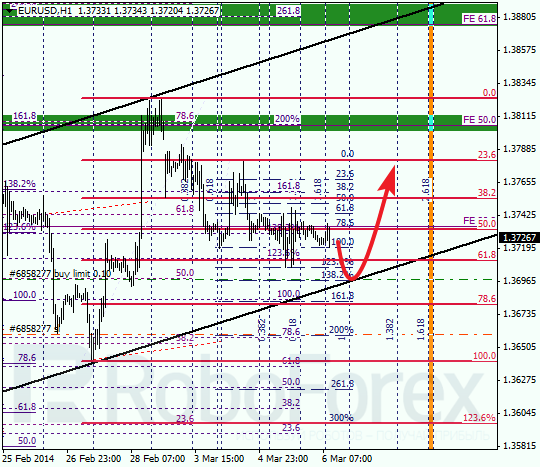
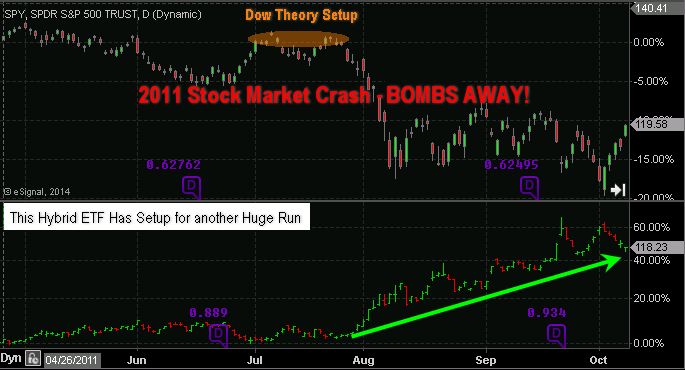
Yesterday Eurodollar tried to rebound from level of 61.8%. Pair didn’t make any significant ascending movement, that’s why it may test this level once again. I’m planning to enter the market using limit order. However, if price rebounds from the channel, I’ll open several more orders.

As we can see at H1 chart, pair is moving inside flat pattern. Probably, price may start new ascending movement until the end of this week and reach its upper targets in the beginning of the next one. We should note that if price breaks the channel downwards and stays below it, I’ll close my limit buy order placed earlier.

USD CHF, “US Dollar vs Swiss Franc”

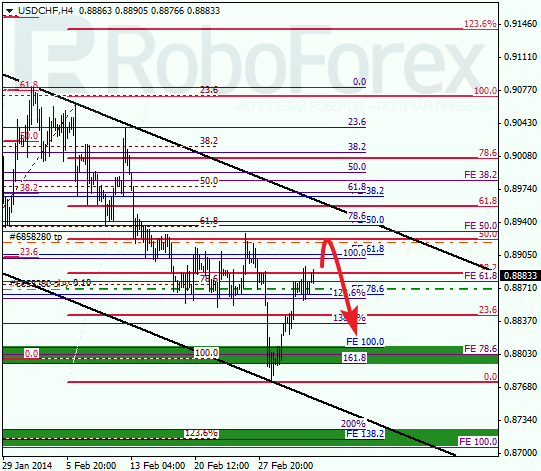
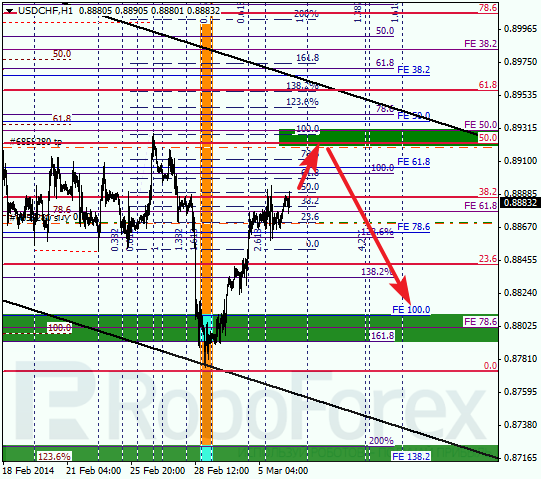
After rebounding from is first target, Franc started new correction, which seems to be quite fast. I opened short-term buy order with target at level of 50%. If later pair rebounds from this level, I’ll start selling with target at latest minimum.

Franc has grown a little bit over the last 24 hours, and I’ve decided to move stop into the black. Earlier pair rebounded from the channel right inside temporary fibo-zone. Possibly, price may reach local level of 50% during the day.

RoboForex Analytical Department

Article By RoboForex.com

Attention!
Forecasts presented in this section only reflect the author’s private opinion and should not be considered as guidance for trading. RoboForex LP bears no responsibility for trading results based on trading recommendations described in these analytical reviews.


Too Late to Become a Polar Vortex Millionaire?

By WallStreetDaily.com Too Late to Become a Polar Vortex Millionaire?

From beaten down and ignored, to becoming the King of the Commodity Hill…

That pretty much sums up the transformation that natural gas has experienced over the last two years.

In April 2012, prices hit a nearly 15-year low of $1.92 per thousand British thermal units.

Fast forward to today, and – thanks to supply shortages caused by the polar vortex – prices recently topped $6.10. That’s a staggering 220% rise!

And I’m convinced prices will stay above $5 over the next three years.

After all, we’ve discovered vast domestic supplies. And demand is steadily on the rise for power generation, as well as various transportation and consumer applications.

Now, for an immediate course of action, I encourage you to check out the archives at Oil & Energy Daily. My colleague, Karim Rahemtulla, has provided continuous coverage of the natural gas sector. And he’s shown subscribers several ways to profit from the momentum in the industry.

Plus, I’ve just uncovered a unique, under-the-radar and low-risk opportunity that’s about to take off in a big way…

Drill, Baby, Drill!

In the wake of the recent price rally, interest is understandably percolating for all types of natural gas investments.

Amazingly, though, few investors have discovered this company. It’s been publicly traded since 1979, yet no traditional Wall Street analysts even cover the stock.

But they should.

It’s sitting on over 150 billion cubic feet equivalent of proven reserves. And it boasts one of the lowest cost profiles in the country.

Not to mention that it carries negligible debt. Cash flows from operations fund most, if not all, of its working interest and mineral acreage acquisition costs. The company has never diluted shareholders. And it’s paid a dividend for 50 years (and counting).

To top it off, the company sports solid insider ownership (15%), and it constantly invests in future growth.

Impressive, yes. But what’s even more compelling is the company’s unconventional business model.

Now, I just released my full research report on the stock yesterday in the March issue of WSD Insider. And it would be unfair to our subscribers if I went into any more detail at this time.

If you’re a WSD Insider, be sure to check your inbox.

If you’re not a WSD Insider, and you’d like more information about the company – including the ticker symbol of the stock – simply click here now.

Ahead of the tape,

Louis Basenese

The post Too Late to Become a Polar Vortex Millionaire? appeared first on Wall Street Daily.

Article By WallStreetDaily.com

Original Article: Too Late to Become a Polar Vortex Millionaire?

Tensions in Ukraine Impacting Oil Prices

By HY Markets Forex Blog

With violence across the eastern region of Ukraine, Russia mobilized troops to the Crimea peninsula. Despite the fact that Russian President Vladimir Putin said he would use force as a “last resort,” the move has impacted many markets, including oil.

People who partake in crude oil trading should pay close attention to the situation in Ukraine, as prices are on the rise out of fears over disruption, according to the Wall Street Journal. The physical oil supply hasn’t been impacted yet, but both Nymex and Brent crude prices increased in response to Russia’s movement to Crimea.

With Russia being one of the world’s largest oil and gas producers, tensions in Ukraine escalating could have serious implications for the world’s oil market.

“For now oil prices have gained slightly but after London markets open it is possible that oil prices go up further,” Ken Hasegawa, commodities sales manager in Japan, told the news source. “The price of West Texas Intermediate oil may touch $105 in the short term.”

Putin Eased Ukraine Concerns

With Putin announcing Russia would take every action necessary to avoid the use of military force in Ukraine, worries eased, which led to a drop in oil prices in the second week of Russia’s movement in Crimea.

Following Putin’s comments, crude oil decreased nearly 2 percent, from the five-month high previously reached, as Russian troops engaged in military exercises near the Ukraine border were ordered back to the base, according to Reuters.

“The receding fears of a disruption of the Russian crude oil supply and the easing geopolitical concerns are weighing on crude,” Dwayne Pliska, senior trading consultant for HighGround trading in Chicago, Ill., told the news source.

The best possible scenario in Ukraine would be a peaceful resolution. Not only would it prevent military action, but the economy could benefit as well. If Russia is subjected to economic sanctions by the U.S. and other nations, the oil supply could be disrupted, which may put a tremendous amount of pressure of crude oil prices.

Investors should keep a close eye on the situation, because if Putin reneges on his words and continues with the military presence in Crimea, there could be some consequences for oil markets across the world.

The post Tensions in Ukraine Impacting Oil Prices appeared first on | HY Markets Official blog.

Article provided by HY Markets Forex Blog

How Much Will a 15% Hair Cut Cost Your ETF Portfolio?

By Chris Vermeulen – www.TheGoldAndOilGuy.com
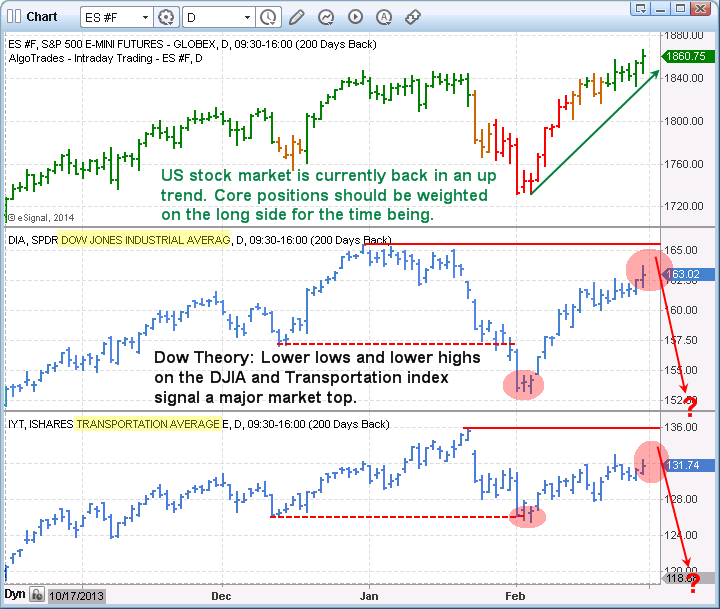
Model ETF Portfolio TradingOver the past few weeks I have been watching the DOW and Transportation index closely because it looks and feels like the Dow Theory may play out this year and the stock market could take a 15% haircut.

But what if you skipped on the haircut and opted for a 40% refund?  What? Keep reading to find out how.

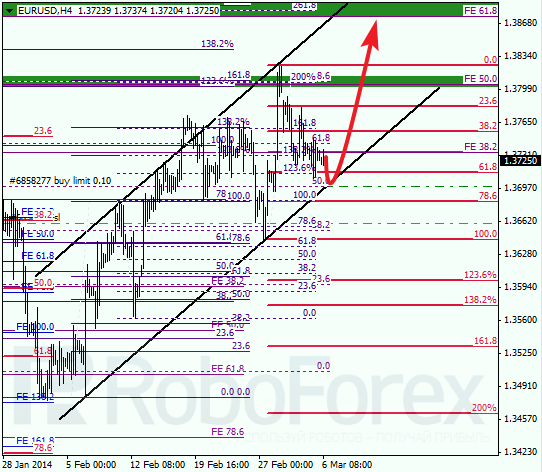
Keeping this post short and sweet, I think the US stock market is setting up for a sharp selloff. And it will look a lot like the July 2011 correction. If my calculations are correct this will happen in the next 3-9 weeks and we will see a 15% drop from our current levels. Only time will tell, but I have a way to hedge against this with very little downside risk to you ETF portfolio.


The Dow Theory Live Example for ETF Portfolio

The daily chart of the SP500 index below shows our current trend analysis with green bars signaling an uptrend, orange being neutral, and red signaling bearish price action. Currently the bars are green and we can expect prices to have an upward bias.

The Dow Theory could be  in play. When both the Transports (IYT) and the Dow Jones Industrial Average (DIA) cannot make higher highs and start making lower lows, according to the Dow Theory the broad stock market is topping.

We are watching the market closely because they have both made lower highs and lows.  This rally could stall in the next couple weeks and if so we expect a 15% correction.


Model ETF Portfolio


Take a look at the 2011 Stock Market Crash

Model ETF Portfolio Trading

The chart above shows how fearful traders have a delayed reaction to moving money from stocks to a mix of risk-off assets.

The choppy market condition during August and September clearly helped in frustrating investors and created more uncertainty. This helped prices of this ETF portfolio fund rally long after the initial selloff took place. This is something I feel will take place again in the near future and subscribers of my ETF newsletter will benefit from this move.

Because we have a Dow Theory setup, our risk levels are clearly defined as to when to exit the trade if it does not play out in our favor. But with the potential to make 40% and the downside risk only being 4%, it’s the perfect setup for a large portion of our ETF portfolio. And just so you know this is not a precious metals trade as we are already long that sector and up 10% in that position already.

Get My Daily Video Forecasts & ETF Trades Today – Get Off The Fence Make Your ETF Portfolio Perform

Chris Vermeulen
www.TheGoldAndOilGuy.com


Ron Struthers: The Juniors Are Forging the Path Forward

Source: Kevin Michael Grace of The Gold Report  (3/5/14)

http://www.theaureport.com/pub/na/ron-struthers-the-juniors-are-forging-the-path-forward

Is the bear market in mining equities finally over? It looks that way, says Ron Struthers, publisher and editor of Struthers’ Resource Stock Report. In this interview with The Gold Report, Struthers explains what distinguishes this recovery from past ones: TSX Venture Exchange stocks, not the majors, are leading the way. But which juniors should investors favor? Struthers names several with proven management, ample funding and good share structures.   

The Gold Report: Back in July, you said that the bullion banks’ fractional reserve system was coming under stress. Do the big gains in gold and silver bullion this year suggest that this system is breaking down?

Ron Struthers: I believe the fractional reserve gold system has seen more stress and was probably in good part responsible for cementing the bottom in gold around $1,200/ounce ($1,200/oz). We know Germany has not even been able to repatriate the modest amounts it asked for. The gold is simply not there. The physical gold was leased or sold years ago.

We see that the gold inventories at COMEX and the bullion banks have been steadily declining for the past year. There are not too many places to turn to, if any, for physical supply. It is no secret that record amounts of physical gold have been moving into China, and India continues as a major buyer despite higher import taxes. I think that a change in the market sentiment, a belief that the bottom is in, and the large short position on the COMEX are the reasons for the recent rises in price.

TGR: Do you put any credence in the claims by the Gold Anti-Trust Action Committee (GATA) that there is an organized conspiracy by central banks and the gold and silver bullion banks to lower the prices of gold and silver?

RS: There has always been a lot of intervention in the markets by the central banks in currencies, of which gold is one. It wouldn’t surprise me if there is front running by bullion banks as well that are privy to any such action.

TGR: Do you think that we could see a divorce between physical and paper gold?

RS: I think we’ve already seen some of that. For instance, the SPDR Gold Shares (GLD) has been at about a 4% discount to the metal for the last couple of years. We’re seeing some very high premiums in Asia on the spot physical price compared to the COMEX paper price—as much as $70/oz.

TGR: The historical appeal of physical gold is that it is a real asset that cannot be duplicated endlessly, as fiat currencies can. That being the case, what is the appeal of paper gold?

RS: It depends where you are. Asians don’t think of paper gold at all. To them, it’s all physical. They buy it, keep it as savings and pass it from generation to generation. But North Americans like to trade things, to buy and sell for short-term profit, so they are more apt to buy paper gold products like futures and exchange-traded funds.

TGR: You’ve argued that quantitative easing (QE) is a ploy by the Federal Reserve to make the U.S. economy seem stronger than it really is. Does the tapering of QE indicate genuine confidence in the future, or is this another ploy?

RS: Actually, that is backward. I believe the Fed strives to make the U.S. economy look stronger than it is so it can try to reduce QE and increase confidence in the U.S. debt. If confidence existed, we wouldn’t need QE. We have QE because the Fed is the lender of last resort. There is not enough confidence from U.S. or foreign investors to fund U.S. federal government debt and real estate mortgage debt. In 2013 the Fed bought 150% more treasury debt than all foreign investors combined. Nor is there the will to reduce this debt. This lack of will is another reason for the lack of confidence.

The Fed has long been on record saying that its low interest rate policy will repair the U.S. economy, so it needs QE to maintain these low rates. And it must do all it can to demonstrate that this policy is actually helping the economy. The Fed is walking a tightrope. It knows it cannot keep QE going forever. It wants to make the U.S. economy look as good as possible to increase market confidence and to manage the debt problem and, eventually, resolve it.

TGR: David Stockman, President Reagan’s budget director, has argued that the hubris of the Fed and the U.S. Government has resulted in a situation whereby “gold could explode at any moment.” Do you agree?

RS: Yes. The whole world financial system is walking a tightrope. Structural problems and large debt loads have not been resolved, only Band-Aids applied. The longer you walk a tightrope, the greater chance of a fall, in this case, a financial fall or collapse. This would result in a big vote of confidence in certain fiat currencies and a huge flight to gold. But so much physical gold has gone to Asia, and it’s not coming back. So when investors come looking for it, there’s going to be a shortage of supply.

TGR: What is gold’s next resistance level?

RS: I’m looking at $1,360–1,370/oz.

TGR: If gold burst through $1,370/oz in the next couple weeks, would this signal a rather rapid acceleration?

RS: Yes, it could. The next level would be $1,450–1,500/oz; that could offer resistance.

TGR: Given the recent rises in gold and silver equities, is the bear market that began in April 2011 finally over?

RS: I believe it is over, but the equities have given little sign yet of a bottom or new uptrend. Gold just went above the 200-day moving average. I would say it’s probably one of the strangest markets I’ve ever seen. We’re really in unprecedented times with all the market interventions, record debt, currency wars, distortion of economic and market data, computer trading and alternate trading platforms on markets.

Looking at the NYSE Arca Gold BUGS Index (HUI) on the gold stocks, we’ve not seen much of a move yet. It looks as if my downtrend line might be broken, but we have not seen a higher high in the index since the last low.

TGR: What do the shorts tell us?

RS: I have not seen short covering in the gold stocks yet. As of Feb. 15, there were seven gold stocks in the TSX Top 20 short positions, which is pretty significant given that they have much higher short positions compared to other stocks that have a much higher number of shares outstanding. We’ve seen covering only in Osisko Mining Corp. (OSK:TSX), which is subject to a hostile takeover bid by Goldcorp Inc. (G:TSX; GG:NYSE).

Another strange thing is the S&P/TSX Venture Composite Index, which is a good measure of the junior mining explorers. Typically, the juniors follow the seniors or producers: the trickle-down effect. Once the bigger stocks do well, the little guys start to follow. In the past 12 months, however, the TSX Venture Index is down about 10%, while the NYSE Arca Gold BUGS Index is down more than 30%.

This time around, the TSX Venture is leading the way up. It broke through the 200-day moving average in early January. It tested that in early February, and now it has broken clearly to the upside, a second higher high above 1,000. The 200-day moving average has started to turn up as well.

TGR: Do you think that all the bad press that the majors have gotten for bad decisions, inefficiency, bloated projects, etc., has caused this anomaly?

RS: Somewhat. The producers’ margins were hit pretty hard by the gold price decline. For junior explorers, however, $1,200–1,300/oz gold is still pretty good if an explorer makes a discovery. On the other hand, while the producers have struggled with rising costs, this bear market has cut the cost of exploration probably almost in half because of falling demand for related goods and services.

TGR: What qualities do you look for in junior explorers?

RS: I’m sticking with companies that have proven management, ample funding and/or good share structures, so they can still raise funds. Diversification is a good approach for investors.

TGR: After the gold price collapse last year, there was a renewed emphasis on the importance of high grade. How crucial is this?

RS: Grade is always important but becomes more so as the price of gold falls.

TGR: What are some companies leading the way in high grade?

RS: Roxgold Inc.’s (ROG:TSX.V) recent preliminary economic assessment at its Yaramoko project in Burkina Faso is projecting a metal grade of 11.9 grams per ton (11.9 g/t) in the first five years. That results in a low cash cost of just $455/oz, a high 47.7% internal rate of return and only a 1.4-year payback on initial capital. So you can see the big effect there.

TGR: Yaramoko’s initial capital expenditure is only $93.8 million ($93.8M). Isn’t that quite low?

RS: Yes.

Eastmain Resources Inc.’s (ER:TSX) Eau Claire deposit in Canada has at least 1.5–3 million ounces (1.5–3 Moz) and a grade higher than 3 g/t. The open-pit resource is 635,000 ounces (635 Koz) at 4.67 g/t, and the underground is 145 Koz Measured and Indicated at 6.3 g/t. These are attractive numbers. Goldcorp already owns almost 9% of Eastmain.

Richmont Mines Inc. (RIC:TSX; RIC:NYSE.MKT) produces good grades but has seen a temporary rise in production costs because its grade declined from about 5.5 g/t to 4.5 g/t. That had quite an effect on its earnings. But I think these numbers will soon reverse, which should make for a good turnaround there. The company is driving down a ramp to produce from its Island Gold Deep deposit in Canada. In late January, it updated that resource to 169 Koz Indicated at 11.5 g/t, with almost 1 Moz in the Inferred at 9.29 g/t. Again, very good grades.

TGR: Of the companies looking to improve grade, which stand out?

RS: A couple. We picked up Mandalay Resources Corp. (MND:TSX) at a good price in November because I like its Costerfield mine in Australia. It has gold grades: more than 9 g/t with 4% antimony on top. Its other mine, Challacollo, in Chile, has a very good silver grade.

TGR: Challacollo was a recent purchase, correct?

RS: Yes. It has a very good silver grade of 209 g/t with 2.28 g/t gold along with it. The company is very profitable, reporting net income of $29M for 2013. That’s $0.09/share, and it is paying a good dividend, too.

SilverCrest Mines Inc. (SVL:TSX; SVLC:NYSE.MKT) has been a great growth story with its Santa Elena mine in Mexico. It has been very profitable even at lower silver prices, and it put its profits into growth and expansion. The company’s 3,000 ton per day (3,000 tpd) mill is almost complete, and it will soon start producing underground reserves.

TGR: How will this affect grade?

RS: The gold grade should remain about 1.6 g/t, but the silver grade should double, to well over 100 g/t. The company’s future is brightened by two other advanced projects. It looks to duplicate Santa Elena’s success at its La Joya project, again using a starter open pit. Its Cruz de Mayo project is just 35 kilometers (35km) from Santa Elena. With 2.3 Moz Indicated and more than 12 Moz Inferred, it could heap leach there and possibly ship the high grade to the Santa Elena mill.

TGR: Let’s talk about companies that have gained greatly in price recently but, in your opinion, still have room to grow.

RS: One that stands out is Avino Silver & Gold Mines Ltd. (ASM:TSX.V; ASM:NYSE.MKT; GV6:FSE). It rose from a bottom of $0.75/share in July to more than $3/share recently. It continues to expand production at its historic Avino project in Mexico, which was relaunched last year. Around year-end 2014, it will add a third circuit to production from the historic Avino mine. That will increase the mill run rate from 500 tpd to 1,500 tpd. Currently, most of production is from the nearby San Gonzalo mine. Its grade is high, recently processing gold at 1.98 g/t and silver at 358 g/t. That results in a low cash cost of under $7/oz silver equivalent.

TGR: With the recent tax-regime changes, there has been a lot of negativity about Mexico of late. What’s your view?

RS: I think the concern is somewhat overrated. Governments always want a bigger piece of the pie. Mexico retains a stable mining regime, a good labor force and infrastructure, and relatively low costs. I think the mining companies can live with the new tax regime.

TGR: Moving on to Nevada, now that Rye Patch Gold Corp. (RPM:TSX.V; RPMGF:OTCQX) has gotten $10M in its settlement with Coeur Mining Inc. (CDM:TSX; CDE:NYSE), does this gives it what it needs to find high grade there?

RS: It was a nice deal. Rye Patch also has a net smelter royalty (NSR) from Coeur, which will generate about $8M annually for the next three years. This should enable Rye Patch to explore actively. I think the bigger story is that the company already has a 1+ Moz resource it can expand on. Its properties are located very close to producing mines.

I’m not so concerned about grade there, as Nevada remains one of the lowest-cost gold jurisdictions. It’s all about the heap leach and good infrastructure. If Rye Patch could deal one or two projects to next-door majors, that could reward shareholders very nicely.

TGR: Is Rye Patch a possible takeout target?

RS: If it were able to grow one of these deposits substantially, I would say so. I think the company would more likely deal one of its projects with either a coproduction agreement or another NSR royalty.

TGR: Which explorers do you like in Nevada?

RS: Asher Resources Corp. (ACN:TSX.V) is fully funded for 2014. There were high expectations for its first drill program at its King property. It did not hit the big hole on the first round, but a lot was learned. It ended up drilling a halo of porphyry, so the real target is likely off to the left of the high induced polarization (IP). It appears it drilled under the gold structure on another target there, despite some good hits in two holes. Before a second round at King, it is drilling three holes on its Lavington gold project in British Columbia.

TGR: Which Canadian explorers do you like?

RS: TerraX Minerals Inc. (TXR:TSX.V). In the past six months it acquired the advanced-stage Northbelt gold property in the Northwest Territories. That had seen previous drilling of 463 holes, with about 25 gold zones, many with some pretty good high-grade numbers. The company has been reassaying previous drill holes and compiling the historic data ahead of a drill program planned for this summer. It has raised ample funding.

Zonte Metals Inc. (ZON:TSX.V), which has a unique group of projects in Newfoundland. It is also focusing on Colombia, and I expect acquisitions could be announced any time. It has a good share structure and strong insider backing. I don’t think it will have any trouble funding a new acquisition.

TGR: What else stands out in Colombia?

RS: Colombian Mines Corp. (CMJ:TSX.V) is well funded with about $4M. Its El Dovio project saw good drill results last year, with 16.8 g/t over 6.85 meters (6.85m). It has a number of other projects in Colombia, including Yarumalito, a joint venture with Teck Resources Ltd. (TCK:TSX; TCK:NYSE) that Teck is funding. Colombia remains one of the best jurisdictions for exploration. It has the oldest, most stable democracy in South America. It remains underexplored, even though it was once the world’s leading gold producer.

TGR: How about Mexico?

RS: Mammoth Resources Corp. (MTH:TSX.V) is funded for 2014 on its Tenoriba project. This shows high-grade gold and silver on surface and good drill results from a 2008 program that included 45 g/t over 1.9m. It is planning some IP and magnetic surveys over four main targets and some road development that could cut zones ahead of a drill program.

Another I’ve looked at lately is Tosca Mining Corp. (TSQ:TSX.V). Its Carol copper-gold project is just 5km from the Piedras Verdes copper mine, the third largest in Mexico, which produces 70 million pounds annually. Invecture Group got this from Frontera Copper, which it bought and took private.

Invecture bought out Kimber Resources Inc. late last year, as well as Vista Gold Corp.’s (VGZ:TSX; VGZ:NYSE.MKT) Los Cardones project. I think Tosca is probably its next target. Invecture has staked all the available ground around Tosca’s project. Carol has seen excellent trench results, including 1.9% copper, 19% zinc, 0.93% lead, 36 g/t silver and 0.59 g/t gold over 10m. Its upcoming drill program should prove quite interesting.

TGR: Any other gold explorers you could mention?

RS: Garibaldi Resources Corp. (GGI:TSX.V) has done much better than many juniors. It was funded throughout the downturn by a big block of Paramount Gold and Silver Corp. (PZG:TSX; PZG:NYSE.MKT) shares it held. It has advanced a number of its projects: La Patilla, Tonichi, Iris and Rodadero in Mexico and Grizzly in Canada. The company is awaiting drill results from La Patilla and has pretty high expectations for good numbers based on previous exploration.

TGR: And there is a uranium junior you’re sweet on, correct?

RS: Yes. Zadar Ventures Ltd. (ZAD:TSX.V) is well funded by two recent financings. It has an advanced portfolio of projects in the prolific Athabasca Basin. Its management has a proven record of uranium discovery in the basin. Its geologist, Kieran Downes, is the former vice president of exploration with Cameco Corp. (CCO:TSX; CCJ:NYSE). And its PNE project is adjacent on trend to the recent significant Patterson Lake discovery.

TGR: Given how depressed the junior sector has been since 2011, seeing the TSX Venture leading the way, as you put it, has to be pretty encouraging, no?

RS: I agree. We’ve had a brutal downturn and washout. For almost two years, the market had little access to capital. This resulted in share consolidations, mergers and many companies disappearing. Now we’re seeing some momentum. This could be the start of quite a turnaround.

TGR: Ron, thank you for your time and your insights.

Ron Struthers founded Struthers’ Resource Stock Report 20 years ago. The report covers senior and junior companies with ample trading liquidity.

Want to read more Gold Report interviews like this? Sign up for our free e-newsletter, and you’ll learn when new articles have been published. To see a list of recent interviews with industry analysts and commentators, visit our Streetwise Interviews page.


DISCLOSURE:
1) Kevin Michael Grace conducted this interview for The Gold Report and provides services to The Gold Report as an independent contractor. He or his family own shares of the following companies mentioned in this interview: None.
2) The following companies mentioned in the interview are sponsors of The Gold Report: Mandalay Resources Corp., Roxgold Inc., Richmont Mines Inc. SilverCrest Mines Inc. and Rye Patch Gold Corp. Goldcorp Inc. is not affiliated with The Gold Report. Streetwise Reports does not accept stock in exchange for its services or as sponsorship payment.
3) Ron Struthers: I or my family own shares of the following companies mentioned in this interview: Asher Resources Corp., Avino Silver & Gold Mines Ltd., Colombian Mines Corp., Eastmain Resources Inc., Mammoth Resources Corp., Richmont Mines Inc., TerraX Minerals Inc., Tosca Mining Corp., Zadar Ventures Ltd. and Zonte Metals Inc. I personally am or my family is paid by the following companies mentioned in this interview: None. My company has a financial relationship with the following companies mentioned in this interview: None. I was not paid by Streetwise Reports for participating in this interview. Comments and opinions expressed are my own comments and opinions. I had the opportunity to review the interview for accuracy as of the date of the interview and am responsible for the content of the interview.
4) Interviews are edited for clarity. Streetwise Reports does not make editorial comments or change experts’ statements without their consent.
5) The interview does not constitute investment advice. Each reader is encouraged to consult with his or her individual financial professional and any action a reader takes as a result of information presented here is his or her own responsibility. By opening this page, each reader accepts and agrees to Streetwise Reports’ terms of use and full legal disclaimer.
6) From time to time, Streetwise Reports LLC and its directors, officers, employees or members of their families, as well as persons interviewed for articles and interviews on the site, may have a long or short position in securities mentioned and may make purchases and/or sales of those securities in the open market or otherwise.


Streetwise – The Gold Report is Copyright © 2014 by Streetwise Reports LLC. All rights are reserved. Streetwise Reports LLC hereby grants an unrestricted license to use or disseminate this copyrighted material (i) only in whole (and always including this disclaimer), but (ii) never in part.


Streetwise Reports LLC does not guarantee the accuracy or thoroughness of the information reported.


Streetwise Reports LLC receives a fee from companies that are listed on the home page in the In This Issue section. Their sponsor pages may be considered advertising for the purposes of 18 U.S.C. 1734.


Participating companies provide the logos used in The Gold Report. These logos are trademarks and are the property of the individual companies.


101 Second St., Suite 110
Petaluma, CA 94952

Tel.: (707) 981-8999
Fax: (707) 981-8998
Email: [email protected]


The Best Investment Opportunity of Your Lifetime: China

By MoneyMorning.com.au

In your lifetime you’ll have many chances to make money.

That’s why we advise investors not to make rash decisions.

It’s why we say that if you miss a stock rally, don’t panic, just wait for the next one.

However, while stocks rise and fall on a daily basis, there are some opportunities you can’t afford to miss. Because depending on your age, some opportunities will never appear again in your lifetime.

One of those opportunities is here right now. And it’s so rare that it’s fair to call it the Halley’s Comet of investment opportunities

If you know anything about astronomy, you’ll know that Halley’s Comet passes through the solar system past the Earth roughly every 75 years.

The last time it showed up was in 1986.

It’s not due to reappear until 2061. A child born today will be middle-aged by the time Halley’s Comet next arrives.

And the investment opportunity before you today is similarly a rare event.

The Dot-com Boom Was a Blip Compared to This

When we’re talking about the Halley’s Comet type investment opportunities, we’re talking about the big investing megatrends.

Those are investing themes that can last for an entire generation. By that we mean for perhaps 20, 30 or 40 years. We’re not talking about something as brief as the dot-com boom.

And we’re not talking about the brief two year trend that was the dividend stock rally.

This is something much bigger. This megatrend started around 2003. It has had what will turn out to be a brief setback that has lasted off and on from 2011 through to today. But this megatrend is set to resume its extraordinary growth path.

By now you’ve probably figured it out. It’s China.

Take this report from the BBC yesterday:

China announced a growth target of 7.5% and revealed plans to raise its defence budget by 12.2%, as it opened its annual parliament session in Beijing.

That one sentence says it all.

Whatever your view on China, there’s no denying that 7.5% annual growth is huge. As we’ve mentioned before, at that rate China’s economy will double in size within the next nine years.

It’s one thing for a small underdeveloped economy to double in size in nine years. It’s something else for the world’s second biggest economy to do the same thing.

To put that into context, based on the current growth rate of 2.8% it will take the Aussie economy more than 25 years to double in size. It’s a mind-boggling comparison.

Perhaps now you can grasp the scale and importance of this megatrend.

Your Chance to Invest in the ‘new America’

That’s why investors need to understand the China story today. The fact that the growth rate is so amazing underlies the rare nature of this opportunity.

If developing nations of this size doubled their economy at the same rate all the time then it wouldn’t be such a big deal.

But it doesn’t happen all the time. The best way of putting this into perspective is to say that investing in China today is like having the foresight to invest in Japan in the 1950s, the US in the 1880s, or Britain in the 1740s.

And because these events are so rare it means you have to make the most of them when they appear. You need to make sure that you don’t end up looking back on today and regretting a huge missed opportunity.

The best thing about this is that it won’t just be a resource boom. If it was, that would be good enough. After all, the demand for Aussie resources over the next nine years will dwarf anything seen so far. After a long drought resource investors will get a reward for their patience.

But it will be more than that.

It will be a technology boom. A services boom. A manufacturing boom. And perhaps most interestingly, a military boom.

It’s the last of which that we’re keen to discuss with military technology expert Byron King. He’s in town from the US at the end of this month to present at the World War D conference in Melbourne.

The Biggest Boom The World Has Ever Seen

Doubtless as China’s economy grows the central government will seek to increase the size and power of its military.

Wealthy nations always do that. China will seek to increase its influence overseas, and maintain control at home.

So from an investing angle the next stage of China’s boom years will be about so much more than just iron ore, copper, oil and natural gas. It will be about consumer electronics, high tech weapons systems, telecommunications, healthcare, and transport.

It would be easy to look at China and say that China already has all these things – skyscrapers, bullet trains, mobile phones, and millions of new cars sold every year.

But remember – and make sure this sinks in – China’s economy is set to double within nine years. If it does the country will need to create in nine years the same size economy that until today has taken over one thousand years.

That will be a huge achievement.

But it’s also an example of the impact that new technology is having on the world’s economies.

In a way, talking about China like this may come across as a bit of a cliché. But anyone who thinks the China boom has ended is missing out on the chance to buy into a booming market.

We won’t say that the boom has only just begun (that would be a cliché), but we will say that the biggest and most spectacular phase of the boom hasn’t even started. When it does it will result in the biggest investment megatrend this generation of investors has ever seen and likely ever will see.

In the weeks and months ahead we’ll fill you in on our plans to help you profit from this boom as it happens. Stay tuned.

Cheers,
Kris+

Special Report: Three Aussie Miners Set to Lead the Resource Sector’s Epic Comeback

Join Money Morning on Google+


By MoneyMorning.com.au

‘Doctor EROEI’ Was Wrong

By MoneyMorning.com.au

For some years now,‘ Tim Morgan writes in Life After Growth,global average EROEIs have been falling, as energy resources have become both smaller and more difficult (meaning energy-costly) to extract.

You may have heard of this concept called energy return on energy invested (EROEI). It looks at how much energy we expend in relation to how much energy we extract. Some, like Morgan, think this is very important.

Consequently, falling EROEIs have become the basis of a variety of dire forecasts…

In these scenarios, we spend more and more energy just getting energy, and we have less and less for other discretionary items. As Morgan writes, ‘If EROEI falls materially, our consumerist way of life is over.

I’m writing to you today to slay this flawed EROEI concept.

I have to say I used to be taken in by this argument. I wrote a C&C issue a couple of years back with the headline ‘Crack This Code: EROEI – Why It Matters Now and What to Do About It.‘ I included a list of approximate EROEI ratios for various energy sources:

  • 1970s oil and gas discoveries: 30-to-1
  • Current conventional oil and gas discoveries: 20-to-1
  • Oil sands: 5-to-1
  • Nuclear: 4-to-1
  • Photovoltaic: 4-to-1
  • Biofuel: 2-to-1.

I noted that such ratios were falling and concluded that a lower mix of EROEI sources means higher prices for many commodities, because it will take more energy to produce them.

It means nothing of the kind.

I would like to right my old error and convince you why EROEI is fatally flawed, so you don’t fall for it. I’ll use Morgan as the foil, because he is an articulate and strong proponent of the idea in his new book.

Morgan’s crucial assumption appears on page five: ‘The economy is not primarily a matter of money at all. Rather, our economic system is fundamentally a function of surplus energy.

This is the key to the whole EROEI argument. Morgan repeats it often. And it is completely wrong.

You can’t take money out of the equation! Money is what it’s all about. It is the essence of the economic life. It’s at the centre of decision making. As economist Hyman Minsky said, ‘Money isn’t everything. It is the only thing.

Be sceptical of anything that seeks to analyse our economy by taking money out. Households and firms make decisions based on money. They certainly don’t use EROEI, nor should they.

When a firm decides to drill a well or not, it does so on the basis of estimated costs and profits. It makes a decision based on some expected return — as measured in money. They are not the same. High-EROEI projects can be losers. Low-EROEI projects can be winners — as measured in profits and return on investment in money terms.

According to Morgan’s logic, you wouldn’t bother generating electricity…

Here is Robin Mills, currently with Manaar Energy (and once a petroleum manager for the Emirates national oil company in Dubai):

Generating electricity, usually at a thermal conversion efficiency of less than 50% plus transmission losses, has an EROEI of much less than 1, but is still rational and economic because electricity is such a useful form of energy.

Put another way, the money costs of the inputs are less than the money prices of the outputs. It works because…it’s profitable! People value electricity more than they value the inputs. Looked at through an EROEI lens, though, it doesn’t make sense.

You can build any scary resource scenario you want if you exclude money prices. If, say, falling ore grades were predictive of prices, then we would see continually rising prices for copper and other resources. Clearly, this isn’t the case. But this does not prevent people (usually geologists) from taking these moneyless concepts to make economic forecasts of higher prices.

A general rule of thumb: If it doesn’t take into account money prices, then it isn’t about the real-world economy as it exists today.

That’s my biggest objection to EROEI. But I’m not making a comprehensive case against EROEI here. That would take too long. I won’t get into how EROEI is calculated: there is no agreement and when you think about it, maybe it’s impossible to know with any accuracy worth relying on.

In the end, I think Morgan doesn’t really get modern money. He repeats an old myth about its origins. He doesn’t seem to know why fiat currency has value. (He says money is a claim on real goods and services,‘ which only begs the question: Why do people accept dollars in exchange for real goods?) He doesn’t seem to understand the primacy of making a monetary profit in a market economy.

Contrary to Morgan, you can’t take money out and hope to understand the modern economy. You have to study money. And in markets, you have to make a money surplus (a profit) — or you are out of the game before long. I can’t say the same is true for EROEI, which is perhaps the best I can say against it.

You can ignore EROEI, but you can’t ignore money.

Chris Mayer,
Contributing Editor, Money Morning

Ed note: The above article was originally published in Daily Resource Hunter.

Join Money Morning on Google+


By MoneyMorning.com.au

Trading Candlestick Patterns With Moving Averages

Article by Investazor.com

In this article I will show you how to trade using a strategy which combines the candlestick patterns with the moving averages. For better understanding I would recommend you to read also:

Candlesticks In Day To Day Trading

Candlestick Patterns In Technical Analysis

Trading Candlestick Patterns At Key Levels

In the articles above I have introduced the candlestick chart and motivated why it is one of the most used type of charts. I have explained how candlesticks are formed and which are the most important and frequently used patterns as well a strategy on how to use this type of patterns at key levels.

Let us talk a little about Moving Averages before getting to discuss about the trading strategy. A widely used indicator in technical analysis that helps smooth out price action by filtering out the “noise” from random price fluctuations. A moving average (noted MA) it is a trend following indicator, or also known as lagging indicator. It is one of the most known and used indicator among technical analysts and not only.

The post Trading Candlestick Patterns With Moving Averages appeared first on investazor.com.

Outside the Box: Ukraine: Three Views

By John Mauldin


All eyes are on Ukraine as the drama continues to unfold. Today, for an early Outside the Box, I’m going to offer three sources on Ukraine. The first is a note that I got from the head of emerging-market trading at one of the world’s largest hedge funds. This is what he sent out last week, ahead of any real action:

My view, Putin is stuck now, cannot easily de-escalate. Further escalation is a possibility, with Ukraine cracking along the obvious ethnic fault lines and the West reacting with measures such as sanctions and visa restrictions. Tit-for-tat follows; gas supplies to the EU are disrupted. Russian capital outflows accelerate and the RUB [ruble] quickly gets to 40/$, fuelling inflation and unnerving the Russian banking system, and also infecting the European banking system, in the manner that Chris Watling has envisaged. Meanwhile, the Chinese liabilities residing inside the European banking system are also in trouble, of course, and will continue to deteriorate. The CBR [Central Bank of Russia] hikes repeatedly with very little effect on slowing the RUB slide, further hurting GDP growth and economically sensitive segments of the market. The Russian RTX index revisits the GFC lows of 2008, Gazprom ADR’s are already within shouting distance of their 2008 lows today. In such a scenario, there is an obvious risk of market contagion spreading throughout Eastern and Western Europe, and in fact the rest of the world. It is likely to resemble something on the order of the 1998 LTCM + RUB collapse + Asian financial crisis magnitude. In fact, a number of hedge funds will fail precisely because they have loaded up so heavily with European debt instruments which will unravel.

Meanwhile, politically, the US ends up looking weaker and weaker, and getting less and less respect internationally. The US-Russia confrontation is taking place under the critical gaze of the leaders of Israel, Saudi Arabia, Egypt, Iran, Syria, Turkey and Hizballah in Lebanon.

They are seeing the following:

  1. President Obama is now seen backing off a commitment to US allies for the second time in eight months. They remember his U-turn last August on US military intervention for the removal of Syrian President Bashar Assad for using chemical weapons. They also see Washington shying off from Russia’s clear and present use of military force and therefore concluding that Washington is not a reliable partner for safeguarding their national security.
  2. The Middle East governments and groups which opted to cooperate recently with Vladimir Putin – Damascus, Tehran, Hizballah and Egypt – are ending up on the strong side of the regional equation. Others such as Turkey and Qatar are squirming.
  3. American weakness on the global front has strengthened the Iranian-Syrian bloc and its ties with Hizballah. Assad is going nowhere.
  4. Putin standing behind Iran is a serious obstacle to a negotiated and acceptable comprehensive agreement with Iran, just as the international EU- and US-led bid for a political resolution of the Syrian conflict foundered last month, and now is unlikely to ever be revisited.

Notice what he said about European banks. Their exposure to emerging-market corporate debt, Chinese debt, and Russian liabilities is going to weaken their balance sheets just as the European central bank stress test will be kicking off.

This is going to be a very interesting period of time and potentially quite dangerous. Very few people saw US market vulnerabilities in early 1998 coming from outside the US. As I said in my 2014 forecast, the United States should be all right until there is a shock to the system. We have to be aware of what can cause shocks. Ukraine in and of itself might not be enough, but notice that the Chinese are preparing to slow their economy down as part of the process of reducing their dependency on bank debt and foreign direct investment in construction and other projects. China has been one of the main engines of global growth, so a slowdown will have effects. It’s all connected, as I wrote in the 2007 letter we reprinted this weekend.

I should note that other very savvy investors and managers think there will be no contagion from current events. That’s what makes a market. It’s why we need to pay attention to Ukraine.

In the second part of today’s Outside the Box we visit a short essay on Ukraine by Anatole Kaletsky, which talks about timing investments during market crises:

Financial markets cannot afford to be so sentimental. While we should always recall at a time like this the famous advice from Nathan Rothschild to “buy at the sound of gunfire,” the drastically risk-off response to weekend events in Ukraine makes perfect sense because Russia’s annexation of Crimea is the most dangerous geopolitical event of the post-Cold War era, and perhaps since the Cuban Missile crisis. It can result in only two possible outcomes, either of which will be damaging to European stability in the long-term.

Finally, I got a piece on Ukraine from my friend Ian Bremmer, who says, “[W]e are witnessing the most seismic geopolitical event since 9/11.” His analysis plus background data help us understand what is really going on in Ukraine.

Ian will be at my conference in San Diego, May 13-16, and you should be too. If you don’t have a plan for dealing with what happens when the midterm forecasts begin knocking on the door, you won’t know what to do when the time comes. Our conference offers a wonderful opportunity to bring your plans into focus and perhaps make a few new ones. You can find out more here.

I’m feeling a lot better today than I did this weekend. I am stuck in Miami due to the cancellation of my flight but hope to be able to get to Washington DC tomorrow morning to experience the East Coast version of the polar vortex. But, for the nonce, I guess I will be forced to sit outside at the pool or on the beach and continue my research, which is once again stacking up. You have to love iPads, which are for me great productivity enhancers. I did finish George Gilder’s brilliant must-read book Knowledge and Power this weekend, and I highly recommend it. And I suppose I should research the gym facilities here later this afternoon. I have mastered the trick of reading on my iPad while walking on the treadmill. No excuses. Have a great week.

Your enjoying the Miami weather analyst,

John Mauldin, Editor
Outside the Box
[email protected]

Stay Ahead of the Latest Tech News and Investing Trends…

Click here to sign up for Patrick Cox’s free daily tech news digest.

Each day, you get the three tech news stories with the biggest potential impact.


Realpolitik In Ukraine

By Anatole Kaletsky, Gavekal

Oscar Wilde described marriage as the triumph of imagination over intelligence and second marriage as the triumph of hope over experience. In finance and geopolitics, by contrast, experience must always prevail over hope and realism over wishful thinking. A grim case in point is the Russian incursion into Ukraine. What makes this confrontation so dangerous is that US and EU policy seems to be motivated entirely by hope and wishful thinking. Hope that Vladimir Putin will “see sense,” or at least be deterred by the threat of US and EU sanctions to Russia’s economic interests and the personal wealth of his oligarch friends. Wishful thinking about “democracy and freedom” overcoming dictatorship and military bullying.

Financial markets cannot afford to be so sentimental. While we should always recall at a time like this the famous advice from Nathan Rothschild to “buy at the sound of gunfire,” the drastically risk-off response to weekend events in Ukraine makes perfect sense because Russia’s annexation of Crimea is the most dangerous geopolitical event of the post- Cold War era, and perhaps since the Cuban Missile crisis. It can result in only two possible outcomes, either of which will be damaging to European stability in the long-term. Either Russia will quickly prevail and thereby win the right to redraw borders and exercise veto powers over the governments of its neighbouring countries. Or the Western-backed Ukrainian government will fight back and Europe’s second-largest country by area will descend into a Yugoslav-style civil war that will ultimately draw in Poland, NATO and therefore the US.

No other outcome is possible because it is literally inconceivable that Putin will ever withdraw from Crimea. To give up Crimea now would mean the end of Putin’s presidency, since the Russian public, not to mention the military and security apparatus, believe almost unanimously that Crimea still belongs to Russia, since it was only administratively transferred to Ukraine, almost by accident, in 1954. In fact, many Russians believe, rightly or wrongly, that most of Ukraine “belongs” to them. (The very name of the country in Russian means “at the border” and certainly not “beyond the border”). Under these circumstances, the idea that Putin would respond to Western diplomatic or economic sanctions, no matter how stringent, by giving up his newly gained territory is pure wishful thinking. Putin’s decision to back himself into this corner has been derided by the Western media as a strategic blunder but it is actually a textbook example of realpolitik. Putin has created a situation where the West’s only alternative to acquiescing in the Russian takeover of Crimea is all-out war.

And since a NATO military attack on Russian forces is even more inconceivable than Putin’s withdrawal, it seems that Russia has won this round of the confrontation. The only question now is whether the new Ukrainian government will accept the loss of Crimea quietly or try to retaliate against Russian speakers in Ukraine—offering Putin a pretext for invasion, and thereby precipitating an all-out civil war.

That is the key question investors must consider in deciding whether the Ukraine crisis is a Rothschild-style buying opportunity, or a last chance to bail out of risk-assets before it is too late. The balance of probabilities in such situations is usually tilted towards a peaceful solution—in this case, Western acquiescence in the Russian annexation of Crimea and the creation of a new national unity government in Kiev acceptable to Putin. The trouble is that the alternative of a full-scale war, while far less probable, would have much greater impact—on the European and global economies, on energy prices and on the prices of equities and other risk- assets that are already quite highly valued. At present, therefore, it makes sense to stand back and prepare for either outcome by maintaining balanced portfolios of the kind recommended by Charles, with equal weightings of equities and very long-duration US bonds.

Looking back through history at comparable episodes of severe geopolitical confrontation, investors have usually done well to wait for the confrontation to reach some kind of climax before putting on more risk. In the 1962 Cuban Missile Crisis, the S&P 500 fell -6.5% between October 16, when the confrontation started, and October 23, the worst day of the crisis, when President Kennedy issued his nuclear ultimatum to Nikita Khrushchev. The market steadied then, but did not rebound in earnest until four days later, when it became clear that Khrushchev would back down; it went on to gain 30% in the next six months. Similarly in the 1991 Gulf War, it was not until the bombing of Baghdad actually started and a quick US victory looked certain, that equities bounced back, gaining 25% by the summer. Thus investors did well to buy at the sound of gunfire, but lost nothing by waiting six months after Saddam Hussein’s initial invasion of Kuwait in August, 1990. Even in the worst-case scenario to which the invasion of Crimea has been compared over the weekend—the German annexation of Sudetenland in June 1938—Wall Street only rebounded in earnest, gaining 24% within one month, on September 29, 1938. That was the day before Neville Chamberlain returned from Munich, brandishing his infamous note from Hitler and declaring “peace in our time”. The ultimate triumph of hope over experience.

Special Eurasia Group Update – Ukraine

By Ian Bremmer, Eurasia Group

dear john,

russia is conducting direct military intervention in ukraine, following condemnation and threats of sanction/serious consequence from the united states and europe. we’re witnessing the most seismic geopolitical events since 9/11.

a little background from the week. russian president vladimir putin provided safety to now ousted ukrainian president viktor yanukovych. the ukrainian government came together with broadly pro-european sentiment…and with few if any representatives of other viewpoints. the west welcomed the developments and prepared to send an imf mission, which would lift the immediate economic challenge. and then, predictably…the russians changed the conversation.

the west – the us and europe – supported the ukrainian opposition as soon as president yanukovych fled the country. that also effectively breached the accord that had been signed by the european foreign ministers, opposition and president yanukovych (a russian special envoy attended but did not add his name). the immediate american perspective was to take the changed developments on the ground as a win. but a “win” was never on offer in ukraine, where russian interests are dramatically, even exponentially, greater than those of the americans or europeans. for its part, the new ukrainian government lost no time in antagonizing the russians – dissolving the ukrainian special forces, declaring the former president a criminal, and removing russian as a second official language. the immediate russian response was military exercises and work to keep crimea. president vladimir putin kept mum on any details.

let’s focus on crimea for a moment. it’s majority ethnic russian, and ukrainians living there are overwhelmingly russian speaking (there’s a significant minority population of muslim crimean tatars, formerly forcibly resettled under stalin – relevant from a humanitarian perspective, but they’ll have no impact on the practical political outcome). crimea is a firmly russian oriented territory. crimea has a russian military base (with a long term lease agreement) and strong, well organized russian and cossack groups – which they’ve supplemented with significant numbers of additional troops, as well as military ships sent to the area. russia has said they will respect ukrainian territorial integrity…and i’m sure they’ll have an interpretation of their action which does precisely that. moscow will argue that the ouster of president yanukovych was illegal, that he’s calling for russian assistance, that the new government wasn’t legally formed, and that citizens of crimea – governed by an illegal government – are requesting russia’s help and protection. all of which is technically true. to be sure, there are plenty of things the russians have already done that involve a breach, including clear and surely provable, given sufficient investigation, direct russian involvement in taking over the parliament and two airports in crimea. but that’s not the issue. it’s just that if you want to argue over the finer points, the west doesn’t have much of a legal case here and couldn’t enforce one if it did.

and the finer points aren’t what we’re going to be arguing about for some time. president obama’s response was to strongly condemn reported russian moves, and to imply it was an invasion of sovereignty…promising unspecified consequences to russia should they breach ukrainian sovereignty. if that was meant to warn the russians, who have vastly greater stakes in ukraine (and particularly crimea) than the americans and the europeans, it was a serious miscalculation, as putin already controlled crimea, it was only a question of how quickly and clearly he wanted to formalize that fact. there’s literally zero chance of american military response, with the pentagon quickly clarifying that it had no contingencies for dealing with moscow on the issue – that’s surely not true, they have contingencies for everything. but secretary of defense chuck hagel just wanted to ensure nobody thought the president meant that all options were on the table. instead, we’re seeing discussions of president obama not attending the g8 summit in sochi and targeted sanctions against russia.

putin has since acted swiftly, requesting a vote from the russian upper house to approve military intervention in ukraine. it was approved, unanimously, within hours. it’s a near-certainty that the russians now persist in direct intervention. the remaining related question is whether russian intervention is limited to crimea – putin’s request included defense of russia’s military base in sevastopol (on the crimean peninsula) and to defend the rights of ethnic russians in ukraine…which extends far beyond crimea. putin’s words may have been intended to deter the west, or he may intend to go into eastern ukraine, at least securing military assets there. given that pro-russian demonstrations were hastily organized earlier in the day in three major southeast ukrainian cities, it seems possible the russians are intending a broader incursion. if that happens, we’re in an extremely escalatory environment. if it doesn’t, it’s still possible (though very difficult) that the west could come in financially and stabilize the kyiv government.

* * *

before we get into implications, it’s worth taking a step back, as we’ve seen this before. in 2008, turmoil developed in georgia under nationalist president mikheil saakashvili, a charismatic figure, fluent english speaker, and husband to a european (from the netherlands). he made it very clear he wanted to join nato and the european union (the latter being a pretty fantastic claim). the russian government was doing its best to make georgia’s president miserable – cutting off energy and economic ties and directly supporting restive russian-speaking republics within georgia. for his part, saakashvili delighted in directly antagonizing putin – showing up late for a kremlin meeting (while he was busy swimming), insulting him personally, etc.

saakashvili was a favorite of the west, the us congress particularly feted him. the messages from the united states were positive, making it sound like america had his back. internally, there was a strong debate – vice president dick cheney led the calls to free himself from russia’s grip as fast and as loudly as possible, secretary of state condoleezza rice thought saakashvili unpredictable and dangerous, and wanted to urge him to back off (as did former secretary colin powell, who lent his view to the white house as well). the cheney view prevailed, georgian president already had a habit of hearing what he wanted to out of mixed messages, and he proceeded. on 8 august, the russian tanks rolled into georgia and then the united states was left with a conundrum –  what to do to defend america’s “ally” georgia.

as it turned out, nothing. national security advisor steve hadley chaired a private meeting with president bush and all relevant advisors, most of whom said the united states had to take action. bush was sympathetic. hadley stopped the meeting and asked if anyone was personally prepared to commit military forces to what would be direct confrontation with russia. he went around the room individually and asked if there was a commitment – which would be publicly required of the group afterwards (and uniformly) if they were to recommend that the president take action. there was not – not a single one. and then the meeting quickly moved to how to position diplomacy, since there wasn’t any action to take.

that’s precisely where we are on ukraine – but with much higher stakes (and with a united states in a generally weaker diplomatic position), since ukraine is more important economically and geopolitically (and to europe specifically on both).

* * *

the good news is that russia doesn’t matter as much as it used to on the global stage. indeed, a big part of the problem is that russia is a declining power, and the west’s response on ukraine was to make the west’s perception of that reality abundantly clear to putin. which, in putin’s mind, required a decisive response. but this has the potential to undermine american relationships more broadly. to say the us-russia relationship is broken presently is an understatement – the upper house also voted to recall the russian ambassador to washington (america’s ambassador to moscow had just this past week ended his term – the decision was unrelated to the crisis).

what will be much more interesting is 1) the significance of the west’s direct response; 2) whether the russians will cause trouble on a broader array of fronts for the west; and 3) whether a strongly-intentioned russia can shift the geopolitical balance against the united states.

taking each of these in order.

1) the west’s direct response. we won’t see much, although there will certainly be some very significant finger-pointing. president obama will cancel his trip to sochi for the upcoming g-8 summit and it’s possible that enough of the other leaders will join him that the meeting is cancelled. it’s conceivable the g7 nations would vote to remove russia from the club. the us would also suspend talks to improve commercial ties with the united states. it’s possible we see an emergency united nations security council session to denounce the intervention – which the russians veto (very interesting to see if the chinese join them, and who abstains…). hard to see significant european powers actually breaking relations with russia at this point, but an action-reaction cycle could spiral. also, nato will have to fashion some response, possibly by sending ships into the black sea. shots won’t be fired, but markets will get fired up.

2) international complications from russia. this will significantly complicate all areas of us-russian ties.

russia doesn’t want an iranian nuclear weapon, but they’ll be somewhat less cooperative with the americans and europeans around iranian negotiations…possibly making them more likely to offer a “third way” down the road that undermines the american deal. on syria, an intransigent russia will become very intransigent, making it more difficult to implement the chemical weapons agreement and providing greater direct financial and military support for bashar assad’s regime.

on energy issues, a russian invasion of eastern ukraine would put in play the integrity of major pipelines. moscow and kyiv would share strong incentives to keep gas and oil flowing, but in the worst case we could see disruptions. ukraine has gas reserves for a while, but then the situation could become dire. russia could divert some european-bound gas through the nord stream line, but volume to europe would drop. this is all in extremis, but out there.

3) geopolitical shift. russia will see its key opportunity as closing ranks more tightly with china. while we may see symbolic coordination from beijing, particularly if there’s a security council vote (where the chinese are reasonably likely to vote with the russians), the chinese are trying hard to maintain a balanced relationship with the united states…and accordingly won’t directly support russian actions that could undermine that relationship. leaving aside china, russia’s ability to get other third party states on board with their ukrainian engagement is largely limited to the “near abroad” – armenia, belarus, tajikistan –  which is not a group the west is particularly concerned with.

but it is, more broadly, a significant hit to american foreign policy credibility. coming only days after secretary of state kerry took strong exception to “asinine”, “isolationist” views in congress that acted as if the united states was a “poor country,” a direct admonition by the united states and its key allies is willfully and immediately ignored by the russian president. that will send a message of weakness and bring concerns about american commitment to allies around the world. g-zero indeed.

* * *

we’ll be watching this very closely over coming days. i’m flying to seoul for a conference on monday, where i’m meeting up with president george w bush. should prove interesting on russia, no question. i’m back on wednesday, but will be available by phone/email throughout, so feel free to get in touch.

yours truly,

ian

Like Outside the Box?
Sign up today and get each new issue delivered free to your inbox.
It’s your opportunity to get the news John Mauldin thinks matters most to your finances.

© 2013 Mauldin Economics. All Rights Reserved.
Outside the Box is a free weekly economic e-letter by best-selling author and renowned financial expert, John Mauldin. You can learn more and get your free subscription by visiting www.MauldinEconomics.com.
Please write to [email protected] to inform us of any reproductions, including when and where copy will be reproduced. You must keep the letter intact, from introduction to disclaimers. If you would like to quote brief portions only, please reference www.MauldinEconomics.com.
To subscribe to John Mauldin’s e-letter, please click here: http://www.mauldineconomics.com/subscribe
To change your email address, please click here: http://www.mauldineconomics.com/change-address

Outside the Box and MauldinEconomics.com is not an offering for any investment. It represents only the opinions of John Mauldin and those that he interviews. Any views expressed are provided for information purposes only and should not be construed in any way as an offer, an endorsement, or inducement to invest and is not in any way a testimony of, or associated with, Mauldin’s other firms. John Mauldin is the Chairman of Mauldin Economics, LLC. He also is the President of Millennium Wave Advisors, LLC (MWA) which is an investment advisory firm registered with multiple states, President and registered representative of Millennium Wave Securities, LLC, (MWS) member FINRA, SIPC, through which securities may be offered . MWS is also a Commodity Pool Operator (CPO) and a Commodity Trading Advisor (CTA) registered with the CFTC, as well as an Introducing Broker (IB) and NFA Member. Millennium Wave Investments is a dba of MWA LLC and MWS LLC. This message may contain information that is confidential or privileged and is intended only for the individual or entity named above and does not constitute an offer for or advice about any alternative investment product. Such advice can only be made when accompanied by a prospectus or similar offering document. Past performance is not indicative of future performance. Please make sure to review important disclosures at the end of each article. Mauldin companies may have a marketing relationship with products and services mentioned in this letter for a fee.

Note: Joining The Mauldin Circle is not an offering for any investment. It represents only the opinions of John Mauldin and Millennium Wave Investments. It is intended solely for investors who have registered with Millennium Wave Investments and its partners at http://www.MauldinCircle.com (formerly AccreditedInvestor.ws) or directly related websites. The Mauldin Circle may send out material that is provided on a confidential basis, and subscribers to the Mauldin Circle are not to send this letter to anyone other than their professional investment counselors. Investors should discuss any investment with their personal investment counsel. You are advised to discuss with your financial advisers your investment options and whether any investment is suitable for your specific needs prior to making any investments. John Mauldin is the President of Millennium Wave Advisors, LLC (MWA), which is an investment advisory firm registered with multiple states. John Mauldin is a registered representative of Millennium Wave Securities, LLC, (MWS), an FINRA registered broker-dealer. MWS is also a Commodity Pool Operator (CPO) and a Commodity Trading Advisor (CTA) registered with the CFTC, as well as an Introducing Broker (IB). Millennium Wave Investments is a dba of MWA LLC and MWS LLC. Millennium Wave Investments cooperates in the consulting on and marketing of private and non-private investment offerings with other independent firms such as Altegris Investments; Capital Management Group; Absolute Return Partners, LLP; Fynn Capital; Nicola Wealth Management; and Plexus Asset Management. Investment offerings recommended by Mauldin may pay a portion of their fees to these independent firms, who will share 1/3 of those fees with MWS and thus with Mauldin. Any views expressed herein are provided for information purposes only and should not be construed in any way as an offer, an endorsement, or inducement to invest with any CTA, fund, or program mentioned here or elsewhere. Before seeking any advisor’s services or making an investment in a fund, investors must read and examine thoroughly the respective disclosure document or offering memorandum. Since these firms and Mauldin receive fees from the funds they recommend/market, they only recommend/market products with which they have been able to negotiate fee arrangements.

PAST RESULTS ARE NOT INDICATIVE OF FUTURE RESULTS. THERE IS RISK OF LOSS AS WELL AS THE OPPORTUNITY FOR GAIN WHEN INVESTING IN MANAGED FUNDS. WHEN CONSIDERING ALTERNATIVE INVESTMENTS, INCLUDING HEDGE FUNDS, YOU SHOULD CONSIDER VARIOUS RISKS INCLUDING THE FACT THAT SOME PRODUCTS: OFTEN ENGAGE IN LEVERAGING AND OTHER SPECULATIVE INVESTMENT PRACTICES THAT MAY INCREASE THE RISK OF INVESTMENT LOSS, CAN BE ILLIQUID, ARE NOT REQUIRED TO PROVIDE PERIODIC PRICING OR VALUATION INFORMATION TO INVESTORS, MAY INVOLVE COMPLEX TAX STRUCTURES AND DELAYS IN DISTRIBUTING IMPORTANT TAX INFORMATION, ARE NOT SUBJECT TO THE SAME REGULATORY REQUIREMENTS AS MUTUAL FUNDS, OFTEN CHARGE HIGH FEES, AND IN MANY CASES THE UNDERLYING INVESTMENTS ARE NOT TRANSPARENT AND ARE KNOWN ONLY TO THE INVESTMENT MANAGER. Alternative investment performance can be volatile. An investor could lose all or a substantial amount of his or her investment. Often, alternative investment fund and account managers have total trading authority over their funds or accounts; the use of a single advisor applying generally similar trading programs could mean lack of diversification and, consequently, higher risk. There is often no secondary market for an investor’s interest in alternative investments, and none is expected to develop.


The article Outside the Box: Ukraine: Three Views was originally published at mauldineconomics.com.

Golden Smackdown for Big Banks

By Investment U

A rogue gang of fat ladies is parked in the lobbies of the big five gold-dealing banks, and they’re clearing their throats and tuning up.

Here’s why: On Friday, researchers announced the London gold fix – the benchmark used since 1919 to set gold’s market price – may have been manipulated for the last decade by the very banks setting it.

Those five banks are Barclays Plc (NYSE: BCS), Deutsche Bank AG (NYSE: DB), Bank of Nova Scotia (NYSE: BNS), HSBC Holdings Plc (NYSE: HSBC) and Societe Generale SA (OTC: SCGLY).

Now, this is no news to gold bugs. We’ve suspected for years that the big gold banks were using the London fix to keep a lid on gold prices. Wall Street scoffed at the suspicions as “tin-foil hat territory.”

But now that research backs up the claims, it’s going to be a lot harder to smash down gold prices.

Boy, I’d hate to be a big bank with a large short position in gold that suddenly found itself under intense regulatory scrutiny.

The Findings

The research was written by Rosa Abrantes-Metz, a New York University Stern School of Business Professor, and Albert Metz, a managing director at Moody’s Investors Service. The conclusion:

Unusual trading patterns around 3 p.m. in London, when the so-called afternoon fix is set on a private conference call between five of the biggest gold dealers, are a sign of collusive behavior and should be investigated.

Bloomberg News reports: “Authorities around the world, already investigating the manipulation of benchmarks from interest rates to foreign exchange, are examining the $20 trillion gold market for signs of wrongdoing.”

The researchers told Bloomberg: “There’s no obvious explanation as to why the patterns began in 2004, why they were more prevalent in the afternoon fixing, and why price moves tended to be downwards.”

Yeah, I’ll bet. No obvious explanation at all.

The London gold fix is set in a telephone conference call twice a day at 10:30 a.m. and 3 p.m. London time. The banks declare how many bars of gold they want to buy or sell at the current spot price, based on orders from clients and themselves. The price goes up or down until the buy and sell amounts are within 50 bars of each other.

That’s when the “fix” is set.

The process is unregulated and the five banks can trade gold and its derivatives throughout the call.

It’s a far cry from how the London fix started nearly a century ago. In those days, dealers met in a wood-paneled room in London and raised little Union Jacks to indicate interest.

But 10 years ago, something changed.

Beginning in 2004, during the afternoon call to set the fix, there were large moves in the price of gold, the researchers found.

Most interestingly, these moves were overwhelmingly in the same direction: down.

“The structure of the benchmark is certainly conducive to collusion and manipulation, and the empirical data are consistent with price artificiality,” the draft report says. “It is likely that cooperation between participants may be occurring.”

I don’t expect the banks to be punished. Banks are never punished, except with laughably small fines. But I do expect the scrutiny to put the kibosh on any potential hanky-panky.

And that will throw off anyone who has the crutch of being able to manipulate prices.

We already saw the price of gold rise 7% in February. So if the price of gold really takes off… and the banks are short the yellow metal… and they can’t manipulate it like in the good old days?

Then, my friends, the fat ladies will well and truly start singing.

What You Can Do

Now is the time to make your shopping list of the best gold miners you want to buy for gold’s big rally… and the biggest may be yet to come. See short-term pullbacks in the gold price for what they are: buying opportunities.

This year could be one of extraordinary opportunity – and profit potential – if you’re holding the right stocks.

Good investing,

Sean

Article By Investment U

Original Article: Golden Smackdown for Big Banks