Poland pushes back any change in rates until end-Q3

By CentralBankNews.info
    Poland’s central bank held its reference rate steady at 2.50 percent, as widely expected, but again pushed back any change in interest rates until the end of the third quarter of 2014 while it revised downward its forecast for inflation but raised its growth projections.
    The National Bank of Poland (NBP), which cut rates by 225 basis points from November 2012 through July 2013, also said the gradual economic recovery was likely to continue in coming months but inflationary pressures will remain subdued.
    After ending its easing cycle in July last year, the NBP said in September it would maintain rates at least until the end of 2013. But in November, the central bank said it would maintain rates at least until the end of June this year and it has now pushed back the timing for any rate rise until end-September.
    “In the council’s assessment NBP interest rates should be kept unchanged for a longer period of time, i.e. at least until the end of the third quarter of 2014,” the central bank said.
    In its latest monetary policy report, the central bank revised downward its 2014 inflation forecast to 0.8-1.4 percent, down from the November forecast of 1.1-2.2 percent, and the 2015 forecast to 1.0-2.6 percent from 1.1-2.6 percent. In 2016 the NBP expects inflation of 1.6-3.3 percent.

    Poland’s inflation rate was steady at 0.7 percent in January and December, well below the central bank’s target of 2.5 percent, plus/minus one percentage point. Core inflation fell, the bank said, confirming that demand pressures are weak and inflation expectations are low.
     Economic growth in Poland is accelerating, mainly due to higher exports with domestic demand also starting to rise due to accelerating consumption and investment, the central bank said. It added that industrial output and retail sales rose in January and business climate indicators suggest that the recovery will continue in coming quarters.
    The central bank revised upwards its growth forecasts, with Gross Domestic Product seen expanding by 2.9 – 4.2 percent in 2014, up from November’s 2.0 – 3.9 percent forecast, 2.7 – 4.8 percent in 2015, up from 2.1 – 4.5 percent previously, and GDP growing by 2.3 – 4.8 percent in 2016.
    In the fourth quarter of 2013, Poland’s GDP expanded by 0.6 percent for annual growth of 2.7 percent, the third consecutive quarter of accelerating growth.
    Although the unemployment rate is still rising, hitting 14 percent in January from 13.4 percent in December, the central bank said the number of people working was higher than a year before in the fourth quarter. But the elevated level of unemployment is hampering wage pressures in the economy.

    http://ift.tt/1iP0FNb

   
    www.

Why Most Forex Traders Fail

By Mike Baghdady

It sounds so seductive. Be your own boss. Work anywhere at any time. Unlimited income potential and a relatively short instruction period. Minimum capital requirements. No wonder so many people have tried to become day traders. However, the success rate has sent most would-be “retail” traders heading for the exits with their financial tails between their legs. Indeed, there is now broad cynicism about trading from the thousands of day traders who have been “seduced” by the possibilities trading offers. I say “retail” because most of the new breed of day traders are independent and either self- taught or have taken one or several of the myriad of online courses promising the necessary tools for trading.

I say “seduced” because the changing attitudes toward being an employee. Layoffs, burnout and the search for an alternative profession that allows for a more flexible life style have been leading many talented, educated and ambitious people to enter the world of trading. But so far, the data is a bit discouraging for the retail trader. Sadly, only about 10% of active traders consider themselves as “successful.”  In this short article, I will tell you why I think this dismal statistic exists and what can be done about it.

Investing vs. Trading

Over the last few decades, more and more people have been introduced to the Investment industry. This has happened for two main reasons: Affective marketing by the Investment and Banking industry and the age of the individual retirement accounts and non-defined pension plans. Many companies have moved away from the defined benefit retirement plans and transferred the burden of funding retirement squarely on the shoulders of employees. Indeed, millions of people have been forced to learn about investing. And, for the most part, the Investment and Banking industry has done an admirable job of educating the public on the concepts of long-term investing and the power of compounding gains over time.

The growth of the internet discount brokers and an oversupply of licensed equities brokers, financial planners, insurance agents and ex-institutional traders has fueled the exponential growth of online investment training and investing sites. And many of these programs are well designed and provide value. However, the Investment and Banking Industries are focused on long-term investing for wealth building and capital preservation.

The gospel for investing has been to learn how to identify investments that have certain fundamental and technical characteristics that will yield a positive rate of return over time. You see, the underlying premise is that growing demographics will push demand and well run and capitalized companies will be able to meet the demands of customers and competition. As the important mandate of job creation is at the heart of modern economies, inflation is a variable that greatly affects monetary policy. Indeed, inflation needs to happen but in a controlled fashion. That also implies long-term economic growth. This is at the heart of investing and the goal is to own shares in successful companies that will be profitable and beat the rate of inflation over time.

Not so for Trading.

Trading is the skill that looks for profits in short term price movements-up, down and sideways. The trader only cares about making a profit from PRICE Movement within a relatively short time period. It has nothing to do with value, industry or quality of companies.  A trader wants to be on the right side of the price movement at any point in time. If equities, currencies or any other tradable vehicle is losing value, the trader wants to be able to capitalize on the downside. Likewise, traders capitalize on upside moves. But here is the big difference: Successful traders learn that consistent profits are made from understanding how the human factors of fear and greed affect price behavior by using technical trading techniques. Technical analysis-a popular part of investing- is concerned with historical data based on past price behavior. Traders rely on real-time price movements and volatility. Indeed, traders adhere to the saying: “Trade what you see.”

When investors and traders are making solid gains and feeling good, what happens if the price starts to flatten out or retrace some of its prior gains? Is there fear that the paper profits will evaporate or even turn into losses? What happens then? Likewise, when traders find themselves caught on the wrong side of a trade, what happens? These are some examples of where successful traders go hunting because they know the high probability of how human emotions can affect prices.

Once the chart patterns show the proper signals, the trader takes premeditated action on real-time price movements. Whereas, investor mentality pins its hopes on historical data that attempt to correctly “guestimate” market direction. Indeed, once investors see movement against their expectations, fear and uncertainty can drive investors out of their positions. Traders are waiting to oblige their fear or greed by taking the other side to the trades.

What can be done?

Very few courses or software focus on how to trade; they are more dedicated to the idea of buying low and selling high. My thirty five years as a professional trader has taught me a lot about the rules of trading, and many of the golden rules taught about investing such as “the trend is your friend” or “let your profits run” do not apply to certain types of trading. In fact, they usually get in the way.

The good news is that the dream of independence and unlimited potential wealth building as a successful trader is not dead. You just have to learn how the rules of trading work and how to implement them in a consistent and disciplined manner. I have a fifteen year old successful trader on my staff and if he can do it, so can you.

Bio

Mike Baghdady is known as the foremost expert on Price Behavior Methodology. With thirty-five years of professional trading experience-and still trading-Mr. Baghdady has been a lead floor trader, trainer for major institutional Investment companies and the recipient of top trader awards. He is now the principal of TrainingTraders.com and developer of proprietary trading software used by many major Investment institutions. For more information, www.trainingtraders.com


Binary Option, Yes or No

By Jan de Wit

Great money is what we all want! And that is possible with binary options trading! That is if the ads and spam are to believe that regularly arrive in your inbox. By trading the stock market, you can earn a lot of money which is well known. The new Scorsese film The Wolf of Wall Street tells the true story of a wealthy stockbroker from the nineties. Leonardo DiCaprio plays Jordan Belfort who has earned fortunes by selling shares that are worth nothing to unsuspecting people. Funny detail is that the real Jordan Belfort has a cameo in the film. In the film the main character invests and sells pennystocks, not binary options or common stocks.

Binary Options Stock Exchange

Options along with stocks, bonds and securities are future contracts. On the stock exchange the price of securities is determined by supply and demand and are usually long-term investments. Stocks and bonds represent a value of paper, options give the right to buy or sell within an agreed period. Comparing with an option on a house: you still don’t buy the house, but you get some time. The seller keeps the house for your firm.

Binary options are also known as digital options. You can buy anything you put in the price of the option. The price goes either up or down. Binary options are short-term , so it is exciting to deal with it. Within an hour you know what you earn with your trading . It goes like this :

  1. You buy an option
  2. Select whether the price of this option will be higher or lower within the time frame
  3. If your prediction was correct after the expiration time you get back the investment plus profit
  4. If your prediction was wrong , you get nothing and you lose the deposit

Trading with a Binary Options strategy

There are several strategies to make money with binary options. For example, by consistently predicting higher. The percentage of binary options that closes with a profit exceeds the number of losses according to optimists. Only betting with money that you have won is also a strategy. Another strategy is to make an analysis of the stock and the company that plays a role in the index of that exchange or the financial news monitor and act on that basis is a strategy that may provide more structure .

There are many websites available which explain in detail how to trade binary options. You can also start by reading our extensive binary options broker reviews.

About the author: Jan de Wit is your forex and binary options blogger, bringing the best free tips, tools, ebook and more to his subscribers at his site.


Canada holds rate, softens warning of low inflation risks

By CentralBankNews.info
    Canada’s central bank held its target rate for the overnight rate steady at 1.0 percent, as widely expected, and said inflation is still expected to remain “well below” the bank’s target for some time so “the downside risks to inflation remain important,” while the risks from high household debt have not materially changed.
    The Bank of Canada (BOC), which has maintained its rate since September 2010, added that “the timing and direction of the next change to the policy rate will depend on how new information influences this balance of risks.”
    The BOC softened its earlier concern over inflation following an acceleration of inflation in January and December. In its previous statement in January, the central bank said the “downside risks to inflation have grown in importance.”


Kiril Mugerman: Graphite Investors Should Look for Large Flakes, Small Resources

Source: Kevin Michael Grace of The Mining Report (3/4/14)

http://www.theaureport.com/pub/na/kiril-mugerman-graphite-investors-should-look-for-large-flakes-small-resources

Companies that boast 80,000 ton-per-year production or high purity levels don’t always impress Kiril Mugerman, mining analyst with Industrial Alliance Securities. Why? Because finding buyers for all those tons is a huge challenge, and thrifty end-users like to purify lower-grade graphite in-house. In this interview with The Mining Report, Mugerman explains why he looks for smaller projects that can hit revenue targets, and indicates which of the 176 graphite projects out there are worth your attention.

The Mining Report: In May 2012, you described graphite as “the black gold of the 21st century.” Do you still believe that?

Kiril Mugerman: By “black gold,” I was referring to both the rush-in exploration for graphite and to the potential high demand for it. I still believe in strong demand for graphite, and that could result from the proliferation of electric vehicles, new modes of power storage, graphene and many other applications.

TMR: Are new applications behind graphite demand?

KM: For new growth in demand, our main focus remains the increased use of graphite in batteries and energy storage. As for the more traditional demand, because graphite is a unique material, it is used in many different applications that contribute to a steady growth in demand over the long term. It’s used in refractories like crucibles and in blast furnaces, for friction materials like brake linings and pads in cars, as well as in lubricants, electrodes, steel making and nuclear reactors. Construction materials, industrial paints and heating and heat conductivity systems that use graphite are all already being used in the industry.

As far as exponential growth in demand goes, electrification of vehicles and energy storage are the two technologies most likely to accomplish this.

TMR: Graphene has been described as a material with almost unlimited potential. Do you think that’s true or hype?

KM: The potential is certainly there. I’ve had the opportunity to visit some of the private companies in this field and see some samples and applications they are working on. It’s fascinating. Unfortunately, it’s still in the R&D stage, and it’s too early to say which applications will become reality.

TMR: What’s your forecast for graphite supply and demand?

KM: Chinese growth slowed down over the last 18 months, and the steel industry slowed down with it. So, of course, demand for graphite for the steel industry declined as well. But as we expect to see increased growth from the BRIC countries (Brazil, Russia, India, China), we should see short-term demand increase by 1–2%.

In the longer term, we model a 2.5% annual growth in demand and a 2% annual increase in production.

TMR: So graphite supply will not meet demand.

KM: We do expect some supply shortages. To balance that, we forecast four new mines to go into production between now and 2020, with average production per mine of 20,000 (20K) tons per year. In total, we see a shortage of 80K tons per year by 2020.

TMR: China is responsible for 70% of world production of graphite. Can the West depend on China for graphite?

KM: For now, definitely. If no mines open up in the next five years, China will still be able to increase production. However, the fact that we depend on China doesn’t necessarily mean we should. Many end-users have said they do prefer to have other options.

TMR: You wrote in November 2013 that graphite prices are “still looking for a bottom.” Why is that the case?

KM: We suspect it’s a result of weaker demand, increased production leading to the 2012 peak in prices and, of course, stockpiling.

TMR: Will this trend change, and, if so, when?

KM: First, we want to see some stabilization in prices. If prices level off more or less where they are right now, that would be a positive. It will persuade end-users that they can resume larger-volume buying, which would reverse the trend.

TMR: You also noted in November 2013 that in the 18 months since May 2012, the number of Western graphite companies and projects had effectively doubled from 36 to 73 companies and from 98 to 176 projects. How many of these companies and projects could be serious contenders?

KM: Of those 176 projects, we have isolated 17 that we actively track, and these are spread between the top four categories in our graphite pyramid diagram. Those projects are run by 16 companies.

TMR: Is it true that graphite projects can be brought to production much quicker than precious or base metals?

KM: This was the view presented in 2012 by many junior graphite companies. They argued that graphite projects require simple flotation and very basic beneficiation. But these companies discovered that this was not the case because many management teams lacked experience in industrial minerals. We see two main challenges industrial miners usually face. First, detailed end-user product specifications significantly affect the product asking price. Second, companies need to find buyers; there is no central graphite exchange or a refinery to buy a company’s entire output. So sales and marketing is a major risk when it comes to graphite.

Many graphite companies floundered with projects that required a lot of metallurgical processing in order to understand what kind of material they would be supplying and how much quality they could preserve. That delayed several projects significantly. In addition to that, because the projects tend to be fairly small, you need to keep capital costs low in order to keep the project economic.

TMR: There’s a great deal of confusion among investors regarding the relative importance of flake versus vein graphite. Could you provide some clarity here?

KM: Sure. Vein graphite is a niche market supplied exclusively by Sri Lanka. It differs from flake in its crystal structure, which gives it properties that allow end-users to use it in specific applications. Flake graphite is the more traditional material with a wider variety of uses.

Because industrial minerals’ end-users buy graphite based on its various properties, they cannot simply change their input materials without either having to tweak their production line or make decisions that affect the end product.

TMR: There is also confusion regarding the question of graphite purity.

KM: All graphite can be purified to 99% by either the wet chemical method or the dry thermal method. It’s only a question of cost.

End-users will often purify the concentrates they buy to the exact specification they require. They might decide that graphite purified to 99% by the miner is too expensive, and they won’t pay the premium. They might decide instead to settle for 94%, 96% or 98% purity and perform the additional purification themselves. Graphite miners will say that they intend to produce at 99%, but they still need to find buyers willing to pay the premium.

TMR: Is it particularly expensive for producers to bring their graphite up to 99% purity?

KM: I don’t think we have seen any costs officially declared by any of the juniors, but we expect that reaching 99% purity could add a significant portion to the operating costs.

TMR: So when graphite companies tout their particularly high purity, is this an empty boast?

KM: A junior that announces 99% purity does not stand out because, as I mentioned, end-users can do this themselves. To find a project that will be able to mine graphite directly at 98% or achieve 99% from floatation, that’s a different story. That demonstrates a potential low-cost operation that could sell at a premium.

TMR: In your evaluation of advanced-stage graphite projects, what criteria distinguish the best projects?

KM: We look at flake distribution and purity levels. The former is somewhat of a proxy for the latter. Larger flakes will tend to have higher purities. With both larger flakes and higher purities, companies can command higher prices. That’s the first criterion and a very important one.

Second, we look at the annual production the company is targeting. Many companies have issued studies suggesting they can produce 50K or 80K tons per year. But considering that the market for flake graphite is anywhere between 400K and 500K tons per year, that is a lot of product being added to the market from just one mine.

TMR: So you prefer smaller projects?

KM: We prefer a project that can give us 20% internal rate of return (IRR) at 20K tons per year instead of a project that will produce 80K tons per year, because being in industrial minerals means you must sell those 80K tons to a multitude of customers. As I mentioned earlier, unlike precious metals mines, you cannot ship all of it to one refinery that will buy it from you. The marketing risk becomes very high for projects that must sell a very large amount of product in order to reach high rates of return.

TMR: Is flake graphite typically mined in open pits?

KM: All current graphite projects in development will be targeting open-pit operations.

TMR: So, putting infrastructure questions aside, is there much variance in mining costs among the advanced projects you’ve examined?

KM: There are two factors to consider. First, strip ratio. Favorable geology will allow some projects to have low strip ratios, whereas projects dealing with much steeper geological structures will have high strip ratios.

Second, grade. For instance, a project like Northern Graphite Corporation’s (NGC:TSX.V; NGPHF:OTCQX) Bissett Creek in Ontario, will have to process many more tons to produce that graphite. Their costs will definitely be higher than a project that has, let’s say, 15–20% graphite.

TMR: So why do you name Northern Graphite as one of your favorite graphite companies?

KM: From the beginning, Northern Graphite has remained the most advanced project among the Canadian juniors that we’ve been following. The company did have some permitting issues over the last couple of years, but that has been taken care of. All the graphite produced at Bissett Creek will be 95%+ purity, so Northern Graphite will definitely target the premium markets. And it will produce only 18K–20K tons per year, so Northern Graphite only needs to sell a relatively small amount of graphite to reach its revenue targets.

TMR: What are Bissett Creek’s financials?

KM: According to the company’s October 2013 preliminary economic assessment, the after-tax net present value (NPV) will be $150 million ($150M), with an after-tax IRR of 22%. The waste-to-ore ratio is 0.24, and mill recovery is 94.7%. Initial capex is $101.6M.

TMR: How does Northern Graphite intend to pay for Bissett Creek?

KM: That’s a hard question. In my opinion, a graphite company at Northern Graphite’s stage needs to attract an offtake partner. The market will appreciate seeing end-users, such as an industrial minerals company, participate in the development of this project. In addition, Northern Graphite has been working to produce battery-quality graphite in-house, from its concentrate. This could allow Northern Graphite to attract a higher valuation for its material and help it secure a development partner.

TMR: What’s your rating for Northern Graphite?

KM: We rate it a Speculative Buy with a target price of $1.50.

TMR: You also follow Tasman Metals Ltd. (TSM:TSX.V; TAS:NYSE.MKT; TASXF:OTCPK; T61:FSE), which is primarily a rare earth elements (REE) company.

KM: Yes. Tasman Metals has the Norra Kärr REE project in Sweden. Last December, the company announced its intention to merge with Flinders Resources Ltd. (FDR:TSX.V), which has the Woxna graphite project in Sweden (scheduled to begin annual production of 10K tons in Q3/14). Since the initial announcement, there has been little news. So it’s too early to say whether Tasman will become a graphite company as well.

Having a combination of different industrial minerals, such as rare earths, graphite, tungsten and vanadium, is a good thing, in our opinion. The tricky part is getting started with one mineral, generating cash flow and then diversifying into other minerals, thus becoming a diversified industrial minerals company. Should Tasman and Flinders merge, they might be able to achieve this.

TMR: What’s your rating for Tasman?

KM: We rate it a Speculative Buy with a target price of $1.75.

TMR: You mentioned the advantage of diversity in industrial minerals. What about Energizer Resources Inc. (EGZ:TSX.V; ENZR:OTCQX), which is in Madagascar? That company’s original flagship was its Green Giant vanadium project. But in the last 18 months, it has pushed its Molo graphite project to the forefront. What do you think of Energizer’s prospects?

KM: Energizer is now focusing entirely on graphite. The company has presented a fairly ambitious plan to produce over 80K tons of graphite annually. My worry with Molo is infrastructure. With such high production volume, we expect marketing and logistics could be major risks. That said, based on metallurgical results the company published in 2013, we expect that Energizer will most likely scale down Molo based on improved flake distribution, which could improve the project significantly and reduce these risks.

TMR: Can you comment on some other graphite companies?

KM: Sure. Mason Graphite Inc. (LLG:TSX.V; MGPHF:OTCQX) has a very interesting deposit in northern Québec, Lac Guéret. Its experienced management team is targeting 50K tons annually. Mason will be able to supply the full spectrum of graphite, from minus-150 mesh to plus-50 mesh. But as with all large projects, marketing will present a challenge.

Syrah Resources Ltd. (SYR:ASX) also has a very interesting graphite-vanadium project, Balama in Mozambique. The company has the largest resource and the largest market capitalization in the graphite sector. Those advantages have resulted in very ambitious plans, in my opinion. The company intends to produce 220K tons annually, which is essentially half of current global flake production. We are following the Balama story closely to determine how it affects and develops the graphite market.

Focus Graphite Inc.’s (FMS:TSX.V) Lac Knife project in northern Québec has been in development for some time. I see it having some problems with infrastructure, although the company did produce improved metallurgical results last year. Focus has also announced an offtake with a Chinese company, although the company hasn’t provided many details on the pricing or the terms of the agreement.

TMR: All the companies we’ve talked about are aiming to produce flake graphite. Is there any news in vein graphite?

KM: Canada Carbon Inc. (CCB:TSX.V) has the past-producing Miller mine in Quebec. The company announced some compelling results recently. I haven’t had the chance to visit the project yet, but I did receive some samples. From what I’ve seen, it is indeed vein graphite at Miller. It’s early stages still, as the company has more lab work ahead of it. We are keeping an eye on that story.

TMR: Because vein graphite is currently mined in Sri Lanka, this would differentiate Canada Carbon from everyone else, right?

KM: Correct. That’s why are we are so interested in that company.

TMR: Many people in the graphite sector believe there will be a massive cull of the 73 junior companies. Do you agree?

KM: I’d say that is most likely. Many juniors will probably abandon graphite and go into precious metals, uranium or base metals exploration. A lot of juniors moved into the graphite sector because of peak prices in 2012. We’ve seen similar migrations to REEs and uranium. It’s just a question of time before we are down to a good 20–30 companies that will focus on a few main projects.

TMR: Kiril, thank you for your time and your insights.

Kiril Mugerman is a mining analyst with Industrial Alliance Securities Inc., based out of Montreal, Canada. He joined the IAS team in September 2011 and currently specializes in precious metals, industrial minerals and fertilizers with focus on graphite, rare earths and specialty fertilizers. He graduated from McGill University with Honors in earth and planetary sciences, after which he worked with Gold Fields Ltd. in mineral exploration and advanced projects development in West Africa, Central Asia and Latin America.

Want to read more Mining Report interviews like this? Sign up for our free e-newsletter, and you’ll learn when new articles have been published. To see a list of recent interviews with industry analysts and commentators, visit our Streetwise Interviews page.

DISCLOSURE:

1) Kevin Michael Grace conducted this interview for The Mining Report and provides services to The Mining Report as an independent contractor. He or his family own shares of the following companies mentioned in this interview: None.

2) The following companies mentioned in the interview are sponsors of The Mining Report: Northern Graphite Corporation, Tasman Metals Ltd., Energizer Resources Inc., Mason Graphite Inc. and Focus Graphite Inc. Streetwise Reports does not accept stock in exchange for its services or as sponsorship payment.

3) Kiril Mugerman: I or my family own shares of the following companies mentioned in this interview: None. I personally am or my family is paid by the following companies mentioned in this interview: None. My company has a financial relationship with the following companies mentioned in this interview: None. I was not paid by Streetwise Reports for participating in this interview. Comments and opinions expressed are my own comments and opinions. I had the opportunity to review the interview for accuracy as of the date of the interview and am responsible for the content of the interview.

4) Interviews are edited for clarity. Streetwise Reports does not make editorial comments or change experts’ statements without their consent.

5) The interview does not constitute investment advice. Each reader is encouraged to consult with his or her individual financial professional and any action a reader takes as a result of information presented here is his or her own responsibility. By opening this page, each reader accepts and agrees to Streetwise Reports’ terms of use and full legal disclaimer.

6) From time to time, Streetwise Reports LLC and its directors, officers, employees or members of their families, as well as persons interviewed for articles and interviews on the site, may have a long or short position in securities mentioned and may make purchases and/or sales of those securities in the open market or otherwise.

Streetwise – The Gold Report is Copyright © 2014 by Streetwise Reports LLC. All rights are reserved. Streetwise Reports LLC hereby grants an unrestricted license to use or disseminate this copyrighted material (i) only in whole (and always including this disclaimer), but (ii) never in part.

Streetwise Reports LLC does not guarantee the accuracy or thoroughness of the information reported.

Streetwise Reports LLC receives a fee from companies that are listed on the home page in the In This Issue section. Their sponsor pages may be considered advertising for the purposes of 18 U.S.C. 1734.

Participating companies provide the logos used in The Gold Report. These logos are trademarks and are the property of the individual companies.

101 Second St., Suite 110

Petaluma, CA 94952

Tel.: (707) 981-8999(707) 981-8999

Fax: (707) 981-8998

Email: [email protected]


Australian Dollar Drops From Previous Gains as Economy Expands

By HY Markets Forex Blog

The Australian dollar dropped from its early gains on Wednesday, following the upbeat GDP release. While the Japanese yen dropped to its lowest in seven weeks against the US dollar as the tensions in Ukraine eases.

The Australian gross domestic product (GDP) expanded by 0.8% in the December quarter, rising higher than analysts forecast of a 0.7% rise, according to the Australian Bureau of Statistics reports released. The annualized growth climbed by 2.8%, rising from the previous reading of 2.3% and surpassing analysts’ estimates of a 2.5% growth rate.

The Aussie dropped 60 pips, hitting a session low of $0.8934, after climbing an intraday high of $0.8995 per dollar. The Australian currency is currently at opening levels, rising 0.12% higher to $0.8958 as of 6:10am GMT.

The Japanese yen was at 102.21 per dollar at the time of writing, after dropping 0.7% on Tuesday, the most since January 14.

In the previous session the aussie was seen trading lower due to the speech given by the Reserve Bank of Australia (RBA) Governor Glenn Stevens, after he said in a statement that “ the exchange rate remains high by historical standards.”

Domestic consumption and net exports in Australia grew in as the nation’s economic output growth exceeded analysts’ estimates in the previous quarter, while investments dropped.

Policymakers from the National People’s Congress (NCP) meeting, which began on Wednesday;  said they would keep last year’s inflation target of 3.5%. The economy expanded at a steady pace of 7.7% in 2013, as inflation was last seen at around 2.5%.

Australian Dollar – China

In China, the HSBC PMI in services expanded, climbing to 51.0 in February and picking up from the previous reading of 50.7 seen in January.

Australian Dollar – Ukraine

On Monday, the crises between Ukraine and Russia escalated when the Russian President Vladimir Putin gave the Ukrainian troops the ultimatum to surrender.

The move was broadly condemned by western leaders, as the US Secretary of State John Kerry arrived Kiev on Monday and threatened Russia with visa bans, sanctions, trade restrictions and to remove Russia from the G8.

However, the Russian President ordered troops to return to base, the Russian news agencies quoted the Kremlin spokesman’s speech on Tuesday. The tension between Russia and Ukraine is still intense as measures of economic sanctions against Russia are still being discussed among the Western powers.


Visit www.hymarkets.com   to find out more about our products and start trading today with only $50 using the latest trading technology today

The post Australian Dollar Drops From Previous Gains as Economy Expands appeared first on | HY Markets Official blog.

Article provided by HY Markets Forex Blog

Euro Trades Flat After Positive German Services PMI

By HY Markets Forex Blog

The 18-bloc euro traded slightly flat against the US dollar after the eurozone’s largest economy, Germany; posted its final services PMI for February, showing another improved reading. While investors focus on the ECB meeting scheduled for Thursday.

Germany’s final PMI in the services sector climbed to 55.9 points in February, compared to the previous figure of 53.1 seen in January.  The preliminary data released two weeks ago showed the gauge at 55.4 points, a three month high and compared to market forecasts of 53.4 points.

The euro traded flat at $1.3741 against the US dollar at the time of writing, holding on to the previous session’s tight range.

The euro is expected to remain near $1.3750, according to a research note from UniCredit, ahead of the European Central Bank meeting, with the central bank expected to maintain its benchmark interest rate.


Euro – Ukraine

Following the ongoing conflict between Russia and Ukraine, the US Secretary of state John Kerry arrived Kiev on Monday and is expected to meet up with the Russian Foreign Minister Sergei Lavrov in Paris on Wednesday, to discuss the situation after threatening Russia with visa bans, sanctions and to remove the country from the G8.

Meanwhile, the North Atlantic Treaty Organization (NATO) and Russia is expected to hold talks in Brussels regarding the turmoil with hopes to prevent any possible violence or war between the countries.

The euro dropped to its weakest level  this week against the US dollar on Wednesday, following  the release of the positive data from the eurozone’s strongest economy, Germany; while  the market focus on the European Central Bank (ECB) meeting  and their decision on its benchmark interest rate.

The market is also focusing on the conflict between Ukraine and Russia in the Crimea peninsula, which has stirred tensions between Russia and the western powers.


Visit www.hymarkets.com   to find out more about our products and start trading today with only $50 using the latest trading technology today

The post Euro Trades Flat After Positive German Services PMI appeared first on | HY Markets Official blog.

Article provided by HY Markets Forex Blog

USDJPY: Bull Pressure Builds Up

USDJPY: With the pair seen building on its Tuesday rally, further bullish offensive is expected towards the 102.82 level. A cut through here will pave the away for a run at the 103.43 level, its Jan 29 2014 high. Above here will set the stage for a push further higher towards the 104.oo level. Further out, resistance comes in at the 104.50 level and then the 105.00 level, its psycho level. Its daily RSI is bullish and pointing higher supporting this view. Support comes in at the 102.00 level, its psycho level. Further down, support stands at the 101.50 level followed by the 100.00 level with a cut through here opening the door for a run at the 99.50 level. A loss of that level will turn attention to the 99.00 level, its big psycho level. On the whole, USDJPY remains exposed to the upside on further strength.

Article by www.fxtechstrategy.com


Wave Analysis 05.03.2014 (EUR/USD, GBP/USD, USD/CHF, USD/JPY)

Article By RoboForex.com

Analysis for March 5th, 2014

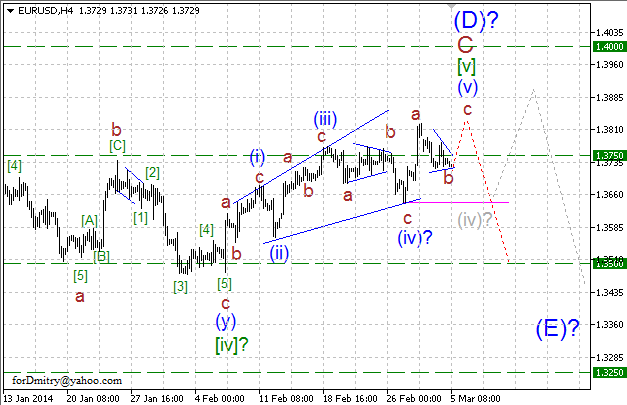
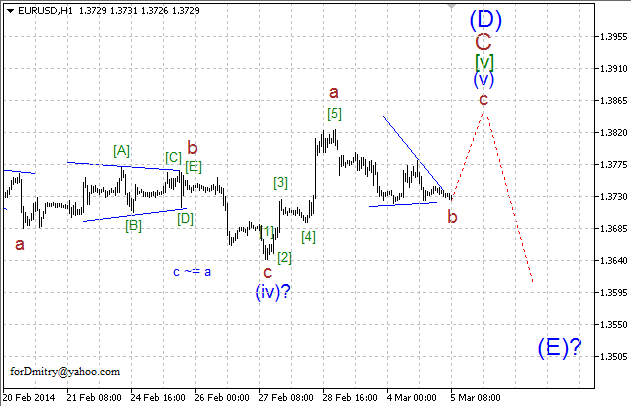
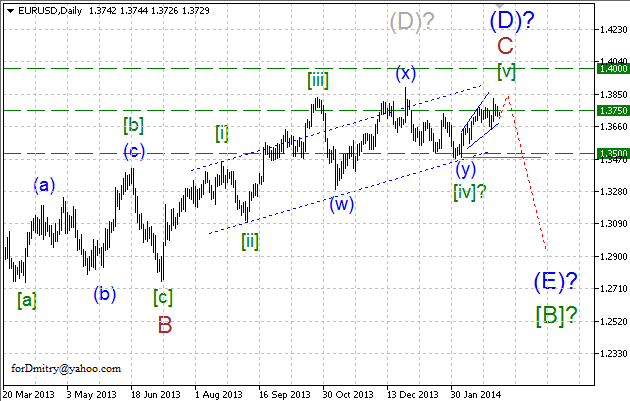
EUR USD, “Euro vs US Dollar”

Probably, Euro is completing ascending zigzag (D) of [B]. In this case, later price is expected to form final descending zigzag (E) of [B].

Probably, price is finishing ascending zigzag (v) of [v] of C of (D), which may be followed by final descending zigzag (E).

Possibly, pair is completing final ascending zigzag (v) of [v] of C, which may be followed by descending zigzag (E).

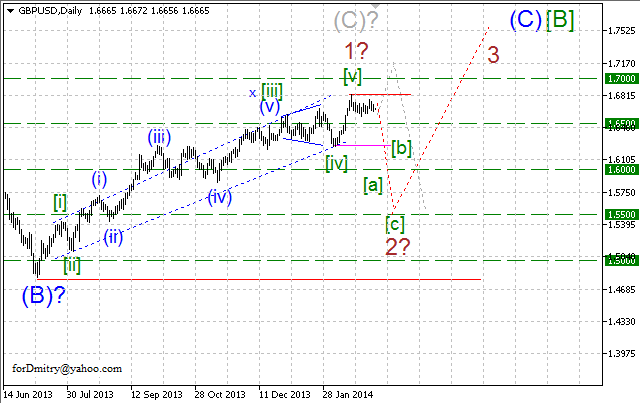
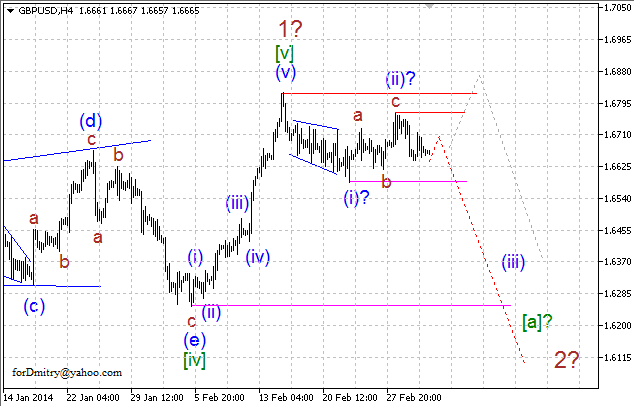
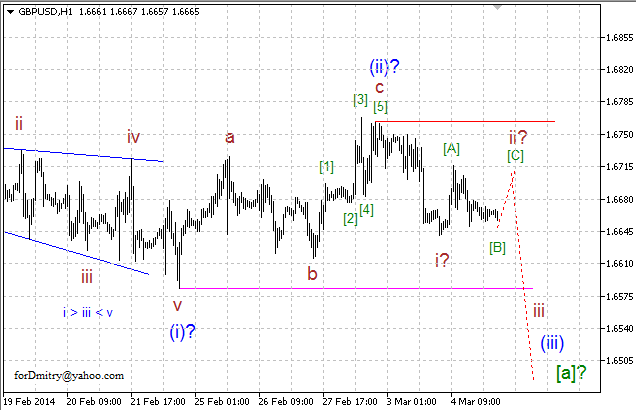
GBP USD, “Great Britain Pound vs US Dollar”

Probably, pair has already completed ascending impulse 1 of (C) of [B] and started forming descending correction 2 of (C) of [B], may be in the form of zigzag. However, we should note that this assumption hasn’t been confirmed and price may yet change structure of wave 1 of (C) of [B].

Probably, pair has already completed final ascending impulse [v] of 1.  In this case, price is expected to start forming descending correction 2.

Possibly, pair completed diagonal triangle (i) of [a] of 2 of descending correction 2. Right now, price is falling down inside impulse (iii) of [a] of 2.

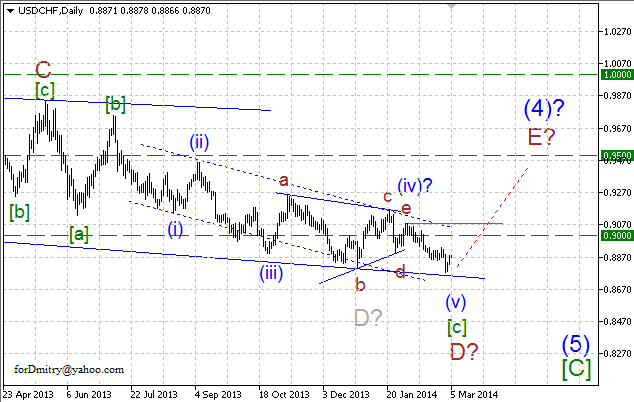
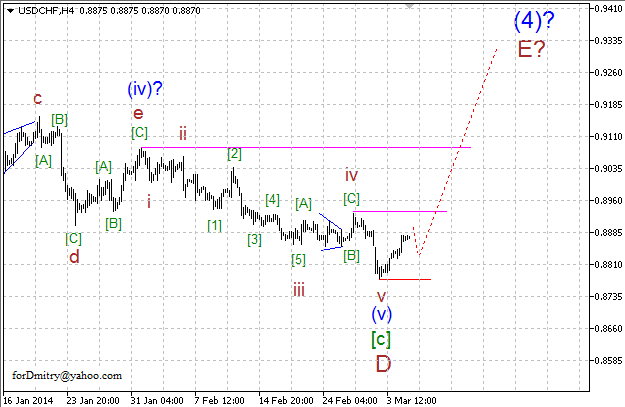
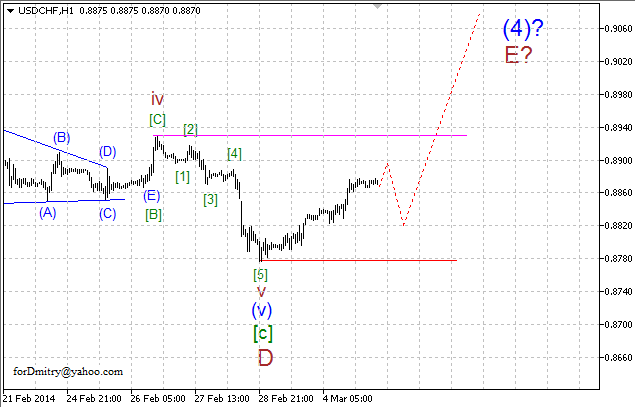
USD CHF, “US Dollar vs Swiss Franc”

Probably, Franc completed descending zigzag D of (4), which may be followed by final ascending zigzag E of (4).

Probably, price finished descending impulse (v) of [c] of D, which may be followed by final ascending wave E of (4).

Possibly, pair completed final descending impulse v of (v) of [c] of D and started ascending zigzag E of (4).

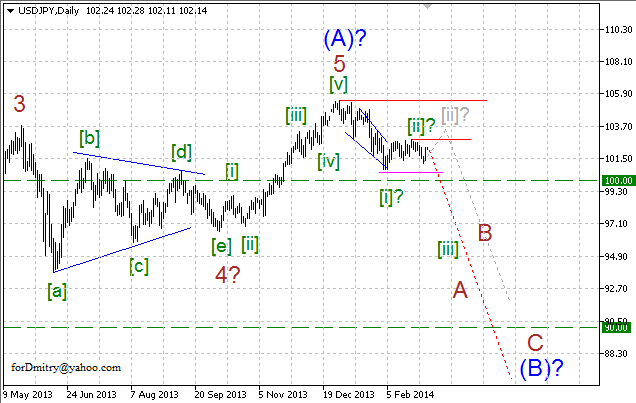
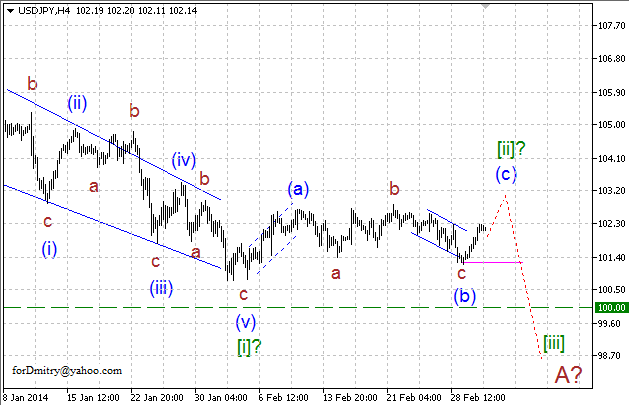
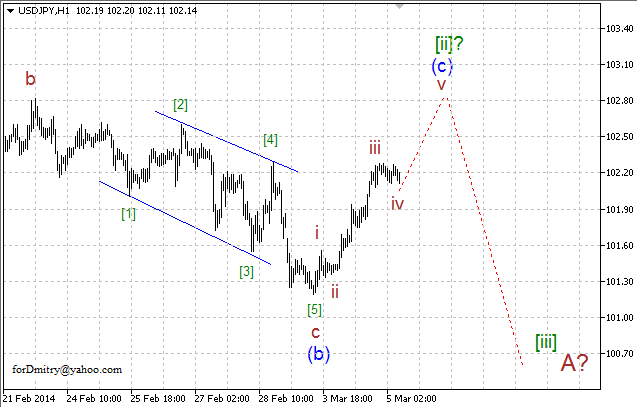
USD JPY, “US Dollar vs Japanese Yen”

Probably, Yen finished ascending impulse (A). In this case, price is expected to start large descending correction (B), may be in the form of zigzag.

Probably, pair finished diagonal triangle [i] of A of (B) of descending correction (B). Right now, price is completing ascending correction [ii] of A, which may be followed by descending impulse [iii] of A of (B).

Possibly, price is finishing ascending correction [ii], which may be followed by descending impulse [iii].

RoboForex Analytical Department

Article By RoboForex.com

Attention!
Forecasts presented in this section only reflect the author’s private opinion and should not be considered as guidance for trading. RoboForex LP bears no responsibility for trading results based on trading recommendations described in these analytical reviews.


A Hot Trend Warren Buffett Guarantees Will Continue

By WallStreetDaily.com A Hot Trend Warren Buffett Guarantees Will Continue

The National Weather Service says there’s virtually no chance the drought in California will end by spring. And yes, we should all care.

Specifically, there’s a 0.1% chance the state will receive enough rain to qualify as an “average” wet season.

But you know what else has a 0.1% chance of ever happening? You and me matching wits and investing prowess with Warren Buffett.

He’s arguably one of the best investors of all time – and as a result, one of the richest people in the world.

Of course, we’re still smart enough to learn a thing or two from him. And thankfully, he’s more than willing to teach us via his annual letter to shareholders of Berkshire Hathaway Inc. (BRK.B).

With that in mind, yesterday we began our rundown on the 10 most shocking and important revelations in his latest letter. It’s time to pick up right where we left off…

~Buffett Shocker #6: Bet on the Urge to Merge

In the last year, many of Berkshire’s subsidiaries engaged in a growth-via-acquisition strategy.

As Buffett writes, “Our many subsidiaries are regularly making bolt-on acquisitions. Last year, we contracted for 25 of these… These transactions ranged from $1.9 million to $1.1 billion in size.”

Notice the deal size? They’re all small caps.

More importantly, Buffett reveals that this urge to merge is guaranteed to continue. “Charlie and I encourage these deals… Many more of these bolt-on deals will be made in future years.”

If Buffett is encouraging and betting on more small-cap M&A activity in the future, we should, too.

~Buffett Shocker #7: Mistakes Happen, Plan Accordingly

Even the Oracle of Omaha gets it wrong!

When discussing his various investments in companies, Buffett reveals that a few “have very poor returns, a result of some serious mistakes I made in my job of capital allocation. I was not misled: I simply was wrong in my evaluation.”

Buffett also confesses that these mistakes won’t be his last: “I have not… made my last mistake in purchasing either businesses or stocks.”

The key takeaways for us?

First, plan on getting it wrong from time to time, and plan accordingly.

By that I mean, position size. As Buffett shares, his “serious mistakes” involved “relatively small” positions. Doing so is the only way to minimize the impact of our stupidity.

Second, be proactive about reducing the number of mistakes. Here, too, Buffett offers up timely advice: “Call Charlie.” That is, his partner, Charles Munger.

In other words, we shouldn’t be afraid to get a second opinion on any investments we’re considering.

And remember, as Buffett writes, “A business with terrific economics can be a bad investment if the purchase price is excessive.” So always insist on buying at attractive valuations.

Hint, these stocks don’t qualify: Tesla (TSLA), Amazon.com (AMZN), Facebook (FB), Netflix (NFLX) and Twitter (TWTR).

~Buffett Shocker #8: Live Debt-Free

Dave Ramsey is the king of encouraging debt-free living for consumers. I’m a believer, too. And so is Buffett, apparently.

He writes, “We will always maintain supreme financial strength, operating with at least $20 billion of cash equivalents and never incurring material amounts of short-term obligations.”

If we learned anything from the financial crisis, it’s that too much debt kills. Literally.

We’d be wise to mitigate that risk entirely by demonstrating some “supreme financial strength” of our own. Specifically, by paying off our debts and stockpiling some cash for emergencies (i.e., irresistible buying opportunities).

~Buffett Shocker #9: Bottom’s Up!

Too many people try to figure out what’s going on in the world before investing. Buffett offers up an alternative – ignore it!

When talking about two of his smartest investments, he writes (emphasis added), “What the economy, interest rates, or stock market might do in the years immediately following – 1987 and 1994 – was of no importance to me in making those investments… We have never foregone an attractive purchase because of the macro or political environment, or the views of other people. In fact, these subjects never come up when we make decisions.”

Put simply, bottom-up analysis is the only thing that matters over the long run. We need to spend the majority of our time on it, instead of trying to discern the direction of countless macroeconomic variables.

~Buffett Shocker #10: Mute the TV

In reference to the talking heads, Buffett writes, “When I hear TV commentators glibly opine on what the market will do next, I am reminded of Mickey Mantle’s scathing comment: ‘You don’t know how easy this game is until you get into that broadcasting booth.’”

Amen!

In turn, Buffett believes that listening to the predictions emanating from the boob tube is a “waste of time.” So mute CNBC – until Buffett, and occasionally yours truly, comes on, of course. (All right, at least when he comes on.)

If you’re even more courageous, go ahead and cancel your cable service completely.

That’s it for today. Rest assured, there’s much more wisdom to be gleaned from Buffett’s letter to shareholders. If you haven’t already, I encourage you to read it in its entirety. Afterwards, don’t be afraid to let us know what you found the most shocking, insightful, or useful by clicking here.

Ahead of the tape,

Louis Basenese

The post A Hot Trend Warren Buffett Guarantees Will Continue appeared first on Wall Street Daily.

Article By WallStreetDaily.com

Original Article: A Hot Trend Warren Buffett Guarantees Will Continue